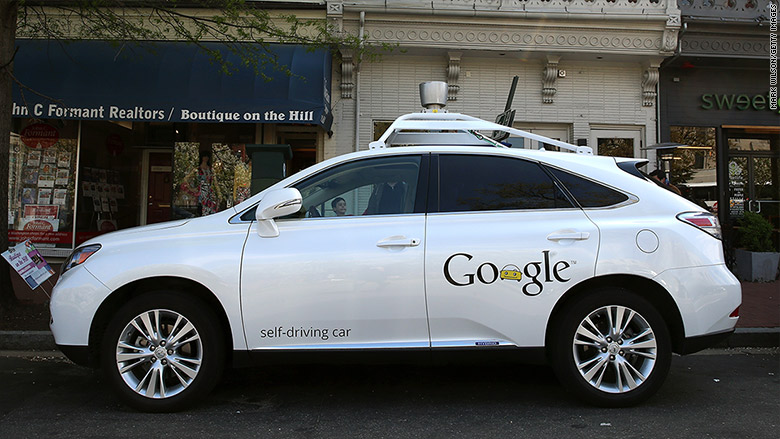
Google self-driving car
Google is having some technical difficulties with its driverless cars.
Or perhaps they’re having human difficulties?
Okay, here’s the story: according to a University of Michigan study, self-driving cars are getting into twice as many accidents as human drivers. None of the accidents so far have been serious ones. What’s happening is that human drivers are crashing into self-driving cars, mostly in low-speed rear-end collisions.
It seems that the driverless cars are too scrupulous in obeying traffic laws, and too quick to slow down or stop when there might be a problem, such as a pedestrian who might step into the street. Human drivers, on the other hand, are less finicky about the rules of the road. Humans expect other drivers to be more aggressive. They crash into the driverless cars precisely because self-driving cars don’t act like the average human driver.
You can read all about it in this article from msn.com: “Humans are slamming into driverless cars, exposing key flaw.”
So it’s all the fault of the human drivers, right?
Well, Google and other self-driving car makers can rightfully claim that their cars are not legally at fault when they get into accidents. After all, they are programmed to scrupulously obey the law. It’s the human drivers crunching into them who aren’t obeying the law—or are just not driving as attentively as they should be.
But there’s more to it than that.
Driving is a social game
In the very act of designing and programming its cars, Google and other self-driving car makers are learning by experience that there’s a lot more to driving than following the traffic laws.
As Dmitri Dolgov, principal engineer of Google’s self-driving car program, says, “Driving is a social game.”
The rules of the road are an important player in that game. But an even more important player is the other drivers on the road, and their psychology. A good driver is not merely one that knows the traffic laws well and follows them diligently. As virtuous as that may be, a good driver is also one who adapts and adjusts to the other drivers on the road in order to get everyone from point A to point B safely.
For example, if the speed limit is 65 mph, but almost everyone on the road is going 70-75 mph, driving 65 is not necessarily the best and safest thing to do. A slower driver—even one who’s actually driving the speed limit—causes cars to bunch up behind it. That makes accidents more likely.
Of course, no one would get ticketed for driving the speed limit. Technically, it’s all those evil speeders who are causing the accidents.
And yet . . . sometimes “going with the flow” actually is the right thing to do for everyone’s safety.
You see, there are the rules of the road, and then there is the way people actually drive.
People are not robots. We don’t just do what we’re programmed to do. Quite often we know very well what we’re supposed to do, and we simply don’t do it. The ability to make personal and moral decisions about when we will and won’t follow the law is precisely what makes us human.
When we’re out on the road, this human reality comes into full force. Since everyone on the road (except motorcyclists) is encased in a big steel and glass box, it’s easy to think of those other big, moving things on the road as just vehicles, forgetting that there are human beings inside of them.
And within the perceived safety of their steel and glass boxes, drivers’ varying characters and personalities tend to come out. Some people are thoughtful and respectful, and drive as if they’re saying, “After you, my friend.” Other people are self-absorbed and aggressive, and drive as if they’re shouting, “Get out of my way now or I’ll hurt you!”
Human drivers must continually assess the character and personality of the other drivers on the road, as expressed in their driving. And when another driver does something unexpected and dangerous, human drivers must make split-second decisions about how to react and what to do.
Humans will make those decisions based not solely on safety and the law, but also on their own character, personality, and values in the context of the particular situation they’re in. Some will think only of saving their own skin. Others will do their best to save the life and limb of others, sometimes even at the expense of their own.
To use an example from the MSN article, would you sacrifice your life by swerving off a cliff to avoid killing a school bus full of children? Do you want your robotic car to make that life-or-death decision for you?
This is all part of the social game of driving. Traffic laws exist in connection with—and often in tension with—that very human social game.
Traffic laws are made to keep people safe
Why do we make traffic laws in the first place?
The purpose of traffic laws is to keep people safe on the road, and get them from point A to point B in the most efficient and safe way possible.
If there were no stop signs or stoplights, together with laws requiring drivers to stop at them, every busy intersection would be a messy free-for-all. Traffic would quickly get snarled up, and accidents would proliferate. Stop signs and stoplights are meant both to keep people safe and to get traffic flowing through intersections as efficiently as possible given that there are many different drivers going in many different directions.
So the letter of the law is that drivers must stop at stop signs and at red lights.
But the spirit of the law—the reason the law was passed in the first place—is to get the mass of drivers to their destinations as safely and efficiently as possible.
What happens when the letter of the law violates the spirit of the law?
- What if you’re merging onto the highway, and everyone is flying by at 75 mph in a 65 mph zone? Does it get the mass of drivers safely and efficiently to their destination if you merge onto the highway at 65, and cause a pile-up in the process?
- What if you’re stopped at a red light, and an ambulance comes up behind you, lights flashing and siren blaring? Should you obey the red light and sit there blocking the ambulance, even though all of the cross-traffic has stopped to let it pass? That ambulance must get to its destination as quickly as possible!
- What if you’re driving down a two lane highway and an oncoming car suddenly veers into your lane? Should you really obey the law and carefully avoid crossing over the double yellow line, even if it means getting into a head-on collision?
Whether a traffic problem that a human driver is facing is caused by other humans breaking the law, or by emergency vehicles, or even by another driver having a sudden heart attack and losing control of the vehicle, acting in order to not get into an accident and in order to get people to where they’re going safely is more important than following a specific traffic law in a specific situation.
In other words, where there is a conflict between the letter of the law and the spirit of the law, we should act in such a way as to accomplish what the law was meant to accomplish—even if that means technically breaking the law.
Self-driving car makers are going to be tearing their hair out over that one for many years to come. While many, if not most ordinary situations on the road can be dealt with by following the traffic laws, quite often something like human judgment is required. And that’s not an easy thing to program into a robot.
Laws were made for human beings, not human beings for laws
Okay, that’s an obvious steal from Jesus, who, when asked by the Pharisees why his disciples broke the Sabbath laws by picking grain on the Sabbath, famously said:
The Sabbath was made for humankind, and not humankind for the Sabbath. (Mark 2:27)
We humans do our best (sometimes . . .) to pass laws that will protect us from one another and ensure a reasonable level of justice and fair-dealing in human society.
And though there certainly is some divine inspiration behind our many religious laws, including those in the Bible, even they must be accommodated to fallen and imperfect human beings. There are many laws in the Bible that we no longer follow because we recognize that the social conditions for which those laws were given no longer exist in today’s society.
So when we look at laws, whether secular or religious, we must ask ourselves the question: Why were these laws enacted? What good things were they intended to accomplish? What bad things were they meant to avoid?
When we consider whether to keep, bend, or break a particular law, we have to ask ourselves the same question: Will obeying this law right now accomplish what the law was intended to accomplish? If the answer in a particular situation is “no,” then keeping the letter of the law would mean breaking the spirit of the law.
Now, none of this should be taken as a license to go around breaking any laws we please.
Yes, there are plenty of bad laws in our world. But for those of us who live in fairly decent civil societies, most of the ordinary laws we deal with in the course of our daily life, such as traffic laws, were passed for good reasons, and have a proven track record of keeping people safer, happier, and healthier than they otherwise would be.
Unless we have a good reason to do otherwise, the default should be to obey the law.
And yet, we are human precisely because we have the ability to evaluate laws and make a decision that in this particular situation, for the good of everyone involved, it would be better to break the letter of the law in order to keep the spirit of the law.
Driverless cars cannot make these decisions. They must be made by the human beings who program them.
And with that, we wish you happy driving and safe travels!
You may also enjoy:
- Pixar’s Movie “Inside Out”: Spiritual Takeouts
- Your Crowdsourced Mind
- Is Wealth a Blessing or a Curse?
- Tommy Gilbert: The Curse of Free Money and Easy Living
- What Does Religion Have to Do with My Profession and My Daily Work?
Share this:


Lee Woofenden is an ordained minister, writer, editor, translator, and teacher. He enjoys taking spiritual insights from the Bible and the writings of Emanuel Swedenborg and putting them into plain English as guides for everyday life.


 Spiritual Insights for Everyday Life
Hi Lee,
I just wanted to get your thoughts on some ideas that I hear being pushed in the materialist / Transhumanist community. Like, experiences of people have in a comatose state like for example Anastasia or someone in a headlock that is put to sleep? And also having technology that would cause people to stop making decisions and act individually/ our conscious awareness? Like I remember people saying that “we humans are already turning into technological organisms” so eventually computer and machines will control the human body and mind. People always use the movie “The Matrix” to say that we are already enslaved but we don’t know it. (I remember hearing Elon Musk say that the chances we are not living in a Matrix is a trillion to one chance. Something like that, so in other words we are living in a Matrix) Also materialist say “all science fiction things will eventually become reality that we never thought were possible” like tapping directly into human consciousness and that “there is no God but we are all gods”. ?
And sorta on the same topic I remember hearing about people being frozen to be brought back. Even though when people are frozen and become unthawed they immediately start to decompose but what are your thoughts on this as well? Like ideas like being shot off into space, being frozen, to Cryogenics to people saying “Okay, well, if we can’t do our whole body, “well, we’ll just sever our heads and… and that’ll do it. “They can clone us when we get back.”? Like how can you clone yourself and your soul be in it?
Also would this mean that if you’re in heaven and all of a sudden you’re back on earth now because your body was revived?
What are your thoughts on these things and will it have any effect on our spiritual life and God?
Thank you kindly Lee
Hi Sam,
Not everything we can imagine, and write science fiction novels and movies about, is possible in physical reality.
For example, in science fiction there can be giant ants rampaging through towns and cities. In real life, scale matters. If you were to increase the size of an ant 100x, it would not be able to support its own weight. Actual animals on that scale, such as elephants and dinosaurs, have big heavy legs because those big heavy legs are necessary to support the animal’s weight at that scale. An ant can lift something like ten times its own weight. That’s because of its tiny scale. If it were as big as an elephant, it couldn’t even support its own weight, let alone lift ten times its weight.
It’s fun to have flights of fancy about all the amazing things that could happen based on what we imagine and portray in science fiction and fantasy. But books and movies can bend the laws of physics and biology. Reality can’t.
Another example: Contemporary movies and video games commonly make male and female characters equal in physical strength and power. Slim and beautiful female heroines effortlessly beat up whole gangs of evil male ninjas and save the day! But when actual females are put into the ring with actual males, the outcome is very different. Even highly trained female fighters get badly beaten by average male fighters. An athletic female body just isn’t anywhere near as strong as an athletic male body. That’s why we have separate sports for men and women.
Once again, we can imagine many things that just don’t work in physical reality.
The same is true of many things that these transhumanists imagine. Sentient computers will not take over from humans (see: “Are We Headed for an AI Apocalypse?”). And we are not living in the Matrix. Elon Musk is a very smart guy. I love what he’s doing with self-driving electric cars and with rockets, not to mention Neuralink. But on some subjects he’s just plain wrong. “The Matrix” was a metaphor for people allowing themselves to be taken over by technology, and submerging their humanity in the process. But that’s about our fears as a society, not about reality. The whole idea that the machines would keep humans as batteries to power their civilization is silly. Humans are not good batteries. We consume far more energy than we put out. If AI is that unintelligent and inefficient about how to power itself, then we have nothing to fear from AI! 😀
As I say in the linked article about the AI Apocalypse, computers will not become conscious and take over because consciousness is not a function of physical matter. It is a function of spiritual life. And machines do not have spirits.
Even some materialists don’t believe computers will ever become sentient because, they say, it took billions of years for biological organisms to develop intelligence and sentience, and this happened in the context of evolutionary pressures in which intelligence and sentience gave great advantages over simpler organisms that lack sentience and intelligence. Computers are not in a competitive evolutionary environment. Humans build them, and they do what they’re built to do. There is no reason or drive for them to develop sentience.
By the same token, computers and technology will not be able to literally take over the human mind because they are on a distinctly lower level than the human mind. They are created by human beings, they are lesser than human beings, and they will never be able to surpass their creators, any more than we humans could ever surpass God. Computers can do various low-level intellectual functions faster than humans. But when it comes to higher level capabilities such as creativity, humans will always be the leaders, and computers—including computers using AI—will always be the followers.
Speaking of Musk and self-driving cars, the big advancement in Tesla’s self-driving software came from training it on millions of hours of humans driving cars. Just trying to program driving into a computer wasn’t making it. There were too many “edge cases” that the programmers just couldn’t program them all in. Finally Tesla gave up trying to hand code instructions, and had their AI computers train based on recordings of human drivers. That’s when the self-driving software suddenly took a huge leap in natural and capable driving.
I can imagine that in the future there will be millions of jobs for human beings to be intensively recorded doing various tasks in order to train computers to do those tasks. This will likely be the best way to train computers.
Also, ever since machines were first invented the doomers have been saying that they will take away all our jobs and we’ll end out falling into poverty. Instead, the exact opposite has happened. Every time we’ve made a great advance in technology, it has created more jobs and more wealth, not fewer jobs. It has simply taken over the really boring and dangerous jobs, freeing up humans to do higher level jobs. The overall effect has been to raise the standard of living for everyone—except where bad government prevents this from happening.
And no, we are not “gods” in a literal sense either, though figuratively we can be. Even Jesus quoted the Psalm where it says, “You are gods” (see Psalm 82:6; John 10:34). He didn’t mean that we are literally gods. But that would be a subject for an entire post. Basically, it means that we are powerful creatures. (But not powerful compared to the actual God.)
Musk’s Neuralink is working on being able to connect human consciousness directly to computers. But it is still human consciousness that will be in control, not the computers that Neuralink connects them to. We’re already connected to computers. It’s just that so far it’s through our eyes, ears, hands, and so on. Hooking computers more directly to our brain will simply make our interaction with computers more efficient. Other than that, it really doesn’t change anything in the relationship between humans and computers. Humans are the masters. Computers serve us. That’s how it will always be, because that’s what we’ve made computers to do.
The first human subject to have a Neuralink device implanted in his brain spends a lot of time using it to play video games. Given that he’s a quadriplegic and can’t work, he’s having a blast! Eventually, once Neuralink is tested and developed, and the bugs worked out, he and others will likely be able to start using it to do actual useful work via the interface from their brain to a computer. And that will be a massive step forward for people whose lives are very hemmed in and constrained by their physical handicaps.
There’s a whole lot of hype about “the dangers of AI.” But really, any danger is in the humans that use AI for nefarious purposes, such as creating deepfake nudes of Taylor Swift. The AI itself just does what it’s told. It’s a tool in the hands of the humans who are creating it and using it. And it is a very powerful tool. It can do boring, repetitive tasks that for humans are pure drudgery. It can analyze huge masses of data that would take humans decades or even centuries to analyze, and provide useful data that helps us to make discoveries and accomplish tasks that we couldn’t otherwise do.
In that, AI is no different than computers themselves, which do all sorts of intellectual grunt work for us, and make it possible for us to accomplish far more than we otherwise could. All the fear of AI becoming sentient and taking over is completely overblown. It’s not going to happen. However, we do have to deal with bad human actors who will use this powerful tool for destructive purposes. The solution is not to hamstring the technology, which would also take away our ability to accomplish great good with it. The solution is to prosecute people (and companies) who use it for bad purposes.
Meanwhile, on the positive side, AI is going to revolutionize human life in a good way. Neuralink making it possible for a quadriplegic to use a computer with his brain is a huge advance over what he used to have to do: use a mouth stick to poke the keyboard or draw on the screen. All the people who fear the machines taking over should instead focus on the wonderful things machines have already made it possible for us to do that we couldn’t do before, and all the even more wonderful things they will make it possible for us to do in the future.
Hi Sam,
About cryogenically freezing ourselves and reviving ourselves later:
I doubt we’ll ever get beyond what you mention: “Even though when people are frozen and become unthawed they immediately start to decompose.” Some worms and fish can freeze and thaw, and remain alive. But I don’t think that will ever work with the human body.
Even if it did, only materialists would think that’s a good thing. If in reality we don’t die, but move on to the spiritual world, keeping our soul tethered to our body would only cause us to linger in limbo for years or centuries waiting for our body’s eventual death. Or as you suggest, it would suck us back into our physical body after we’ve already been living a much better life in the spiritual world. It would be like being sent back to prison after we’ve been freed and have lived on the outside for decades.
But . . . I don’t think it’s ever going to happen in reality. Nor do I think that we’ll ever be able to eliminate physical death and live forever. And once again, if we did that, it would only doom these people to spend centuries in a much darker world than they would otherwise be in. So let ’em try if they want to. They’re only hurting themselves.
Hi Sam,
Oh, and even animals that can freeze and thaw, and remain alive, still have a lifespan. Eventually they do die.
Hi Sam,
About cloning humans:
If this ever happens—which it might—the cloned human would have its own distinct soul and consciousness. It would not be a continuation of the soul or consciousness of the person who was cloned. A clone would be an entirely new human being, only produced in a different way than the usual form of mammalian reproduction.
The clone would also not be exactly like the person who was cloned, any more than identical twins are exact matches for each other. There are subtle, and sometimes not so subtle, differences that people who know them well can use to tell them apart. Our DNA is not the only thing that determines who and what we are.
Hi Lee,
Thank you very kindly for all the in depth clarification on these subjects and how all these things have no worries on spiritual or Divine reality! And not to mention our free will and the rest. What you wrote cleared up the questions I have always heard about throughout the years!
My only follow up question would be when you said “Musk’s Neuralink is working on being able to connect human consciousness directly to computers.” Consciousness is spiritual and Neuralink is material so it would be the brain that is the direct link not consciousness itself since the brain is a tool for our spirit and adding neuralink like you said would just be another added tool?
Thank you kindly Lee
Hi Sam,
Haha! You got me! Yes, even Neuralink is not really connecting consciousness directly to a computer. It’s connecting the brain to a computer, and consciousness is working through the brain and the Neuralink device to control the computer. Yes, Neuralink is just another tool to help people do the things they want to do.
Hi Lee,
Haha! Well I know a really fantastic website called leewoof.org that I learned all about how consciousness is spiritual … haha jk!
But thank you for further the clarification on how it all works! All these subjects can make my head spin!