Right after Jesus was baptized, he went out into the desert, fasted for forty days, and was tempted by the Devil (Matthew 4:1–11; Mark 1:9–13; Luke 4:1–13). In these temptations, the Devil tried to get Jesus to act wrongly. It was after this that Jesus began his public ministry.
During his public ministry, which lasted for about three years, Jesus was continually challenged and tested by the religious authorities of the day. They attempted to trip him up intellectually, accusing him of being a false teacher.
Just before his work here on earth was finished, Jesus went through a far more severe testing of his soul in the garden of Gethsemane (Matthew 26:36–46; Mark 14:32–42; Luke 22:39–46). This temptation brought him to the point of despair. On the Cross, he cried out, “My God, my God, why have you forsaken me?” (Matthew 27:46; Mark 15:34).
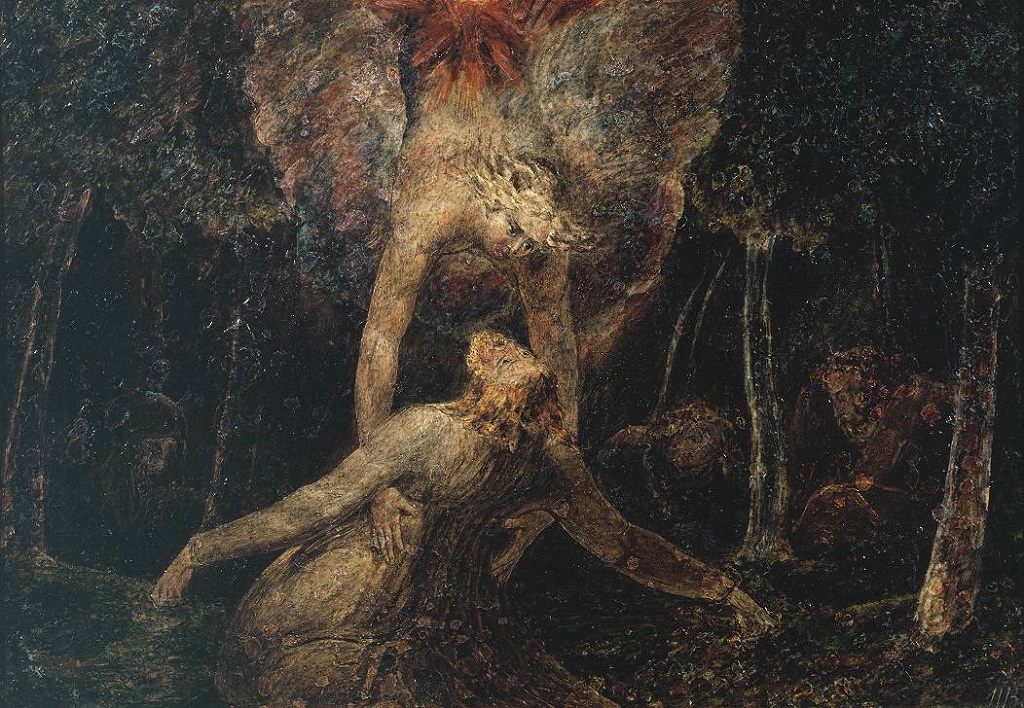
The Agony in the Garden, by William Blake (1757–1827)
These three kinds of temptations that the Lord went through during his life on earth correspond to the three basic parts of us as human beings, popularly known as hands, head, and heart. There are:
- Temptations in behavior
- Temptations in the realm of ideas
- Temptations of the heart and soul
What are these temptations? How do we experience them in our life? What are they leading to?
Temptations in behavior
Temptations in behavior are the usual sort that everyone faces. “I know it’s wrong to steal, but that candy sure looks good, and I don’t have any money in my pocket.” And so on. These are temptations to do something that we know is wrong, but that we really want to do because of the pleasure or advantage it will give us. Of course, it gets far worse than stealing some tasty-looking candy.
Before we can make it any farther on the path of regeneration (a fancy word for being “born again”), we must beat back these basic temptations toward bad behavior. As long as we are doing what is wrong with our hands, feet, and mouth, we are stuck on the lowest tier. Getting our outward behavior in check so that we are not breaking the basic laws of the Ten Commandments is the first step of regeneration.
Temptations in the realm of ideas
Let’s say we’ve gotten our basic behavior in order so that we’re decent, respectable people. We have a job, and we do a good job of it because that’s what you’re supposed to do. Life is good! Everything seems fine.
But so far we’ve only scratched the surface in the lifelong process of being born again. What we will face next is temptations in the realm of ideas. Our beliefs about the meaning of life will be severely tested.
Often this takes the form of a midlife crisis. Suddenly we start wondering why we’re even doing all this. Maybe, by keeping our nose clean and being a good doobie, we’re missing all the fun and excitement of life. Maybe I could have so much more! Maybe my life could be really great! And what, really, is the purpose of life? What’s the point of it all?
There is a battle of ideas and perspectives in our mind. All different philosophies of life vie for our attention. Some assure us that we are gods! We should be the rulers, not the ruled! Others tell us that if we follow certain secret techniques that nobody knows,TM all the things we desire will magically fall into our lap! And so on.
It is still a battle of good vs. evil, of selfishness vs. selflessness. But now it’s an intellectual battle. Like the earlier choices we made when we were on the behavioral level of temptation, the choices we make in these spiritual struggles will also affect our behavior. But this time it is a battle for control of our thinking mind. Whatever belief or philosophy we ultimately settle on, whether good or bad, that’s what will take control of our mind, and that’s what will direct our hands, feet, and mouth to do its bidding from then on.
Victory in the spiritual battle
Let’s say we’re victorious in this battle. We vanquish the appealing-sounding philosophies that are really all about how I’m better and smarter than they are, deserve more, and can get more if I just follow this little-known secret path—or if I’m just plain Machiavellian in my plans and machinations. We’ve chosen instead to follow the high road of loving our neighbor as ourselves, and directing our life by a philosophy of doing what is good for everyone, not just what’s good for ourselves.
This brings us to the next level, which is the level that Emanuel Swedenborg (1688–1772) calls “spiritual.” This in contrast to the “earthly” level below it (the behavioral level), and to the “heavenly” (heart-driven) level above it. If we progress to this second, spiritual stage of regeneration, then after we die we will live in the middle or spiritual heaven, whereas if we remain on the level of “good behavior because that’s what God commands me to do,” then we’ll live in the lowest or earthly heaven. Either way, we will have a very happy life in heaven!
But this level of choosing to live by right principles for the good of other people and society is not the final stage of spiritual rebirth. And as hard as the intellectual battle to overcome all those competing, but essentially self-centered and worldly philosophies of life was, what’s still ahead of us, if we continue on the path, is far deeper, more difficult, and more painful.
Temptations of the heart and soul
That’s because what’s left is temptations of the heart and soul. These are not about doing good vs. doing evil, as in the first stage. They’re not even about getting our head on straight and living from good, correct, and spiritual principles. No, these temptations are about our fundamental character and motives.
My late uncle, the Rev. Dr. George F. Dole, used to tell a story from his many years as a Pastor. One Sunday one of the quintessential sweet old ladies of his church came to him after the service. Heaving a heavy sigh, she said, “You know, Rev. Dole, I’ve come to realize that I’m just not a very good person.”
That’s where people get when they are engaging with the deepest and most difficult of temptations, which are temptations of the heart.
After having lived a life of putting our behavioral house in order, living by right principles, and devoting ourselves to loving our neighbor as ourselves, the final and deepest level of our character is opened up. This is the natural and fundamental self-centeredness of the human heart. Underneath it all, we want something for ourselves. We even fight the good fight because we expect a reward in heaven.
When we realize that underneath it all, we’re still just miserable, selfish people, that’s when we come into our deepest temptations. These involve, not an intellectual battle, but a sense of despair right at the core of our being. Not despair about losing worldly goods or reputation or anything like that. Despair over our own basic salvageability. Perhaps we’re too rotten to the core to ever be anything good. Perhaps there’s no hope for us. Perhaps, despite all our efforts to be good, we’re just doomed.
Letting go and letting God
We cannot win these temptations on our own. The whole point of these temptations is to bring us to the point of letting go of control of our own life, and handing it over to God.
In these temptations of the heart and soul, a distant, unknowable, impersonal God just won’t do. If we’re going to hand our life over to God at this deep level, we must know God as a personal and very present friend, and a strong shoulder to lean on. In Christian terms, we must know, not just “God up above,” but “God with us” (Matthew 1:23), who is the Lord Jesus Christ.
Only when we are ready to let go of our own life and hand it over to the Lord Jesus can we be victorious in these temptations.
And we’re not even the ones who are victorious. It is the Lord doing the fighting for us and giving us the victory.
When we were victorious in our earlier temptations, we thought of it as our own accomplishment. Through the power of our own will we beat our bad habits! We used the power of our own mind to learn, adopt, and follow a right philosophy of life!
In these final temptations of the heart and soul, we recognize the truth that on our own, we are nothing but evil, miserable, selfish, greedy creatures. We recognize, just as Jesus said in Mark 10:18, that only God is good. We realize that we are good only if the Lord is working in us, giving us all the love and understanding and compassion that we have. None of it is our own. All of it is the God’s.
Despair and the fear of letting go
In these temptations, we reach the point of despair. It feels to us as if everything is lost. If, at that point, we do what Job’s wife urged him to do, “curse God and die” (Job 2:9), then we have been defeated, and our life will be very bleak indeed.
But if even when it seems that all is lost, and there is nothing good left for us, we still refuse to get angry and lash out at other people and at God; if we continue to live from love and understanding when there is nothing left in it for us, then we have overcome, not by our own power, but by the Lord’s power working in us.
When he was on the cross Jesus said, “My God, my God, why have you forsaken me?” This is the same feeling of despair that we reach in our final and deepest temptations—though Jesus felt it infinitely deeper than we ever will.
He was, of course, quoting the first line of Psalm 22. That Psalm metaphorically tells the story of these deepest temptations, and of victory in them through the Lord’s power.
But Jesus was also feeling the sense of hopelessness and abandonment expressed in the first line of that Psalm. And in his despair over whether he would be able to achieve his great mission of saving the human race, he reached out to God. “Father, into your hands I commend my spirit,” he said (Luke 23:46). Only by giving his will over to the will of the Father—which was his own inner divine soul—could he be victorious in his final and greatest temptation.
Most people on this earth simply aren’t prepared to let go of their control of their own life in this way. They will hold onto some sense of ego. They will hold onto some sense of personal goodness and rightness. They will feel that if they let go of that, there will be nothing left of them, and nothing left of life. This means they will progress no farther than the middle, spiritual level of regeneration. They will be good and principled people. But there will still be some element of ego in it. Taking the final step of “commending their spirit into God’s hands” they just can’t do. This involves a loss of personal control, which we greatly fear.
Powerful innocence
But for those who do take that final step, on the other side is the beginning of true heavenly innocence. It is an innocence in which we are willing to be led by the Lord like sheep, or like little children. This is how the angels of the third and highest heaven live. They do not attribute anything to themselves. They don’t put on any airs or think that they are good or wise. They know in their soul that only God is good, and that they have the joy of heaven only by the grace God.
Because of their innocence, from a distance angels of the highest heaven look like little children, though up close they look like adults. They have the childlike innocence of wanting to be led by the Lord every day, and every moment.
This also gives them the innocence of being the most harmless of angels in the sense that they never do any harm to anyone. But they are also the most powerful of the angels because they are the ones who are closest to God. They are the ones who put up the least internal resistance to God’s power flowing into them and through them. As a result, they are far more powerful than the angels of the lower levels of heaven, and vastly more powerful than whole legions of evil spirits. But if you ask them, they will tell you that they have no power at all. They will say that all the power is the Lord’s.
People and angels who have regenerated to this level can be in the midst of the worst human pain and misery, and be nothing but a good and healing presence. They can be in the presence of the worst, most selfish, destructive, and criminal person, and feel no hate or anger, but only love for that person. Not that they are deceived about his or her true nature, its destructiveness, and the need to restrain him or her. But they know that “There, but for the grace of God, go I.” They’ve seen into their own heart of evil. They have no illusions. They know very well that “the heart is deceitful above all things, and desperately wicked” (Jeremiah 17:9). And like God, they have nothing but love and compassion for every living being—even the worst demons in the lowest levels of hell.
The road very little traveled
Very few people will attain this level of deep and heartfelt love and compassion for all beings, both good and evil. Arriving there requires going through all three levels of regeneration, and reaching the point where God is everything, and we ourselves are nothing. It requires facing the despair of seeing the true nature of the human heart, of our own heart, releasing control of it, and giving our life over entirely to God.
These temptations of the heart and soul are the deepest temptations we face, in the final stages of regeneration. Most people would simply fold if they were faced with these depths of evil and despair within their own heart. That’s why God doesn’t even open up these depths for them. God does not allow them to face this kind of harrowing of the soul.
These temptations of the heart and soul are even possible only after we have gone through the two earlier two stages of getting our behavior, and then our principles of life, in order. Many people will stop at that point, and go no further.
Only if we continue on, walking through the valley of the valley of shadow of death, entrusting our life to the hands of the Lord, our shepherd (Psalm 23), will we emerge on the other side. And when we do, we will be lifted by the Lord up into the heaven of innocence, which is the highest and inmost heaven. This is the heaven where God’s love reigns, and everything else flows from it.
(Note: This post is an edited and expanded version of a response to a reader named K. You can read the original question, which was a follow-up to an earlier discussion, and my original response, here.)
For further reading:
- Is it Easy or Hard to Get to Heaven?
- What does Jesus Mean when He Says we Must be Born Again?
- Heaven, Regeneration, and the Meaning of Life on Earth
- Why Is Life So Hard? Why are there So Many Struggles?
- What does it Mean to be Baptized with Water, the Holy Spirit, and Fire?
Share this:


Lee Woofenden is an ordained minister, writer, editor, translator, and teacher. He enjoys taking spiritual insights from the Bible and the writings of Emanuel Swedenborg and putting them into plain English as guides for everyday life.



 Spiritual Insights for Everyday Life
Thankyou for this sermon. There is so much truth in it.
Hi Cindy,
Thanks for stopping by, and for you comment. I’m glad you found the article helpful.
Godspeed on you spiritual journey!
How does one give the reins of life over to God? Is it a willingness to be led by Him? And how is one willingly led by God if one lacks any known special ability to receive any revelation?
Does wanting good done and doing good (knowing one does good rather than is good) count as willing to be led by God?
Or do people who finish regeneration gain the special ability to receive revelation?
Hi K,
Here on earth, for most people, being led by God means being led by a conscience formed based on written revelation: the Bible for Christians, and also Swedenborg’s writings for Swedenborgians, and other sacred books for people of other religions, and also based on teaching and guidance from parents, teachers, ministers, and so on, which originally derives from revelation also. Very few people here on earth have a direct conscious relationship with God of a type that would make it possible to receive personal revelation and guidance from God. What we have instead is the aforementioned conscience, through which God directs us to avoid what is evil and do what is good instead.
This continues in the afterlife, but angels who think more deeply, and especially angels of the highest heaven, can also receive guidance and answers directly from God. This comes up several times in Swedenborg’s stories from the spiritual world, in which one or more angels look toward the Lord to receive answers to a question. How exactly this works he doesn’t say. But in heaven, it is much more common for people to be able to receive direct revelation from God.
According to Swedenborg, in ancient times heads of household, especially, commonly had a direct link to heaven, and received revelation from God via the angels of heaven, which they then passed on to their family and clan. This is a frequent occurrence in the Old Testament. This would be possible today also, not to mention receiving revelation directly from the Lord (meaning Jesus, who is God’s personal presence with us), but it happens only for a few people because most people are too materialistic or too focused on this world to have that kind of direct connection to God and heaven.
So the short answer for practical purposes is: Follow your conscience. In doing so, you are following God.
So a completed regeneration is to believe that one does good rather than is good, and one who follows conscience without too much resistance (no one is perfect here)?
Hi K,
I would say, does good while recognizing that it is from the Lord. Also, someone who has regenerated to the final stage will not only gladly follow conscience without any resistance at all, but will spontaneously do good from the heart, with great enjoyment. Doing anything else would be terribly unpleasant.
But even a fully regenerated person can still slip up now and then and do bad things, as no one is without sin?
Hi K,
No one is without sin, but what that really means is that everyone has sinned. Some people still do sin, but not all people do. Angels, especially the highest angels, do not sin. They act according to their conscience as a matter of course, and the highest angels do good from the heart. Sinning would be painful to them.
This doesn’t mean they’re perfect. They could still make a mistake. But making a mistake is not the same thing as sinning. Sinning is intentionally doing something that you know is wrong. Angels don’t do that, because it is contrary to their nature.
So in this life, can a man who is fully regenerated still have an out-of-character moment or slip-up in this life where he does a bad thing (perhaps due to overwhelming urges), but that is out of the ordinary for him (as he usually does not give into temptation because he wants to do good believing it is not from him)?
If a fully regenerated person never sins in this life, then there would be very few who ever fully regenerate, if any. But I imagine any evils done by a fully regenerated person would be minor stuff and no habitual nor really bad stuff.
Hi K,
Indeed, very few people today do regenerate fully. In Secrets of Heaven #13, after having given a summary of the first six of the seven stages of regeneration represented by the seven days of creation in Genesis 1, Swedenborg says:
Perhaps things have gotten slightly better in the 250 years since then, but I doubt that this has greatly changed. There just aren’t many examples of people who have fully regenerated. It’s quite possible that neither you nor I know any such people so that we could have a sense of what they are like.
Sure, it’s possible in this life that a fully regenerated person could “sip up,” because as long as we’re still living on earth, our ruling love can change, and we are also still engaging in the process of regeneration. So even someone who is on the seventh day of creation may still be engaging in mop-up operations.
However, in general, fully regenerated people do not sin. If they did, it would be a sign that they are turning back, and going evil instead of good. And if they persisted in that reversal of course, they would be in a horrendously dire and evil situation. They would be corrupting the deepest levels of their spirit, and would become devils of the lowest hell. The Lord protects against people reaching the latest stages of regeneration and then turning back by ensuring that anyone who cannot sustain those deep levels will never reach them in the first place. It would take a major act of will to reach the seventh stage, and then turn to evil.
The reason it would take a major act of will is that fully regenerated people simply have no desire to sin. They act from a heart of love for God above all, and for their neighbor more than themselves. Sinning, meaning intentionally doing something that they know is wrong, would be wildly out of character for them.
Part of the problem, I think, is that ordinary people have a skewed sense of “sin” because the “Christian” Church has cheapened much of what the Gospels say about sin into something in which if you eat a cookie when you really shouldn’t have, you have sinned and you are an evil person who will go to hell if you don’t believe in Jesus and pray to Jesus to plead for you with the Father, etc., etc., etc.
This is ridiculous. Eating a cookie when you shouldn’t have does not break the Ten Commandments, or any other commandment in the Bible. Most of the things that ordinary people think are “sins” aren’t sins at all. They are the “heavy burdens, hard to bear” that the religious authorities of today lay on people’s shoulders while being unwilling to lift a finger to bear them themselves (Matthew 23:4).
Sure, fully regenerated people might let out a cuss word or step on someone’s toe. But that’s not sinning. That’s just ordinary human frailty. God is not paying attention to whether we cuss or step on someone’s toe. God is paying attention to whether we lie, cheat, steal, kill, and so on. And people who have fully regenerated just don’t do these things, either literally or spiritually, because it would be diametrically opposed to their own character. It would also feel horrendous and painful to them.
But we’re talking about 0.00000001% of the population here. The vast bulk of people are nowhere near that. Most people, as Swedenborg said, are only at the first stage, and will just slip into the lowest levels of heaven. These people can and do sin while they’re here on earth, and they must fight the battles of temptation and repentance, because there is still plenty of evil in their heart, and falsity in their head. These are the people we see around us every day. Even the few shining examples of sterling character are probably still only in the third, fourth, or fifth stage, and maybe one in a thousand of them is at the sixth.
In other words, for all practical purposes, there just aren’t any examples of fully regenerated people here on earth for us to talk about. We can talk about them, and there may be a few in a population equivalent to one of our biggest cities, but once again, there’s a pretty good chance that neither you nor I has even met any of them so that we could see an example of what such a person is like.
So I take it that not wanting to sin maybe but slipping up from urges now and then (but wanting to stop such or not persisting in such) is possible for the (probably still rare) person who has entirely completed regeneration?
Also can someone who has fully regenerated have doubts of matters of faith or belief, while still retaining moral development? Like doubting religion in the face of seemingly overwhelming scientific evidence against the existence of the supernatural?
Hi K,
As long as we are still living in the physical body, it is possible to slip up due to physical urges and drives. Our physical body, and the body-oriented part of our mind, has a will of its own. We’re not always successful in overriding it. But in a fully regenerated person, these slip-ups would be minor, such as eating too many cookies, not major, such as lying, stealing, cheating, and so on. Only after death does our (spiritual) body come into full harmony with our spirit, and we are no longer tempted by anything that goes contrary to our ruling love.
About your second question, first of all, there really isn’t any scientific evidence at all against the existence of the supernatural, even though atheists and materialistic scientists think there is because they’ve discovered natural causes for things that were formerly attributed to supernatural causes. But thinking this disproves the supernatural is like thinking that a demonstration that the earth orbits the sun, and not the other way, disproves the existence of the sun. Just because people have superstitiously believed that thunder and lightning were the gods expressing their anger, when in fact they are electrical phenomena, that doesn’t prove that the gods don’t exist. Only that the gods are not the cause of lightning.
In general, “supernatural,” meaning spiritual, phenomena have their primary influence on the human mind and heart, not on physical objects and phenomena. But in earlier pre-scientific times, people commonly attributed material-world phenomena to spiritual and divine causes.
However, to answer your actual question, people who are fully regenerated are beyond these types of intellectual battles and doubts. They have long since resolved these issues in their own mind, and have moved on to a heart-centered life in which intellectual things are firmly in a servant role. Any ideas and insights that contribute to, support, and guide their path of loving and serving God and the neighbor, they embrace. Any that do not, they discard.
Further, they don’t have to think about some new idea, ponder it, and rationalize about it. They see immediately whether something is true or false based on whether it is good or evil in its effects. This is the type of person Jesus was talking about when he said:
The types of doubts that you are referring to could very well be a phenomenon in the second, spiritual or head-centered phase of regeneration, but not in the third, heavenly or heart-centered phase.
So a man who finished regeneration could not be faced with what he sees as overwhelming scientific evidence against the supernatural and have doubts of faith as a result? Or is such still possible?
Hi K,
I suppose someone could think there’s overwhelming scientific evidence against the supernatural even though there isn’t . . .
But it would still be largely irrelevant to someone who has reached the seventh day of regeneration (to switch over to the stages represented by the days of Creation). These people are not driven by intellectual issues. They’re driven by the heart. And they would continue to love their neighbor just as much even if the idea of and belief in God were somehow suddenly removed from their consciousness. Love is where their heart is. They’re not thinking about whether there will be pie in the sky when they die. They’re expressing that love in their lives right now. They’re already living in their heaven—or as close as it’s possible to get to it here on earth.
So in other words, truth is less important than love to a fully regenerated person?
Hi K,
I suppose you could say that for a fully regenerated person, love is more important than truth. But really, the two of them go together hand in glove. A fully regenerated person sees what is true, and what is false, immediately precisely because s/he puts love first.
I think I read in Swedenborg writings that there are angels who live on the so-called border of the innermost and middle Heaven, and sorta dwell in both. How do such angels get there?
And is it possible for an angel to live on the so-called 4 corners: on the so-called border between the middle and innermost, and also on the so-called border between the half of Heaven where there is some Divine moon and the half where there is some Divine sun?
Hi K,
In the human body, there are many parts and organs. But there are also extensive intricate sheets of fascia and membranes that both enclose the organs, protecting them from outside contamination, and separate the organs and regions of the body from one another. These fascia and membranes correspond to the people and communities of heaven that dwell in between the various regions of the universal human of heaven. They serve as a protection to the communities and regions there from outside infiltration, and also as a buffer and means of communication between the different areas of heaven. The people in these border zones don’t have the same character of the people on either side, just as the membranes that separate the heart from the lungs are neither heart tissue nor lung tissue. They are their own type of tissue different from both.
And yes, these border zones exist between most or all of the different parts and regions of heaven, just as there are fascia and membranes that separate most or all of the different parts and regions of the body. But also as with the body, this is a very complex arrangement that varies based on the particular functions and interconnections of heaven. It’s not just a simple matter of, “There are guards placed between each area of heaven and all its neighbors.” The brain, for example, has enclosing membranes, but it also sends out nerves to the entire body via the foramen magnum and the spinal cord, which provide a passage in and out of an otherwise mostly sealed brain. There are other passages in and out as well, such as the optic nerves.
So in general, yes, there are these border zones between the various parts and regions of heaven, but it is a complex and varying arrangement, not a simple one, and the people in those zones are also varied in their character based on the specific functions and interactions they are engaged in within the spiritual economy of heaven.
So if I read this article and the comments you made right, people at post-3rd level temptations can still have bad urges and slip-ups in this life, but overall they have overcome behavioral temptations, are not believing in self-centered approach to religion or philosophy, and are letting goodness (God) lead the way, knowing that one does good rather than is good?
And if I read right, level 2 temptations are about overcoming self-centered religious or philosophical ways of thinking, not necessarily believing in the right religion? Meaning that an Amish, a Buddhist, or a Catholic can reach and pass the second level of temptations?
Hi K,
As long as we’re still living on this earth, we’re still in the process of regeneration, and we can still be tempted. This involves evil spirits stirring up some remaining evil in us, which requires us to deal with it. We never fully reach post-3rd level temptation status until we enter the spiritual world. This is the seventh day of rest. Here on earth our state of rest is temporary before entering the next period of temptation. In heaven, it is a permanent state—although even there we do go through up and down cycles.
I think it’s best for us not to get complacent and think, “I’ve made it,” as long as we’re still living on this earth. I’m sure there are people who have reached the heavenly/celestial state on this earth. But they can still be tested, and it is still possible for them to fall away. The state becomes permanent and unchangeable only after death.
And yes, people of all churches and religions can have 2nd-level temptations related to the beliefs they have been taught and have adopted, and have become part of their conscience. However, it will be more difficult for people who have faulty and fallacious beliefs because those beliefs will not be as solid and reliable a guide as true and sound beliefs.
In my case, while I still doubt New Church beliefs being true, I still like New Church morality (more or less), and I still think New Church beliefs may be true (more or less) after all. So with that, do you thinkt hat spiritually I am not in the same spot as one who is definitely atheist, nor someone who outright rejects such beliefs?
Hi K,
Yes, you’re in a different category. You have what might be called “positive doubt.” I.e., you want to believe, but you’re not entirely convinced. That’s different from what might be called “negative doubt,” which is wanting to reject something, and looking for reasons to do so.
In the end, of course, what will count will be whether you live according to the New Church morality that you find good and worthy of belief and practice. And if you do live a good and moral life of care and service to your fellow human beings, whatever form that might take, then over time your positive doubts will gradually turn into a positive faith. If this doesn’t happen here on earth, then it will happen in the afterlife, where everything true is in a much clearer and brighter light.
Is it possible for someone to go through multiple levels of temptation simultaneously? Like dealing with behavioral temptations state while also dealing with philosophical temptations state? Or dealing with philosophical temptations while also the soul temptations? I think such may be possible, however rare.
Hi K,
I would say that people’s temptations will be on the level that they’ve reached spiritually, but if it’s one of the higher levels, those temptations might be prompted by or expressed in events at the lower level. Such as a man losing his job, and this thrusting him into a whole struggle with self-doubt that has nothing to do with pay, job performance, or anything on the worldly level. It simply triggered a deeper struggle within himself.
On the other hand, someone going through an inner crisis may become paralyzed and unable to continue with his or her ordinary job and tasks for a while, precipitating an outward crisis along with the inner one.
Speaking more specifically of behavioral temptations, at a low level of spiritual development a man may be physically attracted to a woman who is not his wife, and commit adultery with her. At a higher level, a man may be struggling with his very worth as a person, and whether he is even salvageable spiritually, and this may cause him to falter and become unfaithful to his wife. The outward action is the same, but one is driven by ordinary behavioral issues, whereas the other is driven by deep conflict within the man’s psyche.
So yes, temptations at different levels can occur simultaneously, but they will be driven by the level at which the person is in his or her regeneration process. Inner temptations may be acted out in behavioral ways. Despair in the heart may cause a person to doubt his or her belief system.
Even though there is doubt about New Church theology from metaphysical naturalism seemingly supported by science, and maybe the occasional objection to the theology itself, I find myself keep coming back to it so to speak, subconsciously defaulting to NC belief for how the afterlife works, more or less.
Could that mean that philosophical temptations are more or less resolved, or are almost gone in me? I don’t really buy New Age theology from an egocentric POV like I used to.
Hi K,
I have no special window into your soul. I can only respond based on your comments and questions here over time. Based on that, my sense is that indeed you are drawn to New Church theology, and find it satisfying in many ways that other beliefs systems are not, but that you are still working to resolve various issues and questions in your mind before coming to a settled belief system that either fully embraces New Church theology or constitutes a modified version that is more satisfying to you.
It does seem to me that you are making progress in this endeavor, but that you’re not quite finished studying, forming, and adopting what will become your settled belief system by which you will live your life. Some parts seem to be fairly well-established, while others are still developing. That’s all part of our process of regeneration here on earth.
As for whether your philosophical temptations are more or less resolved, I really can’t say. This will become clear to you over the coming months and years as you come to conclusions or face further intellectual struggles in forming your faith. Also, from time to time life events can and do introduce whole new areas of struggle and temptation—and that’s not something that can be accurately predicted.
So someone going to the outermost Heaven would be someone focused on rules, while those going to the more innermost Heavens are focused on motives?
Hi K,
Yes, that would be one way of putting it, though for the sake of clarity I would say “right behavior” instead of “rules,” and “love” instead of “motives.” Your wording isn’t wrong, but it could be misinterpreted by, say, thinking that the angels in the outermost heaven are rule-bound and hidebound, when in fact they just want to do the right thing, but may need some rules for guidance because they’re not deep thinkers.
If someone has moved on to the love or motive states from the right behavior or rules state, could one say that Matthew 22:37-40 is all they need when it comes to rules because the rest (the 10 Cs) tend to fall into place?
(or at least all they really or normally need that is)
Hi K,
Yes. Paul said so two thousand years ago:
And:
This does not mean, as some have suggested, that people who love their neighbor as themselves do not have to keep the commandments. It means that such people will keep the commandments because they love their neighbor as themselves.
So if I understand right, the final level of temptations is letting go of resisting God leading the way, or understanding that God knows best?
Hi K,
I would say that this is one element of the final level of temptations. One indication of this is these words in Jesus’ prayer before he was crucified—which was his final temptation: