Not long ago a reader named David submitted a Spiritual Conundrum to Spiritual Insights for Everyday Life asking about near-death experiences (NDEs), why they’re so contradictory, and whether we can trust anything near-death experiencers (NDEers) say. He is also struggling with hellish NDEs. Is hell really the horrible, hopeless place described in some NDEs and in traditional Christian literature? Doesn’t this contradict how Swedenborg describes hell? David is so distressed about all the conflicting claims that he’s struggling with fear, and with his faith.
I’ll post David’s full spiritual conundrum in a moment. But here are a few basic points to get you started. I’ll cover them one by one after presenting David’s full question:
- People’s experiences in their NDEs and their beliefs are two different things.
- Angels use our existing beliefs to motivate us toward love and understanding.
- NDEs are only a brief taste of the spiritual world, not a comprehensive tour.
- NDEs take place in “the world of spirits,” not in heaven or hell.
- The world of spirits is customized to our current beliefs and state of mind.
- NDEs, including hellish NDEs, are more like movies than real life.
- God and the angels know who will die permanently and who will return to earth.
- NDEs give people the experience and message they need for their continued life on earth.
About Emanuel Swedenborg (1688–1772) vs. NDEs, keep in mind that Swedenborg spent almost three decades regularly visiting the spiritual world and traveling throughout heaven, hell, and the world of spirits, where we first arrive after death. Unlike NDEers, who spend anywhere from a few minutes to a few days in the spiritual world, Swedenborg had ongoing experience of the spiritual world that continued for many years. Based on that extensive experience, was able to gain a comprehensive knowledge and understanding of its workings and the lay of the land.
In short, NDEs are a valuable source of varied first-hand experience about the afterlife. But if you’re looking for a solid understanding of the afterlife, Swedenborg is your guy.
Struggling for understanding and faith
Here is the full Spiritual Conundrum submitted to Spiritual Insights for Everyday Life by David:
Hi Mr. Woofenden,
My name is David. I first found your website back around 2021–2023, back when I had first discovered Swedenborg. Ever since, I’ve had Swedenborg as my baseline interpretation of what the afterlife was for a while, but after going down the rabbit hole of NDEs and what not, I found that a lot of things about NDEs tend to be extremely contradictory. This scared me, as I realized that I couldn’t really trust anything anyone was saying, and the fear eventually boiled over into what I could only describe as a panic mode conversion to Christianity after I had fallen down another rabbit hole of overtly hellish NDEs.
I’m well aware the vast majority of NDEs are about love and light and all things groovy, with some even overtly saying that reincarnation is real and that everyone will be saved eventually, but the thing is I just don’t know what to think anymore. On one hand, the hellish NDEs and NDE like stories that I found are scarily consistent, detailing that hell is eternal separation from God and that the worst thing about being there is the soul crushing guilt and despair from the knowledge that you’ve permanently screwed up and that God can do nothing to save you anymore, a commonality found even in accounts of hell from as old as the Catholic Saints, yet against everything Swedenborg said about hell. And this isn’t even mentioning the fact that non-Christians can see Jesus in their NDEs. Yet at the same time some people who have had positive NDEs have claimed that everyone sees something different when they come to the other side, implying that all of these, even the overtly religious ones are just God “giving us what we need” to help us understand him better.
In my search, I also discovered online testimonies about people having visions of people that they know burning in hell, or experiencing possession by demonic forces. I know I can’t really trust these accounts either, but I also think that it’s both dangerous and unfair to just dismiss them as lies, dreams, schizophrenia attacks, or misinterpretations of spiritual events.
While I’m becoming increasingly scared that it’s an open and shut case, at this point, I’m just tired, man.
Thanks again, David, for your thoughtful and heartfelt question. I am sorry to hear about your struggles in the face of all the conflicting beliefs pushed by people who have had near-death experiences, and about whether you can believe anything at all.
I am also glad you sent in your question, because there are good answers, which I think and hope you will find helpful and comforting. Much of it has to do with how the spiritual world works. The spiritual world is the world of the human mind—which is a complex and often confusing landscape. However, the experiences and principles Swedenborg lays out bring a clarity to it that is not found anywhere else.
Let’s lay out some of those experiences and principles so that you and others can gain a better understanding of the confusing welter of reports and opinions of those who have briefly visited the spiritual world.
Experience vs. belief
Picture it: Two sports teams are in the final hard-fought game that will determine which team is that year’s champion. The referee makes a controversial call on the game-winning score. The fans of the winning team say it’s a brilliant play and a correct call! The fans of the losing team say there was no score, and their team was robbed of the championship by a bad call! When the instant frame-by-frame replays come out, the fans of the two teams continue to fiercely debate whether it was or wasn’t a legitimate game-winning play.
Even with today’s fancy high-tech millisecond-fast video technology, this is a surprisingly common occurrence. See, for example, “The 25 most controversial calls in sports history,” by Chris Mueller. Two groups of people see the exact same event and come to the exact opposite conclusion about its meaning.
This illustrates the reality that our experiences and our beliefs are two distinct things. Everyone in the bleachers saw the same play. But they interpreted it based on their own desires and beliefs about the superiority of their own team.
The very same thing happens with near-death experiences. Two people have NDEs. One of them comes away from it saying that reincarnation is real; the other comes away saying that it’s not. Obviously, one of them must be wrong.
Does this mean that we can’t trust their experiences as real? Does it mean that these people must be hallucinating, or worse, lying about their experiences?
Not at all. It means that people will interpret their experiences very differently based on their beliefs and inclinations.
This is why we can accept the experiences of NDEers as real, while not accepting the beliefs that they attach to their NDEs. For reasons that will become clear as we cover the rest of the points I made above, NDEs are a very good source of experience about the spiritual world, but a very bad source for beliefs about God and spirit.
Angels and spirits work with our existing beliefs
People commonly believe that their thoughts, desires, and beliefs are their own, and nobody else knows anything about them unless they say something.
That’s not true at all.
According to Swedenborg, the angels and spirits who are with us all the time have access to everything in our mind and heart. Our “guardian angels” are aware that these are our thoughts and feelings, and they work to bend our thoughts and feelings toward what is good. The evil spirits with us, meanwhile, think that these are their own thoughts, and they delight in the evil and false ones, encouraging us to indulge in them even more, which gives them great pleasure. Here is one particularly vivid passage from Swedenborg along these lines:
The spirits with us also adopt our false convictions, whatever those may be, as has been borne out for me by much experience. They adopt our delusions not only on public and private issues but also on spiritual questions of faith. Plainly, then, when spirits are with people who subscribe to heresies, to fallacies and delusions regarding religious truth, and to outright falsities, the spirits have the same bad thinking and do not waver from it a hair’s breadth. The purpose is to leave people in freedom and prevent a spirit’s own ideas from causing them trouble. (Secrets of Heaven #5860)
In other words, our false beliefs are shared with the spirits who are around us in the spiritual world—so much so that as long as they are with us, they believe exactly the same things we do, right down to the smallest details.
What this means is that if we become aware of their presence, as often happens in NDEs, they will affirm everything we believe, swearing that it is true, and giving us an unshakeable conviction that our beliefs are absolutely true because we heard them from the spiritual world. For the very same reason, contacting spirits either directly or through mediums is not only a bad source of truth and understanding about God and spirit, but is likely to cause us to cling to our false beliefs even more strongly than we did before. See:
What about Spiritualism? Is it a Good Idea to Contact Spirits?
But it’s not only evil spirits who glom onto our false beliefs and assure us that they are absolutely true. Angels themselves will protect and defend our false beliefs when evil spirits attack us because of them:
Angels constantly defend us and deflect the evil that the evil spirits intend against us. They even defend the falsity and evil we have in us, because they know very well where we obtained the falsity and evil: from evil spirits and demons. We never produce anything misguided or wicked out of ourselves. It is the evil spirits with us who produce it and at the same time cause us to believe that it comes from us. Such is their malevolence. What is more, at the same instant that they are filling us with these things and making us believe this way, they are also accusing and condemning us. . . . As angels are aware of this, during the trials of regeneration they even defend our falsity and evil. Otherwise we would suffer defeat. (Secrets of Heaven #761)
The angels with us are well aware that these beliefs of ours are false. But they protect and defend them because these are the beliefs we have, and that is what’s available for them to work with in leading us toward living a good life. This is why, even if we are sure that it is angels who are affirming our beliefs, that still isn’t a good reason to believe that they are absolutely true.
For more detailed explanations of how and why angels use our existing beliefs, and specifically people’s belief in reincarnation, to lead us toward living a good life, see my comments in response to readers here and here. These are in the comments section of my main article on reincarnation, which itself is worth a read if you’re troubled by the widespread belief in reincarnation:
The Bible, Emanuel Swedenborg, and Reincarnation
What does this mean for the beliefs of people who have had NDEs?
Whatever people already believe, or are inclined to believe, when they have a near-death experience, they will be among spirits who share and affirm that belief. Even the angels guiding them through the experience will not challenge or contradict their beliefs. Instead, the angels will use NDEers’ already existing beliefs to give them the experience and learning they need to move forward on their spiritual path.
This is why, once again, while NDEs are a good source of experiences about the spiritual world, they are a bad source of beliefs about the spiritual world and our spiritual life.
NDEs are snapshots of the spiritual world
Some friends of yours go on vacation to the Swiss Alps, and send you photos and videos of their trip. It looks incredible! A beautiful lake with crystal clear water surrounded by inspiring snow-capped peaks. A cozy chalet nestled into the side of the mountain, complete with a soft, puffy bed and a luxurious jacuzzi. Friendly locals showing them around and catering to their every wish and whim.
Do you now have a comprehensive, accurate understanding of the nation of Switzerland and all its human and natural complexities?
Hardly.
What you have is a snapshot of a highly curated visit to a corner of Switzerland that specially caters to foreign tourists. If you think, based on those snapshots, that you could move to Switzerland tomorrow, and that’s what your life will be like, you have a rude awakening coming.
Near-death experiences are brief visits to the spiritual world. And as we shall see, they are curated visits that cater to the NDEer’s particular spiritual wants and needs. It’s not that the NDE is a “fake” experience. It’s that it is a brief, tailored visit to the spiritual world. It is not what it’s like to live in the spiritual world, just as a tourist’s experience of the Swiss Alps is not what it’s like to live in Switzerland.
If you want a comprehensive guided tour of the spiritual world that will give you a real understanding of how the spiritual world works, and what it is like to live there, your best source is Swedenborg’s book Heaven and Hell. This book is based, not on a quick tourist trip to the spiritual world, but on years of extensive travels throughout heaven, hell, and the world of spirits in between, talking to angels and spirits, visiting them in their homes, and seeing all the people, communities, and activities of daily life there.
As I said at the beginning, if you’re looking for a solid understanding of the afterlife, Swedenborg is your guy. For more on Emanuel Swedenborg and why he is a credible source of information and understanding about God and spirit, please see:
Do the Teachings of Emanuel Swedenborg take Precedence over the Bible?
NDEs take place in the world of spirits
Everyone talks about heaven and hell. But that’s not where we go right after we die, and heaven and hell are not the parts of the spiritual world that we are most closely connected to while we’re living on earth.
In between heaven and hell there is a vast area of the spiritual world that Swedenborg calls “the world of spirits.” This is where we go right after we die. It is also the part of the spiritual world that we are directly connected to while we’re still living on earth. In the world of spirits people who have died are still in a similar state of mind, and are still living the same way, as they were on earth before they died. That’s why it is the part of the spiritual world that is closest to us.
You see, the spiritual world is not organized by fixed landscapes spread around the globe as the material world is. Rather, it is organized by mindset. People who think and feel similarly live together in the same area and community of the spiritual world. People who think and feel very differently live far apart from each other.
That’s why hell is in the opposite direction from heaven. In heaven, everyone loves God and their fellow human beings most of all. In hell, everyone loves themselves and their own possessions and power most of all. Since these are opposite mindsets, the angels of heaven and the evil spirits of hell live on opposite sides of the spiritual world.
No, that’s not quite right. It’s not opposite sides. It’s up and down. Angels live in the higher parts of the spiritual world, and evil spirits live in the lower parts of the spiritual world, above and below the neutral, or mixed, area represented by the world of spirits.
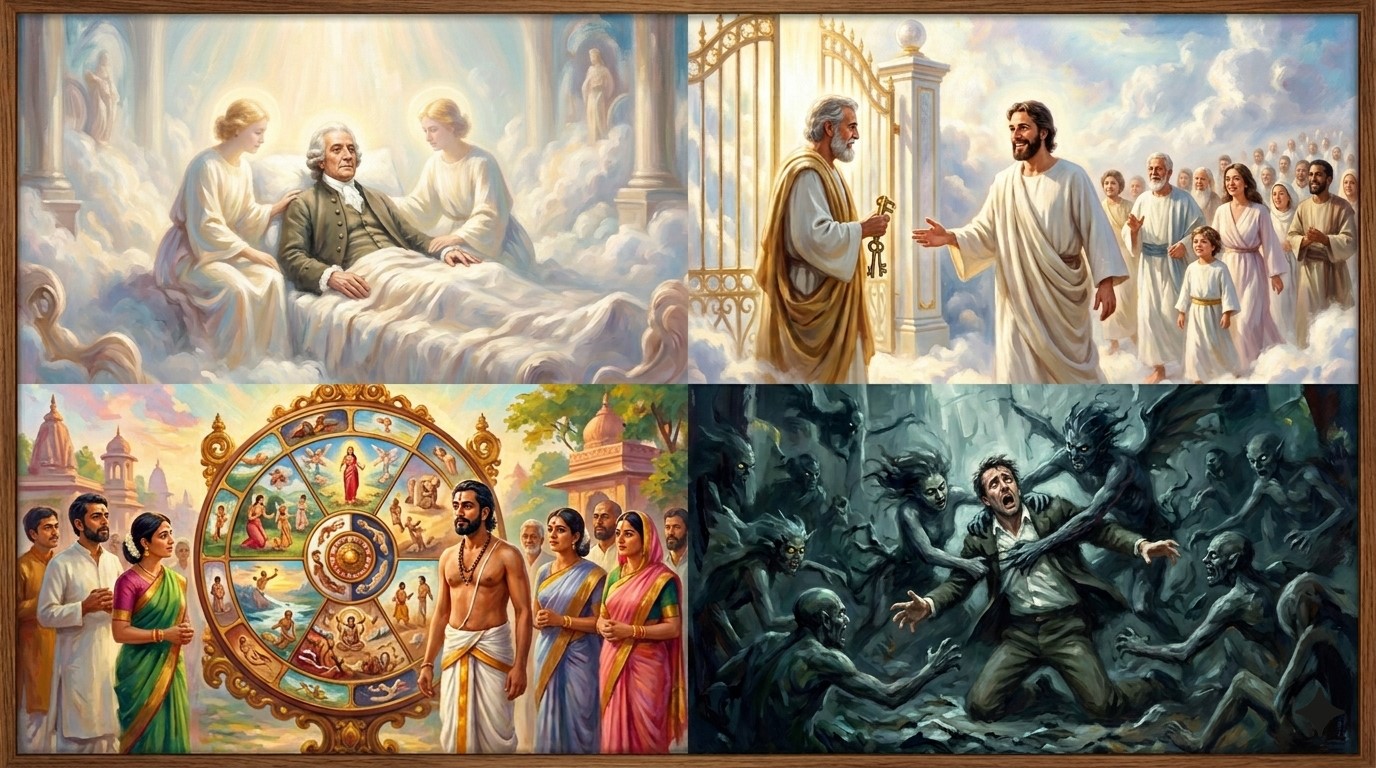
People who have near-death experiences are, of course, people who are living on this earth, and who therefore have a mixed, earthly mindset. This means that when they go to the spiritual world, they will not go to heaven or to hell, but to the world of spirits in between. There, they will be met by angels or spirits who are in a similar mindset to their own, and who think in the same way they do. That’s why people who have NDEs tend to see things that affirm their already existing beliefs. Christians may see the Pearly Gates. Hindus may see the wheel of life in action. And people who are very selfish and greedy may have a very . . . unpleasant experience.
In the world of spirits, people of all different beliefs and mindsets are still all mixed together, just as we are here on earth. So when we have a near-death experience, we’ll easily find and make connections with angels and spirits who think and feel similarly to us. Sometimes they will be friends or family members who knew us well. Other times it will be people we never knew on earth, but who we feel an immediate connection to.
Either way, it’s not an objective view of the spiritual world, nor is it an experience of heaven or of hell. It’s an experience of the world of spirits, where good and evil still mix, and where there are whole groups of people who are still partly connected to earth, and still think the same way they did on earth, because they haven’t fully made the transition to their eternal homes in either heaven or hell.
Are these the best people to turn to for information about the spiritual world? No, they’re not. They’re still figuring it out themselves. And even if we do encounter angels, often experienced as “beings of light,” we are not meeting them in their homes in heaven. No, they have come to the world of spirits to greet us and guide us. And as I said above, they adapt their minds to our way of thinking, and speak to us in ways that harmonize with our already existing beliefs and leanings.
The world of spirits is a customized experience
Another way of saying this is that when we have a near-death experience, it is a customized experience, not in heaven or in hell, but in the world of spirits in between. Everything we see and experience there is adapted to our own mind and heart, and reflects our own desires and beliefs.
Again, this doesn’t mean it’s a fake experience. Rather, it means that it is a curated experience. We are being shown, and given an experience of, the things that we need to see and experience to move forward with our own spiritual life.
This is why, as David points out, so many people come away from their NDEs with so many different, even conflicting experiences and ideas. The NDEers themselves may believe that they are getting a universal picture of what the spiritual world is like. But that’s not what is happening at all. In fact, that’s hardly even possible in such a short period of time. Rather, what they’re getting is a brief spiritual experience that is tailored to their own current spiritual, mental, and emotional state.
Once again, the experience is genuine, but its meaning is different for each person, because each person is different. Yes, there are common threads that run through NDEs. The spiritual world is not a chaotic, disorganized, anything-goes sort of place. But by its very nature, the spiritual world adapts to our mental and emotional states. That’s why different people have very different experiences there.
NDEs are like spiritual movies
You walk into a darkened theater. Suddenly the screen lights up. Playing out before your eyes are scene after scene building a story created to convey a message—perhaps one of hope and joy, perhaps one of despair and doom. Some people love a creepy horror flick. Others go for the romcoms. Others want an exciting combat or adventure film. Even the same people will watch different kinds of movies at different times depending on their current mood.
Having a near-death experience is like going to a spiritual movie theater, only instead of a 2D screen with sound, it is a fully immersive holographic experience, like the Star Trek holodeck. It feels completely real. And in a sense, it is! But it is the reality of the theater of the human mind, not the objective reality of walking around in the streets outside the movie theater.
What about those hellish NDEs in which people either see others tortured with flames and pitchforks, or experience it themselves?
These, too, are not actual experiences of hell. They are spiritual movies about hell, only they are fully immersive movies, like virtual reality headsets that Google and Meta only wish they could produce. It feels so real that it might as well be real. But it is not an actual experience of hell, nor are good NDEs actual experiences of heaven. They are like spiritual movies that people who almost die and come back to tell the tale experience during their brief excursion into the spiritual world.
This is why hellish NDEs don’t match Swedenborg’s description of hell. People who have hellish NDEs aren’t really in hell. They are in the lower part of the world of spirits, not far from hell, where they are given a hellish experience that draws on their already existing beliefs about what hell is like. And since the popular idea of hell in circulation among Christians and non-Christians alike tends to involve lots of fire and pitchforks, that’s exactly what their personalized spiritual theater serves up for them.
Even though people who have hellish NDEs may see and experience flamy tortures, the fire they experience is symbolic, no matter how real it may feel in their spiritual movie theater. Fire, in a negative sense, represents the blazing mutual anger and hatred of evil spirits in hell, and of evil people here on earth. From a distance, it looks exactly like fire and smoke. It’s not wrong that hell is a fiery, smoky chasm. It’s just that this is the way hell looks visually from a distance. For those who live there, it looks and feels very different.
I should add that people in hell can get burned by fire. That may happen from time to time. But they do not spend eternity roasting naked on spits over perennially stoked fires as depicted in some of the more lurid traditional Christian illustrations of hell. For what hell is really like, please see:
Is There Really a Hell? What is it Like?
Hell as “eternal separation from God”
Oh, and one more thing about hell, in response to this part of David’s conundrum:
On one hand, the hellish NDEs and NDE like stories that I found are scarily consistent, detailing that hell is eternal separation from God and that the worst thing about being there is the soul crushing guilt and despair from the knowledge that you’ve permanently screwed up and that God can do nothing to save you anymore, a commonality found even in accounts of hell from as old as the Catholic Saints, yet against everything Swedenborg said about hell.
This is a popular notion of hell that is common among traditional Christians. However, it is based on a fundamental misunderstanding of hell and its residents.
Yes, in a sense hell is eternal separation from God. But that’s because the people in hell have separated themselves from God, and they continually turn themselves away from God. The part that’s missing from the traditional Christian view is that people in hell have freely chosen to reject God, and they have no interest whatsoever in changing their mind about it. God continues to love them just as much as ever. But the feeling is definitely not mutual.
This also means that people living in hell do not feel “crushing guilt and despair,” they do not believe they have “permanently screwed up,” and they certainly don’t want God “saving” them. All of this presumes that they still have a sense of conscience.
But the residents of hell are there precisely because they have no conscience, and no desire whatsoever to do anything good for anyone. They completely reject the very idea of right and wrong. They are driven entirely by their own selfish and greedy desires. Far from thinking they have “screwed up,” they think they are the greatest, smartest, strongest, and best people ever, and they resent and hate anyone who says otherwise.
They especially hate God. The last thing they want is for God to come down and “save” them. They have already rejected all efforts by God and the angels to get them to change their minds throughout their entire lifetime on earth. They have made their choice, and they view people who try to tell them that the way they’re living is wrong as obnoxious, naïve do-gooders who should get the hell out of their way and let them live the way they please.
So no, hell is not hell because of guilt and despair. It is hell because the people there love only themselves and their own power, privilege, and possessions, and they hate and despise anyone who stands in the way of their selfish and greedy desires.
Really, that traditional Christian version of hell is about convincing Christians who are still living on earth not to choose hell. As with everyone else, angels use these Christians’ faulty and false beliefs about hell to move them toward living a good and kind life that leads to heaven instead of an evil and selfish one that leads to hell.
Now back to the points about near-death experiences.
God knows who will return to earth
There is a common assumption that what NDEers experience is exactly the same as what people who die permanently will experience. But that’s not necessarily so.
Keep in mind that God, being omniscient, knows everything that to us is past, present, and future. (If that confuses you or causes cognitive dissonance, please see, “If God Already Knows What We’re Going to Do, How Can We Have Free Will?”) When people have near-death experiences, God knows that they will not be staying in the spiritual world permanently, but will return to their lives on earth.
Angels know this also. NDEers themselves commonly report being told by beings in the spiritual world that it is not yet their time to die, and they must return to their bodies. Often the NDEer fights against this, not wanting to leave this beautiful place and go back to the dark and painful world of earth. But of course, every single near-death experiencer does come back, or they would be dead people, not near-death experiencers, and we would never hear their story.
Since God and the angels know that this or that person will be returning to his or her life on earth, that changes the whole meaning and purpose of the experience.
For those who have died permanently, the experience of dying is arranged to provide a peaceful transition from one world to the next, and to lay the groundwork for the next steps in that transition. When Swedenborg describes the experience of dying in Heaven and Hell #445–542, he is providing a sample experience of what it is like to die permanently.
This doesn’t necessarily mean that everyone will experience it exactly the way Swedenborg did. For one thing, he himself says that his experience was different because he was able to keep his rational, observational mind active throughout the entire experience so that he could report it to people on earth. Different people will likely experience the passage of death differently.
However, the experience Swedenborg narrates is a description of the process of dying permanently, not a description of a brief experience of the spiritual world before returning to earth. That is why we shouldn’t expect people’s near-death experiences to follow the pattern that Swedenborg described for the dying process in Heaven and Hell. Yes, there are similarities. But these are two different kinds of experiences.
For some additional and compatible perspectives, here is a Q&A video from the Swedenborg Foundation’s Off the Left Eye YouTube channel, time-stamped to a section that addresses a question about the differences between near-death experiences Swedenborg’s experiences in the spiritual world:
NDEs are geared toward continued life on earth
Specifically, near-death experiences are organized and overseen by God and the angels to provide people with tailored experiences that will move them forward on their spiritual journey on earth. And NDEers commonly do come back with a completely changed outlook on life, and a new or renewed commitment to living a more thoughtful, loving, and spiritual life. Even hellish NDEs, such as the well-known one described by Howard Storm, commonly bring about huge changes in the lives of the people who experience them.
This is also why different people’s NDEs are often so different, and why they may even present conflicting and contradictory pictures of the afterlife. These experiences are not intended to convey information about the afterlife. They are intended to give each person who has them an experience that will move him or her forward on that specific, unique person’s spiritual path.
If we think of near-death experiences in this way, and with all these considerations in mind, we don’t have to get sucked down the rabbit hole of all the different experiences, interpretations, and beliefs presented by all different NDEers. We can understand that each person who had an NDE had a unique experience specifically tailored to his or her spiritual and emotional state at the time. We shouldn’t expect them to all be the same and agree with each other any more than we should expect every movie in the movie theater or on Netflix to show the same scenes and deliver the same message.
Swedenborg is still the go-to guy
To David and all the other people out there who are confused by the welter of different experiences, opinions, and beliefs of the different near-death experiencers, I say: relax. It is to be expected that different people will see and interpret even the same or very similar experiences quite differently, often in conflicting and contradictory ways. That is the nature of our pluralistic world and its wide variety of people holding to all different belief systems and living all different kinds of lives.
Given the huge variety of people and beliefs, it would be highly suspicious if they all reported the same things from the spiritual world. Keep in mind that the spiritual world is inhabited by everyone who has ever lived and died on this earth. All the varieties of culture, lifestyle, and belief that exist here on earth also exist in the spiritual world, because it’s all the same people, and they carry those vastly different cultures, lifestyles, and beliefs with them into the spiritual world.
Again, the spiritual world is not a chaotic, disorganized free-for-all in which anything goes. True and false beliefs do have consequences. And people who go to heaven do let go of any completely false beliefs that they may have carried with them into the spiritual world. Falsity has its home in hell, not in heaven.
Still, all the religions of the world do have a kernel of truth in them. (See: “If there’s One God, Why All the Different Religions?”) Hindus do not all suddenly become Christians after they die. But they do move on to a deeper and more spiritual understanding of their own religion in which, for example, instead of believing in literal, physical reincarnation, they believe in spiritual rebirth, which is what the mistaken idea of reincarnation is pointing towards.
Meanwhile, once again, if you want the real story and reliable information about what the afterlife is like, Swedenborg is still your go-to guy. No one else in the history of humanity had the sheer length and depth of experience of the spiritual world that he did. That’s not accidental. Swedenborg was specially selected by God to bring the trustworthy and reliable information about God, the spiritual world, the Bible, and the life that leads to heaven that people on earth have been pining for.
Get yourself a copy of Heaven and Hell and read it. Once you understand how the spiritual world works, all the confusion about different NDEs and different belief systems will fall into place. Confusion melts away in the presence of real understanding.
This article is a response to a spiritual conundrum submitted by a reader.
For further reading:
- The Bible, Emanuel Swedenborg, and Reincarnation
- What about Spiritualism? Is it a Good Idea to Contact Spirits?
- What Happens To Us When We Die?
- Is There Really a Hell? What is it Like?
- Do the Teachings of Emanuel Swedenborg take Precedence over the Bible?
- Death and Rebirth: Introduction
- Heaven and Hell, by Emanuel Swedenborg
Share this:


Lee Woofenden is an ordained minister, writer, editor, translator, and teacher. He enjoys taking spiritual insights from the Bible and the writings of Emanuel Swedenborg and putting them into plain English as guides for everyday life.


Hello Lee
It’s been awhile since I have commented or posted a question for you. I scanned much of this but I do intend to read it in full in the next day or two. I have wanted to ask you or the Swedenborg people this question. Are you familiar with the Medium Leslie Flint? In my spiritual journey I came across many of his seance recordings. Some were one on one appointments. They were able to talk to their loved ones like they were having coffee together and talking about whatever came to their minds. Something that I noticed was how close those who they talked to on the other side sounded like the experiences of Swedenborg. None that I can recall ever talked about going through some tunnel or getting the typical life review. They talked of being guided by someone who passed before them who they were close to. Some woke up in a hospital type setting where they are told what happened to them. Soon they are greeted by family and friends. Like Swedenborg they often noted that those who had strong religious convictions had some difficulty adjusting or accepting what they were told. They talk about communities they settle into. I was curious what your thoughts were. What brought me hours of comfort was conversations between a husband and wife over a 14 year period. She passed away in 1966. He started communicating with her in 1970 and the last recording was in 1984. He died in 1985. Her name was Annie Nanji and his name was Dinshaw Nanji. Any thoughts?
Thanks
Cliff Mooe
Hi Cliff,
Good to hear from you again. Sorry about the disappearing message. It went into the spam folder, and I didn’t notice it there until several days later.
I am not familiar with the medium Leslie Flint, but what you lay out here sounds about par for the course on medium communications. I don’t recommend consulting mediums, but I also don’t think it’s an entirely bad or evil thing, especially when it gives people who have lost a loved one a sense of the presence and continuing life of the one that has passed over. The problems come when people start espousing theories about the nature of the afterlife based on communications via mediums, which can be fallacious just as easily as they can be trustworthy. For a fuller version of this, please see:
What about Spiritualism? Is it a Good Idea to Contact Spirits?
As far as people’s reporting about their experience of passing over, I don’t think everyone will experience it the same way Swedenborg did. For one thing, as he said, he was able to keep his thinking, rational, observational mind active through the whole experience so that he could bring back a report about it. Also, he was already very familiar with how the spiritual world works. Neither of these things will be true for the vast bulk of people who die and pass over to the other side. Plus, different people are different, and will have different experiences.
Most of the rest I’ve covered more fully in the linked article, so I’ll let you read that, and then we can continue the conversation if you like.
Hope all is well with you.
My struggle is letting go of all that I have been taught. What is real and what is not. Is this really Hell and we just do not know it. We are all God therefore we can do anything, I think. If this is the matrix or a simulation then we can also do and change anything.Perhaps the truth is we live thousands of years with the fallen angels in a Karmic cycle and then it changes to thousands of years if Christ consciousness. I myself fear nothing( but spiders😆) I know 100 percent that things are not as they seem. I have seen and done so many “ wiered” things, most of the things I script in my journal come true( but in different ways); the kingdom of heaven on earth is very close now!!!🥰 I feel like my mom’s death a couple weeks ago will catapult me even farther, don’t know why😀The only other thing I know 100 percent is that we must all be Love. Those of us that can not love ourselves and all others; are leaving! No fear and love is the key and it’s not easy to get there some say. It is pretty simple if you fallow God or the universes commands, I barely make any decisions anymore, it’s all laid out for me❤️
Hi Shelly,
Thanks for stopping by and sharing your thoughts and your story. No need to respond to all this now. I’m thinking of you as you begin the changed life after you mother passed over to the spiritual world.
When our parents die, it is usually a time of grief, yes, but it is also the time when we become the grown-ups in the room. No more Mom and Dad to look up to and go to for help, advice, and a shoulder to cry on. Perhaps that is what has put you into a contemplative mood. If and when you’re looking for something more for the head than for the heart, here is a piece I wrote in response to a question from a reader:
What Does it Mean When My Parents Die? Will I See Them Again?
I hope you will find it helpful and comforting. Meanwhile, our thoughts and prayers are with you.
Hi Lee, It’s me, the original person who sent you the question. Thank you so much for replying to my ages old cry for help. I would have responded to you much sooner, however I was occupied with a lot of things only just recently came across your response. What you’ve said about how the World of Spirits play a role in NDEs did help put some things into perspective, but there are still some things I’m unsure of.
Mainly, I’d like to take a moment to focus on something I had mentioned in my original ask but isn’t elaborated on much in this article; the stories of people seeing their dead loved ones in hell. In my original ask I sent you some links of distressing NDEs and NDE like experiences, and among them if I remember correctly among them was a YouTube video of a man recounting his experience of being visited by a vision (admittedly during what I remember to be a bad weed trip) his father from hell and another of an article about a woman seeing a vision of her father actively burning in hell. I don’t have the former link on me now, but I have the latter which I will paste here: https://saltandlight.sg/faith/i-saw-my-brother-in-heaven-and-my-father-in-hell/
Now, the reason I bring these two stories up is because I’m having trouble reconciling them with Swedenborg’s teachings, mainly because in both stories, the father in hell was seemingly repentant. In the former YouTube video, I remember that man saying that his father “looked relieved” to be out of hell, and in the short time he was able to be out he tried to tell his son that he was proud of him before being beaten and dragged off by a group of dark hooded figures (a description which oddly shows up in negative spiritual experiences, such as Howard Storm’s NDE but that’s getting off topic) meanwhile, his son was so shaken by this experience that he begged God (who he was communicating with) to erase both him and his father out of existence. Now he’s a born again Christian, but his dad is presumably still stuck there if we take the story at face value.
In the article the woman’s father, despite being described as an abrasive person who plainly rejected anything to do with Christianity also seemed genuinely remorseful, flat out telling his daughter to believe in Jesus Christ before being consumed by the flames.
Both of these stories are confusing to me. Assuming they simply aren’t lying or hallucinating (The former still gives me pause due to DMT experiences) it’s sort of hard to get a grasp on what exactly they’re seeing here. This brings up two questions for me:
1: Why would angels allow people to see horrific visions of their loved ones in Hell suffering for eternity? I guess the intent is to “scare them straight,” as they were both struggling beforehand, the former with his drug addiction and the latter with her possible demonic possession, but wouldn’t there be kinder way do do it? Basically, why did it have to be in the form of the eternal conscious torment narrative when neither seemed receptive to it?
2: Were the loved ones the two people saw real? If so, where are they? In the lower realms of the World of Spirits? Are they being led to believe that they are in hell? Why? Don’t angels “let” you continue your personal beliefs for some time? If they aren’t real, why would angels generate the illusion just to scare people?
If you have the time please read this. I admittedly feel bad for picking apart these testimonies like this, but I’d just like to get some closure on this.
Hi David,
Good to hear from you, and thanks again for your spiritual conundrum. I do cover some of these issues in the section headlined, “NDEs are like spiritual movies,” so you might want to read that part again.
The experiences you mention, though, are not NDEs, but visions, which is a whole different thing. There are many visions in the Bible, and also parables about the afterlife, but these are visions and parables, not reports. They are symbolic experiences or stories that are meant to convey a message, not actual reportage of real conditions in the spiritual world.
I looked back at your original conundrum, and I don’t see any links in it. But I did follow the link you provided in your comment above, and read through it. Once again, these are visions, not near-death experiences. Visions, especially, use ideas and imagery that are already in people’s minds to deliver them a message.
In this case, the woman was already a Christian of a traditional type, so she already had the idea of eternal conscious torment as part of her belief system. The vision used that belief, portraying her father as being tormented in hell even though repentant, to deliver a message similar to the message delivered by Jesus’ parable of the rich man and Lazarus in Luke 16:19–31: “Repent of your sins before it’s too late!” That was a parable, not an account reporting conditions in hell. It is meant to deliver a message to motivate people to change their ways, not to describe what things are actually like in the afterlife.
Similarly, this woman’s visions were not snapshots of hell, nor were they even actual encounters with her father in hell. They were visions, as the article itself said. As visions, they draw on her belief that you have to be a Christian or you’ll burn forever in hell. And since her father had rejected Christianity, her firm belief would have already been that he is in hell, not heaven. And that belief was used in her vision to deliver a message to her.
In actual reality, her father is probably not in hell. Despite the fact that he was not a Christian, presuming he was a reasonably good and honorable man, he would be in heaven, not in hell. Non-Christians can be saved just as easily as Christians if they live good lives according to their own beliefs. Further, if her father actually were in hell, he would not be repentant (otherwise he would be in heaven, not hell), and rather than trying to save others from hell, including his own daughter, he would be maliciously seeking to drag her down to hell as well, because that’s what people in hell are like. That’s why they’re in hell in the first place. As I said, if they were repentant, they’d be in heaven, not in hell.
I hope this much is helpful, but if you still have thoughts or questions, feel free to continue the conversation.
Hi Lee, me again, I’m sorry for my late reply, but I just want to further clarify something clarify something.
Why would supposedly loving angel let people believe that they’re loved ones are in hell? Isn’t that outright lying? Is there another way for them to convince someone to change in accordance to their beliefs without showing them something so nightmarish?
Again thank you for replying. I’m sorry if m message comes across as nit picky or rude, but this is something that’s been on my mind.
Hi David,
It’s a reasonable question.
However, keep in mind that it wasn’t the angels’ idea that the woman’s father was in hell. That’s what she already believed due to her particular brand of Christianity. To you and me it seems nightmarish. But to her, it’s just an “established fact.” And angels don’t argue with us about our beliefs, or try to change them. That would be a waste of time. Rather, they use our existing beliefs to motivate us to have faith and live a good life.
As a counterfactual, consider what would happen if the angels came to her and said, “Your father isn’t really in hell. Non-Christians can go to heaven just as easily as Christians!” Would her reaction be, “Oh, what a relief! I felt terrible that my father was in hell!” No, that’s not what her reaction would be at all. Rather, she would say, “What you are saying is false! You are false prophets. You are Satan dressed up as an angels of light!” So she would reject both the angels and their message.
Why would they use this particular belief of hers? Because it is highly emotionally charged, and it will make a serious impact on her—as it did! If, to use another counterfactual, they had had some anonymous person come to her in the vision, someone she didn’t know, how much impact would it have? She would probably just think of it as some bad, worthless person, and again, she would not be very likely to listen. Keep in mind that her belief was still fairly weak at this point, which is why she needed the vision in the first place. But if it’s her father? This is someone she knew and presumably loved, and is probably heartbroken that (as she believes) he is in hell. So having him come to her in the vision and issue the warning will have a uniquely powerful effect upon her.
It’s not lying, any more than writing a novel that has fictional characters is lying. A vision is a vision, not an experience of reality. If she had actually woken up in the spiritual world and seen what it’s really like there, she would come to know the reality, which is that her father is not in hell for not being a Christian. But it wasn’t an experience of the spiritual world. It was a vision, which is sort of like a novella telling a story that has a moral and a call to action.
Visions are sort of like dreams. And in dreams, many people we know come to us and do things that they didn’t or wouldn’t do in real life, because they represent something in our mind, and their presence in the dream has a specific meaning to us.
In delivering the message that she needed in order to move forward on her spiritual path, the angels used the most powerful and evocative people, ideas, and beliefs from her own mind to deliver the message. And her belief that her father in hell certainly qualifies.
Hey Lee, the option to reply to your last response didn’t appear so I’m writing another comment instead.
Honestly that your reply did help me to understand better. Correct me if I’m wrong, but this makes me think that if it really is angels using a person’s pre conceived notions of how the world works to inspire change in them, then I imagine that the afterlife in responds more to what we consciously believe (or alternatively what the culture we’re the most familiar with believes), while what we want to believe isn’t as strong in comparison.
She probably didn’t want to believe her father was in hell really, but since her belief system (that she wasn’t taking seriously until now) held the belief of eternal conscious torment, it won out.
It loosely reminds me of this Thai NDE from a Chinese Buddhist born and raised in Thailand (scroll down to The Case Of Koiden to read about it) to summarize, Koiden had active preference before the Chinese way of creating merit in the form of only helping his ancestors, but his NDE inspired to broaden his efforts to monks as well. What do you make of this?
By the way, is it okay if I ask you some off topic follow up questions?
Best wishes, David.
Hi David,
Yes, I limited the levels of nesting for comments here so that they don’t become little narrow columns that are unreadable. I can respond to any comment, and so can people using readers or other means of replying, but even then the replies will stay on the same level of nesting rather than getting thinner and thinner and thinner. Anyway, that’s why there was no option to reply to my last comment. It had reached the limit of nesting levels.
Glad you found my last comment helpful. In answer to your next question, it’s complicated. But even in the afterlife we do continue to believe the same way we did on earth, especially at first. And even long-term, our particular beliefs and culture do affect where and how we live in heaven to eternity. We are shaped by our culture and environment as well as by our choices and actions. That doesn’t go away in the afterlife. After we die we’re still exactly the same person we were before we died.
It’s complicated because ultimately, our “outward” beliefs do come into greater conformity with our true inner character and, if we are headed to heaven, in greater congruence with the actual truth.
On the first point, oftentimes people externally state and even believe in their own minds things that they don’t truly believe in their heart of hearts. For example, they may say they believe in Jesus (Christians, that is), but they don’t actually live the way Jesus taught, so their belief is only a belief of the lips, and not of the heart and the life. These faux Christians will, in the afterlife, come more and more to reject and deny Jesus, even if that was their stated belief in this life.
On the second point, after their true self comes out in the afterlife, people who have good hearts go through a time of being taught by angels before they move on to heaven. Based on what the angels teach them, drop any beliefs they may have had that are truly false, and adopt true beliefs in their place, before proceeding onward to their eternal life in heaven.
This does not mean that Buddhists stop being Buddhists, and Jews stop being Jews. But it might mean, for example, that Buddhists who believe in reincarnation realize and accept that physical reincarnation does not happen, but it is really about spiritual rebirth. And in general, people come to recognize who Jesus was, meaning Jesus actually is God in person. But non-Christians will still follow their cultural and religious practices to the extent that those are good and heartfelt. After all, God has provided that every genuine religion on the face of the earth has the basics required for people to believe in God and live a good life that will lead them to heaven. See:
Is There a Common Theme in All Religions?
In the case of that Filipina (?) Christian, in the afterlife she will not cling to her belief that all non-Christians are damned to eternal conscious torment. She seems to be a person of good heart. When she enters the other life, she will learn that her father is not really in hell (as I suspect). In fact, if she had an affection for him, it is very likely that he will be one of the angels who greets her and welcomes her to the afterlife when she passes over. So that oppressive belief will be lifted from her mind, and she will learn the actual truth, which is that Jesus is the God of all people, not only of Christians.
About Kodien in the article you linked on near-death experiences in Thailand, I agree with the author’s conclusions about NDEs being different according to the culture of the people having them. However, His conclusions about Kodien in particular seem a little odd. Kodien wasn’t only Chinese. He was Chinese-Thai, meaning he was living in Thailand surrounded by that culture. So he wouldn’t be affected only by Chinese culture, but also by Thai culture, as shown in what happened in his NDE.
Hi David,
Oh, and about asking off-topic follow-up questions, that would be fine. However, you might want to first do a few quick searches in the “Search This Site” box in the right navbar (or down below if you’re on mobile) to see if there are already articles about your questions. Then you could read the article, and ask any questions at the end of that article, where they’d be on-topic. But if you don’t find anything that matches what you want to ask about, sure, go ahead and ask the questions here. (But I might send you to an on-topic article if there is one.)