Here is a Spiritual Conundrum submitted to Spiritual Insights for Everyday Life by the Rev. Fats Montsho:
Does Swedenborg in any of his books geographically describe Eden in detail?
Thanks for the interesting question, Rev. Montsho!
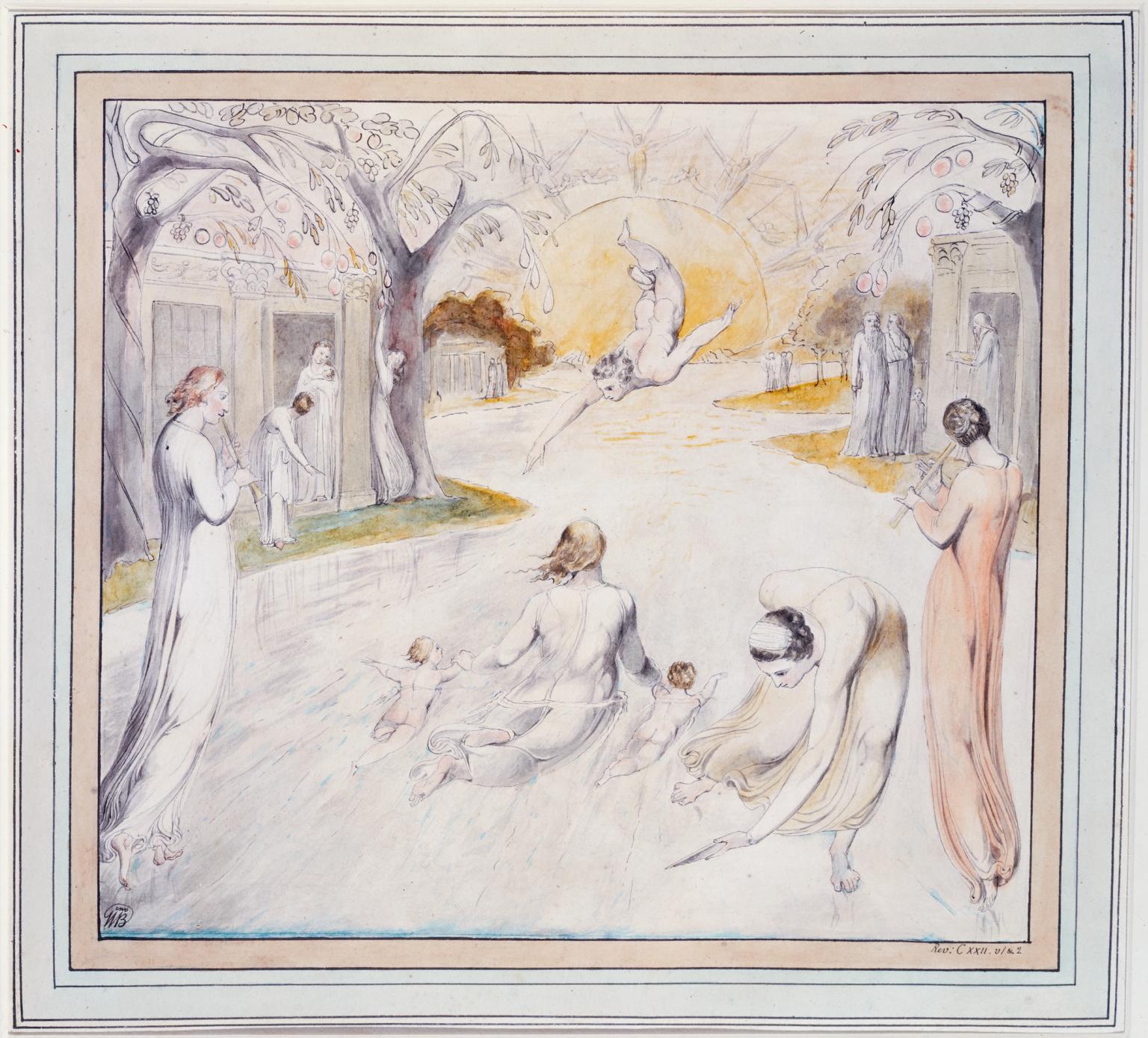
The River of Life, by William Blake
When we hear “Eden” we usually think of the garden of Eden. However, the Bible says that God planted a garden in Eden (Genesis 2:8). This suggests that Eden was a wider area, and the garden was an area within it.
Still, the second Creation story in Genesis chapters 2 and 3 focuses on the garden of Eden, not on the wider area. So we will also focus on the location and meaning of the garden of Eden, while not forgetting that the garden was most likely a specific area within the land of Eden.
In terms of physical geography, Emanuel Swedenborg (1688–1772) associates the garden of Eden with the land of Canaan. This is unusual. The garden of Eden has most often been placed in ancient Babylonia just north of the Persian Gulf, in the area where the Tigris and Euphrates rivers meet.
However, Swedenborg did not think of the garden of Eden as a literal garden where two literal human beings were placed. Rather, he said that the Creation stories in Genesis represent an early culture of human beings who were the first to become aware of God and spirit. He therefore spends most of his time explaining the spiritual symbolism of the garden of Eden. Because of this, he gives us only a few hints about the physical location and geography of Eden. And yet, what he does provide ties in beautifully with its spiritual symbolism.
Finally, in a story in his book Marriage Love Swedenborg describes a beautiful spiral garden in heaven. This garden has a fabulous tree at its center that some of the angels who live in the area call the tree of life. This heavenly paradise garden offers a picture of the garden of Eden that is both physical and spiritual.
Let us look at all of this more closely.
For more on the garden of Eden, please click here to read on.










 Spiritual Insights for Everyday Life