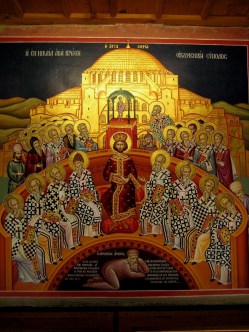
And Jesus Grew in Wisdom

After three days they found him in the temple courts, sitting among the teachers, listening to them and asking them questions. Everyone who heard him was amazed at his understanding and his answers. (Luke 2:46–47)

Jesus as a boy in the templeThe story of Jesus as a boy at the Temple in Luke 2:40–52 is the only biblical account we have of Jesus’ childhood. Even the story of his birth is told in only two of the four Gospels, Mark and Luke. And none of the other Gospels besides Luke have any stories of his childhood at all.

We do get a few hints of what he was doing as he grew up. In Mark 6:3 there is a reference to Jesus being a carpenter. In the parallel passage in Matthew 13:55 it is Joseph who is the carpenter. Apparently he learned his adoptive father’s trade—which would have been common for boys of that era. It appears that outwardly, Jesus was mostly just an ordinary craftsman, living like other boys and men of his time and culture.

If this were not so, more stories of Jesus’ childhood would have survived. It seems that what we have in the two birth stories and this one vignette of Jesus at the age of twelve are the only stories of the Lord’s young life that were noteworthy enough to have survived in people’s memories to be recorded later. The rest of our stories of Jesus all come from the few intense years of his public ministry, which began when he was about thirty years old (see Luke 3:23) and lasted only three years, until his death by crucifixion.
For more on the boy Jesus, please click here to read on.

Tagged with: , , , , , , , ,
Posted in All About God, Spiritual Growth

A Child of Revelation

This child is destined to cause the falling and rising of many in Israel, and to be a sign that will be spoken against, so that the thoughts of many hearts will be revealed. (Luke 2:34–35)

“The thoughts of many hearts will be revealed.” I have been thinking lately that in this largely Christian culture, Jesus is a touchstone as to where people are spiritually. Not that we can judge where anyone else is spiritually. But we can surmise something of their inner state by their reaction to Jesus. The same goes for our own inner state.

There are many different opinions about who Jesus was. Do people accept Jesus? Do they accept him as their Lord and Savior? If so, that says something about their spiritual state. Do people accept him as a great prophet? That also says something. Do people reject Jesus? And if they do reject Jesus, why do they? Is it because they had a bad experience of Jesus growing up in Sunday School and church, and therefore they reject him? Or do they reject Jesus because they are unwilling to have their lives reformed by his influence?

Some people are too skeptical; they can’t accept anything that isn’t demonstrated by “hard evidence.” They therefore reject any possibility that Jesus could be divine. In their view, he was an ordinary human being. And some people are simply indifferent to Jesus. They really don’t care, and don’t pay any attention to Jesus at all. That also says something about their spiritual state.

Of course, for people from non-Christian cultures it is different. But in a Christian culture, our response to Jesus—who he was, how he affects us—says a lot about our spiritual state. So “the thoughts of many hearts will be revealed.” The thoughts of many hearts are revealed in our response to the Lord Jesus Christ—to the God of our religion.

For more on a child of revelation, please click here to read on.

Tagged with: , , , , , , , ,
Posted in All About God, The Bible Re-Viewed

Is Free Will an Illusion? A Response to Sam Harris

In a recent comment, a reader named K asked me to respond to this article: “Why You Probably Don’t Have Free Will,” by Jack Maden. Here is the article’s opening synopsis: “Neuroscientist and philosopher Sam Harris argues that free will is an illusion. In his view, we are the mere conscious witnesses of decisions that deep in our brains have already been made.”

In particular, K wanted a response to this statement by Sam Harris, as quoted in the article:

Sam HarrisThese findings are difficult to reconcile with the sense that we are the conscious authors of our actions. One fact now seems indisputable: some moments before you are aware of what you will do next—a time in which you subjectively appear to have complete freedom to behave however you please—your brain has already determined what you will do. You then become conscious of this ‘decision’ and believe that you are in the process of making it.

Here is my brief response to this statement, edited from a reply to K that I posted here:

The basic error in this quote is the idea that we make decisions with our “brain,” meaning our thinking mind. The reality is that we make decisions in our “heart,” meaning our love/emotional self, and then our thinking mind confirms and supports the decision we have already made in our heart. That’s what’s really going on in the phenomenon that Sam Harris is describing.

However, Western intellectuals such as Harris generally can’t see or understand this because they are trained to think that human intellect is primary, when in reality love and emotion is primary, and intellect is secondary, following what love tells it to think and do. Their fundamental misunderstanding of how the human psyche works leads them into all sorts of errors, including the denial of human free will.

Ordinary people who make decisions every day understand human reality better that these so-called “rational” intellectuals.

The rest of this article is an edited and expanded version of a longer follow-up comment that I posted here, after reading the article itself.

For more on Sam Harris and free will, please click here to read on.

Tagged with: , , , , , , , , , ,
Posted in Science Philosophy and History

The Infant Lord

Sovereign Lord, as you have promised, you now dismiss your servant in peace. For my eyes have seen your salvation, which you have prepared in the sight of all people, a light for revelation to the Gentiles and for glory to your people Israel. (Luke 2:29–32)

Simeon blesses Jesus

Simeon blesses Jesus

These words, usually in a more traditional translation, have found their way into the closing section of many worship services. Yet though Simeon, who spoke them, was close to his departure from this world, he was speaking in celebration of a new beginning—in fact, of the most wonderful new beginning that has ever happened: the birth of the Lord Jesus into the world.

Luke 2:21–32 tells first of the naming of Jesus at his circumcision when he was a week old, and then of his presentation in the Temple at the completion of another thirty-three days, which was the prescribed period for ritual purification of a woman after the birth of a son. This means that at the time of his presentation in the temple, Jesus was forty days old.

When his parents brought him to the temple, a devout man named Simeon was also inwardly directed, by the spirit of the Lord, to come to the temple. There, he took the infant Jesus in his arms and praised the Lord, saying of the child, “My eyes have seen your salvation.” “Salvation” is the meaning of the name “Jesus,” which the child had been given according to the instruction of an angel, as we read in the Gospel of Matthew: “You shall call his name Jesus, for he will save his people from their sins” (Matthew 1:21).

“My eyes have seen your salvation.” How could Simeon say this of a baby less than two months old? How could this baby be the salvation not only of the Jews, but of the Gentiles as well—meaning the Savior of all people?

For more on the infant Lord, please click here to read on.

Tagged with: , , , , , , , ,
Posted in All About God

The Divine Birth

For the day of vengeance was in my mind, and the year for my redeeming work had come. I looked, but there was no one to help; I was appalled that no one gave support. So my own arm worked salvation for me. (Isaiah 63:4–5)

The birth of JesusIn the previous post, I responded to the question “What child is this” by saying that this child Jesus was and is “God with us,” as the prophet and the Gospel say. With that as a preface, I would like to introduce a new series on the inner life of Jesus Christ—originally sermons delivered in 2004, during my decade as a pastor. While I may occasionally post articles on other topics as well, my current commitments as a Swedenborg scholar, seminary professor, and graduate student leave very little time to write new material for Spiritual Insights for Everyday Life.

I was inspired to this theme by the beautiful booklet A Life of Jesus Little Known, by the Rev. William L. Worcester, originally published in 1905, and unfortunately now out of print. In this series, we will follow the Lord’s (Jesus’) life as told in the Gospel stories, together with the deepest level of meaning in the Bible story as illuminated by Emanuel Swedenborg (1688–1772) in his great work Arcana Coelestia, or Secrets of Heaven.

For today’s introduction, I would like to delve a little further into the question of who Jesus was, where he came from, and why he came to earth. Without knowing these things, we cannot possibly understand what was going on in the Lord’s mind and heart during his lifetime here on earth.

For more on the divine birth, please click here to read on.

Tagged with: , , , , , , ,
Posted in All About God

What Child Is This?

All this took place to fulfill what had been spoken by the Lord through the prophet: “Behold, the virgin will conceive and bear a son, and they will name him Emmanuel,” which means “God with us.” (Matthew 1:2223)

The Virgin Laying the Sleeping Christ on Straw, by Carlo Maratta

The Virgin Laying the Sleeping Christ on Straw, by Carlo Maratta

“What child is this?” asks the beautiful old Christmas carol. “What child is this, who, laid to rest, on Mary’s lap is sleeping?” A simple, tender domestic scene—one that has been repeated by the billions in thousands of cultures throughout the world, and throughout human history. A newborn baby lies sleeping in a mother’s lap.

It is a miracle in itself. No matter how much we study it, we still don’t know just how it happens. And no matter how many times it happens, the fact that this incredibly complex biological, psychological, and spiritual being has come into existence is so mind-boggling that the safest thing for us is just not to think about it too much. Every new birth, every new human being, is a work of science and art far, far more advanced than the human mind has even been able to conceive, let alone create. If we think about it too much, our minds may be in danger of expanding beyond any reasonable boundaries, and coming face to face with the infinite Creator whose work of science, art, and spirit each one of us is.

What child is this? Is this truly a child who brings us face to face with our Creator? Is this truly a child in whom the Infinite One has come to meet us and dwell among us?

For more on what child this is, please click here to read on.

Tagged with: , , , , ,
Posted in All About God

According to Emanuel Swedenborg, who is the man Jesus, born of a woman, who died and then was resurrected?

The title is a question recently asked on the website Christianity StackExchange, here. After several quotations from Swedenborgian sources, the questioner asks:

Did the Lord (God Almighty) incarnate as a human in the body of Jesus of Nazareth? Does this mean that Jesus did not have a pre-incarnate existence in heaven? So who died on the cross? And is it up to humans to earn their salvation by good deeds in this life and in the life to come?

Whilst seeking Swedenborgian sources, I also request references from the Bible.

To keep things simple, what I really want to know is: who, according to Swedenborg, is this Jesus, born of a woman, who died and then was resurrected, and what part did Jesus play in our salvation?

The rest of this post will be a slightly edited version of my answer. You can read my original answer on Christianity StackExchange here.

Because the question specifically asked for Swedenborgian and biblical sources, this post will contain more direct quotation from Swedenborg than is usual here on Spiritual Insights for Everyday Life, including examples of Swedenborg’s ample quotations from the Bible. For readers who want to dig deeper into Swedenborg’s teachings about who Jesus Christ was and is, this post will provide some great food for thought.
For more on who Jesus is, please click here to read on.

Tagged with: , , , , , , , , ,
Posted in All About God

The Eternal Word

The Eternal Word

Your word, O Lord, is eternal; it stands firm in the heavens. (Psalm 119:89)

In the beginning was the Word, and the Word was with God, and the Word was God. He was in the beginning with God. All things came into being through him, and without him not one thing came into being that has come into being. In him was life, and the life was the light of all people. The light shines in the darkness, and the darkness did not overcome it. . . . And the Word became flesh and lived among us, and we have seen his glory, the glory as of a father’s only son, full of grace and truth. (John 1:1–4, 14)

The Word as presented in these Bible passages is vast, eternal—a cosmic being or presence that exists beyond all the created universe as its source and as the instrument of its creation. In its essence, it is above human comprehension. The words of the Lord through Isaiah the prophet come to mind:

“For my thoughts are not your thoughts, neither are your ways my ways,” declares the Lord. “As the heavens are higher than the earth, so are my ways higher than your ways and my thoughts than your thoughts.” (Isaiah 55:8–9)
For more on The Eternal Word, please click here to read on.

Tagged with: , , , , , , ,
Posted in The Bible Re-Viewed

How Can I Be Sure that My Partner will Be Waiting for Me in Heaven?

The Meeting of a Family in Heaven, by William BlakeThe article “Will Happily Married Couples be Together in Heaven?” has become one of the most heavily read posts here on the Spiritual Insights for Everyday Life website. Since the time it was published five years ago, it has been visited over 125,000 times. Clearly there is a great yearning for good and comforting news among people who have lost a wife, husband, or other romantic partner. For partners who dearly love one another, the unbiblical “Christian” belief that there is no marriage in heaven is very bad news, not the good news of the Gospel. (See: “Didn’t Jesus Say There’s No Marriage in Heaven?” and the articles linked at the end of it.)

And yet, people want assurance. Many times since that article was originally published, we’ve heard from readers who are concerned that perhaps their partner will not be waiting for them on the other side, and may not be with them in spirit.

Of course, I do not have God’s infinite vision nor God’s infinite wisdom. It’s not for me to say whether a particular couple will be together in heaven. The most I can say for sure is that couples who love one another will meet on the other side, and can then continue their relationship forever if that’s what they want.

And it will be even better than it was before.

For most people whose partner has moved on to the spiritual world, any assurance that their relationship will continue forever must come from within, and from the relationship itself. Let’s take a look at one reader’s questions about this.

For more on partners in heaven, please click here to read on.

Tagged with: , , , , , ,
Posted in Sex Marriage Relationships, The Afterlife

The Right and Left Agree: The Bible Oughta Be Banned!

Recently seen on Yahoo!Life:

Viral photo of near-empty library shelves sends powerful message: ‘We removed every book with content that could offend someone’

The article begins:

Efforts to ban books at school libraries — particularly those telling the stories of LGBTQ youth — have been in overdrive recently. And now a Facebook post on the topic has gone viral.

Near-empty library shelves - Pflugerville, Texas, Public Library demonstrationThe pair of side-by-side photos, shared by Pflugerville Public Library in Texas, aims to provide a visual of what library shelves might look like if everything containing subject matter that could cause someone discomfort was to be removed.

“This is a before and after shot of what a single shelving unit in the library’s Teen Space would look like if we removed every book with content that could offend someone,” the caption begins. “Out of 159 books, there are ten left on the shelves. We removed books that contained profanity, teen drinking, religious content, racism, magic, abuse, sexual content, and more. But in taking away those books, we also removed examples of friendship, love, courage, creativity, faith, forgiveness, reality, resilience, humor, and history.”

Just for the record, Annette and I strongly oppose censorship, no matter what the motivation for it might be. And it occurs to us: by the standards of both the right and the left, the Bible should definitely be banned!
For more on banning the Bible, please click here to read on.

Tagged with: , , , , , , ,
Posted in Current Events, The Bible Re-Viewed
Lee & Annette Woofenden

Lee & Annette Woofenden

Donate

Support the work of Spiritual Insights for Everyday Life by making a monthly donation at our Patreon

Join 1,268 other subscribers
Earlier Posts
Featured Book

Great Truths on Great Subjects

By Jonathan Bayley

(Click the title link to review or purchase. This website receives commissions from purchases made via its links to Amazon.)

Blog Stats
  • 4,233,816 hits