I recently finished watching the animated 2008–2014 TV series “Star Wars: The Clone Wars,” along with the feature film of the same title that forms an opener for the series.
Yes, I’m a fan of science fiction from way back. To be honest, I’m more of a Star Trek guy than a Star Wars guy. Star Trek is a real science fiction powerhouse, covering many classic sci-fi themes and storylines, and dealing with plenty of great moral, ethical, and social issues along the way.

Star Wars space battle scene
Star Wars is more of a big American action movie franchise, complete with the required big battles between good and evil.
Besides the bigger, more action-packed battle scenes and the crazy alien-packed bar scenes that made Star Wars so hugely popular, Star Wars did bring one thing to the screen that the original Star Trek series didn’t: spirituality.
Yes, it’s spirituality lite. But it’s still spirituality.
George Lucas, the creator of Star Wars, intentionally injected spiritual themes into the Star Wars narrative. One of the major ways he did this was through a pervasive plot element called “the Force”—a sort of supernatural energy source that those who are attuned to it can use to improve their skill and agility on the battlefield, not to mention throwing around the scenery and their enemies through telekinesis.
Yes, the Force makes for some great big-screen combat effects. And the samurai-like Jedi evoke classic martial arts good-guy memes that movie viewers flock to see.
But Lucas also wanted to get young people and adults alike talking about God and spirit.
Did he succeed?
The force of Star Wars spirituality
Just Google it, and you’ll see!
There are more articles about the spirituality of Star Wars than there are episodes of Star Wars. Yep, Christians, Buddhists, Confucians, Hindus, and . . . well, you name it, they’ve written articles out about how Star Wars relates to their particular religious beliefs.
That’s the power of the big screen today. Churches wish they could start such a big conversation about God and spirit!
People of many different religions see themes from their own beliefs in Star Wars because Lucas drew from an eclectic mix of Eastern and Western religions to create the Force and other spiritual elements in Star Wars.
Of course, this also means that none of the spiritual leaders of the various religions entirely agree with the spirituality of Star Wars.
Quite frankly, who cares?
If it gets people thinking about spiritual ideas and issues, it’s part of the general influence of God and spirit on society. And that’s a good thing. Star Wars reaches hundreds of millions of people who never darken the doors of a church, temple, mosque, or other religious institution.
The God of Star Wars
So what does Star Wars say about God?
Basically, nothing.
Yes, I know. Many religious folks have analyzed the Force and compared it to their particular beliefs about God.
But when it comes right down to it, God simply isn’t a character in the Star Wars universe.
Okay, perhaps in a pantheistic sense (the idea that everything is God), God does figure into the Star Wars narrative. But everything is not a character. It’s just . . . everything.
Saying that everything is God really isn’t saying anything about God—except that there is no distinct being that we could call God. Just add up everything in the universe, and that’s God.
In practice, pantheism tends to mean either that the physical universe is all that exists, or that some sort of physical-spiritual universe is all that exists—with a touch of awe and wonder about it all. In pantheism, God is not a distinct being. There is no God who created the universe. In other words, pantheism is largely indistinguishable from not believing in God at all.
To the extent that Star Wars draws on pantheism, it is agnostic about God as a distinct being.
The spirituality of Star Wars
Star Wars is not a religion. It’s a fictional series. It doesn’t have to talk about God if it doesn’t want to. Are movie directors really the best source of information about the nature of God?
What Star Wars does talk about is spiritual reality.
You see, the Force is not God, nor is it the equivalent of God.
Rather, in the Star Wars universe the Force is the equivalent of spiritual reality. To see this distinctly, consider the idea that there are three general levels of reality:
- Divine reality (God)
- Spiritual reality (the spiritual world and the human mind)
- Physical reality (the physical universe)
Star wars deals only with the second and third levels of reality in this schema.
From a spiritual perspective, despite the lack of God as a character, the presence of spiritual reality in the Star Wars universe makes the Star Wars franchise much more worthwhile than if it were just another big dumb American sci-fi action movie with lots of great tech wizardry and a whole zoo of wild and crazy aliens.
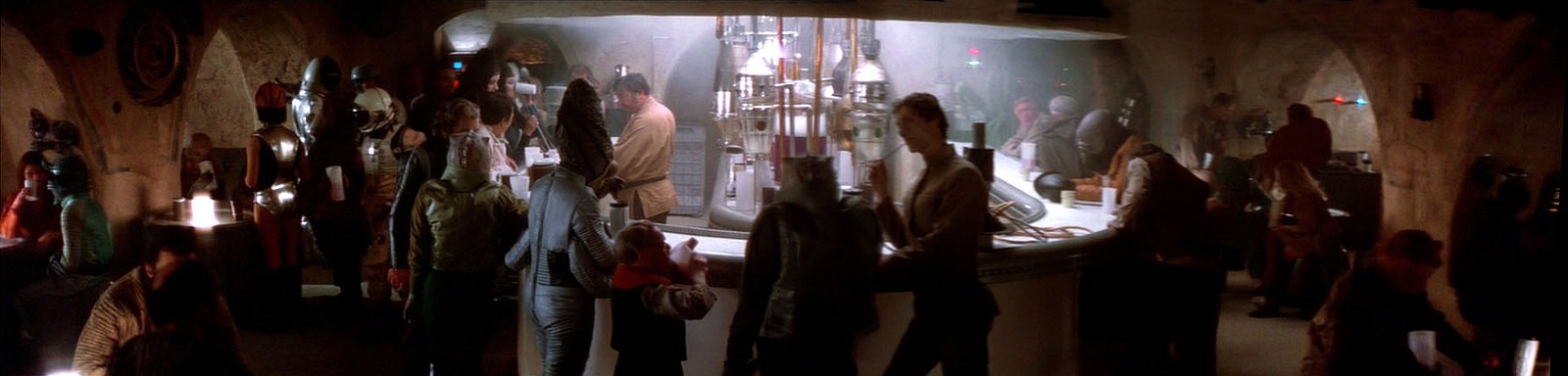
Star Wars alien bar scene at Mos Eisley Cantina on Tatooine
Yes, it’s great entertainment. Isn’t that what big action flicks are all about?
But along with the entertainment comes a spiritual element of good vs. evil; of morality, selflessness, and concern for the good of others vs. immorality, greed, and a desire to rule over others and turn them into slaves.
The vast battles in Star Wars are not only spectacular physical battles. They also represent spiritual battles. And the Force is an all-pervading element that connects every battle with spiritual reality.
A Force for good or evil
A dead giveaway that the Force is not God is that the Force has both a good side and an evil side. The “light side” of the force is the way of the noble Jedi order of Master Yoda and Luke Sywalker. The “dark side” of the force is the way of the evil Sith order of Emperor Palpatine and Darth Vader.
God does not have an evil side. God is only good. (For more about God, see “Who is God? Who is Jesus Christ? What about that Holy Spirit?”)
However, spiritual reality does include both good and evil. In traditional religious language, they are called heaven and hell. And we humans do exist within the pull and influence of both heaven and hell. As expressed in the Star Wars universe, we exist in the tension between the light side and the dark side of the Force.
All of the characters in the Star Wars narratives fall somewhere along the spiritual spectrum that stretches from powerful goodness and light all the way to powerful evil and darkness. And just as in real life, characters are tempted toward the dark side. Some of them yield to it, and become evil characters. Some of these are later redeemed from the dark side by choosing to act from compassion and goodness instead of from greed and a lust for power.
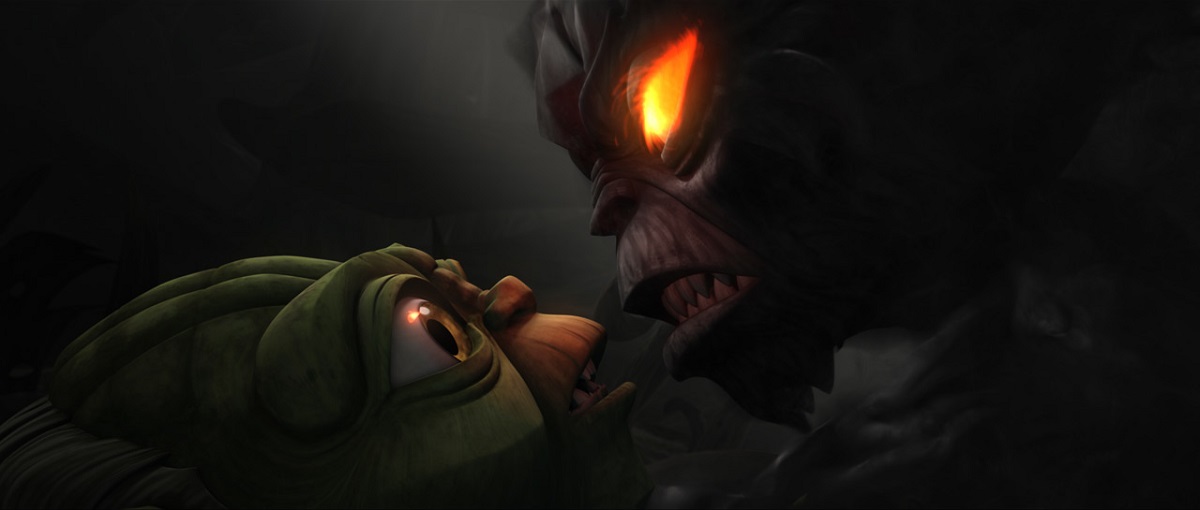
Yoda faces his dark side
And just as in real life, in the Star Wars universe no one is perfect. Even Yoda, one of the most powerful Jedi Masters in Star Wars, must confront and overcome his dark side. Even Yoda must learn through painful trials that if he is not vigilant, he, too, can slip into the darkness of pride and ego. Even Yoda must recognize that he has his limits—that there are some things he simply cannot do.
None of the characters in Star Wars is equivalent to the infinite, all-powerful character of God.
The God behind Star Wars
In short, though there are various references to Saviors and Chosen Ones in Star Wars, as I said earlier, God simply does not appear as a character in Star Wars.
Does this mean that Star Wars is an evil, godless Hollywood phenomenon, as many religious conservatives have charged?
I don’t think so.
Rather, Star Wars does not presume to teach its audience about who God is.
But it does teach much about the nature of spiritual reality, and the spiritual struggle we humans face between good and evil in our own individual lives and in human society generally.
And if Star Wars gets its vast audience thinking about issues of good vs. evil, of morality vs. immorality, of service to humanity vs. oppression of humanity, then the hand of God is present in it.
You see, the very concept of goodness, morality, compassion, and concern for our fellow human beings is an expression of the nature of God. When a hugely popular movie franchise such as Star Wars deals in issues of good vs. evil, isn’t that one more avenue by which God reaches out to us ordinary, entertainment-loving people?
“The Force” in Star Wars is not equivalent to God. But it is a mirror of the spiritual reality in which the human mind, and human society, exists. That spiritual reality is reaching out to us through the minds of George Lucas and a whole host of other people who have brought us the Star Wars universe.
You might also enjoy:
- Video Games, Virtual Reality, and Spiritual Reality
- What Does the Bible Say about Video Games? Part 1
- Amazon vs. Walmart: The Spiritual Shift
- What Happens To Us When We Die?
- Heaven, Regeneration, and the Meaning of Life on Earth
Share this:


Lee Woofenden is an ordained minister, writer, editor, translator, and teacher. He enjoys taking spiritual insights from the Bible and the writings of Emanuel Swedenborg and putting them into plain English as guides for everyday life.



 Spiritual Insights for Everyday Life
[…] and feels familiar is because the Star Wars saga uses spiritual language. Lee Woofenden gives an interesting explanation about what the Force means. The Star Wars films do not talk about God specifically. Instead, they […]
Did you mention the Cosmic Force and the Living Force? In Legends, there are two more parts of the Force, I think one of them is the Physical Force but I cannot remember the other one.
How does the Holy Spirit compare to and contrast from the Force?
Also make an article about similarities and differences between miracles and magic. Like a Venn diagram. Miracles are the power of God’s holy spirit, while magic uses demonic power. Magic is used to hurt and control people, while miracles are used to heal the sick, get the lame to walk again, get the blind and deaf to see and hear. Magic uses elborate words and rituals, while for miracles one just speaks and God does the rest. In the overlap in the Venn diagram, it should either be “defies the laws of physics,” or “makes impossible things happen.”
Hi World Questioner,
I don’t know how your sources are defining “Cosmic Force” and “Living Force,” so I can’t say anything too definite about them.
However, in Swedenborg’s system, there is a generalized inflow and a direct inflow of spiritual force into material things. The general inflow keeps biological processes going at the cellular and systemic level. The direct inflow results in specific ideas, feelings, dreams, visions, and so on within the mind and heart of particular people, based on their particular character and motives.
About miracles vs. magic, I don’t think it’s that simple. The first few miracles Moses did in front of Pharaoh were repeated by Pharaoh’s magicians using their magical powers. A better distinction, I think, is between light magic and dark magic. (But I don’t think “light magic” is the usual term.) Light magic is magic done from good motives, to bring about good results. Dark magic is magic done from evil motives, to bring about destructive results. The same principle applies to miracles.
Oh! The Unifying Force is the term I an looking for. But only the Living Force and Cosmic Force are officially canon, the Physical Force and Unifying Force are Legends.
Would the Living Force correspond to the physical/material world while the Cosmic Force corresponds to World of Spirits?
Wouldn’t the Force compare more to the Holy Spirit? I don’t know about the Ancient Order of the Whills, which George Lucas recently explained in what his sequels would have been had Disney not bought Star Wars. I wouldn’t compare the Whills to God the Father, since they are a mass of single-celled organisms, although they think and feel as one.
Hi World Questioner,
I haven’t gone deep enough into the intricacies and mechanics of The Force in Star Wars to discuss these distinctions. But I will say that I was disappointed when The Force was identified as some sort of biological organism or something. This makes it less like something spiritual, and more like something merely physical.
Check out what George Lucas recently said about the Whills. They are not physical. They feed off the force.
Hi World Questioner,
If you want to post a link about it here, I’ll take a look.
Here’s one link: https://www.youtube.com/watch?v=4GjNa6t9hAE – George Lucas Fully Explains the Whills (Force Gods).
Also check out https://www.cbr.com/star-wars-the-whills-explained/ and https://screenrant.com/star-wars-whills-midi-chlorians-force-explained-by-lucas/
Am I getting off-topic?
If whills are a mass of single-celled organisms, then that doesn’t reflect God. Seems more like decentralized opposite, in which a countless mass of little organisms work together granting powers.
Hi World Questioner,
Thanks for the links. Apparently I am far from the only one who was annoyed by The Force getting all tangled up with cellular biology.
As I say in the above article, I don’t think God is a character in the Star Wars movies. I do not think The Force is a representation of God, as some people seem to think. Rather, I think Star Wars goes only as far as the spiritual level of reality (not to the divine level), and The Force is its representation of the influence of the spiritual realm on the physical.
The mechanics or biology of how that spiritual influence works on the physical is more a matter of curiosity about technical things than an essential part of the relationship between the spiritual and the physical. It’s of interest to nerds, but has no particular practical effect on the actual workings of The Force. It’s just the mechanics of how The Force operates.
It’s like focusing on the pistons of a car rather than on what the car was built to do, which is to carry people and their stuff from one place to another. If you’re an auto mechanic you need to know about pistons and how they work. But if you’re just an ordinary person who wants to get into a car and drive it, it’s not necessary to know how the engine works.
This, I think, is why people were impatient with all that cellular biology in The Phantom Menace.
Oh, and the Whills do seem to be physical entities. They have a ratio to and relationship with the midi-chlorians, which are living biological organisms within living cells.
The Force itself does not seem to be either the Whills or the midi-chlorians. The midi-chlorians feed off The Force, which implies that they are not The Force. And the Whills depend on the midi-chlorians for their supply of The Force. (This is based on the video and articles you linked. Myself, I’m more of a Star Trek guy than a Star Wars guy.)
In his scientific works, written before his spiritual eyes were opened, Swedenborg did propose a complicated scheme by which the creation of the physical universe happened through “first finites,” which were (if I understand him correctly, which I probably don’t) dimensionless points that were the first manifestation of spiritual energy on the physical plane. He then proposed a whole series of nested amalgamations of these “first finites” into larger and larger particles (really, bubbles), each made up of the next smaller particles. So there is a parallel between Swedenborg’s earlier scientific theories and Lucas’s Whills and midi-chlorians, though the parallel is far from exact.
However, in his theological writings, written after his spiritual eyes were opened, Swedenborg’s whole earlier scheme of “first finites,” “second finites,” and so on basically disappears. He may still have been thinking in those terms. But he doesn’t explicitly state that scheme in his theological writings. Perhaps he also recognized, like Star Wars fans did about the Whills and the midi-chlorians, that getting into the weeds of particle physics would suck all the spiritual life out of his theological writings.
How does Heaven or the World of Spirits compare to the Netherworld of the Force in Star Wars?
Hi Word Questioner,
I’m not enough of a Star Wars geek to know anything about the Netherworld of the Force.
It is a good thing that the spiritual realm does not work like the Warp or Immaterium from the Warhammer 40000 series. In that series, the Warp is hyperspace like in other SF (such as Star Wars), but is also a realm of so-called pure psychic power, and is influenced by the thoughts and emotions of sapient entities living in normal spacetime. In WH40K, psykers: people with so-called psychic powers, can tap into the power of the Immaterium for ESP ability (the equivalent of the Force of Star Wars), but such can be rather risky in the WH40K setting.
In the WH40K series, by the year 30000 or so, the Warp had become a literal chaotic hell because of all the suffering in normal spacetime. Entities of the Warp can project into physical space and wreak havoc on the physical, as well as on anyone who has ESP ability.
But in the WH40K setting, there seems to be an absence of an infinite God who keeps order and maintains existence, hence just chaos instead.
Hi K,
Yes, having God in the mix changes everything.
I’m not familiar with that series, but it does sound somewhat reminiscent of Swedenborg’s teachings about the interactions between people in the physical and spiritual worlds. One affects the other, especially on the “psychic” (i.e., mental or spiritual) level.
In particular, the “literal chaotic hell” that the Warp devolved to bears some resemblance to the spiritual world and its effects upon the material world just before the Last Judgment. At that time, evil spirits had gotten control of most of the world of spirits (the region between heaven and hell where spirits first arrive from earth), and were undermining the lowest heaven, which affected the higher heavens as well. The Last Judgment was a process of reducing that situation back to order, banishing the evil spirits to hell where they belong, and reorganizing both heaven and the world of spirits in a better and more stable pattern.
This has taken place at several points during human spiritual history. The biggest one was at the time of the Incarnation (God coming to earth as Jesus), at which time, by taking on a human side, God took the personal power to deal with evil spirits directly. Before that, God had worked mostly through angels. But angels, being human and finite, just weren’t powerful enough to handle the level of rampant evil that had come to exist at that time—which was the lowest ebb of human history.
There has been one more Last Judgment since then. It took place during Swedenborg’s lifetime, and it dealt with the resurgent human evil brought about by the corruption of Christianity over many centuries. This, according to Swedenborg, will be the last universal Last Judgment. From now on God, through God’s divine humanity, will keep heaven and hell in balance.
This most recent Last Judgment freed the human mind from the shackles of false and corrupt Christianity, leading to the greatest period of intellectual and spiritual growth on this earth in the history of humanity. Secularists think of it as the Enlightenment, but based on Swedenborg’s system, the Enlightenment was simply a manifestation on earth of the freeing of the human mind brought about by the Last Judgment that God accomplished in the spiritual world at that time.
So yes, having God in the mix makes all the difference in the world. God intervenes when things are getting so far off track that no human power will be able to right the wrongs of humanity, both in this world and in the spiritual world.
The Warhammer 40,000 series is a so-called grimdark series, about a very dystopian far future Milky Way galaxy, where a totalitarian Imperium of Man has fallen into superstition and corruption. The Imperium is threatened by aliens, so-called heretics, and entities and powers of Chaos (the Immaterium). The setting is like the polar opposite of that of older Star Trek, and it is even more warlike than Star Wars (as the name Warhammer may imply).
[Forget the power of technology and science, for so much has been forgotten, never to be re-learned. Forget the promise of progress and understanding, for in the grim darkness of the far future there is only war.]
(quote from the introduction to the series)
Not really into the series myself because how dystopian it is, and also much of it is in an overpriced tabletop wargame. Yet lore can be interesting, and there is also internet memes. There is also a quote/meme from that series that may resonate with me at times:
[From the moment I understood the weakness of my flesh, it disgusted me.]
(Though I doubt I want to become a machine, which is what the rest of the quote is on.)
Anyway, if there is a realm where thoughts can manifest externally, it is good if the good and the evil are not compelled to mix forever in a hellish realm, with no apparent help or intervention from a Supreme Being.
Hi K,
Fortunately, there is a supreme being, who keeps hell and heaven separated from each other, and doesn’t allow evil spirits to harass good spirits and angels.