Have you ever had a mean, angry, or impure thought and beat yourself up about it, thinking that you are the worst person ever?
Have you ever done a good deed, or had a brilliant idea and patted yourself on the back for it, thinking of yourself as better than the crowd of ordinary people out there?

The crowd
If so, welcome to the human race!
We humans commonly think of ourselves as being evil or good depending on whether our thoughts, feelings, and actions are evil or good in our own judgment.
The reason we think that way is that we don’t understand how things really work—or if we do, we don’t really believe it.
Specifically, if we’re religious or spiritually oriented, we probably believe in our head that everything comes from God. But when it comes down to that great (or horrible) idea we just had, or that good (or evil) deed we just did, do we really believe it? Our natural tendency is to think that everything we think, feel, and do is our own.
The reality is that nothing we have, nothing we are, nothing we think and feel, and nothing we say and do is actually ours. None of it even comes from us. Ultimately, it all does come from God.
But before it gets to us, it is crowdsourced. All of our thoughts, feelings, motives, and attitudes come from the spiritual crowd that surrounds us all the time.
Crowdsourcing
Crowdsourcing is modern name for a phenomenon that has been going on ever since there have been crowds of people. The term was coined in 2005 by two editors of Wired Magazine, Jeff Howe and Mark Robinson.
The basic idea of crowdsourcing is that when a person or organization is looking for new ideas or wants to do some big or complex project that would be difficult to accomplish by themselves, they issue an open call to the world, usually via the Internet, asking for ideas, labor, or money. By putting it out to a large crowd of potentially interested people, they gain access to a large number of people, skills, ideas, and contributions that would otherwise not have been available.
Crowdsourcing is used for many purposes, in many fields. Here are just a few examples:
- Police departments may ask the public for photos and videos taken as crimes unfolded in order to piece together a better picture of events, and search for evidence.
- Professional astronomers may ask amateur astronomy enthusiasts to search for particular celestial objects or events, such as comets, asteroids, or supernovas.
- Families of people affected by rare diseases may put out an open call to others affected by that disease in order to pool their efforts to promote research and cures. (See “Rx for a Rare Disease: Create a Mob.”)
But crowdsourcing is nothing new. Listen to this story about the building the ancient Hebrew tabernacle, as described in the book of Exodus:
The Lord said to Moses: Tell the Israelites to take for me an offering; from all whose hearts prompt them to give you shall receive the offering for me. This is the offering that you shall receive from them: gold, silver, and bronze, blue, purple, and crimson yarns and fine linen, goats’ hair, tanned rams’ skins, fine leather, acacia wood, oil for the lamps, spices for the anointing oil and for the fragrant incense, onyx stones and gems to be set in the ephod and for the breastpiece. And have them make me a sanctuary, so that I may dwell among them. In accordance with all that I show you concerning the pattern of the tabernacle and of all its furniture, so you shall make it. (Exodus 25:1–9)
In this ancient example, God crowdsourced the materials and building of God’s own sanctuary! In the true spirit of crowdsourcing, there was nothing compulsory about it. Instead, the offerings of materials and labor was to be gathered “from all whose hearts prompt them to give.” The result was a sacred space that was a freewill gift from the people to their God.
A crowdsourcing God
That story of how God had the ancient Hebrews build the tabernacle says a lot about how God accomplishes things.
You would think that God, being omnipotent, could just snap those divine fingers and the tabernacle would appear fully formed in a flash.
Yes, God could do that.
But that’s not how God works.
Instead, God works by an orderly, step-by-step process to bring new things into being.
And when it comes to us human beings, although God does work on us directly from within, God also accomplishes many things for us through other human beings.
Even being conceived as a new human being requires two people. And once we’re born, we’re cared for not only by parents, but by an extended family and community that become a part of our upbringing. As the saying goes, it takes a village to raise a child. If we were able to trace all of the people who cared for us, taught us, and influenced us in one way or another from our childhood onward, we would find that it is a crowd of people too large to count.
That’s because God has created us human beings to live in community with other human beings, to take care of each other, teach one another, and love and serve one another in countless ways.
If we spend any time at all thinking about it, we will realize and admit that without hundreds, thousands, and even millions of people contributing to our life in one way or another, we could not possibly be the person we are today.
Physically, financially, intellectually, and socially, who we are does not come from ourselves. It comes from all the people who have ever done anything that affected us and contributed to our lives, either directly or indirectly.
In light of this, can we really claim that our life is our own?
Your crowdsourced mind
Okay, maybe you’ll admit that you couldn’t live in this world if there weren’t millions of people who produced and delivered the food you eat, the clothes you wear, the building you live in, and so on. And maybe you’ll even admit that you have learned most of what you know from other people.
But your thoughts and feelings . . . those are your own, aren’t they?
We commonly think that we are alone in our own minds. Nobody else is in there with us, so how could we be anything but alone in our own thoughts and feelings? Yes, we can share them with others if we choose to. And if they’ve been through similar experiences, they may understand. But we’re still thinking and feeling them by ourselves within ourselves, aren’t we?
From a spiritual perspective, the surprising answer to that question is: No. We’re not alone even in our thoughts and feelings.
Just as our physical, financial, and social life is embedded in a vast community of people without whom we could not live, so our intellectual, emotional, and spiritual life is embedded in a vast community of angels and spirits without whom we could not have a single thought or feeling.
The reality of our spiritual environment

Lightning strike
Yes, I know. These days the idea that we are surrounded by angels and spirits who influence us is considered by most educated, scientific people to be an irrational relic of a superstitious past. Most natural phenomena formerly attributed to gods and spirits—such as lightning, thunder, and the fertility of crops and livestock—have now been shown to be due to ordinary physical processes that are adequately explained by science without reference to the activities and intervention of gods or spirits.
When it comes to physical phenomena, it’s best if we cede that ground to science. This material universe is not run by poltergeists who throw things here and there.
But when it comes to the workings of the human mind, it’s a different story. Yes, science can tell us much about how the human brain works, and how that affects the workings of our mind. But the farther we travel up the ladder to abstract thinking and then to spiritual thoughts and feelings, the less science has to say about what makes us humans tick.
That’s because at our deepest core, we are spiritual beings. This physical world is simply an external arena in which our spirit expresses itself.
This means that as human beings, our native environment is not physical, but spiritual.
That spiritual environment is populated by spiritual beings. In fact, the spiritual world in which our mind lives is teeming with angels and with spirits, both good and bad. Although we are not normally aware of it, our minds and hearts live in a spiritual community of thousands and millions of people who have moved on to the spiritual world.
Our thoughts and feelings are not our own
The most surprising result of this is that just as almost everything we have in this material world is produced for us by others, and only a tiny fraction of it by ourselves, so everything in the world of our minds and hearts comes to us from others. Only the tiniest fraction is our own contribution—and even that does not originate with us.
The reality is that our thoughts and feelings exist in a vast spiritual community in which people’s thoughts and feelings freely flow from one person to another, and around the whole human community, just as goods and services flow freely among people, communities, and nations in the material-world economy.
The reality is that we are not alone in our thoughts and feelings—no matter how much it may feel that way to us in our ordinary, earth-focused life. Instead, all of our thoughts and feelings flow into us every moment from the spiritual beings, both good and evil, who surround us in the spiritual environment where we are already living even while we are still inhabiting our physical bodies here on earth.
That’s why John the Baptist said, “No one can receive anything except what has been given from heaven” (John 3:27). And as for the evil and false things that come into our minds and hearts, those, too, do not come from us. Instead, they come from the Devil (a collective term for hell), whom Jesus called “the father of lies” (John 8:44).
According to Emanuel Swedenborg (1688–1772), if the angels and spirits who surround us all the time were to be withdrawn even a little bit, we would not be able to think and feel anything at all. That’s because our thoughts and feelings are not our own. They come to us from above . . . and below.
What does this mean for us?
Okay, what if all that is true? So what? What’s the difference?
Here’s the difference: If all of our thoughts and feelings actually come from the angels and spirits with us—and ultimately from God, either via a direct or twisted path—then we can’t really take credit for anything we think, feel, or do, good or bad. Nothing in our spirit, mind, or body is truly our own. It all comes from a spiritual source outside of ourselves.
How would it change our lives if we fully realized and accepted this?
Let’s go back to my original questions:
Have you ever had a mean, angry, or impure thought and beat yourself up about it, thinking that you are the worst person ever?
What if you realized that those thoughts are not really yours? What if you realized they came from the evil spirits around you, and from hell? Then, when such feelings popped into your head—as they will—instead of getting angry with yourself and beating yourself up, you could say, “That’s not me. That’s from hell. I don’t want it to be part of me, so I am going to send it back where it came from.”
Have you ever done a good deed, or had a brilliant idea and patted yourself on the back for it, thinking of yourself as better than the crowd of ordinary people out there?
What if you realized that those brilliant ideas and good deeds are not really yours? What if you realized that they come from the angels around you, and from God? Then, when you had a good thought or did a good deed, you would not get all puffed up with pride, turning virtue into an ego trip. Instead, you would think, “These good ideas and good deeds are not mine. They are gifts given to me—and they are meant to be used in serving others.”
Here is how Swedenborg expressed it in Heaven and Hell #302:
I have talked with angels about the connection between heaven and the human race, and have told them that religious people do say that everything good is from the Lord and that there are angels with us, but few people really believe that angels are so close to us, much less that they are in our thoughts and feelings.
The angels have told me that they knew this kind of [empty] belief and talk occurred in the world, and especially (which astonished them) in the church, where people have the Bible that teaches them about heaven and its connection with them. Yet in fact the union is so vital that we could not think the least thought apart from the spirits who are with us. Our spiritual life depends on this. They said that the reason for this ignorance was that people believe they live on their own, without any connection with the Ultimate Reality of life. They do not know that there is this connection through the heavens. Yet if that connection were severed, we would instantly drop down dead.
If we believed the way things really are, that everything good comes from the Lord and everything evil from hell, then we would not take credit for the good within us or blame for the evil. Whenever we thought or did anything good, we would focus on the Lord; and any evil that flowed in we would throw back into the hell it came from. But since we do not believe in any inflow from heaven or from hell, and therefore believe that everything we think and intend is in us and from us, we make the evil our own, and defile the good with our feeling that we deserve it.
If nothing is ours, what are we?
Does this mean that we are nothing at all?
Compared to God, the answer is yes. God is everything, and we are nothing.
But God thinks more of us than that.
That’s why God has given us a sense of ourselves as unique individuals within a community of people and within the being of God.
If nothing we have is ours, then what are we?
We are containers and conduits to carry what is good, true, loving, and compassionate to the people and the world around us.
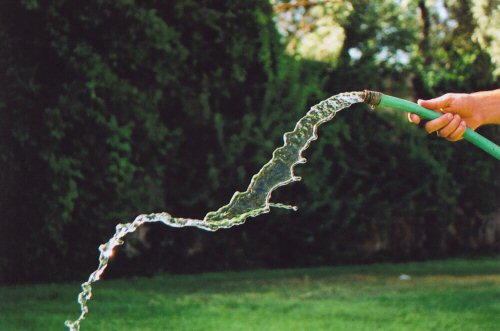
Garden hose
Think of yourself as a garden hose. The water that flows through you is not yours. It comes from the spigot (and beyond), and flows through you. Your job is to direct that water toward the plants and animals who need it to sustain their life. You are not the water. You are a channel or conduit to carry the water to others.
Or think of yourself as a drinking cup. The water in the cup is not yours. You simply contain it.
And we are a choice. That choice is whether to accept what flows into us from God and heaven, and express that in our lives, or to accept what flows into us from evil spirits and from hell, and express that in our lives.
To use the image of the cup, you can turn your cup rightside-up, or you can turn it upside-down.
- If you turn your cup upward, it will be open to the water of wisdom and love that flows into you from above. If you set the cup down, no dust or dirt on the surface below it can get into the cup and contaminate the water. You will be able to offer a cool and refreshing drink of that that life-giving water to everyone around you.
- But if you turn your cup downward, all the good things flowing down to you from above will hit the bottom of the cup, run off the sides, and be lost to you. Instead of receiving life-giving water from above, you will be open only to the dust, dirt, and vermin of evil and false influences from below.
Nothing we have and nothing we are comes from us, or is truly ours. Everything we have flows into us from above . . . or from below.
There is no sense feeling guilty about the bad thoughts and desires that pop into our heads. They do not come from us.
There is no sense in getting all egotistical about the good things we think and do. They are not ours.
But we can refuse to accept and act upon the evil and false things that flow into us from below, and instead send them back to hell where they came from.
And we can, in humility and innocence, express the good that flows into us from God and the angels by living a life of love, understanding, and service for our fellow human beings.
For further reading:
- If Our Thoughts Come from the Spiritual World, Where Did the First Humans Get their Thoughts?
- Containers for God
- Who Are the Angels and How Do They Live?
- Is There Really a Hell? What is it Like?
- Heaven and Hell, by Emanuel Swedenborg
- Heaven, Regeneration, and the Meaning of Life on Earth
Share this:


Lee Woofenden is an ordained minister, writer, editor, translator, and teacher. He enjoys taking spiritual insights from the Bible and the writings of Emanuel Swedenborg and putting them into plain English as guides for everyday life.


 Spiritual Insights for Everyday Life
Thanks for an excellent description of the way in which our minds are dependent on the continual influx of thoughts and affections from the realm of spirit.
Hi Forrest,
Thanks for stopping by. Glad you enjoyed the article!
Hello Lee! I’ts been a while since if been on your website, so I hope you’re doing well
Recently, I’ve been struggling with spiritually matters and have looked all over for answers to my questions, so I decided to cover all the ground I can and come back to your website (since it’s helped me before) and stumbled on this post and “Containers for God”
In a cosmic sort of way i’ve always known everything we are comes from God, since God created everything and i’ve always belived that things like intrucive thoughts are just attacks on your psyci from..uh..well Hell.
But I’ve also always though that God created us to be self sustaining beings (souls? Creatures?) with our own ability to create, love and act for ourselfs. (Sure all these things still COME from God but we are still our own.. thing) So God can have a relationship with us, because we are seperate being from God. Sort of like…mini Gods? (Wooow that sounded self-centered when I actually typed it out, its not meant like that i just cant really describe it in any other way)
Because if we werent then wouldnt it be like God having a relationship with…himself?
Anyway my question (is it really a question?) relates to the fact that i’ve recently learned is that everything we are, everything we think, do, say and so on…is not us, but God
I hope im not sinning or being selfish when I say this, but to me thats very daunting and…depressing really.
In every website i’ve checked, every article i’ve read that says to just aknowledge and accept it, but it never explains or gives examples on HOW to do it.
I hope It doesn’t sound too crazy when I say that (to me atleast) having the bomb of “Oh hey! By the way nothing you are, say, think, do or have is yours 🙂 Nothing is yours! Pretty crazy right?” Dropped on you is a pretty world-shattering and.. kind of depressing thing to be told. (Also I hope im not making it sound like this is pointed at you or your articles, because it isn’t – im just speaking in general)
So my question is…how does one accept this, how did you accept it? Is there anything in the Bible or Swedenborgs writting that deal with stuff like this?…is it sinful to feel like this?
Thank you in advenced for reading this and im sorry it came out so long, I just have alot on my mind right now.
Hi Jazmine,
Good to hear from you again. I hope life has been treating you well since we last spoke to each other here.
These are great conundrums and excellent questions! Before I write a long response though, please take a look at this article, especially its last section, titled “Believing and acting as if by ourselves”:
God, Forgiveness, Freedom, and Hell – Part 1
The key to understanding the situation you mention is Swedenborg’s idea of “as if of self.” Even though everything in us is God, we’re not actually God. We are containers for God. And even though everything in us comes from God (or from hell), not from ourselves, we’re still designed to speak and act as if we are speaking and acting from ourselves. This sense of self is a gift that God gives us so that we can be human, and be our own person in relationship with God and with other people.
Give that article, especially the later sections of it, a read, and see if it helps. Then feel free to continue the conversation if you wish.
Hello Lee! Thank you for the response and I uhh
woow, I uh…really took my sweet time replying huh?
Im very sorry, lifes been a bit hectic lately, but I really do appreciate the response! (But I hope you’ll forgive me if i say I still find it a bit confusing)
What confuses me still is Swedenborgs idea “as if of it self”..mostly because I dont understand how its meant to be interpreted.
Is Swedenborgs idea that “Everything comes from God” the same as.. everything coming from God (see why im confused?)
For example, is me making this comment asking you this.. God, as me, typing you this…while you also being God..essentially God asking himself this..because everything is or comes from God?
Or.. is it that we are more like prisms and God is the light, everything comes from God but we still choose what part of God shines through us and who we are as people (by which qualities, or lack there of we show), that, combine with our free will making us unique and separate being from God, altough it is still God that gives us this power and the ability to actually exist.
Because the latter (to me atleast) sounds more truthfull (is truthfull the right word?) and the former (excuse me if this sounds rude, I just can’t can think of a way to self any diffrently) sounds to me like someone talking with they’re own sockpuppet… which is what confuses me because, I don’t believe God needs to resort to such trickery.
Thank you in adance for reading this, I hope im not sinning my asking such questions or, “questioning” (again, is that the right word?) God, but ill be honest, genuinely, im just a bit confused. (And isn’t honesty one of the seven heavely virtues?)
Hi Jazmine,
Good to hear from you again, and no problem about any of this.
And . . . Yes! It’s the prisms and the light! That’s exactly how it works.
Another one: God is the water tower filled with water, and we’re the hose. Without the water flowing from the water tower, the hose would be pretty useless, wouldn’t it? But the water will still go wherever the hose directs it to go.
Hi, Lee.
I just got the eMail of your reply to Hoyle that pointed here, so I read this article and the comments. I have two short ideas to suggest: one on how to think about this and a second on your “When it comes to physical phenomena, it’s best if we cede that ground to science” comment.
As I was reading the article and Jazmine’s comments, I would like to point out there is a big difference between what we think and what we do. Although analogies are dangerous, this one may be especially appropriate to our time. Consider your ideas as though they are social media Internet postings and consider your ‘doing’ as your curated posts based on those ideas. You have little if any control over the posts that come by but what you pass on and the comments you provide are things over which you do have control. Yes, all of the ideas do start with God, but by the time they get to you, they’ve been adjusted by many if not countless other creatures. But you have choice and intellect to react and decide if and how to pass on the idea. Actually, neuroscience has recently run experiments that actually support this notion. The experiment suggests we don’t have ‘original’ creation but do have the power to reject ideas we disagree with. The experiment suggests Free Won’t. So, each of us is what we choose to do, not random thoughts that come by.
Second, and on the science topic, it’s important to recognize the limitations of science which Scientists routinely ignore and fail to disclose and, yes, lie about. Yes, science has ‘explained’ simple controlled phenomena that it can describe with math so it’s ‘scientific’. But the math all fails at the current limits of science even though Science doesn’t really admit it. It fails at the subatomic size when it goes to statistical explanations. It fails at the cosmological sizes of galaxies and universe when it invents fudge factors like Dark Matter and Dark Energy. It fails when it invents and embraces untestable philosophical ideas like the Multiverse. It fails when it can’t account for Entanglement nor integrate the two foundational theories of physics: Quantum Field Theory and General Relativity. It fails when it can’t explain the Fine-Tuning Problem. It fails when the theory of Evolution fails to account for the observed fossil and genetic record. And, biggest, it doesn’t account for what is so obvious to each of us, our individual consciousness. So, yes science can explain the correlation of simple stuff, but it really doesn’t explain what is hard today.
Ted
Hi Ted,
“Free Won’t.” I like it! 😀
I entirely agree with your thoughts on this. In fact, I said similar things in my main response to Hoyle’s last comment on the other post, which you can read here. We do not originate anything that is “me.” But we do “curate” it. We determine what we will and won’t accept as “me.” That’s why and how we are distinct individuals with our own unique chosen (at least in part) character, able to have real, mutual relationships both with one another and with God.
About science, I don’t view the current unknowns and unexplained issues and phenomena as “failures,” but as areas for future exploration and discovery. Most thoughtful scientists would agree. That’s what keeps their field exciting!
The problems come when philosophical materialists and atheists, including a number of scientists, assert that science is the only means of knowledge, and that anything that cannot be studied by science—notably, God and spiritual reality—does not exist. This is a case of extending science beyond its proper boundaries. Science is the study of the physical universe. It cannot draw any conclusions about non-physical things—including about their existence or lack thereof.
Stephen Jay Gould’s “Non-overlapping magisteria (NOMA)” concept is useful here. I don’t fully agree with his formulation of it. But the core idea that science and religion each has its own domain, into which the other should not intrude, is quite sound, I think.
In particular, I believe that consciousness is a spiritual phenomenon, not a physical phenomenon. That’s why science has such a hard time dealing with it. Science can say things about the results of consciousness in the material world. But I do not believe science will ever be able to get a solid handle on consciousness itself. Here is an article in which I cover this a little more fully:
Are We Headed for an AI Apocalypse?
On some of the other topics you raise about science:
The reality that our current math and physics fails at the boundaries of known science is, once again, not a “failure,” but rather a call to further theorizing and discovery. This the scientists are busily doing.
I have no doubt that there will be new breakthroughs that will lead to more sophisticated ideas about the nature of physical reality. Just as Newton was not “wrong,” but rather his theories turned out to have limited applicability, so current theories of relativity and quantum mechanics will likely turn out not to be wrong, but rather not universal in their applicability. Ordinary earth-bound endeavors such as engineering still rely mostly on Newton. But Einstein is required once we start sending rockets to the Moon and Mars. And quantum mechanics is necessary for advanced electronics. That will continue to be the case even when we have new theories that go as far beyond Einstein, Bohr, and Planck as these men’s theories went beyond Newton’s.
I don’t have a problem with the theory of evolution. I think it’s a pretty good explanation of how the incredibly varied species of plants and animals developed on this earth. Having said that, it’s likely that our initial ideas of exactly how this happened will have to be modified as more and more fossil evidence is turned up in more and more parts of the world.
As for the multiverse, that doesn’t seem to me to be a scientific theory, because it’s unlikely that it will ever be falsifiable by science. We live in our physical universe. That is the only universe our science can study. Other universes will likely remain forever beyond the reach of our science. That’s why many scientists don’t like the multiverse theory.
I would say that science has indeed gone beyond explaining “simple stuff.” But science will always have its limits. One of those limits is the boundaries of the physical universe itself. Science cannot say anything about phenomena that exist outside of the physical universe.
A more interesting question, I think, is whether science will ever bump up against something in the physical universe that it just can’t explain, and that requires a supernatural explanation to account for known scientific data. Personally, I doubt this will ever happen. I don’t think God has constructed the physical universe such that it requires belief in God and spirit.
However, I do think there are many phenomena we experience every day that cannot be explained by science, and that ultimately require a spiritual explanation. The biggest of these is our own consciousness. But as I said, I don’t believe that consciousness is part of the physical universe, even if it clearly affects the physical universe in the form of human (and animal) actions that originate in conscious thought and choice.
Thanks for your good thoughts!
Lee,
Thanks for your thoughts and the AI link.
While I agree with your point that the ‘failures’ are just opportunities for more scientific work, I chose the ‘failure’ word, because these gaps are not pointed out to the general public, nor are they taught in schools these days. We generally ‘publicize’ science in much of the same way that science was publicized at the end of the 1800’s when all that was left in physics were a few minor loose ends … this before both Quantum Mechanics and Relativity. I will also point out that most scientists are working on the ‘safe’ interior of the theories well away from these huge gaps and either don’t know or don’t think about them. Only few actually work on the gaps. And the public is routinely propagandized by how science has all of the answers.
Unfortunately, while I respect Gould for his ‘Punctuated Equilibrium’ heresy to Evolutionary Orthodoxy, his NOMA idea is a cop out to avoid the problem by throwing the hard issues to religion and the safe issues to science thus separating the conflict, but not resolving it. I would suggest you look a bit more into where Evolutionary science is today in terms of explanation vs hand waving. Beyond the simple part of evolving little dogs out of wolves, the rapid emergence of phyla and ‘convergent evolution’ is unexplained and of course the original origin of life remains totally unexplained. Both ‘Punctuated’ and ‘Convergent evolution’ are labels for things observed, but not explained. Most of the issues from Darwin’s time have only gotten worse not better so hoping for an improvement with more time isn’t where the trend lines point. A more promising development is the emergence of Systems Biology (https://en.wikipedia.org/wiki/Systems_biology) that studies life as though it was a designed integrated system … because Evolutionary theory was providing no useful answers.
I’m still working on Swedenborg’s idea of Correspondences between the material universe we experience and things in the spirit world, not just as a way of explaining the real meaning in the Word, but as a way of explaining how the two worlds are connected. Or why when you think to blink your eye, it does. Something that science has decided to ignore apparently. If you define science as only material things as Gould suggests, science has already bumped up against many things it will never explain … until the definition is expanded back to where it was in Swedenborg’s time.
Ted
Hi Ted,
If you mean primary and secondary schools, these schools are always behind the cutting edge on pretty much everything. They use textbooks written by committees, which are generally at least a decade behind current developments by the time they get published.
Beyond that, most ordinary people don’t think about cutting edge issues, nor do they think about the philosophical issues of life. They just get up in the morning, eat breakfast, and go about their daily work. Only when they face some sort of personal crisis do they think about “ultimate things.” But even then, most generally do not have the educational background to really grapple with these issues. That’s why I write the articles here in largely non-technical language, aimed at the general public. And if I have to use technical terms, I define them.
In this, I am following our great theologian, Emanuel Swedenborg, who did his best in his theological writings to use as simple and direct a Latin style as he could muster, even though his earlier scientific and philosophical writings demonstrate that he was quite capable of writing in complex, high-flying, erudite Latin. His writings commonly seem more complicated in English translation than is really necessary, especially in the older translations, because the English used was a stilted, heavily Latin-derived style of English. Still, even in the best and most readable translations, some of the stuff he says is quite mind-bending. It’s going to be a mental workout no matter which way you slice it. That’s why it’s necessary for folks like me to “translate” the ideas into ordinary English, complete with concrete examples.
But to your points:
Yes, for centuries science has been just about to answer all of our questions with a grand unified theory, so that all that’s left is a bit of mopping up and filling in of details. Even such a great mind as Stephen Hawking was silly enough to suggest that now we really, really are almost about to have all the big questions answered. But the advance of knowledge stubbornly refuses to cooperate. The more we learn, the more complex we realize things are, and the more big questions we discover that we still don’t have answers to.
Once again, that’s what makes science exciting for the scientists who are working on the bleeding edge of science. But as you suggest, most scientists are the equivalent of blue collar workers. They just show up for their jobs every day, do the day’s lab work, and go home. And we do need that army of non-cutting-edge scientists to get the work of science done, and to provide the data for those who are advancing our scientific knowledge into new frontiers.
As for evolution, I am in no way qualified to comment on the current state of the science surrounding it. Still, I think the basic idea that one species evolved from another is probably sound. Otherwise we do not have any good theory of how the species came to be on earth, unless we want to invoke direct divine intervention for the creation of every new species. I do not find that to be a credible way that God would operate. If God did such a bad job of designing the material universe that God has to constantly tinker with it to keep it working, that doesn’t strike me as a very competent God.
In general, I believe that things that exist within the physical realm can be profitably studied by science without reference to supernatural or spiritual forces, and much can be learned about how they work.
At the same time, there are two huge areas that we deal with every day that I don’t believe science will be able to arrive at good answers for: 1) the nature and origin of life, and 2) the nature and origin of consciousness. These two, in my view, are both spiritual in nature, and therefore will not yield their secrets to purely scientific study. Once again, science can study the effects of life and consciousness on physical objects and systems. But the nature of life itself, and of consciousness itself, will, I believe, remain forever beyond the capability of science to address.
About Gould’s NOMA principle, as I said, I don’t necessarily agree with his formulation of it. Facts (science) vs. values (religion) is too simplistic a formula. At minimum, it should specify facts about material existence. And though values are in the realm of religion, not science, religion deals with much more than values. It deals with divine and spiritual reality. These have their own sets of “facts,” which come to us as spiritual knowledge and insight.
The germ of correctness and usefulness in NOMA is that there are distinct “magisteria” in the totality of the universe, and these are non-overlapping, and it is best for science and religion not to intrude on each other’s territory and start throwing their weight around.
However, I would assign the magisteria to levels of reality instead, and I would say that there are not two, but three of them:
These three levels of reality do interact with one another through correspondences. But they are entirely distinct from one another, such that they do not overlap, nor do they blend into one another. There are distinct boundaries between them. The spiritual universe and the world of the human mind are entirely distinct from God. The physical universe is entirely distinct from the spiritual universe, which is also the realm of mind and of life.
Further, while God can reach down into both created levels of reality, and spirit can reach down into physical reality, the reverse is not the case. Physical reality cannot reach up into spiritual reality, nor can spiritual reality reach up into God. The flow of “information” is all one-way. Interaction that seems to flow upward is really a matter of the higher levels perceiving the state of the lower levels, and acting into them accordingly.
This is the structural reason why science cannot say anything significant about spiritual reality, still less about God.
Theoretically, spiritual reality could say something significant about physical reality. But for the most part, we humans are too ignorant and inexperienced in spiritual matters for this to work. That’s why we have to stick with science to uncover the nature of the physical universe. If we try to determine the nature of the physical universe based on religious ideas, we’re almost certain to get it wrong, because most of the religious ideas that have become ingrained in the culture are wrong, and they vitiate our ability to think clearly about much of anything.
Even if we do have correct spiritual ideas, we are still nowhere near experienced enough in the spiritual realm to draw any sound conclusions about physical reality based on our rather meager spiritual knowledge. Better to study the physical world directly, and learn from it directly.
Swedenborg also warned against drawing concrete conclusions based on correspondences. He was referring specifically to deriving church doctrine from correspondences, which he said is a mistake because of what we today would call confirmation bias: we would use correspondences to confirm whatever religious beliefs we happen to favor. So, Swedenborg said, we must draw the doctrines of our church from the literal sense of the Bible instead. Then correspondences can illuminate and deepen our understanding of those doctrines.
But I believe the same principle is true of attempting to establish the laws and workings of the physical universe based on spiritual principles. There have been many, many attempts to do this over the centuries. And then, science moves on, and much of what those religious writers said about the nature of physical reality turned out to be wrong.
This happens even to Swedenborgians, who, for example, tried for many years to maintain that spontaneous generation is a real phenomenon, and that it explains the origin of species, because Swedenborg (but really, an angel) said so in his theological writings. For another example, some Swedenborgians still can’t accept that the other planets in our solar system, not to mention earth’s moon, are uninhabited, because Swedenborg said in his theological writings that they are inhabited.
This is also my problem with religious critiques of evolutionary theory. Using religion to determine scientific facts is the wrong tool for the job. It is bound to result in vast errors that will be disproved more and more as science moves forward in its investigations.
Beyond that, using religion to investigate physical reality is a cheapening and destruction of the very purpose of religion, and a massive waste of time for religious leaders. It misses the point of what religion is supposed to be doing, which is guiding us toward eternal life in the spiritual world. This is something science can never do.
If churches and religious leaders fritter away their time trying to do the scientists’ jobs for them, that’s a whole lot of time that they could have spent doing their own job, which is leading people toward a good and loving life. That’s what heaven is, and that’s what churches are supposed to be focusing on, not evolution and the beginnings of the physical universe.
Lee,
Again, thanks for the thoughtful reply. Discussing all that you’ve said would take too long and probably not get to a real destination, but there are two points I’ll comment on.
1. ” the basic idea that one species evolved from another is probably sound”
Strangely, I agree, but my definition of ‘evolved’ doesn’t include random variation and natural selection since only the simplest instances would not lead to extinction. Yes, there was probably an original single cell life form that ‘evolved’ into all that we see today, but, No, creating a new phylum such as trilobites from single cell or cell clump creatures over a few million years or creating a human over 100s of millions of years takes a lot of carefully planned and coordinated changes beyond just the creature from an evolutionary perspective. The Intelligent Design folk have provided sufficient reasons why the ‘random variation’ approach doesn’t work, but they’ve left the who and how of an Intelligent Designer to some future effort. To your point about “direct divine intervention for the creation of every new species”, Yes, God could do it by miracle, but there is a lot of ground between divine intervention and random variation that you’ve skipped over. Still, we’ll both agree there’s not even a credible hypothesis between those extremes yet and the answer is somewhere in between.
2. “If churches and religious leaders fritter away their time trying to do the scientists’ jobs for them, that’s a whole lot of time that they could have spent doing their own job, which is leading people toward a good and loving life. ”
I’m not sure that leaving the Materialists to fire broadsides at the young about religion without credible response is a sound idea. It hasn’t worked so well so far if we look at the falling number of believers. It seems to me that credibly and publicly pointing out the beams in the eyes of science might, at least, slow down the attrition to atheism or agnosticism by the young.
Ted
Hi Ted,
On the issue of evolution:
It doesn’t really matter to me how, exactly, the species evolve from one another.
Fundamentalist Christians attack the holes in evolutionary theory because they want to overturn evolution altogether. It doesn’t square with their literal reading of the Bible.
But that literal reading of the Bible is itself unbiblical. In the New Testament, both Jesus and Paul make strong statements that we are to pay attention to the spirit that gives life rather than to the letter that kills. Not that we should ignore the letter, but that the main point is the spirit that shines through the letter. Fundamentalist Christians are firmly stuck in the letter that kills. That’s why their church is dying: because the letter kills.
If we drop the literalism, and recognize that the Creation stories are not about the creation of the physical universe, but about our spiritual creation as “new creatures in Christ,” then we don’t have to argue about evolution, or attempt to pick holes in it. We can wait for the scientists to work out their theories based on all the evidence that keeps coming in, and all their thinking about that evidence. I have no doubt that eventually they will come up with a solid theory that fits the evidence of the fossil record.
What scientists won’t ever be able to figure out based on pure science is why evolution happened, or even why there is a universe in the first place—a universe containing at least one planet that can support human life.
Science can figure out “why” questions that are contained entirely within the physical realm. Such as why lightning occurs, and why it results in thunder. But it can’t figure out the ultimate “why” questions of why we have this intricate universe in the first place, why there is life on our planet, and why life resulted in thinking, self-aware human beings.
These big “why” questions are where religion comes in.
Of course, the ultimate reason for all this is God, and God’s love.
But specifically about evolution, why did it result in human beings? Many secular thinkers believe that humans are just a particular stage in the development of still more advanced life in the future. I doubt that. I think that humans are the culmination of evolution, and that evolution will not result in life forms more advanced than the human form. For one thing, now that humans are developing the ability to manipulate genes, it’s likely that we will solidify our place as the reigning life form on the planet.
However, from a spiritual perspective, according to Swedenborg God is a human being in the ultimate sense of that word. And since God created the universe, everything tends toward the divine form, which is the human form. This, from a Swedenborgian perspective, is why evolution has brought us to human beings.
Evolutionary theory will, at length, tell us how that happened. But I don’t think it will ever tell us why it happened. The “why” of this question is a spiritual question, not a scientific one.
It seems clear to me that life itself is the driver of evolution. And if life is spiritual, not material, as I believe, then life is responding to spiritual forces. It is moving itself forward in its evolution based on those spiritual forces, not based purely on material forces. This, I believe, is why evolution has tended upward toward more and more complex life forms, culminating in human beings who are not only biological beings, but thinking spiritual beings as well.
That, from a Swedenborgian perspective, is the purpose for which God created the universe in the first place. Specifically, Swedenborg says that the purpose of creation is a heaven from the human race. Science can’t tell us anything about purpose, other than in a purely utilitarian sense such as “the purpose of a chair is to sit on it.” But it can’t tell us anything about the purpose of life, or the purpose of the universe. Religion can and does tell us about the purpose of the universe, and the purpose of our life in it.
The material universe is a tool in the hands of God, and of the spiritual universe. It will serve that purpose, and is serving that purpose at least on this planet. Whether there are other planets out there inhabited by advanced, intelligent life is still an open question for secular science. But if we ever do find advanced alien life, I predict that it, too, will tend toward the human form.
This may or may not mean that it looks pretty much like us in physical form—as is common in our popular science fiction. I tend to think that it will. But even if advanced aliens take on some other physical form, I believe they will have the fundamental human characteristics of will, understanding, and the ability to act from them. That’s what is essential to our humanity. Our human-shaped body is simply a tool adapted to carry out what the mind—which consists of will and understanding—desires to do.
The reason I think other advanced life will probably be human-shaped just as we are is that of all the animal forms we are aware of, the human form is the most versatile and able to carry out the will of intelligent, purpose-driven beings. Perhaps there is a form better suited than ours to express the will of a living non-artificial general intelligence. But I doubt it. I think the human form will remain the pinnacle of animal forms.
This is my view of why evolution took the course it did, resulting in us.
Hi Ted,
On the second point, here’s the passage you allude to:
This suggests to me that for religion, pointing out the errors of science is probably not the best strategy unless and until religion has its own house in order.
Unfortunately, the traditional Christian Church has a whole barge full of logs in its own eye. Not only has it been a highly immoral institution for many centuries, but its doctrine has been false, unbiblical, and non-Christian since at least the fourth century.
The fourth century is when it adopted the Trinity of Persons, an unbiblical doctrine that is now fundamental in all three major branches of Christianity: Orthodox, Catholic, and Protestant. Then the satisfaction theory of atonement was developed in Catholicism, and from there spread to Protestantism, its schism. Then in Protestantism, justification by faith alone was developed, completing the destruction of Christian doctrine.
People are becoming atheist and agnostic, not because of the rationality of the atheists (they’re really not all that rational), but because of the destruction of the religion that they came from. Until Christianity abandons its false doctrines, very few of those who have abandoned it will ever come back. And the existing institutions of Christianity are unlikely ever to abandon the false doctrines that form the conceptual foundations of their church.
This is also why Christians who debate atheists usually get trounced. There are so many logs in their eyes that the atheists have an easy time tearing these so-called Christians apart.
That’s what the atheists are there for. I believe that present-day atheists are a hammer in God’s hand, which God is using to destroy the false Christian church that must come to an end before true Christianity can take its place.
This is why I do not lament the growing abandonment of the Christian Church in its various branches. The dissolution of the existing “Christian” church is a necessary step in the ultimate descent of the New Jerusalem onto our earth. The New Jerusalem is symbolic of the new spiritual era that is now beginning. The old must be destroyed before the new can take its place. That’s why there is so much cataclysm, death, and destruction in the Book of Revelation before the New Jerusalem begins its descent in the final two chapters. Those cataclysms are not about the end of the physical world, but about the end of the destroyed “Christian” worldview that has reigned in the Western world for almost two millennia now.
Once the atheists have done their job of destroying the old, false “Christianity,” they will wane, and fade away.
At that point, the doctrinal detritus of the destroyed Christian church will have been rooted out of the popular mind, and the stage will be set for a new spiritual era that is truly Christian. It will be an era in which people pay attention to what Christ and his Apostles taught in the Bible, which the present-day “Christian” church does not do.
I could go on, but here are a few articles in which I cover some of these points in more detail:
Lee,
I do appreciate our talks and your perspectives. Both of your replies are very thought provoking and useful to me in clarifying my thinking. Also, the links. As always, you’ve succeeded.
But first, on your first reply, can you provide the places in the Bible that you like for: “In the New Testament, both Jesus and Paul make strong statements that we are to pay attention to the spirit that gives life rather than to the letter that kills”?
And, Yes, my allusion to Beams in Eyes might be better pointed at the formal religions of today, but there are ample Beams in the various dogmas of science too. It may be a point that we’ll have to agree to disagree on, but I think science and religion would be better off arguing out differences than trying to divide the realm of existence into two independent fiefdoms. I think there are ways to reintegrate science with religion to get back to the Natural Philosophy of Swedenborg’s time to the improvement of both. I also am finding very interesting hints in the Bible that may point to solutions to the many issues in current scientific theories. I don’t presently think that these hints are predictive but rather retrospective as is similar to the prophecy of Jesus found in the Old Testament.
It’s also helpful to get your perspective on the Christian church of today. Being a very recent Christian, I’ve discovered that I’m apparently an early Christian and not so much a current Christian and don’t much like any of the Creeds beyond the Apostles Creed. I would be interested in your thoughts on that Creed and also the Didache. Specifically, do you know of any church that truly follows the early teaching and/or the way of Jesus?
Ted
Hi Ted,
You are most welcome. Glad to help. About this:
That particular wording is Paul’s in 2 Corinthians 3:5–6:
Some translations capitalize the second “spirit,” but there is no warrant for that in the original Greek.
Jesus had already said something similar in John 6:63:
He speaks of “the flesh” instead of “the letter,” but it is the same idea: literalism and materialistic thinking are useless and even deadly, but a spiritual understanding gives life.
For more discussion of Jesus words in John 6:63 in their context, see the article “Eat My Flesh, Drink My Blood,” especially the section titled “Spiritual food and drink.”
Another indication is Jesus’ heavy use of parables, which are stories that contain deeper meanings. It even says in Matthew:
Incidentally, the quote is from the opening verses of Psalm 78, in which the Psalmist begins by saying he is going to speak in parables, and then proceeds to give a poetic account of Israel’s history from the time of the Exodus. Here, even the historical sections of the Old Testament are referred to as “parables.”
Jesus affirmed that the entire Scripture are indeed metaphorical stories speaking of his own life and work:
Based on this, some traditional Christians have labored to figure out how Jesus literally fulfilled everything written in the Old Testament (the Law of Moses, the Prophets, and the Psalms). But the simple fact of the matter is that Jesus did not literally fulfill all the Old Testament prophecies.
In fact, one of the main reasons he was rejected by the main body of Jews as a false Messiah was that he failed to restore the kingdom of Israel, as was prophesied of the Messiah in their Scriptures. Some of his own followers believed he would do this, as reflected earlier in the same chapter and story in Luke:
Though the wording here doesn’t shout it out, what they meant by “redeem Israel” was “free Israel from Roman rule.” Many of his followers thought he was going to be a literal Messiah who would restore the Kingdom of Israel to sovereignty over itself, as in the glory days of King David. When he didn’t do that, many of them deserted him. But he never had any intention of being a literal Messiah, as he said to Pilate in this conversation just before his crucifixion:
Why did Pilate “find no case against him”? Because clearly Jesus had no interest in claiming any kind of worldly kingship. This would have made him a threat for leading an insurrection. Under Roman law, insurrection and claims to the throne were punishable by death. This was the pretext under which the Jewish leaders were trying to get Pilate to order Jesus’ crucifixion. But Jesus himself denied that he had any aspirations for worldly power. Hence Pilate said, “I find no case against him.” He was not a threat to Roman rule over that region.
If he had literally fulfilled the prophecies of the Old Testament about the Messiah, he certainly would have been a threat to Roman power. If the Jews believed that their Messiah, a descendant of David, had arrived, and was about to re-establish the Kingdom of Israel, they would have risen up as a body and rebelled against the Romans.
But Jesus’ followers did no such thing, precisely because his kingdom was not of this world. It was and is a spiritual kingdom. And the entire Old Testament is a prophecy of Jesus only if we read it spiritually. Yes, he did literally fulfill a few of the prophecies, as noted here and there in the Gospels. But most of them he did not. So his words in Luke 24 require us to read the Hebrew Scriptures spiritually, and not just literally.
I could say more on this. There are many passages throughout the Bible that suggest that it is meant to be read spiritually and metaphorically, not just literally. But that’s enough for now.
Okay, one more thing: About the Book of Revelation, and its internal indications that it was never meant to be read literally, please see:
Is the World Coming to an End? What about the Second Coming?
See especially the section titled, “The Apocalypse: Physical or Spiritual?”
Hi Ted,
Back to NOMA:
I don’t think science and religion have to be “two independent fiefdoms.” I believe that science and religion can go hand-in-hand, as you suggest. After all, Swedenborg himself was a scientist who explored the spiritual world.
What can’t coexist is science and the existing Christian Church. The existing Christian Church has become too corrupted doctrinally, and too materialistic in its thinking. It will inevitably come into tension with science as science does not support the literal reading of the Bible that has become almost universal among today’s Christians.
The other side of this is that many scientists think they can make pronouncements about God, the Bible, and spiritual subjects, and that people should listen to what they say on these subjects even though they have no expertise in them, and only a superficial understanding of them based largely on the fundamentalist wing of Christianity, from which many of them came.
This is why I believe that for the time being, science and religion must remain separate “fiefdoms,” if you will.
As for me, I love science. I have spent many happy hours during my lifetime studying science. I still keep up with astronomy and space travel quite a bit. And I read articles about other branches of science from time to time.
What I don’t do is presume to tell scientists how to do their job, or what they should think on scientific subjects. I don’t necessarily agree with all of their conclusions. On some of them I take a “wait and see” approach. But I think it’s best to leave it to the scientific community to work out their own understanding of the physical universe, while I focus on elucidating and illuminating God and spirit.
Still, I look forward to a time when science and religion can once again peacefully coexist. However, I don’t think that will happen until God completes the destruction of the existing corrupted “Christian” Church. Until then, science must still be on its guard against religion.
Hi Ted,
You say:
I suspect that Swedenborg is about as close as you’re going to get to this. Swedenborg actually liked the Apostles’ Creed, while rejecting the Nicene and Athanasian Creeds. For more on his views about the Apostles’ Creed, see this question on Christianity StackExchange, one of whose two answers was written by yours truly:
What problems, if any, do Swedenborgians have with the Apostles’ Creed?
As for me, I am by no means an expert on early Christian texts. This is something I’d love to spend more time on. Whether I actually will get to it is another question entirely.
And finally, you say:
In general, Swedenborg skipped over all the creeds and traditions that have built up in Christianity over the centuries, and went directly to the Bible. This is why I believe he is the closest you’re going to get in recent Christian history to something like the Christianity that existed in the first two or three centuries after Christ. (However, I believe he also made many advances over early Christianity, but in a good and spiritual direction, not in a corrupt and materialistic direction.)
Almost all of today’s “Christian” churches have been so heavily infected with the later human-originated creeds and traditions that they simply can’t return to original, true Christianity. There’s too much human dogma and tradition standing between them and Christ’s early followers. I’m not aware of any Christian sect today that has been able to repudiate all of that “Christian” history and get back to original Christianity.
At minimum, almost all of them still believe in the Trinity of Persons, which did not exist in the early Church. The Oneness Pentecostals have rejected the Trinity of Persons, but have fallen into the error of Modalism. Modalism does predate the Trinity of Persons, but it still doesn’t go back to the earliest times in Christianity. And it is still a doctrinal error. See:
What is the difference between the Swedenborgian and Oneness Pentecostal doctrines of God?
Unfortunately, the organized New Church has poured Swedenborg’s new wine into old Christian bottles. It has adopted all the forms of the traditional Christian Church, and attempted to be a “New Church” within those old forms.
It hasn’t worked very well. The organized New Church is dying along with the traditional Christian Church. So although I believe Swedenborg himself fits your bill, I can’t exactly recommend that you get involved in any of the currently existing Swedenborgian churches. Certainly if there is a Swedenborgian congregation near you, it would be worth stopping by and saying hello. Perhaps you would find some sympatico people there. But it may or may not be your cup of tea. I say this as someone who grew up in the organized New Church.
My main recommendation would be that you read the Bible itself, and also read Swedenborg’s writings. And, of course, keep coming to Spiritual Insights for Everyday Life! 😀
Lee,
Again, thanks for the thoughtful three answers.
I was hoping for something explicit from Jesus that clearly says something that effectively says: “don’t read the bible literally” like Paul said. Jesus spends much time on self-serving literalism by the Pharisees, but I don’t know of a clear statement warning about literal reading. I’m generally suspect of Pauline doctrine since he’s without supporting witness that I can find. Strangely, I don’t think it makes a difference that 1/2 the New Testament is by Paul or influenced by Paul. You just need to be more careful in those books.
You basically confirm what my search has turned up, that all current churches are built on sand and not rock. Sad. If your prediction of continued decent to chaos is true, and I think it is, it’ll make the Revelation tribulations seem minor.
Thanks. And I’m still reading your book so maybe more questions to come.
Ted
PS if you’ve not read the Didache, it’s very short but interesting: http://www.stjohnsarlingtonva.org/Customer-Content/saintjohnsarlington/CMS/files/EFM/Didache_-_Complete_Text.pdf
Hi Ted,
Fascinating! Thanks!
Hi Ted,
It would not be correct to say, “Don’t read the Bible literally.” That’s why Jesus didn’t say it, nor did Paul.
Some parts of the Bible are to be taken literally, such as the two Great Commandments and the commandments against killing, committing adultery, stealing, bearing false witness, and so on. If the Lord had said, “Don’t take the Bible literally,” people would have used that as an excuse to ignore and violate even the plain teachings that we are meant to obey exactly as they are given.
Of course, even the parts we are meant to follow literally also have a spiritual meaning. And the reality is that it’s complicated, and a judgment call, to determine which parts of the Bible are meant to be followed literally and which are to be read only metaphorically—or correspondentially, to use Swedenborg’s word for it. Different churches draw different lines, and they argue with each other about where that line should be drawn. No churches take everything literally. For example, no Christian church that I’m aware of literally practices gouging out offending eyes and cutting off offending hands. They all agree that Jesus was speaking metaphorically in this instance.
There is no simple rule about what to take literally and what to take only metaphorically, because this will vary according to the spiritual state of the people who are reading the Bible. Some will take more of it literally, and others will take less of it literally. This is the beauty of the Bible: it is written in such a way that people in both high and low spiritual states can read it in a way that speaks to them in their own particular state and character.
This is also why there are no such cut-and-dried statements in the Bible as, “Don’t read the Bible literally.”
About Paul, some of what he wrote was clearly aimed at the culture of the time, and is no longer applicable to today’s culture. For example, his injunction that slaves should obey their masters as they obey Christ. It is also clear that Paul was rather full of himself. He’s always talking about himself—how great he is! How terrible he is! It gets tedious. However, his core teachings about faith vs. the Law were critical to the development of the Christian church as a distinct religion, destined to become the largest religion in the world, and not merely a Jewish sect—which would have quickly faded.
Unfortunately, later on in Christian history Paul’s teachings were yanked out of their historical and cultural context, and were completely misunderstood and twisted into something that has nothing to do with what Paul was teaching. Once we rescue Paul from the satisfaction theory and faith alone crowd, his books do become “good books of the church, insisting upon the doctrine of charity and its faith as strongly as the Lord himself has done in the Gospels and the Book of Revelation,” just as Swedenborg said. For more on Paul, please see:
Why Isn’t Paul in Swedenborg’s Canon?
About the descent into chaos, just to be clear, I am referring to the traditional Christian Church descending into chaos, and ultimately dying. This may or may not lead to chaos in the wider society. The chaos that I am talking about has already been happening for a long time within the existing Christian institutions, which do indeed seem to be dying a long, slow death.
Meanwhile, the wider society is steadily voting with their feet and leaving those old, corrupt “Christian” institutions behind. It therefore doesn’t necessarily follow that society as a whole will descend into chaos. I tend to think that will not be necessary.
Lee,
As usual, good points. But it leads me to another issue, that is less important now than when it first surfaced.
Was Paul a real Apostle? I first became attuned to this issue when I noticed that most of the ‘Christian’ internal issues are sourced in Paul’s writings or derivative of those ideas. It didn’t take much work to find out that I’m not the first to notice issues with Paul. There are lots of inconsistencies in his three stories of his ‘conversion, but the biggest issue for me is all of the evidence for him being an Apostle is Paul’s own assertions. And in a certain sense he undermines himself with “And no wonder, for Satan himself masquerades as an angel of light”
Also, it appears clear that the 12 didn’t embrace him ever even if they ultimately drew some kind of truce. Now, I think that Paul thought he was an Apostle, he certainly said so. But that doesn’t confirm who actually spoke to him on the road to Damascus.
So, what do you think about Paul?
Ted
Hi Ted,
First, I would recommend that you read the article I linked for you in my previous reply:
Why Isn’t Paul in Swedenborg’s Canon?
The whole article provides background for understanding the nature of Paul’s letters from a Swedenborgian perspective. In the later part of the article there are also several sections specifically about Paul.
Paul has always been a polarizing figure. That’s the nature of his character and biography. He started out rabidly persecuting the early Christians, then became a bold and iconoclastic preacher of Christianity himself.
Later in Christian history, the corruption of Christian doctrine that took hold in Western Christianity, especially in Protestantism, was based primarily on a misunderstanding and misinterpretation of Paul’s letters. His letters lend themselves to this because he tended to write in a fancy style, using many rhetorical flourishes that can easily be twisted by people who have a doctrinal ax to grind. This was recognized right from the beginning:
Unfortunately, this twisting of Paul’s writings into doctrines he never taught has turned many people outside the traditional Christian mainstream, including many Swedenborgians, against Paul. That is why, as I say in the above-linked article, it is necessary to rehabilitate Paul, and rescue him from the “Christians” who have so badly distorted his message.
Was Paul a “real Apostle”?
Certainly he was not one of Jesus’ original twelve Apostles. But that number of twelve was maintained as a symbolic number, not as a limitation on who could be an apostle. After Jesus’ death, when the number had been reduced to eleven by Judas’s betrayal and subsequent suicide, the remaining eleven picked another, Matthias, by lot from two candidates they had chosen from among “the men who have been with us the whole time the Lord Jesus was living among us, beginning from John’s baptism to the time when Jesus was taken up from us. For one of these must become a witness with us of his resurrection” (Acts 1:21–22).
Why only one, and not both of the two men they had chosen as possibilities, “Joseph called Barsabbas (also known as Justus) and Matthias” (Acts 1:23)? Because the number twelve had symbolic significance harking back to the twelve tribes of Israel. It could have been thirteen, or some other number. But because the number twelve had spiritual significance, they maintained it at twelve after Judas’s death had reduced it to eleven.
However, in Greek the word “apostle” simply means “one sent out.” And as the story of Paul’s conversion in Acts 9:1–25 shows, Jesus did indeed call Paul and sent him out on a ministry of preaching the Gospel of Jesus Christ.
Could it have been Satan, not Jesus, who called Paul?
No. Not unless it was also Satan who spoke to Ananias, one of Jesus’ followers, and instructed him, and others, to receive Paul into their fellowship. We would have to reject the entire story of Paul as narrated in Acts in order to maintain this.
Was Paul rejected by the original Apostles of Jesus?
No. Read Acts 15:1–35. Not only does this show what Paul’s teachings about being saved by faith apart from the works of the Law really means, but in it, the Apostles in Jerusalem under their leader, James, sent emissaries with Paul to establish his credibility and authorization to preach in Jesus’ name.
Naturally, Jesus’ followers were very suspicious of Paul at first. They knew him as a man who was zealously arresting and persecuting them. So yes, it took some time for them to accept him as one of them. But they did accept him as one of them. He was accompanied on his journeys by various recognized followers of Jesus. He was not a lone ranger preaching his own gospel apart from the body of Christian believers.
Notice that in Acts 15, Peter himself spoke for the same view that Paul held, which was that it was unnecessary for Gentile converts to faith in Jesus to be circumcised and follow the various regulations in the Law of Moses that Jews were required to follow. Peter had had his own “conversion” experience on this front, as narrated in Acts 10. Paul was not an outlier, but held this view together with Peter, one of Jesus’ three core disciples.
Certainly there was tension between Paul and the original Apostles at times. There is the famous story in Galatians 2:11–19 of Paul rebuking Peter for not matching his actions with his words about Christians not being required to observe the Mosaic Law.
However, Paul’s story and his message are integrally woven into the story and message of the earliest Christians. We cannot rip Paul out of the Christian story. Rather, we must rescue Paul from the so-called “Christians” who have distorted his message so that it is no longer recognizable. For more on this, please do read the article on Swedenborg’s Canon that I linked above. Then, if you wish, we can continue the conversation there.
Back to your main question:
Paul was not one of the original twelve Apostles who followed Jesus. But Paul was indeed a real Apostle, sent by the Lord to preach the Gospel of Jesus Christ in the Gentile world, where Christianity had its great growth.
Without Paul, it is doubtful that Christianity would have taken off as a whole new religion of its own. It would probably have remained niche sect of Judaism that would have died out before long. Even if it had survived, it would have remained a niche sect, just as Messianic Jews of today are a niche sect. Paul’s message was necessary for Christianity to escape the bonds of Judaism and become the largest religion in the world.
Today, Judaism numbers somewhere between 15 and 24 million people worldwide, which is less than one third of one percent of the world’s population. By contrast, Christianity numbers about 2.6 billion people worldwide, which is almost a third of the world’s population. If Paul hadn’t buttressed Peter in arguing that Christians do not have to observe the rituals of the Jewish Law, Christianity never would have taken off in the non-Jewish world to become the massive religion that it is today.
So if I got this right, a person is already “with” a community of people with similar minds in Heaven or hell, which is spiritually near similar communities?
Also if I understand right, some angels don’t live in communities, but in a home by itself that’s just one married couple? Like there could be an angel couple living in a tree house in the middle of an uninhabited forest?
Hi K,
Yes, during our lifetime on earth we are associated with a similar-minded community in heaven or hell. Which community it is will likely change over our lifetime, however, as we make different choices and take different pathways in life. Obviously, if we are associated with a community of hell, but we make the choice to be spiritually reborn, we will depart from that hellish community and move into association with a heavenly community.
We can also travel around to different communities within heaven or within hell as our ruling love goes through changes during our earthly lifetime. For example, if we are motivated primarily by love of the neighbor, such that we would be called a “humanitarian” in secular language, we will be associated with a community in the spiritual heaven. But if we move farther along on the spiritual path, and our ruling love moves into the realm of love of the Lord, we will be associated with a community in the “celestial” or heavenly heaven.
Only after death does our ruling love get “fired” like a clay pot, so that it no longer changes. Then we remain associated with one specific community in heaven or in hell for the rest of eternity, and live in one specific house that perfectly corresponds to our character.
And yes, similar communities would be near the community we happen to be associated with, and dissimilar communities would be far away from it. In heaven and in hell, everyone and everything is arranged according to similarities and differences in ruling love. This is what causes “space” in the spiritual world. (In the world of spirits, people with different ruling loves can still be mixed together together for a while, as they are on earth.)
On your last two questions, here is what Swedenborg says:
So it isn’t necessarily just a married couple living off by themselves. It could be more like a family grouping. How exactly this works I don’t know. The only family-type relationships that exist in heaven are the relationship of marriage with one other person, and brothers/sisters type relationships. Everyone in heaven looks to God as a common Father—and in the highest heaven, as a common Mother also. This means that there are no parent-child relationships among angels. However, in some heavens—presumably some of the lower ones—households do seem to have servants and such, mirroring the former earthly culture of the people in those parts of heaven. After all, we are the very same people after death that we were before.
I suspect that today cities in heaven are not limited to tens of thousands in population. Even in Swedenborg’s day, there were cities that had a population in the hundreds of thousands. London was pushing a million. Perhaps people are more spread out in heaven because they are sorted out by their ruling loves. However, since Swedenborg’s day Earth’s population has increased by an order of magnitude. I would therefore guess that today there are cities in heaven that number at least in the hundreds of thousands.
Back to households, I suspect there is great variety in angels’ living arrangements. I don’t doubt that many households do consist only of a married couple, and that some of these do live off by themselves because there aren’t any other angels quite like them. This doesn’t mean they never see anyone else. Angels can travel around here and there just as we do on earth. But when they go home these ones would be only with their married partner, or with their extended household, whatever people that consists of.
I still think it’s possible communities in Heaven aren’t bigger than a few thousand. Even in the late 18th century, there were already cities with populations of hundreds of thousands. Also, modern cities are isolating and anonymizing. People don’t really know eachother. There’s not much real community in them.
It also sounds more doable and sane to have a spiritual “family” – a real community – the size of a high school at most, rather than a city the size of Tokyo or New York.
There’s also a natural limit to how many people the brain can handle a community with – I heard it’s around 150 – but such a limit could go away once one is free from physical biology.
Hi K,
Personally, I’m with you. I prefer smaller communities to the big city. However, I’ve known plenty of people who love the atmosphere of hustle and bustle and crowds of people in the big city. Whether people will live in the big city or in a country hamlet in heaven will be a matter of their own personality and temperament.
Also, cities in heaven will be animated by a common atmosphere of love and understanding that is rare to nonexistent in earthly cities. This doesn’t mean everyone in the big city in heaven will be the same. But it means they will be moved by common goals. They will therefore see every other resident of their city as a brother or sister, no matter how many of them there may be.
That sort of big city unified by common motives and goals would indeed be heaven for many highly extroverted people. Meanwhile, the introverts will find their heaven in smaller communities, or in their own remotely situated household.
As for how big the cities get in heaven, that’s something you and I will find out when we arrive there.
Lee,
Thanks. As always, new insights.
I had already read your ‘Paul and Swedenborg Canon’ post and was already aware of the Swedenborg Canon. I had my doubts about Paul before I had ever heard of Swedenborg.
To your quote from Acts about the Matthias selection criteria, Paul certainly doesn’t qualify. And I know of no source or corroboration for the Ananias story other than Paul alone. Now, we could decide to discard all from Acts that talks to Paul, but that would leave Luke (the supposed author) in question needlessly. Luke could simply have been misled by Paul about his (Paul’s) earlier history. It’s not hard to find pages on the Internet that question Paul’s authenticity, but I’m currently struggling through a tedious book by Jeremy Bentham, “Not Paul, But Jesus” from 1823 that seriously dismantles Paul’s story as inconsistent and contradictory.
As to Acts 15, I’m not sure where you find “sent emissaries with Paul to establish his credibility and authorization to preach in Jesus’ name”? Since the Apostles also sent a letter, perhaps the Apostles purpose was to try to make sure their decision wasn’t distorted as seems to have happened anyway based upon one of Paul’s later letters? And in Acts 15, yes, Peter did espouse the doctrine but that was based upon his Centurion experience from before Saul’s ‘conversion’. So, did Paul learn the doctrine from Peter’s experience? Anyway, I’m still very suspicious of Saul’s conversion. That said, the best lies are wrapped in truths, and much that appear in Paul’s letters appear to be truths. It’s just hard to find the lies. If we apply Jesus’ warnings to judge them by their fruits, then Paul’s contribution has many bad results as you already point out. So, Paul remains very questionable in my mind.
To your point that “Without Paul, it is doubtful that Christianity would have taken off as a whole new religion of its own”, we don’t know what would have happened without Paul and we don’t know how much Christianity grew solely because of Paul’s efforts. Evangelizing the gentiles began before Paul, actually accelerated as a result of the efforts of Saul, so we don’t know how much Paul contributed or if his efforts actually hindered the growth of Christianity.
If you know of analysis that tries to compare with and without Paul, I’d be very interested.
Thanks again.
Ted
Hi Ted,
Thanks for your further thoughts.
I’ve responded to this in a comment over on the post about Swedenborg’s Canon. You can see my reply here.
If everyone has a so-called crowdsourced mind, then what were the first sapient beings in the universe like, when there were no spirits to influence them yet?
Also if I have a so-called crowdsourced mind, does that mean that the way I think and the views I hold likely are not unique, even if I may feel like an odd-out freak?
Hi K,
The picture painted by the earliest chapters of the Bible is that those earliest humans had God as their companion and source. God walked with them in the garden. Ultimately, that’s where everything comes from. In the instance in which there are no other humans for the love and wisdom from God to flow through on its way to us, it will flow to us directly from God.
But even then, God’s love and wisdom flows through all the layers of the spiritual universe. God created these spiritual levels first, before the material world and its levels, not so much in time as in priority and order. Creation flows from the inside out through all the layers of the universe, which form something like a series of concentric circles surrounding its center, which is God. Since we humans are finite, not infinite, and created, not divine, we can’t receive anything directly from God, any more than we receive sunlight directly from the sun. It must first flow through the spiritual distance between us and God. (However, now that Jesus has been born and glorified, we actually can receive thoughts and feelings directly from God via the “Son” and the “Holy Spirit,” which are the human presence and power of God’s love and wisdom. But that’s a different topic altogether. And of course, the earliest humans on earth lived before the Incarnation.)
Another wrinkle is that even though the story in the early chapters of Genesis is highly compressed, the actual creation of human beings as “sapient beings”—which in this context I’ll construe as spiritual beings—took place over many thousands of years. It was not a sudden event, but a gradual process of moving from being mere animals who have no awareness at all of God and spirit to being fully human beings who are fully aware of God and the spiritual realm, and have a conscious relationship with them. This spiritually developed state of being is represented by “Adam” (a Hebrew word meaning “humankind”) being formed and placed in the garden. The garden represents a mental environment of spiritual thoughts and ideas that have grown up in our collective mind until they have become fully developed and stable “trees” of settled concepts about God, spirit, and life.
This is suggested even in the first Creation story. There is a whole series of “days,” or stages, before humans are created as the final act on the last day of Creation. This series of days one after another is metaphorically about creating humans as spiritually aware beings. In the story, though, actual humans show up only at the end of the process.
When applied to individuals, this series of days is about the gradual process of regeneration, which involves moving from our inborn self-absorbed state through the various stages of our spiritual life and development until we reach the final stage of being motivated primarily by love for God and the neighbor. But when applied to humanity as a whole, it refers to the gradual process of moving from being mere earth-focused animals to becoming human beings who have an awareness of God and spirit.
Another way of saying this is that this process involved moving from having only the lowest, “earthly” level of consciousness to having the two higher “spiritual” and “heavenly” levels of consciousness. In Genesis, this process was not complete even at the end of the first Creation story, but only in the first half of the second Creation story, when after a different process of creation, “Adam” (humankind, both male and female, see Genesis 5:1–2) is formed and placed in the garden. Swedenborg presents the first Creation story as the raising up of humans to the spiritual level, which is the level of intelligent spiritual thought, and the first half of the second as the raising of humans up to the heavenly (traditionally “celestial”) level, which is the level of being moved in everything we think, say, and do by a heartfelt love for God and for our fellow human beings.
In other words, becoming human was not an instant event, but a long drawn-out process. The literalists who try to interpret the days of creation as whole periods, lasting a thousand years or more, are wrong literally, but spiritually they are onto something. These very compact stories are telling the spiritual story of events that took place over thousands of years—probably over hundreds of thousands or even millions of years.
How is this relevant to your question?
The creation of spiritually “sapient” (not just conscious, but wise) humans was not instantaneous. It was a process of early humans, who were still just animals, developing over time into spiritually aware beings. God gradually added greater and greater capabilities of thought and feeling to these early humans until they reached the stage of being fully human in spiritual capabilities both in mind and in heart. In the earliest stages of this transition, humans had only vague and crude ideas of God and spirit. God built upon these over the millennia to make it possible for people to think more and more clearly about God and spirit, until they reached the stage represented by Adam in the garden, in which humans walked with God in the sense of having a fully conscious and mutual relationship with God.
However, even the people from the earlier stages, who had only an indistinct sense of God and spirit, still had eternal souls, because they did have some level of spiritual awareness. These people were the “pre-Adamites,” which was a long-established but controversial idea in Christian thought that Swedenborg adopted and spoke of—although only a few times, and mostly in his unpublished journal Spiritual Experiences. Here is the beginning of his main entry on the pre-Adamites in that work, which starts at #3390:
The translation is labored, in part because Spiritual Experiences is more like Swedenborg’s notes to himself than a polished work intended for publication. But the general idea is that this pre-Adamite’s spiritual (“inner”) level was only barely there, and not well-developed at all. Even so, he was living eternally in the spiritual world.
What this suggests is that God gradually built up the community of spirits in the spiritual world so that when humans had reached the stage of full awareness of God and spirit, there were already spirits in the spiritual world through whom thoughts and feelings could flow to them. In other words, by the time the people represented by Adam had been placed in the spiritual “garden,” there were already communities of spirits in the spiritual world through whom these “Adamites” could receive their thoughts and feelings.
Ultimately, of course, all of our thoughts and feelings come from God. And as I suggested earlier, it is perfectly possible for God’s love and wisdom to flow into us “directly” (but really, through the spiritual atmospheres) in the sense of not flowing through the angels and spirits around us in the spiritual world. God does have a direct channel to us through our inmost soul. But our inmost soul is above and beyond our conscious awareness. It is not part of our conscious thoughts and feelings. Thoughts and feelings therefore can flow into us directly from God. This is what made it possible for the fully spiritually aware people represented by Adam to develop beyond the pre-Adamites, whose spiritual awareness was increasingly dim and crude as we move backwards through time from the time in human development that is represented by the creation of Adam.
This leads to your second question: If I think of myself as a real freakazoid, am I really unique and alone in my thoughts and feelings?
The answer is that none of our thoughts are unique, no matter how much of a freak and an oddball we may think we are. By the time anything reaches our conscious awareness, it is shared with the angels and spirits around us, at least some of whom will be having thoughts and feelings (including desires) similar to ours. Most likely it’s the other way around, and our “weird” thoughts actually come from those angels and spirits.
It is possible for us to have brand new thoughts that no one else has had before. Witness the development of scientific knowledge over the ages. Before the discovery of DNA, no one could think about DNA and investigate its nature and function because we had no awareness that it even existed. The same is true of our spiritual thinking, which has also grown and developed over time. Even most of our “new” and “weird” ideas were in the minds of angels and spirits before they occurred to us, and that’s where we got them. But just as God walked with Adam and Eve in the garden, and talked with them, I believe it is possible for us to have new thoughts and feelings that come directly from God. These, of course, would be only good thoughts and feelings precisely because they do come from God, who is entirely and infinitely good.
Still, it’s best not to get all puffed up about this possibility. Most likely our fancy new idea is not really new. Probably someone else has already thought of it, if not on this earth, then in the spiritual world. But even if we did get a brand new idea that no one else has ever thought of before, it’s still God’s idea, not ours. God has literally thought of everything! And if we start taking personal credit for this “new” idea, or even thinking, “I’m extra-special because God gave this unique thought to me, and not to anyone else,” we will quickly corrupt and destroy it, and turn it toward doing evil instead of toward doing good. If we believe God gave us some unique idea, then God’s purpose in doing so was to make it possible for us to use that idea to accomplish good for our fellow human beings. And even the ability to do that is not ours, but is something God gives us. See:
Containers for God
Besides, once such a new idea occurred to us, it would immediately be available to and shared with all the angels and spirits around us. The angels will use it to influence us toward doing good for our neighbor by means of it. The evil spirits will use it to try to puff up our ego so that we will immediately corrupt the new idea. It is still best, as expressed in the quote from Heaven and Hell #302 in the above article, to think of all of our thoughts and feelings as coming from, and shared with, the angels and spirits around us. If something we think or feel is truly new, that’s God’s business, not ours.
What this also means is that none of us is as much of a freak and an oddball as we think we are. Even the most introverted and eccentric person on earth is still in a circle of angels and spirits who are having the same thoughts and feelings on their level as that “odd-out freak” person is having on his or her own level.
Not a single one of us is alone. Even in our most secret thoughts and feelings, we all live in a spiritual “crowd” that shares our thoughts and feelings.
And of course, God is present within it all, fully aware of all our thoughts and feelings, both good and bad, and fully loving and compassionate toward us at a level of intensity that we can’t even imagine.
(P.S. I hope you don’t mind if I take your questions and my answer and turn them into a blog post. I’m working on a major new article on a subject that I’ve been contemplating for years, but it’s taking me a long time to research and write. This will give me something to post in the meantime that I think will be of interest to some readers.)
Hi K,
Here’s the edited, posted version of my response:
If Our Thoughts Come from the Spiritual World, Where Did the First Humans Get their Thoughts?
Did Swedenborg ever write why God causes a consciousness to emerge in a certain person? In other words: why am I me and not you nor an alien on an extragalactic planet in IC 1101?
Hi K,
From a Swedenborgian perspective, you have the particular consciousness you do for the same reason you have the particular body you do, only on a spiritual level instead of on a material level.
Physically, you have the specific characteristics you do primarily because of your heredity and secondarily because of your environment, and it is also shaped to some extent by the choices you make along the way.
You were born of a particular set of biological parents. Each one of them carried a certain stock of genetic material, and passed on a unique pattern of that genetic material to you. Those two unique offshoots of your parents’ genetic material became your genetic material, and determined most of your physical characteristics: gender, race, hair color, eye color, and so on. This was shaped along the way by your environment, which had an effect on whether you grew up more or less healthy and sound, and so on. And you made choices along the way that affected your physical health and appearance as well.
It is exactly the same with your mind, aka consciousness, except that the “genetics and environment” are spiritual rather than physical, and the choices you make are spiritual as well. And by “spiritual” here I mean the same as “mental.” The human mind is the human spirit, although there is more to it than we are normally conscious of here on earth.
Similar to your physical genetics, from each parent (I believe, and not just from your father as Swedenborg mostly believed) you received a unique set of spiritual or psychological DNA that combined with each other to form the basic parameters of your mind, known as your character. This was modified to some extent by the particular circumstances in which you were raised. The choices you made along the way also influenced it in better or worse directions, depending on whether they were good or bad choices, and in one direction or another depending on which way you decided to go at various forks in the road.
New human beings are not produced instantly and arbitrarily by a snap of God’s fingers. We are produced through long and very complex interacting chains of cause and effect, some of them physical, some of them spiritual, and some of them involving human free will. All of these flow together to produce the particular “effect” that is you or me.
In traditional Swedenborgian terminology, God does not work immediately, but through means. The physical universe, and our life-bearing earth in it, was not created instantaneously by God in six literal days, but through a long, complex process that took billions of years to unfold. Similarly, the human mind or spirit was not, and is not, created instantaneously by God, but through a long and even more complex process that also took billions of years to unfold. Our consciousness cannot be extracted from that process. It is an integral part of who and what we are.
While a consciousness does not emerge instantly, why is my so-called point-of-awareness with this consciousness, mind, and body though, according to Swedenborg?
In other words, while I am aware that this consciousness, mind, and body may have certain origins, what I want to know is why, according to Swedenborg, is my POV with such, and not some other mind and body?
From a metaphysical naturalism perspective (atheism with no supernatural), this consciousness seems to be an emergent property of this brain activity, but there seems to be no answer as to why this POV emerged with me and not anywhere or anytime else in spacetime.
Hi K,
I think the problem here is the idea that our consciousness is a “point-of-awareness.” A point is an abstract mathematical concept that has no actual reality. It has no dimensions, no substance, and no form.
Everything that exists in reality, including consciousness, has both substance and form. Nothing can exist, except as a mental abstraction, that doesn’t have both substance and form. And even abstractions are actually thoughts that themselves have substance and form.
Even God has substance and form. God is not a “point.” God is an infinitely organic divine being. The substance of God is love. The form of God is wisdom. These are not “simple” as in Catholic theology. God is not simple, but infinitely complex, consisting of infinite “parts,” which is really infinite state. It’s hard for us even to put words to this at its highest level. But the form of God is not just an abstraction. It is solid, real, complex, and human. Swedenborg gets very explicit about this:
Obviously God’s body is not made of physical matter. It is made of divine substance. And it is not finite like physical matter or even like spiritual substance, but infinite. We therefore can’t really grasp it, although we can understand intellectually that God does indeed have all the parts of a human being, because otherwise God would not be human.
Consciousness cannot just exist as an abstract entity. It must exist as a real thing. That means it also must have substance and form. And since human consciousness is very complex, it must have a correspondingly complex form in order to exist.
If we look at the human brain, we find that it has on the order of 86 billion neurons, and over 100 trillion synapses. Why would it have so astonishingly many if these weren’t necessary to carry out its processes? The brain is a very energy-intensive organ. If all those neurons and synapses weren’t required, the body would eliminate them. It maintains them all continually because that’s what’s required to support and reflect human consciousness, not to mention the many unconscious processes, while a human spirit is inhabiting its physical body.
The brain is not a “point-of-awareness.” It is a highly complex structure that has both substance and form. It is extended in space, and its space is tightly packed with hundreds of trillions of elements that make its functioning possible.
The same is true of human consciousness on its own level, which is the spiritual level. It is not a “point-of-awareness.” It is a highly complex structure that has substance and form, and orders of magnitude more parts and elements even than the physical brain because it is spiritual, and spiritual things are orders of magnitude finer and more complex than physical things.
This is why consciousness can’t just pop into one body or another arbitrarily. It must actually build a brain and body in which it can function. That is what is happening in the process of gestation in the womb. And what’s more, the spirit itself is growing and developing in parallel. Really, what’s happening is that God is building a new human being step by step. But God does this by means of the spiritual and physical DNA derived from a new human being’s father and mother.
When the egg is first fertilized, it is a human being only in potential. It doesn’t have any of the parts and organs of a human being. All it has is the blueprint for a human being, in the form of the specific DNA formed by the combined DNA strands of the two gametes. From this a new human being, including that new human being’s consciousness on the spiritual level, is built step by step.
In other words, there is no initial consciousness that is infused into your body. There is the seed from which a consciousness can grow, and it does grow in correspondence with the embryo and fetus—though really, it’s the reverse: the embryo / fetus grows in correspondence with the growth of the spiritual self, which is our spiritual mind and body—including our consciousness, which is entirely spiritual.
There was not some pre-existing POV that just happened to hook up with your particular body. A POV was being built as your body was being built. Before fertilization, your consciousness did not exist at all. Even at fertilization, it existed only in potential, and not in actuality. It was built in parallel with the building of your physical body. This is a fantastically complex process. It takes nine months just to reach the point of a basic human body and mind capable of surviving outside the womb—though still only with constant care from its mother and other family members and caretakers. Then it takes another twenty years or so for that consciousness to develop its basic adult functioning, and decades more for it to fully mature.
Your consciousness is a brand new creation that first came into being when you as a person were being built in your mother’s womb. It didn’t enter into you mind and body. It is your mind, and as long as you live in your physical body in this physical world, it is also dependent on your physical body and brain.
Your mind is your spirit. And your spirit is not a disembodied energy being. It is an embodied, organic, spiritual body whose specific and complex organic structures are required for you to have consciousness at all. That’s because the functioning of those structures—especially the functioning of your spiritual brain—is your consciousness. Without the incredibly complex organic structures of your spiritual brain, you would not have any consciousness at all. There would be no entity that is you capable of something so incredibly complex as human consciousness.
Your consciousness is a function and a property of your spiritual brain and body. It does not exist separately from your spiritual brain and body.
What I was trying to get at is the question of why I am experiencing awareness as me, instead of anyone else. I think what you are trying to say is that I cannot experience reality as anyone else because God created me as me.
It still seems to be going around in circles though, like with the atheist answer. In the atheist answer, the answer to the question of why I am me and no one else is because this consciousness is an emergent activity of this brain. But why this brain? Because this consciousness is an emergent activity of this brain. See where that goes? In circles. With New Church, it could be why is this awareness with this spirit and body: because God created such with this spirit and body… same thing.
Anyway, thanks for the answers still.
Hi K,
It’s not circular. It’s how God creates the universe, and us, including our consciousness, in it.
This doesn’t happen in some magical or arbitrary way. It happens in an extremely complex step-by-step process, every step of which is necessary for the existence of distinct consciousnesses that have a sense of individuality and autonomy so that they can engage in mutual relationships with one another and with God.
There is a similarity to the materialist answer because the physical universe, and the biological creatures within it, are an expression of the divine and spiritual realities and processes that gave rise to the material universe. When materialistic scientists study the material universe, they are studying the order and organization of God as it is expressed on the outermost level, which is the physical level.
As a materialist understands it, your consciousness is a product of your brain, and the complex structure of the brain is necessary for that consciousness to exist. This is not far from the truth, except that consciousness is actually in your spiritual brain (and body), and only inhabits your physical brain and body while your physical body is alive. Once your physical body dies, your consciousness continues, but now fully conscious in your spiritual body, in the spiritual world.
The bottom line is that consciousness requires structure and form, and the structure and form of your consciousness is the specific spiritual brain and body that you have. That spirit, or consciousness, built a physical body for itself to inhabit during your lifetime on earth. It did this (but really God did it) so that it could come into existence and be a new human being.
There’s nothing circular about it. It’s just how things work.
To use the common (but limited and faulty) comparison made between the brain and a computer, a computer doesn’t exist as some abstract point-of-computation. It exists only as an organized physical entity consisting of transistor chips, circuits, capacitors, power supply, hard drive, and so on, all of which together are the computer. None of its functions take place abstractly from the physical structure of the computer. It all takes place within the physical structure of the computer, which is specifically designed, and has a specific structure and organization, to make it possible for it to do the tasks that computers do.
Though the brain is not a computer, nor is the spirit, the principle is the same. There is not some “point-of-consciousness” distinct from the structures of the spiritual and physical brain and body. The activity of those structures is consciousness. And the activities of the specific and unique structure of your spiritual and physical brain and body are your specific and unique consciousness and character.
There’s nothing circular about it. It is an expression of the basic nature of God, which is love, wisdom, and action, expressed in physical reality as matter, form, and function. These are integral to everything in the universe. These three together are everything that exists, including our consciousness.
Short version: there is no “you” distinct from your spiritual and physical brain and body. These are you, and your consciousness is one of the things they/you do.
Asking why you’re in this particular body is like asking why a Camry is a Camry and couldn’t have just as well been a Porsche. The answer is pretty simple: A Camry is a Camry. A Porsche is a Porsche. That’s just what they are, because that’s what they were built to be. It’s really that simple.
With the spiritual of New Church being a manifestation of the timeless abstract (relative to the physical anyway), that manifests as a spirit body being immortal despite apparent fatal vulnerabilities (like needing a heart to live)?
Anyway, if you ever write that one article about how there can be an afterlife despite mind-brain dependence and how the spiritual mind(s) work with the physical, hopefully it would clear things up because I may still be confused to a degree here.
Hi K,
There is no “timeless abstract” in actuality. Only in the abstract thoughts of the human mind.
God is not abstract. God is concrete, consisting of substance and form. Specifically, God is a human being, having all the parts and organs of a human being, only made of infinite divine substance rather than of finite physical matter or spiritual substance.
Nothing is a “manifestation of the timeless abstract.” Everything is a manifestation, or better, a creation of the human God. Both our mind and our body take the form they do because they are a correspondential expression of the form of God. As it says in Genesis 1:26–27, we are created in the image and likeness of God. Our mind and body also have substance because they are created from the substance of God, but their substance has become finite and non-God because God has put boundaries and limits on them, which is what it means to be finite.
I suspect that one of your conceptual problems is in thinking that everything is a manifestation of abstraction, which is not the case. God is much less “abstract” than the spiritual world, not more, and God is far less “abstract” than the material world, not more. God is solid, concrete, and real, only made of divine substance rather than of either spiritual substance or physical matter.
Another way of saying this is that God is more real than spiritual reality, which, in turn, is more real than physical reality.
This is the opposite of how we commonly think during our lifetime on earth. We think of the material world as being solid and real, whereas we think of the spiritual world as being wispy and relatively unreal. But those who have been there through NDEs or “astral travel” report that the spiritual world is actually much more real and vivid than the material world, which is relatively dark and shadowy by comparison.
Meanwhile, God is ultimate reality, meaning that God is the most real thing of all. In fact, God is the only fully real thing, whereas everything created has a lower level or grade of reality. If everything in the created universe was created by and from God, this only makes sense. What is more real creates what is less real, not the reverse.
And to emphasize what I’ve said in my last few responses, God is not a “point of consciousness,” nor is God a wispy and formless abstraction. God has real substance, which is love, and God has real form, which is wisdom. The love of God is not a mere feeling, but is an actual substance and energy, from which everything represented in the equation E=MC2 comes. And God is not some fuzzy thing, nor is God “simple,” as the Catholic theologians hold. God has infinite “parts,” all crisply differentiated from one another, and all working together to make the divine human being that God is.
In short, God is the very opposite of an abstraction. God is the most real, solid, complex, and organized being there is.
That, and not some “timeless abstraction,” is where everything else, including our own mind and body, comes from.
About our spiritual body having “apparent fatal vulnerabilities (like needing a heart to live),” the error in thinking here is in conceiving of the spiritual body as if it were just another iteration of the physical body.
It’s not.
The physical body is made of physical matter, one of whose properties is that it is characterized by increasing entropy (disorder) over time. This is why our physical heart, and all our other physical organs, are “vulnerable.” They are subject to the decay that is a basic property of physical matter.
The law of entropy does not apply to spiritual substance. Spiritual substance does not decay over time. It is not vulnerable to decay. This is what Jesus was getting at when he said, in his inimitable language of parable:
In the spiritual world “moth and rust” do not consume. In other words, things don’t gradually, or rapidly, break down and disintegrate the way they do here in the material world. There, each person’s self, centered around his or her ruling love, is eternal, because each person is in an eternal conscious relationship with (or in eternal conscious rebellion against) God, who is eternal. The environment around angels and spirits can and does change, sometimes very rapidly. But the core of the angels and spirits themselves never changes.
In Swedenborgian language, when we die our ruling love becomes fixed, and can never change to eternity. This is the bedrock of unchanging character that everything else about our life in the spiritual world arranges itself around, like planets and asteroids orbiting the sun at their center. Besides being God’s own presence, heaven is precisely the interactions between millions and billions of living, breathing “centers,” but really, people who form the community of heaven. Everything in heaven is an expression of the people there, and of their relationships with one another.
This is also why the heart of our spiritual body is not vulnerable. Rather, it is the steady, eternally beating center around which the rest of the body arranges itself, not to mention the environment around us in the spiritual world. The heart of our spiritual body is where our ruling love resides. Really, it is our ruling love. It can therefore never decay or even cease beating for a moment. It will continue steadily, without any vulnerability or decay, to eternity. Not only is it the center of who we are, but God continually keeps it in existence, alive, and beating out of God’s own infinite and eternal love, which is God’s heart, and which can never fail.
Far from being abstract, wispy, and unreal compared to physical things, spiritual things are solid, real, highly organized, and not subject to any decline or decay. This is especially true of our spiritual body, which is our spirit. It is not at all subject to vulnerability and death as our physical body is. It is the steadiest, most reliable, and most durable thing that exists in the spiritual world. It can never decay or fail, but will continue to be young, strong, healthy, and robust to eternity.
If spirit matter is not subject to entropy, then how come spirits have a digestive system and need to eat, implying that constant spiritual chemical reactions need to be fueled to sustain life? And the presence of a spiritual circulatory system implies that a spirit body can die if deprived of spiritual oxygen. Sounds a lot like spirit life is resisting spiritual entropy to stay alive to me.
Anyway, on the topic of this article, I hope that in the New Church afterlife, a spirit being can have thoughts that are not crowdsourced as well as crowdsourced ones. If not, the New Church afterlife keeps sounding ever more disturbing and undesirable.
Hi K,
Even here on earth, our digestive system is not primarily about resisting entropy. It’s about supplying and fueling the body so that it can do its work and its play. Resisting entropy is a secondary effect.
In the spiritual world, where there is no natural entropy, it’s all about supplying and fueling the spiritual body so that it can do its work and its play. The food there is love and goodness, and the drink is truth and understanding—though the experience of eating is still basically the same as here on earth.
Life in the spiritual world is not static. Even though the spiritual body isn’t “physically” growing, people are continually learning and growing mentally and spiritually. That requires continual new inputs of knowledge, experience, and understanding. The digestive system is about taking what is needed and useful from those inputs, incorporating them into our mind, and eliminating the parts that aren’t needed or useful.
About our mind being crowdsourced in the spiritual world, that’s still the case there, but people live in bigger or smaller crowds. Some people love the bustle and excitement and continual swirl of new ideas and experiences in the city, and they love sharing those with the crowd. Others live in smaller towns or villages, where they share ideas mostly with a smaller group of people. And others life off by themselves with only their spouse, with whom they share their ideas, and only occasionally make contact with the wider world to share ideas there.
Oh yeah, speaking of mind, if the spiritual mind is based on a spiritual brain, then it sounds like any damage to that spiritual brain (like from a spiritual whack to the head or spiritual drugs) could permanently alter it, potentially changing the ruling love. Sort of like how Phineas Gage (1823–1860) had his personality altered by that explosion accident in this life. Or at least that is how it sounds to me anyway.
Hopefully if the spiritual world is like this world yet somehow different and more real, one can at least regenerate from any injuries or respawn from any death, if one wants to live in such a realm.
(I know you have insisted that spirits cannot die, but it still sounds an awful lot like they can anyway.)
Hi K,
Though I think it’s probably possible to skin your knee even in heaven, no fatal injury can happen even in hell. And any serious injury, if possible at all, will fully heal.
Our life in heaven is built around our ruling love, which is permanent and unchangeable after death. Our ruling love can never die, and it builds and arranges our whole life around it. This is why there can be no fatal or permanent injury in the spiritual world.
Of course, this is true because God is continually feeding and sustaining our life there. If God were not flowing into us with love, wisdom, and power every moment, we would instantly cease to exist. But since God is infinite, eternal, unchanging, and all-loving, the inflow from God into us never stops, and we live forever, safe from the fatal and incapacitating accidents and events of the material world, where our life was only ever intended to be temporary anyway.
So in the New Church afterlife, learning appears as eating? Is there still learning the normal way there?
And even if one lives in a community of other entities, is there still independent thought possible?
Hi K,
I think eating will be a more experiential type of learning. There will still also be visual learning, such as reading books and learning from the visual appearance of things and events in the surrounding environment.
Really, there is no such thing as “independent thought.” After all, all thoughts come ultimately from God. Since God is omniscient, meaning God has all knowledge and all thoughts from eternity, it is not possible for any human being to have a truly new thought.
However, it is possible for new ideas to enter into human consciousness and thought. This does not mean that some human being has originated a new idea, but rather that some human being or group of human beings has been the conduit for carrying that thought from God into human awareness.
Certainly it’s possible that one person will be having a thought that no one else is having. But even then, it’s not “independent thought.” Not only does the thought actually come from God, not from the person, but the thought exists within the vast structure and array of human thought up to that time.
For example, perhaps Einstein was the first person to formulate the theory of relativity. However, he did so in the context of thousands of years of human philosophy and science, not to mention hundreds of years of rapid development of scientific thought in the wake of the Enlightenment. Without that context of human thought, which is the combined result of thousands, if not millions of human beings all pondering various questions, running experiments, and so on, Einstein could not have come up with the theory of relativity.
We like to think that we’re thinking for ourselves, but we’re really not. The best we can do is to evaluate the various ideas in circulation, decide which ones we think are true and which are false, and build our own structure, or “house,” of thought based on the best we have gathered from all different sources, perhaps adding a few “new” touches of our own—and even those have their source in God, not in our own mind.
Hi Lee,
I wanted to get your thoughts on these topics like hypnosis / thoughts and a bit on dreams and “marks” showing up? I remember watching a video it was on NDEs and what not but one of the professors studied hypnosis and dreams, meditation stuff and how they manifest themselves like in a dream someone was smoking and they burned the person (the dreamer) and then upon waking up had a burn mark on the physical level? And the same regarding hypnosis, this professor took the materialist eastern religion combo approach to the situation and said this is what in eastern religions call the “energy body/chakra/etheric body” it’s called some fancy scientific term I forgot which they explained using sciences “latest studies” and how “the brain when it is broken down into its constituent parts it is no more and no less than a galaxy of energy and this galaxy of energy like thoughts for one example can exist outside the brain effecting things and other people since the brain is the center while “particles/wave form” radiate out from there through scientific entanglement.” Their “proof” was “the observer effect, whereby sub atomic particles change their behavior in accordance with merely being observed by whomever, simply by their presence the experimenter has an effect on the behavior of matter.” They also attributed this to people having shared spiritual experiences? And of course reducing it all down to physical reality as the cause.
It was during a symposium with a large crowd and audience. And I also remember reading on Facebook which popped up regarding hypnosis: “Betty Heller, singer and hypnotherapist (Quantum Healing Hypnosis). Betty has also sung for Virtual Reality videos, and also channeled angel singing she will be at the 2025 Afterlife symposium with others talking about the latest quantum mechanics and sciences.” And domthehypnotist.com “Free Live Hypnosis Session” which popped up as an ad for me on YouTube thinking since I like OTLE then I’ll like that too lol. To me hypnosis looks really fake but I saw how police investors used it to get information from a victim that she initially did not remember? But what about the other things like if a hypnosis said “you feel cold” then all of a sudden the person under it feels cold and is shaking looking for a blanket? And with the dreams as well with “artifacts showing up in physical reality”?
Personally speaking I remember when I was really young like maybe 8 or 9 years old and this nurse at my school said she could “cure my speech impediment” by putting me under hypnosis so of course my mother wanted to help me in any way she could so she agreed but when there at the nurses house she was trying to, I feel, create drama of some sort and the entire time I remember thinking this is not working at all which it didn’t lol. So when I see people snapping their figures and them being totally like a puppet on a string I just think nice acting but I wanted to ask you and your thoughts on these topics.
Thank you kindly Lee
Hi Sam,
Apologies for the delay in responding. Annette and I were away for a few days. I’m just now catching up.
I’m no expert on hypnosis. It does seem to be a real phenomenon. But as with everything, it can be abused by fakers and charlatans to dupe gullible people. I don’t believe the “burn marks” thing. Not that it’s impossible. The mind can do strange things. But that’s not the sort of thing the mind would usually do to the body. Making you feel cold is plausible, but putting actual marks on the body is a stretch, and making physical things pop into existence is even more of a stretch. I don’t believe all the reincarnation birthmarks hype either. Besides, even if it were true, so what? It’s just parlor tricks. It doesn’t make anyone’s life better.
Hypnosis used responsibly does seem to be able to tap into memories that people have forgotten, or suggest things to them that they wouldn’t usually do. But it’s complicated. Some people are more amenable to it than others. As with everything involving the human mind, it’s not a simple mathematical black-and-white thing. A person’s character and personality will affect what does and doesn’t work under hypnosis. Some people are very resistant to outside influences, whereas others are much more suggestible.
About the brain, it’s not just energy. It’s mass also. Yes, the brain uses a great deal of energy. It’s a high-maintenance organ. A lot of heat is lost through the head because of all the blood supply to the brain. But the brain is so valuable that the body keeps it supplied anyway. (And no, we don’t use only 10% of our brain. That’s an urban legend. The body would never waste that much energy on something so inefficient and non-productive.)
However, all that energy is being used in a solid, highly complex organ that has mass. Even our spiritual brain has substance. It’s not just energy. I don’t know why the New Age types want to make everything into energy, and ignore mass and solidity. Everything has both substance and form. Even energy is either a particle or travels in some sort of medium such as air or the electromagnetic field. I don’t think there’s any such thing as “pure energy.”
About the observer effect, physically this mostly seems to involve the instruments used to observe or measure something having some effect on the thing being observed. For example, to see something, you have to shine a light on it. But the light affects the thing you’re seeing. On the spiritual level, there is also a “sphere” or “aura” around each angel and spirit, and around the spirit of each person on earth, that spreads out from that person and can be felt by others, giving a sense of that person’s character and motives. Spiritually, it’s not possible to be near something or someone without affecting it based on your own character.
I did get a chuckle out of your childhood story, though I’m sorry it didn’t help you. When I was younger I had various people try to “help” me with “energy” things. Sadly, it never seemed to have any effect. I guess I’m one of the resistant ones also. 😛
Hi Lee,
Absolutely! No problem! I appreciate the insights to these topics and what they mean and how they relate to our spiritual life. Hypnosis kinda reminds me like the “bending of spoons” in a way where it may give some insights to some thoughts people might have (even though they come from spirits and communities of spirits) but if its not leading someone to regenerate and be a better person than what’s the point. And that’s funny as well having a similar experience of being resistant to “energy” as well!
And it always perplexed me regarding the “observer effect” but learning the spiritual side to that clears it up a lot to learn how it corresponds to the “spheres” and “auras” and how that works which makes a lot of sense and connects the dots!
And regarding our thoughts and our brain being energy, if I may ask a follow up, I just remembered I kept the full quote and I wanted to get your thoughts on it since it talks about the quote above in full context (which I should of included in the first post even though it’s a bit long). I was going to post it on Tumblr and just include the link but I heard this quite a bit in various variations including some who “take a very scientific approach” which is wrong and people make that sound like therefore that is “correct” and has more “weight” but I’ll just post it here. Like it brings up “multiverse and string theory” of course, (seems like it’s their replacement of God) which has already been debunked at this point. But I just wanted to get your thoughts on the full quote even though what you said about the little snippet sums it up, it brings up in the future to have technologies to “talk to our loved ones” and travel via thought and other things.
Full quote: “The final frontiers
How is it possible that events we regard as happening only within our three pounds of brain tissue can be as real as in our waking life? How is it possible that we can experience worlds inside our heads so much grander than the one we encounter with our eyes open? How can we possibly tie these experiences merely to the firing of nerve-endings in our physical brains?
What is this brain and thoughts anyway when it is broken down into its constituent parts?
It is no more and no less than a galaxy of energy: particles, atoms, protons and electrons, and so forth. What and where are these particles? Are they on the inside or the outside? And is there such a thing as inside and outside?
Where does the territory of our being begin and end?
Where do all our experiences really take place?
I cannot decide which is the more miraculous: our out-of-body experiences as the result of electric activity between nerve endings within our brains, or as the result of activities in other dimensions. To me the former seems to be the more outrageous and far-fetched. Some skeptics insist that out-of-body experiences are phenomena of neural function and that what we experience is probably no more than a fantasy. Yes, but what is this fantasy, and where is it enacted? How does a chemical process create it? Does it not make more sense to extend the established fact of this worldly dimension With all its still unsolved mysteries into another dimension? This would make more sense and would allow us to approach the whole complex issue from a more scientific angle. Simply, it will not do for people to put peopie who have out-of-body experiences into a metaphorical new-age loony bin just because they cannot bring themselves to accept that there are thinge in the world that we cannot explain with the logic of our left brain hemiesere, For many if it is not testabile by traditional scentific methods then it does not warrant serious investigation. Could it be that certain scientific methods may just be a little too limited?
From my point of view, as one who has been subject to out-of-body experiences, I find it more plausible and ‘down-to-earth’ to consider that all life in the physical universe is the offshoot of a multidimensional super-universe. Multiple-universes theories have been made already by string-theorists, though whether the dimensions I am speaking of are anything like what they had in mind is uncertain.
Eventually, scientists will have to abandon their pursuit of the unifying theory of everything (or M-Theory), because the new dimensions are beyond the scope of language in this three-dimensional environment.
I think that in order to penetrate deeper into the mysteries of creation more use should be made of the right brain hemisphere, by focusing on sound beyond words, on intuition rather than mathematics, and on direct experience rather than hypothesis. Perhaps in a hundred years from now scientific experiments may be conducted in new ways.
Counting the nerve endings and cataloguing and categorising the parts in our three-dimensional skull, may bring big benefits in understanding behavior and the phenomena of our cognitive systems, but they won’t solve the core mystery behind our fantastic brain. And for scientists to consider any form of space-travel beyond the solar system, they may have to consider revolutionary nophysical means of travel. Many out-of-body travelers will tell them that they can save themselves billions of dollars by focusing their efforts on a specific point within their brain in oder to open the wormhole to another galaxy. I have already documented how time travel works in a previous chapter20. All that is needed is a scientific mindset to access the right information.
At present, many out-of-body experiences don’t take us much further than beyond the ‘I’m flying – isn’t that amazing! level. People feel it is safer and socially more acceptable to talk about traditional scientific methods and experiences, so that they can keep face in front of friends and colleagues. A paradigm shift towards new science may requires a bold, slightly loony (in the eyes of most) explorer, who is not overly concerned about his image, who beavers away quietly in his out-of-body laboratory until he emerges sleepy-eyed with the first live ‘broadband’ link to our deceased relatives.
No doubt as more of us explore our ‘last frontiers’ and as these become a new field in our scientific interest, research will powerfully affect and inevitably transform our culture, society and politics. By the time our technology has evolved enough to enter virtual realities without a facial mask or glasses, we will “have tapped into areas of our brains to open the portals to non-physical realities, where we may travel to and fro at will and communicate with our dead relatives. When this happens, everything we know now will have changed. “I fantasise of being able to source a wealth of information not accessible to us as yet, just by being able to look into our past history and the evolution of our planet, to solve insolvable problems by being able to shift our focus into unknown levels, to explore space without employing cumbersome and costly space technology. I imagine how it will impact on our Consciousness and awareness when we realise there is no death and that we are all part of the same energy operating in individual configurations. The thought occurred to me that I could be watching a specimen of our human species at a future stage of our evolution, maybe a million years from now.”
Thank you kindly again Lee!
Hi Sam,
I do have some sympathy with the writer of this quote. He (I’m going to assume it’s a man, but correct me if I’m wrong) is groping toward an understanding of the physical and spiritual universes, and is using the best language he has available to talk about it. If he were to read Swedenborg, he would have a lot more to work with. But this is the language that current New Agers use to talk about these things.
Yes, I think they’re substituting energy fields for God. God doesn’t really make an appearance in New Age thought, similar to Star Wars, which I write about in this article: “How does The Force in Star Wars relate to God and Spirit?” Like the Star Wars universe, the New Age universe consists of the material level and the spiritual level, and the two are somewhat intermixed.
The reality is that there are three levels, not two, and they communicate with one another without intermixing with each other. As I’ve said here many times before, there is the divine level (God), the spiritual level, and the material level. Each of these is made of its own distinct kind of substance and has its own distinct kind of energy (which are related, as Einstein’s famous equation informs us), and has its own distinct type of form, structure, and law. One level is within the other, without mixing in with the other. It is like wine in a glass. The glass contains the wine, but the glass is not the wine, and doesn’t mix with the wine.
Today the dominant “religion” in the Western world is science. Many religious and spiritual types, from fundamentalists to New Agers, therefore try to support their beliefs through science, and by claiming that their beliefs are scientific. But if we understand that the spiritual world and the material world are two distinct universes that do not mix with each other and do not obey the same set of laws, then we can see the error of trying to establish religion and spirituality on the basis of science. Science is the study of the physical universe and everything in it. But God and spirit are not physical. They cannot be studied via the scientific method. The evidence for God and spirit is inward and spiritual, not external and material.
Sure, once you accept the reality of God and spirit you can draw parallels to science, and you can illustrate and support spiritual ideas by referencing material objects and phenomena. But you can never prove or derive the existence of God and spirit from science. That requires revelation, which is an inner experience even if it is ultimately written down, such as in the Bible or in Swedenborg’s writings or in any of the other visionary and spiritual literature of humankind, not to mention accounts of near-death experiences, out-of-body experiences, and so on. All of these are based on inner spiritual experience, not on outer material and scientific experience.
This is why, although I do sympathize with this writer, I see it as a bit sad, and definitely an error, that he is mixing together science and spirituality, as if we can learn about other physical stars and galaxies through astral travel and remote viewing (which have proven to be an unreliable source of information about distant physical things), or as if we could penetrate into the spiritual realm if we just pushed our science hard enough and far enough and deep enough.
Neither of these things is possible. Science can tell us all about the material universe. That’s its job. But aside from a certain supporting role, such as, for example, surveys of people’s religious beliefs, science can’t tell us anything about God and spirit. Similarly, our spiritual eyes are tuned to see the spiritual world, not the material world. Even if they do see the material world, as seems to be possible, they do not see it entirely as it is physically, but mix in spiritual things with it. That’s why remote viewing is not a reliable way to gain information about material-world things.
I should add that although our spiritual eyes can see physical things, albeit this is not their usual function, and it is a relatively rare occurrence, our material eyes cannot see spiritual things at all. If we see something non-physical, such as God or an angel, we are seeing it with our spiritual eyes, not with our physical eyes.
About speaking with deceased relatives, this is perfectly possible, but it will never happen through science or scientific instruments. Our deceased relatives are in the spiritual world, not the material world. They are therefore not detectable by scientific instruments. There is a slight caveat to this, which I’ll write about in my next blog post, if it goes as planned. However, setting that aside, if we want to talk to our deceased relatives, we will have to do it by using our spiritual senses, not our physical senses. And most people are too focused on this world to have their spiritual senses opened so that they could speak to their deceased relatives. I do believe, though, that as we become more spiritual with the ongoing descent of the New Jerusalem, it will become more common for people to be able to have open communication with the spiritual world, just as people commonly did in the earliest spiritual eras of humankind, according to Swedenborg.
To sum up, the quoted material is seeking to approach and grasp spiritual things and spiritual understanding, but it is missing Swedenborg’s teachings about the distinctness of the material and spiritual universes, and the way they communicate through correspondences without intermixing with each other. There is also a faulty notion that we can arrive at God and spirit through science and rationality, which is impossible. Without revelation, we would know nothing at all about God and spirit. We wouldn’t even know that they exist. So although I sympathize with the effort of this writer, I think he is missing vital information that is required to understand the subjects he is writing about.
Hi Lee,
Thank you so much!! I always learn so much even from topics I already learned before which really shows how our learning, growing and experiences are truly eternal! And what you said really hits the nail on the head of the root cause of this thinking (scientism being the main thought) and how when starting with the physical world and using science it’s only going to lead to faulty conclusions and a weird mixture of inaccuracies.
I remembered reading this quote on an afterlife FB page (the author to this post is named Jurgen Ziewe) right when beginning to learn about Swedenborg because people would post videos or talk about Swedenborg’s experience (since Swedenborg and Robert Monroe were the godfathers of “astral travel” which they are remotely not the same or even in the same category) and then twist it to match theirs experiences or their theory, or science. I think I have some of those videos saved I’ll have to go diving into my YouTube account I’m sure it’s around there somewhere buried under all the other videos lol.
But it is sad when reflecting back and reading it because there’s so many people who are trying to piece together their experiences using science and physical reality when it’s only going to lead to more confusion and no answers when the answers to all these realities (physical, spiritual, divine) and how they work are already answered by Swedenborg over 200 years ago. Yet the majority of societies are still lost and confused (and sometimes purposeful ignorant) despite all the answers being answered and how the Bible is the foundation to all our experiences in life. Why we think like we do and the result of our experience because of it. Then you have the false prophets who take advantage of this ignorance as well, further leading people astray for their benefit. Which just creates a further bigger mess of misinformation which Hell and the community of evil spirits thrive on since it’s truth inverted.
But thank you again Lee for the in-depth information, it helps put these complicated subjects into focus and clarity.
Hi Sam,
You’re welcome, as always! About this statement of mine:
The new post is now posted:
The Fate of the Universe Hangs in the Balance!
See the two sections starting with the one on “The finest substances in nature.”
If something someone likes or does is unpopular or does not conform to the norm in this world, could they still be free to enjoy such in Heaven if such is not immoral and they still like it?
PS: Like if something is looked down on as being “only for nerds” or “only for special people” (or both), someone in the afterlife with no mental impairment could still like it anyway?
Hi K,
If, as you say, it’s not immoral, and it’s enjoyable to the person, I don’t see why not. People in heaven are free to live the way they want to live. Also, the other angels in the area will be of a similar mindset, so they likely won’t think anything of it. Even here on earth, nerds and “special people” gather together and enjoy their Star Wars cosplay together, or whatever they’re into, and everyone has a great time.
I take it that according to New Church beliefs, a person could already be associated with some afterlife community, even if he thinks he is alone in his worldview?
And does the innermost Heaven of the NC afterlife lack communities, and instead there are separate single homes?
Hi K,
Yes, we are associated with a community in heaven and/or hell during our lifetime in the material world. However, which particular community we’re associated with can change over time as we go through spiritual changes in the process of regeneration or spiritual degeneration, as the case may be. Only after we die do we become associated with one particular community forever.
And yes, this would apply even to people who think of themselves as alone. Even the people who live alone in the spiritual world still have some relationship with others. It’s just a more distant relationship, because these people’s ruling loves are more uncommon ones than the ruling loves of people who live in smaller or larger communities. Even hermits on earth depend upon some association with others, such as the old-time trappers who spent most of their time alone out in the woods and fields trapping animals, but periodically went to the nearest trade post to sell their furs and buy the things they need that come from civilization.
And no, the innermost heaven does not lack communities. Swedenborg describes visiting one of their communities, where people live together in an area, though in tents rather than in a town with fixed buildings.
I thought I read somewhere that Swedenborg said there are no communities in the innermost Heaven. Maybe that camp was an exception, and no communities is the norm (though there can still be association)?
Hi K,
I’m not aware of anywhere that Swedenborg says there are no communities in the highest heaven. If anything, he suggests that there are broader communities, in that in the highest heaven, unlike in the lower heavens, people from different planets live together.
If one thinks they are alone in the combo of values they hold, is it possible that there is already a community or communities with the same combo of values in the New Church afterlife that one is already close to, even if the combo of values is not found anywhere else in this world?
Hi K,
Yes, this is possible, although it’s more likely that something near this combo exists somewhere else in this world, since people’s views and values are commonly tied to the culture in which they live. It is unlikely that one would find the same combination of values in, say, someone who lived two or three centuries ago, especially in these times of rapid social change.
At any rate, people who did hold similar values would be gathered together in the spiritual world by the very nature of the spiritual analog of space, which groups people by common ruling loves.
I take it that in this life, in the New Church worldview, that it is possible for someone to be mentally close to people who are physically far away, and maybe even from a different time: like someone in the USA being mentally around people from Switzerland, or someone from France now being mentally around French from the time of the Belle Époque (late 19th century to WW1)? Or, and albeit unlikely, some very spiritual guy from Italy being mentally around beings from some other world in spacetime?
Hi K,
It’s not impossible. Just unlikely. But according to Swedenborg, in the highest, “celestial” or heavenly heaven, even people from different planets can live together. Presumably because they’ve transcended the usual dividing lines between people and live in the universal commonalities of life.
I think I feel mentally closer to a different place than where I physically live, so assuming the New Church Heaven is real and I go there as a final destination, I could wind up living among, and more or less indistinguishable from, residents of a community from that place.
Hi K,
Where you live in heaven will not be based on where you live on earth, but on what your mental landscape is. Whatever “place” (there aren’t really places, but states in the spiritual world) you feel closer to in your mind, that’s where you will live in heaven, along with other people who have a similar mental landscape.
If the New Church afterlife (NCA) is and is as you say Swedenborg says it is, will what I call human BS end in it, even if ruling love does not change?
examples of what I mean by human BS:
* so many different ways that copying is conflated with stealing
*so many different ways to be sexist or racist or creepy or inappropriate or whatever without intending to be so
*society running on social media
*stuff being connected to the so-called internet of things that do not need to be connected
*people carrying around smartphones 24-7 and being smartphone zombies
*possibly in the near future: people being biological humans and yet having implanted chips or brain computer interfaces (that are connected to the internet)
Amazingly, almost none of the above were issues just 20 years ago, BTW. Will such issues be around for all eternity in the NCA?
Hi K,
The spiritual world is not Earth 2.0, as you fear. It has a very different character, and operates on a very different set of rules than the material world does.
For one thing, after the initial period in the world of spirits, unlike on earth, where good and evil are all mixed together, in the spiritual world they are separated from one another. Good, and good people, go to heaven, while evil, and evil people, go to hell.
This includes good people being purged of the remaining evil in them, and evil people being purged of the remaining good in them—a process that takes place in the world of spirits before people go to their final home in either heaven or hell. By the time people get to heaven, all their negative behaviors are pushed well to the side, and no longer constitute a significant part of their daily, ongoing character and interactions.
For people going to hell, all their masks and pretensions of goodness are stripped away, so that it is clear to everyone exactly what their character is. There is no longer any possibility of people pretending to care about other people’s well-being, but actually using their positions to attack and prey on people. And of course, nobody in heaven will have to deal with them anyway, because they’re far away in hell.
Further, your particular heaven will not contain anything you find annoying. Even if there may be a heaven of walking smartphone zombies, that will be their heaven, not yours—and it will be far away, so that you don’t have to see it or be aware of it. Personally, I think they’ll have better things to do in heaven. But you know, different strokes for different folks. It’s not my job to tell people how they should spend their eternity.
As for cybernetic implants, I suppose people could do that if they wanted. But as Swedenborg describes it, in heaven you can already do just about anything people would do with their implants without needing an implant. So why bother? Plus, spiritual substance, and the spiritual world, are orders of magnitude finer and more responsive and capable than physical matter can ever be. That means our minds will already be so superior in their functioning to what our minds are capable of here that it’s hard to imagine why anyone would resort to a cybernetic implant. Their own living spiritual tissue would have far greater capabilities than any inanimate or mechanical thing they would put into their bodies, no matter how exquisitely designed. Plus, everything in heaven is pretty much alive, so “mechanical” and “cybernetic” don’t even compute there.
As for IP theft, in heaven, everyone freely shares everything. There is no concept of personal property, and no need to protect IP for profits. Everyone there has everything they need, and no need to hoard anything for themselves. It’s different in hell, of course. But in heaven, there’s no such thing as theft, because everyone wants to freely give everything to everyone else, and feels great joy when they can do so. Personal “possessions” are more like expressions of our character that surround us. Nobody even thinks about stealing them, and it wouldn’t be possible anyway.
As for racism, sexism, and so on, that will all be gone in heaven. Nothing like that can make it into heaven, and nobody’s going to be accusing anyone of anything. People who get their jollies out of attacking people for whatever reason will be in hell, not in heaven.
So . . . all these things are just not an issue in heaven. Nobody in heaven has to deal with all the crap we have to deal with here on earth. Heaven is not Earth 2.0. It is superior to earthly life in every way—and not just a little superior, but vastly superior.
Didn’t Swedenborg write about Muslims going to a Muslim heaven and being stuck in Islam forever (maybe changed to be more aligned with New Church beliefs)? Something about an upper heaven and lower heaven, and something about Mohamed visiting?
Point is, that is part of what made me worry that people can be stuck in misconceptions for eternity (Islam would be a misconception if New Church is true), in the New Church afterlife.
Hi K,
He didn’t use the word “stuck,” and they’re not stuck. They’re living the life they want to live.
But are they still in Muslim beliefs forever?
Hi K,
The true parts of Muslim belief, yes. Not everything in Islam is false. The basics of God and the life that leads to heaven are present in Islam, just as they are in all the major religions. Muhammad was God’s prophet, delivering a specifically targeted message from God, even if Islam is not God’s primary religion on earth, and even if today much of it has veered in a very unhealthy fundamentalist direction.
Hi K,
In fact, I have long thought that all our technology is just our clumsy earthly effort to have the capabilities angels in heaven have had all along.
Also, I suppose if one has ESP and superior thinking ability, it undermines the perceived need to carry around a smartphone 24-7, and undermines any future perceived need for BCI or chip implants.
Hi K,
Right. Those things are built into the “operating system” of heaven. Why do you need a smartphone if you can see and talk to someone on the opposite side of heaven instantly just by thinking about them? The “tech” in heaven is way more advanced than our best tech here on earth.
So some people depend on smartphones and social media to do instant communication in this life, like how a physically disabled person depends on a wheelchair or scooter to get around. But in the New Church afterlife, ESP (or ESP-like) ability eanbles instant communication, so smartphones and social media would not be needed except as a novelty, just like how young and able-bodied people in this life do not need wheelchairs or scooters (except as a novelty)?
Hi K,
Right. Why would anyone with two sound legs use a wheelchair?
Compared to being in the spiritual body, being in the physical body is like being a disabled person. Many things that we can do in our spiritual body we just can’t do in our physical body. In our physical body we use mechanical and technological extensions to get a lot of those things done, but it’s crude and awkward compared to what we can do with our spiritual body without any such extensions.
Cell phones are handy, and they can do a lot of things. But you still have to carry them around all the time, and they have only a small screen and a tiny speaker. In the spiritual world, without any tech at all you can have a conversation with someone the equivalent of thousands of miles away, but it’s as if you’re right there with each other in person talking to each other. It’s much more than “ESP.” It’s full sensory presence with the other person. We are still very far from being able to do that sort of thing with our tech here on earth.
So . . . why would you carry a smart phone around with you in heaven when you can do way more and better than a smartphone with your unenhanced spiritual body?
Incidentally, this is yet another piece of evidence that our spiritual body is not “gross” “spirit flesh,” but something on a whole different level of substance and capability than the physical body. Our spiritual eyes can see with crystal clarity over vast distances, without the need for a telescope. This is simply not possible with physical eyes. But our spiritual eyes do it . . . without batting an eye. 😉