This is the next installment in a series following up on the article, “How did the Incarnation Change God’s Relationship with Us?”
In a comment on that article here, a reader named Seeking to understand said:
But let me see if I’m understanding correctly in gathering from everything you’ve said, that in the way that God interacts with us humans through the Divine Humanity, when entering into our time and space and so forth, to work directly with us . . . there can be some degree of growth and development, yes? Could this explain the observations that have led some to the idea of Open Theism? Could it seem, for all intents and purposes, as if the Divine Humanity with which we interact is growing in knowledge and experiencing events with us in a sequence rather than simultaneously in an eternal now (as you say is the case with God’s core)?
This article is an edited version of my response, originally posted as a comment here.
It is correct to say that Jesus, during his lifetime on earth, experienced growth and development in knowledge, understanding, love, and power over time.
It is not correct to say that God experienced that sort of growth and development over time.
Within the arrow of time God is able to express more and more of God’s love, wisdom, and power. Still, all of this is present simultaneously in the conscious awareness and experience of God, who is above and beyond time and space.
Jesus was not fully divine at birth
On the first point, Jesus was not fully divine during his lifetime on earth. Rather, he had both a finite human part from his human mother Mary and an infinite divine part from God, his divine Father. This is why in the Gospels Jesus is never called “God” during his lifetime, but only after his resurrection—such as when Thomas addresses him as “my Lord and my God” in John 20:28.
During the course of his lifetime on earth Jesus progressively separated from, and put out of himself, the finite humanity that came from Mary, such that there was none of it left at the time of his resurrection and subsequent ascension to God. But Jesus never separated from the divinity that was his divine soul. Instead, he became progressively filled with it and one with it, such that by the time of the Resurrection, and especially at the time of the Ascension, he became completely divine and one with the Father, which is the divine core, or Divine Love. (See: “Who is God? Who is Jesus Christ? What about that Holy Spirit?”)
Jesus grew and developed
The Gospels make it clear that Jesus didn’t always have full and infinite knowledge, but grew in knowledge as his life progressed. This is stated explicitly in the Gospel of Luke:
And Jesus grew in wisdom and stature, and in divine and human favor. (Luke 2:52)
In other words, Jesus went through a growth process, including a mental growth process, just as we ordinary humans do. That’s because at conception and birth Jesus was the Divine Humanity only in potential, not in full actuality. Jesus’ experience was of continually growing in knowledge, love, and power, as he progressively laid aside the finite humanity from Mary and replaced it with a divine humanity that was God being expressed in human form.
All of this, though, took place within the physical universe, which is subject to space and time.
It also took place within the spiritual universe, which, though it does not have space and time in the usual sense, does have a passage of events that happens because the angels are continually growing in knowledge, understanding, and wisdom. The spiritual universe also has an analog of space, which is the closeness or distance of various angels and spirits from one another due to differences in their “ruling love”—their greatest love, desire, and motivation in life—which is the core element of their character, just as it is of ours.
Unlike created humans, though, since Jesus’ soul was not from God, but was God, his process of development had an entirely different result than ours. The result of our going through the process of “regeneration,” or spiritual rebirth, is that we become angels living in heaven, which is part of the spiritual world. The result of Jesus’ process of glorification was that he became the Divine Humanity of God, which is itself infinite in love, wisdom, and power because it expresses in infinite human form the core divinity of God, which is the origin and pattern of our humanity.
Open theism has a time-bound understanding of God
Open theism sees the progressive development of the divinity of Jesus within the arrow of time as presented in the Gospels, and also sees the development of God in relation to humanity in the Bible as a whole, and it extrapolates these to the Godhead. It errs in not seeing that God, including the fully glorified Divine Humanity, exists outside of, above, and beyond time and space.
Yes, within time and space Jesus grew in wisdom and stature, and in divine and human favor. But from the eternal and infinite perspective of God, who is beyond time and space, this is not a progressive development in the temporal sense, nor is it experienced as such. Rather, it is an “expanding outward” of the Divine into the realm of time and space through adding a Divine Humanity that expresses the Divine Love and Wisdom, and is itself also God.
From God’s perspective, there is no increase in love, wisdom, and power. Only an expression of the already existing divine love, wisdom, and power into the created spiritual and physical universe. From the perspective of angels and humans, this necessarily appears to be progressive in time or in sequence. That’s because angels live within a sequence of developing events, and humans live within the unfolding arrow of time. Humans and angels can experience God in no other way than as a progressive development.
But everything that is progressive and sequential to angels and humans is present simultaneously in the being of God. It is experienced in the eternal present in which God exists. This includes the Divine Humanity, which could only “develop” within the arrow of time and the particularities of space, but which is always present in the experience of God because God is present in all time and space simultaneously from a vantage point outside of time and space.
God’s relationship with time and space is hard to understand
I realize this is a brain-bender. That’s because we humans simply don’t have the capability of raising our minds entirely outside of time and space, and their spiritual analogs. About the best we can do is to think of God expanding outward from the divine core into all time and space, rather than developing sequentially “sideways” within the various layers of spiritual and material reality. It’s hard to hold onto mentally. We do not inhabit the mind and consciousness of God, nor can we.
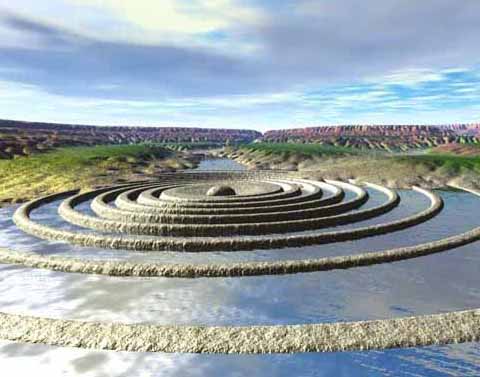 One helpful analogy that Emanuel Swedenborg (1688–1772) offers in a different context is that it is like a pillar that subsides down into a circular flat surface in which the top of the pillar becomes the center and the bottom of the pillar becomes the circumference. What is “sequential” vertically in the pillar now becomes vertically “simultaneous” in the concentric circles within the overall circle that the pillar has become.
We can also think of someone traveling across the country sequentially, but God seeing the entire trip laid out as if in a road map seen from above.
Open theism sees God from a human point of view
Open theism is correct in seeing the “development” of God from a human point of view. But that is a human point of view.
God sees and experiences all of that “development” simultaneously as a single oneness from outside of time. This means that God also sees and knows everything that to us is the past, present, and future. We still make the choices that determine our own individual and collective future. We are still free. But God sees, from outside of time, the entire extent of time from beginning to end. (If there is a beginning and an end to the physical universe. In our current scientific understanding of cosmology, the jury is still out on that question.)
Open theism errs in thinking that God does not entirely know the future, but learns conclusively what happens as a result of our choices only as they unfold. That’s because its proponents are thinking of God as existing and developing within the arrow of time.
However, though God has entered into the arrow of time specifically in the life of Jesus Christ, and universally in God’s unfolding Providence throughout human history and throughout the entire unfolding of the physical universe, the Divine Being of God exists above and beyond the physical universe, its expansion in space, and its unfolding within the arrow of time. Therefore God’s knowledge is indeed infinite, encompassing everything that we experience as past, present, and future.
These questions push the limits of what we time- and space-bound humans can grasp and understand. For a better resolution of the paradox that Open theism attempts to resolve by positing that God’s knowledge grows and develops, and for more on some of the other points raised in this article and in the previous one (“How does God Speak to Us, Before and After the Incarnation?”), please see the articles linked below.
For further reading:
- Does God Change?
- If God Already Knows What We’re Going to Do, How Can We Have Free Will?
- God: Puppetmaster or Manager of the Universe?
- Wavicles of Love
- Containers for God
Share this:


Lee Woofenden is an ordained minister, writer, editor, translator, and teacher. He enjoys taking spiritual insights from the Bible and the writings of Emanuel Swedenborg and putting them into plain English as guides for everyday life.



 Spiritual Insights for Everyday Life
interesting post… many people seem to behave like Jesus was automatically divine on earth
Hi Ihagh G. T.,
Thanks for stopping by, and for your comment. Yes, there is a lot of confusion among Christians about exactly who Jesus was. This comes especially from many centuries of thinking (falsely) that there are three Persons of God, and that Jesus was the incarnation of one of them. This can’t help confusing the minds of Christians about Jesus.
Hi Lee,
We’ve spoken on this point before, but I’m now sure that I won’t change my ‘Open Theism’ perspective without some specific arguments from outside. When you say: “Open theism errs in thinking that God does not entirely know the future but learns conclusively what happens as a result of our choices only as they unfold. That’s because its proponents are thinking of God as existing and developing within the arrow of time.” from where do you get your perspective? I don’t suffer from a belief that God exists in ‘Time’. I do believe that God could create Heavens and Earth where he doesn’t know what his creatures will do in detail. I think that provides real purpose for this experience and real actuality for our choices. What are the specific facts that make you believe that God knows the future in detail since the Bible clearly shows and says in many places that God changes his mind?
I tend to think this ‘everything is simultaneous including the future’ idea of God came from Greek philosophers and not from God. This is also a current scientific extrapolation well beyond the actual facts.
Ted
Hi Ted,
On these questions, please first read this article:
If God Already Knows What We’re Going to Do, How Can We Have Free Will?
It does include early on a section on the biblical basis of the idea that God knows the future. Once you’ve had a chance to read it, we can continue the conversation if you wish. Thanks.
Lee,
Yes, I have read that before, so it is not new. Clearly the Bible says that God knows the future, but it doesn’t say he knows every decision by every creature. It also clearly says he changes his mind and implies in a number of places that there are at least two alternative futures that are possible. It implies that God expected some behavior but that the person did something else, so God changed his mind and did something other than his original plan.
Now, it is certainly possible that God made the Heavens and Earth where nothing that happened or ‘will happen’ in any level of detail is not already known to God. But, if so, why encourage people to repent or try harder or anything since what will play out is already ‘baked in the cake’. Doesn’t that make such a Universe just a stage play and all of his creatures really boring robots?
Alternatively, there is the Open Theism view that what the Bible implies in total is true. Why couldn’t God have made a Heaven and Earth where his creatures actually make real, meaningful decisions that affect what happens. Such a creation could have a universal ‘now’ and a past and a set of future possibilities and decisions to be made by his creatures that God can predict as we can predict other people’s actions but sometimes are surprised by what the creature’s decision actually is.
I believe that Swedenborg said that God arranges things so that we are at a balance that gives us real meaningful choices. If the creation is a stage play with no impromptu options why would a balance be needed?
Ted
Hi Ted,
I would suggest that your description and argumentation of both sides of the debate are from a perspective in which God exists within time and space, not outside of time and space, so that God is limited by time and space, not unlimited. For example, you say:
That is the Calvinist view, not my view. Calvinists see God as existing within time, such that God “already knows” the choices we will make “before” we make them, and has in fact predetermined them since before creation. From a Calvinist perspective, we are mere actors on a stage, or robots carrying out pre-programmed actions. In addition to the article I already linked you to, please see:
If God Sees Everything, Is Everything that has Ever Happened Still Happening?
And also the first half or so of this article, in which I discuss Calvinist predestination:
Response to a Calvinist Critique of my article “Faith Alone Does Not Save”
But as I say in the article I linked for you earlier (which I really do encourage you to read again), that’s not how it works. God does not “see the future,” and God does not know “what we’re going to do.” Such ways of speaking imply that God is seeing from the past something that is going to happen in the future. In other words, that God exists within the arrow of time, and is limited by time just as we are.
But if God actually is all-powerful and all-knowing, that cannot possibly be true. If God is just as subject to time as we are, then God’s power is limited, and God’s knowledge is also limited. This would mean that God is not God, but a god, similar to the gods and goddesses of the various ancient pantheons of gods, who traveled along in time just as we humans do.
As explained in the earlier linked article, God does not “know the future,” or “what we’re going to do,” because God is not looking at the future from the past. Rather, God, from outside of time and space, is seeing all time and space at once. For God, there is no past, and no future, it is all in the present for God. There is also no “here” and “there.” All the vast expanse of space is only “here” for God.
Does this mean that it’s all just a stage, and we are actors reading a pre-written script?
No.
Once again, the “pre” in that statement betrays a time-bound view of God. For God, there is no “before” and “after.” God simply sees and knows everything that happens in all time and space.
Since God does not “pre-determine” things, nor does God see the future from the past, this means that our choices are not predetermined, but real. It means that our choices change the future. It means that we can choose either evil or good, and it will lead to our either living in heaven or in hell after we die, based entirely on the choice that we made here on earth.
God, for God’s part, simply sees the choice that we make. God doesn’t “know what choice we’re going to make.” All of this is covered in the article.
I realize that it is very difficult for us earth-bound, time-bound humans to even abstractly think apart from time and space. Honestly, I struggled with the same question for probably a couple decades before I was finally able to grasp something of the reality and implications of God being outside of time and space. If I had wanted to write that article twenty or thirty years ago, I probably couldn’t have done it. Definitely not thirty years ago. At that time, it still didn’t quite make sense to me.
As Swedenborg says many times, to understand the omniscience, omnipotence, and eternity of God, it is necessary to lift our mind outside of time and space, and think apart from time and space. Otherwise our mind will get hopelessly entangled in earthly concepts of time and space that simply don’t apply to God, and we will fall into all sorts of errors.
On one end of that spectrum of errors is Calvinism. On the other end is Open Theism. Both fail to grasp the nature of God’s omniscience and omnipotence because both place God within time rather than understanding that God is outside of time.
About the Bible saying that God changes his mind, yes, it certainly does. But many things in the Bible are written from a human perspective, for humans on earth. Very few humans on earth even today can lift their minds outside of time and space even theoretically. In the times and cultures in which the Bible was written, I suspect there was not a single person on the face of the earth who could do so. It was far beyond their powers of thought and conceptualization. So they had to think of God as being within time.
The Bible therefore speaks as if God were within time, even while laying down bread crumbs, some of which I quoted in the linked article, that can lead us to the conclusion that God inhabits a realm outside of time.
In short, when the Bible says that God changes his mind, that’s how it looks to time-bound humans when we change our minds, making it possible for God to act toward us in a different way than if we had not changed our minds. The actual change of mind is in the people who repent and do not do the evil acts they previously had in mind to do. That, and not any change of mind on God’s part, is what brings about a change in God’s effect upon them. Instead of being destroyed physically or spiritually, they are lifted up physically or spiritually—which is what God wanted to do all along.
There are many things in the Bible that are written from and for the human point of view. Otherwise, few to no people would understand anything in it. As the Bible itself says:
For my thoughts are not your thoughts,
   neither are your ways my ways,”
declares the Lord.
“As the heavens are higher than the earth,
   so are my ways higher than your ways
   and my thoughts than your thoughts.
                          (Isaiah 55:8–9)
And:
With the merciful
   you show yourself merciful;
with the blameless man
   you show yourself blameless;
with the purified
   you show yourself pure;
and with the crooked
   you make yourself seem tortuous.
                   (Psalm 18:25–26)
Because we humans are so often crooked, God must make himself seem tortuous, or twisted from what God actually is. See:
What is the Wrath of God? Why was the Old Testament God so Angry, yet Jesus was so Peaceful?
And:
What about Violent Religions? Is God Really Bloodthirsty and Vengeful?
The Bible is a complex book, not a simple book. Those who read it in a simple and literal manner will fall into all sorts of errors. That’s where both Calvinism and Open Theism came from: taking statements in the Bible at face value that are meant be read from a deeper and more spiritual perspective.
Unfortunately, most people on this earth do think materially, not spiritually. That’s precisely why the Bible had to be written the way it was. Otherwise it would have gone over the heads of nearly everyone on earth, and would have failed to accomplish its task, which is to lead and guide us, and even scare us if necessary, toward eternal life in heaven. See:
How God Speaks in the Bible to Us Boneheads
Perhaps all of this is just too much for you to swallow. If so, I wish you well. It’s not my job to argue you out of beliefs that you need for your faith and spiritual life.
I would simply say that from my perspective:
Since I think of God as existing outside of time and space, there is no conflict at all in my mind between these two statements.
Lee,
I did re-read the originally referenced article and your two first links in your reply. Strangely, I can agree with your two closing statements, but I’m still looking for the ‘why’ you think about God as you do.
In the ‘God Sees Everything’ article you say: “Time simply doesn’t apply to God. In God’s mind, things haven’t “already happened” nor do they “happen in the future.” God does not “know the future” temporally. To God, past, present, and future are all the same. They are all one, just as God is fully one. On God’s level, everything of all time and space is seen in an infinite present, and God is interacting with all of it all at once from that infinite present in which God lives.”
Am I correct in assuming that you believe that God knows how the past, present, and future manifest to his creatures in the material Universe? So, he knows that, at least to us, they are not the same even if he experiences them differently? If so, then what difference does it make to us that his experience is somehow different? I would expect God’s experience to be vastly different than our own. Also, what difference does an Open Theism perspective produce that is meaningfully wrong? I.e., produces wrong behavior?
Ted
Hi Ted,
These are all good questions.
In answer to the first two, yes, God knows that we humans do live within the arrow of time: that we have experienced the past, are living in the present, and have no definite knowledge of the future. God not only knows this, but God designed it that way, for many reasons.
One of those reasons is precisely so that we humans could perceive things differently than God does, and therefore be distinct from God.
The task God had in creating the universe was to make it distinct from God even though God is infinite, eternal, omniscient, omnipresent, omnipotent, and all other omnis. If God is all of everything, how can there be something that isn’t God? How can the pantheists not be correct that everything in the universe is God?
The answer is that God made everything in creation not infinite and not omni-everything. God put limits or boundaries on created things, making them finite, not infinite. In the very act of doing so, God made every created thing not God. Something that is not infinite cannot be God.
One of the boundaries God put on the created universe is that whereas God lives outside of time and space, and sees and interacts with all time and space at once from a divine presence outside of time and space, we humans (not to mention everything else in the universe) live within time and space, and are able to consciously interact with only a small portion of them.
In time, we interact only with our present moment. The past is water over the dam. The future is not yet determined, and therefore cannot be known with certainty.
In space, we are able to see and interact with only a limited portion, smaller or larger, of all the space that exists.
On the small scale, we interact only with the people and objects in our immediate vicinity. The rest are beyond our field of vision and experience. This is true even though electronic communication has expanded the spatial field in which we can operate. Even with these enhanced sensory capabilities, we have awareness of only a small fraction of the lives of the total population of the world, and we can interact with only a few of them at a time.
On the large scale, astronomers tell us that the amount of the universe that we can see has inherent limits. That’s because everything is moving away from everything else at greater and greater speeds the farther away they are from each other. Once they reach distances from each other at which the sum of the speeds of objects moving in opposite directions exceeds the speed of light, it forms a horizon beyond which we cannot see, no matter how powerful a telescope we build.
So yes, God is aware that our experience of time and space is different from God’s experience of them. That’s how God designed it to work, for many reasons, one of which is to make it possible for us not to be mere extensions of God, but beings distinct from God, so that we can have a relationship with God, and God with us.
So to take up your third question, the fact that God’s experience is different from ours makes a huge difference to us, because that’s how we can be different and distinct beings from God, and therefore have a mutual relationship with God rather than just being a part of God. How much richer is a relationship with another person than a relationship with your own hand or foot?
It’s similar to the fact that no two human beings are the same, which makes it possible for us to have real relationships with each other, bringing new things to each other all the time precisely because we are all different. If we were all the same, there would be little or no benefit, excitement, or joy in having relationships with other people because we would already know everything that everyone else does.
However, in our relationships with one another we are relating with other beings who are more or less our peers. In relating with God, there is an element of complete transcendence far beyond anything we can have in a relationship with another human being. Yes, God is now present with us as a human being in the form of Jesus Christ. But God also exists on a realm discretely and distinctly and infinitely above our own highest levels of spiritual being and awareness, let alone our physical levels.
As such, in our relationship with God we can have a relationship with someone who is far beyond anything that exists in any other person with whom we have an interpersonal relationship. We can have a relationship with someone who is not limited and ultimately flawed, as we humans are, but who is infinite, eternal, omniscient, all-powerful, and most of all, all-loving.
In our human relationships here on earth, there is always some fear of loss. People move. People change. People die. As long as we are living on this earth, none of our relationships are guaranteed. We could lose them at any time—even the closest of them—for a multitude of reasons and in a multitude of ways.
This is not true of our relationship with God. The only way we can lose our relationship with God is if we consciously and intentionally turn our back on God. And even if we do, God is still there, standing at the door knocking. If later on we decide to turn back around and open the door for God again, the relationship will resume. It is always there and available. There is never any lack or defect in it on God’s side. God continually gives us and relates to us precisely as much as we want, and precisely as much as we are open to.
This is not true of any of our human relationships, even our closest ones. Even when we move on to the spiritual world and we no longer have to fear the loss of our closest relationships through change and death, other people are still limited and flawed, just as we are. Other people still cannot give us everything we need to live our fullest and happiest life.
In short, it makes all the difference in the world to us that God’s being and consciousness is just as high above ours as the heavens are above the earth. It provides us with a constancy of boundless love and understanding that is available only in our relationship with God. That is why our relationship with God is greater than any of our relationships with any other human being—even greater than our very closest relationship with another person in spiritual marriage. That’s why the first of the Great Commandments is to love the Lord, and the second is to love our neighbor.
It is our relationship with God that makes it possible for us to rise above and beyond any obstacles and any disappointments and any pain and sorrow that may come upon us as we make our way through this often dark and dangerous world. If we are having struggles in our relationship with our spouse or our closest friend, who would we turn to for help? What relationship would we have that would be deeper and more supportive than that one? Even counselors and therapists can carry us only so far.
If God were limited as we are, there could be an obstacle that would be too much for us, a relationship setback that would be greater than we can bear, inevitably destroying us. But since God is with us and on our side, even though we will certainly have terribly painful and disheartening setbacks, a path forward will always available to us if we are willing to choose to follow that path.
For a related article, please see:
God is Love . . . And That Makes All the Difference in the World
Perhaps this will suggest an answer to your final two-part question. It’s not so much that Open Theism produces wrong behavior. An Open Theist can be a very good person. Rather, it’s that Open Theism puts limits on God, and therefore on our relationship with God. And this can make it easier for us to fall into wrong behavior.
Under Open Theism, God does not know everything. There are time-induced limits on God’s knowledge. God is almost as much in the dark about the future as we are.
This means that instead of being able to confidently turn to God, knowing that God knows everything, and has everything in hand, we have to wonder whether there’s some critical thing that will happen to us in the future that God is unaware of, and therefore can’t prepare us for. We have to wonder whether God is really all-powerful, and can really make sure that there won’t be an insuperable obstacle in our future that will stymie all our spiritual progress, and grind us down to hell whether we want to go there or not. Perhaps, we may think, there’s something God just didn’t think of, and didn’t prepare for, and our life will be destroyed as a result.
Only if have an assurance that God knows everything can we be confident that God has a plan for us, and for all eventualities that may come our way, and has provided a pathway to heaven for us. Whether we choose to take that pathway is another question. But knowing that God knows everything that to us is past, present, and future gives us confidence that the pathway for us personally is there and available because God has laid it out for us through all the events of our lives.
This knowledge means that we can never blame God, or God’s limits, for any failure on our part. It means that if we end out in hell rather than in heaven, it is not God’s fault, but ours.
This, in turn, means that if we do engage in wrong behavior, we can never make the excuse that it’s because that’s how God designed us, or it’s because there is some flaw in God’s design of the universe—something God didn’t account for because God didn’t know the future, and therefore couldn’t prepare for it.
Although Open Theism doesn’t technically produce wrong behavior, it can provide cover for wrong behavior in people who subscribe to it. “God is limited!” they can say to themselves. “God didn’t know this was going to happen to me!” they can say. “So it’s really not my fault!” they can say. “If God had only known what was going to happen to me, he could have prepared me for it!” they can say. “This is all God’s fault, not mine!” they can say.
Would this be a perversion of what Open Theism is supposed to stand for? Yes. A person of good heart who subscribes to Open Theism will not make such excuses, and will persevere, and do the right thing. But even for people of good heart, believing in a God who doesn’t know the future does not give the level and depth of support through the very toughest and most agonizing passages in our lives as believing in a God that knows everything.
A parallel is the damage done by Luther’s doctrine of justification by faith alone. Protestant preachers can preach till they’re blue in the face that even though our works don’t save us, we should still do good works because they show that our faith is real. But ever since Luther came up with that doctrine, Protestantism has been continually plagued with antinomianism.
Since, as Protestants are taught, the only thing that saves them is their faith in Jesus Christ, why, they think within themselves, should I put any real effort into being a good person? Yes, this is considered a perversion of the doctrine of justification by faith alone. But it’s simply inevitable that many people who are taught that the only thing that saves them is their faith will think that it’s not all that important to repent from their sins and live a good life. And so they won’t bother. The doctrine itself pushes them in that direction.
Similarly, the doctrine of Open Theism pushes its adherents in the direction of believing that God is not omniscient, omipotent, omnipresent, and most of all, omnibenevolent. It pushes its adherents toward thinking that God is not as high above us as the heavens are above the earth, but is more like one of the gods in the ancient Roman pantheon: a super-powerful version of us, but one that still ultimately has limits, even if those limits go beyond ours.
The result will be a relationship with a God who cannot do everything possible for us, because God himself has many of the same limitations of knowledge and power that we do. Like Protestant preachers preaching, “You should still do good works!” and having it go in one ear and out the other of many people in their flocks, Open Theist preachers can say, “God is all-knowing, because God knows everything that can be known!” but the people in the congregation can’t help thinking, “Well, God isn’t all-knowing, because God doesn’t know the future. God really isn’t all that. Maybe I know something God doesn’t.”
That’s the damage Open Theism does to people who believe in it. It puts limits on God, and therefore puts limits on their relationship with God. It shortens God’s hand toward them, making God’s actual omniscience and omnipotence less powerful and effective in their lives.
Lee,
As always, thank you for the thoughtful reply. And, yes, either (or all?) views of God can be twisted to evil. Even your Omni – knows absolutely everything – view can be so twisted as Calvin proved.
Overnight, as is not uncommon with me, I had an insight that, for me, seems useful, and would like your thoughts.
It relates to two ideas: 1) the alpha – omega idea, and 2) the life recap from Near Death Experiences reports. First, the life recap: As I understand the life recap, it is a (fast) replay of all of one’s life experiences exactly as they happened with full fidelity except the person also knows in full fidelity how their actions affect others. If this is so, then presumably, in the spirit world, one could also ‘reexperience’ prior life events exactly as they happened and wouldn’t know while experiencing these events that it was a replay vs the original first time. Moving to the alpha – omega idea: It appears to me that your view of God is indistinguishable from God being at the omega point and us experiencing a ‘exactly as it happened’ replay. In this view, all of life’s events are due to our own decisions (from the original first time) and all of our decisions would be known to God in detail since they’ve all happened while all of our decisions would be by our own Free Will.
For me, I’ll stick with the Open view and that this ‘life’ is the ‘original first time’ since it makes my decisions real and open and it makes God’s actions similarly real and open. My view of the future from God’s perspective is that he knows exhaustively where all decisions can lead so the twist you describe in your reply isn’t valid (strangely, this sounds a lot like the ‘Many Worlds’ scenario of quantum physics). I understand that this view isn’t likely to be the real God known answer, but it seems to work.
Thoughts?
Ted
Hi Ted,
I’d say this is more like the alternate timelines idea present in many science fiction series, or like a master chess player looking at the current board and following out the likely results of each possible move several moves ahead before deciding which move to make.
Many worlds doesn’t necessarily mean many similar worlds. This would be a required conclusion only if there were infinite worlds, such that every possible world exists. If there were a finite number of worlds, then the likelihood of one being much like another is very low, let alone the likelihood of every possible permutation of you or me playing itself out on some other world somewhere. The odds of such a scenario repeating itself at all even up to the point where it diverges are so staggeringly low that the only plausible situation in which it would be true would be an infinite worlds hypothesis.
Though we don’t know that such a hypothesis is false, it goes far beyond what science can currently give us any information about at all, let alone create experiments that could disprove it, as is necessary for science to be science. It is therefore not a scientific hypothesis, but a mere speculation.
I prefer not to base my thinking on mere speculation. If something that is purely speculative is required for a particular belief to be true, then that is a very weak belief.
Unfortunately, the alternate timelines theory suffers from the same problem. The idea is that in some world time splits at any given instant in our timeline, and a separate timeline branches off that starts the same as the current state of our timeline, but diverges from there. People who stay alive in our timeline die in the other timeline, and so on.
But this theory, too, is purely speculative. It is not subject to any scientific study or any sort of verification or falsification at all. And ultimately, it also requires the possibility of infinite worlds to work. Chess has only so many moves, and it has fewer moves that make sense in any given scenario. Even so, few to no chess players can follow every possible move all the way out to every possible ending of the game. An inhabited planet, or even a single human being, is many orders of magnitude more complex than a chess game.
“No problem,” you say. “God is infinite, and can therefore follow out all possible branches of the tree all the way to every possible ending.”
Not so fast!
God may be infinite, but we are not. We are bounded by time and space. We have time and space for only so many events and interactions in our lifetime. God’s problem wouldn’t be just following out all possible timelines, but making provision for us for every possible timeline that our life could branch off into.
Why is this a problem?
Let’s look at an example—even if it is a bit of a fuzzy example. In the future, you will have a crisis of faith, and you will need to have heard of one particular set of beliefs that will give you what you require to face and overcome in that crisis. God knows this, and arranges for you to meet and talk with someone who holds those beliefs. You don’t accept them at the time, but they are tucked away in your memory, ready to activate when your life circumstances have changed, and those are the beliefs you need to face this new crisis.
But what if God does not know the exact nature of the crisis you will have? What if God doesn’t know what direction your character and personality will go based on the choices you make and the paths that you travel? How will God know which set of beliefs, and which person representing them, to arrange for you to meet?
There simply isn’t enough time in your life for God to introduce you to every possible set of beliefs that you could possibly need depending upon the specific twists and turns your life takes based on thousands or even millions of circumstances and choices within those circumstances that might be in your future. This is especially so since most people do not spend most of their waking ours exploring various religious and spiritual beliefs. In reality, most people spend very few of their waking hours in that pursuit, making the time and opportunities God has access to very slim indeed.
In this scenario, the best God can do is make an educated guess as to which ways you will most likely go, and arrange for your path to cross with as many people as possible representing those most likely beliefs, starting with the most likely and working on down the list. Perhaps there will be enough opportunities only for six or a dozen of them. However, if you happen to travel on “the road not taken,” then God has taken a number of swings and misses, and struck out. Now you don’t have what you need when you need it—at the time that particular crisis strikes in your life.
There are many other scenarios that could be spun out to show that even though since God is infinite, God could follow every possible future timeline all the way to the end, this would not cut it because we are not infinite.
In short, the only way we could be sure that God is able to provide us with the specific circumstances and experiences that we will need to follow our spiritual path far into the future is if God sees our future, and is able to provide what we need for that specific future.
Hi Ted,
Now in response to this:
This life is “the original first time.” We are not merely following a pre-written script. Every decision we make is real. Every decision we make changes our future. Those decisions are not made until we make them. We could have made different decisions than the ones we did. In that case, our present would have been different than the one that came about because of the decision we did make. There is no predestination. The universe is not deterministic, still less human life. See:
God: Puppetmaster or Manager of the Universe?
It is necessary to understand that God inhabits a completely different realm than we do.
There are three major realms in the universe, each running according to its own rules, but each having a relationship with the others:
The divine realm is God. The spiritual realm is the spiritual world, of which the human mind is a part. The material realm is the physical universe, including our physical body.
These different realms do not shade into one another, like the transition from light to darkness or from heat to cold. Rather, there are distinct boundaries between them where one ends and the next begins.
A physical analogy is the freezing and boiling points of water. There is a gradual transition from cold to hot or vice versa within each state of water: solid, liquid, and gaseous. But at a specific point, there is a sudden transition from solid to liquid, and then again from liquid to gaseous, and the reverse. There is no “shading” from one to another, nor is there continuity, but a distinct boundary that separates them from one another, even if they do have a relationship with one another (it’s still water).
This is how it is for the divine, spiritual, and material realms of the universe. One comes to a complete stop before the next has its beginning. There are distinct boundaries between them, such that one does not shade into the other. When that boundary is crossed, the properties and the laws that govern the realm on the other side of the boundary are distinctly different, and apply only within that realm. Solid water is hard. Liquid water flows. Gaseous water disperses into the available space.
Applying this specifically to time:
Fundamentally, Open Theism thinks of God as just a massively souped up version of human beings, who still lives pretty much the way humans do, only with super (but not unlimited) knowledge and power. For God, the future is still in the future and is unknown. God may be able to trace out every possible future, but God, like us, does not know which possible future will actually happen until it actually happens.
In short, according to Open Theism, God, like us, lives within the arrow of time.
Ultimately, this means that God is not a divine being, but at most a spiritual being, subject to changing states following one after another, and at worst a mere material being, subject to material time.
In other words, God is not an eternal unchanging being, but is subject to change and development just as we are. There are things God does not know today that God will know tomorrow—and this will change God.
If this is what you or anyone else wants to believe, it’s not my job to tell you that you’re not allowed to believe it. People believe many different things, based on their own particular experiences and their own particular level of spiritual development. Perhaps you need to believe in Open Theism to resolve your particular issues and face your particular life based on your particular current character and personality. If so, then once again, I wish you well.
But if you want to move beyond the limited God of Open Theism, it will be necessary to understand the concept of “distinct levels” (traditionally translated “discrete degrees”) that Swedenborg presents and develops in his theological writings. It will be necessary to understand that God inhabits a realm distinctly different from the two that we created humans inhabit, which are the spiritual and the material.
It is also necessary to understand that each of these levels or realms operates according to its own inherent laws, which God created for them out of the infinite form or infinite laws of God, but made them distinct by causing them to be finite rather than infinite as God is. Spiritual and physical laws reflect the nature of God, but they are not God. They therefore operate in their own way within their own realm.
You can think of this as the three realms operating on parallel tracks. They reflect each other, but each proceeds according to its own nature and laws.
Since God is not in time, this means that time as we know it applies only to objects and events in the material universe. And changing states of mind as we know them apply only to our conscious awareness and character, and their development over time.
This means that events in the physical world are not predetermined, but unfold within the material realm over time, within space, according to their own nature and according to the physical laws that govern them, which God has established.
Similarly, our mental and emotional life, which is our spiritual life, unfolds within the spiritual realm through a succession of changes and rebirths within us, according to our spiritual nature and according to the spiritual laws that God has established.
God does not tell the other two realms what to do. Rather, God creates them with a greater or lesser amount of freedom to determine their own character and future within the “rules of the game” that God has established so that they can have some definite form and direction rather than being undifferentiated formless directionless masses. (Consider that the game of chess must have rules, or it is unplayable. Within those rules, there are trillions of possible games, made possible only by the fact that there are rules of the game.)
Once again, please see:
God: Puppetmaster or Manager of the Universe?
In short, as I said at the beginning of this reply, this life of ours is the original first time and our decisions are real and open. Our life and choices are not predetermined. Our free will is real. Our future will change based on how we make use of that free will. Within the physical and spiritual universes, the future is not determined until it actually happens. And the future from there is not determined until it actually happens. Any future is possible within the overall rules of the “chess game” of our lives. And there are not just trillions of possibilities, but an unimaginably large number of possibilities.
God, who inhabits a divine realm above and beyond time, simply sees what takes place within the arrow of time in the material universe, and within the arrow of our changing and growing selves and communities in the spiritual universe, from a position outside of time. That is why I can say:
What you will believe is entirely up to you. But please do try to wrap your mind around the idea that God inhabits a realm distinctly above and beyond ours, where time as we know it does not exist.
Lee,
As always, two thoughtful replies. Since we agree that this world is real and open and we have Free Will to choose different paths, how we live makes a real difference.
Let me leave you with a link to an interesting article that I found that bears on these subjects and makes even this world not as neat as we’d like.
https://www.fourmilab.ch/rpkp/strange.html
Thanks, Ted
Hi Ted,
You’re welcome. And thanks for the link. That’s a long, technical article! Let’s just say . . . I’m convinced. This world is a strange place 😉