The title is a question recently asked on the website Christianity StackExchange, here. After several quotations from Swedenborgian sources, the questioner asks:
Did the Lord (God Almighty) incarnate as a human in the body of Jesus of Nazareth? Does this mean that Jesus did not have a pre-incarnate existence in heaven? So who died on the cross? And is it up to humans to earn their salvation by good deeds in this life and in the life to come?
Whilst seeking Swedenborgian sources, I also request references from the Bible.
To keep things simple, what I really want to know is: who, according to Swedenborg, is this Jesus, born of a woman, who died and then was resurrected, and what part did Jesus play in our salvation?
The rest of this post will be a slightly edited version of my answer. You can read my original answer on Christianity StackExchange here.
Because the question specifically asked for Swedenborgian and biblical sources, this post will contain more direct quotation from Swedenborg than is usual here on Spiritual Insights for Everyday Life, including examples of Swedenborg’s ample quotations from the Bible. For readers who want to dig deeper into Swedenborg’s teachings about who Jesus Christ was and is, this post will provide some great food for thought.
Introduction and Summary
Emanuel Swedenborg (1688–1772) addresses all of these questions thoroughly in his theological writings, and provides extensive quotations from the Bible in support of his teachings on these subjects. See especially his small work The Lord and the first three chapters of his major exposition of his theology, True Christianity. (The links are to the listings for these books on the Swedenborg Foundation website.)
In this answer I can provide only a brief version of his teachings on these subjects, and only a few of the supporting scripture references—especially since there are multiple questions, each of which deserves an answer of its own.
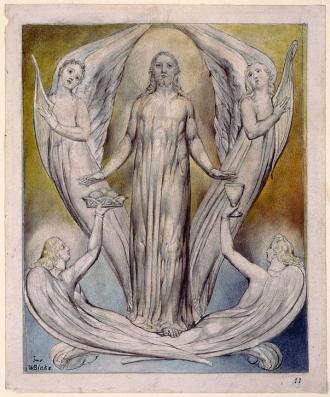
Angels Ministering to Christ, by William Blake, 1820
In brief, according to Swedenborg, Jesus was indeed God from eternity born into the world, by means of a human nature that he took on from his human mother Mary. During his lifetime on earth he went through a process of “glorification” in which he replaced all of the finite humanity he received from Mary with an infinite divine humanity made of the divine substance of God.
What died on the Cross was the last of his finite humanity from Mary. What rose from death was his fully glorified divine humanity, which was the human manifestation of God. At the time of his Ascension, he became fully one with God, so that Jesus Christ is now simply God, in whom is the Father, the Son, and the Holy Spirit. These are three “essentials” of one God, who is one both in Essence and in Person.
Jesus’ primary acts of salvation and redemption were defeating the power of the Devil, or hell, and thereby saving humanity as a whole from the overwhelming power of evil, which was dragging us down to hell. Having gained full power over the Devil, the Lord now keeps humans on earth in a balance between good and evil, and gives us—or really, lends us—the power to defeat the grip of evil on our lives. We humans do not earn our salvation because it is only through the Lord’s power working in us that we can be saved. We can therefore take no credit for our own salvation.
According to Swedenborg, there was no “Son born from eternity,” as in Nicene Christian belief. Rather, the Son of God came into being at the time that the Lord, who is God from eternity, was born into this world. The Son of God is the same as the divine humanity. The Son of God was initially born of a woman and had a finite human nature, but during Jesus’ lifetime on earth it became fully divine, as mentioned above.
This provides a very brief answer to all of the queries posed in this question. Now for a fuller answer to the primary query as presented at the end of the question, including supporting quotations from Swedenborg’s writings and from the Bible, and a much briefer answer to the secondary query. First:
Who is Jesus?
In True Christianity #92 Swedenborg writes:
The “Son of God” is the human manifestation in which God sent himself into the world. The Lord frequently says that the Father sent him, or that he was sent by the Father (for example, Matthew 10:40; 15:24; John 3:17, 34; 5:23–24, 36–38; 6:29, 39–40, 44, 57; 7:16, 18, 28–29; 8:16, 18, 29, 42; 9:4; and very often elsewhere). The Lord says this because being sent into the world means coming down among people, which he did through the human manifestation he took on through the Virgin Mary.
The human manifestation really is the Son of God, in that he was conceived by Jehovah God as the Father, as it says in Luke 1:32, 35. (links added)
A little later in the same section Swedenborg writes:
In the Lord’s case, the divine nature he had came from Jehovah his Father; the human nature he had came from his mother. These two natures united together are “the Son of God.” The truth of this is clearly substantiated by the Lord’s birth, as recorded in Luke: “The angel Gabriel said to Mary, the Holy Spirit will descend upon you and the power of the Highest will cover you; therefore the Holy One that is born from you will be called the Son of God” (Luke 1:35).
According to Swedenborg, then, when Jesus says that the Father “sent” him into the world, it does not mean that one Person of the Trinity, God the Father, sent another Person of the Trinity, God the Son, into the world, as is believed in Nicene Christianity. Rather it means that God sent himself into the world in a human manifestation, whom the Gospels call Jesus Christ.
It is called “sending” because God did this by fathering a child in the womb of a human woman, the Virgin Mary. That child was “God with us” (Matthew 1:23) because that child’s inner self was the eternal God. Because God cannot be divided, Jesus was God as to his inner self even during his lifetime on earth.
Since this is how God came into the world, Jesus had an inner divine being, analogous to our soul, which was God; he also had an outer human self that he received from his human mother Mary, similarly to how humans on earth receive a human nature from their mothers. However, unlike created human beings, Jesus did not receive a human nature from any human father; instead, he received an inner divine nature that made him unique in all history. Only he was God himself present in a human manifestation.
In the next section, True Christianity #93, Swedenborg provides Bible quotes showing that the Holy One who came into the world is none other than the eternal God:
Since the angel Gabriel said to Mary, “The Holy One that will be born from you will be called the Son of God,” I will now quote passages from the Word to show that the Lord in his human manifestation is called “the Holy One of Israel”:
I was seeing in visions, behold a Wakeful and Holy One coming down from heaven. (Daniel 4:13, 23)
God will come from Teman, and the Holy One from Mount Paran. (Habakkuk 3:3)
I, Jehovah, am holy, the Creator of Israel, your Holy One. (Isaiah 43:15)
Thus said Jehovah, the Redeemer of Israel, its Holy One. (Isaiah 49:7)
I am Jehovah your God, the Holy One of Israel, your Savior. (Isaiah 43:1, 3)
As for our Redeemer, Jehovah Sabaoth is his name, the Holy One of Israel. (Isaiah 47:4)
Thus says Jehovah, your Redeemer, the Holy One of Israel. (Isaiah 43:14; 48:17)
Jehovah Sabaoth is his name, and your Redeemer, the Holy One of Israel. (Isaiah 54:5)
They challenged God and the Holy One of Israel. (Psalms 78:41)
They have abandoned Jehovah and provoked the Holy One of Israel. (Isaiah 1:4)
They said, “Cause the Holy One of Israel to cease from our faces. Therefore thus said the Holy One of Israel.” (Isaiah 30:11–12)
Those who say, “His work should go quickly so we may see it; and the counsel of the Holy One of Israel should approach and come.” (Isaiah 5:19)
In that day they will depend on Jehovah, on the Holy One of Israel, in truth. (Isaiah 10:20)
Shout and rejoice, daughter of Zion, because great in your midst is the Holy One of Israel. (Isaiah 12:6)
A saying of the God of Israel: “In that day his eyes will look toward the Holy One of Israel.” (Isaiah 17:7)
The poor among people will rejoice in the Holy One of Israel. (Isaiah 29:19; 41:16)
The earth is full of guilt against the Holy One of Israel. (Jeremiah 50:29)
Also see Isaiah 55:5; 60:9; and elsewhere.
“The Holy One of Israel” means the Lord in his divine human manifestation, for the angel says to Mary, “The Holy One that will be born from you will be called the Son of God” (Luke 1:35).
From the passages just cited that describe Jehovah as the Holy One of Israel, you can see that although the names are different, “Jehovah” and “the Holy One of Israel” are one.
Many, many passages show that the Lord is called the God of Israel, such as Isaiah 17:6; 21:10, 17; 24:15; 29:23; Jeremiah 7:3; 9:15; 11:3; 13:12; 16:9; 19:3, 15; 23:2; 24:5; 25:15, 27; 29:4, 8, 21, 25; 30:2; 31:23; 32:14-15, 36; 33:4; 34:2, 13; 35:13, 17-19; 37:7; 38:17; 39:16; 42:9, 15, 18; 43:10; 44:2, 7, 11, 25; 48:1; 50:18; 51:33; Ezekiel 8:4; 9:3; 10:19-20; 11:22; 43:2; 44:2; Zephaniah 2:9; and Psalms 41:13; 59:5; 68:8. (links added)
This is only a small sample of the extensive scripture references Swedenborg provides in True Christianity and in The Lord to support his teachings about who Jesus Christ was. Space here will not permit a full representation of that scriptural support.
Jesus’ process of glorification
Rather than attempting to explain Jesus’ process of glorification and provide supporting scripture references myself, I will offer this fairly lengthy quote from The Lord #35, which does both:
Step by step he took off the human nature he had taken on from his mother and put on a human nature from what was divine within him, which is the divine human nature and the Son of God.
It is generally known that the Lord was divine and human, divine because of Jehovah the Father and human because of the Virgin Mary. That is why he was God and a human being and therefore had a divine essence and a human outward nature, the divine essence from his Father and the human nature from his mother. This meant that he was equal to the Father with respect to his divinity, but less than the Father with respect to his humanity. It also meant that, as we are taught by the so-called Athanasian statement of faith, this human nature from his mother was not changed into or mixed with a divine essence, since a human nature cannot be changed into or mixed with a divine essence.
[2] All the same, this very statement of faith we have accepted says that the divine nature took on a human nature—that is, united itself with it as a soul with its body, so much so that they were not two but one person. It follows from this that he took off the human nature received from his mother, which was essentially like that of anyone else and therefore material, and put on a human nature from his Father, which was essentially like his divine nature and therefore substantial, thus making his human nature divine.
That is why the Lord is even called “Jehovah” and “God” in the prophetic books of the Word, and in the Word of the Gospels is called “Lord,” “God,” “Messiah” or “Christ,” and “the Son of God,” the one in whom we are to believe and by whom we are to be saved.
[3] Now, since from the beginning the Lord had a human nature from his mother and took this off step by step, while he was in this world he therefore experienced two states, one called the state of being brought low or being emptied out and one called the state of being glorified or united with the Divine called “the Father.” The state of being brought low occurred when and to the extent that he was primarily conscious of the human nature received from his mother, and the state of being glorified occurred when and to the extent that he was primarily conscious of the human nature received from his Father. In his state of being brought low he prayed to the Father as someone other than himself; while in his state of being glorified he talked with the Father as if talking with himself. In this latter state he said that the Father was in him and he in the Father and that the Father and he were one; while in his state of being brought low he bore trials, suffered on the cross, and prayed that the Father would not forsake him. This is because his divine nature could not be subject to any trial, let alone suffer on the cross.
These passages then show us that by means of his trials and the subsequent constant victories, and by means of his suffering on the cross, which was the final trial, he completely subdued the hells and completely glorified his human nature, as has been explained above.
[4] As for his taking off the human nature received from his mother and putting on the human nature received from what was divine within him called “the Father,” this we can see from the fact that whenever the Lord spoke directly to his mother he did not call her “mother” but “woman.” We find only three places in the Gospels where he speaks directly to his mother or about her, and in two of these he called her “woman,” while in one he did not acknowledge her as his mother. As for the two in which he called her “woman,” we read in John,
Jesus’ mother said to him, “They have no wine.” Jesus said to her, “What have I to do with you, woman? My hour has not yet come.” (John 2:4)
And also
When Jesus from the cross saw his mother, and the disciple whom he loved standing by her, he said to his mother, “Woman, behold your son!” Then he said to the disciple, “Behold your mother!” (John 19:25–27)
The one occasion on which he did not acknowledge her is in Luke:
They announced to Jesus, “Your mother and your brothers are standing outside and want to see you.” Jesus answered and said to them, “My mother and my brothers are these who hear the Word of God and do it.” (Luke 8:20–21; Matthew 12:46–49; Mark 3:31–35)
In other passages Mary is called his mother, but never from his own mouth.
[5] There is further support for this in the fact that he did not acknowledge himself to be the son of David. In fact, we read in the Gospels,
Jesus asked the Pharisees, saying, “What is your view of the Christ? Whose son is he?” They said to him, “David’s.” He said to them, “So how is it that David, in the spirit, calls him his Lord when he says, ‘The Lord said to my Lord, “Sit at my right until I make your enemies a stool for your feet”’? So if David calls him ‘Lord,’ how is he his son?” And no one could answer him a word. (Matthew 22:41–46; Mark 12:35–37; Luke 20:41–44; Psalms 110:1)
We can see from all this that as far as his glorified human nature was concerned, the Lord was neither the son of Mary nor the son of David.
[6] He showed Peter, James, and John what his glorified human nature was like when he was transfigured before their eyes:
His face shone like the sun and his clothing was like light. And then a voice from a cloud said, “This is my beloved Son, in whom I am well pleased. Hear him.” (Matthew 17:1–8; Mark 9:2–8; Luke 9:28–36)
The Lord also looked to John “like the sun shining in its strength” (Revelation 1:16).
[7] We are assured that the Lord’s human nature was glorified by what it says about his glorification in the Gospels, such as the following from John:
The hour has come for the Son of Humanity to be glorified. He said, “Father, glorify your name.” A voice came from heaven, saying, “I both have glorified it and will glorify it again.” (John 12:23, 28)
It says “I both have glorified it and will glorify it again” because the Lord was glorified step by step. Again,
After Judas went out, Jesus said, “Now the Son of Humanity is glorified, and God is glorified in him. God will also glorify him in himself and glorify him immediately.” (John 13:31–32)
Again,
Jesus said, “Father, the hour has come. Glorify your Son, so that your Son may also glorify you.” (John 17:1, 5)
And in Luke,
Was it not necessary for the Christ to suffer this and enter into his glory? (Luke 24:26)
These things were said about his human nature.
[8] The Lord said, “God is glorified in him” and also “God will glorify him in himself” and “Glorify your Son, so that your Son may also glorify you.” The Lord said these things because the union was reciprocal, the divine nature with the human nature and the human nature with the divine. That is why he also said, “I am in the Father and the Father is in me” (John 14:10–11) and “All that is mine is yours, and all that is yours is mine” (John 17:10); so the union was full.
It is the same with any union. Unless it is reciprocal, it is not full. This is what the union of the Lord with us and of us with the Lord must be like, as he tells us in this passage in John:
On that day you will know that you are in me and I am in you. (John 14:20)
And in this passage:
Abide in me, and I [will abide] in you. Those who abide in me and in whom I abide bear much fruit. (John 15:4–5)
[9] Because the Lord’s human nature was glorified—that is, made divine—on the third day after his death he rose again with his whole body, which is not true of any human being, since we rise again with our spirit only and not with our body.
So that we should know this, and so that no one should doubt that the Lord rose again with his whole body, he not only said so through the angels who were in the tomb but also showed himself to the disciples in his human form with his body, saying to them when they thought they were seeing a spirit,
“See my hands and my feet—that it is I myself. Touch me and see, because a spirit does not have flesh and bones as you see I have.” And when he had said this, he showed them his hands and his feet. (Luke 24:39–40; John 20:20)
And again,
Jesus said to Thomas, “Reach your finger here, and look at my hands; and reach out your hand and put it into my side; and do not be unbelieving, but believing.” Then Thomas said, “My Lord and my God.” (John 20:27–28)
[10] To make it even clearer that he was not a spirit but a person, he said to the disciples,
“Have you any food here?” They gave him a piece of broiled fish and some honeycomb, and he took it and ate in their presence. (Luke 24:41–43)
Since his body was no longer material but had become divine substance, he came to the disciples when the doors were closed (John 20:19, 26) and disappeared after they had seen him (Luke 24:31).
Once the Lord was in this state, he was carried up and sat down at the right hand of God, for it says in Luke,
It happened that, while Jesus blessed his disciples, he was parted from them and carried up into heaven. (Luke 24:51)
and in Mark,
After he had spoken to them, he was carried up into heaven and sat down at the right hand of God. (Mark 16:19)
Sitting down at the right hand of God means gaining divine omnipotence.
[11] Since the Lord rose into heaven with his divine and human natures united into one and sat at the right hand of God (which means gaining omnipotence), it follows that his human substance or essence is now just like his divine substance or essence.
To think otherwise would be like thinking that his divine nature was raised into heaven and sits at the right hand of God, but not together with his human nature. This is contrary to Scripture and also contrary to the Christian teaching that in Christ God and a human being are like the soul and the body. To separate them is also contrary to sound reason.
It is this union of the Father with the Son, or of the divine nature with the human nature, that is meant in the following passages:
I came forth from the Father and have come into the world. Again, I leave the world and go to the Father. (John 16:28)
I go (or come) to the one who sent me. (John 7:33; 16:5, 16; 17:11, 13; 20:17)
What then if you were to see the Son of Humanity ascend where he was before? (John 6:62)
No one has ascended to heaven except the one who came down from heaven. (John 3:13)
Every one of us who is saved ascends to heaven, though not on our own, but rather through the Lord’s power. Only the Lord ascended on his own.
Once again, this is only a small sample of Swedenborg’s full explanation and biblical basis provided in True Christianity and The Lord. However, this should be enough to provide some idea of the answer to the question, “Who, according to Swedenborg, is this Jesus, born of a woman, who died and then was resurrected?”
What part did Jesus play in our salvation?
Now for a much briefer answer to the secondary question.
This is really a whole separate question of its own. There is not space here to provide a full explanation and biblical basis for it. Instead, I will offer Swedenborg’s list of points on the subject of Redemption in True Christianity #114:
- Redemption was actually a matter of gaining control of the hells, restructuring the heavens, and by so doing preparing for a new spiritual church.
- Without this redemption no human being could have been saved and no angels could have continued to exist in their state of integrity.
- The Lord therefore redeemed not only people but also angels.
- Redemption was something only the Divine could bring about.
- This true redemption could not have happened if God had not come in the flesh.
- Suffering on the cross was the final trial the Lord underwent as the greatest prophet. It was a means of glorifying his human nature, that is, of uniting that nature to his Father’s divine nature. It was not redemption.
- Believing that the Lord’s suffering on the cross was redemption itself is a fundamental error on the part of the church. That error, along with the error about three divine Persons from eternity, has ruined the whole church to the point that there is nothing spiritual left in it anymore.
For the full explanation and biblical basis for these points, please read True Christianity #114–133. The title link is to the book’s listing on the publisher’s website, where it can be purchased or downloaded for free. The numeral link is to a website where these sections can be read sequentially.
Conclusion
These are huge questions! Gaining proper answers to them requires considerable reading of the Bible and of Swedenborg’s writings. However, this answer will, I hope, provide some taste and indication of Swedenborg’s deep and satisfying answers to these excellent questions.
For further reading:
- Who is God? Who is Jesus Christ? What about that Holy Spirit?
- God is Love . . . And That Makes All the Difference in the World
- What Does It Mean to Sit at the Right Hand of God?
- Father, Son, and Holy Spirit
- Is the Doctrine of the Trinity Polytheistic?
- The Logic of Love: Why God became Jesus
Share this:


Lee Woofenden is an ordained minister, writer, editor, translator, and teacher. He enjoys taking spiritual insights from the Bible and the writings of Emanuel Swedenborg and putting them into plain English as guides for everyday life.



 Spiritual Insights for Everyday Life
Hi Lee
Great stuff but on what Biblical basis do JW s believe Jesus was Gods first born or created and therefore distinct from God ? With the angels being created after ..
Hi David,
Thanks.
As for the JW’s beliefs about Jesus, of course I disagree with them. But I don’t know the intricacies of their beliefs and their arguments for them well enough to say what their biblical basis for them is.
The JW s I study with are incredibly knowledgable about the Bible and always say they are only interested in what God says about something . I cannot quite grasp how there can be a different view , based on Biblical facts , about these fundamental issues . Tbh it disturbs me a bit .
Hi David,
Be aware that the JW New World Translation of the Bible is generally considered one of the more theologically biased translations, bending and sometimes breaking the meaning of the original Hebrew and Greek to make it conform to JW doctrine. This also happens in mainstream Christian translations, including some of the most heavily used ones such as the NIV and the NRSV, but mostly not quite so blatantly as with the New World Translation.
As for having different views based on biblical facts, it has become quite clear to me that most of mainstream Nicene Christian doctrine is taught nowhere in the Bible, and is even contrary to plain teachings in the Bible. So if Jehovah’s Witnesses do the same thing to the Bible, this is not so surprising. Precisely because mainstream Christian doctrine isn’t actually in the Bible, the main body of Christianity has created an environment in which the Bible can be “interpreted” to mean almost anything different Christian and quasi-Christian groups want it to mean.
All of this lends credence to Swedenborg’s statements that the Word has been completely falsified by the existing Christian Church. JW teachings about the Bible are just one more tentacle of that falsification of the Word of God, and one more indication that the Christian Church as it has existed for nearly two millennia now is at its end. See:
The Christian Church is Coming to an End
Why don’t you write answers on Quora?
Hi WorldQuestioner,
There’s only so much time in the day. But if you see a question on Quora related to Swedenborg that doesn’t have a good answer, let me know.
Could you join Quora? Then you could look up questions to Swedenborgian, Bible-related, spiritual, and Christian questions, and write answers to them. Not just Swedenborgian questions, but in general Biblical and Christian questions related to spiritual matters like near-death experiences and the levels of existence, not material matters like “should Christians eat pork”, so they can get answers from a Swedenborgian.
Hi World Questioner,
I’ve done that on Christianity StackExchange (C.SE). There are quite a few posts here that were originally answers I wrote to questions asked on C.SE.
I’m not particularly excited about getting involved in answering questions on yet another website. I’ve stepped back from my previous high level of activity on C.SE. It was taking up too much of my time, and I was getting into arguments with the traditional Christians who moderate and are highly active on it. It would have only been a matter of time before they started moderating me out for being “impolite.” That was already starting to happen. I have an increasingly hard time containing my disdain and disgust at the unbiblical falsities proclaimed as “Christian” and “biblical” by Nicene Christians.
As it is, I check C.SE occasionally to see if anyone has asked a new Swedenborg-related question, or included Swedenborg in an answer—often erroneously, unfortunately.
Is there some specific Swedenborg-related question on Quora that you are wondering about? I’m not promising anything. These days, in my available time I’m mostly focusing on reactivating this blog, and on keeping up with all the questions people ask me here. There’s not much time left over to answer questions on other websites.
Alongside Swedenborg’s interpretations of the presence of Jesus in the world, the scriptures do state that salvation is a work that every person must work out for themselves. I admire Swedenborg, regardless of his conclusions, assertiveness, or writings, in that, he studied, and that through his studies, he was working out his salvation. He sacrificed for the study of truth. I hope to greet him some day. Personally I believe, as asserted by Paul, that Jesus was a man, and that divinity or the idea thereof is not embodied in an object being, but rather is a subjective acitivity, an adjective, merely a description of the activity of man’s aspirations, for the sake of mankind, for love and perfection in human experience, to become embodied in physical reality, and as the story goes, through a person known, whether in person or known in mythos, as Jesus Christ… After all, the glorification, the terms, “divine” or “divinity”, what are we really talking about, describing? Swedenborg did not outright reject the Trinity, but rather described the relationship between God, the Son, and the Holy Spirit. And I agree with him in that describing God as a trinity, is nonsense. His ideas are valuable. I wish that research available would expound on the relationship between Swedenbord, Luther, and the Prodestant Reformation.
Hi Richard,
Thanks for stopping by, and for your thoughts. People will make up their own minds about Swedenborg and his writings. Regardless of whether any particular person accepts all, part, or none of what Swedenborg wrote, he is certainly worth reading and reflecting upon. Many of his ideas were new and unique contribution to the theological and philosophical landscape, yet they are coordinated and tied in with already existing knowledge.
On your last point, as the son of a prominent Lutheran clergyman in an overwhelmingly Lutheran country (Sweden), Swedenborg grew up in a thoroughly Lutheran environment. However, Swedenborg’s father was a pietist Lutheran, meaning that he focused more on living the Christian life than on the usual Lutheran hobby horse of faith alone. This very likely had an influence on Swedenborg’s own later complete rejection of Luther’s doctrine of justification by faith alone.
Swedenborg did reject the Trinity as that is usually defined. He rejected the idea that there are three Persons of God, saying instead that there is one Person of God, in whom there is a Trinity of “essentials” or “essential components,” analogous to our soul (the Father), our body (the Son), and our actions (the Holy Spirit). He also rejected the idea of a “Son born from eternity,” saying instead that the Son was born in time. and that the Holy Spirit also came into being at that time. You can read more about this in these articles:
And about Jesus’ process of “glorification,” or becoming fully divine during his lifetime on earth, please see:
What Does it Mean that Jesus was “Glorified”?
Abstractly, “divine” and “divinity” means the self-existing, uncreated entity from which all other created, non-self-existing entities come.
More concretely, “divine” and “divinity” are simply words for God and God’s nature. God is not an abstraction. God is an actual infinite, personal, and fully human being, from which our partial and faulty humanity comes. Genesis 1:26–27 says that God made humans, both male and female, in God’s own image and likeness.
Our human body is made of physical matter. Our human mind—which is the same as our spirit—is made of spiritual substance. Both physical matter and spiritual substance are created; they do not exist in and of themselves, but have a derived existence. However, the Divine Humanity is made of divine substance, which uncreated and self-existing. And that divine substance is love (see 1 John 4:8, 16).
I hope this gives you a little more food for thought. Feel free to continue the conversation if you wish. Meanwhile, Godspeed on your spiritual journey.
According to Swedenborg, when God took on human form and became Jesus, was there a God in Heaven?
That’s the part of Swedenborg theology I’m having trouble wrapping my head around.
Like if God created himself in human form, who was ruling the cosmos? Who was Jesus praying too, who was Jesus saying he was one with? Etc
Thanks for letting me comment
Hi Learned Theology,
Thanks for stopping by, and for your excellent questions. I’ll give you a brief answer here, but for a fuller response, please read these two articles:
Now for the short answer:
Yes, there was still a God in heaven while God took form and became Jesus. That God in heaven was Jesus’ own infinite divine soul.
However, Jesus also had a finite human side that he received from his human mother Mary. During his lifetime on earth, his conscious awareness moved back and forth between his infinite divine side and his finite human side. When his conscious awareness was in his finite human side, he would talk and pray to the Father (his own inner divine soul) as if to a different person. But when his conscious awareness was in his infinite divine side, he would speak for God, as God, and would say that he and the Father are one.
During this entire time, regardless of where Jesus’ conscious awareness was, his infinite divine side, which was God, was still in heaven, ruling the cosmos.
By the time he had finished his life on earth, and had risen from death and ascended back to heaven, he no longer had a finite human side. His humanity had become fully divine through the process of glorification. From that point onward, Jesus Christ was simply God. That is also explained more fully in this article:
What Does it Mean that Jesus was “Glorified”?
I hope these thoughts, and the linked articles, are helpful in answering your good questions. After you’ve had a chance to read them all, and any articles linked at the end of them that may also be helpful, feel free to continue the conversation if you have further thoughts and questions.
P.S. It looks like you asked a similar question here using a different profile. Since the answers to both are the same, I’ve answered only this one, and deleted the other.
Thank you for the answer. I knew I had spent a lot of time on the site in the past but could not remember a user name or what I had commented in the past. Thank you again!
Hi James,
You are most welcome. Godspeed on your spiritual journey!
Why would God allow the New Testament to be published with all the contradictions in it, such as on the life of Jesus?
Hi K,
Perhaps because God isn’t interested in superficial issues such as historical consistency, but in deeper issues such as improving human moral and spiritual life.
Hi Lee. Does Jesus exist as a separate being in Heaven or is he now one with God?
Hi Ray,
He is not a separate being. He is one with God, and is God, as the Bible says. Here are a couple of articles that might help:
https://godisimaginary.com/i39.htm
This site claims that “Jesus was a jerk” and cites verses like the pigs incident among other supposed examples. Maybe the literal sense of the Bible is not entirely accurate when recording the life of Christ?
Hi K,
Or maybe the site is run by modern snowflakes who can’t handle hard truths.
What do you mean by that?
Anyway hopefully that site isn’t right in the conclusion of God being imaginary, as there being just this ugly world full of evil being the only existence the inhabitants of it know would be not exactly the best.
Hi K,
If they can’t handle Jesus’ words about not throwing pearls to pigs, then clearly they are much too sensitive to survive in the real world.
The passages they cite say that Christ called a Canaanite woman a “dog”, cursed a fig tree, and the incident with that outburst at the temple which is said to not be something a mature adult would do. And the pig thing I mentioned was sending the evil spirits into the pigs, causing them to drown en masse, which wasn’t exactly good to those who took care of them.
Like I said, hopefully either way, Christ truly led a sinless life.
Hi K,
So they expect a man who is certainly the most famous and iconoclastic person ever to have lived on this earth to be some meek, milquetoast wallflower who never said anything that would offend anyone?
I think these guys need to grow up and start thinking and acting like adults instead of like post-modern pampered children who are “hurt” by the least bit of friction and unpleasantness.
Doesn’t Swedenborg say God (and by extension Christ in the flesh) is incapable of wrath though, and isn’t Christ said to be sinless?
Also I don’t think it’s necessarily only “post-modern pampered children” who’d expect Christ to be more or less pacifist, but the conclusion of “God being imaginary” can result from thinking only physically, not even considering that there could be an existence beyond this one of spacetime and mass-energy.
(Also hopefully Christ in the afterlife is incapable of wrath, or I don’t think I’d want to face such a guy even if I haven’t done anything really wrong, out of fear of triggering that wrath.)
Hi K,
There is no anger or wrath in the heart of God. However, that doesn’t mean God won’t sometimes appear angry to us. Consider:
God commonly appears to us according to our own state of mind. If our state of mind is “crooked” then God will appear “perverse” to us—meaning, in this context, that God will appear to be an enemy acting contrary to our loves and desires.
Now pay close attention to these words in Mark 3:5:
Here anger is attributed to Christ. And yet, it immediately says he was grieved at their hardness of heart. His true inner emotion was grief at their hardness of heart. But when it came out, it took on the aspect of anger.
For more on this, please see:
What is the Wrath of God? Why was the Old Testament God so Angry, yet Jesus was so Peaceful?
Assuming you have not put yourself in opposition to God, you have nothing to fear. In God’s heart there is nothing but love, mercy, and compassion for you. As explained more fully in the linked article, it is only when we stubbornly put ourselves in opposition to God that God’s love strikes us as anger rather than as love. And yet, it is still us seeing God as angry at us. God is not actually angry at us.
As for Christ, he was a much more complex and hard-hitting character than the old “Gentle Jesus, Meek and Mild” Sunday School hymn would have it. That song is fine for little children, to convey to them Jesus’ tender and loving nature. But once again, the folks at that website need to grow up, leave the Sunday School Jesus behind, and see Jesus as the full adult human being (and from our perspective, divine being) that he was.
Thanks for the reply. Hopefully I didn’t offend by bringing that site up, but it has planted some doubts in me after reading it.
Anyway, if I gather right, Christ as a mortal was prone to human stuff like anger, but lost the ability to actually be angry once resurrected and “ascended” to being fully Divine – although there can still be the appearance or illusion of anger to the wicked?
Hi K,
No offense taken. Honestly, I only took a quick glance at the site. It has the usual silly and superficial arguments that skeptics make against the Bible based on a superficial and hostile reading of it. Most of these skeptics grew up fundamentalist Christian, and never got past the literalistic and materialistic view of the Bible that they were raised with, even after they became atheists.
About Christ and anger, I think it’s more subtle than that. As I said, I think it’s that inwardly he was grieving, but outwardly it showed as anger, and was even felt as anger.
It’s similar to parents who love their children punishing their children when they misbehave. The child will say “Dad was really mad at me for doing that!” But Dad wasn’t really mad. He was inwardly grieving both because he had to mete out punishment to one he loves and because it hurts to see his children doing things that hurt both others and themselves, and that if continued in, will take them down a pathway toward great pain and suffering.
But did Dad feel mad? Probably! “I told you not to do that, and you turned right around and did it anyway!” There is often a feeling of anger in parents when they are punishing their children. But the real feeling underneath, as put so beautifully and succinctly in Mark 3:5, is grieving.
Even if incarnate (mortal) Christ wasn’t the “gentle Jesus” of modern belief, I assume there’s justifications for the drowning of the pigs incident, the cursing of the fig tree incident, and the supposed calling the Canaanite woman a “dog” incident? Those 3 incidents seem unjustifiable to me, even if Jesus wasn’t “gentle Jesus” – assuming such incidents literally happened that is (as a number of Bible stories didn’t literally happen).
Also I assume that “grieving shown as anger” thing is unique to incarnate Christ: as in post-mortal Christ doesn’t truly do “grieving shown as anger”, even if there can still be an appearance or illusion of that to people in wickedness?
Hi K,
About the grieving shown as anger, since Jesus is no longer living physically on earth, this would not be possible here anymore. And though Swedenborg does mention the Lord sometimes appearing to angels in heaven in person, there would be no occasion for grieving in heaven. In hell, my sense is that the Lord does not appear in person, because any divine presence is felt as torture to people in hell, since their character is diametrically opposed to God’s love. The Lord therefore sends angels to keep or restore order in hell whenever that is necessary.
However, people who are opposed to God in one way or another do feel God’s love as anger. So even today, this phenomenon does have its expression, whether or not there is any sense of anger in God’s divine humanity.
Hi K,
About the incidents of the drowning of the pigs, the cursing of the fig tree, referring to the Canaanite woman as a dog, and other similar passages:
On the first point:
For people living in a comfortable Western country in which “all men are created equal,” every individual is equal under the law and in intrinsic worth, and every living being is considered worthy of respect, honor, and protection, it is easy to look at many things in the Bible and consider them terribly evil, and anyone who engages in them to be almost sub-human.
But Jesus did not live in a comfortable Western country that had all these values—which were, after all, a result of the Second Coming, or in secular terms, of the Enlightenment. In earlier cultures, these values simply didn’t exist. These were hierarchical cultures in which some people were considered intrinsically better and more worthy than others. People who had lower status were considered “naturally” inferior, and not worthy of any particular honor or respect. And plants and animals were considered there for human use, disposable if not useful to humans, and to be eradicated if inimical or dangerous to humans.
Sure, folks could argue that Jesus “should have known,” as if our values and morals are the pinnacle to which all other times and cultures should aspire. (What hubris!) But even if he did “know,” he still lived in a particular time and culture, and had to deal with the people of that culture according to their values and morals, not according to the values and morals of people who would live in a different part of the world two thousand years in the future.
The whole idea that Jesus should conform to our values and morals, and that he is “bad” if he doesn’t, is itself the pinnacle of self-absorption. Future generations and cultures will look back on ours and consider us backwards apes. Should we be judged by their assessment of us?
About the drowning of the pigs, not only were animals not considered anything more than property or game in those days, but pigs, specifically, were considered “unclean” by Jewish people, in accordance with their Law. From a Jewish perspective (and Jesus was a Jew), sending the evil spirits into a herd of pigs was not only not “evil,” it had a certain poetic justice, because pigs, and pig-keepers, were themselves considered dirty and contrary to decent, moral life.
About referring to the Canaanite woman as a dog, this was probably a very mild way for a Jew to refer to a Canaanite. After all, Canaanites were considered especially evil because of the Ham’s offense in seeing his father Noah naked, and Noah’s curse on Ham’s son Canaan (not on Ham himself) as a result. At any rate, the Canaanite woman didn’t even bat an eye. She did not argue against being called a dog. She simply turned it around to convince Jesus to help her anyway. The amazing thing about that story is not that Jesus referred to her as dog, but that he actually did help her. A “good Jew” would have walked off without healing her daughter, because Canaanites were considered cursed by God, and worthy of death. From a human perspective, this is a story of Jesus, who grew up Jewish, overcoming his natural aversion for Canaanites and doing good to people who were considered enemies of the Jewish people. From a psychological perspective, I believe Jesus was testing her, and she passed the test.
About cursing the fig tree, once again, plants and animals were considered good or bad based on whether they were or weren’t useful to humans. A fig tree that produced no figs was considered useless. The fact that it wasn’t the season for figs doesn’t really matter that much. A tree didn’t have any rights anyway. If Jesus cursed a fig tree and it withered away, no one in that culture would have a second thought about it, except perhaps the owner of the fig tree. Rather, as happened in the story, they would be amazed at Jesus’ miraculous power. And indeed, it’s likely that Jesus did this for the same reason he did all his other miracles, which was to draw unspiritual and materialistic people toward his teachings. If that incident hadn’t had that effect on people of the time, it never would have been reported in the Gospel.
Do you really think that the Gospel writers would report on an incident that put their Lord and their God in a bad light? Clearly these stories would not have been viewed negatively in that time and culture. Only from a long distance away, in a different time and culture, will they be judged negatively by people who are ignorant of the social and cultural realities of those times, not to mention ignorant of the deeper spiritual significance of these incidents.
There isn’t time here to go into the spiritual meaning of these stories. But long story short, everything in the Bible is there because it speaks of our spiritual rebirth process, and of the Lord’s glorification process—and because it has specific lessons to teach people who read the Bible from a humble and spiritual perspective, seeking to know and follow God’s will.
In general, the Bible has an outer, human-derived meaning which is the literal sense, within which is an inner meaning that comes from God and is fully divine. See:
How God Speaks in the Bible to Us Boneheads
Thanks again for reply. I do not think it is necessarily self-absorbed to think that the moral standards of today should apply back then, especially if one sincerely believes they are the absolute moral standards.
Either way, I think there can be absolute morality (which the developed world now can be an unknown distance from truly knowing), but intent and ignorance can keep one good even if one is far from it, like that gang member example you gave in another article.
Hi K,
It is culturally self-absorbed. Thinking that our particular culture should be the measure of all other cultures. It easily slips into racism and xenophobia as well.
I don’t know about absolute morality. If that exists, it exists only in God, just as absolute truth exists only in God. Everything we have is filtered through our character and culture. And since our character and culture are flawed at least to some extent, since we humans are not perfect individually or collectively, this necessarily means that our morality will be flawed at least to some extent as well.
Better, I think, would be thinking of universals. There are some basics of morality that all or nearly all cultures forbid, such as murder, theft, deceit, and adultery. These are reflected in some form not only in the Ten Commandments in the Judaeo-Christian tradition, but in the laws of every culture for which we have any records of their laws.
Regardless of that, an individual’s conscience and morality are not absolute, but are built according to lessons learned and experience gained in that particular individual’s life. Because there are universals of morality, an individual’s conscience tends to reflect those universals.
But that is not an absolute. Some people are brought up in toxic and criminal environments that reject or sideline even some of the moral stances that are universal across all cultures. For example, someone who grows up in an organized crime family will likely consider murder not to be particularly evil, but just something you do as part of your job.
P.S. See:
Is There a Common Theme in All Religions?
PS: I think any absolute or universal morality could be based on the Golden Rule, as well as Matthew 22:37-39 (where God could be thought of as the Essence of love itself).
I also think it’s possible that if there really is absolute or universal morality, the very first sapient life on this planet could have lived according to it (in a “Garden of Eden” state).
Hi K,
Based on the symbolism of the first one and a half chapters of the Bible, the earliest spiritually aware people on earth did live in close harmony with God. Presumably that means they lived in moral harmony with one another. But more than that, they lived from love for one another, which meant that they would find it painful to do something immoral that would hurt another person.
Did God lack a human body (a defined form) before Christ?
And if God is beyond space and time, then how can there be a state before He had a body and after, or before Christ and after?
Hi K,
God was human before Christ, and had all the parts of a human being before Christ. Otherwise Genesis 1 would not have said that God created humans in God’s image and likeness. What the Incarnation added was the “Divine Natural,” or the most outward level of God, that interacts personally with human beings within Creation. You could loosely say that this means God didn’t have a body before the Incarnation, but really, God didn’t have the outward expression of a body. God still had all the parts of the human body, but at the two higher levels of love and wisdom.
God taking on a “natural” body, of course, took place within time. From a human, time-bound perspective, God did change. But God doesn’t experience things from a human, time-bound perspective. For God, there was no time when God did not have a “natural” body, or to use Swedenborg’s actual term, a divine humanity. All of time and space are a present reality for God, who sees all of it from a perspective outside of time and space. So for God, the Incarnation has always been part of God. Or from God’s perspective, it simply is a part of God.
It’s just that since this part of God interacts directly and personally with the created universe, including the physical universe, which is bound by time and space, and with the spiritual universe, which has analogs of time and space, the Incarnation had to take place at a particular time and place in the physical universe. It would be impossible to do without entering into time and space in a specific way, at a specific location, and in a specific time period.
For a fuller discussion of this, please see:
Does God Change?
And for a related article about God in relation to time, the past, and the future, please see:
If God Already Knows What We’re Going to Do, How Can We Have Free Will?
[
God was human before Christ, and had all the parts of a human being before Christ.
]
If that is literally the case, then why would God need certain systems that He does not really need to use? Like an entire digestive system?
Hi K,
God’s body is not a physical body made of material substance. It is a divine body made of divine substance. All of its parts and organs, including God’s digestive system, are fully functional, and are an integral and necessary part of God’s functioning. But they operate on an entirely different level of existence, in ways that aren’t always easy for us material-minded humans to grasp.
Digestion in general involves separating useful from useless and especially harmful elements in ingested food and drink, absorbing what is useful to the body, and excreting what is not, including things that would harm the body. Spiritual digestion similarly involves separating good from evil as feelings and ideas enter our spirit from the outside, keeping what is good and expelling what is bad.
In the spiritual world, this is the process not just of separating good people from bad people as they arrive from the material world, but also removing what is bad in good people, and what is good in bad people, before they enter their eternal homes in either heaven or hell. See Arcana Coelestia #5392.
Presumably this separation of good from evil is what happens in God’s digestive system as well. And I suspect God’s digestive system is closely connected with the digestive system of the “universal human” of heaven. After all, heaven is heaven because of the Lord’s presence in it, and it is the Lord that gives heaven its human form, which is patterned on the Lord’s human form. Imagery of God sorting and separating the evil from the good are present throughout the Bible. To give just one example, Jesus said:
God’s digestive system, then, has to do with God’s relationship with human beings, in which God separates the good from the evil, both within individual human beings and collectively in relation to good and bad human beings. God accepts and goes into relationship only with the good, not with the evil, which turns itself away from God and refuses any relationship with God. Good people, purified from their remaining evil desires and false ideas, do become a part of “the body of Christ.” And since no angel is perfectly pure, this process of “digestion,” or separating the evil from the good, and ejecting it, continues to eternity for every angel. Ultimately, God is the one who is bringing about this separation of evil from good in every person, and in human society as a whole.
So yes, God has a fully functional digestive system. It’s just not a physical and material digestive system.
Does God even have a core essence that is beyond form, or is His core essence this seemingly logic-defying tangible (yet not physical) Homo sapiens-like body with all the various viscera and organs?
The body of Homo sapiens developed in this life via natural selection to adapt to a harsh environment of predation and disease. And not so great in my opinion, as there are still a host of health issues. There is not even regeneration of lost limbs!
If God ultimately _is_ a human body, then somehow God has that same kind of body developed by natural selection (as an adaptation to the physical, but not physical of course), in some realm beyond spacetime or even the spiritual equivalent of spacetime, and yet is still somehow omniscient (despite having a finite-size brain if He has a human-like body, even with finer substances making it up), omnipresent (despite having a defined body), and omnipotent (despite limitations that come with a human form)?
Hi K,
This conversation is jumping around to the comment sections of various posts. I’ll re-quote here what I quoted from Swedenborg on a different thread, about God having a human body, including all its parts:
This occurs in the context of a discussion that is also about God’s infinity. For example, Swedenborg starts out by saying, “Anyone can come to an inner assurance about the presence of infinite things in God,” and the end of that paragraph he says, “In the Divine Human One, though, they are infinite. Nothing is lacking, so he has an infinite completeness.”
Part of the problem is that our finite human minds cannot grasp infinity or conceive of how something can be infinite. We can think about it abstractly, but we cannot picture it, because all of our mental imagery is finite. This is evident in your saying:
But God’s brain is infinite, not “finite-size.” God’s body is “defined,” but not in the sense of having limitations; rather, it is “defined” in the sense of having definite characteristics. And God’s human form has no “limitations.” It is infinite. We cannot really grasp this mentally, but we can recognize that it is true from the fact that God is human, as portrayed in the Bible in various ways, and that God is infinite, as also portrayed in the Bible in various ways. So if God is human, God is not limited and finitely human, but unlimited and infinitely human.
Here is how Swedenborg introduced the subject of God’s infinity in the previous section of Divine Love and Wisdom:
Here Swedenborg wrestles with the reality that we humans, especially we humans on earth, cannot grasp or comprehend the infinity of God because of our finite minds. God is not extended in space or time. This means that all our spatial and temporal thinking—which is nearly all of our thinking while we are living here on earth—simply doesn’t apply to God. So if you think of God’s body as having limits and being finite like our physical body, or even like our spiritual body, you will get caught in the very conundrum that you are expressing here, which is the idea that God is both infinite and finite at the same time. That, of course, is self-contradictory and impossible.
To avoid having these ideas lead you to doubt and denial, you will need to recognize that none of our earthly limitations of time and space, and even none of our spiritual limitations of understanding and love, apply to God. In God, all the things that we have in finite measure are infinite instead. This includes God’s body, and every part and organ of God’s body.
People who are able and willing to think only materially will, of course, deny all of this. But people who are willing and able to think spiritually can gain a sense that they are true, even if it is not possible for us to fully comprehend or to picture anything that is infinite.
About homo sapiens developing through a process of natural selection, that is really just a description of how we arrived at the physical form we have. It says nothing about why we arrived at that form.
Why should anything have evolved at all? Why should there even have been life at all? Present-day science still has no idea how life began, or even what life is. Scientists just know that there is life, and that at some point it began on this earth, whereas before that there was no life.
From a theistic perspective, and specifically from a Swedenborgian perspective, life arose on this earth by flowing down from the spiritual world into physical structures of sufficient complexity and of proper form to be able to receive it. Or stated in a better way, life flowed in from the spiritual world and formed structures able to contain it. If this inflow from the spiritual world had not existed right from the beginning, life never would have started in the first place. The earth would have remained a barren rock, just like every other planet that we so far know of in our own solar system and out there in the wider universe.
Now, the life flowing in from the spiritual world is not amorphous and undifferentiated. Ultimately, it comes from God, who is human. And since God is human, the life that flows out from God through the spiritual world is also human. It therefore influences everything it flows into toward its own form, which is a human form. Here is how Swedenborg puts it:
There is no need to get into the weeds of Swedenborg’s particular theory of how the body is formed in the womb. Swedenborg did study embryology very carefully, but that was three centuries ago when the science of embryology was just beginning. The main point is that because God is a Person (meaning God is human), love, which is life, is always striving toward a human form.
If that is true, then evolution and natural selection are not random, as materialistic scientists believe. Rather, they are a mechanism by which life, which is essentially spiritual, puts into effect its tendency toward the human form. If so, then our human form is not random. It is not the result of “the fortuitous concourse of atoms.” It is a process that is directed by the spiritual force and direction of life, which works ceaselessly over billions of years to bring about the human form toward which it is aiming.
We human beings are the result.
Another way of saying this is that God is not human because we’re human. No, we are human because God is human. That’s exactly what Genesis 1:26–27 says.
I realize all of this will seem far-fetched and ridiculous to a materialistic mind. The real question is whether you will be able to raise your mind above the limitations of material thought, bounded by space and time, and open your mind to the possibility of a spiritual realm that is not subject to time and space, and to a God who has no limitations at all, but is infinitely human, and the source of our finite humanity.
Hi K,
In the above response I skipped over your very first line:
God’s core essence is love, which is in a sense “beyond form” because love is substance, not form. However, love has form, which is wisdom. Without form, love—even infinite divine love—would be nothing at all.
Everything, including God, must have both substance and form. This is the central idea of Swedenborg’s great philosophical and cosmological work Divine Love and Wisdom. If you haven’t already, I highly recommend that you get a copy of this book, and read it. This is where Swedenborg lays out the ideas that are necessary to know and understand in order to answer the big questions you are asking.
Thanks for the reply. I am still sort of confused on all this.
Previously, I thought God the Father was the essence of love and truth themselves (and an incomprehensible entity), while Christ was the manifestation of that, the body of God, and the Holy Spirit is the action of God.
What I also thought is that various spiritual concepts themselves are not bound by form, such as love or truth: abstract concepts, at least in the physical. Is the spiritual world really a substantial reality that is like a magical and more real version of the physical, but with such abstract concepts as the foundation it runs on, sort of like how virtual reality simulation is based on a foundation of numbers (the data defining the simulation)?
Hi K,
Your idea of Father, Son, and Holy Spirit are not wrong. It’s just that God is more complex than just the Trinity. Also, contrary to Nicene Christian belief, the Christian Trinity of Father, Son, and Holy Spirit came into existence at the time of the Incarnation. It did not exist before that event—which is why there is no mention of Father, Son, and Holy Spirit in the Old Testament. Only in the New Testament. There is an overview of the Trinity and how it works in this article:
Who is God? Who is Jesus Christ? What about that Holy Spirit?
But really, given how deep you’ve gone into these things, the only way you’re really going to get a handle on the nature of God is to read the first three chapters of True Christianity.
I’d still be happy to answer any questions you may have along the way. But there just isn’t enough time to fully cover this vast subject here on the blog and in the comments. To overcome your doubts, you’ll need to gain a solid overview and understanding of the whole teaching about God, which is going to require some time and some reading. You could also get and read a copy of my volume of extracted articles from the blog: God and Creation. But it doesn’t go into as much depth and detail as True Christianity.
It’s not that things are “bound by form.” Without form, something simply can’t exist as a real entity. That’s true whether it exists on the physical level or the spiritual level, or within the being of God. Spiritual form is not physical form. But it’s still form. And God is not a physical or a spiritual form, but a divine form, which is infinite.
Without form, a thing has no attributes. And something with no attributes is nothing at all. If God were a formless entity, that would mean that God has no qualities, no attributes, no character, no personality—nothing that would make God an actual being with real existence. So yes, God has form. God is form. That form is the form of God’s love, which is the substance of God. And it is from that substance and form that God took on a human nature in this world in the form of Christ. This is the meaning of those cryptic opening words of the Gospel of John:
In this passage, “God” represents the divine love, which is the substance of God, and “the Word” represents the divine wisdom, which is the form of God. The divine wisdom is both with the divine love that is the substance and core being of God and also is God, because divine wisdom, as the form of God, is part of God. God’s substance and form, or love and wisdom, expressed themselves in flesh and blood in the form of Jesus Christ. But that is a whole topic of its own.
There is a sense in which the spiritual world and the physical world are simulations, in that only God is ultimate reality, and the other two general levels of reality, the spiritual and the physical, are secondary realities that have reality only from the ultimate reality that is God. However, they are not mere simulations. God gives them their own reality, so that they exist as substantial realms of their own, albeit continually dependent upon God for their ongoing existence. There is no computer code or “foundation of numbers” behind spiritual and physical reality. Rather, there is God behind them. Computer code and numbers are things that happen within the existing reality of the physical universe. They are not above and beyond it.
But yes, the spiritual world really is a substantial reality that is like a magical and more real version of the physical. Except it’s not really “magical” from a spiritual point of view. From a physical point of view it is, because things can happen there that would defy the laws of physics, which is how people usually think of magic. But those things don’t defy spiritual law. They happen according to spiritual law. It’s just that spiritual law operates on a different level of reality, according to different principles than natural law.
The bottom line is that when you go to the spiritual world, everything will seem just as solid and real as everything in the physical world, and even more so. This includes your own body. And it includes all your surroundings. However, they will operate differently, in that things can snap into and out of existence according to your changing thoughts and feelings, and according to the changing thoughts and feelings of the people around you. But once you get used to this, it won’t seem strange at all. Rather, it will seem more real, because everything will express your inner thoughts and feelings. Swedenborg does also say that our spiritual body feels lighter and freer than our physical body.
Even when things pop into existence, they are still solid and substantial, and they have a full and detailed structure and form. If a puppy suddenly appears, it is not just a visual shell. It is an actual puppy that has functioning heart and lungs, brain, muscles, and everything else that makes a puppy a puppy.
Ditto for everything else that comes into existence in the spiritual world. They’re not just wispy shadows. They’re real things. They are simply generated in a different way than things in the physical universe are generated, and they don’t have the fixity through time that physical objects do. They are highly responsive to human mental and emotional states. And once again, that’s exactly why they will feel more real, not less real, than things in this world—which often have little to do with deeper human realities because they have acquired an independent existence and inertia of their own.
I think subjects without form can still have attributes thoug. Like the concept of friendship itself: limits on what friendship is, ways friendship can be expressed, and so on.
Also I still think it’s possible the spiritual is an expression of concepts not restricted to form. For example, the core essence of “love of truth” is not a form (and in the physical is an abstract concept), yet in the spiritual could be expressed as a particular subject: whatever “love of truth” corresponds to.
Either way, it looks like spiritual form is not rigid, and a human spirit doesn’t have to be stuck in a bipedal mammalian form, for example.
Hi K,
I suppose will find out about all of these things with more certainty once we move on to the spiritual world.
This guy (not an atheist BTW) makes the argument that the Christ of the Bible was exaggerated to legend, citing how the Bible stories are different.
Hi K,
He says that the legend developed over time, based on his reading of the various books of the New Testament making the fish bigger as time went on. There are holes in that argument, but I’m not inclined to spend a lot of time with it. If people want to believe that Jesus is a legend, and didn’t actually do all those miracles, and this idea helps them to continue seeing Jesus as a teacher of wisdom, even if a mythical one, then it still provides a pathway for Jesus’ teachings to touch their lives—and that’s not all bad.
Further, from a New Church point of view, it’s not all that important whether Jesus literally said and did everything attributed to him in the Gospels. I tend to think that he did, and that the variations are just the differing memories of different witnesses, and variations that slipped in along the way in earlier oral retellings of these stories. But if it turned out that he didn’t historically say or do these things, it wouldn’t affect my faith all that much, because the main point of the Bible is in its spiritual meaning. The literal meaning is only a vessel for that deeper meaning.
However, there’s not any way to know for sure what his life was actually like historically, because the surviving manuscripts from that period are the only source of narrative information about his life, and these have all been scrutinized with a fine-toothed comb. People can opine that he didn’t really say or do these things, and that it’s just legend, but there’s no actual evidence for that. Just people’s beliefs about whether miracles and such can or can’t happen, according to which they’ll make up their own minds whether things did or didn’t happen as described in the New Testament.
Mind you, I do believe in the virgin birth and in the resurrection, without which Christianity, even the New Church version, really would have a problem. But of course, non-Christians aren’t going to accept those things anyway, even if they are narrated in the New Testament. They’ll just consider them legendary stories, as this gentleman does.