Here is a Spiritual Conundrum submitted to Spiritual Insights for Everyday Life by a reader named Olakunle Ilori:
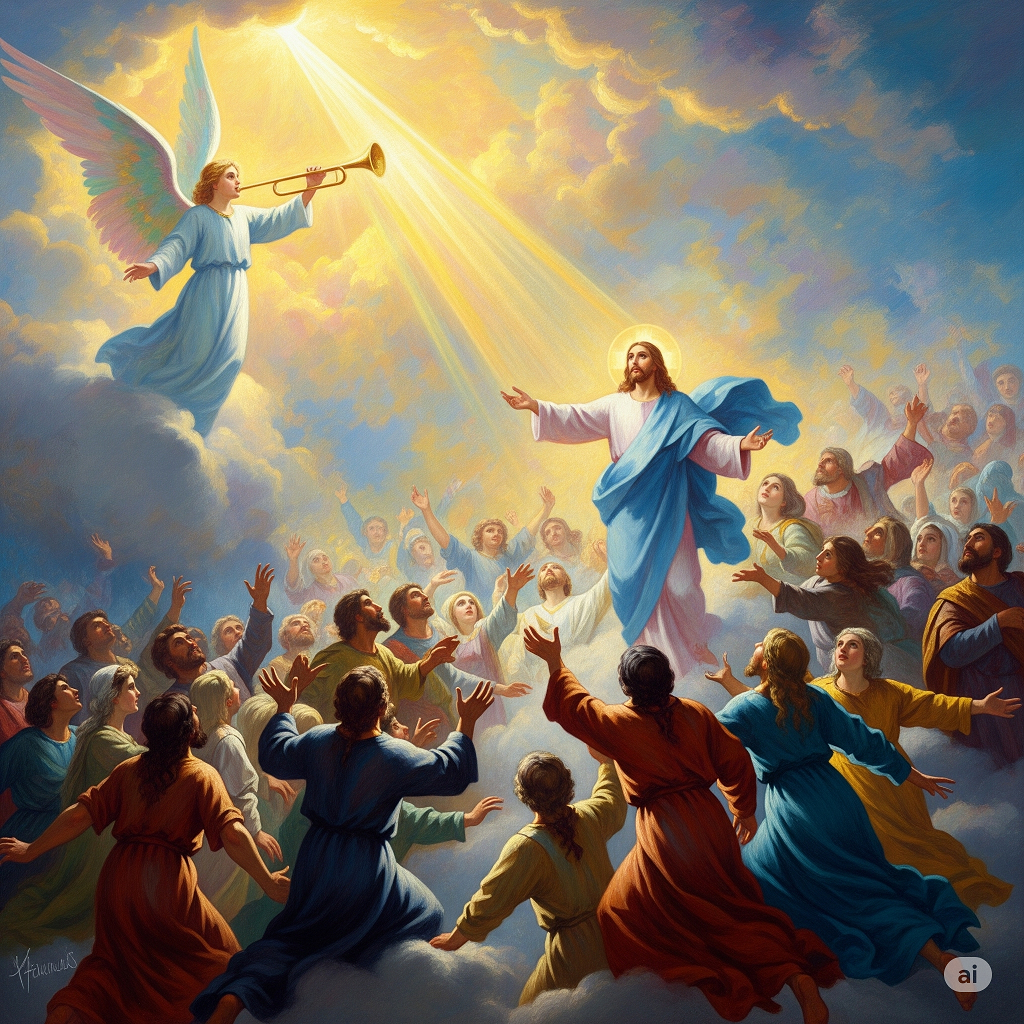
For the Lord Himself will descend from heaven with a shout, with the voice of an archangel, and with the trumpet of God. And the dead in Christ will rise first. Then we who are alive and remain shall be caught up together with them in the clouds to meet the Lord in the air. And thus we shall always be with the Lord. Therefore comfort one another with these words. (1 Thess. 4:16–18)
Greetings Lee, I’ve believed in the above text all of my Christian life. I even have a YouTube channel on which I share the possible dates on which the Rapture event will most likely occur. I no longer believe this event will ever happen. However, how are we meant to interpret what Paul has written in the above text. I’ve not been able to find anywhere where Swedenborg gave his interpretation of the above text. I would love to know your understanding of it. Maybe you’ve already covered it in one of your articles. Please share the link if indeed you have.
Thank you for all your help.
Olakunle Ilori
Thanks for the good question and conundrum, Olakunle! I’ve added the link you provided to your YouTube channel so that others can see the background if they wish.
This passage certainly has been a mainstay for biblical literalists who believe in a literal future resurrection when our physical bodies will rise from the grave and come back to life again.
Here is another one, from the book of Acts, which takes place after Jesus gives his final words to his followers:
When he had said this, as they were watching, he was lifted up, and a cloud took him out of their sight. While he was going and they were gazing up toward heaven, suddenly two men in white robes stood by them. They said, “Men of Galilee, why do you stand looking up toward heaven? This Jesus, who has been taken up from you into heaven, will come in the same way as you saw him go into heaven.” (Acts 1:9–11)
That settles it, doesn’t it! Christ is literally going to come in the clouds of heaven!
Wait a minute. Is it the clouds of heaven, or the clouds of the sky? And why are there always clouds? Where did Jesus go, anyway? Is he up there in the sky somewhere? Or is he up in heaven?
The closer we look at these passages, the less sense it makes to take them literally.
Let’s look at them much more closely. Because I guarantee you, despite what the gentleman in the video you posted says, the Rapture is not going to happen September 23–24, 2025, and Jesus is not going to return to Earth as King on September 15, 2032! (But if predictions like this get a few people to turn their lives around, that’s not a bad thing.)
What does Swedenborg say about this passage?
Emanuel Swedenborg (1688–1772) makes only one brief comment specifically about the passage you quote. It is in an unpublished draft that is a large compilation of passages for potential use in his final great work of Christian theology, True Christianity. In #29 of this draft “Bible Concordance” (traditionally known as Scripture Confirmations), under the heading, “The Coming of the Lord. The Consummation. The New Church. Christ and the Judgment,” Swedenborg makes this entry:
We shall be kept safe in the coming of the Lord. What that coming will be, is described (1 Thessalonians 4:15–17).
From this we know that Swedenborg was well aware of this passage, and others like it. He even included it in this collection of passages from which he could draw to provide scriptural support for his spiritual teachings about the Second Coming of the Lord.
From these few words, we can see that Swedenborg read this passage as being about the Lord keeping us safe at the time of the Second Coming, and as describing what that event will be like. Spoiler alert: Swedenborg does not read Paul’s words literally, but as having deeper spiritual meanings.
We’ll return to a spiritual understanding of this passage later. Swedenborg does comment on some similar passages elsewhere in the Bible, from which we can build an understanding of this one. Meanwhile, here is a link to a Swedenborgian Bible study video that briefly takes up this passage toward the end:
The Ubiquity of the Bible’s Inner Meaning, with the Rev. Dr. Jonathan Rose
This video also highlights Paul’s use of metaphorical and spiritual language, providing some good foundational material for understanding Paul differently than biblical literalists traditionally have.
What was Paul thinking?
Though Paul speaks with bombastic certainty on just about every topic he takes up in his letters, it is clear that he struggled to understand exactly what the promised Second Coming and future resurrection would be like.
That’s not surprising. The Hebrew Bible, which was the Scriptures for Christians of the first century, says almost nothing about the afterlife, and what it does say is obscure and largely metaphorical. The religion of the Old Testament focuses on proper living in this world. It is mostly silent on the afterlife.
Neither was there any highly developed understanding of the afterlife in the wider society of Paul’s day. There were a few texts and teachings here and there, but in general, the afterlife, if it was believed to exist at all, was a great mystery. There was certainly nothing like Swedenborg’s vast and highly detailed description of the afterlife. What, then, did Paul have to draw on? Even his own primary message was about how to get to heaven, meaning how to be saved, not about heaven itself.
It is even unclear from Paul’s writings whether he believed that the resurrection would be a physical event visible in this world, or whether it would be a spiritual event in another world. He did have the concept of a spiritual world and the spiritual body, but it seems not to have been well-developed in his mind. For example, he says:
I know a person in Christ who fourteen years ago was caught up to the third heaven—whether in the body or out of the body I do not know; God knows. And I know that such a person—whether in the body or out of the body I do not know; God knows—was caught up into paradise and heard things that are not to be told, that no mortal is permitted to repeat. (2 Corinthians 12:2–4)
It is unlikely that Paul thought this was a physical location. On the other hand, he seems not sure about that. Twice he repeats, “whether in the body or out of the body I do not know.” This, he says, is something only God knows.
But the clearest indication that Paul was unclear on these things is his famous passage about the resurrection body. I’ll quote it in full despite its length because it is so instructive about the state of Paul’s mind on the subject of the resurrection:
But someone will ask, “How are the dead raised? With what kind of body do they come?” Fool! What you sow does not come to life unless it dies. And as for what you sow, you do not sow the body that is to be but a bare seed, perhaps of wheat or of some other grain. But God gives it a body as he has chosen and to each kind of seed its own body. Not all flesh is alike, but there is one flesh for humans, another for animals, another for birds, and another for fish. There are both heavenly bodies and earthly bodies, but the glory of the heavenly is one thing, and that of the earthly is another. There is one glory of the sun and another glory of the moon and another glory of the stars; indeed, star differs from star in glory.
So it is with the resurrection of the dead. What is sown is perishable; what is raised is imperishable. It is sown in dishonor; it is raised in glory. It is sown in weakness; it is raised in power. It is sown a physical body; it is raised a spiritual body. If there is a physical body, there is also a spiritual body. Thus it is written, “The first man, Adam, became a living being”; the last Adam became a life-giving spirit. But it is not the spiritual that is first but the physical and then the spiritual. The first man was from the earth, made of dust; the second man is from heaven. As one of dust, so are those who are of the dust, and as one of heaven, so are those who are of heaven. Just as we have borne the image of the one of dust, we will also bear the image of the one of heaven.
What I am saying, brothers and sisters, is this: flesh and blood cannot inherit the kingdom of God, nor does the perishable inherit the imperishable. Look, I will tell you a mystery! We will not all die, but we will all be changed, in a moment, in the twinkling of an eye, at the last trumpet. For the trumpet will sound, and the dead will be raised imperishable, and we will be changed. For this perishable body must put on imperishability, and this mortal body must put on immortality. When this perishable body puts on imperishability and this mortal body puts on immortality, then the saying that is written will be fulfilled:
“Death has been swallowed up in victory.”
“Where, O death, is your victory?
Where, O death, is your sting?”The sting of death is sin, and the power of sin is the law. But thanks be to God, who gives us the victory through our Lord Jesus Christ. (1 Corinthians 15:35–57)
Here Paul talks about earthly bodies and heavenly bodies, and about physical bodies and spiritual bodies. But from his description, it is unclear whether he thinks that these are two distinctly different bodies, or that the physical body becomes a spiritual body at the time of our resurrection.
Despite his loud certitude, Paul was clearly struggling to understand these things himself. He sensed that there was a higher world. He just didn’t know enough about it to paint a clear picture, or even to say for sure whether we keep a glorified version of our physical body after death and live once again in this world, or whether we leave our physical body behind and live in a distinctly different spiritual body, in a distinctly different spiritual world, as Swedenborg teaches.
Paul lays the foundation for a higher understanding
And yet, as is often the case, Paul’s groping for a higher spiritual truth lays the foundations for a better understanding of these things once we gain a clearer picture of the difference between the physical world and body and the spiritual world and body.
In one passage Paul refers to “the third heaven” as a distinct realm where people can go, though he’s not sure if we would go there physically or spiritually. In another he introduces the idea of a spiritual body in which we will live after our resurrection, though it’s unclear whether this body is just a new version of our physical body or an entirely new and distinct spiritual body.
This uncertainty, I believe, is providential.
Many people, including many Christians, are incapable of thinking spiritually. They view the physical body as real, and spiritual things as wispy and unreal. The only way such people can believe in a real and solid afterlife is to believe that our wispy, ghostly spirit will rejoin our physical body in a future resurrection, and we will once again live physically right here on a renewed physical planet. The Internet is packed with evangelical Christians saying exactly this!
God knew that many people would be physical-minded and unable to think spiritually. God therefore provided that the Bible would be written in such a way that these literal thinkers could look to it and find support for the idea that they will have a real, physical afterlife in a real, physical world. This is the only way these materially-minded people can maintain their faith in God and eternal life.
Of course, since we’re all living on this physical planet right now, and we don’t see the people who have died, this means that everyone who has died is still dead and still lying in the grave, and the resurrection must be a future event. Again, the evangelical echo chamber is full of this idea!
But with his statements about the third heaven, the spiritual body, and so on, Paul also laid the foundation for a higher understanding of these passages and events. And over the centuries, many people have gravitated toward the more spiritual understanding of things that Paul opens up as a possibility. Mainline Christians commonly believe that after death we will not live on earth, but in heaven, meaning in the spiritual world. And they are more likely to read Paul’s words about the spiritual body as referring to a distinctly different body that we will live in when we arrive in the spiritual world after death. Many mainline Christians even believe that we go to heaven immediately after death—even if their church’s official teaching is that we don’t go to heaven until a future general resurrection.
To sum up, Paul had to write for the worldly and materialistic audience that existed on earth in the first century culture of his time. And even though he himself seemed to have one foot on each side of the line between the earthly and the spiritual, he was reaching toward a more spiritual understanding of things, which he saw as a great mystery—a word that he sprinkles through several of his letters.
One more point: As Jonathan Rose covers in the video I linked above, Paul was part of a long tradition of speaking in metaphor and symbol, and of not meaning everything he said to be taken literally. Who can forget his memorable words about “the whole armor of God” in Ephesians 6:10–20? Obviously, this is not about physical armor, but about spiritual armor.
And here is the smoking gun passage that Paul was not a literalist:
Not that we are qualified of ourselves to claim anything as coming from us; our qualification is from God, who has made us qualified to be ministers of a new covenant, not of letter but of spirit, for the letter kills, but the spirit gives life. (2 Corinthians 3:5–6)
He could hardly have said more clearly in the semi-poetic language of the time that we are not meant to take everything he says literally.
If we recognize that Paul was perfectly capable of speaking in symbol and metaphor, we can open our mind to a better and more spiritual understanding of his words about the Second Coming in 1 Thessalonians 4.
What does the passage say?
With all that in mind, let’s look at the full passage:
But we do not want you to be uninformed, brothers and sisters, about those who are asleep, so that you may not grieve as others do who have no hope. For since we believe that Jesus died and rose again, even so, through Jesus, God will bring with him those who have fallen asleep. For this we declare to you by the word of the Lord, that we who are alive, who are left until the coming of the Lord, will by no means precede those who have fallen asleep. For the Lord himself, with a cry of command, with the archangel’s call and with the sound of God’s trumpet, will descend from heaven, and the dead in Christ will rise first. Then we who are alive, who are left, will be caught up in the clouds together with them to meet the Lord in the air, and so we will be with the Lord forever. Therefore encourage one another with these words. (1 Thessalonians 4:13–18)
It is a message of hope
Here Paul is addressing people who are tempted see things from the perspective of this world. His message is meant to encourage people who might be grieving without hope about their deceased loved ones.
He is tapping into a universal human pain and sorrow: the loss of loved ones to death, and the uncertainty and fear about where they are, if anywhere at all, and whether we will ever see them again. Two thousand years later, many people still grieve without hope about their family members and friends who have died.
This puts the passage in its proper context. Paul is not providing a detailed instructional manual about what happens when we die. He is providing hope and encouragement about a future reunion both with our loved ones and with the Lord. The exact mechanism of how it will happen is secondary to the basic truth that it will happen.
Paul thought the Second Coming was imminent
This is also one of several passages showing that Paul thought the Second Coming of Christ would happen very soon—likely in his own lifetime. In it he says:
Then we who are alive, who are left . . . .
“We,” of course, includes Paul. Clearly, he believed that this was just about to happen.
Then there is his comment elsewhere about why he is advising people not to change their marital status, whether married or unmarried:
I think that, in view of the impending crisis, it is good for you to remain as you are. . . . I mean, brothers and sisters, the appointed time has grown short . . . . For the present form of this world is passing away. (1 Corinthians 7:26, 29, 31)
The “impending crisis” would involve “the present form of this world passing away.” Most likely he was thinking of the Second Coming of Christ. And once again, he thought this was just about to happen.
Paul wasn’t wrong about an impending crisis and “the present form of this world passing away.” Jesus himself said, after describing the end of the age:
Truly I tell you, this generation will not pass away until all these things have taken place. (Matthew 24:34)
Like Paul’s similar statements, this passage has had Christians scratching their heads ever since. This is not the place for a full consideration of this quandary. But here is the short version: there was an imminent crisis and end of the age. It took place shortly after Paul’s death, when the Romans sacked Jerusalem, destroyed the Temple, and initiated a Jewish diaspora from the Holy Land that put an end to Judaism as it had existed up to that time. The corresponding spiritual event was the end of the Israelite and Jewish era, and the beginning of the Christian era.
However, Paul had no specific knowledge of this crisis because it didn’t happen until after his death. In his mind, the Second Coming was just around the corner. Why, then, would it be necessary to give an accurate and detailed account of it? Pretty soon we would all know how it happens, because we would experience it!
This offers yet another suggestion that Paul was not focusing on the literal events, but on the spiritual reality that big changes were coming—and that for the faithful, this was not something to fear, but something to look forward to with hope.
Paul is using metaphorical language
Very quickly in the passage from 1 Thessalonians 4 we see Paul using metaphorical language. He speaks of those who “are asleep” and “have fallen asleep.” Obviously, he means people who have died. When we refer to death as “sleep,” this is not literal language. The dead are not literally sleeping. They are dead. But metaphorically they are asleep, because in the traditional Christian view, at the time of the Second Coming and Last Judgment, they will “wake up” and stand before the throne of God. In other words, they are not dead forever, but are only temporarily dead. So “sleeping,” though not literally accurate, is figuratively an appropriate word to use.
Heaven, or sky?
Then there are all those shouts, trumpets, archangels, and clouds, and the promise that we will “meet the Lord in the air” and “be with the Lord forever.”
Did Paul really think we were all going to be sucked up into the air, meet Christ there, and live in the clouds with Christ forever?
This is highly unlikely. For one thing, it is very hard to walk around in the clouds! There’s nothing solid to give people any footing. Paul was not such a fantasist that he thought we would all be floating around in the sky forevermore.
Literalists will be skeptical. But here’s a question: What does Paul mean by “heaven?” The Greek word οὐρανός (ouranos) can mean either “sky” or “heaven.” So when Paul says, “For the Lord himself, with a cry of command, with the archangel’s call and with the sound of God’s trumpet, will descend from heaven,” which one does he mean? Is the Lord going to descend from the sky, or is the Lord going to descend from heaven? Clearly, the translators think he is going to come from heaven, because that’s how it is always translated.
But it could be translated “sky.” And if we take the rest of what Paul says literally, it should be translated “sky.” After all, there are clouds and trumpets and a meeting in the air. Isn’t the whole scene set in the sky?
However, it is highly unlikely that Paul believed Jesus literally went up into the sky at the time of his ascension, and has been living there ever since. Perhaps the early Israelites believed that God was literally up in the sky above the clouds. But by New Testament times, there was a concept of heaven as an otherworldly place. Paul refers to it here and there, including in the well-known passage quoted above about someone who was “caught up to the third heaven.”
I’m going to agree with the translators, then, that Paul envisioned Christ coming from heaven, not from the sky.
And what about those archangels? Are angels in the sky, or are they in heaven? Clearly, heaven, not the sky, is the abode of angels and archangels.
What all of this suggests is that however Paul envisioned this, it was not something that would take place in the physical sky at all. The most sensible explanation is that the whole scene, including the Lord, the archangels, the trumpets, the clouds, and the air takes place in the spiritual world, not in the physical world.
As suggested above, Paul himself is not clear about whether these descriptions represent physical events or spiritual events. This means that it’s not even contrary to the letter of what he wrote to suppose that what he describes in 1 Thessalonians 4:15–18 was never intended to be taken literally. After all, Paul did not say, “All of this is going to take place in the physical sky of this physical world.”
Where did Jesus ascend to?
If we read these prophecies of the end times as describing things that will take place in the spiritual world, it throws a whole new light on the passage quoted at the beginning of this article about Jesus’ ascension. Here it is again, from the book of Acts:
When he had said this, as they were watching, he was lifted up, and a cloud took him out of their sight. While he was going and they were gazing up toward heaven, suddenly two men in white robes stood by them. They said, “Men of Galilee, why do you stand looking up toward heaven? This Jesus, who has been taken up from you into heaven, will come in the same way as you saw him go into heaven.” (Acts 1:9–11)
Again, the translators use the word “heaven” instead of “sky” to translate the Greek word οὐρανός. And again, I agree with them that the “men of Galilee” saw Jesus go up to heaven, not to the physical sky. It would be silly, especially in light of present-day science, to think that Jesus was physically swept up into the stratosphere beyond our visual range here on Earth’s surface, and has been hanging out there ever since. Besides, it’s getting crowded up there with all those satellites and space stations. It would be hard for Jesus to find a place to hide anymore!
All of this leads to the conclusion that Jesus’ ascension was a spiritual event, seen with the witnesses’ spiritual eyes. After all, physical eyes cannot see heaven. Physical eyes cannot see Jesus leaving the physical world and entering the spiritual world—which is what’s happening in this scene.
If this was a spiritual event involving the spiritual world, then what Swedenborg said about the Second Coming is entirely correct: it is an event that takes place in the spiritual world, not in the material world.
So when the angels tell the people, “This Jesus, who has been taken up from you into heaven, will come in the same way as you saw him go into heaven,” they’re not talking about him coming down from the physical sky. They’re talking about him being seen in heaven, which is his dwelling place.
In short, none of this is meant to be taken literally. It is only stated in physical-sounding words so that people who are focused on “the things of the flesh,” meaning physical-minded people, will have something to hang their faith on. But the real meaning of these passages is spiritual. All of it is about spiritual events, in the spiritual world.
I could give many more examples of how the prophecies of the end times are about spiritual events, not physical events. But for now, I’ll simply recommend that you read this article, which discusses the visions of John in the book of Revelation:
Is the World Coming to an End? What about the Second Coming?
The metaphorical meaning
If what I’m saying here is true, and Paul is not talking about literally meeting Jesus in the sky, what does all this mean?
As I said, Swedenborg never gives any specific explanation of 1 Thessalonians 4:13–18. But he does explain similar passages elsewhere in the Bible. Let’s take some of the elements of these verses one by one, and open up their metaphorical and spiritual meanings. Even this explanation can only scratch the surface. But it can open your eyes to some wonderful deeper truth in Paul’s message of spiritual hope.
For the dyed-in-the-wool Swedenborgians, I am well aware that Paul’s letters are not among the books that have an internal sense. See: “Why Isn’t Paul in Swedenborg’s Canon?” But Swedenborg himself explains the spiritual meaning of many passages in the Protestant Bible that are not from the books that have an internal sense. Just because a book doesn’t have the type of continuous, connected internal meaning that makes it a book of the Word, that doesn’t mean it can’t have symbolic and metaphorical meaning here and there. And this passage is one that begs to be read spiritually, not literally.
A message from the Lord
I’ve already commented on how the real purpose of this passage is to give hope and comfort to people who are grieving, or are fearful of death. Once Paul has given that introduction, he goes on to tell us that what he is saying is a message from the Lord.
Now I ask you, is the Lord interested in telling us about material things, or about spiritual things? If it’s a message from the Lord, this strongly suggests that we are meant to look for deeper meanings in what Paul is about to say. After all, Jesus himself said:
It is the spirit that gives life; the flesh is useless. The words that I have spoken to you are spirit and life. (John 6:63)
I have also already talked about what “heaven” means here. The Lord dwells in heaven, not on earth. If the Lord comes down from heaven, this is something that will happen in the spiritual world, not the material world. In other words, once again, Paul is talking about spiritual things.
With all that behind us, let’s look at more of the details of Pau’s description, and what they mean.
The archangel’s call
Angels in the Bible are messengers. That is the meaning of both the Hebrew and the Greek word commonly translated “angel.” The job of the biblical angels was to deliver messages from God to people on earth. And the messages God wants to give us are spiritual messages, even if they sometimes seem to be about material things such as the birth of a child.
An archangel is not just some ordinary angel, but a high-level angel. If the “call,” or message, is from an archangel, then we can expect it to be some very important message about our spiritual life. By saying that this will all begin with an archangel’s call, Paul is saying that the events that are about to happen are meant to lift our mind and heart up to a very high spiritual level. And as we will see, everything about the story is meant to lift our mind up from the material to the spiritual.
The sound of God’s trumpet
This is not some ordinary trumpet in a human marching band. This is God’s trumpet. We should therefore expect that it will be announcing something having to do with God and spirit.
And that’s exactly what it does.
In the Old Testament, trumpets were used as a call to battle, but they were also used to announce and assemble people for religious events and festivals. For example, after the exodus from Egypt, when the Israelites were gathered around Mt. Sinai about to receive the Ten Commandments, it says:
On the morning of the third day there was thunder and lightning, as well as a thick cloud on the mountain and a blast of a trumpet so loud that all the people who were in the camp trembled. Moses brought the people out of the camp to meet God. They took their stand at the foot of the mountain. (Exodus 19:16–17)
Notice that after the people heard the sound of a trumpet, they went to meet God.
Later, when the Israelites were traveling in the desert, God gave this instruction:
The Lord spoke to Moses, saying, “Make two silver trumpets; you shall make them of hammered work, and you shall use them for summoning the congregation and for breaking camp. When both are blown, the whole congregation shall assemble before you at the entrance of the tent of meeting. But if only one is blown, then the leaders, the heads of the tribes of Israel, shall assemble before you.” (Numbers 10:1–4)
These are just two of many passages about trumpets calling people together for important events in God’s presence. Trumpets therefore have to do with God summoning us to gather for a higher purpose than our ordinary everyday affairs. Though Swedenborg doesn’t provide an explanation for this verse in 1 Thessalonians 4, he does explain the similar statement in Matthew 24:31:
“He will send angels out with a trumpet and a loud voice” symbolizes being chosen—not by visible angels, let alone with trumpets and loud voices, but by sacred goodness and truth flowing in from the Lord through the angels. That is why angels in the Word symbolize something belonging to the Lord. In this instance they symbolize what comes from the Lord and tells about him. The trumpet and loud voice symbolize spreading the good news, as they do elsewhere in the Word. (Secrets of Heaven #4060:8)
The trumpet of God, then, is all about calling us and choosing us and delivering to us the good news of the sacred goodness and truth that flow into us from God through the angels.
Everything in the story is calling us to lift up our minds and hearts to seek and experience higher spiritual and heavenly things.
The Lord will descend from heaven
Since we’ve already covered this above, I’ll just say briefly that even though it appears as if we reach up to God, it is actually God who reaches down to us. This is what God did by coming to us personally as Jesus Christ. And God still reaches out to us personally as Jesus Christ whenever our hearts and minds are ready to open the door so that God can come in and eat with us, and we with God.
And the dead in Christ will rise first
Literally speaking, this is about Christian believers who have died. But spiritually, “death” is not about the death of the body, but the death of the spirit.
Before we have a relationship with God, we are spiritually dead. In other words, we have no spiritual life in us. We are focused only on the pleasures and pains of this world.
But when we “die in Christ,” those earthly things die in us, not in the sense that we don’t have to take care of the necessities of this world anymore, and can no longer enjoy its pleasures, but in the sense that these things are no longer our focus and our goal. This is what Paul means in numerous passages about dying and being raised up by Christ. For example:
So if you have been raised with Christ, seek the things that are above, where Christ is, seated at the right hand of God. Set your minds on the things that are above, not on the things that are on earth, for you have died, and your life is hidden with Christ in God. When Christ who is your life is revealed, then you also will be revealed with him in glory. (Colossians 3:1–4)
Obviously when he says “for you have died,” he does not mean physical death, because he is writing this letter to people who are still very much alive in this world. No, he is talking about our old selfish and greedy self dying, and about our being “raised with Christ” to a more spiritual, loving, and kind way of life.
The “dead in Christ,” then, are people whose old self has died, and who are now living a new life.
The true spiritual meaning of death is resurrection and new life. After all, when our physical body dies, we do not die. We rise again in the spiritual world, and join the Lord in heaven. From a spiritual perspective, physical death is not death. It is the beginning of a new and far greater life. Every time we see someone here on earth dying, the angels see someone new entering their world. For the angels, death is a celebration!
I should add, though, that spiritual death in a negative sense means rejecting love for God and the neighbor, and living a selfish, greedy life. This is a life that leads to hell, which is the living death of people who have killed their own spiritual life.
But in the context of 1 Thessalonians 4:13–18, when it says that “the dead in Christ will rise first,” it means that those who have died to their own life, and are living a new and higher life through the power of Jesus Christ working within them, are the vanguard of the people who will take their place in heaven.
We who are alive, who are left
Ordinarily we think that being alive is better than being dead. But here, those who have died in Christ, meaning those who have already been spiritually resurrected to a higher life, are “in first place.”
In this context, then, “we who are alive, who are left” means people who are still engaged in the struggles, trials, and temptations of this life. They are people who have not yet fully died to the old self, and are still struggling to lay it aside and fully enter into a new and more spiritual life. This is why “the dead in Christ” are given the primary place, and “we who are alive” a secondary place.
And yet, even people who are still engaged in the struggle toward a better and more spiritual life will also be raised up to higher things. It may be later and more delayed than people who have already died and been resurrected in Christ spiritually. But Paul’s promise here is to all people who not only aspire to a better and more spiritual life, but who are actively engaged in walking the path and fighting the battles that lead to spiritual life.
Caught up in the clouds
Clouds, of course, are up in the sky. And the sky, being high above the earth, is a symbol of spiritual things, compared to the worldly things symbolized by the earth below. That’s why God and the angels so often appear in the sky, and in the clouds, not only in the stories of the Bible, but in the experiences of many people who have an encounter with Jesus or with an angel. It’s not that God and the angels are literally in the clouds of the sky. It’s that they’re in a higher spiritual state represented by the sky above, and by the clouds in the sky.
The clouds, being made of water, represent truth. Water is a symbol of living, flowing truth, especially spiritual truth. Just as water satisfies our physical thirst, truth satisfies our thirst for knowledge.
However, the clouds also have a more specific meaning—a meaning that seems like a stretch at first, but that makes more and more sense the more you think about it. The clouds, Swedenborg says, represent the literal meaning of the Bible. And when the sun shines through the clouds, it represents the spiritual meaning shining through the literal meaning. Here is how Swedenborg explains similar words in Matthew 24:30:
“And they will see the Son of Humankind coming in the clouds of the heavens with power and great glory” means that the inner meaning of the Word, which contains the Lord, will then be revealed. The Son of Humankind means divine truth in the Word. The cloud stands for the literal meaning. Power is an attribute of the goodness there, and glory, of the truth. . . . The Lord’s coming in this way is what is meant here, not a literal future appearance by him in the clouds. (Secrets of Heaven #4060)
“The Son of Humankind” is a more contemporary translation of the traditional biblical term “the Son of Man.” And “the Word” is how people of Swedenborg’s time and culture commonly referred to the Bible.
Being “caught up in the clouds,” especially when we are meeting the Lord there, means seeing the deeper spiritual and divine meanings of what is written in the Bible. In fact, that’s what this article is all about! We’re looking at the deeper meanings in 1 Thessalonians 4:13–18. When we see these deeper meanings in the Bible, and Jesus speaking to us in those deeper meanings, that is when we are “caught up in the clouds” to meet the Lord.
To meet the Lord in the air
By now it should be clear that the “air” where we’re going to meet the Lord is not up in the literal sky above our heads here on earth. Ironically, people who think about it that way still have their feet stuck firmly on the ground. Their minds have not been raised up to a higher understanding of Paul’s words.
In other words, “meeting the Lord in the air” means having our thoughts raised up to higher spiritual things, which is where the Lord meets us, and we meet the Lord.
We will be with the Lord forever
This is the great climax of Paul’s end-times narrative: we will be with the Lord forever. Not up in the literal clouds in the literal air, but in the spiritual clouds of the spiritual air, meaning in heaven.
Of course, even in heaven we’ll mostly walk around on the ground just as we do here. But our minds will be lifted up to higher, more spiritual and heavenly things than they are here. For one thing, we will no longer have to worry about putting food on the table, clothes on our bodies, and a roof over our heads. All these things will be given to us freely by the Lord, allowing us to devote our time to the things that truly matter to us.
And yes, as angels we can ascend into the air and cavort in the clouds if we wish. The things Paul describes can happen in heaven.
But the main event is not flying around in the sky, whether on earth or in heaven. It is allowing the Lord to raise up our thoughts, our hearts, and our actions to higher things. Then we will indeed be with the Lord forever in heaven after we die.
After all, it is the presence of God’s love, wisdom, and power flowing into the people and the communities of heaven that make heaven the heavenly place it is. Being with the Lord means having the Lord’s love and wisdom in us, and having in our life the power given to us by the Lord to express that love and wisdom in active service to our fellow angels, and to people on earth who need the presence of angels to carry them forward on their spiritual path.
Conclusion
Of course, biblical literalists (of which you, Olakunle Ilori, apparently were once one) will say that all of this is nonsense. They will say I am reading things into the Bible that aren’t there.
No matter. Literalists are literalists precisely because their minds are stuck on an earthly level. They can’t see the higher and deeper meanings in the Bible. There is no sense even discussing these things with them. Their minds are closed to such things. Since their eyes can’t see the spiritual meaning within the letter of the Bible, they think it doesn’t exist, and that those who can see it are just seeing things.
But when, through hard experiences in life, and through learning many new things both scientific and spiritual, that literalistic and materialistic understanding of the Bible begins to wear thin, so that we can no longer accept it, it is not necessary to throw the Bible away as ex-Evangelical atheists do. Instead, we can open our mind to the Bible’s higher meanings—which is precisely the meaning of this passage about being caught up into the clouds and meeting the Lord in the air.
1 Thessalonians 4:13–18 is not only about some future event. It is also about something we can experience in our lives right now. Yes, it’s a story about death and resurrection. But this “death” is the death of our old earthly mind and its literal reading of the Bible. When this worldliness and literalism dies in us, that is when we can finally be caught up into the clouds and meet the Lord in the air in our mind and heart right here and now, while we are still living on Earth.
Will we experience these things after we die, when we are resurrected in the spiritual world?
Maybe!
In the spiritual world, symbolic and metaphorical things can happen in real life. When evangelical Christians have visions or near-death experiences, and they experience things described in the Bible that are symbolic, such as going through the pearly gates of heaven, those things are still spiritual events and experiences, and they have spiritual meanings—as does everything in the spiritual world.
But will these things take place literally here in the material world?
No, they won’t.
And when September 23–24, 2025—which is just a few months away as I write this—comes and goes without the Rapture happening, you can have a little more confidence that what Paul describes in this passage is not meant to be read as a literal prediction of future events here on earth, but as a vision of metaphorical and spiritual things that happen in the spiritual world—and things that can happen in our own life here on earth whenever we are ready to let the Lord lift up our mind to higher things.
Appendix:
Swedenborg’s explanation of Matthew 24
Swedenborg did not provide any detailed commentary on 1 Thessalonians 4:13–18. However, he did provide a detailed commentary on the “Little Apocalypse” in Matthew 24, about the end times. Here is a listing of the section numbers in Secrets of Heaven, taken from the introduction to volume 1 of the New Century Edition of that work. I have added links to the first section of each group leading to the online version at the New Christian Bible Study website so that you can conveniently read this material for yourself.
Matthew 24: 3353–3356, 3486–3489, 3650–3655, 3751–3757, 3897–3901, 4056–4060, 4229–4231, 4332–4335, 4422–4424. The close of the age: 4535.
Even an article of this length can only scratch the surface of the deeper meanings in the Bible’s prophecies about the end times. If you want to dig into this subject in more detail, Swedenborg’s much longer explanation of Matthew 24 is a good place to start.
This article is a response to a spiritual conundrum submitted by a reader.
For further reading:
- From Literal Slavery to Spiritual Freedom
- Why Isn’t Paul in Swedenborg’s Canon?
- Is the World Coming to an End? What about the Second Coming?
- What is the Biblical Basis for Humans becoming Angels after they Die?
- What Happens To Us When We Die?
Share this:


Lee Woofenden is an ordained minister, writer, editor, translator, and teacher. He enjoys taking spiritual insights from the Bible and the writings of Emanuel Swedenborg and putting them into plain English as guides for everyday life.



 Spiritual Insights for Everyday Life
Thanks To God!
Hi pumpjackdude,
Good to hear from you again, my friend.
Yes, indeed, Praise be to God!
Didn’t the Egyptians have a concept of the afterlife? You’d think the Jews/Israelites would too. I know the Sumerians didn’t believe in the afterlife, but the Egyptians did, didn’t they? Did the Babylonians or the Greeks believe in an afterlife?
Hi World Questioner,
I’m not an expert on ancient beliefs. But belief in an afterlife was very common. Cultures such as ancient Egypt that have elaborate burial rituals (at least for the wealthy) very likely had a strong belief in the afterlife also.
You’d think that since belief in afterlife was very common, the Jews would believe in an afterlife as well, don’t you think?
Hi World Questioner,
The ancient Israelites did have some dim sense of some sort of afterlife, as the story of the witch at Endor makes clear. But they thought of it as simply sleeping. By the time of the New Testament, many of them had adopted a more definite belief about the afterlife, but not all of them, as the Sadducees attest. Anyway, just because a lot of people believed in the afterlife, that doesn’t mean everyone did.
If the second coming occurred at the time of Swedenborg, you’d think that Jesus would return to Earth with his full divine body. Because Jesus rose from Earth with his full divine body, and Acts 1:9–11 says that Jesus would return the same way he went up, you’d think that, by logic (i.e. deductive reasoning), Jesus would return with his full divine body. As you said, people, including Swedenborg, would see Jesus with their spiritual eyes, not their physical eyes. But why did none of the living see Jesus even with their spiritual eyes at the time of Swedenborg? Jesus on Earth, but in the spiritual plane?
Hi World Questioner,
Because the Last Judgment and Second Coming happened primarily in the spiritual world, and only secondarily in the material world. The revelation of Christian truth in Swedenborg’s writings was one of the primary ways that this secondary effect of the Last Judgment and Second Coming happened. It is not a literal return, but a return “in spirit and in truth.”
But did Jesus ascend into Heaven in spirit and truth, in Acts 1:9? Because if not, then returning “in spirit and truth” would not be returning the same way he ascended, referring Acts 1:11 for reference.
Hi World Questioner,
Yes, in fact, he did ascend in spirit and in truth. His body was no longer material, but divine. And the divine body is made of love and formed by truth. After the resurrection he was also seen, I believe, with his followers’ spiritual eyes, not their physical eyes. But even if he was seen with their physical eyes, when he ascended, he did not ascend into the sky (even if that’s how it looked visually), but into heaven. Jesus does not live in the physical sky. He lives in his divine realm at the center of heaven.
Doesn’t 1 Corinthians 15:6 say that 500 people saw Jesus at once? Was that the same event as Acts 1?
Hi World Questioner,
Yes, but these weren’t just random people. They were “brothers,” meaning Christian believers. Why didn’t everyone see him? And why did he “appear” to them? During his lifetime he was outwardly an ordinary human being. Everyone could see him wherever he went. But after the Resurrection, he only “appeared” to a smaller or larger number of his followers. He seems not to have been living among them as before. Clearly there was something different about him after his resurrection.
What about the fish that Jesus ate? Wasn’t it a physical fish? Or whatever it was, an apple? Didn’t Jesus eat something physical to prove that he was real?
Hi World Questioner,
Yes, fish, and in some manuscripts also honeycomb. Here’s the KJV version, which includes the honeycomb:
It seems clear enough that it was physical food. As God, Jesus could interact with physical matter if he wanted to. God is omnipotent, you know.
If Jesus’ resurrection body wasn’t physical, then why did Jesus’ physical body disappear from the tomb when he resurrected? Doesn’t the disappearance of the physical body in the tomb mean that Jesus’ physical body was renewed, or perhaps morphed? Was it Paul that said “it was sown a physical body, it will be raised a spiritual body”?
Why wouldn’t Jesus’ physical body just be left to decay in the tomb while his divine body is his new body?
Apparently, upon the resurrection, when the earthquake caused the tombstone to roll away, the physical body must have just suddenly disappeared into nothing, perhaps faded.
Hi World Questioner,
According to Swedenborg, Jesus was replacing his finite human body with an infinite divine body throughout his lifetime, as part of his process of “glorification.” On the cross, this process was completed. And in the tomb, Jesus left behind the last remnants of his physical body, which, Swedenborg says, were dispersed in the tomb, so that there was nothing left there but the gravecloths in which he was wrapped for burial. The body that rose from the tomb was no longer physical, and not even spiritual, but was a fully divine body.
Didn’t Jesus’ physical body just disappear into nothing? Like fade to nothing? Suddenly vanish? Or is that just a conjecture? It wasn’t decomposed or decayed was it?
Hi World Questioner,
Obviously, none of us was there in the tomb, and neither was anyone at the time, so we don’t have any eyewitness account of what happened. What we know is that there was no body in the tomb, only grave cloths, and that Jesus appeared to many of his followers on a number of occasions for forty days afterwards, in a form that was solid and not ghostly (he could eat food, etc.).
If the body that was laid in the tomb had risen up, we would expect it to be like Lazarus, and come out with the grave cloths still on the body. The grave cloths wouldn’t still be in the tomb. But that’s not what happened. What happened was that the grave cloths were still in Jesus’ tomb, but he wasn’t there. So that suggests that the physical body that was buried was not the body that rose from death, but, as Swedenborg said, it was dissipated in the tomb when Jesus rose from death.
Why did God make it appear that Jesus disappeared into the clouds? Couldn’t Jesus just disappear into nothing, or alternatively fade as he ascends? Or a flash of light could be emitted when Jesus disappears into the clouds?
Why does the Bible even say that we will meet Jesus in the clouds? Why not just say that we will meet Jesus after we die? Or what could be a better way that could be more understood correctly by people who would take “meet Jesus in the clouds” literally?
Hi World Questioner,
Perhaps you should read the above article? That’s what it’s all about.
And as I’ve said before, people who think materialistically are going to take things literally no matter what the Bible says. Even where it says things that are clearly meant to be read metaphorically or spiritually, not literally, literalists find a way to read it literally.
If all Bible authors, was the Apostle Paul the most spiritual-minded? Did Paul give the best spiritual meanings of the Bible up until Swedenborg came in?
Hi World Questioner,
No, that laurel would have to go to John, author of the Gospel of John and the book of Revelation.
i always had the vision that in heaven people are naked just as adam and eve were before is that a thing that happens? people normalized it being weird in public especially if you were naked so would we still think the same about it or?
if we’re with God forever does that mean he’s always watching us? and we have to be careful with everything we do not to mess up? what if people just like to be alone*
Hi Max,
Most people in heaven wear clothes, just as people here on earth do. Heaven is not a giant nudist resort, as pictured in some Renaissance paintings, and hell isn’t either. In the highest areas of heaven, though, the angels wear little or no clothing because of their childlike innocence with one another. They are like Adam and Eve before the Fall, when they were naked and not ashamed.
As for God “watching us,” that’s not really how it works—as if God is some sort of Peeping Tom. But yes, God knows and sees everything everywhere. That’s just as true of our lives here as it is of our lives in heaven. And just as we don’t think about it here, we won’t be thinking about it there either. God loves us no matter what, so it’s not as if God is looking for bad stuff to “get” us on. God already sees and knows all of that, and keeps on loving us just the same.
back to when you said about childlike innocence in the highest heavens.. do they just forget about sin in heaven? does everyone forget about sin in heaven and forget about it? just like in the lowest can someone think and say “remember ___ doing that on earth” also is heaven in the spiritual world? i don’t wanna be all happy to everyone and i wanna express being annoyed if something actually is annoying or makes me sad or mad etc
Hi Max,
I wouldn’t worry about the highest heaven. It’s highly unlikely you’ll go there. This isn’t a knock on you personally. It’s just that for thousands of years, hardly anyone has gone to the highest heaven except babies and toddlers who die and are raised in heaven. Even today, very few people go to the highest heaven. I don’t expect to go there myself. If I go to heaven at all, it’s more likely that I’ll be in the middle heaven. And most average Joes and Janes will probably be in the lowest heaven. It’s not that God says they can’t go higher. It’s that most people today aren’t interested in going any higher. They’re just decent people who want to do good and enjoy life. And they will enjoy life in heaven—more than they can possibly imagine.
Yes, you can still remember things you did on earth if you want to. But mostly, thinking back on our earth life will be a downer compared to the life we’re living there. It would only drag you down into a much darker time. The memories you’ll be making there will be so much better than anything you ever did here that even though you can, you won’t be very interested in remembering your earth life. But yes, if you want to, you can. Angels have an excellent memory.
And once again, you can have whatever feelings and emotions you want to in heaven. There’s no “Happy Police” patrolling the neighborhoods saying, “Smile! C’mon, smile, dammit, or I’ll lock you up!!!” 😉
And yes, heaven is in the spiritual world, not in the material world.
i recently been seeing a debate on hell weither if it’s really enternal punishment or annihilation due to “2nd death” but both have verses in the bible for both things i’m confused.. what’s your take?
Hi Max,
Here’s an article just for you!
Is There Really a Hell? What is it Like?
i’m sorry my comments seem to be duplicating and not being able to finish my sentences not doing it purposely or spamming
Hi Max,
No worries. I did delete one unfinished one that you then did a finished version of.