Heaven and Hell
Emanuel Swedenborg (1688–1772) makes no claim that his descriptions of the afterlife are drawn from the Bible. On the title page of his best-known book, Heaven and Hell—a book in which he provides a comprehensive description of heaven, hell, and the area in between that he calls “the world of spirits”—his subtitle is Ex Auditis et Visis, “Drawn from Things Heard and Seen.”
Yet even in this book, the very first thing he does in his Preface is to quote Scripture. Specifically, he quotes Matthew 24:29–31, where Jesus speaks of the coming of the Son of Man. Swedenborg goes on to explain that this is not meant to be read as being about literal events in the physical world, but about spiritual events in the spiritual world.
This highlights a key issue in drawing beliefs about the afterlife from the Bible. The Bible says very little about the afterlife. The entire Old Testament contains almost nothing about the afterlife, because the ancient Jews had no specific beliefs about any afterlife. Even the New Testament is mostly about how to believe and live here on earth in order to go to heaven. And most of what it does say about the afterlife is in the form of parable, metaphor, and vision rather than being literal descriptions of the afterlife.
This is why so many different Christians and Christian churches have drawn so many different and even conflicting beliefs about the afterlife from the Bible. Most of these beliefs come from reading literally passages that were never meant to be taken literally. Based on conflicting interpretations of the Bible, Christianity as a whole cannot even agree on whether we are reunited with our physical body and live to eternity on this physical earth, or whether we leave our body behind permanently and live to eternity in heaven.
When traditional Christians challenge believers in Swedenborg’s Christian teachings to provide a biblical basis for this or that belief, they do so from the position of a church that is itself highly fractured when it comes to what the Bible says about many different subjects, including what happens to us after death.
Nevertheless, Swedenborg’s key teachings about the afterlife do have a basis in the Bible, even if they cannot be drawn from the Bible in detail. Swedenborg was a careful and thorough student of the Bible. He studied it intensively in its original languages. If he had believed that any of his teachings about the afterlife were in conflict with the Bible, he would not have held to those teachings.
Here are some of his key teachings about the afterlife, and their biblical basis.
Jesus is the God of heaven
The very first chapter of Heaven and Hell is titled, “The Lord is God of Heaven.” And by “the Lord,” as he explains elsewhere, Swedenborg means the Lord God Jesus Christ. This teaching draws directly on the Lord’s own words to his disciples after his resurrection—a passage that Swedenborg quotes many times in his writings:
All power has been given to me in heaven and on earth. (Matthew 28:18)
If all power has been given to Jesus, this can mean nothing but that Jesus has divine power, and is none other than the God of heaven and earth. There cannot be two gods wielding all power.
Swedenborg’s teaching that the Lord is the God of heaven is also supported by many passages in which Jesus Christ is pictured as the King on the throne of heaven, such as:
When the Son of Man comes in his glory and all the angels with him, then he will sit on the throne of his glory. (Matthew 25:31)
There are also many passages in which Jesus is described as sitting at the right hand of God on his throne. However, whenever the throne itself is described, there is always only one figure sitting on it, never two or more. This is because, as Swedenborg explains, “the right hand of God” is not meant to be taken literally. Rather, it is a reference to God’s human side, which is “God with us,” and is the way God exercises divine power. For more on this, see this article:
What Does It Mean to Sit at the Right Hand of God?
On the first subject he takes up in Heaven and Hell, then, Swedenborg is on solid biblical ground.
We are resurrected in the spiritual world immediately after death
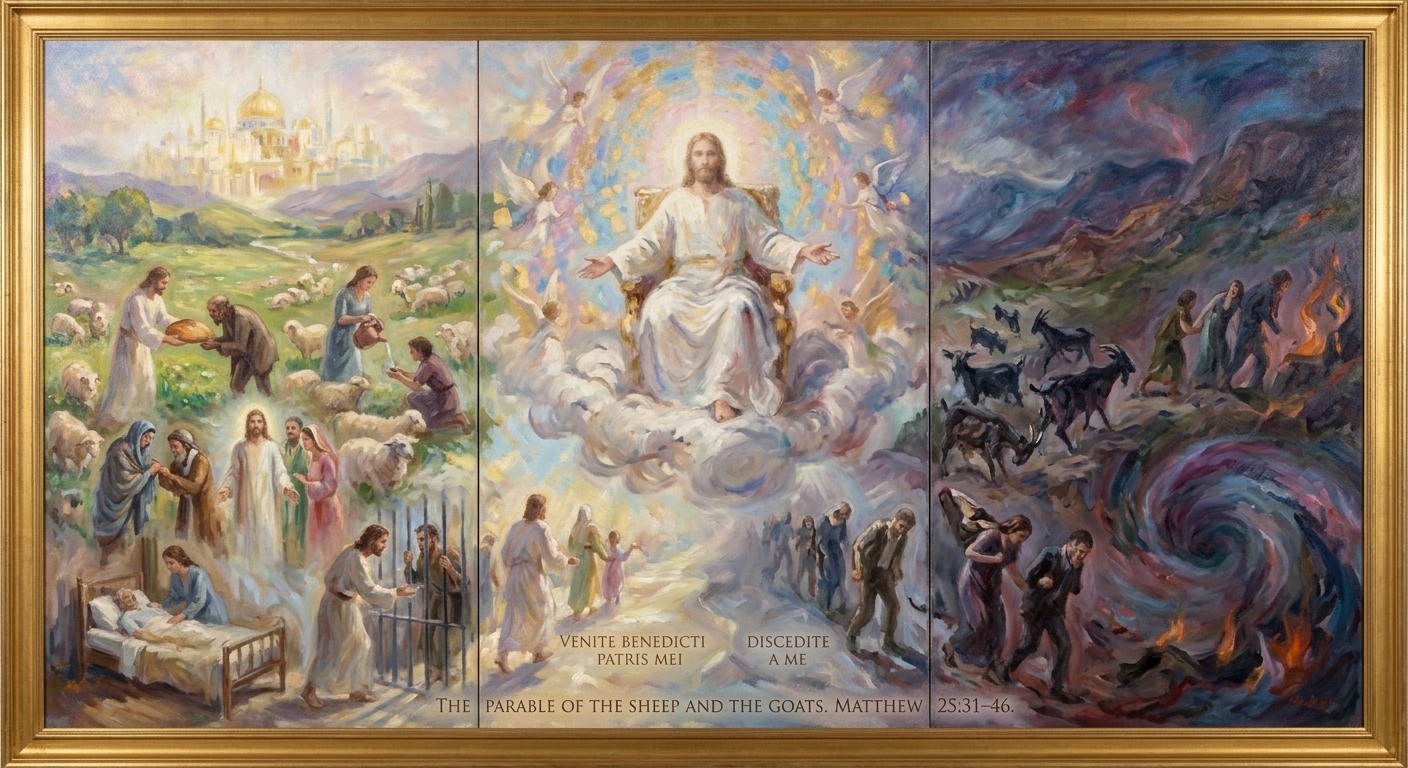
There is a common belief preached in many Christian churches that when we die we will sleep in the grave until a future Last Judgment, when everyone will be resurrected in their bodies and face judgment either to eternal life or eternal punishment. This is based on a literal reading of various passage in the Bible, such as the Parable of the Sheep and the Goats in Matthew 25:31–46.
However, when the Bible speaks about individuals rather than about grand cosmic events, the common pattern is the one described in Hebrews:
People are destined to die once, and after that to face judgment. (Hebrews 9:27)
It doesn’t say, “People are destined to die once, wait thousands of years, and then face judgment.” The natural reading of this passage is that our individual judgment comes immediately after death.
And this is exactly how Jesus Christ himself presents it in various parables and statements. For example:
There was a rich man who was dressed in purple and fine linen and lived in luxury every day. At his gate was laid a beggar named Lazarus, covered with sores and longing to eat what fell from the rich man’s table. Even the dogs came and licked his sores.
The time came when the beggar died and the angels carried him to Abraham’s side. The rich man also died and was buried. In Hades, where he was in torment, he looked up and saw Abraham far away, with Lazarus by his side. So he called to him, “Father Abraham, have pity on me and send Lazarus to dip the tip of his finger in water and cool my tongue, because I am in agony in this fire.”
But Abraham replied, “Son, remember that in your lifetime you received your good things, while Lazarus received bad things, but now he is comforted here and you are in agony. And besides all this, between us and you a great chasm has been set in place, so that those who want to go from here to you cannot, nor can anyone cross over from there to us.”
He answered, “Then I beg you, father, send Lazarus to my family, for I have five brothers. Let him warn them, so that they will not also come to this place of torment.”
Abraham replied, “They have Moses and the Prophets; let them listen to them.”
“No, father Abraham,” he said, “but if someone from the dead goes to them, they will repent.”
He said to him, “If they do not listen to Moses and the Prophets, they will not be convinced even if someone rises from the dead.” (Luke 16:19–31)
Of course, this is a parable. It is not meant to be read as a literal description of the afterlife. Nevertheless, the general framework in which the story of the parable is set agrees exactly with Swedenborg’s teaching that we go to the afterlife immediately after we die, and are there judged for either heaven or hell, where we stay forever.
Specifically, it says, “The time came when the beggar died and the angels carried him to Abraham’s side” (verse 22). Not after some Last Judgment a thousand years after his death, but right after he died he was “carried to Abraham’s side,” meaning carried to heaven.
Similarly, “The rich man also died and was buried. In Hades, where he was in torment, he looked up and saw Abraham far away, with Lazarus by his side” (Verses 23–24). He did not sleep in his grave for a thousand years. Rather, he was immediately in Hades, one of the Greek words used to mean “hell,” and there he was in torment.
Further, this could not possibly be after some future Last Judgment when all people have risen from their graves, because later the rich man says, “Then I beg you, father, send Lazarus to my family, for I have five brothers. Let him warn them, so that they will not also come to this place of torment” (verses 27–28). Even while the rich man is in torment in Hades, his brothers are still living on earth, and have not yet died and gone to either heaven or hell.
In short, though much of the story is metaphorical, not literal (we don’t literally “go to Abraham’s side” after death, or Abraham would be crushed by the weight of billions of people), the general picture of what happens when we die is exactly what Swedenborg says: we are immediately resurrected, not in the physical world, but in the spiritual world, where we go on to our eternal life in either heaven or hell.
Then there are Jesus’ words to the Sadducees, who had concocted an elaborate trick question designed to prove that there is no afterlife:
But about the resurrection of the dead—have you not read what God said to you, “I am the God of Abraham, the God of Isaac, and the God of Jacob”? He is not the God of the dead but of the living. (Matthew 22:31–32)
If Abraham, Isaac, and Jacob were still “sleeping in their graves,” meaning still dead, Jesus would have been lying to the Sadducees.
It is very clear from this statement that Jesus considered Abraham, Isaac, and Jacob to be very much alive. And since they obviously had not been resurrected in the physical world, this can only mean Jesus is telling us that Abraham, Isaac, and Jacob—and by extension, everyone else who has ever died—has already risen from death in the spiritual world, and has been living there ever since. And in fact, the version of this scene in Luke affirms that this does not apply only to Abraham, Isaac, and Jacob, but to all people:
He is not the God of the dead, but of the living, for to him all are alive. (Luke 20:38)
Then there are Jesus’ plain words to the repentant thief in the cross:
“Truly I tell you, today you will be with me in paradise.” (Luke 23:43)
Not, “Truly I tell you, in two thousand years [and counting], after the Last Judgment, you will be with me in paradise.” “Today you will be with me in paradise.”
And no, you can’t wriggle out of it by moving the comma and saying that Jesus is saying, “I tell you today, you will be with me in paradise.” That’s a silly and desperate reading of the text in an attempt to avoid Jesus’ obvious meaning: that the thief would be entering the spiritual world immediately after he died.
More Bible passages could be quoted, but these should be enough to show that when Swedenborg said that people are resurrected in the spiritual world immediately after death, he was simply following in the footsteps of Jesus, who clearly “believed” that we enter the spiritual world immediately after death. But if it is Jesus speaking, it is not mere “belief.” It is the truth.
Meanwhile, when Jesus talks about a future Last Judgment, he is not talking about the resurrection and judgment of individual people, but about a judgment on whole “churches,” or religions.
At the time he spoke his words about the coming judgment, the Jewish religion as it had existed up to that day was in its end times. And it soon came to its end when the Romans sacked Jerusalem and destroyed the Temple in 70 AD. This put an end to Judaism as a sacrificial religion, as it had existed for over a thousand years.
Today, according to Swedenborg, we are in the end times of the Christian Church as it has existed up to this time.
But the end-time events that Jesus described in the Gospels, and that John described in the Book of Revelation, are not literal descriptions of events that will take place in the material world. They are metaphorical descriptions of events that will take place in the spiritual world. For more on this, please see this article:
Is the World Coming to an End? What about the Second Coming?
We rise from death in our spiritual body, not in our physical body
Here, the obvious clearest passage is Paul’s speech about the resurrection body in 1 Corinthians 15:35–58.
Even in this passage, Paul’s fancy language gives wiggle room for people who claim that we are resurrected with our physical body, such as by claiming that our physical body becomes a spiritual body. But Paul’s wording is a sop thrown to people who cannot accept his main message, which is that we have a physical body for this world, and a spiritual body for our afterlife in the spiritual world. He says plainly:
If there is a natural body, there is also a spiritual body. (1 Corinthians 15:44)
And even more clearly:
I declare to you, brothers and sisters, that flesh and blood cannot inherit the kingdom of God, nor does the perishable inherit the imperishable. (1 Corinthians 15:50)
It is possible to read this passage and still believe we will be resurrected in a changed physical body. But only people who are determinedly materialistic in their thinking will read it that way. And the Bible is written so that even “fleshly-minded” people—i.e. biblical literalists—can read it and maintain their faith. But people who can think spiritually will see clearly in Paul’s speech about the resurrection body that we will leave our physical body behind at death, and rise from death in our spiritual body, in the spiritual world.
This is also necessary if Jesus isn’t deceiving us when he says that God is not the God of the dead, but of the living, meaning that Abraham, Isaac, and Jacob, and everyone else who has ever died, is now alive in the spiritual world.
Further, when John in his visions saw the throne of God, and the multitudes surrounding it, he said:
After this I looked, and there before me was a great multitude that no one could count, from every nation, tribe, people and language, standing before the throne and before the Lamb. They were wearing white robes and were holding palm branches in their hands. (Revelation 7:9)
And a few verses later:
Then one of the elders asked me, “These in white robes—who are they, and where did they come from?”
I answered, “Sir, you know.”
And he said, “These are they who have come out of the great tribulation; they have washed their robes and made them white in the blood of the Lamb. (Revelation 7:13–14)
John was not seeing these things in the future. He was seeing these things in the spiritual world in the present. And there was already “a great multitude that no one could count, from every nation, tribe, people and language, standing before the throne and before the Lamb.” And these are clearly people who have lived on earth, because they “have come out of the great tribulation.” Where else would they endure tribulation but on earth?
What John saw was multitudes of people who had lived on earth and fought the good fight, and were now in heaven around the throne of God. Again, that throne is figurative, not literal. These people are now living in heaven, which is God’s throne. And since there has been no physical resurrection, this means they are living in their spiritual bodies.
There is an intermediate area between heaven and hell
According to Swedenborg, in addition to the well-known heaven and hell, there is also an intermediate area between heaven and hell where everyone goes right after death. This is the area of the spiritual world that has the closest connection to people on earth, because like earth, and unlike heaven or hell, it is a mix of good and bad people.
Swedenborg calls this area “the world of spirits,” because it is a whole world, or region, unto itself, distinct from heaven and hell. (This is not the same as “the spiritual world,” which is the entire spiritual realm, including heaven, the world of spirits, and hell.)
The term “world of spirits” is not in the Bible. However, the idea of an area or space or separation between heaven and hell is biblical. For example, in the Parable of the Rich Man and Lazarus quoted above, when the rich man asks Abraham to send Lazarus to dip his finger in the water and cool his tongue, one of the things Abraham says in reply is:
And besides all this, between us and you a great chasm has been set in place, so that those who want to go from here to you cannot, nor can anyone cross over from there to us. (Luke 16:26)
Swedenborg specifically refers to this chasm as an area between heaven and hell called the world of spirits, where influences from both heaven and hell flow in, where people first go after they die, and which we are connected to while we are living on earth:
Between heaven and hell there is a great gap, which, to those who are in it, appears like an entire globe. Into this intervening area evil in great abundance exhales from hell, and on the other hand goodness, also in great abundance, flows in from heaven. This interspace is what Abraham was referring to when he said to the rich man in hell:
Between us and you a great gulf has been established, so that those who try to cross over from here to you cannot, and neither can those who are there cross toward us. (Luke 16:26)
The spirit of every human being is in the midst of this vast interspace for one reason: so that we will have free choice.
Because this interspace is so huge and looks to those who are there like a great globe, it is called “the world of spirits. “ It is also full of spirits, because every human being first comes there after death and is prepared there for either heaven or hell. There we are among spirits and in interaction with them, just the way we had previously been among people in our former world. (There is no purgatory there. Purgatory is a fable invented by Roman Catholics.) (True Christianity #475:3–4)
Luke 16:26 articulates another teaching of Swedenborg about what happens to us in the afterlife, stated multiple times in his theological writings. Here is one of those statements that directly quotes Jesus’ words in Luke 16:26:
Our life cannot be changed after death. It retains the nature it had, because the nature of our spirit depends entirely on what our love is like, and a hellish love cannot be transformed into a heavenly one, because they are opposites. This is the meaning of what Abraham said to the rich man in hell: “Between you and us there is a great gulf, so that those who want to cross over to you cannot, and neither can those from there cross over to us” (Luke 16:26). This shows that people who enter hell stay there to eternity and people who enter heaven stay there to eternity. (The New Jerusalem #239)
But back to the area in between heaven and hell, this is also implied in the Parable of the Sheep and the Goats, which starts out:
When the Son of Man comes in his glory, and all the angels with him, he will sit on his glorious throne. All the nations will be gathered before him, and he will separate the people one from another as a shepherd separates the sheep from the goats. He will put the sheep on his right and the goats on his left. (Matthew 25:31–33)
And ends:
Then they will go away to eternal punishment, but the righteous to eternal life. (Luke 25:46)
God’s throne is in the spiritual world, not on earth. However, the people being judged are clearly not in either heaven or hell, because evil people cannot go to heaven, and good people cannot go to hell. Plus, it says of the evil people that they will “go away” to eternal punishment, and the good to eternal life. If they were already in eternal life (heaven) or eternal punishment (hell), they would not have to “go away” from the place of judgment.
In short, the place of judgment is neither in heaven nor in hell, but is in a place in between, from which good people go to heaven and evil people go to hell. This is the vast area between heaven and hell that Swedenborg calls the world of spirits.
Judgment involves the disclosure of a person’s true character
The traditional Christian idea of judgment is of God literally sitting on a throne and judging people either for heaven or for hell based on their deeds on earth, good or bad. But this, too, is figurative. God does not literally sit on a throne. No throne could contain God, and God is not like a human king sitting on a throne. God’s “throne” is heaven itself, which has God as its center and focus.
The actual process of judgment, according to Swedenborg, is not merely people “self-discovering” whether they are going to heaven or hell. It is a process of stripping away any false exterior pretensions to goodness from evil people, and any false beliefs and bad character traits from good people that don’t match their true inner heart of goodness and love.
This judgment takes place by the light of God’s truth, which is heaven’s light, shining on people in the world of spirits and either rapidly or gradually revealing their true character. Once their true inner character comes out, they voluntarily go either to heaven or to hell, although it does sometimes appear from a distance as if evil people are being cast into hell, and the Bible uses this language as well.
Since most of the Bible’s language about judgment is figurative, not literal, it is not so easy to see in the Bible Swedenborg’s account of how individual judgment works in the afterlife. However, there are some hints of it here and there. For example, although the Bible often describes God as slaying the wicked, Psalm 34:21 says:
Evil will slay the wicked.
This is in accord with Swedenborg’s statements that despite necessary appearances, it is not God who sends people to hell, but their own evil that sends them to hell. Spiritually speaking, “death” is not physical death, but spiritual death, which is a hellish life of evil.
Another hint of Swedenborg’s account of what happens to us in the afterlife comes in the book of Revelation:
Then the kings of the earth, the princes, the generals, the rich, the mighty, and everyone else, both slave and free, hid in caves and among the rocks of the mountains. They called to the mountains and the rocks, “Fall on us and hide us from the face of him who sits on the throne and from the wrath of the Lamb! For the great day of his wrath has come, and who can withstand it?” (Revelation 6:15–17)
This is part of a scene of judgment in the book of Revelation. And here, rather than God sending people to hell, represented by “caves among the rocks,” it is the evil people themselves fleeing into caves to hide from God, and calling on the rocks to seal them in. And this is precisely what Swedenborg says evil people do in the spiritual world: they take themselves away from God, hiding from God in dark, barren, rocky caves that are really the caverns of hell.
About false pretensions being stripped away, and people’s true character coming out in the afterlife, this is the meaning of Jesus’ words:
There is nothing concealed that will not be disclosed, or hidden that will not be made known. What you have said in the dark will be heard in the daylight, and what you have whispered in the ear in the inner rooms will be proclaimed from the roofs. (Luke 12:2–3)
Conclusion
These are only a few of many Bible passages that could be quoted to support Swedenborg’s teachings about what happens to us after death.
Again, neither Swedenborg nor I claim that everything Swedenborg reported about the afterlife can be drawn from the Bible. Once again, the Bible is concerned primarily with teaching us what we must believe and do here on earth in order to live a life that leads to heaven.
And if we do live according to the teachings and commandments that God gives us in the Bible, especially the ones that “God with us” gives us personally in the Gospels, then we will find out for ourselves once we die that the afterlife is far better than what traditional Christianity preaches about it based on a materialistic reading of the Bible.
For those who have spiritual eyes to see and spiritual ears to hear, Swedenborg’s teachings about the afterlife shine out clearly throughout the Bible, especially in the New Testament.
(Note: This post is an answer I recently wrote and posted on Christianity StackExchange. You can see the original question on StackExchange here, and the StackExchange version of my answer here.)
For further reading:
- What Happens To Us When We Die?
- Who Are the Angels and How Do They Live?
- Is There Really a Hell? What is it Like?
- Is the World Coming to an End? What about the Second Coming?
- What Does It Mean to Sit at the Right Hand of God?
Share this:


Lee Woofenden is an ordained minister, writer, editor, translator, and teacher. He enjoys taking spiritual insights from the Bible and the writings of Emanuel Swedenborg and putting them into plain English as guides for everyday life.



What do you think?