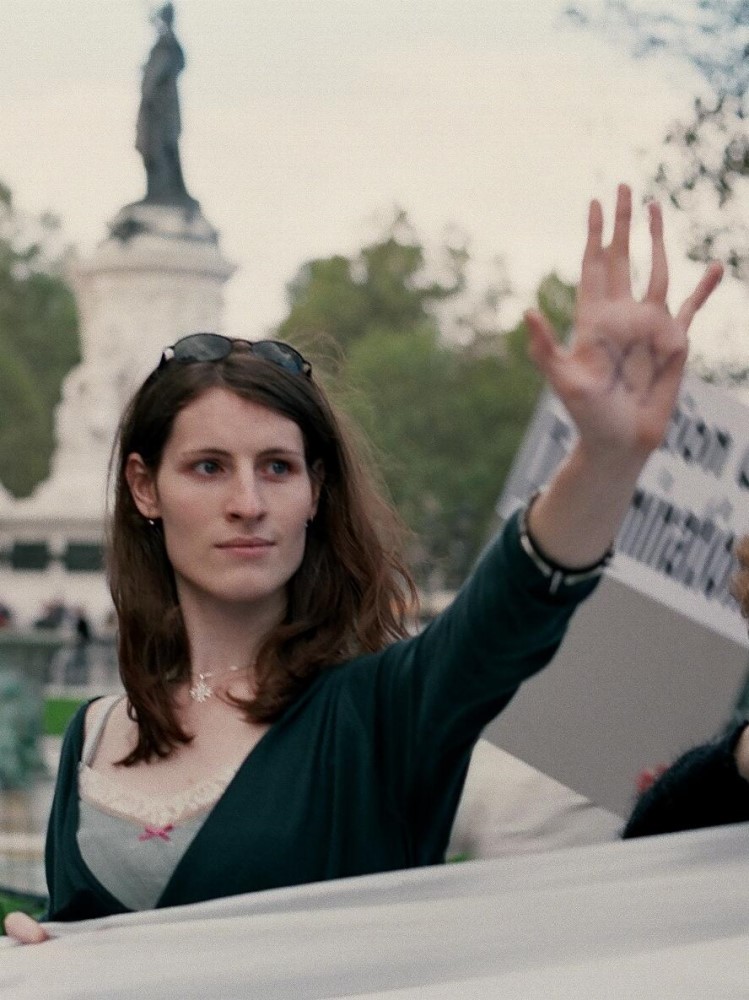
July Schultz – credit: Wikipedia
A reader named Steve S. recently submitted a Spiritual Conundrum to Spiritual Insights for Everyday Life asking a series of questions about the spiritual side of the transsexual issue, focusing especially on this one:
I am truly interested in whether the inner/soul gender would be changed to conform to the outer birth gender in the afterlife, or vice versa.
I’ll post Steve’s full question in a moment.
Neither the Bible nor Emanuel Swedenborg (1688–1772) directly addresses today’s transgender and transsexual issues. In those eras, practically speaking, even if gender transition were an idea in people’s minds, the level of physiological knowledge and surgical technique would have made physical transitioning impossible. And conceptually, today’s complex ideas about gender identity had not yet been developed. There was male, and there was female. That was the beginning and the end of it. About as close as the Bible gets to this topic is a verse in Deuteronomy forbidding men and women from wearing each other’s clothing. We’ll get to that later.
Today, we recognize that this world is not as simple as we might wish it to be. Yes, over 99% of the human population is either male inside and out or female inside and out. But we now recognize that there are edge cases that do not fit this neat male/female divide. And the existence of people born intersex makes it impossible to ignore the reality that sex is not quite as black and white as was traditionally believed.
Swedenborg did see humans as being either fully male or fully female. He addressed that verse from Deuteronomy from this perspective. However, though he didn’t say anything about which body a trans person would have in the afterlife, he did provide some concepts about the spiritual world, the material world, and what happens to us in the afterlife that can help us arrive at an answer.
The most relevant of these is that even though the material universe operates by its own laws that often resist spiritual influences, so that the outward appearance doesn’t always match the inner reality, in the spiritual world we soon transition to a state in which our outer self, including our spiritual body, perfectly matches and expresses the character of our mind.
The trans question and the soul
Here is Steve’s full Spiritual Conundrum:
Hi Lee,
I am interested in the transsexual issue and how it relates to the nature of the soul, and the sex or gender of a person and their spiritual body in the afterlife. First, what is the origin of the soul, or the spirit that is within us? Second, if it is given by God, and it is of a masculine gender why would it be placed in a female birth body, or vice versa? Third, how would the conflict between the birth body and the soul be resolved in the afterlife? Would the form of the spiritual body be changed to match the soul’s gender, or the soul’s gender be revised to match the birth gender?
The first question is probably covered by Swedenborg. If so, I apologize for making you answer something I could have looked up. The latter issues have also probably been covered by some of the Swedenborgian churches. (Same apology here). However, I am truly interested in whether the inner/soul gender would be changed to conform to the outer birth gender in the afterlife, or vice versa. Either way, the person would be made whole without the dysphoria issues that come with transsexualism, but there are also collateral issues to be considered as well. E.g., a person with male sex characteristics at birth who identified as female (i.e., has a female soul) would probably make a lifetime in the female role, including a possible physical sex change and possible matrimony to a male. Reversing soul gender in the afterlife to match birth/spiritual body would create problems in terms of continuing with any lifetime loves, who would then be the same gender/sex.
Anyhow, I once again apologize for raising an issue that Swedenborgians have probably already covered, but you have a way of explaining things in a lucid and understandable manner, so I am defaulting to you on this one.
Cordially,
Steve S.
PS: You can probably tell from the way I framed my last observation that I have a favored result in terms of resolving the foregoing issues, but I am not sure it would correspond with any Swedenborgian consensus on the matter.
Thanks for your good question and for your kind words, Steve. And no apologies are necessary. Since Swedenborg doesn’t say anything about today’s trans issues, there is no Swedenborgian consensus on that subject, and probably not a lot written about it. Ask a different Swedenborgian, and you might get a different answer. But I can give you my Swedenborgian thoughts and conclusions.
What is the origin of the soul?
Ultimately everything in the universe, including the human soul, comes from God and is created by God. But God does not create things directly and instantaneously. Rather, God creates things through channels and means, using step-by-step processes.
For the full version of the origin of the human soul, here is a lengthy article:
Where Does Our Soul Come From? When Does It Become Eternal?
To get the most out of this article, I recommend reading that one first. It explains some fundamental ideas about the origin and nature of the soul, and about the relationship between the soul and the body, that are central to the discussion below about the relationship between the gender of the soul and the sex of the body.
Here are some of the key points that are relevant for this article:
- Human souls are not directly created by God.
- Human souls come from the father (according to Aristotle and Swedenborg), or from the father and mother (according to me).
- Each new human soul is a combination of unique offshoots of the father’s and mother’s souls (in my modification of Swedenborg’s Aristotelian theory).
- Like the human body, which starts out unformed at fertilization, the human soul starts out unformed, and forms into an actual human soul in parallel with the body.
- Each soul forms a body that reflects and expresses its own character.
Can a masculine soul be in a female body, or vice versa?
That last bullet point is the big sticking point on the transgender issue.
Based on the theory of the relationship between the soul and the body originally put forward by Aristotle, and later developed in much more detail by Swedenborg, there can be no mismatch between the soul and the body. If the soul is male, it will build a male body for itself. If the soul is female, it will build a female body for itself.
This Aristotelian idea is the philosophical source of the common belief among Christians that a person’s inner sex must match his or her physical sex. And since our physical sex is clearly visible, it is taken as definitive on the question of whether we are male or female. This is the source of the resistance to the very idea of transgender people among traditional and conservative Christians.
Unfortunately, this neat, tidy, and elegant theory that the sex of the soul and the body must match crashes into some hard realities of actual human births. Because although the sex of the body does match the sex, or gender, of the soul (or mind) a good 99% of the time, there is that wee little 1% or less where it doesn’t.
That is, unless you believe that some souls are intersex. Because in somewhere between 0.02% and 0.05% of births, the genitals are neither fully male nor fully female, but have elements of both. Physicians and parents must simply pick a gender, and the parents then raise the child to be that gender. And they don’t always get it right. There are well-known cases in which an intersex person was raised to be one gender, but felt himself or herself to be the other gender.
Intersex births may be a tiny percentage of all births, but that tiny percentage does not allow those who believe that souls are either male or female to maintain that a male soul always builds a male body, and a female soul always builds a female body. And if the mismatch can be “halfway,” why couldn’t there be a complete mismatch, producing a person who has a male soul but a female body, or vice versa?
And indeed, this seems to be the case for somewhere between less than 0.1% and 0.6% of the world’s population. Yes, there are arguable cases in which someone reaches adolescence and then feels gender dysphoria, and has angst and confusion about his or her gender. But there are also cases in which people feel that they are the opposite gender to their physical sex from as early as they have any thoughts at all about being a boy or a girl. They’re not confused or gender dysphoric. They have a settled sense of being a girl even though they’re in a boy’s body, or of being a boy even though they’re in a girl’s body.
This may be a tiny percentage of all the people on earth, but these are still real human beings. And together with the phenomenon of intersex births, they don’t allow us to make a categorical statement that every male soul will build and inhabit a male body, and every female soul will build and inhabit a female body. That simply isn’t the reality for a small percentage of people.
The physical world has a mind of its own
How could this be if, as Aristotle and Swedenborg believed—and I agree with them—the soul builds a body that reflects its own specific character?
This is a case in which the Devil is almost literally in the details. You see, even though nature, and the physical universe in general, reflect and express the spiritual universe (or in Swedenborg’s terms, correspond to spiritual things), they don’t do so perfectly. According to Swedenborg, nature tends to resist and react to what flows into it from the spiritual world:
By their very nature, substances of the earthly world react against substances of the spiritual world, since substances of the earthly world are intrinsically dead and are activated from the outside by substances of the spiritual world. Anything that is dead and is activated from the outside resists by its very nature, and therefore reacts by its very nature. (Divine Love and Wisdom #260)
In the broader discussion surrounding this quote, Swedenborg relates this phenomenon mostly to the human mind, which reacts against the good and true things that flow in from God and heaven if the person is selfish and materialistic. However, the general principle still holds: The spirit, and the spiritual world, are alive and active, whereas the material world is intrinsically dead and reactive, and resists what flows into it from the spiritual realm, even while also being shaped by it.
For a similar statement, see Apocalypse Explained #1207:2–4 (scroll down and start reading at subsection 2). This passage focuses on how the world of nature expresses what is in the world of spirit. Along the way, it points out that matter is intrinsically dead, whereas spirit is intrinsically alive.
In other passages Swedenborg says that spiritual evil brings about poisonous and predatory plants and animals. In other words nature does not produce only good and healthful things. It also produces dangerous and deadly things. For more on the philosophical issues involved in this, and specifically on how nature could be dangerous and deadly even before humans came onto the scene and originated moral and spiritual evil, see the section titled, “2. Violence, pain, and suffering exist in the universe because the universe was created for us,” in this article:
How can we have Faith when So Many Bad Things happen to So Many Good People? Part 2
Beyond issues of good and evil, common experience tells us that nature doesn’t always do what the spirit wants it to. Every day, babies are born with birth defects, genetic diseases, and other conditions that cause them not to have full physical or mental health as they grow up. Does this mean that their souls are defective? Not at all. Swedenborg says that our physical and mental diseases are taken away at death. People who could not reach full mental and emotional adulthood continue their maturation process in the spiritual world and become normal, healthy adults. The defect is not in the soul. It is in the physical-world environment and biology that the soul must work with to create a physical body for itself.
If genetic and environmental factors can prevent people from achieving normal healthy development physically or mentally, why couldn’t genetic and environmental factors also affect physical sex? This, I believe, is how someone who is inwardly male could find himself in a female physical body, or vice versa. The soul attempts to build a body that matched its gender, but in relatively rare cases, some physical-world factor prevents it from doing so, and the sex of the body does not match the gender of the soul. How exactly this happens I don’t pretend to know. I’m a theologian, not a biologist.
The physical world has a mind of its own. It doesn’t always do what the spirit tells it to do. In the case of people who inwardly feel one gender, but have the physical sex of the other gender, this is what I believe has happened. It is not God mixing things up. It is the resistive and imperfect material world mixing things up, like a cheap radio making a symphony orchestra sound thin and scratchy.
Which body will trans people have in the afterlife?
What we have covered so far provides the groundwork for a clear answer to Steve’s main question—at least, for people whose inner gender identity is clear and stable.
In the spiritual world it is not the body, but the mind that determines a person’s sex.
- A person who in this world has a male mind but a female body will have a male body in the spiritual world.
- A person who in this world has a female mind but a male body will have a female body in the spiritual world.
Spirit vs. matter
How can I say this so definitively?
Because that’s how things work in the spiritual world. This isn’t something special to the trans issue. It is based on general principles Swedenborg lays out about the difference between the material world and the spiritual world, and what happens to us after we die.
When we arrive in the spiritual world we do not go immediately to our eternal home in either heaven or hell. First we go to an area in between heaven and hell that Swedenborg calls “the world of spirits.” There we pass through two stages, and a third stage of instruction and preparation for people who are headed to heaven.
Our first stage after death is a stage of outward life similar to our life in the world. In this initial stage, we continue to look, and live, just the way we did before we died. In fact, everything is so much the same that we may not even believe we have died. Our life goes on just as it was before. That’s because in the spiritual world, our mind determines both our appearance and our surroundings. And right after we die, our mind continues to expect the same bodily appearance and the same surroundings that it was used to in the material world.
However, as our life goes on, things begin to change. This happens during our second stage after death: the stage of our inward life. In this stage, everything about our outer self and life that doesn’t match our true inner character is gradually stripped away. By the end of this stage, whatever we are like inwardly, that’s exactly what we are like outwardly. Not only our words and actions, but even our body perfectly reflects and expresses our true inner thoughts, feelings, and character.
In the spiritual world, unlike in the physical world, our mind does not change in response to the conditions of our body. Our body changes in response to our mind.
In the spiritual world, our mind, and more specifically, our core motivation and identity, is the constant element of who we are. Everything else flows from that, including our body. That’s because we are now living in the spiritual world, in our spiritual body. And in the spiritual world, everything outward, including our body and our environment, perfectly reflects and expresses everything inward, meaning our true thoughts, desires, and inner character.
Once our true inner self has come out in this second stage after death, it is not possible for a male mind to be in a female body, or vice versa.
That is why I can say so definitely that someone who has a clear, settled inner gender identity that doesn’t match his or her physical sex will, in the spiritual world, soon be in a body that matches his or her inner identity.
For more on the process after death of becoming outwardly exactly what we are inwardly, please see:
What Happens To Us When We Die?
What about gender dysphoria?
Many transgender people have no confusion or “dysphoria” about their gender. They are clear in their own mind what their gender is, even though it does not match the sex of their birth body.
What about people who are confused and struggling with their gender identity?
That is a more difficult case. And it’s not something we can make a one-size-fits-all pronouncement about. In these days of stark polarization, reaction, and rethinking of all the old human absolutes, including the nature of man, woman, and their relationship to each other, there is bound to be plenty of angst and confusion about sex and gender. This is just part of the process of moving from the old ways and attitudes toward the new paradigm of man and woman that is developing in this new spiritual era.
As long as we are still in the middle of the chaos that always accompanies major social and spiritual change, it can be very confusing, especially for young people who are on the cusp of adulthood and are still trying to figure out who they are and what life is all about.
The most helpful reaction and approach to that confusion and dysphoria is not social and moral condemnation, but patience, compassion, and a desire to help people who are caught in this angst and confusion find a path forward in a healthy way—but a way that matches their own inner character as it develops into mature adulthood.
As time passes, most of these people will settle into a more definite sense of their own self and gender identity. And if that doesn’t happen here on earth, there will be plenty of time and opportunity in the world of spirits to work these things out and settle into a more stable identity.
I’m of a generation that tends to think people will settle either on a male identity or on a female identity to eternity. However, I can’t deny the possibility that even heaven may require some people in between to do things that neither fully male nor fully female people can do. As a physical metaphor, I think about the part of the pleura that goes between the heart and the lungs and absorbs the very different motions of both so that they can peacefully coexist in the same chest without driving each other crazy.
What about those cross-dressers?
Okay, I promised I would talk about that famous or infamous passage in Deuteronomy. Here it is:
A woman shall not wear a man’s apparel, nor shall a man put on a woman’s garment, for whoever does such things is abhorrent to the Lord your God. (Deuteronomy 22:5)
First, in contrast to the things forbidden by the Ten Commandments and other major moral and ethical laws, which are mentioned over and over again in the Bible, this is the only place the Bible prohibits men from wearing women’s clothing, and vice versa.
Second, this prohibition is grouped together with many other prohibitions that Christians no longer consider binding, such as:
If you come on a bird’s nest, in any tree or on the ground, with fledglings or eggs, with the mother sitting on the fledglings or on the eggs, you shall not take the mother with the young. Let the mother go, taking only the young for yourself, in order that it may go well with you and you may live long. (Deuteronomy 22:6–7)
You shall not sow your vineyard with two kinds of seed, or the whole yield will be forbidden, both the crop that you have sown and the yield of the vineyard itself. (Deuteronomy 22:9)
You shall not plow with an ox and a donkey yoked together. (Deuteronomy 22:10)
You shall not wear clothes made of wool and linen woven together. (Deuteronomy 22:11)
You shall make tassels on the four corners of the cloak with which you cover yourself. (Deuteronomy 22:12)
Why should we enforce the rule against men and women wearing each other’s clothing, and not the rule about eating the eggs or chicks in a bird’s nest you find, but not the mother bird? Or about not planting two different kinds of grapes together? Or about not using an ox and a donkey together to plow? Or about not mixing wool and linen in our clothing? Or requiring us to put tassels on the corners of our outer garments?
These laws are clearly based on the culture in which they were given. For us, living in a very different time and culture, the point is not to literally enforce them, but to understand the deeper values they were intended to inculcate at the time they were given.
The point of the rule against wearing the clothing of the other sex was that people were meant to honor and respect the differences between men and women, and not treat women and men as if they were interchangeable. Yes, I’m aware that even this has become controversial in some parts of Western society. But so far, despite concerted efforts to do so, we have been unable to erase the differences between men and women. And I don’t believe we ever will be able to, even if that were a good idea, which it isn’t.
Even today, the vast majority of women prefer to wear women’s clothing, and the vast majority of men prefer to wear men’s clothing. That’s because the clothing of our gender expresses something about who we are. Walk into any major department store, and the men’s clothing section is clearly distinguished from the women’s clothing section. There’s a reason for that! (And there’s a reason the women’s department is three times as big as the men’s department!)
But if a woman puts on one of her husband’s or boyfriend’s T-shirts, is she committing some terrible moral evil? No. She’s just putting on her man’s T-shirt. No one is getting hurt, and it’s no big deal.
Our life and gender roles are our own choice
What that passage isn’t about is people who feel male but have female bodies, or people who feel female but have male bodies. That’s not a matter of male or female clothing. It’s a matter of inner identity vs. outward physical form.
Swedenborg, coming from his 18th century viewpoint, interpreted Deuteronomy 22:5 as relating to gender roles, which he believed were meant to be kept distinct. His primary commentary on this is in Marriage Love #175. But see also Apocalypse Explained #555:16 (scroll down to subsection 16). Just keep in mind that these books were written over two centuries ago, in an earlier time and culture.
Although I believe men and women are not the same psychologically, just as they are not the same physically, and I think men will continue to be men and women will continue to be women forever and ever, amen, I also think it’s not up to men to tell women what their roles should be, nor is it up to women to tell men what their roles should be.
In this new spiritual era, I believe individuals should be free to choose their own roles and jobs, and not have them imposed from the outside.
And really, in the end, that is the only way we’ll find out if our particular views about men and women are grounded in true inner reality, or if they’re just something we’re trying to artificially impose from the outside. If men and women truly are different inside and out, we won’t have to make them be different. They will simply be different, and that will become clearer and clearer as all pressure to be one way or another is removed.
This is why I believe it is both a mistake and a lack of faith to attempt to impose traditional gender roles on women or on men—or really, impose any gender roles on anyone.
Having said that, it is also just common decency to respect other people’s beliefs about men, women, and gender roles, and not attempt to force other people to accept our own views on these things, whether those views are “conservative” or “liberal.” In today’s polarized society, a little bit of mutual tolerance and respect for those whose cultural views and values are very different from our own would go a long way.
That is the same principle I apply to the transgender / transsexual issue. Whatever may be my personal views of sex and gender, it’s not my job to decide for other people what their gender identity is. I’m not walking in their shoes. I’m in no position to say, “You’re wrong! You’re really a man even though you feel like a woman!” And it’s not anyone else’s job to say that, either.
In the afterlife, people are free to live the life they want to live based on their own heart and their own beliefs. In the afterlife, people’s lives and bodies will fully express their true inner self. Part of the new spiritual era that is now dawning on humankind is bringing more and more of that freedom and personal expression to our society and culture here on earth. Our differences not only add variety to life, but make a complex, harmonious, and well-functioning society possible.
Oh, and just in case you think the current consternation about gender is brand new, here’s an old chestnut from 1926:
This article is a response to a spiritual conundrum submitted by a reader.
For further reading:
- Where Does Our Soul Come From? When Does It Become Eternal?
- Will Sick or Disabled People Return to Good Health in the Spiritual World?
- How can we have Faith when So Many Bad Things happen to So Many Good People? Part 2
- Man, Woman, and the Two Creation Stories of Genesis
- God: Puppetmaster or Manager of the Universe?
- Homosexuality, the Bible, and Christianity
- What Happens To Us When We Die?
- Containers for God
Share this:


Lee Woofenden is an ordained minister, writer, editor, translator, and teacher. He enjoys taking spiritual insights from the Bible and the writings of Emanuel Swedenborg and putting them into plain English as guides for everyday life.


What do you think?