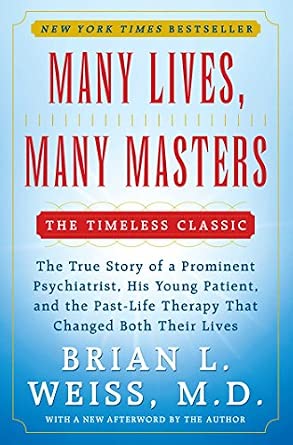
 Recently a reader named Steve asked for my perspective on Dr. Brian Weiss’s book Many Lives, Many Masters. Specifically, he asked about the “past lives” of Dr. Weiss’s pseudonymous patient “Catherine.” This is my response after reading the book. (Note: I will receive a commission if you buy the book from Amazon using any of the title links in this article.)
Overall, Dr. Weiss seems to be a good and well-intentioned person, albeit somewhat full of his own importance. His “past-life regression” therapy does seem to help people, though probably not for the reason he thinks. And in general, recognizing that we are embedded in spiritual reality, and that this is the source of much of our mental disorder and dysfunction, is a good thing.
Materialistic psychology, psychiatry, and psychiatric medication can get you only so far. Some mental illnesses do result from physical, chemical, or cellular damage or dysfunction in the brain and nervous system. However, psychiatric drugs commonly only control symptoms rather than curing the patient, and they have many undesirable side effects. Further, much mental illness is not physical at all. It is the result of traumatic life experiences, yes, but mainly the result of evil spirits assailing people from the spiritual realm using these traumatic life experiences and various individual character traits as “hooks” by which they grab onto the person’s psyche so that they can pour in their dark, deleterious influence.
I am well aware that the idea of spirits being involved in mental illness is rejected as superstitious nonsense by secular psychologists and psychiatrists. Nevertheless, Dr. Weiss successfully used spiritual methods to achieve full healing for a patient who was not responding to traditional psychiatric treatment. And this is far from the only case in which recognizing the reality of spiritual influences has helped people achieve mental and emotional healing when traditional psychiatric and pharmaceutical methods were failing. At the end of this post, I’ll put an Off The Left Eye video featuring interview segments with Dr. Jerry Marzinsky along these lines.
Overall, though I think Dr. Weiss is mistaken in his belief that Catherine’s visions under hypnosis are from past lives she has lived, I do appreciate his willingness to open his mind to methods of treatment that go beyond the strictly material and biological level, and explore the spiritual realities behind people’s mental and emotional struggles.
The perfect doctor
My first impression as I began to read Many Lives, Many Masters was that the story was just too perfect.
In his Preface, Dr. Weiss spends considerable time talking about how brilliant he was and how great his life was and how effortless everything was for him. Clearly, however well-intentioned he might have been, he thought of himself as a very special person. Throughout the book, in Catherine’s “past lives,” he appears as “the teacher”—an ancient sage who was always the “wise one” who “helped” people. Meanwhile, in reality, he was groping his way into spiritual matters against all kinds of intellectual resistance from his secular psychiatric training.
And honestly, most of the “deep insights” that “The Masters” imparted through Catherine’s hypnotized lips were rather ordinary, even trite bits of armchair spiritual psychology. The fact that he thought this was incredibly deep and inspired wisdom only shows that he had acquired very little real knowledge of God and spirit up to that point in his life. In short, the idea that he was some spiritual “wise one” just doesn’t fit his actual, secular background and training.
Apparently, Dr. Weiss did not recognize the “transference” his patient was engaging in, casting him in the role of the sage teacher who is always “helping” her throughout her “many lifetimes.” This, in my view, was a psychiatric fail on his part. Apparently, he uncritically accepted as his own continuously reincarnating soul and character something that was really a persona his patient was projecting onto him as part of her healing process.
It’s an easy mistake to make. But it leads to conceptual errors. And I believe this is exactly what happened to Dr. Weiss. He did help the woman heal from her anxieties and neuroses. And that is good. But it was at the cost of the good doctor himself having his concept of reality, and of his own self and character, pulled in an unreal and illusory direction. Specifically, he came to believe in reincarnation, and saw himself as an ancient wise one passing through many lifetimes to teach people and help people in grand cosmic fashion.
In plain language, the book was full of ego and a grandiose illusion of self. That didn’t sit well with me.
The perfect patient
Then, in Chapter 1, the perfect doctor hit the jackpot with the perfect patient:
The first time I saw Catherine she was wearing a vivid crimson dress and was nervously leafing through a magazine in my waiting room. She was visibly out of breath.
And a couple paragraphs later:
Catherine is an extraordinarily attractive woman, with medium-length blond hair and hazel eyes. At that time, she worked as a laboratory technician in the hospital where I was Chief of Psychiatry, and she earned extra money modeling swimwear.
Sex-appeal? Check! Complete with a stunning, breathless blonde in a red dress . . . and then in a bikini! If this had been a Victorian novel, her ample bosom would have been heaving! At that point, I had to flip to the copyright page to see when the book was published. 1988. Of course. Hook people in with a gorgeous young woman. Then let them picture the stunning blonde in their mind’s eye throughout the book:
As usual, she sank quickly into a deep hypnotic trance in my dimly lit office, her blond hair spilling over in rivulets on the familiar beige pillow. (from chapter 12)
It had to be a woman, and she had to be a blonde bombshell in a red dress, with a beachwear shot thrown in for good measure. If it had been some random guy in jeans and a T-shirt, or some plump middle-aged woman in a dowdy day dress, it wouldn’t make the books fly off the shelves!
Honestly, I started out skeptical. The book looked like the 1980s version of clickbait.
Despite these negative first impressions, I chalked it up to 80s kitsch and to medical types thinking they’re gods, and kept reading. And I did read the entire book. Just to be clear, I don’t think Dr. Weiss is a bad person. I just think he’s been led down the garden path about reincarnation via the hook of his outsized ego. It’s an occupational hazard of people in the helping professions, especially if their non-traditional methods actually work.
New Age myths
Before getting into the reincarnationist substance of the book, I’ll deal with something Dr. Weiss just flat out got wrong. It jumped out of the page at me in Chapter 3:
During the week I had reviewed my textbook from a comparative religions course taken during my freshman year at Columbia. There were indeed references to reincarnation in the Old and the New Testaments. In A.D. 325 the Roman emperor Constantine the Great, along with his mother, Helena, had deleted references to reincarnation contained in the New Testament. The Second Council of Constantinople, meeting in A.D. 553, confirmed this action and declared the concept of reincarnation a heresy. Apparently, they thought this concept would weaken the growing power of the Church by giving humans too much time to seek their salvation. Yet the original references had been there; the early Church fathers had accepted the concept of reincarnation. The early Gnostics—Clement of Alexandria, Origen, Saint Jerome, and many others—believed that they had lived before and would again.
These ideas are popularly bandied about in New Age and reincarnationist circles, having been popularized by various theosophical authors such as Helene Blavatsky going all the way back to the 19th century.
The only problem is, they are completely false.
They were made up by theosophists and New Agers to try to make everything, including the Bible, support reincarnation. But the simple fact of the matter is that the Bible does not support reincarnation, and it never did. See: “The Bible, Emanuel Swedenborg, and Reincarnation.”
The First Council of Nicaea in 325 AD was called to deal with the Arian controversy about the nature of the Father and the Son, and their relationship to each other, in Christian theology. It had nothing to do with the canon or text of the Bible. We have manuscripts of the Bible, especially of the Old Testament, that come from before the Council of Nicaea. There are no references to reincarnation in them that were later “removed.” The idea that the Bible used to teach reincarnation, but corrupt, power-hungry Christian leaders expunged all references to it to consolidate their power, is utter nonsense. It never happened. But to this day it gets repeated over and over again in New Age circles.
Mind you, I’m not saying those fourth-century Christian leaders weren’t corrupt. Their ears were already full of the siren call of worldly power, personified in the brutal Roman Emperor Constantine, who called the Council of Nicaea and presided over it. But in historical reality, altering the text of the Bible was not one of the corrupt things they did.
Further, Clement of Alexandria, Origen, and Saint Jerome were not Gnostics. In fact, they condemned both Gnosticism and reincarnation (known then as “metempsychosis”). Origen and some other early Christian writers believed in the pre-existence of souls, but that is not the same as reincarnation. It is the idea that souls were created by God from the beginning, and were infused into our body at conception or at birth or at some other point along the way in our development. It does not involve a soul passing from one body to another. The Second Council of Constantinople in AD 553 did not condemn the concept of reincarnation. It condemned the concept of the pre-existence of souls.
I don’t know what “textbook” from his comparative religion class he reviewed, but if all these pseudo-facts are in it, that textbook deserves a quick trip to the circular file.
The fact that Dr. Weiss uncritically repeated these New Age urban legends without verifying them shows that he was sucked in by reincarnationist ideas without subjecting them to proper scrutiny. He could have consulted standard sources on Christian history. He could have done the research and discovered for himself none of these things are true. The fact that he did not do so demonstrates that he is not coming at this subject from the objective, scientific stance he claims throughout the book. He is coming at it from a position of credulity without doing due diligence to verify his information and sources.
No historical evidence
And in general, though Dr. Weiss talks throughout the book as if Catherine’s “past-life memories” were real historical people, not once in the entire book does he ever provide any historical evidence that any of these people actually existed, or even that the “history” in them is real.
There are many anomalies that could have tipped him off, such as the people in her past lives not knowing the name of the king or Pharaoh at the time, which would have been universal knowledge, and the fact that someone who supposedly lived in ancient Egypt identified the date as “1863 B.C.,” which comes from a calendar system thousands of years in the future. People at that time commonly identified the year as the year in the reign of the current king or Pharaoh. They had no concept of “B.C.” and “A.D.” because Christ’s birth was far in the future.
The entire book struck me as an example of credulity without real research. I kept expecting that Dr. Weiss would confirm or verify the historical “facts” being presented in Catherine’s “past-life memories” with actual historical research, but he never did.
There’s a reason for that: When people actually do check the history on these “past-life regressions,” what usually comes out is that the “past lives” are based on popular conceptions, movies, or novels of what that time period was like rather than on what it was actually like historically. They are not memories of past lives. They are reconstructions and dramatizations based on contemporary concepts of what the past was like.
When Catherine was under hypnosis on the therapist’s couch, Dr. Weiss was continually pressing her for verifiable details such as names and dates. Catherine was continually not giving them to him. This should have rung alarm bells in Dr. Weiss’s mind. Instead, he continued on, credulously believing that these were real past lives taking place in the past all over the world. Only a little bit of research would likely have shown that these were reconstructions, not actual past lives. But apparently Dr. Weiss never did any such research. He was already hooked into the idea of reincarnation, and he interpreted everything Catherine said through that lens.
However, there is an entirely different way of looking at Catherine’s “past lives” that resolves all these problems, and makes much more sense.
Psychological sources
Naturally, people who believe in reincarnation will read the stories of Catherine’s “past-life regressions” as real accounts of past lives and as amazing evidence of the reality of reincarnation. That’s clearly how Dr. Weiss interpreted them—even though as a trained psychiatrist, he could have read them as elements of Catherine’s subconscious mind constructing stories that deal with her anxieties and neuroses. Dr. Weiss is continually talking about how she couldn’t have known the things she was narrating. But if they are seen as mental constructions, the picture becomes much more complex.
In Chapter 1, Dr. Weiss mentions in passing that Catherine “had read sparingly about the Hindus.” He goes on to emphasize that “she had never read any metaphysical or occult literature, having had no interest in it.” But you don’t have to read metaphysical or occult literature for your mind to have the material to construct “past lives.” You only have to read books and articles or watch movies or hear people talk about earlier times in distant lands. If Catherine’s reading was broad enough to have included something about the Hindus, presumably she had read other books about different cultures and religions as well.
And indeed, in Chapter 2, he mentions that she had an interest in Egypt. It seems likely that Catherine had read books about various historical times, cultures, and religions, and had seen movies set in various times and cultures. Her mind was probably not as empty of ideas and objects representing those time periods as Dr. Weiss thought. And the human mind has a marvelous ability to pull material together and construct vivid scenes out of it, as evidenced by our dreams.
In fact, from my non-reincarnationist point of view, the tone and content of Catherine’s “past-life experiences” read more like dream sequences than like memories. They have a dreamy, indefinite quality about them, in which the characters and events represent various elements of Catherine’s mind and experience, right down to identifying various characters in her “past lives” with people she knew in this life. It is common in dreams for people we know to be present, but in a different form than their usual one in the waking world.
Her “past-life experiences” read like dreams, visions, and narratives constructed to represent various parts of her psyche and relationships. And like dreams, which commonly have an integrating and healing effect on people, these constructed narratives that Dr. Weiss interpreted as “past lives” could very well have had a healing effect on Catherine. They were her subconscious mind seeking understanding and healing from her waking reality of anxieties and fears.
As such, there were recurring themes and scenes that held special meaning for her. And Dr. Weiss, who was still, after all, a psychiatrist treating a patient, was continually seeking to mine these stories for explanatory and healing material to help his patient—which, indeed, he did. His error was in thinking that these were actual past lives that Catherine had lived rather than being scenes constructed in her mind to face and deal with the very fears and anxieties that had brought her to Dr. Weiss’s office in the first place.
Spiritual sources
Thus far I have been talking from a perspective that any secular psychologist who has some knowledge of Freud and Jung could take. (Jung, by the way, read many volumes of Swedenborg’s symbolic interpretations of the Bible, which was a major source for his theories of the collective unconscious, archetypes, and so on.)
Dr. Weiss, of course, was well aware of this psychological perspective. That’s why he is continually stating and emphasizing that this or that element of Catherine’s narration of “past lives” is something she couldn’t have known. In many cases I think she very well could have known it based on reading, movies, and so on. Her subconscious mind was using material that she herself may not have had conscious recollection of during her waking hours. And Dr. Weiss could not have known all the sources from her life up to that point that her mind might have been drawing upon.
However, in some cases he is almost certainly right that she conveyed information she could not have known by normal means. For example, in Chapter 4, she relays details about Dr. Weiss’s deceased father and son that she would have had no material-world way of knowing. And less conclusively for the reader, since we were not there, in Chapter 2 he speaks of her correcting the guide at an Egyptian exhibit about some of the artifacts in the exhibit, and being right. Whether or not skeptical readers will be convinced, these and a few other incidents of Catherine “revealing” information she could not have known by normal channels were highly convincing to Dr. Weiss. They went beyond the ability of the above-mentioned psychological mechanisms to produce.
Dr. Weiss soon jumped to reincarnation as a solution to this problem that his mind could not solve from its secular perspective. But knowledge coming from paranormal sources does not automatically point to reincarnation. Rather, it points to the reality of the paranormal. In more traditional terms, it points to the reality of the spiritual realm. If there truly is a spiritual world, and there are angels and spirits around us unseen, and if all people who have died before us are in that realm, then there is a boundless source of information about things people could not know from “normal,” i.e. material, sources.
Where do the “memories” come from?
And indeed, as covered in the article on reincarnation that I linked earlier, this is precisely what Emanuel Swedenborg (1688–1772) says about information that comes from “past lives.” It is not coming from past lives, except perhaps in the sense of someone else’s life in a previous time and a different land. The memory of that life still exists in that person’s mind in the spiritual world.
Even if some life described in a “past-life regression” were to withstand historical scrutiny and come out accurate and verifiable, it still wouldn’t mean it was the memory of a past life of the person undergoing past-life regression under hypnosis. It could simply be the memory of a person who lived in the past being infused into the mind of the person who is under hypnosis as if it were his or her own memory, when in fact it is someone else’s memory.
This kind of memory transference is very easy to accomplish in the spiritual world. Swedenborg describes an instance in which some spirits rapidly sifted through his entire memory, evaluating the truth or falsity of everything he knew. And he speaks of criminals who tried to deny their crimes in the afterlife having them played out in front of everyone present in full detail, together with every thought and feeling the person was having while committing the crime, to the point that the criminal had to admit what he or she had done.
In general, Swedenborg says that infusing the memories of people living in the spiritual world into the minds of people on earth is not allowed. However, he then goes on to say that the experience of having this happen is what led to the idea of reincarnation. And he himself describes instances in which someone else’s memories were infused into his memory so that he thought they were memories of his own experiences. Apparently, this kind of memory transference is discouraged, not entirely banned.
The presence of spirits and angels
Meanwhile, since Dr. Weiss’s deceased father and brother would be in the spiritual world, the details Catherine recounted about them would be readily available there, and easily communicated to her. His father and brother wouldn’t even have had to be present with her. Memories and information are commonly shared widely in the spiritual world. It could have been Dr. Weiss’s father present as Catherine said, or it could have been another spirit who had knowledge of Dr. Weiss’s father using it to pose as Dr. Weiss’s father, or even to innocently convey a genuine “message” from her father. It can be very hard to tell from this side. That’s why it is best not to put too much credence in the things spirit mediums say. See: “What about Spiritualism? Is it a Good Idea to Contact Spirits?”
Swedenborg also talks about the angels and spirits around us flowing into our mind while we are asleep and drawing on the contents of our memory to create our dreams.
All of this together is what I believe was happening in Catherine’s “past-life regressions.” They read, not like memories, but like dream sequences. They read like dramatic scenes illustrating metaphorically elements of our own mind, experience, character, and relationships. Most of what was in them was likely drawn from Catherine’s own memory, based on books, movies, and so on. That’s why people who take the time to analyze and research these “past-life experiences” commonly find that rather than representing the actual historical time period, they represent the picture present-day books, movies, and ideas paint about what that time period was like.
However, especially when there is conscious awareness of the presence of spiritual beings, as there was during Catherine’s “past-life regressions,” spirits can also convey information from their own memories to the person who is under hypnosis. And so, although most of what Catherine experienced was probably drawn out of her own memory, it could have been supplemented with things she could not have known from her own reading and experience. It is possible that memories from someone else’s life on earth could have been infused into her mind, so that she would “remember” things someone else had done and experienced as if they were her own memories.
Therapeutic scenes
In Catherine’s case, especially given the therapeutic setting, I suspect that most or all of the “past lives” she experienced were narrative constructions, not actual past lives. That is likely the case for most “past-life regressions.” Catherine’s experiences seem too evocative and personalized for them to be someone else’s past life.
For example, in Chapter 9 she talks about being a German pilot during WWI who spoke fervently about the evil and futility of war. Though I suppose that is possible, it sounds more like a present-day reimagining of how a young WWI pilot must have felt, given how horrible we think war is these days. But in those days, war was not considered horrible by most people. It was considered glorious! Young pilots and soldiers commonly believed fervently in the rightness of their country and cause. The whole sequence reads more like a projection of Catherine’s own present-day negative views about war back into the past than like something an actual German WWI pilot would have said.
Other scenes and sequences also read more like dramas and reconstructions designed to express Catherine’s own mind and fears in dramatic form, similar to horror movies making people’s fears “real” in dramatic form. These scenes and sequences aren’t things that literally happened in real life. They are stories constructed from human experience and ordered into narratives that expresses something about the human psyche and experience, and about the specific psyche and experience of the person going through the “past-life regressions.” They have a healing effect for the same reason dreams and visions often have a healing effect: through them our mind confronts its fears and anxieties, and through confronting them, overcomes them.
In other words, I believe that the healing Dr. Weiss helps his patients to achieve through “past-life regressions” is real. But I don’t think their experiences under hypnosis are evidence of reincarnation.
It is telling that though Dr. Weiss came away from his experience with “Catherine” fully convinced of reincarnation, she herself, in her waking life, remained a devout Catholic. She had no interest or belief in his reincarnationist interpretation of her experiences while under hypnosis in his office. Under his guidance and care, she achieved healing that came from psychological and spiritual sources, while he wandered off into spiritual error.
And yet, even people whose beliefs are mistaken can be good and caring men and women who help and serve others on their path of life. While I believe Dr. Weiss is mistaken about reincarnation, I respect him as a man who has devoted his life to healing people’s minds and hearts.
I could say more, but I hope this much will give you, dear reader, some useful ways to approach books such as Many Lives, Many Masters, and deal with any doubts you may have about reincarnation vs. Swedenborg’s (and Christianity’s) view of this life as a one-time birth and preparation for eternal life in the spiritual world.
(Note: This review is an edited and revised version of my responses to a reader named Steve, who asked for my take on this book in a long comment thread that starts here.)
And here, as promised, is an Off The Left Eye video featuring interview segments with Dr. Jerry Marzinsky, in which he discusses the role of evil spirits in mental illness:
For further reading:
- The Bible, Emanuel Swedenborg, and Reincarnation
- What about Spiritualism? Is it a Good Idea to Contact Spirits?
- Facing our Demons of Darkness, Depression, and Mental Illness – Part 1
- Can We Trust Anything Near-Death Experiencers Say?
- Where Does Our Soul Come From? When Does It Become Eternal?
- Response to a Christian Universalist: Is There an Eternal Hell? Wouldn’t an All-Powerful God Save All People?
- Can Gang Members Go to Heaven? (Is Life Fair?)
- Heaven, Regeneration, and the Meaning of Life on Earth
- What Happens To Us When We Die?
Share this:


Lee Woofenden is an ordained minister, writer, editor, translator, and teacher. He enjoys taking spiritual insights from the Bible and the writings of Emanuel Swedenborg and putting them into plain English as guides for everyday life.



What do you think?