He is the reflection of God’s glory and the exact imprint of God’s very being, and he sustains all things by his powerful word. When he had made purification for sins, he sat down at the right hand of the Majesty on high. (Hebrews 1:3, New Revised Standard Version)
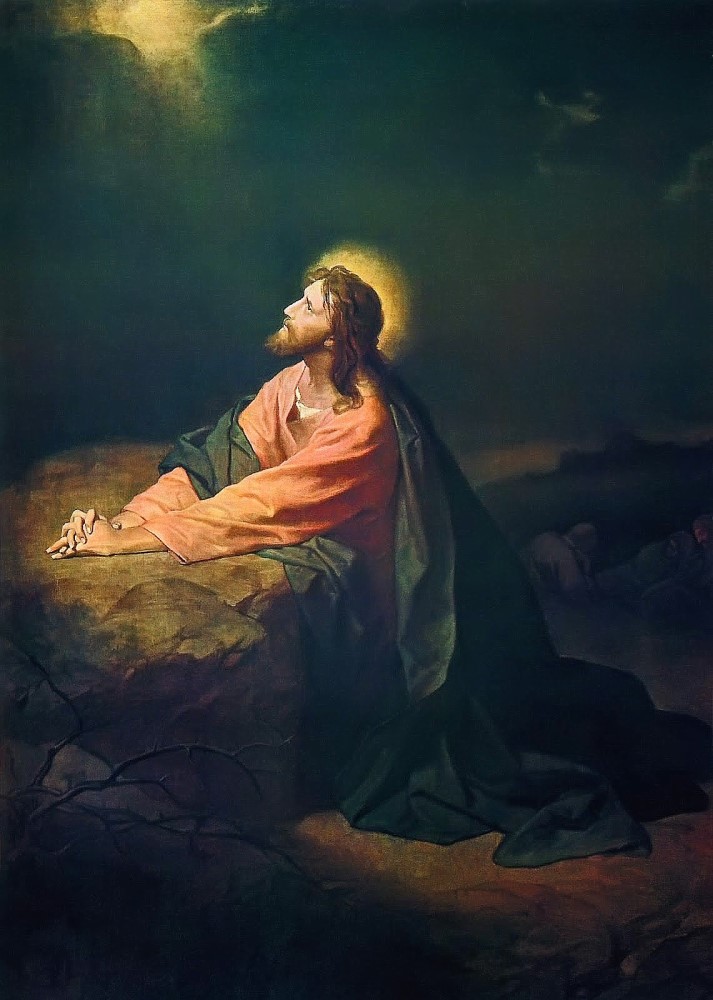
Christ in Gethsemane, by Heinrich Hofmann (1824–1911)
Recently on Christianity StackExchange a question was posted asking how a Swedenborgian understands the words in Hebrews 1:3 about “purification for sins.” Below is an edited version of my answer.
As with some of my other StackExchange answers, this one gets a bit technical. It may not be everyone’s cup of tea. But it is part of a growing collection of articles here on Spiritual Insights for Everyday Life offering a Swedenborgian understanding (really, simply a truly Christian understanding) of the Acts and the Epistles, which historically have been covered relatively lightly in Swedenborgian literature because they are not part of Swedenborg’s canon of the Bible. I post it here for readers who might find it helpful in understanding the complex landscape of the Protestant Bible.
Introduction
Emanuel Swedenborg (1688–1772) never quotes or explains Hebrews 1:3. However, there is a reference to Hebrews 1:2–9, 13 in an unpublished collection of Bible passages traditionally titled Scripture Confirmations that he compiled as a source of supporting passages in writing his final great work of theology, True Christianity. This reference to the passage shows that Swedenborg was well aware of it, and considered it to be supportive of his theology. And indeed, properly understood, it articulates in compact form a fundamental element of Swedenborg’s doctrine of the Incarnation, which is about God coming to earth as Jesus.
Though Swedenborg didn’t comment on this verse specifically, its true meaning is covered extensively in his theological works, primarily in his explanations of the doctrine of the Glorification, which is the process by which Jesus Christ, during his lifetime on earth, became fully divine and one with the Father, so that they are now one both in Essence and in Person.
The primary error in the Western Nicene Christian reading of Hebrews 1:3 is in thinking that it refers to Christ purifying the sins in us. But that is something Christ does as a result of the accomplished action referred to in Hebrews 1:3, which was to purge all human evil and sin from the human nature he had received from Mary. This was an essential part of his glorification. And it had to be completed prior to his “ascending to the Father,” which is referred to in the last part of the verse.
A close reading of Hebrews 1:3 itself, together with related passages from elsewhere in the New Testament, support this reading of the text.
The verselet
To prevent this answer from becoming book-length, I will focus on the specific wording in question from Hebrews 1:3, which reads, in Greek, in most of the earliest extant manuscripts:
καθαρισμὸν τῶν ἁμαρτιῶν ποιησάμενος
I will take up the translation of this earlier version below.
Later manuscripts, as represented in the Textus Receptus, reverse τῶν ἁμαρτιῶν and ποιησάμενος, add the words δι᾽ ἑαυτοῦ to the beginning, and add the word ἡμῶν to the end, so that it reads:
δι᾽ ἑαυτοῦ καθαρισμὸν ποιησάμενος τῶν ἁμαρτιῶν ἡμῶν
This expanded version is translated into English in the traditional King James Version as:
when he had by himself purged our sins
There is considerable scholarly debate about whether δι᾽ ἑαυτοῦ (“by himself”) should be included, based on the earliest manuscripts. However, there is broad agreement that ἡμῶν (“our”) is a later addition.
ἡμῶν
Though either reading is compatible with Swedenborg’s doctrine of the Glorification (covered below), the earlier reading, without ἡμῶν, “our,” points more clearly to the correct reading of the text. The simplest version, containing only the words universally agreed upon to be original, is commonly translated into English as:
after making purification for sins
However, a more literal and accurate translation of the Greek wording would be:
having made purification of sins
ἁμαρτιῶν, “sins,” is genitive. Without the infection of later Western Christian doctrine that has crept into the translation of this passage, it states, not that Christ made purification for sins, but purification of sins.
The distinction is critical. The common mistranslation suggests that the passage is saying that Christ accomplished an action that purified us of sin “vicariously,” or on behalf of us—i.e., that this completed action was that of purifying us from our sins. But the passage does not say that. It says that he made a purification of sins.
δι᾽ ἑαυτοῦ
The situation with δι᾽ ἑαυτοῦ (“by/through himself”) is nowhere near as clear as it is with ἡμῶν. To this day, biblical scholars continue to debate whether it should or should not be included in the text. For a layperson’s example of this debate, see the Q&A, “In Hebrews 1:3 is ‘by himself’ original?” on Biblical Hermeneutics StackExchange. Unlike the situation with ἡμῶν, there are reasonable arguments that δι᾽ ἑαυτοῦ represents a slight variation on δι᾽ αὑτοῦ (“by/through him”), which is seen by its defenders as part of the genuine early version of the text.
And once again, either reading is compatible with Swedenborg’s theology.
If δι᾽ ἑαυτοῦ is included:
Seen through a Swedenborgian lens, this means that the verselet is talking abut something Christ accomplished, not upon us, but upon himself, through his own power. This is the meaning and force of δι᾽ ἑαυτοῦ, δι᾽ meaning “by, through, with, for,” and ἑαυτοῦ, a reflexive pronoun, meaning (together with δι᾽) “by himself, for himself.”
The full significance of ἑαυτοῦ meaning not only “by his own power,” but “for himself” has been missed in Nicene Christian readings of this verse due to the faulty assumption that the passage is talking about Christ cleansing sins in us. This misunderstanding of the text is likely occasioned not only by the lens of their later-developed doctrine of the satisfaction theory of atonement and its Protestant penal substitution variant, through which they read the Bible, but also because of the earlier addition of ἡμῶν, “our,” to the text.
If δι᾽ ἑαυτοῦ is not included:
Reading the verselet as “after making purification of sins,” without “by himself / through himself” simply reduces it to its most basic form. Christ “made purification of sins,” here seen in retrospect as a completed action. With the proper, original lack of “our,” this points, in traditional interpretations, to a universal action of cleansing from sin. The parallel in Swedenborgian theology is that this points to the full conquering and subjugation of the Devil by Jesus Christ during his process of glorification.
This does not automatically purify every person on earth from sin, as evidenced by the fact that people continued to sin even after Christ’s victory over the Devil. What it means is that now Christ has the power to purify us from sin, as represented by the clause that immediately follows, about his sitting down “at the right hand” of God. The meaning of this is explained below.
ἡμῶν again
Even with the addition of “our,” the passage still does not mean what Catholics and Protestants misinterpret it to mean. This textual change was made long before Anselm originated the satisfaction theory of atonement with his publication of the book Cur Deus Homo late in the eleventh century. The scribes who made this change therefore could not have had satisfaction theory in mind when they added ἡμῶν to the text.
If we take this as an addition that does not corrupt the meaning of the text, then from a Swedenborgian perspective, “our” simply means that the inclinations to sin that Jesus Christ inherited from his human mother Mary consist of the taint of our sin—humans being the only source of sin. Christ was therefore facing and fighting against the accumulated weight of human sin, which was attacking him in the form of “Satan” or “the Devil.” This is referenced later in the book of Hebrews itself:
For we do not have a high priest who is unable to sympathize with our weaknesses, but we have one who in every respect has been tested as we are, yet without sin. (Hebrews 4:15)
This is the exact process of Christ “making purification of sins.” Through the inherited fallen human nature that he received from his mother Mary, he was “tested,” or traditionally, “tempted in every respect as we are, yet without sin.” In other words, he fought and overcame within himself all human evil and sin, completely conquering and subduing it in his own being, through his own power.
It was only when he had thus “made purification of sin” that he could, as the remainder of the verse says, “sit down at the right hand of the Majesty on high.” Only when he had overcome and purged the last dregs of human sin from his own finite human side that he had received from Mary did he become one with the Father, and fully divine as the Father’s human nature and presence with us.
The Glorification
The primary reason Nicene Christianity, especially in its Western, post-Schism version, has misread this passage is that it does not have one of Swedenborg’s central doctrines, which is the doctrine of Glorification. A full explanation of this teaching would require an entire chapter, if not an entire book. But here is the brief version:
At birth, Jesus Christ had two natures: a finite human nature from Mary, and within that, a divine nature that was God—or “the Father” in New Testament terminology. His finite human nature was just like the human nature of any other person born on earth, including, not actual sin, but inherited tendencies toward sin, which all other humans succumb to at least to some extent, resulting in actual sin.
It was through these inherited tendencies toward sin (referred to as “our sin” in the later versions of Hebrews 1:3) that Satan, or the Devil, meaning the personification of all human evil, had access to Jesus, and could tempt him. In the Gospel story, this happened in the desert after his baptism, and in Gethsemane right before his crucifixion. If Jesus had not had these inherited human tendencies toward sin, the Devil would have had no way to approach and tempt him at all.
Uniquely, though, as Hebrews 4:15 says, Jesus Christ faced all the battles against evil and sin that we face, but was continuously and completely victorious. Unlike us, he never sinned. Throughout the course of his life, he battled, not just the small sliver of evil and sin that we puny humans face in our lives, but the entirety of evil and sin. And by overcoming all sin within himself, by his own power, he defeated and broke its power, taking full control of the Devil and of all human evil.
As he purged this “sin,” or evil, from the finite humanity he had received from Mary, he progressively replaced that finite humanity with an infinite divine humanity that is not only free from evil and sin, but is actually God, being divine, infinite, omnipotent, and having every other attribute of divinity. He finished this process in the passion of the Cross, so that when he rose from death, and when he ascended to the Father, he was fully divine, and was one with the Father, just as he said in John 10:30.
This is the “fully accomplished” act (from the original question on StackExchange) referred to in Hebrews 1:3. It had indeed been “a continuous action” during his lifetime on earth. However, by the time the book of Hebrews was written decades after the Crucifixion and Resurrection, it was a completed action, and Christ had already “sat down at the right hand of the Majesty on high.”
For the meaning that last part of the verse, see: “What Does It Mean to Sit at the Right Hand of God?” It does not literally mean that Jesus was a “second Person” sitting next to God the Father on his throne. There is only one figure on the throne, as is made clear in many passages in the New Testament. Rather, it means that Jesus became the powerful right hand of God, metaphorically speaking.
For more on the Glorification, see “What Does it Mean that Jesus was ‘Glorified’?”
Our process of purification from sin
Once we understand that Hebrews 1:3 is talking, not about our purification from sin, but about Jesus’ process of purifying his own inherited finite human nature from evil and sin, the rest falls into place naturally.
Even in Christ’s case, accomplishing this was a lifelong process, referred to in various passages in the New Testament, such as:
I have a baptism with which to be baptized, and what constraint I am under until it is completed! (Luke 12:50)
So now, Father, glorify me in your own presence with the glory that I had in your presence before the world existed. (John 17:5)
And for their sakes I sanctify myself, so that they also may be sanctified in truth. (John 17:19)
It was fitting that God, for whom and through whom all things exist, in bringing many children to glory, should make the pioneer of their salvation perfect through sufferings. (Hebrews 2:10)
These passages all talk about the process by which Christ “made purification of sins” within his own self. Hebrews 1:3 speaks of that process when it has been completed.
It was the completion of this process of purging and purification from all evil and sin within himself, during his lifetime on earth when he still had a finite, sin-prone human nature from Mary, that gave Christ the power represented by “the right hand of God.” He now wields that power to bring each one of us through a similar process of purification from sin, if we turn to him and accept that power into our life. However, our process results, not in our becoming divine, but in our becoming spiritual.
Just as Christ’s purification, which was an essential part of the Glorification, was a lifelong process before he completed it and ascended to the Father, so our parallel rebirth, or regeneration, is a process that we go through during our entire lifetime on earth, becoming spiritual in the process, so that the Lord God Jesus Christ can give us eternal life. This is why Paul says:
Therefore, my beloved, just as you have always obeyed me, not only in my presence but much more now in my absence, work on your own salvation with fear and trembling, for it is God who is at work in you, enabling you both to will and to work for his good pleasure. (Philippians 2:12–13)
This precisely describes the process of rebirth, or regeneration, that Jesus teaches us about in John 3:1–21, and that Swedenborg expands upon at length in his theological works. As this process unfolds, God is at work in us as we work on our own salvation with fear and trembling, enabling us both to will and to act for God’s good pleasure.
Just as Christ’s glorification was fully accomplished before he figuratively sat down at the right hand of God, when our work on this earth is done, our salvation will also be fully accomplished before we move on to our eternal home in heaven.
Conclusion
These are huge topics. The above answer only scratches the surface of the depths of meaning contained in Hebrews 1:3 and related passages. But this much will show that when read closely and carefully in the original Greek, this verse perfectly expresses in amazingly compact form Swedenborg’s doctrine of the Glorification.
Once Christ was glorified, having overcome all evil and sin, he took to himself the power to accomplish the same for us if we turn to him, believe in him, accept his power into our life, and live the way he taught us to live, actively loving God and our neighbor.
This, process, too, is compactly stated in one of the verses mentioned, but misquoted, in the original question on StackExchange:
The next day he saw Jesus coming toward him, and said, “Behold, the Lamb of God, who takes away the sin of the world!” (John 1:29)
It does not say, as it is commonly misquoted to say, that he “took away the sin of the world,” past tense. It says that he takes away the sin of the world, present tense. In us, this is something that the Lord God Jesus Christ does and is doing, not something he did in the past.
What Jesus Christ did in the past once and for all was to glorify his humanity, purifying it of all human evil and sin, and making it divine. Having done that and taken his place as the right hand of God, he does the same for each one of us who turn to him—though none of us does it fully and completely as he did. Still, in his love and mercy, he accepts the labors that we do engage in through his power, and in the end, when our labors are complete, lifts us up to heaven and eternal life.
(Note: This post is an edited version of an answer I originally wrote and posted on Christianity StackExchange. You can see the original question on StackExchange here, and the StackExchange version of my answer here.)
For further reading:
- How did Swedenborg interpret 1 John 2:2: “He is the propitiation for our sins”?
- Did Jesus Really Die to Pay the Penalty for our Sins?
- Why Isn’t Paul in Swedenborg’s Canon?
- Is there Really a Devil? Why??
- What Does It Mean to Sit at the Right Hand of God?
- What Does it Mean that Jesus was “Glorified”?
- The Logic of Love: Why God became Jesus
Share this:


Lee Woofenden is an ordained minister, writer, editor, translator, and teacher. He enjoys taking spiritual insights from the Bible and the writings of Emanuel Swedenborg and putting them into plain English as guides for everyday life.



I need to Thankyou so much for your blog as it helps me so much. I always hear so much Christian conservatism talking about how everyone it seems is going to hell unless they aren’t specifically like them and how scared you should be. I’m a Christian but there’s days I forget to pray and I have empathy for others of all religions and none. Especially family members
Hi Annie,
Good to hear from you. It’s been a while! Hope everything is okay with you. Glad you’re finding the articles here helpful. Yes, there are some very wrong ideas floating around among traditional Christians. It’s not what the Bible says, but it’s what they believe anyway. God bless.