So both of Lot’s daughters became pregnant by their father. (Genesis 19:36)
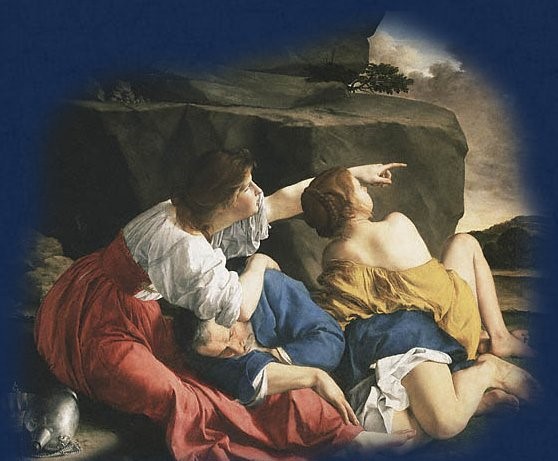
Lot and his daughters
With this article in our series on Genesis, mercifully, we complete the sorry tale of Genesis 19. If the Bible skeptics want a chapter to turn to in casting doubt on the divine and spiritual nature of the Bible, this would be the one. It reads almost like a compendium of human sexual and behavioral corruption—not to mention the descriptions of destructive divine wrath. It is no wonder that even the Swedenborgian commentaries largely pass by this chapter in silence, or give it only the most cursory treatment.
Even Swedenborg himself seems to weary of the chapter as he enters into this final section: Genesis 19:30–38. Yes, he does interpret it. But he does so in summary fashion, referring to earlier and later explanations for some of the details. In partial explanation of this, he mentions the obvious: these things “shock people’s minds and offend their ears” (Arcana Coelestia #2466). And here I would mention once more that when we actually read the Bible, it turns out not to be a “nice book full of nice stories,” but rather, a hard-hitting human book full of human stories, including the good, the bad, and the ugly of human life.
The good, the bad, and the ugly
The Lord Jesus, while he was here on earth, also dealt with the good, the bad, and the ugly of human life. And if we follow this story in its deeper meaning, we find that it deals with the ugliness of those who think that religion is just a matter of external observance and ritual, without the deeper matters of love, understanding, justice, and kindness that form religion’s inner core. In other words, the story of Lot and his daughters is symbolic of those who practice a superficial religion. Jesus was speaking of these when he said:
Woe to you, Scribes and Pharisees, you hypocrites! You give a tenth of your spices—mint, dill, and cummin. But you have neglected the more important matters of the law—justice, mercy, and faithfulness. You should have practiced the latter, without neglecting the former. You blind guides! You strain out a gnat but swallow a camel.
Woe to you, Scribes and Pharisees, you hypocrites! You clean the outside of the cup and dish, but inside they are full of greed and self-indulgence. Blind Pharisee! First clean the inside of the cup and dish, and then the outside also will be clean.
Woe to you, Scribes and Pharisees, you hypocrites! You are like whitewashed tombs, which look beautiful on the outside but on the inside are full of dead people’s bones and everything unclean. In the same way, on the outside you appear to others as righteous, but on the inside you are full of hypocrisy and wickedness. (Matthew 23:23–27)
Emanuel Swedenborg (1688–1772) gives descriptions almost as colorful of the nature of people who make a great outward show of religion, but inwardly are corrupt and foul. See, for example, Secrets of Heaven #2468:2.
Jesus encountered such people in the Scribes and Pharisees—those who studied and taught the religious law of ancient Judaism. Though they knew their stuff, they did not practice it except in the most superficial way. Yes, they did all the proper tithes and ritual cleansings and sacrifices. But they were not only critical and condemnatory of everyone who didn’t live the way they did, but they also engaged in corruption and profiteering from their positions of religious authority. In other words, even though they looked religious, they were really in it for themselves. In Swedenborg’s terms, they were ruled by self-love. So everything that made up their religion—or perhaps we should call it their religiosity—was impure because it was driven by selfish motives.
Anti-Jewish?
Swedenborg has often been accused of being anti-Jewish because of his many harsh statements about both ancient and contemporary Jews. And certainly there was a lot of anti-Jewish sentiment throughout Swedenborg’s culture, which could easily have affected Swedenborg’s view of the Jewish people. However, I prefer to think of his descriptions of the superficial and corrupt nature of “the Jews” as a description of the human condition. When we look at the story of Lot, and how he was corrupted by his own apathy and his focus on saving his own skin, we see a reflection of all people who take the easy, external way in their religion.
In the New Testament, the Jews also come in for heavy criticism by Jesus himself and by the various Biblical writers. That, I believe, is largely because from the Bible’s point of view, the Jewish religion was the leading religion of the day—yet its followers, instead of being a leading light for the world, had corrupted their own religion, and given it a bad name because of their greedy and selfish lives.
Is it only Jews who do this to their religion? I don’t think so! The history of Christianity right up to the present day is full of church leaders who have corrupted this beautiful religion in their pursuit of personal wealth, pleasure, and power. In the 1990s, it was the fundamentalist Christian televangelists who were the focus of the exposés of religious corruption, as the American public discovered that the same men and women who preached Jesus, Jesus, Jesus on TV were racking up enormous personal wealth and sleeping with prostitutes in hotel rooms. In the 2000s the focus of the media’s wrath was the Roman Catholic Church, with its terrible crimes not only of child abuse on the part of some of its priests, but of the cover-ups engaged in by bishops and archbishops going right up the church hierarchy.
Where the finger points
Superficial religion is not limited to the Jews. It is a universal human curse. And though we could spend all day decrying the evils of all those churches, clergy, and leading lay people out there who have made a mockery of their religion, the real point of the Bible story is not to give us ammunition in pointing the finger at others, but rather to make us conscious of our own faults that need correcting. When Jesus confronted the corrupt religious authorities of his day with their hypocrisy, the point was not so much to fuel our righteous indignation at those who misuse their religion for personal power and gain, but to let it serve as an object lesson for each one of us when we are tempted to act similarly.
The Bible story is the story of each one of us. And if we can believe it, even the whole culture in which we live is the story of each one of us. If we find ourselves pointing fingers of blame at all those terrible, corrupt Scribes and Pharisees out there, we should be aware that our finger is also pointing squarely at our own soul. This is expressed another way in the classic words of John Donne: “Therefore never send to know for whom the bell tolls; it tolls for thee.” Donne understood, and expressed beautifully in his poetry, that the sickness and death of all is the sickness and death of each one of us.
Of course, this does not mean we should ignore the corruption out there in our society. Televangelists, priests, and other church and society leaders, not to mention ordinary lay people, must be put on notice that if they engage in hypocritical and corrupt behavior, they will be brought to account for it; that if they use their positions of spiritual power to engage in practices of worldly greed and debauchery, they will pay the price.
Yet when we have confronted the corruption in our society, we have only waged half the battle—and not the most difficult half. Our greatest struggle is to confront the corrupt superficiality within our own selves. The message of Lot, and the message of Jesus to the Scribes and Pharisees, is a message to all who consider themselves to be religious, yet don’t live up to the ideals of their own religion. Lot was a nephew of Abraham, who received the call of God; yet he lived among the corrupt people of Sodom. The Scribes and Pharisees were the called and chosen religious leaders of the ancient Jews; yet they used their position for personal power and privilege.
With great wealth comes great responsibility
What do we, who are blessed with the incredible depths of an entirely new revelation of spiritual understanding, do with these spiritual treasures that have been entrusted to us? If outside observers were to compare the way we live to the way anyone else in our society lives, would they notice any difference? Does the fact that we belong to the New Jerusalem Church (Swedenborgian) cause us to go beyond the ordinary ranks of our community, not in great shows of our religious piety, but in a life full of acts of care and compassion for the human beings who surround us on every side?
And looking at our church, what have we done, and what are we doing, with the great blessings of material and spiritual wealth that have been entrusted to us? In all our struggles to move the church forward, are we acting merely from a desire for self-preservation? To preserve the church that we and our families attend and benefit from? Or are we truly interested in serving the spiritual needs of the community, the state, and the continent where we as a church have our home?
These are ultimate questions of our own spiritual worth, and the spiritual worth of our church. These are questions even Jesus faced within himself, when he confronted the temptation to merely be right rather than to be compassionate. And Jesus gave us another metaphor to move us out of the curse of superficial religion:
No one sews a patch of unshrunk cloth on an old garment, for the patch will pull away from the garment, making the tear worse. Neither do people pour new wine into old wineskins. If they do, the skins will burst; the wine will run out and the wineskins will be ruined. No, they pour new wine into new wineskins, and both are preserved. (Matthew 9:16–17)
When we have experienced the new wine of deeper spiritual religion, we must put it into new wineskins of a changed life: a life of constant, growing understanding and compassion for our fellow human beings.
(Note: This post is a revised version of a talk originally delivered on June 6, 2004, to a Swedenborgian congregation. To start at the beginning of the series, please go to the article, “What Child Is This?”)
For further reading:
- The Christian Church is Not Christian
- The Christian Church is Coming to an End
- The Christian Church is in its End Times. What Comes Next?
- The Evangelicals are Right: The World IS Coming to an End!
- Christianity is Dead. Long Live Christianity!
- The Logic of Love: Why God became Jesus
Share this:


Lee Woofenden is an ordained minister, writer, editor, translator, and teacher. He enjoys taking spiritual insights from the Bible and the writings of Emanuel Swedenborg and putting them into plain English as guides for everyday life.



What do you think?