Recently in the comments section of one of the articles here, a reader named World Questioner asked:
Why did God take 15 billion years to create the physical world? Couldn’t he have done it in just six days? What is a good reason for God to have all species descended from a common single-celled ancestor? Couldn’t he make all species distinct and create each creature to reproduce after its kind? Why did God decide humans should be descended from apes? Couldn’t the first humans have just been created separately, distinct from all animals?
You can see the comment here, and my original response here. This article is an edited and expanded version of my original reply.
Hi World Questioner,
All these questions zero in on a single aspect of how God creates things:
God creates things, not instantaneously, but by using step-by-step processes. Nothing just pops into existence. Everything develops over time.
Why?
It’s a very good question. I’m still thinking about it.
One answer is that God is working with material reality, which is pliable, but also resistant to change. Compared to divine reality, which operates outside of time altogether, and is present in all time and space simultaneously, and compared to spiritual reality, which also has no time and space as we know it, but which does have distance and nearness and a sequence of events, material reality exists within space and time. In material reality, things must unfold over spatial distances and on temporal time scales. This means that doing things instantaneously is contrary to the very nature of physical reality.
Why did God create material reality in this way?
The created universe must be different from God
One answer is that for anything to be not-God, and therefore able to have a relationship with God, it must have distinct differences from God. And yet, it must still express something of God’s nature so that there are commonalities between God and Creation that make a real relationship possible.
If we were nothing at all like God, if God were a totally alien being, how could we have any understanding of God? How could we come to love God? How could we have a relationship with God, and God with us, if we couldn’t comprehend God at all? If we could form no concept of God, God would mean nothing to us. And we can’t love nothing.
But we can love God if we are created in the image and likeness of God, as Genesis 1:26–27 says. We can love God if God is sort of like us, only far greater.
We can’t really love someone that we have nothing at all in common with, can we? Even people from very different nations and cultures still share common human thoughts, feelings, and experiences that make a relationship between them possible. But it is the differences that make the relationship real—and make it interesting and even exciting!
The way God accomplished this similarity and difference was to spin out Creation from God’s own substance so that it expresses God’s nature, but to impose limits on created reality, both spiritual and material. This means that Creation expresses the character of God, but it is also different from God. God is infinite. God has no limits. Created reality does have limits. That makes it, and us, different from God.
God put fewer limits on spiritual reality, and greater limits on material reality. One of the limits of material reality is that things must develop and unfold over time, within space. This means that things in the material universe must happen via processes, not instantaneously.
Material reality both responds and resists
Another answer is that material reality, and the material world, must provide the opportunity for sentient, spiritually aware beings (us) not to choose a loving relationship with God.
If we were not free to reject the relationship God wants to have with us, we would not be human, and the relationship wouldn’t be real. It would just be something God programmed into us, making it meaningless. How much does a friendship mean if both people are simply programmed to have that friendship? That’s just an algorithm, not a real human relationship.
Designing the physical level of reality to have the ability not to do what God wants it to do means designing it with a certain amount of resistance to divine and spiritual influences. It means making things somewhat—or even very—inefficient, so that the material world doesn’t always do what God and the angels want it to do. It means that God and the angels must labor to get physical reality to do what they want it to do. This is the meaning of the six days of Creation, and of the six days of labor, culminating in the seventh day of rest. There is real work involved in producing the finished product: angelic human beings who will live forever in heaven.
Pan out to the grand scale of the physical universe, and an answer to your question emerges: The material universe is naturally resistant to what flows in from God and spirit. It takes a long time for material reality to respond. It took over nine billion years for the universe to get to the point where it produced Earth—a planet capable of supporting life. It took another half a billion years or so before Earth began hosting life. It took another three or four billion years before that life developed to the level of organization and complexity required to host a sentient, spiritually aware mind: ours.
God does not work by forcing things, and people, to do what God wants them to do. God works by bending and influencing things, and people, to do what God wants them to do. This means that particular people, and particular parts of creation, can opt out of God’s plan. Not every planet is capable of hosting life. Even fewer planets are capable of hosting complex, sentient life. It’s quite possible that even some planets that could host life don’t host life. No one is forcing them to. God makes it possible. But the material universe must say “yes,” or nothing will happen.
Mind you, I’m not speaking literally here. I don’t believe, as some do, that the material universe is conscious. But it does operate by its own rules, and there is a certain element of randomness built right into those rules. Sometimes that randomness may figuratively say “yes,” and sometimes it may say “no” to what God and the angels are working to achieve here in the material universe.
In short, God works by coaxing and cajoling Creation to move toward hosting human beings who can love God, love one another, and live forever in heaven. And just as it takes us the ol’ threescore and ten years of emotional and spiritual growth to become that sort of person, so on a grander scale it takes billions of years for the universe to become the kind of universe in which we soft, delicate human beings can live . . . at least, on a few rare and precious specks in the vast voids and violence of the physical universe.
Time means nothing to God
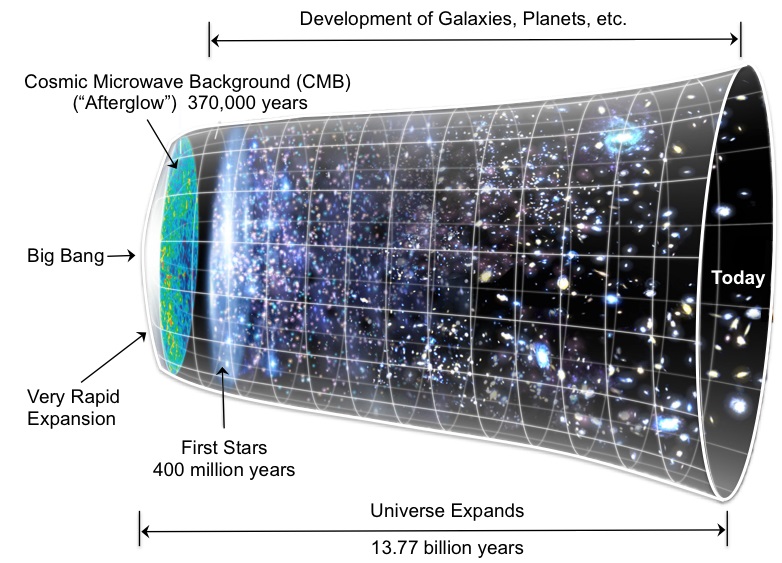
Why does it take so long? About 13.8 billion years, by current estimates of the age of the universe.
Keep in mind that for God, time is meaningless. God is present in all of time all at once. For God, it doesn’t matter if it takes six days or 13.8 billion years or 13.8 trillion trillion years. All time scales are the same for God, because God is present in all of them simultaneously, from a realm of being that is outside of time and space. God sees and interacts with all time and space at once, no matter what their scale. As the Psalm says poetically of God:
For a thousand years in your sight are like yesterday when it is past, or like a watch in the night. (Psalm 90:4)
God has all the time in the world to make us. God is in no hurry. And God created a material universe in which things unfold over time—long periods of time.
Creation by trial-and-error
This also means that what does develop is very robust and resistant to forces that would tear it down.
Evolution is a process of trial-and-error that unfolds over hundreds of millions of years, and longer. What emerges, under the influence of divine and spiritual forces gradually coaxing evolution in a human direction, is organisms wonderfully adapted to survive in the conditions that this earth throws at them, and able to persist and thrive in those conditions.
On a different planet, under different conditions, the organisms, including the ultimate human organisms if there are sufficient time periods and conditions for them to develop, will persist and thrive in those conditions.
As for the specific evolutionary path it took to get from our single-celled ancestors to us, I’m hardly qualified to talk about that. I’m a theologian, not an evolutionary biologist. But once again, the development of complex, rational, spiritually aware beings under material-universe conditions is a long, complex task that had to go step-by-step from the primeval amoeba all the way to the human body and the mind it contains. Apes just happen to be one of many steps along the way. Apes have a lot of what we have, but they’re not quite there yet. It took several more evolutionary steps to get to us.
An infinite God means a vast universe
One more thing:
Creating a universe this vast, having such huge time scales, gives us time- and space-bound humans some sense of the greatness of God.
If the universe were a small little thing—only about the size of earth’s orbit around the sun, as we once thought—we might admire God, but we wouldn’t necessarily be in awe of God. But it’s hard for a believer to look out on just how huge and old the universe is, really contemplate its unimaginable vastness, and not be overwhelmed by the omnipotence and infinity of God!
Why would an infinite God create a puny, quick little universe when God could create a vast, ancient universe? Anything else would hardly be a worthy expression of God’s infinite love and wisdom.
For a follow-up article, please see: Why did God take 14 Billion Years to Create Human Beings?
Here is a shorter video version of this article:
For further reading:
- How did God Create the Universe? Was the World Really Created in Six Days?
- On Pluto, Atoms, and Other Things (such as Heaven) that Just Keep Getting More Complex
- God: Puppetmaster or Manager of the Universe?
- Do Galaxies Have Heart and Lungs?
- Containers for God
- Spirit: The Final Frontier
Share this:


Lee Woofenden is an ordained minister, writer, editor, translator, and teacher. He enjoys taking spiritual insights from the Bible and the writings of Emanuel Swedenborg and putting them into plain English as guides for everyday life.



Hello Lee, after reading your article, a question has been on my mind for some time regarding Swedenborg’s claim that the physical universe is a constant creation that will never cease.
If the purpose of the universe is to serve as a “nursery” for angels, there is a temporal gap that I find fascinating. Science estimates the universe to be about 13.8 billion years old, yet organic life as we know it is an extremely recent phenomenon. This means there was a silence of billions of years where the nursery was “empty,” waiting for stars to cook the chemical elements necessary for biology.
In light of current cosmology, could Roger Penrose’s theory (Conformal Cyclic Cosmology) be the key to understanding this? Penrose proposes that the end of the universe, or heat death, connects to the start of a new Big Bang. If this is the case, the infinite creation Swedenborg spoke of could function through cycles or aeons.
I wonder: given that time does not exist in the spiritual world, would that interval of billions of years in which no new angels reach heaven be irrelevant? Could the universe “die” and restart infinitely by divine will so that the expansion of the spiritual world never stops, with entropy being simply the closing of one sowing cycle?Best Regards
Hi Fernando,
These are big questions. Definite answers are elusive, in part because we’re still only at the barest beginnings of our scientific understanding of the cosmos and its ultimate fate. We really don’t know whether we live in a one-off universe, a cyclical universe, a multiverse, or something else. So it’s best not to tie our theology too closely to any particular cosmological theory. In general, I figure that God has a plan, and has set things up to work both materially and spiritually, even if our minds and our knowledge are too small to grasp it.
But on to the specifics of your comment.
First, it should be said that Swedenborg’s statement that procreation on Earth will never cease is more of a theological pronouncement than a scientific one. It is made in the context of his refutation of a literal end of the world and subsequent Last Judgment, as believed in traditional Christianity, when all people will rise from the grave and be judged at once. His main point is that this won’t happen. The Earth will keep right on producing generation after generation. This will not stop at the time of some future Last Judgment.
Having said that, Swedenborg apparently did believe that Earth would never cease to produce new human beings. This idea is all tied in with his statements that the spiritual world depends upon the material world, and vice versa. In particular, angels, he says, depend upon humans on earth to provide a natural foundation for their spiritual life. There is a regular ongoing relationship, albeit mostly an unconscious one, between people on earth and angels in heaven. This means that if current science is correct, and this universe will have a limited time span in which it can host life, the problem for Swedenborg’s system is real.
The problem isn’t that the universe is 13.8 billion years old, and intelligent, spiritually aware life on our planet began perhaps only 100,000 to 150,000 years ago, which is a tiny, tiny amount of time compared to the current age of the universe. Clearly, producing immensely complex biological life capable of hosting a human spirit is a stupendous task, requiring immense amounts of time and space to accomplish. If anything, the vastness of the universe in space and time compared to the tiny blip on the radar screen of our human culture and civilization should put us in awe of vast things God did in order to bring about our existence.
No, the problem is one of looking into the distant future, when this universe ceases to have the capacity to host life. And just to give the problem its full scope, the time period in which our universe will be able to host life is infinitesimally small compared to the total theorized lifetime of the universe: 1014 years in which it can host life, compared to 10100 years subsequently when it will not be able to host life. We’re talking about nanoseconds, relatively speaking, in which the universe can produce life.
Of course, if this is the only universe that has ever existed, and the only one that will ever exist, this means that once the stelliferous era of our universe is over, there will be no more humans living in the material world to provide the needed foundation for the angels and spirits in the spiritual world, ever.
But even if Penrose’s theory is correct (thanks for bringing it to my attention; I had not heard of it before), there will be an unimaginably long time period in which there will be no humans living in the material universe before the next Big Bang happens, and for a brief blip early in that universe there will be another potential crop of humans reproducing and living in the material universe.
A multiverse could save heaven from that fate. But it’s a highly speculative idea, and may not even be subject to scientific exploration and the scientific method. I.e., it may not even be a real theory from a scientific perspective. Personally, I don’t like the idea of a multiverse. But of course, if that’s what God did, then I’ll accept that God is considerably smarter than I am in designing things. 🙂
And one more issue:
Infinite regression seems even more problematic than a universe that either comes to an end or continues in endless cycles of life and death.
For one thing, according to Swedenborg, only God is infinite, whereas everything created is finite. The very means of creation, according to Swedenborg in True Christianity #33, was that “God first made his infinity finite in the form of substances put out from himself” (emphasis added). This suggests to me that even though we can talk about infinity and use it in our mathematics, there are no actual infinities in the real world, including both the real material world and the real spiritual world. If the material universe goes back in time infinitely, this would violate that principle.
Going forward “to infinity” doesn’t violate that principle, because we never actually reach infinity. We just continue to move forward in time, or in the spiritual equivalent of time, which is state of mind. But no matter how long we have gone so far, there is always an infinity of time, or state, ahead of us. We never actually reach infinity, and we are therefore never infinite.
Going backwards though, if something were always in existence, that would mean that something would have had to exist for an infinitely long time going backwards. And that is a problem. So the theory of my admittedly small brain is that the universe as a whole, meaning everything material, whether single or cyclical in nature, did have a definite beginning. And if it did, it seems likely that our universe is the first one, since I believe God would have become human at the first opportunity rather than delaying to a later one.
However, I could very well be mistaken about this. And in general, I defer to science and the scientists to determine how this physical universe works. If it turns out that Penrose’s theory, or one of the other cyclical universe theories, is correct, I won’t lose too much theological sleep over it.
I do like the idea of a cyclical universe better than the idea of a one-shot universe. It better fits what seems to be the regular pattern of nature, which is cycles of birth, life, death, and new birth, generation after generation.
However, if it turns out that the universe we see is a one-off, I won’t lose theological sleep about that, either. After all, each one of us has only one life, not multiple lives as the reincarnationists believe. So there would be a certain symmetry to a universe that has only one life, too. Perhaps the humans that this universe produces simply form the “adult” that lives for the rest of eternity as heaven, in relationship with God, similar to how each of us reaches adult stature, and then stays there. We don’t just keep getting bigger and bigger and bigger forever.
As for how a universe that spends the vast bulk of its time not producing humans to feed heaven, I figure that God must have had a plan for that when creating the universe as it is. Most likely, Swedenborg is not correct that heaven cannot subsist without a foundation on earth. But how this works, I don’t claim to know.
Early on (decades ago) before I knew just how vast the timescale would be in which the physical universe would not produce new humans, I thought perhaps heaven as a whole would go through a period of sleep, and wake up when the next cycle of humans came along in a cyclical universe. But I can’t imagine a scenario in which heaven is awake for far less then a nanosecond for every year of its existence, proportionally speaking.
This brings me back to believing that Swedenborg to the contrary notwithstanding, heaven is able to continue in its happy existence without having people on earth and new arrivals from earth. Another analogy that comes to mind is that parents raise their children, and while they are doing so, a large amount of their mental, emotional, and physical energy is focused on that task. But once their children grow up and are emancipated, their parents can go on to live a very full, productive, and happy life during the rest of their years on earth.
So, my friend, once again you’ve brought up a material conundrum that, if we focus too much of our mental energy on it, could have us foundering on the shoals of disbelief. But this, once again, is why spiritual faith, knowledge, and understanding cannot be derived from the material world and material thought. It must come from revelation.
And I do not believe that Swedenborg’s extensive experience of the spiritual world, and millions of other people’s much briefer experiences of the spiritual world, are all just a bunch of hallucinations and products of fevered brains, as the skeptics imagine. In fact, people, including Swedenborg, who have these experiences regularly report that the realm they visited is far more real than this material world—which is dark, shadowy, and insubstantial by comparison.
This is why, even though I do not have good answers as to how heaven can survive without people living on earth—a situation that will apparently last vastly longer than the tiny amount of time that there will be people living in the material universe—I believe that God must have it all well in hand. Even if it came as a surprise to us humans as we entered into this scientific era that our earth will come to an end, it does not come as a surprise to God, who is present in all time and space from a position outside of time and space, and who literally knows everything.
This, therefore, is another one of those areas that I like to exercise my brain on from time to time, but that I don’t allow to get me too worried about the reality of God and spirit. Revelation gives us huge amounts of human and spiritual evidence that God and spirit are real, and that we will live eternally in the state of mind that we have chosen for ourselves here on earth. And that is the most important thing to know to put our earthly life and meaning in its true place and perspective, so that we can make the best of it while we have it.
Hi, thanks for your thoughts. I pondered the matter for a while and finally concluded that Swedenborg based his ideas on the cosmology of his time, which held that the universe was infinite and eternal—a mechanistic view based on immutability. From this perspective, he formulated the premise (likely, as you say, from a theological standpoint, to dismantle the belief in an end times with an apocalypse and final judgment) that the spiritual plane cannot exist without the natural one, and vice versa.
I think the correspondence theory speaks more to the interconnection between both planes and the fact that everything that vibrates at the same frequency of love or selfishness corresponds to/attracts to one another.
I mentioned the CCC theory because, after much thought and considering different theories, as you did, it seems the closest and most reasonable to me. Rather than a dream in the spiritual world, I would see it as rest, just as winter precedes spring and the reproduction associated with that season. It would be a time of rest/vacation until the next cycle. In any case, the concept of time is something from our dimension, and surely even if an eon were to pass (as Roger Penrose expresses it), it wouldn’t be noticeable to them in the same way. And even if it were noticeable, they could surely assign many other functions to those in charge of working with incarnate humanity.
The idea of photonoes being the seeds of the next big bang resonates deeply within me as an analogy for how matter transforms in our dimension and how everything is recycled by God.
Hi Fernando,
Yes, Swedenborg was likely influenced by ancient Greek ideas of an infinite, eternal universe. This was what he had available to turn to once he had rejected the traditional Christian idea of a young earth and an imminent Last Judgment in which the current earth would be replaced. Like it or not, revelation must come through human minds. And it must work with the natural concepts that are present in those minds. The revelation embodied in Swedenborg’s writings is no exception.
The trick is to distinguish the human container from the divine contents. That is not an easy task. It’s one that will keep us busy for many generations, as each generation requires a fresh understanding to adapt the divine message to its present-day mind, knowledge, and culture. Anything we do in this generation will be provisional. It will be both built upon and superseded by future generations. And yet, a thread of truth runs through it all, and can be seen starting with the earliest New Church writers, not to mention many other writers and thinkers going back for thousands of years.
I also like the CCC theory, even if I don’t understand how the transition from the heat death of the previous universe is supposed to lead to the Big Bang of the next. While it makes abstract sense in that it follows the pattern of death leading to new birth, the physics of it are beyond me. I can understand a Big Crunch leading to the next Big Bang. But if Penrose is right, there’s hope for a cyclical universe even if there never is a Big Crunch. That’s what I like about it.
Reality may beg to differ, however. And we won’t be around to find out.
About the lack of time in the spiritual world, this is something that’s rather difficult to understand for those of us who haven’t been there. Dreams can give a taste of it, in that you’re not looking at your watch in a dream. You’re just in the flow of the dream, experiencing the present moment as the events of the dream unfold.
The spiritual world is a waking state, not a dream state. However, there is a similar sense of living in the present without reference to time. There is still a passage of events, just as there is in a dream. There is still a past and a future. But for angels and spirits, all of that is contained in the present. There are no worries about the past or the future. Life is lived in the present.
How this interacts with the time and space of the material world is a fascinating brain-bender. After all, people die at a specific time, one after another, and enter the spiritual world at that time. Before that time, they are not in the spiritual world—at least, not consciously present and regularly visible there. After that time, they are in the spiritual world. You would think, then, that you could construct time in the spiritual world by noting the time of death of each person, and correlating that with their arrivals in the spiritual world.
But from the spiritual-world side, it doesn’t work that way. Yes, there is a before and after of when a loved one arrives in the spiritual world to join you. But there is no sense of time about it. You’re still living in the present, both before and after your loved one arrives. It’s not a temporal thing.
And if that doesn’t bend you brain, I don’t know what will! 🙂
As for incredibly long times, such as the 1086 years that the universe will last after it can no longer support life, it’s hard to imagine that this won’t feel like a long time to angels and spirits. But “a long time” has no meaning to them. They will just continue living, and when the 1086 years have passed, it won’t be any different than if a minute had passed. But there will still be unimaginably many events in their lives in the meanwhile.
It’s not something that our material brains can comprehend.
Really, the bigger problem is whether the spiritual world actually does need the physical world, and people living in it, in order to survive and thrive.
I’m inclined to think that it doesn’t. Otherwise, if our current science is anywhere near correct, God didn’t design things very well. If there is only one universe, and it’s not cyclical, perhaps a universe in a state of heat death will be sufficient as an outer envelope for the spiritual world. Or perhaps there are some kind of time dynamics related to that state that mean that the spiritual world continues to relate to a more dense universe. I don’t know. It’s beyond both my knowledge of physics and my knowledge of spiritual dynamics.
Meanwhile, as Candide said, we must tend our garden.
Why didn’t God decide that angels would just be created? Why not make messengers/agents of God distinct and separate from humans? Why couldn’t Michael and Gabriel be created as angels from the beginning? Why not a clear distinction between terrestrial and celestial beings? Why not have only terrestrial beings born as babies while celestial beings are created as adults? Or should I say something other than adults to apply to celestial rather than terrestrial? Men (ish) and women (ishah) but not humankind (Adam)?
What grounds does God have?
Why not create cherubim and seraphim with full knowledge?
The reason Satan won’t repent and won’t be redeemed – is it because he sinned with full knowledge? Whoever sins will full knowledge will never repent, right? Whoever never sins with full knowledge, if created with partial knowledge, either never sins, or sins and (like Adam and Eve) repents later. Whoever repents would never have sinned if created with full knowledge?
Why should God be the only one that’s not born as a baby? Why couldn’t at least some higher beings just be created instead of born as babies?
Hi World Questioner,
There are no “higher beings,” if by that you mean beings higher than human beings. Human beings are the highest beings God created. And we are the ones who become angels of the higher and lower heavens.
There is also no Satan if by that you mean an angel of light who rebelled against God and was ejected from heaven and thrown down to hell. All those stories are metaphorical, not literal. And they’re not even in the Bible, for the most part. Satan is a personification of hell, which consists of all the evil people who have ever lived.
I presume that by now you’ve seen the follow-up article to this one that I just posted. Give that a read, because it deals with one element of these questions:
Why did God take 14 Billion Years to Create Human Beings?
You still didn’t comment on all I said. WHY didn’t God decide that angels would just be created? That angels would be a separate creation distinct from humans? For humans to be humans, angels to be angels?
WHY did God decide that humans would be the highest beings he creates? Why not create higher celestials while humans would be terrestrial? Much like in the fantasy of Lord of the Rings where Maiar and Ainur (and by extension Valar) are just created separately from men, dwarves, elves, etc.? That’s fiction, but why not God do it in real life?
God could have even created other gods. More specifically, subordinate gods. Like henotheism. But also like the fiction of Marvel and DC.
Hi World Questioner,
What’s higher than being made in the image and likeness of God? There is nothing higher than that. Humans are already the highest possible thing in God’s creation. There’s no need for anything higher.
Besides, we are gods:
I say, “You are gods,
    children of the Most High, all of you.
                              (Psalm 82:6)
And:
Relative to everything else in this created world, we are gods, exercising godlike power over all the other plants and animals, and the environment itself, just as we were created to do:
And when we become angels, our powers are even greater.
Of course, none of it is really our power. It is all God’s power acting in us and through us. Nevertheless, for those who love God and the neighbor and do God’s good work, there is nothing more godlike in existence. That’s because, as Genesis 1:26–27 says, God created us in God’s own image and likeness.
There is no need for anything greater, nor can anything greater exist besides the actual God of the universe.
But HOW can humans POSSIBLY be the highest created beings, when they are terrestrial and not celestial? Why not create celestial and terrestrial beings separately as higher and lower orders?
You still didn’t answer my question about angels. WHY did God decide that angels wouldn’t be created separately from humans? Regardless of whether angels would be higher than humans or equal or lower? Does the Bible say that in the Resurrection on the New Earth, the Saints will govern angels? That angels will serve the saints? That’s what Randy Alcorn claims in his book “Heaven” including on the page “Will we become angels?” Angel means “messenger” or “agent,” not just any celestial being. But why did God decide that not every saint would have a guardian angel? Why not create guardian angels? I’ve had it suggested that God is waiting for an exact number of people to be saved until Christ returns. That God is waiting until there are as many people saved as there are angels in Heaven. But Sam Storms says “Not all angels serve in this capacity.”
Dad told me to take a moratorium with you, so this will be one of my last two questions to you for months to come, along with a question I asked a few minutes before this comment.
Hi World Questioner,
Humans are both terrestrial and celestial. “Celestial” just means “heavenly,” or “spiritual.” And we humans have not only an earthly (“terrestrial”) side, but also a spiritual (“celestial”) side. So we’re all that. There isn’t anything higher.
And Randy Alcorn has a rather materialistic view of the afterlife. It’s covered in one of my articles here:
Marriage in Heaven: A Response to Randy Alcorn and John Piper
He’s interpreting that Bible passage literally and materialistically also. But if your father wants you to stop posting for now, I’ll stop here also.
There’s one more thing I could say. It’s expression of despair. Saying “Please God, tell me that Swedenborg’s doctrines are FALSE. Please tell me that the separation between the physical/natural/material and spiritual/celestial world isn’t THAT strict! Please tell me that the natural world isn’t the foundation for the celestial world! That the celestial and divine can exist independently of the natural world. PLEASE God?!!! PLEASE tell me that Swedenborg’s metaphysics is not true?! PLEASE!? Please tell me that babies can be born in an idyllic utopia and be born 50/50 self/others focused? PLEASE tell me that people can go to Heaven alive? PLEASE tell me the physical world will be redeemed, not just the spiritual? I’m so ANGRY at God! I wish I could FORCE!!! God to do my will. What do you think of using “FORCE!!!” with all-CAPS and those exclamation points. I wish I could FORCE!!! my will to be done. And I want it not just good, but great! Without one bit of suffering or sorrow, just eternal joy and pleasure!
Hi World Questioner,
I suppose you could apply for God’s job if you want. But I think your application will be turned down. 😉
And so is Sam Storms interpreting those Bible passages literally and materialistically, right? So I have one more objection. Humans don’t have cosmic powers, even in the spiritual world. And I’m not talking about a genie, who isn’t free.
The highest created beings should just be created high, not born as human babies. That’s how it’s depicted in the fiction of Middle-Earth (Lord of the Rings if you may), Marvel, DC, The Legend of Zelda, etc., right? Have such shows been depicting things wrong?
Devas are also not born as babies in Buddhism, they are just rebirths subject to samsara.
Are angels also distinct from humans in Islam? Angels created high in Islam? What about Zoroastrianism? Greek and Roman mythology depicts multiple gods and celestials as higher than humans.
Speaking of “depicting things wrong,” about four-eyed monsters and two-armed slugs and four-armed aliens and millipede-legged aliens… have Star Trek, Star Wars, and Monsters Inc., and Monsters vs. Aliens been depicting things wrong? Have Battlestar Galactica, Hyperion, Foundation, and Dune done it better? That “four-eyed monsters” etc. are lower than humans? Except the 2003-2009 Battlestar Galactica doesn’t even depict alien wildlife – no four-eyed monsters or two-armed slugs or four-armed aliens or millipede-legged aliens etc., not even wildlife.
I don’t think “image of God” necessarily means… I don’t know how to explain it. It only means above the animals. That psalm “a little lower than the angels” uses Elohim, not malakh, why did the Septuagint writers decide to translated as angelos and not theos? Or what’s the plural for theos? Elohim is plural, is it ever translated in the septuagint as the plural of theos?
Hi World Questioner,
Angels do, in fact, have cosmic powers in heaven. But only if they’re doing something good with it. And the power comes from God, not from themselves. If they think it comes from themselves, they become weak as babies.
I can’t say anything about all those characters and worlds because I don’t know them. And you’d have to ask a Muslim Imam or a Zoroastrian priest about what they believe about angels. I can tell you what the Bible says about angels, and what Swedenborg says about angels, and a little bit about what traditional Christianity says about angels.
As for the image of God, yes, it’s above animals, because it’s human. We’re human because God is human. It doesn’t say God created the plants or the trees or the fish or the birds or the animals in the image and likeness of God. It says that God created adam (“humanity”) in the image and likeness of God.
And presumably the Septuagint translators, who were a couple millennia closer to the original times and culture of the Old Testament than we are today, also had more of the passed down lore and understanding of the Bible from the culture in which it was originally written. They probably knew that this is what the text meant, and translated it that way.
But why can’t magical/miraculous/spiritual/supernatural powers be their/our own? How is is it different from our physical abilities like running or pushing or picking things up and building things and operations and whatever else? If the superpowers are God’s and not our own, then the same should be for physical abilities on Earth, right?
If magic cannot be used for God’s glory, then the same should be true for technology if magic achieves the same things as technology.
If two things achieve the same thing, then either both should be sin/forbidden or both should be permitted by God, don’t you think?
Magic achieves some things technology doesn’t. But for things that magic achieves that technology also achieves, magic should not be sin.
Two things cannot achieve the same thing and one be sin and the other not, can they?
Why couldn’t telekinesis, telepathy, flying like Superman, and magical healing of living bodies and magical fixing of broken things or magically creating a headphone jack on a new iPad or teleportation be our own power? Pyrokinesis and cryokinesis on the other hand could hurt people, as could electrokinesis. Then again, those three powers could be used for both good and evil. As for good, to chastise evil with correction and retribution.
If magic achieved the same thing as medicine or surgery, then either both should be sin or both should be permitted, don’t you think?
Hi World Questioner,
Everything comes from God. Nothing comes from us except evil, and even that is just a twisting of the good that comes from God. The idea that we can do anything at all without God either in the material world or the spiritual world is an illusion. It’s a necessary illusion, because otherwise we would never get off our butts and put out the effort to do things. But it’s still an illusion.
Even here on earth, “our physical abilities like running or pushing or picking things up and building things and operations and whatever else” all come from God. They are not ours, except in the sense that God gives them to us as if they were ours. Creation is not something God did 6,000 years ago or 13.8 billion years ago, and then let it run. God is continually creating everything in the universe every second. If God were to stop creating your head even for a second, it would instantly disappear. Your entire body and all its abilities is being continually created by God. It’s only because God never stops creating you, even for an instant, that you feel solid and persistent and like your own person.
So yes, even here on earth, all our powers come from God and are God’s. They do not come from us, and they’re not truly ours. But God gives them to us as gifts so that we can think of them as ours, and have an identity of our own. That’s how we can be in a mutual relationship with God, and in mutual relationships with each other.
Hi World Questioner,
About magic and technology, it’s all about whether it is used for good or for evil. In themselves magic and technology are neither good nor bad. What makes them good or bad is how we use them.
In the Bible, there is “witchcraft,” “sorcery,” and so on, referring to bad magic, but there are also “miracles, signs, and wonders,” referring to what we today would call good magic. Sometimes the two are doing the exact same thing physically, such as the first few plagues Moses inflicted upon the Egyptians, which the Egyptian magicians then replicated with their magic. The distinction is not so much in the act itself, as in the intent behind it.
But of course, objectively, using magic to kill and maim people, to steal their belongings, and so on is evil.
You STILL didn’t answer my question: WHY did God decide that angels wouldn’t just be deceased humans? WHY didn’t God decide that angels would be a separate creation, created as celestial adults instead of born as mortal babies?
Please just answer that simple question! Please?
There’s something else though. Even if angels are a separate creation, created celestial, they could still rever the terrestrial humans, since humans are made in the image of God. Islam teaches that Allah told the angels to revere Adam and Eve, but Shaitan (the equivalent to Satan) rejected it.
And as for “glorified body,” according to Evangelical, Baptist, Protestant, and Dispensationalist Christians, etc. it seems like humans are promoted from mortal to celestial upon the resurrection, and promoted above the angels, that they would govern angels and angels would serve humans, as Randy Alcorn said. Angels are not promoted.
You also still didn’t answer about why there aren’t literal “guardian angels.”
Hi World Questioner,
Evangelicals don’t know anything about angels. Their beliefs about angels are mostly derived from earlier Catholic superstitions. They think their understanding of angels comes from the Bible, but it doesn’t. The Bible doesn’t say anything about the origin or creation of angels. And that should clue in these Bible-thumpers that they’re wrong about angels. If God had created angels in the beginning alongside or before humans, the Bible would have said so. And in Revelation, when John tries to worship the angel, the angel equates himself to the prophets and followers of Jesus. There is absolutely nothing in the Bible saying that angels are a separate creation. That’s all from extra-biblical sources.
You should be aware by now that none of the beliefs of the Bible-thumpers are taught anywhere in the Bible. They are blind leaders of the blind. They are not really even Christians, because they have replaced everything Christ taught with human-invented doctrines. They have done the exact same thing that Jesus berated the Scribes and Pharisees for doing.
As for why God didn’t create angels as angels, that’s just not how God operates.
God is self-existent and eternal. Everything else is created. And if we look at the created world around us, nothing just pops into existence fully formed. Everything develops from a seed or an egg, and grows from there through its embryonic stages, its young stages, and on to maturity and adulthood. This is the pattern of God’s creation. No created thing starts fully formed. Everything starts as a tiny little almost formless beginning, and develops from there. In the symbolic story of Genesis, even the earth itself was “without form and void” when God first created it.
Why, then, would angels be the one exception in all of God’s works? Why would God just pop angels into existence fully formed, when everything else God does, including the creation of the earth itself, starts from a “formless and void” seed or egg or state, and develops into its mature form from there?
Humans are the “seed” or “egg” form of angels. When we die, we are “hatched” or “born” into the spiritual world, and we take our true form as angels. Unless we have chosen hell, in which case we become evil spirits, referred to as “devils” and “satans.”
God is the only being in the universe who is fully formed from the beginning. Everything else must grow and develop to become what it will be. The same goes for angels.
Traditional “Christians” are simply ignorant about this. They do not understand God or God’s ways. They are therefore easy marks for all sorts of fallacious and superstitious beliefs that are taught nowhere in the Bible. The idea that angels are separate creations is just one of these fallacious and superstitious beliefs that they have fallen for.
“God is self-existent and eternal. Everything else is created. And if we look at the created world around us, nothing just pops into existence fully formed. Everything develops from a seed or an egg, and grows from there through its embryonic stages, its young stages, and on to maturity and adulthood. This is the pattern of God’s creation. No created thing starts fully formed. Everything starts as a tiny little almost formless beginning, and develops from there. In the symbolic story of Genesis, even the earth itself was “without form and void” when God first created it.”
Then why does Genesis 1:1 to 2:3 present it differently? Why does it (and Genesis chapter 2:4 onwards) present Adam and Eve as just popping into existence fully-formed (created as adults straight from the dust of the Earth)? Besides the “Formless and void.” It says that animals and plants were created, not evolved from more primitive forms, but evolution on the other hand agrees with you that all animal and plant species didn’t just pop into existence fully-formed, but evolved through stages from more primitive life forms like bacteria. Why doesn’t Genesis suggest that?
Hi World Questioner,
This should clue you in to the fact that these stories are metaphorical, not literal. Later on in the Bible, everyone is born and grows up. The people who originally told those early stories knew very well that this is how God operates. They were using those first people as symbols of spiritual things, not talking about their literal creation.
And incidentally, Genesis 1—3 doesn’t say God “just popped Adam and Eve into existence fully formed (created straight as adults from the dust of the earth.” That’s a conclusion that literalists draw from the story, but the story itself doesn’t say that. It just says, in Genesis 1, that God created adam (humankind), and in Genesis 2 that God formed adam from the dust of the earth, and made Eve from a rib taken out of Adam’s side. It doesn’t say anything about God’s method. So even the idea that God just “popped them into existence fully formed” is unbiblical, based on a literal reading, and reading that into the story.
“Everything else is created. And if we look at the created world around us, nothing just pops into existence fully formed. Everything develops from a seed or an egg, and grows from there through its embryonic stages, its young stages, and on to maturity and adulthood. This is the pattern of God’s creation. No created thing starts fully formed. Everything starts as a tiny little almost formless beginning, and develops from there. In the symbolic story of Genesis, even the earth itself was ‘without form and void’ when God first created it.”
That’s the case for the physical world. But couldn’t things be different for the celestial, spiritual, metaphysical, or cosmic including cherubim, seraphim, and God’s messengers/agents?
Angel can mean “agent” as well as “messenger,” right?
“Why, then, would angels be the one exception in all of God’s works? Why would God just pop angels into existence fully formed, when everything else God does, including the creation of the earth itself, starts from a “formless and void” seed or egg or state, and develops into its mature form from there?”
That’s because they are not terrestrial or mortal, but celestial, metaphysical, cosmic, and spiritual while “everything else god does,” as you call it, does is physical, mortal, and terrestrial.
Heaven was created, just as the Earth was, right?
Hi World Questioner,
In fact, things in the spiritual world do pop into and out of existence. But that’s based on the changing thoughts and feelings of the people (angels, spirits, and evil spirits) who live there. The people themselves have permanent, stable, but still living and growing existence.
The difference is that humans have full spiritual and heavenly consciousness, whereas nothing else does. Not lower animals, which have only earthly consciousness, not plants, which have no real consciousness, but only responsiveness to influences, and not inanimate objects, which have nothing like consciousness. So humans are the only beings (besides God, of course) who have the spiritual and heavenly levels of mind that make it possible to have a full, stable existence in the spiritual world, and a conscious relationship with God—which is what truly gives us eternal life.
Angels are posited as beings that have those same higher levels of conscious awareness. They, too, have a relationship with God. They can think about God and spirit. They can act morally or immorally, as the “rebellious angels” show. They are self-aware and self-conscious. In a word, they have all the same higher mental and spiritual capacities that humans have. That’s why, unlike animals, plants, rocks, and hills in the spiritual world, they would need to develop into what they are, not just pop into and out of existence the way anything besides people can do in the spiritual world.
Once you recognize that angels are essentially the same as humans when it comes to their nature and character, there’s no reason left to make them into a separate creation. They are, as Swedenborg says, simply humans who have lived on earth and have chosen to believe in God and live a good life of love and service to their fellow human beings.
Hallo Lee
This is a very nice short article again that even freshly inspired me! Thank you very much. I haven’t read the discussion yet…
Radko
Hi Radko,
Good to hear from you again, my friend! I hope all is well with you and yours. Feel free to post any thoughts or questions you might have if you do go ahead and read the discussion.
You said “material reality, which is pliable, but also resistant to change.” But isn’t God capable of bending material reality to his will? Isn’t God a Kardashev Type V civilization and Barrow Type-Omega-Minus civilization, able to bend the very fabric of space to his will? God is capable of reality-warping, isn’t he? God can do anything and everything any fictional cosmic entity of Marvel and DC, such as the Beyonders, can do, right? At least, whatever is his will.
If magic and enchantment and other physically impossible elements of fantasy like Chronicles of Narnia and the Lord of the Rings happened in the physical world in real life, would it be like a square circle? It’s not like changing what 2+2 equals, is it?
Everything we see in Hollywood sci-fi and fantasy is logically possible, right? Not physically, just mathematically.
I suppose there’s a difference between mathematically possible, hypothetically/speculatively plausible, physically possible, and realistically plausible, right?
I’d like to give more but my screen time is out.
Hi World Questioner,
God designed and created the whole universe. Isn’t that enough for you? 🙂
But more to the point, God did it right the first time. It is not necessary for God to intervene and tinker with it all the time. It already works exactly as God designed it to work.
Why couldn’t God just instantly create humans from the dust, like Genesis Chapter 2 says? Why doesn’t God just do things literally like in Genesis 2:7?
Can’t God bend matter to his will? Wouldn’t God be more than capable of causing dust of the ground to instantly organize into a human body?
Why did God make life to evolve by survival of the fittest? Doesn’t that mean unfair competition? Why can’t nature be cooperative instead of competitive? Why did God make life to evolve by the unfit dying? Why can’t God just make it like Lamarck, with inheritance of acquired characteristics? In which when giraffes need to reach tall trees, the average neck length between the two parents is less than the average of the first-generation offspring?
Why not make life to genetically modify their own DNA to adapt to an environment? Self-modifying DNA like self-modifying code.
Why does there have to be competition for mates? Why can’t mating be 100% cooperative? Why didn’t he make prehistoric humans so that everyone has equal opportunity for romantic and sexual relationships? Why can’t it be assortative like Hall’s Marriage Theorem? Why hypergamy? Search on Google and Bing images “hypergamy.” Also search https://sigmaframe.wordpress.com/?s=hypergamy.
Hi World Questioner,
Again, this is too many questions to answer all at once. But about why the universe was created violent and competitive, see Part 2 in this article:
How can we have Faith when So Many Bad Things happen to So Many Good People? Part 2
You said “material reality, which is pliable, but also resistant to change. Compared to divine reality, which operates outside of time altogether, and is present in all time and space simultaneously, and compared to spiritual reality, which also has no time and space as we know it, but which does have distance and nearness and a sequence of events, material reality exists within space and time.”
But God is all-powerful, so can’t he bend material reality to his will? Isn’t it easy for God to manipulate the fabric of space-time? Easy for God to bend matter and energy fast-and-easy? Easy to bend the quantum whatever? Or however I explain it?
Isn’t God capable of reality-warping like some fictional cosmic entities in Marvel Comics?
Hi World Questioner,
Sure, God could do all that. God is omnipotent. But God doesn’t have to, because God already created both the spiritual world and the material world to work the way God wants them to work.
If you build a perfect car, you don’t have to spend all your time doing mods on it. It’s already perfect.
“Keep in mind that for God, time is meaningless. God is present in all of time all at once. For God, it doesn’t matter if it takes six days or 13.8 billion years or 13.8 trillion trillion years. All time scales are the same for God, because God is present in all of them simultaneously, from a realm of being that is outside of time and space. God sees and interacts with all time and space at once, no matter what their scale. As the Psalm says poetically of God”
But doesn’t God know what it’s like to be human, to be bound by time?
I think human time is REAL time. That it absolutely took 13.8 billion years for the Universe to form. To be fair, there’s relativity of simultaneity, but that’s different than God being outside of time.
What takes God so long? Don’t talk about God’s time. Talk about human time. Why does it take so long in human time? Why doesn’t god just do things fast in human time? Human’s view of time is the correct absolute one, save for relativity of simultaneity as the only thing that breaks it.
Don’t miracles ignore the laws of physics?
Wouldn’t magic circumvent the laws of physics?
God is the Government of Physics, right? He created the Laws of Physics.
Hi World Questioner,
Yes, God knows what it is like to be human and bound by time. Not only did God come and live a human lifetime here on earth, and experience it personally, but God is also present in the mind and experience of every one of us, seeing what we are seeing and feeling what we are feeling. God knows everything. But God sees all of that from outside of time and space.
And yes, human time is real time. Time is not a mere illusion. It is real. It’s not as real as God, but it’s still real, and our lives within time are real. Our choices and our actions are real, and they do determine our future.
As for why God takes so long, I think few people fully appreciate just how incredibly complex the human body is. It has literally tens of trillions of parts, and that’s only on the cellular level. If you multiply that by the number of organelles in each cell, it increases the number of parts by anywhere from one to three more orders of magnitude, pushing it up into quadrillions of parts. Nothing we humans make comes anywhere close to the level of complexity of a human body. For example, an average car, which is one of the more complex things we manufacture, has on the order of 30,000 parts. That seems like a lot. But it’s nothing compared to the trillions or quadrillions of parts in the human body.
This is not the sort of thing that you just pop into existence. God had to provide foundations for the incredible complexity of a human being, both physical and spiritual. That meant spinning out a universe and having it produce all the elements and environments necessary for human life to exist.
Could God have just popped it all into existence in an instant? Theoretically, yes. But given that we humans must live and develop in time, that would be completely uncharacteristic of the type of universe God created. God created a universe stretched out in time. And within time, complexity takes eons to develop.
Even with this design that is capable of producing and supporting human life, life is very rare in the universe. Most planets are not habitable, especially by advanced, complex life. So God spun out an unimaginably vast universe to make it possible for tiny little pockets to exist where human life could develop.
If nothing else, this should give us a great appreciation for the level of God’s love for us. God spun out this entire vast universe for us, and for our benefit, so that we could exist and live our lives and love and laugh and serve and care for each other.
This huge universe and its huge spans of time gives us some sense of the infinity of God. A small, quick universe would not be an accurate representation of God.
What do you think of https://discourse.biologos.org/t/how-do-i-explain-my-evolutionary-faith-to-my-conservative-family/58712/99? What about “like the evidence, it doesn’t fit with your really 20th century interpretation of Genesis (studying Genesis in it’s context reveals it to be a theological polemic against Mesopotamian religion showing that the theology is primary in the text”?
I once told you to that you should join the Biologos forum. But perhaps you should also join Reddit. Even if you create a Reddit account, you don’t need to tell me your username, not if it’s a pseudonym. But you can find my Reddit profile at https://www.reddit.com/u/WorldQuestioner.
And you know what minds of people will downvote your posts and comments, right? Including on reddit.com/r/TrueChristianity, Reddit.com/r/Christianity, and other Christian subreddits. I know the answer, but I want you to say it first.
Hi World Questioner,
I have been on Reddit for a decade now. Go to the Swedenborgianism subreddit, and you’ll find me. And yes, I’ve had my comments downvoted in non-Swedenborgian forums. I mostly don’t bother with them. People already have their minds made up. If they want what I have to offer, they’ll find me.
And . . . Genesis is not a “theological polemic against Mesopotamian religion.” Yes, it departs from Mesopotamian religion in being monotheistic and having a whole different reason God created the earth and humans in it. It doesn’t have to be against anyone. It tells its own story.
Materialistic minds are those that will downvote your comments and posts, right? Were you going to guess that’s what I had in mind? Materialistic-minded Redditors? Spiritual-minded Redditors won’t downvote you, will they?
Hi World Questioner,
Not necessarily. But religious people who have materialistic minds are more likely to think in black-and-white terms, and believe that something I say that doesn’t agree with their beliefs is not just wrong, but dangerous. So they’ll downvote it. But honestly, I’ve gotten downvoted in atheist forums much more than in religious forums. Those guys are about as fundamentalist as it gets, only they’re atheist instead of religious. Meanwhile, spiritual-minded people are more likely to live and let life. Still, I do occasionally downvote posts that are rude or off-topic or egotistical.
You mean the atheists will downvote your comments that say “The bible is about spiritual events” or “divine depths of meaning” and with the downvotes, reply “The Bible was meant to be taken literally by its original authors” or “The Bible is about material, literal events” or “The Bible cannot be interpreted spiritually” or “the Bible cannot have a deeper meaning beyond literal interpretation”? Or the atheists will point out that the Bible uses material terms, that the word for “spirit” really means “breath” or the word for “heaven” really means “sky”?
Also, do you get downvoted more or less on Hindu, Buddhist, Esoteric (e.g. Theosophy) and New Age forums than on Christian forums?
Hi World Questioner,
Honestly, I mostly just don’t bother with atheists anymore. It’s a waste of time. Their heads are full of so much emotion and misinformation about God and spirit that talking with them is not fruitful.
I am interested in reaching out to people who are searching for a better understanding of God, spirit, and walking the path toward heaven during our life on earth. Debating people whose minds are already made up is, I have come to realize, mostly just a waste of time that could be devoted to something more fruitful.
You once said “Further, if God tried to change that belief to a more spiritual one in their minds, they would stoutly resist, and hold onto their materialistic belief, to the point where they would actually reject God and the Bible altogether if they thought that’s what the Bible was saying.”
And they will have no chance of learning to think spiritually?
You mean that they have to do whatever it takes to have faith, such as interpreting the Bible materialistically and literally in the case of materialists, in order for the fundamentalist to have any change of learning to think spiritually?
I’m sure if Precepts or the fundamentalists and Seventh-Day Adventists and Calvinists and Protestants (and Aaron Ra’s wife who was unable to reconcile the Theory of Evolution with her Protestant beliefs) lost faith because they realized the Bible cannot be taken literally or materially, they could still learn to think spiritually, and then their faith would come back… or rather, they’d get a new faith.
Why not?
Also, do you vote on non-Swedenborgian forums?
Hi World Questioner,
Sometimes. But I use Reddit mostly for the Swedenborgianism forum.
Did you ever comment on https://www.reddit.com/r/Christianity/comments/18qlogu/is_it_possible_to_believe_in_god_without_taking/? You would answer “yes” and elaborate on it, right? But is it archived?
Hi World Questioner,
Yes, but that post is three years old, so it’s a little late to comment on it now.
It does illustrate why thinking people reject the Bible. But that’s because they don’t know about its inner meaning. From Swedenborg:
And:
“Their minds made up” but I’m sure they could CHOOSE to think spiritually if they wanted to. If fundamentalists, Calvinists, Adventists, Muslims, and atheists think materialistically, it’s because they CHOOSE too out of their OWN free will, right?
Hi World Questioner,
People believe what they do for a reason. It’s not just coincidence that Muslims are Muslims, Christians are Christians, and atheists are atheists. People gravitate towards the belief that fits their character and mindset. Mostly, people choose with their heart and character, not with their brains. And even when people think it out and decide to change belief systems, they do so because their heart and their hands are not satisfied with what they have now. Choice isn’t just an intellectual thing. It’s something we do with our whole self, from the heart.
This is why no matter how cogent and logical your arguments might be, you simply won’t convince anyone who has a settled belief system to change his or her mind. You’re not going to convince a young-earth creationist that the Creation stories are not meant to be taken literally, and you’re not going to convince an atheist that God exists.