In a question on Christianity StackExchange here, a user asks:
According to non-Trinitarians, if God’s nature is not adequately portrayed by trinitarian theology, then why did God allow such an erroneous understanding of His nature to become so widespread among the members of the Church, the Bride of His Son? If God has the power and the prerogative to intervene in historical events, then why hasn’t God made use of His divine privileges to ensure that the correct doctrine about His nature achieves widespread acceptance?
What follows is the answer I posted, very slightly edited. You can see the original here.
This answer draws and expands upon key points made by Emanuel Swedenborg (1688–1772), an 18th century scientist, philosopher, and theologian. During his theological period, which covered the last three decades of his life, Swedenborg rejected the Nicene Trinity of Persons. Instead, he taught a Trinity of “essential components” in a single Person of the Lord God Jesus Christ. For a plain English explanation of Swedenborg’s Trinity, please see:
Who is God? Who is Jesus Christ? What about that Holy Spirit?
Summary
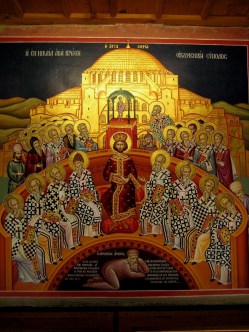
The Council of Nicaea
Swedenborg believed that by the time of the Council of Nicaea in 325 AD, when the Trinity of Persons first began to be established as orthodox Christian doctrine, the Christian Church was fast becoming corrupted by a desire for power and wealth on the part of its leaders. This caused its leaders to adopt doctrines such as the Trinity of Persons that would allow them to arrogate the power of Christ to themselves.
The alternative to the Trinity of Persons was Arianism, which ultimately denied the divinity of the Son, and thus of Christ. The primary doctrinal reason the Council of Nicaea was called was to condemn and reject the teaching of Arius about the Godhead. If this had not been done, Christianity would have died altogether.
By adopting the Trinity of Persons, a corrupt Christian leadership would still preach that Jesus is divine. The common people, who listen in simplicity to what their clergy teach them, could still be saved by a Christian faith and life.
In short, the reason God allowed the Trinity of Persons to become the primary doctrine of the Christian Church even though it is unbiblical and false is that the alternative was to allow the Christian Church to be rapidly destroyed, leaving the sheep without a shepherd.
Now for a fuller version.
For more on the historical prevalence of the Trinity of Persons, please click here to read on.


 What is lacking in these New Age ideas is a clear understanding of Swedenborg’s concept of distinct levels and gradual levels (“discrete degrees” and “continuous degrees” in traditional Swedenborgianese). This is the subject of Part 3 of Divine Love and Wisdom (#
 During the time my wife and I have been living in Soweto, Johannesburg, since we moved here from the United States in January of 2020, it has become clear to me how strong a role the ancestors play in African community and spiritual life. Funerals here are not perfunctory affairs as they often are in the U.S. They are ongoing cultural observances that extend over weeks, months, and even years, highlighted by specific ceremonies and rituals. Recently, I was honored to attend a traditional Xhosa ceremony in Eastern Cape that took place over two decades after the person remembered in the ceremony had passed on from this world.