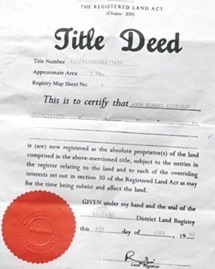
Title Deed
One of the most powerful and enduring fictions of human society is the idea that we can own things. A large part of our legal, civil, and social system is based on property ownership and the right to possess what is “ours.”
Further, in much of present-day society our sense of self-worth is heavily bound up in how much money we make, and what we can afford to buy and own. What sort of a house (or apartment) do we live in? Do we own it or rent it? What kind of car do we drive? How nice are the clothes we wear? We even speak of our “net worth,” which is the dollar value of everything we own minus the dollar value of everything we owe.
How much are you worth? Can it be counted in dollars? And more fundamentally, do any of us really own anything?
Legal ownership
Of course, legally we can and do own things. The law says that if I hold title to a piece of property, then I own it, and I can generally do with it what I wish. If I decide to sell it, the money is mine, and I can use it to buy something else, which I will then own. So in one sense, it’s obvious that we can own things.
And yet, human laws are simply an agreement among people that we are going to treat certain things in certain ways. Human beings in various nations have written laws saying that if I hold a particular officially recognized piece of paper, and it is registered with the county or state, this gives me an exclusive right to use and benefit from the property or other items described on the piece of paper. And since almost everyone in society agrees to abide by the laws giving me that right, we all maintain together the persuasion that I own this or that piece of property. We all agree on it, therefore it must be true.
As long as we do broadly agree on this system, it provides a reasonable framework for sorting things out among ourselves and avoiding conflicts. Property ownership law is not necessarily a bad thing.
However, it is good to keep in mind that this system of possessions and property ownership is not an ultimate reality of the universe, nor is it a God-given right. It is simply a system that we humans, in many nations around the world, have developed and agreed upon for our own purposes in creating a reasonably orderly and peaceful human society here on earth.
Who owns the land?
In an ultimate sense, we don’t really own anything. We simply have a limited level of outward control over certain things that we call our own, and that others agree are ours.
That control is tenuous at best. If our employment situation changes, or the laws change, or disaster strikes, or we die or become incapacitated, our sense of ownership can be wiped out very quickly. We can suddenly have little or nothing that we can call our own. Things pass into our hands, things pass out of our hands, and our control over it all is more limited than we like to think. Ownership is a fleeting thing.
In earlier ages, when legal systems weren’t so well developed and human society was simpler than it is today, the sense of personal ownership was not such a central aspect of society—and this is still true in some cultures today.
In Old Testament times, when the Israelites moved into and conquered the Holy Land, although it was sometimes referred to as a “possession,” it was also carefully pointed out that the land was an “inheritance”—in other words, a gift—from the God of Israel. The land itself could not be sold because the people did not actually own it. Only the use of the land could be sold for a certain period of time. Every fifty years, in the year of Jubilee, any land that had been “sold” was to revert back to the original clan whose inheritance it was.
David, the Psalmist, summed it up when he wrote:
The earth is the Lord’s, and everything in it, the world, and all who live in it. (Psalm 24:1)
This brings us to the reality of the situation, beyond all human laws, agreements, and commonly held myths and fictions.
The fact is, none of the land and nothing else we possess is really ours. Not even our own body is really ours. It is all God’s. God made the entire universe and everything in it—including us. Among ourselves we agree that we own things for a shorter or longer time, and we agree (or should agree) that we each have control over our own body. But in reality God owns everything, rules everything, and even keeps everything in existence moment by moment, from eternity to eternity.
A gift from God
We don’t own anything. Everything we have is a gift from God.
And it is not the sort of gift that God gives to us and then it becomes ours to hold onto. It is the sort of gift that God is continually giving us.
It is like water running out of a faucet. If the flow were cut off at the source, it would run through our fingers and be gone.
We think material things are so solid, so permanent, so real. We can touch them and hold onto them. They are solid, stable, dependable.
And yet, all of these seemingly solid things around us are made of trillions upon trillions of tiny little atoms that have practically no substance to them. They are made of infinitesimally small particles—or perhaps just waves—zipping around in a vast amount of empty space and creating force fields that we feel as solid matter. If the energy powering them were taken away, if their motion were stopped, they would instantly collapse into nothing, and that seemingly solid chair that you are sitting on would simply vanish.
The energy behind them is God’s love.
The reason your chair, and the electronic device on which you are reading this, are not vanishing right now is that God wants them to be there, and is continually creating and sustaining them for you. They do not keep on existing because matter is permanent. Matter is not permanent. It is evanescent and fleeting, made of energy and empty space. Your chair and your computer or tablet or smart phone are still there because God wants them to be.
The building you are in, and the grass and flowers and streets and buildings outside, the sky and earth, the sun and stars, and everything else in this world has a sense of permanence about it because God’s will is permanent and eternal, and God continually creates for us everything in the world around us as a pure gift of love.
We own nothing; it is all a gift
And here we are, thinking that we own things. That they are ours.
The sooner we realize that we that we own nothing; that we are nothing on our own; that everything we have and everything we are is a pure gift of God, given to us continually, moment by moment, out of pure, compassionate, infinite, eternal divine love, the sooner we will see our real place in this universe—and the sooner we will gain the happiness, joy, and deep inner peace that God wishes to give us now and forever.
No matter what human law and custom may say we own, and no matter what we may think is “ours,” we are all the recipients of fantastic, incredible gifts from God.
Forget the house and the car—as nice and necessary as they may be. Take a look at the world around you. Take a look at the trees, the flowers, the sky, the clouds, the sun, moon, and stars, the wonders of a single tiny insect flying by, and of the entire vast universe as far as our most powerful telescopes can reach. All of it is a gift to us from God.
Consider our own bodies, so incredibly intricate and complex that even our most advanced science has barely begun to understand how it all works. We walk around in our body all day, and rarely stop to think that we are a walking, talking miracle. Each one of us is a miracle of human form and function designed by a loving God. Our own bodies are an incredible gift from God.
And then there are all the people around us. Just look around in your neighborhood or your town. People of all ages. Babies, children, teenagers, adults, elders. Every one of them is also a miracle. And we have been given to each other through the love and grace of God.
Consider your family and friends. Perhaps you don’t always get along with them. But every family member and friend is a miracle given to us by God. The same goes for everyone in our community.
Then consider that there are billions of these human miracles living on this earth. And every one of them is unique—different from every other.
Yes, the entire world of nature and the entire world of human society has been given to us as a huge, incredible gift from the vast, inexhaustible love of God.
None of it is our own.
Yet all of it is given to us to enjoy, to learn from, to share with, to grow into. Everything around us, both what we think of as good and what we think of as bad, is God’s free gift, given to us for our pleasure and enjoyment, yes, but also for our learning and growth. And if we will only appreciate it and use it well, it is given to us for our eternal happiness and peace.
We have received much more than we have given
Once we understand and accept this (and we resist it with every fiber of our being!), we realize that we have received far, far more than we have ever given. Everything we have and everything we are, everything we have experienced, learned, or felt, has been a gift from God. As the Gospel of John says:
From the fullness of his grace we have all received one blessing after another. (John 1:16)
This is what Thanksgiving is all about. It is about recognizing all of our wonderful gifts, all of our wonderful blessings from God, and being thankful for them.
No matter what we have suffered and what we have lost, we have all been given far more than we have ever given in return. Even the beloved people and belongings that we have lost were gifts from God—and the more precious the gift, the harder its loss. Yet these dear loved ones and these treasured possessions have enriched our lives, and continue to enrich our lives as we hold them in our memory.
Giving as we have received
We have all received one blessing after another, whether or not we recognize and appreciate it.
And God does ask something in return.
Just as God has given everything to us, we are to give everything to one another.
Wealth and poverty may be important to us here on earth, but they mean nothing in the eternal scheme of things. It is what we do with what we have—whether it is much or little—that will stay with us eternally. And true wealth is not the wealth of the world, but wealth of the spirit. True wealth is the spiritual gold and silver of love and understanding, of joy and inner peace.
We have freely received a wondrous wealth of gifts from God, material and spiritual, human and divine. What God asks in return is that we give ourselves as a living gift of love and service, of help and support, to one another.
God asks us to give to others the same generosity of love, understanding, and kindness that God has so richly given to us as an eternal blessing.
(This article is a revised version of a talk titled “Giving and Receiving” that was originally delivered November 24, 2002.)
For further reading:
- Wavicles of Love
- Containers for God
- God is Love . . . And That Makes All the Difference in the World
- Viktor Frankl on Meaning through Relationship: It’s All About Love and Understanding
- Heaven, Regeneration, and the Meaning of Life on Earth
Share this:


Lee Woofenden is an ordained minister, writer, editor, translator, and teacher. He enjoys taking spiritual insights from the Bible and the writings of Emanuel Swedenborg and putting them into plain English as guides for everyday life.


 Spiritual Insights for Everyday Life
A good post for Thanksgiving, thank you. Regarding other spiritual matters, I found reading religious/spiritual quotes from Einstein to be humbling and enlightening. You may too.
Hi Hoyle,
You are very welcome. Glad you enjoyed it. And yes, Einstein’s mind went beyond physics to offer some great spiritual insights as well.
Thank you Lee for the most beautiful interpretation of science and the Writings around matter that I have ever heard. For me it brings together theories of energy, atoms, matter and our understanding of love in a sparklingly logical way. And with it a whole new way of seeing myself…we are all full of God’s love because otherwise our atoms and all the subatomic particles and those within them and within them….would all have nothing to hold them to the centre and they’d evaporate.Ta! Bronwyn
Hi Bronwyn,
Thanks for your beautiful words! I’m glad to have stirred up some new inspiration for you.
Happy Thanksgiving!
So according to Swedenborg, does God own us and our bodies (spiritual or physical)? That sounds sorta tyrannical and/or like enslavement if so.
Hi K,
What would ownership even mean as applied to God? It’s not as though there is some divine legal code establishing property rights. That’s not how things work on the spiritual and divine levels. Ownership is replaced by expression of one’s inner self, which is reflected in the things around the people in the spiritual world, such as in their houses, their towns and cities, and the natural scenery around them. And the entire created universe, both material and spiritual, is an expression of God, though some parts of it are inverted reflections of God (i.e., the evil parts).
Another way of saying this is that God doesn’t strut around like an all-powerful emperor saying, “Everything I see is mine!” God wants to give everything that is God’s to every created being in the universe. And that’s exactly what God does, as much as we are willing to accept it.
As far as enslavement, what God does is exactly the opposite. God leaves us in complete freedom to choose and live whatever kind of life we want to live. Unfortunately, some of us choose types of life that are inherently self-limiting and self-punishing. But even then, God allows us to live that life as much as is possible. And for those who choose a good life, God gives them everything possible to enjoy that life to the fullest. Maybe not so much here on earth, where material and human factors get in the way. But in heaven, everyone is completely free to live exactly as he or she wants to live every moment.
That could hardly be called slavery.
And yet, the angels glory in feeling that they belong to God. To them, this is not slavery, but freedom, because God gives them the full gift of freedom in everything they think, feel, and do.
I do not like the idea of my body or me being property: it would make wrong choices I make with my own body like theft or vandalism, and not merely whatever the wrong choice is. So that is part of why I hope God does not try to assert ownership over me.
When I am done with this life sometime in the future, I do not want to be subject to laws anymore (I see the so-called commandments as simply being the right path of moral behavior), and I do not want anyone to rule over me anymore (God being an infinitely wiser being who knows best and a parent in a non-authoritarian way is better).
Hi K,
I think it should be clear by now that God does not “try to assert ownership” over us. Even though in a sense God does own us, rather than “asserting” that ownership, God gives everything to us freely, including our own life and the choice of what to do with it. If ownership is the right to control something and use it as we see fit, God cedes ownership of us to us, because God does not want to control us. God wants to have a freely chosen mutual relationship of love and understanding with us. And if we choose not to have that relationship with God, the last thing God will do is assert control and force us into it.
Having said that, if you make wrong choices with your body, it is a form of theft or vandalism, not just against God, but against other people and even against yourself.
We humans are only semi-independent. Really, we’re interdependent. We depend upon others even for the basics of survival such as food, clothing, and shelter, not to mention the many nicer optional things in life. If everyone else on earth were to suddenly disappear, most of us would not survive long, and the few who did would have a severely limited life devoted mostly to keeping themselves alive. For the few who survived more than a few weeks or months, subsistence would be a full-time job, leaving little room for anything else.
Making a wrong choice with your body means doing something that is damaging either to yourself or to others, or both. And that means rendering yourself, and probably others, less able and willing to contribute to the well-being of others in the interconnected web of relationships, goods, and services that makes human society functional and livable. You would be vandalizing your own body, or whatever you damage with your body, through your wrong choices, and you would be stealing from others the goods and services that you otherwise would have provided as part of the overall exchange that gives us all the kind of lives we prefer to live.
And you would be vandalizing the body God gave you, and stealing from God the joy of being able to make you, and others through you, happy.
Wrong choices are wrong not because of some arbitrary code, but because they do actual damage. Any time you choose to do damage instead of doing good, you are indeed engaging in vandalism and theft. Perhaps it is only a small instance of vandalism or theft, analogous to writing graffiti on someone’s car. But it can also be major vandalism and theft, like taking yourself out of the pool of useful citizens by descending into alcoholism and drug abuse so that you are a drag on society instead of a contributor to it.
Long story short: Making wrong choices with your body does real harm to yourself, to others, and to God. Thinking that we “own our own body,” so that we can do whatever the hell we want with it, is toxic thinking, not healthy thinking.
On your final points, all the laws of heaven are “simply the right path,” not something arbitrarily imposed at the whim of or for the benefit of some arbitrary ruler or ruling class.
And God is not an arbitrary ruler, but is precisely the ultimate person who knows best and is a loving, non-authoritarian parent to us. Some people do need God to be an authoritarian ruler, but these are people at the lowest rungs of the spiritual ladder. God is happy when when climb up higher on that ladder, and can have a less hierarchical relationship with God. Again, Jesus said to his disciples:
So according to Swedenborg, the body is property of another, if making deliberate wrong choices with it is theft or vandalism? As a meme goes, do not want.
And if someone is suicidal (not saying I am here), that would make being suicidal far worse: one who is suicidal because they want to end suffering is always desiring to steal or vandalize or whatever, which would probably lead them to hell after they pass away (even if they do not do so via suicide).
I think prefer the so-called toxic thinking that no one except maybe myself owns myself, and not doing good for others or missing opportunities to do so is simply that, rather than much worse. Otherwise it can really feed into worries of being enslaved or stealing, especially if one has OCD about living morally.
Hi K,
No, Swedenborg doesn’t say the body is the property of another. God gives us both our body and our soul as a gift, to use as we wish, within certain well-known limitations. God does not claim our bodies as a personal possession, or exert any control over them, as someone who owns a piece of property would do. If your body were God’s property in the usual sense, you would be God’s slave. But as Jesus said in the quote from John 15:15, God doesn’t call us servants (literally: slaves), but friends.
As for the rest, none of us is perfect. There are commonly extenuating circumstances even when we make bad decisions and do bad things. God does not hold our sins against us, but always looks to extract us from them, and to bring us to heaven if there is even a sliver of uncorrupted good in us to work with. This will be covered in my next post, which, unfortunately, has gotten delayed.
But the fact remains that making bad choices causes damage. There’s just no way around that. It’s not that God’s going to zap us with a lightning bolt. It’s that we’re going to suffer the effects of our bad choices, and so are other people. That’s what we should be worried about, not about God giving us the boot.
About suicide, in the overwhelming majority of cases I don’t believe there is malice involved, but despair. And we’re not sent to hell for suffering despair. See:
Back to ownership, it’s fine to claim ownership of our own body. But that is something we do at an earlier stage in our psychological and spiritual development, when we’re establishing ourselves as an independent, self-responsible adult. It’s a necessary stage in our formation as a person.
But it’s not the final stage. In the final stage, we have a very clear sense of our own identity, but we think of ourselves as belonging to the Lord. Paradoxically to the earthly mind, these two actually go together. Here is how Swedenborg puts it:
I’ve linked the section for you so that you can read the whole sequence, which goes through #45.
I also do not like the idea of being interdependent with others, as that feels like being chained to others. I would rather be not interdependent, but still doing good voluntarily.
Hi K,
Well . . . unless you want to pull a Tom Hanks and maroon yourself on a deserted island, you’re pretty much stuck with being interdependent.
I presume you don’t grow all your own food . . .
I meant in the afterlife. In this life being physically interdependent is more or less unavoidable, but I do not think I want to be stuck in some sort of metaphysical interdependence with others in the afterlife forever.
Hi K,
In heaven, it is possible to live alone if that’s what you want to do. Normally it would be with your partner in marriage. Since God freely gives everyone everything they need to live, there’s no need to be dependent upon anyone else for your necessities of life. Of course, most people want human companionship and community and companionship anyway. But in heaven, no one will die for lack of it.
To make it simpler so I do not worry too much (or I seriously question New Church even more), and according to Swedenborg:
Beyond God Himself (and probably His Divine Realm that is beyond the spiritual and physical realms), God does not necessarily claim ownership of _everything_ in creation in a property-of-finite-beings sense, nor am I nor any of my bodies (physical, any spiritual, etc) the property (at least in the property-of-fintite-beings sense) of anyone else?
Hi K,
Your physical body can be the property of someone else, though not legally anymore except perhaps in a few small pockets of the world. Slavery, which is the literal ownership of other people’s bodies, has been an institution for as long as we have any kind of history. The recent (by historical standards) abolishment of legal slavery throughout most of the world initially spearheaded by the British in the 19th century is an unprecedented development. You and I grew up with the results, so that we think it’s not legitimate for one person to own another. But for most of human history, ownership of people was simply assumed and accepted as the natural order of things in all continents and cultures around the world.
Your spirit, however, cannot belong to another person unless you voluntarily give up your spiritual freedom and enslave yourself. This is done by choosing evil over good. It commonly (but not always) involves attaching oneself to some demagogue or movement and turning one’s intellectual and emotional (i.e., spiritual) life over to that person or cult-like group. This is self-enslavement. Unlike physical slavery, it is voluntary. I.e., you can choose not to be a slave if you decide you no longer want to be a slave spiritually. You can leave the movement you enslaved yourself to, and you can break away from the demagogue.
So are you or any of your bodies the property of anyone else? Physically, I presume you live in a country and region where literal slavery is illegal, and not practiced, so that you own your own body. But spiritually, that’s entirely up to you. You can enslave your spirit, including your spiritual body to someone other individual or group by choosing evil over good. As Jesus said, “Everyone who commits sin is a slave to sin” (John 8:34).
Or you can choose to be free. Two verses later, Jesus said, “If the Son makes you free, you will be free indeed” (John 8:36). As I’ve attempted to explain in earlier responses, our human concept of property ownership doesn’t really apply to God, represented here by “the Son,” because even though God theoretically could assert ownership over everything, having created it all, that’s not how God operates. Instead, God freely gives everything to everyone, and leaves us all free to decide what to do with it, including with ourselves, body and soul. And if we choose the good, also represented here by God’s presence as the Son, then we will be truly free.
For a related article that discusses God’s relationship with Creation from a more philosophical perspective, see:
God: Puppetmaster or Manager of the Universe?
So in a metaphysical or spiritual sense, I am right in thinking God does not necessarily own everything in a finite being property sense, and that me and any body I have is not the property of anyone else? Again, this is in a metaphysical or spiritual sense.
PS: The assumption I live in a place where slavery is illegal and socially unacceptable is correct, but if I think any claim of ownership by masters over slaves is invalid in a moral sense anyway, even if the laws they are subject to claim otherwise. Just because a human makes laws does not mean they are morally valid laws.
PS: That “but if I think any claim of ownership” should have read “I think any claim of ownership” there.
And the first paragraph is referring to me being right about what Swedenborg wrote, that is.
Hi K,
What I’m attempting to convey to you is that property ownership in the earthly sense simply doesn’t apply to God, nor does it apply to our spirit.
Nobody in heaven has any legal right of ownership of anything, including their own body, which is what property ownership is defined as here on earth. Property ownership is not a “natural” thing. It’s something that we culturally and legally agree upon as human beings in this material world in order to organize our lives in community with one another in a reasonable and workable way.
What exits in heaven instead is the “properties” of people, meaning their character and personality. Everything that is their “property” there is an expression of their inner “properties.” It is not the result of some legal or cultural acceptance of their having the right to use and even abuse this particular item, which may be land or an object or their own body.
In heaven, you will have no property at all in the earthly legal and cultural sense. Neither will God. God doesn’t have a title deed to heaven, or to your house and yard in heaven, or to your spiritual body. That’s just not how things work there.
What you will have is a specific character, which is your identity, or proprium in Swedenborg’s Latin, and which at its core will not change forever. It is still kept in existence by God. You don’t have it on your own. But it is permanent because God’s love for you specifically as you are keeps it in existence forever, as does your mutual relationship with God.
That proprium, or “property” of you as a person will then be expressed in all the objects and scenery around you, not to mention in your relationships with other people, and with God. It can’t be taken from you, and neither can your home and surroundings, the objects in your home, and so on, nor can the people you are close to be taken away from you. Nor can your body be taken from you. It is an expression of the essential “property” of your heavenly proprium. And that is eternal because God is eternal and you are in relationship with God.
If your fear is that someone else, including God, will take possession of your body, your home, and so on, and force you to do something with you body and your home and its contents that you don’t want to do, that’s not going to happen, nor is it even possible for it to happen in heaven.
If you have some other worry, I guess we could address that.
If your issue is that you want to control your own life, and you want God to butt out, well then, you’re going to have a problem. First, that would indicate that you have a wrong understanding of God. And second, it might mean that you want to be free to choose and do evil, which is to act against God. And you are free to do that. But ironically, that would actually involve enslaving yourself, and ceding ownership of yourself to the Devil, meaning evil and hell. People in hell are slaves. It is a self-imposed slavery that they are unwilling to be free from because they love it.
If your issue is something else, then out with it!
But the bottom line is that if you’re talking about God and spirit, our earthly concepts of property and ownership simply don’t apply. It would be like trying to run an electric car on gasoline. It just doesn’t work that way.
Even without laws, there still can be personal property in a finite being sense. Like my body, my clothes, my toothbrush, etc. If anything I have in any afterlife was somehow the property of another in such a finite being sense, then that means I have a moral obligation to use it like I would use someone else’s property in this life, which means a lack of freedom.
For example, if I own a pen, that means I can freely use it how I want, get rid of it how I want, etc. But if I’m using your pen, then I gotta ask you permission to use it, and I cannot just get rid of it or give it away without permission. Even if we were on a boat on international waters.
That’s what I’m getting at with what Swedenborg believed the nature of ownership is in the afterlife.
Hi K,
And I’m saying that that’s just not how things work in heaven.
You don’t have to ask anyone’s permission to use your pen or your clothes or your toothbrush or your body, but that’s not because you own them in a property sense. It’s because these things are an expression of you and your character, so they “adhere” to you because they reflect you. No one else would use your toothbrush, not because it belongs to you, but because it wouldn’t fit them and their character. It would be like a business executive named Bob putting a nameplate on his desk with the name Frank. Bob is not going to steal Frank’s nameplate and use it, because it says “Frank,” not “Bob.” In heaven, everything in and around your house is like that. Not that they literally have a “K” engraved on them, but that they express you and your character, and would be out of place in anyone else’s hands or homes.
Shared spaces also don’t belong to anyone as property. They are the expression of the common character and culture of the community in and around which they live. You don’t have to ask permission to use a city park or drive down the road or climb a tree because you are part of the community that causes them to be there. (Technically, God causes them to be there, but God does so in a way that reflects the specific community and its character as a complex of all the people in it and their relationships with each other.)
When it comes to other people’s homes, you wouldn’t just go barging in as if you own the place, and they wouldn’t do that to you either. You would call out or knock on the door or do whatever is done in your culture to visit people in their homes, and they would welcome you in, so that you are a guest, not an intruder, just like here on earth. In heaven, intruders don’t get very far. Usually they can barely make it over the border of heaven before they are seized with physical agony and pain, unable to breathe, and quickly retreat back to their own homes in hell. But an invited guest is welcome in people’s houses. And everyone in every community of heaven is friends with one another, some closer, some more distant, but all having good and cordial relations. Even once welcomed in, you wouldn’t walk around the house messing with the host’s stuff as if you owned it. It would be rude. And people there are the same people as here, only with a few more of their rough edges worn off.
Bottom line: In the other world, there is no ownership of the type we’re used to here.
Nevertheless, people still have their bodies, their homes, their personal “possessions,” and so on, and are free to use them as they wish, because these are all reflections and expressions of themselves and their own unique character. No one else can take, have, or use your things unless you welcome them to do so.
Even if you gave one of your household items to someone else as a gift, it would go through subtle or perhaps significant changes in the transfer, because now it would reflect its meaning to its new “owner,” which is not exactly the same as its meaning to you. Its status as a gift from you would remain part of its constitution, but it would also take on meaning based on that person’s particular, unique relationship with you, and to the object itself and what it represents. So it would not be exactly the same object in their house as it was when it was in your house. If they then gave it back to you, it would change yet again. Things in the spiritual world are fluid in that way.
Oh yeah, and if a thing is the property of another, then the owner can freely change or revoke it. For example, if I am on a university campus and I like a particular courtyard, the university can change or demolish that courtyard even if I do not like the changes, because they own that courtyard.
Hi K,
Yet again, that’s not how things work in heaven. I would venture to say that if you were on a university campus in heaven, and there was a particular courtyard you liked, then when you were there, that courtyard would be there specifically because you like it, even if it vanished the moment you left.
Thanks for the reply. BTW I didn’t mean to sound hostile in the replies I posted here.
I also do not know if I could get used to a reality that is seemingly so fluid as you describe, in any afterlife.
Hi K,
I didn’t detect any hostility. Just . . . “persistence.” 😛
And I think we’ll get used to the different rules of the afterlife fairly quickly.
One day a couple decades ago when my kids were still young, I looked over the shoulder of one of them while he was playing a video game on the computer. In the game world, his character and someone else’s were running straight at each other. I flinched, thinking they were going to crash into each other. But they ran right through each other. To my son, that was totally normal. His mind had quickly adjusted to the different rules of the in-game world.
I expect the same thing will happen for us when we move from this world to the next.
For one thing, everything there will be an expression of our mind, and of the minds of the people around us, so it will all seem completely natural and sensible. I expect that very quickly, we’ll start to feel a sense of revulsion and even horror at the very idea that we could go back to the material world—as the reincarnationists believe—where the things around us no longer respond to our thoughts and feelings the way they do in the spiritual world. It would feel like being forced to put on a straitjacket and leg shackles after getting used to running free.
So if I understand what Swedenborg claims is the case right:
1: God does not own creation (physical or otherwise) in a finite-being-sense or a cat-who-growls-at-you-for-trying-to-take-his-food sense, but the very existence of creation is dependent on God anyway, hence that Bible verse about the Earth being of God?
2: The New Church afterlife, being a manifestation realm of the otherwise abstract (more or less) cannot really have ownership in the previously mentioned sense going on because it is more or less a manifestation realm?
(again, this is according to Swedenborg I am trying to see if I get right)
Hi K,
In general, yes.
1. God doesn’t own the universe in a property sense because that’s not how God works. The universe comes from God, and is an expression of God, and is continually dependent upon God. But God freely gives all of it to us, and to created creatures in general, and even, on the material level, to the physical universe itself, and its laws. God could claim ownership of it. But God doesn’t claim ownership of it. That’s just not how God operates. God is love, and love wants to give what it has to others.
2. Similarly, property ownership as we know it here on earth doesn’t exist in heaven (or in hell) because that’s just not how the spiritual realm works. Everything there is an expression of the people there. There’s no separate “property” that people could own in some legal fashion.
In one of the responses, you mention spiritual enslavement. Can one be freed from such in the next life, at least beyond hell?
Hi K,
For people who have chosen hell, the enslavement lasts forever. They are slaves to their own evil, and it is a self-imposed slavery from which they do not want to escape, because they love their evil desires and actions.
For people who have chosen heaven, any enslavement they’ve had to evil (bad desires, bad thoughts, bad actions that persist even though they’re good people at heart) will come to an end, and they will become completely free, even if they may have to go through some hard experiences in the process of letting go of their remaining bad attitudes and habits.
So to see if I understand this right again, and in brief:
(1) God does not own creation in a finite-mortal-being sense.
(2) In the New Church afterlife, or at least in the heaven, no immortal inhabitant owns anything in a finite-mortal-being sense either.
Does that sound like what Swedenborg wrote?
Hi K,
I think it is accurate. But it is more of a conclusion derived from what Swedenborg wrote than something that Swedenborg explicitly wrote.