The title of this article, minus the question mark, is the title of an article posted recently (December 1, 2016) on the Huffington Post Blog. Its author is J. H. McKenna, Ph.D., Senior Lecturer on the History of Religious Ideas at the University of California, Irvine. Here is the article’s introductory line:
As far as I can discover from interviews and from books, there are at least 21 reasons smart people find God unconvincing. Here are the 21 reasons, explained.
This multi-part article here on Spiritual Insights for Everyday Life is my response to Dr. McKenna’s 21 collected reasons, from the perspective of a perhaps moderately smart theist of the Swedenborgian Christian variety.
The “About” page at Dr. McKenna’s website, “Upon Religion,” ends with these words:
Dr. McKenna often views religious ideas through the lens of benign humor.
Fascinating! As it turns out, I often view atheist ideas through the lens of benign humor! I’m sure Dr. McKenna won’t mind.
Speaking of which, before getting to my point-by-point response to Dr. McKenna’s article let’s take a look at that title.
Argumentum ad idiotam
Way back in the dark ages (meaning the early 1990s, before the Internet broke out of academia and became mainstream), when I was even more foolish than I am today, I haplessly wandered into a Fidonet computer network “Echo” (public discussion forum) called “Holysmoke.” Put simply, Holysmoke was the Echo where moderators of other Fidonet Echoes sent overly zealous Christian proselytizers to get eaten alive by a pack of atheist piranhas. (And no, I hadn’t been proselytizing. The name of the Echo just sounded interesting!)
In one of my earlier messages there (which, alas, is apparently among the “missing links” in the online Holysmoke archives), I rather foolishly started one of my arguments with the words, “If you are smart, . . . .”
As you might imagine, the aforementioned pack of atheist piranhas swarmed all over that one!
They accused me of engaging in the logical fallacy of argumentum ad idiotam. (Okay, okay, that may not be the exact name of the logical fallacy.) To say that only smart people believed a certain thing, they assured me, was a completely baseless, illogical, and in fact completely idiotic and downright ******* stupid argument to make, and I was a complete moron to say such a ridiculous and insulting thing!
Imagine my surprise, then, over twenty years later, to find Dr. McKenna’s atheist apologia headlined: “God Is Unconvincing To Smart Folks”!
Now, Dr. McKenna does seem to be a much nicer person than the denizens of that old HolySmoke Fidonet Echo. Yet he’s tangled in the same old argument about who knows better: Smart Folks or Stupid Folks. And of course, the people who agree with me (whoever I happen to be) are the Smart Folks!
And no, I won’t let Dr. McKenna hide behind “scholarly objectivity” and claim that he’s just reporting what other people think. As the old newspaper maxim goes, “You can say whatever you want. Just put it between quotes.”
Educated elites don’t get to decide what’s true
It doesn’t help that a 2013 academic study titled “The Relation Between Intelligence and Religiosity: A Meta-Analysis and Some Proposed Explanations,” by Miron Zuckerman, Jordan Silberman, and Judith A. Hall, generally supported the idea that higher levels of intelligence are associated with lower levels of religiosity. But as pointed out in a Washington Post article responding to the study, “Are atheists smarter than believers? Not exactly,” it’s best not to jump to hasty conclusions.
The debate about that study is extensive. But here’s the bottom line for our purposes today: Whether something is true or not isn’t dependent upon how many smart people believe it is true. Truth is not a majority-rules process, still less a process in which the educated elites get to decide among themselves what the rest of us must believe if we’re smart. Throughout history there have been many Very Smart Folks who have believed some Very Stupid Things.
The opening abstract of the aforementioned study ends with this sentence:
Intelligent people may therefore have less need for religious beliefs and practices.
Now that is a very insightful observation!
In addition to the reasons given in the study itself, I would add this one: Highly educated and intelligent people are commonly found in academia and in the upper echelons of society. There, they can feel a sense of economic and personal security that is not enjoyed by the mass of ordinary working people who do not have their high level of education and privilege.
It’s easy not to feel any need for God when you’re in a tenured position in academia, or in a highly paid upper-level position in a booming tech or biomedical company.
But for the people down in the trenches, life is fragile and uncertain. One serious mistake, one accident, one injury could cost them their job and their livelihood—and they know it. These people live one missed paycheck or one bad break away from being chucked out onto the street. For these folks, the need for a higher power to provide a deeper sense of security is very real.
Beyond that, whether intelligent people have less need for religious beliefs and practices is irrelevant to the existence or non-existence of God. Our need for God, or lack thereof, does not determine whether or not God exists. The truth, whatever it may be, is independent of our particular perspective or position in society.
Now that we’ve dealt with Dr. McKenna’s title, let’s dig into his twenty-one points.
1. God as an old white man in the sky is unconvincing
Under this heading, Dr. McKenna writes:
Depictions of God as a humanoid (this is called ‘anthropo-morphism’ = in human form) have been considered incredible since ancient times. Rendering God as a male humanoid is not credible to skeptics. Does this male God have genitals, a deep voice, facial hair? Also, it’s curious that God usually resembles whoever it is that’s depicting God—and that’s men! Men made God in their own image and likeness.
For Jews and Christians, the idea that God is in some sense human is based especially on this passage in the very first chapter of the Hebrew Bible:
Then God said, “Let us make humankind in our image, according to our likeness. . . .”
So God created humankind in his image,
in the image of God he created them;
male and female he created them. (Genesis 1:26–27)
In his Notebooks, the deist philosopher Voltaire (1694–1778) famously wrote:
If God has made us in his image, we have returned him the favor.
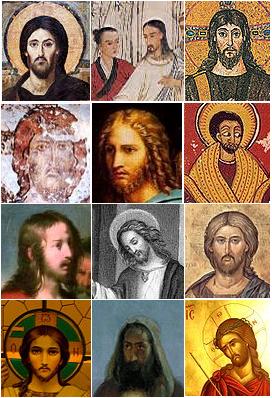
Jesus depicted as being of various races (image courtesy of en.wikipedia.org)
The historical and social reality that God is pictured by various believers as being their own type of human being doesn’t mean that God actually looks like an old bearded white man (in the case of common European depictions of God). Given that there are many different races, types, and sizes of humans in the world, all of them created “in the image and likeness of God,” it is sensible to believe that God encompasses the various qualities of, and is the origin of, all of those different types of human beings, rather than looking exclusively like any one of them.
And yes, this would mean God is the origin of European male humans’ genitals, deep voices, and facial hair, not to mention being the origin of European female humans’ genitals, higher voices, and non-bearded faces—and of the sex-linked traits of people of every other race. Does Dr. McKenna have a problem with God being the origin of human sexuality? Is Dr. McKenna just as uncomfortable with sex as the Christian conservatives whose religious ideas he views with benign humor?
If God made humanity in God’s own image, then God must encompass all human qualities, of all different types of humans. However, as Voltaire said, since God created us in God’s image, it is only natural that we humans will return the favor, and picture God in our own particular image—whatever that image might be.
As for the more general issue of an anthropomorphic God, we’ll save that for Dr. McKenna’s second point:
2. God as immaterial and yet with biological functions is unconvincing
It’s self-contradictory to say God is ‘immaterial’ and in the same breath say God sees, hears, speaks, and feels—all of which are functions of biological, material organisms. What does God ‘see’ with if not a material eye? ‘Hear’ with if not a material ear? ‘Speak’ with without a material mouth? These descriptions of God are self-contradictory and nonsensical.
These things are self-contradictory and nonsensical only if our conception of reality is limited to physical, material reality.
According to Emanuel Swedenborg (1688–1772)—and Swedenborg is far from unique in thinking this way—there are three distinct general levels of reality, in descending order:
- Divine reality, meaning God
- Spiritual reality, encompassing the spiritual world and the human psyche
- Material reality, or the physical universe and everything in it, including the human body
Where Swedenborg departs from many thinkers is in saying that each of these levels of reality is substantial and organic, in the sense of being made of real substance and also having a living, functioning, and complex form without which it could not be real.
According to Swedenborg, the spiritual world, though completely non-physical, is every bit as real, solid, and complex as is the physical world. In particular, he says that we have a spiritual body (compare 1 Corinthians 15:44) that has every part, every organ, and every detail that our physical body does—so much so that after we leave our physical body behind and enter the spiritual world, we will hardly be able to tell the difference. (And yes, Dr. McKenna, this does include what’s between our legs.) And yet that body is not made of physical matter, but of spiritual substance.
And God, Swedenborg says, exists on a still higher level of reality: the divine level of reality. At that level (which is infinite, and therefore beyond our ability to fully grasp), God also has real substance and real “organic” form. In fact, God has an infinitely complex form, which encompasses, and is the source of, all of the forms and functions that we enjoy as human beings, including sight, hearing, speaking, and feeling.
In short, God does not see with material eyes, but with divine eyes. God does not hear with material ears, but with divine ears. God does not speak with a material mouth, but with a divine mouth. And so on with the other senses and abilities. And unlike our limited physical senses here on earth, and even our not quite as limited spiritual senses when we move on to the spiritual world, God’s divine senses, being infinite and above all the other levels of reality, are capable of sensing everything in the created universe.
Further, God is human not so much because God is physically shaped like a human being, but because God has all the essential qualities of human beings, including love, wisdom, intelligence, passion, perception, humor, and all of the other qualities that make us human rather than simply being a higher order of animal.
We’ll say more about how God senses everything in the created universe in Part 2 when we take up Dr. McKenna’s third point: “God as all-knowing is unconvincing.”
Share this:


Lee Woofenden is an ordained minister, writer, editor, translator, and teacher. He enjoys taking spiritual insights from the Bible and the writings of Emanuel Swedenborg and putting them into plain English as guides for everyday life.



 Spiritual Insights for Everyday Life
I’ve followed your articles for 6 months or so. With all due respect, it appears that you work too hard explaining “Spirituality”. I would suggest your insights would be better understood by the reader if you lessen the intertwining of religion and spirituality. Fewer answers and more exploratory type of discussion would be very refreshing and I believe well received. Regardless of my opinions, it looks like you’re well on your spiritual journey as you understand it. God speed and Merry Christmas!!
Hi Hoyle,
Thanks for the feedback. It’s good to have you with us. Can you be a little more specific on what type of articles you would like to see more of here?
Annette and I wish you a wonderful Christmas season!
Ugh. That old argument that smart people do not need God, because they have science. Hogwash. Universal truth lies with God and even the smartest person alive can be more oblivious to spiritual matters than the average person.
I would count to said ‘educated folks’ and I can tell you one thing. It has little to do with my perception of spiritual values and gaining spiritual understanding. I only get said understanding when God wills it.
I can see where it comes from though. I tend to question things a whole lot because I dislike blind belief. So I question, I doubt, I learn. If anything, my intelligence is a responsibility. God graced me with it and now it is my task to use for the benefit of others, not to cast out God and act as if I know all.
Anyway, good read. Thanks 😉
Hi Alex,
Thanks for your good thoughts and reactions. Glad you enjoyed the article. Don’t miss our next exciting episode! 😀
For me, a universal source conscious awareness at the fundament of our reality seems pretty obvious. What I don’t get is how so many “smart folks” insist that ALL of the bizarre old stories contained within these ancient religious texts must come from God, particularly when they often paint God in such a dismal, all-too-human light. I seriously don’t understand the mindset that says “all of our holy book (whichever one that might be) must be true or none of it is true.” From my perspective, that’s the part that’s not “smart.”
I understand that it’s the human need for certainty within this big, scary reality – with death always looming large – that causes this need in people to believe that every word of their holy books must be true, must come from God. But I still don’t understand how the rational mind in these folks does not naturally overcome their existential fear and its resulting need to believe ALL – in the face of some pretty outlandish, heinous things being attributed to God.
So this need by many to believe in their holy books ENTIRELY quite naturally sets them up for the lifelong task of trying to justify all the craziness and inconsistencies, both to themselves and others. It seems far more likely to me (actually, pretty obvious) that many, many religious texts contain some deep truths that represent the reality of our source consciousness, but at the same time they are mixed with much that is not from god, i.e., ancient tribal folklore. When we simply accept the fact that there has been “human adulteration” to “God’s word” in all legitimate religious texts – because that’s what humans do – it frees up ours mind so we can spend the majority our time growing, spiritually, and far less of it trying to make sense out of all the primitive weirdness. All the best!
Hi tenderelftown,
Good to hear from you again. I hope life is treating you well.
I have come to think of the Bible, and of divine revelation in general, as a relationship between God and humanity. This means that it must have both a divine side and a human side. If it didn’t have a divine side, it wouldn’t be revelation. If it didn’t have a human side, we wouldn’t be able to understand it.
Another way of saying this is that in the Bible God speaks to us in human language, not divine language. If God were to speak in pure divine language, it would be beyond our ability even to hear it, let alone to comprehend it. So God speaks to us in our own language. And since our language is based on our culture, this means speaking to us in terms of the particular cultures through which God delivers the message.
In the case of the Bible, that means ancient Hebrew culture in the Old Testament, and later, in the New Testament, ancient Hebrew culture as influenced by ancient Greek and Roman culture. To understand the message, it is necessary to learn and understand what the various actors and events in the story meant in terms of the culture of the time. That culture and its people and stories serve as metaphors for deeper spiritual and divine realities.
If we look only at the surface—the literal meaning—we will mostly see an ancient culture less developed scientifically, morally, and spiritually than our own. And those who are stuck at that level of meaning, both conservative Christians and atheists, will miss most of the Bible’s real message because they’re focusing on the material, human imagery rather than the metaphorical meaning that it is meant to express.
As it turns out, Part 3 of this article, which will be posted in a few hours, deals briefly with this issue of atheists reading the Bible essentially the same way that fundamentalist Christians do, only rejecting it instead of accepting it. And I have previously referred you to the article, “How God Speaks in the Bible to Us Boneheads,” which goes into more detail.
Unfortunately, there are still billions of people on this earth who think primarily in physical and materialistic terms. Some of them are religious and some of them are not. The religious ones read their sacred books literally, and believe that God is an angry, punishing being who calls them to wars of various kinds. The non-religious ones reject their sacred books altogether, and therefore miss any deeper spiritual content those books may have to offer to those whose eyes are open to see it.
Part of our mission here at Spiritual Insights for Everyday Life is to help restore the awareness and knowledge of the deeper divine message within the human, cultural clothing of the Bible. We believe it is a message that the world, both sacred and secular, very much needs in this new era of humanity.
Oh, I forgot to check the “notify” box. So I shall do it now. LOL.
“The religious ones read their sacred books literally, and believe that God is an angry, punishing being who calls them to wars of various kinds.”
Yes, it’s easy to see why they would think this, considering all of the seemingly punitive slaughter attributed to God in the OT. But if taken as a metaphor, then what is the meaning/lesson/metaphor in the flood story, for example? The only thing I see in it is: “Obey me, or I’ll squash you like a bug.” I see this as a projection of our own limited abilities to love onto “God” via this and many other ancient stories, which often pop up in a variety of cultures, like the flood story.
I see God as giving all of us only unconditional love, since we are a sacred part of him. As a result, we get all the time and help we need to “grow up,” spiritually, both in this life and beyond. In my view, God would no sooner “throw any of us away” than a preschool teacher would throw an unruly child in the the dumpster out back and forget about them forever because they misbehaved.
Also, what role do you think other sacred texts, besides the Bible, play in God getting his intentions known to mankind? What are some of the things you see, specifically, in other sacred texts that you find to be inspirational and from God?
If the ancient sacred holy books are culture-specific, as you say, in that they were written for other people at a certain time and place, then it makes sense to my why they are often rejected by modern people. So I have taken Christ’s lessons of love from the Bible and applied them to my life, but I reject most of the rest of it because it of it’s “primitive weirdness,” as I said before.
Instead I choose to study things like the NDE evidence, as well as other areas, where currently living people experience the “larger reality” directly, and they relate their experiences to us in modern terms. I find this much more useful in trying to understand “God” than attempting to decipher ancient texts that – as you say – that were not meant for our culture. Also, I find my direct experience of “God” during meditation to be far more powerful than reading the confusing (to me) old stories. And I think modern people are experiencing God in some very deep way and sharing their information with us to help us understand this reality on a deeper level. I don’t think this communication just stopped a couple thousand years ago; it has been ongoing and will continue to be, which in a way is making the arcane, culture-specific texts far less useful. I’d say that ex-NASA physicist Tom Campbell has been the most help for me in this regard, but there are many others. All the best!
I became an atheist of the God that was defined by religion. I’ve settled on the phrase “creating life force” to reconcile my existence. By definition of the word “INsight”, spiritual insights are derived from within. If I adopt the thinking of others to define my God, I lose all insight. One’s awareness of God and one’s knowledge of God are quite distinct. However, I do enjoy reading about the history of God and religion as I enjoyed your answer.
“By definition of the word “INsight”, spiritual insights are derived from within.”
I agree. Others can point out various things to us, but we have to develop our own understanding for ourselves. As they say, “If it is not your experience, it is not your truth.” That’s how I look at Christianity and other ancient, prepackaged belief systems: Those beliefs are their beliefs, not mine – and from a long time ago. I feel compelled to develop my own understanding of this reality by studying the experiences of others, but most importantly, seeing how they fit in with my own internal experiences/insights. All the best!
Hi tenderelftown,
Of course, there are prepackaged versions of the various religions, including Christianity. And that’s what many people want: something they can believe and follow without having to think too hard about it. That’s why those religions are so popular. They serve a large group of people who want what they offer.
However, the Bible itself is anything but prepackaged. Certainly it developed over many centuries, and was edited along the way. But for the most part it’s not a book of doctrine and theology. Rather, it’s a book of stories, experiences, parables, and prophecies. Those who are able to read it without too thick a lens of prepackaged dogma are often surprised and amazed at what they find there. It’s mostly not what is presented as doctrine by the various branches of mainstream Christianity.
Hi Hoyle,
Reminds me of what one of our old seminary professors back in the 1970s used to say to his counseling clients who declared themselves atheists and had issues about God based on their religious upbringing (as the professor recounted it to his students in class). He would ask them to describe this God they didn’t believe in. Usually it was some variation of the angry, capricious God who sends people to hell because they’re gay or Jewish. When they were finished, he would say, “That’s amazing! You don’t believe in the same God I don’t believe in!”
Imagine how unreliable the recording of events was 2,000 years ago! With all of today’s technology, it’s still difficult to get people to agree on the same event they’ve just witnessed. It seems an incongruity that anyone could have developed a spiritual connection based upon the historical recordings that would later become “the word”, no matter what religion. I find it unnerving that Swedenborg, or anyone else, would claim mankind before revelation had “contact with the spiritual world” to know anything about their thoughts.. Written revelations are recordings of other people’s ideas of spirituality. Religion is necessary and healthy in many ways but not for the purpose of establishing one’s very own spirituality.
Hi Hoyle,
It is an error of our age to look at ancient sacred texts and reject them because their historical reliability is low. The purpose of those text is not and never was to provide an accurate accounting of events that took place historically. And though historians can glean some useful information from them through meta-study of the text, that simply isn’t and never was what they were written for.
I have come to believe, in fact, that the lack of historicity of much of the writing of that time period is precisely the reason God could use the human authors of biblical times to write an inspired text, whereas with today’s valuation of historical and scientific accuracy it would have been more difficult for God to accomplish the aim of having text written in a story-based, quasi-historical style whose real purpose was not historical, but spiritual.
To state all of this more briefly, the Bible simply isn’t a textbook of history or science, nor was it ever intended to be. It is an extended metaphor on the human spiritual condition and human spiritual history and development.
From my perspective, then, written revelation is not merely a recording of other people’s ideas of spirituality—although it certainly does have that element to it. But far more than that, it is a cultural story that God has influenced and inspired so that it contains deeper spiritual and divine meaning that, for the most part, its own human writers were unaware of. (Though I do think that the original “authors”—probably oral storytellers—of the stories in the first ten or eleven chapters of Genesis were aware that their stories had deeper meanings, and that this was their intent in telling those stories.)
Nor is religion the same as revelation. If by “religion” you mean the various religions that humans follow, these are human institutions that have grown up around revelations, seers, prophets, and so on. The can and often do go seriously off-track from what their own founding texts or prophets conveyed to them. So it’s not necessarily a good idea to evaluate their holy books and their seers based on those religions’ interpretations and applications of them. In particular, Christianity as an institution has, over the two millennia of its existence, departed very far from what’s in its holy book, the Bible, such that the fundamental dogmas of nearly every branch of Christianity today are simply never stated in the Bible. On this, see:
Both Christians themselves and people looking in from the outside assume (for understandable reasons) that Christianity is based on the Bible. But the fact of the matter is that the key doctrines and dogmas of nearly every major and minor branch of Christianity today were formulated by human theologians hundreds or even a thousand or more years after the Bible was written. And though they all claim to be based on the Bible, if you read the Bible itself, you will simply not find those doctrines and dogmas stated there. And in many cases, you will find that the Bible actually firmly and plainly rejects those dogmas.
Short version: Today’s “Christianity” is Christian in name only, and not in reality and essence. It is not the Christianity that the Bible teaches.
However, the reality is that although there certainly are people such as you who are comfortable charting your own spiritual path, the bulk of humanity consists of followers, not leaders. And the bulk of humanity consists of people for whom God and spirit are not their primary interest, but still something they want in their life in one form or another. So the bulk of humanity is going to follow an existing spiritual path laid out for them by some religion rather than charting their own path. And if the available religions are offering a rather faulty and tortuous path, that’s the one they will travel, in all innocence.
Hi tenderelftown,
About the story of the Flood, soon after Darren Aronofsky’s film “Noah” came out (which I reviewed here), I wrote a major article looking into the spiritual meanings in the story and how it relates to our life today: “Noah’s Ark: A Sea Change in the Human Mind.” There’s a lot more to it than “Obey me, or I’ll squash you like a bug”!
Hi tenderelftown,
The rest of your questions are also big ones—and good ones. For starters, I would recommend your reading the “Boneheads” article I linked earlier, if you haven’t already.
Of course, not every pathway to God goes through a sacred book. The very need for written revelation stems from the general abandonment of the spiritual in favor of the material early on in human culture and civilization. According to Swedenborg, there was a time early in the spiritual history of humanity when contact with the spiritual world was common, and written revelation was not necessary because people regularly had direct experience of God and the spiritual realms. Their spiritual senses were open so that this could happen. And as we know from NDEs and other accounts of people experiencing the spiritual realms today, that is still possible.
However, the bulk of humanity remains focused more on the physical things of this material world than on the deeper realms of God and spirit. And in that rather unspiritual environment, written revelation is necessary as an external “physical” reminder and teacher about God and spirit.
This also explains, I think, why much written revelation, including the Bible, looks rather primitive and even barbaric to our “enlightened” modern eyes. Even the Bhagavad Gita, which I read as a teenager, is set on a battlefield. Since written revelation must reach the ears, minds, and hearts of people who are anything but spiritual, it must draw on and deal with the most unspiritual and even evil states of humanity. Otherwise much of its intended audience would totally ignore it as ethereal and impractical.
And yet, that very concreteness and pragmatic, often ugly human reality presented in the Bible also makes it an excellent extended metaphor for the human spiritual condition. Even people who don’t fight literal wars with guns and bombs find themselves wracked by internal wars and battles over moral, spiritual, ethical, and relational issues in their lives. The battlefield pictured in the Bhagavad Gita, and the battlefields of the Bible, are metaphors for those deeper battles we fight between the higher and lower, or light and dark, parts of our own psyche—and within human society generally.
If we read our ancient sacred books in this deeper way, as a metaphor for the human condition, the stories in them that look crude, barbaric, and violent on the surface begin to evoke deeper understandings of our inner states and spiritual processes.
Thanks for your thoughtful reply. You are a rare Christian to be able to make this statement: “Of course, not every pathway to God goes through a sacred book.” I applaud you for that.
I read a good chunk of your, “Noah’s Ark: A Sea Change in the Human Mind,” and it reinforces the main reason why I have given up trying to make sense out of ancient religious texts – because you really can interpret these old stories in almost any way you want to – which accounts for all of the disagreement within the various religions about what is meant by the various passages.
I’ve always had a spiritual drive, but none of the traditional paths I’ve tried made enough sense for me continue down one path specific path. I feel lucky to have stumbled upon this sort of unusual character, Tom Campbell. His work has been the thing that has really clicked with me on a spiritual level. Believe it or not, it was his explanation and interpretation of the “famed” double slit experiment that really got my attention. And it has become clear to me, over time, that “God” (or what he calls The Larger Consciousness System) works in a variety of ways to help us grow, spiritually. In Tom’s case, he is able to appeal to us “left-brainers” because he has been able to demonstrate, “scientifically,” that there is likely far more to this world than our immediate material reality.
I notice you have done the same thing with the Noah story that I have done with the Bible as a whole. You have taken what you find useful in it and discarded the rest, the “nastiness,” or the mass slaughter of humanity. But when I read, “If we want to do something destructive, such as killing someone we are angry with, we can tell ourselves that this is not a good idea—that we should take a chill pill until our anger wears off,” I can’t help but notice that God did, in the story, exactly what you warn against: killing people who we are angry with.
Anyway, thanks again for you thoughtful words. All the best!
Hi tenderelftown,
Thanks for your further thoughts.
The Christianity that I grew up in, and continue to follow, is a whole different animal from the various widely known institutions that go by the name “Christian.” As I said to Hoyle in my previous comment above, I view those “Christian” churches as Christian in name only, and not in reality and essence, because they have departed very far from what their own holy book, the Bible, actually teaches.
I am aware that the Bible, like many other sacred books, can be interpreted in various ways. But when none of the key, fundamental doctrines of a church or religion is actually stated in the sacred book it claims to revere and base its beliefs on, that is a serious problem. And that is the case for the main branches of Christianity today. On this, see the articles I linked for Hoyle in this comment above.
I am also aware that the type of Bible interpretation I engage in is likely to seem arbitrary to people who are first encountering it and are not familiar with the principles behind it.
However, although I don’t attempt to outline the system behind it in most of my articles (that’s not their purpose), it actually is based on a coherent system of Bible interpretation that links in with a concept of the nature of reality, encompassing divine, spiritual, and material reality. It is based on what you might call a “Theory of Everything”—but Emanuel Swedenborg’s Theory of Everything rather than Tom Campbell’s. And although it does allow for personal interpretations, it doesn’t allow for interpreting any story to mean just any old thing we want it to mean. It is a principled and structured way of interpreting the Scriptures, and yet its application is always to human spiritual life as we experience it, and to the nature of God.
Having said all that, I do not believe anyone has to follow my particular version of Christianity or spirituality in order to be on a path toward God and, in traditional Christian language, to be “saved.”
In one of his many radical departures from the existing Christian institutions, Swedenborg stated clearly and repeatedly (and this was in the 18th century!) that people of all religions are saved if they believe in God as their religion teaches them to believe, and live a good life of love and kindness toward their neighbor as their religion teaches them to live. He categorically rejected the belief, which was universal in the Christianity of his day, that all non-Christians will be damned to hell. In fact, in what I find to be a delicious irony, he called this “Christian” doctrine—which was and still is considered by many Christians to be fundamental to Christian belief—“an insane heresy”:
I therefore do not feel that I must “convert” or convince anyone who has a spiritual path that they find helpful and enlightening for their own spiritual journey. There are many paths to God. And although I happen to like mine very much, I recognize that it is not for everyone. God reaches out to people and draws people toward God and spirit in many different ways, and through many different paths. What Annette and I present here on Spiritual Insights for Everyday Life is offered for people who are seeking new spiritual insight and understanding, and who may find what we have to offer helpful on their spiritual journey.
Hi tenderelftown,
You said:
I see this whole issue a little differently.
It’s not so much that I “discard” the nastiness contained in the Bible as that I see and interpret it in the context of the cultures in which it was written, and for the purposes for which it was written in that way, and from there look to the deeper and more universal trans-cultural meanings contained in it.
First, it is necessary to understand that the Bible, like other sacred books, has its divine side and its human side. The human side is taken from the cultures in which the Bible was written, and is like a vessel containing divine truth, or like clothing both concealing and revealing the Divine Being within.
This applies also to the picture of God presented in the Bible. For the most part, that picture is not God’s true nature, but rather the way God’s nature was perceived by the people of the cultures in which the Bible was written. The Bible itself suggests this poetically in saying of God:
In other words, God appears to people of different character according to their own character rather than according to the actual character of God. Hence one of my favorite sayings: “When a pickpocket encounters God, all the pickpocket sees is God’s pockets.”
Although it may seem just wrong that God would be presented as being like what that particular culture thinks God is like, rather than as what God actually is, this is necessary for the sake of the salvation of the people of that culture, and of people in other cultures who are in a similar spiritual state. And realistically, vast numbers of people today aren’t much farther along on the spiritual path than were the bronze age nomads who feature in the Old Testament story.
The purpose of the Bible, and of many other sacred books, is not so much to present correct doctrine and a correct understanding of the nature of God and spiritual reality as it is to move and inspire people away from worse spiritual states—states of greed, selfishness, anger, and oppression of others—toward better spiritual states involving love, compassion, and kindness toward their fellow human beings.
And every journey, including every spiritual journey, must start from where people are, not from some theoretical place where we might wish they were. That is why God speaks to people where they are spiritually, and in their concept of God, rather than attempting to get them to leapfrog forward in their mind and spirit to states of understanding and spiritual life that are far beyond where they are right now.
For those ancient people—and for billions of people even today—God is a super-powerful being who can do whatever he (as is usually conceived) wants to do. In their conception, God can and will “squash you like a bug” if you violate God’s commandments. And for people in that mindset, believing that God can and will do this is critical to moving them from evil states of being to good states of being. For them, “the fear of the Lord” is a very real thing, and it creates a fire under their butts to straighten out and fly right, to mix a couple of metaphors.
So God allows people in low spiritual states to have a picture of God as an arbitrary, angry, and punishing being because that’s what’s necessary for those people to believe in order to move forward on their spiritual path.
But the reality is that God’s “wrath” as pictured in the Bible and in the minds of people in similar spiritual states is simply the appearance to “crooked” human beings of God’s love. God’s love appears as wrath to them both because they are in states of opposition to God’s love, so that God’s love appears like a destroyer to them, and because thinking of God as wrathful drives them to leave behind their selfish, greedy, and evil ways and move toward love for the neighbor and love toward God. So the “wrath” of God as presented in the Bible is really a human appearance of God’s love. For more on this, see: “What is the Wrath of God? Why was the Old Testament God so Angry, yet Jesus was so Peaceful?”
All of this is why, when Swedenborg interprets places in the Bible that speak of “the wrath of God,” he regularly interprets it as meaning the love of God.
The same is true of God being presented in the Bible as a destroyer who slaughters evil people and the enemies of Israel. The reality is that God kills and destroys no one. But people in that low spiritual mindset, must believe that God can and does destroy the evil or they would consider God to be a weak God who is not worthy to be believed in and followed. I myself have had a conservative Christian minister get angry at me because I said that there is actually no anger in God, only love. From her perspective, if God were not angry and wrathful at evil sinners who murder people in cold blood and sexually abuse children, and if he did not destroy them in the everlasting fires of hell, he would not be worthy of belief, and she would reject God altogether.
But the reality is that our own evil destroys us if we do not leave it behind. We blame God for it, just as a criminal who gets sentenced to jail blames the judge rather than his or her own criminal actions that brought the sentence upon him- or herself. The reality is that we send ourselves to hell and kill ourselves spiritually when we cling to our evil and destructive desires, thoughts, and actions. As Psalm 34:21 says in the traditional KJV translation, “Evil shall slay the wicked.”
So it wasn’t actually God who sent a (metaphorical) flood to destroy all the wicked people on earth, even though the Bible presents it that way. Rather, it was people’s own wickedness that caused them to destroy themselves and one another. The Great Flood is a metaphor for a flood of evil and falsity that overwhelmed most of humanity and caused it to die out spiritually, and perhaps physically as well.
I could say more, but this is getting long, so I’ll leave it at that for now.
Well, I hope i didn’t offend you with my comments. That’s wasn’t my intention, but I do tend to be too blunt at times.
I have no doubt that you have spent a massive amount of time developing your interpretations of the various parts of the Bible and building your philosophy into a cohesive whole. But that’s your subjective interpretation and others have theirs, which, as I said, is the major stumbling block in trying to learn spiritual lessons from many of the old stories. Although, some of them a far more clear than others.
Perhaps check out a YouTube Channel entitled InspiringPhilosophy. He really reminds of you a lot, very thoughtful and open-hearted. Of course, his views on Christianity aren’t going to align exactly yours, but I think you guys would likely have a lot to talk about. All the best
Hi tenderelftown,
No offense taken. Just explaining my view of things. In some sense, everything is subjective—even the idea that a material universe actually exists out there, and isn’t just a projection of human consciousness.
Interesting you say that. Because that’s what initially drew me to InspiringPhilosophy’s channel in the first place, his videos on virtual reality theory. Tom Campbell’s model shares that with IP, the difference being that IP thinks our consciousness is created within the VR – which makes no sense to me because a VR is not “real.” Wheres Campbell’s model says that our consciousness already existed – and currently exists in another dimension, or “reality frame,” as he calls it – and then we decide to enter into the “game” here because a “physical reality” is the most effective place to grow, spiritually.
I think the evidence shows that the multi-lifetime model is what’s going on here. (See Jim Tucker and Ian Stevenson from the University of Virginia, and their decades long studies of past life memories in children, if your interested. Also, Michael Newton and Brian Weiss, etc., and their past life and “life between life” regressions. It’s the verification of the evidence in the historical record in these accounts that gives them their credibility, IMHO. James Linegar is probably the most well-known case of a past life memory in a child being verified to an actual person in a previous life. But there are hundreds of others, if not thousands, that are also compelling)
I think we are all an inseparable part of our source consciousness/”God”, which is evolving to greater/broader states of love through us, through each of our personal spiritual evolution – over thousands of lifetimes. (During NDEs, people who “merge with the light” consistently report their realization that they are made of the same conscious stuff that “God” is made of. And they say they know everything that “God” knows while in this coupled state – the purpose of life, how this material reality works, etc. But when they uncouple from the light and return to their bodies, their memories of this knowledge quickly fades. Which also makes sense because they are no longer coupled to the source of that knowledge.) So in this model, “God” isn’t a finished product, but rather, an evolving entity. And we are like individual consciousness cells within “God’s” universal source consciousness.
I think were are actually starting (probably just starting) to figure out what’s going on in this mysterious reality via our current direct evidence – in the form of people’s conscious experiences. All the best!
Hi tenderelftown,
I did also watch this InspiringPhilosophy video on science, materialism, and theism:
And yes, that’s the sort of stuff that inclines me to believe that materialistic atheism is just as much a matter of faith as is theism.
However, I am also wary of “proofs of the existence of God” based on science and the material universe. I tend to believe that God has specifically designed the universe so that God’s existence cannot be objectively proven, in order to preserve our freedom of choice in spiritual matters.
Beyond that, I’m not a modern physicist, and I would hesitate to make any grand pronouncements about what “physics says.” I do take up similar themes in some of my articles here. But in general, I leave it to the physicists to debate the nature of material reality, and simply look in from time to time as an interested bystander. And I certainly don’t base my belief in God and spirit on the debates and conclusions of natural science.
I do agree in a way with Campbell’s idea that physical reality “is the most effective place to grow, spiritually,” as you put it. However, I would state it as physical reality being the best—and only—place to start our process of spiritual growth. I think of the physical universe as being the womb in which our initial spiritual development takes place, to the point where we are sufficiently developed and human to be ready to be “born” into the spiritual world, where we will continue to develop spiritually to eternity.
This means that in my view, there is no need to return to physical reality after our lifetime here, any more than there is a need for us to return to our mother’s womb after we have once been through the process of gestation there. But I have covered this more fully in my article, “The Bible, Emanuel Swedenborg, and Reincarnation.”
About people in NDEs merging with the light, I would say, rather, that during their experiences in the spiritual world, NDEers’ higher spiritual consciousness is opened up, so that they are able to think spiritually, and there comprehend reality at a level that is a whole order of magnitude higher than what we are able to comprehend while our consciousness is still linked with the physical body. I do not believe that NDEers or other spiritual experiencers of various kinds truly experience the consciousness of God. But experiencing spiritual reality and consciousness is sufficiently vast and amazing beyond what we can experience here on earth that it may feel to those who experience it as if they are experiencing the universe as God does.
And yes, unfortunately, the ability to remember and express spiritual realities once one’s conscious awareness has returned to its housing in the physical body is severely curtailed, though not entirely snuffed out. Swedenborg wrote extensively on the nature of the spiritual world. But from time to time, he would say that material thought and the words of material language simply cannot express the full reality of what he experienced in the spiritual world.
I do agree that we are “made of God stuff.” But I also believe that this happens in such a way that we become distinct from God, and therefore non-God, although we remain filled with God. Another way of saying this is that I am a panentheist rather than a pantheist. These are tricky concepts. I grappled with some of them in my article, “Containers for God.”
Thanks for the heads up on the “InspiringPhilosophy”. Interesting title for the program. Is is it intended to inspire philosophy or is it a philosophy of inspiration? In many ways, all religions are more about philosophy than truths.
Hi tenderelftown,
I’d like to add a some more substantive replies to my earlier quick reply.
First, I really can’t take credit for “developing my interpretations of various parts of the Bible and building my philosophy into a cohesive whole.” In fact, at least 95% of that work is done in the theological writings of Emanuel Swedenborg (1688–1772). I am piggybacking on what he wrote. He is the one who presented an integrated, cohesive method of spiritual interpretation of the Bible. And he is the one who presented a cohesive philosophy of the nature of reality. And he didn’t claim credit for that himself. He attributed it to divine instruction and guidance.
Having said that, although I am steeped in Swedenborgian philosophy and religion from birth, I don’t uncritically accept everything Swedenborg wrote. There are areas where I think he was affected by the existing science and philosophy of his day, and where we have learned more since the 18th century and can now see things in a clearer light. For my general assessment of Swedenborg’s writings and teachings, see the article: “Do the Teachings of Emanuel Swedenborg take Precedence over the Bible?” written in response to a reader’s question.
So my interpretation of the Bible really isn’t “my subjective interpretation.” It is an application of the method of Bible interpretation that I learned through a lifetime of training in and study of Swedenborg’s method of Bible interpretation via “correspondences,” or a system of “symbolism” that is more than mere symbolism, but is an expression of how the fundamental interrelationships between divine (God), spiritual, and material reality work.
Yes, I do add my own personal take and experience to it. But the method of interpretation is really not mine at all, nor is it subjective in the usual sense. It is a product of applying definite rules that are part of a coherent and universal system not only of Bible interpretation, but of the nature of reality.
Of course, none of this means that you have to agree with Swedenborg, or with me, about the nature of the Bible and how it is to be interpreted spiritually. I simply want to be clear that my interpretations of the Bible are not something I have subjectively developed on my own as a personal philosophy, but are something I derive through application of a learned system that I believe reflects the nature both of the Bible and of reality as a whole.
Hi tenderelftown,
Thanks for the reference to the InspiringPhilosophy YouTube channel. I have now watched half a dozen to a dozen of his videos in whole or in part. As you say, I find his channel thoughtful and open-hearted, but also marred by what I believe is a faulty and non-biblical traditional Christian theology. For example, he defends the Trinity of Persons, which I believe was the first and biggest doctrinal error of Christianity, which led to all subsequent doctrinal errors, to the point where the vast bulk of current Christian theology is simply false and non-biblical.
In saying this, I don’t believe I am merely casting stones. Rather, having debated traditional Christians for many years, and having closely studied the biblical basis they give for their beliefs for many years, it has become abundantly clear to me that the doctrines that are taken as fundamental “Christian” doctrine in the bulk of traditional Christianity—from the Trinity of Persons through Jesus satisfying the honor or justice or wrath of the Father by his death on the cross through the Protestant doctrines of justification by faith alone and Penal Substitution—simply are not stated in the Bible, and in many cases are flatly contradicted by the plain statements and teachings of the Bible.
You can see more about this in my article, “‘Christian Beliefs’ that the Bible Doesn’t Teach,” and the various articles linked from it.
I started to watch an InspiringPhilosophy video supporting the Trinity, but must admit I stopped when it stated that the Bible presents God as being three Persons. It simply doesn’t. The Bible never refers to Father, Son, or Holy Spirit as “persons.” And it never speaks of a “Trinity” either. This was a later, human invention.
But to stick with the theme of the current article, about atheism vs. theism, I did find this InspiringPhilosophy video interesting:
I was mostly with him along the way in his main point, which is that the human brain seems to be wired to believe in God, and that not believing in God actually requires more mental effort than believing in God.
I was, however, disappointed when he got to assigning reasons for the atheism of atheists:
And a little later in the video:
These are all variations of the traditional Christian “atheists are evil” idea—even if they may be somewhat mild, modern variations on that theme. This assignment of bad motives to atheists for their atheism suggests to me that the unnamed person making these videos believes, as traditional Christians ordinarily do, that atheists will go to hell. If so, then I think he is quite mistaken, as I outlined in my article, “Do Atheists Go to Heaven?”
My own contact, discussion, and debate with atheists over the years simply doesn’t support the traditional Christian “atheists are evil” stance. I have found, instead, that most of them are sincere, thoughtful, and kind people. Yes, there are indeed some who seem to get their greatest joy from attacking and denigrating Christians in the most insulting ways possible. But those, I think, are just the loudmouths who get the air time. Your average present-day atheist, in my experience, is a good and decent person who wants the best for humanity, and who lives according to a moral code that is seen as being greater than his or her own self-interest and personal benefit.
In my experience, the common traditional Christian charge that atheists are atheists because they don’t want to have to follow any moral code and don’t want anyone telling them what to do is simply false in the case of most atheists. And yes, there is anger on the part of many atheists. But that anger is, in my view, largely justified. And it is really a misdirected anger that should properly be directed against traditional Christianity itself rather than against God.
I believe that the maker of the InspiringPhilosophy video misses the primary reason most atheists today are atheists. And he misses it because his own so-called “Christian” beliefs are the cause of it.
Most atheists today are atheists, I believe, because they can simply no longer accept the horrible, irrational, and despotic picture of God painted by traditional Christianity. To their eyes “God” (as presented in traditional Christianity) is a bastard and a madman who arbitrarily sends billions of people to eternal torture in the flames of hell simply for believing the “wrong” thing. And this “God” inspires many “Christians” to persecute gays, Jews, Muslims, people who masturbate, people who have sex before marriage, and on and on.
In other words, most atheists today, I believe, reject God because of the arbitrary, irrational, and hateful picture of God that traditional Christianity has presented to the world.
And in this, I am in complete sympathy with the atheists.
I believe that traditional Christianity has a corrupt and false picture of God, and a whole host of corrupt and false doctrines that flow from that corrupt and false picture of God—the primary one being the idea that all non-Christians will go to hell. The Bible clearly and explicitly states the opposite, especially in Romans 2:5–16, and in many other places as well.
In short, I believe that traditional Christianity itself, with its false and non-biblical doctrines about God and salvation, is the primary cause of the rise of atheism in the West over the past few centuries. And I believe that the rise of atheism will not peak and subside until traditional Christianity and its false doctrines have been entirely repudiated by Western culture. And as I’ve said in these articles, I believe that the present-day atheist movement is a tool in the hands of God to hasten the repudiation and destruction of that old and false “Christianity.”
That repudiation and destruction will, I believe, clear the way for that false “Christianity” to be replaced replaced with a better, broader, truer, and actually Bible-based form of Christianity.
That is the form of Christianity that I believe Swedenborg presented to the world over two centuries ago. And that is the form of Christianity that we present to the world here on Spiritual Insights for Everyday Life.
Do you think it would be beneficial for Christians to stop worrying about the details of their particular interpretations of the Bible – such as whether or not the triune God represents an accurate representation of God (personally, I think it’s just a metaphor) – and focused solely on their all-important spiritual growth? This is a lesson that I need to keep reinforcing within myself because I am still struggling with it. I need to remember that it doesn’t matter what spiritual path a person is on, if any. The important thing is whether or not we are putting a daily focus on improving ourselves as human beings: with an intent of growing from selfish “children” into selfless adults.
“That repudiation and destruction will, I believe, clear the way for that false “Christianity” to be replaced replaced with a better, broader, truer, and actually Bible-based form of Christianity,”
I’ve “talked” with IP enough to know that he feels exactly the same way you do: that his interpretation of Christianity is “a better, truer and actually Bible-based form of Christianity,” It’s pretty obvious that there are thousands upon thousands of other Christian teachers who also feel this way. You are all convinced that your way is the “right way,” and yet you can’t all be right. In a broader sense, what do you think this means? What do you think this says about the human psyche?
This is basically why I don’t believe in belief. I prefer to think of my worldview as my current working model of reality, so to speak – which is always subject to updating, should I discover some new, pertinent information that might be useful to my understanding of our reality.
“I believe that the present-day atheist movement is a tool in the hands of God to hasten the repudiation and destruction of that old and false “Christianity.”
What if this is an incorrect belief? Then what? Cheers.
Hi tenderelftown,
I do very much agree with you that the most important thing is not beliefs, but in your words, “putting a daily focus on improving ourselves as human beings: with an intent of growing from selfish ‘children’ into selfless adults.”
And what I find most upsetting about traditional Christian beliefs—especially of the Protestant variety—is precisely that they don’t put the emphasis on improving ourselves as human beings. Rather, they put the emphasis on believing the correct thing as the only means to salvation. Meanwhile, what I would call spiritual growth or “regeneration” is generally put on the back burner as something that maybe you do if you want to be a really good Christian, but that isn’t actually necessary for salvation, and can therefore be dispensed with if it’s unpleasant or inconvenient.
Yes, I believe that particular beliefs are much less important than committing oneself every day to becoming a better, more loving, more thoughtful person. But that’s what beliefs are supposed to direct and guide us to do. And if they don’t, then they are worthless beliefs. I say more about this whole issue in my article, “Does Doctrine Matter? Why is it Important to Believe the Right Thing?”
I haven’t spent enough time watching the InspiringPhilosophy videos to determine just which Christian perspective he represents—whether a variety of Catholicism, of Protestantism, of Orthodox Christianity, or of a smaller non-aligned sect. But what I did watch, while enjoyable and thought-provoking in many respects, also raised some concerns, as I expressed in my previous comments.
However, the reality is that most ordinary Christians, while believing certain dogmas because that’s what their church teaches them to believe, do actually put their emphasis on living a good life of loving God and loving the neighbor, as Jesus Christ himself taught. And that, rather than holding to their particular church’s doctrines intellectually, is what “saves” them as people.
An atheist argument I’ve heard is to look at gods one doesn’t believe in and apply the reasoning for that to God, and “wonder why you didn’t see it earlier”. I assume a rebuttal could be that a truly transcendent infinite Being that is the source of existence is different from some finite arbitrary deity made up by finite beings?
Another argument (from that 50 proofs of imaginary site) is that religions have “magic” in them, with the examples of “magic” golden plates in the LDS church, and of course the “magic” of elements of Christianity. The claim that the “magic” is a marker of the imaginary was made.
PS: by “Christianity” there I meant “traditional” Christianity like Catholicism or Protestantism.
Hi K,
Yes. The first argument you mention assumes the result: that all gods are made-up human contrivances. If there actually is a God, the argument itself is silly. It’s like saying, “Think about the Edsel, and how it failed. Now look at Ferraris and BMWs and Teslas, and imagine they’re just like Edsels.”
The second argument also assumes the result: that “magic” isn’t real. This is something that atheists and materialists believe, but can’t demonstrate to be true. Proving a negative is a fool’s errand. It’s an assumption on their part. If they encountered any real “magic” (by which I mean spiritual power acting into the material world), they would deny it, and come up with other explanations for it. Not that I believe in the golden plates, etc. But it’s still a weak argument, more aimed at making fun of religion than at mounting a serious challenge to religion.
Like arguments for the existence of God, the various arguments against the existence of God are convincing to people who already believe what the argument is purporting to demonstrate, but not to those who don’t.
Throughout history, the volume of thought and opinion surrounding the issue of God would overwell the mind of God himself, so to speak. “How many angels can dance on the head of a pin”? Thomas Aquinas. And the answer strikes me as rather simple. As many as someone at any particular time in history, at any given moment in their life, need and want there to be. And, it seems to be the dance that keeps many filled with purpose, convinced theirs is the most elaborate and beautiful of dance steps and intellectually entertained. Swedenborg certainly moved about the dance floor masterfully. I’ve only learned to Texas Two Step.
Hi Hoyle,
Perhaps Swedenborg “moved about the dance floor masterfully” because he didn’t waste time debating pointless questions such as, “How many angels can dance on the head of a pin?”
And that is exactly my point; theological speculation. And, speculation is the stuff that keeps existentialism alive. “To know thyself is to know God”. Our understanding of God can only come about through self-understanding. No doubt, Swedenborg “knew God” in his own way but, that could only be interpreted by him and him alone. I don’t believe that anyone can really get to know God by studying the thoughts of others. One might adopt certain beliefs about God considering the ideas of others but, to stop there would be an abdication of our internal struggles to “know thyself”. And, I certainly don’t want anyone else to define who and what God is to me.
Hi Hoyle,
Both the Bible and Swedenborg’s writings are meant to lead people to a direct relationship with the Lord. People who read these books and think they are enlightened because they can repeat it all in perfect order are not enlightened. They may have understanding, but they have no wisdom. Wisdom comes from humbly allowing oneself to be led by God toward a more loving and thoughtful life. This does not come from reading other people’s words, but from walking the path oneself. Other people’s words can point the way and light up the path. For that they are very useful, and even essential. But we must still walk the path ourselves, or everything we have is someone else’s, not our own.
Dunno if this was addressed already in any of this series, but an argument that’s been raised against God’s existence is that God could’ve outlawed slavery and rape* in the Bible unambiguously, since there’s no ambiguity about various Law of Moses stuff that isn’t followed anymore.
*(instead of the rapist marrying the rape victim and paying compensation to the father)
The argument also countered the “that was just the culture at the time” by pointing out that other cultures around at the time could be even more morally developed, and that children now without much knowledge of the world can be taught, so why not adults?
(The argument in question comes from the video “That’s Just How It Was Back Then” by Darkmatter2525 if you want to look it up, but be warned that he also posts some rather irreverent and crude videos as well.)
PS: I guess a counter to that argument would be that assuming the Bible doesn’t already forbid such bad stuff, that it could make it harder to deny the Bible, as well as make it so that it’s less graspable by very “hard-headed” people?
Hi K,
It’s more a matter of moving people forward only as many steps as they are able to move at that time. You don’t climb a mountain by taking one giant stride to the top. Depending on where you are and how the roads are laid out, you might even have to start out in the opposite direction just to get yourself to the foot of the mountain before you even start to climb it. And then you just have to climb it, step by step.
Yes, having later codes of morality all spelled out in the Bible thousands of years ago would make it very hard to deny the Bible. That could be a problem. But the real problem is that people just weren’t ready for that code of morality. They had to be led from where they were, not from where we think they should have been.
Hi K,
It’s a starry-eyed idea that doesn’t take into account how “stiff necked” (to use the biblical term) we humans are.
God can’t just outlaw things and expect us to obey those laws if they are entirely contrary to our character and mindset. We tried that in the U.S. with alcohol back in the 1930s, and it was an absolute flaming disaster. Eventually we had to repeal those laws, not because people decided that alcohol was good after all, but because it plunged the whole country into lawlessness and violence. We’re doing the same today with recreational and hard drugs. And just as in alcohol prohibition, it’s an absolute flaming disaster that is engulfing whole neighborhoods and whole regions of the world in constant violence and death. Anyone who wants any drug can easily buy it, no matter what the law says. And yet, we keep on making and attempting to enforce laws against it, despite decades of failure of those laws to make any meaningful dent in the flow of drugs.
It took eighteen centuries after Christ for the first nation or empire to set its face against slavery and begin the work of abolishing it. That was the British Empire in the early 1800s. From a Swedenborgian perspective, that was a result of the Second Coming. Before that, slavery was accepted as normal and natural in all times, places, and cultures all around the world. In Africa, Asia, Europe, the Americas, and every other part of the world we know about, slavery flourished. It was practiced by all races, commonly involving enslaving people of their own race, but also people of other races if they had access to them.
Could God really have just “made a law” and caused everyone to stop owning slaves? Hardly. People would have rejected that law, and the God behind it. God has to gradually bend us toward the good, leading us by baby steps out of our evils and toward what is good.
About rape, the objection to the biblical law that a man who rapes a virgin who is not promised in marriage must marry her and pay the bride price to her father once again shows a vast cultural self-absorption and vast ignorance of the culture of Bible times. This was actually a protection for the woman and for her family. Otherwise, she would be unmarriagable, and all her prospects for any kind of honor and decent life would be cut off. No man in those days would marry a woman who was not a virgin. Even her own family would likely reject her and abandon her. If the one who took her virginity did not marry her, the most likely result would be that she would be forced into prostitution just to survive.
This was not 21st century Western culture. She couldn’t just go out and get a job and support herself, as a woman can in today’s Western culture, and increasingly in most cultures around the world. Once again, this objection to that Old Testament law only shows the vast ignorance and cultural self-absorption of the people making it. It is a superficial and stupid reading of the Bible.
Have we made great advances since then? You bet! But those advances took place only through centuries of hard work on the part of many people to improve the culture as a whole, and the position of women in particular. It’s easy for these keyboard warriors to condemn earlier cultures, not realizing that it was the people of those cultures who fought the moral battles that gradually brought about the easy and comfortable cultural, political, and financial situation that allows an airhead to sit lazily at a computer and take potshots at everyone who doesn’t conform to his or her pampered ideas of how the world oughtta work.
me again
I assume that while you say it’s “culturally self-absorbed” or “pampered” to think God should expect the pre-industrial Israelites to follow (true) Information Age moral values (IIRC), that still doesn’t change that abhorrent stuff like slavery or animal cruelty is still wrong* in an absolute moral sense anyway?
*(which ignorance and intent may excuse accountability if practiced by people who don’t know any better)
PS: Even in the Bible, there seems to be hint of animal cruelty being wrong, so hopefully ancient Israelites had at least some compassion for animals despite the whole property and sacrifice thing.
(Proverbs 12:10)
And from what I heard, the Bible could be used to argue against slavery, even though it was also used to justify it.
Hi K,
Most people whose lives are intertwined with the lives of animals do treat their animals well. Many of them actually care about the well-being of their animals. But even if they don’t, their animals are their livelihood. Mistreating them and damaging them makes no more sense than a taxi driver taking a sledgehammer to his taxi.
Where animal cruelty really came in was with modern factory farming and industrial production of food, cosmetics, and other products. The people consuming the products are far removed from those producing them. Very few people ever see what goes into the steak on their plate or the no-tears shampoo they’re using to wash their hair. We no longer have the direct connection to the animals that provide the food and other products we consume. And as for animal testing, this didn’t exist in any organized fashion in the pre-scientific and pre-industrial age.
Really, we should clean up our own house before we presume to pass judgment on people of earlier ages, most of whom treated their livestock far better than they are treated in the more “civilized” societies of today.
Yes, arguments against slavery can be and have been made based on the Bible. But the Bible itself never says a single word to indicate that there is something wrong with slavery. Slavery was an accepted part of the culture in those days, as it remained in every known culture for another 1,700 to 1,800 years after the last books of the Bible were written.
Hi K,
On a personal note:
Ironically, although I have been a vegetarian for over forty years now, I’ve spent many years living in cattle country—especially in the last decade. I’ve talked to ranchers and seen how they treat their cattle. I’ve been to cattle auctions, and have seen cows and sheep being slaughtered.
For the ranchers, shepherds, and so on, this is a good and honest way of life, providing food and other products to many people. They take pride in their work. And they treat their animals well, because a well-fed and happy animal is a profitable animal. Many of them have a real affection for their animals.
These animals have an easy life. They are given good pasture, which the ranchers are careful not to over-graze. They have water, vitamin supplements, protection from diseases, veterinarians to take care of any health problems and even attend to any difficult births, shelter from the elements when the weather is bad, no worries about predators, and so on. No animals in the entire sweep of evolutionary history have had it so easy. Even their death is usually quick and relatively painless. It lasts a few minutes at most, compared to years of peacefully grazing, bearing their young, and so on. (I am talking about people who run their livestock in open pasture, not about intensive factory farming methods.)
Am I going to judge the people who farm these animals to be immoral and barbaric because I personally don’t eat meat, and don’t personally like the idea of raising animals for their meat, hides, and so on? No, I am not. These are good people, engaged in work that people have done for thousands of years—work that provides food and other useful products to sustain the lives of billions of people on this earth. Who am I to sit in judgment on them?
Hi K,
I’m not sure what you mean by “(true) Information Age moral values.” Even if our moral values may be an advance over those of many earlier cultures, they still have many shortcomings. We humans never reach “truth” in an absolute sense, nor do we ever reach moral perfection. The best we can say is that we are traveling a path in that direction—which is the same as saying that we are traveling a path toward God. Still, no matter how many eons we spend traveling that path, there is always an infinite amount of pathway in front of us. That’s because only God is infinite. We are finite. No matter how much distance we travel, there is still infinitely more road ahead of us.
Therefore it’s best not to get too big for our britches, and think that unlike the people of past ages, we are something really special. People in past ages thought the very same thing about themselves. And they’re the ones we now look down on as immoral and barbaric. People of future ages will have the same attitude about us. Perhaps raising animals to kill and eat will be considered just as abhorrent as we now consider slavery to be. Yet the vast bulk of people in today’s world see nothing at all wrong with killing animals and eating their meat. Or maybe it will be something else that we don’t even think about, any more than people of earlier ages gave a second thought to slavery.
Should the people of our age be judged immoral and barbaric for doing things that everyone in the culture thinks is normal and good, and hasn’t even given a second thought to? Should we be judged by the moral standards of some culture that has had two or three thousand more years worth of humanity struggling on the rocky path upwards in the general direction of the perfection of God?
And yet, these skeptics and atheists presume to do this about the people of past ages, who lived at a time and in a culture and under circumstances unimaginable to these comfortable people in their air conditioned homes that have water and electricity delivered to them at the turn of a faucet or the touch of a switch, not to mention being able to order and have delivered to their door anything else they could possibly want. They stand in judgment of people who had none of these things, who had to labor most of the day just to get enough food to eat, if they were even able to get enough food to eat, and who commonly straddled the line between life and death in their daily lives.
Transport any of these keyboard warriors back in time and make them walk in the shoes of those people of several thousand years ago, and most of them wouldn’t last a week. Let them bring their modern sensibilities back to the times of Babylonian or Assyrian or Roman Empires, and let them preach it in the street. They would quickly find themselves on the wrong side of a sword. That would be the end of their presumptuous preaching of 21st century values to the “bronze age nomads” that they look down their noses at.
Hi K,
And once again, if there are “absolute moral values,” we humans don’t have ’em. We have only what we’ve taught and what humanity has learned over many ages from the time we were originally expelled from the Garden of Eden because we wanted to do things our way, not God’s way.
Do I think that slavery and animal cruelty are abhorrent? Yes, I do. Do I think that someone who lived three thousand years ago is abhorrent because they had slaves and beat their animals? No. If they acted in a moral fashion within the moral codes of their own way, then they were good people within the context of their time and culture.
We are not judged good or evil by some absolute moral standard. If we were, none of us could stand. We would all be condemned. No, we are judged by the standard of our own conscience, inculcated into us from our parents and teachers and spiritual leaders and by the culture as a whole. What other people—especially people in some far distant future culture—think of our moral code is irrelevant.
Does this mean that bronze age nomads had a moral code just as good as ours? Not in my opinion. I do think our moral code is better than theirs, because it is closer to God’s way of doing things. But it is not “absolutely” better. It is simply farther along the path toward God than theirs. And we will be judged by our moral code as it dwells in our conscience, while they will be judged by theirs.
There is also the criticism raised of God being hidden now but not so hidden in the past, yet either way free will does not seem to be impacted.
I guess a counter to that would be that any Divine miracles that happened literally were witnessed by a limited number of people in a time before photography, video, and mass media, and so the people of this world as a whole do not have any truly compelling case for the existence of the spiritual in this world (which could also explain why Divine miracles seem to be less common now)?
I also guess that on any worlds with more spirituality out there, Divine miracles could be less hidden?
(thanks again for the replies)
Hi K,
There are a number of statements in the Gospels that miracles were done according to people’s faith, and that Jesus could not do many miracles where there was little faith. By definition, people who are materialistic in the sense of believing only in material things do not have faith in the sense of faith in God and spirit. Therefore the aforementioned principle stated and illustrated in the Gospels makes difficult if not impossible for many people in this materialistic and scientific age to experience miracles.
If there is a god, you’d think that intelligent people would be more likely to believe in God. To not believe in a god that does exist would be unsmart. To not believe the truth would be unsmart.
You’d think intelligent people would think about the logic.
You’d think intelligent people would be smart enough to believe the truth while unintelligent people would be unsmart enough to be deceived.
Hi WorldQuestioner,
Unfortunately, many intelligent people get very full of themselves and very enamored of their own brilliance. This happened in the Christian Church, resulting in all sorts of false doctrines being cooked up by some very smart people, and then adopted as “Christian” doctrine. Most garden variety atheists are reacting against those false doctrines, which depict an evil and bloodthirsty God that these people understandably cannot accept. Unfortunately, in the process their minds are so poisoned against the very idea of God that they cannot accept the real nature of God even if it is presented to them. But eventually, many of them do come around to a much healthier and sounder understanding of and belief in God.
A pro-atheism argument I’ve heard is that “science is convergent and religion is divergent”: that is, real science converges on revealing how things work, while religions tend to branch off (with early Christianity giving way to all the different denominations of today given as an example).
(The implication being that “metaphysical naturalism is based on seeking truth, while religion is based on making stuff up” there.)
Hi K,
While many responses could be made to this, perhaps the most cogent one is that science and religion have two entirely different purposes, hence they must be very different in character.
There is only one material universe. As far as we know, it operates by the same laws everywhere. Therefore science will naturally tend to converge on a better and better understanding of those laws and how they play out in physical reality.
In contrast, there are many people and cultures, each of which is different from all the others. Attempting to form a one-size-fits-all religion would only result in that religion fitting only a few people, while it was ill-fitting for all the rest.
Instead, God has provided for many religions and churches so that no matter what a person’s character and level of spiritual development (or lack thereof) may be, there will be somewhere to turn to receive what he or she needs to walk the pathway toward heaven. See:
If there’s One God, Why All the Different Religions?
Do we complain about how many shoe manufacturers there are, and how many different kinds of shoes they make? Are shoe manufacturers just “making things up”? If shoes were real, wouldn’t all shoes converge upon one size and style, instead of branching out into thousands of different shoes?
Are you saying that there isn’t a multiverse? What about other universes or dimensions?
Why did God make the speed of light as it is, and not faster? Why did God make the speed of light in a vacuum constant and not variable?
World Questioner,
Even if there is a multiverse (which I doubt), science has access only to our own universe. What goes on in other universes does not affect the science we do in this universe.
As for why God created the universe with the laws it has, you can take that up with God. 😉 However, current science says that this universe is very finely tuned to be able to produce galaxies, stars, and planets. If the laws and initial parameters were just a tiny bit different in either direction, that would not be possible. That’s what I’ve read, anyway.
Thanks for reply.
But if religion is divergent because of spiritual needs, how can one be sure that Swedenborg got it more or less correct with the spiritual, especially with the stuff he seems to have gotten wrong (like in Earths in the Universe as an example)?
Hi K,
Swedenborg himself commonly provided three types of support for his teachings:
These are in contrast to the three Catholic “pillars of faith,” which are scripture, tradition, and the Magisterium, and the Anglican pillars, which are scripture, tradition, and reason. Swedenborg ditches the authority of the Catholic Church (the Magisterium) and also Church tradition, which includes the various Christian councils and creeds.
If we use Swedenborg’s own criteria, then when we are evaluating the correctness of something he said, we can ask, “Is it compatible with what the Bible says?” “Does it make rational sense?” “Does it square with what we have learned from experience?”
This is why I have no problem rejecting Swedenborg’s statement that there are people living on all the then-known planets in our solar system. We have now landed humans on the moon, and have sent a mix of landers, orbiters, and fly-by missions to Mercury, Venus, Mars, Jupiter, and Saturn, not to mention Neptune, Uranus, and Pluto, which were we had not yet discovered in Swedenborg’s day. As a result, we know beyond a shadow of a doubt that none of these planets are habitable by intelligent life. Based on experience, we can say that Swedenborg was mistaken about all planets and satellites being inhabited by intelligent life.
When it comes to Christian doctrine, the primary pillar is scripture. Swedenborg said that the doctrine of the church is to be drawn from the literal sense of the Bible and supported by it (Sacred Scripture #50, True Christianity #225). And Swedenborg’s essential Christian teachings are stated plainly in the Bible, whereas the key teachings of Nicene Christianity are not. See:
But it is also good to subject doctrinal points to the analysis of reason and experience. Does it make sense? Does it work in real life? Does my experience in life support it?
These are the criteria I apply when reading Swedenborg’s writings and evaluating whether this or that statement of his is true.
I do read Swedenborg’s writings with a “positive doubt,” meaning that I am inclined to believe what he says, especially on spiritual subjects, unless I have good reasons to believe that something he says is not true. I believe that when it comes to Christian doctrine and Bible interpretation, Swedenborg was guided by the Lord while he was reading the Bible, as he says in True Christianity #779. So I need a good reason not to believe something he says about Christian doctrine or about the internal sense of the Bible.
However, Swedenborg himself rejects blind faith. He warns against believing something merely on the authority of someone else. That warning applies just as much to his writings as it does to anything else. It is not even a good idea to blindly believe things we read in the Bible. Perhaps we are misunderstanding what the Bible says. No belief should become a part of our faith unless we have tested it, and found it to be true—or at least are willing to test it in any instance in which it might be challenged.
One of the reasons I engage in debate with Protestants and Catholics even though I believe that all of their key teachings are unbiblical and false is that it provides an opportunity to test my beliefs against people who hold to different beliefs. Perhaps they will bring up Bible passages or points that I had not thought about before, or had not thought in that context. Over the decades in which I have engaged in these debates, I have had to modify some of my thinking. But I have also greatly strengthened the core tenets of my faith, which are the key teachings in Swedenborg’s writings.
It is also best not to be in too much of a hurry to settle upon a particular belief. Beliefs quickly adopted without scrutiny are often superficial, weak, and easily shattered when we face life’s trials. Better to take our time, subject various beliefs and tenets to the test of the Bible, reason, and experience, and let them gather strength in our mind so that they can weather the storms of life, and carry us safely through.
Good science is based up empirical data as perceived. Science relies upon many different factors in reaching conclusions. Of course, neither are those conclusions are 100% accurate nor are the cast in stone as later events and discoveries might alter the outcome. Like most things, science is not perfect but has been instrumental in providing information to mankind for their overall benefit.
Religions are important, in large part, because they serve important social functions. The social needs of its members is reflected in their culture, social-economic status and existential needs, wants and desires. Like every organization, religion is a man-made institution possessed of the good and bad. Religions are primarily a belief system and scientific analysis is unnecessary to “sell the product“ to the masses. In the end, the focus should be on asking one’s self, does my religion, faith and belief give me comfort in life?
“If God did not exist, it would be necessary to invent him”. Voltaire
Hi Lee,
Just watched a YT short video from WLC, the famous Christian apologist, where he talks about the biggest argument against God existence. His answer was Platonism, or the existence of uncreated abstract objects like mathematical numbers. In this little video he doesn’t actually give his philosophical objection against it, so I will leave you another more complete video about the same question and what he thinks is the best answer for that.
William Lane Craig Retrospective V: God and Abstract Objects | Closer To Truth Chats
I can relate to the abstract nature of existential inquires. However, it seems to me that one’s faith in a higher being is more important in everyday life than arguing about it empirically.
Does it really matter if the concept of God, as interpreted by different religious, is accurate? It’s the varying beliefs that are important to each individual.
I have little doubt that the concept of God is important to both individuals and the society in which they live.
While Voltaire didn’t buy into the Catholic explanations, he remained convinced throughout his life of the importance of God and that there must be a “creating life force”
“If God didn’t exist, it would be necessary to invent him”. Voltaire
Hi Caio,
These are arguments that philosophers get all exercised by, but ordinary people shrug their shoulders at. It is all too easy to tie our minds in complicated knots arguing this or that thorny abstract and philosophical issue, while not paying attention to what’s right in front of our eyes out there in the real world.
What is the biggest argument for the existence of the material universe? It’s not some philosophical argument about abstract objects. When philosophical idealists argue that material reality does not exist, the general shrug-of-the-shoulders response is, “We know that material reality exists because we experience it.”
It’s the same with the existence of God.
Various skeptics and materialists (and mathematicians!) make various abstract arguments about why God does not exist. Although it’s not that hard to poke holes in those arguments, really the best argument for God’s existence is the same as the best argument for the existence of the physical universe: “We know that God exists because we experience God.” That experience has been recorded in the sacred literature of humanity for thousands of years across every culture that has written language, and in the oral traditions of every culture that does not. In short, there is massive experiential evidence of the existence of God.
This, and not various abstract arguments for and against the existence of the material universe, or of God, is why the vast bulk of people believe that the material universe, and God, exist.
It makes no difference that for most people that experience is second-hand. Most people’s experience of scientific knowledge about the physical universe is also second-hand. Each of us does not start over from scratch investigating material reality and learning everything about it for ourselves through our own direct sensory experience. Rather, we tap into the accumulated knowledge of humanity based on the sum total of studies done by millions of people over many centuries, and accelerating greatly in recent centuries and decades. Without this, we would be largely ignorant. Put simply, most people aren’t scientists. They simply accept what scientists discover and tell them about the nature of the material world.
It is the same with our knowledge and understanding of God. We do not each have to directly experience God and come to an understanding of God on our own. That would be like not believing any scientific fact unless we discovered it for ourselves. Rather, we tap into the accumulated knowledge of humanity based on thousands of years of millions of human beings experiencing God and telling others about it verbally and/or in print.
Here is an interesting video by Sabine Hossenfelder about flat earth theory that makes the same point about our knowledge of the nature of physical reality:
So honestly, I just can’t get too excited about William Lane Craig’s thirteen years of being stuck on this issue of abstract objects as an argument against God’s existence.
But just to say at least a little about it:
I suspect that much of the problem is the religious (especially Nicene Christian) fallacy of creation out of nothing. The idea is that God created everything in the universe out of nothing. The argument is framed as an alternative to, on the one hand, infinite regression, which is thought to be inevitable if God did not create everything out of nothing, and on the other hand, pantheism.
Presumably William Lane Craig, being a Nicene Christian, believes in creation out of nothing. This, I suspect, is why he has problems with the idea of abstract objects being intrinsically existent, or self-existing. He believes that this would challenge the uniqueness of God’s “aseity” (self-existence), and therefore call into question God as the creator and ruler of all things. His solution, as covered in the video you linked, is to adopt a particular version of denying the reality of abstract objects. He does discuss the idea of abstract objects existing in the mind of God, but finds that unsatisfactory, although it is one of his go-to fallback positions.
The whole problem disappears, though, if instead of believing in creation out of nothing, we believe in what Swedenborg taught, which is that the universe is created, not out of nothing, but out of God, from God’s own substance.
Traditional Christian clerics and philosophers almost universally shrink back in horror at this idea because they cannot see how this would not result in pantheism: that everything in existence is God. They therefore reject out of hand the idea of creation from God.
But Swedenborg dispenses with pantheism quite neatly by saying that in the act of creation God put limits on substances sent out from God, thereby distinguishing them from God, who is infinite—meaning that God is without limits. The fundamental distinction between God and Creation is that God is infinite, whereas Creation is finite. In the very act of putting limits on substances sent out from God, God made them not God, while simultaneously being continually dependent upon God.
That last is because, as Craig alludes to in the video, creation is not something that takes place in time, but outside of time in a relationship of prior to posterior. In other words, creation happens not from before to after, but from the inside out.
If, rather than being created from nothing, the universe is created from “the mind of God,” as Craig might put it, then there is no problem with abstract concepts being somehow absolute. That’s because they would not exist at all if they did not already exist in the mind of God. This is the view that Craig at first thought he would adopt, but ended out avoiding, presumably because this would conflict with his belief in creatio ex nihilo.
Creation out of nothing creates all sorts of philosophical tangles and problems. Jettison creation out of nothing, and many of the abstract philosophical Gordian knots that philosophers such as William Lane Craig struggle with dissolve into nothing.
A skeptical claim I heard is that religion divides, while science does not necessarily divide, which is related to that religion is divergent and science is convergent argument addressed earlier. One may wonder why God would allow different religions when their contradictions can easily lead to conflicts.
Science has its foundation in nature. Religion has its foundation in the minds of me.
Hi pumpjackdude,
I presume you mean “the minds of men.” There’s a sense in which I agree with you, in that religion is a matter of the mind first—the mind being the spiritual side of a human being. But to make the parallelism apples to apples, it would be better to say that science has its foundation in the natural world, while religion has its foundation in the spiritual world.
Hi K,
Science can be used to heal and to empower. It can also be used to kill and subjugate. The same is true of religion.
Many ‘Smart Folks’ find the idea of a Creator very reassuring and reasonable to explain, in whole or in part, their own existence.
Many of those same people simply cannot identify with the explanations given by the various religions as to how they define God.
Hi pumpjackdude,
Sorry about the disappearing messages. The spam checker has been overactive lately.
Anyway, I agree 100% that many thinking people cannot accept the explanations of God given by various existing religions, especially including today’s Christianity. That’s why, as I believe, God gave us a better understanding of God in the writings of Emanuel Swedenborg over two centuries ago. When the old ideas of God were becoming inadequate due to new developments in human knowledge, God provided better ideas for those who want to accept and believe in both science and spirituality.
Here’s a video by Thunderf00t (scientist and atheist) which shows how religion does not seem to have accomplished much compared to science. Thunderf00t also is the one who observed that religion is divergent while science is convergent.
Creationism vs Science
(some disturbing imagery at the start)
I guess the New Church explanation is that even though religion is divergent, it serves spiritual needs of different cultures, while science serves physical needs, or something like that.
Hi K,
First, the “Creationism vs. Science” title is a give-away that this will be yet another silly attempt to compare “biblical science” to modern science. Neither creationists nor atheists understand the purpose of the Bible. The Bible is not a scientific textbook, nor does it ever claim to be.
If you were writing an article for Consumer Reports evaluating various brands of cordless screwdrivers, would you evaluate them based on how well they drive screws, or on how well they pound nails? Creationists and atheists spending thousands of hours of video and millions of words analyzing the Bible’s scientific merits is like cramming Consumer Reports full of articles evaluating the ability of cordless screwdrivers to pound nails, and the ability of jackhammers to sew clothing.
Second, the video is obviously highly prejudiced. Even if it were a good idea to compare biblical science with modern science, this is a propaganda piece, not an objective comparison.
The disturbing imagery at the start has nothing to do with “biblical science.” It’s a whole series of images of people being tortured and killed by religious people. However, for some reason the “science” part doesn’t show cadres in officially atheist nations torturing and killing people in their gulags. It doesn’t show cluster bombs killing hundreds of people in a single strike. It doesn’t show atomic bombs leveling Hiroshima and Nagasaki and killing well over a hundred thousand people all at once. Why isn’t that “modern science,” while religious people fighting wars and torturing people is “biblical science”? This is an emotional video, not a rational one. In fact, it’s an irrational video.
Neither religion nor science tortures or kills anyone. People torture and kill other people, using both religion and science as tools. Both religion and science can be twisted and corrupted to do massive damage. If anything, science has the potential to be far more destructive in the hands of greedy and power-hungry people than religion. Religion has not given us the ability to wipe out all life on earth. Science has.
Having said that, much of religion, including Christianity as a whole, has been highly corrupt for many centuries, and in many ways has done more harm than good. The solution is not to eliminate religion altogether, any more than the fact that science has aided in massive environmental and human destruction means that we should eliminate science altogether.
What’s needed is the reformation of the human heart. That is what religion is supposed to be doing. And if religion were doing its job better, then both religion and science would be blessings, not curses, on humanity.
13 Enter ye in at the strait gate: for wide is the gate, and broad is the way, that leadeth to destruction, and many there be which go in thereat:
14 Because strait is the gate, and narrow is the way, which leadeth unto life, and few there be that find it.
– Matthew 7
An atheist argument I heard is: Why would a supposedly omnibenevolent god create a reality where such is the case? And if God is omnipotent, then why couldn’t he make a reality with free will that somehow doesn’t have evil?
And of course there is also the question of why God creates people knowing they will later be trapped in hell for all eternity (even if they freely choose a hellish life rather than are condemned to hell by an evil wrathful god).
Hi K,
I wrote a fairly extensive commentary on Matthew 7:13–14 in the article “Response to a Calvinist Critique of my article “Faith Alone Does Not Save” starting with the heading “Matthew 7:13–14: The narrow gate.” The commentary on those verses, and a related verse, Matthew 22:14 ends at the heading “Statistics! Statistics!”
Short version: The gate was narrow in Jesus’ day because the religions that the people followed had been corrupted by their leadership, making it difficult to get access to the path toward heaven. However, the whole purpose of Jesus’ Advent was to clear the way and broaden the path.
In addition to what I said there, it occurs to me that these verses appeal to people’s desire to have “secret knowledge” and to be one of the “few special ones.”
Why do people go for clickbait titles like, “The secret message of Star Wars that nobody noticed” and “Only a few people know who really killed JFK”? Even though approximately a bajillion people click on these articles and “know” the “secret” that “nobody knows,” people keep right on clicking on these illogical and silly titles because they want to be “in on the secret” that “nobody knows.”
Why do people click on the clickbait titles saying “Hardly anyone passes this simple IQ test that has only four questions” and “Only 5% of people see the pattern in these dots. Are you one of them?” Same reason. People want to feel like they’re one of the few special ones who get it right, even though in reality most people get it right, and most people see the pattern.
Though Jesus’ statement that “few there be that find it” was in fact true at the time he lived, it also harnesses people’s natural desire to be one of the “few,” one of the “special ones.” So they search harder and work harder to be one of those few who find the strait gate and travel the narrow path that leads to life.
Isn’t this appealing to people’s ego and desire to be “special”?
You bet it is!
See:
What is the History and Importance of Bethel in the Bible?
and:
Spiritual Growth 101 with Mike Tyson: “The Virtue of Selfishness”
The Bible is intended not only to tell us how to travel the path to life, but also to motivate us to travel that path. And it is not at all averse to harnessing our existing motives, unworthy as they may be. Better motives can develop later, after we have progressed farther down the path of life.
Hi K,
This is basically the same as asking if God can make a rock so heavy that he can’t lift it. This is covered in Part 2 of the above article, under the heading “5. God as all-powerful is unconvincing.” God does not do contradictory things. That would be weakness, not strength.
“Making a reality with free will that somehow doesn’t have evil” is a fine example of thinking that omnipotence includes the ability to do contradictory things. A reality in which free will exists without evil is an impossibility. This would be God saying to us, “You can do whatever you want, as long as I approve of it.” God would approve of only what is good, not what is evil. If that were the rule, then we would not have free will. There would be only God’s will for us.
The story of eating from the tree of knowledge of good and evil in Genesis 3 is the story of the origin of evil through humans exercising the free will that God gave us. God >could have prevented Eve and then Adam from eating from that tree, but didn’t. That’s precisely because we have free will to do what we want to do, even if it is not the same as what God wants us to do.
For much more on this, see the articles linked from the section in Part 2 with the heading, “4. God as all-good is unconvincing.”
In short, this atheist objection to God’s existence, omniscience, omnipotence, and benevolence is based on superficial, faulty, and illogical thinking on the part of the atheists.
Hi K,
This objection combines multiple errors in thinking about the nature of God’s omniscience, the nature of evil, and the nature of hell.
On God’s omniscience, God doesn’t “create people knowing they will later be trapped in hell for all eternity.” This falls prey to the error that God is embedded in time, and sees the future from the present just as we do.
It is an error to think that God does things that end out having “later consequences,” which God “sees” when God does those things. In reality, God exists outside of time and space. God sees all of time and space in a single view. For God, there is no past and no future. Everything that to us is past, present, and future is a present reality for God. For more on this, please see:
If God Already Knows What We’re Going to Do, How Can We Have Free Will?
It is true that the Bible often speaks of God as if God exists within time. That’s because the Bible is written for human beings, via human minds. We humans do exist within the arrow of time. We think in terms of time, and we have great difficulty thinking about anything outside of time as long as we are living on this earth. Even in the spiritual world, where time as we know it doesn’t exist, there is still a past and a future, and we are still moving from one to the other.
If the Bible presented God as God really is, entirely outside of time and space, it would go beyond the ability of most, if not all, people to understand it. The Bible would become ineffective because it would be far too complex and abstract for the vast bulk of people to get anything out of it at all.
So the first error in thinking embedded in the above question is the error of thinking that God operates from a position in time, such that God does things that have “later” consequences, when in fact God operates from a state outside of time, in which every action and its consequences within time is simultaneously present in God’s perception and awareness.
Another error in thinking that is implicit in the above question, even if not stated explicitly, is a misunderstanding of the nature of evil.
Evil gets its name and nature from the fact that things that are evil are harmful and destructive. Something that is good is good because it is healthful and constructive on various levels. Evil is evil, not just because God says so, but because it causes damage to people, to society, and to many other things on various levels. So evil just looks . . . evil to people who are analyzing it abstractly.
But there is another aspect of evil that is rarely commented on, and even more rarely taken seriously, in today’s discourse. This is the fact that evil has its pleasures. Or to put it more plainly, people who engage in evil actions commonly do so because they enjoy doing evil things. It is pleasurable to them.
Why do people keep on smoking cigarettes even though they know it is destroying their body and their health? Because they enjoy smoking cigarettes! Why do people who have plenty of money continue engaging in fraud and outright robbery to get more money? Because they enjoy stealing from people, and profiting from it! Why do people commit adultery, even if they are Christians or Jews who know very well that it is against the Ten Commandments? Because they enjoy the excitement of forbidden sex!
Yes, all of these things do lead to damage and destruction to people, relationships, and society. But they are also enjoyable to the people who are engaging in them. Otherwise, why would anyone choose evil over good?
This leads to a third, more explicit error in the above question: that people are “trapped in hell.” The reality is that everyone in hell chooses to be there. Abstractly, they may be “trapped” there. But if they are, they are trapped by their own desires and their own pleasures. Externally, it may appear as if they are forced to be there. But in reality, they are there because they want to be there, and have no desire to leave.
People in hell are sometimes “allowed” to leave hell. But what’s really happening is that since they are human, and humans have the ability to lift their rational mind above their desires, they sometimes have thoughts that amount to either curiosity about heaven or a desire to “help” the angels in heaven by teaching them that the real pleasures of life are the ones in hell, not the ones in heaven. So, God allows them to go up to heaven.
Most of them are instantly wracked with pain, and quickly hurl themselves back down to hell. They can’t stand the atmosphere of mutual love and peace that exists in heaven.
Some of them manage to last longer, though, and they are amazed by the beauties and wonders of heaven. They realize that they have been insane, and that the people in heaven are much happier than they are. However, this is just an intellectual thing for them. Their heart isn’t in it. As soon as their heart reasserts itself, they get more and more uncomfortable in heaven, and make their way back to hell, where they can finally breathe easy again. Then they deny and ridicule everything they had learned about heavenly peace and joy during their visit to heaven.
In short, no one is “trapped” in hell. They are all their by their own choice because that’s where they can enjoy at least some of the evil things they find enjoyable.
And so, yet another error in thinking in the above question is the idea that hell is unending torture, or “eternal conscious torment,” to use the fundamentalist Christian term.
This is not true. It is based on a shallow, literal reading of various statements in the Bible about hellfire, wailing, and gnashing of teeth. These are all metaphors, not literal descriptions of hell. For more on the actual nature of hell, please see:
Is There Really a Hell? What is it Like?
In short, all the people in hell are there, not because they’re trapped there, but because that’s where they want to be due to the nature of the enjoyments they have chosen to center their life on. And though there are punishments in hell, those punishments come only after the people there have indulged in their evil pleasures. No one is punished for anything evil that he or she did on earth. Only for the evil things they continue to do in the spiritual world. But because those evil things are what give them their greatest pleasure, they continue to do them even though they know it will lead to punishment and pain.
That’s the nature of evil, and of life in hell, that the skeptics and atheists know nothing about because they have a superficial understanding of all of these things. They get these superficial ideas from the evangelical and fundamentalist churches that most of them grew up in. Even after they become atheists, they continue to think about God and religion in the same materialistic, literalist, and superficial way that they did when they were evangelical Christians. The only difference is that now instead of accepting it all, they reject it all.
None of it has anything to do with the real nature of God, Christianity, good, evil, and the afterlife. Of that, they are supremely ignorant because they are unable or unwilling to lift their minds above material things.
Thanks for all the replies. Although why would God create someone seeing (from a timeless perspective) they turn out eternally evil by choice? I guess the New Church issue is that relates to the free will and evil thing?
Hi K,
Again, a misconception about hell makes this a harder issue than it really is. The people in hell actually do enjoy their lives, even if they also hate their lives. They enjoy it when they’re engaged in their favorite evils. They hate it when the backlash hits. But they still go right back into it, because they love the life they have chosen.
Consider someone who loves beating other people up. In hell, you can do that! You can beat people up and inflict real pain on them! It’s just that afterwards, they’re going to round up some of their friends, come after you, and beat you until you’re black and blue. So does this evil spirit then think, “Well, maybe I should start being nice instead?” Not on your life! Rather, he immediately starts plotting to get back at the other guy as soon as he heals up. And so it goes. It’s gang warfare, and the people involved love the thrill of it, and they feel truly alive when they’re getting the better of their rivals. It’s what they live for.
So why does God allow it? Because God wants us to be happy. And if our version of being happy is to beat people up because it’s fun and it makes us feel tough, then God’s going to give as much of that to us as is possible. Though more accurately, God is going to allow us to engage in that sort of thing as much as possible.
Whether we choose heaven or hell, God is always doing as much as possible to make us as happy as possible, and to minimize the pain and suffering we experience as much as possible. For those in heaven, the pain and suffering can be reduced close to zero. For those in hell, that’s not possible due to the inevitable consequences of their actions pursuant to their desires. But God still minimizes the pain as much as possible, and doesn’t allow it to go any farther than is proportional to the evil the people there do.
In short, both heaven and hell exist so that people can enjoy their pleasures. The pain and punishment in hell is simply the inevitable consequence of the evil actions that the people there love to engage in. But they still won’t give it up, because that’s what they love to do.
But why does God knowingly create evildoers anyway? Why would God create someone who’s a mass murder, or a rapist?
If I had the ability to see into the future, I doubt I would be a parent of a kid who I could see would grow up to be a brutal dictator, for example.
Hi K,
God doesn’t create evildoers. We do that. Everything God creates is good.
PS: And this question is especially pressing with God creating someone knowing they end up being evil forever (eternal hell, New Church style).
Hi K,
Eternal hell New Church style is where some of us prefer to be. God doesn’t stop us from going there.
Still, why would someone supposedly infinitely good knowingly create someone who turns out evil, especially evil forever? If God didn’t create anyone who is seen to turn out evil, there wouldn’t be evil in reality.
Hi K,
And we wouldn’t be free, rational, or human. Nothing we did would be ours. None of our relationships would be real, including our relationship with God. It would all be determined by God, and we would just be marionettes on a string. The whole point of creating humans who can live our own lives, make our own choices, and be semi-independent individuals in relationship with one another and with God would be destroyed.
So what you’re saying is that even if God created everyone with free will, but didn’t make anyone he knew would turn out evil, that would impact the free will of the people who chose good that were created?
Hi K,
If you said to someone, “You can choose whatever you want, but if you make the wrong choice, I’m going to kill you,” would that be free will?
Hi Lee,
I noticed from when I started learning about true spiritual reality, how even in other spiritual circles to the scientific/skeptic communities there is definitely a common theme of taking spiritual knowledge and experiences and turning them materialistic which is really common. For instance, sites like Skeptico have millions of followers espousing these kinds of ideas.
For example, Swedenborg talks about how we belong to a spiritual community and how our thoughts and feelings are being influenced by angels and evil spirits, which is up to our free will to choose what we act on. But on the flip side of that, people will take those same experiences but will say, sure that’s true but in reality it’s caused by some materialistic collective subconscious force, or quantum entanglement or some materialistic psychological phenomenon, Or spirits and the afterlife is just caused by our emotions, or a hologram, etc.
And on the over flip side of that, there are spiritual circles who say “every afterlife / spiritual experience is a “trap” set up by negative entities” along with ideas of “Soul Traps / Archons / Reincarnation Cycles”. Basically the same idea as above, saying that what happened to you is real but it’s not what you think it is.
I remember watching this video a long time ago talking about it and people saying our loved ones are “archons” or NDErs who saw God as a man in a white beard as an “advanced entity who is feeding off of their energy” or the light is a trap forcing you to reincarnate… etc.
Sorta like when you talked about how some people think spiritual experiences are caused by aliens and not spirits or the afterlife, it’s like these people are now willing to say what you experience is true but it’s not what you think it is, it’s actually some materialistic phenomena or something “we will eventually discover” in the material sphere of things. Which I feel like their love is to sow doubt and makes others question themselves. It also brings to mind what you said regarding how these people can have all these detailed explanations and can be wrong.
But I just wanted to get your thoughts on this.
Thank you kindly Lee!
Hi Sam,
What these people “will eventually discover” after they die is that they are still living in a world similar to this one, in a body similar to the one they had before, but that they are now in the spiritual world, that angels and spirits are indeed real, and that they themselves are spirits now. Perhaps they will discover this something like the way Swedenborg humorously describes a certain encounter he had with a newcomer to the spiritual world:
I always get a chuckle out of that story! 😀
However, as long as people are still living here on earth, many of them will be skeptical of the existence of angels and spirits, and of the reality of the spiritual world. So if they encounter various phenomena that would ordinarily be attributed to spiritual beings or forces, such as people being visited by angels or traveling out of their bodies, they’ll come up with all sorts of fancy explanations as to how these things aren’t spiritual at all, but are just natural phenomena based on the latest whizz-bang quantum holographic theories. 😉
So, let them think that way if they want to. We’re all free to believe or not believe as we wish. That’s part of being humans who have rationality and free will. The fact that some people have to come up with fancy materialistic explanations for every spiritual phenomena does not have to disturb those of us who are able to raise our minds up into the spiritual realms at least in thought, and accept that God and spirit are real, and that we will be living with our loved ones and with God in the spiritual realm once we have done our work here and our time in this physical realm is complete.
Hi Lee,
Thank you for the clarity on the subject and how these things that people come up with doesn’t have to affect those who have raise their minds above the earthly realm into true spiritual knowledge which is a really good feeling rather than constantly battling and bringing up counter arguments. Plus they’re only hindering their spiritual development anyways! Also thank you for sharing that story of Swedenborg! It definitely made me laugh as well as highlighting how these people will react when they realize how wrong they were and the spiritual world is just as real and solid as this one is!
Thank you again Lee
“The body-the flesh and bones-has never possessed life or engaged in thought.”
– Swedenborg
But there is metabolism and brain activity in the body. Maybe Swedenborg was referring to some supernatural life that is distinguishable from physical life (metabolism), and consciousness itself and supernatural thinking instead of brain activity?
PS: Otherwise it can look like Swedenborg was ignorant of metabolism and neurology, and when one is ignorant of such things it can look like otherwise inanimate matter is animated by some kind of magical force.
Swedenborg was only capable of speaking for himself.
Everyone has a responsibility to “find” God on their own accord. Many choose to follow the beliefs of others and that’s what they find, the beliefs and opinions of others.
God hasn’t made available a map that can be used to find him. God leaves it up to each individual to find his own way.
Hi pumpjackdude,
Good to hear from you again, my friend.
Of course, I don’t agree that God hasn’t made a map available to find God. That’s what the Bible, Swedenborg’s writings, and all the other sacred literature of humanity is for. Yes, these are mediated through human beings. But they all contain instructions from God. There are many maps available to find God, some better and more accurate than others.
Hi K,
Swedenborg was well aware of anatomy and the workings of physiology. During his scientific period he wrote several fat anatomical volumes. What he’s saying is that none of that life belongs to the body itself. All the body’s life is from the spirit within the body. That’s why when the spirit departs, which we call “death,” the body has no more life, and begins to decay.
A materialist counter to that could be that Swedenborg did not know about DNA or cellular biology, and that life is very complex chemical reactions (and post-mortem decay is entropy from that chemistry breaking down). Even so, there could still be some kind of correspondence between a living being (active metabolism) and having a soul or spirit there?
Hi K,
Read the literature. Biologists today still don’t know why cells, and bodies, are alive. And they certainly don’t know how the brain (supposedly) thinks. They can study all the electrochemical processes, but they are no closer to understanding how these things are alive, and how we are conscious, than they were when the Enlightenment first broke several centuries ago.
Hence the confusion of talking about “organic compounds,” which are really just dead molecules, and giving the false impression to non-scientists that these have something to do with life. They have as much to do with life as a pile of lumber has to do with a carpenter building a house out of it. The pile of lumber will never build itself into a house. Neither will “organic compounds” ever build themselves into living organisms. Only life itself can do that. And life is spiritual, not physical.
Why is a cell alive one moment, but begins dying the next when the body dies? There is no difference whatsoever in the cell itself from one moment to the next. But for some reason that scientists can’t pinpoint based on all their scientific and biological studies, one moment it is alive, and the next moment it starts dying. Even if the cell is isolated in a petri dish growing in solution, why does it suddenly die? What changed so that whereas the cell was alive and active a minute ago, now it is dead and motionless.
What biologists study is the mechanics of life, the chemical processes of life, the electromagnetic signals of life, and so on. But they still don’t know what life itself is. They don’t know why or how life began on this earth several billion years ago. They don’t know why or how at one point Earth was a lifeless rock, and then, a million years later, it was teeming with one-celled organisms. They don’t know why those organisms became more and more complex—i.e., why evolution even happened. They only know that it did happen. They can study how it happened, but they still have no idea why it happened.
DNA and cellular biology doesn’t change the issue at all. Thousands of years ago people could see a living, breathing person and see that he or she was alive, and later see that person’s dead body, and know that now he or she was no longer alive, but dead. Taking that down to the cellular level doesn’t change anything. We still have no more idea why a cell is alive one minute and dead the next than a prehistoric person had an idea of why a person is alive one minute and dead the next.
That is, unless the prehistoric person was aware of the spirit dwelling within the body. Then that prehistoric person would have been more enlightened about the difference between life and death than whole armies of today’s secular scientists.
>Biologists today still don’t know why cells, and bodies, are alive.
If you do an internet search for metabolism roadmap, you can see that there is a fairly in-depth understanding of how biology works at a molecular level. There has also been much research into DNA, RNA, and protein synthesis. So I doubt that biology is still as limited as it was in the 18th century.
As for why a cell dies when a body dies, I think that is because there is no longer nutrients being supplied.
Anyway, even if science can or does understand not just how but why biology works in the physical, hopefully there could still be room for some kind of afterlife, like via correspondences.
Hi K,
How biology works, yes. But why the collection of molecules is alive rather than dead, no. What, exactly, is the spark of life? Biologists just don’t know.
Regardless, there is plenty of room for an afterlife. Even if the life of cells life were physical, that still wouldn’t rule out the existence of a spiritual element in a human being that is also alive, and continues after death.
But from a Swedenborgian perspective, life is entirely spiritual. The soul is that elusive spark of life. When it departs, the whole body dies, and every cell in it. But the soul itself continues to live in the spiritual world.
Cristopher Hitchens claimed that the Abrahamic religions could not have been founded had current scientific knowledge existed back when they were founded. And in the clip below, he argues that if you believe Christianity, you believe that Heaven watched the suffering of this world with indifference until 2000 years ago, with the only intervention being the life and death of Christ in a remote and fairly illiterate part of the world.
PS: In that video, he also compares Heaven to a so-called celestial North Korea (with endless eternal surveillance by God), says that to be Christian is to want to be a slave for eternity with God as the master, brings up the lack of evidence for God and afterlife, brings up the important of separation of church and state, is rather critical of clergy claiming to have a connection to the supernatural, and how science does not need God to work.
PS: the video code is 2GspDWrvqcY if it is not working, BTW. Vid title is “Christopher Hitchens’ Sharpest Arguments Against Religion” by Planet Curious.
Hi K,
If Christopher Hitchens were as aware of his own ignorance as he is of other people’s ignorance, he might not say so many ignorant things. In particular, if he read and understood Swedenborg’s theology and Swedenborg’s description of the afterlife, most of his “sharpest arguments against religion” would collapse under their own weight. Or at best, they would become his sharpest arguments against false religion, many of which Swedenborg himself made over two centuries ago.
As far as his gloomy picture of early humanity, I think atheists paint a much darker picture than the reality. They focus on the moment of death (I wonder why?) rather than the generally healthy and content lives that most animals live most of the time. Even disease was probably far less prevalent in early humans because they were not living so far from their natural healthful lifestyle, as so many people are today.
This isn’t to say that there’s no suffering and pain in nature, and in the lives of early humans. But when you observe the average animal in nature, that animal isn’t suffering most of the time. That animal is mostly living a peaceful and content life, seeking out its food, mating, raising its young, and so on. Only the negativity of a negative mind such as that of Christopher Hitchens looks at nature and sees everything as “red in tooth and claw.”
It seems to me that their very anger at God and religion has caused them to look at even the material universe and nature from a very negative perspective, as if they’re still blaming God for how bad it supposedly is, even though they supposedly don’t believe in God. But it’s nowhere near as bad as the picture they paint.
As for human wars and such, that’s on us. And we’ve fought far more brutal wars in recent millennia than we ever did in those first 100,000 years.
As for whether the Abrahamic religions would have been founded today, the fact is that they weren’t founded today, and there are reasons for that. God founded those religions when they needed to be founded. And one of the reasons they were founded in those times is that there weren’t self-important atheists like Christopher Hitchens parading around making silly arguments against the existence of God. God’s existence and reality were simply assumed by the vast majority of the people. That created an atmosphere in which God could talk to the people and found those religions.
It’s high irony that he chooses North Korea as his foil for attacking religion. North Korea is an officially atheist communist state. If anything, North Korea is an illustration of what happens if you kick God and religion out of your nation and culture, and put human beings in God’s place.
And of course, heaven is nothing like North Korea. The whole idea is phenomenally silly.
I could go on, but over and over again, Hitchens proves that he has no real understanding of humanity or religion.
Thanks for reply. Also I cannot edit that post to change the video to the correct one.
PS: Seems to be working though. Also North Korea may be officially atheist, but they do act very religious, but with communism and the Kim family.
Hopefully there is not the feeling of eternal surveillance in the New Church heaven, BTW.
Hi K,
Atheists assume that an atheist world will be better than a religious one. North Korea is one data point suggesting that that’s not the case.
And of course there’s not a feeling of eternal surveillance in heaven. Hitchens is projecting his own fears onto heaven.
PPS: vid may work but may not. Code definitely needs to be changed to the simpler one to make it work (2GspDWrvqcY).
Hi K,
It was working fine for me, but in case it isn’t for others, I replaced the embed code with a simple URL.
In case the vid is not working as YouTube has an issue with embeds, here is a transcript of Hitchens on North Korea:
[Religion is a totalitarian belief. It is the wish to be a slave. It is the desire that there be an unalterable, unchallengeable, tyrannical authority who can convict you of thought crime while you are asleep, who can subject you to total surveillance around the clock every waking and sleeping minute of your life, before you’re born and, even worse and where the real fun begins, after you’re dead. A celestial North Korea. Who wants this to be true? Who but a slave desires such a ghastly fate? I’ve been to North Korea. It has a dead man as its president, Kim Jong-Il is only head of the party and head of the army. He’s not head of the state. That office belongs to his deceased father, Kim Il-Sung. It’s a necrocracy, a thanatocracy. It’s one short of a trinity I might add. The son is the reincarnation of the father. It is the most revolting and utter and absolute and heartless tyranny the human species has ever evolved. But at least you can f*****g die and leave North Korea!] – Christopher Hitchens
Hi K,
I’ve already watched and responded to the video, so I won’t repeat that. This little rant that you’ve excerpted from it demonstrates a number of things:
Here’s an article which attempts to demonstrate how Christianity is mythology.
https://churchandstate.org.uk/2017/05/3-signs-christianity-is-mythology/
What really stands out is how Jesus apparently did not abolish slavery, and the author questions why the true God would allow blood sacrifices. And in the comments, the argument is put forward that one is a result of their environment, and that had one been born in the Middle East, they would likely be Muslim instead of Christian.
Hi K,
As usual, this article swallows whole the fundamentalist view of the Bible in which everything said in the Bible is read as being literally true. It’s a primitive and unenlightened way of reading the Bible, intended for people who have very little intellectual or emotional sophistication. Atheists should know better and do better. But they’re more interested in pushing their dogma than they are in gaining any real understanding of the Bible and its complexities and nuances.
Any Swedenborgian who has the most basic understanding of true Christianity can easily answer the “hard questions” posed in the article. But atheists aren’t talking to Swedenborgians. They’re talking to evangelicals and fundamentalists, who provide an easy foil for their lazy arguments.
Of course the Bible is written within the culture and times of the people among whom it was written. Otherwise it could not speak to us at all. The Bible is divine truth in human containers. Change the human containers, and the divine truth stays exactly the same. If you pour fine wine into a rough ceramic cup or into a fine crystal goblet, it’s still the same wine, and still tastes just as good, assuming the cup is clean. If the Bible had been written in a different time and culture, the story would have been different, but the spiritual and divine message would have been the same.
As far as Jesus abolishing slavery, that would not have been possible. It was too deeply ingrained in fallen, corrupt human nature and society. It took almost another 2,000 years for sufficient people to advance enough spiritually and morally for slavery to finally be abolished legally, if not entirely in practice.
“Allow blood sacrifices” is the correct term. Blood sacrifices were never God’s idea. Even in the Bible, God did not tell Cain and Abel to offer sacrifices. It was apparently Cain’s idea, and Abel followed suit. Even then, God paid little attention to the sacrifice itself, but only to the heart and the state of mind in which it was offered. That’s why God accepted Abel’s offering but not Cain, even though externally, Cain’s offering was perfectly valid.
But all this nuance is completely lost on the atheists because they’re more interested in reading the Bible to disprove it and to prove their point than they are in reading the Bible to understand it on its own terms.
There are several places where the Bible itself says that sacrifices were not something commanded by God, such as:
And yet, in connection with the Exodus from Egypt, in the very same book, presented as being given at the very same time, there is an extensive body of law concerning sacrifices. So according to Jeremiah, none of that came from God, even though the Bible itself explicitly says that it did.
Atheists ignore this nuance, or just dismiss it by saying that it’s a “contradiction,” and don’t learn anything at all about the actual nature of God and the Bible.
Sacrificial worship was already a long-established facet of most religions at that time in human history. It wasn’t God’s idea; it was our idea. And God accepted it only as it represented hearts willing to follow God’s ways, and minds willing to listen to God. Basically, God used already established human cultic practices and beliefs to lead us toward better things—a process that takes place not instantaneously, but gradually over thousands of years.
By the time Christianity came along, a certain portion of the human population was mentally prepared to abandon sacrificial worship and move on to less materialistic and bloody forms of worship. If God had tried to abolish animal sacrifice before we had reached that point, instead of rejecting sacrificial worship, the people would have rejected God.
Atheists completely miss this because they understand neither the nature of God nor the nature of the Bible. They are stuck in the same literalist, materialist, fundamentalist beliefs about God as the Christian fundamentalists. The only difference is that instead of accepting those beliefs as the Christian fundamentalists do, they reject them. But they still think the very same way about God and the Bible as they did when they were religious. Most of them who were religious grew up fundamentalist and evangelical. And they still have the same ideas about God and the Bible as they did when they were evangelicals, except that they don’t believe them anymore.
For them to make any real progress, they would have to recognize what Swedenborg recognized, which is that those beliefs aren’t really Christian in the first place, and they’re certainly not an accurate picture of God and the Bible. More than that, they would have to lift their minds up from purely materialistic thinking to spiritual thinking. And most of them don’t have the capacity to do that.
If they were to sit down and have a little chat with just about any Swedenborgian minister or knowledgeable layperson, they could get answers to all their questions about God, the Bible, and spirit. But even if they did, they would reject it all because they are stuck in a materialistic level of thinking. The article tips its hand on that point right from the beginning:
These “great thinkers” think that because the Bible fails as a textbook of science and history, it must be wrong and worthless. But the Bible was never intended to be a textbook of science and history. and those early chapters of Genesis were never meant to be taken literally. Reading the Bible that way is completely missing the point.
I could go on, but I think you get the point. The atheist arguments presented in this article are just plain silly to anyone who has the most basic knowledge of true Christianity as presented by Swedenborg in his theological writings.