Here is a Spiritual Conundrum submitted to Spiritual Insights for Everyday Life by a reader named Mpho Montsho:
Let me share a question I was asked. It will be good to have you answer it on my behalf in depth:
“What is an Angel of Death? Isn’t an angel a regenerated soul?”
Thanks for passing on this question, Mpho.
I’m glad the question is, “What is an angel of death,” not “What is the angel of death.” Contrary to popular belief, there is no figure literally called “The Angel of Death” in the Bible.
Yes, there are figures in various religions and cultures around the world that people sometimes call “the angel of death.” For example, there is Azreal in Islam, Shinigami in traditional Japanese culture, and the increasingly popular Santa Muerte in Mexico and surrounding areas.

Yes, in the Bible, there are certain figures, such as the one named Abaddon and Apollyon in Revelation 9:11, that people sometimes call “the angel of death.” But the Bible itself never calls them that. At most, it calls them “destroying angels” or “evil angels.” The closest the Bible comes to “the angel of death” is in Proverbs 16:14: “The wrath of a king is as messengers of death; but a wise man will pacify it” (King James Version). In Hebrew, the word for “angel” is the same as the word for “messenger.”
People usually fear the angel of death. And yet, from a spiritual perspective, if there are “angels of death,” they are the highest and most loving of the angels. They are the ones who greet us at our time of death, and welcome us peacefully into the spiritual world. These are indeed the souls of people who have been “regenerated,” or reborn, to the highest levels of heavenly love and wisdom.
But first, let’s look at those celestial (or infernal?) agents of massive death and destruction in the Bible.
Destroying angels in the Bible
In the Bible, there are troubling tales of mass torture and death attributed to God, or to destroying angels released by God. Here are some examples:
The plague of the firstborn
In Exodus 12, in the tenth and final plague on the Egyptians, the Lord killed the firstborn of the Egyptians:
For I will pass through the land of Egypt that night, and I will strike down every firstborn in the land of Egypt, both human beings and animals; on all the gods of Egypt I will execute judgments: I am the Lord. (Exodus 12:13)
Or was it the Lord who killed them?
For the Lord will pass through to strike down the Egyptians; when he sees the blood on the lintel and on the two doorposts, the Lord will pass over that door and will not allow the destroyer to enter your houses to strike you down. (Exodus 12:23, italics added)
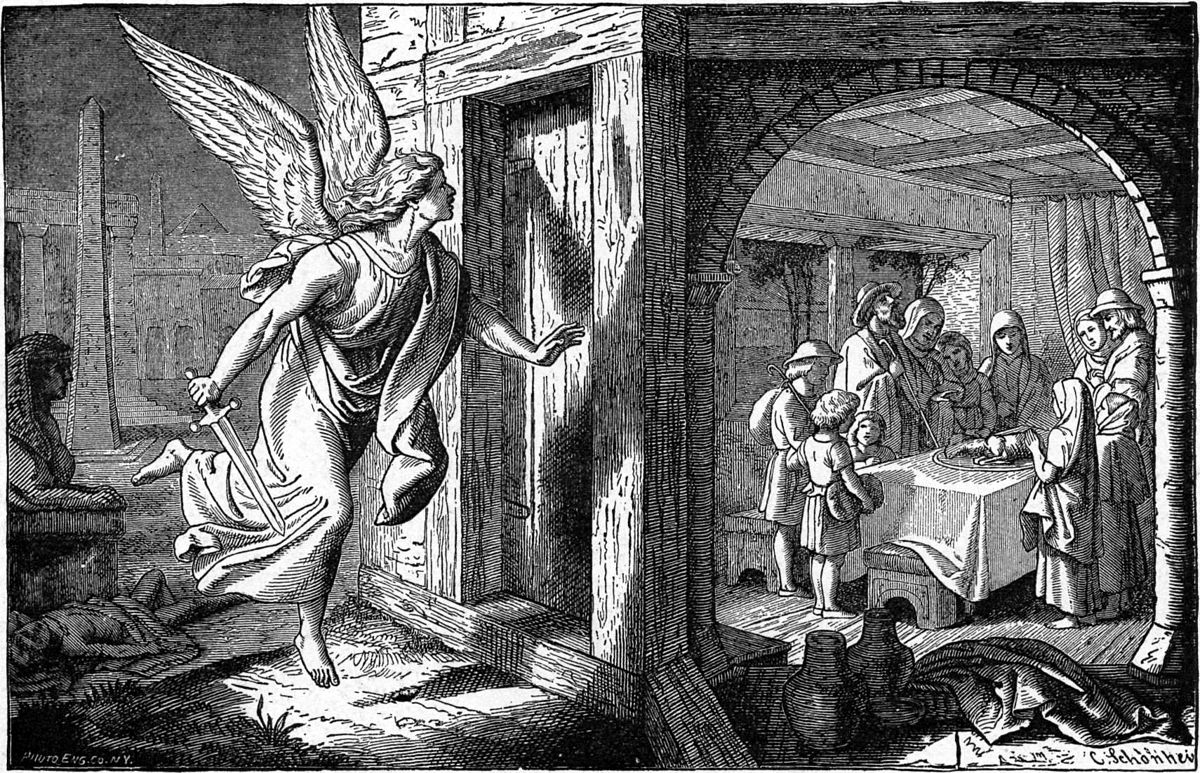
This “destroyer” seems to be a powerful being who is distinct from the Lord. And when Psalm 78 retells the story of the Exodus in poetic form, it identifies this destroyer as not just one angel, but a whole group of angels:
He let loose on them his fierce anger,
     wrath, indignation, and distress,
     a company of destroying angels.
He made a path for his anger;
     he did not spare them from death,
     but gave their lives over to the plague.
He struck all the firstborn in Egypt,
     the first issue of their strength
     in the tents of Ham.
              (Psalm 78:49–51, italics added)
The pestilence on Israel
In 2 Samuel 24, as a punishment for something God himself had incited King David to do, it says:
Therefore the Lord sent a pestilence on Israel from that morning until the appointed time; and seventy thousand of the people died, from Dan to Beer-sheba. (2 Samuel 24:15)
And as we discover if we read on, it was “an angel of the Lord” who did the killing:
But when the angel stretched out his hand toward Jerusalem to destroy it, the Lord relented concerning the evil, and said to the angel who was bringing destruction among the people, “It is enough; now stay your hand.” The angel of the Lord was then by the threshing floor of Araunah the Jebusite. When David saw the angel who was destroying the people . . . . (2 Samuel 24:16–17, italics added)
However, when the same story is told in 1 Chronicles 21, it is not God, but Satan who incites David to act presumptuously (see 1 Chronicles 21:1). That version also adds this dramatic detail:
David looked up and saw the angel of the Lord standing between earth and heaven, and in his hand a drawn sword stretched out over Jerusalem. (1 Chronicles 21:16)
In this story, it is very clear that it is not the Lord, but an “angel,” or messenger, of the Lord who is doing the killing.
The slaughter of the Assyrian army
In 2 Kings 19, when the Assyrian army was threatening the kingdom of Judah and its capital, Jerusalem, King Hezekiah prayed to the Lord for salvation. The Lord answered the king’s prayer in grim fashion:
That very night the angel of the Lord set out and struck down one hundred eighty-five thousand in the camp of the Assyrians; when morning dawned, they were all dead bodies. Then King Sennacherib of Assyria left, went home, and lived at Nineveh. (2 Kings 13:35–36)
Notice that once again that it is an “angel of the Lord” who did the killing.
The angel of the bottomless pit
And in the prophetic final book of the Bible, in Revelation 9:1–12, when an angel of heaven blows the fifth of seven trumpets, an army of strange quasi-scorpion, quasi-human locusts swarms up from the bottomless pit to inflict pain, but not death, on people who do not have God’s seal on their forehead. And, it says:
They have as king over them the angel of the bottomless pit; his name in Hebrew is Abaddon, and in Greek he is called Apollyon. (Revelation 9:12)
Both “Abaddon” and “Apollyon” mean “destruction” or “destroyer.” The Hebrew word “Abaddon” does occur in the Old Testament six times, as a name, not for some fearsome creature, but for the shadowy underworld—“the place of destruction”—where people in ancient Hebrew culture believed they would go after death. See Job 26:6; 28:22; 31:12; Psalm 88:11; Proverbs 15:11; 27:20.
Does God bring death and disaster upon us?
In each one of these stories, although it says that God inflicted pain and death on many thousands of people, it was not actually God, but some sort of “angel” or “messenger” who inflicted that pain and death. It was a so-called “angel of death.”
And as the two different versions of the story of the pestilence on Israel show, the Bible sometimes says that God causes people to do things that are wrong and evil, but in other places it says that it is Satan, not God, who incites people to evil. As another example, if you read the story of the Ten Plagues in Exodus 7–12 very carefully, you will see that although it says a number of times that God hardened Pharaoh’s heart, sometimes it says that Pharaoh hardened his own heart.
So is it God, or Satan, or humankind itself, that brings pain and death upon the people of this earth?
First, it is important to understand that “the Devil” and “Satan” mentioned in the Bible are not some arch-devil. Rather, they are personifications representing the combined force of human evil, otherwise known as “hell.” For more on this, please see:
Is there Really a Devil? Why??
In other words, whether we say it was Satan or humans who bring pain and suffering upon ourselves, it amounts to the same thing. Satan is us when we are bent on selfishness, greed, and evil. This reduces the question to a simpler one:
Is it God, or people, who bring punishment, disaster, and death upon people?
The Bible gives both answers. For example, Isaiah 45:7 says:
I form the light and create darkness,
I bring prosperity and create disaster;
I, the Lord, do all these things.
On the other hand, Jeremiah 2:19 says:
Your wickedness will punish you,
and your backsliding will rebuke you.
And Isaiah 59:1 says:
Evil will slay the wicked.
So which is it? God, or human evil, that punishes and kills us?
People must first believe that God is all-powerful
Let’s return to the passage from Isaiah 45, but include the two verses just before it. These give a hint of why the Bible says that God inflicts punishment, pain, and death upon us. Here is Isaiah 45:5–7:
I am the Lord, and there is no other;
     apart from me there is no God.
I will strengthen you,
     though you have not acknowledged me,
so that from the rising of the sun
     to the place of its setting
people may know there is none besides me.
     I am the Lord, and there is no other.
I form the light and create darkness,
     I bring prosperity and create disaster;
     I, the Lord, do all these things.
Can you see it? The passage is telling us that there is only one God, who is God everywhere and at all times, and who is all powerful—able to bring about both good and evil. This is a God that people should pay attention to. In other words, the main point of the passage is that God is all-powerful, and therefore worthy of our belief, trust, and obedience.
Unfortunately, most of us boneheaded humans wouldn’t pay any attention to God at all if we didn’t think God will be angry with us and punish us if we do things that are evil, selfish, and wrong. In many people’s minds, if God has the power to send us to hell, where we will be in pain and agony forever, that is a God we’d better pay attention to! (But see: “Is There Really a Hell? What is it Like?”)
And so, in order to convey the most important overall idea—that God is all-powerful—the Bible speaks in terms that we humans can understand: It says that God does both good and evil. Here’s how Emanuel Swedenborg (1688–1772) puts it:
In ancient times, for the benefit of simple-minded people, everything bad was attributed God. It was attributed to God because simple-minded people could not have known, and most of them could not have understood, how the things that happened could come from anywhere else but God. They could not have understood the truth that even though God is all-powerful, God permits the devil’s crew to inflict evil, and does not stop them. Since simple-minded people could not have grasped these things, and even intelligent people could hardly have understood them, the Bible said, in accordance with what most people believed, that God was the source even of what was bad or evil. This is a common feature of the Bible, whose literal meaning is adapted to the beliefs of simple-minded people. (Arcana Coelestia #7632)
The reality is that God never does anything evil. Only people, and evil spirits who were once people, do evil. But God allows us to believe that God does evil, and the Bible even says this, because the Bible speaks to us according to our own ways of thinking.
For people who think in a simple-minded way, the main point the Bible makes is that God is all-powerful. Exactly how God does things can come later. Here is Swedenborg again:
The very general outlines of belief must come first, after which they must be filled out with individual truths. This is so with the general piece of knowledge that all things that happen come without exception from God, including the miseries that punishment brings. In what way those miseries come from God has to be learned afterwards, as also do the nature and source of what happens by [divine] tolerance. (Arcana Coelestia #6071:4)
Everything ultimately comes from God . . .
Aha! You say! Miseries and punishments do come from God!
And that is true, in the sense that if we keep peeling away layer after layer, everything comes from God. Jesus even said to Pilate, who was about to send him to be crucified (certainly a very evil deed!), “You would have no power over me if it were not given to you from above” (John 19:11).
Ultimately, there is no other source for everything in the universe, both good and evil, but God. In that simplistic sense, the Bible speaks the truth when it says that God “forms the light and creates darkness,” and God “brings prosperity and creates disaster.” If it were not for the power coming from God, none of these things could happen.
. . . But it is humans, not God, who are responsible for evil
But that’s not the whole story. Let’s bring in one more passage from Swedenborg. He is commenting on this Bible passage, in which the Lord is speaking to Moses:
Then the Lord said to him, “Who gives speech to mortals? Who makes them mute or deaf, seeing or blind? Is it not I, the Lord?” (Exodus 4:11)
Swedenborg says:
“Is it not I, the Lord?” means that these different conditions exist as a result of the life flowing in from the Divine. This becomes clear from the fact that the kinds of conditions that are meant by “the mute,” “the deaf,” and “the blind,” as well as by “mouth” and “those who see,” arise in a person as a result of the life that flows in from the Lord. From that life arise both the bad things and the good things that exist in every single person. Yet the bad ones arise from the people, and the good ones from the Lord.
The reason why the bad things arise from people is that the life—meaning the goodness and truth—that flows in from the Lord is turned by people into evil and falsity, and so into the opposite of life, which is called spiritual death. It is like the light from the sun, which is turned into different colors by the objects receiving it. In some objects it is turned into vivid and lively colors. In others it is turned into dead and dreary ones, so to speak.
Since it appears as though the Lord, being the One who gives life, is also responsible for what is bad, the Bible attributes bad things to Lord. We can see this from many places in the Bible. The same applies here to the Lord making the mute, the deaf, and the blind. Because these conditions come from the life that flows in from the Divine, it is said that the Lord brings them about. But the deeper meaning presents and teaches the true nature of the matter, not the apparent nature of it. (Arcana Coelestia #6991)
In other words, nothing in human society and experience, whether good or bad, could exist if life from God were not continually flowing into it, maintaining its existence from moment to moment. However, it is the people receiving the life from God who turn it from good into evil. Everything that flows from God is good. We humans are the ones who turn it into evil.
If you find this whole line of thinking abstract and hard to wrap your head around, then you can understand why God doesn’t get all technical in the Bible! God just lets people believe what most of them already believe: that God has the power to do both good and evil; that God has the power both to reward us handsomely and to punish us miserably—so it’s a bad idea to do things that will make God mad!
What is a destroying angel?
If all of this makes at least some sense to you, then you should be able to see that it is certainly not God who tortured and killed all those people in the Bible stories. That is the appearance, so that simple-minded people will pay attention to God, and follow God’s commandments. But it is not the reality.
And if God does not visit pain and destruction upon the people of earth, then the angels of heaven, whose minds and hearts are in harmony with God’s mind and heart, would not visit pain and destruction upon people either. They, like God, do only good things for people. That’s because they are children of God, who does good to the evil and the good alike:
But I tell you, love your enemies and pray for those who persecute you, that you may be children of your Father in heaven. He causes his sun to rise on the evil and the good, and sends rain on the righteous and the unrighteous. (Matthew 5:44–45)
If the destroying angels in the Bible are not God, and they’re not the angels of heaven, then who are they? After all, in English, an “angel” means a good and powerful being who lives in heaven.
But that’s not what the Hebrew and Greek words usually translated “angel” mean. They mean “a messenger.” And since these biblical messengers often come from God, people usually think of them as angels of heaven. But as you can see in Matthew 25:41 and Revelation 12:9, the Devil also has “angels,” or messengers.
And that, according to Swedenborg, is exactly what the “destroying angels” in the Bible are. They are not God, nor are they angels of heaven. Rather, they are evil spirits from hell. These are the “angels” or “messengers” who do the Devil’s destructive bidding. But as I said earlier in this article, “the Devil” is really just another name for hell. And hell consists of all the evil people who have ever died and gone to the spiritual world. Once again, please see: “Is there Really a Devil? Why??”
And just as the biblical “angels” or “messengers” could be either a single angel or a whole company of angels, so the “destroying angels” mentioned in the Bible are commonly not just a single evil spirit, but a whole crew of evil spirits acting together as one. (That’s what Swedenborg means by the odd phrase, “the Devil’s crew.”)
However, even though these “destroying angels” actually come from hell, God is still in control of them, and God does not allow them to do any more damage than is absolutely necessary to punish the evil and protect the good. That is why, to simple-minded people, they look like “angels of the Lord,” and the Bible allows people to believe this, for all the reasons discussed earlier.
What is an angel of death?
Now we can answer the original question.
What is an angel of death?
For the benefit of simple-minded people, who would only be confused by all of this complicated stuff, the Bible speaks as if God sends angels of heaven to torture and destroy wicked people.
But in reality, an angel of death is an evil spirit, or an entire phalanx of evil spirits, whom God allows to inflict punishment and death upon wicked people under certain circumstances. Most often, it is to protect good people from harm, as in the story of Pharaoh refusing to release the Israelites from slavery, and the story of the Assyrian army threatening to conquer the kingdom of Judah, and kill or enslave its people (see 2 Kings 19:11).
And notice that in the Bible’s stories of destroying angels, it often mentions that God restrains these messengers of death from killing even more people. The reality behind the appearance of God sending angels of death to torture and destroy is that God does not allow these “evil angels” to do anything more than they absolutely must in order to restrain the evil and protect the innocent.
Why does God allow all of this pain and suffering to happen in the first place? On that ancient and vexed question, please see these articles:
- If God is Love, Why all the Pain and Suffering?
- How does God Govern Humankind? Is God Actively Involved in our Lives?
- How can we have Faith when So Many Bad Things happen to So Many Good People? Part 1
Beautiful and loving angels of death
Yeesh! All of that is awfully grim!
Let’s end on a more positive note. As I said right at the beginning, the Bible never actually mentions “angels of death.” It speaks of “evil angels” and “destroying angels,” but not “angels of death.”
Maybe that’s because the real “angels of death” are not evil spirits at all, but angels of the highest heavens. These are the angels who greet us when it comes our time to pass from this world of darkness and struggle into the higher world of light and love that God prepared for us long before we were born.
Thousands of people who have almost died, but have come back to tell the story, have encountered these wonderful angels. People who have had “near-death experiences” tell us that the angels, or “beings of light,” who greet them at the gateway to the other world fill them with such peacefulness, warmth, and love that words fail to express the beauty of the experience.
These are the true “angels of death.” And they are not evil destroyers, but the highest heavenly angels, whom God sends to gently usher us from our temporary life in this world to our eternal home in heaven.
This article is a response to a spiritual conundrum submitted by a reader.
For further reading:
- Is there Really a Devil? Why??
- How God Speaks in the Bible to Us Boneheads
- If God is Love, Why all the Pain and Suffering?
- Who Are the Angels and How Do They Live?
- Death and Rebirth: Introduction
Share this:


Lee Woofenden is an ordained minister, writer, editor, translator, and teacher. He enjoys taking spiritual insights from the Bible and the writings of Emanuel Swedenborg and putting them into plain English as guides for everyday life.



 Spiritual Insights for Everyday Life
Glad to see you back. You solve a lot of mysteries that bounce around in my head.
Hi ghudsonwilmidconet,
Thanks. Glad you’re finding the articles here helpful. We hope to post a little more often now that we are settled into our new home.
Do 2 Samuel 24:16–17 and 1 Chronicles 21:1 contradict each other?
Hi WorldQuestioner,
I presume you mean 2 Samuel 24:1 and 1 Chronicles 21:1. If you read these verses literally, then yes they do contradict each other.
Didn’t you say 2 Samuel 24:15 and 2 Samuel 24:16-17 in your article? Oops! I meant does 1 Chronicles 21:16 contradict 2 Samuel 24:15-17?
Hi WorldQuestioner,
No. 1 Chronicles 21:16 says the same thing as the second half of 2 Samuel 24:16.
Based on what you’ve said in other articles, the “angel of death” would be a deceased human that has passed into the spiritual world, would it not?
Hi WorldQuestioner,
Yes, or a whole community of spirits. Since they are “angels of death,” they are evil spirits, not angels of heaven as we usually conceive of angels.
Hey Lee I read the above article and the reason you gave for why the bible attributes some evil things to God even though God is not actually the one doing them. I think its a good explanation but not the best, I have some questions about it. You say that people need to believe that God is all powerful and will punish the wicked so that people will pay attention to God, respect God and listen to him. And the bible also says this because it’s simpler to put it that way then by explaining all of the details. But is it really so hard to understand that God will allow evil spirits to hurt people or nations if they do evil? If the bible said that, instead of attributing all these evil things to God himself then people would still have good reason to be afraid of God and listen to him. After all pain is pain, who cares where it’s coming from, if it’s coming from God or the Devil it hurts just the same. So if the bible assigned the evil to where it is actually coming from (the devil and his crew), and said that God would allow them to hurt people who do evil, it would accomplish the same effect as attributing various evil and painful things to God. And if the bible attributed these various evil things to evil spirits instead of God then people would be able to learn something true about God, namely that he doesn’t do evil to anyone. Some of the harsher bible verses concerning God punishing people make some people so terrified of God that they don’t want to have any kind of relationship with him because they are scared to get close to him because they see him like they would see any other violent person. I’ve heard a saying before that “fear of being thrown into hell is a hell all its own”. It just seems to me like all this harm and misunderstanding could be avoided if the bible just said how things really were, because as I already mentioned the truth of the matter would have the same effect as the “God punishing people” verses do, without the harmful side effects of people who don’t need to be terrified of God terrified of God. I hope you can address some of these issues, thanks.
Hi Bob,
I have had similar thoughts. Wouldn’t knowing the truth have the same effect?
But this assumes a sophistication in thinking that many people don’t have. Also, many people, especially in these materialistic days, don’t think that spirits are real. But many people still do believe that God is real.
You’re clearly a thoughtful person who likes to think things out and analyze them. Not everyone is like that. Many people don’t think deeply about things at all. They’re more about doing than thinking. And they think in simplistic ways. How else could so many people believe that the earth is flat when we have overwhelming evidence that it is spherical? Many people hear something that makes sense to them because of the way things appear (“Looks flat to me!”) and that’s as far as they go. They don’t think any more deeply than that.
If that’s so even about material things that people can see and hear, it’s even more true of spiritual things that they can’t see and hear. Many people don’t think spirits are real, or that if they are, they don’t have any influence on us. They’re off in some “spiritual” place far away from us. So the idea that our pain and suffering comes from evil spirits wouldn’t make any sense to them.
These same people, if they believe in God, will believe that God does have a big influence on us and our life. If something bad happens they can easily think, “God is punishing me for what I did.” But they won’t think, “Spirits are punishing me for what I did,” because they don’t think spirits have any real influence our life.
For such people, God being all-powerful for both good and evil is the only idea that will have any effect upon their behavior. For them, fear of God is the only fear in town when it comes to avoiding wrongdoing.
As for people who don’t want to have any relationship with God because they’re afraid of God, that’s why it’s important to get the message of the real truth out there so that it’s available to people who need it.
However, even for people who don’t know the truth, there’s another option: Don’t do bad things! If you avoid doing the things that will make God mad at you, then you don’t have to worry about God punishing you.
In olden days, well-behaved elementary school students didn’t get spanked. Only naughty ones did. Don’t misbehave in class, and you won’t suffer the pain and humiliation of going over the teacher’s knee and getting your bottom spanked in front of the whole class. The teacher is way bigger and stronger than you are. If s/he gets mad at you, there’s nothing you can do about it. So you’d better behave! It was very simple. Every kid in the school knew it.
Just to be clear, I’m not advocating corporal punishment. I’m glad it’s increasingly a thing of the past. But this common classroom scene from decades past provides a good illustration of the old-style simplistic thinking that many people still have even today. Unlike wispy spirits, God is way bigger and more powerful than you are. If you get on God’s bad side, you will have no control over the pain and humiliation God can bring crashing down upon you. So you’d better behave yourself!
Of course, the example presumes that the teacher is fair, and not biased or cruel. As long as people believe that God’s justice is fair, then all they have to do is obey God’s commandments, and they’re good. If they disobey God, that’s on them. It is within their own control whether they put themselves into a position to suffer punishment at God’s hands (as they believe).
So yes, it would be better for people to know the truth. But many people just aren’t going to get it because their way of thinking (or lack of thinking) doesn’t allow it. Simple ideas for simple people.
Meanwhile, for people who are capable of getting it, here and there the Bible does suggest the truth, such as when it says in Psalm 34:21, “Evil will slay the wicked.” Not God, but evil.