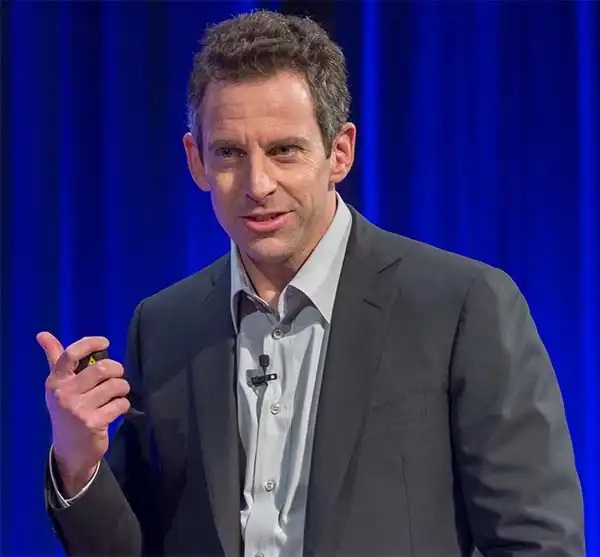
In a recent comment, a reader named K asked me to respond to this article: “Why You Probably Don’t Have Free Will,” by Jack Maden. Here is the article’s opening synopsis: “Neuroscientist and philosopher Sam Harris argues that free will is an illusion. In his view, we are the mere conscious witnesses of decisions that deep in our brains have already been made.”
In particular, K wanted a response to this statement by Sam Harris, as quoted in the article:
These findings are difficult to reconcile with the sense that we are the conscious authors of our actions. One fact now seems indisputable: some moments before you are aware of what you will do next—a time in which you subjectively appear to have complete freedom to behave however you please—your brain has already determined what you will do. You then become conscious of this ‘decision’ and believe that you are in the process of making it.
Here is my brief response to this statement, edited from a reply to K that I posted here:
The basic error in this quote is the idea that we make decisions with our “brain,” meaning our thinking mind. The reality is that we make decisions in our “heart,” meaning our love/emotional self, and then our thinking mind confirms and supports the decision we have already made in our heart. That’s what’s really going on in the phenomenon that Sam Harris is describing.
However, Western intellectuals such as Harris generally can’t see or understand this because they are trained to think that human intellect is primary, when in reality love and emotion is primary, and intellect is secondary, following what love tells it to think and do. Their fundamental misunderstanding of how the human psyche works leads them into all sorts of errors, including the denial of human free will.
Ordinary people who make decisions every day understand human reality better that these so-called “rational” intellectuals.
The rest of this article is an edited and expanded version of a longer follow-up comment that I posted here, after reading the article itself.
Atheists and Calvinists
Harris is the atheist equivalent of a Calvinist predestinarian. He contorts himself into positions just as unnatural philosophically as Calvinists do theologically, all in an effort to say that there is no free will, but you’re still responsible for your actions and you should still make good choices, but then again, you’re really not responsible for your actions because it’s all predetermined—in Harris’s mind by genetics; in Calvinists’ minds by God. Here is the resulting philosophical gobbledygook from the linked article:
But it’s important not to mix determinism—the view that all events are completely determined by pre-existing causes—with fatalism, the view that we are powerless in the face of ‘destiny’.
Our choices matter. What we decide to do shapes the paths we take in life. The point is that we cannot decide what we will decide to do. As Harris summarizes:
You can change your life, and yourself, through effort and discipline—but you have whatever capacity for effort and discipline you have in this moment, and not a scintilla more (or less). You are either lucky in this department or you aren’t—and you cannot make your own luck.
Yes, according to both Harris and Calvinists we both do and don’t have the ability to change our life. We must make choices, and our choices do change the course of our life, but we aren’t really making choices at all because free will is an illusion, and the choices have already been made for us by our brain, or by God.
Harris may think he’s being scientific and rational, and that he has gone beyond the irrational and unscientific theists that he ridicules. But really, he is just rehashing the same old irrational, self-contradictory arguments that Calvinists have been making for almost five centuries now. These arguments make no more sense coming out of the mouth of an atheist than they do coming out of the mouth of a Calvinist.
Once again, ordinary folks who make choices every day are smarter about these things than “smart” people like Harris and Jack Maden, the author of the article, who tie themselves in hopeless self-contradictory Gordian knots on issues that are beyond their materialistic scope and ken.
Oh, and speaking of atheists who think they’re smart and everyone who believes in God is stupid, please see:
God Is Unconvincing To Smart Folks? – Part 1
Current science no longer supports determinism
Harris’s view that there is no such thing as free will because everything is predetermined is not only part of the old Newtonian scientific paradigm, but leads to absurdities such as the idea that the Mona Lisa was predetermined and inevitable at the time of the Big Bang. On these subjects, please see:
God: Puppetmaster or Manager of the Universe?
Science itself no longer posits or even supports the sort of strict determinism that would be necessary for Harris’s rejection of free will to have a sound scientific basis.
Trivial vs. major decisions
The neuroscience experiments that Harris and the article cite are all about relatively trivial choices that don’t have much impact on a person’s life, such as whether to eat beef or lamb for supper tonight. The big, determinative choices in life are nowhere near so simple.
The big choices in our lives usually happen when we are under extreme weight and pressure of one sort or another, to the point that our life seems to be spinning out of control. The Christian term for this is “temptation.” Spiritual temptation is not about whether or not to eat one too many cookies. It’s about whether to give up in despair and allow our life to go to ruin, or whether to do the hard work of moving forward with integrity even when there seems to be no benefit in it to ourselves. These choices cannot be reduced to milliseconds of cortical activity before we become conscious of the choice we have made. These are decisions we agonize over, go back and forth about, backslide and then press ourselves forward again. No analysis of neural activity will throw any light on these big, life-changing choices that determine whether our life will go down to ruin or up to better things.
Our day-to-day decisions about what to eat and what to wear flow from the “ruling” or predominant love, and the subordinate loves, that we have put at the center of our soul, and surrounding it, through these big choices in life.
I do think we have free choice even in what we will eat for dinner tonight. I do not think these choices are just an illusion, no matter what neuroscience says about neural firings in the brain that seem to precede our choices. Correlation does not equal causation.
But as I said above in my initial short reaction to the Sam Harris quote, our conscious, thinking mind is not where we make our choices. Rather, we make them in our heart, and then they are communicated to our thinking mind. We are the ones who decide and have decided what our ruling love will be. We put that ruling love in place as the ruler of our life, and then proceed to make choices based on it, which our thinking mind then apprehends, supports, and carries out. The big choices have already been made before these little choices are made. And realistically, many of our little moment-to-moment choices are made on autopilot.
However, even when it comes to food, we decide upon a dietary plan of one sort or another, and then proceed to carry out that plan. Eating beef or lamb may be just one of the small choices made in our unconscious mind, not requiring much of our conscious thinking and effort, pursuant to the bigger choice we have made about our plan and guidelines for feeding ourselves.
The four basic loves
But our biggest choice in life is what sort of love we will put at the center of our life. And the basic choices of what to put there are:
- Love for God
- Love for our fellow human beings
- Love for material possessions and pleasures
- Self-love
All of these loves are good and healthy if we keep them in the proper order, as listed here. But if we put love for ourselves or love for material possessions and pleasures ahead of love for God and/or our fellow human beings, then our life will go on a downward trajectory spiritually—and probably materially also in the long run.
Whatever we place in the center of our soul as our “ruling love,” that’s what will determine the shape of our whole life: our heart, our thinking mind, and our actions. That is the biggest and most important choice we make in life. And no amount of neural firings can make that choice for us.
In the most important matters of spiritual life and death, we very much do have free will. Everything else is a lesser form of free will. Even if some of our day-to-day choices may be automatic and not matters of conscious choice and control, as Harris believes, the fundamental free will to determine the overall shape and direction of our life remains. That fundamental choice is where all the rest of our choices flow from.
Materialist vs. spiritual views of humanity
Beyond that, materialist viewpoints do tend to lead people to a denial of our free will, and of our humanity along with it. It leads people to believe that we are simply animals with bigger brains that make it possible for us to have a self-conscious awareness of our actions, unlike lower animals. Take away the spiritual realm, and it’s hard to argue against this view. (Though as I said above, current science simply doesn’t support the type of strict, Newtonian-style determinism that Harris apparently espouses.)
Once we recognize that humans are not purely material beings, and that there is a part of a human being that exists beyond the physical brain, Harris’s views become even more foolish and irrational. Not only do ordinary people know that intellectual big-shots like Harris are full of . . . manure, but once we add in the spiritual dimension, Harris’s views become hopelessly narrow and small-minded.
Once we recognize that our consciousness is not physical, located in the material brain, but is spiritual, located in our spiritual mind, then neuroscience, while still telling us interesting things about how the human physical body functions, ceases to give us sound conclusions about how human thought, emotion, love, ideas, decisions, and so on, work. From a spiritual point of view, none of our decisions are made in our physical brain. All of them are made in our spirit, and are then communicated to our brain, which proceeds to instruct our body to carry them out.
Unfortunately, most people these days are not very spiritual, and not very self-reflective. Many people make their “choices” by default, allowing themselves to be led along by their desires without consciously taking charge of those desires.
Our original fall from spiritual life
This goes back to a theme present in the opening chapters of the Bible. When God first made humans on earth, God told them:
Be fruitful and multiply and fill the earth and subdue it and have dominion over the fish of the sea and over the birds of the air and over every living thing that moves upon the earth. (Genesis 1:28)
In the spiritual sense, having dominion over the rest of Creation means attending to our own thoughts and feelings, represented by fish, birds, and other animals, and directing them from our higher spiritual self, which is represented in the Bible story by “Adam,” which is a Hebrew word meaning “humankind.”
Unfortunately, we quickly failed to follow God’s directions on this point. In Genesis 3, Eve, then Adam, allowed their outward senses—represented by the serpent, and by Eve seeing the tree of knowledge of good and evil as “a delight to the eyes” (Genesis 3:6)—to direct their actions rather than having their actions directed by their inner spiritual self and their connection with God, represented by the tree of life, and by God walking with them in the garden. As a result, they fell into “slavery to sin,” as Jesus terms it much later in the New Testament (see John 8:34).
Our slavery is self-imposed
By definition, being a slave means not being free. In allowing ourselves to be led by our physical senses and desires, we do indeed abdicate our true, spiritual human free will, and become “slaves”—or Harris’s predetermined beings. If Harris is talking about materialists such as himself, of which there are many, then his arguments do have some merit. Such people have the human ability to be spiritually free, but they are not using it to best effect.
However, to people who have made the choice not to be led by outward, physical things, but by spiritual things and by God, Harris’s arguments are mere chaff that the wind drives away (see Psalm 1). The wheat of free will is in our spiritual self, not in our physical body and brain. But since Harris believes that our physical body and brain is the sum total of who we are, he easily falls into an irrational denial of the free will that we all experience every day.
So let Harris think that free will is an illusion. His spirit is still making choices about what he wants to believe, what he loves most, and how he wants to live. His spirit is still communicating those choices to his physical brain, which then marshals and orders his physical body to execute them.
What awaits Harris in the spiritual world?
Here’s where I’m supposed to breathe out dire threats that when Harris dies and stands before God’s judgment seat, God will judge him to eternal torture in hell because he rejected God and religion.
But that’s not at all what will happen.
When, much to their surprise, Harris and his fellow atheists find themselves very much alive in the spiritual world after their physical death, the angels who receive them will know just how spiritually foolish they have been. But those angels will still welcome them into the spiritual world, love them, answer all their bewildered questions, and care for all their needs.
In particular, when Harris finds himself in the spiritual world after his death, the angels who receive him will look for the good in his heart, hoping that it will be enough for him to recognize just how ignorant and foolish he has been on spiritual subjects, all the while thinking of himself as so much smarter than all those irrational and superstitious people who believe in God and heaven.
If, underneath all the bluster, he does have a good heart, then he, too, will accept the truth about God, spirit, and human free will that you and I have known in our heart all along.
Then Sam Harris will find his place in heaven, where he can continue to study, write, and speak on the subjects he is smart about.
For further reading:
- Do Atheists Go to Heaven?
- What Happens To Us When We Die?
- God Is Unconvincing To Smart Folks? – Part 1
- God: Puppetmaster or Manager of the Universe?
- If God Already Knows What We’re Going to Do, How Can We Have Free Will?
Share this:


Lee Woofenden is an ordained minister, writer, editor, translator, and teacher. He enjoys taking spiritual insights from the Bible and the writings of Emanuel Swedenborg and putting them into plain English as guides for everyday life.


 Spiritual Insights for Everyday Life
Lee, you’ve got to stop with this gibberish. Nothing of what you say makes the slightest bit of sense in view of the facts of neuroscience.
You are free to make wild speculations about supernatural inventions, but in the realm of the reality that we humans with our consciousness reside in, you’re also going to hear back that these religious claims go nowhere.
Hi notabilia,
Thanks for stopping by, and for your comment. I understand that these are your opinions, and the opinions of Sam Harris, who is an excellent neuroscientist, but a terrible theologian.
Harris’s belief that there is no God causes him to jump to all sorts of conclusions about God, spirit, and the human psyche, which he then calls “facts.” But most of it is just opinion and speculation. This is what regularly happens when scientists elevate themselves to expert status on spiritual subjects, which is not their area of expertise.
As for gibberish, I don’t think anything could top the gibberish in the second quotation from the linked article, and from Harris, in the above post. We both do make choices and don’t make choices. We must make choices, but they’re not really choices. Sounds like gibberish to me!
We’re in agreement on Sam Harris – whatever value he had as a thinker in the beginning, he’s now an Intellectual Dark Web guru ripe for dismissal.
Consciousness is not an easy problem to solve as to its origins and nature, so we can keep forging ahead with contradictions and dead-ends abounding. But when you’re using terms like “angels” and “heaven,” you’re not really in the modern conversation.
Hi notabilia,
I wouldn’t go quite that far on Sam Harris. He still has some interesting things to say. But I do tend to think that the fame related to his public stance on atheism has gone to his head a bit too much. It is unfortunate that what he’s famous for is not his intellectual forte.
Yes, consciousness is a hard problem from a position of materialism and pure science. I, for one, do not believe it will ever be solved from that perspective. However, it does challenge scientists to keep moving forward in their knowledge of the human brain and mind. Even from a spiritual perspective, consciousness is a complex phenomenon, not easily reducible to simple formulas.
Of course “angels” and “heaven” are not part of the modern materialistic conversation, except to dismiss them out of hand. But that is not the only conversation being had in the modern world. This is a spiritual blog, meaning that angels and heaven are very much a part of the conversation here. See:
Where is the Proof of the Afterlife?
I got the feeling from reading Sam’s quote, that perhaps he was talking about the time interval, nano-seconds, between the time our brain makes a decision and the time it takes for our neuro-muscular system to react? However, the statement that our brain has already made the decision, resulting in the absence of free-will, is absurd simply because it ignores our ability to change our minds. Discussions about free-will, often revolve around how that concept is defined and it seems to be abstract. Lastly, and as a matter separate from Sam’s quotation, I cannot relate to Lee’s statement, ” . . . when scientists elevate themselves to expert status on spiritual subjects, which is not their area of expertise”. I think either everyone is an expert in “spiritual subjects” or no one is. “The world is awash in expert opinions regarding matters of uncertainty, especially those that concern religion and spirituality”. hk The unknown is the genesis of all religions, spiritual reckoning, and a great number of philosophical type beliefs and discussions; the ground is fertile for both misconception and deception.
Hi Hoyle,
No matter how various atheists and materialistic scientists attempt to deny free will, our common experience of “changing our mind,” as you say, will cause the vast bulk of people to reject the rejection of free will.
However, I think that the intent of the Sam Harris quote is that the decision is made before we become consciously aware of the decision, not before our neuro-muscular system reacts to the decision. He’s basically saying that “we” don’t make the decision at all; our brain makes the decision, and then “we” (meaning our conscious mind) become conscious of it. I discussed this in the article, so there’s no need to respond to it further here.
Why, in your view, is spiritual knowledge uniquely unaffected by the general rule that people who study a subject intensively, and especially people who are engaged in the practical application of the knowledge in that subject area, know more about that subject area than people who don’t study and apply knowledge in that subject area?
Would you say that all people are equally expert on automotive technology or heart surgery or animal husbandry? That it doesn’t matter that some people have studied and worked in these areas all their lives, while others have only dabbled in them? Should we just ignore automotive designers and heart surgeons and ranchers, and consult any old person for knowledge about their areas of expertise?
And would you say that the unknown is the genesis of all these areas of knowledge? That we really can’t know anything about them, so we just come up with our own theories, of which one is just as good as another? Perhaps we should put ranchers to work designing automobiles, and automotive designers to work running cattle? Because it’s all based on ignorance anyway, so what difference does it make?
The whole idea is absurd.
Understanding the concepts that form the various religions requires study. Spirituality only requires a certain internal awareness and is unique to every individual. ” . . the recognition of a feeling or sense or belief that there is something greater than myself, something more to being human than the sensory experience . . . ” Dr. Maya Spencer. Spirituality is abstract. It’s not possible to “study” and put into words individually experienced abstract awareness for to do so would take it out of the realm of being abstract. Granted, there are those who study how an abstract concept might be explained in the sensory world, but the “internal awareness” of spirituality is beyond the abilities of mortal man to put it into words; “a feeling or sense or belief . . .” As I’ve mentioned in some of my earlier comments, those on Earth who claim to be experts on spiritual and religious matters will be just another person in line to move through the “Pearly Gates”.
Hi Hoyle,
And yet, people have been describing their spiritual experiences in words for thousands of years. This is the basis of the great religious texts of humankind. Words can’t do full justice to the original experience. But they can convey some reflection of it, as in a mirror.
Spirituality and spiritual experience are not abstract any more than materiality and material experience are abstract. People who have spiritual experiences commonly say that they are not wispy and abstract at all, but are much more real than experiences in the material world.
Also, having spiritual experiences is not the same as understanding spiritual experiences. Billions of people experience rainbows. Most of them cannot explain the science behind a rainbow. It is true that people can and do have spiritual experiences without any significant spiritual understanding. But when they want to understand what they have experienced, they will turn to people who have studied and understood the nature of God and spirit.
I feel there should be a distinction made between the conscious and sub-conscious thought processes. As Dr Joseph Murphy claimed, our subconscious is susceptible to our conscious thought processes. Our conscious thought processes in the main, are influenced by our emotions. Even factual, logical information is filtered through our subjective, emotive and experiential lenses. These elements filter through to our subconscious. So even our decision-making at this level is influenced by our emotions (heart thinking). What we feed into our executive or subconscious functioning is indeed “choice”. There is never “nobody” at the controls.
Hi leeannemeredith,
Thanks for this. I couldn’t have said it better myself.
Could you kindly supply a picture of this “somebody” you say is “at the controls”?
I assume, if you can provide me with this picture or photo, this would be the famous homunculus residing in the brain that author-scientist Robert Sapolsky asks for, and never gets.
The heart does not “think,” of course. And what we “feed into” our tumultuous subconscious is highly dependent on the environments we fall into, the worlds we inherit. “Choice”? Perhaps as a necessary illusion, and that will have to do.
Although I never mentioned a “somebody” at the controls, I had hoped to make clear the notion of free will in our decision making processes and the clear involvement of heart/mind/emotion in our actions. Whilst the heart is not a thinking brain, it’s very closely interlinked with our neurogical processes. There’s a simplified explanation at this link:
https://www.drlamcoaching.com/nem-therapy/cardionomic/the-heart-brain-system/
Hi leeannemeredith,
In support of what you’re saying, here are a couple of sections from Swedenborg. The first one is part of a conversation Swedenborg had with some angels in heaven about the nature of spiritual marriage. I’ve extracted out the relevant part, in which he is recounting what the angels told him:
In short, our soul and mind do not act only in our brain, but in our whole body at once. This, of course, includes the heart, or the seat of our emotions.
Related to that, here is a fascinating passage about the relationship between love and wisdom in us. To summarize it in more contemporary language, Swedenborg notes that people commonly think it is our thinking mind that makes us who and what we are, but really it is our love and emotion that make us who and what we are; our thinking mind follows their lead. Here it is:
“It’s better to be lost and know it than it is to be on the wrong path thinking you are right”. hk
I wrote this quote while thinking about those who follow, profess, and advocate a particular spiritual/religious pathway as if they were correct. I am truly flabbergasted when I consider that some of these same people have convinced themselves they speak for God by interpreting his motives, conduct, and word as if they were God themselves; Swedenborg comes to mind.
Swedenborg’s attempts to take abstract concepts such as love, soul, spirit, the human mind, wisdom, angels, free will, etc., and then connect them to God in concrete terms, is absurd. His explanation for the timing of the Incarnation is illogical, as I’ve penned previously. Swedenborg can only speak for himself. Deceivingly, his intellect, mostly logical arguments, self-righteousness, and superb writing abilities have convinced many of his “correctness” including himself. It would be refreshing sometimes to hear these “enlightenment experts” simply say, “I don’t know”.
I believe in a “Creating Life Force” to justify my own existence. Beyond that, I really don’t know any of the particulars After much internal struggle .earlier in my life, I find it rather peaceful to admit and accept that the vast majority of existential questions will and perhaps should remain unanswerable.
Hi Hoyle,
Your opinion on these subjects is duly noted.
Hi notabilia,
If you think of consciousness in physical terms, you will never understand it. And you’ll deny free will, too, even though you exercise it every day. These are the absurdities that inevitably accompany materialistic thinking about spiritual things.
What about slave to sin?
Is it Biblical to say “I’m no longer a slave to sin; I am a child of God”? That’s lyrics of some song.
Hi WorldQuestioner,
This is based especially on Jesus’ statement in John 8:31–36:
See also Romans 6:15–23.
If given the choice to have a genius IQ and amazing intellectual capacity or the love, dependence, and trust of a child in my heart guiding my choices, decisions, and actions, I choose to be a little child of Jesus, my Creator, my Master, my Savior, the King of the Universe.
Hi Joe,
Beautiful thoughts. Thank you.
no free will in the bible. As soon as this supposed omnipotent being interferes with human action, free will dies. And when it murders people, they have no free will at all.
Per both Jesus and Paul, this god has already chosen who it will allow to believe in it and then damns the rest for no reason. You might not like your fellow christians who claim this, but alas your claims have no more evidence than theirs do.
Hi clubschadenfreude,
Thanks for stopping by, and for your comment.
It fascinates me that atheists read the Bible in exactly the same way that fundamentalist and evangelical Christians do, only the fundamentalists and evangelicals accept it, whereas atheists reject it. One day I’m going to have to write an article about this fascinating phenomenon.
The Bible is a complex book that, if taken entirely literally, contains all sorts of inconsistencies and contradictions, not to mention scientific impossibilities. But the Bible never actually says that it is meant to be taken literally. Jesus, especially, was a master of metaphor and parable.
Today’s heavy, committed biblical literalism among a significant segment Christians only goes back a couple hundred years. Ironically, it arose only after the Age of Enlightenment, and the scientific revolution that followed in its wake, began to raise questions about the historical and scientific accuracy of the Bible. But the Bible was never intended to be a historical and scientific textbook in the first place. See:
Can We Really Believe the Bible?
The Bible certainly does present humans as having free will, even if some verses, read out of context and without any real understanding, seem to say the opposite. For example, in the Old Testament, God says to the Israelites:
And in the New Testament, the post-resurrection Jesus says:
Obviously, these statements have no meaning if humans do not have free will.
Both Jesus and Paul say that people will be saved or damned based on their actions. See Matthew 25:31–46 and Romans 2:1–16. It is very clear from these passages that this applies to all people, not just to Christians. Over the centuries the so-called “Christian Church” has replaced what the Bible actually says with all sorts of doctrines made up by various human theologians and councils. See:
The Christian Church is Not Christian
And about human free will vs. God’s omniscience, see:
If God Already Knows What We’re Going to Do, How Can We Have Free Will?
It is common for chrsitians attack each other and to claim that they and only they have the “Right” answer. Unfortunately, not one christian can show this to be the case.
I read the bible as it is written, with no presuppositions I must fit in like all Christians do. Unsurprisingly, christians can’t agree on what their bible “really means”, so you have a problem when you try to insist that yours is the only way. It also shows your god to be quite incompetent for not being able to make itself understood.
Christians all disagree on what parts of the bible are to be taken literally, as metaphor, as “exaggeration”, etc. How is one ot know which of you have the right version, Lee? Not one of you self-proclaimed christians can do what Jesus promised to his true followers, so it seems you have quite a problem in that too.
That is quite false about Jesus and paul since neither say it is by their actions in Matthew 13 or Romans 9.
You claim that there is free will in the bible, and I’m supposedly taking things out of context and don’t have a “real understanding”. Christians do love to claim these things, and don’t support their claims. What is this context that I have wrong? and again, do show how I should know that only you have the “real” understanding.
Every christian claims what you do, Lee, and they contradict your claims.
IF this god has put in place everything, as christians claim, then nope, no free will, since it knows what will happen and has not changed its mind in its parameters. It isn’t simply a problem of knowing.
Oh and do show how there is free will when this god of yours kills David’s son. Where is the child’s free will when an omnipotent being kills him?
Hi clubschadenfreude,
Except for your last paragraph, this is all generalities and standard atheist talking points.
I quoted you two passages from the Bible that clearly demonstrate that free will is in the Bible. Did you read them? Did you respond to them? Did you attempt to show that these passages don’t involve free will?
None of the above. You just ignored them, and parroted your original atheist talking point about there being no free will in the Bible. But really, it is a Calvinist talking point, because for several centuries now Calvinists have been making the very same arguments against free will, based on their very selective and faulty reading of the Bible. As I said previously, atheists—and specifically you—read the Bible the same way that fundamentalist and evangelical Christians do, only you reject what you derive by reading it that way instead of accepting it.
I linked you to two passages in which Jesus and Paul specifically say that we will go to eternal life or eternal damnation based on our actions. Since you don’t seem to have read them, but once again just went back to parroting standard atheist talking points, here is a section from the Romans passage:
Here Paul says very clearly that people will receive glory, honor, and immortality if they have done good deeds, but affliction and distress if they have done evil deeds. And he says very clearly that this applies to people of different religions (Jews and “Greeks,” or pagan polytheists), not only to Christians.
Did you consider this passage, and attempt to show that it doesn’t say we will be judged according to what we have done, and that it doesn’t mean both Christians and non-Christians can be saved? No. You just fell back on standard generalities and atheist talking points. But really, you’re making the same arguments that Protestants make. You read the Bible the same way that fundamentalist and evangelical Christians do, only you reject what you derive by reading it that way instead of accepting it.
In fact, all of your arguments so far are based on a fundamentalist and evangelical reading of the Bible. This, once again, is quite fascinating. You’re not really making any new arguments. You’re just reversing the arguments that literalist Christians make.
For example, you say:
This is precisely how fundamentalist and evangelical Christians argue for their stance that the Bible must be taken in a thoroughly literal manner. So it is clear that this statement of yours is not correct:
You do have at least one presupposition, which is that the Bible is to be read literally, not metaphorically, just like some Christians do. You have accepted a particular Christian reading of the Bible, to the exclusion of others. In this, you are no different than the Christians you criticize.
How can you justify having adopted the particular way of reading the Bible that fundamentalist and evangelical Christians have adopted? Really, you’ve just uncritically accepted a particular Christian approach to the Bible, and used it to reject the Bible instead of accepting at as those Christians do. Your arguments are just warmed-over and reversed Christian arguments. Everything you’re saying is reactionary. You’re not thinking for yourself at all.
I challenge you to find a single verse or passage in the Bible itself that says we must take everything it says literally.
I know you can’t produce any such passage, because for several decades now I’ve been making this same challenge to fundamentalist Christians, who think the same way you do about the Bible. None of them has ever been able to produce such a verse or passage.
If anything, the Bible, especially the New Testament, is full of suggestions that we should not read everything it says literally. Here are just a few examples:
Psalm 78 opens with these words:
Give ear, O my people, to my teaching;
    incline your ears to the words of my mouth.
I will open my mouth in a parable;
    I will utter dark sayings from of old,
                                 (Psalm 78:1–2)
What follows after this is a poetically expressed history of the Israelites from patriarchal times to the settlement in the Holy Land. And yet, this is all referred to as a “parable,” and as “dark sayings from of old.” How is a historical recounting of the Israelites and their relationship with God a “parable” and a “dark saying from of old”? Your literalist and fundamentalist viewpoint fails to answer this question.
Moving to the New Testament, it is said of Jesus:
And indeed, the bulk of Jesus’ public teaching in the Gospels is in the form of parables, which are obviously not meant to be taken literally. In John 6, after goading his listeners with provocative statements about the necessity of eating his flesh and drinking his blood, thus driving away a number of erstwhile followers, Jesus makes it clear that he was not speaking literally:
Jesus has just told his listeners that they must eat his flesh. Now he is saying that the flesh is useless, and that it is the spirit that gives life. Clearly his words about eating his flesh are meant to be taken metaphorically and spiritually, not literally. For more on this, see:
Eat My Flesh, Drink My Blood
And one more for now. Paul says:
Paul could hardly have been clearer that we are not meant to take everything in Scripture literally, but spiritually.
What is your response to all this? How do you justify, from the Bible itself, not from the beliefs of the fundamentalist and evangelical Christians that you have adopted, that we must take the Bible literally throughout? Where does the Bible itself say that we must read it literally?
Really, you have just internalized fundamentalist and evangelical Christian dogmas, and then rejected them. It has nothing to do with what the Bible says, because the key evangelical and fundamentalist beliefs and doctrines are stated nowhere in the Bible. We know the historical origins of all of them in the long and sordid history of institutional Christianity. Even the oldest of these unbiblical doctrines, the Trinity of Persons, still originated and was codified several centuries after the last books of the Bible were written.
You lazily say that all Christians just fight with one another, and none can demonstrate their claims. This is not true. The Bible says specific things. It either says something or it doesn’t. In particular:
If you don’t believe me, then please show me the passages where the Bible says any of these things. Vague generalities and platitudes won’t cut it. The Bible either does or doesn’t teach these things. If it does teach them, you will be able to show me the passages where it does.
But I know you cannot show me any such passages, because once again, for several decades now I’ve been challenging Protestants (and for the first two, Catholics) to show me any passages in the Bible that say any of these things. None has ever been able to produce a single passage. Oh, they’ll quote and cite passages. But when you read them, they don’t actually say what these Protestants and Catholics claim they say.
Don’t give me your vague generalities. Show me from the Bible itself where it teaches all these conflicting things that various Christians claim are taught by the Bible. You reference Matthew 13 and Romans 9 as saying this or that, but you don’t show any particular verses that say what you claim is there. Your arguments are nearly identical to the arguments I have been hearing from traditional Christians for decades, except you reverse them.
You’re not thinking for yourself. You’re just reacting against traditional Christians’ faulty beliefs. I suspect that you grew up in a fundamentalist or evangelical household and church, and that’s why you’re so butt-hurt about all this. If so, I can’t say I blame you. But you’ve got to break away from the stranglehold those false and destructive beliefs have gotten on your mind. You’ve got to get out of reactionary mode, and start thinking for yourself.
Today, scientists argue about many things related to the nature of the physical universe. To use just one example, in the field of cosmology one of the big questions is whether there is life elsewhere in the universe. Scientists are sharply divided on this point. Some believe it is quite common. Others believe it is quite rare. Still others believe it is unique to earth. And they have big debates about it.
Does all of this disagreement and debate mean that it’s impossible to know whether there is life elsewhere in the universe? Should we just throw up our hands say that there are no answers? That there is no truth?
That is not what scientists do. Instead, they spend billions of dollars and millions of hours designing ever more sophisticated telescopes, robotic probes, and scientific instruments in an attempt to get better answers on this big question. They don’t say “no one can know, and one opinion is just as good (or bad) as the other.” No. They do the hard work of searching and researching, refining their theories, eliminating ones that the evidence has disproven, and attempting to strengthen or disprove theories that are still standing.
Like the evangelical and fundamentalist Christians whose beliefs about the Bible you have been infected by, you attempt to make the Bible a simple, black-and-white text whose entire meaning is obvious on the surface. And obviously that meaning conforms to your particular beliefs, which happen to be fundamentalist reactionary atheist. How are you any different from those Christians? Vague generalities and standard atheist talking points won’t get you any farther than scientists would get if they just stood around arguing without doing the hard and painstaking work of investigating the nature of the universe to gain a clearer knowledge of the answers that it holds to their big questions.
You can stand around shouting your generalities while swallowing whole the boneheaded beliefs of the evangelicals and fundamentalists about the Bible, as you have been doing so far.
Or you can do the hard work of engaging with the text of the Bible, paying close attention to what it does and doesn’t say, and learning with precision what it teaches and what its message is.
Your choice.
Yep. They are common atheist points, and unsurprisingly, Christians still have no rebuttals to them.
There is no free will with a god that will torture you eternally if you don’t obey it. That is not a choice. The verse from Deut 30 does get close but in the context of your bible, it doesn’t work since this god repeatedly interferes with human activity and mind controls people so this god has an excuse for killing them. Christians love to claim “context!” except when it doesn’t work for their baseless claims.
The verse from Revelation has nothing to do with free will ,since your jesus has already established that this god does not accept everyone and intentionally keeps the supposed “truth” from them, in Matthew 16, etc. There’s quite a long list of verses that support predestination https://www.openbible.info/topics/predestination and that is why there are Calvinists. Funny how your god hasn’t come down and said they are wrong. Unfortunately for you, Jesus has long earlier claimed that he won’t be knocking on everyone’s door.
Unsurprisingly, you Christians don’t agree on the most basic things, and yep, you are all frauds in your claims that your particular version of this cult is the only right one. Yep, you hate Calvinists and they hate you, and you are all quite the circular firing squad, with each Christian claiming the next is wrong.
You then claim that yet again, only your way to read the bible is right, and alas, you can’t do what jesus promised just like the rest. Why is that, Lee? How can I tell which TrueChristian™ is the right one?
Why should I accept baseless nonsense that even self-proclaimed Christians can’t agree on?
Yep, you gave yet more verses and these contradict the ones I mentioned. How problematic for you.
As paul and jesus both said, we don’t go to our afterlife based on our actions. Paul is the source of the silly sola gratia nonsense that Christians claim is true.
Yep, Paul claims this “6 He will repay according to each one’s deeds: 7 to those who by patiently doing good seek for glory and honor and immortality, he will give eternal life, 8 while for those who are self-seeking and who obey not the truth but injustice, there will be wrath and fury. “
and then funny how he also claims this: “16 So it depends not on human will or exertion but on God who shows mercy. 17 For the scripture says to Pharaoh, “I have raised you up for this very purpose, that I may show my power in you and that my name may be proclaimed in all the earth.” 18 So then he has mercy on whomever he chooses, and he hardens the heart of whomever he chooses.” Romans 9
And yep, in Matthew 25, this jesus claims that it depends on actions, and funny how he claims otherwise earlier in Matthew: “” 10 Then the disciples came and asked him, “Why do you speak to them in parables?” 11 He answered, “To you it has been given to know the secrets[b] of the kingdom of heaven, but to them it has not been given. 12 For to those who have, more will be given, and they will have an abundance, but from those who have nothing, even what they have will be taken away. 13 The reason I speak to them in parables is that ‘seeing they do not perceive, and hearing they do not listen, nor do they understand.’ “ Matthew 13.
and here: “You did not choose me, but I chose you and appointed you that you should go and bear fruit and that your fruit should abide, so that whatever you ask the Father in my name, he may give it to you.” John 15
And Here: “No one can come to me unless the Father who sent me draws him. And I will raise him up on the last day.” John 6
And other bits “And all who dwell on earth will worship it, everyone whose name has not been written before the foundation of the world in the book of life of the Lamb who was slain.” Revelation 13
“And when the Gentiles heard this, they began rejoicing and glorifying the word of the Lord, and as many as were appointed to eternal life believed.” Acts 13
“In him we have obtained an inheritance, having been predestined according to the purpose of him who works all things according to the counsel of his will, so that we who were the first to hope in Christ might be to the praise of his glory.” Ephesians 1
“15 But when he who had set me apart before I was born,[d] and who called me by his grace, 16 was pleased to reveal his Son to[e] me, in order that I might preach him among the Gentiles, I did not immediately consult with anyone;[f] 17 nor did I go up to Jerusalem to those who were apostles before me, but I went away into Arabia, and returned again to Damascus.” Galatians 1
You have yet to show that the passage from Romans isn’t about no works needed. Why is that Lee? You claim I’m wrong, but where is the support for that claim?
Happily, no god and no wrath, just the sadistic fantasies of humans who are upset people don’t agree with them and don’t give them the validation they crave. Again, you Christians can’t agree on what a “good” deed even is. As for Jews, pagans, etc being forgiven for not believing in this supposed messiah, well Revelations, Hebrews, etc all contradict those verses in Romans 2.
I consider your bible to be a hilarious mess of contradictory claims and chrisians to be inept since they pick and choose to create a god in their own images.
Yes, dear, repeating that you are the only TrueChristian™ is what you do and that doesn’t make it true.
Unsurprisingly, you can’t answer my question “Christians all disagree on what parts of the bible are to be taken literally, as metaphor, as “exaggeration”, etc. How is one ot know which of you have the right version, Lee?” Why not? I am asking why you Christians can’t agree on how to read your bible and why anyone should think one version any better than the other. I’m still waiting on your answer.
I have no presuppositions that I need to read the bible literally. I know that quite a bit of it is indeed metaphor and exaggeration, since I know that the claims within it are largely false. Again, it is Christians who cannot agree.
You ask me how can I adopt one version over another? Well, since I haven’t, your question fails for me. However, I can ask you the same question and have earlier: how can you know your version is the right one?
Christians all claim that different parts of the bible are indeed to be taken literally. You just disagree, Lee. Let’s see, verses that say that one doesn’t have to read into the bible but take what it says:
“All the words of my mouth are righteous;
there is nothing twisted or crooked in them.
9 They are all straight to one who understands
and right to those who find knowledge.” Proverbs 8
of course any Christian can claim that only they are the “one who understands”.
“ 2 But we have renounced the hidden things of shame, not walking in craftiness nor [a]handling the word of God deceitfully, but by manifestation of the truth commending ourselves to every man’s conscience in the sight of God” 2 Corinthians 2
Same here.
I’ve found some quite Christian arguments that the bible must be taken literally since Jesus took it literally, including the silliness of the noah flood, etc. The website “Got Questions” has an entire essay on this “Can/should we interpret the Bible literally?
“
Well, you were wrong in your claim, Lee. You’ve ignored what other Christians claim, sure that only you have it right.
Yep, your bible contradicts itself yet again with indeed saying it shouldn’t be read literally. This is nothing new. I am glad that you do admit that this Jesus intentionally keeps information from people. Why would this character do this if it supposedly wans “all” to come to it? Again, just another contradiction.
Unsurprisingly, some Christians do take the “Flesh” literally, and yet again we see how Christians don’t agree on the most basic things.
There’s nothing in the second Corinthians verse that says not to take things literally. If I take it as you claim, I can ignore anything I want in the bible as literal, including the resurrection.
Every Christian claims that they and they alone know what this god “really” meant, and yep, you do all claim this is through some “spiritual” revelation. Funny how you all claim this and give different and contradictory answers. Why is this, Lee? The ol’ Holy spirit tells each of you something different? Again, how do I know which version is the right one since you all make the same claims?
Your beliefs are just as evangelical and fundamentalist, Lee. You just choose different things to be that about. Yep, your religion is hilariously incompetent with its claims of “truth”, the “trinity” included.
You have demonstrated just how chrsitians fight with one another, and I thank you for that. Again, still no demonstration from you that your version is the right one. You are a antitrinitarian, and gee, other Christians aren’t. Hmm, are you a Jehovah’s Witness? Or some other invented version of this nonsense?
Your claims of what the bible says are just baseless opinions like every other Christian, dear.
“The Bible never says that God is a Trinity of Persons.”
I agree with this. It never does.
“The Bible never says that Christ satisfied the Father’s honor, or justice, or wrath.
The Bible never says that Christ paid the penalty for our sins.”
That’s quite a fail. “He is the propitiation for our sins, and not for ours only but also for the sins of the whole world.” 1 John 2
“The Bible never says that we are saved or justified by faith alone.”
that’s false “16 So it depends not on human will or exertion but on God who shows mercy. 17 For the scripture says to Pharaoh, “I have raised you up for this very purpose, that I may show my power in you and that my name may be proclaimed in all the earth.” 18 So then he has mercy on whomever he chooses, and he hardens the heart of whomever he chooses.”
“16 You did not choose me, but I chose you. And I appointed you to go and bear fruit, fruit that will last, so that the Father will give you whatever you ask him in my name. “ John 15
“For by grace you have been saved through faith. And this is not your own doing; it is the gift of God, not a result of works, so that no one may boast.” Ephesians 2
“He saved us, not because of works done by us in righteousness, but according to his own mercy, by the washing of regeneration and renewal of the Holy Spirit” Titus 3
“The Bible never says that only Christians can be saved.”
False. ““For God so loved the world, that he gave his only Son, that whoever believes in him should not perish but have eternal life.” John 3
“For by grace you have been saved through faith. And this is not your own doing; it is the gift of God, not a result of works, so that no one may boast.” Ephesians 2
“Whoever believes and is baptized will be saved, but whoever does not believe will be condemned.” Mark 16
“13 For “everyone who calls on the name of the Lord will be saved.”” Romans 10
“Jesus said to him, “I am the way, and the truth, and the life. No one comes to the Father except through me.” John 14
“12 And there is salvation in no one else, for there is no other name under heaven given among men[c] by which we must be saved.”” Acts 4
“Jesus answered him, “Truly, truly, I say to you, unless one is born again he cannot see the kingdom of God.” – John 3
Your prediction has failed. No surprise there. Happily, I am thinking for myself.
You then lie about scientists which is no surprise. Yep, big debates about if there are aliens. We don’t know yet and no one is claiming to have some “truth” like Christians claim. If you all acknowledged that your claims were simply opinion, I’d have no leg to stand on. You don’t and your claims of “truth” are false. Not one Christian has any evidence their “truths” are that at all. You aren’t scientists.
You try to make the bible a black and white text that only you understand “correctly” just like very other Christian. I’ve engaged with the bible and I have concluded that it is a set of myths that chrisians can’t agree on when they claim their baseless nonsense. You claim to have the right “message” and I know you lie just like the rest.
BTW, still waiting for you to tell me why I should think your baseless nonsense is true.
Hi clubschadenfreude,
I’m curious: How many of my articles have you actually read? Did you even read the article you’re commenting on?
I ask because you seem to think you know everything about what I believe, apparently without having done your homework, because you’re wrong about most of it.
Discussing these things with you will probably be useless. Your charged language suggests that you’re too butt-hurt about religion to have a reasonable discussion about it. But here is a list of articles for you to read that answer some of your questions:
There are plenty more I could link for you, but that’s enough for now.
I’ve read quite a few of them, and you say nothing new that apologsits haven’t been lying about before, Lee.
Unsurprisingly, you try to chance the subject and don’t answer my questions or rebut my points.
Yep, you are a christian who isn’t a calvinist. There are millions who are. You are an antitrinitarian, and there are millions who are. You can’t do what Jesus promised to this true believers, just like every other self-proclaimed Christian.
You calim that only you have the “right” version, just like millions of others. Your cult leader, Swedenborg made up garbage just like every other christian cult leader, from the “early church fathers” that catholics whine about, to Calvin, to the various leaders of the anabaptists like Zwingli, to Joseph Smith and his mormons, to Russel and his JWs.
I can discuss religion with no problem. Theists like you don’t like when I show that your cult isn’t any different from the rest. You make the same baseless claims. You are the same charlatans.
Hi clubschadenfreude,
Most of your questions I’ve already answered in the articles I linked for you. And most of what you’re saying in this latest response is just over-the-top silly. So far, you haven’t given any evidence that you’ve read any of my articles. It’s just a whole bunch of standard pot-boiler atheist talking points, blended in with the usual insults. Yawn. I’ve heard it all before.
Yep, claiming my questions are “over the top silly” but you can’t answer them or explain why you think they are “silly”. Hmm, why is that? Alas, yet again, your articles don’t answer my points. You may indeed think they do, like all failed apologists, Lee.
Take for example your claim about jesus being required for salvation. Yep, you’ve made up your own version, just like any Christian does. Is that claim true? Nope, it’s just as baseless as those Christians whom yuo claim are wrong. Making yet one more baseless claim doesn’t make your claims true at all.
Or how about your claims about sola gratias? YEp, just more baseless nonsense by a theist who picks and chooses through his bible, just like al other christains. Paul and Jesus are quite clear but yuo don’t like this parts, so you claim otherwise, just like other Christians.
You claim thath Paul never says “faith alone” but he does, just not in exactly those words, a common whine amongst christains who don’t agree. Paul says that no one comes to this god without this god’s “grace” – “the spontaneous, unmerited gift of the divine favour in the salvation of sinners, and the divine influence operating in individuals for their regeneration and sanctification.” aka “14 What shall we say then? Is there unrighteousness with God? Certainly not! 15 For He says to Moses, “I will have mercy on whomever I will have mercy, and I will have compassion on whomever I will have compassion.” 16 So then it is not of him who wills, nor of him who runs, but of God who shows mercy. ” and “No one can come to me unless the Father who sent me draws him. And I will raise him up on the last day”
oh, I know you’ve heard it all before. So have I, and still not one self-professed chrsitian can do what Jesus promised. You are all frauds.
Hi clubschadenfreude,
You have still given no evidence that you have read any of the articles where I answer your questions. It appears that you have only read the titles.
Your questions aren’t silly. But your rhetoric is. Clearly you’re more interested in rhetoric than in answers. This is typical of militant atheists. There are good answers to all their questions, but they’re too busy spouting their atheist dogma to listen to any of them.
you now counter your own words, Lee. You said “And most of what you’re saying in this latest response is just over-the-top silly.”
You give baseless opinion as answers. unfortunately for you, I have read your articles and yet again, I am not impressed. There is nothing new in them, Lee. You are one kind of christian. You attack others insisting they are wrong with no evidence, just as they attack you and claim you are wrong with no evidence. I quote from your claims about there being no sola gratias in the bible, and show you are wrong.
I’ll quote your nonsense again “Although Protestant theologians insist that Christians must live a good life, average Christians who hear that salvation comes 100% from believing in Jesus naturally assume that the way they live is not so important. After all, the preacher has told them over and over again that it’s their faith, and not their good works, that saves them.”
funny how that’s exactly waht Paul says: “14 What shall we say then? Is there unrighteousness with God? Certainly not! 15 For He says to Moses, “I will have mercy on whomever I will have mercy, and I will have compassion on whomever I will have compassion.” 16 So then it is not of him who wills, nor of him who runs, but of God who shows mercy. ” and exactly what Jesus says 16 So then it is not of him who wills, nor of him who runs, but of God who shows mercy. ” and “No one can come to me unless the Father who sent me draws him. And I will raise him up on the last day”
I do love this bit “In other words, God used these people’s own limited and faulty ideas about God’s anger and wrath to cause them to follow God’s commandments, such as, “You shall not kill. You shall not commit adultery. You shall not steal. You shall not bear false witness against your neighbor” (Exodus 20:13–16). God’s main concern is to make us into better people, and ultimately, into angels of heaven.
Now perhaps it is clearer why the Bible says that God hardened Pharaoh’s heart—and yet in other places it says that Pharaoh hardened his heart against God.”
funny how this god did harden pharaoh’s heart to do no more than show off. This showing off slaughtered people who had no choice in their king. And the pharoah is only spoken of hardening his own heart *once*, not as you claim. That is in Chapter 9, and that still fails since in Chapter 7, this god has hardened his heart and the story doesn’t change that status in chapter 9.
Then you hilariously try to make your god ever so concerned and adding things to your bible that it never says, to make yourself feel better about this vicious and ignorant character.
and we see that right here “Since only about one third of the world’s population is Christian, this would mean that at least two thirds of the world’s population is going hell simply because they were born into the wrong religion.
That makes God look pretty bad”
yep, the christian must ignore what his bible says to not have an idiot god like that bible repeatedly presents. You’ve made up quite a version of christianity, just like every other christian.
Hi clubschadenfreude,
Once again, I’ll pass over the silly rhetoric and focus on the substance.
Here is the short version:
This is exactly the same reason Christian fundamentalists’ arguments are consistently wrong. As I said to you in an earlier response in this thread, your arguments are indistinguishable from fundamentalist Christian arguments, except that instead of accepting what you see in the Bible based on a literal reading of it, you reject it.
Now on to the specifics.
Romans 9:14–16, which you quote, does not say that it is our faith, not our good works, that saves us, as you claim it does based on the Protestant arguments you have adopted. The word “faith” does not occur in this chapter until the last few verses. And the term “good works” does not appear in this chapter at all; only “works,” which is not the same as “good works.”
If you read Paul’s entire argument carefully in all of his letters, you will find that he never says that we are saved by faith without good works. Only that we are saved by faith without works, which the context of his usages shows refers to “the works of the Law,” or in plain terms, being an observant Jew who obeys the ritual Law of Moses, commonly referred to in Paul’s letters as “circumcision,” as compared to “uncircumcision,” which refers to non-Jews who do not obey the ritual law of Moses.
Romans 9:6–29 is a general argument for God’s sovereignty and power over human life. It doesn’t say anything about whether an individual is saved by faith or by good works, or by both, or by neither. Whatever else it says, it simply doesn’t say what you and the Protestants claim it does: that we are saved by faith and not by good works.
Even Romans 9:30–33, which are the final verses of the chapter, does not say that we are saved by faith apart from good works, as you and the Protestants claim. These verses do mention faith and works, but they do not mention good works. I covered just above what Paul means by “works.” It is explained more fully in this article:
Faith Alone Does Not Save . . . No Matter How Many Times Protestants Say It Does
To sum up, your claim that Romans 9:14–16 says that it is our faith, not our good works, that saves us is false. These verses say nothing of the sort. You have uncritically accepted Protestant dogma, which is the source of your error.
You then quote John 6:44. This verse also does not say that we are saved by faith and not by good works. So your claim about what this verse says is also false. Like the Protestants whose arguments you have adopted, the verses you quote to support those arguments simply don’t say what you claim they say.
You then move on to a similarly Protestant-derived argument about the hardening of Pharaoh’s heart. I already dealt with these arguments in the article you are quoting from, so I won’t repeat them here. That article, for those reading in, is:
Why does God Harden our Hearts, and Why are We Held Responsible?
However, I will point out that your statement, “And the pharoah is only spoken of hardening his own heart *once*, not as you claim. That is in Chapter 9,” is false. Exodus 8:15, 32, 9:34, and 1 Samuel 6:6 all say that Pharaoh hardened his heart. That’s four times, not once.
Beyond that, your entire interpretation of the Exodus story is based on a fundamentalist Protestant style literal reading of the Bible. Biblical scholars generally do not accept the Exodus account as representing historical events because there is no evidence, documentary or archeological, outside of the Bible itself that such an event ever took place. Yet you and the fundamentalist Protestants from which you derive your arguments read the story as if it is telling a literal, historical story.
A much more plausible reading of the story is that it represents a culturally developed origin story for the Jewish people. As such, it does not represent something God actually did historically, but a cultural myth that represents something of the Jewish people’s understanding of God and of God’s special relationship with the Jewish people.
The implications of this much more plausible reading of the story are vast. But to stick to the issue you are raising, it means that God did not, in fact, harden Pharaoh’s heart, nor did God send plagues upon the Egyptians, nor did God destroy the Egyptian army that was pursuing the Israelites into the desert. These are all things that the Bible story attributes to God, but that is not the same thing as saying that God actually did those things literally and historically.
It is only a literalistic, fundamentalist Christian reading of the Bible that insists that God actually did these things. Once again, your arguments are exactly the same as those of the fundamentalist Christians, except instead of accepting those arguments, you reject them.
If you were able to raise you mind above the literalism and materialism of the fundamentalists whose arguments you have adopted, you would be able to get a better understanding of all the passages you quote from the Bible. But since your mind is stuck in the same pit of literalism as fundamentalist Christians’ minds are, you misread and misunderstand every Bible passage you quote, just as they do.
And unfortunately, you choose not to tell me what these passages supposedly “really” mean and how you know your interpretation is the only right one when other christians interpret them differently.
Every christian reads the bible literally and fundamentaly, the parts they want to, and each christan has a different set.
Alas, Romans says what that it is grace alone, aka it is only god’s choice, not any effort on a human’s part. you have yet to show that is not the case.
“f you read Paul’s entire argument carefully in all of his letters, you will find that he never says that we are saved by faith without good works. Only that we are saved by faith without works,”
Wow, lovely demosntration of how a Christian twists things. I also enjoy that you ignore what your bible says about your god’s actions with the pharoah. Happily, a lie doesn’t mean the words disappear from the bible. I know what you have claimed in your articles and your bible itself shows you wrong.
Exodus 8 “15 But when Pharaoh saw that there was a respite, he hardened his heart and would not listen to them, just as the Lord had said.”
see that “as said”. That refers back to This in chapter 7, you know, context: “The Lord said to Moses, “See, I have made you like God to Pharaoh, and your brother Aaron shall be your prophet. 2 You shall speak all that I command you, and your brother Aaron shall tell Pharaoh to let the Israelites go out of his land. 3 But I will harden Pharaoh’s heart, and I will multiply my signs and wonders in the land of Egypt. ”
that is also he case for versse 32 “2 But Pharaoh hardened his heart this time also and would not let the people go.”
and in chapter 9, we have yet again you failing and your god forcing its will on someone “34 But when Pharaoh saw that the rain and the hail and the thunder had ceased, he sinned once more and hardened his heart, he and his officials. 35 So the heart of Pharaoh was hardened, and he would not let the Israelites go, just as the Lord had spoken through Moses.”
“just as the lord had spoken”.
As for 1 Samuel 6, funny how that’s a later report of a lie told since this didn’t happen at all as claimed by the author of this book.
So, again you fail.
Yep, actual historians know that the bible claims are just stories, and not literal events, showing that evidently jesus was an idiot since he is written claiming they were actual events, including the magic flood, creation, etc.
No reason to think a “second adam” was needed if there was no first, or to think that some repeat of this god’s wrath in the flood will ever happen again.
Taht’s what comes from picking and choosing like all Christians do, you all demonstrate your set of myths is a house of cards. One is claimed as just a story and the rest fall.
Poor TrueChristians(tm), you all fail.
Hi clubschadenfreude,
Am I right that you grew up evangelical or fundamentalist Christian? You seem to have all the mental programing of a conservative Protestant.
Neither Romans nor any other book of the Bible says that we are saved or justified by grace alone. By grace, yes. But not by grace alone. Ditto for faith alone. The Bible just never says this. In the one and only place where the Bible speaks of faith alone, it specifically rejects it:
Paul never uses the term “faith alone.” The term “grace alone” does not appear anywhere in the Bible. It was Luther who said that we are justified by faith alone—and he said this a millennium and a half after the last books of the Bible were written. Ever since then, Protestants have claimed that the Bible says this, but it just . . . doesn’t. Not anywhere. Now you’re making the same mistaken claim, demonstrating that you have accepted and internalized the Protestant mind programming.
I have linked for you many articles that say what these passages really mean.
Meanwhile, I’ve never actually said that my interpretation is the only right one. This idea seems to be part of your Protestant programming. What I’ve said is that the Bible does not say what Protestants claim it does, and that therefore the key Protestant teachings are not Christian teachings. I’ve said the same about the Catholic Church. If you can show me places where the Bible actually does say these things, then you might have a leg to stand on.
For starters, where does the Bible say that we are saved by grace alone, as you claim it does?
And, those four passages do indeed say that Pharaoh hardened his heart. Just because it says something different in other passages, that doesn’t change the fact that these four passages do say that Pharaoh hardened his heart. For a biblical literalist such as yourself, that’s a problem. But for people who do not feel the need to read everything in the Bible literally, it is not.
Where did Jesus say that these things are literal events?
Really, you must have been brought up by fundamentalists. You’re repeating all of their false claims. Jesus never said any such thing.
You attack Christians, but your own view of the Bible is thoroughly Protestant fundamentalist. You are not thinking for yourself at all. You believe the same things about the Bible that you were taught growing up, only now you think they’re bad instead of good. You have never broken out of your Protestant programming.
And lee still can’t show his christanity is the right one or that any other one is wrong. I’ve quoted the bible to you, Lee ,and you are quite funny in watching you desperately try to ignore your bible.
I also enjoy when you claim “Meanwhile, I’ve never actually said that my interpretation is the only right one.”
that’s quite a lie there, Lee. You keep saying that protestants, evangelicals, etc are wrong. “It is only a literalistic, fundamentalist Christian reading of the Bible that insists that God actually did these things”
It’s also sweet that you are quite ignorant of your bible.
“36 “But of that day and hour no one knows, not even the angels of [f]heaven, but My Father only. 37 But as the days of Noah were, so also will the coming of the Son of Man be. 38 For as in the days before the flood, they were eating and drinking, marrying and giving in marriage, until the day that Noah entered the ark, 39 and did not know until the flood came and took them all away, so also will the coming of the Son of Man be. 40 Then two men will be in the field: one will be taken and the other left. ” Matthew 24
“26 And as it was in the days of Noah, so it will be also in the days of the Son of Man: 27 They ate, they drank, they married wives, they were given in marriage, until the day that Noah entered the ark, and the flood came and destroyed them all.” Luke 17
”
And behold, Moses and Elijah appeared to them, talking with Him.” Matthew 17
“9 He said to them, “All too well you [e]reject the commandment of God, that you may keep your tradition. 10 For Moses said, ‘Honor your father and your mother’; and, ‘He who curses father or mother, let him be put to death.’ ” Mark 7
you fail yet again.
Hi clubschadenfreude,
This is actually quite funny, if it weren’t so sad. Your fundamentalist Protestant programming is so strong that you can’t even read and understand what I wrote, nor can you read and understand what the Bible says.
It’s too bad that you were so badly confused by the so-called Christians who brought you up. I feel sorry for you having had your mind so thoroughly programmed by your upbringing that you can’t even see that your mind has been programmed, let alone break out of that programming.
and gee, every other christian says it is sad that you follow a cult leader like Swedenborg.
it’s hilarious that you yet again claim your veresion is the only right one and that you lie that I can’t read or understand the bible since I dare not agree with you.
I do love when christians call each other “so-called christians” when not one of you poor dears can do what your bible has jesus promising to his true believers.
Hi clubschadenfreude,
More silly stuff from you that ignores both what I said and what the Bible says. You’re so programmed by your fundamentalist upbringing that you can only spout dogma. Maybe one day you’ll jettison the programming and start thinking for yourself.
And yet again, the member of one cult can’t show that his claims are true, or that the others are false.
Hi clubschadenfreude,
This is also a result of the Protestant brainwashing that you still have not been able to get rid of, even though you’ve become an atheist.
Just to confirm my surmise that you were brought up Protestant/literalist, I looked around on your website, and found your “atheist testimony” document. Given the vehemence of your rejection of Christianity, I am not at all surprised that you were brought up Presbyterian, which is a Calvinist outfit.
Among mainstream Christians, Calvinism is the absolute worst doctrinally. Not only does it accept Luther’s false and unbiblical doctrine of justification by faith alone, but it adds Calvin’s false and blasphemous doctrines of total depravity and double predestination. Now the particular tracks that your phonograph keeps skipping back to over and over again make much more sense.
Honestly, I feel sorry for you, having had such horrendous stuff fed to you as “Christian truth” when you were too young to critically evaluate it. If I had been brought up with that theological sewage, I would also have become an atheist.
It does my heart good to know that you were able to break out of that institution and have a good marriage and a happy life. (Incidentally, my wife Annette is also a cat person.)
I only wish you could break out of the mental prison that your upbringing imposed upon you. Decades later, you’re still fighting the same old battles against the theological brainwashing of your childhood. Physically and organizationally, you have left your old Presbyterian church behind. But mentally and emotionally you are still tied firmly to it, like one gladiator chained to another, condemned to fight each other to the death.
But back to my initial point, your focus on “members of cults” showing “that his claims are true, or that others are false” is just one more symptom of your Protestant brainwashing.
In the sixteenth century, Martin Luther propounded his doctrine of justification by faith alone, even though the Bible explicitly rejects it (James 2:24). Most of the doctrinal underpinnings of that doctrine came from his Catholic background. He only brought to their logical conclusion the doctrinal falsities of Catholicism based on its satisfaction theory of atonement, whose origins and development began with Anselm of Canterbury in the eleventh century.
Long story short, under satisfaction theory, including its Protestant penal substitution variant, it is not how we live, but what we believe that determines whether we are saved or damned. Hence Protestants are insistent that those who believe the wrong thing are damned to eternal punishment in hell. Specifically, they believe that anyone who does not believe that Jesus died to pay the penalty for their sins will be dammed to hell. The Bible never says any of this, but that’s what they believe.
And in believing it, they are dead wrong.
Here is what our church’s great theologian, Emanuel Swedenborg (1688–1772) said about this over two centuries ago:
So you see, it is a basic doctrinal tenet of my church, right from its beginnings in the late 18th century, that people of all religions can be saved if they live a good life—meaning a life of love and service to their fellow human beings—based on their own beliefs. Whether those beliefs are entirely true is a secondary consideration. Hindus, Buddhists, Jews, Muslims, Native Americans, Rastafarians, Pastafarians, and yes, even atheists can be and are saved if they live a good life based on their own beliefs.
This is also what the Bible teaches, such as in Romans 2:1–16 and Matthew 25:31–46.
It is your Protestant brainwashing that causes you still, all these years later, to focus on who’s right and who’s wrong doctrinally. The Bible does not focus on this, but on how people live their lives. The only function of “faith,” or belief, is to lead people to live a good life of love toward the neighbor.
As it is, when you read the Bible, you read it through such a thick lens of Calvinist dogma that you cannot even see what it says. You are continually telling me that the Bible says this or that, and then quoting passages that don’t actually say that. This is exactly what Protestants do in supporting all their false doctrines. You still think about the Bible exactly as you were brought up to think, only now you reject that false understanding of the Bible instead of accepting it.
For example, in one of your comments (here) you say, “Alas, Romans says what that it is grace alone.” That is what Protestants say that Romans says. But Romans itself never says that. In fact, the term “grace alone” does not appear anywhere in the entire Bible. And in the one place that it uses the term “faith alone,” it specifically rejects it:
Protestants have spewed out millions of words arguing that James didn’t really mean what he said. But his words are as plain as day. And there are no other places where the Bible says that we are justified by faith alone. The Bible literally never uses the term “faith alone” anywhere else.
This is how I know that even though you have been an atheist for many years, your mind is still in captivity to the Calvinist brainwashing of your childhood. You still think that the Bible says what you were taught it says, even though it never actually says those things.
Only when you have broken out of your Calvinist brainwashing will you be able to read and understand the Bible.
As far as I can tell, you’re a good person who treats your fellow human beings well. On that basis, I believe that you will spend eternity in heaven, not in hell, even if you remain an atheist to your dying day. I therefore have no need to “convert” you or “save” you.
However, if you ever become interested in breaking the brainwashing and gaining the ability to read and understand what the Bible says, and what it means, I would be happy to walk that path with you.
I do enjoy when yuo claim other christians have “brainwashed” me. So much for your false claims that you’ve not said your version is the only right one.
As always, the christian claims that everyone but his version of this nonsense is “horrendous”. Yours is no better. Swedeborg’s made up nonsense is no different from Calvin’s, or Augustine’s, etc.
I am indeed a good person. No god or cults to it needed.
Hi clubschadenfreude,
Your brainwashing is clear from your pet issues, which you return to over and over again, even when they have nothing to do with anything I’ve said or anything I believe.
For example, I did not say that “everyone but my version . . . is horrendous.” I said that Calvin’s doctrine is horrendous. Calvin is not “everyone but my version.”
Once I realized you’d been brought up Calvinist, all your pet issues, and your great hatred of religion, suddenly made sense. Calvin completed the centuries-long doctrinal destruction of Christ’s beautiful teachings. He was the absolute worst. Unfortunately, you were on the receiving end of that destruction.
Augustine was also pretty bad. Some of the most destructive doctrines that got adopted later by various Christian sects were first suggested by Augustine—including Calvin’s horrendous predestination doctrine. Study Augustine’s biography. You’ll see why he was such a font of bad theology.
Your statement that “Swedeborg’s made up nonsense is no different from Calvin’s, or Augustine’s, etc.” only shows your ignorance of Swedenborg’s theology. That’s about like saying, “Albert Einstein’s scientific nonsense is no different from Ken Hamm’s scientific nonsense.”
You’ve shown by your silly mischaracterization of my beliefs that you have no idea what Swedenborg taught. You just assume that he’s the same as all the others. That assumption only demonstrates your ignorance.
If you wish to continue in your brainwashed state, unable to tell the difference between Swedenborg’s theology and Calvin’s theology, that’s your choice. If you were tasting wines with that attitude, you’d be unable to distinguish a $10,000 bottle of fine French wine from a bottle of red wine vinegar.
Again with the false claims and Lee being unable to show his version of Christanity any better than the rest.
I’ve not mischaracterized anything. You are one more cult member who is sure that only his version is the right one.
I know what Swedeborg taught since I can read it quite easily. Again, nothing different than any other cult leader who comes iup with his “right” interpretation.
Unsurprisingly, you can’t show that Swedenborg’s version of Christanity is any better than Calvin, Knox or Augustine or any other OneTrueChristian(tm).
You, and he, demontrate how you are just frauds since yet again, you can’t do what your supposed savior promises.
Oh and lovely, now comparing your version of chrsitianity to wine and others to vinegar. How niceof you to again insist only your version is the right one.
“Finally, if you are going to assert that I have said that only I am right, and everyone else is wrong, please quote me the place where I said this. You have made a claim, but you have failed to support it, as usual.” this was just a lie.
Hi clubschadenfreude,
You’re still going round and round on the same old circular track that you’ve been stuck on ever since you got brainwashed by Calvinists growing up. Very sad.
Now you say:
First of all, you didn’t even spell Swedenborg’s name right (not the first time you’ve made that error), which suggests that you have only the faintest notion of who he was.
But since you’ve made this bold claim, here is a simple assignment to test it:
Based on your claims, this should be a very easy assignment for you. If you are able to complete it for me, then I will know that you are not just full of hot air.
oh dear, I made typing error.
Funny how anyone can cut and paste answers to your questions.
and when I say nothing is different I mean that they are the baseless claims by christians who can’t show that they are true. Of course they aren’t the same claims, since christians don’t agree on their supposed “Truth”.
Still waiting for you to show how your version is the only right one and all others are wrong.
Hi clubschadenfreude,
Yep, I knew it was just hot air.
and poor lee didn’t realize that his “test” was garbage.
Hi clubschadenfreude,
You don’t know the first thing about Swedenborg. You don’t even know the most basic tenets of the church you grew up in. Your claims are just empty rhetoric.
And more lies from Lee, who thinks that I don’t know things since I won’t play his “test” and cut and paste the TULIP nonsense and ol’ Swedenborg’s claims that also fail.
sigh.
“(1) There is one God,
the divine Trinity exists within him, and he is the Lord God the Savior
Jesus Christ. (2) Believing in him is a faith that saves. (3) We must not do
things that are evil—they belong to the Devil and come from the Devil.
(4) We must do things that are good—they belong to God and come
from God. (5) We must do these things as if we ourselves were doing
them, but we must believe that they come from the Lord working with
us and through us. ”
and
“total depravity, unconditional election, limited atonement, irresistible grace, and perseverance of the saints.”
both as silly as the other, with nothing to support their claims. just like I said.
Hi clubschadenfreude,
You got the first two questions correct. But you failed the last question, which is to show they are “nothing different from” each other. As anyone can see just from reading them, they are very different from each other. Final score: 66%. Not quite a fail, but that’s a D by the American grading system.
and again, Lee can’t comprehend that these beliefs are no different from each other since they both make up nonsense and fail. it’s always good when someone intentionally ignores what I’ve said in order to attack a strawman.
Hi clubschadenfreude,
Ah, more rhetoric without substance. I always love it when the strawman charge pops up. It’s rhetoric, all the way down.
You said the beliefs were nothing different than each other. Then you quoted them, making it clear to any objective reader that they are vastly different from one another.
I’ll let my readers judge who is making up nonsense and failing.
It’s too bad. You could break free of the old Calvinist brainwashing and begin thinking for yourself. Instead, you choose to continue tilting at the same old windmills over and over again.
And more false claims from Lee. I do enjoy that you try to lie about what I said. Nice.
It’s too bad, you could break free of your Swedenborgian brainwashing, and not have to follow a cult at all.
Hi clubschadenfreude,
My statement that you are still stuck in your old Calvinist brainwashing is based on the evidence of what you yourself have said in this conversation. Here are two of the clearest examples.
“it is grace alone”
You said in this comment:
I did show that this is not the case in my reply to you comment here, starting with this statement:
You can read the rest of my refutation in my linked comment, and in the various articles here that I have referred you to. Bottom line: The Bible never says that is “grace alone,” or that it is “only god’s choice.”
You believe that the Bible says “it is by grace alone” not because the Bible actually says this, but because of the Calvinist programming from your childhood that you have not yet been able to break out of.
“no free will in the bible”
You say in this comment:
I responded in a comment here quoting two of many passages that could be quoted showing that the Bible does indeed present humans as having free will.
However, because of the Calvinist programming from your childhood, you dismissed these passages. Calvinism teaches that humans have no free will. Therefore, your Calvinist programming makes it impossible for you to accept that the Bible does, in fact, contain many passages that present humans as having free will. Without free will, most of the narrative of the Bible would make no sense at all.
Are there passages in the Bible that make it sound like we are predestined? Yes. But keep in mind that the Bible is really a library of books written by various authors over many centuries. Taking a few passages out of their context and thinking that this is what the entire Bible says is not a reasonable way to read the Bible.
In short, you could make a reasonable argument that the Bible contradicts itself on the issue of human free will. But to say that there is no free will in the Bible is incorrect. That is your Calvinist programming speaking.
Brainwashing is characterized by people not being aware that they have been brainwashed. They think that their view is the only possible view.
This is how you think about the Bible. You have accepted the Calvinist interpretation of the Bible, and you are incapable of seeing any other view of it. If one is presented to you, you reject it as ridiculous and outlandish—even though Calvinism is only one particular minority branch of Christianity, whose views are not accepted by the rest of Christianity. Thinking that your view is the only view on any particular subject, and not being able to see any other view on that subject, is a common indicator of brainwashing.
Another indicator of your brainwashing is your repeated insistence that one view of the Bible, and of Christianity, is no different than any other. Because your eyes have been blinded, and your heart burned, by the Calvinist view of the Bible, you cannot see anything else, even in Christian viewpoints such as mine that utterly reject Calvin’s interpretation of the Bible. You think they’re all the same. This is objectively false, but to you it looks like the absolute truth. This is another indicator that you are still in the clutches of the Calvinist brainwashing that you were subjected to during your growing up years.
And as I suggested, this has affected not only your mind, but your heart.
For the most part, when people come here spouting all sorts of charged language, I just delete their comments without responding because it is clear that there will be no rational conversation, and because their comments commonly violate our Comments policy. However, in some cases of people who have been badly burned by past experiences, such as atheists who grew up in conservative and fundamentalist households, or MGTOW who got burned in their relationships with women, I bend the rules and allow the comments because it’s clear that these people have been badly hurt, and they need to say their piece.
Your comments have all the hallmarks of this. Christianity and the Bible are clearly emotional issues for you. And so you use charged language speaking about it, and speaking to Christians.
As an example, you continually accuse me of “lying.” Here is a common definition of “lie” in that sense:
Lying is not simply saying something that’s untrue. It is intentionally saying something that’s untrue with the intent to deceive the listener. For something to be a lie, the person must know it’s untrue, and say it anyway, with bad intent.
When you accuse me of “lying,” you are accusing me of intentionally saying something that I know is not true in order to deceive you.
Now, that is not what I do here on Spiritual Insights for Everyday Life. I believe that the things i say here are true, and I do not intentionally deceive anyone. If you were to read through my many blog posts, you would recognize that even if you think everything I say is false, I am saying it sincerely, with an intent to help people.
Then why do you keep accusing me of “lying”? It’s because Christianity and the Bible are emotional issues for you. Because of your past experience with them, you believe that anyone who identifies with them must be not only a stupid person, but an evil person.
This, also, is characteristic of people who have been brainwashed and seriously harmed by cults and conservative religious sects. They have been so hurt and damaged by their experience in them that they have a visceral reaction against any person or institution that they associate with the cult or sect that hurt them. I have encountered this over and over in atheists who grew up in conservative and fundamentalist Christian sects. They cannot believe that any Christian could ever be sincere and well-intentioned. Everything becomes a “lie.”
As for me, it is true that I grew up Swedenborgian. But I spent a number of years looking into other churches and religions and learning what they believe, and I continue to do so today. I don’t make the mistake of the brainwashed in thinking that they are all the same. I have learned what they believe, compared it to what I was taught growing up, and have made an informed choice between them. I have not yet found anything else that even comes close to the depth, reasonableness, and power of the beliefs I was brought up with. I have also critically evaluated many of the things Swedenborg himself taught, and on some points I disagree with him, and with the church that I grew up in, while still maintaining my own faith. If I were brainwashed, this would not be possible for me to do.
In short, your charge that I am brainwashed just as you are holds no water. Your charged language and your inability to see how any other Christian viewpoint is different from the Calvinist one in which you were brought up show all the hallmarks of a person who was brainwashed and has not been able to break free from that brainwashing.
You are still under the thrall of the cult that you grew up in. It’s all over your language and your statements. And it is very sad. Most of what you have been taught about the Bible, and most of what you now believe about the Bible, simply isn’t true. It’s not what the Bible says. Just like the average Protestant, you can read the very words of the Bible, and completely miss what those words are saying. But until you’re able to break free from your Calvinist brainwashing, you won’t be able to see that.
If you ever get to the point where you’re ready to break out of it, you know where I am. I’d be happy to help you out of it, not through some sort of counseling, which you may also need, but simply through analyzing the text of the Bible and helping you to gain a clear understanding of what it does and doesn’t say.
and here is lee again showing that he has lied when he has claimed that he doesnt’ think only his religion is the right one.
Alas his cult is no different from any other christian one.
“Are there passages in the Bible that make it sound like we are predestined? Yes. But keep in mind that the Bible is really a library of books written by various authors over many centuries. Taking a few passages out of their context and thinking that this is what the entire Bible says is not a reasonable way to read the Bible.”
and more lies about Lee having the only “reasonable” way to read the bible.
and yep, you lie, since you try to spread baseless claims intntionally for your ownbenefit.
“Lying is not simply saying something that’s untrue. It is intentionally saying something that’s untrue with the intent to deceive the listener. For something to be a lie, the person must know it’s untrue, and say it anyway, with bad intent.”
Hi clubschadenfreude,
You keep claiming that I’ve said that I believe my views are the only right ones, and everyone else is wrong. Now please show me where I have said this. I can show you where I have pointed out that it is not true. I have criticized particular sects, especially including the Calvinist sect that you grew up in. That is not the same thing as saying that everyone else is wrong any more than pointing out that a particular house has been demolished is the same thing as saying that all houses have been demolished. This is just a lot of rhetoric and hot air on your part, demonstrating how deeply brainwashed you are. Very sad.
Ditto for your constant parroting of the refrain that “his cult is no different from any other christian one.” It’s just a lot of silly rhetoric, showing no understanding of Christianity at all, outside of the version that was brainwashed into you at a young age, which you still have not been able to get over.
“For my own benefit”? I’m paying to keep this blog online. The few paltry commissions I receive from the occasional click over to Amazon from here do not even cover the costs of maintaining the blog. Meanwhile, I spend many hours of my time posting articles and answering comments that I could be putting into paying work. Not only does this blog not benefit me, it costs me a money in expenses and lost income. This continual parroting over and over of the “lies” red herring is just brainwashed rhetoric. But you can’t see that, because you don’t have any real perspective on what made you an atheist in the first place.
You’re just spouting the usual rhetoric of church-wounded atheists who have not been able to get over the things that a terribly corrupted version of false “Christianity” did to them when they were young and were intellectually and emotionally defenseless. I hear it all the time, and it’s terribly sad. But as long as you refuse to recognize that you are still living in the mental cage that the Calvinists trapped you in at a young age, you will never be able to break free from it.
Lee, you claim calvnism is “brainwashing”. So yep, I can show you claiming that only your version is true. I always enjoy when a christan tries to play the “I didn’t say tht literally, so you are wrong” card.
here you go again “terribly corrupted version of false “Christianity””
and yes it is you claiming all are wrong, sine you have not admitted anyothers are correct. But please do that now if you think they are, and I’d be happy to say I am in error.
which other religions are right just like yours, Lee? which other versions of Christianity? Surely you can list them, right?
Hi clubschadenfreude,
As I’ve pointed out to you before (in this comment), because you’re still programmed by your Calvinist upbringing, your whole focus is on whether a particular religion is right or wrong in its doctrinal beliefs. You were brought up believing that the religion you were in (the Presbyterian Church, which is a Calvinist church) was the only right one, and that all other churches are wrong. And to this day, this remains one of your primary criticisms of Christian churches. You bring it up over and over again like a mantra. It is one of many indications that you have still not broken away from the indoctrination that you received during your growing up years.
None of this is an issue for me. That’s because this statement of Swedenborg, which I have quoted for you previously, is a key part of my belief as a Christian:
In short, I believe that all religions, including even the Christian sects that I have attacked, have the basic teachings required for a person to be saved and go to heaven.
I’m not just saying this for your benefit. I am on record saying this at least a decade ago, in this article:
If there’s One God, Why All the Different Religions?
And half a decade ago, I added this article, which says the same thing:
Is There a Common Theme in All Religions?
In fact, this is what I have believed since I was a child, because this is what I was brought up believing. So you are not only wrong, but hugely wrong when you claim that I believe that every other religion besides mine is wrong. Once again, I believe that every legitimate religion (by this I mean to exclude hardcore cults) throughout the world has the basic truths that are required for its faithful adherents to live a good life and go to heaven. They’re all right when it comes to the basics.
Do I disagree with them on many of their other doctrines? Yes, I do. Do I think that Christianity as a whole has become corrupt and non-Christian in its key doctrines? Yes, I do. I have documented this in many articles here on this blog, which I would be happy to link for you.
But even Calvinist churches, which are the absolute worst doctrinally among mainstream Christian churches, have the basic teachings required for those of its members whose hearts are in the right place to live a good life and go to heaven.
Most of the doctrinal tenets of the traditional Christian churches are unbiblical and false. But those churches can’t get rid of Jesus’ basic teaching that the most important commandments in the Bible are to love the Lord your God with all your heart, soul, mind, and strength, and to love your neighbor as yourself. This teaching is present in the Bible—which is the sacred book of Christianity—in all three of the synoptic Gospels. It is therefore present in all Christian churches and sects, no matter how false the rest of their doctrines may be.
There is no need for me to list which other religions are right. When it comes to the basic beliefs required for salvation, they’re all right.
This is true regardless of the many structures of false dogma that they’ve built around those core true teachings for so many centuries.
Under God’s providence, any religion that doesn’t have the basic teachings required for salvation will decline and die. This is why the aforementioned hardcore cults rarely last long. Mainstream Christianity is dying out more gradually because even though its key doctrines are unbiblical and false, it still does teach its people that they must love God and the neighbor, must repent from their sins, and must live a good life of love and service to the neighbor. Not all of their members do this, of course. But those whose hearts are in the right place can learn these things from their preachers and from the Bible, and can put them into practice in their lives. That is why, even though their key doctrinal tenets are false, God still allows these churches to continue to exist.
TL;DR: Every legitimate religion has the basic true teachings needed for its members to live a good life and go to heaven, regardless any other structures of false doctrine they may have built up.
gee, still claiming that only your version is the truth, with your claims about how everything else is brainwashing.
Unsurprisingly, you are unable to list the religions that are as right as yours. I do love how you need to say “legitimate” religion now. Alas, poor Lee, he considers anyone who doesn’t agree with him as illegitmate, but can’t show his cult to be any better than them.
Hi clubschadenfreude,
I see that you’re still chugging around your track of circular reasoning.
I’ve never made any “claims about how everything else is brainwashing.” I’ve said that you have been brainwashed by your Calvinist upbringing, and that you have been unable to break free from it despite becoming an atheist. If I say that you have been brainwashed, that doesn’t mean I’m saying that everyone has been brainwashed.
Similarly, just because I say that some religions are illegitimate—specifically, hardcore cults—that doesn’t mean I’m saying that every religion that disagrees with me is illegitimate.
These are just basic logical fallacies.
And you’re still stuck on “how right” a particular religion is. That’s because of your Calvinist indoctrination, which causes you to think that religion is all about how doctrinally correct a particular religion is instead of how well it leads its people to live a good life. Whether or not my religion is “righter” than any other religion, God works through all the religions to lead people to live a good life. If that’s not good enough for you, well then . . . once again, it’s your Calvinist brainwashing at work.
That’s why you can’t take “yes” for an answer.
Is there value in correct doctrine? Yes there is. See:
Does Doctrine Matter? Why is it Important to Believe the Right Thing?
Do I think my church has a better understanding of spiritual truth than other churches? Of course I do. Otherwise I would leave it and join whatever other one I thought understood God and spirit better. That’s just basic logic.
But do I think that all other religions are hopelessly wrong and useless, as you seem to think I do? No, I don’t, as I explained at length in my previous reply to you, and in the two articles I linked for you, all of which you seem to have completely ignored because it doesn’t fit with the black-and-white narrative about religion that you have adopted due to the Calvinist brainwashing that has had its tentacles wormed deep into your mind ever since you were a child.
What I have said is that the Calvinist sect that you were brought up in is the worst doctrinally among the Christian sects. That doesn’t mean that every Christian sect is the worst. Just the one you were brought up in. Your misfortune in having been brought up in that particular sect is most likely the reason for the particular vehemence and vitriol of your atheism.
I have also said that over the centuries, traditional Christianity in general has adopted unbiblical and false doctrines as its central tenets. Contrary to your claims that I can’t show that my church is any better than them, there are dozens of articles here documenting this, and showing how my church’s beliefs are biblical and true, whereas theirs are unbiblical and false. I have linked you to a few of them. If you can’t be bothered to read them, that’s on you. It just shows that you’re operating out of brainwashing and prejudice, not out of any actual knowledge, and that your strident claims have no sound basis because you don’t know what you’re talking about. You cannot be objective about Christianity because of what the sect you grew up in did to you intellectually and emotionally.
I have also said that all the legitimate Christian churches have the basics that are needed for salvation, because those basics are in the Bible itself, and their preachers do preach them to the people. Would I prefer that they ditch all the false and unbiblical doctrine that they’ve built up around those basic Christian truths? Yes, I would. Are they going to do that? Not likely. What’s happening instead is that people are abandoning those churches as they realize that much of what they teach just isn’t true. Meanwhile, people who belong to those churches can learn what they need to learn from them to live a good life and go to heaven.
Once again, you just can’t take “yes” for an answer.
If you want to continue with your Calvinist black-and-white view of religion, and the faith-alone attitude toward doctrine that you’ve adopted from the Calvinism of your upbringing, that’s your choice.
If you ever decide you want to break out of your old indoctrination and gain a thoughtful and objective view of religion, you know where to find me.
and here’s Lee yet again making more false claims. I’ve asked you to tell me which other religions are as “true” as yours since you keep claiming you really do believe that, but yet you have to give me names.
What you do is repeatedly claim that anyone who dosen’t agree with you or doesn’t have a “legitimate” religion is brainwashing people. You keep claiming that everyone who doesn’t agree with you has “unbiblical doctrine” but gee, you can’t show your nonsense any better than theirs.
it’s hilarious taht you claim that people are leaving those religions you claim are illegitimate, and gee, people are leaving yours for the exact same reason.
I do enjoy the lie that you have a “thoughtful and objective view of religion”. Yawn, every theist claims that, and gee, yet again, they can’t demonstrate their claism at all.
Hi clubschadenfreude,
And once again, you make the same basic errors of logic. Yawn. This conversation is getting boring.
Again, no evidence to support Lee’s claims.
The back and forth between you and Lee was at first interesting. Now, it’s turned comical. I rarely agree with Lee in total and find most of Swendenborg’s claimed experiences in the ‘spiritual world’ outlandish. However, I find little if any underlying current of anger in Lee’s posts but do see a degree of hostility in yours. What are you REALLY angry about? I presume it’s something in your life related to religion but of course, I have no way of knowing to any degree of certainty. I don’t expect you to respond publicly in an insightful way but you might want to take a sober, honest, objective look within yourself. Personally, I’ve found it easier to be honest with others than with myself about certain life events that molded my current way of thinking and behavior. Best regards, Hoyle
Yes, I do find it funny to watch christians lie.
Alas, not angry at all, but christans find they must lie about others in order to try to cling to their religion. That’s my public insight about you, Lee, and Christianity.
You may have a problem being honest. It’s rather pitiful that you have to try to claim others have that problem. I do enjoy also seeing christians try to lie about my honesty, yet again trying to poison the well, when they can’t address my points.
We agree and disagree with one another because we’re attempting to provide explanations and understanding for subjects that are abstract; God, freewill, spirituality, etc.
Their are many so called “books of God” that have appeared at various times throughout history; Bible, Koran, Book of Mormon, etc. All of them have both commonalities and divergence in the matters we are speaking of herein. Two of the most telling similar attributes are first, the content was supposedly derived from direct contact with “God” or one of his ‘official spokesperson’. The second likeness is, those ‘revelations’ were recorded by man. One exception is the Mormon claim that the words of God were inscribed on Golden Plates but they’ve never been produced, of course. Although I wouldn’t rule that out as the Mormon’s have had over 100 years since their founder Joseph Smith made such a claim.
My point is, no one really knows except what they know and feel within themselves. The arguments/discussions about the reliability of published religious material is never ending and in vain if someone is looking for objective truths.
Granted, some of Swedenborg’s stories and conclusions are both outlandish and illogical. However, the same can be said for Allah and Joseph Smith.
The conflicts that arise within Spiritual Insights discussion seem to be most prevalent when the respective author attempts to persuade the reader that their point of view is true and correct. Abstract concepts don’t work that way. This is true despite the claim that God isn’t an abstract concept as advanced by some of this sites participants. No man speaks for God. God as each of us understand that concept, would never be so ‘narrow’ minded to allow only a chosen few to speak on ‘his’ behalf. “Perhaps we should look no further than our questions when seeking answers to existential questions “? hk
you all make the same claims, and you all claim you have the truth.
Yep, your claims are indeed outlandish and illogical, just like any theist’s.
“We agree and disagree with one another because we’re attempting to provide explanations and understanding for subjects that are abstract; God, freewill, spirituality, etc.”
these are aren’t abstract at all. They each have a definition. The problem is that each theist thinks that only their definition is the right one, and cannot show that to be the case at all.
I seems you are trying to make your god as vague as possible as all theists doso they can claim no one can show it doesn’t exist. Am I correct? you also seem to be trying to use the common “sophisticated theology” argument, that anyone but you doesn’t “really” understand this god.
You also seem to think you can speak for this god since you insist that your version, that this god “would never be so narrow minded to only have a chosen few speak on his behalf.”
why think your version is any better than the next?
When it concerns existential subjects in particular, I sometimes offer an opinion but nothing more. My opinions for the most part form my beliefs in that regard. I attempt to word my posts in a way that invite discussion rather than argument although I’m certainly not adverse to robust discussion.
I was struck by your comment that some of my perceptions about the subject matter wasn’t abstract because the words I used could be defined. Can you clarify? To the best of my understanding, words chosen in explaining an abstract are subject to definition, as are all words, but that doesn’t take them outside the realm of abstraction.
Words have definitions. Theists do like to think they can make up new definitions when the words they want to use don’t work.
There is nothing to put words *into* the realm of abstraction.
Hi clubschadenfreude,
But to deal with the specifics:
Your quoting of these passages only shows how strong your Protestant programming is. Nowhere in these passages does Jesus say that the Bible must be taken literally, and that these things literally happened.
In particular, your quoting of that passage from Luke 17 shows that your mind has been programmed by Christian fundamentalists. Jesus quotes the Old Testament, which to them was the Bible, to illustrate what it will be like when the kingdom of God comes. And he could hardly have been clearer that these things are not going to happen literally and physically:
Jesus said this to introduce what he said in the verses you quoted. It takes a thoroughly programmed literalist mind to read his words there as if the things he is describing will be “coming with things that can be observed.” But that is precisely what fundamentalst Christians, and fundamentalist atheists such as you, are doing.
This is just one more reason it is clear to me that your mind has been thoroughly programmed by Protestant fundamentalists, and that despite your embrace of atheism, you have been unable to break free from your original fundamentalist programming. Fundamentalist and evangelical Protestants thump the Bible, but ignore what it actually says. You are doing exactly the same thing.
But for what these things really mean(TM), please see:
Is the World Coming to an End? What about the Second Coming?
And also:
The Evangelicals are Right: The World IS Coming to an End!
About Moses and Elijah appearing with Jesus at the time of his transfiguration (your quote from Matthew 17), how does this show that everything in the Old Testament is to be taken literally? I happen to think that there probably were historical figures of Moses and Elijah. But this doesn’t mean that everything that is said about them in the Bible happened literally as it is described in the Bible.
Even if they weren’t actual historical figures as many secular Bible scholars believe, they were still important cultural and religious figures in the Jewish faith in which Jesus and his disciples were raised. The Transfiguration itself was clearly a visionary experience. And in visions, people see many things that didn’t, or don’t, exist in physical reality. Just consider all of Ezekiel’s wild visions, which included many creatures that do not exist in physical reality.
In short, when Jesus’ inner circle of disciples saw him in a resplendent vision surrounded by Moses and Elijah, this does not demonstrate that everything in the Old Testament happened literally as it is described there.
In the mind of a Jewish person, Moses and Elijah represent the Law (Moses) and the Prophets (Elijah), which, at the time of Jesus, were the two primary divisions of Scripture. That’s why Jesus is always referring to “the Law and the Prophets,” or “Moses and the Prophets,” which means the same thing. (The remaining books, which now form the Jewish Ketuvim, or Writings, had not yet been fully collected and canonized at that time.)
This is why Peter, James, and John saw Moses and Elijah accompanying Jesus. These two figures represented a living scriptural endorsement of Jesus as the Messiah.
And when Jesus points out the inconsistency and hypocrisy of the scribes and Pharisees in Mark 7, this doesn’t mean that he literally endorses everything the Old Testament says, including the commandment to execute the death penalty on people who curse their father or mother. There are many passages in the Gospels in which Jesus reinterprets or even abrogates the literal application of Old Testament commandments, such as in his words and actions about the Sabbath, adultery, and divorce.
Once again, your quoting of these passages only shows that your Protestant programming is so strong that you cannot even read these passages, and understand what they mean.
Specifically to the claim you were attempting to support, in none of these passages does Jesus say that the Bible must be taken literally. If anything, he continually urges people to think spiritually rather than literally about his words, and about the words of Scripture. For one example, please see:
Eat My Flesh, Drink My Blood
Finally, if you are going to assert that I have said that only I am right, and everyone else is wrong, please quote me the place where I said this. You have made a claim, but you have failed to support it, as usual.
The Bible is a complex book. I have pointed out on this website that the key doctrines of the main branches of historical Christianity are not stated anywhere in Scripture, and I have provided extensive scriptural support for those statements. But I have never said that my interpretation is the only right one.
For an example, the famous or infamous Jordan Peterson has posted on YouTube his extensive lectures on the psychological meaning of the stories of Genesis. His interpretations of those stories are not the same as Swedenborg’s interpretations. There are some points of agreement, and some points where Peterson interprets it quite differently than Swedenborg did.
Does this mean that Peterson is wrong? Not necessarily. The Bible is a deep and complex book. It is capable of yielding different meanings for different people, especially when it is read spiritually rather than literally. I have watched the first few of Peterson’s lectures on Genesis. I find them quite fascinating and insightful, even though his interpretation is not the same as mine.
In short, your claim that I believe only my interpretation is correct, and everyone else’s is wrong, is simply false. I have never said that, nor do I believe any such thing.
christians can’t agree on what parts of theh bible to take literally or to claim they are metaphor, or claim they are “exaggeration/hyperbole”, etc.
You are all making this nonsense up. And yep, you all think that you and only you have the right version.
No wonder not one of you can do what jesus promised.
gee, since you guys can’t agree on what’s literal, we can safely say that there was no actual resurrection, no actual miracles, and god and jesus are just metaphorical characters.
Your claim of what “But for what these things really mean(TM)” are no differnt than any other christians. Thanks for confirming yet again that you indeed to think only your version is the true one, despite your claims otherwise.
and every christian claims to read the bible “spiritually” so you have nothing special with that either.
Hi clubschadenfreude,
You also can’t take a joke. Come back when you’ve deprogrammed yourself from your fundamentalist upbringing, and are ready to talk sensibly.
a joke? where?
Again, still unable to show that I am incorrect, including when I can point out how you claim that only your vesion is the right one.
Hi clubschadenfreude,
Ugh. Explaining jokes is the worst. But since you asked . . .
My “But for what these things really mean(TM)” was a joke riffing off your “Poor TrueChristians(tm)” and your “christians can’t agree on what their bible ‘really means.’” Instead of getting the joke, you took it as “confirmation”(tm) that “you indeed to think only your version is the true one, despite your claims otherwise”(tm).
Another sign of programming, aka brainwashing, is not being able take a joke, and indeed, not being able to see humor at all. People whose minds have been affected by cults (in your case, the Calvinist Presbyterian cult) rarely have a sense of humor about their own beliefs.
The Bible is full of humor. Jesus, in particular, had a razor-sharp wit, and was not afraid to use it. But Poor TrueAtheists(tm) take it all just as seriously, and literally, as Poor TrueChristians(tm). See the section titled “18. God is not funny (and that makes God unconvincing)” in this post:
God Is Unconvincing To Smart Folks? – Part 4
hmm, seems that there was no joke there.
Alas, no, brainwashing doesn’t have the inability to suposed take a joke as a “sign”. But nice try to make up more nonsense.
I do enjoy that yuo have no sense of humor about your own beliefs either.
There is no humor from jesus, but that’s quite a claim. Do demosntrate it. What verses is jesus this “wit”, you claim?
Hi clubschadenfreude,
More silliness that has nothing to do with reality. There are quite a few things in Swedenborg’s writings that I find very funny.
And if you can’t see the humor in Jesus’ saying to the scribes and Pharisees, “You strain out a gnat, but swallow a camel” (Matthew 23:24), then you really are a sad, humorless person. Once again, please see the section titled “18. God is not funny (and that makes God unconvincing)” in this post:
God Is Unconvincing To Smart Folks? – Part 4
There you will find a reference to a whole book (a classic) on the humor of Christ.
It’s nice analogy but it’s not funny.
Hi clubschadenfreude.
An analogy to what? It’s not analogy. It’s satire.
wow, you have no idea what satire is.
Hi clubschadenfreude,
If Jesus’ devastating takedown of the scribes and Pharisees for their extreme hypocrisy isn’t satire, then I don’t know what is. Any modern secular screenwriter parsing it for a lively, non-dogmatic script would read and render it as satire.
There is a never-ending stream of philosophical and religious points of view offering “answers” for what defines the “self”, “existentialism” and “God’s” role therein.
Perhaps the “answers” and “truths”, as those terms are assessed by each individual, are contained more in the questions we ask rather than in the “answers” provided by others.
Personally, I feel that each individual must answer to themselves first or their attempts to find “answers” from outside sources will be in vain.
Hi Hoyle,
Of course, we must each arrive at answers that satisfy us. But we are not islands unto ourselves. We live embedded in human community, including human intellectual community. We arrive at better answers when we put our minds together than when we go it alone.
Yep, you have no idea what satire is.
Hi clubschadenfreude,
I could say the same thing about you.
You could but you’d be lying. Nothing new.
Hi clubschadenfreude,
Here is the first definition of “satire” that comes up on the web:
Now here is Jesus’ diatribe against the scribes and Pharisees:
This is clearly “the use of humor, irony, exaggeration, or ridicule to expose and criticize people’s stupidity or vices.” It is the very definition of satire.
unsurprisingly, it is not “clear” at all, but nice try to make yet another false claim.
irony: the use of words to express something other than and especially the opposite of the literal meaning.
where is this used?
humor? no evidene of that here.
exaggeration? perhaps, in an attempt to be insulting.
ridicule? again, where is that here?
Hi clubschadenfreude,
If you can’t see any of these things in Jesus’ words, then I’m sorry, I can’t do anything for you. I suppose I could go through it point-by-point, categorizing each of his statements under the heading of humor, irony, exaggeration, and ridicule. But that would be tedious, and you seem quite determined not to see the obvious examples of all four of these things in his words. You can lead a horse to water, but you can’t make it drink.
yep, I can’t see them and your false claims fail
I know you can’t go through and support your claims, and of course you offer excuses why your supposed ability to do this won’t be shown, trying to blame me for your failure. This is nothing new.
Hi clubschadenfreude,
Sigh. I guess I’ll have to walk you through it.
Here, once again, is a standard definition of satire:
So we have four elements of satire:
Let’s look at each segment of Jesus’ diatribe against the scribes and Pharisees, and identify which of these characteristics of satire they contain.
Here we have 2. irony, and 3. exaggeration. Crossing sea and land to make a single convert is exaggeration. No one crosses land and sea to make a single convert. Making the convert twice as much a child of hell as themselves is irony. They’re intending to save these people, but instead they condemn them. The supposedly righteous scribes and Pharisees not going into the kingdom of heaven themselves is also irony.
Here we have 1. humor, 2. irony, and 4. ridicule. “Blind guides” is humor. It paints a picture of people who can’t see stumbling along as they presume to guide others along the path. (This was long before today’s accommodation of blind people in many venues.) “Blind fools” is obviously ridicule. The scribes and Pharisees were considered to be the wisest of the Jews. Making the gold of the sanctuary important, but not the sanctuary itself, is irony. Making the gift on the altar important, but not the altar itself, is a doubling and therefore an emphasis of the same irony.
Here we have 1. humor, and 4. ridicule. “You strain out a gnat but swallow a camel!” paints a humorous picture of the attitudes and actions of the scribes and Pharisees. This picture also paints them in a ridiculous light. And “blind guides” repeats the ridicule of the previous segment of the satire.
Here we have 1. humor, 2. irony, and 4. ridicule. Picture someone at the sink carefully washing the outside of every cup and plate, but not the inside. That’s not only funny as an image, but also ironic in that it is the inside of the cup and plate from which people eat, and which most needs cleaning. And of course, saying that this is what the scribes and Pharisees do is ridiculing them.
This is mostly a flat-out attack against the character of the scribes and Pharisees. It doesn’t add obvious specific elements of satire, except perhaps irony, but it is part of Jesus’ overall satirical portrayal of them—which, as satire, is intended “to expose and criticize [their] stupidity or vices.”
This is the “punch line,” or denouement, of Jesus’ satirical attack against the scribes and Pharisees. The gloves are off here. He is no longer joking around. It does, however, include 2. irony, in that it portrays the scribes and Pharisees as the descendants of the murderers of the prophets, who sanctimoniously decorate the graves of the holy men their ancestors killed.
In short:
Once again, if this isn’t satire, I don’t know what is.
per your jesus, this god/he would do *anything* to retrieve a lost sheep.
Again, you are like all other christians, you make up what you want to claim is “exaggeration” since to your modern ears, the claims of the bible are ridiculous.
You fail again.
Hi clubschadenfreude,
Why can’t you just admit that you were mistaken about Jesus’ speech in Matthew 23:13–36 not being a satire, when it obviously is a satire? It wouldn’t be that hard. No one would think less of you.
Well, Lee, since I wasn’t wrong, why would I admit that? It’s always fun when a Christian repeatedly pleads with me to agree with them.
Hi clubschadenfreude,
There are none so blind as those who refuse to see.
says every cultist.
Hi clubschadenfreude,
Regardless of all your bluster, my offer still stands: If you ever decide you want to break away from the Calvinist indoctrination of your childhood that still has your mind and heart in its grip long after you became an atheist, I would be happy to help you break free of it. No strings attached, no membership required. You know where to find me.
The christian who is sure that anyone who dares not agree with him has been “brainwashed”.
Alas, his lies are no different from the Calvinists he claims are wrong and he is unable to show his nonsense is the “right” version.
sorry, dear, your prayers to your god that I would agree with you have failed, and I have no need for your version of the Christian cult or any other version.
Hi clubschadenfreude,
Regardless of all this schadenfreude of yours, my offer still stands as long as both you and I remain alive on this earth.
I am enjoying watching you cause problems for yourself by your own ignorance. You still have no evidence for your god and that your particular version of Christianity is true.
Why would I take up the offer of someone who has nothing but baseless nonsense?
Hi clubschadenfreude,
My offer still stands, if and when you’re ready—which obviously isn’t now, but may come to pass in the future. It’s fairly common for people who have rejected God to have second thoughts when they see death looming closer on the horizon.
I will never be “ready” for listening to a cultist, Lee. Happily, I’m okay with death and don’t need your fairy tales to make it more palatable. It’s always good to see that yet again it is confirmed that your cult depends on fear and ignorance.
“What we say of others is self-revealing”. It applies to everyone, including myself. However, I do wonder why you’re so argumentative?
A nice aphorism, but it doesn’t always hold true.
I have no reason to stand by and let people make up nonsense and attempt to spread it.
Hi clubschadenfreude,
Regardless of all your bluster, my offer still stands: If you ever decide you want to break away from the Calvinist indoctrination of your childhood that still has your mind and heart in its grip long after you became an atheist, I would be happy to help you break free of it. No strings attached, no membership required. You know where to find me.
Lee: I was somewhat surprised to read your response to clubschadenfreude as noted above.
Why would you feel the need, the righteousness and “authority “ to change someone’s mind on what they believe? It would make no more sense for you to attempt this as it would for clubschadenfreude to attempt to change your views. Isn’t everyone both the prisoner and jailer of their own beliefs? This prisoner/jailer attribute is a blessing because it allows us to adopt various beliefs, internalize them and the decide of our own volition which ones will serve us and those that do not. The substance of our beliefs is not nearly as important as what relevance and power we choose to give them. For example, you have chosen to interpret the Bible and your reading of Swedenborg in ways that serve you at any particular moment in your life. And that’s as it should be. The most genuine and meaningful argument that we can have about religion and Gid is the one we have with ourselves. In the end that’s what’s most important in our everyday life.
Hi Hoyle,
I have heard and understand your perspective on individuals forming their own beliefs without reference to any other sources, and valid only for themselves. And as I’ve said to you in the past, I do not agree with that perspective.
However, to be brief, I didn’t say anything to clubschadenfreude about “authority” or “changing her mind on what to believe.” I said that if she wants to break free from the Calvinist indoctrination that clearly still has her mind and heart in its grip so many years later, I would be happy to help her exit that indoctrination.
One of the significant reasons I maintain this website is to help people who have been “church wounded” to heal from those wounds. This healing can come only from leaving behind the false and highly damaging and destructive beliefs of those churches, and gaining a better and healthier understanding of God, the Bible, the afterlife, and the life that leads to heaven.
Whether people want to accept that help from me and this website is entirely up to them. It’s not a matter of authority, but of free will. This is fundamental to my beliefs.
Without my sounding argumentative, condescending, and/or dismissive of your beliefs, it does appear to me that you’ve become so enmeshed in your own spiritual and religious beliefs that you fail to see the forest for the trees. Your explanations for your posts sometimes do not match the wording of the same post, when giving ordinary meaning to the words you’ve chosen. I’m not attempting to persuade you to change your messages or beliefs but perhaps to instill a sense of objectivity into your overall analysis of the subject matter. Good luck!
Hi Hoyle,
Your concerns are noted. If there is anything specific I’ve said that seems inconsistent or confusing, feel free to bring it up in the comment sections, and I’ll do my best to address it. I do not claim infallibility.
“What we say of others, is self-revealing”. hk
I do admire you for the restraint you show when dealing with those who seem only to want to argue.
Keep up the good work and the good fight.
Hi Hoyle,
Thanks. Yes, it was clubschadenfreude’s standard, repeated attacks that clued me in to her own issues. In hindsight, based on her specific issues, I should have realized right from the start that it was Calvinism that did her in. Of all the mainstream “Christian” sects and heresies, Calvin’s are the worst.
Regarding your comments Lee. It can be very difficult to break out of one’s indoctrinated programming. I have no love of Churches and the dangerous entrapment they create. I have struggled my whole life with this Protestant paradigm in which I was raised. And which made little real sense. I’m grateful that you have the patience and willingness to engage on this site without rancour or judgement. One of the hardest things is beginning to find a way out of the systemic mind imprinting and then feeling absolute fear in case one has it wrong. Once damaged in this way from early formative years, the recovery to finding Truth is a lifelong enterprise. I liken it to the plight of substance abusers who face a similar battle to free themselves.
Hi leeannemeredith,
Thanks for your thoughts. Yes, it is very difficult to break out of early programming. Even those who leave these churches are still imprinted with the ideas and attitudes that they imbibed there from before they were able to think critically.
I have begun to think that perhaps several more generations must go by in which traditional “Christianity” dies out in people’s minds, and people are no longer brought up “Christian,” before real, spiritual Christianity can re-establish itself among the many. Perhaps this period of growing atheism is a necessary stage in humanity’s spiritual journey.
Meanwhile, for those who seek a healthier version of Christianity, I keep on offering one here on this humble little website.
A related argument that the metaphysical naturalist may use against the soul is, and I paraphrase:
“If one damages the brain a little, mental functioning can be reduced. If one damages the brain more, more functioning can be lost. So how can there be an immortal mind if all of the brain is damaged with death?”
Also there’s the case of Phineas Gage (1823-1860), where brain damage changed his personality, which the metaphysical naturalist could argue shouldn’t happen with an immortal spirit.
(BTW thanks for making an article addressing the “neurological processes means no free will” argument)
Hi K,
You’re welcome. That was a fun one!
On the question of the relationship between the brain to the mind, the mind-body problem is one of the classic debates in human philosophy. I won’t be able to do it justice in a brief comment.
However, it is quite clear that as long as the spirit inhabits the physical body, it is integrally connected to the physical body, and depends upon it for its effective functioning. Any kind of mental or physical damage, dysfunction, or illness will affect the mind and spirit as well. For example, Swedenborg says that in cases of extreme brain dysfunction—what doctors today call severe mental illness—the process of regeneration stops, and if the dysfunction persists until death, the person picks up in the afterlife where s/he left off at the time the mental illness first struck.
We are born into the physical world, in the physical body, because our spiritual development requires a period of existence in the physical world. Our time in the material world is analogous to our time in the womb, without which we cannot develop into a human being. So our time in the physical body is an essential part of our developing into an angel, meaning a spiritually mature human being.
If our physical body, including our physical brain, malfunctions, our spirit does not have a sound channel through which to express itself and develop itself. The classic analogy of the radio receiver captures this idea in part: if the receiver is broken, the signal gets garbled, or cannot get through at all. Only in our case, the transmitter (the spirit) and the receiver (the body) are integrally connected to one another during our lifetime on earth. This is where the analogy of the radio receiver breaks down.
So yes, our spirit does require a working physical body for its development. This is one reason why physical and mental health professionals are doing God’s work—assuming they’re actually helping people to regain their physical and mental health.
However, even if a brain malfunction causes our spirit not to be able to go through its full process of development here on earth, or even seems to turn a good person into an evil person, none of this will prevent a person from becoming an angel. Instead, as Swedenborg says, what happens is that a person’s spiritual development is arrested at that point, and continues in the afterlife, in the person’s spiritual body, after the person has been freed from the malfunctioning physical body through death. In some cases, they may have to develop all the way from a state of infancy or childhood.
The good news is that all such people who die in a state of mental infancy or childhood make their final home in heaven, and none of them in hell. And assuming people who did reach an adult mental state were good people before some brain malfunction distorted their spirit’s ability to function in this world, they will also make their eternal home in heaven, not in hell. The only people who make their bed in hell are those who, with a functioning rational mind, freely choose evil over good through their life choices here on earth.
For a related article, please see:
Will Sick or Disabled People Return to Good Health in the Spiritual World?
I hope these few thoughts help. Of course, this is a complicated issue. Feel free to continue the conversation if you still have unanswered questions, or further thoughts.
“For example, Swedenborg says that in cases of extreme brain dysfunction—what doctors today call severe mental illness—the process of regeneration stops, and if the dysfunction persists until death, the person picks up in the afterlife where s/he left off at the time the mental illness first struck.”
So I take it that if someone has a disability where they have the mind of a baby in an older body (which I have witnessed IRL), they could manifest in the spirit body of a baby after death? And the same for someone who has a severe mental disability from the start?
(thanks for reply)
Hi K,
Possibly. But I tend to think that they will still have the adult body they had developed on earth, only without the physical dysfunctions. After all, that’s what they are used to, and it’s become part of their identity.
I think what could happen is in the 1st state after death one who has a child mind in an adult body could resemble their biological Homo sapiens form from Earth, but once they their outer nature is gone (2nd state), they could appear as children on the outside in their true form.
Hi K,
Possibly. But keep in mind that people who die as infants and children grow into adults in heaven, and they do so more rapidly than on earth. Also, it can take up to two or three decades worth of perceived time for people to go through those stages before entering heaven. At any rate, it’s an interesting question.
I recall one developmentally disabled man I knew years ago who had a mental level somewhere in the single digits. He was a big, burly man, and used his size to hold down a job doing simple physical labor. I just can’t imagine him reverting back to the body of a seven or eight year old boy in the afterlife. It wouldn’t fit with the life he had lived on earth.
Thank you for this very good explanation regarding the limitations caused by malfunctioning neurological processes. My teenaged son endured a number of insults to the brain due to sporting concussions, an assault and accidents (brain injury can lead to further accidents due to alteration in spatial and cognitive functions) which resulted in many changes and ultimately a degenerative traumatic brain injury leading to huge personality changes, mental illness and ultimately suicide. This has had devastating and profound effects on my own life. As the years unfold, it surprisingly also has precipitated a great deal of growth in my spiritual and intellectual understandings. I have come to believe that my son entered the Spirit World and commenced first healing and then the growth and learning that were unwound and cut off due to his injuries and subsequent health misfortunes. It’s my hope that he will fulfill the promise and talents that were aborted in his shortened life here.
Hi leeannemeredith,
Sorry to hear about your son’s many injuries and struggles, leading to a difficult and untimely death. I don’t know how long ago he died, but by now he will certainly be his full self, without all the distortions caused by the brain injuries. I won’t repeat everything I said in the comment you’re replying to. But yes, he can now continue on his path to his best life.
And yes, God turns evil into good. I can’t say how many people have come here after losing a loved one, often under very difficult circumstances, and that tragic event is what jolted them out of an unthinking worldly life onto a spiritual path. I do not believe God causes bad things to happen. But under God’s providence, nothing evil happens that cannot have at least some good effects. Or at minimum, that didn’t prevent something even worse from happening.
For some people whose lives have been so severely damaged by accidents and circumstances, death may be the best thing for them. Rather than having to struggle along in darkness here—a darkness that is not going to end as long as they are living on this earth—they move to the love and light of the spiritual world so that they can commence their healing and have a whole and healthy life again. In these instances, as hard as it is for the people left behind, for the person who has passed on to the spiritual world death is a not a curse, but a blessing.
Hi Lee. I’m probably not addressing this comment in the correct space as it’s difficult on mobile sometimes. I’m hoping to spend the time to read this entire discourse which became quite protracted with Clubschadenfreude. I just had a couple of observations regarding the Calvinists and predestination. Years ago when I used to engage in theological discussion on Facebook, I was quite negatively dealt with by a group of Calvinists, a notable person (from Ohio I think) in particular, who used to become quite aggressive across the internet in fact. I had not encountered this before as I haven’t found Calvinism to be very prominent here in Australia. I had not heard of the concepts they espoused. To me, it seemed telling they called themselves God’s Elect. They were quite condemning of those they considered the non-elect. It came over to me as a theological snobbery. Like an exclusive club. My understanding of the concept of Biblical predestination was that God knows the spiritual fate of us all. God after all, is all-knowing. Knows who will choose the path of willful evil and who will try to strive for goodness. I may be wrong, but that’s how I understood it. The only confusion I had around the issue was with the Jews being God’s “chosen” (why did God bother to make non-Jews I had wondered since childhood) and the story of when God specifically hardened Pharoah’s heart. That seemed an act of God to condemn a man to do evil. I wonder Lee, has this been addressed in your writings? Why would God ensure Pharoah did not relent, did not perhaps have the chance to do something good? This is where I run up against the idea of an “elect”.
Hi leeannemeredith,
Just a quick reply for the moment to give you this link, in response to the questions at the end of your comment:
Why does God Harden our Hearts, and Why are We Held Responsible?
Hi leeannemeredith,
I’m sure there are some very nice and sincere Calvinists in the world. But Calvinism itself is the worst Christianity has to offer doctrinally. Its combination of total depravity and double predestination is absolutely toxic, destroying the very foundations of genuine Christianity. Unfortunately, that seeps out into the behavior of a few too many Calvinists. I’m sorry you had to deal with that.
On the issue of human free will vs. God’s foreknowledge, in addition to the above article, please see this one, which is the last one linked for further reading above:
If God Already Knows What We’re Going to Do, How Can We Have Free Will?
The misconception that tripped up Calvin and others who have struggled with the issue of God’s omniscience vs. human free will is thinking that God exists within time, so that God sees what is going to happen before it happens.
That’s not how it works.
Yes, God did enter into time and space in the Incarnation (being born as Jesus Christ). But God exists in a divine realm (which is God) entirely outside of time and space. For God, there is no past, and there is no future. Everything is present to God.
Of course, God is well aware that we humans are embedded in time, and that for us there is a past and a future. But God sees all of time and space in a single present view. This means that God does not “know the future.” Rather, God simply sees what to us is the future, just the same as God sees what to us is the past.
It is similar to our looking out the window and seeing that someone is walking by on the sidewalk. Our seeing it doesn’t determine that that person must walk by on that particular sidewalk at that particular time. It is simply an observation of what that person is in fact doing.
Just so, God’s present knowledge of what to us is the future does not cause that future to happen. It is simply an observation of what to us is the future. Our choices and many other factors are still what cause those events to happen in what is our future.
The linked article goes into this and related issues in more detail.
Hi leeannemeredith,
About “the elect”:
For Calvinists, this means the people God chose before creation to be saved. God chose everyone else for damnation before creation. This is what “double predestination” means.
The smugness of some Calvinists comes from their belief that they are among the special ones whom God chose for salvation long before they were born, whereas other people—especially people who disagree with them and people they don’t like—are among the ones God chose for damnation long before they were born.
This belief and attitude is part of the aforementioned absolute toxicity of Calvinism.
However, that is not what the Bible means by “the elect.” This word is just a fancy and now archaic English rendition of a word that simply means “the chosen ones.” By traditional Christians this is usually thought of as the ones God has chosen for salvation. And some biblical argument could be made for that, though it is a superficial and fallacious argument.
God chooses everyone for salvation: “It is not the will of your Father in heaven that one of these little ones should be lost” (Matthew 18:14). We are all God’s “little ones.” Unfortunately, not all of us accept the salvation that God offers. Some of us insist upon being lost. (And no, this doesn’t mean not “believing” in Jesus. See: “Is Jesus Christ the Only Way to Heaven?”)
I would suggest that it is better to think of “the chosen” as people whom God has chosen to perform a particular task, and to fulfill a particular role.
This may or may not have anything to do with the excellent character of the ones chosen. If a teacher in elementary school chooses a particular student to go to the Principal’s office and fetch something from there, does it mean that this student must be the teacher’s favorite? Not necessarily. It could be that this student has been disrupting the class, and sending him or her out of the classroom for a while will reset things, and allow the class to continue.
The idea that the Jews were chosen by God because they were particularly excellent people, or because they were the only ones from among the nations who would be saved, does not have very good support in the Bible. It’s too complex a story and issue to delve into the details of it here. But it is more likely that God chose that particular clan because they were more stubborn and clannish than any other clan, and would therefore cling strongly to whatever beliefs and practices God gave them, even if those beliefs were very unpopular in the world.
This is symbolized by the story of Jacob wrestling with the angel of God in Genesis 32:22–32. Basically, in the story, the angel of God blesses Jacob because Jacob was too stubborn to let him go! This was the character God needed in order to bring monotheism into a thoroughly polytheistic world.
The story in Genesis 25:29–34 of Esau selling his birthright to Jacob for a bowl of stew because he was hungry illustrates the same thing. Esau was weak-minded and opportunistic. He would “sell” the “birthright” of monotheism the first time he got “hungry.” Jacob, on the other hand, was devious and persistent. He had a vision and goal for what he wanted his life to be, and he clung doggedly to it until he achieved it, regardless of what anyone else thought and despite the designs anyone else might have had upon him. Once again, that was the character God needed to bring monotheism into a thoroughly polytheistic world.
To put it bluntly, God needed a clan that would stubbornly stick to the idea that it was better than all other clans because of the special beliefs and practices that God had given to it, and not to anyone else. God needed a clan that would not run with the crowd wherever it went, but would follow its own course, regardless of what anyone else was doing. Whether or not these are virtues compared to any other character traits, that’s what God needed for the particular task, and that’s why God chose the Jews to do it. (For more on this, see “Dan Gheesling: Judas, Jesus, . . . or Jacob?”, scroll down if you’re not interested in the Big Brother TV show, and start reading at the heading “Jacob: a driven, devious strategist.”)
The Jews themselves, and many Christians also, commonly think that the Jews were better people than everyone else because God chose them for this task, and for the task of composing and being the main subject of the book that would be the Word of God not only for Jews, but for future Christians as well. However, The Old Testament itself does not agree. It is constantly saying how “stiff-necked” (stubborn) and wayward the Jews were.
For example, after God saved the Jews from slavery in Egypt through a whole series of amazing miracles, what was the first thing they did? They set up a golden calf in the desert, and started worshiping it. In the story, God was ready to destroy them all for their errant disobedience. Only Moses’ intervention saved them from that fate. (See: “How God Speaks in the Bible to Us Boneheads.”)
It wasn’t because the Jews were any better than anyone else that God chose them to be the people through whom the Bible would be written, and among whom the Savior would be born. It was because their particular stubborn, dogged character was the exact character needed to accomplish what God wanted to accomplish.
The error of Calvinists is thinking that “the chosen” are the ones chosen for salvation. Yes, it can be read that way. But really, “the chosen” are the ones whom God has chosen to carry out a particular task. This is not anything in which we should glory. Rather, it is something that we should take as a commission and mission from God, and should carry out like faithful servants. It doesn’t make us any better or worse than anyone else.
Only God is great. Only God is good.
here’s a video by “Sciencephile the AI” that makes that “free will an illusion” argument:
(You Are A Hallucination Of Your Brain)
(tl;dw: The claim is made again that decisions are made before awareness of them. Another claim is made that the brain is a biological computer, and the workings of it can be broken down into “if-then” statements. In other words, the video argues that consciousness is just a byproduct of the brain.)
I take it that the New Church explanation is that the workings of the brain merely correspond to spiritual activity, even if brain activity could be fully understood. And of course that consciousness doesn’t emerge from brain.
I wonder how that accounts for the vast array of variability of behaviour, personality, moral reasoning, preferences and culture? Surely the brain should be identical in everybody in its “if when” responses? Logic is logic?
(also the ad is from 3:01 3:58 to if you want to skip it)
Hi K,
“As we know, consciousness emerges from the brain.”
No, we don’t know that at all. This is what materialists of all stripes believe, but it is just that, a belief based on their assumption that nothing but material reality exists, leaving no other possible seat of consciousness besides the brain.
Aside from the annoying computer voice, this entire video is just a whole lot of opinions and beliefs, along with a few facts thrown in that seem to support those opinions and beliefs for people who do not accept the existence of spiritual and divine reality, but only material reality.
Most of this I already addressed in the above article. And yes, from a New Church perspective, the workings of the brain correspond to spiritual activity. Conscious does not emerge from the brain. It is expressed into material reality through the brain.
As long as our consciousness is in our body, our consciousness depends upon the brain for full functioning. This is why physical damage to or defects of the brain cause a person to have limited consciousness or to lose consciousness altogether. But as soon as the consciousness is separated from our body, which always happens at death, but sometimes also happens more briefly during various spiritual experiences while we are still living in our physical body, then the functioning of our consciousness no longer depends upon the state of our physical brain. That is why people can have active consciousness in the spiritual world even when their brain has flatlined, during a near-death experience.
“You are a body. Or more specifically, you are a brain.”
Wrong on both counts. We are not a body. We are a spirit that temporarily inhabits a physical body.
And we certainly aren’t our brain. Our brain couldn’t even exist without the rest of our body. And it exists in constant relationship with our body. This is yet another error of materialistic intellectuals, who want to reduce humans to the cognitive functioning of the brain. We are much more complex beings than that.
If I understand right, the New Church explanation is that consciousness is in the spirit. So while someone is living mortal life, the spirit is aware of – and (usually) only aware of – the brain state, and the brain state changes in correspondence (in a New Church sense) to the choices made by the spirit?
But how would altered states of consciousness or unconsciousness with the physical brain work, with consciousness in the spirit?
Hi K,
I’m not sure I would say that the spirit and consciousness is aware of our brain state. Mostly the workings of both our spirit and our brain are seamless and invisible to us unless we pay specific attention to them, and even then they can be hard to see and discern. Perhaps you mean that the spirit is aware of the external things in the environment that the brain interacts with? I.e., the states induced on the brain as it reaches out to and perceives the things in the world around us?
If I understand your question correctly, then the basic answer is that as long as we are living in the material world, we have two states of consciousness: a higher, spiritual state and a lower, earthly state.
Most of the time we are aware only of the earthly state, because this is where our consciousness usually resides during our earthly lifetime. This is the state in which we perceive the material things around us, including other people as they exist in their physical bodies and in earthly society. This state is dependent upon the brain, because the brain is the organ that is primarily responsible for perceiving the world around us and processing it into something that the spirit can apprehend.
As long as our consciousness is in that earthly state—which, for most people, it is all the time in every waking moment—a properly functioning brain is necessary for us to enjoy normal consciousness and awareness. Without a properly functioning brain, if we are still in the earthly state of consciousness, everything gets distorted because the brain is not providing proper signals to the perceiving spirit.
This is what is happening when people enter altered states of consciousness through various physical processes and substances, such as yogic meditation or LSD. These affect the functioning of the brain, which affects our earthly level of consciousness. And since for most people this is the only consciousness they are aware of, the brain and its functioning is inextricably tied to their conscious experience.
Our spiritual level of consciousness, by contrast, operates entirely independently from the physical brain. (But not from any brain. We do have a fully structured and functional spiritual brain and body, in which these functions take place.) Most people come into the higher spiritual level of consciousness only after they die, when they no longer have a physical brain. But some people do have shorter or longer experiences of their spiritual level of consciousness while still living in their physical body. Most often these days this is through near-death experiences, in which the person can be having a very rich sensory and conscious experience even while the physical senses, and in some cases the physical brain itself, are completely shut down and non-functional.
Incidentally, a biblical and Christian tie-in for these two levels of consciousness is Jesus’ two levels of consciousness, a finite, earthly one and an infinite divine one, during his lifetime on earth. See:
Thanks for the replies.
If this spiritual brain is the seat of spiritual consciousness and not just a manifestation, then there could be a memory issue after a lot of living. The physical brain has been estimated to have the analog equivalent of 2.5E15 bytes of storage, but that is still a finite amount.
If this spiritual brain is in the image of the physical and it’s the seat of spiritual consciousness, then wouldn’t it have the same limited memory issue?
Hi K,
I’m skeptical of efforts to digitize the human brain, let alone the human mind. People want the brain to be a computer, but it really isn’t. There are no “bytes” of storage in the brain.
And once again, I’m doubtful that physical reality is digital at all. Yes, there’s the wave/particle duality. (See: “Wavicles of Love.”) But the very fact that it’s a duality, and it’s not just particles, suggests that physical reality is not a simple matter of bytes and pixels, but has an analog element that cannot be reduced to discrete units. As such, it’s not clear to me that there would be any specific number that could express the limits of the memory storage capacity of the brain
If, indeed, memories are stored in the physical brain at all. They may be, but for me the jury is out on that. If memories are stored in the physical brain, then I presume it has enough capacity and more to record all the required memories of the longest possible human life span. That’s all it would ever need.
As for the spiritual brain, it is not subject to time and space as the physical brain is, because time and space don’t exist in the spiritual world. Even if we tried make some ratio between the physical and the spiritual, the spiritual would have at least three orders of magnitude more “storage” than the physical world. This is based on statements in Swedenborg that a thousand spiritual thoughts reduce down to a single earthly thought. I don’t think he’s being literal about an exact one thousand to one ratio. Just that the “resolution” of spiritual things is at a whole heckuva lot more than the “resolution” of physical things.
But really, there is no storage problem at all in the spiritual world precisely because there are no limitations of time and space. As there are more experiences to “record,” the “storage capacity” simply expands to hold the memories of them, in full detail, including all sensory inputs.
In several places Swedenborg says that the spiritual world is mostly empty, because there are so few people compared to the available possibilities. In that way it is similar to the physical universe, which has vast empty spaces salted here and there by tiny little stars and planets. It would take longer than the age of the universe for humans to fill in all those vast empty spaces, if that were even possible.
In short:
Hi Lee.
Thank you so much for taking the time to provide such a detailed response to the issues I raised. You explain things with such simple clarity that makes sense. It seems strange to me that such convoluted doctrinal and theological concepts are extracted from what should be messages of beautiful simplicity. Naturally at the heart of it lies the drive for power and control in mediating God to the masses. Little has changed since Jesus critiqued and found the Churches sorely wanting.
Hi leeannemeredith,
You are most welcome. Thank you for your kind words.
And yes, unfortunately, the scribes, Pharisees, Herods, and Pilates are alive and well in today’s “Christian Church.” Fortunately, there are also some ordinary good people in today’s churches, just as there were in Jesus’ day.
Hi Lee,
YouTube recommended two videos today from the same author / channel, one of them is about free will and the other about another theory for the future of the universe.
I will link the other video in another one of your articles since it’s not related to this topic.
I don’t believe in free will. This is why.
Looking by some of her other videos, she doesn’t seems like one of those New Atheists who constantly attack religion and believers like Harris, but apparently seems to think that God is not important and even unnecessary for our understanding about how life and the universe works, putting him at the same group of belief as the multiverse theory.
She also have a small video about it too:
Does God exist? Science does not have an answer.
I just find interesting how even when scientists like her do not dismiss God and spirituality directly and with intention, they can leave a pretty hard impression that you should definitely not bother with those things since there isn’t any way of proving that God exists scientifically and that it doesn’t change anything in your life, whatever exists or not.
I would love to hear your analysis of the videos when you have some time Lee 😉
Thank you and of course, blessings!
Hi Caio,
I actually commented previously on a different video by the same YouTuber on the same subject. This link should take you to my comment:
https://www.youtube.com/watch?v=zpU_e3jh_FY&lc=Ugw7bXwr0y3ChHf0xNZ4AaABAg
I’ll reply about the two videos you linked once I’ve watched them.
Hi Caio,
I suspect that Dr. Hossenfelder is typical of European scientists especially, who are living in a largely secular society and just don’t have any interest in God. This is the atheism that Swedenborg predicted would result from the existing false “Christian” dogma that prevails in traditional Christianity. Isn’t it interesting that Europe, the historical stronghold of Christianity, is precisely where atheism became so dominant out of all the continents in the world?
This is also what happens when educated people start talking about subjects that are outside their area of expertise. I’m sure Dr. Hossenfelder is a fine physicist. But as she herself says in these videos, she is neither a philosopher nor a psychologist. Yet here she is giving her opinions on a major philosophical and psychological issue: free will. It is a common disease of educated, intelligent people to think that because they have expert knowledge in one area, this means that they can give expert opinions on other areas of knowledge as well. (Celebrities and politicians are also heavily infected with this disease.)
At least this time Dr. Hossenfelder is not so absolute. She titled her previous video, “You don’t have free will . . . .” This time she titled her video, “I don’t believe in free will . . . .” That at least is a defensible statement. The fact that she doesn’t believe in free will does not mean that we don’t have free will. Only that she doesn’t believe we have free will.
And as in my YouTube comment on her earlier video on free will (linked in my comment just above), in this video she somewhat more elaborately dismisses the big physical hole in her argument: the existence of randomness in the nature of the physical universe. She keeps bringing up that some things happen randomly, and even says that her making of this video was not determined at the time of the Big Bang. Yet she insists that free will does not exist. Somehow, even though the universe isn’t actually deterministic, there is no free will. This makes no sense.
Really, this is simply a belief of hers. And she does acknowledge that it is a minority belief among physicists. As long as she’s clear that she’s simply giving her opinion and belief on a subject on which physicists disagree, no problem. She’s free to express her opinions on any subject, just as you and I are free to express our opinions on any subject. But given that the subject of free will is outside her area of expertise, there is no more reason to listen to her opinion on this subject than there is to listen to anyone else’s opinion on this subject.
If we have a question about physics, then Dr. Hossenfelder is a good person to ask. But if we have a question about philosophy or psychology, why would we ask a physicist? That makes just as much sense as asking a medical doctor how to fix a carburetor.
But the overarching issue is that as with atheists in general, Dr. Hossenfelder is a materialist. She clearly believes that physical reality is the only kind of reality that exists, and that any other type of reality that we might conjecture about is therefore irrelevant to the real world. This is a belief on her part. She is at least honest enough to say in her video on whether God exists that science does not have an answer. Perhaps she could be classified as an agnostic, then. But the effect is the same: she doesn’t believe there is any God because in her mind Occam’s Razor eliminates the need for and relevance of God. The most she might say is that if there is a God, then that God exists in some realm that has no effect whatsoever on our life in this universe.
Once again, she’s free to believe this if she wishes. Ironically, that is part of the free will that God has given us. Rejecting the existence of God is also part of the free will God has given us.
But rather than continuing on in this comment, here are two other articles that take up some of these subjects in more detail:
https://subtlesalmon.substack.com/p/theres-no-afterlife-and-thats-good
This article (and a video in it) claims that science shows there’s no afterlife (tl;dr: mind-brain dependence showed in different things). I guess the New Church explanation is the body corresponds to the spirit somehow, so it can appear to be all natural in action when only the physical is looked at?
Hi K,
Most of these are pretty standard arguments that I’ve dealt with in various articles and comments on the blog.
And yes, as long as we’re living in our physical body in the physical world, and our consciousness is embedded in it, the two are indelibly interconnected. Of course the objects we see with our eyes will be reflected in particular patterns of brain activity, because the physical body is delivering those sensations to our non-material consciousness. The argument about this in the essay and video is rather silly. It shows a shallow understanding of how the soul and the brain/body interact.
We also have the ability to have consciousness separate from the physical body. That’s because we have a spiritual body as well, which has a full suite of senses, organs, and parts corresponding exactly to those of the physical body. The article seems to assume that the soul is some wispy bodiless thing, which is a common misconception among theists and atheists alike. But the soul is indeed embodied, and the spiritual body is even more intricate and organized than the physical body.
As long as we are living in our natural or earthly consciousness, all the things described in the article and video will be true because that consciousness is intimately connected with our physical brain and body, such that anything that affects the brain or body will affect that level of our consciousness. But once we are no longer living in the body, we are also no longer living in our natural or earthly consciousness, but in our spiritual consciousness. That consciousness is entirely independent from the physical body. It is instead intimately connected with our spiritual body. In both cases, the consciousness itself is spiritual.
As for when in the process of the development of life on earth the soul entered into the picture, the answer is: at the very beginning of the process. All living things have soul, not just humans. However, just as humans are much more complex and capable beings than amoebas, so the human soul is much more capable and complex than an amoeba’s soul.
That’s enough for now. If there’s anything else in the article or video that you’re wondering about, just let me know.
And boy, are these guys gonna be surprised when they die and just keep right on living in the spiritual world! 😀
Oh, and of course our physical life has a time limit. Our time on this earth is very valuable, and not to be wasted, because this is where we form ourselves into the person we will be to eternity.
What about the claim that free will is an illusion because it’s ultimately driven by wants one way or another, or “if-then statements” in that one video likening the brain to a biological computer?
Hi K,
The “wants” are the “will” part of “free will.” It is our will that is free. Our intellect follows our will.
It is true that the intellect guides and instructs the will. But ultimately, the will takes the information the intellect gives it, and makes its own decision which way to go and what to put first in priority (what to put in place as its “ruling love”).
Especially among Western intellectuals, there is the conceit that decisions are made by the intellect. That our rationality analyzes things, and determines what we will do.
That is an illusion. And that illusion is why the same intellectuals, when they realize that the thinking mind isn’t actually in charge of a person’s life, deny free will. But that denial is based on their own misconception that intellect is primary.
It is also based on their desire for intellect to be primary. Will, love, emotions, and so on seem too fuzzy and amorphous to them to give that part of us the primary place in human psychology. They can’t get a handle on it. It doesn’t conform to their idea of what the human mind is supposed to be: intellect-driven, just as they fancy themselves to be intellect-driven.
But we are not intellect-driven. Nothing is. Intellect is a vector. Will is the driving force. And though the intellect can suggest particular vectors as being the most sensible or fruitful or even good, it is the will that will choose among them. The intellect will then marshal its forces to support and implement that decision, giving specific form and direction to the marching orders given to it by the will.
Another way of saying all this is that free will is not a matter of rationally analyzing various alternatives and then rationally choosing the best one. It is a matter of our rationality analyzing various alternatives, passing that information on to the will, and then standing by as the will chooses what it likes best. This it will do in accordance with the ruling love it has chosen.
The will can also choose to change its ruling love, as long as we are still living on this earth. It will consult with the intellect on this as well, but ultimately it will make the decision, which the intellect will then support and direct in achieving its objectives.
So yes, free will is ultimately driven by our wants one way or another. That’s precisely what free will is.
Hi K,
Oh, and about the brain being a biological computer:
Besides the fact that the brain isn’t actually where our thinking takes place (our spirit is), the idea that the brain is a biological computer is just an extension of the mistaken notion that intellect is primary in the human psyche. Because intellectuals want that to be true, and think it’s true, they see even biological processes as occurring based on the digital logic that characterizes computers.
However, neither biology nor consciousness is intellect-driven. Even if the brain were the locus of our thought, it is not a biological computer. In fact, “biological computer” is an oxymoron.
Hi Lee,
I have two questions one is on current events that I just heard today and another one is an article.
I was watching the news today NBC and how Elon Musk (I think)successfully implanted the first chip into someone’s brain for I guess for calling people? and what not but I wanted to ask you what does this mean if anything for spirituality? And would things like this be just a tool for our spirit whether organic or artificial like this? I just heard this today so I don’t have a lot of info on it. A lot of these people are trying to become transhumanist of merging tech with brain and body? What are your thoughts on this?
And I recently read an article from PBS about “How to keep conspiracy theories from ruining your time with family” but I wanted to ask you on the sections of the article talking about how the how the human brain decides what piece of information is true based on “Harvard brain studies”. And how “encourages people to believe in things like superstition.”
But I can understand their argument in conspiracy thinking but I’ve also heard these arguments from materialist about people who make the same argument for people who believe in spirituality as well. Like I remember hearing about how anyone who believe in spirituality is suffering from a brain disorder. I just wanted to get your thoughts on what they said. Because technically you can apply that same argument to their materialistic thinking as well?
Like some quotes here: “…neuroscience-backed guide“”There are three essential keys behind how our brains judge a piece of information as being true, according to a comprehensive review of the current thinking in this field, co-published by Brashier and Duke University cognitive psychologist Elizabeth Marsh in September. Those keys are base rates, emotional feelings and consistency.”
And “The third key to judging truth is consistency — when our brains encounter the same concept or claim repeatedly, they become more likely to believe it.”
They went in more detail in the article and I also posted more quotes on the tumblr link.
Here are some quotes https://www.tumblr.com/swedenborg-topics/740884497640390656/nadia-brashier-a-cognitive-scientist-at-harvard that I picked out from the article but this is the full article here https://www.pbs.org/newshour/science/how-to-keep-conspiracy-theories-from-ruining-your-thanksgiving that I got the information from.
But I just wanted to ask you your thoughts on what they said and just your overall thoughts as well.
Thank you kindly Lee
Hi Sam,
About Neuralink and other devices to tap directly into the brain:
I don’t think these will fundamentally change our humanity. We already have a vast array of mechanical and electronic tools that we use to learn what we want to know and accomplish what we want to get done. As of now, we do that mostly through our hands and fingers. Bypassing our hands and fingers to do it directly from our brain may be more efficient, which is the appeal of neural interfaces. But it’s still just the human mind using tools to learn things and do things. We’re still the same human beings underneath it all. We’re just using various technologies to increase our ability to accomplish our goals.
All the things we’re currently doing and attempting to do with technology are already possible in the spiritual world without the need for technology. These things are built right into the “operating system” of the spiritual world. Communicating over vast distances, traveling rapidly to distant places, turning our thoughts into physical (or in the spiritual world, spiritual) objects, using our mind to directly get things done, and on and on. We’re not doing anything with our technology that we don’t already do in the spiritual world. All of these things were described by Swedenborg as happening in the spiritual world two and a half centuries ago. Our technology still hasn’t caught up with some of the things he described as happening in the spiritual world.
So I’m not worried about neural implants and so on. They’re just tools to accomplish what the human mind and heart want to accomplish.
Incidentally, though Musk has ideas of Neuralink giving physically sound people instant access to the vast world of digital information and operation of things, its more immediate demand and usefulness will likely be to improve the ability of people who are paralyzed or have other neural blockages to live more normal lives. If a few nutty transhumanists want to become Borg instead of human, that’s their problem. But practically speaking, if Neuralink and similar efforts are successful, it will be a tremendous help and relief to millions of people who do not have full use of their physical body.
Hi Sam,
About the conspiracy theory article:
In general, it’s a good article. I particularly appreciate its linking of our ideas and beliefs with our emotions. This is something Swedenborg said way back in the 18th century. We like to think that our knowledge is objective and independent from our feelings and emotions. But in fact, the things we love and desire drive us to adopt ideas and beliefs that help us to pursue and get the things we love and want. Our ideas and beliefs cannot be separated from our loves and emotions.
Of course it’s silly to believe that people who believe in God and spirit are suffering from a brain disorder. This charge was made against Swedenborg, and still is in some quarters. Even during his lifetime all sorts of false rumors were spread about him going insane. They were all carefully investigated and found to have no basis in reality. Everyone who actually knew him said that he was very sound and stable mentally.
These sorts of charges are just groundless efforts by materialists to support their own belief that God and spirit are not real. As you say, there’s just as much evidence that people who do not believe in God and spirit are suffering from a brain disorder as that people who do believe in God and spirit are suffering from a brain disorder: zero evidence.
Back to conspiracy theories, one thing the article seems to assume is that everything that mainstream science, government, and society believes is objectively true. There’s a hint early on in the article that conspiracy theories serve a purpose because they force us to seek out what actually is true. The article even admits that some things that were originally conspiracy theories are now known to be true.
It’s not so simple as to say, “Just fact-check the conspiracy theory against known facts.” Many “known facts” are not actually true. They’ve just been repeated so many times by so many people who are in positions of authority that the bulk of people believe they are true.
This is the “consistency” basis for conspiracy theories mentioned in the article. If we hear something stated as fact over and over again, we’ll tend to believe it—even if it’s not actually true. That’s especially so if we hear it from someone who is accepted as an authority in the relevant field.
Scientists, politicians, doctors, and so on are not immune from this. There are tremendous commercial interests brought to bear on scientific research, political decisions, and yes, medical doctors attempting to convince them that this or that thing is good and true, because those commercial interests stand to make a tidy profit. To deny this is to bury our head in the sand.
If conspiracy theories are everywhere these days, it’s not just because social media has made them easier to repeat and propagate. It’s also because people in positions of political, social, and scientific power have propagated many things that aren’t actually true—and many people have discovered that they’re not true.
To take just one example, the authorities want us to believe that vaccines are wonderful, safe, scientifically proven tools against disease. And that’s not entirely false. Vaccines have done a lot of good. But vaccines have also caused damage to a lot of people.
I’m one of them. The worst illness of my life was caused by a measles vaccine when I was a toddler. After it ravaged me to the point where I became emaciated and I was hallucinating, my parents stopped using vaccines altogether. No amount of doctors telling them that vaccines are safe was going to change their mind. They knew from experience that vaccines can be dangerous. They were not going to chance it anymore with any of their children.
As a result, when I hear the supporters of vaccines tarring people who don’t want to be vaccinated with the disparaging label “anti-vaxxer,” I have a different view of things. To this day, I do not want to be vaccinated if I don’t have to. That’s because, of all the events in my life, a vaccine was what came closest to killing me. Doctors can tell me until they’re blue in the face that vaccines are perfectly safe and harmless. I am living proof that they’re not.
I believe people should be free to get vaccinated if they want to, and they should also be free not to get vaccinated if they don’t want to, without being attacked and ridiculed by people who believe in the efficacy of vaccines, and who conveniently ignore their so-called “side-effects.” “Side-effects” are just effects. There is nothing “side” about them if you’re one of the people who’s had your health and your life seriously compromised by a particular drug or vaccine.
This is just one small example of why many millions of people do not trust what the social, scientific, and political authorities tell them. Sure, some of the alternate theories they come up with are utterly outlandish. But people have been misled and even lied to enough times by the so-called authorities that many of them are just not willing to trust those authorities anymore.
I would therefore add to the article one more key factor: many “facts” claimed by the authorities to be “objectively true” are actually false. While most conspiracy theories are hogwash, some of them turn out in the end to be true, as the article itself says. And so, as the article also says or at least suggests, conspiracy theories are part of our process of learning what is and isn’t true.
In the realm that I have devoted my life to, which is true Christianity, there are large human institutions called “Christian churches,” all of whose key doctrines are completely unbiblical and false. None of these doctrines are stated anywhere in the Bible, and Jesus Christ certainly never taught any of them.
And yet, the vast bulk of people think that these false doctrines, such as the Trinity of Persons and salvation by faith alone, are what the Bible and Jesus Christ taught. The vast bulk of people think that these doctrines accurately represent “Christianity.”
There are millions of “Christian” authorities who assert these doctrines vociferously, and attack anyone who doesn’t believe them as non-Christian, false teachers, tools of the Devil, and so on. I’m sure they believe that any efforts to overturn their foundational doctrines are conspiracy theories prompted by Satan.
Of course, as with non-religious conspiracy theories, most of the alternative beliefs are also false. One of the most popular ones these days is New Age thinking. And you and I both know how misleading and destructive that is!
But buried in all the wrong ideas flooding the Internet there is actually the real truth. And if we simply reject everything but what the authorities say is “Christian truth”—and worse, if we don’t allow people to even say anything different—then the truth will remain buried, and the present-day false Christianity will continue to entrap people’s minds in its false doctrines, causing confusion, heartbreak, and anguish for billions of people.
“Conspiracy theories” and “misinformation” must be allowed to be spoken and defended. Only in the free exchange and battle of ideas can the truth eventually come out. Suppressing anything that doesn’t agree with the current orthodoxy is a recipe for error and stagnation. If an idea is ridiculously false, let people say it, and then respond with what you believe is the truth.
I believe that eventually the truth will win out. That is, it will win out if people act from a good heart out of care and concern for their fellow human beings.
Hi Lee,
Thank you for the clarification on these topics. And how the brain chip stuff how it makes so much sense on how it wouldn’t be no different using our hands or our brain how these are just tools for our spirit. I know how some people I know would be saying look see how consciousness is all in the brain if we can put chips and what not but at this point I just laugh. And thank you for the link as well.
And thank you for the guidance on the article as well. Regarding vaccines that reminds me of where I work. I work in a pretty big office with about 50 or so employees and I had so much pressure to get the Covid vaccine and I never got it. But what’s funny is that everyone else got sick who got the shot and I never did knock on wood. But that’s like my family members as well, like I got an aunt who gets vaccinated with absolutely everything available and she’s perfectly fine and really healthy and never sick and then I know others who got deathly sick from vaccines as well. And “side effects”
that “they never seen before”. Which this remind me what Swedenborg said in Heaven and Hell #405 of how “Hell is never the same for any two people, nor is heaven. In the same way, no one of us, no spirit, and no angel is ever exactly like any other, even facially. When I even thought about two identical or equal beings, the angels were aghast.” And “Useful activities in the heavens occur in similar variety and diversity. The function of one individual is never exactly the same as that of any other, so the delight of one is never the same as another’s.” That’s why I don’t care how many “test”’or “trials” or whatever statistics these doctors come up with until you yourself get that vaccine, you don’t know how it will affect you. Which that goes for anything in life really.
Also I appreciate you allowing me to ask all my off the wall questions and then giving practical grounded answers which makes so much more sense and making my anxiety go from ten to a one. lol. And like you said in the article how our love is what drives our thoughts and motives and therefore like you where saying as well when people stop trusting the social, scientific, and political authorities tell them. You have other people who take advantage of that and start creating fearful narratives which people then become part of. Like, David Icke for instance with the whole 5g towers spreading Covid and how alien lizards from the Draco star system are running everything and they put on these conventions and rallies and they make millions and millions on it and if someone disagrees with them they just say “you will probably have to elevate your mind and stop rejecting things you cannot understand or contradict your beliefs.” Which is word by word what I’ve heard before but it Is a very good manipulation tactic. But there’s just so much stuff out there that at the end of the day I’m still very much learning but like Swedenborg said in Divine Providence #318 [2] “…Given the fact that anything false may shine in our earthly self because of its superficialities and illusions, while truth shines only in our spiritual self, we can see that what is false is easier to prove than what is true. And [3] “Let me offer an example to show that anything false and anything evil can be justified to the point that what is false seems to be true and what is evil seems to be good.” That’s why I started following Divine Love and Wisdom and using my spiritual heart to guide of being a better neighbor and of being of usefulness. I’m still far from my fearful beliefs but definitely have came a tremendous way ever since finding your website and off the left eye and reading Swedenborg!
Thank you again Lee
Hi Sam,
As always, you are most welcome.
And . . . great Swedenborg quotes! Pretty soon you won’t need me at all! 😀
In the end, it’s all about loving God and loving the neighbor. Loving the neighbor means being useful, as you say. If we devote our days to loving and serving our fellow human beings, all the rest will fall into place in God’s own time.
Hi Sam,
Here’s a video that gives a layperson’s overview (not produced by an expert in the field) of Neuralink, plus short bits on several other companies working on similar projects:
Hi Lee,
Haha, I pray for the day when I’m asking about normal questions and not paranoid crazy ones! But like you and Swedenborg says how God is constantly trying to guide us and it’s just our earthy self’s thinking is getting in the way instead of thinking spiritually. To listen to the authentic inner voice instead of the materialistic outer.
But I just wanted to get your thoughts also on these statements and concepts. It’s sort of in the same category.
Like this materialistic interpretation of “Brain Injuries Make You Psychic? / Astral Brains / News / More – Can an injury that forces right temporal lobe dominance lead to psychic abilities? When we die, do we still have brains? All that and more.” They make it sound like if we just change our brains in a certain way that’s what’s going on spiritually instead of how the spirit is using the brain as a tool? He also mentioned Dr. Jill Bolt Taylor on her book My Stroke Of Insight of how she lost the use of her left brain hemisphere she experienced a higher state of consciousness from the shift from left to right brain hemisphere which her experience was similar to a “higher dimensional OBE”. And how if we didn’t have these filters in the brain we couldn’t function?
And on this statement here “Why Some Spirits Seem To Have Memory Issues… – There’s some reports of communications that are missing important details, sometimes ‘word’ tests are not successful with a crossed over loved one. What’s going on?” How supposedly that if we can’t read than we are not having an OBE because when we sleep that part of the brain is shut down therefore proving that you’re not having a spiritual experience? And how spirits can’t read or write and they have memory problems because they forget everything on earth? What? Personality I had plenty of dreams where I could read and write.
And how “Fatalism and Pessimism a Problem Among Paranormal Researchers – Many will accept the existence of spiritual, supernatural or paranormal subjects BUT will cling to the most dreary, fatalistic interpretations of the evidence — why?” And “It’s Too Good to be True ” / Afterlife Fatalism / More – How authors over complicate the afterlife and try to poke holes in what the direct evidence seems to tell us, or believe forces on the other side are out to get us…. Time to take a breather.”?
And for make last question what do you make of so called government “mind control programs” and “behavior modifications” like MK ULTRA and there are a couple of other ones as well. I remember there was a podcast about it but I’m sure if you type in “government mind control programs” they’ll come up and more which I’m sure that’s a whole can of worms there lol. But what do you think of stuff like this?
Here is https://www.tumblr.com/swedenborg-topics/740555328702283776/five the link to the videos.
Thank you again Lee
Hi Sam,
On the first video, I agree with a lot of what the guy says in it, but I probably have a different view of how all this works.
We humans naturally have the ability to communicate with the spiritual world. However, since much of human society today is very materialistic, that ability is turned off for most people. There is a (metaphorical) veil between our earthly mind and senses and our spiritual mind and senses. (Yes, all of our mind is spiritual, but the lower part of it is “tuned” to interact with the material world via the physical brain, body, and senses.) This veil is firmly in place during the waking experience of most people on this earth, which means most of us are only aware of the material world around our physical body, not of the spiritual world around our spiritual body.
However, if something disturbs our usual mental state, that veil can become thin, or be removed altogether, so that our natural ability to be conscious of the spiritual world comes through. This can happen due to various kinds of drugs, including hallucinogenic drugs, and it can happen due to various kinds of traumas and brain injuries.
When these thing happen, it doesn’t necessarily mean we have a clear view of the spiritual world. The veil is commonly still partially in place, so it’s as if we’re looking at the spiritual world through cheesecloth rather than through a window pane. Not literally, of course! What I mean is that we don’t necessarily see the spiritual world as it actually is. We may get disconnected glimpses and images that evoke something for us, but that aren’t like walking around fully conscious in the streets of the spiritual world.
Perhaps a bigger issue is whether, when this happens, the person becomes “more spiritual.”
Not necessarily! The ability to see into the spiritual world does not necessarily change a person’s underlying character.
Our character changes from materialistic to spiritual through the process Jesus calls being “born again,” which comes out as “regeneration” in the English translations of Swedenborg’s Latin works. This, as I think you already know, is a process of repenting from our sins, meaning stopping ourselves from doing evil and selfish things, and living a new and better life of loving and serving our neighbor instead.
Perhaps people who have a glimpse of the spiritual world are more likely to be motivated to go through this process. But it’s still a freely made choice, not something that can be imposed upon people by opening their spiritual eyes. There are plenty of gurus and “spiritual” types who use their spiritual abilities to make themselves great in their own eyes and put themselves up on a pedestal in the world, not to mention cashing in on their abilities.
In other words, psychic abilities do not necessarily correlate with being a good and spiritual person. They may or may not, depending on the choices a particular person makes.
As for whether we have an “astral brain” we definitely do, although I would call it a “spiritual brain.”
There is a common fuzzy idea that consciousness is just some undifferentiated thing that we automatically have. But consciousness is a complex phenomenon. It can’t happen in an unorganized ball of light. It needs an organ, even if it’s a spiritual organ, to function.
The study of the physical brain shows that it is an enormously complex organism. That complexity is necessary for the brain to do the millions and billions of functions it does every day. Without that complex organism, the brain could not function and do its work.
The same is true of our spiritual brain, or mind. It’s not just some simple unorganized ball of light. It is a spiritual organ that is every bit as complex as the physical brain. In fact, being spiritual, it is orders of magnitude more complex than the physical brain. From time to time Swedenborg makes statements that the detail and complexity of the spiritual world compared to the physical world is a thousand to one. I don’t think he’s being literal and mathematical about that, but it gives the general idea of how much more complexity there is in the spiritual world compared to the physical world.
In short, without a spiritual brain that is even more complex and detailed than our physical brain, we could not think, feel, or do any of the other things that make us conscious.
The idea that we could do these things without some complex organic structure (made of spiritual substance) only shows a lack of understanding of how reality works. Things don’t just magically happen. They happen because there are structures that are specifically designed to make them happen.
Part of the conceptual problem here is that people have accepted the silly traditional Christian idea, apparently also present in other religions as well, such as Islam, that God is “simple,” meaning that God has no parts.
This is false.
God is not only complex, but infinitely complex. God not only has parts, but infinite parts. This includes the divine equivalent of every body part that we humans have. Here’s how Swedenborg expresses it:
Even God does not just love and think in some amorphous blob. Even God has all the body parts and organs that we do, only made of divine substance, which is infinite, not of spiritual or material substance, which are finite. Even God requires a brain to think. After all, as Swedenborg points out here, the Bible itself says that we are made in the image and likeness of God. We have a brain because God has a brain.
I am aware that this will sound strange to people who think that God and spirit are just wispy, amorphous things. But God and spirit are very solid and real—much more solid and real than the physical world. And since they are solid and real, they have parts and organs and functions just as our physical body does, only far more complex and complete—and in God’s case, infinitely complex and complete.
So you can banish from your mind the idea that God and the spiritual world are some ethereal, diaphanous things that are like ghosts or clouds. No. They are solid and real. When one spirit hugs another, it feels even more solid and real than when we hug each other on earth. And when angels and spirits think and feel, there are spiritual neurons and synapses firing in their spiritual brains. Otherwise they could not think and feel.
Hi Sam,
Is that @swedenborg-topics thread on Tumblr something you set up? Is everything there something you posted? Even though my blog is mirrored on Tumblr, I never actually use it, so I don’t really know how it works. I don’t see any identification for the thread or who is posting on it.
Hi Sam,
On the second video, I generally agree with the guy’s responses on those issues. Interesting that he mentions the Off The Left Eye channel as another one that dissects spiritual experiences.
We do tend to gradually forget our time here on earth as we move forward in the spiritual world, in part because our life there is so much more vivid and real that our previous life here seems dim and shadowy by comparison. But also, there, as here, old events and experiences tend to fade away over time. If we constantly remembered everything we ever did in full detail, our minds would quickly become so cluttered that we could hardly think. We remember the things that are important to us now, and that we want and need for our current life. Old things that are no longer particularly relevant or useful to us, we generally forget.
This doesn’t mean they’re gone altogether. They are still in our memory. Everything we’ve ever thought, felt, said, done, or experienced is present in our memory in full detail forever. What happens, rather, is that our ability to easily recall those things from memory fades over time, so that we don’t normally access it. They’re like books deep in the dusty stacks of a huge library, in parts that we rarely go to anymore because we’ve moved on to other subjects.
I agree with this YouTuber that we continue to use language on the other side. However, according to Swedenborg everyone there speaks a universal spiritual language, not English or any other language from earth. What’s happening when people contact angels and spirits is that this spiritual language is automatically translated into whatever language the person living on earth speaks, so that although angels speak in the language of the spiritual world, someone from this earth who speaks English will hear it in English.
One wrinkle is that Swedenborg says every book that has ever been written on earth is available in the libraries of the spiritual world. How exactly this works, since those books were written in particular earthly languages, I don’t quite know. But as for books and writing, these definitely exist in the spiritual world, and people who like to write books here can continue to write books in the spiritual world.
Hi Sam,
On the third and fourth videos, again, I mostly agree with this YouTuber’s response to all that skepticism and fatalism: Why not just accept the most obvious answer, which is that the loved ones we meet on the other side are the actual people we knew and loved here on earth? Why make up all these complicated theories of computer simulations and psychic projections? The real truth is much simpler and more beautiful.
Swedenborg also talks about people trying out their faulty and simplistic concepts of heaven, which they quickly tire of and want to get back to their regular life. He even talks about people seeing some bearded guy sitting on a throne up in the sky whom they think of as God the Father. And he talks about people getting dragged down into the lower earth, near hell, and experiencing hard things there until they give up some of their false beliefs and negative attachments (though he doesn’t use that word), such as to a bad circle of friends.
All of this, however, happens in the spiritual world. No matter how much people may want to live their life over again, or be reincarnated, that simply doesn’t happen. Maybe they go through experiences like this in the spiritual world, but no one ever returns to a new body in the physical world, no matter how much they believe in reincarnation.
And about secret government mind control programs, it wouldn’t surprise me if there were attempts like this. If there were, clearly they didn’t work, or you’d see a bunch of mind-controlled zombies walking around, which we don’t see. Sure, there are people who follow the authorities like lemmings. But that’s not the same as being mind-controlled. It’s people choosing to follow the crowd. We are, after all, social creatures. It’s very easy to just want to do what everyone else is doing, or to do what the authorities are telling us to do. It’s not some mind control conspiracy. It’s just human nature. Most people are followers, not leaders.
I think I’ve now covered most of what was in those videos that you were asking about. If there’s something I missed that you’re especially wondering about, please let me know.
Hi Lee,
Thank you so much again and just clarifying these topics from being confusing and contradictory to making total sense it’s like having a cheesecloth removed from my eyes! From our speech and memory to the spiritual reality and body is so much more complex so obviously the natural body and brain will correspond to that which really blows away what New Age and so much spiritual groups promote. There is a prevalent black and white picture that is pushed a lot and like you said how certain Christians and other religions of portraying God as simple influences these ideas. And how these experiences are still being filtered and in accordance with who we are as a person. Which makes these so called “guru” on what they say is nothing special and still doesn’t make them any better of a person unless they are regenerated.
And that’s funny that they mention OTLE I didn’t even realize that, I watched these a while ago (ending of 2022 is when I started on this journey) before finding Swedenborg works which I wished I did in the first place it would of saved me so much stress and questions! lol. But what’s funny on the FB group someone posted the most accurate afterlife person and Swedenborg’s name came up and someone posted a link to your website along with that YouTuber who did a response to your post. So out of the mess and of all the ideas espouse (like there was another website using Swedenborg to prove there is a multiverse and other crazy ideas) I finally found your website, Swedenborg, and OTLE which I wished I found so much sooner like I said before watching so much New Age mumbo jumbo that’s now permanently in my memory unfortunately but I guess this would be like Gods Providence, gravitating to what is true and right.
And yes, the tumblr page is mine that I just created. I wanted to put everything on one tab so it’s organized and just a single link rather than just posting a bunch of YouTube videos. I didn’t know what to called it so I just thought up of Swedenborg topics lol.
My only question that comes to mind with this is even if someone was so called “mind control” which like you said we would see it. I know the government wanted to mind control with LSD too but these things would be dealing with the material brain and not spiritual but if our spirit left our body then the effects would be gone?
Also this got me thinking what are your thoughts on Transhumanist who want to make people live forever? I remember (unfortunately) on that same YouTube channel the title was how people like the Kardashians will be able to live forever. Something like that if you search for the video on the channel I’m sure you’ll find it but it was essentially about how scientist are making vaccine shots or these little robots or something to inject into people to reverse aging but ultimately the goal being able to live forever. They said this will be out around 2055? What are your thoughts on this as well and what does this mean for spirituality too?
Thank you again Lee
I don’t want to live forever. Who would want to live in this vale of tears for eternity?
Hi tammi85,
You took the words right out of my mouth! People who want to live here forever have no idea what they would be missing!
Hi Sam,
Any effects of physical drugs or other influences on the physical brain, such as disease or brain trauma, will be gone after we die because we leave our physical brain behind at death. Some effects on our character may persist, because it affected how we were able to live and what we were able to do here on earth. But at most it may affect what particular part of heaven (or hell) we end out in. It will not have any part in determining whether we go to heaven or to hell. And everyone who goes to heaven will have a very good and very happy life, no matter where they are in heaven.
No drug or mind control technique can cause people to go to hell. That happens only when people themselves choose to go to hell in a state of freedom and rationality, as self-responsible adults. If their mind is being controlled by someone else, they are not free, which means that things they do or choices they make under that influence will be zeroed out of the spiritual equation.
So . . . mind control is not good. Coercion in general is not good. But it does not determine our eternal fate. And the time we spend here on earth is a drop in the ocean compared to the time we spend in the spiritual world.
Also, the default destination is always heaven. Anyone who is so mentally controlled as never to be able to make free and rational choices here on earth will have all that taken away, and will move on to heaven in the spiritual world. This is what happens to children who die. It is also what happens to people who have such severe mental disabilities that they can never become self-responsible adults. It would also be what would happen to a person who was mind-controlled from an early age. Anyone who was mind-controlled at some point during adulthood would just revert back to where they were spiritually before they got mind-controlled.
I don’t think evil governments or corporations will ever be able to establish mind control over people, such that the people cannot even make free and rational choices. But even if they did, all it would do would be to cause the people under mind control to halt their spiritual development wherever it was when the mind control was established. It would be a terribly evil thing. But the greatest evil would accrue to the perpetrators, not to the victims. The perpetrators would have to answer for their crimes, and for the crimes they did through the people they controlled.
But once again, I don’t believe it will be possible to establish mind control over people long-term. The human mind is a stubborn thing. Over time, it tends to reassert control over itself.
Hi Sam,
As for transhumanists and living forever, I doubt that will ever happen either. The body seems to have a biological clock that is probably not reversible. And if the transhumanists think they’re going to upload their consciousness into a computer and continue living consciously in the machine, I think they’ll have a rude awakening—and that awakening will be in the spiritual world! 😉
Even if someone were able to live forever, all they would be doing is depriving themselves of a much better life in the spiritual world. So the joke would be on them. But most likely, sooner or later some accident or trauma or disease would take them out, and they’d die like everyone else.
Years ago I read most of the Robert Heinlein science fiction novels, including the ones about a character in the distant future named Lazarus Long, who was over 2,000 years old. At that point, he was doing his best to die, because he was tired of living. He even traveled back to WWII and became a front-line soldier so that he would get riddled full of machine gun fire and die. And he was very angry when his friends used a device they had implanted in his body to yank him back to his present and save his life!
So . . . let them try to live forever. But I think that:
Hi Sam,
Oh, and if the Kardashians will be able to live on this earth forever, then that will be just one more blessing for the rest of us when we leave this earth and move on to our eternal homes in heaven! 😀
Hi Lee,
Thank you for the further clarification on these topics. I never thought about these things in that way. How free will, will always on our side no matter what, and being able to live forever is nothing to worry about how it relates to spiritual life. But I can’t wait for all the wonderful reunions and meeting family members that I never met. Like my grandfather and getting to know him and all his wonderful stories and adventures. And I was re reading what you said about how God has a form and a brain and everything else which is kinda mind blowing because when people talk about God it’s just this wispy ether that we exist in so that was really eye opening!
Also this reminded me of an article I read if I may ask one more follow up.
What do you think of people who think aliens know all the secrets of the universe or reality, know how to heal / cure all things, and know the secrets of life and death and how to even stop death. To know how to be able to live forever? The article listed other things but it’s essentially all the major important things in life. Basically having Godlike power. People also said how ETs will “unify” the planet under one “way of thinking” so no more religions since what they say is the full “truth”. The materialist believe and even “insiders” say that when we talk to ET they will tell us that and that there is no life after death just quantum whatever fancy words you can think of.
What do you make of a statement like this? I’m sure if you look it up it will pop up regarding this topic.
I know Swedenborg says how diversity is essential to all the infinite ways we can love. And how God is infinite variety. That would be really depressing if everyone just thought the same way. And that scenario like I said above which is stress inducing!
Thank you again Lee
Hi Sam,
About people ascribing godlike powers to aliens, I think people are on a quest for God, but when God is taken away from them they look for the qualities of God anywhere they think they might be able to find them. Only by returning to a pathway toward the actual God of the universe will any of these people find what they’re looking for.
For one thing, there is still absolutely no real evidence of any actual aliens visiting our planet. And if no aliens are visiting us, it will be awfully hard to learn all the secrets of life from them, don’t you think? 😉
But even if aliens do exist, why would we assume that they’re so much more spiritually advanced than we are? Presumably if they were to come to our planet, they would be more technologically advanced than we are. We can still barely make it to the Moon, let alone to another solar system halfway across the galaxy. But has even our level of technology really made us better people?
Technology itself is neither good nor evil. It’s just a tool, which can be used for good or evil in the hands of good and evil people. Knowing how to produce concentrated nuclear fission can provide us with lots of power to make our lives better. It can also be used to make bombs to kill millions of people at once. Maybe the fears of people like Hawking and Musk will come true, and aliens will come here and exterminate all of humanity as if we were ants!
Really, either way, we’re just projecting our own hopes and fears onto aliens. Since we’ve never actually encountered any visiting alien civilizations, we have no idea what they would be like. Maybe all they’re interested in is some hallucinogenic drug that’s gone extinct on their planet! 😀
But seriously, I suspect that if there are any other technologically advanced alien civilizations out there, they’re just as materialistic as we are. Though we might get some cool new technology from them, we wouldn’t get any answers to the big philosophical and spiritual questions of life.
Besides, we already have all those answers in the accumulated spiritual experiences and sacred literature of humanity. We don’t need aliens to give us the answers. We only have to pay attention to the answers we already have. Unfortunately, too many people are more interested in money and power than in searching for satisfying answers to spiritual questions. But for those who do search persistently from a true desire to know in order to live a better life, the answers are available. As Jesus said, “Search, and you will find” (Matthew 7:7).
Isn’t that how it worked out for you? 🙂
Hi Lee,
Thank you for this much refreshing guidance on these peoples perspectives. Everything you said makes so much sense and makes what these people espouse look silly actually! I have another question on aliens but I’ll save that for the other post lol. And what you said about how we don’t need aliens to give us the answers is such a powerful statement and how we only have to pay attention to the answers we already have gives so much power back to your own self in being able to have a relationship with God. We don’t need anyone but ourselves and God which is super inspiring and makes you have free will to be able to make choices and figure things out and not something else for you. Or tell you how to think. And that quote from Jesus Mathew 7:7 is exactly what happened to me which I never really realized until now.
But all what you said has really help me in this area.
Thank you so much again Lee
Oh and about the Kardashians, you said it! Haha! 😂 that would be God Providence at work! lol
Hi Lee,
Today I came across this article online (of course this stuff finds me lol) https://www.politifact.com/factchecks/2023/nov/01/nikki-haley/what-is-nikki-haley-talking-about-when-she-cites-c/ about “‘neuro-strike weapons” and how using biotechnology to create “purported brain-control weaponry.” And how China is developing a program it calls Cognitive Domain Operations that combines traditional psychological warfare with internet and communications platforms, hoping to affect
“a target’s cognition and resulting in a change in the target’s decision making and behavior.”
And how The weapons are designed or adapted to affect the central and peripheral nervous system, said James Giordano, a Georgetown University Medical Center neurology and biochemistry professor and executive director of the Institute for Biodefense Research, a federally funded think tank. They “represent a clear and present reality in the current and future armamentarium of a number of nations,” Giordano said, adding that China “has dedicated programs in the brain sciences that are directly applicable, and intended for national security, intelligence and defense applications.”China — and possibly the U.S. — is pursuing. Some say the technology could become reality within a decade.
And currently FDA is using “electromagnetic waves’ effect on human brains can be seen in a U.S.” A device that’s used therapeutically as”transcranial magnetic stimulation.”
They talk about it more in the article but I just wanted to get your thoughts on something like this and how this applies to our spiritual selves and does this affect and even apply to our spiritual life since this is talking about our physical body?
Thank you kindly Lee
Hi Sam,
What strikes me about the article is how little solid information it contains. There’s a lot of bio-pschyo-electro-chemical-weapon language, but very little about what these things actually do. There’s a section about using electromagnetic fields to calm people who have various nervous disorders. And there’s some stuff about disrupting the brain with electrical pulses. Beyond that, it’s just a lot of mystery of exactly the type that is perfect for politicians and conspiracy theorists to get people’s fear juices flowing, and railroad them into whatever the politician or conspiracy theorist wants to get them to do. In the case of politicians, it’s to get people to give them votes, money, and power. I don’t trust much that politicians say because they have ulterior motives for everything they say.
Until there are more specifics, I will continue to doubt that there’s much to all of these “neuro-strike weapons” beyond the ability to scramble people’s brains with high-powered electromagnetic frequencies. But we’ve been able to do that for decades. Weaponizing it is ugly, but it’s not some deep, dark secret. It’s just one more awful thing that we humans do to one another in our quest for money and power.
On the positive side, biofeedback and related therapies have been around for a long time. They’re not miracle cures. They’re just one more tool in the toolbox for people seeking to stabilize and improve their physical and mental health.
Hi Lee,
I can’t thank you enough for your clarity on such things and for your time as well. The article made it seem like they were able to control our “free will” and “decision making”. But like you said there’s nothing there and what is there has been around for a long time plus how these people use fear to control.
This also reminds me of what Swedenborg talked about possession since our body is a tool of the spirit.
And if I may, what do you make of this statement on the same subject of someone also incorporating spirituality into it?
Quote: “…The sound was obviously a sign my clairaudience was fully activated, because it was as loud and real as if I had headphones playing in my ears. The song, ‘Shake It Off’, played from start to finish, after which, a second popular song played from start to finish. It was like my brain, which we know are receivers, tuned into a local radio station for just a few moments, which was pretty cool.
But as entertaining as this experience was, I knew I was guided to have this experience to remind me of the importance of cleansing my thoughts on a daily basis, because not all the stuff we tune into is divinely inspired…
On a subconscious level, our brains are constantly receiving hundreds of signals, originating from both physical and nonphysical sources. And some of the signals inevitably filter through to our conscious minds as sudden insights, ah ha moments, deja vus, random songs which we start humming for no apparent reason…as well as less savory data signals, such as the deep states mind control programs, which are designed to adversely affect our perceptions of reality.
Due to this underhanded interference, I tend to work from a level where I can lovingly affect our world by not staying stuck in fear. Because regardless of how the deep state negatively influences our culture, what we do in the present moment is what counts the most. Because we’re not exclusively being held back by their subconscious mind control systems, but we’re also being held back by not being more conscious about applying our spirituality in the present…
As such, it’s important for us to appeal to the loving Universe on a daily basis through meditation and prayer, to guide us in ways to apply love to the same level or greater than where fear is currently being applied in the world!”
Thank you very kindly again Lee
Hi Sam,
Yes, that article clearly wanted to give the impression that those awful, awful Chinese are just about to make hapless Americans into robots and zombies controlled by Xi and his communist henchmen! But mostly, it was a big nothingburger.
About this quote, for the most part, I agree with its sentiments. We are indeed receiving all sorts of inputs both from the spiritual world and from the physical world. It’s up to us to keep the good and throw out the bad, and keep ourselves on the path toward God, spirit, understanding, and love. On this particular quotation, I’d throw out the creeping ego of how enlightened this person seems to think he or she is, and also the standard conspiracy theory memes about “the deep state” and “their subconscious mind control systems.”
Hi Lee,
Haha exactly!
It does make us feel like we’re helpless and that the brain is all there is or what Sam Harris and his New Atheist friends say like in the article about free will. But like you said it’s a lot of nothingburger.
And Thank you again for the clarity. It’s like a breath of fresh air with all these subjects! It reminds me what Swedenborg says about spiritual clouds represent a lack of clarity and spiritually it feels like those clouds parting.
Thank you again Lee
Hi Sam,
As always, you are most welcome. This is what Jesus meant when he said that he would come in the clouds of heaven! 🙂
Something that seems to support the metaphysical naturalism position is that when I try to recall something, the brain appears to do some behind-the-scenes processes I’m not aware of, and then brings the answer to conscious awareness.
This appears to support the naturalist theory that consciousness is an emergent property of high level brain functioning, but I suppose a New Church theology response would be similar to the answer to the supposed lack of free will in the article.
And what was those writings of Swedenborg where he addresses mind-brain dependence again? Looks like the subconscious processes are not working this time.
Hi K,
Just because our thinking is in our spirit, not in our body, that doesn’t mean we’re conscious of it all. Keep in mind that the physical body is a direct correspondential expression of the spiritual body. All the things we’re discovering about how the brain and nervous system work are a result of the fact that they reflect how our spiritual brain and nervous system work. We are not conscious of everything our spiritual brain and nervous system does any more than we are conscious of everything our physical brain and nervous system does.
Beyond that is the fallacy I’ve already pointed out in earlier responses to this objection. It is not actually our thinking mind that makes decisions. It is our heart, or loves and motives, that makes decisions. The thinking mind simply advises, and then executes what the heart decides. And we’re not anywhere near as aware of what our heart is doing as we are of what our head is doing.
Finally on this, when it comes to the big decisions in life that determine the direction our life goes, these are things we think about heavily, and come to decision points about, often under the influence of conflicting advice from various friends, family members, neighbors, business associates, and so on. These decisions are heavily weighed, and don’t just come as the result of some pre-cognitive flash.
Bottom line: This objection is a superficial one based on a superficial understanding of how our mind works.
The book you’re looking for is:
Soul-Body Interaction
The link is to its page at the Swedenborg Foundation site, where you can purchase it or download a free PDF version. It is bundled with one of Swedenborg’s other small works. You can also read it on the Web starting here.
thanks for link
Meanwhile it seems there is a new naturalistic theory of consciousness emerging.
https://neurosciencenews.com/physics-consciousness-21222/
“A Relativistic Theory of Consciousness”
summary (more or less):
“Consequently, in [Bob’s] cognitive frame Alice has only neural activity that represents her consciousness, but no sign of her actual conscious experience itself. But, for Alice to measure her own neural activity as happiness, she uses different kind of measurements. She doesn’t use sensory organs, she measures her neural representations directly by interaction between one part of her brain with other parts. She measures her neural representations according to their relations to other neural representations.”
Hi K,
I don’t know what this Neuroscience News site is, but that article sure looks like junk science to me. The article begins by contradicting itself. First it says, quite sensibly:
This is exactly what I’ve been saying for years. Correlation does not equal causation. Just because brain activity is correlated with thought, that does not necessarily mean that thought is occurring in the brain, or is the result of brain activity.
But then the first sentence of the very next paragraph contradicts this, without providing any supporting evidence or references whatsoever:
On the one hand, the article quotes a philosopher who says that “our conscious experience cannot arise from the brain.” But then the article says the opposite, that “the brain is responsible for the creation of our conscious abilities.” So which is it?
The ensuing argument sounds scientific. It references Einstein’s famous thought experiment about the relativistic nature of motion. But then it quickly goes off the rails, attempting to make consciousness simply a result of different frames of reference. But why would different frames of reference produce consciousness? The article gives no reasonable explanation for this.
Instead, it simply assumes that there is an “Alice” whose consciousness interprets neural activity as consciousness:
What cognitive frame of reference? Where is this cognition that is measuring neural activity as conscious experience? Who is this “Alice” who apparently has some consciousness that is able to engage in measurement of neural activity?
This theory falls straight into basic logical fallacies such as begging the question and assuming the result. I can hardly believe the article passed any kind of peer review before getting published. And if it did, it only shows the desperation of materialistic scientists to come up with some theory, any theory, “to solve the hard problem of consciousness in a purely physical way.”
This theory certainly hasn’t done so.
What’s a good summary of the argument in favor of dualism and against mind-brain dependence? There should be a good, simple argument against such if dualism is true, otherwise Occam’s razor seems to favor the position against the soul.
Hi K,
I would say that thousands of years of people experiencing God and the spiritual realm is the best argument. The sacred literature of humankind goes back to at least 1,500 BC. There has been a steady stream of descriptions of human experience of God and of the spiritual realms ever since.
Using Occam’s Razor to deny the reality of all that experience is no more sensible than flat-earthers denying the reality of thousands of years of knowledge that the earth is spherical, not to mention thousands of photos of the spherical earth from space, because the earth “looks flat to us.”
No offense, but that is not a very convincing argument to use as religion is so divergent, and a lot of (but not necessarily all) spiritual experiences can be chalked up to mental illnesses and hallucinations.
And spiritual experiences or not, the mind goes out during non-REM sleep or anesthetic, can be altered by stuff like drugs or delirium from fever, and of course can be permanently changed with brain damage (like the Phineas Gage case). It is such a nagging doubt that it makes it really hard to believe there is any immortal soul where consciousness really is.
What does Swedenborg claim again? That there are 2 or 3 spiritual minds and one of them somehow corresponds to the physical mind during mortality?
Hi K,
No offense, but if you’re going to throw out all human experience of the spiritual realm, then you have to throw out all human experience of the material realm as well. See:
Where is the Proof of the Afterlife?
Objectively speaking, we can be less sure of the existence of the material universe than we can of the spiritual universe. We have direct experience of spiritual things. We have only indirect experience of material things, and no way to conclusively demonstrate that they even exist anywhere outside the human mind.
Still, how is apparent mind-brain dependence addressed by the physical world being processed via senses but spiritual or mental experiences being more direct in thinking?
And does a spirit have like 2 different spiritual minds when incarnate, according to Swedenborg?
PS: thanks again for replying
Hi K,
There is only one mind, and it is spiritual. The brain is simply an organ that the mind uses to communicate with the physical body, and to receive sensory information from the physical body. All consciousness, thought, sensation, emotion, and every other function of consciousness takes place in the spirit, not in the body.
The mind does, however, have various levels. The earthly level of the mind focuses on the physical world and its people, objects, and events. The spiritual level of the mind focuses on moral and spiritual issues of truth, understanding, principles, and so on. Motives and goals occur in a still higher, heavenly level of the mind, which is also where our higher loves and emotions reside.
Though we have only one mind, as long as we are living in the physical world we do have two bodies: a physical body and a spiritual body. Our spiritual body remains quiescent during our life in the physical world, unless we are having some sort of spiritual experience such as a near-death experience, “astral travels,” and so on. But the vast majority of people, the vast majority of the time, are conscious only of their physical body during their lifetime on earth.
This also means that we have two sets of senses: physical and spiritual. Again, our spiritual senses are normally quiescent during our lifetime on earth. During our ordinary conscious life on earth, only our physical senses are open, and they provide us information about our physical surroundings. When we die, we leave our physical body behind, and our spiritual body and senses become active.
We are then living in the spiritual world, which our spiritual body is adapted to live in, and our spiritual senses to perceive. It feels exactly like living in the physical world, especially at first. But as we go on, if we are headed for heaven, our senses become more acute, so that we can see, hear, feel, and so on much better than we could on earth. But of course, everything we are seeing, hearing, touching, smelling, and tasting is spiritual, not physical.
Even in the spiritual world, we don’t have direct experience of the things around us. Rather, we have a set of spiritual senses—eyes, ears, nose, tongue, touch receptors, and so on—that sense the spiritual world around us and deliver the sensations to the spiritual brain just as our physical senses deliver sensations to the physical brain. However, our spiritual brain actually is conscious, whereas our physical brain only serves as a relay station for consciousness.
Also, even in the physical body, external stimuli does not travel to the brain and form pictures there. The process of physical perception involves the nervous system actively gathering information from the organs of sense, processing it all along the way, and carrying it to the brain. The eyes, for example, do not project movies onto some screen in our brain. Rather, the rods and cones in the retina gather information from the incoming light, perform initial processing on it, and hand it over to the optic nerves, which actively carry that information to the brain, where it is further processed.
Similarly, physical sensations as processed by the brain don’t flow into our spiritual brain/mind. Rather, the spiritual mind reaches out and gathers the information from the brain, processes it even further, and gives us the ability to see, hear, and so on.
A more abstract way of saying this is that the flow is always from higher to lower, never from lower to higher.
Light does not flow into the brain. It strikes the retina, and the retina senses it and sends electrochemical impulses to the brain representing the light that has struck the retina.
Similarly, physical sensations don’t flow from the brain to the mind, which is in the spirit. Rather, the spirit reaches out and gathers information from the processing centers of the brain.
The spirit flows into the body, but the body does not flow into the spirit. And yet, the spirit can sense what is in and around the body by reaching out and gathering that information from the body. This means that there is a mutual relationship between the mind and the body even though the flow is always from the mind to the body, and never the reverse.
Thanks again for the reply.
Also:
“However, our spiritual brain actually is conscious, whereas our physical brain only serves as a relay station for consciousness.”
Where in the Swedenborg writings can I read about that?
Hi K,
That is gathered from various statements scattered throughout Swedenborg’s works. There are some that seem to imply that some earthly-level thinking does go on in the physical brain, but this statement from Heaven and Hell seems fairly definitive that this is not the case:
There is, of course, the phenomenon of reflex actions, such as pulling our hand away from a hot stove before we become consciously aware of the pain in our hand. So there does seem to be some processing that takes place in the physical nervous system. This could loosely be called “thought,” but it is not really thought precisely because it is not conscious. I suspect that this sort of unconscious reflex action that takes place in the nervous system is the phenomenon behind the passages that seem to imply that some earthly-level thinking does go on in the physical brain.
Of course, even the life of the nervous system is from the spirit, not from the body, so it could be argued that even reflex actions are taken by the spirit, not by the body. But at minimum, no conscious thought takes place in the physical brain. Consciousness is spiritual. It can dwell in the brain the way a person dwells in a house, but the brain itself is not conscious, nor is it capable of conscious thought.
It does appear as if conscious thought takes place in the brain because we can measure various patterns of brain activity and correlate them with various thoughts and emotions. But correlation does not imply causation. What’s happening is that as long as our spirit inhabits our physical body, its states of mind and heart flow into the body generally, and also specifically into the brain, causing it to display patterns of activity that correspond to the thoughts and desires of our spirit. This is how the spirit communicates those thoughts and desires to the body so that the body can act upon them.
None of this happens by magic. All of it requires organized structures capable of the functions required of them:
This, incidentally, is one of the passages that seems to imply that thinking does go on in the physical brain. However, based on statements elsewhere, such as the one quoted above from Heaven and Hell, I do not think that is the case. Rather, as long as our consciousness, which is spiritual, is residing in our body, it depends on the functioning of the physical brain and body for proper functioning. But if our consciousness is separated from our physical body, as happens at death, but also during spiritual experiences such as near-death experiences, our conscious mind is no longer dependent upon the physical brain, and functions normally even if our physical brain is damaged and prevents us from thinking normally when our spirit is present and conscious in the body.
In other words, it is a complex relationship in which, even though consciousness is entirely in the spirit, and only flows into the body, our experience of our consciousness still depends upon the soundness of our physical brain and body as long as our spirit is inhabiting, and conscious in, our body. That’s why it’s only natural for materialists to conclude that our brain is the locus of our consciousness, and of our thoughts and feelings, based on the fact that brain damage can cause our thoughts and emotions to become disordered.
Another counter-example is dreams, in which people can do things that are physically impossible for them. In their dreams, paraplegics can run and jump and play volleyball. I suspect that in their dreams, people who have brain damage preventing them from thinking normally while awake can think normally. But I don’t know if there is any way to test this, since once they wake up, they will again be subject to the limitations of their physical brain and its damage and dysfunction. At any rate, if all of our life and consciousness were in the body, we should not be able to do in dreams things that we cannot do while awake. The fact that we can suggests that consciousness itself is not in the body, but in the spirit, and is not intrinsically limited by the limitations of the physical body.
In the above quote, when Swedenborg says, in the later part of the section, “Likewise, we are rational and moral according to the organic shape of our mind,” when he says “mind” he is talking about our spirit, not our physical brain. He is saying that our spirit, and our spiritual brain, also have organic structures that are intricate and complex, and that these intricate and complex spiritual organic structures are required for conscious thought and feeling to take place in our spirit.
Ultimately, as Swedenborg says in other passages in Soul-Body Interaction, even the life of our spirit is not our own, but flows in from God. However, that is another layer of complexity that we don’t need to get tangled up with at the moment.
Have you heard of Ajivakas (also spelled Ājīvikas)? How do they compare with five-point Calvinism? On what post should I have posted this comment on?
I am still confused as to how there can be an eternal so-called soul or spirit despite mind-brain dependence. Like Sam Harris claims, consciousness really does appear to be a high-level emergent property of brain function, with numerous simple brain processes building up to more complex ones, and then consciousness emerges in a normal or usual state with the optimal functioning of such. And it appears consciousness can be altered or lost with alteration or destruction to such processes.
So what again is a simple summary of the New Church explanation for consciousness and how a so-called spirit or soul relates to the physical brain? Is there a mind beyond the physical that is aware of brain functioning and which makes decisions that are somehow reflected in the physical brain via that correspondences thing?
Hi K,
The mind is dependent on the brain only as long as our consciousness is present in our body and focused on the material world. Under these conditions—which is our normal waking state during our lifetime on earth—our mind works through our brain. Any change of state in the brain affects our consciousness because our consciousness is at that point dwelling within our brain and body.
As an imperfect analogy, consider a man living in a house. If a tree falls on the house while the man is in the house, he might get injured or killed. But if he were not in the house at the time, although the house would be damaged, it wouldn’t affect his life and health at all. It’s an imperfect analogy because if he were injured while in the house his injuries or death would be permanent, whereas injuries to the brain affect us only as long as our mind is inhabiting the body. Once our mind leaves our body and brain, physical brain injuries no longer affect it. But the general idea is that our mind is affected by our brain only as long as it is inhabiting it.
I say the brain injuries no longer affect the mind once the mind leaves the body, but there’s a caveat. Having a serious physical malfunction, especially a serious malfunction of the brain, can affect our ability to conduct our conscious life, including possibly slowing our process of regeneration or stopping it altogether. In that case, after we die the injuries are removed, and we resume our life and growth from the point at which the brain injury occurred, or at the level of spiritual maturity we had reached if our brain injury did not entirely take away our ability to function as an adult. We still have a fully functional mind, but it might be at the level of a ten-year-old and grow up from there in the spiritual world even if we were physically an adult when we died. Any adults who die while still mentally children will always go to heaven, and never to hell.
Back to the big picture, yes, we have a mind that is independent of the brain. It is the mind of our spirit, which, as I’ve covered in previous responses to you, consists of a spiritual organism orders of magnitude more complex and detailed than the physical brain. While we are conscious in the physical world, our mind’s functioning is actually curtailed considerably due to the relative limitations of the physical brain and body. Only when we are free of our physical body does our mind gain its full level of functioning.
And yes, the relationship of the mind to the brain happens via correspondences. The mind, which is spiritual, flows into the brain and gives it both its life and its ability to function. All the electrochemical processes that we observe in the brain that are correlated to our thinking processes are correlated because our (spiritual) thinking processes are flowing into our brain and causing activity there that corresponds to our thoughts and feelings, which are entirely spiritual.
Again as an analogy, think of an artist painting a painting. It’s all being done with physical paintbrushes and paint, but these are only tools in the hands of the artist. We wouldn’t say that the brush and the paint paint the painting. It’s the artist that paints the painting. And yet, the paintbrush is making complex motions as if it were painting the painting all by itself. What if the artist were invisible, and all we could see was the paintbrush applying the paint to the canvas? It would seem obvious that the paintbrush is producing the painting. But that would be an illusion due to our inability to see the artist. That’s how it is with the functioning of the physical brain in relation to the (spiritual) mind that inhabits it and directs all its processes.
Hi Lee,
I have a multi part question regarding the brain that I recently read. Not sure if it was wiki or another science website but it was a recently published article entitled Everything we know about Mickey 17 | Space it’s a new upcoming sci-fi movie from South Korea about “duplicating your consciousness” or “cloning?” like a copying machine and “what it’s like to die”. But in the article (I’m pretty sure it’s this one) saying how this may become a reality one day and how this is so called “proof” and “cutting edge science” that consciousness is just a form of matter especially if something like this could happen. Basically seemingly endless looping experience of waking up again and again which actually a few “afterlife researchers” say that’s what happens when we die like Anthony Peak a skeptic and metaphysical theorist who basically says like the movie “Groundhog’s Day” breaking down time, where a person reenters the same life again and again until they are “perfect”. He quotes Quantum physics, David Bloom and other theories relating to Consciousness. I also remembered reading something by Peake regarding these weird brain studies like stimulating certain parts I guess and having our free will go away? And others things like
prisms from light are from different dimensions along with quoting Steven Hawkings shadow people are just people in another physical reality. I remembered it had all this jargon and totally went over my head I’m sure it’s probably on YouTube or his website as well but here is a quote I found saved saying “In our research we are very much at the beginning and so far we have only speculation, religious believes and fantasies. Anthony Peake, with his excellent body or work, is one of the few people who has taken it upon himself to provide a scientific superstructure to this ongoing work. We have to bear in mind that research into our hidden nature is barely a hundred years old, which includes our psychology and we are still very much in the dark ages of rising consciousness. We are still struggling against an unyielding materialist mindset, but once we break these barriers we will be able to access realities which are the bedrock of all existence and all life in the universes. This will be the point where we will emerge out of our dark ages. It will be a few more years yet and will require the consensus of other explorers before a more objective report can emerge, but I am keeping a journal.”
And sorta on that same note, there is even “supposed” technology of so called “fabricated memories” of putting fake memories which are staged into someone’s brain by using Magnetic Hysteresis which allows the core to “remember” and store state of consciousness? I remembering hearing about this study of memory replacement procedure in implanting artificial memories Direct-Access Memory Storage Device into the subject’s mind and how subconscious seems to radically alter perception to fit fabricated memories without being able to recall the traumatic parts about the fabricated memory? “Initial results show promising neuron spike detection. Along with the memory replacement procedure was successful in implanting artificial memories into the subject’s mind. Further observations seem to indicate suppression of parts of the fabricated memory but no sign of the existence of old memories. Subject’s perception is altered in order to support the suppression of those memories.” And suppose dangerous new drugs that can alter the use of 100% of brain capacity, to help human evolve beyond human logic? (These concepts sorta remind me of a game that came out in 2024 called “Reveil”?)
I remember reading and learning how Swedenborg talks about us having an outer and inner memory/consciousness but I just wanted to get your thoughts and insight overall on these
subjects and this guy Peake (which reminds me like another Greg Benson or Tom Campbell and them using their status as weight that you should believe them because they went to a prestigious university or work for a place like NASA …. Etc. than trusting in our own feelings and gut and other sources like Swedenborg and the Bible) who supposedly has “science” to back him up on his “proof”. It’s hard to wrap my mind around someone promoting that grim outlook and being happy. It’s like the materialistic version of reincarnation in a way. And I’m sure with these ideas people promote it says more of them themselves and their spiritual state and community they are with since it reflects their shared thoughts (Universal Human) than actual reality.
Thank you very kindly Lee
Hi Sam,
Good to hear from you again. Hope all is going well for you.
I suppose I could get into the specifics of all this, but I don’t know if it’s really necessary.
One major telltale sign of bogus ideas, whether spiritual or scientific, is that they’re based on what we’re about to discover instead of on what we’ve actually discovered.
It’s similar to news headlines saying that Russia or China or North Korea or some other country is about to collapse. That’s not news. What’s news is when they do collapse. Until then, it’s all just speculation and theory. Maybe we can make some preparation for it to happen if there’s credible reason to believe that it might. But until it actually does happen, it’s all just plans and contingencies that may never happen in reality.
Another way of saying this is that it’s best to base our beliefs on realities, not on theories. Reality and theory are two different things. Anyone can theorize anything they want. Then, if it has any merit as a theory, it still has to be tested against reality. If reality doesn’t support it, then it’s mistaken and wrong, no matter how beautiful a theory it might be, and no matter how fervently its devotees may believe in it.
Ditto for using movies and novels to support theories. What part of “fiction” don’t these people understand?
I remember when the Dan Brown novel The Da Vinci Code came out. All sorts of kooks and cranks were going gaga over it, saying how it “shows” this and “proves” that.
The Da Vinci Code is a novel. Sure, it uses a few historical characters such as Jesus, Mary Magdaline, and Leonardo to tell its tale. But it is fiction, not history. Much of it is completely ahistorical, unbiblical, and unrealistic. I actually read it at the time, so I can tell you that for a fact! 😀
Likewise, I’m sure the upcoming Mickey17 movie will be enjoyable and entertaining for fans of science fiction. I may even watch it myself if it comes to a platform I have access to. Looks like fun! But it’s a movie that follows a fictional script played by actors and dressed up with a whole lot of special effects created on computers in a studio. Are we really having a conversation about its “implications” for the nature of life, the universe, and everything?
It’s fine to think about cloning humans and transferring memories and consciousness from one clone to another. But until we actually do it, it’s all just speculation and theory. Treating it as if it’s reality that we must “discuss” and “grapple with” is living in fantasy land, not in the real world.
So sure, I could discuss all these things and dissect them from a Swedenborgian perspective. I could also discuss the possibility of living on the surface of the sun, or at the center of a black hole. And it would be just as big a waste of time until any of these things happens in reality. That’s when they are worth taking seriously.
Still, if there’s any part of this that you think might be reality, or close to it, and not just fancy woo-woo theory and speculation, let me know and I’ll be glad to offer any thoughts I may have about it.
Hi Lee,
Thank you doing well, been reading Divine Providence and trying to focus on true spiritual knowledge and having that as the main concern lol and I hope all is well with you as well!
And what you said makes a lot of sense! There’s more woo woo fantasy out there masquerading as legitimate topics that people dress up and make look like it’s breaking news when it’s not. And it’s funny how people took the Da Vinci Code seriously lol so knowing this is nothing new is refreshing! I brought up that movie because of people like David Bloom or Anthony Peake, who he’s part of the international studies for near death, is part of the “Gaia TV” channel and the parapsychology group from London and all these other afterlife groups that take him seriously. And what’s funny is that he rejects people like Swedenborg and all spiritual experiences because it rejects his theory and “model of reality” he tries to push. But like what you have said and even Swedenborg that using science like that is a weak belief and you can “prove” anything you want if you talk convincingly. I guess a lot of people just assume all these things will be eventually true so they take it as fact but in reality that’s not true and it’s a good reminder to not get caught up on and people’s status as well.
Thank you again Lee
Hi Sam,
Yes, a lot of people assume that their particular theories are true, and they draw conclusions based on them without bothering to check whether that’s how things actually work in reality.
To cut these people some slack, everyone does this. We all have basic beliefs and assumptions about how the universe works, and our mind makes its predictions about what will happen in this or that circumstance based on these beliefs and assumptions.
A sincere search for truth involves testing our assumptions and beliefs against reality, and being willing to change them when it turns out that what happens in reality does not match what we thought would happen. This is what our life is all about: trying things our way, seeing the results, and learning and growing as a result.
In our mind we make predictions about all sorts of things. For example, “My friend will like it if I buy this knick-knack for her.” So we buy it and give it to her. If she loves it, then we know our prediction, based on how well we know our friend, is correct. But if she just pretends to like it, or even gets upset about it, then we have to adjust our understanding of our friend’s character, likes, and dislikes. Maybe the knick-knack is sort of a joke and makes fun of one of our friend’s quirks or mannerisms, and we think she’ll find it funny, but instead she finds it insulting and offensive. So . . . lesson learned!
The same thing is true of our beliefs about God, spirit, the purpose of our life, and so on. God gives us freedom to try all of these things out, and see what the results are.
Unfortunately, we don’t always pay attention because we’re so stuck on believing something, especially if we have a bit of an ego and think we understand things better than other people do. This is a trap that a lot of religious and spiritual teachers fall into. It prevents them from paying attention and noticing that the things they believe and teach don’t actually work very well in reality, and may even make people’s lives worse, giving them pain instead of help and comfort.
Swedenborg himself wasn’t immune from having ideas that aren’t actually true, and making predictions based on them that we now know don’t bear out in reality. I cover some of them in the article, “Do the Teachings of Emanuel Swedenborg take Precedence over the Bible?” I’m also working on a major new post that will take up one of these things that Swedenborg believed based on the knowledge and ideas of his day that now, in the light of the additional scientific knowledge we have today, we can’t continue to believe.
In other words, this is something that can snag the best of ’em.
In Swedenborg’s case, most of his mistakes were about material, scientific, and historical issues, not about his spiritual teachings. But it illustrates that no matter who you’re reading or listening to, it’s always best to keep your thinking, rational mind active, and give everything the “truth sniff test.” If it doesn’t sound right to you, and doesn’t make sense based on your own knowledge and experience, you don’t have to accept that it’s true. Maybe it is, and you just have more to learn, or you have mistaken ideas that are preventing you from accepting it. But maybe it’s false. If you accept it anyway, even though it doesn’t make sense to you, just because Swedenborg or guru so-and-so said it, then that’s not good.
Since you’re reading Divine Providence, I’ll give you a spoiler for my upcoming article (which might take me a few weeks or even a few months to finish). In Divine Providence #277a:3, Swedenborg says:
Obviously he is mistaken about what he says in the last sentence. People born of parents of two different races are not born with the race of the father. They are born mixed-race. Clearly Swedenborg never checked actual babies born of parents of two different races to test the truth of his statement here. If he had checked, he would have realized that it’s not true. This is a prediction he made based on the theory of the origin of the soul that he (and most other thinkers in his day) had adopted from Aristotle. If that theory were true, then indeed a baby’s race would match the race of its father. And so we have to re-evaluate that theory about the origin of the soul, because the predictions it makes turn out not to be true in fact and reality.
That’s exactly what my upcoming article will do, in a more organized and detailed way than in various comments and discussions I’ve had with people on this subject here on the blog and in other online forums.
No matter who we’re reading or listening to, it’s always good to consider whether what s/he is saying is actually true based on everything we know and have experienced. In particular, it’s good to check it against facts and reality before accepting it. Some thinkers will turn out to be mostly right and only a little wrong (which I believe is the case for Swedenborg). Others will turn out to be mostly wrong. But even they will likely get some things right. It’s very hard to be 100% wrong! 🙂
And as I said in my previous reply, checking some idea or belief against what we think science is just about to discover, or checking it against fictional books and movies, just doesn’t cut it! 😀
Hi Lee,
Thank you for the further clarification and the sneak peak as well! I really like the saying “truth sniff test” because it gives yourself the ability to say that you can rely on yourself and don’t have to accept what someone else says is true just because they say so. Of course we always have to reflect and adjust ourselves if something didn’t turn out as planned but that’s the beauty of free will and being able to learn and grow from our mistakes. I like Swedenborg so much because it resonates with me and feels like what a loving and fair God would create. But what you said it reminds me of a video I watched on Conjugal Love on OTLE and I guess some people said it has outdated views on women and men and Swedenborg shouldn’t have written it and others think it is empowering and a wonderful book. Then again that’s talking about material reality than spiritual as well. I haven’t read that book yet to give my perspective but knowing that it’s ok to have a different perspective and it’s actually good to double check and not just agree with the person or group because of their education or job or anything else is empowering.
But I do think people like Anthony Peake are 100% wrong just based on the countless experiences with deceased loved ones and in general spiritual experiences across all time and cultures that people like that have to bend or dismiss all those experiences so much to boast their theory. But when we do that compared and check to what we know vs what the theory is saying it really does expose it as just that, a theory. Of course they always come up with something else like it’s a projection of your subconscious or super psy or brain hallucination or undiscovered quantum matter, this or that! But I feel like those people never had a true spiritual experiences because those who do always say it was absolutely real and even more real in fact.
Thank you again Lee
I have a suggestion for a future article: summing up what you have said in various comments throughout this site how Swedenborg explains how there can be dualism despite apparent mind-brain dependence, and how spiritual mind(s) work with the physical brain.
Hi K,
Yes, that would be a good subject for an article.
Thanks. If you post it, I look forward to reading it.
What if a solution in favor of dualism for mind-brain dependence is that the consciousness is in a non-physical entity, and the physical (impaired or altered brain function and all) corresponds to it, and then after one passes away at the end of the life, full consciousness without mental illness nor impairment is restored somehow? Is that something like how Swedenborg explained dualism despite mind-brain dependence?
Hi K,
Yes, it’s something like it.
Our physical brain and body do correspond to our spiritual brain and body. However, because our physical body exists on its own level of reality—the physical or material level—and because that level has its own semi-autonomous life and its own rules, it doesn’t always correspond perfectly to the spiritual element that inhabits it, which in the case of our physical body is our spirit, complete with our spiritual body.
For example, if someone swings a hammer at my head and causes injury to my physical brain, that is not something that my spirit did to my body, and it doesn’t correspond to the life of my spiritual brain. The laws of physics and biology state that if someone hits my head with a hammer hard enough to cause brain damage, that damage is going to affect the physical functioning of my body. And because it is the brain that is damaged, and the brain is specifically where our conscious will, thought, and awareness interface with our body and with our life in the material world, it is going to affect how our mind can function as long as our consciousness is engaged with this world. In Swedenborg’s terms, as long as our earthly mind is active.
This does have some constricting effect upon how well my spiritual mind can develop itself. If the brain damage is severe enough, and I become unable to think clearly and rationally, I cannot continue to develop my rational and intellectual capabilities. However, the effect of this is not to impair my spirit’s ability to think rationally and engage in intellectual pursuits. Rather, its effect is to put a pause on these activities as long as my mind is still inhabiting my damaged physical body. Once the spirit is freed from the body, it is no longer subject to or limited by the damaged physical brain, and it continues on its merry way capable of full rational and intellectual thought. That’s because, in Swedenborg’s terms, it is our spiritual mind, not our earthly mind, that is now active.
So yes, the physical body does correspond to the mind, which is spiritual, but it can be thrown out of correspondence, and that affects our mind as long as we are still living and conscious in this earthly realm. Once we are no longer living in our physical body in this physical realm, its limits, injuries, and malfunctions no longer have any effect upon our thinking. We simply continue where we left off when our brain got damaged so severely that we could no longer think in an adult and rational fashion. We are now using only our spiritual brain and body, and it has remained intact and fully functional the whole time.
The reason this is true is that our spiritual brain and body are kept intact by God, and can never be permanently damaged or destroyed. The exception is if we choose evil, which does derange even our spiritual brain. However, even then we have an inmost area (confusingly called “the soul,” but it is our inmost soul) that remains intact and untouched. This is what makes it possible for us to have a relationship with God and live forever. Even if we reject God, God doesn’t reject us. The relationship continues, but it is largely a one-way relationship. Still, it means that we can never die. But because we have chosen evil, we have damaged not just our physical brain and body, but our spiritual one as well, and that damage persists in the form of our living an evil and destructive life rather than a good and constructive one. Yet even this is something we chose, and we are not so impaired that we can’t live the sort of life we have chosen. It’s like being a runner who has persistent arthritis that causes running to be painful. S/he can still run, but it hurts. I.e. the damage is real, but not incapacitating.
Meanwhile, people who have chosen good and heaven have a fully intact and fully functional mind and body regardless of any physical damage, disease, or handicap that may have affected their physical body. Before long they forget all about their old limited and frustrating physical life and experience. They are now fully healthy, and can engage in all their favorite activities and pastimes, not to mention fully engaging in relationships of love and friendship with the people around them, without any handicap or limitation. All of their thoughts, feelings, words, and actions now take place fully within, and as an expression of, the brain, organs, and parts of their spiritual body, which remains young and healthy forever.
Just as God is both invisible and visible, can an angel be that way too, so if any injury were to happen it could be completely healed? If a hellish soul can look one way in one light and completely different in another, I think that may be possible.
And like I said earlier, hopefully injuries or even so-called death of the afterlife body could be healed or undone. Otherwise all it could take to instantly end immortal existence is the same stuff that can instantly end mortal life, but in the afterlife: explosions, too much volcanic gasses near a volcano, getting too close to a black hole, etc.
Hi K,
I’ve said it before and I’ll say it again: The spiritual body cannot be destroyed, nor can it be fatally wounded. It is eternal, and is eternally protected and preserved by God. It is simply not possible for any event in the spiritual world to end the life of our spiritual body.
That’s good to know. Also if people are made in the image of God, does that mean that a soul is both invisible and visible, even though a soul is a spirit body, in New Church theology?
And I guess immortality-ending events in the afterlife cannot happen if such are manifestations or correspondences: just as truth or love itself cannot be eliminated, there cannot be a spiritual happening that corresponds to or manifests as some life-ending event in the New Church afterlife.
Hi K,
Like God, we have a soul, body, and actions. Our body can be seen. Our soul cannot. But saying that our soul is invisible simply means that it can’t be seen. More accurately, it can be seen only through the body. The body is visible to us, but the soul is visible only through the body. In itself it is “invisible” in the sense that we can’t see it with our eyes.
As an analogy, our heart and our brain are “invisible.” When we look at someone, we can’t see their heart or their brain. But we know that they are there within the person. Otherwise the person could not be alive and conscious. This also shows that being “invisible” in this sense does not mean being transparent or diaphanous or formless or wispy. The brain and the heart are invisible to us, but they are also solid, real, alive, and highly structured and complex organs.
The same is true of our soul. It is not “invisible” in the sense of being transparent, diaphanous, and formless, but in the sense of not being visible to our eyes. In itself, it is solid and substantive, and has a definite and very complex form. God’s soul, called “the Father” in the New Testament, is infinitely solid and substantive, and infinitely structured and complex, but made entirely of divine substance, which we cannot see with our eyes unless God takes on a form in front of us. And even then we are seeing God’s body, not God’s soul.
On the other subject, specifically, God’s love and God’s truth cannot be eliminated. And since human beings are able to have a direct and conscious relationship with God, each of us also represents some eternal element of God’s love and God’s truth. That is why our spirit, including our spiritual body, can never be destroyed, but will continue to live intact and indestructible forever. Nothing has the power to destroy God, and nothing has the power to destroy God’s friends, either.
So is the soul being invisible yet visible also the case in the New Church afterlife as well as in the physical, just like God, even though one is their spirit body in the afterlife?
Hi K,
Yes, even in the afterlife, we do not see another person’s soul directly. We see their soul through their body. The body both houses the soul and expresses it.
In other words, does a soul in the afterlife have the image of the so-called Trinity, being both invisible, yet visible in a body, and with actions, though of course not infinite like God is?
With evidence and experience seemingly pointing at mind-brain dependence (https://subtlesalmon.substack.com/p/theres-no-afterlife-and-thats-good and https://infidels.org/library/modern/keith-augustine-immortality/), as well as Occam’s razor, it really does look like it is much easier to believe that dualism is false, and that there cannot be an afterlife unless God re-creates the mind in a different realm after death (sort of like what the Jehovah’s Witnesses believe).
I still think it may be a good idea to write an article summing up how Swedenborg believes consciousness interacts with the phsyical (despite alteration to the brain altering or even stopping consciousness), and how these supposed different minds (natural, spiritual, etc) are supposed to interact with eachother. Because as I said, it seems much easier to believe that there is simply no magical ghost animating the body, and the only way for there to be an afterlife is some kind of resurrection (does not need to be a physical resurrection).
Hi K,
Boy, are 92.1% of leading scientists going to be surprised when they find themselves still alive in the spiritual world after they die!
I watched the video in the first link, but honestly, I didn’t read the articles, which are very long. People who want to believe there is no God and no soul will pile up argument after argument to support their conclusions, totally convincing themselves, not on the basis of science, which does indeed say nothing about the existence of God and the soul, but on the basis of their own desire not to believe in those things.
In reality, the arguments in the video are full of fallacies, and also full of just plain ignorance about the actual nature of the soul and the afterlife. That ignorance is excusable, because much of what has been taught about the soul in Christianity for many centuries, and also in other religions, is either partial or entirely false. The afterlife that this young fellow thinks it’s good not to exist is not the afterlife that actually exists, just as the God that atheists reject is not the God that actually exists.
He also knows nothing about the spiritual body. He knows nothing about correspondences, which form the relationship between the mind and the body. He knows nothing about the actual nature of God; only the false picture of God painted by today’s so-called “Christianity.” He doesn’t know what the afterlife is actually like, because he hasn’t read Heaven and Hell—and even if he did, he’d just be looking for reasons to reject it.
Such people will accept things only via the evidence of their physical senses. But when they no longer have physical senses, because they have died, their spiritual senses will take over. Then, if they have not completely hardened themselves in their materialism, they will have “physical, sensory” evidence of the reality of the soul and the spiritual world. They will then finally accept that God and spirit are real. And they’ll probably be embarrassed by their former rejection of these things.
Meanwhile, they have so convinced themselves of their own superior intellect in areas that are well beyond their own areas of expertise (namely, God and spirit), that talking to them about God and spirit is pretty much useless. Better to go bang your head on a wall.
To take up just one statement in the video:
This involves a basic “correlation does not equal causation” fallacy, together with ignorance of the way the soul interacts with the body.
He does not know that perceptions take place in the brain. He knows only that there is brain activity that correlates with perception. This is the basic “correlation equals causation” fallacy.
But in Swedenborgian theory, that brain activity is precisely what we would expect. Because the soul inhabits the body during our lifetime on earth, and because the brain is the specific organ that mediates perception, and because this mediation requires specific, complex physical biological structures to accomplish, we would expect to see highly detailed and specific brain function whenever perception (i.e., seeing, hearing, etc.) is taking place.
However, in Swedenborgian theory, this is not where the actual perception is taking place, any more than the actual vision is taking place in the eye or the optic nerve. Like the eye and the optic nerve, the brain receives and processes sensory input and then passes it on to the soul, where the actual perception takes place. Just as the eye requires complex structures to receive and do initial processing on visual stimuli, so the brain requires complex structures to further receive and process the incoming data before passing it on to the spirit, which is where the actual perception takes place.
There were multiple other instances of fallacy and ignorance in the video, but it would be tedious to go through them all. This one example will, I hope, suffice to show that his supposed “evidence” that the soul does not exist is based on fallacy and ignorance, not on evidence or science. The science is sound. His conclusions with regard to the soul are fallacious.
Still, even if Keith Augustine and he know nothing of New Church teachings, the basic idea of New Church beliefs that consciousness is not in the brain is challenged (at least to me) by the basic premise that altering the brain alters consciousness and can even change one’s moral values.
As far as I can see, with New Church belief, sensory input that is perceived happens at some low-level spiritual mind that the physical brain corresponds to. Then that low-level spiritual mind makes decisions, which the physical brain then mirrors via correspondences. Somehow, if damage, alteration, or even just sleep happens to the physical brain, this low-level spiritual mind is mirroring that. It seems rather overly redundant and complicated. Then at death, this low level spiritual mind goes away, and it turns out that consciousness was with some more inner mind that was mirroring all this all along, yet is somehow undamaged by any damage that occurred in mortality AND is somehow free of any mental disability that impacted the brain and the lower level spiritual mind that mirrored it?
To be honest, unless there is something I am not seeing here, the New Church explanation seems deliriously convoluted and delusional, especially when you consider that Swedenborg said that spiritual never goes up but only flows down. The claim that all the evidence against dualism from physics, biology, neuroscience, etc is full of fallacies is, so far, not intellectually satisfying to me as a result. I think I would like to believe there is a better afterlife BTW.
It is currently much easier to believe that the brain is like a biological chemical-analog computer, where consciousness emerges from higher level brain functions, and where damage or alteration to brain function alters or even removes consciousness. It is easier to believe, as I see it now, that mental disability comes from damaged or different and maladaptive brain functioning. It is also easier to believe that if there is any afterlife, God may re-create the mind in a new mode of existence after death, where any mental disability or brain damage can be easily removed in the rebuilt mind. Again, this is assuming there is something I am not seeing here which makes the New Church explanation make sense, is consistent and logical, and fits with apparent mind-brain dependence.
PS: As I see it, if consciousness really was beyond the brain and that television receiver analogy that dualists use were true, then the body should work in a remote-control and feedback way.
In other words, if dualism and that television receiver analogy as I see it were true, the body would be like a drone, with the spirit like the drone operator. The operator gets visual from the drone and can control the drone, and does all the thinking of how to control the drone. If the drone is damaged, the operator may lose the picture from the drone and/or have inhibited ability to control the drone, but the operator himself is unaffected by the damaged drone, and his thinking is not impacted. So if my brain functions were impaired, then it should be that my thinking is still clear, even with reduced or lost input from the brain. I should not even _have_ to fall asleep when the physical body does, nor lose my ability to think straight if I were to drink too much.
In reality, what I get is something like _being_ the drone with no operator.
Hi K,
Of course, you’re entirely free to believe whatever makes sense to you. From a Swedenborgian perspective, that isn’t so critical as long as you actually live a good life from a good heart. Faulty ideas can be sorted out and corrected after death. A faulty heart and a bad life can’t. That’s why the Bible, especially, focuses far more on urging and moving people to live a good life than it does on getting everything theologically and scientifically correct.
Having said that, it’s really not complicated to see how the Swedenborgian system works. The radio analogy has everything you need for a basic understanding. The signal (consciousness) does not come from the radio. It comes from the broadcast tower and flows into the radio. Without that inflowing signal, the radio just sits there doing nothing at all. But when the signal comes in, the radio has all the organized structures it needs to receive that signal and turn it into audible sounds that people can listen to.
However, if there is anything faulty in the radio, the sounds it produces will be scratchy or distorted, or will cease altogether. The signal from the broadcast tower is still perfectly intact. But the receiver isn’t functioning properly, so the resulting sound is a distorted version of the clean signal that is hitting the radio’s antenna.
Really, it’s quite simple conceptually. It’s just that the brain is orders of magnitude more complex than a radio, and human consciousness itself is orders of magnitude more complex than the brain. The brain actually can’t receive and reproduce the full complexity and detail of the human mind because the physical brain, as complex as it is, is still relatively simple compared to the spiritual brain/mind. It’s like a radio that has only a small speaker. You can broadcast the sound of a full symphony orchestra to it, but it’s going to come out sounding tinny, and not much like the experience you get when you are sitting in the theater listening to the symphony orchestra in person. Being on earth is like hearing the symphony through a pocket radio. Being in the spiritual world is like sitting in the theater and listening to the full, rich sound of the orchestra.
Yes, we do have a “low-level spiritual mind,” which Swedenborg calls the “natural” or “earthly” mind. And it does make low-level decisions, such as what to eat for breakfast this morning. But it doesn’t make the big moral and spiritual decisions. Our rational mind does that, and ultimately our spiritual mind, if we move upwards towards God instead of downwards towards hell.
As long as we are living in the physical world and are present mentally in our physical body, that low-level part of our mind is the primary center of our consciousness. And since it is closely tied to the physical body, it is affected by the state of the physical body, and especially by the state of the physical brain. If the physical brain is damaged, it will affect our ability to think in our ordinary earthly consciousness. If the physical brain is stimulated in one way or another, it will affect our thoughts and feelings in our ordinary earthly consciousness. If certain types of radiation or signals hit the workings of a radio, it will change the sound that comes out. Once again, this doesn’t affect what comes from the broadcast tower at all. But it affects how the radio receives and processes that signal.
It is well-known that physical diseases that affect the brain can affect people’s character and personality. My own paternal grandfather, who was the sweetest man ever, and the perennial Sunday School Superintendent of the Detroit New Church (Swedenborgian), became irascible and even violent in the later stages of Parkinson’s disease, which was completely unlike him. It wasn’t a real change in his character. It was his malfunctioning brain and nervous system distorting the signal, and causing it to come out in distorted ways. After he died, I have no doubt that he returned back to his old sweet self, which was the real person underneath the exterior that was being distorted by his vitiated brain and body.
Sending magnetic signals into someone’s brain doesn’t change their actual inner character. But it might distort how that character comes out in the earthly mind and in earthly words and actions. Once that distorting influence is removed, though, the person will return back to normal.
Oh, and in the radio analogy, the signal always flows from the broadcast tower to the radio, and never the reverse, just as Swedenborg said was the case with influx from the spiritual into the physical.
As for God just “re-creating the mind in a new mode of existence after death,” what, then, would be the point of having an earthly life at all? If God could do that, why wouldn’t God just go straight to the new version, and not put us through all this hell here on earth? What would be the point of an earthly existence at all, if God could just magically perform a complete do-over after we die? Everything we do here would become meaningless.
No, our life and character are not something that God just pops into existence. They are something that build and develop over time, one moment to the next, each new element building on and adding to all the previous elements of our genetics, environment, experience, character, decisions, and so on.
What would be the point of that incredibly complex lifelong process of building and developing a unique new human being if God is just going to throw the whole thing away when we die, and fabricate a whole new replacement in an instant?
I still fail to see how the radio analogy is an adequate explanation. If it were true, I should be at the radio station, not at the radio, so to speak. It would be like that drone analogy I mentioned. And like I said, if brain is merely a receiver of mind, then I should not have thinking impaired or cut when my body is tired or out of it. Drugs or medication should not have any effect on my ability to think. So again, the radio analogy is unconvincing, even if I want to believe it.
As for God re-creating the mind, that would be the only possible way for there to be an afterlife if dualism is false. That or some kind of double or duplicate mind is being built along with the physical, with some transfer of consciousness at death from brain to new mind, somehow.
Or is there me as my physical brain, and another me in some non-physical realm, that later gets my point-of-awareness transferred to them after life if I go?
Hi K,
When you’re living on earth, your ordinary consciousness is the radio, not the radio station. When you enter the spiritual world, then you’ll experience the radio station.
As for the rest, to my mind, that truly is getting “deliriously convoluted and delusional,” to quote a famous person. 😉 Much simpler just to assume that the spirit built during our time on earth is the spirit we live in after we die.
So physical consciousness is a receptor of spirit? Then that would mean there’s multiple points of consciousness in a person: one from the physical brain, and at least one in the afterlife realm.
Hi K,
There’s one “point of consciousness,” which is what we’re conscious of at the moment. However, there are multiple levels that our point of consciousness can be in. During our lifetime on earth, it is mostly, if not entirely, on the earthly level, which, as I’ve said, is connected with and mediated by the physical brain, but is still part of our spirit, not part of our body. After death, and also during some kinds of spiritual experiences, our consciousness is no longer on the earthly level that it’s normally in during our earthly lifetime. A higher or more inward level opens up fully, and we spend the rest of eternity with our point of consciousness on that level.
There are also sub-levels within the spiritual level as a whole, not to mention on the earthly level, but for our purposes now it’s not necessary to get into that level of detail.
Hi K,
About this:
Not exactly. And on this point the radio analogy is not fully reflective of reality if we think of our earthly consciousness as being the radio while simultaneously thinking of the radio as representing the physical body and brain.
As I understand Swedenborg’s system, all of our consciousness, which consists of our will and understanding on various levels, is in our spirit, and none of it in our body. The body is like the radio in that it is only a receptor of “signal” (life and consciousness). None of the signal is inherent in the radio itself. It simply receives the signal, processes it, and outputs the resulting sound waves via its speaker. In this way the radio is like the body, receiving life and consciousness from the spirit—while not having any life or consciousness inherent in itself—processes it into physical forms, and outputs the resulting actions both internally in the functioning of the bodily organs and externally in the form of our words and actions.
This is where Swedenborg ultimately arrived. However, in his earlier scientific works he seems to have thought that there is consciousness in the body also, seated in the physical brain. And there are some echoes of this in his later theological writings. A case could therefore be made—but I don’t think it’s a very strong one—that at the lower parts of our earthly mind reside in the physical brain.
One of the reasons I think this is a weak position is that Swedenborg says that when we die, we retain our earthly mind, but it goes quiescent. If the earthly mind were a function of the physical brain, it would seem more likely that we would lose that level of our mind altogether along with the body, rather than having it go quiescent. And even though it is usually quiescent, even in the spiritual world it does seem to be able to be reactivated for brief periods of time for specific purposes.
Still, I say “it would seem more likely” because there’s that pesky little detail of the limbus, consisting of “the finest/purest substance of nature,” that, according to Swedenborg, we take with us when we die. So an argument could be made—but again, I don’t think it would be a very strong one—that our earthly mind is a function of the physical brain, and we retain it in the limbus after death. Once again, I don’t think this would be a strong argument because the meaning of limbus is “a border, envelope.” This suggests that it is more like a skin than a brain. And Swedenborg describes its function as giving us fixity and holding us together in our spiritual form, which is a function of the skin, not as housing our earthly consciousness, which would be a function of the brain.
All of this is why I lean heavily toward Swedenborg’s later statements that all of our thinking is in our spirit, and none of it in our body. Here is perhaps his clearest statement of this:
In other words, there is no such thing as “physical consciousness” if that means “consciousness as a function of our physical body.” In this sense, there is only “spiritual consciousness,” meaning consciousness as a function of our spirit.
However, our mind, which is spiritual, does also have a “natural” or “earthly” level, which is the level of our ordinary consciousness while we are living our life in the material world. This is the part of our mind that focuses on and takes care of all of the elements of living in the material world, such as work, food, clothes, housing, transportation, and so on. All of these are earthly things, taken care of by our earthly mind, as compared to our rational mind, which is where we reason and make significant decisions, and our spiritual mind, which is where we think about God, spirit, eternal life, and so on, and direct our rational mind accordingly, if we are spiritual people rather than materialistic people in the negative sense.
The basic reason why “physical consciousness” is not “a receptor of spirit” is that there is no such thing as “physical consciousness.” Only perception and consciousness of physical things.
However, our earthly mind can be a receptor of our rational mind, and both of these can be receptors of our spiritual minds. (I should add that these are not separate and distinct minds, but different levels of one mind.)
I say “can be” because if we are physical-minded, and specifically if we are driven by selfishness and greed (“love of self” and “love of the world” in traditional Swedenborgese), then our earthly mind is in control, and it bends the rational and even the largely undeveloped spiritual mind to its will. I.e. it will use what we learned in church in order to further its own goals of wealth and power. Such as, pretending to be religious in order to gain a reputation in the community for being a good person, because that’s good for business and profit.
In this case, the earthly mind is still a “receptor” of the rational and spiritual minds, because inflow is always downward, and never upward. But it takes what it receives from them and twists it to its own worldly purposes.
However, for those who become rational, and then spiritual, through the process of regeneration, the earthly mind does become a receptor for the rational and spiritual minds. You could say they act through the earthly mind, but it might be more accurate to say that the earthly mind acts from them. It receives what comes from them, and then executes it on its own initiative, so to speak. Because it is a living and conscious part of our mind.
Although the part of our earthly mind that we largely dwell in here on earth goes quiescent after death, there is still a “natural” or “earthly” mind active even in the spiritual world. It is the part of our mind that, as I just said, executes on the direction it receives from the rational and spiritual mind. Because even in the spiritual world, we say and do things, meaning we need an “executive branch” to our mind, whose purpose and capability is to get done what the will and understanding want done.
Perhaps this all sounds “deliriously convoluted and delusional.” But even this much only scratches the surface of the complex structure and function of the human mind. We are enormously complex creatures, as is obvious just from looking at our physical body and its almost overwhelming complexity of anatomy and physiology. According to Swedenborg, the spirit, which we can loosely think of as the mind, is orders of magnitude finer and more complex than the body, such that the physical body can only roughly and imperfectly carry out the will and understanding of the spirit, like a pocket radio that has only a small speaker trying but failing to do justice to the sound of a symphony orchestra.
Perhaps we could extend the radio analogy by speaking of three parts or even four parts: the orchestra, which is playing the music, the recording equipment used to record the music, the radio station and its broadcast tower that converts the input from the recording equipment into a radio signal and broadcasts it, and the radio, which receives the signal and converts it back into physical sound waves. We could then think of the radio as our physical body, the radio station as our earthly mind, the recording equipment as our rational mind, and the orchestra itself as our spiritual mind.
Once again, the analogy is imperfect. But it does illustrate the one-way, multi-level flow of the entire system. It also illustrates the principle of correspondence in the relationship between the mind and the body, in that everything all along the way is a representation of the sound emanating from the orchestra, sometimes as electrical oscillations, sometimes as radio waves, and sometimes as sound waves, but each representing in its own way, in its own medium, the original sound.
The analogy doesn’t work perfectly, though, because it doesn’t explain how the malfunctioning of the radio could affect our thinking abilities, character, mood, and so on, as we know it does during our time on earth. In reality, although the flow of life and consciousness is one-way, the higher levels are able to sense what is happening on the lower levels, and make adjustments accordingly. It would be like the radio station noticing that the radio is losing volume, and transmitting a stronger signal to it to compensate.
This is why the radio analogy can give a basic understanding, but not a full understanding. For a fuller understanding, it’s necessary to take into account the ability of the higher levels to sense what’s going on in the lower levels, and adjust themselves and their output accordingly. In this, it’s probably more like the Internet than a radio, where there is a much more complex set of interactions between the “transmitters” and the “receivers.” However, I think I’ve pounded away at this enough for now, so I’ll stop here before getting completely into the weeds.
That still sounds rather convoluted. And you are sure that the materialist explanation that there is the brain and emergent consciousness sounds convoluted?
Anyway, what is a simple summary of how Swedenborg explained apparent mind-brain dependence, such as drinking too much booze and being unable to think straight? Swedenborg surely knew of people getting drunk, and it is a simple example of apparent mind-brain dependence.
Like I said, a flaw I see with the radio analogy is that a problem at the receiver end (like getting drunk) seems to have an upstream effect (impaired thinking), when if it is just a receiver, the thinking should not be impaired.
Anyway, if you do not get around to writing an article on how Swedenborg explains mind-brain dependence, then where in the writings can I read up on that?
Few, if any, subjects have been saturated with philosophical and religious discussion as “Free Will”. Why? In large part because it’s an abstract concept. Basically, we can do whatever we choose with it. God has given us the ability to make choices. Those choices will be influenced by a variety of factors, our culture, home life, education and political/religious persuasions. I would suggest that people make the best choices they’re capable of, knowing they will leave with the outcome. Beyond that, what’s the point in beating the concept of “Free Will” to death with a well-educated, intellectual Billy-club?
Thanks for the reply, though I am less interested in a point-by-point rebuttal and more in a simple way to explain dualism despite mind-brain dependence, which I am either dense or just cannot see. Like I said, the problem with spirit only flowing down is that stuff downstream (impaired brain function) can impact upstream (consciousness that is supposedly beyond the physical).
Thanks again for taking the time to analyze that article.
Hi K,
I haven’t forgotten about this request, but it may take me a little longer to get around to responding properly.
Meanwhile, you might be interested to read Swedenborg’s short work (only 20 sections) Soul-Body Interaction. The link is to the beginning of the NCE translation at the NCBS website. Though the sections do tend to get longer as the booklet goes on, it still wouldn’t take all that long to read. It doesn’t provide a clearly laid out answer to your specific question about how the brain can impact the mind, but it does contain a lot of basics that are necessary for understanding that.
A few concepts in the book are especially relevant to your question, such as this one from the very first section:
I recommend that you read through it, which might clear up a few things in your mind, and also save some time going over basic principles of the correspondential relationship between the mind and the body, especially the concept that the inflow is always in one direction, from “top to bottom,” and never in the other direction, “from bottom to top.”
Thanks for reply and the link. There could be something I am missing, but so far it still seems that consciousness itself should not be able to be impacted by brain state if it is that downstream only thing and consciousness is not from the brain.
BTW, that part about thinking flowing into seeing or whatever seems to be about spirit somehow flowing into what is picked up by the eyes. There is still the same upstream problem I have mentioned earlier.
Hi K,
In my college intro to psychology course decades ago there was a section on “perception,” meaning physical perception, as in, seeing. I was surprised and delighted to discover that the textbook described the physiological process almost exactly the way Swedenborg described it from a more spiritual perspective. The textbook was at pains to say that the common idea that visual images just flow from the eyes into the brain is not at all how it works. Rather, at each step, the incoming stimuli are processed, starting with initial processing in the rods and cones of the retina. And even then, they don’t just stream into the brain. Rather, the brain actively reaches out, monitors, and gathers the processed input, performing even more high-level processing on it, until it produces the visual imagery that we see.
That imagery is not just a picture projected on our brain from our eyes, like a projector projecting a movie onto the screen. It is an image built by the brain based on the information it is retrieving from the rods and cones in the retina, which have already done some processing on it.
This has prompted some scientific types to theorize that the actual physical world out there may not be anything like what we perceive it to be, because evolutionary pressure didn’t necessarily reward accurate perception of what’s out there, but what might be called “functional” perception that distinguishes positive from negative things, such as life-threatening vs. life-giving things, and presents them to us for action. Whether it corresponds to what’s actually out there is secondary.
I’m skeptical of this. I tend to think that we do have a generally accurate picture of what’s out there. But the very fact that some thinkers theorize that we don’t, based on what we know about the physiological process of perception, suggests that things don’t work at all the way people commonly think they do: things flowing into us from the outside. The actual process is very different. We grab what we want from the stimuli that come in, process it, and use it to build a useful picture of our surroundings.
In other words, as Swedenborg would say, influx does not go from the outwards in but from inwards out. Our brain acts based on “the state of the sensory organs.” Another way of saying this is that what we see, hear, taste, smell, touch, and so on does not make us do things, or even perceive things. Rather, our brain gathers that information and acts based on its perception of the situation around us. The brain is always the active party, and the stimuli are acted upon, not the other way around as in the popular conception.
Relative to your question, this begins to build a picture to resolve your “upstream problem.” The spirit acts in accordance with the state of the body as long as it is in the body. It’s not that the body flows into the spirit. But the spirit does flow out into the body, gather a more or less complete set of information as to the state of the body and its surroundings, and acts into the body accordingly.
Further, this is not an unconscious process, but one of which we are consciously aware, even if we are not analytically examining it all the time. In the hemorrhoids example, it would be easy to think that the hemorrhoids make us grumpy. But that’s not what’s happening. What’s happening is that the brain is reaching out and gathering that pain and discomfort information, and is then acting accordingly. The pain and discomfort is a signal to the brain, and more to the point, to the mind/spirit, that there is a problem in the workings of the physical body. The spirit can act in various ways in response, including trying to ignore it, trying to fix it, and all sorts of variations in between and beyond. Grumpiness is just one possible action that the mind might take as it gathers that pain and discomfort information from the body’s nether regions.
Stepping back for a wider view, as long as the spirit is present in the body, it is constantly gathering information about the state of the body and its surroundings. This information forms the basis for all its perceptions, words, and actions. The spirit therefore must be seamlessly integrated into the physical body it is inhabiting, which means being in a state of continually sensing and feeling everything that is affecting the body, both internally and externally. It would not be possible for the spirit not to be affected by this. But really, the spirit is not “reacting to stimuli,” but is acting based on stimuli, which involve “the state imposed upon the body,” to adapt Swedenborg’s term.
Further, the physical body is the spirit’s primary mode of expression as long as the spirit is inhabiting it. That’s because during our lifetime on earth we are not ordinarily aware of our spiritual body, and the senses of our spiritual body are closed most or all of the time, not providing us with any stimuli that we are consciously aware of. As long as we are living in the physical body, our life is a life of involvement with the physical body and its environment.
This means that if the physical body is vitiated in one way or another, although the spirit may remain intact, its ability to express itself is limited and vitiated. And when we are unable to express things, we are unable to properly develop those parts of our mind and spirit. For example, if our face were paralyzed from birth, and we could not move our lips, tongue, and so on, we could not develop the ability to talk, because there would be no opportunity to practice and develop that skill. Similarly, someone without legs cannot learn to walk, someone whose optical nerves are absent cannot learn to see (yes, we actually have to learn to see as newborns), someone who does not have access to a computer cannot develop the ability to program computers, and so on.
Perhaps this will begin to suggest to you the resolution to the “upstream problem.” It’s not that the body flows into the spirit. It’s always the spirit flowing into the body. But if the body does not give the spirit the ability to engage in certain activities in concert with and through the physical body, then the spirit cannot engage in those activities as long as its consciousness is on the “earthly” level, meaning in the body. It therefore cannot develop itself in those areas.
A simpler example that I’ve used numerous times before is a garden hose and the water that flows through it. Opening the nozzle does not “make the water flow.” What makes the water flow is the pressure due to the water in the water tower being at a higher altitude than the spigot and the nozzle. Opening the nozzle allows the water to flow. And if the water is never allowed to flow, even though the water is always what acts, and the hose and nozzle are always what the water is acting upon, and never the reverse, the water will eventually became brackish and contaminated because that’s what happens to stagnant water. So even though the water is always the active party, and the hose always the passive party in relation to one another, the “state imposed upon the hose” by the nozzle does affect the water.
If it is the brain itself that’s damaged, in the areas that correspond to our cognitive or emotional abilities, then that also affects the spirit’s ability to think and feel, or the way our spirit thinks and feels, as long as it is inhabiting the body. The spirit doesn’t just sort of float around in the body. It is tightly integrated with the body, each part of the spirit corresponding to a specific part of the body, and having its primary communication with that part of the body. It’s not like air expanding a balloon (the air being the spirit and the balloon being the body). It’s more like air filling the lungs. Each bit of air inhabits one specific alveolus of the lungs. The spirit is, in a sense “distributed” throughout the body, but correspondentially, not by literally, physically filling it individual part by individual part, as in air filling the lungs.
I know this doesn’t fully resolve the “upstream problem.” It’s a highly complex issue, and not easy to sort out. I can’t claim to fully understand it myself. But I hope these thoughts and examples at least move things forward a bit in your mind.
This article on a neuroscience site addresses the brain-as-receiver analogy, and even addresses the claim that parts of the brain receive influx from different parts of a spirit mind.
[
A dedicated dualist might still argue that each specific mental function requires its own specific receiver. Brain circuits are receiving specific signals. If you stimulate the circuit it acts as if it is receiving the signal. Eventually, this argument leads to a brain that has all the circuitry necessary to produce everything we can observe about mental function – it leads to the light fairy argument, where the light fairy is simply not necessary.
]
– https://theness.com/neurologicablog/the-brain-is-not-a-receiver/
Looks like it assumes that there is no correspondences thing, and it assumes the classic view of the soul being merely a magical ghost that simply animates the body though.
As for me, if the upstream problem could be satisfactorily solved (which can be summarized as: Why is thinking impaired by booze if thinking is beyond the brain?) then the clumsy brain-as-a-receiver analogy may not be necessarily to defend dualism.
Until then, it is still simpler to believe that consciousness is an emergent phenomenon of higher level brain function, rather than this convoluted system of correspondences and the spirit reaching out to and gathering thing.
Hi K,
By the logic of that article, there’s no need to postulate a driver for the car, because the car has all the parts and circuits necessary to drive itself down the road.
But in reality, the driver is actuating all those parts and circuits to do what they do. Yes, we’re now getting to self-driving cars. But even then, the car just sits there idling and doing nothing until a human being calls it and gives it a destination to drive to. The car then executes that directive from the human being.
It’s the same in the relationship between the mind and the brain. Yes, the brain has all the circuitry necessary to carry out the mind’s directives. It must have that fantastically complex array of circuitry, because the mind is immensely complex. If the brain didn’t have a commensurate level of complexity and division of labor on the physical level, the mind would not be able to use it as the primary nexus of conscious communication with the body in directing the body to do the things the mind wants it to do.
A car is a much simpler mechanism. But what if, for example, it had no brake pedal? In that case, no matter how much the driver wants to direct the car to stop, the driver cannot do so, because the car does not have the parts and circuits necessary to carry out that particular directive. For the car to be effective in carrying out the will of the driver, it must have all of the necessary parts and circuits to carry out every specific action that the driver wants it to carry out.
This is the relationship between the mind and the brain.
This neurologist not only doesn’t have the concept of correspondences, but he’s also falling into the classic fallacy that correlation equals causation. He sees the tight correlation between neurological activity and mental functions, and concludes that the neurological activity must be the cause and locus of the mental functions.
However, no neurologist yet has been able to show how the electrochemical functions of the brain result in conscious awareness and experience on the part of the person. Electrochemical functions are physical. Mental processes are not. And no matter how much we correlate one with the other (because, from a Swedenborgian point of view, they correspond to one another), that still doesn’t show that thoughts and feelings are simply functions of the brain. Only that thoughts and feelings are correlated with activity in the brain.
Once again, correlation does not equal causation.
Materialistic science deals with the realm of effects. It does not deal with the higher realms of end (purposes) and causes, in the traditional philosophical triad of end, cause, and effect. Neurologists can say how the brain functions, but they cannot say what causes it to function that way, and they certainly can’t say what the ultimate purpose of that functioning is.
This neurologist, being a materialist, is stuck on the level of effects, and of functioning. He can’t say anything about why there even is a brain, and what it’s purpose is, beyond some evolutionary argument that itself begs the question of why any of this exists in the first place, and why nature would bother to develop life that evolve to higher forms of life.
In the triad mentioned above, the heart, or will, is the realm of ends (purposes/motives), the intellect is the realm of causes, and the body, including the brain, is the realm of effects. The neurologist is stuck on the level of effects. He therefore doesn’t see a need for an end or a cause.
The human mind is the end and the cause behind the effect of the brain and its functioning.
As for the upstream problem, I acknowledge that it’s a difficult issue. But to use the car analogy, if you’re a human being driving a car, and suddenly the brakes stop working, you can pump that thing as much as you want, but you’re going to crash into the tree, and it’s going to injure or kill you. Even though you always act upon the car, and the car never acts upon you, since you’re currently inhabiting the car, if it loses its ability to respond to your commands, it’s going to carry you to injury or death.
Hi K,
Since you seem to want more specifics about the fallacies in the attached articles, I’ll make my way at least partway into the first one, and comment on some of the arguments. Starting with:
Here is where the errors in thinking start. The author says the same thing in the video. He thinks that science is sufficient to cover all knowledge, including knowledge about spiritual things. That’s where he’s wrong. And he’s wrong because he thinks that the material level is the only level that exists, which means that science is the knowledge of everything that exists.
But God and spirit also exist, despite his denial of these, and science cannot say anything intelligent or useful about them because they are outside the subject matter and purview of science. Science is the study of material reality. God and spirit are not material. Ergo science cannot give us any useful knowledge, and certainly not any conclusions, about God and spirit. Consulting science for information about God and spirit is like consulting an auto mechanic for knowledge about human psychology. It’s the wrong tool for the job.
This is an error that all the major, famous atheists make. Some of them are actually excellent scientists in their own fields. But when they start talking about God and religion, more ignorance and foolishness comes out of their mouths than you can shake a stick at. Theology is not their field of expertise, and they’re not good at it.
The author of the article quotes from the book he is recapitulating:
No, the soul isn’t “only a potential explanation for certain facts about the flexible behavior and the complex mental lives of human beings.” That’s not even the soul’s most important function as an idea. But this does illustrate the materialistic, scientific mindset of the author of the book that’s being reviewed and recapitulated. He thinks in terms of material-world phenomena, and of the soul as simply an originator of material-world phenomena.
But the soul is an entity in its own right, and it is capable of living without any physical body, and without any behavior in this world at all. It has its own realm that it inhabits. The things it does via the body and even via the “complex mental lives of human beings” in this world are only a temporary epiphenomenon of the soul, as part of its process of forming itself into the character and person that it will be to eternity.
I.e., the soul really isn’t about earthly behavior or earthly thinking processes at all. These are just tools that the soul uses to shape itself for its actual life, which is in the spiritual world. Flattening the soul down to its earthly manifestations is like saying that we don’t need the broadcast station, still less the orchestra, because everything is in the radio.
More than that, it’s putting the material world and earthly things at the top of the hierarchy of realities, when in fact they are at the bottom of the hierarchy. God is at the top, then the spiritual world, then the material world. And our soul’s primary function is not to exhibit behavior and mental processes in this world, but to engage in loving relationship with other human beings and with God.
After thinking that science is the study of everything that exists, the next fallacy is thinking that the soul is all about its functions in this world. That’s like saying that the hammer is the main thing. The guy that wields it is unimportant.
When it comes to the definition being used for the souls, I don’t have any problem using it as a reasonable working definition:
However, it’s a somewhat weak definition of the soul. The soul is a full human being all by itself, consisting of will and understanding, mind and body, all of them made of spiritual substance. In the spiritual world it is just as real, solid, and functional as our physical body is in the physical world. However, materialists, and even many religious people, commonly think of the soul as a wispy thing without any substantial reality. So they don’t assign it any solid or real properties. They therefore dismiss it as something unreal, when in fact it is far more real than the physical body, just as the spiritual world is far more real and vivid than the physical world.
So the next fallacy is that even though the definition of the soul is not wrong, it reflects an erroneous conception of the soul as a wispy, ethereal thing that simply “carries consciousness into the afterlife” rather than the actuality, which is that it is a complete, fully formed, and fully functional human being in its own realm, which is the spiritual world.
Still, it’s probably about the best definition of the soul that a materialist is going to be able to comprehend, given that materialists think that the spiritual realm is not real, and that God is even more not real, when in fact God is the most real thing in the universe, and it is the material world that is a wispy shadow by comparison.
Next the author makes the second fallacy explicit:
Here is where ignorance comes into play, leading to fallacy. He is ignorant of the fact that the spiritual realm is an entirely distinct, entirely non-material realm that has its own substance and form, and that the soul is part of that realm. He is also ignorant of the mechanism of correspondence by which the soul communicates with the body.
The fallacy is that if the soul can have an effect upon the body, it must be material, and therefore be “measurable by science.” That is false. The soul is not material, and it is not measurable by science. In fact, scientific measurement is impossible in the spiritual world, and in reference to the soul, because time and space, which are basic requirements for anything to be measurable by scientific instruments and means, do not exist in the spiritual world, and they do not apply to the soul. The soul is entirely non-temporal and non-spatial. It therefore cannot be measured by any scientific instruments.
In short, the author is wrong that if the soul can have an effect upon the brain, it must be measurable by science. This, once again, is a function of the limitation of his thinking mind to the material realm, and his rejection of the reality and existence of God and spirit.
Just as God has an effect upon both the spiritual and material universes via correspondence, without God being spiritual or material (but divine), so the soul, which is spiritual, has an effect upon the body via correspondence, without being material or measurable itself.
In short, the soul is outside the purview of science, scientific measurements, and scientific method. Science can therefore make no useful statements about the soul, just as it cannot make any useful statements about God or about the spiritual world. It is the wrong tool for the job.
All the rest of the fallacies are built on this basic fallacy: that only matter exists, and everything that has any reality or influence at all must be measurable and material.
Quoting from the book:
Everything that is alive has a soul behind it. Plants have souls. Animals have souls. Humans have souls. The soul was not at some point infused into an already living body. It has existed as long as life has existed, because it is the life of everything that exists. Of course, plant souls are simpler than animal souls, which in turn are simpler than human souls. And plant and animal souls are not eternal like human souls. But if something is alive, it has a soul.
But yes, the soul hypothesis is a statement about biology. According to Swedenborg, all life is in the soul, and none of it in the body. We loosely say that a plant or an animal is alive. But really, it is the soul or spirit in the plant or animal that is alive, and it lends that life to the plant or animal and its biology. The death of a plant or animal is the departure of its soul. This generally happens when the plant or animal is no longer capable of hosting a soul because its functions have become so vitiated that it no longer has the organized structures capable of hosting a soul.
However, the claim that the life is spiritual, not physical, doesn’t really affect the science of biology, which is the study of the effects of life in the physical realm. Biologists still have no idea what life itself actually is. They only know that the organisms they study are alive, and that this involves complex biological and physiological processes going on in the physical organism, which they can study and document.
So technically the soul hypothesis isn’t a statement about biology. It’s a statement about life, the effects of which on material organisms biology studies.
The fallacy that science can explain everything continues specifically in the author arguing against any limitations of science, starting with:
No, science hasn’t “already explained a lot of what we used to think was caused by souls.” It has only studied and catalogued the effects of the soul, i.e., the life of the body, on the body. Again, the author things that the soul is a material thing, existing on the material level, so that if we describe how the material world works, we’ve taken away the soul’s function.
That is a fallacy. The soul, and the spiritual realm generally, is the source of all the physical and biological functions that scientist study. Saying that the soul doesn’t exist because we can explain how material things work is like saying that the auto manufacturing plant doesn’t exist because obviously the car can drive all by itself, and we can describe how it does it, so it doesn’t need no stinkin’ auto manufacturing plant.
Another way of saying this is that science can say how things work on the material level, but it can’t say why they work that way, or even why they exist in the first place. We can trace things all the way back to the Big Bang. But why was there a Big Bang in the first place? Science has no idea. It can only study material and biological things as they are once they already exist in the material realm. It can’t say why they exist, why they are formed and function the way they do, and it is completely incapable of assigning any purpose to their existence. All of these are functions of spirit, and ultimately of God, which science can say nothing intelligent about, because they’re outside the purview of science.
So the next fallacy is that because we can describe and explain how things work on the material level, that means the soul has no function. It’s like saying, “We can explain how the radio works, so there’s really no need for a broadcast station.”
It’s really a basic, boneheaded fallacy, which, like all the others, flows from the materialism of atheists and skeptics. Science itself says nothing about God and spirit.
Continuing in this line:
And the ancient Greeks were right about this. If there was no soul in the body, the body could do none of these things. Again, saying that the soul is not necessary is like saying that because we can see the movie on the screen, there’s no need for a projector. Take away the projector, and there’s no more movie on the screen.
The rest of this argument falls under the same fallacy, so I’ll move on.
Here I actually agree with the author. There’s a whole lot of woo-woo “spiritual” stuff claiming that quantum physics proves that spirit is real, or that quantum physics are spiritual, or other equally nutty claims. None of this is true. And it’s not really any different than fundamentalist Christians using “science” to prove that the earth was created in six days six thousand years ago. It’s junk science, not worth the paper or pixels it’s written on.
Can quantum physics occasion some interesting thoughts about the nature of God and spirit? Yes. For one thing, simply knowing that the material universe is not as solid and simple as we thought it was should give us pause in thinking that what our eyes see is all that exists. We can’t see quanta with our eyes, but we can study them via scientific instruments, so we know they are real. Modern science, including quantum physics, suggests that the universe is far more complex and intricate than we ever thought. That can lead the mind inward and upward by extension to spiritual things, which, unlike quanta and quantum physics, is not physical, but which is orders of magnitude more complex and amazing that anything in this material realm, including quantum physics and subatomic particles.
I only skimmed the section on “Introspection,” but just because there’s a lot of “spiritual” quackery such as ouija boards, that doesn’t mean the spiritual realm doesn’t exist any more than the existence of snake oil salesmen means that there are no actual effective medicines.
To cut to the chase, we have massive evidence of the existence of God and spirit in the form of all the spiritual experiences of thousands of people throughout history, and millions of people today. None of it is scientific evidence. But that is exactly what we should expect, because science is the study of material things, and the soul and the afterlife, not to mention God, are non-physical. So the evidence for God and the afterlife is not in the form of scientific investigation or evidence, but in the form of first-hand human experience of God and spirit reaching back thousands of years, and continuing right up to the present day.
In fact, ironically, medical technology has given us a whole flood more evidence of God and spirit by reviving a lot of people who would otherwise have died, a significant percentage of whom come back having had a brief glimpse into the spiritual world.
Of course, atheists, materialists, and skeptics will reject all this evidence because it’s not scientific evidence. But that is based on their own self-selecting bias as to what types of evidence they’ll accept and what types of evidence they won’t. Because they’re materialists, they will accept only material evidence. So they rule out any types of evidence that would question or disprove their particular beliefs about reality. How convenient!
Refusing to accept any evidence other than material, scientific evidence is like an attorney going into the courtroom and saying, “Your honor, in accordance with my physicalist beliefs, I will accept only forensic evidence. No witness testimony will be accepted.” The judge is just going to laugh at that attorney.
But I’ve covered this whole area more fully in this article:
Where is the Proof of the Afterlife?
Skipping farther along:
Yep, reincarnation itself is a fallacy. Demonstrating that it doesn’t happen simply shows that it is a false belief—something I agree with:
The Bible, Emanuel Swedenborg, and Reincarnation
Unfortunately, junk religion has given real religion a bad name in the minds of many thinking people. But just as some scientific theories are wrong, and must be disproven before further scientific progress can be made, so many spiritual theories (beliefs) are wrong, and must be shown to be wrong before further spiritual progress can be made. Reincarnation is one such wrong spiritual theory that must be disproven before people can move on to the next steps in their process of regeneration.
Skipping some more:
Again, the fallacy is in thinking that the soul is a material thing, and its energy is material. The law of conservation of mass, energy, and momentum is about physical mass, energy, and momentum. Since the soul is non-physical, it is entirely outside of that law.
The soul also doesn’t “give energy” to the brain if by “energy” we mean physical energy. All the energy that drives the brain comes from the usual biological processes that produce the nutritional material and electrical impulses on which the brain functions. What the soul does is to direct those functions in one way or another.
Saying that the body doesn’t need the soul because it has its own source of power, and no outside source of power can add anything to it without violating the laws of physics, is like saying that a car does not need a driver because the car has a self-contained source of energy, and no driver can add anything to that without vitiating the mechanical functioning of the car. But the driver’s function is not to deliver the energy to the car. The driver’s function is to direct the car as to when it will go, and stop, and in which direction, using the powers and functions that it has.
Yes, the driver does press the pedal, turn the wheel, and move other controls such as the turn signals and the headlight switches. But these are negligible inputs compared to the power output of the car. Perhaps the analogy isn’t perfect. But it holds in that the function of the soul in the body is not to provide it with power, but to direct it as to how it will use the power that it already has.
So that is yet another fallacy based on the materialism of the authors.
I already covered thin above. There was no point at which souls were added to bodies. Living bodies of all kinds, both vegetable and animal, have always had souls. It was the soul, or the spiritual realm, that gave them life in the first place.
Rather, what happened was a continual development of the complexity of the soul along with the complexity of the physical organisms themselves. At some point human brains and bodies became complex enough for our higher rational and spiritual functions to be able to inhabit them. That’s when the human soul became spiritual, and fully conscious. This was not a sudden “pop,” but a gradual process of starting with a very dim spiritual awareness, and developing it into something much clearer over time, such that we can now have complex thoughts about God and spirit that were completely impossible for our early hominin ancestors, who were animals, not humans.
So yet another fallacy is thinking that the soul is something infused into the body at some point, when the reality is that nothing can be alive without a soul, and soul is always present in a living body. However, these authors can be excused for this fallacy, because various religions, including much of Christianity itself, believes that the soul is infused into the body at some point along the way. And these atheists are drawing on and reacting against what they’ve heard from traditional Christianity and other religions, much of which is false.
I touch on some of these issues in this recent article:
Where Does Our Soul Come From? When Does It Become Eternal?
We’ve already discussed this fairly extensively, so I’ll just note that this is yet another fallacy based on ignorance of how the soul and the body interact during our time of living in the material world.
All of this, and the associated “fascinating experiment,” fall prey to the same ignorance and fallacy about how the soul and the body interact during our time in the material world, so I’ll mostly pass this by also, except to say that of course external inputs can affect our brain and even our character during our lifetime in the world because our earthly mind is closely associated with our physical brain and body as long as the two are connected to one another, and our consciousness is primarily in our earthly mind—as it is for almost all people almost all of the time during their earthly lifetimes.
Magnetic beams and such aimed at specific parts of the brain can affect the person’s “intentions” because those are the areas where those intentions are expressed in the physical body. Someone who has ongoing painful hemorrhoids is probably also going to be cranky a lot, because they hurt and they’re literally a pain in the butt. But it’s still the person’s spirit that’s sensing and feeling the pain, and responding to it by getting cranky.
So, this is just another fallacy based on not understanding the relationship between our spirit and our physical body.
And here we have the “correlation equals causation” fallacy that I talked about in an earlier comment. Plus, once again, ignorance of how the soul and body interact.
Yes, the thoughts and feelings of the soul are reflected in the brain as long as soul and body are together, and this is not just a simple thing, but a complex process that results in all the specific patterns of brain waves that the MRI machines measure. Once again, saying that this means there is no soul is like saying that because we can measure exactly what the moving picture on the movie screen does from second to second, and correlate that with the images we see, there’s no need for a projector.
The soul is the projector. The brain is the movie screen.
In short: yet another fallacy.
I could keep going, but as I said, it gets tedious to take up one fallacy after another. Perhaps this will be useful to you. But it’s all based on ignorance and fallacy flowing from a rejection of any non-material reality, and a consequent ignorance of how God and spirit work, and how they interact with the body.
So let’s jump to the:
If all these things were true, then that would be a very sound conclusion. Unfortunately for the authors, every single one of these premises is false, rendering the conclusion false also.
So let’s take up the authors’ concluding attempts to make lemons sweet:
The good news is that we no longer have to “worry about what the afterlife will hold” because we now have very good and detailed information about this, especially in Swedenborg’s book Heaven and Hell, but also from many other sources, including near-death experiences, which give us much briefer glimpses of the spiritual world, but confirm much of what Swedenborg presented in far greater detail based on his extensive experience in the spiritual world.
And the basic message is: There’s nothing to worry about. The afterlife will be exactly what you want it to be. That is, unless you’re a total jerk, in which case it will come as close as is practically possible to being what you want it to be, but unfortunately, you won’t be able to escape the boomerang effects of being a total jerk. The solution to that, also, is in your own hands: “Don’t be a jerk!”
These atheists have been fed all sorts of false ideas about the afterlife by a corrupted “Christianity” that has no sound idea or understanding of what the afterlife is actually like. If they knew what the afterlife is really like, then they’d have nothing to be afraid of. That is, unless they’re total jerks, which most of them aren’t. The fellow in the video is clearly a thoughtful, caring person who truly believes what he is saying. He’ll be surprised and perhaps a bit embarrassed when he dies and keeps right on living in the spiritual world as exactly the same person. But assuming he’s actually a decent sort, as he seems to be, he’ll get over that fairly quickly, and will find his way to the best and happiest life in heaven that he can possibly imagine.
And then he’ll be really glad at how wrong he was about there being no afterlife.
Also, pre-life is irrelevant. There’s no pre-life. We start at conception, and our conscious life starts closer to birth, and develops from there. No one has a problem with having a beginning. But even this author has a problem with their being an end, as evidenced by his acknowledgment that “even without a soul, dying still sucks. You’ll no longer be able to learn another language or do anything else you were putting off. And your loved ones will miss you.”
Despite this attempt at sweet lemons, this author, and the author of the book he’s reviewing, will ultimately be quite pleased to find out that dying actually doesn’t suck. Sure, the process of dying itself can be quite uncomfortable. But once you’ve died, things immediately become so much better that only the rankest sensualists and materialists will have any desire to return to the relatively dim, dark, constrained life they had here on earth compared to the vast, bright, wide-open life they can enjoy in the spiritual world, without any end to opportunities to do all the things they were putting off.
And of course, their loved ones can rejoin them when it comes their time to die. Death is actually a great blessing, not something that “sucks”:
When Death is a Celebration
We do have a finite future ahead of us on this earth. It therefore is a good idea to make the most of the limited time we have here on earth.
However, our finite time on earth is not an absolute deadline, after which we can do nothing at all. It is more like the time we have to spend in school doing full-time studies. Once we graduate, we’ll have to move out into the working world and spend most of our time doing whatever job we take. We can no longer spend all day studying and learning. Sure, we can still study and learn. But gone are the days when you can spend all week reading books and writing about them. You’ve got work to do, and books are something you do in your meager spare time.
So make the most of your school years, because those are the years when you can fully devote yourself to learning and developing your mind. And that is the development of the mind that you will take with you into your working life. You can keep adding to it, especially if you enter an academic or scientific field. But even there, you have work to do. You can’t just follow all your own interests without concern for putting food on the table and a roof over your head.
Our time on earth is like our time in the womb. It is time-limited, and it is a critical time during which we develop into the person we will be forever after once we die physically and are “born” into the spiritual world.
If anything, the reality of the afterlife makes the earthly deadline of our death, and the time we have up to that deadline, even more precious. What’s the point of developing all sorts of knowledge and skill, only to have it cut off and rendered completely useless? It would be like going through nine months of gestation in the womb, and then having a stillbirth. Or it would be like spending a couple of decades in school, and then dying the day after graduation, so that none of the learning ever gets used for anything practical on this earth.
But this fallacy is probably based on the traditional Christian concept of an afterlife that is really a largely empty existence of continual “praise and worship of God.” If these atheists and skeptics knew what the afterlife is actually like, and that it consists of a continuation of all the best parts of life and human community, without all the bad parts, they would have a very different view of death.
So, nice try at point 2 of the “sweet lemons” crusade, but this argument applies even more strongly if there is an afterlife of the sort that Swedenborg describes.
And finally:
Won’t he be happy to find out that heaven is the ultimate freedom! There, we can live exactly as we want to live, in complete freedom, without any external constraints holding us back, as in this world.
Further, freedom is an essential part of true Christianity as laid out by Swedenborg. In fact, he says that God continually protects and preserves our freedom, and will not do anything to violate it, even allowing us to choose evil if that’s what we want to do, without taking away our freedom to do that.
In other words, despite all the false religion that these guys’ heads have unfortunately been filled with due to the doctrinal destruction of Christianity over the centuries, true Christianity gives us the ultimate freedom to decide who we want to be and how we want to live not just partially here on earth, constrained by various factors beyond our control, but completely in the afterlife.
So . . . nice third swing at the “sweet lemons” thing, but this one is also a miss.
Three strikes and you’re out!
It was mostly religious people who fought against and ended slavery and other evils. Slavery was ended primarily by the British, who were acting under moral principles that they derived from their religious beliefs. And incidentally, there were several prominent Swedenborgians who were central figures in the early anti-slavery movement.
He casually says “believers and nonbelievers,” but it was religion that gave us the moral codes that caused us to see the evil of these things, and seek to redress that evil. Atheists can make their claims that “we would have come up with those morals anyway,” but this is an empty claim, because that’s not how it actually worked, and to use their language, there is absolutely no evidence that we would have come up with a moral code, and sought to overcome these human evils, if religion hadn’t put it into our mind to do that.
The atheist had it as a tenet of their faith that if you get rid of religion, everything will get much better, people will be nicer, and all the old human evils will go away. But in fact, the rise of atheism and secularism has mostly brought about generations of people who have no meaning in their lives, and therefore turn to hedonism or worse things such as racism in order to try to give their empty lives some meaning. Now some of the atheists are admitting that Christianity actually was an critical part of Western society developing the freedoms and moral stances that it enjoys, and that set it apart from many other parts of the world, where life is not as good or as peaceful as it is in the Christian areas of the world.
Of course “there are times when we need to acknowledge our own mistakes and correct them.” That’s what Jesus taught 2,000 years ago, and Moses before him. That’s what every legitimate religion teaches. And that’s where these atheists got that idea. You can bite the hand that feeds you if you want. But it was still religion that put these ideas of repentance and self-improvement into people’s minds, and into human society.
And with his final sentence he’s confusing science with morals. Science has no morals. Scientists may have morals, but they don’t get it from science. They get it ultimately from religion. Science itself is an amoral pursuit. It is simply the pursuit of knowledge about the material world. That knowledge can be used for good, or for evil. And science itself has nothing to say about which we’ll use it for, because science is simply knowledge, which is the derivation and meaning of the word “science.”
We can use our knowledge of atomic structure to make RTGs that power space ships, or we can use it to make nuclear bombs that could wipe all humanity off the face of the earth. Science can’t tell us which one we should do. It can only give us the information we need to do one or another. It’s religion that says it’s wrong to kill, and that we shouldn’t nuke each other. Science can’t say it’s wrong to kill. After all, killing is an integral part of the natural biological order that science studies. Can science really tell us that we shouldn’t be predators, when predators are a key part of the natural order? Why shouldn’t the strong subjugate and kill the weak as they wish and are able? Science can give us no good reason. Only religion can.
Thus blithely brushing away the fact that it is religion that over the ages has restrained us from our worst evils, and pushed us toward that future that we can look forward to “with hope and confidence.”
None of this human betterment happens automatically. Nowhere in nature do things get better over time. Lions keep right on killing and eating baby gazelles. Parasites keep right on eating people and animals out from the inside. Supernovas keep right on happening, and sterilizing any planets in the near vicinity that might have had life.
Only in the human realm do things get better. And they get better, not because of science, which, as I said, is a tool that can be used either for good or for evil, but because we humans have a level to our soul that plants and animals don’t have, which is the spiritual level. That’s where all our moral awareness resides. That’s where all our unselfish love resides. That’s why our lives can get better, and not just continue on in the same predator/prey relationship that exists throughout nature.
Yes, religion has gotten corrupted. And when the best things get corrupted, they become the worst things. But a world without religion, and without the spiritual level, would not be a world of progress and of overcoming old evils. It would be a world very much like the world of nature, in which survival of the fittest is the rule, and the weak are just out of luck.
That’s not the sort of world I want to live in.
So . . . no thanks to their world without God, spirit, and religion. That would be a brutish, animalistic world, just like the world of nature.
We humans are capable of far greater things. And that’s not because of science. It’s because we have a soul, and because there is a God of love and wisdom behind it all.
If it turns out that the upstream problem I mentioned cannot be resolved, mind-brain dependence shows that there is no magical ghost animating the physical body, and yet there can still be an afterlife via God recreating the mind in another realm, then one could say that God re-creates what one builds through choices.
PS: Sometimes when I click the Comment button, it will say the message cannot be posted, and whatever message was in the input field is lost. Good thing I copy into clipboard as a precaution.
Hi K,
There is a resolution, even if we don’t fully know or understand it.
As for re-creating us, sure, theoretically God could do that. But all evidence suggests that that’s not how God operates. False Catholic theology to the contrary notwithstanding, God does not create anything out of nothing. God builds things up step by step from what came before. That’s how it is in the material world, and that’s how it is in the spiritual world.
I’m aware that the comment facilities of this platform are a bit flaky. I make temporary backups of my own comments as I go if they’re of any length. At one time I tried to migrate this website to another hosting arrangement. It was a disaster. I had to revert back to the original WordPress.com hosting. The blog is married to this hosting for life, for better or for worse.
Another challenge to dualism is the fact that severing the connections between the two hemispheres of the brain can result in 2 separate consciousnesses.
Hi K,
Sort of separate. They actually do communicate with each other, except in a different way, through external action and feedback. Besides, during our lifetime on earth, our spirit can and in fact does have a dual personality also. There’s the good version of us and the bad version of us, which come out at different times as we make our lifelong decision of which one we want to be. And there are all different sides of our character that come out at different times, some of which are so different from each other that they could be called two separate consciousnesses. But they’re still in the same mind.
If it were somehow proven that dualism is false and that there is no so-called spirit inhabiting a physical body, could New Church belief still somehow work, or would it all fall apart?
For example, maybe that idea I suggested earlier of God recreating someone with the choices they make in an eternal state after their physical self passes away?
Hi K,
If it were somehow proven that God doesn’t exist, would this cause New Church beliefs to fall apart?
If it were somehow proven that there is no afterlife, would this cause New Church beliefs to fall apart?
If it were somehow proven that the Bible is a forgery, would this cause New Church beliefs to fall apart?
If it were somehow proven that Swedenborg didn’t exist, would this cause New Church beliefs to fall apart?
If it were somehow proven that New Church beliefs are wrong, would this cause New Church beliefs to fall apart?
If it were somehow proven that the Moon is made of green cheese, would this cause New Church beliefs to fall apart?
Did not intend to offend. I take it it is inconclusive as you see it?
Hi K,
It’s not a matter of offense, and I’m not offended. It’s just that these hypotheticals of “what if it could be proven” are mere hypotheticals that have little to do with the real world and existence as it actually exists. There is no way to “prove that dualism is false.” If there were, it would already have been done. And I prefer to base my thinking on reality, not on hypotheticals that have no real bearing on real life.
Good to know no offense. But can New Church survive without dualism in this life (with obviously some modification to the beliefs), or does it all fall apart (like how Christianity in general falls apart without Christ)?
Hi K,
Does materialism fall apart if matter doesn’t actually exist? We might as well ask that question. And then there will just be endless argument, because the materialists will say that matter does exist, and the idealists will say that matter doesn’t exist, and nobody will be able to demonstrate their position to the other.
Ditto dualism. We can do all the “what ifs” we want, but the dualists will still say that the universe is dualistic, and the monists will continue to say it’s not, and neither one will be able to demonstrate their position to the other.
This is why I don’t bother with these hypotheticals.
Better just to come to an understanding of Swedenborg’s system, and then decide whether you think it’s entirely true, partially true, or entirely false. That’s a more useful exercise than speculating about whether if one camp or the other is right on a particular issue that’s been debated for thousands of years, Swedenborg’s system works. Swedenborg’s system is a particular position. You either come to think he’s right or you don’t.
Paul Thiry, Baron d’Holbach (1723 – 1789) was a contemporary of Swedenborg. Unlike Swedenborg, d’Holbach was very much atheist. In contrast to Swedenborg, d’Holbach wrote in the very first paragraph of Chapter 1 of System of Nature:
[Man has always deceived himself when he abandoned experience to follow imaginary systems.—He is the work of nature.—He exists in Nature.—He is submitted to the laws of Nature.—He cannot deliver himself from them:—cannot step beyond them even in thought. It is in vain his mind would spring forward beyond the visible world: direful and imperious necessity ever compels his return—being formed by Nature, he is circumscribed by her laws; there exists nothing beyond the great whole of which he forms a part, of which he experiences the influence. The beings his fancy pictures as above nature, or distinguished from her, are always chimeras formed after that which he has already seen, but of which it is utterly impossible he should ever form any finished idea, either as to the place they occupy, or their manner of acting—for him there is not, there can be nothing out of that Nature which includes all beings.]
The afterlife of Swedenborg can look rather physical (even if it is made of some magical spiritual substance), which could be argued to support that claim by d’Holbach, especially with apparent mind-brain dependence and that upstream problem I mentioned.
PS: Did Swedenborg and d’Holbach ever meet?
Hi K,
Swedenborg was probably aware of d’Holbach and his French materialist salon and followers, but he never mentions him by name. He only makes more general reference to the blindness of the highly educated atheists who make nature into God. His statement along these lines fit d’Holbach to a T.
Of course, even in the statement you quote, b’Holbach contradicts himself. First he says:
Then he says:
So man can step beyond nature in thought, but he carries his material thought up with him when he does so. This is not an inability to think beyond nature. It is traveling from nature up to higher realms by way of extension and analogy. Or to be more precise, in Swedenborgian terms, it is thinking via correspondences from lower to higher things, even though the flow of causality is actually in the opposite direction, from higher to lower things.
If I read Little Red Riding Hood, and I recognize that it is a morality tale, warning against a too trustful attitude toward unknown people, ideas, and so on, I am carrying the natural characters and events of the story into a higher realm. The girl, the wolf, the grandmother, and so on, are still there, but now they represent higher things that correspond to them, or rather, that they correspond to.
When people build upon their natural thought to conceptualize spiritual things, it is indeed stepping up above material things to spiritual things. The material ideas form a foundation for the spiritual ideas.
Granted, much of religion historically and even today has been very materialistic, and is therefore subject to being proven wrong by scientific investigation. But the conclusion to draw from that is not that God and spirit don’t exist, but that religion is about God and spirit, not about material-world phenomena.
At any rate, no, Swedenborg didn’t ever meet d’Holbach as far as we can tell. But he certainly commented on the type of materialism that d’Holbach represented.
I doubt d’Holbach contradicted himself there, if he meant to say that when man _thinks_ he is elevating his thought above nature, he still thinks in a nature-based way, using subjects from nature. Like angels with bird wings as an example.
Hi K,
Mainly, he said we can’t think above nature, but then talked about us thinking above nature, just using things from nature to think above nature.
Over in the Fermi paradox article, you came up with the analogy of the crappy car impacting the mind of the driver.
“It’s an imperfect analogy, I know, but this is just one illustration of how material things can affect the mind, which is spiritual. How much more will the mind’s own material instrument, the brain, affect the mind when it is malfunctioning?”
It is an imperfect analogy, because when something alters my consciousness (like medication, delirium, or even regular sleep), my thinking (which is supposed to be immaterial) is changed. For example, in dreams I can think stuff is true and be convinced stuff that did not happened really happened. If I am delirious with a fever, my thinking goes nuts. And of course, when I have gone under complete anesthesia for surgery, my consciousness completely blacked out and then came back what I think is an instant later, but it has really been the length of the entire surgical procedure: and with groggy thinking for awhile.
And of course there are reports of magnetic stimulation and even physical trauma (like the case of Phineas Gage) altering intention and even personality.
PS: If you were to write an article on how the different minds (spiritual, natural) relate to eachother and how consciousness works according to Swedenborg, I think it could be convincing to people who may be more convinced of mind-brain dependence (even IF it not so to me).
This article sums up mind-brain dependence, but it is a rather long one…
https://infidels.org/library/modern/keith-augustine-immortality/#scicase
Hi K,
Yeah, sorry, but I’m not inclined to wade through all of that. All their fancy arguments will fall to nothing when they wake up in the spiritual world.
I did not intend to offend there, BTW. And that other article you went through already covered similar points.
Hi K,
No offense taken. I just didn’t really want to read that big long thing.
Hi K,
Yes, the relationship between the mind and the brain is more complex and closer than the relationship between a driver and a car. As you say, I probably won’t satisfy you on this issue. The definitive “proof” that the brain is not the mind, or the generator of our consciousness, will be when you leave your physical brain behind at death, and you can still think.
Still, it could be nice to have the New Church view on consciousness and the different minds and how they relate to eachother summed up, if you want to do that. One of the issues with the Swedenborg writings is that he can scatter stuff on subjects throughout what he wrote, and he wrote quite a lot.
Depending on the nature of the afterlife, I would like there to be one, because being limited to one finite mortal life does sound really limited, and belief or acknowledgement of one finite mortal life can impact the motivation to do stuff.
Hi K,
If you really want to dig into it, here’s the book that’s usually referred to:
The Human Mind
Its Faculties and Degrees
A Study of Swedenborg’s Psychology
By
Hugo Lj. Odhner
The link is to a web version of the book.
I don’t endorse everything in the book. Odhner tends to over-systematize things and make clear-cut distinctions that aren’t always so clear-cut across Swedenborg’s writings. But he does cover the ground on Swedenborg’s schema of the human mind and its psychology in a lot more depth and breadth than I can possibly do in a blog post.
Hi K,
Well, I’m glad you have at least some positive thoughts about the afterlife. 😉
I promise you, it will be good. Assuming, of course, that you do you work here on earth.
An argument by Sciencephile the AI* against free will is that one cannot chose what one wants. For example, one cannot change their likes to not want to be warm if one is cold, or make it so that one no longer likes pizza if pizza is liked. Another argument he makes is that the thinking one is aware of is really emergent from many simpler subconscious biological IF THEN routines. Like IF thirsty=true THEN do drink.
*(not an AI despite the name: a guy writes the script that a TTS reads)
There is also a much older meme I saw a “philosoraptor” meme with the question of (and IIRC): if particles act in a deterministic way and the brain is made of particles, then how can free will exist? Even if particles have some degree of randomness to them, things are more deterministic on larger scales, like with how neurons work. And while the supposed spirit is above that, such would still be limited to the deterministic thinking of the brain while in this life.
Hi K,
The spiritual brain/mind does work through the material brain while we are living in our physical body in the physical world. But it does so mostly for the purposes of interacting with the material world and the people and things in it. The spiritual mind also has its own higher levels that can operate independently from the brain, as seen in people who have near-death experiences or out-of-body experiences when their brain is largely shut down.
When we are living in the spiritual world, we are much more free than we are here on earth because then we are no longer constrained by the rather rigid matter and laws of the material world. But the half-truth in the above argument is that the material brain does put limits on our freedom, precisely because the material world, and the human brain along with it, is less free than the spiritual world and the spiritual brain.
The part that’s untrue is that this means we have no free will at all.
First of all, as this argument admits, even the material universe is not strictly deterministic. Materialists are always wanting to make it completely deterministic, but it just . . . isn’t. So even from a purely materialistic perspective, arguments for strict determinism are built on a shaky foundation. Materialistic determinists have to make arguments such as the one you represent here, that “Even if particles have some degree of randomness to them, things are more deterministic on larger scales.” But “more deterministic” is not the same as “deterministic.” Someone who is under house arrest is “more free” than someone who is in prison, but is still not free. Likewise, something that is “more deterministic” just means that it’s not quite as random, or free, as before. It’s still not fully deterministic. There is still an element of randomness to it, which is the material analog of freedom.
But materialist opponents of free will gloss over all that, and brush it under the rug, preferring to pretend that the material universe is deterministic when this idea is based on an old, outdated Newtonian conception of the universe. Even present-day atheist scientists who understand the randomness inherent in the material universe still gloss over it and argue strenuously for determinism. This just goes to show that their determinism is not based on science, but on their own belief in determinism. They have faith but not science, behind their determinism.
The spirit is not deterministic even when it’s operating through the material brain. Neurons are not deterministic. Yes, they operate according to material law. But they are also influenced by human consciousness, which is spiritual, and which is the real power behind the scenes in human decision-making and free will. When we make a choice, it’s not the neurons in our brain making that choice. We are making that choice with our spiritual brain and heart, which have far more freedom than our physical brain and heart. That choice is then communicated to the body via the brain and its neurons, and our body acts upon it.
Hi K,
Notice that these arguments are all about material and biological things. That is the area where we are least free, because the material world, including its biological part, is the least free segment of the universe. Most of our freedom is spiritual, not material, and it takes place in our spirit, not in our body.