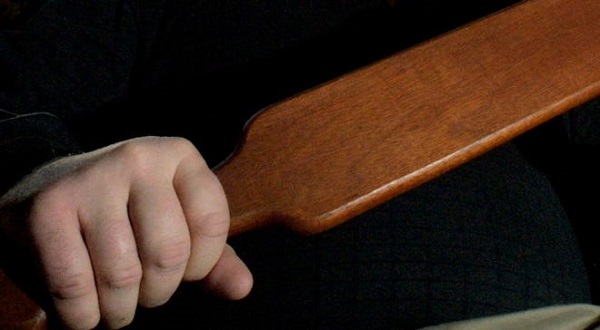
 Is spanking biblical?
Contrary to popular belief, the answer is no.
Yes, there is corporal punishment in the Bible.
But no, there isn’t spanking in the Bible.
Corporal punishment as mentioned in the Bible involves striking the back of the person being punished. Spanking involves striking the buttocks of the person being punished. There’s a big difference.
People who claim that spanking is biblical have not bothered to read their Bible carefully. Instead of reading what the Bible says and letting it teach them, they have read their own ideas into the Bible, and made it say what they want it to say. That’s the wrong way to read the Bible.
Let’s take a closer look.
Corporal punishment in the Bible
Conservative Christians who support spanking often quote the old saying, “Spare the rod, spoil the child,” as if it came from the Bible. It doesn’t come from the Bible. Look it up for yourself.
The Bible does mention “the rod.” Often it is used in a positive way. It can refer to a shepherd’s staff, which the shepherd uses to direct the sheep, and as a weapon to protect them from predators. The best-known example is in the twenty-third Psalm. Here it is in the traditional King James Version of the Bible:
Yea, though I walk through the valley of the shadow of death, I will fear no evil: for thou art with me; thy rod and thy staff they comfort me. (Psalm 23:4)
However, there are also references to the rod being used as an instrument of punishment, especially in the book of Proverbs. Here is the one that comes closest to the old “spare the rod” saying, and probably inspired it:
Those who spare the rod hate their children, but those who love them are diligent to discipline them. (Proverbs 13:24)
So far, this could be read metaphorically. “The rod” is a metaphor for discipline.
“The rod” is used metaphorically in the Bible, especially in the Prophets. Here is a prophecy about the promised Messiah:
He shall not judge by what his eyes see
or decide by what his ears hear,
but with righteousness he shall judge the poor
and decide with equity for the oppressed of the earth;
he shall strike the earth with the rod of his mouth,
and with the breath of his lips he shall kill the wicked.
Righteousness shall be the belt around his waist
and faithfulness the belt around his loins. (Isaiah 11:3–5)
The rod of his mouth is obviously not a literal rod, nor will the breath of his lips literally kill the wicked, just as righteousness will not literally be the belt around his waist, nor will faithfulness literally be the belt around his loins. Clearly, this passage is meant to be read metaphorically, not literally.
However, it’s a little hard to read this passage metaphorically:
Do not withhold discipline from your children; if you beat them with a rod, they will not die. (Proverbs 23:13)
Unfortunately for liberal Christians who argue that the rod of discipline in the Bible is meant only metaphorically, corporal punishment was practiced in Bible times, and the Bible does mention it and even recommend it.
We’ll return to the general issue of corporal punishment at the end of this article. For now, the question is not whether the Bible supports corporal punishment, but whether it supports spanking.
The Bible’s method of corporal punishment
The Bible is not silent on what sort of corporal punishment it is talking about. Multiple times, the Bible mentions which part of the body is to receive the punishment (emphasis added in all cases):
On the lips of one who has understanding wisdom is found, but a rod is for the back of one who lacks sense. (Proverbs 10:13)
Punishments are prepared for scoffers, and flogging for the backs of fools. (Proverbs 19:29)
A whip for the horse, a bridle for the donkey, and a rod for the back of fools. (Proverbs 26:3)
I gave my back to those who struck me, and my cheeks to those who pulled out the beard; I did not hide my face from insult and spitting. (Isaiah 50:6)
These passages make it clear how corporal punishment was practiced in the culture and times of the Bible. The rod or whip was applied to the back of the one being punished, not to the buttocks.
“The buttocks” in the Bible
Nowhere in the Bible is there any mention of striking the buttocks.
This is not because the Bible doesn’t have a word for “buttocks.” In fact, there are two different words for “buttocks” in Biblical Hebrew. Though they are used very sparingly (only three times between the two of them). Each time, it is in the context of humiliating people, not punishing them for wrongdoing.
Two of these instances are two different tellings of the same story, one in the book of 2 Samuel, and the other in the book of 1 Chronicles. Here is the 2 Samuel version:
In the course of time, the king of the Ammonites died, and his son Hanun succeeded him as king. David thought, “I will show kindness to Hanun son of Nahash, just as his father showed kindness to me.” So David sent a delegation to express his sympathy to Hanun concerning his father.
When David’s men came to the land of the Ammonites, the Ammonite commanders said to Hanun their lord, “Do you think David is honoring your father by sending envoys to you to express sympathy? Hasn’t David sent them to you only to explore the city and spy it out and overthrow it?” So Hanun seized David’s envoys, shaved off half of each man’s beard, cut off their garments at the buttocks, and sent them away.
When David was told about this, he sent messengers to meet the men, for they were greatly humiliated. The king said, “Stay at Jericho till your beards have grown, and then come back.” (2 Samuel 10:1–5, emphasis added)
The other version is very similar. You can read it in 1 Chronicles 19:1–5. Interestingly, it uses the other Hebrew word for “buttocks.”
The third instance of “buttocks” is found in the book of Isaiah:
In the year that the supreme commander, sent by Sargon king of Assyria, came to Ashdod and attacked and captured it—at that time the Lord spoke through Isaiah son of Amoz. He said to him, “Take off the sackcloth from your body and the sandals from your feet.” And he did so, going around naked and barefoot.
Then the Lord said, “Just as my servant Isaiah has gone naked and barefoot for three years, as a sign and portent against Egypt and Cush, so the king of Assyria will lead away naked and barefoot the Egyptian captives and Cushite exiles, young and old, with buttocks bared—to Egypt’s shame. Those who trusted in Cush and boasted in Egypt will be dismayed and put to shame. In that day the people who live on this coast will say, ‘See what has happened to those we relied on, those we fled to for help and deliverance from the king of Assyria! How then can we escape?’” (Isaiah 20:1–6, emphasis added)
In the Bible, there is no mention of striking the buttocks. But there is mention of baring the buttocks. This was not a method of punishment. It was a way to humiliate people and establish dominance over them.
For example, as reflected in the above passage from Isaiah, the people of conquered nations were sometimes marched into captivity naked and in chains as a way of demonstrating their complete inferiority and submission to the conquering nation, its people, and its king. It was also a way to break any remaining national pride and resistance in the captives. In those honor-based societies, forced public nudity stripped people of all honor and respect.
You see, in ancient society, much like today, the clothing people wore represented their status in society. People who wore fine clothing had the highest status. People who wore average clothing had average status. People who wore poor and ragged clothing had low status. People who wore no clothing at all had the lowest possible status.
This is why clothing the naked was an act of kindness and mercy, as reflected in Jesus’ Parable of the Sheep and the Goats:
Then the king will say to those at his right hand, “Come, you who are blessed by my Father, inherit the kingdom prepared for you from the foundation of the world, for I was hungry and you gave me food, I was thirsty and you gave me something to drink, I was a stranger and you welcomed me, I was naked and you gave me clothing, I was sick and you took care of me, I was in prison and you visited me.” (Matthew 25:34–36, emphasis added)
On the other hand, when clothed people were stripped naked, it was an act of humiliating them by taking away all their dignity and honor. For other examples in the Bible, see Deuteronomy 28:47–52; Job 22:5–8; Isaiah 47:1–4; Ezekiel 16:35–43. To be paraded past the crowds of common people “naked and barefoot . . . with buttocks bared” was to be reduced in everyone’s eyes to a status lower than slaves.
This also points to the difference between spanking and the Bible’s version of corporal punishment. Striking people on the back for misbehavior is an act of punishment. Striking people on the buttocks is an act of humiliation.
What happens in a spanking?
Proponents of corporal punishment tend to lump together every type of corporal punishment as if they were all the same. Christian proponents of corporal punishment commonly point to passages in the Bible that support corporal punishment, and jump to the conclusion that spanking is a biblical method of discipline. Some conservative Christians even insist that spanking is the only proper and effective method of disciplining children.
Never mind that study after study shows that spanking is not particularly effective compared to other, non-corporal methods. As the Bible passages quoted above show, spanking is just not the type of corporal punishment that the Bible mentions and condones.
The definition of spanking is striking a person’s buttocks with an open hand or with an implement such as a paddle or hairbrush. That’s what makes it a spanking.
And that’s why Christians who claim that spanking is biblical are in error. Nowhere does the Bible mention, let alone recommend, striking a person’s buttocks. It is always the back, never the buttocks.
That is for good reason.
Spanking is not the same as whipping
In ages past, whipping was a common form of military punishment. The man to be punished would be stripped to the waist, tied to a pole or frame, and given the prescribed number of strokes on the back. This was not exactly reputation-enhancing. But if a man took his punishment bravely, he gained a certain measure of respect among his peers. When it was all over, his offense was considered paid for, and everyone moved on.
It is true that more severe and humiliating forms of whipping have also been common throughout history. But the above type of traditional military discipline is a fair representation of the type of corporal punishment that is mentioned in the Bible. The biblical rod of discipline was not meant to maim and kill people. It was meant to inflict a measure of pain proportional to the offense committed.
Spanking is very different. It is an inherently humiliating form of punishment. Its advocates even emphasize the shame of being spanked as an important part of its effectiveness as a deterrent.
Spanking is humiliating
Proponents of spanking generally avoid getting explicit about what happens in a spanking. Even opponents of spanking often describe it only in general terms. But with apologies to readers who may be squeamish, to demonstrate why spanking is neither a biblical nor a defensible method of discipline, it is necessary to take a clear-eyed look at exactly what is taking place when children are being spanked.
(Note: The next few sections will get explicit in places. If that may be upsetting to you, please skip to the section titled “Spanking is risky and unnecessary.”)
Spanking, submission, and dominance
Spanking is not the sort of punishment that can garner a person respect for taking it bravely. Respectful human interaction usually takes place face-to-face or side-to side. A spanking requires the one being punished to present his or her buttocks to the one giving the punishment.
In other words, spanking requires a submissive posture. Usually this means bending over. A child may be spanked while bending over from a standing position, or bending over a piece of furniture such as a table or chair, or bending over an adult’s lap. If a child is physically restrained during the spanking, this only adds to the sense of helplessness.
The child’s submissive position is a key element in the humiliating nature of a spanking. The flip side is that spanking is an act of domination by the adult. The dominance and submission of a spanking conveys a message of enforced obedience to authority.
Spanking is painful
At the risk of stating the obvious, spanking hurts. Yes, sometimes an adult gives a child a quick swat as a warning. But an actual spanking is intended to be painful, and it is painful. Depending on the severity of the blows, the pain may last a few hours or a few days.
While the next few sections continue on the subject of the humiliating nature of spanking, keep in mind that while the child is going through these embarrassing things, his or her bottom is being painfully and repeatedly struck. Often the spanking continues until the child is crying, which only adds to the embarrassment.
Spanking in front of an audience
Today, spankings are usually done in private. But that was not always the case, and it is not always the case even today.
In times past children were often spanked in front of the class. At home they might be spanked by one parent in the presence of the other, in front of siblings of both sexes, and even in front of friends and relatives who happened to be visiting at the time. Children were also spanked out in public, such as at the playground or in the grocery store.
Spanking children in front of an audience was intended as a deterrent, not only for the child being spanked, but for the children who were watching. When a teacher spanked a child in front of the class, it sent a clear message: “See what happens to naughty children? Behave yourself, or you’ll be next!” Long after public whipping of adults had been outlawed in most countries, children were still subject to public spankings.
Spanking and nudity
The Bible mentions uncovering the buttocks as a shameful thing. Yet some Christian advocates of spanking have insisted that spankings must be given on the bare buttocks. Really, this is just a reflection of the social reality that spankings often were given on the bare buttocks. It happened both at home and in school.
When the movie Joe the King came out in 1999, some viewers were incensed at a scene in which a female elementary school teacher gives the main character a spanking on his bare bottom in front of the entire class. When confronted about it, Frank Whaley, the movie’s writer and director—on whose childhood the movie is largely based—said that this actually happened to him in the early 1970s when he was nine years old, at his elementary school in Syracuse, New York.
Today, that teacher would be arrested. But those were different times. And Whaley was far from the only boy or girl to receive a bare-bottomed spanking at school—though it might be in the hallway or in the principal’s office rather than in front of the class. Bare-bottomed spankings were even more likely to happen at home. In rarer cases, parents or principals required children to be fully naked for their spankings.
Spanking and shame
Why the nudity?
This was supposed to make the spanking more embarrassing, and therefore more effective as a deterrent. Unfortunately, sometimes there were other motives involved.
Let’s not sugar-coat this. Baring the buttocks may also mean baring the genitals and anus, depending on how the child is positioned. Full nudity means exposing the entire body. And unlike movies, reality is not cropped or censored, and the camera does not quickly pan away from sensitive scenes.
Then, as now, children were taught that they must always cover certain parts of their body in public. So when a child is forced to uncover those parts in front of other people, it causes great shame.
The submissive posture, crying, and pain make spanking embarrassing even in the mildest case. There is always at least one person watching: the adult giving the spanking. Add in an audience, and in the worst case nakedness, and the spanking becomes a shameful ordeal.
Many spanking advocates see this as a feature, not a bug. The most effective punishment, they say, combines pain with shame. Spanking delivers plenty of both in a single package.
But there’s more to it than that.
Spanking is sexual
There is an unavoidable sexual element in spanking. This is true even if the person being spanked remains fully clothed, and even if the person administering the spanking has no sexual thoughts about it.
Thankfully, the practice of spanking on the bare buttocks is much less common than it once was. However, leaving the buttocks covered does not erase the fact that it is an erogenous zone of the body. The same nerves that supply the buttocks also supply the genital area. Stimulating one part stimulates the other parts as well.
There is no magical exception to this when a child’s buttocks is painfully struck during a spanking. It is common for spankings to elicit a physiological reaction in the genitals. The child being spanked may or may not distinguish this reaction from the sensations of the spanking itself.
Yet another element in the sexual nature of spanking is that the bent-over positions commonly used for spanking mimic the most common female mating posture among mammals. Earlier I referred to this as a submissive posture. More precisely, it is a sexually submissive posture. The rhythmic nature of a spanking also mimics the rhythmic nature of sexual intercourse.
It is no surprise that spanking and sexuality get all tangled together in some children’s minds.
This is a highly sensitive aspect of spanking that its advocates do not want to see or admit.
Spanking is sexual regardless of mindset
I am not saying that every parent or teacher who spanks a child has sexual thoughts or motives while doing so. For most of these adults, this was just how they were raised. They don’t give much thought to it. They simply discipline children the same way they were disciplined.
And yet, the existence of spanking fetishes is testimony to the reality that even adults who mean nothing sexual when they spank children can still elicit a sexual response in them. Most children who are spanked go on to live a normal romantic and sexual life. But for some, spanking and sexuality become so intertwined in their minds that it is difficult if not impossible to disentangle them in adulthood.
And let’s be honest. Some adults know exactly what they are doing when they are spanking a child. They enjoy it, and they take it as far as they think they can get away with it. Children who are intentionally sexually abused while being spanked are even more likely to develop sexual dysfunctions or fetishes.
But just to be clear, no matter what the circumstances—even when it is a fully clothed spanking administered in private by an adult who has no sexual intentions—there is always a sexual element to a spanking. That’s because spanking a child is hitting a child on an erogenous zone of the body, right next to his or her genitals. This is an unavoidable fact of human physiology.
Spanking is risky and unnecessary
This is a big reason spanking should never be used as a method of disciplining children.
Spanking is not biblical. It is not the most effective method of discipline. And it is fraught with many negative consequences. Besides the elements of humiliation and sexual entanglement already covered, another negative consequence shown by study after study is that children who are spanked are more likely to resort to physical violence in adulthood as a “solution” to various problems. That’s what was modeled for them as children.
Why play with fire? Parents and teachers who truly care about the children entrusted to them will banish spanking to the past where it belongs. There is no need for it, and no excuse for it when there are far better and more effective ways to raise ethically and emotionally healthy children. A few quick Internet searches will provide plenty of guides to raising children without corporal punishment.
But if you insist upon being “biblical” about it, the proper way to administer corporal punishment is on the back, not on the buttocks—and certainly not on the bared buttocks. Any “Christian” preacher who teaches that spanking is a biblical method of punishment is reading the Bible in a sloppy and lazy way, and is not worth listening to.
Should Christians use corporal punishment?
What about corporal punishment in general? Doesn’t the Bible say that fools and wayward children should be punished with a rod?
This question deserves an entire post of its own to properly explore and support a solid answer based on the Bible. For now, here are the basics of why corporal punishment is an Old Testament method of punishment, but not a Christian method of punishment.
The religion of the Old Testament is one of strict laws. There were severe punishments for disobeying them, and great rewards for obeying them. See, for example, Leviticus 26 and Deuteronomy 28.
But as presented in the New Testament, Christianity was not to be a religion of external obedience to behavioral laws. It was to be a religion based on an internal faith. In other words, Christianity was to be a religion of knowing and believing the truth, and living by it. And ultimately, Christianity was to be a religion of love. As the apostle John said, love is incompatible with fear of punishment:
There is no fear in love, but perfect love casts out fear; for fear has to do with punishment, and whoever fears has not reached perfection in love. We love because he first loved us. (1 John 4:18–19)
Yes, in his parables Jesus mentioned whipping. But parables regularly use common events and practices from the surrounding culture to illustrate deeper lessons. They are not meant to be taken literally—and Jesus never said that people should be whipped.
Even when Jesus himself used a whip to drive money-changers out of the Temple in John 2:13–17, it was not an instance of corporal punishment, but of physically removing people who were desecrating the Temple of God. It was more like a police action than a punishment session.
Nowhere does Jesus say that physical force should be used as a punishment to compel proper behavior. Instead, his teaching is based on faith and love as the primary motives for living a good life.
That is why, even though corporal punishment was appropriate to the Old Testament’s religion of behavioral obedience to law, it is not appropriate to the New Testament’s religion of living from faith in the mind and love in the heart.
Corporal punishment is not a Christian method of child-raising
Think about it. In Old Testament times, obedience to the law was enforced by strict punishments for everyone in the culture, from childhood to old age. Today, we do still have punishments for breaking the law. However, the goal of parenting and education in today’s society is to raise children to have an internal understanding and dedication to living an ethical and moral life.
Corporal punishment is not a good way to develop an internal dedication to right living. It teaches children not to do wrong because if they do, they will get into trouble. This is at cross-purposes with teaching children not to do wrong because they know and understand the harm caused by wrong behavior.
Corporal punishment teaches children to avoid wrong behavior for external reasons, based on a fear of punishment by external authorities. The goal of child-raising today is—or at least should be—to raise children who do the right thing for internal reasons, based on internal understanding and motivation.
This, in a nutshell, is why corporal punishment is appropriate to an Old Testament type of religion, but not to a New Testament, Christian type of religion.
And one more time: Spanking is not appropriate to either type of religion. Spanking is unbiblical, damaging, and destructive.
(Note: Due to the sensitive nature of this subject, the comments section on this post will be moderated more strictly than usual. Please see our comments policy. In particular, this is not the place to tell the story of your personal spanking experience.)
For further reading:
- To Train Up A Child, or: Spare the Rod? What Rod?
- Can Christians be Hardass?
- Pain, Punishment, Prison, and Hell
- The Spiritual Anatomy of Physically Abusive Men
- Is Christianity an Abusive Relationship with God?
- How Can I Raise My Children from a Spiritual Perspective?
Share this:


Lee Woofenden is an ordained minister, writer, editor, translator, and teacher. He enjoys taking spiritual insights from the Bible and the writings of Emanuel Swedenborg and putting them into plain English as guides for everyday life.



 Spiritual Insights for Everyday Life
Normal person: Do you believe spanking is good?
Conservative Christian: Yes! It’s in the Bible!
Normal person: When was the last time you and the other men of your city stoned your disobedient and rebellious child to death?
Conservative Christian: …
Hi Imperfect Glass,
😀 That about sums it up.
Hello from Vienna, Austria! In my country corporal punishment has been outlawed since 1989 and it is unbelievable that countries considered to be “modern” are still allowing it. It might have a very profound impact on societies becoming violent says peace researcher Franz Jedlicka. And religious persons should be reminded about the Kyoto declaraton of “Religions for Peace” where child protection was declared to be a common goal of all religions.
Hi Doris,
Thanks for stopping by, and for your good thoughts.
It takes a long time for deep-seated evils to be removed from human society. It does not happen all at once, but bit by bit, here and there in patchwork fashion, and often two steps forward followed by one step back. That is why we must continue to engage in the battle, beating back the evil everywhere we can, wherever it becomes possible, until it is finally defeated.
Even in the U.S., where corporal punishment is still legal in the home in all states, and in school in a third of the states, the worst and most shameful forms of it are being moderated and pushed back. There is still a great deal of work to be done, but at least there is progress.
Great article! Christian parents need to realize that Proverbs is not divine commands to obey, nor promises to claim. I think you would enjoy reading my articles on this very important subject!
Hi Shannon,
Thanks for stopping by, and for your comment. I did take a look at some of your articles. Thanks for the link.
I very much agree with the concept of a “redemptive trajectory” in the Bible. God is always bending us toward the good from where we are now, not breaking our cultural attitudes by flatly contradicting them. This is the meaning of the prophecy about Jesus:
Even if our current ethics may be “a dimly burning wick,” God will not quench them, because that’s all we have to go on until we can learn and grow more as a culture. As suggested in your articles, many biblical commands are actually limitations placed on the excesses of cultural practices of the day that, from the perspective of a divine standard, are “bruised reeds” and “dimly burning wicks.” God also uses these bruised reeds and dimly burning wicks to lead us toward what is good. If God broke them, or quenched them, we would be left without any moral and ethical support and guidance at all.
But they are still bruised reeds and dimly burning wicks. When we have grown spiritually to the point where we have firm and strong reeds, and brightly burning lamps, we can move beyond the specific rules given at an earlier, less spiritual and less understanding time, and follow the “redemptive trajectory” of the Bible toward something far better than God could reveal to us in the literal meaning of the Bible. As Jesus said, “I still have many things to say to you, but you cannot bear them now” (John 16:12). Many of the laws of Moses—not only the law about divorce—were given “because of the hardness of their hearts,” but “from the beginning it was not so” (Matthew 19:8; Mark 10:5).
This is the fallacy of the biblical literalists. They are limiting themselves to the low cultural standards of the times in which the Bible was written. The Bible itself, and especially the Gospels, have brought about great improvement in our spiritual and moral level. If we follow that trajectory, we can read the Bible based on the spirit that gives life rather than based on the letter that kills.
One place where I disagree is that spanking is an improvement over beating the back.
Yes, there is less likelihood of physical injury from striking the buttocks compared to striking the back. The buttocks is fleshy and muscular rather than bony as the back is, and it is beyond the end of the critical and vulnerable spinal column. This means that the danger of serious physical injury from spanking is very low compared to the danger of serious physical injury from beating the back.
However, the psychological and emotional damage of striking the buttocks is far greater. That’s because as covered in the above article, unlike the back, the buttocks is an erogenous zone. Striking it commonly causes a cross-wiring of pain with sexuality. It is true that many children who were spanked shrug it off and go on to live emotionally healthy lives as adults. But for others, spanking causes severe emotional and sexual damage that remains with them far into their adulthood, and that is very difficult to overcome and heal from.
The reality is that spanking is not biblical at all, nor is it part of a “redemptive trajectory” toward better and less harsh forms of discipline. It is a serious backwards step, sexualizing corporal punishment in a way that is flagrantly unbiblical. No one who was biblically beaten on the back had sexual fantasies about it in adult life, and was unable to have a healthy romantic and sexual relationship as a result.
In today’s culture, I am altogether opposed to corporal punishment. As covered in the above article, it is entirely inappropriate to a truly Christian culture and to truly Christian child-raising. However, if I were forced to choose between parents spanking children or striking them on the back, I would choose striking them on the back, but with some flexible instrument (not a rod) that would not be so likely to cause damage to the spine. This would still be very objectionable, and would still have some potential to cause injury. But at least it wouldn’t cause the types of severe emotional injury that some people who were spanked as children must struggle with.
The truth for biblical literalists (which I am not) is that biblical corporal punishment is applied to the back, not to the buttocks. There is no sound biblical argument for spanking children.
But to end on a positive note, I believe you are putting out a good message. It is good to see others spreading the word on these subjects. Thank you for the good work you are doing.
How very much I enjoyed reading your reply! The wisdom you shared has enriched my perspective on this very important topic. I love the imagery of the bruised reeds and dimly burning wicks illustrating our potential for spiritual growth and/or ability to move beyond the ethics of the day.
I don’t recall saying hitting a child’s back is “better” than the bottom- I firmly oppose hitting a child anywhere. But, maybe your comment stems from my discussions about spanking (in general) showing movement towards a better treatment of children than the corporal punishment texts in the Bible. The purpose of that statement is not to advocate for spanking, but to highlight that proponents of spanking have already deviated from literal Biblical interpretations, so why not continue in the that trajectory to an even better ethic.
I appreciate you taking time to read some of my work, and sharing your thoughts. It’s always a joy to connect with a fellow child of God who believes that there is no sound biblical argument for spanking children.
I hope to hear more from you in the future. God bless you and your family!
Hi Shannon,
Thanks for your reply. I’m glad I was able to pass some new biblical insight on to you. The more we share the wisdom around, the more wisdom grows among God’s people.
When I said, “One place where I disagree is that spanking is an improvement over beating the back,” it was in reaction to these two statements in your article “Part 2: Spare the Rod, Spoil the Child”:
And:
First, earlier forms of spanking were more likely to use a cane or other implement that was considerably more severe than an open hand. The “rod” that had previously been used on the back was simply moved down the body to the buttocks. Even today, in states where corporal punishment is still allowed in school, the usual implement is not the hand, but a wooden paddle.
Perhaps the motive in moving from whipping to spanking was to cause less harm. But I believe there were more sinister motives at work, prompted by evil influences from below. The buttocks has been known as a sexual and sexually enticing area of the body throughout human history. Only the technical terminology (“erogenous zone,” etc.) is new. And we know of the unfortunate child sexual abuse that has gone on not only in the Catholic Church, but in various conservative Protestant churches as well.
It is true that moving from the back to the buttocks means that there is less likelihood of serious physical injury. However, it also causes the blows to be applied to the sexually sensitive area surrounding the child’s genitals. And for those adults who do have sexually corrupt motives and desires, it provides access to a child’s sexual parts—including the buttocks itself—in a way that punishment on the back does not. In the corrupted “Christian” world where people who had a proclivity for sexual abuse of children found safe haven for centuries, it is hard to believe that the shift from back to buttocks wasn’t driven more by this motive than by the motive of causing less harm.
Once again, I’m not saying this is the motive of average parents who spank their children. As I say in the above article, most parents and teachers who spank children do so simply because that’s the way they were raised, and that’s the form of punishment they know.
But in past centuries the church was the primary source of instruction and example in all areas of life. What parents did innocently, often following the lead of the church, some of the clergy in the church did not so innocently. Laypeople who had the same predilections also quite readily adopted the practice of striking the buttocks instead of the back. Hence the stories of sexual abuse in connection with corporal punishment that caused lasting emotional damage and sexual dysfunction in so many people who suffered it, not to mention in many people whose parents or teachers were innocent of any lustful motives.
All of this is why I very much disagree that “present-day spanking is a much improved form of discipline.” Yes, the back is more susceptible to injury than the buttocks. But parents who cared about their children, and cultures that cared about their young adults, did not set out to cause permanent bodily injury. Yes, the whipping of slaves and convicts did indeed sometimes cause serious injury or even death. Some whippings were intended to kill the victim. But as applied to young people who were simply misbehaving and needed discipline, it was not administered in such a way as to cause permanent injury. It was meant to warn, not to maim or kill.
I therefore do not accept the idea that striking the buttocks instead of the back is “safer” or constitutes “better treatment.” People who received ordinary punitive beatings on the back almost always fully recovered and suffered no permanent injury. Meanwhile, many children who were spanked have suffered long-lasting and very debilitating emotional injury.
All of this is why I believe that the move from the back to the buttocks was not at all an improvement over the biblical form of corporal punishment, but a major downward slide that has had serious negative consequences in the lives of many people.
I do agree that the world has moved toward better ethics than the ethics of Bible times. The Bible itself, especially the Gospels, is a key driver of that move toward better ethics.
However, I do not agree that spanking is part of that move toward better ethics. I believe it is a move toward worse ethics in an especially sensitive area of human behavior and interaction.
I know this wasn’t the point of your articles, and that your overarching goal is to abolish corporal punishment altogether. But I am not prepared to let the existing Christian Church off the hook for what I view as a step toward degeneracy in its method of corporal punishment compared to the biblical method. That’s the whole point of the above article.
But to end on a positive note once again, I agree with you 100% that corporal punishment of all sorts should be entirely abolished among Christians—and the sooner, the better! It is an Old Testament form of punishment. It is not a Christian form of discipline.
I’ll also add that the “redemptive trajectory” of the Bible is visible even within the Bible itself, not only between the Old Testament and the New Testament, but even within the flow of the Old Testament. However, that is a major subject that deserves an entire article—or series of articles—of its own. Perhaps this is also included in William Webb’s book, which I have not read.
P.S. I meant to add that using the hand instead of an implement is also a downward step when the area the hand is being applied to is one of the erogenous zones of the body. A recognition of the inappropriateness of this kind of touching is one of the reasons school spankings today are usually done with a paddle, not with the hand of the adult administering the punishment.
Thank you for writing this article! I truly hope that more people use common sense to correct and raise their children! The number of people that misinterpret passages in the Bible to suit their own needs/ beliefs is appalling . Taking the time to learn and pray instead of relying on the standard “that was how I was raised and I turned out fine “ will benefit parents greatly! The second anyone try’s to explain that spanking is not biblical so many people just shut down or become angry (which is not appropriate Christian behavior) No one is debating the need to give a child rules, structure and yes correction! And it should be with the Lord in mind however, violence and nudity play absolutely no part in that! I think a lot of people also forget that intent does not equal impact. The only person who will ever be able to decide how they feel about how they were disciplined (especially once they are adults) is your child. Being a parent is an awesome responsibility and privilege and I hope that more people read your article and gain the insight to parent in ways that are both beneficial and not harmful! God Bless
Hi Lea,
Thanks for stopping by, and for your good thoughts. I agree 100%!
Godspeed on your spiritual, and parenting, journey!