There is some reflection of the human form in everything in the created universe. . . . God is a person, and the created universe is an image of God. (Divine Love and Wisdom #63–64)
So says Emanuel Swedenborg (1688–1772). But he admits that this is not always very clear to us here in this material universe.
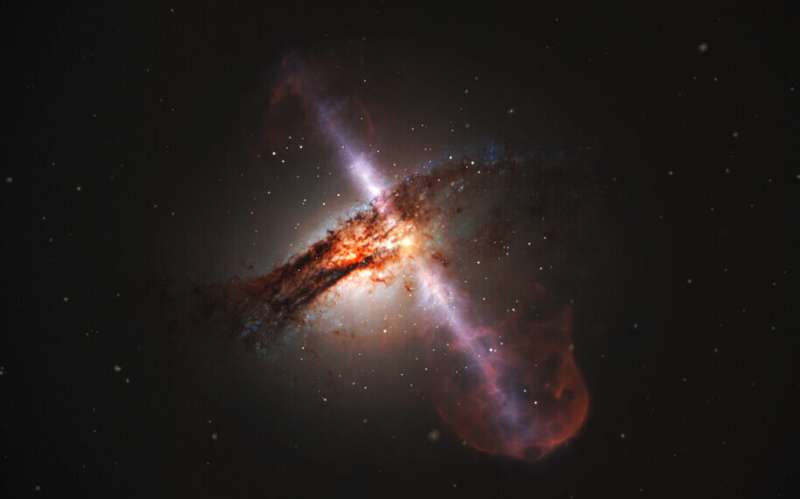
“Heart and lungs” of a galaxy
Imagine my surprise, then, when not long ago an article popped up in my news feed about a recent scientific study suggesting that galaxies have a “heart” and “lungs”! “Really?” I thought, “That sounds like clickbait!” (Okay, okay, sort of nerdy clickbait!)
But when I read the article, “How the ‘heart and lungs’ of a galaxy extend its life,” that’s exactly it said. The original published scientific study, “Simulations of pulsed overpressure jets: formation of bellows and ripples in galactic environments,” by Carl Richards and Michael Smith of the University of Kent, is very mathematical and theoretical. It makes only one brief mention of “lungs,” and says nothing at all about a “heart.” But in the article covering the study, also published by the Royal Astronomical Society, the authors of the scientific paper do make the analogy explicit:
In their analogy, the researchers compared the supermassive black hole at the centre of a galaxy to its heart and the two bi-polar supersonic jets of gas and radiation they emit to airways feeding a pair of lungs.
Maybe ol’ Swedenborg wasn’t so far off about everything in the created universe reflecting the human form—which is the form of God, its creator!
Black holes
I must admit, when I first heard about black holes decades ago, I didn’t like ’em. Not at all. Collapsed balls of matter and energy so dense that not even light can escape their gravity? Black holes sounded like hellish things, sucking in, destroying, and swallowing up anything and everything that got too close, and never letting any of it go.
No, I didn’t like ’em one little bit. “Say it ain’t so!” I thought.
But it is so. Black holes have become a well-established element of modern cosmology. Most galaxies have a supermassive black hole at their center. I had to find some way to make my peace with them.
It was an uneasy peace. Maybe their gravity helps to hold the galaxies together? (Not really. The central black hole’s gravity is only about one tenth of one percent of the average galaxy’s total gravity.)
When I heard about “Hawking radiation,” which would cause black holes to evaporate over vast periods of time, I felt a little better. At least eventually all the black holes would let go of the matter and energy they had greedily gobbled up over billions of years. But by that time, all the stars in the universe would have long since died, so it was a small consolation.
Enter the “heart” and “lungs” of galaxies, and their vital role in making galaxies suitable for life.
How the galactic heart and lungs work
One of the problems in cosmology that has exercised scientists’ brains is why galaxies don’t quickly collapse under the weight of their own gravity, and burn out their star-forming material so fast that there is no chance for life-bearing solar systems and planets to form. This latest study is one attempt to answer that question. For a layperson’s understanding of it, see also, “Galaxies Regulate their Own Growth so they Don’t Run Out of Star Forming Gas,” by Mark Thompson.
To be clear, the study is based on computer simulations, not on actual observations. But there does seem to be some support for the authors’ theories in our observations of various galaxies.
Here’s the basic idea:
At the center of most galaxies there is a supermassive black hole. As gas, dust, and other material falls into that black hole, it gets accelerated to very high speeds and heated to very high temperatures. The resulting intense energy causes a pair of high-pressure jets of matter and energy to shoot out from the poles of the black hole, and therefore from the center of the galaxy, usually at right angles to the plane of the galaxy.
If these jets of energy are steady and regular, all that happens is that they sweep some of the surrounding gas and dust along with them, circulating the material surrounding the galaxy, and mixing it up a bit.
However, nature is not necessarily that slow and stately. In these high-pressure environments, pulsations commonly develop around the black hole, sending repeated waves of matter and energy out along the length of the jets. This pulsation is the “heartbeat” of the black hole at the center of the galaxy.
As each pulse travels up the length of the jets, it crashes into the material from earlier pulses, causing shock waves that travel not just up the length of the jets, but also sideways into the region around the jets. If the pulses are of medium speed—not too fast and not too slow—the resulting pressure waves transfer energy into the region around the galaxy, pushing the gas and dust there outward so that it does not rush in upon itself too rapidly under the inward pressure of the galaxy’s immense gravity.
Here is an animation of this effect based on the study:
You can read the linked articles—and if you’re brave, the study itself—for a more detailed explanation of how this “heart and lungs” system works to keep galaxies “alive” long enough for life such as ours to exist in them.
The short version, in summary, is that the supermassive black hole at the center of each galaxy forms a “heart” that sends regular pulses of matter and energy out into the jets that shoot out from the two poles of the black hole. These pulses cause those jets to act like “lungs” that keep the star-forming material around the galaxy inflated so that it doesn’t all rapidly rush into the center and burn itself out too quickly for life to form.
The heart and lungs are necessary for life
In the human body—not to mention the bodies of other vertebrate creatures—the heart and lungs are key elements of life. The heart circulates life-giving blood around the body, feeding all its cells and keeping them alive. The lungs provide a continual supply of fresh life-giving oxygen to the bloodstream and all the cells it supplies.
If the conclusions of this new study are borne out by further astronomical observations, then something analogous is happening in the physics of entire galaxies. Not exactly the same, of course. The “heart” of a galaxy doesn’t pump blood, and its “lungs” don’t supply oxygen to the galaxy’s stars. But the galaxy’s “heart” does beat, and its “lungs” do take that heartbeat and turn it into a “breathing” motion that helps to keep galaxies alive far longer than they would otherwise live, so that they can have the required multiple generations of stars required for solar systems capable of supporting life. In a sense, the galaxy’s heart and lungs do “feed” later generations of stars with the material they need to form, and to develop life-bearing solar systems around them.
You see, the early universe was made almost entirely of hydrogen, plus some helium. There were none of the heavier elements required to form rocky planets such as ours, capable of hosting plants, animals, and humans on their surface. Those heavier elements were created by the processes of fusion in the first generations of stars, and by the supernova explosions that the larger ones ended their lives in. Scientists believe that at least three “generations” of stars, one after another, were necessary to provide enough of the heavier elements for solar systems like ours to form.
If the galaxies had burned through all their surrounding supplies of hydrogen gas too fast, these second and third generation stars would never have had a chance to form. The hydrogen necessary to sustain every star over a long lifetime would have already been fused into helium and heavier elements by a massive, dense first generation or two of stars. There would not be enough of it left for third-generation solar systems like ours to exist.
And so, although the “heart and lungs” of a galaxy don’t function quite the same as the heart and lungs of a human being, they do play a vital role in keeping galaxies alive long enough for us to exist.
A universe created for life
From a purely materialistic perspective, our existence is a cosmic fluke. The right conditions just happened to exist in this universe for at least one planet—ours—to develop and support life long enough for us to evolve into a species that could study the universe and contemplate our own existence.
But from a spiritual perspective, there is nothing random or happenstance about it. The universe we see around us is capable of supporting life because that’s exactly what God designed it to do. Modern science is teaching us not only exactly how it does that, but also how incredibly complex are the conditions and processes required for the physical universe to generate even one planet capable of supporting life. Many scientists believe there must be more such planets in this vast universe, but that remains an open question.
If God is the creator of the universe, then according to Swedenborg, the universe and every part of it must in some way reflect the nature of God. And God, says Swedenborg, is a human being, having love, wisdom, power, and all the human emotions and capabilities. Yes, God even has a body that has all the human body parts—though on a divine level rather than on a merely physical level. For the biblical parallel to this idea, see:
Was Adam Anatomically in God’s Image?
Of course, the universe doesn’t look like a giant human being. But the more we study it, the more we see reflections of the human form in it. For example, the large-scale structure of the universe looks remarkably like the structure of the human brain.
This latest study suggesting that galaxies have “heart and lungs” that help to sustain its life is just one more piece of evidence, for those whose eyes are open to see it, that the universe does indeed reflect and express the human nature of God.
And maybe God didn’t make a mistake in creating black holes after all.
For further reading:
- God: Puppetmaster or Manager of the Universe?
- Are We All Just Bundles of Quantum Energy?
- Are We Headed for an AI Apocalypse?
- Thoughts on Seeing the Eclipse
- The Breakthrough Starshot Initiative & the Spiritual Aspirations of Atheists and Agnostics
- Containers for God
Share this:


Lee Woofenden is an ordained minister, writer, editor, translator, and teacher. He enjoys taking spiritual insights from the Bible and the writings of Emanuel Swedenborg and putting them into plain English as guides for everyday life.



 Spiritual Insights for Everyday Life
What do you think?