In the comments section of the article “Your Crowdsourced Mind” (which I recommend you read to get the most out of this article), a reader named K asked:
If everyone has a so-called crowdsourced mind, then what were the first sapient beings in the universe like, when there were no spirits to influence them yet?
Also if I have a so-called crowdsourced mind, does that mean that the way I think and the views I hold likely are not unique, even if I may feel like an odd-out freak?
This article is an edited and slightly expanded version of my reply. You can see my original response here.
The picture painted by the earliest chapters of the Bible is that the earliest humans on earth had God as their companion and source. God walked with them in the garden (see Genesis 3:8). Ultimately, God is where everything comes from. If there were no other humans, angels, or spirits for the love and wisdom from God to flow through on its way to us, it would flow into us directly from God.
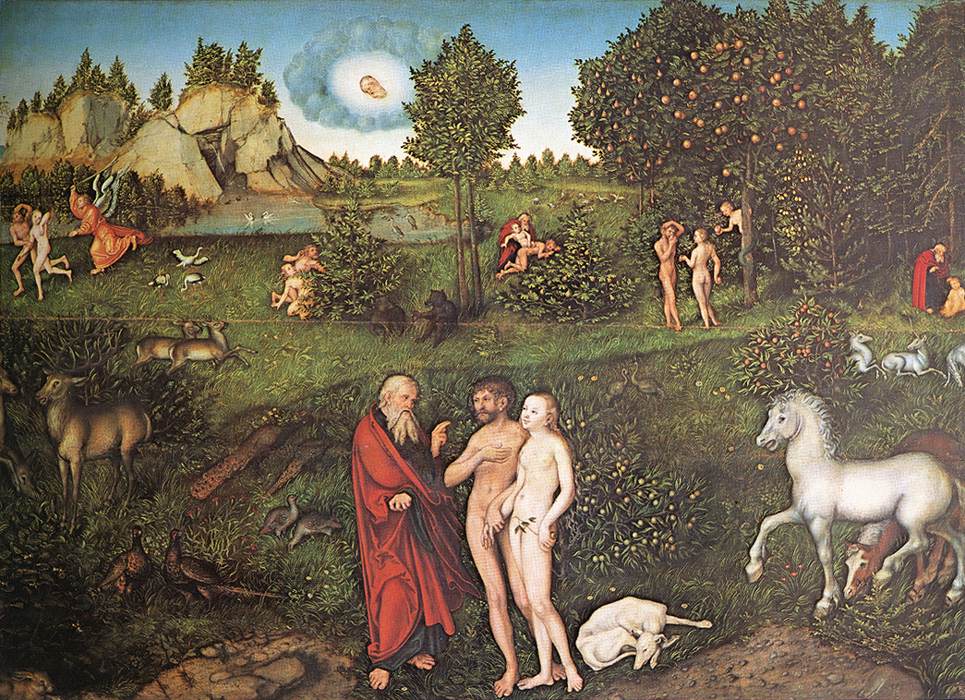
Adam and Eve, by Lucas Cranach
But even in that case, God’s love and wisdom flows through the higher layers of the spiritual universe on its way to us. God created all the levels of the spiritual universe first, before the material world and its levels, not so much in time as in order and priority. Creation flows from the inside out through all the layers of the universe, which form something like a series of concentric circles surrounding its center, which is God. Since we humans are finite, not infinite, and created, not divine, we can’t receive anything directly from God, any more than we receive sunlight directly from the sun. It must first flow through the spiritual distance between us and God.
Now that Jesus has been born and glorified, we can receive thoughts and feelings directly and personally from God via the “Son” and the “Holy Spirit,” which are the human presence and power of God. But that’s a different topic altogether. And the earliest humans lived long before Jesus was born, so for the purposes of this article we’ll set that aside. For the real meaning of the Father, Son, and Holy Spirit, please see: “Who is God? Who is Jesus Christ? What about that Holy Spirit?”
Besides, the people represented by “Adam” in the Bible were not the first spiritually aware people on earth.
The ascent of humanity
Even though the story in the early chapters of Genesis is highly compressed, the actual creation of human beings as “sapient beings”—which in this context I’ll construe as spiritual beings—took place over many thousands of years. It was not a sudden event, but a gradual process of moving from being mere animals who have no awareness of God and spirit to being fully human beings who are fully aware of God and the spiritual realm, and have a conscious relationship with them. This spiritually developed state of being is represented by “Adam” (a Hebrew word meaning “humankind”) being formed by God and placed in the Garden of Eden. The garden represents a mental environment of spiritual thoughts and ideas that have grown up in our collective human mind until they have become fully developed and stable “trees” of settled concepts about God, spirit, and life. (See: Where is the Garden of Eden?)
This is suggested even in the first Creation story. There is a whole series of “days,” or stages, in which many different things are created one after another before humans are created as the final act on the last day of Creation. This series of days is metaphorically about building up the life and awareness of humans until they become spiritually conscious and active beings. In the Bible story, though, actual humans show up only at the end of the process, representing the time we have become fully human.
When applied to individuals, this series of days and the events in them is about the lifelong process of regeneration, which involves moving from our inborn self-absorbed state through our various stages of our spiritual life and development until we reach the final state of being motivated primarily by love for God and the neighbor. But when applied to humanity as a whole, it refers to the gradual process of moving from being mere animals to becoming human beings who have a living awareness of and relationship with God and spirit.
Another way of saying this is that the process involved moving from having only the lowest “earthly” level of consciousness to having the two higher “spiritual” and “heavenly” levels of consciousness. These two higher levels are present only in human beings. The consciousness of lower animals is limited to the earthy level. That’s why they can’t think about God and spirit, and they have no rationality and no sense of morality.
In Genesis, the process of becoming human was not complete even at the end of the first Creation story, which recounts the seven days of creation, but only after the first part of the second Creation story, when after a different process of creation, Adam (meaning humankind, both male and female, see Genesis 5:1–2) is formed and placed in the Garden of Eden. Emanuel Swedenborg (1688–1772) interprets the first Creation story as God raising humans up to the spiritual level, which is the level of intelligent spiritual thought, and the first part of the second Creation story as God further raising humans up to the heavenly (traditionally “celestial”) level, which is the level of being moved by a heartfelt love for God and for our fellow human beings in everything we think, say, and do.
In other words, becoming human was not an instantaneous event, but a long, drawn-out process. The biblical literalists who try to interpret the days of creation as whole periods, lasting a thousand years or more, are wrong literally. That’s still not how the physical earth was created. But spiritually, they are onto something. These very compact stories are telling the spiritual story of events that took place over thousands of years—probably over hundreds of thousands or even millions of years.
The pre-Adamites
How is this relevant to the question?
The creation of spiritually “sapient” (not just conscious, but wise) humans was not instantaneous. It was a process of early humans, who were still just earth-focused animals, developing over time into spiritually aware beings. God gradually added higher and higher capabilities of thought and feeling to these early humans until they reached the stage of being fully human in spiritual capabilities, both in mind and in heart. In the earliest stages of this transition, humans had only vague and crude ideas of God and spirit. God built upon these over the millennia to make it possible for people to think more and more clearly about God and spirit, until they reached the stage represented by Adam in the garden. This was a state in which humans walked with God in the sense of having a fully conscious and mutual relationship with God.
However, even the people from the earlier stages, who had only an indistinct sense of God and spirit, still had eternal souls because they did have some level of spiritual awareness. Every being capable of spiritual awareness lives forever in the spiritual world after physical death.
These earlier people were the “pre-Adamites.” This was a long-established but controversial idea in Christian thought that Swedenborg adopted and spoke of—though only a few times, and mostly in his unpublished (by him) journal Spiritual Experiences. Here is the beginning of his main entry on the pre-Adamites, which starts at #3390 in that work:
It was shown me what the pre-Adamites were like, who were regenerated by the Lord and called “Adam”: a certain one spoke with me in a speech not swiftly articulated, as speech usually is, but in the words there was little life, so that one can hear [from the speech] what kind of life. I heard him speaking when I awoke in the night.
He had been put there to guard me, and he said that evil ones were trying to carry me off. I had heard that there was such a guard, and that he was not evil, but had little life left, so that he was an external person, yet in whom inner qualities were in the outer ones—but few inner qualities. So he had not become such an outer person as ours [today], in whom outer qualities are separated from inner ones. But there were inner ones with him, though few.
The translation is labored and awkward, in part because Spiritual Experiences is more like Swedenborg’s notes to himself than a polished work intended for publication. But the general idea is that this pre-Adamite’s spiritual (“inner”) level was only barely there, and not very well-developed. Even so, this man was living eternally in the spiritual world.
What this suggests is that God gradually built up the community of spirits in the spiritual world from the ground up so that when humans had reached the stage of full awareness of God and spirit, there were already spirits in the spiritual world through whom thoughts and feelings could flow to them. In other words, by the time the people represented by Adam had been placed in the spiritual garden, there were already communities of spirits in the spiritual world through whom these “Adamites” could receive most of their thoughts and feelings.
Ultimately, of course, all our thoughts and feelings come from God. And as I suggested earlier, it is perfectly possible for God’s love and wisdom to flow into us directly, in the sense of not flowing through the angels and spirits around us in the spiritual world.
Besides the more recent channel now made available to us of God having a personal relationship with us as Jesus Christ, God does have a direct channel to us through our inmost soul. But our inmost soul is above and beyond our conscious awareness. It is not part of our conscious thoughts and feelings. Thoughts and feelings can therefore flow into us directly from God, becoming conscious to us as they flow down into the conscious parts of our mind. This is what made it possible for the fully spiritually aware people represented by Adam to develop beyond the pre-Adamites, whose spiritual awareness was increasingly dim and crude as we look backwards through time from the period in human development represented by the creation of Adam.
What if I’m a weirdo?
This leads to the second question: If I think of myself as a real freakazoid, am I truly unique and alone in my thoughts and feelings?
The answer is that none of our thoughts are unique, no matter how much of a freak and an oddball we may think we are. By the time anything reaches our conscious awareness, it is shared with the angels and spirits around us, at least some of whom will be having thoughts and feelings (including desires) similar to ours. Most likely it’s the other way around, and our “weird” thoughts actually come from those angels and spirits.
It is possible for us to have brand new thoughts that no one else has had before. Witness the development of scientific knowledge over the ages. Before the discovery of DNA, no one could think about DNA and investigate its nature and function because we had no awareness that it even existed. The same is true of our spiritual thinking, which has also grown and developed over time. Even most of our “new” and “weird” ideas were in the minds of angels and spirits before they occurred to us, and that’s where we got them from. But just as God walked with Adam and Eve in the garden, and talked with them person-to-person, I believe it is possible for us to have new thoughts and feelings that come directly from God. These would be only good thoughts and feelings precisely because they do come from God, who is entirely and infinitely good.
Still, it’s best not to get all puffed up about this possibility. Most likely our fancy new idea is not really new. Probably someone else has already thought of it, if not on earth, then in the spiritual world. I suspect that most people on this earth think they have thoughts and feelings nobody else does. But that’s only because we tend not to share these “weird,” unconventional, and perhaps socially unacceptable thoughts and feelings with other people. Most likely there are thousands or even millions of other people who are having pretty much the same “oddball” thought or feeling that we have.
Even if we do get some brand new idea that no one else has ever thought of before, it’s still God’s idea, not ours. God has literally thought of everything! And if we start taking personal credit for this great new idea, or even start thinking, “I’m extra-special because God gave this unique thought to me, and not to anyone else,” we will quickly corrupt and destroy it, turning it toward doing evil instead of toward doing good. If we believe God gave us some unique new idea, then God’s purpose in doing so was to make it possible for us to use that idea to accomplish some new type of good for our fellow human beings. And even the ability to do that is not ours, but is something God gives us. See: “Containers for God.”
Besides, once this new idea occurred to us, it would immediately be available to and shared with all the angels and spirits around us. The angels will use it to influence us toward doing good for our brothers and sisters on this earth by means of it. The evil spirits will use it to try to puff up our ego so that we will immediately corrupt the new idea and poison the people around us by means of it.
It is still best, as expressed in the quote from Heaven and Hell #302 in the earlier article, to think of all of our thoughts and feelings as coming from, and shared with, the angels and spirits around us. If something we think or feel is truly new, then that’s God’s business, not ours.
We are not alone
None of us is as much of a freak and an oddball as we think we are. Even the most introverted and eccentric person on earth is still living within a circle of angels and spirits who are having the same thoughts and feelings on their level as that “odd-out freak” is having on his or her own level.
Not a single one of us is alone. Even in our most secret thoughts and feelings, every one of us lives in a spiritual “crowd” that shares those thoughts and feelings.
And of course, God is present within it all, fully aware of all our thoughts and feelings, both good and bad, and fully loving and compassionate toward us at a level of warmth and intensity that we can’t possibly imagine.
For further reading:
- Your Crowdsourced Mind
- Who Are the Angels and How Do They Live?
- Which Tree is in the Middle of Your Garden?
- Where is the Garden of Eden?
- Containers for God
Share this:


Lee Woofenden is an ordained minister, writer, editor, translator, and teacher. He enjoys taking spiritual insights from the Bible and the writings of Emanuel Swedenborg and putting them into plain English as guides for everyday life.


 Spiritual Insights for Everyday Life
The question is: Who are our first ancestors not who were the first humans. Or at least that’s my take on things.
Hi Julian,
Thanks for stopping by, and for your comment. The answer to that question depends upon what you believe about human origins, and on what you mean by “ancestors.” What are your thoughts on these subjects?
Very simply and as a Buddhist: There is no birth; and there is no death. Quite where that leaves the first ancestor point, is moot, to the extent that from our actual experience — i.e. a blistering encounter with God or the like — we’re not able to say. Take care, Julian
Hi Julian,
Interesting. That’s different than the Buddhism I’ve heard of. Then again, I’m not a Buddhist, so I probably don’t have a full understanding of its philosophy.
Thanks for taking the time to write this article.
And in the innermost Heaven of the New Church afterlife, is it true that there are no communities, only people living in separate households? If so, are they similar to the earliest sapient beings, or do they still have thoughts and feelings influenced by that so-called crowdsourcing phenomenon?
Also, according to Swedenborg, is it possible for someone to get that crowdsourcing thing from spirits of extraterrestrial origin? Like could someone on this planet somehow be close to spirits from a world light years away?
Hi K,
You’re welcome. Your questions gave me an opportunity to cover a topic I’ve wanted to write up and publish anyway, so it’s all good.
In answer to your first question, no, most people in the inmost heaven do live in communities, not individually. In fact, according to Swedenborg, in the inmost heaven even people from different planets live together with one another in the same communities, whereas in the lower heavens people remain in their own planetary areas and cultures.
Even the relatively small number of people who live alone (with their husband or wife) aren’t necessarily isolated from other people. There are people on this earth who live in a secluded compound, but go to work in the city, or these days, engage with other people electronically from home. Living “alone” in heaven doesn’t necessarily mean living as a hermit on a desert island and having no human contact at all.
Even if there may be a very few who rarely see anyone but their own spouse, as with Adam and Eve in the Garden, the Lord still walks with them, meaning that they are “alone with God.” No one is ever cut off completely.
But I think it’s unlikely that there would be many, if any, people in heaven who don’t have any contact at all with other people. After all, heaven is not about enjoying one’s own bliss, but about loving and serving other people. If there is never any contact with other people whom one is loving and serving, what’s the point of being in heaven? (In this context, your spouse doesn’t count, because the two of you are seen as one angel.)
On your second question, Swedenborg generally says that people on a planet are in contact with angels and spirits from their own planet. However, he doesn’t say that it’s not possible to be in contact with angels and spirits from a different planet. And his statement that the highest angels live together with people of other planets suggests that even on earth, people who have regenerated to the final, heavenly level may be in community with angels from other planets, because the angels they are closet to and in community with are likely some of the ones who live among people from other planets as well.
In this context, the physical distance of another planet in the material universe (“light years away”) doesn’t matter at all. It is only spiritual distance, which has to do with closeness or distance in heart and mind, that matters. A planet could physically even be beyond the boundaries of the observable (for us) universe, but if someone from our planet were in a mindset similar to the mindset of the people from that planet, they could be in each other’s company in the spiritual world.
But again, this would likely only be people who have completed the full journey of regeneration. The bulk of people on this earth are not of the highest, heavenly mindset. They would therefore presumably be in contact only with spirits who come from our planet, despite all the noise about aliens in the popular media. Most of the “aliens” people encounter are not, in my opinion, actually aliens, but are projections from the minds of spirits from our own planet adapted to the expectations of the people who see them as to what people from “other worlds” are supposed to look like.
Hi Lee:
Good articles! I am writing a book about the garden of Eden about the pre-Adam people quite a bit.
I have a question about the angels and spirits who flows in people. this kind of flow is indirect stream. Based on Swedenborg, there are two angels and two bad spirits for each people. IF so, what about holy spirit? Is spirit the two angles?
Sometimes, when we pray, we could hear some voice from our heart to comfort us. We usually call it holy spirit’s voice., or God’s voice. Is the voice from two angles? I am confused about it…
Thank you.
Hi Pengpeng,
Glad you enjoyed the articles. Sounds like they were timely for your current project.
The Holy Spirit is distinct from the angels and spirits who are with us. The Holy Spirit is God’s own direct presence with us. The angels with us are an indirect presence of God. God flows into them, and they flow into us. But the Holy Spirit does not go through any angels or spirits. It flows directly into people’s hearts and minds.
We may not always be able to tell whether the voice we hear within ourselves is the voice of our angels or the voice of the Holy Spirit, which is the Lord’s own voice. And really, it doesn’t matter all that much which it is. If the message is the one we need at the time, there’s no need to concern ourselves about whether it was a direct or an indirect message from God. However, sometimes people feel very distinctly that it was their angels, and sometimes people feel very distinctly that this was the Lord speaking to them directly and personally—which has a much stronger effect than if it feels as if it is coming from angels.
Hi Lee:
Thanks for your reply.
Jesus said the holy spirit would come to us after him. So, for these people before him, they have no holy spirit?
Based on Swendenborg, the general flow is for everyone. Is the holy spirit the general flow for us?
Hi Pengpeng,
Before the Incarnation (God coming to earth as Jesus), there was the spirit of God, but the Holy Spirit in the Christian sense did not yet exist. See, for example, John 7:39:
Before the Incarnation, God spoke to people through angels rather than directly, as covered in this article:
How does God Speak to Us, Before and After the Incarnation?
Now that God has become fully human even on the lowest level, and the Holy Spirit has come into existence also, God can and does talk to people directly in addition to still talking to us through angels.
Swedenborg gets rather technical about “general inflow” vs. “particular inflow,” but I’m not sure that’s the distinction you’re referring to. For his primary statement on the difference between these two, see Secrets of Heaven #5850.
More relevant to your question, I think, is that everyone receives inflow from heaven through the angels, which would be a “general inflow” in a different sense. However, the Holy Spirit comes only to people who at least worship God in a human form, and primarily to believing Christians who think of Jesus as being “God with us.”
This isn’t because of any discrimination on God’s part. It’s just that the Holy Spirit is God reaching out in a very human way, in love and wisdom that is not abstract, but personal. People who don’t think of God as a human being whom we can have a personal relationship with won’t be receptive to the human type of divine presence that is the Holy Spirit. For them, it will be similar to the way it was for everyone before the Incarnation, when God reached out to people, not directly, but through angels.
dear Reverend Lee,
may I ask you a question? Is it possible for a man to have a female soul or essence while in heaven he/she still has a male body? I ask because I feel like I have a feminine soul but here on earth I can’t fit in with girls because I’m a biological male and they’d never accept me but I also can’t fit in with guys because I’m too different from them (in personality/temperament that can be considered feminine).
I don’t hate my male body, it’s just I get frustrated because I want the world to know I have a female soul.
would a male with a female soul (if it’s possible for that to exist) still be able to marry a woman in heaven?
Hi Luke,
In the spiritual world, after the initial process of shedding any parts of ourselves that don’t match our true inner self, there will be no more gender dysphoria, and no more gender mismatch between body and mind. People who have a feminine soul will have a female body. People who have a masculine soul will have a male body. Each person’s body will perfectly express and reflect his or her inner self and character, including gender, because our spiritual body completely corresponds to our spirit, which is our mind. There are no external genetic or environmental factors breaking up the flow of the mind into the body, as there often are here on earth.
In today’s Western and West-influenced world, there is a great deal of confusion about gender, sex, marriage, relationships, and so on. This, I believe, is because the old pattern of gender relations that has existed ever since the Fall told mythically in the early chapters of Genesis is finally coming to its end. We are now in transition back to God’s original intention for the relationship between male and female.
Originally, men and women were created equal but different, to balance and complement one another. This is reflected in the first Creation story in Genesis 1:1–2:3, in which humans are created male and female, both in the image of God, and together are given dominion over the rest of creation. Only in the second part of the second Creation story, after God pronounces something “not good” in Genesis 2:18, does inequality enter into the relationship between man and woman. And then, in the story of the Fall in Genesis 3, woman becomes not just unequal to man, but ruled by man.
Ever since then, relations between men and women have been either in the Genesis 3 pattern in which man rules over woman, or in the Genesis 2 pattern in which woman wraps her life around man. For more on this, see these articles:
Today, we are moving back to the original equality between men and women.
But it’s a messy process. In the transition, there is a lot of chaos and confusion. Competing beliefs and ideologies are battling it out. Young people are caught in the crossfire. Young people are being given conflicting and ideologically-driven messages about men, women, and their character and relationship with one another. This is causing many young people to question their own gender and sexuality.
Eventually the gender wars will be over. Society will settle into a new and better pattern of gender understanding and relations.
Unfortunately, you had the bad fortune to be born right in the middle of the war, when gender chaos still reigns. And since the competing beliefs and ideologies about gender and gender relations are still battling it out, there is no clear answer for you in your situation. Different people and factions will tell you different, conflicting, and opposing things.
Ultimately, you’ll have to sort it out in your own mind and heart. You’ll have to decide for yourself what you will believe and how you will live in your own mind and your own skin when it comes to gender and relationships.
I have posted many articles on the subject of men, women, and relationships here on Spiritual Insights for Everyday Life, starting with the first one linked above. I would recommend that you read some of them, and see if any of it makes sense to you. About masculinity, please see also:
A New Model of Manhood
This piece was originally written a quarter century ago, when we were in an earlier stage of the gender wars. But I think it still stands the test of time, even though we’re now in a different phase of the battle. It’s not the last word on the subject, but it offers a starting point.
Back to your original question, in the spiritual world, after you have gone through the three stages described in the article “What Happens To Us When We Die?” there will be no more confusion about whether you are male or female. Either your mind and body will both be female, or your mind and body will both be male. There will be no mismatch between one and the other. And assuming you’re not gay, you will marry someone of the opposite sex.
Part of the problem is that “male” has been poorly defined, such that men who are not alpha and aggressive sometimes come into doubt about whether they are actually male. But the underlying definition of “male” in Swedenborg’s theology is “love covered in wisdom,” and the definition of female is “that masculine wisdom covered in love.” (I have some quibbles about Swedenborg’s definition of female. It is a Genesis 2 type definition. But for now I’m just presenting what he says. See Marriage Love #32.)
In other words, the fundamental character of male is not about being macho or alpha. That is one way in which the male psyche may express itself, but it is not the only way. The real character of male is an underlying driving love or motive expressed outwardly in an intellectual or mechanical way. This may take the form of engaging in battles with weapons to subdue others. Weapons correspond to truth. But it may also take the form of engaging in intellectual pursuits to “conquer” new ground by way of discovery and understanding. Or it may come out in any number of other ways. The distinguishing characteristic is not aggressiveness, but expressing inner motives and drives in an intellectual or spatial way.
I say “mechanical” and “spatial” because not all men are nerdy intellectuals, and not all men are grand strategist going out to battle. Many men just like to work with their hands on different types of structures and systems, such as buildings, electrical wiring, plumbing, heavy machinery operating, and so on. This is still a masculine type of mind, but it’s focused on physical objects instead of on ideas. However, the things that blue collar men work on correspond to the ideas that white collar men work on. It’s the same thing, only on a different level.
Though I’m not inside your head, and can’t make any grand pronouncements on your situation and your struggle, I would suggest that you consider that perhaps the definitions of masculinity that you’ve been presented with, mostly by implication rather than explicitly, are not adequate to cover the full extent and variety of the masculine character. Previous definitions of “male” have been too narrow and restrictive, causing some boys and young men to think of themselves as “feminine,” when in reality they are just on a different part of the range and scope of masculinity.
This is not to say that there aren’t actual cases of female minds in male bodies. But I think this is a tiny percentage of the population, and in no way accounts to the large numbers of young people who are questioning their gender and sexuality these days.
I should add that in cases of actual gender mismatch between mind and body, I believe that in the afterlife, the body’s gender will match that of the mind, and not the other way around.
In the end, you’ll have to work through these things in your own mind and heart. I hope these thoughts give you something to consider as you go through that difficult and painful process. It is very unfortunate that such conflict and confusion currently reigns in our world about gender and relationships. Unfortunately, the current chaos is a necessary stage on the way to a new and better order. See Secrets of Heaven #842:3.
Hi Lee,
Nice article, i have few questions but I’ll start with in the account you provided above, what is significance of deliberation or effort in generating new ideas? Also,
Hi Saran,
Thanks!
About your question, ideas don’t exist in a vacuum. To have particular ideas, it is necessary to build up the foundation and fund of knowledge on which they rest. You can’t come up with calculus if you haven’t build up a solid working knowledge of the lower levels of mathematics. There would be no basis for it in your mind.
The deliberation and effort in generating new ideas is necessary so that our mind is prepared to receive the new idea that it is consciously or unconsciously working toward.
If thought are something that comes from outside, then let’s focus on wicked thoughts and how they come to us and what does that mean for is it a sign of something like us not being on right path or just random? My point is why do angels or God even allow such wicked thought to pop up in my head. And if they do come what can we as humans do to manage them and make our mind as such that only good spiritual thoughts surrounds us?
Hi Saran,
Especially here on earth, we are a mixture of good and evil. We have good motives and bad motives. God and the angels connect to our good motives and the thoughts that come from them. Evil spirits connect to our bad motives and the thoughts that come from them.
Since we are a mixture of good and evil, God and the angels cannot prevent evil spirits from injecting wicked thoughts into our mind. That would take away our freedom, and it would suppress, rather than regenerating, the negative parts of our character. Eventually what is suppressed will surface, in even more malignant form because it has been festering under the surface all along. God and the angels know this. That’s why they do not prevent evil desires from expressing themselves and corresponding evil thoughts from coming into our mind. The evil must appear in order to be fought and overcome.
The only lasting solution to the problem of wicked thoughts entering our mind is the lifelong process of regeneration, or spiritual rebirth. Only when we have gone through that process, moved on to the spiritual world, and taken up residence in our eternal home in heaven will evil spirits no longer have significant access to us so that they could inject evil thoughts into our head.
Meanwhile, the primary defense against those thoughts is not to act upon them. If they’re just thoughts in our head, they’re not really a part of us. But if we act on them, we make them a part of ourselves because now not just our thinking mind, but also our intentions and our actions are engaged in them. Whatever we intend and act on becomes a part of ourself. Later we can think better of it and commit ourselves to not doing that anymore. But the fact that we did act on an evil thought gives a handle for the evil spirits who are with us to grab onto.
Of course, none of us is perfect. We are going to act on some of those wicked thoughts. That’s why God has provided the path of repentance, reformation, and regeneration for us to follow.
The wicked thoughts that enter our mind are not random. Both angels and evil spirits connect primarily with our will, and only secondarily with our understanding. The evil thoughts that come to us therefore originate in evil desires that exist within us. In fact, noting what particular bad thoughts come into our mind is one effective way of identifying the bad motives we have so that we can see, face, and overcome them. In this way, the evil spirits are doing us a service. If our motives remained at the level of will (love), we would never be able to see them clearly and confront them in ourselves.
About surrounding ourselves with good spiritual thoughts, the best way to accomplish this is to continually do good and useful things for other people. This can be in our regular job and employment, which is what takes up much of our day. It can also be in our time and days off, in our household and neighborhood. Angels especially connect with our good motives and the actions that flow from them. If we keep ourselves engaged in good and constructive actions, and good and positive conversations and relationships with other people, this opens the doors for angels to flow in with good thoughts.
There’s an old saying, “Idle hands are the Devil’s plaything.” Sitting around and doing nothing useful is one of the best ways to ensure that all sorts of negative and destructive thoughts will enter our mind. Doing the opposite, and engaging ourselves in good deeds day by day and hour by hour is the best antidote. This doesn’t mean we must work, work, work all the time. We do need our R&R time. There’s even a commandment to that effect. But then it’s time to get back to engaging in useful work that is of benefit to other people. Over time, this will push aside the evil thoughts, and bring the good and spiritual ones front and center in our mind.
Hi Lee,
It’s been long and i was quite away from the theological and philosophical discourse. But recently after i was one day scrolling through YT and a video from pbs, Closer to truth, mysteries of God came through, while this topic is not new and i have looked it up and many explanations and counterarguments from various theologians exists.i wanted to learn about you opinion and if Swedenborg had any explanation on a broad subject.
You don’t have to look through videos just skip to Conclusion part of each and you shall find the confusion of argument.
I want to know about your opinion on this topic.
Hi Saran,
Good to hear from you again. Thanks for your comment and the videos, which I did watch in full.
First, freedom is not one of the characteristics traditionally attributed to God. Omnipotence, omniscience, omnibenevolence, and so on. But freedom as we commonly think of it, meaning freedom of choice, is not one of the classical characteristics of God.
Our primary freedom is the freedom to choose between good and evil. This is obviously not a characteristic of God, because God is 100% good, and 0% evil, and choosing evil is not something God could or would do. God is good. Choosing not to be good would be choosing not to be God, which, for God, would be the ultimate unfreedom. So the key freedom that we have as an essential part of our humanity simply doesn’t apply to God.
Does this mean that God is unfree? No. It means that freedom of choice is not an issue for God. God doesn’t need it, because God is the originator of everything, and God is good.
We need freedom of choice in order to not be just an extension of God, which would mean being a robot. To have an actual, mutual relationship with God, we have to be able to choose whether or not we want to be in relationship with God. In other words, we have to have a will of our own. And since everything good is God, the only way we can have a will distinct from God is if we can choose something other than good.
That choice is, inevitably, evil, because if good were the only possibility, then we’re right back at square one, where every “choice” we have is to be in relationship with God, and it would just boil down to what exact type of relationship we want with God.
It would be like the classic trick of saying to a child, “Do you want to wear your blue pajamas or your red pajamas to bed?” when what the child actually wanted was not to go to bed. The child doesn’t have a choice not to go to bed, but you’re making it look like there’s a choice by giving the child a cosmetic choice.
If we could choose only what kind of heaven we wanted, and not whether we wanted to be in heaven in the first place, the relationship with God would not chosen, and therefore not free, and therefore programmed rather than real. This is why God put the tree of knowledge of good and evil in the garden. Without it, we would not be free, and we would not be human.
The tree of knowledge of good and evil is not intrinsically evil. It was only the eating from the tree that was forbidden. If Eve and Adam had not eaten from it, it could have been there, and been a good and beautiful tree because it represents our ability to choose something other than God, so that our choice for God is free, and not just programmed into us and therefore not real. But once Adam and Eve actually ate from it, evil entered into human life. This is a necessary byproduct of the freedom of choice God gives us as an essential part of our humanity.
Second, freedom of choice is not the only kind of freedom that exists. There is also the freedom to do what we want to do—which, if anything, is an even greater freedom than freedom of choice. Freedom of choice is a baseline for us to be human in the face of God’s omnipotence. But would it even mean anything if, once we made a choice, we were unable to act upon the choice we made?
A free country is not just a country where you can choose to be a doctor or a lawyer or a mechanic or an athlete, and nobody else can make that choice for you. It is, even more than that, a country where, once you’ve made a choice about what you want to be or do, you are free to go ahead and do it without constraint, presuming that your choice is constructive and not criminal. Would our freedom of choice mean anything if we could choose to be a doctor, go all the way through medical school, but once we graduated and had the credentials, we were not allowed to practice medicine?
The greater freedom, then, is the freedom to live as we want to live, which is the freedom to express what we love in our life. This is the kind of freedom that God has. God is able to do what God wants to do. And that is the ultimate kind of freedom.
It is also the kind of freedom we humans have in heaven, forever (and in a more limited form even in hell), even after we have made our choice of what sort of person we want to be during our lifetime on earth—which is infinitesimally short compared to our eternal life in heaven. I do think that in heaven we still have freedom to choose between one or another good course of action. But these are cosmetic choices. We no longer have the freedom to choose between good and evil, which is the ultimate form of freedom of choice. What we have instead is the freedom to live the way we have chosen to live with no external constraints and no fear that we will ever lose the life that we have chosen because it is the life we love.
God, meanwhile, is already living the life God loves. And God is free to do everything God wants to do.
This is not a simple freedom, but a complex one, because it involves taking into account the freely made choices of other beings (us) and not violating those choices by, for example, taking people who have chosen hell and turning them into angels instead. God doesn’t want to do this because it would mean destroying them as human beings by taking away both their freedom of choice and their freedom to live as they have chosen. Once God allowed evil to exist, there is no longer any possibility of a simplistic God—if that was ever a possibility in the first place.
Third, God is not in time and space. God only acts into time and space.
We now know that time and space are properties of the material universe. This is something Swedenborg said two and a half centuries ago. And since God exists outside of the material universe, time and space do not apply to God. All the talk about God changing, learning, growing betrays a fundamental misunderstanding of the nature of God. It requires God’s consciousness to exist within the arrow of time, which it doesn’t. God does indeed see all things everywhere in all time, including what to us is the future, from a state of eternal present.
It’s not so much that God “can’t” change as that the very idea of change simply doesn’t apply to God, just as the very idea of freedom to choose between good and evil doesn’t apply to God. Since God is eternally present within all time and space from outside of time and space, change doesn’t make sense when applied to God.
This is very hard for us created humans, who exist within the arrow of time, to comprehend. It would seem to us that God must then be static and frozen. But that’s not how it is for God. God is the very opposite of static. God is infinite activity and power. However, God does not act temporally and spatially. Rather, God operates from within outward, from the center to the outside, into all times and spaces simultaneously.
Fourth, God is not constrained by something outside of God such as moral goodness. God is moral goodness. God is not constrained by logic. God is logic. God is not constrained by physical law. Physical law is an expression of divine law, which is God. God is the source of physical law. Physical law is simply the way God gets things done in the physical universe. Saying that this is a constraint on God would be sort of like saying that a pen is a constraint on a writer. No. The pen is the instrument that the writer uses to write.
God does operate according to law. But this is not a constraint on God. It is a tool or means in God’s hand to do what God wants to do. Without law, nothing can get done at all, because everything is chaotic. Law provides channels by which God can accomplish what God wants to accomplish, which is primarily creating a heaven from the human race. All the laws of the created universe, both spiritual and material, are the means God uses to accomplish that purpose. They are not constraints on God. They are tools in God’s hands. And ultimately, they, too, are God.
The core attributes of God are love and wisdom. Love is the motivating force. Wisdom is the structure or law by which love acts. The result is effective power, or action, which is getting things done. None of these are constraints on God. They are how God gets things done.
Fifth, freedom of choice doesn’t apply to God because this assumes that God has to choose between doing this thing or doing that thing among possible things that can be done. But the reality is that God does all the things that can be done simultaneously. God doesn’t choose between A and B. God does both A and B.
This, too, is complex, not simple, because God is acting into realms that, unlike God, are finite, not infinite. And that means some things just can’t be done, because they would require an infinite creation, which is not possible. The very thing that makes Creation distinct from God is that it is finite, not infinite. That’s why I say that God doesn’t choose among possible things that can be done, but does all things that are possible. God does option A, B, C, D, E, and F. All of the above.
But God doesn’t require infinite choices because, once again, God’s freedom is not freedom of choice. Rather, God’s freedom is the freedom to do what God wants to do. And what God wants to do is create a heaven from the human race, meaning a vast community of people who have freely chosen to love God and the neighbor mutually, and who are living a life of expressing that choice. That is a life of loving relationship with God and with one another.
This is what God wants to do.
This is what God is doing.
And this is the true meaning of God’s freedom.
Hi Saran,
I have now edited this comment into a post, and made an associated video:
Is God Free?