I grew up in a house full of books. The living room wall was lined with books. From time to time, I would pull one off the shelf and read it. Many of them were serious classics.
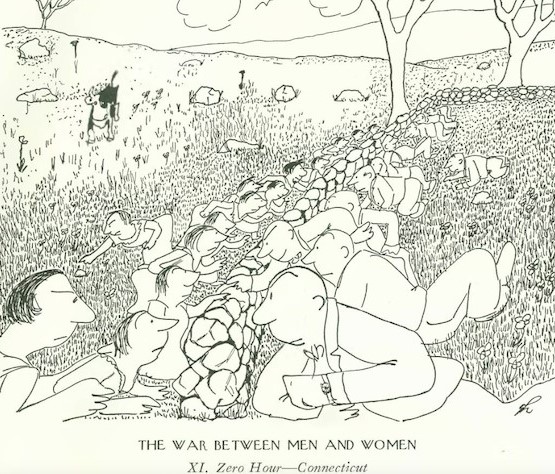 Then, there was humorist James Thurber. I flipped through his book Men, Women, and Dogs, originally published in 1943, laughing at the cartoons. But the only ones I remember decades later were a series that, to my young mind, were both funny and weird: “The War Between Men and Women” (the inspiration for the 1972 comedy movie of that name), featuring literal pitched battles between armies of the opposite sexes.
Apparently, that battle has been going on for a long time.
Fortunately, there are not literal physical armies of men fighting armies of women. But we do have the ongoing verbal and sometimes legal battle between feminism and the manosphere. And in general, for a century or more there has been tremendous conflict and chaos about the roles of women and men, and their relationship with each other legally, socially, economically, and interpersonally.
Are men and women destined to be in eternal conflict with one another?
I don’t think so.
But I do think that the current chaos in that realm is a symptom of a major transition in the relationship between man and woman. Specifically, I believe we are making the painful transition from an era lasting thousands of years in which women were secondary to, and even subservient to, men, to a new era in which there will be genuine equality—but not sameness—between men and women.
And I believe that this is a good thing.
Chaos and conflict
Emanuel Swedenborg (1688–1772) wrote:
Before being reduced to order, it is very common for everything to fall into confusion or seeming chaos. This allows things that cling together poorly to separate, and when they have separated, the Lord arranges them in their place. (Secrets of Heaven #842)
When it comes to male-female relations, we are in the middle of that chaos right now. And it’s an uncomfortable time to be in. Long-established patterns of behavior and relationships are breaking down. Gender relations are fraught with conflict, leading some on both sides to walk away from the “dating game” altogether. On the male side, there is the MGTOW movement. On the female side, many women are choosing to delay forming a relationship, or to remain single long-term.
One result of the new gender confusion and conflict is the widely recognized falling birth rates in much of the world. Outside of Africa, much of the world has now fallen below the birth rate required to maintain the current human population. The old pattern of marrying young and having lots of babies is itself something of an endangered species.
All this prompts some to say that the end is near. And indeed, the end is near. But it’s not the end of the world. It’s the end of the old order of things.
A new order will emerge from the current chaos. And it won’t be the same as the old order of things.
The old order
For thousands of years, ever since the spiritual events among early humans described metaphorically in Genesis 2:18–3:24 (See “Man, Woman, and the Two Creation Stories of Genesis”) woman has been secondary to man. In the best case, a woman would wrap her life around the life of her husband, serving his needs, and of course, bearing his children. In the worst case, woman would be reduced nearly to the status of a slave, being dominated and ruled over by her husband.
Romantic notions of earlier societies in which women were warriors, chiefs, and priestesses are mostly just that: romantic notions. Though every society has had its exceptional women who rise to high levels and achieve great things, these women are the stuff of lore and legend precisely because they are so rare throughout history. For the overwhelming majority of women, life was one of service and subservience to the men in their lives.
In the best case, this was not a bad arrangement for women. However it might look to us today, it did provide women the necessary safety and security to live their lives and bear and raise their children, giving their lives meaning—and pragmatically speaking, making it possible for them to pass their own genes and their own heritage on to succeeding generations. In general, throughout history, life was not any worse for women than it was for men. The existing order of things was established and accepted. People simply lived out their lives, men, women, and children together.
And compared to the way much of the world’s population lives today, life was hard. Women died young, and so did men. For most people, throughout most of human history and pre-history, life was a daily struggle for food, shelter, clothing, and other necessities of life. Women died in childbirth. Men died in battle. Life was short and brutish. There was no halcyon era of peace, enlightenment, and equality—at least, not in any of the human history we know about. Most people in today’s world live far better and more secure lives than in any culture or society at any time in the past.
Yes, there were times when culture and gender relations were more settled and stable than they are today. But anyone who has a realistic picture of the past would not want to go back there compared to the life that we have managed to achieve for ourselves today. There were no “good old days.” There was no time when “all the women were strong, all the men were good-looking, and all the children were above average,” to adapt the famous line from “Lake Wobegon.” That’s nostalgia, not reality.
And with the new prosperity, safety, and security (not perfect, I know), there has come a shift from the old patterns of male-female relations.
The new order
The shift started with the women. As life became better, and less of a sheer struggle for survival, women began pushing for rights that they historically had not had. The right to vote. The right to own property. The right to divorce. The right to consensual sex. And so on. This new struggle was not easy, and it is not over, but women have gained many of these rights in much of the world.
And these are real advances over the earlier order of things. Under the old order, if a woman had a good man, she was generally okay, and her life could be good. But if she got stuck with a bad man, or even a mediocre man, she had few recourses. Her life could become very bad very fast, and there wasn’t a whole lot she could do about it. If nothing else, the new rights for women that men had always had started giving women the tools they needed to improve their own lives, and to extract themselves from destructive situations. And that’s a good thing.
But the big picture is that the old order of man being primary and woman being secondary is breaking down. That is the underlying issue in all the gender conflict and chaos in the world around us today.
The new order that will emerge from the current chaos is one in which women and men are fully equal legally, socially, economically, and interpersonally. It is an order in which woman will not walk three steps behind man, but the two will walk together, side-by-side, as equal partners.
Does this mean that woman and man will be exactly the same?
Of course not. Women will still be women, and men will still be men. The differences are real, both physical and psychological, and that will never change. Why would God create two sexes in the first place if there were no difference between the two? It is precisely in the differences working together that man and woman become stronger and greater together.
But those differences don’t require one to be the head and the other to be the tail. It is possible for men and women to work together as equals while recognizing the distinct contributions that each makes to the whole. Women will still be women, and men will still be men. And each will appreciate and value what the other brings to the table, and to the relationship, without vying for “leadership” or supremacy.
A vision of a couple in the highest heaven
I could go on to describe the nature of this type of relationship, but I’ve already done that in some of the articles linked below, especially in the final part of the (initially tongue-in-cheek) article “What Do Women Really Want?” Instead, I’ll offer a picture of this kind of love, in the form of an experience Swedenborg had in the spiritual world:
Once when I was thinking about marriage love I had a yearning to know what that love was like for the people who had lived in the Golden Age, and what it was like later in the following ages named after silver, copper, and iron. I knew that everyone who lived rightly in these ages is in heaven, so I prayed to the Lord to let me talk with them and be informed.
And there beside me stood an angel! He said, “The Lord sent me to guide you and keep you company. First I’m going to guide and accompany you to those who lived in the first age or era, called Golden.” (Marriage Love #75)
Swedenborg then describes the long and difficult journey required to reach the heaven of the people who lived in the early, now mythical, Golden Age. After arriving, he met a married couple from that heaven. (Yes, there is marriage in heaven!) Here is the beginning of that encounter:
The man wore a blue cloak and a tunic of white wool, and his wife wore a purple gown and an embroidered linen blouse under her tunic.
Since I had been thinking that I wanted to find out about the marriages of the earliest people, I looked closely at the husband and the wife, one at a time, and I noticed in their faces a sort of unity of their souls. I said, “You two are one!”
“We are one,” the man replied. “Her life is in me and mine is in her. We are two bodies but one soul. The union between us is like the two tents in your chest called heart and lungs. She is my heart, and I am her lungs. But here we mean love when we say ‘heart’ and wisdom when we say ‘lungs,’ so she is the love of my wisdom and I am the wisdom of her love. Because of this her love from outside veils my wisdom, and my wisdom from inside is in her love. This is why you can see the unity of our souls in our faces.” (Marriage Love #75)
Yes, there’s some talk of “inside” and “outside.” But the key metaphor here is that the husband and wife are one the way the heart and lungs are one, the wife being the heart and the husband being the lungs.
Now let me ask you a question: Which is more important, the heart or the lungs?
Really, it’s a silly question. Neither one can function without the other. Both are essential for the life and functioning of the body. If it weren’t for the lungs, the heart would have no life-giving oxygen to pump to all the cells of the body. If it weren’t for the heart, the lungs would have nothing to distribute the life-giving oxygen that they extract from the air. And even if, by popular acclaim, the heart were to be acclaimed the most important organ, keep in mind that the wife is the heart, not the husband.
The underlying message is that this is a oneness, not of primary and secondary, but of two equal partners working together side-by-side in everything they do. Arguments about which is “primary” are useless distractions. Each one has its own essential contribution to the partnership, without which there is nothing but death.
A new partnership
Change is hard. Men, especially, are having a hard time adjusting to the new reality that women are no longer their helpers, still less their servants, but are now becoming equal partners both out in the world and within marriage and relationships.
But it is a change for the better. And once the transition is complete, both men and women will be far happier in their relationships and in their working lives out in the world.
Consider what life would be like for the heart and lungs if one were always trying to be the head, and make the other into a helper or servant. What a waste of time and energy! Better to let each focus on and excel at what it does best, so that both can work together to achieve greater things.
And of course, the heart is never going to become the lungs, and the lungs are never going to become the heart. Men and women never have been the same, and they never will be the same. And that’s a good thing. If life were all heart, and no lungs, where would we be? And if life were all lungs, and no heart, where would we be?
Life and relationships are much better when each stands on his or her own two feet, fully committed to the relationship and to the common work, freely choosing to be with his or her partner for what the two of them can be and accomplish together, which neither of them can on their own.
In the new partnership, the weight of responsibility and leadership does not fall more heavily on the man, nor does it fall more heavily on the woman. Each carries an equal, if different, share of the burden. Each makes an equal, if different, contribution to the relationship and to its work. There are no leaders and followers. There are two partners working together, and walking together, throughout all the pathways, struggles, and accomplishments of life.
Once we have achieved this new partnership, the war between men and women will cease, and we will enter a new Golden Age, both in our relationships and in our society.
Here is a shorter video version of this post:
For further reading:
- What are the Roles of Men and Women toward Each Other and in Society?
- Man, Woman, and the Two Creation Stories of Genesis
- “Wives, submit to your husbands.”
- A New Model of Manhood
- What Do Women Really Want?
Share this:


Lee Woofenden is an ordained minister, writer, editor, translator, and teacher. He enjoys taking spiritual insights from the Bible and the writings of Emanuel Swedenborg and putting them into plain English as guides for everyday life.


 Spiritual Insights for Everyday Life
That story Swedenborg recounts really does make Heaven seem all stuffy and formal, and not just the afterlife from Swedenborg’s time. From the way that couple is dressed to the way the angel and the couple speak. Seems overly formal and ritualistic.
PS: And not just in that story, but in pretty much all the others too. Aside from the overly formal dialog, the people are always dressed in tunic this and elaborate jewelry that.
Hi K,
I think this is mostly due to translation, at several levels.
First, Swedenborg is taking a spiritual experience and reducing it to earthly language, and specifically, to fairly standard, simplified 18th century Latin scholarly language. The angels themselves would be speaking the universal heavenly language, which vividly and directly expresses thoughts and feelings in a way that can’t be fully represented in earthly language.
And second, that Latin is being translated into English by people who did not have the original experience, and who have their own cultural tendency to put it in somewhat formal and stuffy English.
The result is something that sort of gives a sense of what Swedenborg experienced, but has had a lot of the life taken out of it. Even Swedenborg’s Latin in his stories from the spiritual world is more vivid and varied than what comes through in most English translations. But few people today have the living sense of Latin that Swedenborg and many other intellectuals of his day had, given that they spoke and wrote in it every day, making it, for them, a living language, whereas for us it is a dead language.
As far as clothing, that’s probably a limitation of language also. Tunics, robes, etc., are well-represented in Latin due to its origins in Roman culture, where this was standard attire. Swedenborg had to use the language available that best fit what he saw.
Bottom line: the reality in heaven will be far more vivid than what comes through in our English translations of Swedenborg’s Latin accounts of what he experienced in the spiritual world.
Even if they do not always act so formal and ritualistic, angels seem to always be overdressed. Like I said, it’s like tunic this, cloak that, etc. Even angels from the supposedly nudist innermost Heaven overdress when they wear clothes.
HI K,
I wouldn’t say they’re overdressed. They follow the usual pattern of having undergarments and overgarments.
Today, it’s very common for people to have two to three layers of clothing. There’s the underwear, there’s the pants/shirts/dress, and there’s an overcoat, shawl, or some other garment placed over them either for warmth or for looks.
These layers of clothing represent the various levels of people’s socially-presented thinking. In a “cold” or unfriendly environment, we put on the most social coverings to conceal our true thoughts and feelings. In more casual, accepting, and friendly environments, we shed the overcoats, and express ourselves in ways closer to our true thoughts and feelings. We don’t usually show our underwear except to people we’re very close to. And nudity is reserved for people that we trust completely.
People in the spiritual world, including angels, follow the same pattern, because it is a correspondence of the relationships they have with various kinds of people.
Either way, people in non-nudist Heaven don’t have to overdress with 2 or 3 layers of clothing all the time, do they? Maybe the ones who met Swedenborg overdressed because that is what Swedenborg was used to?
Hi K,
People in heaven can wear whatever they want to wear, whether it’s zero layers or ten layers. Most won’t be comfortable with zero layers in public, just as most people on earth aren’t. We’re the same people there as we are here. People who have worn clothes all their lives don’t suddenly become nudists. And yes, as I said before, I suspect that couple from the third heaven were dressed as they were for the benefit of Swedenborg and his angel guide.