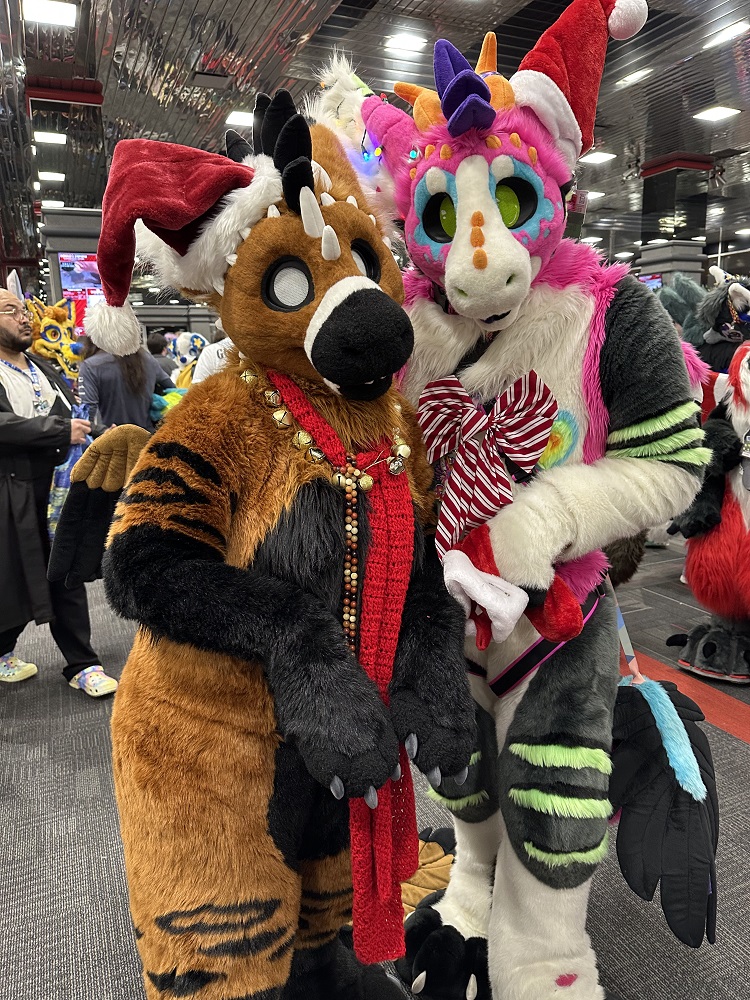
 In recent weeks and months, the latest way for young people to annoy their parents has been in the news. Most of the action happens online, but there are in-person gatherings and conventions too. That’s when the older generation really gets worked up.
What terrible, awful thing are the youth doing now?
They’re dressing up as animals and calling themselves “furries“ and “therians.” Shocking!
But don’t call a therian a furry, or a furry a therian. You’ll get an earful about how they’re not at all the same! Here’s how to tell the difference:
- A furry is an animal being human.
- A therian is a human being an animal.
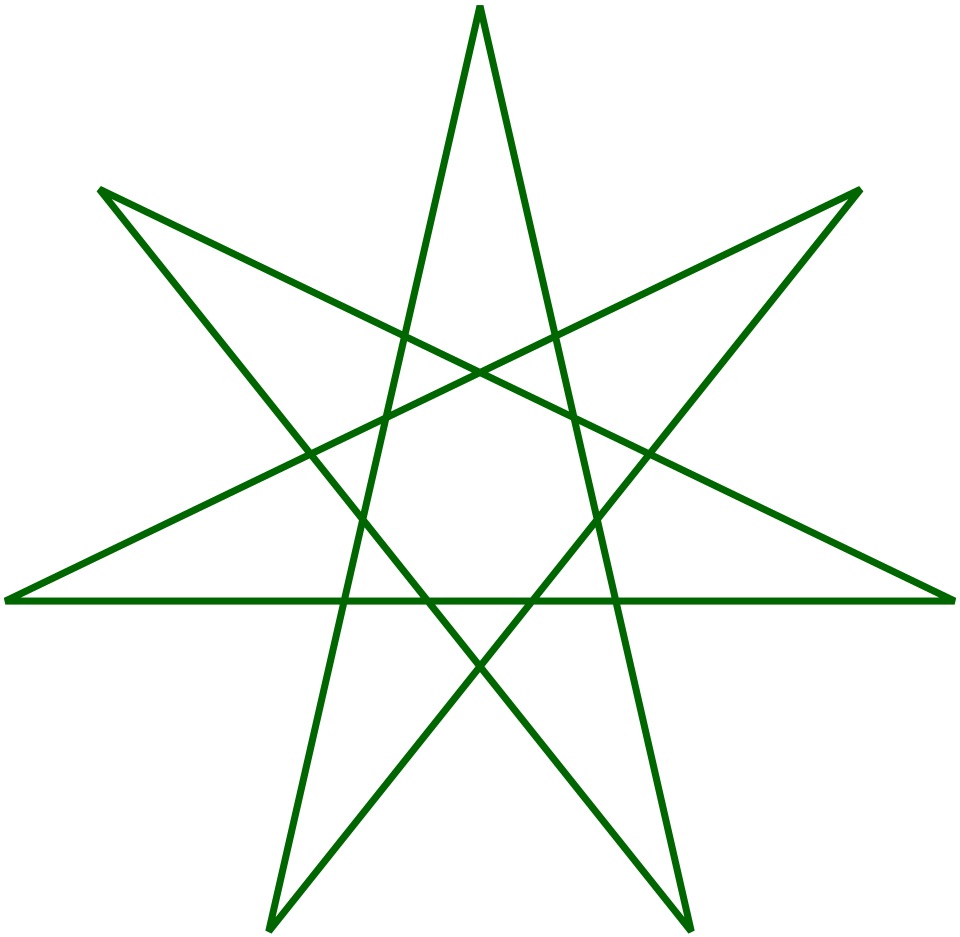
Otherkin heptagram
In fancier terms, a furry is someone who’s into anthropomorphized animals, whereas a therian is a person who identifies with, or as, a mammalian animal. Therians are part the broader phenomenon of “otherkin,” which is a blanket term for people who identify with various non-human creatures and species.
One classic expression of the “furry” idea is the 1972 novel Watership Down, by Richard Adams. The novel centers on a clan of talking rabbits that are culturally very human. Therians, on the other hand, are more akin to individuals in some indigenous cultures identifying with the spirit of a particular animal.
Though furries and therians are effective at annoying the older generation, they’re really nothing new. Even the Bible has a story about a talking donkey.
And what about those satyrs? We’ll get to that. As it turns out, there is a real connection between humans and animals, not only physically, but spiritually.
Talking donkeys?
A favorite target of atheists who set out to “debunk” the Bible is the story of Balaam’s donkey. Balaam was a prophet—but not an Israelite prophet, and his career in the Bible is quite checkered. Here’s the story:
Balaam got up in the morning, saddled his donkey, and went with the Moabite officials. But God was very angry when he went, and the angel of the Lord stood in the road to oppose him. Balaam was riding on his donkey, and his two servants were with him. When the donkey saw the angel of the Lord standing in the road with a drawn sword in his hand, it turned off the road into a field. Balaam beat it to get it back on the road.
Then the angel of the Lord stood in a narrow path through the vineyards, with walls on both sides. When the donkey saw the angel of the Lord, it pressed close to the wall, crushing Balaam’s foot against it. So he beat the donkey again.
Then the angel of the Lord moved on ahead and stood in a narrow place where there was no room to turn, either to the right or to the left. When the donkey saw the angel of the Lord, it lay down under Balaam, and he was angry and beat it with his staff. Then the Lord opened the donkey’s mouth, and it said to Balaam, “What have I done to you to make you beat me these three times?”
Balaam answered the donkey, “You have made a fool of me! If only I had a sword in my hand, I would kill you right now.”
The donkey said to Balaam, “Am I not your own donkey, which you have always ridden, to this day? Have I been in the habit of doing this to you?”
“No,” he said.
Then the Lord opened Balaam’s eyes, and he saw the angel of the Lord standing in the road with his sword drawn. So he bowed low and fell facedown.
The angel of the Lord asked him, “Why have you beaten your donkey these three times? I have come here to oppose you because your path is a reckless one before me. The donkey saw me and turned away from me these three times. If it had not turned away, I would certainly have killed you by now, but I would have spared it.” (Numbers 22:21–32)
Now, you and I know that donkeys don’t talk. But there it is right in the Bible: a donkey that talks like a human being. And it’s not just the equivalent of grunts and squeals. It’s a rational human conversation between Balaam and his donkey.
The story says that “the Lord opened the donkey’s mouth.” For a biblical literalist, that’s enough. If God wants to make a donkey talk, God can make a donkey talk.
But the Bible is not a simplistic book, and this is not a simplistic story. People in those days also knew that donkeys can’t talk. And based on today’s science, we know that lower animals such as donkeys do not have the brain capacity to engage in rational thought and express it in speech. If they did, they would have developed language by now, just as we humans have, to express their thoughts.
Clearly, something else is going on here. In present-day idiom, we would say that God put words into the donkey’s mouth. And God’s voice comes from within.
The explanation offered by Emanuel Swedenborg (1688–1772), contained in two of his unpublished (by him) works, is that Balaam heard God’s words in his mind, but they were superimposed on the sounds the donkey was making so that it sounded to Balaam as if the donkey was speaking to him. You can read Swedenborg’s explanations for yourself in Spiritual Experiences–Word Explained #361 and Apocalypse Explained #140:5.
Regardless, here is a story in the Bible of an anthropomorphized animal. A donkey speaks as if it were a human being, just as the rabbits do in Watership Down. Today’s furries anthropomorphizing animals is nothing new. It goes back thousands of years. It was part of our literature long before it became a present-day movement.
A king becoming an animal?
Daniel chapter 4 tells the story of Nebuchadnezzar’s dream of a tree. In it, Nebuchadnezzar dreams of a magnificent, abundant tree that is cut down to a stump and bound with iron and bronze. It is then said of the felled tree:
Let him be drenched with the dew of heaven, and let him live with the animals among the plants of the earth. Let his mind be changed from that of a man and let him be given the mind of an animal, till seven times pass by for him. (Daniel 4:15–16)
In the prophet Daniel’s interpretation of the dream, King Nebuchadnezzar himself is the tree—and this is what Daniel reluctantly prophesies will happen to him:
You will be driven away from people and will live with the wild animals; you will eat grass like the ox and be drenched with the dew of heaven. Seven times will pass by for you until you acknowledge that the Most High is sovereign over all kingdoms on earth and gives them to anyone he wishes. (Daniel 4:25)
And sure enough:
All this happened to King Nebuchadnezzar. Twelve months later, as the king was walking on the roof of the royal palace of Babylon, he said, “Is not this the great Babylon I have built as the royal residence, by my mighty power and for the glory of my majesty?”
Even as the words were on his lips, a voice came from heaven, “This is what is decreed for you, King Nebuchadnezzar: Your royal authority has been taken from you. You will be driven away from people and will live with the wild animals; you will eat grass like the ox. Seven times will pass by for you until you acknowledge that the Most High is sovereign over all kingdoms on earth and gives them to anyone he wishes.”
Immediately what had been said about Nebuchadnezzar was fulfilled. He was driven away from people and ate grass like the ox. His body was drenched with the dew of heaven until his hair grew like the feathers of an eagle and his nails like the claws of a bird. (Daniel 4:28–33)
It is a tale of human hubris brought low. Nebuchadnezzar is eventually restored to his throne, but only after acknowledging that the power and the glory are God’s, not his own.
Regardless, here is a story in the Bible of a human being living like a wild animal, and taking on animal characteristics: grazing like an ox, and growing hair like eagle’s feathers and nails like a bird’s claws. Today’s therians expressing their inner animal is nothing new. It goes back thousands of years.
Our inner animal?
People who love animals commonly see human traits in animals, and animal traits in people.
This should not be too surprising. From a material-world evolutionary perspective, we were once non-human animals ourselves. Both our physiology and our psychology evolved from their early evolutionary roots in the animal kingdom. To this day, our bodies and our minds have many similarities to those of our animal relatives. The human difference is that we have higher levels of motivation, thinking, and physical dexterity built on top of our animal foundations.
From a spiritual perspective, Swedenborg states that animals do indeed represent something about the human mind and spirit. He even assigns specific meanings to many different animals as part of his spiritual or “correspondential” method of interpreting the Bible. Here are a few examples:
- A lion = The power of truth from a good heart
- A lamb/sheep = Innocence, love, and kindness
- A dove = Innocence and purity of thought
- A serpent/snake = A focus on the physical senses
- An eagle = A broad view based on rational thinking
- A goat = A focus on outward, literal beliefs
- A cow = A focus on outward good behavior
These are simplified, basic meanings. This type of animal symbolism isn’t unique to Swedenborg. The meaning of each animal also varies and becomes more complex depending on the context. But this gives an idea of how particular animals may relate to specific elements of human character.
Why are so many of us drawn to animals? Because animals reflect something of our own thoughts, feelings, character, and spirit.
What about those satyrs?
Here’s the beginning of one of Swedenborg’s stories based on his experiences in the spiritual world:
My eyes were opened, and I saw a dark forest and a crowd of satyrs in it. The satyrs had hairy chests, some had feet like calves, some like panthers, and some like wolves, and they had the claws of wild animals on their feet in place of toes. They were running around like wild beasts and shouting, “Where are the women?” (Marriage Love #521)
Satyrs are part human, part animal creatures in Greek mythology. As reflected in this story, they are associated with male sexual “lust,” or lecherous desire. As the story unfolds, it becomes clear that these are not actually satyrs, but people—albeit very materialistic and immoral people. To each other, and even to Swedenborg when they approach him, they look like normal people.
Swedenborg tells them that they look like satyrs from a distance because of their lecherous sexual desires. He suggests that they send some of them off into the woods to see for themselves. The story continues:
They did it and sent two, and near the brothel shack they saw them just like satyrs. When the satyrs came back, they greeted them and said, “Oh, did you look funny!”
While they were laughing, I joked about different things with them, and told how I had even seen adulterers look like pigs.
This, of course, is a negative example. But it is an example of our animal side showing itself as people who look partly animal. Once again, the idea of humans taking on partially or wholly animal forms has been in the culture for hundreds and even thousands of years.
A scene of innocence and peace
However, the human-animal connection is not necessarily animalistic. It can also be innocent and good. In another of his stories from the spiritual world, Swedenborg describes a journey he took to a part of heaven where people from an earlier and simpler era lived. To get there, he and his angel guide had to travel through a dark forest that provided protection against people who might disturb the peace of the angels who lived there. Once they came within visual range, Swedenborg says:
There beyond the grove was a rolling meadow where rams and ewes were grazing. They were symbolic of the mountain people’s innocence and peace. (Marriage Love #75)
Sheep, as I said earlier, represent innocence and love, which also bring us peace. And not only were these gentle animals associated with these high-level angels, but, Swedenborg goes on to say:
As we went, I saw at a distance three boys and three girls sitting at the door of one of the tents. But when we came closer, they turned out to be men and women of medium height.
“All the inhabitants of this mountain look like little children from a distance,” the angel said, “because they are in a state of innocence, and childhood is what innocence looks like.”
Anything can become negative by being abused or taken to extremes. People are people. Still, even though it may look strange to the older generations, mostly, furries and therians just seem to be engaging in some playful fun. It is a type of fun that also has real spiritual significance behind it.
Here is a shorter video version of this article:
For further reading:
- Will We See our Pets Again in Heaven?
- The Red Pill Movement (PUA): Men Waking Up as Animals
- Where is the Garden of Eden?
- Are Angels Sexless Beings?
- Your Crowdsourced Mind
Share this:


Lee Woofenden is an ordained minister, writer, editor, translator, and teacher. He enjoys taking spiritual insights from the Bible and the writings of Emanuel Swedenborg and putting them into plain English as guides for everyday life.


 Spiritual Insights for Everyday Life
I’m glad someone religious isn’t calling therians and furries bad.
Hi Vee,
Thanks for stopping by, and for your comment. As you can probably tell, furries and therians aren’t my cup of tea. But no, I don’t think they’re bad. In fact, as I say in the article, I see them as a present-day expression of something that has been part of human experience for thousands of years, and that also has a spiritual significance.
Meanwhile, Godspeed on your spiritual journey!
As someone who’s been in the furry fandom for over 20 years, I can attest that it’s just like any other fandom: a group of people gathered around a common interest (anthropomorphic animals) contributing to said interest with art (clean or R-rated), stories, video, music, and whatnot. It’s really no different than Star Trek fans, Star Wars fans, Matrix fans, Lord of the Rings fans, etc.
As to why people are drawn to anthropomorphic animals… well, ask a dozen members of the fandom and you’ll get a dozen different responses. Some love animals and wish they could have humanoid versions of them as companions; others feel drawn to a particular animal and use them to express traits they wish they could have, like confidence, self-esteem, physical ability, etc. Others love the idea of being able to hang out and be friends with pop-culture characters like Godzilla, the dinosaurs from the Jurassic Park/World franchise, or characters from My Little Pony: Friendship is Magic without fear of being eaten or harmed.
In the end, as long as everyone involved enjoys themselves, harms no one, and keeps minors from seeing age-inappropriate material, there’s nothing to fear from either fandom.
Hi Imperfect Glass,
Thanks for your thoughts. I agree! And it’s good to hear from you again. It’s been a while. Hope all is well with you and yours.