Recently in the comments section of one of the articles here, a reader named World Questioner asked:
Why did God take 15 billion years to create the physical world? Couldn’t he have done it in just six days? What is a good reason for God to have all species descended from a common single-celled ancestor? Couldn’t he make all species distinct and create each creature to reproduce after its kind? Why did God decide humans should be descended from apes? Couldn’t the first humans have just been created separately, distinct from all animals?
You can see the comment here, and my original response here. This article is an edited and expanded version of my original reply.
Hi World Questioner,
All these questions zero in on a single aspect of how God creates things:
God creates things, not instantaneously, but by using step-by-step processes. Nothing just pops into existence. Everything develops over time.
Why?
It’s a very good question. I’m still thinking about it.
One answer is that God is working with material reality, which is pliable, but also resistant to change. Compared to divine reality, which operates outside of time altogether, and is present in all time and space simultaneously, and compared to spiritual reality, which also has no time and space as we know it, but which does have distance and nearness and a sequence of events, material reality exists within space and time. In material reality, things must unfold over spatial distances and on temporal time scales. This means that doing things instantaneously is contrary to the very nature of physical reality.
Why did God create material reality in this way?
The created universe must be different from God
One answer is that for anything to be not-God, and therefore able to have a relationship with God, it must have distinct differences from God. And yet, it must still express something of God’s nature so that there are commonalities between God and Creation that make a real relationship possible.
If we were nothing at all like God, if God were a totally alien being, how could we have any understanding of God? How could we come to love God? How could we have a relationship with God, and God with us, if we couldn’t comprehend God at all? If we could form no concept of God, God would mean nothing to us. And we can’t love nothing.
But we can love God if we are created in the image and likeness of God, as Genesis 1:26–27 says. We can love God if God is sort of like us, only far greater.
We can’t really love someone that we have nothing at all in common with, can we? Even people from very different nations and cultures still share common human thoughts, feelings, and experiences that make a relationship between them possible. But it is the differences that make the relationship real—and make it interesting and even exciting!
The way God accomplished this similarity and difference was to spin out Creation from God’s own substance so that it expresses God’s nature, but to impose limits on created reality, both spiritual and material. This means that Creation expresses the character of God, but it is also different from God. God is infinite. God has no limits. Created reality does have limits. That makes it, and us, different from God.
God put fewer limits on spiritual reality, and greater limits on material reality. One of the limits of material reality is that things must develop and unfold over time, within space. This means that things in the material universe must happen via processes, not instantaneously.
Material reality both responds and resists
Another answer is that material reality, and the material world, must provide the opportunity for sentient, spiritually aware beings (us) not to choose a loving relationship with God.
If we were not free to reject the relationship God wants to have with us, we would not be human, and the relationship wouldn’t be real. It would just be something God programmed into us, making it meaningless. How much does a friendship mean if both people are simply programmed to have that friendship? That’s just an algorithm, not a real human relationship.
Designing the physical level of reality to have the ability not to do what God wants it to do means designing it with a certain amount of resistance to divine and spiritual influences. It means making things somewhat—or even very—inefficient, so that the material world doesn’t always do what God and the angels want it to do. It means that God and the angels must labor to get physical reality to do what they want it to do. This is the meaning of the six days of Creation, and of the six days of labor, culminating in the seventh day of rest. There is real work involved in producing the finished product: angelic human beings who will live forever in heaven.
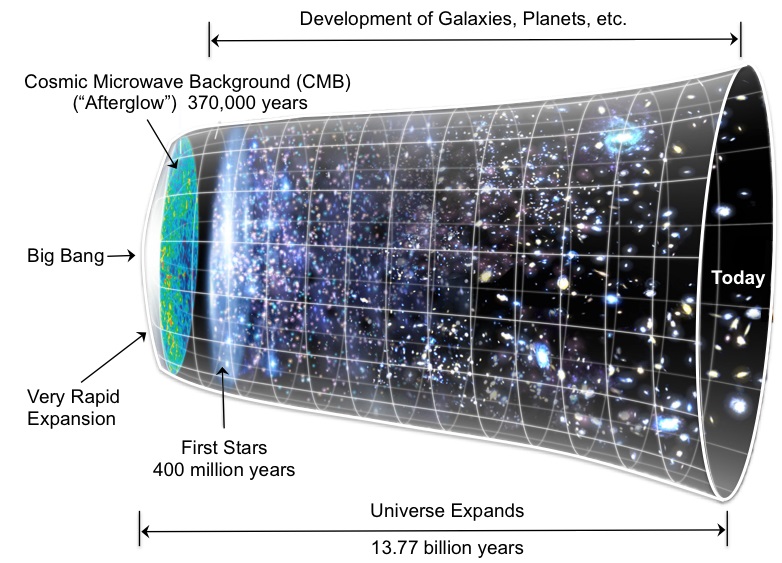
Pan out to the grand scale of the physical universe, and an answer to your question emerges: The material universe is naturally resistant to what flows in from God and spirit. It takes a long time for material reality to respond. It took over nine billion years for the universe to get to the point where it produced Earth—a planet capable of supporting life. It took another half a billion years or so before Earth began hosting life. It took another three or four billion years before that life developed to the level of organization and complexity required to host a sentient, spiritually aware mind: ours.
God does not work by forcing things, and people, to do what God wants them to do. God works by bending and influencing things, and people, to do what God wants them to do. This means that particular people, and particular parts of creation, can opt out of God’s plan. Not every planet is capable of hosting life. Even fewer planets are capable of hosting complex, sentient life. It’s quite possible that even some planets that could host life don’t host life. No one is forcing them to. God makes it possible. But the material universe must say “yes,” or nothing will happen.
Mind you, I’m not speaking literally here. I don’t believe, as some do, that the material universe is conscious. But it does operate by its own rules, and there is a certain element of randomness built right into those rules. Sometimes that randomness may figuratively say “yes,” and sometimes it may say “no” to what God and the angels are working to achieve here in the material universe.
In short, God works by coaxing and cajoling Creation to move toward hosting human beings who can love God, love one another, and live forever in heaven. And just as it takes us the ol’ threescore and ten years of emotional and spiritual growth to become that sort of person, so on a grander scale it takes billions of years for the universe to become the kind of universe in which we soft, delicate human beings can live . . . at least, on a few rare and precious specks in the vast voids and violence of the physical universe.
Time means nothing to God
Why does it take so long? About 13.8 billion years, by current estimates of the age of the universe.
Keep in mind that for God, time is meaningless. God is present in all of time all at once. For God, it doesn’t matter if it takes six days or 13.8 billion years or 13.8 trillion trillion years. All time scales are the same for God, because God is present in all of them simultaneously, from a realm of being that is outside of time and space. God sees and interacts with all time and space at once, no matter what their scale. As the Psalm says poetically of God:
For a thousand years in your sight are like yesterday when it is past, or like a watch in the night. (Psalm 90:4)
God has all the time in the world to make us. God is in no hurry. And God created a material universe in which things unfold over time—long periods of time.
Creation by trial-and-error
This also means that what does develop is very robust and resistant to forces that would tear it down.
Evolution is a process of trial-and-error that unfolds over hundreds of millions of years, and longer. What emerges, under the influence of divine and spiritual forces gradually coaxing evolution in a human direction, is organisms wonderfully adapted to survive in the conditions that this earth throws at them, and able to persist and thrive in those conditions.
On a different planet, under different conditions, the organisms, including the ultimate human organisms if there are sufficient time periods and conditions for them to develop, will persist and thrive in those conditions.
As for the specific evolutionary path it took to get from our single-celled ancestors to us, I’m hardly qualified to talk about that. I’m a theologian, not an evolutionary biologist. But once again, the development of complex, rational, spiritually aware beings under material-universe conditions is a long, complex task that had to go step-by-step from the primeval amoeba all the way to the human body and the mind it contains. Apes just happen to be one of many steps along the way. Apes have a lot of what we have, but they’re not quite there yet. It took several more evolutionary steps to get to us.
An infinite God means a vast universe
One more thing:
Creating a universe this vast, having such huge time scales, gives us time- and space-bound humans some sense of the greatness of God.
If the universe were a small little thing—only about the size of earth’s orbit around the sun, as we once thought—we might admire God, but we wouldn’t necessarily be in awe of God. But it’s hard for a believer to look out on just how huge and old the universe is, really contemplate its unimaginable vastness, and not be overwhelmed by the omnipotence and infinity of God!
Why would an infinite God create a puny, quick little universe when God could create a vast, ancient universe? Anything else would hardly be a worthy expression of God’s infinite love and wisdom.
Here is a shorter video version of this article:
For further reading:
- How did God Create the Universe? Was the World Really Created in Six Days?
- On Pluto, Atoms, and Other Things (such as Heaven) that Just Keep Getting More Complex
- God: Puppetmaster or Manager of the Universe?
- Do Galaxies Have Heart and Lungs?
- Containers for God
- Spirit: The Final Frontier
Share this:


Lee Woofenden is an ordained minister, writer, editor, translator, and teacher. He enjoys taking spiritual insights from the Bible and the writings of Emanuel Swedenborg and putting them into plain English as guides for everyday life.



 Spiritual Insights for Everyday Life
What do you think?