
The Faulty Foundations of Faith Alone – Part 6: Jesus’ Death Appeased the Father’s Wrath?

For Part 5, click here: The Faulty Foundations of Faith Alone – Part 5: Jesus Paid the Penalty For Our Sins?

Or start at the beginning: The Faulty Foundations of Faith Alone – Part 1: God is a Trinity of Persons?

As shown in Part 5, the whole idea that Jesus died to pay the penalty for our sins is not only completely non-Biblical, but is diametrically opposed to the Bible’s plain teaching that God neither condemns the innocent nor acquits the guilty—and neither must we.

And yet, somehow Jesus paying the penalty for our sins is supposed to satisfy God the Father’s justice, and appease God the Father’s wrath.

It would be hard for anything to be more false than this.

For more on divine wrath and justice, please click here to read on.

Tagged with: , , , , , , , ,
Posted in All About God, The Bible Re-Viewed

The Faulty Foundations of Faith Alone – Part 5: Jesus Paid the Penalty For Our Sins?

For Part 4, click here: The Faulty Foundations of Faith Alone – Part 4: God Condemns Us to Hell Because We’re Not Perfect?

Or start at the beginning: The Faulty Foundations of Faith Alone – Part 1: God is a Trinity of Persons?

Here’s where we get to the crux of the matter.

The Protestant theory of justification by faith alone is tightly connected with an atonement theory called penal substitution, which was developed by the leaders of the Protestant Reformation in the 1500s. Here’s the basic idea:

For more on penal substitution, please click here to read on.
Tagged with: , , , , , , , , ,
Posted in All About God, The Bible Re-Viewed

The Faulty Foundations of Faith Alone – Part 4: God Condemns Us to Hell Because We’re Not Perfect?

For Part 3, click here: The Faulty Foundations of Faith Alone – Part 3: It’s Impossible to Satisfy God?

Or start at the beginning: The Faulty Foundations of Faith Alone – Part 1: God is a Trinity of Persons?

Based on the previous faulty foundation of faith alone—the idea that we can never satisfy God’s perfect justice—the doctrine of justification by faith alone then goes on to say that because we can never be perfect in God’s eyes, God continues to be angry and wrathful toward us, and condemns us to eternal hell.

And that is a terrible smear on the name and character of God.

For more on God the tyrant, please click here to read on.

Tagged with: , , , , , , , ,
Posted in All About God, The Bible Re-Viewed

The Faulty Foundations of Faith Alone – Part 3: It’s Impossible to Satisfy God?

For Part 2, click here: The Faulty Foundations of Faith Alone – Part 2: Original Sin?

Or start at the beginning: The Faulty Foundations of Faith Alone – Part 1: God is a Trinity of Persons?

After stating (falsely) that we are born sinful and guilty, the doctrine of justification by faith alone goes on to say that it is impossible for us to become righteous enough to satisfy God’s justice.

The idea is that not only are we sinful and guilty from birth, but God’s standard for us is nothing short of perfection, and we must therefore become perfectly sinless in order to avoid God’s judgment. Unfortunately, as most of us realize, perfection is not possible for us ordinary mortals.

In other words, it’s impossible for us to satisfy God.

Really???

For more on satisfying God, please click here to read on.

Tagged with: , , , , , , , , ,
Posted in All About God, The Bible Re-Viewed

The Faulty Foundations of Faith Alone – Part 2: Original Sin?

For Part 1, click here: The Faulty Foundations of Faith Alone – Part 1: God is a Trinity of Persons?

The doctrine of Original Sin is another faulty foundation of faith alone that predates Protestantism. Like the Trinity of Persons, it is an old Catholic doctrine that was not rejected by the Protestant reformers, but was incorporated into their sola fide theology.

In fact, Martin Luther (1483–1546) and John Calvin (1509–1564), the primary founders of Protestantism, doubled down the Catholic doctrine of Original Sin, turning it into something even more non-Biblical.

For more on Original Sin, please click here to read on.

Tagged with: , , , , , , , , , ,
Posted in All About God, The Bible Re-Viewed

The Faulty Foundations of Faith Alone – Part 1: God is a Trinity of Persons?

When Martin Luther (1483–1546) made his big break from the Roman Catholic Church, he originated a new doctrine, which he set up as the foundation stone of Protestant belief. That doctrine is “justification by faith alone,” also known by its Latin shorthand name, sola fide (“by faith alone”).

Justification by faith alone is taught only within Protestantism. It is rejected by the Catholic Church and the Eastern Orthodox Church, which together represent nearly two-thirds of Christianity.

And yet, because Protestants—especially evangelical Protestants—are so vociferous about faith alone, many people think that being saved by faith alone is the cornerstone of Christianity, and the most important teaching in the Bible.

There’s only one problem: The Bible doesn’t actually say that we are saved by faith alone.

In fact, in the one and only place in the entire Bible where “faith alone” appears, it is specifically rejected as “justifying,” or saving a person:

You see that a person is justified by works and not by faith alone. (James 2:24)

This doesn’t seem to bother most Protestants. They say that the important thing about being saved by faith alone is that it means salvation is completely God’s work; we can’t take any credit for it by piling up enough good works to earn heaven for ourselves. However, as I said in this comment on my article, “Faith Alone Does Not Save . . . No Matter How Many Times Protestants Say It Does,” doing good works has nothing to do with earning heaven.

Besides, there are deeper problems with Luther’s doctrine of justification by faith alone. It is based on a whole series of non-Biblical and false doctrines, without which it falls to the ground:

  1. God is a Trinity of Persons.
  2. We are born with Original Sin from Adam, and are guilty from birth.
  3. It is impossible for us to be righteous or to satisfy God’s justice.
  4. God the Father therefore condemns us to eternal hell.
  5. Jesus Christ paid the price, or penalty, for our sins
  6. This satisfied the Father’s justice, and appeased the Father’s wrath.
  7. Christ’s righteousness is “imputed” to those who believe in him.
  8. The Father then accepts us as righteous even though we are still sinners.

These are the faulty foundations of faith alone.

Let’s look at each of them, and see why no matter how good salvation by faith alone may sound to some people, these faulty and crumbling foundations completely invalidate the doctrine that Luther invented in order to make a decisive break with the Catholic Church.

For more on the faulty foundations of faith alone, please click here to read on.

Tagged with: , , , , , , , ,
Posted in All About God, The Bible Re-Viewed

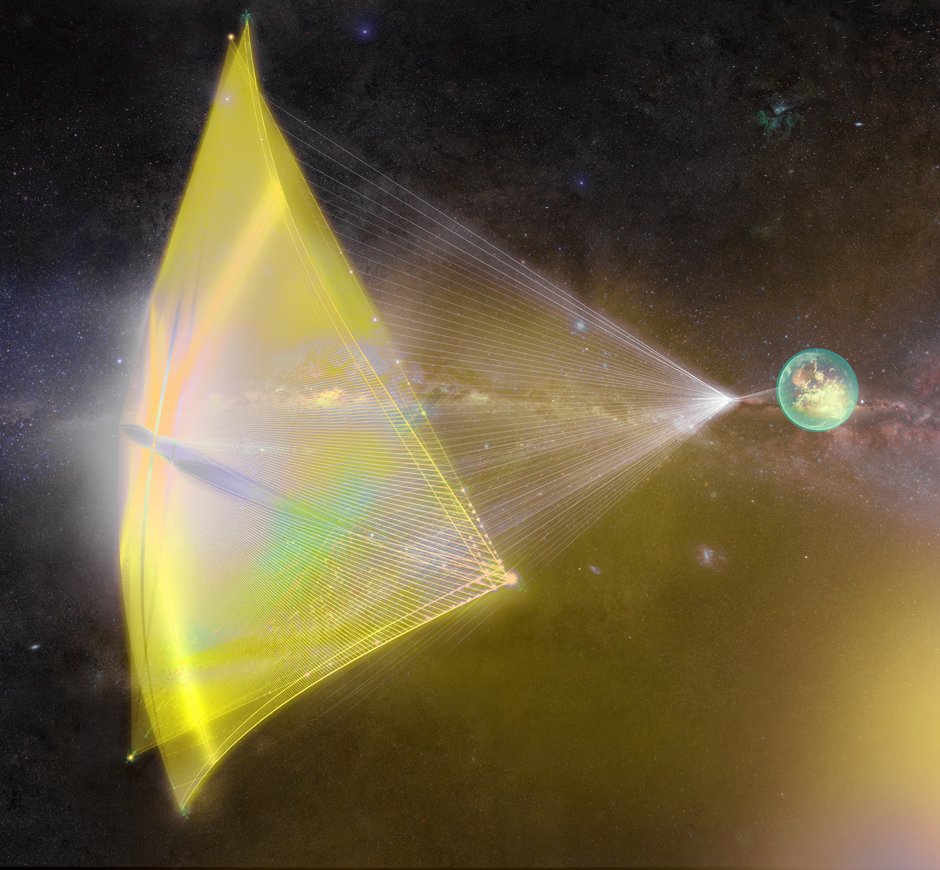
The Breakthrough Starshot Initiative & the Spiritual Aspirations of Atheists and Agnostics

Breakthrough Starshot concept art

Breakthrough Starshot concept art

Two atheists and a minimally observant Jew have recently teamed up on a $100 million research and development project aimed at designing a fleet of tiny spacecraft that would take only twenty years to reach the nearest stars and photograph their planets.

Ancient priests and prophets looked up to the sky in the belief that the sun and stars were the celestial abode of God and the angels.

Today scientists and tech billionaires look to the stars of our earthly heaven—the vastness of space—with similar thoughts on their mind: Are we all alone, or do we have company out there?

You see, this massive new scientific and technological initiative, along with several other recent big-ticket privately funded programs, are driven by the hope of discovering extraterrestrial life.

The Breakthrough Starshot Initiative, announced in New York on March 12, 2016, is the latest of the Breakthrough Initiatives sponsored by Russian tech billionaire Yuri Milner.

In a fascinating article at Wired.com, “How Russian Tycoon Yuri Milner Bought His Way Into Silicon Valley,” author Michael Wolff asked Milner how observant he was as a Jew. Milner replied, “Very limited.” Yes, he attends synagogue. But apparently his religious life doesn’t go much farther than that. The other two members of the Breakthrough Starshot board, world-famous physicist Stephen Hawking and billionaire Facebook co-founder Mark Zuckerberg, are both atheists.

For tech billionaires and physicists alike, beyond making buckets of money and discovering the scientific secrets of the cosmos, there is a deep yearning to reach out and discover life beyond our little planet orbiting a small star tucked toward the edge of a rather ordinary galaxy among billions of galaxies and trillions of stars in the universe.

You are here

It is a yearning that is almost . . . spiritual.

For more on Starshot and spirituality, please click here to read on.

Tagged with: , , , , , , , , , ,
Posted in Current Events, Science Philosophy and History

Judge Verda Colvin Reads the Riot Act of Love to Troubled Teens

Judge Verda Colvin

Judge Verda Colvin

Bibb County, Georgia, Superior Court Judge Verda Colvin did not know she was being filmed as she read the riot act to a group of troubled young people as part of a “Consider the Consequences” program meant to show kids what will happen if they embark upon a life of crime, and to equip them and encourage them to make better choices in life.

She was simply speaking to them from her heart—and from a wealth of wisdom and experience about the direction these teens and pre-teens were going, and where it would most likely end out.

In other words, she read them the riot act.

But it was the riot act of love.

“I don’t want you to come in my courtroom and I have to sentence you as an adult at the age of seventeen,” she told them.

You can read all about it here: ‘You Are Special’: Judge’s Emotional Speech To Troubled Teens Brings Courtroom To Tears, and you can watch the nine minute video below.

By now, millions of people have seen it. Though she didn’t know her impassioned speech was caught on tape, it has gone viral.

And for good reason.

For more on Verda Colvin reading the riot act of love, please click here to read on.

Tagged with: , , , , , , , , ,
Posted in Current Events, Spiritual Growth

God, Forgiveness, Freedom, and Hell – Part 4

(Note: This article is the last of a four-part series. The first three parts were edited versions of a series of questions by a reader named Rami, and my answers, in the comments section of the article, “What is the Unpardonable Sin? Am I Doomed?” The fourth part is a response to a related Spiritual Conundrum that Rami submitted to Spiritual Insights for Everyday Life.)

For Part 3, click here.

In a spiritual conundrum submitted several months before the questions and comments that the first three parts of this article are based on, a reader named Rami said:

Hi Lee, I was hoping you could talk a little about sin, forgiveness, and what God expects of us? Does God necessarily have ‘expectations’ of us? That word might imply being held to a standard of behavior, and being punished for failing to fulfill the obligation to do so. But, might it be more meaningful to say that, for example, God wants and hopes for us to love one another, rather than expects us to love one another?

The implications of that are tremendous, and would completely redefine the way I understand the idea of sin, its consequences, and forgiveness. The idea that God forgives us, for example, would imply to me the idea of us having committed some offense against God, displeased God, or failing to live up to His expectations. But maybe the only offenses we commit are against ourselves and each other, and the only forgiveness we need is from ourselves and each other.

…and maybe God does not judge, punish, or forgive, but is the One who we chose to draw nearer to or further from, with an afterlife that is the fully realized manifestation of these choices that has nothing to do with ‘judgement’…? What does Swedenborg have to say about it?

God’s forgiveness was the main topic of Parts 1 and 2 of this article. In Part 4, we’ll cover the other questions about sin, judgment, punishment, and God’s expectations of us. Of course, these are huge topics, but I’ll pack in as much as possible to point out the general lay of the land.

So fair warning: this is a densely packed post!

Here are the main points we’ll cover in Part 4:

  1. Sin in the Old Testament generally means doing something God has commanded us not to do. But in the New Testament, it shifts toward doing something not just that God has commanded us not to do, but that we know is wrong and against God’s will.
  2. Judgment is not really a matter of God condemning us for sinning or rewarding us for being faithful. Rather, it is the light of divine truth from God shining into our soul and revealing our true nature, whether that is good or evil.
  3. Punishment, similarly, is not something God does to us, but rather the inevitable consequences of our engaging in evil and sin.
  4. God does not so much have expectations of us as aspirations for us, what we can become, and the love, joy, and peace we can experience if we are willing to commit our lives to doing what it takes to achieve our best potential.

For more on God, forgiveness, freedom, and hell, please click here to read on.

Tagged with: , , , , , , , , ,
Posted in All About God, Spiritual Growth, The Afterlife

God, Forgiveness, Freedom, and Hell – Part 3

(Note: This article is the third of a four-part series. The first three parts are edited versions of a series of questions by a reader named Rami, and my answers. The original versions appear in the comments section of the recent article, “What is the Unpardonable Sin? Am I Doomed?” The fourth part will be a response to a related Spiritual Conundrum submitted earlier by Rami.)

For Part 2, click here.

In a further follow-up comment on my response to the original question, which formed Part 1 of this article, a reader named Rami said:

Also, I really appreciate the illustrative value of likening our relationship to Divine grace to that of a cup, but I would like to ask a hopefully clarifying question about what it might imply: if a cup turned away from God is analogous to rejecting the goodness that flows from God, does that person necessarily still ‘experience’ that goodness, but just refuses to acknowledge it for what it is? Is there an ‘inner self’ that is always aware of one’s Divine nature and the Divine realities that are constantly at work within it, and a human, worldly, ‘outer self’ that can reject and try to suppress this awareness, making the outer self the only self? If it’s appropriate to look at the human being as composed of two ‘selves,’ is it even possible for the inner/higher self to ever really be closed off to God? Is the cup always filling, only it’s us who choose to not acknowledge this, and allow that goodness to flow upward into our lives and ultimately the lives of others?

Here is my response, originally contained in this comment, but with a major new segment and illustration added:

Hi Rami,

Good question.

The example of the cup is, of course, a simplification of an immensely complex reality. It gives the general idea, and in that way it’s a good example. But it doesn’t tell the whole story.

To get right to it, Swedenborg says that every human being, angel, and spirit (good or evil) has an inmost level, which Swedenborg calls the “soul” when he’s using that term in a technical sense. (He also uses the word “soul” in the more common sense as a synonym for the human spirit as a whole.) About that inmost soul:

  • It is in direct communication with God, being the place where we receive our life from God.
  • It is beyond our conscious awareness. As I picture it, our inmost soul is the vantage point from which we would look at everything else if our consciousness were raised to the highest level possible for us. And like the eye, it cannot see itself.
  • It is beyond our reach or ability to affect, so that it is preserved pure and inviolate in everyone, even the worst devils in hell.
  • For evil people and evil spirits, then, it is not corrupted, but rather is closed off from below.
  • However, even in evil people and evil spirits, some life from it seeps down through the somewhat porous barrier that closes it off from the rest of the person, which is what makes it possible for us to continue to live, and to have eternal life.

For more on God, forgiveness, freedom, and hell, please click here to read on.

Tagged with: , , , , , , , , ,
Posted in All About God, Spiritual Growth
Lee & Annette Woofenden

Lee & Annette Woofenden

Donate

Support the work of Spiritual Insights for Everyday Life by making a monthly donation at our Patreon

Join 1,296 other subscribers
Earlier Posts
Featured Book

Great Truths on Great Subjects

By Jonathan Bayley

(Click the title link to review or purchase. This website receives commissions from purchases made via its links to Amazon.)

Blog Stats
  • 4,201,756 hits