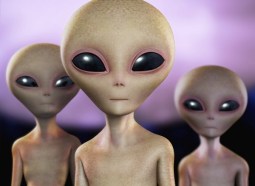
 “Where is everybody?”
That is the question physicist Enrico Fermi asked several of his fellow physicists over lunch one summer day in 1950. And that’s how the Fermi paradox got its name.
What is the Fermi paradox?
Here’s the short version: There should be intelligent life on other planets. But so far, we haven’t found credible evidence of any civilization other than the one here on Earth. Why not?
We now know that in our galaxy alone, there are over one hundred billion stars. We think that most of them have planets. We know that intelligent life is possible, because it exists on our planet. Even if only a small percentage of stars have habitable planets, intelligent life could have developed on millions of other planets in our galaxy. (The Drake Equation is one tool for making such estimates.)
Since most stars are billions of years older than our sun (which is about 4.5 billion years old), some of those intelligent beings would have had billions of years to develop technology far beyond what we earthlings have achieved since we first started on a technological path a few thousand years ago.
By now, there should be spaceships zipping all over the universe! Aliens should be exploring every corner of the galaxy, as portrayed in popular science fiction series such as Star Trek and Star Wars.
And yet, there is no scientifically sound evidence that alien civilizations have ever visited our planet, nor have we been able to detect any signals or other evidence for the existence of any intelligent beings elsewhere in the universe.
So where is everybody?
Many answers have been suggested to the thorny question raised by the Fermi paradox. Most conclude that intelligent life on other planets is very rare, and maybe even unique to Earth.
A common assumption in these answers is that other intelligent species would naturally follow the scientific and technological path that we humans on Earth have followed. Any cultures that didn’t develop advanced technology would be primitive, and far below our level of development.
Swedenborg had a different view.
Who is Swedenborg?
Emanuel Swedenborg (1688–1772) was an 18th century Swedish scientist, philosopher, and theologian. During his regular working career he was an Assessor on the Swedish Board of Mines. Mining was one of the most important industries in Sweden. Meanwhile, he researched and wrote hefty books on many scientific and technological subjects, such as metallurgy, chemistry, cosmology, and human anatomy.
However, after a spiritual awakening in his fifties, he spent the last three decades of his long life focused on spiritual subjects. He wrote extensive commentaries on the Bible. He presented a renewed version of Christian theology centered on a God of universal love and wisdom. He developed Jesus’ words about being born again in John 3:1–8 into a detailed teaching about “regeneration”—what we today would call personal spiritual growth.
His most popular book has always been Heaven and Hell, which has gone through hundreds of editions in dozens of languages since it was first published in 1758. In this book, Swedenborg offers a detailed description of the spiritual world and what happens to us after death. It is based, he said, on his own first-hand experience. According to Swedenborg, for the last twenty-seven years of his life he was able to be fully conscious in the spiritual world so that he could travel extensively there, visit angels and spirits in their communities and homes, and talk to them about their beliefs and their everyday life. In recent decades, thousands of people who have had near-death experiences have corroborated much of what Swedenborg wrote about the spiritual world three centuries ago.
A universe teeming with human life?
Having a curious and wide-ranging mind, Swedenborg also delved into more esoteric subjects that were of special interest to scientifically-minded people in his day—and that are still hot topics today. One of those subjects was extraterrestrial life.
If the Drake equation had existed three centuries ago, Swedenborg would have had the most optimistic possible solution to it. He believed that every star had planets, and every planet—and even every moon—had people on it (see Other Planets #3–4, 112).
He even said that during his travels in the other world, he met many beings who came from other planets, and were now living in the spiritual world. This included groups who, he said, came from all the then-known planets in our solar system—Mercury, Venus, Mars, Jupiter, and Saturn—and from Earth’s moon. (We now know that he was mistaken about the other planets in our solar system being inhabited. More on that in a minute.) He also described meeting beings who came from five or six planets in other solar systems.
All of these beings from other planets, he said, were human. They had bodies very similar to ours, with only slight variations. He did know that Earth’s moon had no atmosphere, and he was uncertain just what sort of people could live on planetary bodies that have little or no atmosphere (see Spiritual Experiences #1670). But for the most part, he described the other planets as having everything we have on ours: mountains, hills, rivers, lakes, trees, animals, birds, fish, and so on, all under the warmth and light of a sun that was the star of their solar system.
In fact, Swedenborg’s universe was very similar to the Star Trek and Star Wars universes. In Swedenborg’s universe, if we had spaceships capable of interplanetary or interstellar travel, we could hop on over to any planet we cared to visit, whether it was orbiting our star or another star. If we landed on any planet that had a proper atmosphere, we could step out of our ship and breathe its air, stroll in its meadows and forests, eat its fruits and vegetables, and talk to its inhabitants.
Swedenborg, of course, did not have access to our current knowledge of astronomy and cosmology. Today’s powerful telescopes did not exist in his day, nor were the scientists of the 18th century able to send robots or even humans to other planets and moons. There was little or no information about what it was like on the surface of other planets.
Unfortunately for 21st century aficionados of science fiction, we now know that none of the other planets or moons in our solar system has humanoids walking around on its surface. The huge gas giants—Jupiter, Saturn, Uranus, and Neptune—probably don’t even have solid surfaces. And if they do, the atmospheric pressure there would be so intense that it would crush us into jellybeans. The surface of Venus is a blazing furnace hot enough to melt lead. The atmosphere of Mars is so thin (only 1% of Earth’s atmosphere) that it would be impossible to breathe there. Mercury, the Moon, and Pluto have no appreciable atmosphere at all.
Whatever may be hidden inside some of the planets and moons of our solar system, we now know that Earth is the only body in our solar system that has fields, forests, animals, and humans on its surface. And though we have discovered thousands of planets orbiting other stars, we also know that most of them could not host life on their surface.
In short, if life does exist elsewhere in the universe, it is nowhere near as abundant as Swedenborg thought it was. For more on Swedenborg’s interplanetary error, please see:
Aliens vs. Advent: Swedenborg’s 1758 Book on Extraterrestrial Life
A low-tech universe?
However, in relation to the Fermi paradox, the interesting point about Swedenborg’s aliens is not how common they might be in the universe, but what type of intelligent life they might be.
Swedenborg’s aliens are intelligent and even human. But he also describes them as low-tech.
And yet, he saw most of them as being more, not less, advanced than humans on Earth.
You see, as much as Swedenborg loved science and technology, his view of what makes humans advanced was very different from today’s common secular and scientific view. For Swedenborg, it was not advanced knowledge of earthly science and technology that made a culture advanced, but advanced knowledge of God and spirit.
In fact, based on his experiences of speaking with spirits from other planets, whose spiritual knowledge was usually far beyond what we have on Earth, Swedenborg viewed Earth’s people as crude, materialistic, and ignorant of the most important aspects of human life.
In terms of technological advancement, none of the alien cultures Swedenborg encountered had progressed even as far as what we humans on Earth had thousands of years ago. They lived in very simple dwellings. If they wore clothing at all, it was hand-made from simple natural materials. Most of them were gentle vegetarians, though he mentions the inhabitants of one planet eating fish, and some of them had domesticated animals for their milk and wool. He also describes simple agriculture on other planets. (See Other Planets #93, 134, 144, 152, 162, 166, 176.)
The civilization on our planet is unique, Swedenborg says, in having such intellectual disciplines as astronomy, geometry, engineering, physics, chemistry, medicine, optics, and philosophy. The aliens he encountered had no science as we know it, and no advanced technology at all. People on other planets, he says, do not have such things as shipbuilding, metal casting, written language, or books and publishing. And yet according to Swedenborg, it is because the people of Earth have “a love for things physical and earthly” that we have all this science and technology, while the people of other planets do not. (See Other Planets #28, 81, 136, 155.)
Most people on other planets, Swedenborg says, have open communication with angels and spirits in the spiritual world. They do not need printed books, nor do they need shipping to carry those books and their information around the planet, because they have a direct and personal source for the most important information: knowledge about God and spirit.
After all, they know that they will live on their physical planet for only a few years, whereas they will live forever in the spiritual world. What sort of knowledge, then, is most important for people to cultivate? The aliens Swedenborg encountered were far more interested in talking about spiritual subjects than about magnificent mansions and other marvels of earthly technology. As for books, they joked about how on our planet, books know more than people do.
Swedenborg’s solution to the Fermi paradox
Why haven’t we been visited by aliens? Why haven’t we detected any radio signals from civilizations on other planets?
The common view today is that we haven’t detected any alien civilizations because intelligent life is exceedingly rare in the universe. If there is any intelligent life out there, it must be primitive and brutish, or else so far away that its signals and spaceships cannot reach us.
Not so, says Swedenborg. The universe is teeming with intelligent, human life. But most of the cultures on other planets are so much more spiritually advanced than humans on Earth that they would consider it a waste of their time and energy to develop material-world science and technology of the sort that we earthlings love.
Further, because they are not driven by the materialistic desire for wealth and power that is so common on our planet, they do not have kingdoms and nations, armies and weapons, war and conflict. They live simply and at peace with one another, each in their own extended families and clans. If any of their people do engage in selfishness and hostility, the others exile them to distant and deserted places in order to maintain the peace and harmony of the community.
Maybe Swedenborg is right, maybe he’s wrong. Certainly he was wrong about how common intelligent life is in the universe.
And yet, the picture he presents of how alien cultures live is entirely consistent with everything we have discovered so far. It neatly solves the Fermi paradox without resorting to the depressing notion that we are quite lonely, and perhaps all alone in the universe.
Based on what we know from our best current science, there should be millions of habitable planets in our galaxy, and many trillions in the universe as a whole. Many of these habitable planets would have had billions of years for technologically advanced civilizations to develop and thrive on them, and to spread from there throughout the known universe. And yet, we haven’t seen or heard from any other civilizations.
Perhaps that’s not because intelligent life is rare.
Perhaps it’s not because we humans on Earth are all alone in this vast cosmos.
Perhaps it’s because most intelligent life in the universe is far more advanced than we are when it comes to the things that really matter: our relationship with God, our relationships with our fellow human beings, and our preparation here in the material world for living to eternity in our true home in heaven.
For further reading:
- Spirit: The Final Frontier
- Aliens vs. Advent: Swedenborg’s 1758 Book on Extraterrestrial Life
- The Breakthrough Starshot Initiative & the Spiritual Aspirations of Atheists and Agnostics
- On Pluto, Atoms, and Other Things (such as Heaven) that Just Keep Getting More Complex
- Are We Headed for an AI Apocalypse?
- Wavicles of Love
Share this:


Lee Woofenden is an ordained minister, writer, editor, translator, and teacher. He enjoys taking spiritual insights from the Bible and the writings of Emanuel Swedenborg and putting them into plain English as guides for everyday life.



 Spiritual Insights for Everyday Life
Billy Graham suggested intelligent life on other planets in the Universe.
Hi John,
It’s a fairly common idea, both in Swedenborg’s day and today. However, most evangelical Christians reject the idea that there could be intelligent life on other planets because they believe salvation is possible only through conscious faith in Jesus, which would not be possible for people on other planets. Billy Graham was a bit unusual in that regard.
Correct as he stated God doesn’t clue us in on all His secrets
Billy Graham was a bit more open-minded than some of his followers!
I think it’s still possible that there could be technological aliens out there, but they’re incredibly rare. Even on Earth, people have only been technological for about 200 or so years, and agrarian for about 10,000, out of the 100,000+ years they’ve been here.
Like one can say cats have hair – even though there’s the odd one out that’s bare – one can say there’s no technological aliens out there. Even if they’re out there, but very rare.
But Swedenborg could be literally right, and _only_ Earth ever developed civilization like it has. The rest of the universe may not need it to be spiritually advanced, like you say.
Hi K,
Swedenborg’s conception of the universe was considerably larger than the prior Judaeo-Christian conception of the universe, which was basically about the size of earth’s orbit around the sun in idea. However, he did not know just how vast it was. He probably thought of it as something like the size of our galaxy. He seems to have had some awareness of other galaxies, but probably didn’t know that they were full of stars just like ours. He probably thought of them as some sort of clouds out there in space.
Given just how vast we now know the universe is, it does strain credulity to think that we are literally the only technological civilization in existence in the entire universe. Perhaps, as you suggest, they are simply very rare. Maybe there is on average only one in each galaxy, or one in every thousand galaxies. Put that together with the length of time any civilization would exist with high technology, and the distances between technological civilizations may just be too great for us to have any likelihood of detecting them. Or it will take technology far beyond what we have now to detect them.
If faster-than-light (FTL) travel ever becomes possible, then we might be able to start visiting other galaxies and seeing if we find any technological civilizations. Or maybe there is one on the other side of our galaxy, and it just hasn’t made it here yet. But I suspect that FTL travel is not possible. Otherwise, given that there could already be civilizations that are millions or even billions of years old, it would seem that we would have already been visited by aliens from elsewhere in our galaxy or from another galaxy. But there just isn’t any credible evidence for that. And I do not believe that aliens would travel the vast distances to earth only to play cat-and-mouse games with us. If they visited us, everyone would know it, and see it with their own eyes.
If FTL travel is not possible, then technological civilizations would probably be limited to traveling within their own galaxies. And if there is only one technological civilization per galaxy, or one per thousand galaxies, then it’s unlikely that one of them would ever be able to visit or communicate with another one.
As of now, there are just too many unknowns for us to draw any definite conclusions. But I am certain that SETI will continue to move forward and develop. Perhaps in our lifetime we will get some answers. Or perhaps it won’t be for several more centuries. Who knows?
Meanwhile, Swedenborg’s solution to the Fermi Paradox gives us some reason to believe that there may indeed be many inhabited planets in our galaxy and in our universe, even if we have not been able to detect any so far.
Hi Lee,
You and I once briefly discussed this idea once before, but I wanted to again bring up the possibility that there is at least some version of the Great Filter hypothesis- the idea that all civilizations inevitably reach a technological singularity where they eventually destroy themselves- that satisfies the Fermi Paradox. But rather than the standard model where these civilizations obliterate themselves into non-existence, might it be possible that they reach a point of *material* technological development where they implode upon themselves and are forced to revert to a simpler, spiritual existence? And perhaps, many eons later, redeveloping a ‘spiritually organic’ technology that’s consistent with what you’ve described before?
This would make sense for materially minded civilizations like our own, as our conception and development of technology is purely material from the ground up. It seems that to follow along this material trajectory might ultimately lead to a reality where it explodes right back in our faces, blowing us back to the Stone Age and forcing us to start from the beginning, only with a renewed sense of spiritual values that will guide our rebuilding process. So not so much a great filter, but more of a great reset.
Because Swedenborg’s characterization of alien relationships with technology resonates with me, but it doesn’t necessarily follow that this was their way of life from the beginning. It’s entirely possible that alien worlds far older than ours also lost their spiritual mindfulness at some point in their histories and began to think more materially, developing technology much in the same way they we did, until it became either too self-consuming or simply too volatile that their arrogant recklessness caught up with them.
Maybe we’re slowly reaching our own singularity. Maybe alien civilizations never develop too far beyond our own point of development before they self-destruct and are forced to reconsider their priorities as they fragment into small communities and rebuild with sticks and stones all over again.
Hi Lee,
I wanted to talk about the possibility of life in the universe, as you touched on in your comments. One entirely plausible scenario is that the universe is in fact teeming with simple life, but complex, intelligent life is exceptionally rare, and this is where the Rare Earth Hypothesis brings itself to bear on the subject. But as we materially look for answers to this and other questions, I wonder, does Swedenborg’s theory of correspondence shed any light on possible answers? Obviously, this is hardly a scientific speculation (at least science as is materially understood), but I often look toward correspondence theory to make sense of material realities, kind of inductively reasoning from the literal ground up.
When it comes to life in the universe, and more specifically the *creation* of life in the universe, can we look toward the creation of human beings in the womb as paralleling, say, the creation of habitable planets and complex life? Because creation, well, is not an easy task, and is indeed quite difficult, as evidenced by just how difficult it is for a single sperm to reach a single egg and create new life. If there is a spiritual correspondence to the conceiving of new humans in the womb, might that same correspondence underly the creation of new life in the universe? If so, and if complex life in the universe is so rare, then correspondence might explain why,
Hi Rami,
Current scientific knowledge generally supports the theory that advanced life is very rare in the universe. Most of the exoplanets we have discovered so far do not look suitable for the development of any life at all, let alone advanced life. Some exoplanets may be suitable for life, and there are some candidates that exobiologists would love to study more closely. But so far, there’s not much reason to think that advanced life is anything but very rare out there.
Looking at our own solar system, it took 3.5 to 4 billion years for humans to evolve from the simple forms of life that first appeared on earth only half a billion to a billion years after it initially formed. If that is a reasonable estimate for how long it takes intelligent life to develop on a planet, the other two planetary candidates for life in our solar system, Venus and Mars, simply didn’t have enough time.
Some scientists think Venus may have had liquid water on its surface for as long as three billion years. This would easily be long enough for simple, and even moderately complex, life to develop there. But it’s well short of the lower estimate of 3.5 billion years for humans to develop on earth.
Meanwhile, Mars apparently lost its liquid water a whopping 4 billion years ago. And since the solar system formed about 4.6 billion years ago, there just wasn’t time for much in the way of life to develop on Mars. At best there may have been simple microbial life on Mars.
As for using correspondences to create theories and even draw conclusions about scientific matters, it is fun, but perilous. It’s easy to bend correspondences one way or another, based on our own pre-existing ideas and proclivities.
To use your example, if a planet is like a womb, we would expect life to be very common, since a rather high percentage of wombs do become host to new life. A more apt comparison might be sperm, the vast bulk of which expire without fertilizing an egg and producing new life. Perhaps planets are like sperm, not like eggs and wombs. Perhaps God produces hundreds of millions of planets for every one that leads to life.
And yes, if we’ve learned nothing else, we’ve learned that life is incredibly complex, and the conditions for it to exist are also incredibly complex. If it takes the entire vast universe that we see to produce the “many hundreds of thousands” of inhabited planets that Swedenborg alludes to in Other Planets #26, that would still be within range of the “correspondences” of sperm as bearers of new life.
Hi Rami,
Good to hear from you again. This is certainly a possible scenario. At this point, we don’t have enough information to support or disprove it. That information could come in one of two ways:
Unfortunately, it will likely be centuries before we are able to get either kind of evidence.
For my part, I’m not a technology-hater. I don’t believe technology is destroying the earth. Advanced technology is just an advanced and more powerful tool in human hands. If we destroy the earth through our use of technology, that’s because of us, not because of the technology. We can also use technology to restore the earth. The choice is in our hands.
Further, if the purpose of creation is a heaven from the human race, as Swedenborg says, then Elon Musk’s goal of making humanity a multi-planet species is congruent with that purpose. More people on more otherwise uninhabited planets means more humans for heaven. From that perspective also, I don’t think technology is an inherently evil thing that must be wiped out for humanity to achieve its true spiritual potential.
Hi Lee,
Always good to drop by here, and I thank you for making me feel welcome.
I must admit, I’ve grown increasingly anti-technology over time (an ironic thing to be typing on my fancy new laptop over my high speed internet connection, for sure), but my cynicism toward technology as at present vague and sketched in broad strokes. I’m not yet prepared to articulate those thoughts, but one thing I can say is that I’m particularly anti technology that operates out of sync with nature- technology that exist in a state of disharmony with the natural world.
For instance, we have things like wind and solar power, which I would uphold as an example of technology that works in harmony with nature as it harnesses natural resources. Yes, traditional windmills are constructed from wood, but it’s entirely possible for humans to harvest the bounty of Mother Earth in a responsible, renewable way.
Contrast this with, say, the automobile- the internal combustion engine. The simple reality is this is piece of technology which pumps poison into the air. The fact that single automobile has a negligible effect on the environment over the course of its life doesn’t change the fact that it operates out of sync with the environment, and collectively, have done tremendous damage that environment. So I would describe the automobile as technology that operates in disharmony with nature.
And then it becomes ever more complicated when we see how technology is invariably linked to industrialization and industrial capitalism, which is both exploitative and historically pernicious in its complete lack of stewardship. So we have destructive technology, and the paradigms on which this technology is born that has influenced my disenchantment with our modern technological age.
I know this is both fringe and besides the point, but while I don’t necessarily believe in the existence of Atlantis, the technologically advanced way the Atlanteans were said to live seems entirely consistent with the spiritually grounded technology you once described. They were profoundly more advanced than we are nearly 10,000 years before we showed up, but not advanced in the materially conceived understanding of technology that we presently have, but in a spiritually holistic way that we have long since forgotten.
I’m not a technology doomsdayer, but I have great concerns that technology that’s purely material, and a civilization that exalts it as much as we do can only end in one, dramatically destructive way.
Hi Rami,
As I said earlier, I view technology as a tool in the hands of the human beings who wield it. The effects of the technology will mirror the motives and purposes of the people who direct the technology to accomplish those motives and purposes. This is why I believe that the most important thing for the future of the earth is to us humans to develop our spiritual and ethical awareness.
And I do see much development in that direction, despite the pernicious alliance between government and big industry that tends to subsidize old and dirty technology and practices while making it difficult for newer and cleaner technologies to take their place.
Currently we see a single company, Tesla, pushing the entire auto worldwide auto industry toward electric vehicles (EVs), which are far cleaner and more ecologically sound than the old internal combustion engine (ICE) technology.
While much has been made of government subsidies for EVs, Tesla was already firmly on that path long before any subsidies appeared, and has already surpassed the numbers at which it could receive further subsidies. Yet it continues to produce more EVs than any other automaker. Meanwhile, government subsidies continue for the fossil fuel industries and the legacy automakers. It is laughable that General Motors is supposedly “leading the EV revolution” when it is currently not offering a single EV of its own for sale, and continues to make nearly all of its profits from manufacturing ICE vehicles.
The reality is that fossil fuels are highly inefficient, and cannot compete with renewable energy sources on a level playing field. This, and not subsidies, is why renewables are quickly overtaking fossil fuels.
In another decade or two, no auto manufacturer will be making gasoline-powered cars anymore. Any auto manufacturers that don’t successfully make the transition to EVs will go bankrupt, and go out of business. (This may include GM.) In another two or three decades, very few power plants that burn fossil fuels will be left in the world. They will not be able to compete with wind, solar, and other renewable energy sources.
This is why I do not share your pessimism about technology. As we have become more ecologically aware, we have pushed our technology in more ecologically sound directions, despite strenuous efforts by the corporate / government alliance to continue with the older, dirtier technology. If Elon Musk had not come on the scene with Tesla and its goal of converting the world from ICE to EV vehicles, the legacy automakers would still be slurping at the government trough while churning out more and more highly inefficient and heavily polluting ICE vehicles.
As for Atlantis, I will believe it existed when I see some sound scientific evidence for its existence. Meanwhile, I think it is a mythological origin story of human beings similar to the origin stories in the early chapters of Genesis. These stories didn’t literally happen, but they do have a deeper significance that tells about our emergence from being mere animals to being spiritually aware humans.
Back to the main subject, I believe that as humanity continues to become more spiritually and ecologically aware, our technology will continue to get cleaner and more in harmony with both nature and spirit.
It seems really odd to be born on born on this planet, given just how vast the universe is. I suppose one could say the same of one born on some other world out there, but this world is unique in how evil it is, and being the only world with technology (according to Swedenborg).
It seems to defy vast astronomical odds, and can be seen as supreme misfortune.
Is there any spiritual advantage to being born on Earth versus somewhere else?
Hi K,
I think of this earth as being especially materialistic rather than being especially evil. People from more spiritual planets can also become more evil precisely because they commonly have access to the deeper parts of the human spirit that the bulk of people from our planet simply aren’t interested in.
Given that our planet is inhabited by humans, a certain number of people will be born on this planet. We just happen to be among them. It’s not as though we existed before and chose this planet, as in reincarnation theory. We are original creations from the seedbed of this earth.
Advantages. Hmmmmm . . . . We get to play with all the cool toys? 😛 (I guess that’s not really spiritual.) But seriously. Heaven needs all types of people, including basic, low-level people, to get all the jobs done that need to be done here. I don’t know if there is a particular advantage to being born on this earth from a spiritual perspective. We just happen to be adapted to serving in certain jobs.
However, according to Swedenborg, our planet is unique in the universe in that the Lord was born here, and not anywhere else. Also in having a written Word of God. As discussed in the above article, the reason for this is unflattering to the people of our earth. But it does give us a special job in heaven: to spread word of the Lord’s birth.
Although Earth is overall very materialistic, an Earthling can be non-average and be very spiritual, or somehow even more materialistic than the average Earthling, I take it?
And while there may be evil people out there, I assume that being materialistic could lead to evil more easily, meaning this world could have a higher concentration of evil – especially with more opportunities from technological civilization to be evil?
(For example, there’s probably no stock market fraud or phishing scams on a planet where everyone lives in shell houses on an ice-covered ocean “planemo” without a sun.)
(thanks again for the reply)
Hi K,
There does seem to be an interesting flipside to our being the most materialistic planet. That flipside seems to be that people from our planet are capable of regenerating to a very high level. Though I won’t take the time to look them up right now, there are a few passages in which Swedenborg speaks of very wise angels from our earth showing depths of understanding to spirits from other planets that were well beyond those spirits’ own ability to discover and comprehend for themselves.
A parallel to this is Swedenborg’s great love of the Old Testament in general, and of the Hebrew language in particular. The Old Testament, and its Hebrew, is a very earthly text in its literal meaning. There’s very little in the OT about “spirituality” as we would think of it today. Yet that pragmatic, earth-centered language provides the outward expression of the deepest understanding and wisdom both about our individual regeneration and about the Lord’s process of glorification during his lifetime here on earth.
In short, the most physical, outward things provide the fullest foundation for the deepest spiritual and heavenly things. The relationship between them happens by correspondence.
One of the reasons the Lord chose to be born on this earth is precisely that the culture of this earth focuses on the most outward, physical things. This gave the Lord a field on which to battle the Devil (i.e., hell) all the way down to the lowest and most outward levels. Another planet whose culture didn’t have our outward-looking, physical-minded cast would not have provided a field that reached all the way to the bottom of where the Devil can reside in human beings and human communities.
For example, if most or all other planets in the universe are generally similar in their cultures to the representative sample of alien cultures that Swedenborg describes in his theological writings, the crucifixion itself would have been highly unlikely to happen on any other planet. Only here on earth would we develop the cruelest, most barbaric, most physical, most agonizingly painful, and most publicly shameful (there was no loincloth) means of punishment and execution. Of the many cunningly cruel methods of torture and execution we humans on this earth have devised over the centuries, crucifixion is among the worst.
In choosing to die in this most horrible manner (and the Gospel of John makes it crystal clear that it was his choice to do so), the Lord demonstrated beyond all possible doubt that God’s love is greater than the worst and most horrific evil that any people from any planet could ever devise. Anything less than this would leave room for doubt that God can handle this or that horrible human evil or perversion that we find our minds and hearts, and sometimes our hands, have sunk into. Now that the Lord did choose to die in this way, we can know in our heart, mind, and hands that we humans cannot come up with or experience any evil that is stronger than the power of the Lord’s love to save us from it. Jesus rose from that death, and became Lord of all. That is the God we worship, and look to for salvation.
Hi K,
Back to your thoughts and questions, being materialistic does incline us to evil. But the evil it inclines us to is a low-level evil. The physical torture I mentioned in my previous reply is one example of this.
People who ascend beyond the sensory and physical, and into the psychological and spiritual, are capable of far deeper and more destructive evil. Consider the psychological and spiritual destruction a corrupt priest can wreak upon his victims compared to an ordinary mugger or rapist on the street. Both are horrible. But when it is one trained in religious doctrine, and acting as a representative of God, who is perpetrating the crime, the damage goes much deeper.
Likewise, the damage that can be done by power-hungry and greedy people using technology is mostly physical damage, such as destruction of the environment or highly efficient killing of enemy soldiers and civilians in war. The same technological capabilities can be turned to good in the hands of thoughtful and well-intentioned people, such as by growing and transporting mass amounts of food to feed people in famine-struck areas.
So yes, our earthly materialism can lead to concentrated and horrific evil as shown in our many empires and wars of conquest and oppression. Yet these are mostly outward, material evils. Cultures that delve into the spiritual side of things are capable of much deeper evil, such as using black magic to curse people and break them down psychologically and spiritually. The long-term damage of this is much greater than the damage we commonly do to one another’s bodies here on this materialistic world.
Is it possible for someone to somehow be born into “the wrong culture” or even “the wrong planet”, and after death go to the community of people from a different culture or even planet than the one they were born in? Like someone born in the UK goes to a community from Korea after death, or someone from Italy goes to a community from TRAPPIST-1d (assuming anyone lives there) after death?
(It may also be possible that people who feel out-of-place like to live in a “community” of just their own home, as Swedenborg describes.)
(thanks for continuing to reply)
Hi K,
People do this here on earth, so I don’t see why they couldn’t do it in heaven. In particular, Swedenborg says that in the third or highest heaven, people from all different planets live together in harmony. Whatever cultural differences they may have had from their origins in the physical universe are transcended by their common love for God and for their fellow human beings.
And yes, some people do live alone, which doesn’t necessarily mean they never see anyone else, but their houses are “out in the boonies,” so to speak. Also, they aren’t truly alone, because they live with their husband or wife.
Some believe aliens and ghosts are connected some how.
Hi WorldQuestioner,
Some believe all sorts of crazy things. But seriously, I do think that the “aliens” people see are not literal aliens seen with their physical eyes, but visions and experiences that came to them via their spiritual senses. This can be superimposed on physical experience so that it seems for all the world as if aliens have just landed in your back yard.
The Devil is behind alien activity.
Could alien deception be a fulfillment of 2 Thessalonians 2:9-12 “strong delusion”?
Hi WorldQuestioner.
Highly unlikely. We’ve already been over this.
Yes, we’ve been over the following: No individual Devil. The Devil is just everyone in hell. Satan is not a pronoun, but a common noun. The same Hebrew (or Greek?) word usually used for “adversary.” You’re saying that 2 Thessalonians 1:9-12 probably refers to spiritual events.
This story outlines the structure of the universe in accordance with the doctrine of Swedenborg. What do you think about this? https://sites.google.com/view/heavenlyjerusalem/miracle
Hi Vera,
Thanks for stopping by, and for the link. The piece is quite poetic and inspiring, though I do take issue with some of the specific ideas contained within it.
What of the “reptillian aliens” that people supposedly have independently witnessed “out-of-body” or in an “altered state of consciousness” or with “enhanced eyesight”? Supposedly they’re beings that feed off of negative emotions, and see this world as a “farm” for that. Assuming they’re not some hoax or elaborate fiction, they sound like evil spirits to me, as Swedenborg described evil spirits taking on all sorts of not-exactly-human forms.
source:
https://downthechupacabrahole.com/2022/01/04/reptilian-beings-emerged-during-cias-interdimensional-experiments/
Hi K,
I only skimmed the linked article. But yes, it sounds likely that these are evil spirits, who can appear in all sorts of non-human and quasi-human forms.
Is it possible that more spiritual yet still mortal aliens could freely explore this universe using “out of body experiences” or “remote viewing”, even if such “violates causality” by involving faster-than-light?
(prophecy kind of “violates causality” so I don’t see why not if such things are possible in the first place)
Hi K,
That is a fascinating question, and not one that I can give a definite answer to.
My gut feeling is that although it would be possible to travel around the physical universe in one’s spiritual body, it would probably not be possible to do so faster than the speed of light. As you say, that might violate causality. Still, I wouldn’t bet my life on it.
As for seeing material things with our spiritual eyes, we know this is possible both from out-of-body experiences and from a few tantalizing statements in Swedenborg that the spiritual can see the physical, but not the reverse. So that part of it I’m fairly confident about.
I lean toward thinking that nothing like time travel would be possible, including traveling faster than the speed of light, because it’s very clear that angels and spirits in the spiritual world have no more advanced knowledge about the material world than exists in the material world at that time. Not only does Swedenborg never report anything about future events, as would be possible if we could time travel in the material world with our spiritual body, but angels and spirits fairly often tell Swedenborg things about scientific matters that were believed to be true at the time, or at least could have been true based on the science of Swedenborg’s day, but that we now know are not true.
The most famous or infamous example of this is Swedenborg reporting that he was told from heaven that various groups of spirits he met in the spiritual world came from various then-known planets in our solar system, and one group from Earth’s moon. But there are also others, such as that spontaneous generation happens, that in optics all colors are derived from white and red, and that children borne of an interracial relationship will be of the same race as the father. We now know that none of these things are true, but Swedenborg stated these things quite confifdently in his theological writings, often with confirmation from the spiritual world.
In short, angels and spirits seem not to have any view of the material-world future, or of any material knowledge that is still in the future. Though they do not experience time and space themselves, there seems to be a correlation with their passage of events and our time, such that they have access to what is in the past in the material world, but not to what is in the future.
The mechanism for angels and spirits obtaining material-world knowledge that Swedenborg reports most often is people arriving in the spiritual world from the material world after their deaths, and reporting on current events in the material world. Another means is through direct communication by angels and spirits with people still living in the material world. Neither of these can provide any information about future events or future knowledge in the material world because they depend upon people currently or recently living in the material world.
On the other side of the coin, it has become abundantly clear to me that God sees all things in all times and spaces, including the future, in a single present view. Also, Swedenborg makes a few statements that suggest that angels may have a knowledge of the future. However, these statements are not very clear, and I tend to read them as meaning that they have a clear sense of the future based on the direction things are going from their knowledge of the past and the present. This would simply be an elevation of our ability to project events into the future based on the past, though only as pretty good guesses, not as definite knowledge.
All of this is what makes me think that though travel through the material universe would be possible in one’s spiritual body even while still living in the physical body, it would most likely not be possible to travel faster than the speed of light, effectively giving a person a view of the future.
I should also mention that as covered in the above article, according to Swedenborg, people on other planets don’t develop technology. Swedenborg also says that people on other planets live in their local communities and clans, and do not travel around to other areas even of their own planet. This is certainly not an absolute rule: Swedenborg’s Mercurians do travel all around the spiritual universe seeking knowledge. But in general, according to Swedenborg, people from other planets aren’t all that interested in exploring other realms. They are happy with their lives in their local communities. Between this and the lack of technology, such as telescopes and spacecraft, designed to reach out into the physical universe, it seems unlikely that many cultures on other worlds would even attempt to explore the universe through out-of-body travel.
Still, there are those Mercurians . . .
Thanks for the reply.
I think going at what’s FTL in this universe is still possible with “remote viewing” and “out-of-body” (assuming such are possible), as people who’ve supposedly done such have supposedly gone to space, and didn’t take minutes or hours to go to interplanetary destinations, nor years to get to extrasolar destinations. Maybe going faster-than-light happens as long as it doesn’t produce undeniable time-travel like effects.
Like finding out what it’s like in a galaxy 2.5 million light years away now instead of 2.5 million years from now isn’t the same thing as finding out what it will be like 2.5 million years from now in the present time.
Also, would angels from any world in this life be interested and able to explore the heavens – which Swedenborg says are vaster than this universe (IIRC) – even if they’re not interested in exploring the physical universe?
Hi K,
On your last question, the only angels Swedenborg encountered who were interested in traveling around the spiritual world were angels from our planet and angels (supposedly) from the planet Mercury. Perhaps there are others, but according to Swedenborg, most angels are quite content to live within their own communities, and only go abroad when there is some specific reason to do so.
On FTL, while I don’t claim to fully understand it, it seems that because of relativistic time effects, if it were possible to travel faster than light, it would be possible to deliver information or people from the future to the past. And that doesn’t seem possible. If it were possible, this earth would be swarming with people, technology, and information from the future—so much so that it would be obvious to everyone, and there would be no need for UFO conspiracy theories about it.
The thing about OBEs is that they happen by means of our spiritual body and senses, not our physical body and senses. However, it won’t necessarily be clear whether the experience is actually of the physical world (which is indeed possible), or of similar areas in the spiritual world, or of an actual “projection,” like a full-sensory movie—or if you’re a Star Trek fan, a holodeck-like experience. These can also all be overlayed upon one another so that the person having the experience can’t easily distinguish what’s material, what’s spiritual, and what’s “virtual,” to use today’s word for the third category.
As a biblical example of this, if we read literally the story in Genesis 18:1–15 of the three men/angels/the Lord visiting Abraham and predicting Isaac’s miraculous birth, there are some problems. If they are indeed angels, how do they eat physical food? And yet, it says that Sarah and one of the servants prepared food for them, and they ate it. Meanwhile, Swedenborg says that when angels visit people on earth, the people on earth see the angels with their spiritual eyes, not with their physical eyes. Yet Abraham and Sarah, not to mention many other figures in the Bible, such as the women at Jesus’ tomb, all saw the angels superimposed on their physical surroundings. If these stories are literal and not mythical, then there’s a lot of sorting-out to do to figure how these things would even be possible—especially the part about angels eating physical food.
What I’m suggesting is that we shouldn’t look to OBEs and other spiritual experiences for accurate information about the material world, whether here on earth or 2.5 million light years away in another galaxy. This is demonstrated also by Swedenborg’s reporting of things from the spiritual world about material things that turned out not to be true, such as all of the then-known planets in our solar system, plus Earth’s moon, being currently inhabited by races of human beings.
In summary, I do not think that FTL travel is possible even using our spiritual senses through OBEs and “astral projection.” And if people report such experiences, I do not believe they are actually traveling faster than light to distant places in the physical universe, but that they are having an experience that feels as if this is what’s happening to them.
Thanks again for the reply.
I still think that FTL travel and communication – at least in spirit – may still be possible, as (1) spiritual locations can correspond to physical locations and there’s no physical spacetime in the spiritual, (2) faster-than-light and maybe even time travel already happen at the subatomic scale, and (3) FTL travel or communication don’t always involve “blatant time travel” even if there may be a little causality violation.
As for the “spiritual holodeck” thing, hopefully one can tell the difference between “spiritual holodeck” and “not spiritual holodeck”, at least once they’ve fully crossed over. Otherwise it may not be that good for sanity.
Hi K,
On your last point, people living in heaven can tell the difference, but people in hell go back and forth. Sometimes they’re caught up in the fantasy, and think it’s real. But then reality hits them, along with the consequences of their actions.
Could it be that despite what Swedenborg said, there’s rarely agrarian civilizations out there, and industrial civilizations even more rarely, and a lack of FTL (faster-than-light) travel is why there is no apparent signs of intelligent life out there?
If Swedenborg can be wrong about life on worlds in the solar system, it is possible he is wrong about Earth somehow being the _only_ world in the entire universe with civilization (which sounds rather unrealistic, given about 1E11 galaxies in the observable universe alone, and about the same number of suns in this one).
Hi K,
I have my doubts that our Earth would be the only planet inhabited by intelligent beings that have developed science and technology. I tend to think, rather, that this would be very rare among populated worlds. This is in contrast to the standard view among scientists today, and reflected in our science fiction, that intelligent life will follow a “natural” course toward science and technology, and that alien cultures millions or even billions of years older than ours would “naturally” have far superior technology, possibly even including FTL travel.
But if that were the case, then we should have seen them by now. And we haven’t. Hence the Fermi Paradox.
And of course, we now know that if life does exist elsewhere in the universe, it is far more rare than Swedenborg thought it was. He thought that every planet and moon around every star must be populated with human life. There is now great debate about what percentage of planets in the universe are habitable. But in general, the view is that many if not most stars will not have any planets orbiting them that could host advanced life, or even simple life.
Given how vast we now believe the universe is, this still leaves room for plenty of intelligent life out there. But it is likely to be very spread out in the universe, such that contact between two different planetary cultures would be difficult, if not impossible.
I think the limits of technology that nature allows may not be far off. While people in the past have claimed this, they lived before the internet and computers. Despite exponentially increasing knowledge aided by computers, the rate of technological change since the start of the 20th century seems to have been slowing down.
So it is possible that the most advanced a civilization can get is not too far off (despite with science fiction commonly promotes), and the modern world may not be sustainable for long, and “modern worlds” may be quite rare, so that is why there is a lack of evidence for them out there.
Also even if Swedenborg is consistently wrong about the nature of the physical universe (and it seems he is wrong all the time with stuff unknown to 18th century science), how can I know if he is reliable about the nature of existence Beyond this natural one?
Hi K,
Perhaps we’re getting to the point where possible technological progress is leveling off. I have my doubts about that, but it’s an interesting theory. It would be one way to solve the Fermi Paradox while still remaining in a materialistic mindset.
On your final question, Swedenborg’s science was pretty good for his day. It’s just that science has continued onward from there.
But science is limited to the things of the physical universe. That is the field of study and applicability of the scientific method. The spiritual world, by contrast, operates in a realm that is beyond the material things and beyond scientific method. Scientific errors are irrelevant there. The spiritual world operates by its own laws, which Swedenborg was able to observe over an extended period of time, and report on.
I suspect that even in the spiritual world, many things have changed in the two or three centuries since Swedenborg sojourned there. I don’t think people from our era will still be riding in carriages in the spiritual world. It’s best not to get too rigid even about Swedenborg’s descriptions of the spiritual world.
But as for the principles by which the spiritual world operates, and by which God operates, these do not change, any more than God changes. These are the things in Swedenborg’s writings that I believe we can consider reliable even if some of Swedenborg’s science, history, and culture have not turned out to be correct in light of further development in knowledge and understanding in those areas.
“These are the things in Swedenborg’s writings that I believe we can consider reliable. . .”
But how can we know that? Usually when a religion makes inaccurate claims about physical stuff, it makes that religion look unreliable, especially when such incorrect claims are consistent.
Hi K,
That’s the error of turning to religion to answer physical questions. Religion exists to answer spiritual questions, and guide people to spiritual life. We don’t turn to science to answer spiritual questions. Neither should we turn to religion to answer physical questions.
The problem with religions though is that they give conflicting answers on the nature of the spiritual. For example, “traditional” Christianity teaches of an angry God who casts sinners into eternal torment, while Buddhism teaches reincarnation until nirvana is achieved.
Hi K,
It is necessary to understand that spiritual laws are not the same as physical laws. Physical laws are aimed at maintaining order in the physical universe, and ultimately (from a spiritual perspective) at making it possible for habitable planets to exist—of which so far we know of only one.
Spiritual laws, on the other hand, exist to make it possible—and as likely as possible—for the people living on those habitable planets to develop into angels who can inhabit heaven and have a good and happy life there to eternity. God arranges everything on our planet pursuant to that purpose.
This means that “consistency,” as required by natural science, is not a particular requirement of spiritual law. In spiritual law, it is not necessary as it is in physical law for the same rules to apply everywhere. There are spiritual meta-laws that do apply everywhere. But ordinary day-to-day religious beliefs, rules, and regulations can and do vary pursuant to the primary purpose of spiritual law—which, to use Swedenborg’s terminology, is to provide for a heaven from the human race.
One necessity for this is that humans have free will to desire, think, and act according to their own ideas and decisions. This includes the ability to stray away from God’s ideal path for us.
Another is that variety is necessary for a well-functioning human society and heaven. This means that there must be all different kinds of people, who have all different characters and personalities and who think, feel, and act differently from one another.
Put all of this together, and perhaps you can see why there is such great variety, and even conflicting beliefs, in the religions of the world. Different people of different cultures are not the same, nor do they think and act the same as one another. In a general way, yes. We’re all human. But within that basic humanity, we come in all different types, and our cultures come in all different types.
That’s why there must be all different religions, adapted to each culture and to each individual within the culture. Even the various major religions of the world all have fundamentalist, mainline, and mystical wings because even within a particular culture, there are all different types of people.
Based on the primary spiritual law that the purpose of creation is a heaven from the human race, it doesn’t matter at all whether different religions teach different things that conflict with one another. What matters is that each religion provides a pathway toward heaven for the people who belong to it. That’s what each religion is designed to do, regardless even of its conception of heaven.
Skeptics and atheists who expect religion to function in the same way science does are thinking materialistically. The very reason they are skeptics and atheists is that they are unable to think spiritually. They therefore simply can’t understand how spiritual law works. They expect religions to act like scientific disciplines.
But religions are not scientific disciplines. They are pathways to spiritual life. And each provides its own pathway to spiritual life for its adherents, based on their particular character and culture. The New Jerusalem has, not one gate, but twelve gates, “on the east three gates, on the north three gates, on the south three gates, and on the west three gates” (Revelation 21:13).
Thanks again for the reply.
I guess there is one difference between New Church and a number of other faiths: the involvement of the physical.
A number of faiths require certain physical events to be true to be true, and if they are proven false, it effectively neutralizes the faith. On the other hand, New Church views on the afterlife could still be possible even though Swedenborg looks wrong about life on other planets in the Solar System.
Hi K,
Yes.
PS: An example is Young Earth Creationism Christianity, where the absence of a literal creation 6000 years ago and a flood renders such faith discredited, as such are integral parts of the faith.
Hi K,
Right. That’s why YECs fight so hard to attempt to establish a “scientific” basis for a 6,000-year-old earth, when that has long been far beyond the realm of possibility from an actual scientific perspective.
Yes, Swedenborg has turned out to be wrong about a certain number of scientific and historical statements he made in his theological writings. But the big picture is that the system he presented has stood the test of time. It has not been falsified by advances in scientific and historical knowledge, whereas the previous increasingly literalistic Christian paradigm has been increasingly falsified by advances in scientific and historical knowledge.
The evolution vs. creation debate is a prime example. Swedenborg laid the groundwork for making that debate unnecessary a full century before Charles Darwin published On the Origin of Species. Many Swedenborgians initially were resistant to the theory of evolution because Swedenborg had talked about spontaneous generation and species being created directly by God at first. But this was not a keystone of his system. Most Swedenborgians now have no problem with evolution.
Swedenborg’s system itself holds that those early chapters of Genesis are not meant to be taken literally, but to be read correspondentially. As a result, when advances in scientific knowledge made it clear that the universe is not a few thousand years old, but tens of billions of years old, Swedenborgians didn’t bat an eye. There was no conflict whatsoever between Swedenborg’s teachings about how to read the Bible and what scientists were telling us about the origins of Earth and the universe.
How could Swedenborg have a solution to the Fermi Paradox? He died nearly two hundred years before Enrico Fermin asked his fellow physicists the question that this article is about. The Fermi Paradox wasn’t asked until nearly 200 years after the death of Emmanuel Swedenborg.
Hi WorldQuestioner,
Haha! Let’s just say that Swedenborg was ahead of his time! 😉
Scientists finally solved the Fermi Paradox – and it’s not good news
By Fexl, https://www.youtube.com/watch?v=7PNe_i3fwvQ
Hi World Questioner,
The title of the video is a lie, and the person who posted it knows it’s a lie. Scientists have not solved the Fermi Paradox. The video itself says this. This video is yet another piece of clickbait trash.
Not aliens with inverted-teardrop heads?
Not like Vulcans or Romulans in Star Trek?
Not different colors like green and blue?
Not reptilian or reptomammalian aliens?
Or what am I trying to come across.
Humanoid aliens is implausible according to modern science.
Hi World Questioner,
Given that modern science has only one life-bearing planet to study—ours—it’s all speculation whether humanoid aliens would develop on other planets.
From a Swedenborgian Christian perspective, humanoid aliens are what we would expect, since God is human, and we are created human in God’s image.
But even from a purely materialistic evolutionary perspective, an argument can be made that the human form is the most efficient and effective for an intelligent race to have, such that evolution would tend to go in that direction because that form would be the “fittest” form, edging out others.
Until we actually find and visit another planet that has intelligent life, or really, any life at all, we really don’t know for sure. We’re just making educated guesses. And even when we visit planets that we thought we knew what they were like, they regularly turn out to be completely different than we expected. No one expected what we found on Pluto, for example. If we can’t even predict what the physical features of an unknown planet will be like, how do we think we can predict anything about life on an unknown planet?
What about the great filter?
Hi World Questioner,
What about it?
Only we have passed the great filter? The Great Filter is mentioned in a video I linked you to in a comment to this post. Also check out https://www.youtube.com/watch?v=FlPG7CwudAs and https://www.youtube.com/watch?v=FlPG7CwudAs (That’s why we haven’t met any aliens yet! By TheSimplySpace. I am thinking of commenting on those videos and linking to this post of yours, so that the uploader and other viewers and commentators can see Swedenborg’s solution to the Fermi paradox.
I am kind of skeptical about Swedenborg’s teachings, namely those based on his visions.
I have made up my own mind that Swedenborg is an unorthodox Christian. Swedenborg is not a prophet, therefore “false prophet” is not the right term. I’ll just use the term “false teacher.” Or what about “false minister”?
I will be open to corrections, as I want to know and accept the truth.
Hi World Questioner,
Both links are to the same video. If there is a Great Filter, we haven’t passed it yet. Generally, the idea is that we would be wiped out at some time in the future before we got to the point where we could colonize the galaxy. Hence the lack of colonization of the galaxy by any alien civilization. Any civilization approaching that capability would all have been wiped out by the Great Filter before they were able to do so.
If you believe Swedenborg was a false teacher, why are you spending so much time here? You said some time back that you were going to stop posting, but then you kept right on posting. Apparently you find something worthwhile in Swedenborg’s thought, or you wouldn’t keep coming back.
As you said to Ed Hill, compare what Swedenborg said to what the Bible says. Swedenborg himself tells us to do so. I have done so, and what Swedenborg says is far more solidly based on the Bible than anything Nicene Christianity teaches. Why doesn’t the Bible say God is a Trinity of Persons? Why doesn’t the Bible say that Christ made satisfaction for our sins? Why doesn’t the Bible say that faith alone saves? Why doesn’t the Bible say that Christ paid the penalty for our sins? Why doesn’t the Bible say that only Christians are saved? And on and on. Not a single one of the key teachings of Nicene Christianity is stated anywhere in the Bible.
Meanwhile, not every teaching of Swedenborg is stated in the Bible. But the key ones are all there, either explicitly stated or just under the surface. I will put Swedenborg’s teachings up against any other Christian teaching any day of the week. In the end, Swedenborg’s teachings will be the ones that remain standing, because they are the ones that truly pass biblical muster.
Maybe some of what Swedenborg said was true. Like related to the Trinity, and James 2:24 saying we need to do good works to be justified. We just need to compare what he says to what the bible says.
I look for answers and evaluate sources.
Another unpopular doctrine not from Swedenborg, but Seventh-Day Adventists, I would strongly prefer not to work on Saturday, per the Fourth Commandment, to keep the Sabbath and make it holy. Shabbat is not the Hebrew word for Saturday, but the Hebrew word that means “day of rest.” That might be a good topic for a different post or a comment to a different post.
I’m getting ready to take a moratorium in conversations with you.
When I said disengage… I haven’t blocked anyone, and I don’t plan to.
Hi World Questioner,
Unfortunately, I just don’t have time these days to write and post new articles regularly. I hope my situation will settle down before too long so that I can resume regular posting.
As always, what you believe and whether you will continue to engage in conversation here is entirely up to you. Swedenborg himself said that we should not believe anything just because someone else said so, even if that someone else is a minister or priest.
Sometimes I wish I was someone else, thinking the grass is greener where other people are. But also, this world is full of suffering and sorrow, for all have sinned. This couldn’t be the only world. Not all sapient/sentient beings should have to suffer for sin, only all humans. There’s got to be more than this life. Not to spoil the live action Beauty and the Beast (2017), one of many reimagined Disney classics, but I’m referring to the quote of Belle “There must be more than this provincial life.”
So I was wondering, is the grass greener where the extraterrestrials are? Afterall, they are more technologically impaired, but perhaps that’s the point. They are more advanced in spiritual matters, just more limited in material things like mechanical and electronic technology. By “technologically impaired,” I don’t mean that the aliens are like the Amish, as in the lyrics of the song “Amish Paradise.” But Amish communities and music is a good topic for another post, a comment to another post, or even another blog and comment to it. Maybe “technologically impaired” isn’t the right term.
Hi World Questioner,
Based on Swedenborg’s descriptions, people on other planets just aren’t very interested in science and technology. They’re more interested in human relationships and spiritual understanding. They do have basic technology, in that they build houses for themselves, make clothing, and so on. They’re not living like primitive animals. But once they have those basics necessary for living in the material world, they don’t have any interest in focusing further on material “progress,” because they are focused on spiritual progress.
In general, Swedenborg presents the people of our earth as the lowest of the low spiritually, which is why we’re so interested in material things, including developing material science and technology. Life does at least seem simpler on other planets compared to the life of most people on our planet.
Hi Lee,
I just recently got an email letter from a Swedenborg speaker who also talks about and gets into Eastern religions and New Age concepts as well so they kind of blend everything together. I just wanted to ask you your thoughts on it. I put my questions below in ( ) so they don’t blend in with the quotes.
They said:
“There’s a lot of news lately about government disclosures of alien aircraft, or at least, what they are now calling unidentified aerial phenomena (UAPs). The US and others have started to share information about these strange objects, many of which move much quicker than our fastest planes and seem to defy the laws of physics as we know them…Confirmation of UFOs”
(But like you said we would know about it? How they, US and others can’t even conceal basic stuff but they can conceal this? And even if something “defy the laws of physics as we know them” but that wouldn’t automatically make it an “alien craft”? And along with “disclose” would other scientist and people be able to study it not have it locked away for the government to disclose? Plus all the “discloseres” I’ve heard is them saying they having not found anything yet? Would the last post apply to this as well? I know you have talked about this but I wanted to include it nonetheless. If I didn’t it would bother me lol)
“As recent years have seen a rise in popular videos about ETs and it seems as though our younger generations are having a type of renaissance when it comes to out-of-the-box thinking.”
(But “popular videos” like you said they’re all grainy and look like they were filmed with the first camera ever invented? And “younger generation” as being part of that generation youngest millennial I would say my generation is more into materialism than a true spiritual life, they are more into thinking reality as a VR than in the mind of God. The more edgy the better it seems.)
“I came to realize that Swedenborg was in the spiritual realm when he saw these ET spirits, meaning that perhaps these ETs are from another dimension or even another time, maybe millions of years ago, parallel or otherwise.”
(What are your thoughts on this? This seems like taking what Swedenborg said and apply sci-fi conspiracy to it? And it’s Going back to all spiritual things are material reality and the spirit world is just a parallel universe or ETs are time traveling to different timelines or our mind is accessing different timelines that is being mistaken for the spirit reality or physical dimension type of thing? What do you make of this?)
“Many of these more modern ET reports say that there are vast civilizations that live within planets.”
(I’ve never heard of a so called “ET report” like this before that they live underground? Since we never found anything yet now they’re saying that “ETs live underground”? This seems like moving the goalpost type of thing?)
“ETs show up throughout the world’s traditions again and again. From appearances in the Old Testament as a chariot of flame or “wheels within wheels” in the sky to perhaps even being the star that traveled through the sky leading the magi for perhaps days, only to stop above Christ’s manger. And these indications go beyond the Bible, Indigenous traditions are full of references to ETs and extra-dimensional beings, angelic or otherwise, even some that say that their people originate as beings from the stars or from underground. And the various spiritual traditions that are often called Hindu or Vedanta speak of flying craft like UFOs and of beings from many other planets and realms, we see this also in Sikhism and Buddhism.”
(What do you make of this with the Bible and the other listed Eastern and indigenous religions talking about “ETs or extra-dimensional beings”? I’ve never heard this before about the Bible and others talking about “flying UFO crafts” like the star above Christ? I even heard people say Jesus was an “alien”? Also I feel like this is going back into taking the Bible and all these other religions teaching materialistically than spiritually? And also it’s like the Star child again with talking about people originating from ETs?)
“Like ETs, and other dimensions! But with recent ongoing revelations, I believe it’s only a matter of time until public catches up, and these recent government disclosures will surely help.”
(So again now our government has “all the answers” aka godlike and how they will help us but yet they are so incompetent our country is falling apart?)
“Like “to die to ourselves” as Christ required of us to fully entre heavenly life. But unlike Christ, I wouldn’t go as far as to say that we have to reject spouse and family to find unity with the Christ-Spirit.”
(What does this mean? Isn’t this putting a New Age spin on the Bible making it sound like “ego death”? Because he says “unlike Christ, I wouldn’t go as far…”?)
“The countless spiritualities throughout our universe have also created angelic beings, with love and wisdom beyond words. And accept the way things are in this very moment.”
(I can understand this, how God wants to provide infinite ways to have a relationship with God, but I don’t agree with “accept the way things are in this very moment” so if we are having negative thoughts or are being mistreated, etc than we shouldn’t just accept it?)
“Personally, I don’t have firsthand knowledge about ETs or angels, but perhaps you do. For those that have, what did that experience of vision or spirit open you to, how did it affect you? I hope that you are willing to share about it during our discussion. We hear that through experiences like Near-Death Experiences and ET encounters or channeling, people have a renewed sense of their unity with the cosmos and often open to a greater wisdom.”
(This sounds a lot like New Age thinking. Let’s just jumble NDEs, “ET encounters”, taking drug trips, channelers, other physical dimensions and what not and create this “religion”?)
So, why do the world’s spiritual traditions repeatedly reference alien craft and beings? Perhaps to tell us that we’re not alone, to sometimes shock our system from time to time, like reading the book of Revelation or having a psychedelic trip into the spirit ourselves.
(Do spiritual traditions say this? Or is this being interpreted more materialistically as literal? So apparently the book of Revelation and psychedelic trips include aliens crafts and beings? What?)
Thank you kindly Lee
Hi Sam,
Just to get the full picture, I looked up and read the full piece that you are quoting from, which is online here:
Let ETs Open Your Mind, by Rev. Cory Coberforward
My general reaction is that I agree with the main idea of the piece, which is to let the possibility of extraterrestrials open our mind to realms that go beyond what we see with our physical eyes. That’s really what the piece is about.
Where I part ways is in the tendency to mix and mach aliens from elsewhere in this physical universe with spiritual visions, dreams, and other-world communication. But to put a positive spin on it, I believe the author is using the popular interest in ETs to move people toward a more spiritual understanding of the universe. And that is exactly what Swedenborg did in his book on other planets, as covered in the above article.
Many spiritual types are not scientists, nor are they well-versed in science. They therefore don’t have a solid knowledge of the physical realities of our solar system and the developing science of extrasolar planets—meaning planets around other stars. I’m not a scientist either. But I’ve had a long-standing interest in astronomy and cosmology. I continue to keep up with developments in space news and space travel to this day.
Meanwhile, most Swedenborgians have not actually read Swedenborg’s book on the inhabitants of other planets. Or if they have, they haven’t read it very carefully, and they haven’t read it with the scientific knowledge to evaluate it from a material-world perspective.
These are things I have done for many years, including an intensive time of working on the annotations for that book for the Swedenborg Foundation’s New Century Edition of Swedenborg’s theological works. This required me to go through the exact words of the book with a fine-toothed comb, looking for places that might be unclear or confusing for present-day readers. Believe me, I have studied this book in great detail!
Because of all this, I’m not inclined to be too hard on Swedenborgians who have a rather loose view of aliens and of what Swedenborg said about them. Honestly, I liked the piece you quoted from. I just think it’s a bit rough around the edges when it comes to the scientific aspects of this question, and the exact nature of what Swedenborg said about aliens.
Having said all that, here goes:
The piece starts by saying (as you quote):
What is distinctly missing from these “government disclosures” is any actual evidence for aliens. Really, these “disclosures” are a big nothingburger.
But of course, ET enthusiasts and conspiracy theorists will latch onto whatever scraps they can in order to “prove” that the government is “hiding” evidence of real aliens! And then they’ll fall back on the tried-and-true, “They’re still hiding real proof from us!” No matter how much the government “reveals” in an attempt to stave off the UFO nuts, they just can’t win.
And isn’t it interesting that articles about these things always use people’s favorite clickbait words such as “secret,” “reveal,” “disclose,” “expose.” People really want to be in on the big secret!
But the real secret is spiritual life and the spiritual realm, not aliens from other planets. This, I believe, is what the human spirit truly yearns for. But crowds of people are looking in all the wrong places to satisfy that yearning, running after UFO conspiracy theories when what their soul is really searching for is knowledge of angels, spirits, the spiritual world, and what happens to us and our loved ones after death.
Hence the tendency to mix and match aliens and UFOs with angels, spirits, and spiritual experiences.
About this:
UFO nuts have been scouring the sacred literature of humanity, including the Bible, for evidence of alien visitors from other worlds. And they’ve found it there! But what they’ve really found is descriptions of angels visiting humans on earth, and of spiritual visions whose meaning is metaphorical and correspondential, not literal.
The book of Ezekiel in the Bible certainly does have some strange visions of “unidentified aerial phenomena.” But it doesn’t say they’re UFOs, nor do the sacred books of Hinduism and other religious traditions say this. These are not visitors from outer space, but visitors from inner space—meaning from the spiritual world. They are meant to be read as symbolic of spiritual realities, not as literal spacecraft from another world. This applies to Ezekiel’s vision, it applies to the chariot and horses of fire that took Elijah up into the sky, and it applies to similar stories in the sacred texts of the Eastern religions. Reading these as being about physical spaceships and alien visitors is completely missing the spiritual point of these visions and stories.
As for the star of Bethlehem, Swedenborg says that this was a spiritual star seen with the wise men’s spiritual eyes, not a literal star. How could a literal star locate itself right above the place where the young child lay? That is not possible. Stars are too far away for us to visually localize them over a specific place on the earth’s surface. But a spiritual star can easily be seen in a specific earthly location.
On to this quote:
When we sent people to the Moon in 1969 and everyone saw the photos and videos of a barren wasteland incapable of supporting life, it sent many Swedenborgians into a tailspin.
Of course, scientists had already known that there was no possibility of life on the Moon. But the Apollo program was broadcast around the world to billions of people—which was when ordinary people realized what scientists already knew about the uninhabitability of the Moon.
So Swedenborgians, not to mention various fringe religious and New Age types who had a belief in extraterrestrials, got busy coming up with explanations for why the aliens they had expected the Apollo astronauts to find on the Moon were not there. Two of the most popular explanations were the ones mentioned here:
The second one is easily disposed of from a scientific point of view. We have a pretty good model now of how solar systems and planets form, and how planets work. For most of the planets and moons in our solar system, there is no possibility of life ever having developed there, nor will there ever be in the future.
Aside from being too close to the sun or too far away from it, most of the planets in our solar system are either too big or too small for life to develop on them.
Jupiter, Saturn, Uranus, and Neptune are gas and ice giants. They may or may not even have a solid surface, and if they do, it is under such intense pressure from the weight of their massive atmospheres that it would crush any life that attempted to go there.
Meanwhile, Mercury, Mars, the Moon, and Pluto are too small to hold onto an atmosphere long-term. Mars comes closest, and scientist still hope to find signs of life there from when it did have a significant atmosphere. But it just didn’t have enough time of having liquid water and a thick atmosphere for anything more than simple life to develop. It took four billion years, or nearly the entire lifetime of our planet, for advanced life to develop here. Mars just didn’t have enough time before it lost its atmosphere and the liquid water on its surface.
Venus does have a thick atmosphere, but it is way too thick. It would crush and fry any life that attempted to live on its surface. We’ve sent a few probes to the surface of Venus, and they managed to last an hour at most before being crushed and destroyed.
As for advanced life living on these planets in the future, except for the possibility of humans colonizing some of them, it’s not going to happen.
In another billion or two years our Sun will become a red giant, obliterating the inner planets, including Earth, while possibly sparing Mars. But Earth will become uninhabitable in more like half a billion years as the Sun gradually expands before then. Even if life did start to develop on any of the other planets, it would get wiped out by the expanding Sun long before it had time to become complex, intelligent, self-aware life. And the gas and ice giants will keep right on being gas and ice giants that can’t possibly support life.
So no, there were not people on the Moon at some time in the past. And other than humans colonizing it, there will not be people on the moon at any time in the future. Ditto for all the other planets in our solar system. Within a few hundred years it is likely that there will be humans from earth on every planet or moon in our solar system that we can survive on. Even if advanced aliens could theoretically develop on any of them in the future (which, as I’ve just covered, they can’t), our presence there would prevent that from happening.
In short, the idea that the aliens Swedenborg saw from other planetary bodies in our solar system may have come from a different time, either in the past or in the future, is not possible.
Besides, Swedenborg describes looking through the eyes of inhabitants currently living on one or two of the planets whose spirits he said he visited in the spiritual world. And he says that each planetary region in the spiritual world is near to its planet so that its angels and spirits can interact with the people still living on their planet. It is crystal clear that Swedenborg saw these planets as being inhabited in the present.
Finally on this issue, there is every evidence that although in the spiritual world there is no time and space as we know it, things do progress there through a “forward arrow of time” in parallel with time here in the physical universe. People who have died long ago have now been in the spiritual world for hundreds or thousands of years. People ho have died recently have been there only a short time. And new arrivals are constantly arriving in sequence from the material world. Time travel is not possible in the spiritual world any more than it is in the physical world. There are no future beings living there. The people who do live there come from definite times in the past, not from some fluid and indeterminate time in the past or future.
As for other dimensions: Sure, there are other dimensions. In addition to the physical dimension, there is the spiritual dimension! And then there’s the divine dimension, which is God.
As for there being other physical dimensions, this remains firmly in the realm of science fiction. We have no actual scientific evidence of other physical dimensions. In fact, many scientists are very annoyed with multiverse theory, saying that it’s not even a real scientific theory because it is not subject to the rules of scientific inquiry and evidence-gathering. If there are other dimensions, we have no access to them, so they remain purely unscientific and hypothetical.
People can talk about aliens living in other physical dimensions if they want. But in doing so they are going beyond anything we can observe or establish based on physical evidence. It’s more of a religious belief than a scientific one.
And really, all this “other dimension” stuff is all about the spiritual world, but filtered through materialistic minds who want it to be all about other physical dimensions where their favorite aliens live.
I, for one, do not believe that there are other physical universes and dimensions. The universe we have is plenty big enough.
Next:
This is probably a reference to hollow earth theory, which used to be quite popular in some quarters, but which has been thoroughly disproven by present-day science.
Bottom line: planets are not hollow. There is no place on the inner “surface” of planets for vast civilizations to live. For one thing, if there were, the laws of gravity would cause these civilizations and all their stuff to float “upward” to the center of the sphere, where they would have a very hard time walking around, and where they would be pelted and crushed by all the other incoming people and objects.
In actual physical fact, when rocky planets are in their molten formative stages, the heaviest elements, such as iron and nickel, sink to the center where they form the core of the planet, and the lighter elements rise to the surface. Most of the heavy elements now in the surface layers of the earth came from a long period of asteroids bombarding the earth after it had already formed a solid crust. Ditto for most of the water on earth’s surface, by the way.
So where “within planets” would these “vast civilizations” live? There just isn’t room for them. Sure, there are caves. But most caves are small and tight spaces. They are also dark places, where there is no sunlight to power plant and animal life. Yes, there is life in Earth’s caves. But most of it is relatively simple life, and the farther from the surface the caves go, the simpler the life becomes.
There is a reason we humans live on the surface of the planet, not underground.
So no, there are not vast civilizations living within planets.
Scientists do have some hope of finding life in the liquid oceans within some of Jupiter’s moons. But this, of course, would be aquatic life. And aquatic life is not what developed high intelligence on this earth. Only after life began migrating onto land did life begin evolving toward human life. Sensationalist conceptual artwork and videos to the contrary notwithstanding, the most scientists hope for is very simple life forms in the subsurface oceans of Jupiter’s moons Europa, Ganymede and Callisto.
One more thing: As covered in the above article, the idea of ETs visiting Earth isn’t compatible with Swedenborg’s descriptions of people on other planets. He said that our advanced technology does not exist on other planets. Only on ours. This is the whole point of my suggestion of “Swedenborg’s Solution to the Fermi Paradox”: people from other planets don’t zip around the universe in spaceships, not because they don’t exist, but because they don’t have advanced technology as we do.
In other words, the idea of aliens visiting us in advanced spacecraft really doesn’t support what Swedenborg wrote about people on other planets. Swedenborgians thinking that it does is an example of not reading Swedenborg’s book on other planets very carefully. (I’m not saying that’s what the author if this piece is doing, however. I really think he’s just drawing on the popular idea of ETs to draw people into a more spiritual view of life.)
I think I’ve responded to most of the stuff about aliens that you asked about. I’ll make another shorter response about a couple of other things you mention from the piece.
Hi Lee,
Thank you so much for the clarification on these subjects! And really breaking it down in depth. And that’s really cool how you work on the books as well!
On the OTLE they have links to also another Swedenborg YouTube channel the Swedenborg foundation and I’ve just signed up for everything (lol) but I’ve notice that channel and newsletter they talk about more New Age type concepts and I did stumble upon some other places too where it was more fundamentalist speakers I forget the name of that Swedenborg group it’s on the Swedenborg website. But I should have known that not everyone is going to interpret things through the same lens.
Also I wanted to add that kinda pop into mind is that I remember the TV show called “Ancient Aliens” I never watched it but people would make fun of it using it as a meme but the whole premise of the show is showing how ancient text “proves” aliens somehow. But just like the Christian fundamentalist they read it literally as well then spiritually the way it should be. I also hear a lot of New Age people promote a lot
about “String Theory” and Quantum Theory or parallel timelines saying there’s at least 11 dimensions curled up or something. But like you said it’s more Marvel superhero’s thinking than anything. I watched not too long ago on OTLE talk about that but they said it’s still in the physical dimension and not spiritual which is separate reality still.
But thank you again Lee for the guidance on these subjects. I’m just so happy and blessed I found your website!
Hi Sam,
There’s a basic history of the main branches of the organized New Church (Swedenborgian) in this article:
Who is Emanuel Swedenborg? Did He Start a New Church?
Currently the most liberal of the churches is the Swedenborgian Church of North America, commonly referred to among Swedenborgians as “Convention” based on its old name. There are definitely some people in this church who lean toward the New Age. This is the one I come from—but I’m not big on New Age ideas.
The most conservative is the General Church of the New Jerusalem, which broke off from Convention in 1890. It is headquartered in Bryn Athyn, Pennsylvania, USA. This is basically the fundamentalist wing of Swedenborgianism, though there are some very good and thoughtful people in the General Church.
There are various other Swedenborgian churches around the world that fall somewhere in between on the liberal/conservative spectrum. So you’ll come across a lot of variation in approach to Swedenborg and his teachings.
It is true that there are theories among physicists that there are more dimensions than the three we’re used to, plus time. But the “curled up” part is that they’re so tiny that very little can actually exist in them. As I understand it, they’re mostly for subatomic particles and phenomena. Further, they’re not “dimensions” in the popular sense of that term, meaning separate realities. In other words, these theories do not involve whole different realities and worlds and civilizations in the other dimensions.
Modern guru types like to talk about quantum theory and string theory, but for the most part they don’t have the background in math and physics to actually understand how these theories work. They’re just projecting their own wacky ideas onto the cool new scientific theories because it sounds fancy and ordinary people don’t really understands those theories anyway, so it makes the gurus sound smart and advanced. If you run their ideas by actual physicists, they’ll mostly roll their eyes at it all.
Hi Lee,
Very interesting never knew that regarding different churches of Swedenborg and the whole history regarding that. I just assume everything was the same. But I guess that was a foolish thought on my part because Christianity alone has countless versions. Recently I learned about Christian Atheism which that’s a new one!
Also, what are your thoughts on string theory? I hear some materialist make it sound it’s already fact and in the bag type of thing. I also hear them use to applied to the spiritually saying that all spiritual phenomena is just part of string theory of someone experiencing the effects of other beings in another bubble universe?
Thank you again Lee
Hi Sam,
I know almost nothing about string theory except that it’s a scientific theory that involves some sort of little stringy things. 🙂
But as for spiritual phenomena being just part of string theory, that’s just a lot of stringy baloney! 😀
Haha! Very funny and well put!
Thank you Lee
Hi Sam,
Now for responses to a few things that are less about aliens. First:
Ego death is not a bad concept if it’s understood correctly. It doesn’t mean we have to stop being an individual and merge into an undifferentiated cosmic consciousness as some New Agers believe. Rather, it means that we must allow (or force) our self-centered ego (or sense self) to die, so that a heavenly ego, or sense of self, can take its place. But that’s a big topic!
About Christ’s statement that we must abandon spouse and family:
First, as usual, his words should not be taken too literally. We don’t have to literally abandon all our loved ones. This would go contrary to Jesus’ own teaching that loving our neighbor is the second most important commandment in the Law, after loving the Lord our God.
In some instances, we may actually have to leave behind family members who stand in the way of our spiritual life and growth. See, for example:
Can I be Saved if I Hate my Mother?
For another example, if possible it is best to go no-contact with an abusive spouse or partner after leaving them. Otherwise they are just going to drag us right back into that downward spiral.
But spiritually, Jesus’ words are parallel to Adam’s words about a man leaving father and mother and being joined to his wife. The idea is to leave behind our old habits and associations so that we can begin a new life of being “married” to spiritual life. This, also, is a very big topic!
And:
Yeah, I wouldn’t quite put it that way myself. But I think the idea is to accept people as they are right now in the sense of loving people (and ourselves) even if they’re not perfect. It’s a reaction against fundamentalist types who condemn people and believe they are damned to hell if they don’t believe the right things and live the right way according to the fundamentalists.
But certainly, if things are not good right now, it is a part of Christian living to work toward making them better, especially within ourselves, but also in the world around us.
There is an old saying that we are to “hate the sin but love the sinner.” This saying has been misused. But the idea is that we love our neighbor even while not accepting the negative and destructive parts of them. Swedenborg talks about this quite a bit, making statements that are controversial today about not giving aid to poor people who are bad people because they will only use it to do more damage. He was right, but we’re going to have to learn that the hard way. Sometimes what’s required is not a handout, but a reform school or a prison cell.
Even there, though, we must treat the people held there with basic human decency. How else will they have any model for possibly reforming themselves into a better person? It’s ultimately their choice, of course. You can lead a horse to water, but you can’t make it drink. However, I believe it is critical to a decent society to treat even inhumane people humanely, while restraining them from harming innocent people.
Meanwhile, if we look for the good in people, while not ignoring and condoning the bad, we will have the best chance of moving them and ourselves in a more positive and spiritual direction.
And:
There has been and is a certain amount of New Age influence in some parts of the Swedenborgian movement, just as there is a certain amount of fundamentalist Christian influence in other parts of the Swedenborgian movement. While I’m not very interested in either, it’s a case of “different strokes for different folks.” Swedenborg’s message is very broad. It can appeal to people from all parts of the political and religious spectrum. And there are people within the Swedenborgian movement who come from and reach out to both ends of the spectrum, not to mention the vast middle.
Although it seems that those who have passed on cannot easily learn about the physical anymore (limiting any science revealed in any communication with anyone in the physical), can anyone in any part of Heaven still continuously learn about the way the spiritual realm works?
Hi K,
Yes, of course.
Is a possible argument in favor of Swedenborg not making stuff up that he met beings from other worlds, but because he got recollections from the physical from other beings in the afterlife realm, such recollections got distorted? In other words, physical –> afterlife realm –> trying to convey in the physical again?
Hi K,
I’m not sure I fully follow your reasoning. But if I understand you correctly, it seems as reasonable a stab as any at why Swedenborg got it wrong.
As I’ve commented before, Swedenborg never said that the Lord told him that these were people from those planets. He did not present it as revelation. Rather, he says rather elliptically that this was something he was “told from heaven.” It would be reasonable to assume that these were likely angels that came from 18th century or earlier European society, since these seem to be the main group of angels that Swedenborg moved among in the spiritual world. And since it was still commonly believed by many people in those days that the other known planets in our solar system, including the Moon, were inhabited, these angels likely brought that belief with them to the spiritual world. It’s not a spiritual subject, so it wouldn’t necessarily be corrected in their minds, as it’s not critical for living a good life in heaven.
The general principle seems to be that people are allowed to keep their more peripheral beliefs, even if they’re not entirely accurate, but core spiritual beliefs that might actually do damage due to their falsity are corrected. Even here, there can be variation, but not outright falsity. Meanwhile, matters of earthly science are not critical in the spiritual world, nor do angels and spirits have direct access to the physical world.
My supposition is that scientific matters are just not important enough to bother spending any more time with in the spiritual world. As a case in point, Swedenborg’s own science seems to have frozen in place at the time he became fully engaged in his spiritual-world travels and spiritual-themed writing. In his theological works he does, in passing, repudiate some of his earlier theories. But he seems to have stopped studying any new science in the mid 1740s when his spiritual experiences began. While he used his previously learned science as a means of expressing and exemplifying spiritual concepts and experiences, he didn’t bother continuing to move forward with the developments of science during that nearly three-decade period.
I suspect that it is similar for angels. When they think of earthly things at all, they operate based on the scientific (or not) worldview that they had developed while on earth. This provides “vessels” for their spiritual thinking as needed, even if it’s not fully accurate by later scientific standards.
Perhaps this has some relation to your schema of “physical –> afterlife realm –> trying to convey in the physical again”? If you were thinking of something entirely different, I’m all ears.
What I meant was that the ET beings were, in the realm of the afterlife, trying to recall something from the physical, who then conveyed it to Swedenborg who was in a non-physical state, and then he tried to write that down on paper in the physical. Maybe that led to distortion of where the ET beings came from and how they recalled the worlds they lived on?
In other words: physical –> memory –> memory in afterlife –> conveyed to Swedenborg –> Swedenborg tries to write it down in the physical –> distortion?
Another theory I read in this book called “Afterlife” by Archie Matson, claimed that Swedenborg said the aliens live in a different vibrationary level or whatever in the physical, hence why they cannot be detected. I dunno if Swedenborg said that.
Hi K,
No, Swedenborg never said that the aliens live in a different vibrational level. That’s not part of Swedenborg’s cosmology. His cosmology consists of three main levels, and sub-levels within them. The physical is its own level, and it is entirely “interoperable,” so that any human beings living on different planets would be fully detectable to each other if they were to somehow meet on the physical plane. Further, the different levels within the physical level are all perceptible by everyone in that level. Examples of these levels on the physical plane in present-day physics would be solid objects, sound waves, and light. These are on distinct levels, but we can perceive all of them. There are no “alternate realities” in which beings could live in the same space but be undetectable to each other. If there were men on the moon, we would see them.
I’m aware of this theory about the people on the other planets in our solar system, and on our moon, living on some other level or plane. It’s a theory that was floated among Swedenborgians themselves when it became clear that there are no men on the moon. But this is a third-party theory, not something Swedenborg himself said, and it’s not compatible with Swedenborg’s cosmological system. I do not consider it to be a workable theory.
By contrast, people in the physical world cannot see people in the spiritual world, unless their spiritual eyes are opened, and people in the spiritual world can’t normally see people in the physical world, though this does seem to be possible under special circumstances. These are not “different vibrational levels,” but different planes of reality, which are not perceptible to each other. I suspect this is where the “people on other planets live on other planes of existence” idea came from. But it is a mistake, because Swedenborg is crystal clear that every angel and spirit starts out as a physical person in the physical world, and in his system, there are no “other planes” or “other vibrational levels” within physical universe for beings to inhabit in sensory isolation from one another.
Thanks for the clarification on your meaning. As you now explain it, this seems less tenable as a theory. For one thing, it was not from the spirits themselves that Swedenborg got his information about what planets they were from. At most, they gave corroborating evidence, such as that their sun appeared smaller or larger than ours appears to us, or that the spirits from Saturn saw the rings as a bright band of light in the sky. But as has been pointed out in discussions of this issue among Swedenborgians, the people from those planets would have no way of knowing what planet they were from, and probably not even that they were living on a planet, because Swedenborg presents them as being non-scientific and non-technological. They would have been like early humans who just thought of the land as the land, and probably as a flat disk, and had no concept of other planets or other races living elsewhere in the universe.
But more to the point, according to Swedenborg, his knowledge of the conditions on the physical planets of the aliens did not come only from their memory of it, but from actually seeing those conditions with his own eyes. For example:
This last statement is rather unusual. There’s a note about it at the linked NCE version. Regardless, however he actually saw it, he is quite clear that he saw the conditions on that physical planet directly. He was not dependent upon the memories of the spirits who came from that planet.
In general, it’s clear that Swedenborg thought of conditions on other planets as being similar to conditions on earth, having similar plants and animals, only with variations that to us would be well within the realm of variations that could happen to our plants, animals, and humans if they had developed under slightly different environmental circumstances. Even on our planet there are variations in animals on different continents that are no less than the variations Swedenborg mentioned in the animals on other planets, such as sheep and cows.
Thanks for the reply. Also, if there is physical life in the physical but at a different phase or vibration or whatever, they would still be physical beings.
Hi K,
Theoretically, yes. However, there is no actual evidence of any such other vibrational levels that would make it possible for there to be thriving ecosystems and human populations on Mercury, Venus, Mars, Jupiter, and Saturn that we can’t see because they’re in another dimension. Not coincidentally, there is no provision for such a thing in Swedenborg’s cosmology, either.
According to Swedenborg, no other world developed technology or even writing, which led to conditions unique to this planet which necessitated God manifesting here as Christ. But I find it unrealistic and unlikely that there are literally no worlds out there with similar conditions. Especially if the universe is big enough that this world could be repeated by chance, or if there is a multiverse with more or less copies of this world. Such possibilities undermine not only the Earths in the Universe book claims, but also Christ incarnating on this world.
Less of a challenge, but still a challenge to New Church thought, is the possibility of sapience arising in forms of life that are not exactly mammalian bipedal primates. Especially in different environments (like merely underwater as a mild example).
Hi K,
I don’t go for all the multiverse and infinite universe ideas. But I do think it’s likely that there are at least some other technological societies in the universe. As you say, it seems unlikely that literally no other intelligent species would ever develop science and technology. Even the aliens that Swedenborg describes have basic “technologies” for building dwellings, making textiles, and so on. They’re not stone age humans living in caves, and they’re not living out in nature like animals. In fact, they seem to have domesticated animals and such. I.e., they’re not mere primitives.
If Swedenborg is right about aliens at all, it seems more likely to me that technological civilizations are just exceedingly rare, whereas most human societies elsewhere in the universe do not bother to develop high-level science and technology. For one thing, if there were a highly technological civilization in our galaxy, and they had been around much longer than we have, we’d see evidence of it, because they would be spreading around the galaxy. This is why some scientists and science journalists believe we’re alone. If there were other technological civilizations out there, we should be seeing evidence of them. Hence the Fermi paradox. Perhaps there are other technological civilizations, but they are so rare that only one in a billion galaxies has one, whereas most planets inhabited by intelligent life have non-technological societies on them, which are much harder to detect.
As far as other types of life becoming sapient, I know that’s a popular staple of science fiction, and even ordinary scientist interested in SETI don’t restrict themselves to searching for humanoid life. But as I’ve said elsewhere, I don’t think the human form is arbitrary. I think it is a direct, detailed expression of what intelligence corresponds to and requires in a physical body. As for underwater life, of course, it exists here on earth, and even has a certain amount of intelligence. But underwater life has the inherent limitation that you can’t light a fire underwater. That in itself will limit how far an underwater species can go on the path toward science and technology.
Swedenborg said that Providence is indistinguishable from chance, and according to evolution, I do not see why there could not be something like a giant amphibious octopus that has sapience and can manipulate stuff with tentacles. A brain (or brain-like thing) could get sapient without bipedal mammalian needed to emerge. As for not being able to make fire, there could be other ways to make tools (even underwater), IIRC.
BTW, it would be a rather boring universe if the only sapient life forms were bipedal mammalian primates.
Hi K,
Another possibility is that we are the first scientific and technological species to develop in the universe, and that’s why God incarnated on this planet. Swedenborg would then be right about there being no other technological societies in the universe currently, but others might develop in the future.
I still think that sounds unlikely, even if the universe is finite in size. Speaking of infinite universe, that is very possible based on current observation. And if the universe is infinitely big, every possible combination of matter (such as this planet) is recurrent via sheer chance. A multiverse is also possible, with string theory being one way.
Hi K,
That’s not quite what Swedenborg said. He said that we are unaware of the operation of Providence until after it happens, if at all. Most of it we’re completely unaware of. Do people attribute the particular instances of the operation of Providence to chance? Certainly. But most of the operation of Providence we’re just completely unaware of.
As for the rest, maybe it’s possible, but there’s a reason sapient life took the course it did on this planet, and developed on land, not in the water. And I think there’s a reason it took the form it did. However, of course, without any other known examples of sapient life from this-world sources of information (i.e., science), we don’t have all that much to go on. Perhaps it’s possible for intelligent life to develop underwater. But I’m skeptical of that.
Hi K,
It’s not as unlikely as it might sound at first. Even though the universe is about 13.8 billion years old, and our solar system is only about 4.6 billion years old, it’s unlikely that the first generation or two of stars had planets capable of supporting life because there likely weren’t yet enough heavy elements in the universe to form rocky planets. These elements are forged in stars and in supernovas, so it might take a couple generations of stars forming and going through their life cycles to provide enough heavy elements to form planets capable of supporting life. Our sun is considered a third generation star. The jury is still out, but the idea that our time period is the first time period in the history of the universe in which there could be planets capable of supporting intelligent life is plausible based on current science.
As for an infinite universe or a multiverse, that’s more speculation than science. And as I’ve said a number of times, I prefer to base my ideas on what is known, not on what’s unknown. In particular, I don’t see any way that the Big Bang could have produced an infinite universe. It happened at a finite point in time, and the universe has been expanding at a finite speed for a finite amount of time. The most sensible conclusion based on current science is that the universe is finite, not infinite.
Hi K,
I should add that this wouldn’t necessarily mean that we are the first sapient species in the universe. Just the first one that developed science and technology. Maybe Swedenborg is right, and other planetary cultures have not developed science and technology, but he’s right for now, not into the indefinite future. I.e., we just happen to be the first technological civilization, but others may develop in the future.
Is this correct? We don’t have enough information to know. But once again, it is a plausible explanation for why Swedenborg said what he did, and simultaneously for why we so far have not detected any signs of intelligent life anywhere else in the universe.
If the universe is infinitely big, it is the distances between points that expanded, not the distance from one so-called side (likely where space wraps around) to another.
Anyway, I also think it is unlikely and doubtful that sapience _has_ to be in more or less Homo sapiens form every single time. Especially if ETs can figure out how to transfer brain function to synthetic brains that can be in a wide variety of machine bodies.
Hi K,
As I said in my article on the AI Apocalypse, I do not think there will ever be synthetic brains that can actually think and be self-aware, if those “brains” are non-living. Consciousness, in my view, is a spiritual thing, happening on the spiritual level. It can’t occur in non-living things because they do not have a spirit, and all thought and feeling goes on in the spirit, not in the body. Machines may be able to emulate consciousness, but in my view, they will never actually become conscious.
I’m not sure what you mean by your theoretical on the universe being infinitely big. This would have meaning only if there is some sort of matter and energy in all of that infinite space, because space itself is a property of matter. It does not exist independently of some sort of matter or energy inhabiting the space. The Big Bang did not happen in space, because space was the singularity at that point. And since then, space has been whatever the matter/energy from the Big Bang has filled at this point. That, as I said, must be a finite amount of space, because the Big Bang happened at a particular point in time, and matter/energy has been expanding from that point at a finite rate, for a finite amount of time, since then.
As for intelligent aquatic life, cetaceans (whales, dolphins, etc) as well as octopi come rather close to sapience (if not already there).
Hi K,
Many people very much want various animals to be almost human, but they’re just not. Certainly some animals are more intelligent than others. But none of them has anything like the ability to engage in abstract, still less spiritual, thought that humans have, and none of them has the type of self-awareness and self-critical ability that humans have. There is a vast gulf between our minds and the minds of every other animal on this planet, because other animals are mere animals, whereas humans are human, and that is a whole distinct level above being a mere animal.
The point I was making is that if cetaceans and cephalopods can be as smart as they are on this planet (like more or less comparable to non-human primates), then it is not too hard to imagine non-human aquatic life becoming sapient on some other world way out there. Or maybe even closer, like in the ocean of an ice-covered moon of one of the gas worlds.
Hi K,
I’m not going to say it’s impossible. We don’t have enough information to know that for sure. But even if cetaceans and cephalopods can be as smart as non-human primates, there is still a major, discrete jump from there to human-level consciousness. Non-human primates have been evolving just as long as we have, and aquatic life has been evolving even longer. But none of it besides us, and perhaps some early branches of the homo line that died off or were absorbed into homo sapiens, has developed human-level consciousness. And no aquatic life has developed human-level consciousness. I think there’s a reason for that.
Also, even if consciousness really does come from some magical extradimensional body instead of being an emergent property of brain activity, it is still related to brain activity, and I doubt that brain activity _has_ to be with neurons making up a meat computer. Why not synthetic neurons? Or something like crystals in a comparable optical system?
Hi K,
Standard disclaimer: Spiritual phenomena are not “magic.” They follow spiritual law, which is just as definite as physical law.
It is only from a materialistic perspective that spiritual phenomena would look like magic, because anything that doesn’t follow physical law appears like magic to people who do not believe there is any other kind of law, or realm, than the material.
It is also from a materialistic perspective that it looks reasonable that synthetic (non-living) neurons or complex optical crystals could be a seat of consciousness. This assumes that consciousness is, as you say, “an emergent property of brain activity.”
From a spiritual and Swedenborgian perspective, that is not the case. No non-living thing can have consciousness because consciousness is a spiritual phenomenon, and when an organized physical entity is inhabited by a spirit, that is when it has life. This means that life and consciousness go hand-in-hand, and consciousness is not possible without life.
Spirit is still magic relative to the physical, even if one is spiritual yet focuses on the physical. Magic being, as Terry Pratchett described it, a lack of reality. I define it as reality manipulation or beyond the physical (supernatural).
Anyway, hopefully brains that consciousness at least linked to can take other forms besides meat computers*, because that would be boring otherwise. Just like sapient life only being mammalian bipedal ape-like beings from grasslands would be boring. Not only boring, but very unlikely according to evolution and natural history. Maybe in New Church theology there could be sapient life that looks humanoid, but is fish-based, or even fungus-based, adapted to a different environment.
*There is said to be some sort of network between mushrooms or trees, so maybe that shows that brains do not _have_ to be meat computers or a collection of animal-based cells.
Hi K,
It is magic only if the physical is considered to be the only reality. This is implied by the definition you cite of magic being “a lack of reality.” If the spiritual is unreal, then yes, it could be considered “magic.” But in fact, the spiritual is far more real than the physical, and it is also more law-abiding than the physical. Both are law-abiding, but spiritual laws are higher and more complex than physical laws, and are therefore less magical than physical laws, even if spiritual things may appear “magical” to the eyes of a materialist.
Also, the brain is not a computer. Although computer designers attempt to mimic the brain in functionality, the brain itself is a biological entity, whereas computers are mechanical/electrical entities. One is living, the other is non-living. Living things operate differently than non-living things. Further, the pejorative term “meat” comes nowhere near capturing the incredible order and complexity of the brain. This type of terminology is inaccurate and misleading. It does not correspond to reality.
Really, it’s magical thinking to think that something as complex as consciousness could happen in some barely differentiated ball of light or even a crystalline structure that has nowhere near the resolution, complexity, detail, and functionality required to be a basis for consciousness. It’s like thinking that an abacus can provide the functionality of a Cray supercomputer. It’s not realistic. Hence, it’s “magical thinking.”
I did not imply there that alternative means of brain _have_ to be less complex than flesh brain. They could even be more complex. But with only one known planet with life, it is too early to tell. As for so-called magical thinking, that is thinking unrelated events are connected, despite lack of any real connection between them (per Wikipedia).
And I guess lack of physical reality could be a more accurate term for the so-called magic of the supernatural, relative to the physical of course (assuming such even exists in the physical). Or the more science-y sounding reality manipulation term I mentioned.
Finally, the brain is like a computer: albeit an analog chemical one. There are components (cells) that exchange messages and store states, and many simple tasks combined make more complex ones. A whole lot of subconscious processes go on from simple processes that the conscious mind is not even aware of. Like I can try to remember something, then a bit later the answer surfaces in consciousness.
Hi K,
I don’t think you’re appreciating the sheer complexity and density of the brain’s “thinking” power. Even today, our best computers require thousands of times more power, and hundreds of thousands of times more space, to do the same “thinking” work that the human brain does. The idea that you’re just going to pop out some crystalline entity that has the same complexity as the brain, and whose complexity is of the right type to make thinking possible, is, at this point, a pipe dream. After over a hundred years of intensive development by millions, if not billions, of scientists and technicians, we have not even come close to what the brain can do in the volume and with the power that it needs to do it.
I suppose it’s possible that on another planet somewhere, nature took a different course, and developed some entirely different method of thinking. But it seems highly unlikely to me that any non-living system, especially one without a designer (as materialists believe) would be capable of rivaling the brain’s “thinking” power. After all, why, on our planet, did it not take some other course? Why do we humans have the architecture we have, particularly the brain architecture, and not some other architecture that would win out in the survival of the fittest game? Presumably, the brain (in general, not just human brains) is highly optimized and efficient, and that’s why it won out over other possibilities.
Sure, we can theorize about other possibilities. But theory has to be based on reality, not based on wishful thinking. In reality, the brain is a stupendously complex, compact, and efficient “thinking” machine, packing more “processing” power into a far smaller space, and with far less energy requirements, than anything we human designers have been able to come up with so far. And if we ever do surpass the brain (which I doubt we will), it will have been something accomplished by a designer (us), and not just by random natural forces and processes.
Now if you bring God into the picture, if there had been a better structure and method than the one the brain provides, don’t you think God would have used that, instead of the one God did? Would God have said, “Well, the brain concept is the best one, but I think I’ll just go for this much less efficient, more wasteful model”? If God is the designer, then we can presume that God went for the best possibility, within the constraints of the rather gross and crude limits of the physical realm, in designing the material analog to the spirit’s power of consciousness, thinking, and feeling.
It’s easy to throw around pejorative terms like “meat brain,” completely obfuscating what’s actually going on in the brain. It is a system far surpassing in “computing” power and efficiency anything we’ve been able to come up with so far. If you combine the volume and power advantages of the brain, it is billions, if not trillions, of times more efficient than our best modern computers. If it’s made of “meat” (i.e., living organic biological material), then that “meat” is far better than all the non-living “crystals” we’ve been able to design and build so far.
Sure, we can theorize about the possibility of something surpassing the brain. But the fact of the matter on the ground today is that the brain is far better and more efficient at what it does than any non-living system we’ve been able to design and build so far. Yes, our biggest supercomputer clusters have more computing power than the brain by ordinary material metrics. But this is achieved only by throwing massive amounts of material and power at it, requiring huge industrial buildings filled with thousands of racks of computers that suck down a significant chunk of our total power output. All to achieve what the brain achieves with about 20 watts of power, in about 1/20th of a cubic foot of space.
If there is a god who somehow designed the brain directly, that does not necessarily mean that the meat brain is the only way. And I am aware of how complex the human brain is. There could be other brain ways, as said before.
And speaking of brain, Swedenborg claimed that the spirit brain does the thinking and all the flesh brain does is provide sensory information (IIRC). Once again, that seems to go against experience, neuroscience, and that upstream problem (which can be summarized as one should not experience altered thinking when drunk).
Hi K,
I’m not aware that Swedenborg said that all the physical brain does is provide sensory information. This is certainly not correct, because the brain is also the pathway by which the spirit controls the body. I think the relationship is much more complex even than this.
And yes, as long as the spirit is operating in conjunction with the physical brain, being drunk and other states of the physical brain are going to affect our thinking. Its not really an “upstream” problem. It’s a “downstream” problem. The spiritual brain may be clear, but the physical brain is not, and the physical brain is the medium by which the spirits thoughts and feelings are communicated to our earthly self.
And I still don’t think you’re fully appreciating the incredible marvel that the brain is. It’s like hearing a symphony orchestra playing a sublime, uplifting classical piece, and saying, “That was a nice little kazoo ditty.”
Hi K,
I wouldn’t say that God “designed the brain directly.” It happened through intermediate steps and levels. There is spiritual reality, which has its laws, and physical reality, which has its laws, and God worked through all these laws and their processes to produce the human form, including the human brain. It is therefore a human form modified and adapted to fit the particular environment in which it was developed.
This also means that humans on other planets will not be exactly the same as humans on this planet—which is exactly what Swedenborg reports. However, all of Swedenborg’s aliens are still very recognizably human. Perhaps there is another form humanity could take. Unfortunately, we’re unlikely to discover it in your lifetime or mine, so this will remain an unanswered question for us, and a matter of speculation rather than facts and information.
Hi K,
Speaking of “drunk,” there’s plenty of talk about drunk driving, but what if the car is “drunk”?
IOW, what if the car is malfunctioning, and not driving properly? Doesn’t that affect the mind of the driver? Perhaps the driver desperately needs this car to get him to a destination. Maybe a loved one is in critical condition in the hospital emergency room, and he’s got to get there. He lives in an isolated rural area, and this is his only way to get to the hospital. But the car is coughing, sputtering, stalling, and running very rough even when it does run. A drive that would normally take an hour might take three or four hours, if it gets him there at all.
Won’t this situation affect his mind? It’s just a malfunctioning car, purely physical. And yet, his interaction with it is causing him huge angst, and calling up all sorts of emotions on top of the ones he’s already feeling. This is the “downstream problem.” Downstream from his perfectly functional mind is a badly functioning car, and that malfunctioning physical item is the occasion for huge cognitive dissonance and negative emotion in his (spiritual) mind.
It’s an imperfect analogy, I know, but this is just one illustration of how material things can affect the mind, which is spiritual. How much more will the mind’s own material instrument, the brain, affect the mind when it is malfunctioning?