Bible Study Notes, by Anita S. Dole

Practical and spiritual Bible lessons for all ages

In the early 1950s, Anita S. Dole completed a graded set of Bible Study Notes intended for use in Swedenborgian Sunday Schools. Since then, they have become popular with Bible students all over the world. This is one of the finest sets of Bible lessons available today, offering both practical wisdom for daily life based on the Bible story itself and spiritual insights based on the symbolic or “correspondential” method of Bible interpretation taught by Emanuel Swedenborg (1688–1772).

Bible Study Notes, by Anita S. Dole, 6 volume set

Bible Study Notes, by Anita S. Dole, 6 volume set

The notes for each Bible story start with the basics for young children, and progress up through the age groups, adding more and more depth to the story as they go along, and culminating in the adult-level notes. Many adult readers find that the children’s lessons are just what they need to get a handle on the Bible stories! Yet even advanced Bible students will find a rare depth of understanding here.

Since these notes were written over sixty years ago, they have a “classic” feel about them. Yet the lessons for daily life and for a deeper, more spiritual view of the Bible stand the test of time.

On a personal note, Anita Dole was my grandmother. She was married to the Rev. Louis A. Dole (my maternal grandfather, many of whose sermons are posted here), and taught Sunday School for many years during his pastorates in Fryeburg and Bath, Maine. She also taught the teen class for many years at Fryeburg New Church Assembly. My father, the Rev. Dr. William R. Woofenden, edited this six volume set from its original looseleaf form.

To purchase the Bible Study Notes direct from the publisher, click on the image above, or on any of the title links.

For further description and review, please click here to read on.

Tagged with: , , , , , , , , , , , ,
Posted in Books and Literature, The Bible Re-Viewed

What Does it Mean When My Parents Die? Will I See Them Again?

In a spiritual conundrum submitted to Spiritual Insights for Everyday Life, a reader named Tom asks:

I just stumbled upon your website in my spiritual search and I am glad I did. Over the last 3 years I have lost both my parents and these events have made me consciously aware of my own death. I used to feel more comfortable with what awaits us on the other side but I am now more scared than ever there may be nothing. I guess I am looking for some comfort that my parents are ok and I will see them again one day. Thanks.

First, my thoughts are with you, Tom, on the loss of your parents.

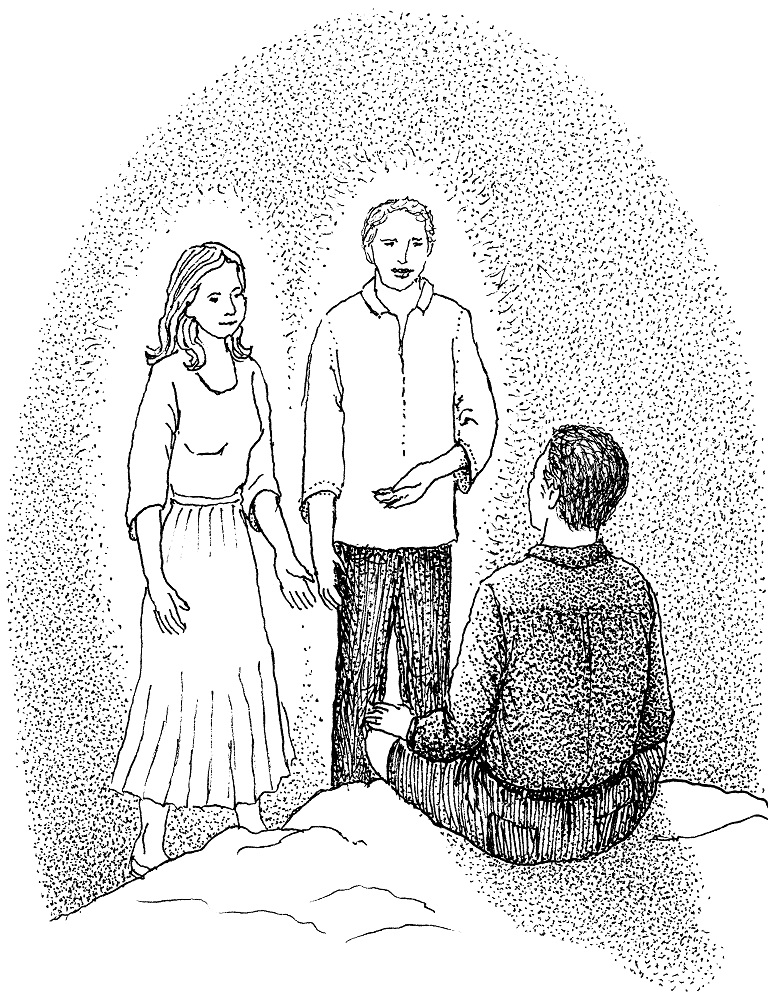
Rising from Death, from Death and Rebirth, by Lee Woofenden (copyrighted image)

Rising from Death

Both of my parents also died within the past few years. I wrote about their passing in an article, “When Death is a Celebration.”

It is very common for us to contemplate the meaning of life and death when our parents’ time of death arrives. Whatever our relationship may have been with them, knowing that they are gone changes our view of ourselves. There is no longer an older generation above us. Now, in a psychological sense, we’re on our own. Now we have to think about why we’re here on earth, and about where we are headed in life and in our own eventual death.

So your spiritual conundrum raises at least two issues that confront us at the time of our parents’ deaths:

  1. Are my parents okay, and will I see them again one day?
  2. What does my parents’ death mean for my own life?

Let’s look at these questions in reverse order.

For more on the meaning of our parents’ death, please click here to read on.

Tagged with: , , , , , , , , , , , ,
Posted in The Afterlife

Dr. Zenko Hrynkiw: When a Hero Says he’s Not a Hero

Dr. Zenko Hrynkiw, Neurosurgeon at Trinity Medical Center, Birmingham, AL

Dr. Zenko Hrynkiw

In our hero-worshipping culture, what happens when someone hailed as a hero rejects that label?

On January 28 of this year, during the snow storm that paralyzed much of the U.S. South, Dr. Zenko Hrynkiw received a call that an emergency brain surgery was needed to save a patient at the hospital where he works, Trinity Medical Center in Birmingham, Alabama. At the time, he was six miles away at another hospital, Brookwood Medical Center, where he had been assisting another doctor in surgery.

All in a day’s work.

Only this wasn’t an ordinary day.

Dr. Hrynkiw attempted to drive over to his hospital, but he didn’t get far. The roads were jammed with accidents, stuck vehicles, and roadblocks. So he got out of his car and started walking.

Along the way, he used his cell phone to keep in contact with Steve Davis, the charge nurse at the neurological intensive care unit at Trinity Medical Center, getting updates on the patient and giving instructions for medications and preparations for surgery. Without immediate surgery, the patient had a 10% chance of survival. Dr. Hrynkiw was not going to let him die—snowstorm or no snowstorm.

When AL.com picked up the story, Dr. Hrynkiw was hailed as a hero.

But he insists that there was no heroism involved. He was just doing his job. In a follow-up interview with AL.com, he had this to say:

Interviewer: Why do you think this is such a big story?

Dr. Hrynkiw: It’s not. I don’t understand it. (pauses) It’s not a story.

And when a Huffington Post interviewer bubbled over about how heroic his actions were, Dr. Hrynkiw brushed it off:

Interviewer: Everyone seems to be calling your actions “beyond heroic.” Do you feel like a hero?

Dr. Hrynkiw: No! I think this is much ado about nothing. I mean, basically, that’s my job, and you know, you gotta do what you gotta do.

He matter-of-factly described the events of the day and the patient’s almost certain death if he didn’t make it, adding that it wasn’t going to happen on his watch—as if walking six miles in the snow is just what an ordinary human being does in the course of his job.

And you know, he’s right!

Or at least, he should be.

For more on Dr. Zenko Hrynkiw just doing his job, please click here to read on.

Tagged with: , , , , , , , , , , , ,
Posted in Current Events

What is the Meaning and Significance of Gilgal in the Bible?

Here is a spiritual conundrum posed by a reader named victor:

What is the significance of gilgadh mentioned in 2king 2:1 – why the journey starts from gilgadh?

Gilgal Refaim ("circle of ghosts" or "circle of giants"); or Rujm el-Hiri ("stone heap of the wild cat")

Gilgal Refaim, or Rujm el-Hiri

Thanks for the question, victor! I assume you mean Gilgal, which is mentioned in 39 verses in the Bible. One of those verses is 2 Kings 2:1—the start of a story about the prophet Elijah being taken up to heaven in a whirlwind while the prophet Elisha, his apprentice, looks on (2 Kings 2).

The name Gilgal has been associated by Bible scholars with at least five different possible locations in and around the Holy Land, none of them certain. But as we will see, it seems likely that “Gilgal” is not a town name at all. Instead, it is likely a word for a particular type of human-made site. In recent decades archeologists have made some exciting new discoveries of ancient “Gilgal” sites!

Though Gilgal is first mentioned in Deuteronomy 11:30, it gains its primary meaning and significance in the book of Joshua. The first camp of the Israelites after they crossed the Jordan into the Holy Land was at a place called Gilgal. This camp served as their base of operations during the initial conquest of the Holy Land under Joshua. Several other important events in the Bible take place either at this Gilgal or at a different one. Eventually, though, Gilgal became corrupt, and two of the prophets railed against it later in Israel’s history.

In some ways Gilgal has a story similar to that of Bethel, which is covered in an earlier article: “What is the History and Importance of Bethel in the Bible?” However, as we will see in Part 2 of this article, “the gilgal” (as it should really be translated) has its own particular meaning in the Bible story, and its own special significance for our spiritual life.

Okay, okay! I’ll spill the beans just a little . . .

As the Israelites’ point of entry into the Holy Land and their base of operations for the initial conquest of the land, the site called “Gilgal” signifies the simple, basic religious beliefs and teachings that first introduce us to a spiritual life, and that we return to again and again as we fight our early battles to reform ourselves and get our life into order.

It’s all about stones and circles.

For more on the meaning and significance of Gilgal, please click here to read on.

Tagged with: , , , , , , , , , , , ,
Posted in Spiritual Growth, The Bible Re-Viewed

Did Jesus Really Die to Pay the Penalty for our Sins?

One day some years ago, a fundamentalist Christian tract came through the mail slot. I almost tossed it out. But out of curiosity, I gave it a read-through.

It’s a typical piece. And it pushes an old “Christian belief” that the Bible doesn’t teach. You may be surprised to discover that some the most basic claims of evangelical Christians simply aren’t found in the Bible.

In this case, it’s the idea that Jesus “paid the price” or the “penalty” for our sins. Believe it or not, the Bible simply doesn’t say this! The Bible does say that Jesus died for our sins, and that Jesus takes away our sins. But it never says that he paid the price or the penalty for our sins.

It may seem like a nitpicky point. But in fact, it is very important for understanding what salvation is all about from a Christian perspective.

Let’s take a closer look at the tract, and see exactly where it goes off course.

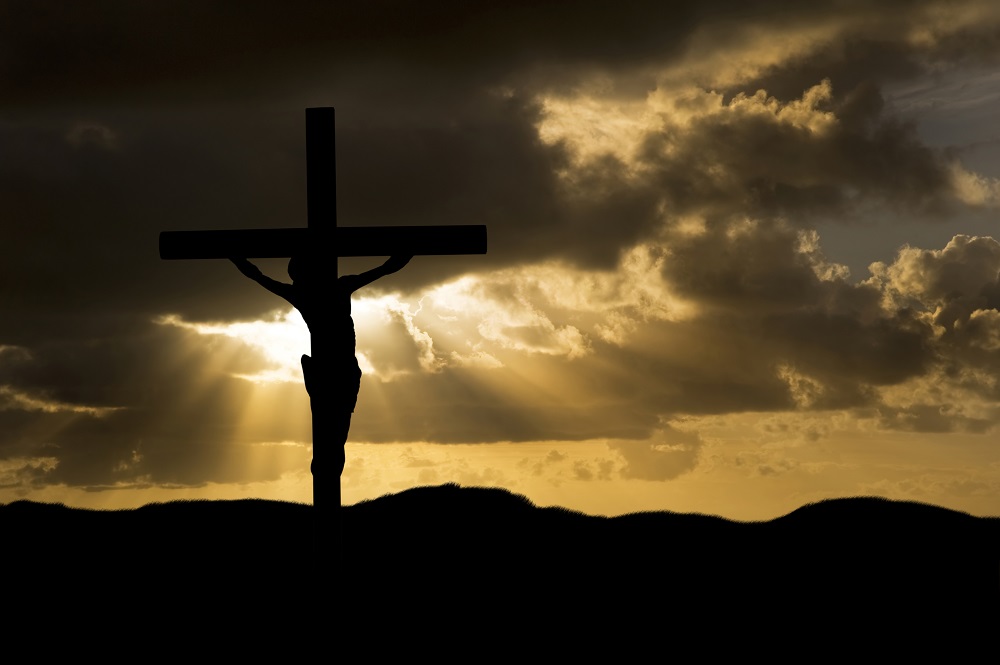
Was this death really to pay the penalty for our sins?

Was this death really to pay the penalty for our sins?

For more on taking away penalties vs. taking away sins, please click here to read on.
Tagged with: , , , , , , , , , , , ,
Posted in All About God

Chris Strickland Catches a Baby

In the latest viral video, a 19-year-old named Chris Strickland deftly catches a baby falling out of a shopping cart. It happened—all nine seconds of it—at a Home Depot store in Anchorage, Alaska. Here’s the article about it in the local paper, the Anchorage Daily News: “Gone viral: Anchorage teen who caught falling baby finds out how fast the Internet can bring fame.”

Chris Strickland at the Home Depot store Anchorage, Alaska, where he caught a falling baby girl

Chris Strickland at Home Depot, Anchorage, Alaska

(Photo credit: Bill Roth, Anchorage Daily News)

It was a moment made to go viral. Some unknown Home Depot employee couldn’t resist recording the incident from the security screen using his phone. Once it was leaked, it began making the rounds. Strickland’s church, Jewel Lake Community Church, posted it on its Facebook page. Chris’s brother Dale posted it on YouTube with the simple title, “Chris to the rescue.” From there it propagated around the web, logging hundreds of thousands of views.

It’s a simple, heart-warming story. A young man, just three months into his first job, saves a baby girl from injury or death a split second before she would have hit the concrete floor. Strickland is being hailed as a hero. And there’s talk of how he was in the right place at the right time.

But there’s one other element to the story that should be highlighted: Chris Strickland was paying attention, and he was ready to serve. His saving the day in what could have been a tragic accident was no accident.

For more on attention and service in the small things, please click here to read on.

Tagged with: , , , , , , , , , , , ,
Posted in Current Events

If You Think You’re Going to Hell, Please Read This First

Do any of these sound familiar?

  • Every Sunday the preacher shouted from the pulpit that you’re a terrible sinner. God is angry at you. Because of God’s wrath, you’re going to burn in hell for all eternity.
  • Your parents drilled it into you that you’re just no good. And they’re probably right. You just can’t feel good about anything you do.
  • You’ve done terrible things . . . horrible things. What you’ve done is so bad that you deserve to be in hell. There is no hope for you. You’re a goner.
  • No matter how hard you try, you just can’t be good. You know what you should do, but you just keep on doing the things you shouldn’t do.

If any of these are much too familiar for you, I’ll be straight: There are no easy answers. Besides, you’ve probably tried the easy answers already, and learned the hard way that they don’t work.

I’m also not going to tell you that all you have to do is believe in Jesus. Believing in Jesus is great. I highly recommend it! Being born again is wonderful! But for Christians, believing in Jesus is only the start. Then come the many years of growing from spiritual infancy to spiritual maturity.

The fact is, if any of the things on this list describe your experience, then no matter how you slice it, you’ve got some hard work to do. And it may take years to fully recover, even with God’s help.

What I can offer you is new light and a new understanding of your situation. Nothing I say will snap you right out of it and instantly make your life a bed of roses. But it will give you hope that there is a path out. And it might help you take your next steps on that path toward the life of heaven God has in mind for you.

No matter what that preacher or your parents or anyone else has said, God created you for heaven, not for hell. And there is no reason on earth that you can’t find your way to heaven . . . no matter what your history.

So let’s straighten a few things out.

For more on heavenly hope vs. hellish despair, please click here to read on.

Tagged with: , , , , , , , , , , , ,
Posted in Spiritual Growth, The Afterlife

The Bible Doesn’t Say It!

The Bible

The Bible

I’ve written a new article on “Christian Beliefs” that the Bible Doesn’t Teach.  Its purpose is to show that many old, traditional, and common “Christian beliefs” are not actually taught in the Bible, even though many people think they are.

This article will occupy a prominent place here on Spiritual Insights for Everyday Life. It may also be updated from time to time with additional “Christian beliefs” that are not taught in the Bible.

Here’s how it starts:

Q: What do the “Christian beliefs” in the list below have in common?

A: None of them are taught by the Bible.

“Christian beliefs” that the Bible doesn’t teach:

  1. There is a Trinity of Persons in God
  2. We are saved by faith alone
  3. Jesus died to pay the penalty for our sins
  4. The Bible is inerrant
  5. Only Christians can be saved

All of these beliefs were originated by human beings hundreds or even thousands of years after the Bible was written.

Are they wrong? I think so. But the purpose of this article isn’t to show that they’re wrong. It’s to show that even though millions of Christians believe them, they are not actually taught by the Bible. They are human interpretations.

To read the whole article, please follow this link:

“Christian Beliefs” that the Bible Doesn’t Teach

If you like it, please tell your friends. Thank you.

Enjoy!

Tagged with: , , , , , , , , , , , ,
Posted in All About God, The Bible Re-Viewed

Is it Easy or Hard to Get to Heaven?

Two thousand years ago Jesus Christ said, “Come to me, all you that are weary and are carrying heavy burdens, and I will give you rest. Take my yoke upon you, and learn from me; for I am gentle and humble in heart, and you will find rest for your souls. For my yoke is easy, and my burden is light.” (Matthew 11:28–30)

Echoing Jesus’ words, Emanuel Swedenborg (1688–1772) wrote, “It is not so hard to lead a heaven-bound life as people think it is” (Heaven and Hell #528).

A reader named Rob is not so sure. In a recently submitted spiritual conundrum he asks:

What if I cannot attain to the kind of life Swedenborg says I need to to go to heaven? The demands are too burdensome. I try and fail. Spectacularly.

Am I doing something wrong here? Are some people just born with a better disposition and can do the good easily?

Thanks, Rob, for the great questions!

My sense from what you write, and from your earlier comments here on Spiritual Insights for Everyday Life, is that life has been difficult and painful for you. You question in your heart whether someone like you can really find your way to happiness and to heaven. It seems to you unlikely, if not impossible. It seems that you may be fated for pain and sorrow, and for eternal darkness.

Is it really so easy to get to heaven? Or is it hard . . . maybe impossible? Is it even worth trying?

The short answer is: It’s both easy and hard to get to heaven.

As Swedenborg says, living a life that leads to heaven is really not all that hard. We don’t have to be perfect, pious people who spend all of our time praying and never have an evil thought. Mostly, we just have to avoid doing dishonest and destructive things, and make ourselves useful to our fellow human beings.

Unfortunately, there is often huge resistance, both within us and around us, to living the way our better self wants to live. We have an ideal for ourselves, and we just can’t seem to live up to it. We keep on thinking, wanting, and doing the things we swore we’d stop doing.

There are also a lot of misconceptions floating around about what type of person we have to be to get to heaven. Heaven has room for all different kinds of people, not just for the bubbly, cheerful types that are held up to us as shining examples of what a “real Christian” is supposed to look like. In fact, heaven needs all different types of people.

Even though you may think that with your particular character, disposition, struggles, and failures, there will be no room for you in heaven, it’s very possible that heaven needs someone exactly like you.

For more on the rocky path to heaven, please click here to read on.

Tagged with: , , , , , , , , , , ,
Posted in Pain and Suffering, Spiritual Growth

Good News of Great Joy

The brightest star in the sky: Sirius

The brightest star

At Christmastime, Christians celebrate the greatest event that has ever taken place—the greatest event that ever will take place. It is not a victory in war. It is not a world championship in sports. It is not a triumph of medicine or technology. It is not a great scientific breakthrough. It is not a political or economic breakthrough. It does not fit into any of our usual categories of great events. It is in a category all its own. It is unique in history. Though the world is still not sure exactly what happened, we number the years of our history forward and backward from this event.

What is the great event that forms the centerpiece of our world’s history?

It is the birth of the Lord and Savior, Jesus Christ. Not a great, flashy current event that would, in our day, have its brief moment of fame in the media and then be forgotten a few days, weeks, or years later. The birth of a baby. A birth that was noticed only by a few shepherds, prophets, and wise men who were told by angels. A birth that took place, not in the ornate halls of a royal palace, but in a village—and in that village, not in a comfortable bedroom in a house or inn, but in a place where animals lived.

That is how the God of the universe chose to come to us. “A bruised reed he will not break,” says the prophet (Isaiah 42:3). God did not want to overwhelm us with grand miracles, forcing on us a belief that would be only skin deep. No, God came to us gently, with the innocence of a baby—not demanding, but asking graciously for our faith, our love, and our obedience. The Lord stands and knocks at the door, waiting for us to open it and let him into our lives (Revelation 3:20).

For more good news of great joy, please click here to read on.

Tagged with: , , , , , , , , , ,
Posted in All About God
Lee & Annette Woofenden

Lee & Annette Woofenden

Donate

Support the work of Spiritual Insights for Everyday Life by making a monthly donation at our Patreon

Join 1,296 other subscribers
Earlier Posts
Featured Book

Great Truths on Great Subjects

By Jonathan Bayley

(Click the title link to review or purchase. This website receives commissions from purchases made via its links to Amazon.)

Blog Stats
  • 4,201,959 hits