Practical and spiritual Bible lessons for all ages
In the early 1950s, Anita S. Dole completed a graded set of Bible Study Notes intended for use in Swedenborgian Sunday Schools. Since then, they have become popular with Bible students all over the world. This is one of the finest sets of Bible lessons available today, offering both practical wisdom for daily life based on the Bible story itself and spiritual insights based on the symbolic or “correspondential” method of Bible interpretation taught by Emanuel Swedenborg (1688–1772).
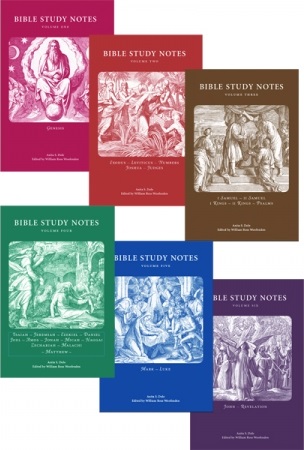
Bible Study Notes, by Anita S. Dole, 6 volume set
The notes for each Bible story start with the basics for young children, and progress up through the age groups, adding more and more depth to the story as they go along, and culminating in the adult-level notes. Many adult readers find that the children’s lessons are just what they need to get a handle on the Bible stories! Yet even advanced Bible students will find a rare depth of understanding here.
Since these notes were written over sixty years ago, they have a “classic” feel about them. Yet the lessons for daily life and for a deeper, more spiritual view of the Bible stand the test of time.
On a personal note, Anita Dole was my grandmother. She was married to the Rev. Louis A. Dole (my maternal grandfather, many of whose sermons are posted here), and taught Sunday School for many years during his pastorates in Fryeburg and Bath, Maine. She also taught the teen class for many years at Fryeburg New Church Assembly. My father, the Rev. Dr. William R. Woofenden, edited this six volume set from its original looseleaf form.
To purchase the Bible Study Notes direct from the publisher, click on the image above, or on any of the title links.
For further description and review, please click here to read on.