Containers for God

This article is a sequel to the previous one, “Wavicles of Love.”

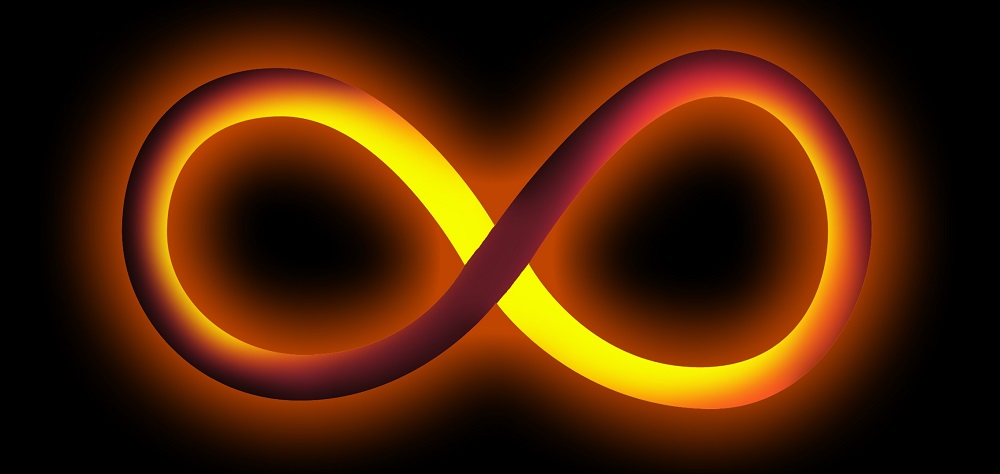
The infinity symbol

The infinity symbol

If God is infinite, how can there be room for anything else? Wouldn’t everything just be a part of God? If God is infinite and therefore is present everywhere, how can we humans exist and not be God?

Good questions! I’m sorry you asked! Because now we have to bend our brains some more.

But it will lead us to some practical thoughts that can be helpful to us personally. I promise!

First, let’s do some brain-bending. In True Christianity #33, Emanuel Swedenborg (1688–1772) writes:

Every created thing is finite. The Infinite is in finite objects the way something is present in a vessel that receives it; the Infinite is in people the way something is present in an image of itself. . . . [In creating the universe,] God first made his infinity finite in the form of substances put out from himself. The first sphere that surrounds him consists of those substances. . . . He then completed the remaining spheres even to the farthest one, which consists of inert elements. He increasingly limited the world, then, stage by stage. I lay this out here to appease human reason, which never rests until it knows how something was done.

Gotta love that final sentence!

What Swedenborg is really talking about, in abstract, philosophical terms, is why we human beings exist, and what our life is all about. In essence, we are God-shaped containers. And if we see and understand that we are God-shaped containers, we can come to know that everything we do—even the most menial task—is helping to bring God’s love and wisdom into this world, so that it can flow to the people around us.

That is what gives meaning to this life that sometimes seems so meaningless.

For more on God, the universe, and us, please click here to read on.

Tagged with: , , , , , , , , , , , ,
Posted in Science Philosophy and History

Wavicles of Love

There is an ancient theory that the deeper we look into the nature of reality, the simpler it gets. The Greek philosopher Democritus (c. 460 – c. 370 BC) is often given credit for being the originator of the idea that matter consists of atoms, though his teacher and mentor Leucippus should probably receive that honor. Democritus, however, developed the concept of atoms into a well-developed theory of the nature of reality.

Today, physicists speak of subatomic particles. According to the original atomic theory developed by Leucippus and Democritus, however, this would be a contradiction in terms. The very word “atom” comes from a Greek word meaning “indivisible.”

In this ancient atomic theory, if we were to cut an object, such as a piece of wood, in half, and then cut one of the resulting pieces in half, and so on, eventually we would get to something that could no longer be cut. This would be an atom. Atoms were seen as the fundamental, indivisible building blocks of the universe. According to Democritus’s theory:

  • Atoms are indivisible and indestructible.
  • Atoms have always existed, and always will exist.
  • There is an infinite number of atoms.
  • Atoms come in an infinite variety of sizes and shapes.
  • Atoms are always in motion.
  • In between the atoms there is only empty space.

Democritus believed that all things, including subtle phenomena such as light, consisted of these indivisible, indestructible atoms.

However, it didn’t take long for an alternative viewpoint to be proposed. The Greek philosopher Aristotle (384–322 BC) proposed the theory that light is composed of waves that travel through the “element” of air. (Aristotle posited four elements: earth, water, air, and fire.)

Fast forward nearly two and a half millennia to today, and we’re still trying to figure out whether the phenomena we see around us in this material world consist of some sort of fundamental particles, or whether reality is more of a wave-like thing. Sometimes it looks like everything is made of waves; other times it looks like everything is made of particles. And in some famous experiments in which a beam of light is passed through two slits, light seems to behave like both waves and particles at the same time.

Twin slit pattern - Computer generated

Twin slit pattern – Computer generated

(Images courtesy of http://www.hotquanta.com/wpd.html)

This has given rise to the idea that reality involves a “wave-particle duality.” Sometimes particles explain things better, other times waves do, and sometimes it’s necessary to put waves and particles together, resulting in the coined term “wavicle.”

In modern physics, our general experience is that as we look deeper and deeper into the nature of reality, instead of getting simpler, things only gets more complex.

What’s going on here?

Emanuel Swedenborg (1688–1772) offers some insights and theories that may help to put “wavicles” and the other strange phenomena that occur at the borders of physical reality into a more spiritual and universal perspective. Swedenborg began his adult life as a scientist and ended it as a theologian. As he saw it, science and theology are not in conflict, but form a unified whole.

For more on wave-particle duality and spiritual reality, please click here to read on.

Tagged with: , , , , , , , , , , , ,
Posted in Science Philosophy and History

Father, Son, and Holy Spirit

Quick! Guess! What was the hot topic for Christian leaders a few centuries after Jesus Christ died?

Naturally, they were having a spirited discussion about the nature of God.

But that doesn’t quite capture what was going on.

In the late 200s and early 300s, the leaders of the Christian Church were locked in a pitched battle about what the (then) fairly new books of the New Testament meant when they talked about the Father, the Son, and the Holy Spirit (also called the Holy Ghost).

And wow, were they confused! What they were reading just didn’t make sense to them. So they began coming up with theories, staking out positions, kicking each other out of the church, and telling each other to go to . . . oh, wait, that’s not quite right. They told everyone who didn’t believe what they themselves believed that they would go to hell.

Yes, Father, Son, and Holy Spirit was the hot topic among Christian leaders in the year 325. That’s when the Roman emperor Constantine invited all 1,800 Christian bishops to a council held in a town called Nicaea. Two or three hundred of them actually showed up. In meetings attended by the emperor himself, these bishops came up with the first version of a statement of belief that attempted to define the relationship between Jesus Christ (the Son) and the Father. The statement they drafted is called the Nicene Creed. The vast majority of Christians and Christian churches have accepted it as essential Christian doctrine ever since.

And yet, the Council of Nicaea is precisely where the Christian Church got seriously off track. At least, it is according to Emanuel Swedenborg (1688–1772).

Why?

Although the Nicene Creed does not actually use the word “Trinity” or the word “Persons” (neither does the Bible, by the way), what it did say about the Father, the Son, and the Holy Spirit set the Christian Church on a course toward the doctrine of the Trinity of Persons. One and a half to two centuries later, the Athanasian Creed, another statement of belief that greatly expanded on the Nicene Creed, did use the terms “Trinity” and “Persons,” making explicit the doctrine that the earlier creed had strongly implied.

And according to Swedenborg, the doctrine of a Trinity of Persons in God led to a quick death for true Christianity by introducing contradiction, confusion, and polytheism into the church.

For more on the Trinity in God, please click here to read on.

Tagged with: , , , , , , , , , , , ,
Posted in All About God

Christianity is Dead. Long Live Christianity!

Christianity as it has existed for most of the last two thousand years is in its death throes. For many centuries, Christianity ruled Western minds, and thus Western society. The Christian Church was the final authority on the truth or falsity, the right or wrong, of any question or course of action. Those who dared to challenge the authority of the Church generally did not fare well.

The Christian Church displayed as a museum

Museum Christianity

Today, not only has the Christian Church fallen from its former position of the final spiritual, social, and scientific authority in the Western world, but the institution of the church is itself in rapid decline. Traditional churches are bleeding members, and closing their doors in droves. Many magnificent old church buildings are being converted to secular use, or have become museums and tourist attractions.

The death of traditional Christianity in Europe is especially stark. Recent studies show that only 25% of 18-24 year olds in Britain believe in God. Church attendance throughout much of Europe is at an all-time low. In the United States, Christianity is still much more mainstream than in Europe. But even in the U.S., traditional churches are closing their doors; both the Catholic Church and the mainline Protestant churches are declining in membership.

While there is a resurgence on the Evangelical side, that, too, is showing signs of losing steam. Even when traditional Christian theology is set to rock music, people eventually realize that it’s the same old wine in those hip new wineskins. Though new converts do flock to the tech-savvy, modern Evangelical churches, the turnover is high. These churches depend on constant high-intensity proselytizing to produce a continual stream of new converts in order to replace the people who are continually flowing out of their revolving doors. Modern marketing techniques can carry you only so far when you’re selling an outdated theology.

You see, there’s more going on here than the repackaging of Christianity that is commonly covered in the media.

For the last two or three centuries, Christianity itself has been dying. At least, the church that has been called “Christian” all these centuries has been dying.

But that church was never really Christian in the first place.

For more on the death and rebirth of Christianity, please click here to read on.

Tagged with: , , , , , , , , , , , ,
Posted in Science Philosophy and History

Divine Providence, by Emanuel Swedenborg

How can a loving God allow so much evil in the universe?

What is the purpose of all the pain and suffering we humans endure?

Does God have a plan for us?

If you’ve ever wondered how an all-loving and all-wise God could allow so much evil, pain, and suffering in the world, Divine Providence is the book for you. In this spiritual classic, Emanuel Swedenborg digs deep into the mind of God to deliver a message of hope and love for ordinary people struggling along in a world that often seems senseless and hopeless.

Divine Providence
By Emanuel Swedenborg

Divine Providence was originally published in Latin in 1763. I recommend the New Century Edition linked here for the most readable and accurate modern translation. It is also available in a deluxe hardcover edition combined with its companion volume, Divine Love and Wisdom.

To purchase Divine Providence on Amazon, click the cover image above, or any of the title links. To purchase direct from the publisher in various formats, or to download a free PDF or epub version (without the scholarly introduction and notes), click this link.

For further description and review, please click here to read on.

Tagged with: , , , , , , , , , , , ,
Posted in Books and Literature

How does God Govern Humankind? Is God Actively Involved in our Lives?

Why does God let us experience pain and suffering?

Clearly all is not right in our world. The daily news brings us more death and disaster, pain and suffering than we would ever desire. How could a loving God allow so much evil in our world?

First, we must understand that while we humans usually focus on our own immediate pleasure or pain, God focuses on our eternal happiness. Yes, God would like us to be happy here on earth. But compared to eternity, our few years here are relatively short and insignificant.

God’s goal is to form us into angels who can be part of the joyous community of heaven. And God will allow us to experience pain and suffering here on earth if that is necessary to bring about our eternal happiness.

After all, most evil exists in the first place because we humans have been given the freedom and the rationality to make our own choices, whether good or evil. God will not violate our freedom and rationality. But God is continually working in our hearts and through our hands to overcome the evil in the human spirit and in this world of ours.

For more on how God governs our world, please click here to read on.

Tagged with: , , , , , , , , , , , ,
Posted in All About God

How does Marriage Fit In with a Spiritual Life? Is There Marriage in Heaven?

Is marriage biological, social, or spiritual?

Answer: All of the above. Not to mention divine.

Yes, we humans have the same biological drives to mate and reproduce as the rest of the higher animals. And yes, marriage does help to provide social stability and a healthy environment for raising children—assuming the marriages themselves are healthy.

But marriage goes far beyond biology and sociology. At least it does according to Emanuel Swedenborg, who published a controversial book on the subject back in the eighteenth century. Marriage, says Swedenborg, is a spiritual and eternal relationship because it comes from the very nature of God.

What? Is God married?

Yes . . . but it’s not what you’re thinking! There is not a marriage between male and female deities and a whole family of little gods and goddesses running around some celestial Mount Olympus. Instead, there is a marriage of divine love and divine wisdom. From that marriage comes everything God says and does, including all of creation.

From its origin in God, marriage goes down through every level of a human being. And when marriage is a spiritual union of two people who share common loves and common values, it becomes heavenly, spiritual, holy, pure, and clean on all levels, from the spiritual right down to the physical.
For more about this view of marriage, please click here to read on.

Tagged with: , , , , , , , , , ,
Posted in Sex Marriage Relationships

The Bible: Literal Inerrancy vs. Divine Depths of Meaning

Here is a comment that a reader named Ben made on my article, “Can We Really Believe the Bible?”:

We can definitely believe the Bible. There is no denying that careful interpretation and context are important, but there is no reason to ever assume that the Bible and science contradict. Take a look at the Hebrew word that we translate as “day” in Genesis 1. Biblical Hebrew did not have a huge amount of words and therefore many words were versatile. The Hebrew word “yom” or yowm” can be translated as day or something more like “age” depending on the context. In other words, the creation days were probably very long. Once people step away from the 24-hour day assumption for Genesis 1 it is amazing how much they can calm down. This does not mean that English Bibles are wrong, as we often use phrases like “back in my day” that are not taken to mean a literal 24-hour day. It also does not necessarily mean that evolution is what God used if He took His time creating the earth and its creatures, but I have no problem with the thought of God using the “big bang” to kick-start the universe. Scientific discovery does not put biblical inerrancy in any kind of troublesome spot.

You make many good points in this post, Lee, but your implication that Genesis 1 is merely allegory has me somewhat troubled.

Thanks for your thoughtful comment, Ben!

I am aware that interpreting the Bible symbolically or correspondentially rather than literally is troubling for many people. There is a desire to be faithful to the Bible, and this is seen as requiring adherence to the literal inerrancy of all of its statements. While I applaud the desire to be faithful, this way of being faithful misses the greatest spiritual and divine treasures of the Bible, and limits its adherents to the more superficial aspects of the Word of God.

For more on the divine depths contained in the Bible, please click here to read on.

Tagged with: , , , , , , , , , , , ,
Posted in The Bible Re-Viewed

What is the Source of Human Fragility, Sickness, and Disease?

Here is a spiritual conundrum posed by a reader named Joe:

I’m looking for doctrinal statements that deal with the human physical fragility and its source. Is human fragility (sickness, disease, etc.) a consequence of original sin? Is human fragility a consequence of the curse to the ground. (ie. The ground is cursed, we grow food from the ground, we eat cursed ground food and we eat animals that eat cursed-ground food, we therefore are processing cursed-ground foods and we get sick and have diseases). I hope you get my drift and may have some helpful insight or direct me to a reliable resource. Thank you for your time and I really appreciate your message “Curses or Consequences…”

Wow! Great question, Joe!

And since it’s such a huge question, I’ll give you the short version first:

Like human beings themselves, human fragility, sickness, and disease is a result of a highly complex interaction of many physical and spiritual causes, both individual and societal, from the past, the present, and (strange as it may seem) even the future.

If a person is sick—especially if it is a serious illness—there is no single, simple cause, nor is there a single, simple solution. All sickness and disease is systemic. Even if it may appear to affect only one part of the body, in fact it both affects and is affected by the entire body, mind, and spirit of the person who is sick.

It also both affects and is affected by the person’s physical, social, and spiritual environment. We humans are social creatures embedded in a human environment. We are also biological creatures embedded in a physical environment. Our physical and spiritual environments have a profound effect on our sickness and health.

Because of this highly complex source of human frailty, sickness, and disease, we both do and do not bear responsibility for our own weakness and disease as individuals. By taking responsibility for what we can take responsibility for, we can indeed improve our physical and mental health.

And yet, there will always be factors beyond our control influencing us. Even if we were to live a near-perfect life and lifestyle, we could still suffer from human frailties and diseases because of the rather toxic physical and spiritual environment in which we live. Being sick is not something to beat ourselves up about. It does not necessarily mean that we are bad people or that we are being punished for our sins.

But it does mean that we have work to do, both individually and as a society.

Now for the long version, including responses to your specific doctrinal and Bible-based questions.

For more on human fragility, sickness, and disease, please click here to read on.

Tagged with: , , , , , , , , , , , ,
Posted in Pain and Suffering

Paula Deen’s Secrets: The Inner Self Revealed

Paula Deen happy in earlier days

Paula Deen

Paula Deen has been outed again. This time it’s literally a show-stopper.

Last year the queen of rich, sweet, buttery Southern cooking outed herself: she suffers from type 2 diabetes, which is linked to the very kinds of foods she showcased on her highly popular cooking shows. She took criticism at the time because her announcement came three years after she was diagnosed—and after continuing to tout her unhealthful comfort foods all the while.

But that pales in comparison to the current controversy.

It all began when Lisa Jackson, a former manager at a restaurant called Uncle Bubba’s Oyster House in Savannah, Georgia, owned and operated by Deen and her brother Earl “Bubba” Hier, filed a 1.2 million lawsuit against Deen and Hier alleging racism, discrimination, and acts of violence.

In a recently leaked deposition, Deen admitted to using racially charged language, and to tolerating discriminatory behavior in her restaurants. The deposition went viral, and the criticism came pouring in. Deen quickly released two or three videos offering apologies. But that was not enough for the Food Network, which announced that it would not renew its contract with the celebrity chef for the three popular Paula Deen cooking shows that were airing on its network, including “Paula’s Best Dishes.” She has also lost endorsement deals, and contracts with several retailers that carry her products.

Amid the chaos of condemnation, there are also some more measured reactions to the Paula Deen racism scandal. However, though Deen still has ardent supporters, the damage is done. Her reputation is indelibly tarnished. She will never again be viewed in quite the same way by society.

That’s what happens when the inner self that we keep hidden away comes out into the open.

And our secrets will be revealed sooner or later.

For more on the secrets of our inner self, please click here to read on.
Tagged with: , , , , , , , , , , , ,
Posted in Current Events, Popular Culture
Lee & Annette Woofenden

Lee & Annette Woofenden

Donate

Support the work of Spiritual Insights for Everyday Life by making a monthly donation at our Patreon

Join 1,296 other subscribers
Earlier Posts
Featured Book

Great Truths on Great Subjects

By Jonathan Bayley

(Click the title link to review or purchase. This website receives commissions from purchases made via its links to Amazon.)

Blog Stats
  • 4,201,993 hits