Okay, so it’s a clickbait title. Sue me.
But the fate of the universe is hanging in the balance!
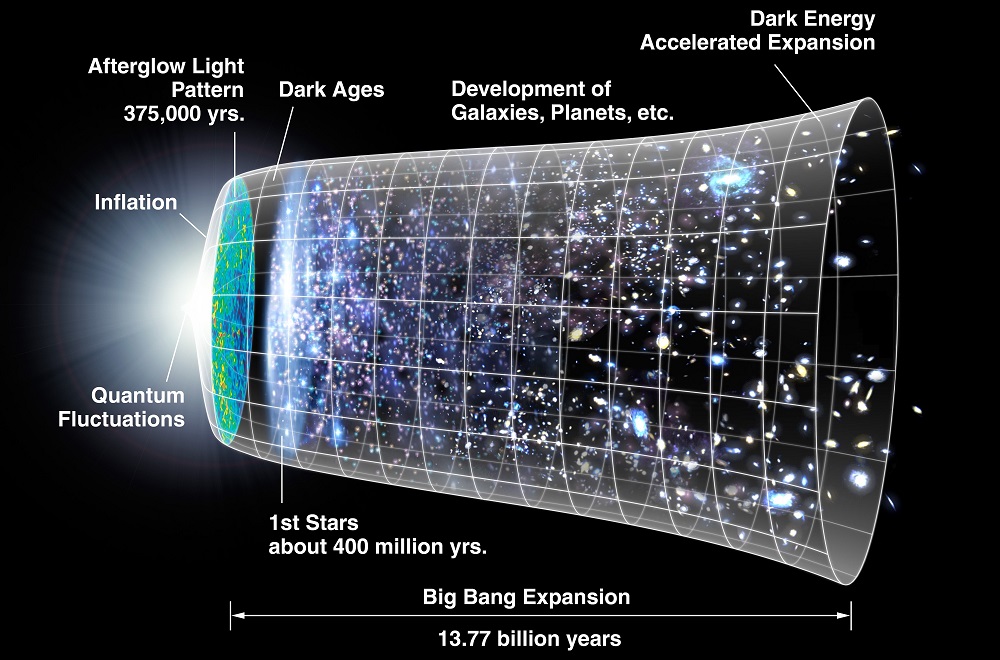
You see, in recent decades the reigning scientific cosmological theory, the Lambda cold dark matter model (Lambda-CDM for short), has suggested that the physical universe started with a Big Bang that was so energetic that the universe will keep expanding forever, resulting in the eventual heat death of the universe—a “Big Freeze” in which matter and energy are so thinly spread throughout such a vast space that everything is cold and dead.
Sounds grim. And a lot of people don’t like it. That’s why there is considerable excitement about new findings suggesting that the universe may have a very different fate. You can read all about it in this article from BBC Sky at Night Magazine:
“The Universe may end in a ‘big crunch’ after all,” by Ezzy Pearson and Chris Lintott
“Big Crunch” is the nickname for the idea that eventually the universe will stop expanding, and will start collapsing in on itself again until everything comes together in a singularity, which is an incredibly small hot dense state like the one that existed just before the Big Bang. This would open the door to the possibility of an oscillating universe, in which the universe goes through an ongoing cycle of expansions and contractions, one after another, like pearls on a string. A lot of people like this idea much better than the idea that everything ends in the dead, dead death of the universe.
So which theory is right?
The fate of the universe
Okay, that was sort of clickbait too. I can’t tell you which theory is right because we don’t know which one is right. We’re still trying to figure that out.
But I do have some thoughts.
First, one thing that’s clear is that the steady state model of the universe is no longer a viable theory. The steady state model was the primary alternative to the Big Bang theory. In that model, even though the universe is expanding, it always stays the same because new matter is continually being created to “fill in the gaps,” so to speak.
Even less viable is the old static universe model, in which the universe is neither expanding nor contracting, but remains “flat” and unchanged all the way out to infinity in both space and time. We now know beyond a shadow of a doubt that the universe is indeed expanding, and has been ever since the Big Bang began it all about 13.8 billion years ago.
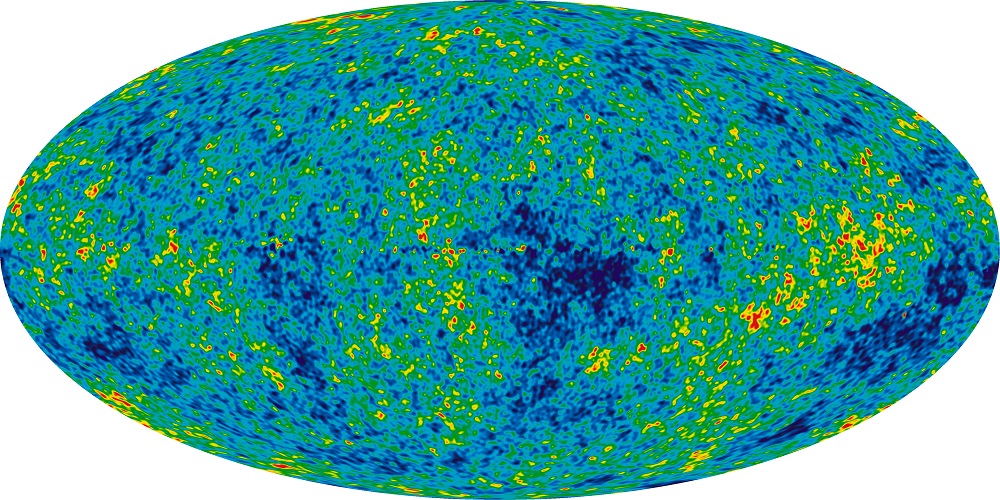
Map of the cosmic background radiation left over from the Big Bang
In other words, like everything in it, the universe itself has a life cycle. Plants, animals, solar systems, and galaxies are all born, go through their cycle of life, and eventually die. It is now clear that the same thing happens to the universe as a whole. It was born in the Big Bang, it is now going through its life cycle, and eventually, trillions and trillions of years from now, it will die.
The only question is whether it will die an “eternal death” in a Big Freeze, or whether it will die in a Big Crunch, only to be reborn into a new universe and continue the cycle.
Poetically, the cyclical nature of everything in the universe favors the idea that the universe itself is also cyclical. But poetry is not science. We will have to wait on future scientific progress before we know the fate of the universe. Hence my clickbait title!
A never-ending universe?
What does all this have to do with God and spirit?
Obviously, from a spiritual perspective, it was God who designed and created the universe. When scientists study the nature of the universe and everything in it, whether they think of it this way or not, they are studying the handiwork of God. And the things that God makes also reflect the nature of God. This means that in studying the physical universe, we can learn something about who God is—assuming we believe in God in the first place.
More to the point, the fate of the universe has been a big question both materially and spiritually for thousands of years. Some thinkers have believed that the universe will stay the same forever. Others have believed that the universe as we know it will come to an end at some future date. And some have believed that multiple universes will be born and die one after another, or even simultaneously, as in the multiverse idea.
Most Christians have believed that our current world has an end date marked by the Last Judgment, when the physical world will be destroyed, and God will rebuild it as our eternal home. Some have taken this less literally, but most still believe in an “end of history” when the Last Judgment and Second Coming happens, after which there will be no more birth or death, and everyone will live forever in either heaven or hell depending on what they had believed or how they had lived. In plain terms, no more babies will be born. However many people there are at the time of the Second Coming, that’s all there will ever be, and the good ones will spend the rest of eternity praising God.
Emanuel Swedenborg (1688–1772) begged to differ. He saw the Last Judgment and the Second Coming as spiritual events, taking place primarily in the spiritual world, and only secondarily in the material world. In his book on the Last Judgment he wrote:
People who have adopted the belief that the Last Judgment will entail the destruction of everything in the heavens and on earth and that a new heaven and a new earth will come into being in their stead also believe, because it logically follows, that the reproduction and successive generations of humankind will come to an end after that. They think that all this will be over and humanity will then be in a different state than before. However, as explained in the preceding chapter, the day of the Last Judgment does not mean the destruction of the world; it follows, then, that humankind is in fact going to continue and its reproduction will not cease. (The Last Judgment #6)
Well then, that settles it, doesn’t it? There’s not going to be any destruction of our Earth, and humanity will continue to exist and reproduce forever!
The only problem is that no currently plausible scientific theory of the universe allows for this. Whether the universe ends in a Big Freeze or a Big Crunch, it does end, and human reproduction will cease.
To be fair, I don’t think Swedenborg was making an absolute or scientific statement. His real point was that there is not going to be some future literal Last Judgment involving the destruction of the current version of Earth followed by an Earth 2.0 in which there is no sex and no reproduction. (How boring!)
Still, we’re going to have to ditch the idea that we humans will be able to continue our species forever in our current physical universe. As covered above, it is very clear by now that the universe itself has a life cycle. And our species would not be able to survive either a Big Freeze or a Big Crunch. It may be hundreds of millions or even hundreds of billions of years in the future, but human reproduction will eventually cease, even if we manage to spread out from Earth and colonize the galaxy.
This leaves us with two main possibilities: Either the universe will end in a Big Freeze and the birth of new human beings actually is time-limited, or this particular universe will end in a Big Crunch and then there will be a new Big Bang and a new universe in which future human cultures and civilizations can develop, and continue to feed new people into the spiritual world. Here I am using “humans” and “people” in a broad sense, meaning intelligent self-aware beings who can contemplate God and spirit, and make moral decisions.
Even Swedenborg agrees that there is a heaven and a hell where people live forever. But Swedenborg’s concepts of heaven and hell are quite different from traditional Christian concepts.
What if reproduction is time-limited?
Personally, I’m among those who don’t like the idea that the universe will eventually become dead, and there will be no more new beings to enter heaven and contribute to its strength in diversity. But I also don’t think it’s the job of religion to dictate science. If over the next century or two science converges on a clear answer to the question of the fate of the universe, and that answer is “heat death,” then we spiritual types will just have to accept that this is the way God designed things.
And that wouldn’t be all bad. Reincarnation theory to the contrary notwithstanding, each of us as an individual human being is born once, lives out our lifetime, and dies once, after which we move on to our permanent home in either heaven or hell, based on the decisions we have made and the life we have chosen here on earth. Perhaps God has designed the entire universe to work the same way. Humanity (in the broad sense as defined just above) has its birth on one or more planets throughout the universe, we have our life cycle, and then we die, and the last of us goes on to the spiritual world, where we all live forever in community with God and with one another.
There’s nothing critically wrong with that. It still provides a vast community of human beings who can live eternally the way we have chosen to live during our lifetime here in the developmental “womb” of this earth. If that’s how God designed the universe to work, I can accept that.
How many humans?
But Swedenborg might have a problem with it. For one thing, he believed that every planet and even every moon is inhabited by human beings. His rationale:
I have talked with spirits about the fact that if people consider how incredibly vast the starry heaven is and how incalculably huge the number of stars in it is—and each star is a sun in its own realm, has its own solar system, and is much like our sun, though it may vary from it in magnitude—they can come to believe there is more than one inhabited world in the universe. Anyone who ponders this in the right way will conclude that all this immensity must be a means of achieving the ultimate purpose of creation, which is a heavenly kingdom in which the Divine can dwell with angels and with people [still in the physical world]. The whole visible universe, the sky studded with stars beyond number, each and every one of which is a sun, is just a means of producing planets with people on them, people who are the source of that heavenly kingdom.
The only conclusion rational individuals can draw from this is that a means so vast for a purpose so great was not brought into being so that a single planet could then produce the human race and the heaven it populates. How would that satisfy the Divine, which is infinite, for which thousands or even millions of planets full of people would amount to so little a thing as to be almost nothing? (Other Planets #4)
Swedenborg’s concept of humanity was vast. His universe included at least hundreds of thousands of planets and perhaps millions of planets (see Other Planets #26) all inhabited by human beings who would go on to populate heaven, and give the infinite God some reasonable number of people to love and care for.
Today we know that if there are other inhabited planets in the universe, they are very rare. We have so far discovered over 5,000 exoplanets (planets outside our solar system), and almost all of them couldn’t possibly host life. In simplified terms, almost all of them are either too hot or too cold. If scientists discover even one planet that has signs of life on it, they will be jumping for joy!
However, we also now know that the universe is far vaster than Swedenborg could have imagined. Even if human-habitable planets were so rare there is only one in each galaxy, this would still mean that there are far more inhabited planets than even Swedenborg thought. Current estimates are that the universe has as many as two trillion galaxies. Even though Swedenborg was wrong about every planet and moon being inhabited by human beings, he could still be right on his main point, which is that there are a vast number of planets producing new inhabitants for heaven.
I am therefore not too worried about whether this universe will eventually die a permanent death, and no more new people will be born. During its likely hundreds of billions of years of habitability, it could produce an unimaginably large number of people to populate heaven.
Besides, whether the universe produces one hundred billion or one hundred trillion or one hundred octillion people, that would still be nothing compared to the infinity of God. I think that even an infinite God would be happy with a whole lot of people who love God and love one another.
In short, if the universe comes to an end and is never reborn, this is not a worst-case scenario.
Heaven rests upon Earth
Still, I don’t like that idea.
And even from the perspective of Swedenborg’s theology, there’s a fly or two in that ointment.
First, according to Swedenborg heaven and earth—meaning the spiritual universe and the physical universe—are so inextricably linked to one another that neither can survive without the other. He writes:
Humankind is the foundation on which heaven rests. This is because humankind was created last, and what is created last serves as a base for all the [higher] things that preceded it.
Creation began from the highest or inmost things because it began from the Divine, and it proceeded to the last or outermost things and there it came to rest. (The outermost level of creation is the physical world, including our globe of lands and seas and everything on it.)
* * * * *
People who do not know the mysteries of heaven may believe that angels exist apart from us and that we exist apart from angels, but I can solemnly testify on the basis of all my experience of heaven and my conversations with angels that no angel or spirit exists apart from humankind and that no human being exists apart from angels and spirits. I can testify also that the way we are joined together is mutual and reciprocal.
This leads to the prime conclusion that humankind and the heaven of angels make up a single whole and depend on each other mutually and reciprocally for their existence, which means that neither can be parted from the other. (The Last Judgment #9)
If there is such a close connection between heaven and earth that “neither can be parted from the other,” what happens to heaven when (not if) this material universe ceases to be inhabited by human beings?
“The finest substances in nature”
And it gets worse. Not only does heaven as a whole depend upon its connection with earth for its ongoing existence and integrity, but even individual angels and spirits, according to Swedenborg, also depend on an ongoing connection with the material world for their continued existence and integrity as individuals. In one of his more head-scratching statements, Swedenborg writes:
The soul we get from our father is our true self. The body we get from our mother is part of us but is not our true self. It is only something that clothes us, woven out of substances belonging to the physical world. Our soul is woven out of substances belonging to the spiritual world. After death we put off the physical component we acquired from our mother but keep the spiritual component we acquired from our father, along with a border around it made of the finest substances in nature. For those of us who go to heaven this border is at the bottom and the spiritual part of us is above it. For those of us who go to hell the border is at the top and the spiritual part of us is below it. This border allows angelic people to speak from heaven and say what is good and true. It allows devilish people to speak from hell when they speak from their hearts, and to seem to speak from heaven when they speak with their lips, the latter being what they do in public and the former what they do at home. (True Christianity #103, italics added)
For now we’ll pass over the part about the soul coming from the father and the body from the mother. This idea comes from Aristotle (384–322 BC). It is based on science even more rudimentary than existed in Swedenborg’s day. It can no longer be maintained in light of today’s far greater knowledge of genetics and reproduction. But I will cover that in the next post: “Where Does Our Soul Come From? When Does It Become Eternal?”
The second fly in the ointment of a universe that comes to an end is the little statement that when we die, our soul retains “a border around it made of the finest substances in nature.”
What are these “finest things in nature”?
I don’t think anyone knows for sure. Swedenborg only mention it in a few places. There is one passage in Marriage Love #183 where he makes the fascinating statement that we start out as an offshoot of our father’s soul in his semen, “enveloped in substance made of the purest things in nature.” (The Latin is the same in both places: purissimis naturae.) It appears that we both come into this world and leave it with a border (Latin: limbus) or skin made of these “purest things of nature.”
The only other place where Swedenborg provides any further detail is in his unpublished work Divine Wisdom. The only published translations are old and not easy to understand, so here it is in my own translation:
Angels and spirits gain their ability to remain in existence and to be alive from having been born as people in the material world. Being born in the world first provides what is necessary for our continued existence. From this world we take with us an intermediary between the spiritual and material levels, made from the inmost things of nature. This is what gives us a boundary so that we can remain in existence and have permanence. It is what gives us the ability to remain in connection with things in the material world, and to reflect them within ourselves.
This is also how angels and spirits can have a connection and a relationship with people on earth. After all, for there to be a connection there must be an intermediary through which the connection takes place. Angels are aware of this intermediary. However, since it is made of the inmost things of nature, and the words of our languages come from the outermost things of nature, this intermediary can be described only abstractly. (Divine Wisdom #8, italics added)
Ha! Even Swedenborg can’t put it into plain words! I’ve linked one of the existing translations of this section in case you want to read the whole fascinating and brain-bending thing.
Here Swedenborg says “inmost things of nature” instead of “purest” or “finest things of nature,” but he is talking about the same thing. This “border” made of the innermost or finest things of nature gives us a “boundary” that provides fixity for our spirit. It is like the skin of our body, which keeps all our internal organs from spilling out and dying through exposure. And like our skin, this “boundary” is what makes it possible for us to “touch,” or be in communication with, people on earth even after we have moved on to the spiritual world and have become angels or spirits.
What if the physical universe dies?
What we’re concerned with here is the part about this “border” of “the finest things in nature” being necessary for angels and spirits to continue in existence forever.
Material things cannot enter the spiritual world. These “purest things of nature” that we retain when we move on to the spiritual world after death must exist in the physical universe, not in the spiritual universe. This in itself is not a problem. If our spirit can inhabit an entire physical body made of both pure and gross substances from the material world, there is no reason our spirit couldn’t continue to inhabit a very fine, presumably diaphanous version of that body to eternity. Perhaps this is why ghostly images of spirits apparently show up occasionally in photographs taken by our physical-world cameras, which cannot detect anything spiritual, but which might be able to detect these “purest substances of nature.”
The problem is, if the physical universe ultimately ends in either a “Big Freeze” or a “Big Crunch” in which matter as we know it is either dissipated or destroyed, what happens to these “purest things of nature”?
Put another way, if angels and spirits depend on a “skin” in the physical universe for their ability to remain in existence permanently, what happens if the physical universe cannot provide that “skin” even temporarily in a Big Crunch, or permanently if the universe ends in a heat death in which all matter has dissolved into something so thin and dead that there will no longer be any life or even any organized structures in it?
Honestly, I don’t have an answer for that question. But it’s one of the reasons I hope this new scientific study turns out to be correct, and our universe ends in a Big Crunch rather than a Big Freeze. At least then, if God can tide us over for a while at Crunch time and through the next Big Bang, there will continue to be a physical universe to serve as a border and foundation for the spiritual universe and all the angels and spirits in it. Perhaps heaven and hell just “go to sleep” for a while, and wake up when the next universe is ready to serve as a foundation for them again. Or perhaps these “finest substances of nature” can survive even the Big Crunch.
God has a plan
Though I can’t say how this works, and probably no one else can either at this point, I trust that God, being infinite and eternal, has a plan. Since God sees all time and space from an eternal present, none of this will be a surprise to God. We’re the ones who are taking hundreds and thousands of years to figure it all out. God is the one who created it to be the way it is.
Since I trust God to know what God is doing, I’m not worried that we’ll all cease to exist due to some grim fate of the material universe. Over time, as we continue to study the physical universe through the scientific method, we’ll gain a more definite idea of the fate of this universe. Meanwhile, it is good to exercise our thinking mind on these big questions. That’s what keeps life exciting!
Scientists are far from understanding everything about the material universe. Every time we make new discoveries, although they answer old questions, they raise many new questions that we had never thought of before. That’s what keeps science fresh and exciting for scientists and for the laypeople who follow their discoveries.
The same is true for our understanding of God, spirit, and eternal life. We are far from knowing everything about these things. Every time we learn something new—such as the massive data dump about the afterlife contained in Emanuel Swedenborg’s theological writings—it answers many old questions, but also raises whole new questions to ponder. That’s what keeps our spiritual explorations fresh and exciting!
And the beautiful thing is that as we explore and ponder these questions, we gain new knowledge and understanding not just about the physical universe where we live temporarily, but about the spiritual universe in which we will live to eternity. At the same time, we gain new knowledge and understanding of the mind of God, from whom it all comes.
Yes, the fate of the universe hangs in the balance. Perhaps that will always be the case, because we humans will always be living our lives and making the critical decisions that will determine the fate of our lives, and of human society both here on earth and in the eternal world that we will enter after our time on this earth is completed.
This, too, is part of God’s plan.
For further reading:
- How did God Create the Universe? Was the World Really Created in Six Days?
- On Pluto, Atoms, and Other Things (such as Heaven) that Just Keep Getting More Complex
- Aliens vs. Advent: Swedenborg’s 1758 Book on Extraterrestrial Life
- Are We All Just Bundles of Quantum Energy?
- Wavicles of Love
- If God Already Knows What We’re Going to Do, How Can We Have Free Will?
- God: Puppetmaster or Manager of the Universe?
Share this:


Lee Woofenden is an ordained minister, writer, editor, translator, and teacher. He enjoys taking spiritual insights from the Bible and the writings of Emanuel Swedenborg and putting them into plain English as guides for everyday life.


 Spiritual Insights for Everyday Life
Hi Lee,
In Swedenborg’s writings he says that:
Heaven and Hell 106: “In a word, absolutely everything in nature, from the smallest to the greatest, is a correspondence. The reason correspondences occur is that the natural world, including everything in it, arises and is sustained from the spiritual world, and both worlds come from the Divine. We say that it also is sustained because everything is sustained from that from which it arose, enduring being in fact a perpetual arising; and since nothing can endure independently, but needs something prior, it therefore needs a First, and if it were separated from that First, it would utterly perish and disappear.”
Using Swedenborg’s experiences the “finest substances in nature” or “skin” that spirits have if that is from nature than that would also have a spiritual correspondence and it would arise and be sustained from the spiritual world and of course First by God since everything in nature has a correspondence to something spiritual.
So even when the material universe dies regardless if it’s a crunch or an eternal death there would also be a spiritual side to that “finest substances in nature” or “skin” still in existence since everything comes from God to spirit to our material universe and it is sustained in that order. Just like when the physical body dies and we become a spirit, the material universe would also be the same way which would be a correspondence to our human existence which is mirrored in the universe. Then there will be the spiritual with its three levels and the divine with no material correspondence since there is no material universe but we would still have that correspondence between the heavens and the hells in the spiritual universe. So we would be just fine at the end of the day and not just ceasing to exist because the material universe is gone.
That’s my thinking on this topic.
Hi Sam,
Good quote and good thoughts. Perhaps you’re right that these “finest substances in nature” that we keep will be sustained from the spiritual world regardless of what happens to the material universe. I just find that idea hard to maintain if there is no surrounding material universe in which those finest substances in nature could exist.
One other thing that didn’t make it into the article is that the other main reason Swedenborg gives for humans being eternal is that we have the spiritual and heavenly levels of our spirit in addition to the earthly level that is the only level that animals’ spirits have. Since we have those two higher levels, we can have a conscious relationship with God, and that relationship is what gives us eternal life.
These two reasons for our eternal life are either complementary or in some tension with each other. I think they’re complementary, but if the material universe ceases to exist in a way in which those finest substances in nature can persist, that’s not the only thing that gives us eternal life.
Anyway, thanks for your thoughts. I expect that I’ll be pondering these questions for many years. And of course, we can kick that can down the road for oh, maybe a few trillion years before it becomes a real issue anyway. Maybe that will be long enough for us to figure out what God knew all along. 😉
Hi Lee,
Haha! Thank you and good thoughts added as well!
One fear I have is that if there is no afterlife, the Big Crunch happens, time resets, and then the universe happens all over again and again forever (as Nietzsche speculated?) — so when one dies, they find themselves back in the womb, doomed to repeat the same mortal life over and over and over, in such a situation.
I think I would rather have the universe just end with an eternity of nothing happening than that.
Hi K,
The idea that we’ll return and live our life again is an old one. It even makes it into one of Swedenborg’s stories from the spiritual world:
Needless to say, this idea is roundly rejected. And I should mention that these “philosophers” are drawing on Plato’s concept of reincarnation, not on the Hindu concept of reincarnation.
At any rate, the likelihood that the next universe would be the same as this one is infinitesimally small enough to be considered zero. No two things are ever exactly the same. This holds true for universes just as much as it holds true for snowflakes, if not more so, because universes are far more complex than snowflakes. There is no realistic chance that you or anyone else would live the same life over and over.
Besides, if there is no afterlife, that probably means there’s no soul, so at death you would just cease to exist, and have no more consciousness at all. Even if by some stupendous coincidence the next universe happened to be exactly like this one, the K in that universe would have no continuity of consciousness with the K in this universe. Although it might be annoying to think that someone else would live the same life you’re living, that someone else would be someone else, not you, and you would be totally unaware of it because your consciousness would have ceased long ago.
The basis of that fear is that the universe collapsing and expanding again somehow resets time, or in other words time is a ring instead of a line.
But the way I see it, in order to experience recurrence, several things would have to line up: the universe would have to be a closed system in which nothing can get out and nothing from any multiverse can get in (cannot have time repeating if not a closed system), the universe would indeed have to collapse, the universe would have to rebound after such a collapse, and collapsing and re-expanding would have to mean time resetting. And of course, as the final requirement for such a cosmic horror, there would also have to be no afterlife or other reality for consciousness to escape to (or already reside in).
Hi K,
The fatal flaw to that scenario is not the ones you’ve listed, but the reality that even if the universe did collapse and expand again, it would not repeat the previous universe, but would unfold differently than the previous one.
As we now know, randomness is built into the physical universe. There is zero chance that any two iterations of the universe would unfold exactly the same, or even very similar to one another. Each one would be new and different, just as each new plant sprouting and each new animal born is new and different. Yes, there’s a general similarity of species. But each new plant or animal is a unique individual. If we live in an oscillating universe, the same will be true of the universe as a whole. No two universes will be exactly the same.
Bottom line: There is no chance that another you would arise and live the exact same life you’re living now.
Hi Lee,
This is certainly a thought-provoking topic, one that I suppose I’ve never considered before. My speculations on this are vast, but I’ll do my best to keep them succinct. My first thought is that scientific theories at this time might not hold up if the physical universe is actually infinite. Wouldn’t an infinite God be capable of creating an infinite universe that is infinitely sustainable, if that is in fact the plan? I read recently that the universe can’t be truly infinite because it would eventually start to repeat itself. I don’t know, maybe, but that’s something my little human mind has trouble imagining.
My other thought is that we really don’t need to be so concerned with the entire universe as much as the lifespan of our own sun. Scientific estimates say the sun will start to expand in 4 to 5 billion years and engulf the inner planets. However, well before that in 1 billion years, the sun will be too hot for Earth to be considered in the habitable zone. Now the Star Trek fan in me likes to imagine that we’ll be able find another distant world to move to well before that. In reality though, we simply don’t know if interstellar travel is feasible. We humans of Earth may be stuck here until the end, and maybe that’s just by design.
On the spiritual side of things, perhaps once this planet has passed, the angels from the former planet Earth will act as shepherds to a new world (or worlds) of fledgling people similar to own and guide them through their own spiritual awakening. In an infinite physical universe this could work best, where the torch is always being passed and the community of heaven is always interconnected.
Just my thoughts for today.
Hi Brian,
Thanks for your thoughts. Glad you enjoyed the article.
I am aware, but skeptical, of the idea that the universe is infinite.
From a scientific point of view, if the Big Bang theory holds—and unlike its competitors, it has so far withstood everything thrown at it—then the universe began at a specific point in time, and has been expanding since then at a finite rate of speed. This would require the universe to be finite, not infinite, in extent.
From a spiritual point of view, according to Swedenborg God’s method of creation involved this procedure:
In other words, the very act of Creation involved placing limits on created substances. How, then, could the material universe be infinite in any way?
It seems to me that as applied to anything other than God, infinity is a mathematical concept useful in abstract thinking, but not something that actually occurs in the real world.
But even if the created universe were infinite, that wouldn’t necessarily mean it would repeat itself. Witness the Star Trek Vulcan IDIC concept: “Infinite Diversity in Infinite Combinations.” Part of infinity would be infinite variation.
On to the next point, yes, earth will probably become uninhabitable for us in about five hundred million years, or even sooner. However, we might only have to go as far as Mars for a planet that might remain habitable through the sun’s red giant phase. Perhaps the larger and brighter sun would even make the environment on Mars more pleasant.
However, given the pace of technological innovation, I have no doubt that by that time we could travel to other solar systems. We’re talking millions of years of potential scientific and technological progress compared to a few hundred years at most of rapid progress so far. Even if the fastest speed we ever reached was 10% of the speed of light, that would get us to the Centauri star system in under a century. Other more distant star systems believed to possibly have habitable planets would take several centuries at that speed. But I think we’ll figure out propulsion methods that get us much closer to the speed of light long before then. 5–10% of the speed of light is what we could achieve with methods of propulsion using already theorized near-future technology.
If we developed a method of persistent constant-thrust propulsion, we could kill two birds with one stone by producing artificial gravity due to the constant acceleration while propelling ourselves close to the speed of light. At the halfway point, the ship would reverse direction and apply the same 1G of reverse thrust, providing artificial gravity for the rest of the trip. According to Grok:
That would get us to another star system in a reasonable fraction of a lifetime as experienced by the crew. And according to Grok again:
If worse came to worst, and we never develop that sort of technology, we could flee out to Pluto and Charon and set up habitations for ourselves there. A few of the moons of the outer planets might also be possibilities.
The alternative, of course, is that we destroy ourselves as a species. That would be a monumentally stupid thing to do. But history has shown that we humans can indeed be monumentally stupid.
On your third point, in a passage that I always have trouble finding, Swedenborg does say that if human life ceases on a planet, the spirits from that planet living in the spiritual world will be transferred to association with another planet. So your theory is certainly tenable from a Swedenborgian point of view.
I agree that we don’t have to concern ourselves with the fate of the universe trillions of years into the future. But it’s still something to exercise the mind about for fun and to challenge our ideas and assumptions. At minimum, we can’t accept uncritically everything Swedenborg says about life on other planets, because present-day science doesn’t allow it. And we have to put a pretty big asterisk on his statement that new generations on earth will not cease.
Hi Lee, thank you for the insightful response! I appreciate your inclusion of known science, so our speculations stay somewhat grounded lol.
Interesting that Swedenborg even mentioned human life ceasing on a planet. I can only imagine then that there might be some precedent for that, especially given the age of the universe.
Finally, I had this crazy thought about what Swedenborg may have been referring to with the “finest substances in nature”, even if he might not have known what it was at the time. As we know, atoms are the smallest form of matter. At the sub-atomic and quantum levels though, the particles (both confirmed and theoretical) are kind of more like energy than anything tangible. That said, perhaps angels have some sort of thin veil or “skin” of energy that correlates to what also exists in the physical world even if they are not a part of it. Idk, maybe I’m just getting sleepy at this late hour lol.
Hi Brian,
You’re welcome. Maybe this topic isn’t an immediately practical one, but it’s still fun to think about. BTW, this may have been the passage I was thinking of about a planet’s spirits being transferred elsewhere if people die out on that planet:
It’s buried in the middle of a long discussion of the reason that the Lord came into the world. The translation is old-fashioned. And there’s a bit of a quibble because the original Latin actually says the equivalent of, “would have been transferred from elsewhere,” which doesn’t make any sense, hence the accepted translation. It’s a pretty thin hook to hang that idea on, but there it is. I thought there was another mention of this elsewhere, but so far I haven’t found it.
Of course, if Swedenborg is right and people on other planets don’t bother to develop science and technology, then the possible out for us of going to other planets and solar systems wouldn’t exist for them. When their planet becomes uninhabitable due to the life cycle of their sun, or from a massive asteroid strike, or for some other reason, their race would die out, and that would be the end of new people entering the spiritual world from that planet.
About your thoughts on the limbus, I’ve had similar thoughts. But the whole idea of something that has energy but not mass is a bit out there for me. It would seem that the energy would at least have to act on some mass or substance, or it wouldn’t really be anything would it?
I know that mass and energy are interchangeable as described in Einstein’s famous equation. I just can’t conceptualize energy that doesn’t at least have some relationship with some substance or medium.
Also, to form a “skin,” I would think that the limbus would have to have some sort of solidity, which pure energy doesn’t have. The whole idea is that it keeps the spirit from dissipating by providing a boundary or border around it, which is the meaning of the Latin word limbus. Could energy provide a border or boundary? It seems to me that the energy itself would just flow out and dissipate if it didn’t have a connection to some mass or substance.
Thank you again for your thoughts, Lee! These are indeed fun things to speculate on, especially where divine engineering is involved!
What if that finest substance of nature thing is just some spacetime itself?
Hi K,
As far as I know, spacetime isn’t a substance.
Current science sort of treats spacetime as a thing though. I do not think I would want to be stuck with a physical reality thing in a reality that is supposed to be beyond space and time, in order to keep from dissipating.
Hi K,
The whole “limbus” thing is indeed a head-scratcher. Possibly, it’s altogether wrong. Maybe it comes from some human source, similar to the “soul from the father and body from the mother” thing coming from Aristotle. It’s certainly not a major element of Swedenborg’s system. I’m not too hung up on it. Mostly, it’s an interesting mental exercise. Just as the video you posted is an interesting mental exercise, but we don’t actually know that that’s how the universe is going to end. It’s just a theory.
Here is a vid by melodysheep (the one who made that vid on alien life) about the fate of the universe according to current science.
spoiler: It seems entropy completely takes over the universe in the end, where “nothing happens, and it keeps not happening, forever”. Of course it is pointed out that if proton decay is not, or if dark energy works differently, then the story could change drastically.
Hi K,
Cool video. And yes, we still don’t know if the universe will end in heat death as portrayed in this video, or if there will be a Big Crunch, so that it could start all over again. That’s what the above article is all about.
As mentioned in the video (briefly, towards the end), there could also be the Big Rip. Estimated to happen in a “mere” tens of billions of years, the universe expands so fast that the event horizon at any point in spacetime is too small for even particles. After that, it could be the end of space and time, or I read somewhere it could lead to a new kind of physical existence with new physics.
Hi K,
Practically speaking, there isn’t much difference between a Big Freeze and a Big Rip. Either way, the physical universe eventually ceases to be able to host life, meaning that its lifespan is finite.