Recently a reader from Germany named Michelle submitted a Spiritual Conundrum to Spiritual Insights for Everyday Life asking for my thoughts on some Vedic (Hindu) ideas quoted from an article by Swiss poet and thinker Armin Risi. Michelle began by saying:
I find the teachings of Swedenborg and your in-depth and insightful articles here on your blog really helpful. And I have read (among others) your article, “If God is Love, Why all the Pain and Suffering?” Here’s what I’m struggling with: Swedenborg said that we are kept in the balance of good and evil forces. That implies that good and evil are equivalent—but are they? It is usually portrayed that way. (link added)
Her conundrum goes on to quote long sections of the article, adding some of her own comments along the way.
First, thank you for your kind words, Michelle! I am very glad you are finding the articles here helpful. That’s what this bog is all about.
I would be happy to provide some thoughts from a Swedenborgian perspective in response to Mr. Risi’s presentation of Vedic ideas. Full disclosure: I am only lightly acquainted with Vedic philosophy. I make no claim to any expertise in that area. I can’t even say how closely Mr. Rishi’s statements match core Vedic philosophy. Here, I will simply respond to his statements as they stand, from my own Swedenborgian Christian perspective.
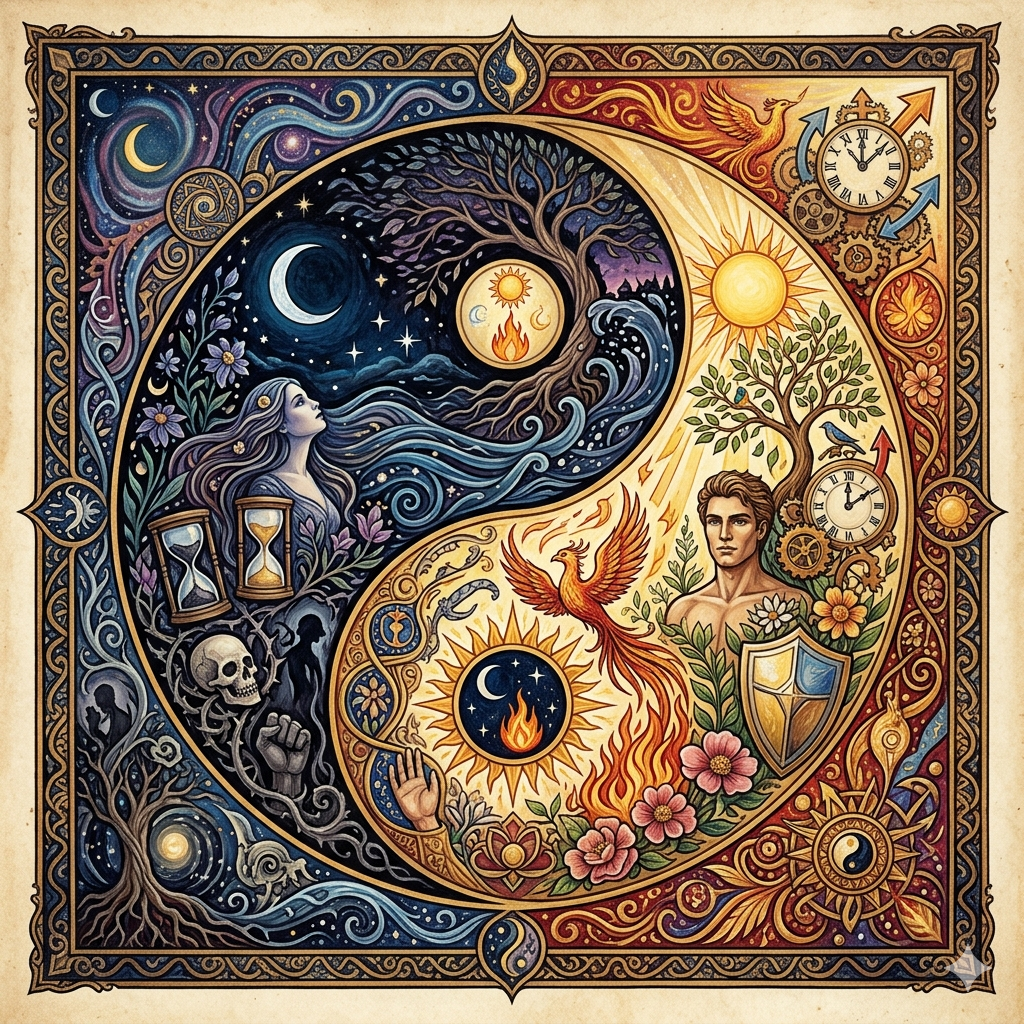
Short answer to your initial question: Good and evil are opposites. Evil is a distorted mirror image of good.
During our lifetime on earth, God keeps us in a balance between good and evil forces so that we can be free to choose which one we want for ourselves. The good comes from God through heaven. The evil comes from hell. God, who rules both heaven and hell, makes sure neither one gets too much stronger than the other and takes away our freedom. But once we move on to the spiritual world, we go either to heaven, where we live in good, or to hell, where we live in evil.
Good, evil, polarity, and duality
Before we start, I will mention once again that Michelle’s conundrum is quite long. It could fill a blog post on its own! Instead of quoting it all at once, I’ll take it section by section, offering my thoughts and reactions along the way. (Fair warning: this will be a long blog post.) I have done the usual light editing for publication. The sections of Michelle’s conundrum are quoted in blue. My responses are in regular black type.
The subject is the nature of good vs. evil, truth vs. falsity, light vs. darkness, and a distinction Mr. Risi makes between “polarity” and “duality.” Fair warning: these are heady, philosophical topics! If that’s not your cup of tea, there are plenty of other articles here that dig into more practical issues of daily life and struggle, including the one Michelle mentions in her opening statement.
However, if you want to contemplate the broader structure of reality in which our daily struggles are embedded, and gain a deeper understanding of our human situation, this article is for you.
Overall, I find much commonality between the Vedic ideas expressed here and the philosophy of Emanuel Swedenborg (1688–1772). I also find some significant differences. I hope that you, dear reader, will find this interplay of ideas thought-provoking and helpful in making sense of your everyday life and struggles.
Absolute and relative
Let the journey begin!
I’d like to share something with you that I learned when I first encountered a spirituality that made sense to me, by a Swiss teacher, Armin Risi, who has a Vedic but holistic (theistic, NOT non-duality) background. I’m quoting from his (German) article (please hang in there, even though it starts out philosophically):
“Good and evil are not equivalent, even though they are both relative. Relative means ‘dependent on conditions; in relation to something.’ The relative does not define itself, but depends on higher criteria. Philosophically speaking: The relative depends on the absolute. Good is not good simply because it is the opposite of evil. Good is good because it resonates with the balance of the divine order. Evil, on the other hand, is defined by the negation of good, which is why the negating (‘negative’) side of duality always consists of two extremes: too much and too little.”
The very last statement, about the negative side of reality consisting of extremes, introduces one of the points of dissonance between my views and Mr. Risi’s views. We’ll get to that later, when it comes up again. Meanwhile, on the main point about the non-equivalency of good and evil, there is much agreement, though not perfect agreement.
The core idea here, from my perspective, is in the statement, “Good is not good simply because it is the opposite of evil. Good is good because it resonates with the balance of the divine order.” On this, there is full agreement.
Good things are sometimes defined as the state that exists in the absence of evil.
For example, consider what we mean by “peace.” Some people might define it as “the absence of war and conflict.” But that is not what peace is, except on a superficial level. Peace is something that comes from within. It exists when we have a positive connection with God, and with the good things that come from God. Here is how Swedenborg puts it:
I have talked with angels about peace, and have told them that on earth they call it peace when wars and conflicts between nations are over, or enmities and disagreements between people, and that they think inner peace is simply the peace of mind we have when anxieties are banished, or especially the relief and delight when things turn out well for us.
The angels have responded, though, that this peace of mind, this relief and delight when anxieties are banished and things turn out well for us, may look like effects of peace, but it does not come from real peace except in people who are focused on heavenly good. This is because peace occurs only in that good. Peace actually flows in from the Lord into the very core of such people, and from that core comes down and spreads into their lower natures, causing peace of mind, relief of the spirit, and a consequent joy.
For people engrossed in evil, though, there is no peace. There is an apparent calm, tranquility, and pleasure when they get their way, but this is outward only, with no inward substance. Inside there is raging hostility, hatred, vengefulness, cruelty, and all kinds of evil cravings. Their spirit rushis into these feelings the moment they see anyone who is not on their side, and it bursts forth whenever there is no fear to restrain it. This is why their delight is at home in insanity, while the delight of people involved in good is at home in wisdom. It is like the difference between hell and heaven. (Heaven and Hell #290)
Peace is an inner state of mind that we have when God is flowing into us with good thoughts and feelings that come from heaven. If we do not have this inner peace, even the cessation of war and conflict does not bring us peace. We are still at war within ourselves. The superficial peace that reigns outwardly will soon be shattered when our ego, greed, and self-centeredness clash with the people around us. This is the source of all war and conflict.
It would be more accurate to reverse the popular but shallow definition of peace: War and conflict are the absence of peace. When there is no peace within us because we have blocked our connection to God, goodness, and truth, the inevitable result is interpersonal conflict and international war.
I would only add that although in us both good and evil are relative, in God good is not relative, but absolute. We have only relative good because our good is never entirely pure and complete. It always has its imperfections due to our limitations as created, fallen, and imperfect beings. There is absolute good and absolute truth. It’s just that we don’t have them. We have only relative good and truth.
Meanwhile, all evil is relative, because all evil originates in the blockage and twisting of what is good and true. There is no such thing as absolute evil. Absolute evil would be absolute nothingness—and by definition, something that is nothing does not exist.
This also means that there is no true opposite to God. There is no perfectly evil Devil or Satan who is the opposite of God. There is only human evil—and no one is perfectly evil. Hell itself is simply the collection of all human evil, and all evil humans. See:
Well, that’s a bit of a downer to end this section on. Let’s move on . . . quickly!
Everything is relative?
There’s a popular saying: “Everything is relative.”
My reply: “Everything is relative . . . to the Absolute.” Here is Mr. Risi’s take on that:
“Good and evil are therefore not equivalent, because the relative does not exist independently but is always embedded in the whole and always relates to the absolute. That is why it is crucial what we mean by ‘absolute.’ In the holistic (theistic) understanding, we see the Absolute as the living God with consciousness and will, which is why we have here—and only here—an absolute standard, namely the balance of creation as well as God’s will (= love, connectedness with the Source, oneness with God and all parts of God). Good resonates with God’s will, whereas evil separates and splits itself off, just as symbolic darkness does from light.”
Yes. God is the absolute. God is absolute everything: absolute love, wisdom, good, truth, power, effectiveness, and everything else. God is absolute existence and essence. God is. Everything else that is, is from God.
And, Swedenborg would add, God is not just abstract consciousness and will. God is human. God’s consciousness and will are a human consciousness and will. Biblically speaking, we are human in God’s image and likeness, not the other way around. We are human because God is human. When we have a relationship with God, we are in a relationship with a perfectly human being who has all the same thoughts and feelings we do, only infinitely more and greater than our limited and sometimes faulty versions of them.
This means that good not only resonates with God’s will, but is God’s will. Our good, if we have it, resonates with God’s will, and is relative to God’s will. But God’s will exists on its own. It is the source of the resonance.
The other side of the coin, as Mr. Risi says, is that evil separates and splits itself off from good, like darkness from light. That is what makes it evil. The absence of peace is war and conflict. The absence of good is evil. But this is not merely an abstract concept. When we do not love, we hate. When we do not wish good for our fellow human beings, we wish them evil. When we are not devoted to the truth, our mind is filled with falsity.
There is no in-between position—at least, not a stable one. Even though we may be a mix of good and evil here on earth, in the end we will always jump down on one side of the fence or the other. If we cut ourselves off from the love and wisdom of God, and from the good and true things that come from them, we will fall down on the side of evil and falsity. We will put our own well-being ahead of other people’s well-being, seeking pleasure for ourselves at other people’s expense. That is where evil comes from.
Evil comes from greed and selfishness. It comes from a desire to take other people’s belongings for ourselves, and to rule over other people and make them our servants. This is the practical meaning of the absence of good. Good is putting love for God first and love for the neighbor second, just as Jesus taught us. Evil is the opposite of good.
In summary . . .
“Goodness is not defined by its opposite, but by its harmony with the divine order and love. In other words, goodness can exist in and of itself, whereas evil is a negation of the divine order.”
This sums up what we have just been discussing. Here, there is full agreement. Goodness can exist in and of itself because ultimately, goodness is God, and God is self-existent being. The goodness that we have is derived from God. It is God in us. Of course, we are not God. Every good and true thing we have is a continual gift from God, and really belongs to God, not to us. But God lets us think of it as ours so that we can have our own sense of identity and character, and be in relationship with God and with one another.
Back to the point, since we are relative to God, our goodness is also relative to God’s goodness. Meanwhile evil, as the negation of good, is not relative to, but the opposite of the goodness that is God.
The grain of truth in falsity
This does bring us into a realm where there is some tension with Mr. Risi’s views, though not necessarily complete disagreement. Let’s move along, because we’re almost gotten to that issue.
“Falsehood is truth gone astray, but truth is not simply falsehood gone astray. Hate is a lack of love, but love is not simply a lack of hate. War is the absence of peace, but peace is not simply the absence of war. Evil is the force that turns against the divine order and, as a divisive force, leads to one form or another of one-sidedness, to the extremes of too much and too little.”
What did I just say about peace? On this there is full agreement.
The parallel to truth and falsity also holds. Truth has existence of its own, and is absolute in God, because God is truth. Falsity, on the other hand, has no existence of its own. It exists only as the twisting and absence of truth.
Just like evil, there is no such thing as absolute falsity. There is always some grain of truth in it, which is then twisted into something false.
For example, the idea that some races are superior to others has a grain of truth behind it: the different races are not the same as each other, or they wouldn’t be different races. But when we decide that the qualities that make our race distinctive from other races are better than the qualities of other races, the underlying grain of truth that the races are different from each other gets twisted into the falsity that one race is better than another. From there, it is a very short hop to the belief that “inferior” races should serve the “superior” race (my race, of course!), or even more diabolical, that inferior races should be wiped off the face of the earth.
And so, we twist a grain of truth into a horrendous falsehood. Yes, falsity is the absence of truth. But it is also the twisting of some little grain of truth into something that is false and deceptive.
This reminds me of a story Swedenborg tells about misers in hell, who love to indulge in the fantasy of having huge bags of gold on tables in front of them. In reality, all they have is little specks of gold. After painting the picture, Swedenborg, who was traveling with two angels, writes:
The coins on the table appeared to be of pure gold, even to us. But when we let in the light from the east, the “coins” were little grains of gold that they magnified by common united fantasy. They said that everyone who entered there had to bring some gold with him, which they divide into small bits and then into little grains, which they enlarge into bigger coins by the unanimous power of fantasy. (Love in Marriage #268)
Isn’t that what we do when we build up our favorite false ideas and conspiracy theories? We take some “coin” of truth, slice and dice it into tiny, disconnected factoids, and then weave so many of our own fantasies around those disjointed specks of truth that they become completely twisted into a massive sack of falsity. This huge, elaborate falsity causes us to see everything in the world, and all the people in the world, in a false and fallacious light.
Evil as extremes?
But now, at last, I must take issue with one of Mr. Risi’s statements. Here is that last sentence again:
“Evil is the force that turns against the divine order and, as a divisive force, leads to one form or another of one-sidedness, to the extremes of too much and too little.” (emphasis added)
It’s all good until we get to the “extremes of too much and too little” part. This is an expression of the idea of “everything in moderation” and “the golden mean.” The idea is that evil consists in having too much or too little of good, making it unbalanced.
This idea isn’t completely wrong. Too much of almost any good thing will turn destructive, and too little of a good thing can also spell death. The sun sustains life on earth, but too much of it will kill us, and too little of it will freeze us to death. Water is essential to life, but too much of it and we will drown, whereas too little of it and we will die of thirst. So yes, it is true that too much or too little good turns into evil.
However, that is not the essential nature of evil, nor is it the primary distinction between good and evil. A more fundamental distinction is that evil is the opposite of good by way of its destructiveness of good.
The idea that evil is too much or too little good suggests that if we did evil things in moderation, in just the right amount, they would be good. However:
- There is no moderate amount of murder that makes murder good.
- There is no moderate amount of adultery that makes adultery good.
- There is no moderate amount of theft that makes theft good.
- There is no moderate amount of deceit that makes deceit good.
- There is no moderate amount of jealousy that makes jealousy good.
And on the other side of the coin:
- Murder is not caused by too much or too little love of the neighbor; it is caused by the opposite of love for the neighbor, which is hatred for the neighbor.
- Adultery is not caused by too much or too little love for one’s partner in marriage. It is caused by a disdain for, and underneath it all, a hatred for one’s partner, and for the relationship of marriage.
- Theft is not caused by having too many or too few possessions. It is caused by a desire to have other people’s possessions for ourselves.
- Deceit is not caused by too much or too little truth. It is caused by a rejection of the truth.
- Jealousy is not caused by too much or too little desire for the things we have. It is caused by a lack of desire and appreciation for the good things we do have, and a desire to have the good things we don’t have, meaning the good things other people have
I therefore must dissent on the idea that evil is “the extremes of too much or too little.” Yes, there is some truth to that. But it does not get to the root meaning and nature of evil.
The continuum of good and truth
Here is one more helpful concept:
Good and truth exist on a continuum, from very little to very much good and truth. But nowhere along that continuum do they become evil and falsity. A little feeling of love towards our fellow human beings is still love for our fellow human beings. A little understanding of math is still understanding of math.
Evil and falsity are not on the continuum of good and truth. They start where good and truth leave off. And as Jesus says, there is even a great chasm between good and evil. (See the Parable of the Rich Man and Lazarus in Luke 16:19–31.)
Swedenborg reports that this is exactly how the lay of the land works in the spiritual world. Heaven and hell do not touch each other. Heaven is above, hell is below, and in between there is the “great chasm” that Swedenborg calls “the world of spirits,” where we first arrive after death before moving on to our eternal home in either heaven or hell. (See: “What Happens To Us When We Die?“)
Visualizing this arrangement of the spiritual world helps us to understand that evil is not simply too much or too little good. No matter how much or little we have of good, it is still good, not evil. Only when we cease to have good altogether in a particular area do we move over into the territory of evil.
We don’t become murderers when we love other people too little. If I love you even a tiny bit, I’m not going to kill you. No, we become murders when we don’t love other people at all. We become murderers when we hate people.
Luciferian inversion
“Atheistic or monistic esotericism leads to the fallacy that good and evil are equivalent and can only exist in relation to one another—in other words, that everything is relative: Lies and truth are always merely relative and subjective. Love cannot exist without hate, and without hate there would be no love. Without darkness there would be no light. Without evil there would be no good. This is the typical ‘Luciferian’ self-justification of evil.”
Agreed. This “Luciferian” idea is the inversion of the truth, which is that without truth there could be no lies, without love there could be no hate, and without light there could be no darkness. Without truth, love, and light, there would be nothing at all, good or evil. But without lies, hate, and darkness, truth, love, and light would still shine just as brightly—and even more so because they would not be blocked anywhere by lies and hatred.
Lucifer as a satanic figure represents the inversion of the truth. As Jesus said, the Devil is the father of lies (John 8:44). Here is a fascinating passage in which Swedenborg takes up this idea from a different angle:
Spirits have two kinds of sensory life: real and unreal. The distinction is that everything experienced by the inhabitants of heaven is real, while everything experienced by the inhabitants of hell is unreal.
Whatever comes from the Divine—the Lord—is real, because it comes from the ultimate reality and inherent life; but whatever comes from a spirit’s sense of independent existence is unreal, because it does not come from ultimate reality and inherent life. People who respond to what is good and true have the Lord’s life and therefore real life. The Lord is present in goodness and truth through their response to it. People who engage in evil and falsity because they respond to it, though, have the life of apparent autonomy and therefore life that is not real, because the Lord is not present in evil and falsity.
What is real is distinguished from what is not real in that what is real actually is the way it appears, and what is not real is not actually the way it appears. (Secrets of Heaven #4623)
That is the difference between truth and falsity: Truth is seeing what really exists, whereas falsity is not seeing things as they really are. And notice that both are based on the truth of reality. One is seeing the truth of reality. The other is not seeing the truth of reality.
So of course, the “Luciferians” are badly mistaken. Truth and goodness have their own existence independent from falsity and evil, whereas falsity and evil have no existence of their own. They exist only through the corruption and negation of truth and goodness.
Further, as Mr. Risi suggests, there is no continuum between good and evil, or between truth and falsity. One does not gradually shade into the other. Evil is on its own continuum that starts when good has ceased to exist in us. Falsity is on its own continuum that starts when truth has ceased to exist in us. There are no gradations from good to evil, or from truth to falsity. No, there is a great chasm between them.
Polarity and Duality
And now a long quote that makes a distinction between “polarity” and “duality.”
I do think there is a real distinction here. However, using the terms “polarity” and “duality” to make that distinction seems more dogmatic than real. Swedenborg offers clearer terms and distinctions.
We’ll get to that. First, let’s let Mr. Risi have his say, as introduced by Michelle:
He is making a very clear distinction between polarity and duality—which to me seems important and so far, I have not found it anywhere else. I continue from his article:
“Polarity and duality: not the same. Twoness is not simply ‘one.’ Twoness must be viewed in a nuanced way, because there are two types of twoness: polarity and duality. What is the difference?
“These terms should not be equated, as they are not synonyms. . . .
“Polarity is the twoness of equal, complementary poles, rooted in the natural balance of the divine order. Polarity is the fundamental principle of the divine creative dynamic and is an expression of the original harmony of the material world. Examples of polarity include: masculine and feminine, space and time, cause and effect, subject and object, ‘positive’ and ‘negative,’ creation and dissolution, sun and moon, inhalation and exhalation, etc.
“Duality is the division into opposing, mutually exclusive opposites, caused by division and one-sidedness in thought, feeling, and action. Duality arises when someone strays from the divine middle ground and disrupts the balance inherent in creation. This occurs due to a divisive force, where ‘divisive’ has the same meaning as ‘diabolical’ (from the Greek dia-bállein, ‘to throw into confusion; to divide, to set against one another; to slander,’ Duden Etymological Dictionary). Balance can always be lost on either side, which is why the divisive, the ‘evil,’ is two-faced and has two aspects: too much and too little.
“Typical examples of duality include the opposites of good and evil, ‘turning towards’ God and ‘facing away from’ God, perpetrator and victim, love and hate, light and darkness (as symbols of ‘being in the light’ and ‘separation from the light’).
“Equating duality with polarity leads to the fallacy that good and evil are inseparable. . . . Good and evil are not equal poles of polarity, but opposing aspects of duality.”
I’ve already commented on the idea of evil as too much or too little. This, I believe, is mostly a misconception. Let’s move on to “polarity” and “duality.”
Polarity
“Polarity,” Mr. Risi says, “is the twoness of equal, complementary poles, rooted in the natural balance of the divine order.”
Here, there is much agreement with Swedenborgian thought. Though Swedenborg does not use the term “polarity,” he does have a parallel concept: the marriage of love and wisdom, or of good and truth.
And it is “rooted in the natural balance of the divine order” in the sense that love and wisdom are God and the divine order. Everything in God is a union of love and wisdom. This union is the source of everything God says and does. Because God is love and wisdom, and the universe is created from God, this means that everything in the universe is also a marriage of love and wisdom, or of good and truth, or of substance and form. Or in the opposite sense, a marriage of evil and falsity, and their derivatives.
This is the fundamental “polarity” of the universe, rooted in the very being and nature of God.
Duality
“Duality,” Mr. Risi says, “is the division into opposing, mutually exclusive opposites, caused by division and one-sidedness in thought, feeling, and action. Duality arises when someone strays from the divine middle ground and disrupts the balance inherent in creation.”
Here is where I believe dogma is entering into the picture. This treatment of “duality” has all the hallmarks of the common Eastern objections to Western dualism. The words are too close for this to be a mere coincidence. Using the word “duality” to describe opposites, division, and one-sidedness, and painting that word with a very negative brush, is by extension painting Western philosophy and religion, including Christianity, as a negative, deceptive enterprise.
But dualism is much more complex and many-faceted than this simple definition of “duality” as division and opposites allows for. Dualism means many different things to different thinkers and in different contexts. This isn’t the place to get into all that. If you’re interested, you can follow the link I’ve provided to the Wikipedia page on dualism.
The short version is that this is a very partial and dogmatic definition of duality, and by extension, of dualism.
Dualism is any system that sees a distinction between two different realms or two different kinds of existence. Most forms of dualism are not about the distinction between good and evil that Mr. Risi defines as “duality,” but about different levels or realms of existence.
Perhaps Mr. Risi was not intending to impugn dualism. But the use of the word “duality” as the negative term in contrast to the positive use of “polarity” is unfortunate. It is bound to get tangled up with dualism, even if that is not the intention. And in common usage “duality” has about the same range of meanings and usages as “dualism.” I therefore think it is a poor choice of terms for the distinction Mr. Risi is intending to make.
“Threealism”
This is not to say that I am a defender of dualism and think it is an essential belief. There have been debates among readers of Swedenborg as to whether he is a dualist. Some say yes, some say no. I would say, instead, that Swedenborg is a melding of holism and what I will call, for the moment, “threealism.”
“Holism” in the sense that everything is connected to and coordinated with everything else, and together forms a coherent, organized whole under the single eye and governance of God.
“Threealism” (yes, I know, that’s not a real word) in the sense that Swedenborg’s system has, not two realms, but three realms: divine, spiritual, and material. The divine realm is God. The spiritual realm is the spiritual universe and the human mind. The material realm is the physical universe and the human body.
I said earlier that fundamentally, God is a marriage of love and wisdom. That’s two. The third in the threealism of God is action, or God’s power flowing out into the universe. These three are what Swedenborg calls, in Latin, the three essentialia of God.
This word is difficult to translate well. Traditional translation simply carry it over into English as “essentials.” That’s not bad, but it also doesn’t give a very clear idea of its meaning. The New Century Edition of Swedenborg’s works sometimes translates it as “essential components.” This gives a more definite idea, but it also suggests the idea of “parts.” It is tempting to say that the essentialia are the “parts” of God, but they’re not parts in the usual sense of separate chunks of stuff that are bolted together. They are three distinct aspects or elements of God that are always together, and must be together by their very nature. If any one of the three is missing, God is not God, and nothing else can exist, either. This is the sense in which they are “essential.”
Perhaps the easiest way to conceptualize them more definitely and concretely is by thinking of substance, form, and function. Every physical object has all three of these, or it does not and cannot exist. Everything is made of some material, is in some shape, and has some function or role in the physical world. If it is a living, moving thing, function also extends to action.
As you can see, these aren’t exactly “parts” of an object such as a table or a chair. They are “essentials” of the object, in the sense all three of them must be present for the table or the chair to exist. Nothing can exist without some substance, nothing can exist without some form, and nothing can exist without some function or action. (I’m aware that modern physics may question this when it comes to exotic particles and such, but I’m sticking to my guns on this one.)
On the spiritual level, which is the level of the human mind, these three are motivation, understanding, and action, including the action of speech. Motivation (traditionally “will”) relates to love. Understanding relates to wisdom.
On the divine level, the three are divine love, which is the substance of God, divine wisdom, which is the form of God, and divine power flowing out, which is the action of God, including the words of God.
And so, although there is the “polarity” of love and wisdom at the core of God and the universe, these two to do not exist without the third, which is action or expression—or in inert physical objects, function.
Of course, in traditional Christian language we are talking about the Trinity, represented in the New Testament as the Father, the Son, and the Holy Spirit. But Swedenborg’s Trinity is not the traditional (and false) Christian Trinity of Persons. Rather, it is the Trinity of love, wisdom, and action that exists in God, or in the specifically Christian Trinity, it is God’s soul, body, and actions, which are symbolized by “Father,” “Son,” and “Holy Spirit” in the New Testament. See:
Who is God? Who is Jesus Christ? What about that Holy Spirit?
Is Swedenborg a dualist, then? Not really. His is a more complex system that has the duality or polarity of love and wisdom at its core, a third essential element of action that flows from the marriage of these two, and a universe that reflects both the two-ness and the three-ness of God, not to mention all the other numbers that follow after them.
But the fundamental number in Swedenborg’s system is still one. God is one. The universe is one. God and the universe are even one. This is the holistic element of Swedenborg’s thought.
And yet, though the universe is one with God, the universe is not God. Rather, it forms a distinct level, or really two distinct levels, that are in continual relationship with God.
Distinct and gradual levels
Essential to understanding these matters is Swedenborg’s system of distinct and gradual levels. (In the traditional translations, “discrete degrees” and “continuous degrees.”) Here is how he introduces them in his great cosmological work Divine Love and Wisdom:
There are two kinds of levels, vertical levels and horizontal levels. . . .
We move from outer to inner and then to inmost by levels—and not by gradual levels, but by distinct ones. “Gradual levels” is the name we give to declines or decreases from coarser to finer or denser to rarer, or better, to gains or increases from finer to coarser or from rarer to denser. They are just like going from light to darkness or from warmth to cold.
In contrast, distinct levels are totally different. They are like antecedent, subsequent, and final events, or like the purpose, the means, and the result. We refer to them as “distinct” because the antecedent event exists in its own right, the subsequent event in its own right, and the final event in its own right; and yet taken together they constitute a single whole. (Divine Love and Wisdom #184)
Swedenborg goes on to explain these two different kinds of levels more fully. I’ve linked the first section in the series in case you want to dig into the subject more deeply.
An example of a “gradual level” is the gradations of temperature from cold to hot. Temperature rises smoothly from cold to hot, without any distinct “jumps” or “breaks” in the temperature scale.
But what happens when water, for example, hits its melting point or its boiling point? At these special points on the temperature scale, something distinct happens. There is a sudden jump from solid to liquid, or the reverse, at the melting/freezing point, and a sudden jump from liquid to gaseous, or the reverse, at the boiling point. This is an easy-to-grasp illustration of “distinct levels.” Distinct levels do not go gradually from one end of a scale to the another; they jump suddenly from one level to another.
In a human being, the mind and the body are the classic distinct levels. Mind and body form a “duality” in which they are intimately connected to each other, but each of them exists on its own distinct level of reality. The mind is spiritual. The body is material. This is an example of distinct levels. Our words and actions form a third distinct level, flowing from our mind through our body.
However, we also have gradual levels within us, such as having more or less knowledge, and more or less love. These things increase or decrease on a gradual scale, from less to more or from more to less.
I should add that distinct levels are related to each other and interact with each other through what Swedenborg calls “correspondences.” This is the living relationship by which higher things express themselves in lower things. For more on correspondences, please see:
Can We Really Believe the Bible?
Good and evil
Then there is the distinction between good and evil, and the parallel distinction between truth and falsity. This does fall into the category of what Mr. Risi defines as “duality”: they are opposites. Evil is opposed to good, and is the opposite of good. Falsity is opposed to truth, and is the opposite of truth.
And I do agree with Mr. Risi that evil and falsity are the ones that put themselves in opposition to good and truth, and not the other way around. But once evil and falsity come into existence through our own selfishness and greed, good and truth do oppose them and fight against them, even if that fight is a defensive battle, not an aggressive one.
The opposition is real. Something cannot be both good and evil at the same time. Something cannot be both true and false at the same time. This really is a “polarity” in the sense that they are polar opposites. They cannot coexist with each other in the same space.
We humans, of course, are a mix of good and evil, and of truth and falsity. But in the end, one or the other will prevail. Either we will move to the side of good and truth, and do the work of rejecting evil and falsity from our mind and heart, or we will do the opposite, choosing evil and falsity, and ultimately ejecting everything good and true from our mind and heart.
Ultimately, we will be either one or the other. We cannot be both. In Christian terms, in the end we will choose either heaven or hell—and whichever we choose, that is where we will dwell. We cannot be in both heaven and hell at the same time. Not in the long run, anyway.
Classifications and distinctions
These terms and concepts from Swedenborg are, I think, a clearer and more realistic way of understanding the distinctions between things than the distinction between “polarity” and “duality” that Mr. Risi makes in his article.
These concepts are not all original to Swedenborg, of course. The distinction between good and evil goes back as far as recorded human thought. And the concept of God as three-in-one goes back at least to New Testament times—though from a Swedenborgian perspective, the Christian Church went badly off-track in its understanding of the Trinity in God at the time of the First Council of Nicaea in 325 AD.
But to get back to Mr. Risi’s article, let’s re-classify some of his polarities and dualities using Swedenborg’s terms and distinctions.
Mr. Risi offers as examples of polarities: “masculine and feminine, space and time, cause and effect, subject and object, ‘positive’ and ‘negative,’ creation and dissolution, sun and moon, inhalation and exhalation.”
As examples of duality he offers: “good and evil, ‘turning towards’ God and ‘facing away from’ God, perpetrator and victim, love and hate, light and darkness (as symbols of ‘being in the light’ and ‘separation from the light’).”
Some of these are tricky, because they can mean different things in different contexts—as suggested by Mr. Risi’s example of what sort of light and darkness he is talking about. Still, let’s take stab at putting these examples into Swedenborg’s terms and categories. Some of them may fit into more than one category, but for our current purposes I’ll keep things as simple as possible.
Love and wisdom (and action):
- Masculine and feminine (and child)
- Space and time (and our unfolding existence)
- Sun and moon (and the cycles of nature in which we live)
Gradual levels:
- Light and darkness (seen as a gradation from more to less light)
Distinct levels:
- Cause and effect
- Subject and object
Good and evil:
- Positive and negative
- Creation and dissolution
- Inhalation and exhalation
- Good and evil
- Turning towards God and facing away from God
- Perpetrator and victim
- Love and hate
- Light and darkness (seen as one annihilating the other)
Some of these should be obvious. Others may require some explanation:
- Space and time are in the love and wisdom category because space relates to love, and time relates to wisdom.
- Similarly, sun and moon are in the same category because the sun represents love, and the moon represents faith, or truth, which are related to wisdom.
- Light and darkness go into both gradual levels and good and evil because there can be more or less light, but even a little light that is enough to see where we’re going is still light, even if it is dim light. However, thick black darkness, in which we can’t see anything, is the opposite of light.
- Cause and effect are in the distinct levels category because they are distinctly different from one another, and one follows as a consequence of the other.
- Subject and object are harder to classify in this system, but the basic idea is that both philosophically and grammatically, they are distinct from one another, and have different positions and functions in an unfolding sequence.
- Creation and dissolution are in the good and evil category because creation is constructive, but dissolution is destructive. However, these can also be seen as simply cyclical events.
- Inhalation and exhalation are in the good and evil category because the function of inhalation is to bring life-giving oxygen (and other elements) into our body, whereas the function of exhalation is to expel carbon dioxide and other toxic substances from our body. But this is also a cyclical event, and the entire cycle is necessary for our continued life.
- Perpetrator and victim fit in the good and evil category because perpetration is a matter of doing evil to someone or something, and the primary target of evil is everything that is good. However, in practical terms, victims of crime and aggression are not always good people themselves. Being a victim doesn’t automatically make a person good.
Some of these could be debated. Some of them are judgment calls. But this at least illustrates that the situation is much more complex than the distinction commonly made in Eastern and New Age circles between “polarity” and “duality.” Our life is more multi-faceted than that.
Also, both “polarity” and “duality” are commonly used to mean both types of things that Mr. Risi individually defines them as. Sometimes people use the word “polarity” to mean what Mr. Risi calls “duality,” and vice versa. This is another reason I don’t think these are the best terms to use in talking about the legitimate distinction that Mr. Risi is making.
Light and darkness
Mr. Risi then adds some thoughts about light and darkness:
“The typical symbol of this is darkness, which arises and exists only because something divisive has interposed itself between us and the light. Darkness is the opposite of light, but light is not the opposite of darkness, for exclusion occurs only on the part of darkness. It is not the light that creates darkness, but rather the forces that, of their own accord, separate themselves from the light and sever themselves from the light (and thus also from divine love)—and then formulate pseudo-religious or atheistic ideologies to justify themselves and their behavior.”
Here there is much agreement. It is evil and falsity, not good and truth, that causes division and opposition in human hearts, minds, and lives.
God loves all people, both good and evil. God wants good things for everyone, regardless of whether they are good people or bad people. But evil people love only themselves and the people they consider to be extensions of themselves, such as their family and friends, while hating and attacking everyone else—and especially hating and attacking God. Here is a clear statement of this principle from Swedenborg’s writings:
Evil spirits are the ones who attack. . . . This happens to each of us when we are being tested, that is, when we fight evil spirits. With us, angels never mount an attack, but the evil, hellish spirits never stop attacking. Angels only deflect and defend against the attacks. This comes from the Lord, who never wants to hurt anyone or force anyone down into hell, not even the worst or most hostile of all his enemies. It is actually his enemies who hurt themselves and hurl themselves into hell.
This situation also follows from the nature of evil and the nature of goodness. Evil by its nature wants to wound everyone; goodness by its nature wants to hurt no one. The evil feel they are fully alive when they go on the offensive, because they are always wanting to destroy. The good feel they are fully alive when they are not attacking anyone but are taking advantage of the opportunity to help others by protecting them from evil. (Secrets of Heaven #1683)
Still, I would suggest caution about classifying “pseudo-religious and atheistic ideologies” as always coming from a desire of evil people to justify themselves and their behavior. Sometimes this certainly is true, as seen in toxic cults that attack outsiders and even their own people, while enriching their leaders and giving them godlike power.
However, we also live in an age when some of the major religions and churches have become toxic themselves. This has caused many good and thoughtful people to reject religion altogether. Unfortunately, many of them have thrown the baby (God) out with the bathwater of toxic religion. These people are not atheists at heart. They are only rejecting the toxic god of anger, division, and condemnation that has been pounded into them by the churches and religions of their birth.
The root of all evil?
Next, Mr. Risi writes:
“Separation from the ‘Light’—that is, from the Source—means that one has cut oneself off from God’s infinite energy and must therefore go in search of energy. This separation, along with the resulting ‘necessity’ to seek out energy, is the archetypal root cause of all evil deeds: exploitation, overexploitation, wars, violence, lies, slander, and so on.”
While this is not entirely wrong from a Swedenborgian perspective, it does not, in fact, get at the “root cause of all evil deeds.” Separation from God is not the cause of evil. It is the effect of evil. We do separate ourselves from God when we are engaged in evil, but it is the evil that causes the separation, not the reverse.
And what is evil? Quite simply, in human terms, it is putting ourselves and our own power, pleasure, and possessions ahead of other people and ahead of God. In Swedenborgian Christian terms, evil is putting love for self and love for worldly things ahead of love for God and love for the neighbor. For more on this, please see:
The Four Kinds of Love that Drive Human Life
In more contemporary terms, evil comes from greed, which is putting love for worldly things first in our motives; and it comes even more from a desire to control people and dominate them and force them to serve us, which is what we want when we love ourselves most of all, and view other people as inferior to ourselves.
This is where evil comes from. This is what causes us to separate ourselves from God.
God’s love is constant and universal
Finally, in Michelle’s quotations from his article, Mr. Risi writes:
“It is entirely possible to separate oneself from the Infinite. To put it paradoxically: we can separate ourselves from God, but God never separates Himself from us. Figuratively speaking: we can separate ourselves from the light and create darkness, but the light is neither diminished nor extinguished as a result, and as soon as we overcome that separation, the former darkness becomes light again, as if it had never been darkness at all.”
Here we come full circle back to agreement. Even when we separate ourselves from God and turn our backs on God, God still turns toward us and continues to love us. Not only Swedenborg, but the Bible itself says this:
Since the Lord’s face is mercy, peace, and everything good, it is clear that he never looks at anyone except with mercy and never turns his face from anyone. It is we, when we are wrapped up in evil, who turn our faces away. As the Lord said through Isaiah:
Your offenses are what cause a separation between you and your God; and your sins hide his face from you. (Isaiah 59:2)
Likewise it says here [see Genesis 3:8–11] that they [Adam and Eve] hid themselves from Jehovah’s face because they were naked. (Secrets of Heaven #223)
And consider this beautiful saying of Jesus:
You have heard that it was said, “You shall love your neighbor and hate your enemy.” But I say to you: Love your enemies and pray for those who persecute you, so that you may be children of your Father in heaven, for he makes his sun rise on the evil and on the good and sends rain on the righteous and on the unrighteous. (Matthew 5:43–45)
The way to be like God is to love even people who hate us and persecute us. That’s because God is a being who loves and cares even for people who have made themselves into God’s enemies.
And as Mr. Risi suggests, all that is required for the breach between us and God to be healed is that we turn away from our own darkness and evil, and turn back toward the love and light that is God.
God is ready whenever we are. No matter what we have done, when we turn back to God, God will joyfully welcome us back into those infinitely loving arms. For the quintessential biblical illustration of this, see the Parable of the Prodigal Son in Luke 15:11–32.
Finishing up?
Michelle says:
Would love your thoughts on this.
Well, now you have them!
Believe it or not, I could say much more. I hope this much will give you some good and useful insights.
But wait, there’s more!
Michelle wasn’t quite finished. Here are my quick takes on her quick takes:
As an aside (for clarity): he does believe in reincarnation
For my view of reincarnation, please see:
The Bible, Emanuel Swedenborg, and Reincarnation
Short version: Reincarnation as commonly believed does not happen. However, the idea of reincarnation does point to a deeper reality, which is spiritual rebirth, or what Jesus calls being “born again.”
and believes that there are forces of light and forces of darkness influencing our world.
He and Swedenborg are in agreement on this. Swedenborg says that there are always at least two angels and two evil spirits with us, not to mention whole crowds more in the background. The evil spirits attack us and try to drag us down to hell, sowing falsity, hatred, and division in our minds. The angels, working together with God, seek to defend us from the attacks of the evil spirits, and to lift us up toward love, light, heaven, and God.
He does not believe in evolution nor creation in the literal sense but through a process of “involution,” which he defines as “interdimensional, cosmically descending evolution.”
Swedenborg lived before Darwin and the concept of evolution, so the evolution of species as we know it today does not come up in his writings. He believed that each species was directly created by God, and was given the ability to reproduce from there. But given that the concept of evolution was not yet available in his era, that’s not surprising. This was the common belief about the origin of species back then.
For my part, I have no problem with evolution as the means God designed into our world to bring about life, and ultimately, to bring about homo sapiens as complex human biological organisms that are capable of hosting the even more complex human mind and spirit.
I also find evolution entirely compatible with Swedenborg’s view of our gradual spiritual development in which we start out spiritually unformed and inchoate, represented by the dark and empty wasteland of God’s initial creation mentioned in Genesis 1:2, and proceed through all the stages of creation and development one after another until we reach the seventh day of rest, which is when we are one with God in heart, mind, and action.
He assumes that the universe came into being through spiritual impulses that animate and shape matter, starting from the highest, least dense dimensional realm and extending down to our three-dimensional reality. Central to this is the idea that the “higher” gives rise to the “lower.” Accordingly, the visible material world is embedded in higher, invisible realms, and life on Earth did not evolve from matter, but from the spiritual foundations of the cosmos.
This is compatible with what Swedenborg wrote about creation ultimately coming from God, and going outward and downward through the various levels of reality from there. Matter didn’t originate itself. God is the only entity that has being and existence in itself. God is therefore the source of everything else that exists.
However, this, in my mind, is not incompatible with evolution. Evolution, I believe, is the mechanism that God designed into the material universe to bring about God’s purpose of creating human beings who could form a heavenly community in loving relationship with one another and with God. Here are a couple articles that dig into this further, starting with one that’s short and sweet, and moving on to one that’s long and complex:
- How did God Create the Universe? Was the World Really Created in Six Days?
- God: Puppetmaster or Manager of the Universe?
He explains that the material world came into existence out of love for our “fallen” brothers and sisters, so that they could have a chance to be born again onto earth (from their places in “darkness”/hell) where they then would be able to experience “the light”/love that also exists on earth and thus being given the chance to change their ways.
Unfortunately, I must end by departing from Mr. Risi’s views once again.
It is true that our life on earth gives us a chance to change our ways. This is what Jesus calls being “born again.”
However, it is not true that this opportunity is extended to already existing beings who enter the material universe to avail themselves of it.
This belief about why the material world was created is based upon the common Eastern belief in the eternal pre-existence of souls. In this view, the material world serves as a plane for gaining experience or understanding or some similar thing. Mr. Risi’s view presupposes that there were already “fallen brothers and sisters” before the material universe was created.
From a Swedenborgian Christian perspective, this is mistaken. The universe is not a place to recycle used and worn-out souls into better ones. Nor is it a place for an unconscious or semi-conscious divine being to gain experience, light, and understanding, as some Eastern and New Age systems hold.
Rather, the material universe, in Swedenborg’s theology, is the seedbed of heaven. Each person born is a brand-new soul that has never existed before. From a Christian perspective, we are not recycled and refurbished beings, but newly manufactured beings.
God is endlessly creative. God is always creating new souls to grow and develop into angels.
Like a seedbed, this world is where we initially grow and develop into human beings who can inhabit heaven. First we grow physically in the womb—a process that continues even after we are born. Then we grow mentally and spiritually throughout our life on earth until it is time for us to move on to our eternal home in heaven (or in hell, if that is our choice).
To continue the analogy from business and industry, this world is the factory where the car is built. Once it has been built, it is ready to leave the factory and begin its active life of carrying people where they want to go.
To use a more living and human analogy, this earth is the womb in which we develop into a human being who is ready to be born into our true life and home in the spiritual world.
Okay, that take wasn’t so quick! But this is a major difference between Eastern and Western views on the purpose of Creation, and of our life here in the material world. And on this point, I have no problem saying that I believe the Western view is better!
Finishing up
Now we come to the end of Michelle’s long spiritual conundrum!
That is (in a very small nutshell) what he learned about Vedic cosmology when living in Vedic monasteries for 18 years.
And there you have it. My thoughts in response to his thoughts.
But . . . If that’s your “very small nutshell,” I’d hate to see your big nutshell! 😉
I hasten to add that anyone who spends real time and energy learning about God and spirit out of a genuine desire for understanding and enlightenment has my kudos and respect—especially if the intent is to make life better for people in this difficult life here on earth. Even though I don’t agree with some key aspects of Vedic philosophy, I do believe that people who sincerely follow Hindu or Vedic beliefs from a good heart are making their way toward heaven just as much as good-hearted Western Christians are. On that, please see:
If there’s One God, Why All the Different Religions?
Certainly there are points of agreement and points of difference between Swedenborg and Vedic philosophy. But even more important than right belief is having our heart in the right place.
When we arrive on the shores of heaven, the angels won’t ask us, “What did you believe?” They will ask us, “How did you love your neighbor?” That is a question that good and thoughtful people of all faiths and religions can answer in a way that will usher them through the figurative pearly gates of heaven.
This article is a response to a spiritual conundrum submitted by a reader.
For further reading:
- Is there Really a Devil? Why??
- What Happens To Us When We Die?
- Who is God? Who is Jesus Christ? What about that Holy Spirit?
- The Four Kinds of Love that Drive Human Life
- How did God Create the Universe? Was the World Really Created in Six Days?
Share this:


Lee Woofenden is an ordained minister, writer, editor, translator, and teacher. He enjoys taking spiritual insights from the Bible and the writings of Emanuel Swedenborg and putting them into plain English as guides for everyday life.


What do you think?