Jesus told the crowds all these things in parables; without a parable he told them nothing. (Matthew 13:34)
With many such parables he spoke the word to them as they were able to hear it; he did not speak to them except in parables, but he explained everything in private to his disciples. (Mark 4:33–34)
And yet, some Christians claim that Jesus was a literalist!
On his “Answers in Genesis” website, the famous or infamous Ken Ham writes:
What Jesus says about creation reminds us that, if we want to be faithful to his Word, we must take Genesis as literal history—just like he did! (quoted from Creation Basics: What Did Jesus Say About Creation? by Ken Ham)
So let me get this straight: Jesus, who always spoke to the crowds in parables, was a strict literalist in his reading of Scripture?
Well then, if we’re going to faithful to Jesus, maybe we should do the same for the whole Bible. Maybe we should read Jesus literally, too!
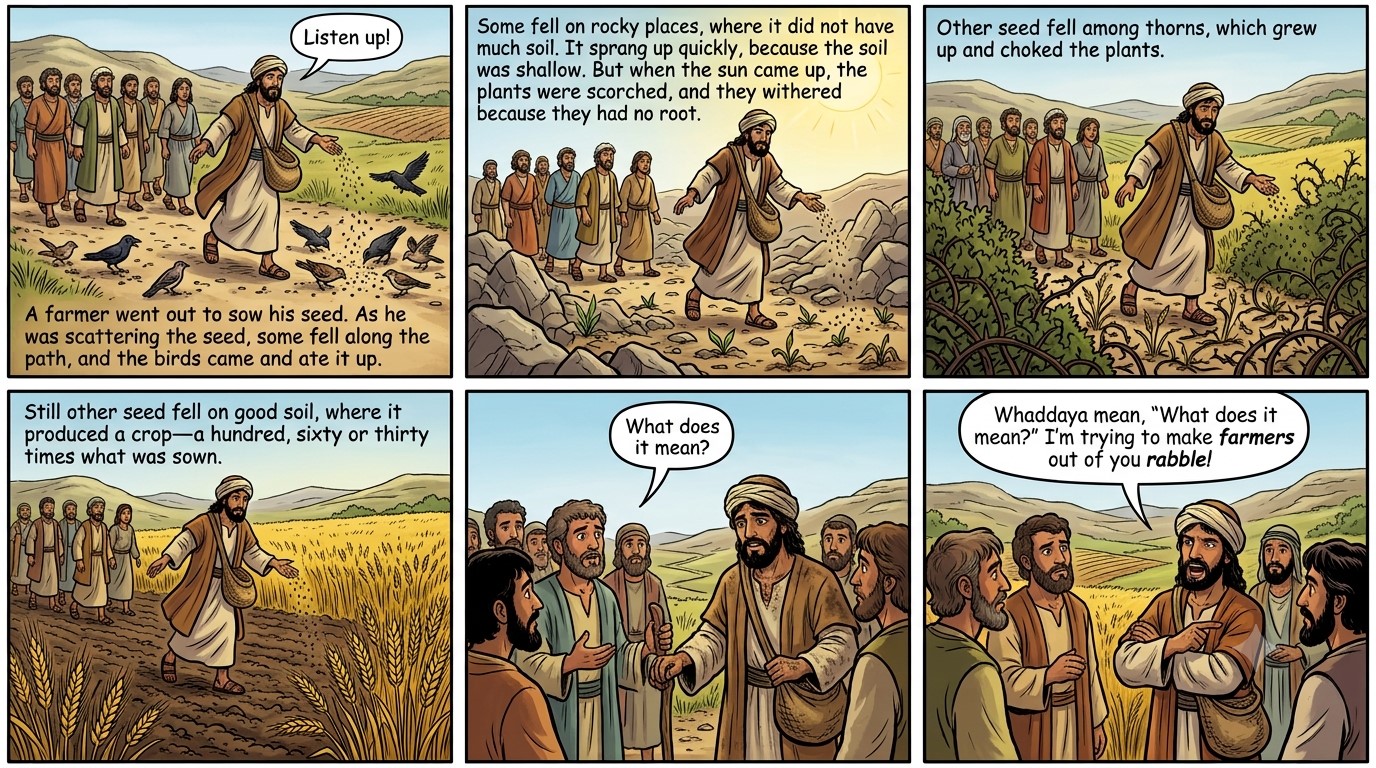
Did Jesus say we should take the Bible literally?
Dr. Henry M. Morris, another young Earth creationist and the founder of the Institute for Creation Research, writes about Jesus:
In the days when He was on Earth, He had only the Old Testament, of course, but the gospel records make it clear that He accepted these Scriptures as coming without error from God. He quoted and referred to them often, always indicating that He accepted their records as true and authoritative. (quoted from The Bible and Jesus Christ, by Henry M. Morris)
Notice he says that Jesus was aways “indicating” that he accepted their records as true and authoritative. Why does Dr. Morris word it that way? Because nowhere in the Gospels does Jesus ever say that he takes the Scriptures literally, or that they are “true and authoritative records”—especially not in the sense of being literally inerrant and historically true.
Young Earth creationists, and fundamentalists generally, commonly attribute literalism to Jesus. But Jesus never made any such statement himself, nor do any of the Apostles or other New Testament writers ever say that we must read the Scriptures literally.
This is a case of people who already believe in biblical literalism and inerrancy attributing their own views to Jesus. They read Jesus’ words literally because of their own literalism, not because of anything Jesus himself said on the subject.
How literal can we get?
It would be tedious to go through all the arguments and Bible verses the literalists use in their attempt to paint Jesus as a literalist. But you’ll get the idea if we take up one of the more common Bible verses they misuse in this way. Here is the entire passage from the Gospel of Mark:
Some, testing him, asked, “Is it lawful for a man to divorce his wife?”
He answered them, “What did Moses command you?”
They said, “Moses allowed a man to write a certificate of dismissal and to divorce her.”
But Jesus said to them, “Because of your hardness of heart he wrote this commandment for you. But from the beginning of creation, ‘God made them male and female.’ ‘For this reason a man shall leave his father and mother and be joined to his wife, and the two shall become one flesh.’ So they are no longer two but one flesh. Therefore what God has joined together, let no one separate.”
Then in the house the disciples asked him again about this matter. He said to them, “Whoever divorces his wife and marries another commits adultery against her, and if she divorces her husband and marries another, she commits adultery.” (Mark 10:2–12)
Any reasonable person would recognize that the subject here is marriage, divorce, and adultery. However, young Earth creationists pull a single verse out of that context, and use it to derive a completely different meaning and message:
“But from the beginning of creation, ‘God made them male and female.’” (verse 6)
About this verse, another young Earth creationist writer says:
This quote of Genesis reveals Jesus’ thoughts on the timeline of creation, as well, because He said that it was this way “from the beginning of creation.” If Jesus is speaking on a timescale of 4,000 years from creation to His day, it makes sense to refer to something which was instituted on Day 6 as “from the beginning of creation.” But it makes no sense to refer to it as “the beginning of creation” if there were millions of years before the creation of mankind. (quoted from The use of Genesis in the New Testament, by Lita Sanders)
Nice try. But if we want to be really literal, then “the beginning of creation” is Day 1, not Day 6. That’s true no matter how many thousands of years come after it. After all, for God, “one day is like a thousand years, and a thousand years are like one day” (2 Peter 3:8). In God’s eyes, what’s the difference between six days and millions or even billions of years?
So . . . how literal do you want to be? If you’re going to take Jesus’ words literally, why not really take them literally, and “recognize” that he was saying that God made them male and female at the very beginning of creation, which is Day 1?
Obviously, that’s silly.
The whole argument is silly. Jesus was not making a point about the literal historicity of the Creation story in Genesis. He was making a point about God’s original intention for man and woman from when they were first created. He was talking about how God created us from the beginning of our creation, not from the beginning of the universe’s creation.
Paul recognized that “creation” applies to each of us as human beings when he wrote, “So if anyone is in Christ, there is a new creation: everything old has passed away; look, new things have come into being!” (2 Corinthians 5:17). It makes no more sense to insist that Jesus is talking about the literal creation of the world in Mark 10:6 than it does to insist that Paul is talking about the literal creation of the world in 2 Corinthians 5:17.
However, yanking individual Bible verses out of their context and using them to make a point that was never the original writer’s meaning or intention is how biblical literalists operate to support their unbiblical viewpoint.
Nowhere does the Bible say that we must read the Bible literally. That’s why literalists quote all sorts of passages out of context in their attempts to support their literalist belief system.
Types and figures
Even biblical literalists recognize that the Old Testament isn’t always fulfilled in the New Testament in a strictly literal way. The more intellectual among them recognize that some fulfillments are “typological” rather than strictly literal. “Typology” is the idea that people and events in the Old Testament prefigure or foreshadow greater events that take place in the New Testament, especially in the life and teachings of Jesus Christ, that aren’t exactly like the original events that prefigure them. Take, for example, this passage from the Gospel of Matthew:
Then some of the scribes and Pharisees said to him, “Teacher, we wish to see a sign from you.”
But he answered them, “An evil and adulterous generation asks for a sign, but no sign will be given to it except the sign of the prophet Jonah. For just as Jonah was three days and three nights in the belly of the sea monster, so for three days and three nights the Son of Man will be in the heart of the earth. The people of Nineveh will rise up at the judgment with this generation and condemn it, because they repented at the proclamation of Jonah, and indeed something greater than Jonah is here!” (Matthew 12:38–41)
Even the most hard-boiled literalists don’t think Jesus was literally in the belly of a sea monster, and they don’t think the people of Nineveh will literally rise up at the time of judgment and condemn that generation. Even Christians whose doctrine requires them to read the Bible as literally as possible cannot read it completely literally, because the Bible itself doesn’t allow it. It is so obviously metaphorical in so many places that literalists must carve out a whole raft of exceptions to their literalist dogma.
This is where typology comes in. In another, more scholarly co-authored article, two biblical literalists write:
Frequently, Jesus understands the Scriptures to be fulfilled in him or in the events with which he is involved. Occasionally, these were direct predictions of things that have now happened. Far more commonly, they represent typology—the recognition of patterns in history as God reveals his characteristic, recurring ways with human beings, especially in saving or judging them. Thus, Jesus quotes Micah typologically in Matthew 10:35–36 (and parallel) in order to affirm that his disciples may face hostility and opposition in their own families, just as in Micah’s day. (quoted from Jesus’s View of the Old Testament, by Craig Blomberg and Julie N. Dykes, link changed)
Aha! So Jesus doesn’t always take everything in the Old Testament literally!
But the authors quickly backpedal, going on to say, “Jesus’ typology, nevertheless, remains firmly grounded in historical events.” Even these two literalists seem to recognize that if they open the door as far as recognizing that Jesus used typology, this could bring their whole edifice of Jesus as literalist crashing down on their heads.
Jesus the non-literalist
And so it does. Because the simple fact of the matter is that Jesus was not a literalist. He regularly applied Old Testament scriptures in non-literal ways. For example:
See, I will send you the prophet Elijah before the great and terrible day of the Lord comes. (Malachi 4:5)
Referring to this, Jesus said in the Gospels:
“For all the Prophets and the Law prophesied until John came, and if you are willing to accept it, he is Elijah who is to come.” (Matthew 11:13–14)
Obviously, John the Baptist was not literally Elijah.
And another one:
And the Lord said to Moses, “Make a poisonous serpent, and set it on a pole, and everyone who is bitten shall look at it and live.” So Moses made a serpent of bronze and put it upon a pole, and whenever a serpent bit someone, that person would look at the serpent of bronze and live. (Numbers 21:8–9)
In the Gospel of John, Jesus refers to this story, and gives it a non-literal interpretation:
“And just as Moses lifted up the serpent in the wilderness, so must the Son of Man be lifted up, that whoever believes in him may have eternal life.” (John 3:14–15)
This is commonly read as a reference to Jesus’ crucifixion. However:
- Jesus is not literally a poisonous (or fiery) serpent made of bronze.
- Jesus was not literally lifted up on a pole, but on a cross.
- Seeing Jesus on the Cross does not literally save people from poisonous snake bites.
Unlike the original story in the Old Testament, Jesus wasn’t talking about physical life and death at all. He was talking about eternal life, which is spiritual life. In other words, Jesus used this Old Testament story as a metaphor, and interpreted it spiritually rather than literally.
And one more, which should clinch it for all but the most die-hard literalists:
He rained down on them manna to eat
and gave them the grain of heaven. (Psalm 78:24)
In the New Testament, Jesus uses this story (originally told in Exodus) as a metaphor for spiritual food:
Then Jesus said to them, “Very truly, I tell you, it was not Moses who gave you the bread from heaven, but it is my Father who gives you the true bread from heaven. For the bread of God is that which comes down from heaven and gives life to the world.”
They said to him, “Sir, give us this bread always.”
Jesus said to them, “I am the bread of life. Whoever comes to me will never be hungry, and whoever believes in me will never be thirsty.” (John 6:32–35)
This reinterpretation of a famous Old Testament event—the story of God feeding the children of Israel with manna from heaven—is a wonderful example of Jesus’ non-literal, spiritual reading of the Scriptures. And no, Jesus did not mean that his flesh is literally the bread of life. For more on the spiritual meaning of Jesus’ words in John 6, see: “Eat My Flesh, Drink My Blood.”
Referring to a story is not taking it literally
One of the arguments the literalists make is that since Jesus mentioned Old Testament figures such as Abel, Noah, and Jonah, this means he affirmed that they were literal, historical figures.
However:
- If I refer to Little Red Riding Hood as an example of the dangers of naivete, does this mean I am saying that Little Red Riding Hood, not to mention her grandmother, the Wolf, and the huntsman, were all literal, historical figures?
- If I refer to Ahab in Herman Mellville’s classic novel Moby-Dick; or, The Whale as an example of the folly human hubris, obsession, and revenge, does this mean I am saying Ahab was a real historical person?
- If I refer to Luke Skywalker in Star Wars as an example of the human capacity for self-mastery and triumph over the forces of evil, does this mean I am affirming that Luke Skywalker, Darth Vader, Obi-Wan Kenobi, Yoda, Princess Leia, and all the rest were literal, historical figures?
This whole argument is silly on the face of it. You and I are perfectly capable of referring to fictional people and stories to make points about the human condition. Was Jesus really so small-brained and narrow-minded that he was incapable of doing the same?
Put plainly, the fact that Jesus refers to many Old Testament people and stories does not in any way, shape, or form mean that he affirmed that they all were real, historical people and events. Reading it this way reduces Jesus’ spiritual message drawing on the Word of God to a mere historical catalog.
Only people who read the Gospels through the thick lens of their own materialism and literalism could come away with the notion that Jesus was a biblical literalist.
Really, the whole idea is preposterous.
’Nuff said.
For further reading:
- Can We Really Believe the Bible?
- How God Speaks in the Bible to Us Boneheads
- The Bible: Literal Inerrancy vs. Divine Depths of Meaning
- Secrets of Heaven, by Emanuel Swedenborg
- Eat My Flesh, Drink My Blood
Share this:


Lee Woofenden is an ordained minister, writer, editor, translator, and teacher. He enjoys taking spiritual insights from the Bible and the writings of Emanuel Swedenborg and putting them into plain English as guides for everyday life.



In the beginning he made them male and female – he was just skipping the passages of the second part of day 1, all of 2-5, and the first part of 6, right? Jesus was just calling the entire creation week the beginning, right?
Hi World Questioner,
That’s what the literalists are arguing. But their arguments fall apart under scrutiny. The Creation stories were not meant to be taken literally.
If we have a concept of Heaven separate from sky and spirit separate from breath, then we should have a concept corresponding to bread but separate, but we don’t. We use sky for sky, Heaven for Heaven, breath for breath, and spirit for spirit, but we just use bread for both bread and its spiritual counterpart, just like Heaven is the spiritual counterpart of sky and spirit of breath/wind.
Hi World Questioner,
Language isn’t a secret code ring. You can’t just dial the dial for every word, and have a corresponding spiritual word for it. We’ve developed separate words for some of them, but not for others. For “sky,” we’ve added the word “heaven.” But for “bread,” we haven’t developed a distinct word, so we just say something like “spiritual food.”