Can Communication and Confrontation be Spiritual?

Confrontation: Handle With Care

Adam Sandler and Jack Nicholson in "Anger Management"

An angry confrontation

“I hate you!”

“I hate you too!”

Ouch! Too many of our “conversations” turn into confrontations, and then degenerate into shouting matches. After it’s all over, neither side feels very good. These battles can be bruising—and even deadly.

How can a spiritual perspective help us to communicate well both with those we love and with those we consider enemies?

We start by working on developing direct and caring communication with those we are closest to. After all, if we can’t communicate well with our friends and lovers, how will we ever communicate well with our enemies? Good communication takes time and effort. But it also pays big dividends in closer and deeper relationships, and a happier life.

When we find ourselves in situations of conflict and confrontation, the skills and practice we have gained in communicating well during the good times can turn what could have been a breakup or a war into an opportunity for spiritual and interpersonal growth.

It all starts with developing love and respect both for our friends and for our enemies. Yes, we are commanded to love our enemies! Developing respect for them can be even trickier. But the rewards of doing so are well worth the effort.

For more on negotiating the path of communication with friend and foe, please click here to read on.


Tagged with: , , , , , , , , , ,
Posted in Sex Marriage Relationships, Spiritual Growth

World Series Obstruction: Intent or Not Intent, That is the Question?

In a freak ending—a first in World Series history—game three of the 2013 World Series matchup between the Boston Red Sox and the St. Louis Cardinals ended with an obstruction call. Here’s the official definition of “obstruction” from the Major League Baseball rules:

OBSTRUCTION is the act of a fielder who, while not in possession of the ball and not in the act of fielding the ball, impedes the progress of any runner.

Rule 2.00 (Obstruction) Comment: If a fielder is about to receive a thrown ball and if the ball is in flight directly toward and near enough to the fielder so he must occupy his position to receive the ball he may be considered in the act of fielding a ball. It is entirely up to the judgment of the umpire as to whether a fielder is in the act of fielding a ball. After a fielder has made an attempt to field a ball and missed, he can no longer be in the act of fielding the ball. For example: If an infielder dives at a ground ball and the ball passes him and he continues to lie on the ground and delays the progress of the runner, he very likely has obstructed the runner.

That’s almost exactly what happened in the final play of the game, except that it was a thrown ball rather than a hit ball. Because of the obstruction call, the Cardinals won the game. Needless to say, Red Sox fans were not happy!

Will Middlebrooks obstructs Allen Craig in game 3 of the 2013 World Series

Middlebrooks obstructs Craig, World Series 2013, Game 3

That has set off a spirited debate about the obstruction rule. Why should there be a penalty when the Red Sox fielder obviously had no intention of obstructing the Cardinals’ runner?

Spiritually speaking, this has a lot to do with the difference between evil and sin. But before we get there, let’s take a look at the unusual call that decided a World Series game.

For more on obstruction and intent, please click here to read on.

Tagged with: , , , , , , , , , , , ,
Posted in Sports and Recreation

Secrets of Heaven, by Emanuel Swedenborg

What are the stories in Genesis about?

Was the world really created in six days, or is there some deeper meaning?

What about Adam and Eve? Noah and the Ark?

How can we believe these stories in the first few chapters of Genesis when science tells us that the universe is billions of years old, humans evolved from lower animals, and there isn’t anywhere near enough water on earth to cover all the mountains in a worldwide flood? Is the Bible just plain wrong? Or is science itself an illusion, as many Christian fundamentalists claim?

If these questions trouble you, I recommend Secrets of Heaven, Volume 1, by Emanuel Swedenborg. This volume, the first of fifteen volumes covering the books of Genesis and Exodus, sets the stage and provides the opening acts for a revolutionary new way of understanding the Bible—especially the early, mythical stories in the first few chapters of Genesis.

For example, the Creation story in Genesis chapter one is revealed not as a mere literal account of how people thousands of years ago thought God created the world, but as a divinely inspired story of our spiritual rebirth as new creations in the image and likeness of God.

In Secrets of Heaven, Swedenborg looks at the stories in Genesis and Exodus chapter by chapter and verse by verse, explaining the deeper, spiritual meanings in the Word of God. These meanings provide new and deeper light on our own spiritual journeys, and on the inner life of Jesus Christ when he lived among us here on earth.

Secrets of Heaven
By Emanuel Swedenborg

Secrets of Heaven was originally published in London, 1749-1756, in eight Latin volumes. I recommend the New Century Edition linked here for the most readable and accurate modern translation.

To purchase Secrets of Heaven, Volume 1 on Amazon, click the cover image above, or any of the title links. To purchase direct from the publisher in various formats, or to download a free PDF or epub version (without the scholarly introduction and notes), click this link.

For further description and review, please click here to read on.

Tagged with: , , , , , , , , ,
Posted in Books and Literature

Suffering, Struggle, and Hope: The Example of Ismail Khalif Abdulle

Although the world is full of suffering, it is full also of the overcoming of it.
—Helen Keller, in a 1903 article titled “Optimism.”

The Al-Shabaab terror group made headlines last month with its horrific massacre at the Westgate shopping mall in Nairobi, Kenya. However, Al-Shabaab has been terrorizing innocent civilians for over a decade. Try as they might, Al-Shabaab cannot break the spirit of all their victims. A mighty spirit is a powerful foe to those with evil intentions.

Ismail Khalif Abdulle in Harstad, Norway

Ismail Khalif Abdulle in Harstad, Norway

One such mighty spirit is Ismail Khalif Abdulle, a young Somali who was a teenager when Al-Shabaab maimed him. In 2011, to escape the fear he lived with back at home, he moved to Harstad, Norway, 125 miles north of the Arctic Circle.

There, he had a clean, comfortable place to live, food to eat, access to the medical care he needs, and a chance to make a life for himself.

The climate and social atmosphere of his new home in Norway were about as different as you could get from the home he left in Mogadishu, Somalia—which is about the same distance north of the Equator as Harstad is north of the Artic Circle. Before arriving in Norway, Ismail had seen snow only on TV. In Somalia, his idea of “chilly” was evening temperatures plunging to 64° F (18° C). It was also quite an adjustment to move to a place where the sun never sets in mid-summer, and never rises in mid-winter.

But the biggest adjustment was cultural: moving from the familiar equatorial African culture in which he had grown up to the northernmost of northern European cultures. When he arrived in Harstad, its population of about 23,500 people included about 150 refugees, with perhaps a dozen Somalis in that number. In Norway as a whole, people of African descent account for less than 2% of the population.

Yet for Ismail, it was all worth it to escape the fear, horror, and pain he had suffered because of Al-Shabaab.

For more on suffering, struggle, and hope, please click here to read on.

Tagged with: , , , , , , , , , , , ,
Posted in Current Events, Pain and Suffering

Tobias Bass and the Far-Reaching Power of Childhood Love

Tobias Bass reading his letter to News9 requesting a jogging stroller for his brother Titus

Tobias Bass reading his letter to News9

Tobias Bass had a problem. He wanted to run a 5K race with his older brother Titus, and he didn’t see how he could do it. You see, Titus has cerebral palsy. He can’t walk. And the boys’ single mom, a teacher, couldn’t afford a jogging stroller.

But Tobias didn’t let that stop him. Day after day he saw his brother looking longingly out the front window as other children played and rode their bikes outside. Tobias wanted Titus to be able to get outside and feel the wind on his face, too. So he took matters into his own hands.

What did he do?

He wrote a three-page letter to Kelly Ogle and Amanda Taylor, news anchors on KWTV News9, a local Oklahoma City TV news program. You can read the letter here. Among the many gems in the letter, he wrote, “My pastor said we have to be God’s hands and feet, but I’m going to be his legs, too.”

Ogle and Taylor were so moved by his letter that they not only ran a segment about it on their news broadcast, but contacted Oklahoma Able Tech, a provider of strollers and other equipment for disabled people. Soon Titus had a jogging stroller, and he and Tobias began training together for the 5K run.

For more on Tobias Bass and the power of love, please click here to read on.

Tagged with: , , , , , , , , , , , ,
Posted in Current Events

The Cain and Abel Story: Does God Play Favorites?

A reader named Sue posed this spiritual conundrum:

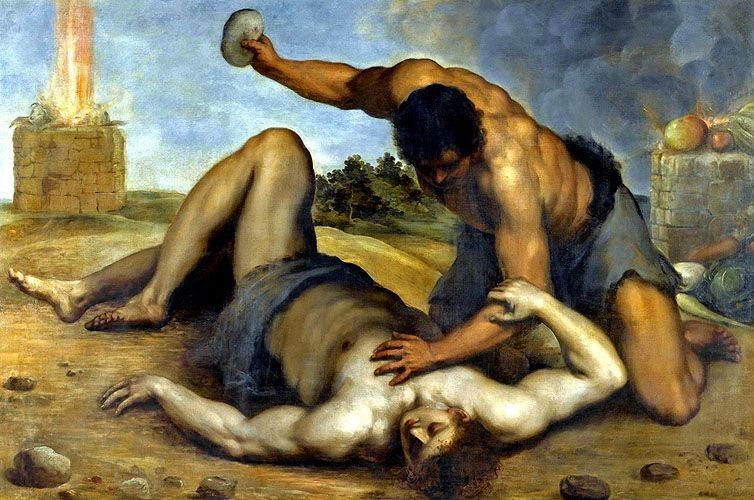
Cain Slaying Abel, by Jacopo Palma, 1590

Cain murders Abel

The Cain and Abel story in the Bible is the first example of murder. I don’t condone murder, but I’ve often found myself feeling sorry for Cain and upset with God over his treatment of Cain. God didn’t treat the brothers equally. God liked Abel’s offerings but did not like Cain’s offerings. Cain presumably worked as hard as Abel to prepare his offerings to God. God shouldn’t have been surprised that His disfavoring Cain would make Cain jealous of Abel and that the two would get into a fight. Why did God not favor Cain as He did Abel? If God had treated the brothers equally, this murder would not have occurred. All Cain wanted was to be equally loved by God. Instead God disfavored him and Cain predictably acted badly as a result thus having to bear lifelong consequences when all he wanted was equal love.

Really, Cain is not much different from many of us. What do you think?

Great one, Sue!

Too many people experience the pain of seeing siblings loved and cherished while they themselves are criticized and punished by their parents. This sort of favoritism causes many deep psychological and spiritual problems for both the disfavored and the favored children.

The story of Cain and Abel has been confronting and confounding people with that theme for thousands of years. And yet, it is an ancient, mythical story that has many more layers of meaning than what appears on the surface. The deeper we look, the more clearly we can understand the mysterious ways of God.

For now, let’s look at it on four levels, as a story in which:

  1. God acts like a seriously flawed human parent.
  2. God acts like an intelligent, experienced leader.
  3. God acts like . . . well . . . God!
  4. There are deeper meanings about our spiritual journey.

I hope that by the time we’re finished, the Cain and Abel story will be more meaningful to you . . . and less infuriating!

For more on Cain and Abel, please click here to read on.
Tagged with: , , , , , , , , , , , ,
Posted in The Bible Re-Viewed

How does Jesus Appear to Us? Can We See God Face to Face?

Last month a Swedenborg reader named Nevada Sample submitted a spiritual conundrum about how Jesus appears to human beings and to angels. Here is a shortened version of what he wrote, focusing on his questions:

I have just read your blog “Father, Son, and Holy Spirit.” Am I still confused? Yes.

In the gospels, between the resurrection and the ascension, the Lord appeared many times to his disciples and others. Sometimes he was recognized. Other times he was not. In what form was he during these appearances?

Even though the Lord is “human,” what difference does it make since no one is ever allowed to see him as a human, rather only manifesting thru some angel, or manifesting as the heavenly sun?

Is Jesus only seen as the sun in heaven OR when he fills an angel with his beingness?

Nevada Sample also asked about Emanuel Swedenborg’s experience of seeing the Lord.

These are highly philosophical and theological questions—questions that push the envelope of what we can know about the nature of God and about how finite human beings can have a relationship with the infinite God. But they also have a personal side that goes to the heart of Christianity and to the meaning and presence of Jesus Christ. My responses to these questions draw on the Bible, on the teachings of Swedenborg, and on my own thoughts based on what I have read and contemplated.

First, here’s the short version:

  1. God is eternally present as the sun of heaven to those whose eyes are open to see it.
  2. Before God came as Jesus Christ, God appeared to humans by filling an angel with the divine presence.
  3. After God came as Jesus Christ, God can and does appear personally both to people and to angels.

Now let’s “look under the hood” and see how all of this works.

For more on how God appears to us, please click here to read on.

Tagged with: , , , , , , , , , , , ,
Posted in All About God, The Bible Re-Viewed

How to Know if Mr. or Ms. Right is Right for You: Pointers from Gloria and Emilio Estefan

Gloria and Emilio Estefan (Photo credit: Jesus Carrero)

Gloria and Emilio Estefan

You’ve been in a relationship and are considering taking the next step into marriage with your partner. How can you have confidence that your marriage will not become a statistic like so many others that started with wonderful excitement, promise, and love?

There are many different ideas about what’s necessary for a harmonious long-term marriage:

  • If the sex is great and we are physically attracted to each other, everything else will work itself out.
  • According to the old adage, “opposites attract.” Our opposite natures will keep things interesting!
  • The opposite theory is, “like attracts like.” We’re meant to be together because we enjoy the same diet, the same music, the same movies, the same hobbies, the same vices, and so on.
  • Financial security is key. Does my partner have good money and a reliable job?

All of these things can be helpful in creating and maintaining a good relationship. They’re important—though you may want to go easy on those vices! Still, they are not the key to ensuring a long-term, harmonious marriage.

What does make a marriage stick?

Gloria and Emilio Estefan, the Latin and pop music superstars, have been married for thirty-five years now, and they are still very much in love. What’s their secret? What pointers can we glean from their harmonious, long-term marriage?

For Gloria and Emilio Estefan’s take on making marriage stick, please click here to read on.

Tagged with: , , , , , , , , , , , ,
Posted in Popular Culture, Sex Marriage Relationships

The Heavenly City: A Spiritual Guidebook, by Emanuel Swedenborg

The Heavenly City is Swedenborg’s own brief introduction to his religious ideas, translated into readable modern English. If you want to get the basics on Swedenborg in his own words, without having to struggle through old-fashioned translations, this is the book for you!

The Heavenly City
By Emanuel Swedenborg
Translated by Lee Woofenden

The Heavenly City was originally published in Latin in 1758. It was previously published in English under the title The New Jerusalem and its Heavenly Doctrine. This modern translation assumes no previous knowledge of Swedenborg or of the vocabulary traditionally used in translating Swedenborg’s works.

For further description and review, please click here to read on.

Tagged with: , , , , , , , , , , , ,
Posted in Books and Literature

Wrestling with Angels: When “Good Enough” is Not Good Enough

Huh? Wrestling with angels?

Aren’t angels supposed to be the good guys? Don’t they go around spreading love and light and all that wonderful stuff?

Yes, angels are beings of love and light. But as portrayed in the Bible, angels have a dark side, too:

Jacob Wrestling with the Angel, by Eugene Delacroix

Jacob Wrestling with the Angel, by Eugene Delacroix

That same night . . . Jacob was left alone; and a man wrestled with him until daybreak. When the man saw that he did not prevail against Jacob, he struck him on the hip socket; and Jacob’s hip was put out of joint as he wrestled with him. Then the man said, “Let me go, for the day is breaking.”

But Jacob said, “I will not let you go unless you bless me.”

So he said to him, “What is your name?”

And he said, “Jacob.”

Then he said, “You shall no longer be called Jacob, but Israel, for you have striven with God and with humans, and have prevailed.”

Then Jacob asked him, “Please tell me your name.”

But he said, “Why is it that you ask my name?” And there he blessed him.

So Jacob called the place Peniel, saying, “For I have seen God face to face, and yet my life was preserved.” The sun rose upon him as he passed Penuel, limping because of his hip. (Genesis 32:22, 24–31)

Yes, Jacob thought he was wrestling with God. But that’s impossible. God is omnipotent. If the “man” that Jacob was wrestling with had really been God, it would have been no contest! That’s why the story has been traditionally identified as “Jacob wrestling with the angel.” As we’ll see in a future post, in the Bible God commonly appears through angels, and angels are sometimes called “gods.”

Now, if all of the leading characters and all of the stories in the Old Testament are symbolic of Jesus Christ (as he himself told us in several places in the Gospels), does this mean that Jesus, too, wrestled with angels?

And if the Bible is telling the story of our own spiritual rebirth as “new creations in Christ” (see 2 Corinthians 5:17), do we, too, wrestle with angels as part of our spiritual journey?

That’s the subject of a spiritual conundrum posed by a reader named Ray Silverman:

Swedenborg says that Jesus was “tempted by the angels.” I’ve been thinking a lot about this and wondering if this is just something that took place within Jesus’ mind at a level we cannot begin to imagine, or something that takes place within our minds as well. If it does take place within us as well, could you give me some practical examples of how we might be “tempted by the angels.” Thanks!

For more on wrestling with angels, please click here to read on.

Tagged with: , , , , , , , , , , , ,
Posted in The Bible Re-Viewed
Lee & Annette Woofenden

Lee & Annette Woofenden

Donate

Support the work of Spiritual Insights for Everyday Life by making a monthly donation at our Patreon

Join 1,260 other subscribers
Earlier Posts
Featured Book

Great Truths on Great Subjects

By Jonathan Bayley

(Click the title link to review or purchase. This website receives commissions from purchases made via its links to Amazon.)

Blog Stats
  • 4,226,017 hits