The Bible: Literal Inerrancy vs. Divine Depths of Meaning

Here is a comment that a reader named Ben made on my article, “Can We Really Believe the Bible?”:

We can definitely believe the Bible. There is no denying that careful interpretation and context are important, but there is no reason to ever assume that the Bible and science contradict. Take a look at the Hebrew word that we translate as “day” in Genesis 1. Biblical Hebrew did not have a huge amount of words and therefore many words were versatile. The Hebrew word “yom” or yowm” can be translated as day or something more like “age” depending on the context. In other words, the creation days were probably very long. Once people step away from the 24-hour day assumption for Genesis 1 it is amazing how much they can calm down. This does not mean that English Bibles are wrong, as we often use phrases like “back in my day” that are not taken to mean a literal 24-hour day. It also does not necessarily mean that evolution is what God used if He took His time creating the earth and its creatures, but I have no problem with the thought of God using the “big bang” to kick-start the universe. Scientific discovery does not put biblical inerrancy in any kind of troublesome spot.

You make many good points in this post, Lee, but your implication that Genesis 1 is merely allegory has me somewhat troubled.

Thanks for your thoughtful comment, Ben!

I am aware that interpreting the Bible symbolically or correspondentially rather than literally is troubling for many people. There is a desire to be faithful to the Bible, and this is seen as requiring adherence to the literal inerrancy of all of its statements. While I applaud the desire to be faithful, this way of being faithful misses the greatest spiritual and divine treasures of the Bible, and limits its adherents to the more superficial aspects of the Word of God.

For more on the divine depths contained in the Bible, please click here to read on.

Tagged with: , , , , , , , , , , , ,
Posted in The Bible Re-Viewed

What is the Source of Human Fragility, Sickness, and Disease?

Here is a spiritual conundrum posed by a reader named Joe:

I’m looking for doctrinal statements that deal with the human physical fragility and its source. Is human fragility (sickness, disease, etc.) a consequence of original sin? Is human fragility a consequence of the curse to the ground. (ie. The ground is cursed, we grow food from the ground, we eat cursed ground food and we eat animals that eat cursed-ground food, we therefore are processing cursed-ground foods and we get sick and have diseases). I hope you get my drift and may have some helpful insight or direct me to a reliable resource. Thank you for your time and I really appreciate your message “Curses or Consequences…”

Wow! Great question, Joe!

And since it’s such a huge question, I’ll give you the short version first:

Like human beings themselves, human fragility, sickness, and disease is a result of a highly complex interaction of many physical and spiritual causes, both individual and societal, from the past, the present, and (strange as it may seem) even the future.

If a person is sick—especially if it is a serious illness—there is no single, simple cause, nor is there a single, simple solution. All sickness and disease is systemic. Even if it may appear to affect only one part of the body, in fact it both affects and is affected by the entire body, mind, and spirit of the person who is sick.

It also both affects and is affected by the person’s physical, social, and spiritual environment. We humans are social creatures embedded in a human environment. We are also biological creatures embedded in a physical environment. Our physical and spiritual environments have a profound effect on our sickness and health.

Because of this highly complex source of human frailty, sickness, and disease, we both do and do not bear responsibility for our own weakness and disease as individuals. By taking responsibility for what we can take responsibility for, we can indeed improve our physical and mental health.

And yet, there will always be factors beyond our control influencing us. Even if we were to live a near-perfect life and lifestyle, we could still suffer from human frailties and diseases because of the rather toxic physical and spiritual environment in which we live. Being sick is not something to beat ourselves up about. It does not necessarily mean that we are bad people or that we are being punished for our sins.

But it does mean that we have work to do, both individually and as a society.

Now for the long version, including responses to your specific doctrinal and Bible-based questions.

For more on human fragility, sickness, and disease, please click here to read on.

Tagged with: , , , , , , , , , , , ,
Posted in Pain and Suffering

Paula Deen’s Secrets: The Inner Self Revealed

Paula Deen happy in earlier days

Paula Deen

Paula Deen has been outed again. This time it’s literally a show-stopper.

Last year the queen of rich, sweet, buttery Southern cooking outed herself: she suffers from type 2 diabetes, which is linked to the very kinds of foods she showcased on her highly popular cooking shows. She took criticism at the time because her announcement came three years after she was diagnosed—and after continuing to tout her unhealthful comfort foods all the while.

But that pales in comparison to the current controversy.

It all began when Lisa Jackson, a former manager at a restaurant called Uncle Bubba’s Oyster House in Savannah, Georgia, owned and operated by Deen and her brother Earl “Bubba” Hier, filed a 1.2 million lawsuit against Deen and Hier alleging racism, discrimination, and acts of violence.

In a recently leaked deposition, Deen admitted to using racially charged language, and to tolerating discriminatory behavior in her restaurants. The deposition went viral, and the criticism came pouring in. Deen quickly released two or three videos offering apologies. But that was not enough for the Food Network, which announced that it would not renew its contract with the celebrity chef for the three popular Paula Deen cooking shows that were airing on its network, including “Paula’s Best Dishes.” She has also lost endorsement deals, and contracts with several retailers that carry her products.

Amid the chaos of condemnation, there are also some more measured reactions to the Paula Deen racism scandal. However, though Deen still has ardent supporters, the damage is done. Her reputation is indelibly tarnished. She will never again be viewed in quite the same way by society.

That’s what happens when the inner self that we keep hidden away comes out into the open.

And our secrets will be revealed sooner or later.

For more on the secrets of our inner self, please click here to read on.

Tagged with: , , , , , , , , , , , ,
Posted in Current Events, Popular Culture

One Girl’s Heaven is Another Man’s Hell

Once upon a time, a five year old girl named Jayden Sink decided to set up a lemonade stand to raise money for charity. Her plan was a big success! She and her father raised over $170 selling cups of lemonade to local residents—and much more in a matching online fundraiser. Here they are at the lemonade stand:

Jayden Sink and Jon Sink at the Lemonade Stand for Peace

Jayden and her Dad at the lemonade stand

(Photo courtesy of FRESHCASSETTE – Creative Compassion)

Where did Jayden get the idea of selling lemonade for charity?

It may have helped that her father, Jon Sink, founded the humanitarian organization FRESHCASSETTE – Creative Compassion, which raises money for charities such as World Bicycle Relief and The Water Project by distributing free music and requesting donations from anyone who enjoys it.

What charity did Jayden’s lemonade stand benefit?

The money from the fundraiser went to Planting Peace, whose international projects include support for orphanages and safe havens, deworming programs, and anti-bullying campaigns. With permission, Jayden and her father set up their lemonade stand in Topeka, Kansas, on the front lawn of “Equality House,” which is owned and operated by the Planting Peace organization.

The locals showed up in droves to buy Jayden’s lemonade. For her, it was like a magical fairy tale—a little slice of heaven!

But not everyone thought her lemonade stand was heavenly. In fact, the neighbors across the street didn’t like it one little bit. They tried their best to squash little Jayden’s lemonade stand.

They thought it came straight out of hell.

For more on lemonade, heaven, and hell, please click here to read on.

Tagged with: , , , , , , , , , , , ,
Posted in Current Events

What is the History and Importance of Bethel in the Bible?

Here is a spiritual conundrum posed by loganfields2:

Could you please explain to me in one of your posts the history of, and the importance of Bethel in the Bible! I would greatly appreciate it!

Thanks for the question, loganfields2.

The Old Testament town of Bethel (formerly named Luz) was one of the first places in the Bible where the Hebrew people met with God. The most famous of these encounters was Jacob’s dream of a stairway to heaven, with angels ascending and descending on it, and the Lord standing above it (Genesis 28:10–22).

Because this and several other early encounters with God happened at Bethel, it signifies our first beginnings of knowledge and understanding about God, heaven, and spiritual truth. And since this early knowledge of heavenly things comes in the first stages of our spiritual journey, when we are more earthly-minded than spiritual, Bethel represents a rather external and pragmatic sense of what God and spirit are all about.

One hint at this significance is that in the original Hebrew, Bethel means “house of God.” A house of God is an earthly, physical place (such as a church or temple) that is seen as the dwelling place of God. God cannot really be contained in a physical building or location (see 1 Kings 8:27), but we earth-bound humans often need something solid and physical to remind us of the presence of God, heaven, and spirit.

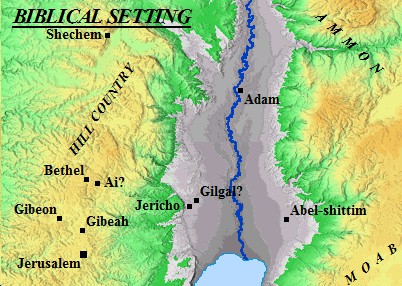
Before we dig deeper into the history and importance of Bethel, let’s get a visual on where it is located. Here is a map showing the position of Bethel in the Holy Land. It is west and a little north of Jericho, the first city that the Israelites conquered when they entered the Holy Land (Joshua 6). It is north of Jerusalem, which became the spiritual and political center of Israel.

Map showing the position of the Biblical town of Bethel in relation to Jericho and Jerusalem

Bethel in relation to Jericho and Jerusalem

(Map courtesy of www.israel-a-history-of.com)

For more on the history and importance of Bethel, please click here to read on.
Tagged with: , , , , , , , , , , , ,
Posted in The Bible Re-Viewed

Who was Swedenborg? What Should I Read?

If you’ve encountered Emanuel Swedenborg, and you’re a bit fuzzy on what he’s all about and where to start, the Swedenborg Foundation has just released a new video especially for you!

Jonathan Rose, Series Editor of the New Century Edition of the Works of Emanuel Swedenborg, narrates the video. It provides a brief overview of Swedenborg’s astonishing accomplishments, then reviews five of Swedenborg’s most popular books.

At the end of the video there are clickable links to pages where you can either purchase print and Kindle editions or download free e-versions of each of the five recommended books. You’ll also find these links after the YouTube video description below.

Enjoy!

Here is the description of the video from the Swedenborg Foundation’s YouTube channel:

Published on Jun 7, 2013

Emanuel Swedenborg is a fascinating historical figure. Though he was at the top of many of his fields of study in 18th century Europe, he remains relatively unknown in the world today. This may well be because of one of the most unique features of Swedenborg’s career: in his mid-fifties, he underwent a series of spiritual experiences that completely changed the trajectory of his life. He reported having extensive visions and insight into the afterlife, the nature of God, and the purpose of life here on earth. He spent the rest of his days writing down and publishing his spiritual findings in an incredibly systematic, coherent way. He ended up writing twenty-seven volumes on spirituality, which had a significant impact on many important thinkers of his century and those that followed.

You can purchase print and Kindle editions, or download free epub and PDF versions, at the following links:

Heaven and Hell
Divine Love and Wisdom
Divine Providence
True Christianity
Secrets of Heaven

Tagged with: , , , , , , , , , , , ,
Posted in Books and Literature

What is the Sin of Sodom?

The sin of Sodom? That’s obvious, isn’t it?

No, it’s not.

The Bible does tell us what the sin of Sodom was . . . and it’s not what you’re thinking!

In the book of Ezekiel, God says:

Now this was the sin of your sister Sodom: She and her daughters were arrogant, overfed, and unconcerned; they did not help the poor and needy. They were haughty and did detestable things before me. Therefore I did away with them as you have seen. (Ezekiel 16:49–50)

There you have it. The Bible says that the sin of Sodom was arrogance, overindulgence, indifference, lack of charity for the poor and needy, and haughtiness. It’s all about self-centeredness and lack of love for the neighbor. Not a word about homosexuality.

Oh, yes. It also says that they “did detestable things.” And though Old Testament law does say that sex between two men is detestable (Leviticus 18:22; 20:13), it says that dozens of other things are detestable too, such as:

If the sin of Sodom were homosexuality, the Bible would have been more specific about it! In fact, the Bible never mentions homosexuality in relation to Sodom. (Though Jude 1:7 is sometimes translated as if it did, there is much controversy over exactly what the original Greek word means in this context.)

You can think whatever you want about homosexuality. But it’s sloppy Biblical scholarship to claim that the story of Sodom and Gomorrah in Genesis 19 is about the evils of same-gender sex. Such claims also display an ignorance of Biblical and Middle Eastern culture.

Let’s take a closer look at the story, and see what it’s really about. Though many people avoid the shocking story in Genesis 19, it does offer powerful insights for our everyday life.

For more on Sodom and Gomorrah, please click here to read on.

Tagged with: , , , , , , , , , , , ,
Posted in The Bible Re-Viewed

Divine Love and Wisdom, by Emanuel Swedenborg

How did God create the universe?

What does the universe say about God . . . and about the human psyche?

This highly philosophical work will expand the boundaries of your mind, revealing many deep mysteries of the cosmos, the human spirit, and the mind of God:

Divine Love and Wisdom
By Emanuel Swedenborg

Divine Love and Wisdom was originally published in Latin in 1763. I recommend the New Century Edition linked here for the most readable and accurate modern translation. It is also available in a deluxe hardcover edition combined with its sequel, Divine Providence.

To purchase direct from the publisher in various formats, or to download a free PDF or epub version (without the scholarly introduction and notes), click this link.

For further description and review, please click here to read on.
Tagged with: , , , , , , , , , , , ,
Posted in Books and Literature

Creation vs. Evolution: Can We All Just Calm Down, Please?

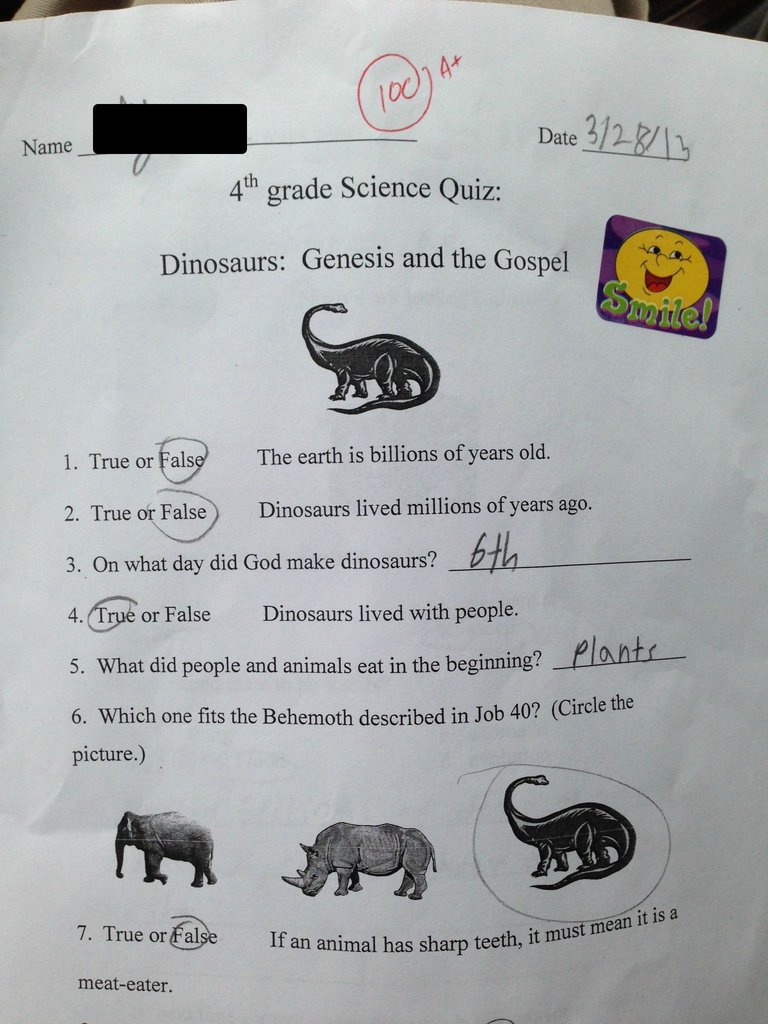
4th Grade Science Quiz on "Dinosaurs: Genesis and the Gospel" (Page 1)

Creationist Fourth Grade Science Quiz Page 1

4th Grade Science Quiz on "Dinosaurs: Genesis and the Gospel" (Page 2)

Creationist Fourth Grade Science Quiz Page 2

This just viral: a fourth grade science quiz.

Normally, grade school science quizzes are not that interesting. But when the correct answer to the true/false question “The earth is billions of years old” is “false,” that gets people’s attention.

As it turns out, the quiz in question was given at the Blue Ridge Christian Academy in the town of Landrum, S. Carolina, north of Greenville. The children had been shown the DVD presentation “Dinosaurs, Genesis, & the Gospel” by Ken Ham and Buddy Davis, published by an organization called Answers in Genesis. The DVD expounds a “young Earth creationism” view of the Bible, which holds that the Creation story in Genesis is to be taken literally, and that the earth is six to ten thousand years old. The quiz tested the children’s knowledge of what was taught in the video.

The moment a photo of the completed quiz hit the Internet on the r/atheist forum at reddit.com, the heated rhetoric began.

For more on creation, evolution, and heated rhetoric, please click here to read on.

Tagged with: , , , , , , , , , , , ,
Posted in Current Events, Science Philosophy and History

Why Didn’t Moses Lead God’s People into the Holy Land?

That’s right. Moses led the Israelites out of Egypt, and all through the desert, but Moses did not lead God’s people into the Holy Land.

Why not?

That’s the subject of a spiritual conundrum posed by darcydee:

My question to you is, “Why was Moses refused entrance into the Holy Land, after he led God’s people there?”

Thanks for the great question, darcydee! It points to some fascinating stories in the Bible. And those stories point to some wonderful insights on the mental and emotional changes we must pass through in order to reach our own “holy land” of spiritual adulthood.

The short answer to your question is that Moses, because of his character and his cultural and spiritual significance, was the right person to lead the people of Israel out of slavery in Egypt; but he was the wrong person to lead them into the Holy Land.

Why was Moses the wrong person to lead God’s people into the Holy Land?

As great a leader as he was, like every human being Moses had his character flaws. He was not allowed into the Holy Land because of his:

  1. Lack of trust in God
  2. Grumbling and complaining
  3. Failure to follow God’s commands exactly
  4. Grandstanding and stealing God’s glory in front of the people

These failings in Moses’ character all came out at a place near Kadesh (also called Kadesh Barnea), just south of Palestine. This place came to be called Meribah (“quarreling”) because of a certain incident that took place there.

That’s where God commanded Moses for a second time to bring water out of a rock for the thirsty people.

And where, instead of following God’s simple instructions, Moses made a big production of it in front of the people.

And thus where God told Moses and his brother Aaron that because they had neither trusted God nor given God the glory, they would never set foot in the Holy Land (Numbers 20:12).

Let’s take a closer look.

For more on Moses’ merits and demerits, please click here to read on.

Tagged with: , , , , , , , , , , , ,
Posted in Spiritual Growth, The Bible Re-Viewed
Lee & Annette Woofenden

Lee & Annette Woofenden

Donate

Support the work of Spiritual Insights for Everyday Life by making a monthly donation at our Patreon

Join 1,260 other subscribers
Earlier Posts
Featured Book

Great Truths on Great Subjects

By Jonathan Bayley

(Click the title link to review or purchase. This website receives commissions from purchases made via its links to Amazon.)

Blog Stats
  • 4,226,070 hits