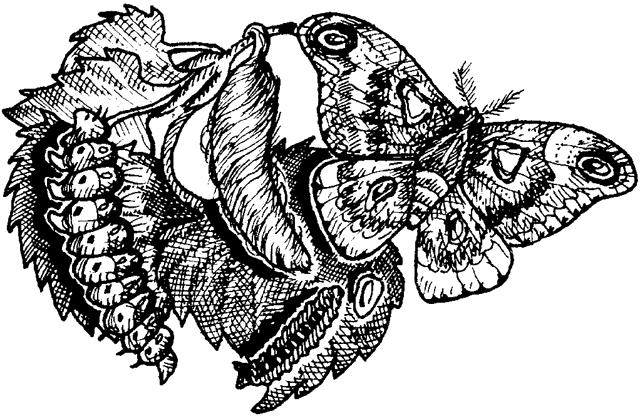
From Caterpillar to Butterfly
“Do you believe in reincarnation?”
I’ve been asked this question many times over the years.
Sometimes it’s a litmus test question. The people asking already either believe in reincarnation or they don’t. If my answer agrees with their view, they’ll see me as enlightened. If not, they’ll see me as unenlightened. So it’s always tempting to answer with a light-hearted, paradoxical non-answer of the type a certain uncle of mine loves: “Not this time around!”
But the question keeps coming. People also want to know what the Bible says about reincarnation. And they want to know whether my favorite theologian, Emanuel Swedenborg (1688–1772), says anything about reincarnation. Some are sincerely looking for understanding on this often confusing subject.
For example, here is part of a comment that a reader named Mark left on the article, “If there’s One God, Why All the Different Religions?”
Specifically however, please enlighten those of us who remain confused by reincarnation. As an example, Krishna conciousness teaches an absolutely beautiful and devoted life to God (whom appears in any way he chooses but still only ONE god). The bible seems to teach that we come through this human “life” but once. I understand that this could be once per each human life and I have considered that each human life, even reincarnated, is once. Please provide your take on this. Unless I have misunderstood, according to Krishna teachings, heaven is not the “final” or utmost attainment.
We’ll dig into all of this in a few minutes. But first, for those of you who just want the quick answers so that you can move on:
- I do not believe in reincarnation (though I do think it points to a deeper truth).
- The Bible does not support reincarnation (and it never did).
- Emanuel Swedenborg also does not support reincarnation (but he explains why people think it happens).
There! I’ve said it!
If you still want to learn more, settle in. This is going to take some time. But it will be worth your time if you want a thoughtful, spiritual, non-dogmatic Christian response to the currently popular belief in reincarnation.
There’s more to reincarnation than meets the eye
Before we dig into the specifics, let’s get the general idea in mind.
If understood from a spiritual rather than a materialistic viewpoint, neither the Bible nor the Eastern scriptures teach reincarnation. Instead, they teach spiritual rebirth. And they teach a continual “re-incarnation” of God in an infinite variety of finite (non-God) human beings. Each creation of a new human soul, and the resulting birth of a new human being, is a brand new expression of a unique, never before expressed facet of the infinite reality of God.
In other words, God’s infinite creativity is continually creating brand new expressions in the form of new, eternal human souls that briefly inhabit a material body on earth on their way to an eternal (and very solid and real) life in the spiritual world. Our lifetime here on earth is like our development in the womb before we are born into our true, spiritual and eternal life. Along the way we experience many spiritual rebirths, both during our lifetime here on earth and during our eternal life in the spiritual world.
Reincarnation as popularly believed—souls passing through multiple bodies and lifetimes in the material world—does not actually take place. However, there is a reason under God’s providence that people are allowed to think that it does.
Many people see all the injustice in the world, and they cannot accept that a loving God would allow so much evil and injustice. For people who have difficulty thinking beyond this material world, with its physical and financial rewards and punishments, reincarnation provides a way to think that life is just. And it is better for people to believe in God and spirit, even if their belief is not entirely accurate, than to reject God and spirit altogether because they believe God has created an unjust world.
In other words, a belief in literal, physical reincarnation is an accommodation God makes for people who are focused more on material justice in the physical world than they are on spiritual and eternal justice.
It is similar to some Christian fundamentalists believing that in a future apocalyptic Last Judgment, the world as we know it will be destroyed, God will create a new one, and we will all be reunited with our physical bodies and live in an eternal paradise right here in the physical world.
That’s not going to happen. Those prophecies are about spiritual events. (See “Is the World Coming to an End? What about the Second Coming?”) However, for people who can’t conceive of any solid reality other than material, physical reality, the belief in a literal resurrection of the body allows them to think that there will be a real future life, not just some disembodied, ghostly “spiritual” life.
As a matter of fact, life in the spiritual world is much more solid and real than life here on earth. But that idea is difficult, if not impossible, for many people to grasp.
In the same way, reincarnation does not take place as is popularly believed. But it allows many people who are stuck on physical, material reality to believe that life continues after death, and that there is meaning, purpose, and justice in the way the universe is constructed.
Beyond that, the materialistic idea of physical reincarnation provides an image of a deeper, spiritual truth.
You see, even beliefs and ideas that are fallacious in themselves can serve as stepping stones to a deeper understanding of spiritual reality. When we move beyond the external appearance, we can discover the deeper truth. Eastern scriptures that speak of reincarnation are using material images of life and death to speak about deeper realities of our spiritual rebirth.
That’s also what the Bible means when it speaks about being born again.
Did the Bible ever teach reincarnation?
Let’s dispose of one common rumor right away: the idea that the Bible used to teach reincarnation, but those evil Christian councils changed the text hundreds or thousands of years ago, so that it no longer does.
Hogwash.
There is absolutely no evidence for this.
Now, I have no great love for the so-called Christian councils. Most of them just mucked up Christian doctrine and said nasty things about everyone who disagreed with their particular heresies. But one thing they didn’t do was change the text of the Bible. It wasn’t really possible for them to do that. There were too many manuscripts of the various books of the Bible, going too far back. Any changes they made would have been so obvious that they would have been rejected.
The only thing the councils could do was decide which books would be in the Bible. However, for the books they did include, the text we have is as good as or better than any other text we have from that far back in history. Though a few minor scribal errors made it through, and there were a few sections added to the originals (such as all but the first few words of 1 John 5:7), for the most part we have a fairly reliable text of the entire Bible. And none of the changes that did take place had any effect on what the Bible says about reincarnation.
What does the Bible say about reincarnation?
The word “reincarnation” does not appear in the Bible. However, there are several places in the Bible where the idea of reincarnation comes up.
Let’s be clear about this.
There are many spiritual leaders who claim that the Bible teaches reincarnation. However, the fact that the idea of reincarnation shows up in the Bible does not mean it is true according to the Bible. It only means that in Biblical times there were people who believed in reincarnation. In the few places where it does come up, reincarnation is not affirmed in the Bible. And there are many passages that state clearly that once we die, we go to an eternal afterlife, from which we do not come back.
As we will see, the Bible, especially the Gospels, offers a teaching in place of reincarnation that is much deeper, more spiritual, and in the end, more just and human than reincarnation.
Let’s look at some of the places where the idea of reincarnation is present in the Bible.
Was a man born blind because he sinned in a previous life?
John 9 tells the story of Jesus healing a man born blind, and its aftermath. When Jesus first encountered the man, his disciples asked him, “Rabbi, who sinned, this man or his parents, that he was born blind?” (John 9:2). Of course, for the man to have sinned resulting in his being born blind, he would have had to sin in a previous life.
However, Jesus rejected both of the possible explanations that his disciples suggested: “Neither this man nor his parents sinned; he was born blind so that God’s works might be revealed in him” (John 9:3). That is a fascinating reply, with a lot of meaning, as explored in the rest of the chapter. But for our purposes at the moment, the point is that Jesus rejected the idea that sins in a supposed previous life were the reason for this man’s blindness from birth. And since the doctrine of reincarnation generally holds that sins in past lives are the reason we suffer in our present life, by extension Jesus rejected the whole idea of reincarnation.
Was Jesus a reincarnation of John the Baptist or one of the prophets?
In Matthew 16:13–20, Jesus asked his disciples who people were saying that he is. They responded, “Some say John the Baptist, but others Elijah, and still others Jeremiah or one of the prophets.” Jesus was not satisfied with this answer. He said to them, “But who do you say that I am?” Then Peter answered, “You are the Christ, the Son of the living God.” This answer Jesus heartily approved of. Jesus answered him, “Blessed are you, Simon son of Jonah! For flesh and blood has not revealed this to you, but my Father in heaven.” He goes on to say that he will build his church on the “rock” of this truth (not on Peter himself, as the Catholic Church teaches).
Once again, when his disciples present Jesus with popular speculations that he was a reincarnation of John the Baptist (impossible, since John the Baptist and Jesus lived at the same time) or one of the ancient prophets, Jesus did not accept that idea. Instead, he accepted the idea that he is the Christ (the Greek equivalent of the Hebrew word “Messiah,” meaning “the anointed one”), and the Son of God.
Incidentally, the Bible also does not say that Jesus was a reincarnation of King David. Like Elijah as a prophet (see below), in the Hebrew scriptures David became a figure representing greatness as a king. In associating Jesus with David, the Bible does not mean that Jesus was a reincarnation of David. It means that he took over from David in spirit as the greatest King of all time.
Was John the Baptist a reincarnation of the prophet Elijah?
There was also a lot of speculation that John the Baptist was a reincarnation of the ancient prophet Elijah. This came about because of a prophecy in the Old Testament:
Behold, I will send you the prophet Elijah before the great and terrible day of the Lord comes. He will turn the hearts of parents to their children and the hearts of children to their parents, so that I will not come and strike the land with a curse. (Malachi 4:5–6)
And in fact, in the Gospels, Jesus does identify John the Baptist as Elijah who was to come (see Matthew 11:13–14, 17:10–13). This has been seized upon by those who believe in reincarnation to say that Jesus did, indeed, teach reincarnation. But this idea cannot withstand scrutiny. Neither the prophecy in Malachi nor Jesus’ words identifying John the Baptist with Elijah were meant to be taken literally.
What does this prophecy mean, then? And how was it fulfilled by John?
Essentially, it means that John was to be a great prophet like Elijah, preparing the way for the coming of the Lord. In the Hebrew Bible (the Old Testament), Elijah had come to be a representative figure of prophets, and of prophecy in general. This is why in the Gospel of Luke, an angel of the Lord told John’s father Zechariah that his yet unborn son would go before the Lord “with the spirit and power of Elijah” (Luke 1:17, emphasis added). John was not to literally be Elijah, but to “wear the mantle of Elijah” (in Biblical terms) as a great and powerful prophet—the last of the Biblical prophets, leading up to Jesus himself.
We can be assured that John was not literally a reincarnation of Elijah by a later incident recorded in the Gospels. After John’s death, at the time of Jesus’ transfiguration, Jesus’ closest disciples, Peter, James, and John, saw Moses and Elijah with Jesus (Matthew 17:1–13; Mark 9:2–13; Luke 9:28–36). Now, if Elijah had been reincarnated as John the Baptist, he would no longer be Elijah, but John. Yet after John’s death, both Elijah and Moses were still living in the spiritual world as themselves. Many centuries after they had lived and breathed on earth, they had not been reincarnated and become someone else.
In short, according to the Bible story, Elijah could not possibly have been reincarnated as John the Baptist. Elijah was still living in the spiritual world, very much himself, after John the Baptist had already lived and died.
For some other Bible stories in which well-known figures are seen or mentioned as alive and themselves (not some other, reincarnated being) in the spiritual world years or even centuries after their deaths, see 1 Samuel 28:3–25; Matthew 22:31–32; Luke 16:19–31.
The Bible denies reincarnation, and affirms an eternal afterlife
The stories about the man born blind, the question of who Jesus was, and John the Baptist fulfilling the prophecy of Elijah’s return are sometimes pointed to by reincarnation supporters to argue that the Bible teaches reincarnation. But in fact they show just the opposite. Wherever the idea of reincarnation is brought up in the Bible, it is either directly denied or the story itself makes that interpretation impossible.
Meanwhile, there are many passages in the Bible stating either directly or through imagery that once we die, we move on to an eternal state from which we do not return. Here are just a few of them:
As the cloud fades and vanishes, so those who go down to Sheol [the grave or the underworld] do not come up; they return no more to their houses, nor do their places know them anymore. (Job 7:9–10)
“But now he is dead; why should I fast? Can I bring him back again? I shall go to him, but he will not return to me.” (2 Samuel 12:23)
“And these will go away into eternal punishment, but the righteous into eternal life.” (Matthew 25:46)
And if your eye causes you to stumble, tear it out; it is better for you to enter the kingdom of God with one eye than to have two eyes and to be thrown into hell, where their worm never dies, and the fire is never quenched. (Mark 9:47–48)
And just as it is appointed for mortals to die once, and after that the judgment . . . (Hebrews 9:27)
Yes, there are shadows of reincarnation in the Bible. But the whole story of the Bible is based on the idea that we humans have but one life on earth, and we then we move on to our eternal reward or punishment, never to return.
There is another story in the Bible that relates to reincarnation: Jesus’ nighttime conversation with Nicodemus in John 3:1–21. That story offers the key to understanding the real, deeper meaning behind the popular misconception of individual reincarnation. But before we get to it, let’s look at how people came to believe in reincarnation.
What does Emanuel Swedenborg say about reincarnation?
Long before there was widespread knowledge of near-death experiences, and all of the information and experience about the afterlife from them, there was Emanuel Swedenborg (1688–1772).
As far as I know, no one else in human history has ever even claimed to have the length, depth, and clarity of experience in the spiritual world that Swedenborg did. By his account, for the last twenty-seven years of his life he was able to be fully conscious in the spiritual world while still living in the material world. He didn’t just hear voices like a spirit medium. He lived and moved among angels and spirits as if he were one of them from his mid 50s until the time of his death at age 84.
During those years, he traveled extensively throughout heaven, hell, and the intermediate “world of spirits” (as he called it), fully acclimating himself to the realm that we all pass into after we die. His most popular book, Heaven and Hell offers a verbal map and guided tour of the spiritual world.
While thousands of people have had a brief glimpse of the spiritual world during near-death experiences, and have come back to tell us about it, Swedenborg had several decades to fully experience the other world, and unlock its secrets. From that extensive experience, he made his few brief but illuminating statements about reincarnation.
In most of those statements, he quickly dismisses reincarnation as a mere fantasy. However, in Heaven and Hell #256 he offers more substance about how people came to believe in reincarnation:
No angel or spirit is allowed to talk with one of us from the angel’s or spirit’s own memory, only from that of the individual in question. Angels and spirits actually have memory just as we do. If a spirit were to talk with us from his or her own memory, then it would seem to us entirely as though the thoughts were our own, when they would really belong to the spirit. It is like remembering something that we have never seen or heard. I have been granted knowledge of the truth of this by experience.
This is why some of the ancients were of the opinion that after some thousands of years they would return to their former life and all its deeds, and that they had in fact returned. They gathered this from the fact that sometimes a kind of memory would come up of things that they had never seen or heard. This happened because spirits had flowed from their own memory into the images of these people’s thoughts.
What is Swedenborg saying here?
Short version: when people “experience past lives,” they are indeed experiencing a past life. But it’s not their own. It is the life of someone else who had previously lived and died here on earth, and is now living in the spiritual world.
Spiritual IT
You see, in the spiritual world, what we call “information technology” (IT) is far more advanced than it is here on earth. Here, we require complex electronics to store and transfer data. Large memory banks are required to store databases full of information. Transferring all that information over land lines or via satellite can take a considerable amount of time.
In the spiritual world, information storage is built right into the “operating system.” And transmission, even of massive amounts of data, is almost instantaneous.
For example, even after we die, the memory of every experience we have ever had from pre-birth to death is stored away forever. This is not just a general memory of the high points. It includes every single experience in full detail: sight, sound, smell, taste, and touch, together with all of the thoughts, feelings, impressions, desires, and reactions associated with it. The record of our life is so detailed that it is possible for us to re-experience any event or time period in our life so fully that it feels as if we were actually there.
That’s a vast amount of information! Yet it is all stored effortlessly and without error in the spiritual “data banks” of our minds, and in the general “data centers” of the spiritual world.
Not only that, but it is possible for that vast amount of information to be transferred almost instantly from mind to mind. In the spiritual world, it is not only possible for us to re-experience events in our own lives from the records of it in our spiritual memory, but for the angels and spirits around us to share in that experience.
For example, Swedenborg describes how angels are able to draw out of the memories of criminals who have died the exact circumstances of their crimes, and display every single detail of each crime, one after another from beginning to end, until they cannot possibly deny what they have done. See Heaven and Hell #462b (scroll down to 462b).
“Experiencing past lives”
Of course, people in the spiritual world don’t walk around all day dumping the contents of their earthly memories into other people’s minds. Usually, once we move on to heaven (or hell), the memory of our earthly life fades away as we build new and much more vivid memories of our new life in the spiritual world.
However, those memories do still exist. And under the right circumstances, it is a simple matter to transfer the entire memory of one person’s life into another person’s mind.
This is the most basic explanation of what is actually happening when people experience “past life regression,” and “remember past lives.”
We have spirits around us all the time, even while we are still living in the material world. They are so tied in with our thinking and feeling that if we were cut off from the spiritual “atmosphere” created by the spirits who surround us in the spiritual world, we would not be able to think or feel anything at all.
The spirits who are with us normally have access only to our minds and memories, not theirs, while they are with us. This is to prevent them from confusing us by transferring into our minds their own memories or the memories of other spirits that they have access to. Instead, they draw out things from our own thoughts and feelings, resulting in our recollecting things we’ve experienced, coming up with new ideas and theories, and evaluating our ideas and beliefs, our loves and feelings, and the meaning of our lives.
Sometimes, though—especially when it is desired by those on both sides of the sensory “veil” that separates the material and spiritual worlds—memories of a departed spirit’s life are transferred into the minds of people who are still living on earth. This can cause feelings of déjà vu. Or, when a more complete set of memories is transferred, it can cause us to “remember” whole life experiences of someone who lived in the past.
This is not necessarily the past life of the actual spirits who are around us. Once a spirit gets access to another spirit’s memories, those, too, can easily be transferred to the mind of someone still living on earth.
It is quite common for people who believe they’ve experienced past lives to think that in a past life they were someone famous from history. In the spiritual world, famous people are the subject of just as much fascination and investigation as they are here on earth. But in the spiritual world, it is possible to get access to “inside information” from memory records that are not available here on earth. Those memories can then be transferred to someone who is still alive on earth, causing the phenomenon of famous people being more likely to have been “reincarnated” than unknown ones. Wouldn’t you rather have been one of the elite few such as Plato or Hypatia, and not just one of the anonymous masses of slaves, serfs, and poor laborers who toiled away for decades and then died in obscurity? Yet statistically, the chances that you were someone famous in a past life are almost nil.
Such memory transfers are not the only mechanism by which people have experiences that convince them that they’ve been reincarnated from previous lives on earth. But they are the explanation for most of the “experiences of past lives” that believers in reincarnation report.
This doesn’t necessarily mean those experiences are evil or demonic, as claimed by many conservative religious opponents of reincarnation. Everything happens under God’s providence. For some people, the belief that they have been here before, and will be here again, gives great meaning to their lives. And the angels and spirits who are with us lead and inspire us according to our own beliefs, whether or not those beliefs are actually true.
This is all part of God’s protection of our freedom to believe and live as we choose. However, this is also one of the reasons why contact with angels and spirits is not a good source of genuine spiritual truth. (See the article, “What about Spiritualism? Is it a Good Idea to Contact Spirits?”)
What’s wrong with reincarnation?
So why shouldn’t people believe in reincarnation?
Practically speaking, it may not matter all that much whether people do or don’t believe in reincarnation. It either happens or it doesn’t, regardless of what we happen to believe. And as long as we love and serve God by loving and serving our fellow human beings (see Matthew 25:31–46 and Romans 2:5–16), it’s not so critical that we have correct beliefs rather than faulty ones.
The fact is, people can believe all sorts of things, including reincarnation, and still be good and loving people who are heading to heaven, not hell. For example, I have no trouble accepting the description of Krishna consciousness as teaching “an absolutely beautiful and devoted life to God.” God has spoken divine truth to people of all races and cultures. Each one hears it in its own unique way. (See “If there’s One God, Why All the Different Religions?”)
If you, dear reader, still want to believe in reincarnation after reading this, I have no problem with that. I won’t argue with you or try to convince you that you are wrong.
But since I’ve been asked the question so many times, I’ll tell you why for me, reincarnation is not an acceptable belief.
Reincarnation robs us of our humanity
It all has to do with our humanity.
And that has to do with our freedom to choose our own life and our own destiny.
What I personally find so troubling about the systems of belief that include reincarnation is precisely what those who do believe in them find so attractive and comforting.
In every form of reincarnation that I’ve encountered so far, there is no eternal hell.
Sooner or later, every soul ends out either re-merged with the Divine or in a state of blissful nirvana that is the Eastern equivalent of the Western heaven.
What’s so bad about that? Isn’t it good that everyone would end out in the highest attainable state?
In a word: No.
Theoretically, God could have created the universe so that it contained no eternal evil, or even so that it contained no evil at all. But the cost of doing so would have been the absence of any created beings who were truly human. If real, eternal evil did not exist in the universe, there could be no beings in the universe (other than God) capable of real, human relationships of love and mutual understanding with God and with one another.
You see, for love to be real human love, it must be freely chosen. God could have created us pre-programmed to love God and love our fellow human beings. But it would have had exactly as much meaning as programming a computer to print “I love you” on the screen. The computer doesn’t actually love you. It’s just mindlessly displaying what it is programmed to display.
What makes us human is the freedom to choose who and what we will love, and the rationality to think for ourselves and make our own decisions about what to believe. Without these capabilities at the core of our being, we would be no more human than a rock or a tree.
Further, if we are to be truly free, we must be able to choose what we will believe, what we will love, and how we will live permanently, not just temporarily.
That’s the problem with the doctrine of reincarnation. Eventually, no matter what choices we make, we will all end out in the same place: either as part of the Divine or in the blissful state of nirvana. In fact, under the doctrine of reincarnation, we will be forced to undergo endless lifetimes until we make the choices, and reach the enlightenment, that we are supposed to make. Choosing anything other than pure love and enlightenment will only send us back for another lifetime . . . and another . . . and another, until we get it “right.” Only one choice is acceptable: the choice for divinity and enlightenment.
What this really means is that under the doctrine of reincarnation, we are not human at all. We are like rats in a maze, forced to keep running the circles of continual reincarnations until our behavior, our thoughts, and our loves conform to the way the designer of the maze wants us to think, feel, and act. Only then are we released from the wheel of reincarnation.
“Karma” as taught in the doctrine of reincarnation is not only cause and effect—which in itself is a perfectly true and reasonable idea. It is also a deterministic and behavioristic training mechanism that gradually and inexorably forces all souls to make the same “choice” (which is really a non-choice), and end out in the same place.
Eternal heaven + eternal hell = true humanity
People who believe in reincarnation often say that it’s not fair to have just one lifetime to make an eternal choice between good and evil.
However, if we look at it objectively, it really doesn’t matter whether our choice is made in seventy seconds, seventy years, or seventy centuries. There is no ratio between eternity and any finite time period. Once a period of seventy billion years is over, it will still be like nothing compared to eternity. And if every choice we make except the choice to re-merge with the Divine or enter a blissful nirvana is only temporary, then those “choices” are not real, no matter how long they take to make. They are only a temporary illusion.
Only what is eternal is truly real.
This means that for our humanity to be real, we must be able to make choices that last forever.
And for our freedom of choice to be real, we must be free to choose not to do what God designed us to do. So we must be free to choose not to love God and not to love our fellow human beings. We must be free to reject the light of truth that God offers us, and cling to our own particular darkness and falsity.
This is why God allows (not creates) evil and falsity, and allows (not creates) an eternal hell. Without it, none of our choices are real. Without it, we are not humans, but rats in a maze or pre-programmed robots who merely do what we are trained or programmed to do.
The fact that we can choose not to go to heaven, but choose instead to go to hell forever, means that our choices are real, what we choose really matters, and we are truly human. As free and rational human beings, we can choose our own life and determine our own eternal fate.
Hell is a choice
Yes, the existence of an eternal hell is a choice. And it is our choice.
Why would anyone ever choose to live in the eternal punishment and torture of hell?
It helps to understand that although there certainly are painful and devastating punishments in hell, that’s not the primary purpose of hell. In fact, the primary purpose of hell is to provide a place where people who choose hatred over love, greed over generosity, domination over cooperation, and falsity over truth can experience as much of their particular pleasure as possible given the self-limiting and self-punishing character of evil and falsity.
Hell has many other purposes as well, such as protecting angels and good spirits from the destructive influence of evil spirits and providing a balance between good and evil so that people on earth can remain in spiritual freedom. (For more on why there is a hell and what it is really like, see the article, “Is There Really a Hell? What is it Like?”)
In short, the only way we can be truly human is if we have a choice between good and evil . . . and that choice is permanent. Our life on earth is our opportunity to make that choice. God could have made our life last a single day, which is the life span of some insects, or it could have lasted fourteen billion years, which is the estimated age of the universe so far. It really doesn’t matter. Seventy to one hundred years is as good a number as any.
What does matter is that God doesn’t force us to do it God’s way. As human beings, God offers us the choice between good and evil, lets us make that choice for ourselves, and then respects the choice we have made.
A conversation with some inhabitants of hell
Believe it or not, the people who go to hell choose to be there. As terrible and disgusting as their life may seem to us, they wouldn’t have it any other way. Swedenborg was once present for a conversation in the spiritual world in which a spirit newly arrived from earth, together with some angel guides, encountered some evil spirits from hell. Here’s what happened:
The ground suddenly yawned wide at some distance from them. Up through the chasm came three devils, who were visibly lit up by the delight that comes from what they love. The angels who were accompanying the newly arrived spirit perceived that it was not by coincidence that the three devils had come up just then. The angels called out to the devils, “Don’t come any closer, but from where you are, tell us something about what delights you.”
“It is important to know,” they replied, “that all people, whether labeled good or evil, have their own delight. The so-called good people have theirs and the so-called evil people have theirs.”
“What do you take delight in?” the angels asked.
“What is delightful to us,” they replied, “is whoring, taking revenge, cheating, and speaking blasphemy.”
“What are those delights like for you, exactly?” the angels asked.
The devils replied that their delights were sensed by others as resembling the stench of excrement, the reek of dead bodies, and the smell of stagnant urine.
“Are those things actually delightful to you?” the angels asked.
“Very much so,” the devils replied.
“Then you are like the filthy little creatures that live in those substances,” said the angels.
“If we are, we are,” the devils said, “but those things give our noses intense pleasure.”
“Do you have anything further to add?” the angels asked.
“Yes,” they replied. “Everyone is allowed to have her or his delight, even if it is of the ‘most unclean’ kind, as others call it, provided she or he does not attack good spirits and angels; but because our delight makes it absolutely impossible to resist attacking them, we are thrown into workhouses where we suffer many hard things. Being restrained and withdrawn from our delights causes the so-called torment of hell, which is profound inner pain.”
“Why do you attack people who are good?” the angels asked.
“We can’t help it,” the devils said. “A kind of rage comes over us every time we see any angel and sense the Lord’s divine sphere around that angel.”
“Then you are also like animals,” we said.
Soon afterward, when they noticed the newly arrived spirit with the angels, a diabolical rage came over them, which looked like a burning fire of hate. Therefore to prevent their doing any harm, they were thrown back into hell. (True Christianity #570:7)
During this brief time of withdrawal from their usual life in hell, these evil spirits were quite rational. They had a clear understanding of their own life and pleasures. And they assured their listeners that although others may find their pleasures revolting, to them they are intensely pleasurable.
Outside of hell, they could not indulge those pleasures. So although their pleasures are inextricably linked with pain, they choose to be in hell, where at least some of the time they can enjoy the types of pleasures they have chosen, and no one can force them to be someone they do not want to be. In other places, Swedenborg describes evil spirits jeering at those who feel love and kindness for others, and rejecting such feelings as idiotic and unreal.
As inhuman as this may seem, having the choice to live this way is part of what it means to be human. It means having the freedom to choose what sort of person we want to be, even if that involves rejecting the life for which God designed us.
In the doctrine of reincarnation, we are not given that freedom—which means that ultimately, we are not really human.
Why does reincarnation appear in so many ancient writings?
Why, then, do so many scriptures—especially Eastern scriptures—talk about reincarnation?
That’s a very good question, and it deserves an answer.
First, the idea of reincarnation has been ingrained in many cultures for thousands of years. As we’ve already seen, it shows up in the Bible. It also shows up in the writings of the ancient Greek philosopher Plato. And of course, it shows up in many ancient Eastern scriptures. It is present in the ancient writings of many cultures.
However, the purpose of scriptures is not really to set us right intellectually. It is to lead us toward a life of loving God and our fellow human beings (see Matthew 22:34–40). In order to accomplish this, the various scriptures of humankind commonly accept beliefs and practices already ingrained in the cultures in which the scriptures are written, and use them to lead the people of those cultures toward more kind and loving ways of life.
The simplest answer to the question of why reincarnation appears in many ancient writings is that the people of those cultures already believed in reincarnation. Those sacred writings simply used that belief to inculcate in them a life of caring and concern for their fellow human beings.
In the case of reincarnation, the basic message conveyed by the ancient Eastern scriptures is this:
If you engage in evil practices such as lying, stealing, adultery, fraud, and so on, you will be punished for it in a future life. For example, if you are wealthy but corrupt and oppressive in this life, in your next life you will experience the same poverty and oppression that you now inflict on others. On the other hand, if you are poor and lowborn, but you live a kind and virtuous life, in your next life you will be rewarded by being born into a privileged, well-to-do family, and enjoying the finer pleasures of life.
This is just an example of how the already existing belief in reincarnation is used in ancient Eastern scriptures to encourage people to choose love and kindness over greed and selfishness. It doesn’t matter very much whether the belief in reincarnation is true or false. What matters is that the people who believe in it see reincarnation as a reason to live good lives rather than evil ones.
What is the deeper meaning of reincarnation?
But there is a more profound reason reincarnation appears in many of the great scriptures of humankind.
Reincarnation in itself is a rather materialistic and physical-minded belief. Like the doctrine of bodily resurrection held to by many conservative Christians, the doctrine of reincarnation is well-adapted to the minds of people who are focused on material rewards and punishments.
However, it also plants the seeds of a deeper understanding of the meaning of life, death, and rebirth. That’s because if we look deeper, the real meaning of reincarnation is not physical rebirth, but spiritual rebirth. It points to the same spiritual reality that the Christian Gospels express through their teachings about being “born again.”
Let’s go back to the Bible, and read part of Jesus’ nighttime conversation with Nicodemus:
Now there was a Pharisee named Nicodemus, a leader of the Jews. He came to Jesus by night and said to him, “Rabbi, we know that you are a teacher who has come from God; for no one can do these signs that you do apart from the presence of God.”
Jesus answered him, “Very truly, I tell you, no one can see the kingdom of God without being born again.”
Nicodemus said to him, “How can anyone be born after having grown old? Can one enter a second time into the mother’s womb and be born?”
Jesus answered, “Very truly, I tell you, no one can enter the kingdom of God without being born of water and spirit. What is born of the flesh is flesh, and what is born of the spirit is spirit. Do not be astonished that I said to you, ‘You must be born again.’ The wind blows where it chooses, and you hear the sound of it, but you do not know where it comes from or where it goes. So it is with everyone who is born of the spirit.” (John 3:1–8)
Here Jesus makes it clear that the rebirth he is talking about is not re-entering the womb and being born again physically, as in the doctrine of reincarnation. Instead, the rebirth he is talking about is being “born of the spirit.”
In plain words, what Jesus is talking about is becoming new people in our minds and hearts. In 2 Corinthians 5:17, the apostle Paul is referring to the same thing when he speaks of our becoming “new creations” in Christ. In the Bhagavad Gita, Krishna means the same thing when he tells his student, “Arjuna, both you and I were born many times in the past. You do not remember those births, but I remember them all.”
In each case, the scriptures are not talking about physical rebirth, but spiritual rebirth.
In accordance with Krishna’s words, this takes place many times in the course of our lives. Each time we turn over a new leaf in any of our habitual thoughts, feelings, or actions, we are being born again. We can easily forget about these spiritual rebirths, just as Arjuna did. But if we look back on our lives and reflect on the changes we have been through, we can identify many of the inner rebirths we have experienced from our earliest childhood right up to the present.
For more on this deeper meaning of being born again, see:
- What does Jesus Mean when He Says we Must be Born Again?
- Heaven, Regeneration, and the Meaning of Life on Earth
This is not to deny that many Eastern scriptures and mystical writings do teach a literal, bodily reincarnation. However, that belief is present in those scriptures because it was already a part of the popularly accepted belief system of the people to whom they were addressed.
Even though physical reincarnation does not actually happen, and is in itself a false belief, under God’s providence it was allowed to appear in various ancient scriptures and philosophies because it points toward the deeper truth of spiritual rebirth.
For those whose minds are focused on physical punishments and rewards, reincarnation provides something to hold onto as a reason to live a good and virtuous life. But for those whose minds are able to move beyond material things to spiritual realities, behind the appearance of bodily reincarnation is the deeper reality of the ongoing cycle of rebirth and renewal of our heart, mind, and life. The longer we continue on this cycle of spiritual rebirths, the higher we go on our journey toward God and heaven.
Rebirth does not stop at death
One of the attractive features of reincarnation is that it provides a way for us to continue growing and developing spiritually even after we die. If we don’t get it right in this life, or we don’t attain the level of personal and spiritual growth we are capable of, we will be given another lifetime in which to continue our spiritual journey.
To many people, this looks like a major advantage over beliefs such as those in Christianity, in which we have only one life on earth, and then we go on to our final home in heaven. If we see heaven as “the final or utmost attainment,” then the afterlife looks static, and even stagnant. Who wants to sit on clouds to eternity, playing harps and praising God all day? We humans want to live and learn and grow and experience new things!
So let me ask you a question: When, after many months in your mother’s womb, you were born into the world, did your physical growth stop there? Certainly you went through many amazing transformations while you were in the womb. But after you were born, you continued right on growing to adulthood. And even once you reached adulthood, you did not stop growing intellectually, emotionally, and spiritually. Each new day brings new things to learn, new things to do, new ways to grow. Even here on earth, the day we stop learning and growing is the day we start dying.
Don’t you think this would be even truer when we are “born” from this material world into the spiritual world through the process known as death? Does our intellectual, emotional, and spiritual growth stop just because we have moved from one world to another?
According to Swedenborg, it does not. In fact, he describes a heaven in which the angels are continually learning and growing to eternity! For example, in Secrets of Heaven #4803, he writes:
It is worth mentioning something completely unknown in the world: Good spirits and angels are continually changing and developing as human beings. As this happens, they move into more and more central locations in the areas where they live, and they move up to higher and more responsible jobs. You see, heaven is a place of constant purification—and as the saying goes, of “new creation” [see 2 Corinthians 5:17]. Here’s how it is there: No angel can ever achieve absolute perfection—not to all eternity. Only the Lord is perfect, and all perfection is in and from the Lord.
Just because we die and go to heaven, that doesn’t mean we stop learning and growing. In fact, because we are then in a spiritual world, without the physical limitations of the material world, we have far greater opportunities for growth than we do here on earth!
Consider Nicodemus’s question to Jesus: Now that you’ve grown up, would you even want to go back into the womb? As beautiful and comfortable a place as it is, when we are in utero we are confined to a small, dark space—and our possibilities for growth are very limited. There comes a time when we must leave the womb. If we don’t, there will be no more room for growth, and both we and our mother will die.
In the same way, there comes a time when we have done all the growing we can do in the rather dark and restrictive “womb” of the material world. Not only Swedenborg, but practically everyone who has ever had a brief glimpse of the spiritual world through a vision or a near-death experience describes it as incredibly more real and alive than the material world, and as positively vibrating with love, light, and activity. In that greatly enhanced environment, our ability to learn and grow intellectually, emotionally, and spiritually vastly surpasses what is possible for us here.
If that is so, what would be the purpose of coming back to earth?
It would make no more sense than returning to the womb after we have already been born.
There is absolutely no need for us to return to earth once we have completed the initial process of development as human beings that the material world is designed to provide for us. Any return to the material world would not be a step forward in our spiritual evolution, but a huge step backward.
Reincarnation is unnecessary
There is a very good reason that the Bible does not teach reincarnation.
There is a very good reason that Swedenborg, who is the one human being in all of history who has had the most extensive first-hand experience in the spiritual world, says that reincarnation simply doesn’t happen.
Reincarnation is unnecessary.
Believing in reincarnation isn’t the worst thing in the world. Yes, the popular Hindu belief in reincarnation did serve as a justification for the brutal caste system in India for many centuries. But a belief in reincarnation also helps many people to feel that there is ultimate justice in the universe, and that it is worth avoiding evil actions and doing what is good and right in their own lives.
However, a belief in reincarnation becomes unnecessary when we realize that:
- Heaven and hell are a choice.
- The ability to make that eternal choice is what makes us human.
- Whatever choice we make, we can pursue and experience our own pleasures.
- This is true even if other people think our choice of pleasures is wrong and disgusting.
- The material world is an environment in which we are prepared for the spiritual world.
- If we choose heaven, we can continue to learn and grow to eternity.
- Our ability to learn and grow mentally, emotionally, and spiritually is vastly greater in heaven than it is on earth.
When we realize and understand these things, then we will understand what Nicodemus realized: that once we have grown old, we cannot possibly return into the womb and be born again physically. We have already done that, and we don’t need to do it again. Instead, we are born from the womb of the material world into the wide open vistas of the spiritual world.
There, we will continue to learn and grow and face new challenges every day to eternity. Life will never get old, because we will be continually renewed and reborn in our heart, mind, and life.
For further reading:
- Who Are the Angels and How Do They Live?
- Is There Really a Hell? What is it Like?
- Can Gang Members Go to Heaven? (Is Life Fair?)
- If God is Love, Why all the Pain and Suffering?
- What about Spiritualism? Is it a Good Idea to Contact Spirits?
- What Happens To Us When We Die?
- What does Jesus Mean when He Says we Must be Born Again?
- Heaven, Regeneration, and the Meaning of Life on Earth
Share this:


Lee Woofenden is an ordained minister, writer, editor, translator, and teacher. He enjoys taking spiritual insights from the Bible and the writings of Emanuel Swedenborg and putting them into plain English as guides for everyday life.


 Spiritual Insights for Everyday Life
Hi Lee, thanks for your taking on another difficult subject.
Concerning your remark ‘reincarnation is not necessary’ I have this question: perhaps I do not understand this rightly, but aren’t boddhisattva’s people who have reached a spiritual state transcending normal humanity, such that they stay around (by means of reincarnation) not because this would be necessary, but out of compassion for others, to help them realize their spiritual nature?
Also I have read that in certain traditional African belief systems reincarnation is not considered a normal route for everyone, but those with great spiritual power only can choose to return after dying, not to lead a better life, but just to be among the living again, and I suppose also to lead them spiritually.
This is quite another understanding of reincarnation than the one usually thought of (in the West) as a new chance to improve your spiritual chances.
Hi Angela,
Thanks for your comment. Even an article of this length could not cover every aspect of reincarnation. You are quite right that in the doctrine of reincarnation there are other reasons for returning besides the playing out of karma. The ideal of the bodhisattva does raise bodily reincarnation to a higher level than mere cause-and-effect and behaviorism.
However, bodily reincarnation is still unnecessary for the concept of the bodhisattva to have meaning.
As I understand the root meaning of “bodhisattva,” it refers to “an enlightened being.” In Buddhist thought, as compared to classical Hindu thought, it is possible for any human being to achieve enlightenment in one lifetime–the current one–rather than having to go through many future lifetimes. Christianity takes this one step further in saying that for those who seek it, not even past lives are necessary; it is possible to achieve enlightenment, and even become a great world teacher, within a single lifetime. This is how I would interpret all past bodhisattvas, or great world teachers.
Practically speaking, most people do not aspire to becoming great world teachers. Yet every person has unique worth in the universal body of humanity. If nothing else, for every great teacher there must be many great listeners!
Essentially, Christianity applies Occam’s Razor to the bodhisattva concept, cutting out all unnecessary elements, such as unremembered past lives, and making it attainable in a single lifetime for those who seek it.
Of course, none of us is really self-contained within our own lifetime. As the saying goes, “We are standing on the shoulders of giants.” The enlightenment of humankind is cumulative. A person of the present generation can learn and benefit from the progress toward enlightenment of all past spiritual teachers. So even though in my view souls are not reincarnated in new bodies, in a sense, enlightenment and truth are continually “reincarnated” as newly born and spiritually growing human beings are “seeded” with the truth and enlightenment achieved through the spiritual labors of previous generations.
Hello Lee, great post. Reincarnation is a complicated subject as it touches on several spiritual matters. I have always found a “shared group memory” or the “collective unconscious” as Jung would term it the most plausible. The way I look at it, it is not exactly true, but not exactly false either. Each human personality is connected to the spiritual world, and each person’s psychological makeup is not just genetic but also determined/guided by our connections to the spiritual world. When we learn, the angels/spirits associated with our material mind learn as well. In addition to the shared memory explanation from Swedenborg – I remember reading that as a confirmation of some theories I had from Jung – I found this interesting passage where Swedenborg discusses the Jewish laws of not touching a dead body. The spiritual explanation of it is interesting. Swedenborg says that at times in order to progress, spirits “drop down” back to a natural state to grow out of it. And to “drop down” to a natural state would mean sharing the experience with someone living. By that I mean all of our thoughts have a spiritual origin, it is our choice whether we act on them or not. I discussed this a bit at http://dream-prophecy.blogspot.com/2013/10/christianity-reincarnation-and-emanuel.html
So what it means, is that yes, there is a cycle that we have to break through and reach a higher level. So those New Age and eastern teachings are not false, they are true – but I would say they are an “appearance” of truth. And yet if we say we only live once and that’s it, thats not the complete truth either, but closer to it. When one recognizes that, it is all still completely compatible with the scientific biological fact that when born, we are all unique living beings. We are here to fill in a unique piece of God’s jigsaw puzzle. Which He never seems to finish.
I guess not the answer most people want to hear, they will think white or black on this, but we have here an answer that’s a bit of a shade of grey.
Hi Doug,
Thanks for your comment, and for the link to your article. It does bring out some additional points that I didn’t attempt to cover in this article. This subject could very easily be expanded into an entire book!
In particular, I didn’t delve much farther into the matter of contact with angels and spirits, partly because I’d already written about it in one of the linked articles, and partly because I do think the memory transference phenomenon is the primary source of people’s belief in reincarnation.
However, in addition to that, there are the experiences of conversations with spirits in which spirits affirm the reality of reincarnation. Most of the time they’re simply affirming whatever the person already believes. Since they are inhabiting the person’s memory during the encounter, they believe whatever the person believes.
However, other times the spirits themselves may believe it, perhaps due to the type of experiences you describe in your article. As I point out in the linked article about contacting spirits, a common fallacy is that spirits must know the truth just because they are spirits. Not so, according to Swedenborg. People continue to believe ideas they have adopted and confirmed even after they die, even if those beliefs are false. And just as here, spirits who believed in reincarnation while the were living on earth will take various experiences they have in the spiritual world, such as inhabiting the mind and memory of someone who is still living on earth, and interpret it as supporting reincarnation.
Now . . . I like to think that I think both in black and white and in gray, not to mention in full color! 🙂
When it comes to black and white, I do think each of us is completely and eternally unique in having a soul that occupies a unique “point” in spiritual space. No other soul occupies that point. And that point expresses some unique, differentiated aspect of the infinity of God. It can inhabit only one body as its own body. In fact, according to Swedenborg, our soul is the architect of our body, and builds our particular body to fully and uniquely express the soul.
When it comes to shades of gray and technicolor, each of us also has a sphere of influence that flows out from the “point” that is our soul, and flows into and through others. So in that sense, we do interpenetrate one another, flow into one another, and share the same areas of spiritual space, which can also be thought of as thoughts, feelings, memories, ideas, beliefs, and so on.
I don’t have a problem thinking of reincarnation as an “appearance of truth” as long as we don’t think that the appearance is an actual reality. In other words, souls simply do not pass from one body to another, taking on new bodies sequentially like a string of pearls. That doesn’t happen. But we are continually reborn spiritually. And our loves, ideas, feelings, beliefs, and so on do form a “string of pearls” that starts with God and flows down through many angels and spirits on their way to flowing into us, where, as you say, we can either accept them and make them a part of ourselves or reject them and exclude them from our identity.
In terms of “appearances of truth,” reincarnation is like the “appearance” that the sun rises and sets. It just doesn’t. The earth turns. But to us it appears as if it rises and sets. It’s no problem talking that way if we want to, for convenience’s sake. Many people still do think that the earth is the center of the universe, and the sun orbits around it. However, that’s not what’s really happening. And if we persist in that view in the face of contrary evidence, and start trying to come up with a cosmology based on the earth being the center of the universe and the sun revolving around it, we’ll fall into all kinds of fallacies, falsities, and contradictions.
It is the same if we try to construct a spiritual cosmology based on the idea that bodily reincarnation actually does happen. As I say in the article, this ultimately robs us of our humanity. And that, in turn, does away with the entire reason for the creation of the universe by God. Under the doctrine of reincarnation, there really isn’t any reason for God to create the universe, because the end result is to return right back to the original condition, with no particularly good reason for everything in the middle ever to have happened.
How would angels and spirits who believed in reincarnation in their life on the physical world still believe in reincarnation after death if they are living in an eternal heaven/hell?
Hi Luna,
The human mind has an amazing ability to see what it wants to see, and not to see what it doesn’t want to see.
How, for example, can so many people still, in the twenty-first century, believe that the earth is flat, even though we now have thousands of photos of Earth from space showing beyond a shadow of a doubt that it is a sphere, not a flat disk? Thinking people have known for thousands of years that the earth is a sphere. There is so much evidence for a spherical (technically, oblate spheroid) Earth that this is just basic cosmological knowledge today.
Yet Flat Earthers just shrug it all off and continue to believe that the earth is flat. In fact, they spend many hours coming up with completely unscientific “science” to prove that they are right, and the earth is flat. Anyone with even the slightest knowledge of science and cosmology can see that their “science” is ridiculous nonsense. But to them, it looks like incontrovertible truth.
If people here on earth can continue to believe ridiculous things despite massive amounts of evidence to the contrary, then they will continue to believe fallacious and wrong things such as reincarnation even when they are living in the spiritual world. That is, they will if they have so strongly convinced themselves of these wrong ideas that they are completely unwilling to give them up. And there, just like Flat Earthers here on earth, they will get together with other people who believe the same crazy things as they do, and form echo chambers in which they all assure each other that these crazy ideas are the absolute truth.
I think you have a good point, but im not intellectually satisfied.
Swedenborg’s description of the devils’ pleasures is just disgusting, I can’t think of any other word. It just doesn’t seem to have any logic, why would they prefer Hell over Heaven? If the answer is: “because they never had the opportunity to experience Heaven”, wouldn’t that be unfair? Many people (even adults) lack the “spiritual enlightment” to make the decision of experiencing the best of life, or going upward to Heaven… If the answer is: “because they twisted nature makes them find Hell more pleasurable over Heaven”… well then there is something wrong with Heaven that brings the possibility of some souls choosing Hell. In any other way that would be just sad, what about psychopaths who can’t feel emotions or love, or serial killers that have been abused in their childhood (the mentally-ill Ed Gein for example)? They just can’t help it. An eternal Hell for those people would just be sad.
Why reincarnation deprives us from our humanity? God made it that way, or is that your own opinion? Because many people do not see it that way. Why should we assume that past life memories are other souls’ memories and not ours? We have no logical reason for assuming that (Actually -and to be fair- we do not have evidence that past life memories are real)… Why should we think that the evidence of past lives is not veridical (or is twisted) while evidence of Heaven is?
Something that is clearly an advantage in reincarnation over Christian beliefs, is that we have unlimited time to make the choices that will bring us the greater good, so everyone can achieve it, and no one has to get stuck in Hell, nevermind it is or not a choice to enjoy “the stench of excrement, the reek of dead bodies, and the smell of stagnant urine” (my God…), We can reincarnate and choose to live a better life, without the need of an eternal “consequence” for what we experienced in one lifespan. It all depends on how you look it, and both points of view are valid, but if reincarnation is real, every soul created can reach God, without getting stucked in their self-created Hell, not wanting to be part of God’s Love. They can “try it again” and reach Heaven after all.
And ultimately: Why is the Bible more reliable than any other source? Is biased to simply assume that the Bible is legitimate, while the Vedas are not… According to who is Jesus a better teacher than Krishna?
Altough I respect anyone’s beliefs (as I like mine to be respected as well…) this text is full of unjustified assumptions: for example that Swedenborg is “the one human being in all of history who has had the most extensive first-hand experience in the spiritual world”… It just doesn’t work that way… I could say the same of Siddharta Gautama, wich as you may know, supports reincarnation. Anita Moorjani had a very intensive NDE, and she supports reincarnation, she experienced what could be described as cosmic consciousness (wich is the ultimate source of wisdom a person can achieve) and she is convinced reincarnation is real. She felt she was outside time and space, she was what she called “Universal energy”… in other words: God (not the Bible God, but some kind of eternal, infinite and perfect Cosmic Mind that is All That Is). Assuming that something regarding the spiritual world is real just because Swedenborg says so doesn’t convince me (again, to be fair, assuming that reincarnation is real just because Anita says so doesn’t convince me, either). One of my best friends was a diagnosed schizophrenic, and what he had to say about the spiritual world wasn’t very pleasing… (I’m not suggesting that Swedenborg -or Anita Moorjani, for that matter- was schizophrenic, but trying to point out that we should not take anyone’s word as the Ultimate Truth).
Just one more thing: I don’t have anything against the belief in eternal Heaven or Hell, actually, I find the idea of an eternal resting place of Infinite Love and joyous work, reunited with all my loved ones quite appealing. But I don’t see why that belief is more valid that a belief in reincarnation.
Hi Luciano,
Thanks for your thoughtful comments and questions.
If you personally believe in reincarnation, and that belief helps you to feel that the universe is just and life is fair, the last thing I want to do is try to argue you out of it. As I said in the article, I believe that one of the reasons reincarnation is available to us humans as a belief we can hold to if we choose is that it does help many people feel that life is fair, given the great injustices in this world. I can respect that–even if I see the fairness of life and of God operating in a different way. Of course, the views expressed in this article are my own, as informed by the spiritual sources that I trust. You are free to make up your own mind what to believe. That freedom to choose our own beliefs and our own faith is part of the humanity placed in us by God.
About Swedenborg, I’m simply not aware of anyone else in history, Eastern or Western, who had the length or depth of fully conscious experience in the spiritual world while still living in this world that Swedenborg did. If there is someone else who spent nearly three decades able to be fully conscious in the spiritual world at will (not just hearing voices or sensing spiritual influences), I would certainly like to know about it!
About fairness, my belief is that nobody goes to hell unless he or she makes a free, informed choice to live an evil and destructive life instead of a good and constructive life. Nobody goes to hell because they weren’t taught properly, or had a mental illness, or were abused as a child, or for any other reason besides a free moral choice for evil over good. For more on this, please see the article:
Can Gang Members Go to Heaven? (Is Life Fair?)
The Bible contains the holy scriptures given for people in the Judaeo-Christian perspective. As such, it is the primary text I turn to, since I am a Christian. People of other faiths will naturally turn to their own scriptures rather than the Bible. I do believe there is something special about the Bible that isn’t in most other Scriptures. But that is my view, which people of other faiths are free to disagree with.
However, I do also believe that when the Eastern scriptures speak of rebirth, they, like the Bible, are actually speaking of spiritual rebirth, not about the literal return of a soul to another body, which is physical rebirth.
I’m aware that many adherents of Eastern religions interpret those teachings in their scriptures literally rather than spiritually. But if I were to turn to the Eastern scriptures instead of the Bible, I would interpret them spiritually just as I interpret the Bible spiritually. In Christianity, we have fundamentalists who interpret the Bible literally. I disagree with them just as much as I disagree with the literalists and fundamentalists of other religions.
In short, I believe that even the Eastern scriptures do not teach reincarnation when they are seen from a more spiritually oriented perspective.
Finally, as I explained in the article, I believe that real humanity means that we must have a real choice whether or not to be in a loving relationship with God and with our fellow human beings.
So here’s a question for you: What if, even given a billion lives and a billion opportunities, a particular soul still chooses evil over good? Will that person’s freely made choice be rejected every single time–even a trillion, trillion, trillion times–until he or she makes the “right” choice?
I find the idea that sooner or later we must all choose good to be very overbearing and tyrannical, and entirely opposed to the freedom and rationality that make us human. I find it to be cruel and disrespectful to force souls to continue to go through life after life until we make the “right” choice as approved by God.
A good parent will discipline a child whose behavior is selfish and destructive. But there comes a time when good parents must let go of their children (as they enter adulthood) and let them live their own lives as they choose–even if it is far from the kind of life that the parent wanted them to live.
To me, one of the most amazing things about God is that even though God loves each one of us fully and infinitely, God also respects us enough not to impose God’s own way on us whether we want it or not. God respects us enough to let us choose what kind of life we want to live, and to allow us to live that way forever if that is what we have chosen.
Like a good parent, God makes every possible effort to teach, guide, discipline, and cajole us into choosing love, truth, justice, and compassion over selfishness, greed, cruelty, and oppression of others. But if we persistently choose evil over good, God will, in the end, respect that choice, and leave us to the life we have chosen–as dark and disgusting as it looks from God’s infinitely loving and wise perspective.
This is why I don’t believe in reincarnation, and its idea that all people will eventually become one with God. If we are not ultimately allowed to choose how we will live, but will all eventually end out in the same place no matter what we do, how are we even human?
And in that case, what more is this world than a sad and pointless exercise in pain and suffering with no reason to exist, because in the end everything will just return to the way it was in the beginning? Why would God put us through all this pain? Why not just stay one with God in the first place? To me, reincarnation would make the entire created universe cruel, pointless, and inhuman.
Still, I respect those who believe in reincarnation. I have no wish to engage in debate and argument with those who are happy with their beliefs and find them spiritually helpful and fulfilling, even if their beliefs differ greatly from my own. If you find reincarnation to be a sensible and helpful belief for your spiritual life, I wish you well!
However, your general question seems to be why I do not believe in reincarnation. This is my honest answer.
Yes, I’m now sattisfied with your answer. I personally don’t see reincarnation in that way (It’s just a matter of perspective, isn’t it?), and I think maybe there is a little of truth in every aspect of human beliefs.
Differences are what makes us unique, and that is always a good thing, this kind of dialogues are what makes life richer for me! Always respecting the other person 🙂
Thank you for your answer, and excuse my bad english, as my name may suggest, I’m spanish, not american! haha
I truly find your posts very enlightening. Thank you for your contributions!
There are several people that I know of from India who have been connected with the spiritual world for most of their lives. Some examples – Swami Lakshmanjoo Maharaj, Ramana Maharishi, Lahiri Mahasaya, Sri Yukteshwar Giri, Paramahamsa Yogananda, etc. These are just some of the people in the last couple of centuries that I follow for my spiritual journey. There are several others since the Vedic period and in the present. They do teach reincarnation. Paramhamsa Yogananda explains in his book “Autobiography of a Yogi” why reincarnation happens and he also gives a very nice perspective on phrases from the Bible. According to him, reincarnation happens because of human desire and the karmic law states all desires must come true. So it is definitely by choice, even if one doesn’t consciously realize that. I also like this particular book because it talks in detail about a lot of the metaphysics that I haven’t found in many scriptures or commentaries.
As for the statement on Bhagavad Gita, there are other Hindu scriptures such as Bhagavata Purana, Vishnu Purana that explicitly say Arjuna and Krishna were humans with different names in a previous lifetime in a previous age – Hindu scriptures talk about Yugas (ages, like Stone Age, Bronze Age, etc.). I think these scriptures along with the Bhagavad Gita led to the current belief system of reincarnation. There is also a common misunderstanding that our karma determines our life. According to scriptures, past karma only determines the situations we will be put into in our present life. How we choose to act in these situations is our free will and that becomes karma for future lives if we do not attain salvation. If reincarnation is indeed true, I would like to think the “eternal hell” described in the Bible is actually repeated life on earth because some people prefer material life over the eternal bliss with God. I do not have a strong belief either way with respect to the concept of reincarnation. At least, not yet 🙂
I completely agree with you that reincarnation is unnecessary if we truly connect with God and attain salvation in one lifetime and I also agree that whether we believe in reincarnation or not is immaterial. The important part is we need to focus on living by God’s words and connecting with God to receive the ever-flowing grace in the present to attain salvation. This is exactly what enlightenment and self-realization is all about too – living fully in the present to receive the grace and enjoying the flow of life with love and compassion for all.
Hi Divya,
Thanks for stopping by, and for your good thoughts. I’m glad you’re enjoying the articles here!
I am far from an expert on Hinduism and Hindu scriptures. However, I am aware that some of them do say things that confirm the idea of reincarnation for people, and I am aware that many Hindu masters do teach reincarnation.
This, I believe, is for similar reasons that the Bible makes statements that sound like we are going to be physically resurrected at some future Last Judgment, and our afterlife will be on a newly re-formed physical earth. The reason for this is that many people cannot think spiritually; they can think only materially. If such people did not believe that they would eventually live again in their physical body, they would not believe in any afterlife at all. This would result in many of them rejecting God and religion altogether, and just living for the worldly and physical pleasures they can get in this life.
Similarly, I believe that the Hindu scriptures make statements that can be read as meaning literal, physical reincarnation because just like many Westerners, many Easterners are physical-minded, and cannot think spiritually. If they didn’t believe in a literal, physical reincarnation, in which the karma of their actions in this life would follow them, many of them would reject God, spirit, and religion altogether, and would live self-indulgent and thoughtless lives.
Meanwhile just as Western religion (primarily Christianity) has become more and more external over the centuries, I suspect that a similar thing has happened to Eastern religions, one of the oldest of which is Hinduism. I believe that Buddhism arose out of Hinduism to begin the movement away from what had become a choking and stratified belief in the long cycle of reincarnation that supported the oppressive caste system. Buddhism taught that anyone, of any caste, could attain enlightenment in a single lifetime. This leveled the playing field and did away with the religious justification for some people to think they were better than others because of their birth, parentage, and skin color.
People who can think spiritually can read the Hindu scriptures spiritually rather than literally, just as people of a spiritual mindset can read the Bible spiritually rather than literally. They can then understand that the deeper meaning of passages that seem to be talking about physical rebirth is really about spiritual rebirth. People who read the scriptures of their religion spiritually rather than literally can read them as speaking about the spiritual rebirth and spiritual journey that we go through in our current lifetime, and can be inspired by this to walk the spiritual path with greater motivation and meaning.
I am also aware that many spiritual leaders, both Eastern and Western, have lifelong connections with the spiritual world. But that is not the same as being fully conscious in the spiritual world, as Swedenborg was.
Great spiritual leaders often have spiritual and angelic presences with them that inspire them and give them enlightenment about God and spirit. But I’m not aware of any others besides Swedenborg who had all of their senses fully open in the spiritual world as if they had already died and gone to the spiritual world themselves, so that they could walk among angels and spirits, visit them in their homes and communities, and engage in conversation with them just as we do with one another here on earth. Yes, I’m aware that many people have had brief experiences of this type. But not almost continuously for decades.
That is the experience Swedenborg had for the last twenty-seven years of his life. To my knowledge, no one else in history has even claimed to have that kind of experience of the spiritual world for that many years.
Still, as you say, whether or not we believe in reincarnation is not the most important thing. The important thing is living a God-filled life of love, compassion, and service to our fellow human beings.
Hello Lee,
this post is nine years old but I hope you still come across this comment.
I really like Swedenborg’s philosophy and the idea of not having to reincarnate, so the point of this comment is not to argue with you what’s true or false, but I do actually know some persons that recently talked about being in the afterlife for some time.
If I have to choose the one, whose experiences I need to get explained is Jurgen Ziewe.
He claims to been having OBEs since the 70s until today and he says that reincarnation is real. He also supports the hindu beliefs, so, technically you could call him a hindu. He uses hindu terms while talking about the afterlife like “Jiva”, “the akashic records” and he also talked about cosmic consciousness which I didn’t really understand but I understood that he claims to have been enlightened. Also, many other people who claim, that they constantly had OBEs believe in reincarnation.
I would be greatful, if you could help me. Because I think it would take quite a while, let me know before.😄
I’m hoping for an answer!🙂
Hi Anton,
Thanks for stopping by, and for your comment and question. Yes, I’m still here, and happy to answer your good question. 🙂
It is common for people who have a particular belief system to have those beliefs confirmed by their spiritual experiences. Yes, sometimes people’s beliefs are changed by having an OBE or NDE. But just as commonly they “see what they want to see,” as the saying goes. In other words, the experience confirms already existing beliefs. Christians will see Pearly Gates and no reincarnation. Hindus will see the Akashic Records and reincarnation. People of other religions and beliefs will see other things that confirm their already existing beliefs.
This happens for many reasons.
First and foremost, our beliefs are part of who we are. Entering the spiritual world, either briefly or for an extended visit or permanently doesn’t necessarily change that. Some of our lightly held beliefs may drop off based on the new experiences we have there. But strongly and deeply held beliefs will persist. Here on earth, people believe many outlandish things, such as that the earth is flat, in the face of overwhelming evidence to the contrary. If we have firmly entrenched ourselves in a particular belief, we will interpret everything we see based on that belief, and will simply reject whatever doesn’t support it.
This doesn’t change in the spiritual world. Keep in mind that our beliefs exist in our mind, which is part of our spiritual self. Entering the spiritual world has no effect upon them, except perhaps to make them even stronger and clearer and more firmly held. People of good heart will eventually let go of some of their less important beliefs that aren’t part of their core understanding of life. And people who do not have firmly held beliefs will be willing to be taught the truth if their heart is good. But beliefs that we have confirmed and supported through many arguments and much study are very resistant to change. In the spiritual world, Swedenborg encountered Protestant theologians and clerics who were still writing thick tomes supporting Luther’s doctrine of justification by faith alone long after they hid died and gone to the spiritual world, even though it is an entirely unbiblical and false belief, and completely contrary to the light of heaven. These were people who took great pride in their own superior intelligence and erudition, who therefore made their bed in hell rather than in heaven.
In the spiritual world we are even more likely to have our existing beliefs confirmed than here on earth because there, as they say, “birds of a feather flock together.” The very atmosphere of the spiritual world brings us together with other people who think and feel the same way we do. Those are the people we interact with there, and of course, since they agree with our beliefs, they will confirm that everything we believe is true. That’s just how the spiritual world works. People who have very faulty beliefs but a good heart may have to go through some very hard experiences before they are finally ready to let go of those false beliefs so that they can live in the light of heaven, which is divine and spiritual truth.
Some faulty beliefs also are not eradicated in the spiritual world, but rather raised to a higher level. The idea of reincarnation, for example, can be lifted up to the idea of spiritual rebirth, as discussed in the above article. This shift can happen almost unconsciously in the spiritual world because the spiritual environment there does this to objects, ideas, and beliefs. They are all transformed into their spiritual counterparts.
In the reverse direction, spiritual beliefs can easily be converted into their materialistic counterparts in the minds of people from earth who spend some time in the spiritual world, especially if they think rather materialistically about God, spirit, and religion. The idea of spiritual rebirth, which is a true and spiritual idea, can easily be converted into reincarnation, which is a materialistic and false version of that idea. So a person who encounters the concept or the practiced reality of being spiritually born again in the spiritual world may seamlessly and unconsciously experience it as a confirmation in their pre-existing belief in reincarnation. This is especially true if their mind runs along physical and materialistic lines, as is the case with people who believe in bodily reincarnation.
This is one of the reasons God and the angels don’t argue with people from earth about their beliefs. The angels see the deeper meanings of those beliefs. They also recognize that arguing with people about their beliefs is fruitless and a waste of time. So instead of doing so, they simply use people’s existing beliefs to motivate them toward living a good life, not breaking those beliefs, but bending them toward what is good and true. This is the meaning of the prophecy about Jesus in Isaiah 42:3, quoted in Matthew 12:20:
If the angels encounter a person who believes in reincarnation, they will not try to break or quench that belief. If they were to do so, they would be putting themselves in opposition to that person’s beliefs, and their character that is formed by those beliefs, and would not be able to do anything for him or her. Instead they would cause the person to fight against whatever the angels want to inculcate into him or her. So they let people continue in their existing beliefs, and lead and guide them toward living a good life of love and service to others based on that belief. There will be plenty of time in the afterlife to correct faulty beliefs if the person is open to it. And people of good heart will be open to it.
All these things, I am sure, are what are happening with this Jurgen Ziewe person, and to others who have OBEs or NDEs or other spiritual experiences that confirm their existing beliefs, such as Ziewe’s belief in reincarnation and other Hindu doctrines. Reincarnation does not happen in the usual sense of that word. But it serves as a stand-in for people whose thinking is rather materialistic, giving them a reason to live a good life in this life so that they don’t have to endure another life that is worse, or even an endless and tiresome cycle lives in this world of struggle until they finally “get it right.” This is an example of how angels use the false belief in bodily reincarnation to motivate its adherents to live a good life.
For the same reason, it is not only useless, but counterproductive to try to argue people out of false beliefs, whether it is reincarnation or justification by faith alone or anything else. Not only will they not listen to you, but arguing with you will actually cause them to hold more firmly to their existing beliefs as they bring up more and more counterarguments to support what they believe, and to combat your differing belief. People’s beliefs do not change through argument. They change through life experience. And firmly held false beliefs can generally be changed only through major life crises that shake the person’s faith and render him or her open to a different perspective on life.
As for whether to believe Jurgen Ziewe or Emanuel Swedenborg on any subject, including reincarnation, ultimately you’ll have to make up your own mind about that. However, I will put Swedenborg’s nearly three decades of almost daily full consciousness in the spiritual world up against Jurgen Ziewe’s repeated OBEs any day of the week. For more on why, please see:
Do the Teachings of Emanuel Swedenborg take Precedence over the Bible?
I hope these thoughts, and the linked article, help as you sort these things out in your own mind..
Hello Lee,
I recently watched a video by Ziewe again, which led to me, thinking, I solved a misconception of Ziewe’s experiences, which doesn’t really make me feel comfortable.
In his latest video, he says, that reincarnation works like this: If someone dies, this person then inhabits a region, that manifests through their inner self. But the person then starts to act like they did in the world, he says, and if their soul isn’t really willing/eager to let go of the ego and experience…MORE, it then falls into a, sort of, sleep, from which it awakes as a baby in the womb and having completly forgotten their previous life. Can you relate to what somehow, from Swedenborg’s perspective? Also, I began to watch more of his videos again, which led to even more confusion, as there were things that I simply forgot about or could explain to myself earlier, which is now somehow getting harder.
You made a point when we were talking about Swedenborg a few weeks before, that came, to me, in like a game-changer: We were talking about Ziewe’s experiences and how to align them with what Swedenborg learned. Ziewe claims to have gotten first-hand-experiences by seeing and interprering and also talking to people there/spirits. You said that if people in an out-of-body-state were to talk with spirits there, the spirits would actually rather avoid telling them truths that they don’t believe in. So, Ziewe had an experience where he was talking to his mother, who at some point said: “You have to stop identifying me as your mother, as in your next life, I might be your sister or uncle.”
Now, this I can explain to myself. But the question is: “What about not what he learned from talking to spirits, but what about what he experienced?
He said, he someday lost his ego-identification and saw the totality of his self as millions and billions of energy-centers, and if he zoomed into them, he could see, and even experience a past life. Partially not even on this earth but on other planets or even dimensions. I could explain this to myself by saying: “Oh, yeah, he just connected to god, as this is god, he’s this many centers of energy-fields and the unity consciousness and people can dive into his consciousness by meditation and stuff.”
But why do so many people who ecperience this God- or “unity-consciousness” instantly connect it to reincarnation? And I think, that’s because the concept is the same. They experience this “unity-consciousness” as a consciousness of finding ways to solve problems. (Karma)
And as a little recap: If our consciousness is not yet evolved to the point where we can access this, we reincarnate unconscious, and if we’re giving up the ego-identification we can then see, how that whole system works.
Can you explain this in a not-reincarnating-way? Because I’ve got trouble with it.
Plus: If you got some spare time, and I don’t want to sound compelling, I just think it’s a chance for me and for you, are you willing to watch some videos and interviews of Ziewe? As he represents the modern-day-mainstream-out-of-bidy-experiencer and I think you can understand more of my confusion if you watch his videos instead of reading my reproduction of his experiences.
But don’t feel forced, time in the physical world is limited!😄
Thanks for all the help, Lee!🙂
Kind regards
Hi Anton,
As with every false belief, reincarnation does have a grain of truth behind it. Falsity has no core existence of its own. It consists of truth that has been twisted or corrupted into a false shape. That’s how it is with the popular belief in bodily reincarnation.
The grain of truth behind reincarnation is that we are born again. It’s just that we are born again spiritually, not physically.
However, for people whose minds are materialistic, the truth of spiritual rebirth gets converted into a materialistic belief in reincarnation in new physical bodies one after another.
This is a similar phenomenon in Eastern religions to the common idea among many evangelical and fundamentalist Christians that at the time of the Last Judgment our physical body will rise from the grave and we will resume living in it on a new physical earth that has replaced the old physical earth. This idea is based on a literal and materialistic reading of Bible passages that are meant to be read as parables and metaphors of spiritual things—in this case, of resurrection in our spiritual body in the spiritual world after the death of our physical body.
The Eastern scriptures are also talking about spiritual rebirth when they use the words commonly translated “born again” or “reincarnated.” But because people in the Eastern world, and Westerners who have adopted Eastern beliefs along with them, have become just as materialistic as people in the Western world who adhere to Western religions, the Eastern scriptures have similarly been converted into materialistic ideas such as bodily reincarnation.
I know you have viewed Ziewe as a spiritual-minded person. But his belief in bodily reincarnation tells a different story. It says that he still thinks materially rather than spiritually when it comes to the process of death and rebirth.
You ask why so many people instantly connect their spiritual experiences to reincarnation. This is the reason. They think materialistically. Therefore whatever spiritual experiences they have about death and rebirth gets converted in their mind into a belief in reincarnation and its various details.
Similarly, the grain of truth behind the Eastern idea that we must let go of our ego-consciousness and become merged into the universal God-consciousness is that we do have to let go of our egotistical ego that is all wrapped up in our sense of our own greatness and goodness, and instead accept the presence of God in our soul, mind, and life, recognizing that everything we are and everything we have is from God and is God’s in and around us, not our own.
The error in popular Eastern thought is that this means we lose all sense of individuality, and simply merge into some general undifferentiated god-consciousness, so that we no longer have any individual existence. This is false. Rather, as Swedenborg writes:
In other words, being truly God-conscious makes us more of a distinct individual, not less. The difference is that we then recognize that our distinctive individual identity is a continual gift from God, not something we can claim credit for ourselves or claim as our own. God wants to give us this sense of distinctive identity because that is how we can live a happy human life in relationship with other people and with God.
Really, Ziewe’s apparent belief that true enlightenment is being dissolved into “energy-fields and the unity consciousness” is a rejection of the spiritual level of existence.
In Swedenborg’s schema, there is the divine level of existence, the spiritual level of existence, and the material level of existence, each distinct from the other two. The divine level of existence is God. The material level of existence is the material universe and the human body. The spiritual level of existence is the spiritual universe, including the human mind (which is the human spirit) and our spiritual body.
In saying that we become dissolved into some sort of God-consciousness, Ziewe and others who believe like him are saying that the spiritual realm has no real existence of its own. It is just a bridge between the physical universe/body and God, which we pass through on our way to re-merging with God, from whom we came.
The practical effect of this is that Ziewe will believe that what Swedenborg calls the spiritual world is ultimately empty and unformed. It has no lasting existence. It, like the physical world and body, is ultimately an illusion. Only God is real, and our ultimate fate is to re-merge with God.
Again, this false idea has a grain of truth to it. That grain of truth is that we have separated ourselves from God, and the goal of our spiritual journey, or rebirth process here on earth is to reconnect with God. But this process leads, not to merging with God such that we are simply a part of God, but with entering into a mutually free and loving relationship with God as beings distinct from God.
If that were not so, what would be the point of the physical universe and our lifetime in it? Why go through all this pain and suffering if ultimately we end out in the same place we started, as part of God?
There is an idea in Eastern and New Age thought that this is God experiencing many states of being, which then become merged into God. But this presupposes a non-infinite God. Specifically, a God who has limited knowledge, understanding, experience, and wisdom, such that God must gain more by sending out sparks from God’s self to experience many things and bring those experiences back to God.
Once again (you guessed it!) this is based on a materialistic conception of God. Time and space are properties of the physical universe. Learning, experience, and change in understanding and awareness are properties of the spiritual universe. Humans have a material element and a spiritual element. Therefore we experience time sequentially and space spatially, and similarly experience passage of events in the spiritual world in which we have experiences one after another from which we learn and grow in knowledge, understanding, wisdom, and love.
None of this applies to God. God exists on the divine level, which is beyond time and space and its spiritual analogs. God does not experience new things, and learn and grow from them. God is omniscient. This means that God knows all things. If God were to send out sparks to gain new experiences which would then re-merge with God such that God gained more knowledge, wisdom, and experience in the process, this would mean that God’s knowledge is finite, not infinite. It would mean that God does not encompass all knowledge and experience, but can grow in knowledge and experience just like a (finite) human being.
In short, this entire view of re-merging with God is a materialistic view, or at best a material/spiritual view of God. It sees God as some sort of superhuman being, like one of the Greek or Roman gods. It misses the truth, which is that God is neither material nor spiritual, but divine.
I could go on, but this is getting long. I’ll pause for now and let you read this much and come back with any further thoughts or questions you may want to discuss and explore. If there’s something you said that I haven’t responded to, and you still want my response, feel free to ask the same question again.
As for watching Ziewe videos, do I want to watch a whole series of Ziewe videos to learn what he believes and teaches? Not really. As you say, our time in this physical world is limited!
However, if there is a particular video or two that you have specific questions or wonderments about, and it would help if I watched and reacted to it/them, I’m willing to do that. You already did post one Ziewe video that I watched and responded to.
Yes, I absolutly agree with you, about, that Ziewe’s experiences suggest, that God is finite and that the believe in the whole mission just being about reuniting with our core is neither very comforting nor reasonable.
Ziewe says, that the reason why we’re going through all of this, and why we’re here, is that the higher consciousness (he doesn’t use the term “God”) indeed is not complete, and that, if you will, it wants to experience EVERYTHING that’s possible out there! Just…that’s the simpliest way of describing it.😅
And that’s why, he says, consciousness is eternal, and even enlightened souls come back to the physical plane(s) to learn, as we as souls try to experience everything that’s possible to do. Every possible state of mind, every possible plant, life forms, even laws of physics, it wants to see/experience. Do you got any thoughts on this concept behind it? I…can’t really tell, if this sounds rather materialistic or spiritual to me, tho.😄
If you’re willing to hear/see Ziewe talking about the concepts of his, and how he built it up in his mind around his experiences, I’ve got 2-3 videos cued up for you, as there may be some points, that you just may understand better by watching the videos on your own, and maybe I even missed out something!😄
If you are, in the end, willing to watch one, let me know, and until tomorrow, I’ll decide, which one would be the most effective one, to help me.
Kind wishes🙂
Hi Anton,
Perhaps I should modify my earlier assessment and say that from a Swedenborgian Christian perspective, Ziewe does believe in the spiritual realm of existence, but not in the divine realm. In other words, Ziewe doesn’t believe in God as a (true) Christian would think of God. He believes only in some spiritual “universal consciousness” that is always learning and growing. That’s what I would call created and finite human consciousness, not divine consciousness.
Really, it’s the modern Eastern equivalent of the ancient Greek and Roman pantheon of gods and goddesses. They weren’t infinite, eternal, omniscient, and so on. They were basically superhuman beings, very much like ordinary mortals but more powerful. Talking about it as “energy fields” doesn’t change the fundamental reality that this “universal consciousness” is finite and limited, not infinite and unlimited as the Christian God is (not the false trinitarian gods).
“Energy fields” sounds all woo-woo. But it’s really just adopting and mysticalizing the language of modern physics—which, after all, is a material view of the universe. Yes, everything is energy and all. E=MC2. Far out, man!!! But that’s just the physics of it. It doesn’t say anything about the human and personal nature of God and creation.
For comparison, please see:
How does The Force in Star Wars relate to God and Spirit?
And about the infinite and omniscient nature of God that is above and beyond time and space, please see:
Some of the articles linked for further reading at the end of these two may also be relevant.
About the videos, if they’re not too long and you have questions related to them, go ahead and post the links here and I’ll take a look.
Also, here’s the playlist, where Ziewe and Marable are talking about life after death, if you’ve got some free spots in your to-do-list. 😀
They really talk about everything, that I didn’t adress yet, just as in my comment from some minutes before; Take your time!
(I really appreciate all of your answers so far! You didn’t hear from me, for a while, but I really think, there should be more people like you, who take their time and knowledge and help people understand Christian and Swedenborg’s views on modern day life! And especially answer the many, many questions, the people have!
Kind wishes and a lovely week,
Anton
Hi Anton,
Good to hear from you again, my friend. Thanks for your kind words.
Is this multiple videos? And are there any particular ideas or points made in them that you would like me to respond to?
Hi Lee,
thanks for your comprehensive answers!
LatelyI was wondering about what we will remember in the afterlife, I think, one of my questions was also about this topic, but then I stumbled upon the Swedenborg Foundation’s article about the difference of the “inner memory” and “outer memory”, of which in the afterlife, we’ll only be allowed to use the inner memory, which builds itself if the outer memory. The inner memory is far superior to the outer one. The outer memory contains mainly routines, like how to speak letters or words, how to get to the market or to the bureau, and so on. We won’t need this in the afterlife. We’ll speak the angelic language, and we don’t have to get to our old bureau. The inner memory only contains important things we learned, such as how to love, how to show affention and such things, but there is a way, by which things from the puter memory can be “leveled up”😅 to the inner memory. For example by really loving something.
So, this is (nearly) everything I know about this topic.
But I saw a roleplay by some people of the Swedenborg Foundation, about which I want to ask you something;
Two spirits are sitting in a room playing memory. An angel walks in.
The Angel: ” Hey folks, I hope, you’re all enjoying your sty in the world of spirits?”
Spirit A: “It’s going great! I love this game-room. Memory was actually my favourite game back when I was a kid!
The Angel: “We aim to please! But I could guide you to your next state of spiritual development, to Heaven!
Spirit 1: “Sounds nice! But can we play this game first?”
The Angel: “Of course.”
Spirit 2: “My turn!”
Gets his guess right
Spirit 2: “Haha! I love this! I collected all this information, I gathered all this knowledge, I’m so wise, and I’m happy to be wise!”
The Angel: “You know, actually, some of the knowledge won’t be relevant or usefeul in Heaven. And a lot is incorrect anyway.”
Spirit 2: “But…all this knowledge has been so fun to me…”
The Angel: “Most of it is clutter and will make it hard to take in new knowledge. But turn over that card. And that one.
Shows to two memory-cards on the table. Spirit 2 turns them.
The two cards show: “ability to learn” and “love of learning”
The Angel: “That’s something you can keep active forever. You can let the rest go. It’ll be there in storage if you need it, but there’s much cooler Stufe to learn now!”
Spirit 2 thinks a while, then nods his head and the Angel takes him to Heaven.
(Spirit 1 looks after them, looks into the camera or the eye of the viewer, shrugs his shoulders and continuses playing.😅)
I really love history and just as the 2nd Spirit, I’m doing a lot of research, and while it’s fun, I can see, that the stuff, the Angel talks about, could be cooler.🙂
But still, I’d like to ask, whether there are Angels who really, still, in Heaven, learn and care about earthly history?
I remember hearing an NDE story, where the near-dead was taken to a sort of, library, where an Angel was “watching” the battle of Gettysburg and the Angel said, that she really was really interested in the American Civil War, while on earth, and continued being interested in the afterlife. Or was the second spirit completely focused on the knowledge itself to be “wise” and not particularly interested in something? Has this: “You can {…} let it go.” anothef meaning, and would the memory pop up (more) often if someone’s interested in something more tangible rather than the wisdom itself? Does this play a role in this story?
Plus, with the playlist videos, I would ask you, if you could watch the videos and then respond to the contets of the videos from a Swedenborgian Christian perspective, for example the two talking about the possibility, that you can create your own children in the afterlife. Rather bizarr…I really don’t know ’bout it 😀
Kind wishes and a good Weekend
Hi Anton,
Yes, the inner memory contains deeper things than the outer memory. But both of these memories are actually in our spirit, and not in our body. The interweaving of neurons, axons, and dendrites in the brain that physiologists believe is how our memories are formed are only correspondential representations in our physical body of memories that are actually stored in our spiritual mind.
This means that both our inner memory and our outer memory continue to exist when we leave our physical body behind and begin living solely in our spiritual body in the spiritual world. And not only that, but every single detail of everything we have ever experienced on earth is permanently recorded in our memory. So much so that things we did and experienced in the physical world can not only be recalled, but replayed in full-sensory detail in the spiritual world—including things that we didn’t even notice at the time. This happens, for example, when in the afterlife criminals try to deny their criminal deeds, and have them replayed in full detail one after another until they are forced to admit that they actually did these things.
All of our memory, including our memory of earthly knowledge and experience in the material world, remains with us forever.
The question is not whether it remains available. The question is whether we will have any interest in accessing it. If not, just like memories here on earth, it will fade into the background, like books in a library’s deep stacks where few people ever go. But if we do want to access it for any reason, there is nothing stopping us from doing so.
In general, I would suggest that even if an angel or spirit wanted to watch the battle of Gettysburg, the interest would not be in the battle itself, but in the clash of human desires and ideas that the battle reflects in all its detail. Spiritual things, and spiritual clashes, are just as complex and detailed as earthly ones. Every sword slashed and every bullet fired represents some specific aspect of some particular spiritual conflict between good and evil, and between truth and falsity. I don’t think it’s impossible that an angel would want to view the battle of Gettysburg. But the angel would be thinking about in a different way than you or I would ordinarily think about it.
About creating our own children in the afterlife: We are not God. We don’t actually create things. We only serve as conduits through which God creates things. That’s especially true of creating new human beings, who are the most precious things in God’s Creation.
But on the practical level, a human being requires time in this world to form a foundation for eternal life in the spiritual world. That’s why no new humans are formed and born in the spiritual world, but only in the material world.
Oh, and one question I’ve got to this, agreeably strange point of creating children, is it possible for Angels, if they wish to, create landscapes? And if yes, can they build villages, cities, towns and so on? (As a hobby or something) And if yes, can they create sort of, robots or something like that, life forms, that look like humans, animals and so on…? I mean, Angels can create everything if they desire to, apart from real humans, that can evolve into or even “start” as spirits.
Although, again, I’m sure, Swedenborg didn’t talk about it (that much).😅
Kind wishes
Hi Anton,
Swedenborg did describe angels involved in handcrafts, sculpture, and so on. So it’s clear that angels can make things. In a loose sense that is “creating” things, though it’s not starting from scratch, because God provides the materials.
As for creating landscapes, that seems to be a more organic process of God creating landscapes around the angels that correspond to their states of mind. Again, in a loose sense you can say that the angels create the landscapes because those landscapes are really the angels’ individual and collective mindscapes manifesting all around them in created things. But once again, it’s really God doing the creating and providing the materials.
Hi Lee,
sounds like a good explanation to me.
I was also wondering, if these worlds fade away immediately for good, becuase maybe there can be a sort of storyline or something connected to this. Just another example: An Angel, who has been a comic or cartoon artist, who has turned his job into a hobby in Heaven. (Kind of the opposite, of what hopefully often happens.😊)
He likes to draw whole cartoon TOWNS and CITIES, which are REAL. He finally made his wish come true.
But since he is constantly drawing more and more cartoon towns, my question is, whether he’d be able to always visit his “older” towns by his memory of the towns (and even invite his family, friends and people from his Heaven-community, to visit these) or whether they fade away for good if he leaves them behind.
Best wishes
Hi Anton,
Everything we have ever said, done, thought, felt, and experienced is recorded in full detail in our inner (spiritual) memory. So much so that it is possible to replay events from earlier in our life as if we were there. Even things we didn’t notice at the time are recorded.
This means that anything your artist had created would be recorded in full detail in his memory, and could be recalled and recreated at will.
Memories do fade when we lose interest in them. However that fading is from our conscious awareness, not from our actual memory. It’s a matter of retrieval, not a matter of storage. So if there were some reason to recall even old memories that we have forgotten in our conscious mind, this can also be done.
In short, nothing is lost. Things fade from our awareness only when we have moved beyond them and are no longer interested in them. But they are still there, hidden away, constituting a formative part of our character.
Hi Lee,
many spiritualists believe, that there’s a place in the afterlife, that is called “Homecoming” and the name speaks for itself. The idea is that there’s a place, where you’re feeling as much home, as you could, because if you would have a look at the surroundings, you would realize, that you ARE your surroundings. You ARE the little plants around you, you ARE the smell in the air, you are just EVERYTHING there. (Or, if I understand it right, you at least SEEM to be everything there, because after all, they claim, that we are all one, because we came from the same coreconsciousness.)
However, they say that it’s not just a place, where you can just go without anything, rather it’s a state of mind that creates this place. Do you have general thoughts on that?
I also would like to ask: How can Angels come to earth and interact and influence us, if the time in the spiritual World is not as fixed as in the physical world? Sure, they can visit different times and relive that scene in bird’s eye view or worm’s perspective or whatever, to see, what had happened, (for example the assasination of Julius Caesar or the day-to-day life of people in the renaissance or whatever) but they can’t influence what is actually taking place then. So, is the time, through which Angels are living and experiencing equivalent to the time, that has gone by on earth? I also noticed, that Angels often have to wait until some relatives finally arrive at the spiritual World. And even dreams are dreamed, because of the conversations of nearby Angles. How is that, if time in the spiritual World is not the same as it is on earth?
Another question is, whether spirits or Angels will experience some sort of nostalgia or think about things, that they experienced. I don’t mean, that they come together, look at old photos and say sadly: “Man, look how happy we were, I wish I could go back and relive that scene…” Because they can. I mean something like just looking back at something great they had experienced and enjoyed (maybe even in Heaven). They remember, how they climbed that mountain together, how nice that soccer game they played was, or how beautiful that city was, which they visited.
Nice weekend and Kind wishes
Hi Anton,
On your first question, Swedenborg describes our surroundings in the spiritual world not as a “projection” of ourselves but rather as an environment created by God that corresponds to ourselves, or our character, and to the character of the people in our community. What’s around us there is not us. It is not part of us. We are still an individual whose self ends at our skin. But our environment is an expression, or better, a correspondence of ourselves. In other words, it reflects who we are—our thoughts, feelings, attitudes, beliefs, and so on.
This means that when we arrive at our community and our home in heaven, it does indeed feel like home to us. It is the perfect place for us, and we feel perfectly comfortable and contented there, because it expresses everything we feel is good and understand to be true. It will be different for different people, precisely because different people are different.
The second question is a tricky one. Though angels and spirits have no sense of time and space, they do have analogs of those things. “Time,” for them, is a passage of events as they experience new things and learn new things. “Space,” for them, is emotional closeness or distance from other people. Closeness to the people they love the most, and distance from the people they love the least, or don’t love at all. So even though they have no idea what earthly time or space is, they still put one foot in front of the other and go from one place to another as if they were in time and space.
They also don’t just float around in time, forward and backward. Their lives are always moving forward, never backward. They can remember the past, and they can have some idea of what will happen in the future, but the future has not yet happened for them. Yes, they could relive the times of the Caesars, but it would be from history or from memory, not from actually going back to the earthly time and place of the Caesars and experiencing it directly.
And though they do not experience time as we do, their progression of events does seem to be correlated with earthly time, so that someone who dies in 2015 will arrive there before someone who dies in 2020, and so on. The spiritual world is connected with the physical world via correspondences, which means that there are specific relationships between specific things and events in the spiritual world and corresponding ones in the physical world.
It’s somewhat hard for us here on earth to understand or believe that there could be this sort of correlation, yet angels and spirits still have no concept of time. But think of an infant, who lives in a continual present, without any concept of past or future, even though that infant actually is living physically in time and space. The infant’s body is in time and space, but the infant’s mind is not. Similarly an adult who is completely wrapped up in a project, or engaging in some highly enjoyable activity, may lose all track of time. Mentally and emotionally, he (or she) is not living in time, even though physically, eventually he will realize that he’s hungry, and re-enter a conscious awareness of time.
Similarly, angels and spirits live in the world that that infant or adult is living in mentally and emotionally when time and space fade away, even while being in connection with the physical world, where time and space do exist.
On your third question, yes, angels and spirits can look back on past experiences that they enjoyed, and experience the glow of them in the memory. Everything we can do here, angels and spirits can do in the spiritual world.
I just realized, that you mentioned in some previous answers that nothing we have ever known is forgotten for good, but things we don’t really need are simple moved aside until we need them and they are recalled. So maybe I should redefine my question: Do spiritual or heavenly Angels recall some natural concepts constantly and often because they like to encompass those things in their hobbies? For example, let’s bring back our fellow cartoon/comic artist who named his town “Beautycity”(-> translate this into heavenly language in your imagination😅) but his next town could be called “Beautina”(-> same thing), which is put together with a ‘real’ word (beauty) and an ending (-ina), which he just sort of imagined or invented. XD
Hi Anton,
There’s no reason artwork, comics, and so on cannot appear in heaven just as they do on earth. People have eyes there to see with, and hands to draw with. There is paper and ink, and now, I’m sure, computers and screens. Whatever people can draw here, they can draw there. And as I suggested before, I believe they can do even more, creating what we would call full holographic projections of the characters and scenery. It’s not necessary to be thinking materialistically to do all this. The spiritual world is not an empty place. It is full of everything we have here on earth, and millions of things that we don’t have here.
Hi Lee, this interpretation, I got while reading the last part of Heaven and Hell §33
“The deeper levels are actually opened by our acceptance of divine good and devine true gifts. […] People who live good moral lives, though, and believe in the Divine with no particular interest in learning, are in the outermost or first Heaven.”
Swedenborg also talked about the Natural Angels having direct perceptions of earthly concepts, but I wasn’t able to find that number. I hope that helps you for understanding my question. Kind regards
Oh, and also, I’ve seen a YouTube-Short by Off The Left Eye earlier today, that confused me:
Curtis Childs talks about, that Angels couldn’t live without humans. But what if the humans on earth one day are no more? As wee know, one day, the earth will be swallowed up by the sun. Or do other planets also count, or is it not bound to any physical time?
As I said, I’m quite confused.😅
Hi Anton,
Swedenborg, of course, lived in a time when the science of cosmology was in its infancy. He believed that the earth would continue to exist forever, and would never cease to produce new generations of people, animals, and so on. From his perspective, the statement that heaven cannot exist without earth seemed perfectly plausible and reasonable.
Today, it’s a head-scratcher. Even if we take into account Swedenborg’s statement that if a particular planet were to cease to have people on it, the angels that came from that planet would be connected to the people living on a different planet, that only kicks the can down the road. Based on current cosmology, not only will our planet cease to be able to support life somewhere between half a billion and a billion years from now (some say sooner), but eventually the entire universe will become so thin and dark that it can no longer support life anywhere.
Of course, our current cosmology could turn out to be wrong. We’ve had to modify previous ideas of how things work, and we’ll certainly have to modify our scientific understanding of the universe more in the future. But as of now, most scientists in this field do believe that the universe will eventually end in heat death (meaning death by lack of heat), and will no longer be able to support life. Even if this happens trillions and quadrillions of years in the future, that is still nothing compared to the eternity that Swedenborg (and others) say we will live in heaven for.
However, I also don’t think Swedenborg was the last word on every subject he talked about. Some things he said have turned out to be incorrect. For example, that every planet and moon is inhabited. We now know for a fact that this is not true. In fact, so far, it looks like inhabited worlds are probably quite rare in the universe. And in scientific terms, “inhabited” doesn’t mean “having intelligent and/or humanoid life walking around on it.” It means having any sort of life at all, even if it’s only single-celled organisms.
So besides our current science being mistaken, the other possibility is that Swedenborg was mistaken. Maybe the reality is that heaven and earth are tied together as long as earth exists, but after that, heaven can go independent. Perhaps it’s like raising a child. Children need their parents for eighteen or twenty years, sometimes longer, sometimes shorter, but after that they can go out on their own. They may or may not still have a relationship with their parents. Many people do, but some people don’t. Either way, they can get along in this world just fine.
Perhaps as long as this earth is feeding our planet’s region in heaven with new people, the bond is indissoluble. But once this earth ceases to produce new people (and if we’ve become multiplanetary, the galaxy stops producing people) our heaven is “complete,” and doesn’t need its relationship with the physical planet anymore.
Or perhaps there’s something God knows and we don’t. None of this will be a surprise to God, who is present in all time and space without being subject to them or limited by them. If the universe will end in heat death, God sees that just as much as God sees what you and I are doing right now. And I’m sure God has it all figured out.
Meanwhile, we have a very long time before any of this will happen. Unless, of course we nuke ourselves to oblivion before we become multiplanetary. And then I pity the poor planet that has to take on our region of the spiritual world. 😉
And meanwhile, I don’t figure it’s my job to have an answer to every single question. In spirit as in science, unanswered questions are what goad us on to search more carefully and think more deeply.
Hi Lee,
a quantumphysicsist who claims to have had astral visits since his childhood is Tom Campbell. You may or may not already have heard of him. I looked over your conversation with Sam, where he also talked about him, but to make it short, he backs his pretty New-Age-like understandings with his scientific studies. But I got your message from last time, so I just wanted to point that out and not start a discussion over the exact same things from last time.😅
Also, I am reading your new post adressing my question.👍
A thing that want to start a discussion about, however (or, at least, ask you something about) is a section of Jurgen Ziewe’s video ‘Vistas of infinity’. He seems to talk about things he could see while meditating and opening to ‘higher states of consciousness’. I just wanted you to leave your thoughts about it, because I’m pretty irritated about this. Like, why would something like that appear or what is the meaning behind it, why would seeing these things be so important to him?
The section I mean is 15:26 to roughly 17:26. So it’s not all that long.
Maybe this might be familiar to you as I already sent you this video once and you’ve watched it already. That time it was because all these scenes look pretty strange and not like anything Swedenborg talked about. The landscapes, scenes, etc. you said are appearing more out of imagination and meditation in the avatar than actually being in Heaven.
So…yeah, still this video’s kind of being a thorn in my side…
Best regards, anyhow.😄
Hi Anton,
Right. Not all New Agers don’t know what they’re talking about when it comes to quantum mechanics! 😀
About that section of the video, I actually agree with most of it. But I don’t know why he singles out sound as “the primordial element of creation.” He moves on to talk about sound and thought forms. There, he mentions “shape, colour, sound, and motion.” I don’t see why sound would be the basic element of thought forms. If anything, vision is more prominent in thought forms than sound. So that part of what he says doesn’t make sense to me.
As for the statement that “every thought has shape, colour, sound, and motion,” Swedenborg says the same thing in different words. He says that thoughts are not mere abstractions, but are real entities in the spiritual world, and that they do express themselves in landscapes, plant and animal life, architecture, towns and cities, and so on, not to mention in less solid forms, such as rainbows. For example, when he explains the meaning of the New Jerusalem, he says that the city is an image of the doctrines of the new church (or spiritual community) that is about to descend onto earth from heaven. The streets are ideas, and their being made of gold means that they are all based on love.
As for the imagery in the video looking unlike anything Swedenborg describes:
First, Swedenborg was much more of a writer than an artist, so he didn’t give us any artistic renditions of his experiences of heaven. The possible exception is in the artistic decorations in his published works, some of which he may have drawn himself. But they are very stylized, and are clearly not intended to be literal depictions of any of his experiences. However, he does give us some descriptions that suggest that there are areas of the spiritual world that may look similar to some of Ziewe’s depictions. For example:
You ran read those descriptions starting at Secrets of Heaven #1624. Much of what he describes would be perfectly at home in one of Ziewe’s illustrations.
When you linked that video for me previously and I watched it, I had no problem at all with the artwork and depictions. Many of them that depicted scenery reminded me of things Swedenborg described in heaven or in hell. Others that were more abstract seemed to evoke various thoughts, emotions, and experiences, all of which are spiritual things.
Beyond that, Swedenborg and Ziewe are two different people. We shouldn’t expect them to see all the same things in the spiritual world. The spiritual world is a vast realm. It really should be translated “the spiritual universe.” The word “world” is nowhere near big enough. Different people will see different parts of it, based on their own particular character.
Even in the nearly three decades that Swedenborg spent in the spiritual world, he could only visit relatively few places there. He did get an overall picture of heaven, such that it’s unlikely that there would be something that just doesn’t fit into his picture of heaven at all. And he did visit enough different places there to get a pretty good idea of the variety that exists there. But it would simply not be possible for him or anyone else to visit every single place in the spiritual world, any more than anyone here on earth could visit every single part of the earth. There’s just too much of it.
Like travelers here on earth, each person will have different, if overlapping, experiences, because no two people will visit the exact same places, and even if they did, they would see them at different times, under different circumstances.
In short, it’s not a problem that Swedenborg and Ziewe saw different things in the spiritual realm. But really, there is a lot of overlap in what the two of them saw there.
Hi Lee,
the thing I wanted to adress more, I realized, you already gave an answer to, in my huge comment.😅
Because some of these scenes seem kind of abstract and stuff.
On you first series of questions:
I would say that Ziewe and other “astral travelers” are seeing either actual landscapes in the spiritual world or what we would today call virtual landscapes, but also in the spiritual world. They are seeing, hearing, and otherwise sensing these things with their spiritual senses, which are the senses of their spiritual body, not with their physical senses.
Even actual landscapes in the spiritual world are precise reflections of the thoughts and feelings of the angels or spirits in the area. They are stable to the extent that those thoughts and feelings are stable, and ever-changing in the same way that people’s thoughts and feelings are ever-changing.
Given that this is the case even for the regular landscapes of the spiritual world, there is no limitation on the virtual landscapes that we could travel through there. They would be subject only to the limits of our imagination. Even Swedenborg, as I believe you once mentioned, spoke of a “rainbow heaven,” where everything was filled with rainbows.
I say “virtual landscapes” because these would be landscapes that people don’t actually live in, but that are generated by the travelings of our own mind. They may or may not correspond to inhabited areas of the spiritual world. An inhabited place would be what I’m calling an “actual landscape” in the spiritual world.
Swedenborg did say that the portion of the spiritual world that is inhabited is infinitesimally small compared to the vast uninhabited areas. Perhaps Ziewe and his fellow astral travelers are touring some of the uninhabited areas of the spiritual world that simply don’t yet have people to fill them and bring them alive.
However, these are still spiritual landscapes, being experienced with their spiritual senses. If Ziewe or any other astral travelers think that they are in any way having a direct experience of the mind of God, they are mistaken. God is on the divine level, and is entirely beyond our capacities, which are finite. The finite can never attain to the infinite. But the infinite can reach out to the finite, and make him/herself known to the finite.
However, so far in the videos you’ve linked for me that I’ve watched, I haven’t noticed Ziewe talking about God at all. So far, then, it doesn’t seem as if he’s claiming to be experiencing the mind of God.
Would you give the same answer now again? (Sure you would.😁)
In my typical fashion: Another point:
Genetics. Biologists claim, that our whole potencial is written in our DNA. There’s stuff you’d expect, like for example when do you get cancer, which is your eyecolor, under which circumstances will you get diabetes? But also, which potential you have and even which music-taste. Your thoughts on that? Because, sure, if we are choosing to act through selfishness or goodness is not written down in our DNA. But somehow this seems to be where our preferences and talents may be written down. I read your post: “It’s unfair that some of us are beautiful and others only average” (Not quoted title) Do the same laws come into action here, too?
Because it seems weird to say, that I only like football and Beethoven, because my genes say so…always seemed kind of like a spiritual thing for me…
Kind regards
Hi Anton,
Yes, I’d give the same answer. 😀 I might quibble a bit with myself about Ziewe and friends visiting uninhabited areas of the spiritual world, though. My sense is that areas of the spiritual world are opened and populated with objects and scenery only in response to people who live there. Uninhabited areas would be more potential than actual. The counter-argument to that is that God is everywhere, and could hold areas of the spiritual world in existence even if no one lived in them. So it’s an interesting question. Perhaps going into a mental state like that of people who would live in those uninhabited areas if they existed would be enough to allow an experience of those areas. Beyond that, many people enjoy visiting vast open spaces where no one lives. I presume these exist in the spiritual world just as they do in the material world. Once again, it’s an interesting question.
About DNA, perhaps our whole potential is there, but our actual life involves not just heredity, but also environment, not to mention our freely made choices. I generally think that our DNA (but really, our spiritual DNA) determines our basic character type as a person, but there are countless possible variations on it, only one of which will unfold as the person we become, based on the external circumstances of our life and even more on the choices we make within those external circumstances.
Even among materialists there is a great debate on nature vs. nurture, or heredity vs. environment. And from my perspective, it’s sufficiently clear that neither one is all-in-all. What exists in the biological realm is an interplay between the two. And in the human realm, free will is a third factor that has a greater influence on exactly who we will become to eternity than either heredity or environment.
PS: I imagine real, non-imaginal (nice😄) landscapes to be more like the ones shown in one of his latest videos.
He made all of them with computer graphical programming (surely not the right term) and of course, over the years it got better and more realistic.
Also, he even says it himself in the video, I sent you before, when it comes to these sort of looking-outta-place-like landscapes: ‘Everything imagined is reality’.
So, these are not the ones you would Actually see in your day-to-day life in Heaven, you know what I mean?😀
Also, do you understand these ‘super dimesions’ he talkes about, also in the other video? Could he access those through meditation? I guess so, but how come? Ans where would they have their place in Swedenborg’s experiences?
Kind regards
Hi Anton,
What’s presented in this video is very similar to what Swedenborg describes. With just a few tweaks in language and approach, it could have been produced by a 21st century Swedenborg. Most of the scenes in this video certainly could be a part of some people’s everyday life in heaven. He even speaks, early in the video, of people living an active life of commerce in the spiritual world. Swedenborg would describe it as a life of useful service to others. And as for it being so similar that many people don’t even realize they’ve died, Swedenborg says the exact same thing.
It has become standard among New Age to speak of different dimensions. Swedenborg didn’t use that term. But what he called “distinct levels” (or “discrete degrees” in the older translations) are probably the same thing. They’re not really “dimensions” as that word is usually used, suggesting that they’re just different ways of extending material or spiritual reality. Rather, they are higher and lower levels of reality, one above the other, or one within the other. God forms the highest or inmost levels. Then there are various levels of spiritual reality. And below or outside of these there are various levels of physical reality.
Hi Lee,
to quote Curtis Childs: “Never underastimate, how terryfying a concept can feel to someone!”
For instance, I love music! And I was thinking about the reality, that there’s a limited number of notes, and with that, there’s a finite number of melodies, and with that there’s a finite number of songs! And that idea, for me, is terryfying! The point of this comment is not to ask you, whether this is true or wrong, but to ask you about your opinion on the following:
Take the Eurovision Song Contest, as an example. I love this concept with different countries choosing their entry to the contest and then participating for the win, ultimately. And every year, there are new songs from eacg country, and while there are patterns visible in the genres, for example that Finland often chooses rock music, every year, there’s a new song and it feels fresh and that’s what makes it enjoyable to listen to, but if this would go on, let’s say, FOREVER, then ultimately after quadrillions of contest, there wouldn’t be any new songs to be written. Hpow could we solve this problem? Maybe forget about songs? I have no idea! Or is there not the importance of a song to be “new”, because there’s no “time” but only changes of state, and in that sence, the song will feel original for the eternity to come?
Hop you can understsmd what I’m meaning😅 and solve this conundrum.
Kind wishes
Hi Anton,
Never fear! We will never run out of new songs.
Music isn’t just a collection of notes strung along one after another. Even if it were, there are enough notes in the European standard heptatonic scale over several octaves commonly used in music to allow for almost limitless variety. Add in chords and harmony, and that variety goes up several orders of magnitude. Now introduce rhythm, syncopation, tone, volume, style, and many more elements of music that musicologists could list, and there really is no limit to the number of different songs and types of music that are possible. Consider that most of today’s genres of music didn’t even exist a couple of centuries ago, and you get the idea.
The spoken and written word are especially a way to communicate ideas. Music adds the element of emotion in a way that the written word just can’t. As long as we humans keep having new thoughts and feelings, there will always be new things to write, and new music to play, sing, and listen to.
PPPS: I think I haven’t really adressed the point in your article above about the theory that christianity used to teach reincarnation, but one emperor temoved it from the bible. I got your message about this but are there any further thoughts, regarding this video?:
And if someone (I) thinks that this makes more sense than Swedenborg, how would you explain that?:
Although these are just two videos, what he thinks is pretty much why I am so confused and don’t only have the feeling like it is so, but it really is that wherever I go outside of traditional religion, outside of christianity, I keep stumbling into reincarnation.
And he also covers in another video, that our particular affections, hobbies, etc. here on earth don’t really matter, because this is not our TRUE self. Our soul is, and it (we) have/has decided to come to earth. And we can see it in the way we think about live, that really it’s more like eastern religion and less like Swedenborg’s explanations. An example would be that what we see is really seemingly outside ourself, but what we really see is inside ourselves, what we see is actually light inside our eye. We don’t see outside us, we see inside us, so to speak. And contrary to what Swedenborg says, they say that actually all the correspondences are from the outside world mirror onto us, so really everything is not inside out, but inside in. They say that was a major illusion of Swedenborg’s.
I really got your message about all of those previous things, but are there any further helping thoughts?
Hi Anton,
On the first video:
In the above article I’ve already covered the Bible passages the presenter quotes in support of his belief that the Bible teaches reincarnation. None of them do. But I won’t repeat it all here. You can re-read those sections for yourself. For just one example, Jesus never said “that John the Baptist has been the prophet Elijah in a previous lifetime,” as this presenter claims. The presenter’s statement is factually incorrect. That’s not what Jesus said. Instead of reading what the Bible says, this presenter is reading his own ideas into the Bible. That’s the wrong way to read the Bible.
Jesus did not teach reincarnation to his disciples. Rather, people who think materialistically hear “reincarnation” whenever Jesus talks about rebirth, which is a spiritual event, not a physical one. Unfortunately, this presenter reads both the Bible and the Eastern scriptures materialistically rather than spiritually. That materialistic mindset is the whole origin of the idea of reincarnation, when what those scriptures are really talking about is spiritual rebirth.
But once again, all of this is covered in the above article. Perhaps I should start linking this article for you over and over again! 😀
Yes, Justinian I was a bad dude. But he didn’t change the Bible. And the Bible simply never teaches reincarnation. Not in the Old Testament. Not in the New Testament. As covered in the above article, the most we can gather is that there were people back then, as now, who believed in reincarnation. But Jesus himself dismisses the idea. That’s because, once again, reincarnation is a materialistic idea.
Ancient Judaism was a very materialistic religion. So it’s not surprising that in New Testament times many ancient Jews believed in reincarnation, under the influence of the Greek philosophy that suffused the Roman empire. However, the Old Testament itself hardly contains anything at all about any afterlife. Even today, like the Sadducees in Jesus’ day, many Jews do not believe in an afterlife at all because they don’t find it in their Scriptures. I’ve had Jews tell me this directly. The idea that Judaism is suffused with reincarnation, but it was later removed, is just as baseless as the idea that Jesus taught reincarnation, but it was removed six centuries later by a corrupt and power-hungry Pope.
And yes, it’s true that the Christian Church came up with all sorts of new and false doctrines. But it wasn’t because they rejected reincarnation. It was because they rejected the spiritual teachings of Jesus, and fell into materialism and a lust for worldly power themselves. It’s the very same materialism that leads to thinking that when Jesus says we must be born again, he is talking about reincarnation, when it is abundantly clear to any objective reader that he is talking about spiritual rebirth, not about being physically born again in a mother’s womb.
Unfortunately, this presenter is blinded by his pre-existing belief in reincarnation. He therefore sees reincarnation everywhere he looks.
Jesus does not teach reincarnation. The Bible does not teach reincarnation. There was no original Christian belief in reincarnation. This presenter is simply wrong about this because he is reading both Scripture and history through a materialistic, reincarnationist lens.
Hi Anton,
About the second video: Honestly, it disgusts me.
There are not enough words to say how horrendous and wrong and destructive these ideas are.
First, the presenter has it exactly backwards about the best environment for learning. He thinks we can learn more here on earth than we can in the spiritual world. The exact opposite is the case. We can learn so much faster there than here that the difference is like leaving a dark cave (earth), where there are only snakes and bats, and going out into the bright world above (heaven), where there are trees, plants, flowers, and sunshine. Who would go back into the cave after experiencing the sunshine? Who would make “careful plans” for going back into the cave and “learning” in the black darkness there, when they are now out in the sunshine where they can see everything clearly?
This person has a few sparks of truth about the spiritual world, such as that people of a similar spirit gather together there, but he completely misunderstands and misinterprets them. So much so that what he believes about where it is easier to learn is the exact opposite of the truth. He is groping around in the cave when he could be seeing everything clearly in the sunshine on the surface.
But what really disgusts me is his idea that having cold, unloving parents is somehow a spur to greater learning about love. The whole idea is not just preposterous, but deadly. Talk to any child psychologist, or any counselor or therapist who has adults as clients, and they will tell you that having cold, unloving parents is terribly destructive of the psyche of children, and that this destructive effect continues right into adulthood. Many people never recover from it. Those who do, do so only after heavy and difficult struggles. And even then, they still have to face the darkness within them for the rest of their lives.
This whole idea is absolutely, horribly false. It makes me angry that there are people claiming to be “spiritual” who are stating such horrible, horrible falsity. Do we really choose to be born to cold, unloving parents to “learn a lesson of love”? Perhaps we should all choose to have violent, abusive fathers so that we can learn how to be non-abusive. Perhaps we should all choose a drug-addicted mother so that we can learn how to free ourselves from addiction. Perhaps we should all choose lecherous, cheating parents so that we can learn how to value faithful, committed, loving marriage.
Through all of this there is the idea that if we are abused or oppressed or damaged by our parents, it is because we chose it. It is the ultimate blaming of the victim. Evil is good, and good is evil. It’s utterly disgusting. And it’s all parading as “spiritual enlightenment.”
I really don’t have words to say how horrendously false and wrong this idea is. It is highly destructive. It is horrendously wrong. And the presenter says the whole horrible mess with a smile on his face.
This is exactly why, although I don’t believe New Age reincarnationist people will go to hell, I hate and despise their teachings. It is the rankest, foulest falsity, and it destroys many, many lives.
It is trying to destroy your life. These ideas are so seductive that even though you have access to something that you see is so much better and brighter, you’re still constantly getting sucked back into the darkness and despair that comes from taking these horrendously false teachings seriously, and carrying them to their logical conclusion.
How much longer are you going to keep punishing yourself with this darkness and confusion?
For your own sanity, I urge you to make a clean break, and leave it all behind. There is a much brighter world awaiting you if you can break free of the dark cave you keep getting sucked back into.
Why subject yourself to all of that darkness? Something much brighter is calling you out of that cave.
And I know, that it’s because of me that I keep falling back to this new age stuff on youtube and accidently distance myself from Swedenborg, but even if I watch something on Off The Left Eye, for example, if I wouldn’t watch with my own account, my next recommended videos are all from new age (e.g. next level soul) or eastern religion (e.g. Ziewe or sadhguru)…
If it only seems like it’s higher or more spiritual than Swedenborg, then it’s doing a REALLY GOOD JOB, because to me and many out there it’s about the perspective it brings, and this stuff offers just SUCH A WIDE AND BROAD PERSPECTIVE…
Hi Lee,
I have no idea how that was possible to happen but the second link in my third comment, the first you didn’t yet talk about, that is a completely different video I don’t recall ever watching. I don’t know what allowed that to happen, since I just copied the link from the video: “The Infinite in You” from Off The Left Eye, and as I said, the relevant section from the video is from 46:52 onwards including everything Curtis Childs says in regard to the proprium-clip.
If the reason that it confused you that I was hyping up an OTLE-video and sou got some kind of Eben Alexander interview is why you could’t answer, then I just cleared that up.😅
Kind wishes
Hi Anton,
Hmm. I haven’t noticed a wrong video in your comments. But thanks for letting me know.
Thanks Lee, for your answer.
For Ziewe and Sundberg it was actually the case, that they already had past-life-rememberings in child-age and forgot it, only to remember it again in an OBE.
-BUT- I wouldn’t say that Ziewe can’t think spiritually, because, as I mentioned, he says that he’s been enlightened and had enter cosmic consciousness. So, I think, he would’ve been free to any belief. But my theory from a Swedenborgian Perspective is that by believing in reincarnation, he could help the greater good, by sharing his experiences via youtube.
Also, which I think is pretty strange is that his mother, who didn’t believe in anything other than atheism while still being here on earth said to him once, that he has to stop viewing her as his mother, cause in their next life she might be his sister or even brother. Does she say this too, to strengthen his hindu view?
Kind regards😀
Hi Anton,
People thinking that they are spiritual doesn’t necessarily mean they are spiritual. Even having spiritual experiences doesn’t make a person spiritual. There are hordes of physical-minded spirits in the spiritual world. Being in or visiting the the spiritual world does not change whether or not a person is spiritual in outlook and life.
Ditto for people saying they are enlightened vs. actually being enlightened. There are many, many people who think they are the most enlightened people in the universe who are actually not enlightened at all. They just have a big ego characterized by enormous pride in their own intelligence. That’s not enlightenment. It’s hubris.
I can’t comment on the people you mention because I don’t know anything about them. I’ve heard the name Jurgen Ziewe before, but that’s about it. So I can’t say whether or not they have any genuine enlightenment or spirituality.
What I can say is that reincarnation is a physical-minded belief. It is quite literally the belief that we return to the physical world, and a new physical body, each time we die. How could anything be more physical-minded than that? It has nothing to do with spiritual enlightenment, except that the idea is that once people are enlightened they don’t have to reincarnate anymore.
But people’s definition of “enlightenment” is commonly rather self-absorbed. They think that having high-level “spiritual” knowledge makes them enlightened. But that is not what makes a person enlightened. What makes a person enlightened is using the knowledge he or she has to love other people through everyday acts of kindness and service to them out of concern for their well-being—especially for their eternal well-being. Living the truth we know in a life of kindness and service is true wisdom. Just knowing lots of high-level truth is mere knowledge. It doesn’t mean anything if it isn’t lived.
The idea that “enlightenment” makes us special, and frees us from the cycle of reincarnation, is the Eastern version of the Western Christian dogma of justification by faith alone. It’s the idea that our superior knowledge makes us special, and “saved” or “freed from the cycle of karma” or whatever you want to call it.
When people arrive in the afterlife, no one asks them how enlightened they were, or how many things they knew. They ask them how they treated their fellow human beings. That is the measure not just enlightenment, but of spiritual love and eternal life.
Well, actually, when Ziewe is talking about enlightenenment he means this, as followed:
He was meditating almost his entire life.
He often had glimpses of a state which is being connected to absolutly everything. And this state, je says, he reached in 2013 in an intense meditation and reached a state in which there was only one consciousness. Or aomerhing like that. He fehlt every suffering of every living organism and the only way to make it even was by experiencing every Joy of every living organism, he felt, in his core, connected to atoms, cells, plants, animals, humans, volcanoes, stars, to everything.
Did he just connect to the core of life? And if it’s just, that he us now wiser and The Lord will teach him the truth in the afterlife, because I consider this experience spiritual.😅
Good Friday!😄
Hi Anton,
I don’t doubt that Ziewe had these experiences. But honestly, I’m not particularly impressed by them. Thousands of gurus report the same thing. Not all of them are good people. Rajneesh had all these experiences of enlightenment. But he was a despicable human being who piled up 93 Rolls Royces for himself while his followers labored in voluntary poverty. And that’s by far not the worst thing he did.
Decades ago I read the autobiography of one of these “enlightened” gurus who described all his fantastical spiritual experiences and abilities. The whole book was dripping with pride and ego. I borrowed the book from a friend whose family had fled this guru’s ashram, along with most of the rest of its residents, when the guru became so full of himself, and began acting so badly, that most of his followers could no longer stand living there. Of course, sleeping with their attractive followers while preaching asceticism to everyone else is standard practice for these “enlightened” gurus.
Back in the 1960s millions of people had experiences of “enlightenment” through ingesting LSD, mushrooms, and other hallucinogenic substances. Did it make them into better people? Apparently not. Many of those people are now running the world, and I don’t see that they’re doing any better job of it than their “unenlightened” parents did.
Jesus addressed this phenomenon many centuries ago when he said:
Any Tom, Dick, or Harry can have an experience of enlightenment. Tomorrow you or I could take a hit of LSD and see amazing things. Would that make us a better person? Probably not. The human mind has the ability to reach all sorts of heights of intellectual understanding and experience. But it is not our intellect or our understanding that makes us who we are. It is our heart, and our actions from the heart, that make us who we are. Regardless of any heights of enlightened understanding and experience we may reach, we will always fall back to the level of our heart, meaning what we love and what motivates us.
Knowing that Ziewe has had these experiences doesn’t tell me anything about his character. I would have to see his fruits, meaning his actions, to know if he is merely “enlightened”—meaning he knows a lot of things—or if he is truly a wise person—meaning he lives a life of love, kindness, and service to his fellow human beings based on his knowledge and experience.
By their fruits you will know them.
I don’t actually think, Ziewe is as an ignorant person as Osho.
Sure, I don’t know him in person but he says that he grew so much into this stuff, that he actually can’t identify with “Jurgen Ziewe” anymore, because he feels so much unity between everything. And the fruits, that he made are spiritual people who watch his videos.
I don’t consider him a “bad” person, from what I heard and saw.
If course, many gurus and hindu teachers such as Osho, Gandhi, for example, were pretty nasty people, but if you’re willing to inform yourself of Ziewe’s “enlightenenment” and habe got 10 minutes of free time, maybe this video can clear up your view on my concernment, that just so happened to have been uploaded a few hours earlier.😅
Kind regards
Hi Anton,
It’s a nice video.
I also don’t consider Ziewe to be a bad person. What I’m saying is that based on his reported experience of being enlightened, I can’t tell whether he’s good or bad. Even bad people are capable of such experiences. Rajneesh was not an ignorant person. He was quite intelligent and aware. And he had many spiritual experiences. Ditto for the guru whose autobiography I read decades ago. Whatever else may be said about him, the guy was not stupid, and he had certainly had many spiritual experiences.
It is not our knowledge or our understanding or our enlightenment or our experiences that make us a good or bad person. It’s what’s in our heart, not what’s in our head and in our memory, that makes us a good or bad person. I have seen something of Ziewe’s head. I haven’t seen what’s in his heart. I don’t know anything about what he does day to day. I therefore have no information or opinion about whether he’s a good or bad person.
Not that it’s my job to decide that anyway.
So, I’m pretty sorry to ask this question, as it’s confusing, but I hope, it’s less confusing to you:
You said, that people/spirits who had false beliefs in the world, will remain at this belief, as they’ll be chaperoned and will live with people/spirits who have the same belief as they have.
Now, I’m very hesitent asking this question, because I’m afraid, you may have no answer to it. But here we go:
Phew! “Then, does Swedenborg know if the spirits he talked to said the truth?” I think, that this would be crucial understanding Swedenborg’s teachings. I thought to myself the most plausible idea is, that the Lord enlightened him in this way. (I believe, that there are many different types of enlightenenment)
But what do you think? Does Swedenborg adress this? Are every things that The Lord told him true?
I think, even in while writing this comment I possibly understood more,😅 but maybe you can explain me my misconceptions.🙂
Kind wishes!
Hi Anton,
First, it’s important to understand that Swedenborg did not get his teachings or his Bible interpretations from angels or spirits, but from the Lord, as he himself said:
It is true that Swedenborg published many accounts of his conversations with angels and his debates with devils. But these are simply illustrations of his time and experiences in the spiritual world. They are not the source of the teachings found in his theological writings.
In short, the common notion that Swedenborg’s teachings came from spirits is false.
By the same token, Swedenborg could tell if what he was being told by spirits was true or false precisely because he was being taught and instructed by the Lord. If something that a spirit said conflicted with or contradicted something that the Lord had taught him, then he knew it was false.
Beyond that, the very light of heaven in which Swedenborg lived when he visited the spiritual world distinguished truth from falsity for him. That’s because the light of heaven is truth. Even when he visited hellish communities, he would sometimes see light coming down from heaven to show the real nature of the people and landscape there. In fact, that’s one of the reasons evil spirits in hell hate the light of heaven: because it shatters their grandiose illusions about themselves and shows them for the miserable wretches they really are.
Of course, it’s possible that Swedenborg himself was living in a giant illusion. That’s what many of his detractors claim. On that, you’ll just have to make up your own mind. For my part, I have not encountered any other writer who describes so many things so accurately as Swedenborg does. For your part, you’ll have to decide whether he was a deluded and delusional madman as his opponents claim, or whether the things he writes make sense and accord with reality as you experience it.
For my longer take on Swedenborg, his spiritual experiences, and his writings, please see:
Do the Teachings of Emanuel Swedenborg take Precedence over the Bible?
No, no, I now believe, it’s the ultimate truth. It makes sense and has so many similarities with experiences from people who disagree with on a lot of issues, that it even starts to confirm, what Swedenborg’s saying!
Thank you so much for our conversation, Lee!
Hi Anton,
You are most welcome.
Hello Lee,
thank you so much for your help and willing to spend some time to watch the videos, that make me feel confused and uncomfortable.
I’ve selected two videos, the first is an hour long and in it, Ziewe talks about the “higher states of consciousness”.
The second is half an hour long and in it, he talks about food in the afterlife and the possibility to progress from the “lower astral levels” (hellish states) into higher, heavenly ones. (Which two aren’t as interesting for me as the last one) And reincarnation.
I’m not rushing you, since espacially the first one is pretty long, but I’d be happy to hear your first thoughts soon!😊
I hope, you understand him and can explain to me some of it!😀
Kind wishes and Great Friday🙂
Hi Anton,
I watched the videos. If you could say what it is about them that makes you feel confused and uncomfortable, that would be helpful. Then perhaps I could respond more specifically.
Meanwhile, I do have some general reactions.
First, much of what Ziewe says does agree with Swedenborg’s experience of the afterlife. For example people eating food there, but it is more than food because it is also an embodiment of love. He also says that people commonly continue in their occupations, and that if they are doing it to serve people, their life gets better.
In general, he talks about non-physical reality being greater than physical reality, which is very true. He describes various levels or realms that people live in, some of them dark and shabby, and others light and beautiful. And that in some parts of it, people hardly realize that they have died because it is so much the same as life here on earth. All of these things, and many more, entirely agree with Swedenborg’s description of the afterlife.
I noticed that in the first video he mentioned having found out about Swedenborg, and said a few words about Swedenborg—specifically, that Swedenborg saw angels as people who had moved on to higher levels.
For the most part, what Ziewe speaks of as the “astral body” and the “astral levels” are the same thing Swedenborg refers to as the spiritual body and the spiritual world.
Having watched a couple of his videos, then, I would definitely modify my earlier statement. Ziewe has experienced the spiritual world in some form or fashion. But I still think his belief in reincarnation represents a difficulty in letting go of materialistic ideas.
Also, in the entirety of the two videos he mentions God only once, and that is in the context of an experience of fear that if he continued in the experience he was having, and stepped over a line, he would be swallowed up in God and destroyed.
God does not seem to be a significant part of Ziewe’s experience and belief. And in connection with his visit to the Christian monastery, he speaks of himself as being non-religious. I would therefore now say that Ziewe’s experience seems to be limited to the physical and spiritual realms, and does not extend to any knowledge of or relationship with God. Of course, this is based entirely on three of his videos (including the one you linked earlier). Perhaps in other videos or in his books he does talk about God. But so far, God doesn’t seem to be a significant part of his experience and belief.
In place of God, Ziewe seems to believe in “consciousness” as the primary reality of existence. He even uses the term “primary consciousness.” And he speaks of consciousness as something that didn’t come from anywhere, but just is, as far as he knows. This is very similar to how theists speak about God. From this much I would conclude that Ziewe believes that “consciousness,” or spiritual awareness, is the central reality of the universe. His seems to be a non-theistic belief and experience.
Swedenborg’s belief and experience, of course, was highly God-centered. It centered on an intensely human God who is not merely “consciousness,” but is infinite human love, wisdom, and power—very much personal and relational. This appears to be a major difference between Swedenborg and Ziewe.
The other major difference I see is their respective beliefs about the purpose of our existence here on earth.
For Ziewe, we come from a pre-existing consciousness that desires to gain new experiences that can be gained only in the physical body living in the physical universe. This is all part of “primary consciousness” gaining more and more experience of a multitude of different states of being. Consciousness is continually adding to its experience by sending souls out into the material realm and the various astral realms, which then return to the source enriched with new experiences.
I will note also that contrary to what I conjectured earlier, Ziewe does not believe that we lose our individuality when we return back to the highest planes of existence or consciousness. In fact, he says something quite similar to what Swedenborg says about this: that we actually gain an enhanced sense of individuality. What we lose is our “ego-identifications.”
This last would tie in to Swedenborg’s teachings about love of self and love of the world when they are primary in our life—something we must let go of in the process of regeneration. And yet, what we have to let go of is putting them first. When they are in their proper place, which is serving the higher levels of love (love of the Lord and love of the neighbor), they are good and positive loves.
But back to our purpose here on earth, Swedenborg sees it quite differently from Ziewe—though even here there are points of agreement. For Swedenborg, our life on earth in relation to our eternal life in the spiritual world is analogous to our time in the womb in relation to our earthly lifetime. Its purpose is not to “gain experiences,” but to develop into the person we will be once born into the world, or reborn into the spiritual world.
This is why in Swedenborg’s system, there is no need to go back and do it over again. Once we have spent nine months in our mother’s womb, there is no need for us to go back and do it again. We have already accomplished what needs to be accomplished in the womb. Similarly, once we have lived a life in our physical body in the material world, there is no need to go back and do it again. We have already accomplished what needs to be accomplished in our material-world body and experience. That is to become first a human being, and then an angel (or if we make the opposite choice, an evil spirit) that can live independently, or better, interdependently, first in the material world and then in the spiritual world.
The main point of agreement here is that in Swedenborg’s system, as in Ziewe’s, the life, experience, and resulting character of each person does add to the richness of heaven. New human beings and new angels do add new experiences, knowledge, and wisdom to humanity as a whole, and to heaven as a whole. It’s just that for Swedenborg that’s a secondary purpose, whereas the primary purpose is to create new human beings who can live in loving and harmonious relationship with one another and with God.
In Ziewe’s system, which draws heavily on Eastern religion, the experiences are new, but the souls are not. In Swedenborg’s system, which draws heavily on Western religion—specifically, Christianity—both the souls and their experiences are new with every birth, and with every rebirth.
Continually recycling them back into the world would actually detract from God’s goal for the universe. It would be like manufacturing cars, driving them for a while, sending them to the crusher, and then making replacement cars out of them. The total number of cars would either increase much more slowly, or it would not increase at all if there are only a certain number of cars to start with, and they just keep getting recycled into new cars.
Though that’s a rather crude and materialistic analogy, the main point is that in Swedenborg’s system, every new birth represents a brand new human being and a brand new potential angel to add to the richness of heaven. There is not a fixed pie that just keeps getting sliced up in different ways. Rather, the angelic community is continually growing.
Personally, I find this to be a much greater and more inspiring view of Creation than the idea that something that already existed is just being continually churned through various experiences.
For God, having new experiences is not necessary. God already has all experience, of everything that we think of as spread out in time and space, and in the spiritual analogs of time and space. All of those experiences are simply expressions of different aspects of what already exists in God, or else distortions of different aspects of what exists in God (which is the origin of evil).
For God, what’s “new” is not the experiences, but being able to share them with beings distinct from and other than God. This is an expression of the nature of love, which is to give to others what belongs to oneself, and to feel their joy as joy in oneself. Without other beings in the universe who are not God, God would have no one to love, and no one to be in relationship with.
In Swedenborg’s system, the purpose of the universe is not experience, but relationship.
I do think Ziewe is moving in that direction with his realization along the way (if I am hearing him correctly) that the greatest element of existence is love. Experience is a mental and intellectual thing. Love is a relational and heart-centered thing. Loving relationship is far greater and deeper than experience, no matter how rich and varied our collective experiences may be.
To sum up, I do think that Ziewe has a considerable amount of valid experience of the spiritual realms of existence. But I don’t think he has yet encountered God in any real and personal way. His system is probably about as far as a person can get while having room only for the material and the spiritual, but not for God.
These are my thoughts and reactions to watching these two videos, and the earlier one as well. I hope you will find it helpful. Please do let me know if there is something more specific, or different, that makes you feel confused and uncomfortable about Ziewe’s experiences and views.
Hello Lee,
what’s mking me feel uncomfortable, in the first place, is the idea of reincarnation. Now you might think: “Well, I’m telling you Swedenborg’s view, which you already accepted in many ways, that does NOT support the idea and concept of reincarnation.” But for me, unfortunately, it’s easier to believe in what’s more plausible, than what I want to believe.
What’s confusing me tho, is the idea that at some point, you lose the ego-identification. Swedenborg says that the ego goes dormant and when it pops up, it can cause problems, BUT through this process, you learn and progress deeper into the region of Heaven you inhabit. If you give up the ego, then this process seems to not work. I think, that the ego-identification is lost by living in the highest Heaven, but then how does the regeneration work there?
Sidenote: I also don’t feel comfortable about the idea of losing the ego-identification, but then maybe it’s because I’m I don’t (yet) feel like, I belong in the innermost Heaven.🙂
I will probably continue looking out for Ziewe-Videos for you to watch, that could be helpful for me, understanding and feeling comfortable.😄
Kind regards
Hi Anton,
About reincarnation, you’re just going to have to make up your mind one way or another. But to me, the idea that a person would get a memory wipe after each life, losing all the learning and experience that had come with that life, and would have to start all over, is extremely implausible. It makes no sense at all. What’s all that learning and experience about if you lose it all each time? It’s a complete waste of time.
On your other issue, Swedenborg doesn’t exactly say that ego goes dormant. Rather, he says that in the process of regeneration our earthly, selfish ego is replaced by a “heavenly ego,” which is a gift from the Lord, and which is our true self. In other words, we never do lose our ego-identity. What we lose is the selfishness and greed of our earthly ego (though even that is only pushed to the side, not wiped out completely), to be replaced by an ego that is motivated love for the Lord and love for the neighbor.
Part of the problem is that the word “ego” is a modern psychological term that does not completely match Swedenborg’s use of the Latin word proprium, or sense of self. It is a heavenly proprium that we receive as a replacement for our earthly and materialistic proprium, which is our naturally born selfish self.
Does that help?
Hi Anton,
About identity and being in the highest heaven, consider this statement by Swedenborg, which I think I quoted for you previously as well:
The highest angels in fact have the clearest sense of identity, because they are the angels that are most closely united to the Lord.
Hello Lee,
Yes, that does certainly help me!
Ziewe says that after losing the ego-identification, he also lost the complete sense of self and connecting to this “unity-consciousness”. Any extra points to it, from your side?
But back to reincarnation.
I already made up my mind many times about this topic and you making up your mind about Ziewe’s belief. You even said it already yourself: In Ziewe’s concept, the memory being wiped out is in total agreement with everything else of his philosophy. Of course, in Swedenborgianism, it’s just absolute nonsense.
By the way, did Swedenborg say, that if people have already existing beliefs, they will pretty surely have these beliefs confirmed by experience, in one of his books? I remember stumbling upon True Christianity §79 with some philosophers having their beliefs keeped through death into the afterlife and arguing in favor of their earthly philosophies. Now, this only confirms, that we can carry on with our already existing beliefs, but what about getting these beliefs confirmed by experience? In True Christianity §79, what’s happening, is actually the exact opposite😅, the Lord removed their loves to earthly things, and they in the first couple moments put beside their (previous) beliefs as “insane”.
So, yeah, how about it?😄
I now got another question, which I could put into the category “Divine Design”:
Ziewe talked about other and planets being very different from our planet, something that, of course Swedenborg doesn’t support, as he says that the other planets are very much like our earth, and the people living there, are humans, just like we are. And other dimensions with conpletely different lass of physics and so on, in this video:
By the way, you can also perhaps share your thoughts about Ziewe’s concept of states of consciousness.🙂
Kind regards
Hi Anton,
Losing our old self-centered sense of self can feel like losing ourselves altogether. But what’s really happening is that our thoughts are no longer centered in our self, which means that our thinking broadens out, and ultimately centers on God.
Perhaps for Ziewe, since God doesn’t seem to be an active part of his experience, when he moved beyond a self-centered ego there was nothing for his mind to focus on, so it just spread out into the vast environment and lost both its former boundaries of “mine vs. not mine” and any sense of being centered on anything at all. Just a conjecture.
For angels in the highest heaven, which is the highest “consciousness” any human can attain, there is a definite focus and center of their lives, which is the Lord, known outside of Christianity as God. No matter which way angels face, east is always in front of them, and God is visible as the sun of heaven in the east. This wouldn’t work in the fixed space of the physical world, but it is how things work in the spiritual world. The evil spirits in hell, by contrast, always face away from God, so that God is always behind them.
In general, Ziewe’s descriptions in the video of various planes of existence in the non-physical realms sounds very much like what Swedenborg describes, only seen with different eyes from a different perspective. In the spiritual world, our surroundings reflect our inner state. And our inner state can be anything from horrendously evil to tremendously loving and beautiful.
A distinct difference is that Swedenborg says that we form a particular character for ourselves during our lifetime on earth, and this character remains the same forever because it stems from and expresses the “ruling love” that we chose to put at the center of ourselves during our earthly lifetime. Ziewe apparently believes, in contrast, that hellish spiritual states are always temporary, and that all people eventually end out in the highest states of consciousness. This difference neatly fits in with a general difference between Christian and Eastern thought.
About whether people’s existing beliefs will be confirmed by experience once they have moved on to the spiritual world, this depends upon whether those beliefs are in full agreement with the person’s ruling love. People who have adopted various beliefs in the world because that’s what they were taught by their priests or ministers may or may not continue in those beliefs and have them confirmed by experience, depending upon whether those beliefs agree with their own loves and desires. Those who have a good heart but accepted false beliefs from their religious leaders will leave those false beliefs behind during the third stage after death, when they will be taught by angels before heading to their eternal homes in heaven.
However, people who have selfish and greedy hearts will cling closely to any and all beliefs that support and endorse their desires and behavior. It is true that they can temporarily have their minds lifted above the evil desires of their hearts, and see the truth in its own light. But because this conflicts with their ruling love, they soon drop back into the same false view of things that they held to before. Then everything they see will confirm those beliefs because their very eyesight, and their thinking mind, is distorted by the distortions in their heart.
This is the general picture that Swedenborg presents both in his descriptions of the spiritual world and in his stories from it. Offhand, I can’t think of a place where he explicitly says that people’s existing beliefs will be confirmed by their experience in the spiritual world. Perhaps he does. But what he does say supports that idea whether or not he says it explicitly.
Let me know if I’ve missed anything that you were particularly interested in.
Hi Lee,
Yes, I do have a particular under-topic I would like to adress a little bit more. And also an extra question.
In his spiritual experiences, Swedenborg reported many landscapes, that are very much like on our earth. He describes mountains, farmlands, meadows and animals and Birds, that we can also find on our earth. (All but unicorns😅)
But he also describes stuff, that’s not on our earth, such as the so-called rainbow Heaven with rainbow lights everywhere; in the sky there, the grass, even in the athmosphere there. He says, the rainbow Heaven IS actually a bigger rainbow, made out of an infinite number of smaller rainbows.
Ziewe however, describes many, many, environments, that look strange, in comparison to the landscapes here on earth and to those, that are described by Swedenborg.
If you want to have some explanations or images on these, I can’t describe them.😄 But Ziewe does, and even comes along with some pictures of them, which he showed in the details of the “higher states of consciousness”, in the later segments of his video “vistas of infinity”, which I already linked you in my last comment. I understood, that you already watched it, which, by the way, I really appreciate!🙂
My question is, if this IS, what Swedenborg referred to, as the rainbow Heaven, in which Angels with a particular mindset live. Or would you describe these experiences in a different way? Or did The Lord even just simulate this, because Ziewe expected something pretty “Out-there”…?
Because, do these kinds of “Nature” even have a correspondence in the world or are they a correspondence? I don’t think, they quite fit the Divine Design and even the other planets Swedenborg saw.
The other question is a little more complex; I’m also currently in a conversation with some members from Off The Left Eye and the Swedenborg Foundation, Chara Daum, Chelsea Odhner and Karin Childs.
Chelsea said, in one of their YT-videos on the OTLE-YT-channel, that in the afterlife, people can go into a, kind of, dream or “virtual reality” would be the best word(s) to describe it, although Ziewe also describes, that when people sleep in the afterlife, they’ll have a lucid dream, in which happens something kinda similar, but not what I’m trying to describe as followed, but Ziewe also describes it happening. And NOT in these dreams. Confused? Because I am!😅
Anyway, Swedenborg seems to describe a, sort of, virtual reality, in which people can do anything they want to.
You can leave a comment on this, but it’s not primary, the next one is;
Swedenborg says, that morning, noon, evening, etc. are experienced by spirits according to their state of mind. Although the night is the correspondence to no Love (the loves of people, who are in hell).
Now, will Angels be willing or even only able to experience the NIGHT in these virtual realities. As in Heaven, it’s for sure, that they won’t. Or will they will think in correspondences so much, that they are not even one second, feeling comfortable in the lightened-up streets in the darkness of the night?
This is all a lot to get through!😁
Kind regards
Hi Anton,
On your first series of questions:
First, it is good to know that the spiritual world is vast.
Only in the past few centuries have we realized just how vast the physical universe is. In comparison to Medieval times, when it was common to think of the universe as being about as big as the distance between the Earth and the Sun, we now know that our solar system is an infinitesimally small speck in a universe that is so large that the human mind cannot fully grasp it. At the speeds we are currently capable of traveling through space, even going to the nearest star would take us 6,000 years—which is about as long as fundamentalists Christians think the world has been in existence.
The same is true of the spiritual world, if not more so. Even in the twenty-seven years Swedenborg spent visiting the spiritual world, he could not possibly see more than a tiny fraction of the vast expanse of the spiritual world. He himself speaks of hundreds of thousands of inhabited regions in the spiritual world corresponding to inhabited planets on earth, and he saw only about a dozen of them. Even exploring all the communities of heaven, hell, and the world of spirits that came from our earth would take multiple lifetimes, just as here on earth it would not be humanly possible to visit every city, town, and village on earth within a human lifetime.
What am I getting at?
Just this: It should not be at all surprising that Ziewe saw different scenes in the spiritual world than Swedenborg did. Even on earth, no two world travelers have been to exactly the same places. This will be even more true of travelers in the spiritual world.
And second, it is good to know that in the spiritual world, the scenery we see has no independent or “objective” reality of its own. Rather, it is all an expression of the people and human communities in the area. That’s why there are resplendently beautiful scenes in heaven, and horribly dark and depressing scenes in hell. It is all a reflection of the particular people who live there.
Of course, it is perfectly possible to travel to areas of the spiritual world that don’t correspond to one’s own states of heart and mind. But this requires special preparation and even protection. The natural tendency is for people to visit places in the spiritual world that are similar to their own character and personality.
I did see all the imagery in the Ziewe video, and indeed, some of it did not look much like what Swedenborg describes seeing in the spiritual world. But Swedenborg and Ziewe are two different characters and personalities, from two different times and places. Swedenborg was thoroughly Western and Christian in his thinking, whereas Ziewe, though a Westerner, has clearly has been heavily influenced by Eastern thought. This in itself would likely result in the two of them seeing a different, though certainly overlapping, set of sceneries in the spiritual world.
Really, all this suggests to me is the great vastness and variety of the spiritual world—something Swedenborg himself commented upon many times.
Hi Anton,
On your other questions, my main response would be that people in the other world are exactly the same people as they are in the material world, except that they no longer have their physical body (but they have a nearly identical spiritual body), and any outward affectations that don’t match their real inner character are soon stripped away, so that they say and do exactly what they think and feel.
Since people are still people in the spiritual world, they will still have all the same types of experiences that they do in the material world, and more. Sleep? Yes. Dreams? Yes. Daydreaming? Yes, but even more vividly than here.
In today’s computer age it’s popular to talk about “virtual reality.” But the word that used to be used for this sort of thing in real life is “visions.” When people are seeing visions, they are not seeing what the physical or the spiritual world is really like in day-to-day life. It is more like being in a spiritual movie theater, where things can happen that can’t or don’t happen in ordinary life, and they all have some greater significance. Visions are just as possible in the spiritual world as they are in the material world. The entire vision that John describes in the book of Revelation took place in the spiritual world, but it was a vision, not something such as Swedenborg experienced walking around in the streets and paths of the spiritual world.
As far as lucid dreaming, that just means being aware that you are in a dream, so that you can decide what to do there, including things that you could never do in waking life, rather than just experiencing it without any control over its flow. I’ve had it happen to me a few times, and it can be a lot of fun!
About night, though angels don’t normally experience what we think of as night, but only sort of a twilight according to Swedenborg, I see no reason why they couldn’t experience night time in a vision or dream. After all, night has an archetypal spiritual significance. It could easily become a “character” in an angel’s vision or dream.
Hi Lee,
a little extra point, I would like to adress:
If we lose our self-centered ego and focus our life interely on God or do we still have hobbies and our own interests? Because, I think, it was right at the beginning of Married Love, where after a marriage ceremony in Heaven, Swedenborg vistited a village, in which people went after their work and when they were done (or they just needed some (spiritual) recreation,) they began to do hobbies. Trainspotting*, collecting things, I think, he even uses the word “tennis” in there, somewhere, but at least something with rackets and balls.😄
The people have centered their life on God, but they still have hobbies and interests. Will this stop, when we enter the highest Heaven and center our lives conpletely on The Lord and the neighbor?
PS: *: He, of course, didn’t talk about Trainspotting, as in his day, there weren’t any trains, yet. This is just my Hobby, which I would like to follow in Heaven.😊
Best wishes🙂
Hi Anton,
Focusing our life on the Lord does not mean withdrawing from the world and being “otherworldly” and “ethereal,” but keeping the Lord in our heart and mind while we are engaged in the world and its people and activities.
The idea that heaven is some sort of never-ending beatific vision in eternal rapturous praise and worship of God is based on a literal and materialistic reading of passages in the Bible that are meant to be interpreted symbolically and spiritually. How anyone could read the book of Revelation and not realize that it is a vision, not an actual description of everyday life in the spiritual world, is beyond me.
So yes, we can continue with our hobbies in heaven. And now that trains exist on earth, I presume they exist in heaven as well, so that you can continue with your trainspotting. As for tennis in heaven, I have just the article for you!
Is Heaven Physical? Can Angels Play Tennis?
And just for good measure, one other point, before you make your response:
My knowledge of Swedenborg heavily relies ok the Off The Left Eye-YT-channel. There, in the video on reincarnation, the Host, Curtis Childs, said something on the ideas of the “ego” or proprium,to say it better🙂, after reading
Heaven and Hell §158:
By . . . alternations of delight and discomfort, [angels’] perception of and sensitivity to what is good become more and more delicate. [The angels] have gone on to say that the Lord does not produce these changes of their states, since the Lord as the sun is always flowing in with warmth and light, that is, with love and wisdom. Rather, they themselves are the cause, since they love their sense of self and this is constantly misleading them. (Heaven and Hell §158)
“So, even Angels can have an ego, right? It doesn’t totally just get wiped away, but sometimes it pops up, and it can cause problems, so that they [the angels] cn go through a cycle to shed harmful things and personality traits, that aren’t real great, and that’s why they go through this cycle and remain to posess an own ego-identity.”
So, I understand that like nothing changing in our sense of self, but letting go of the negative aspects of the ego, but never losing it interely, as it is a tool to cycle ourselfs deeper into the region of Heaven, we inhabit.😄
Kinf regards
Hi Anton,
Nothing that has ever been a part of us is ever completely gone from our self and character. For one thing, it’s all still in our memory, which is the reservoir from which our current mind and personality draws in moving forward with its day to day activities and its development of new habits and skills. If we have ever been selfish (as we all have), that selfishness is still a part of us. It isn’t washed away so it vanishes. It is just pushed more and more to the periphery of our character as we focus more and more on loving the Lord and the neighbor.
If our memory were wiped away, and that part of our character were just gone, gone, gone, where would be the lessons we learned from the stupid and selfish things we’ve done in life? Some of our greatest learning and growth happens after some of our biggest, stupidest, and most selfish blunders! Thinking back on the stupid and destructive things we’ve done not only helps to keep us humble, but it reminds us of what we learned the hard way, and makes it much less likely that we’ll make the same big fat mistake all over again.
We do continue to have a certain affection for the selfish and materialistic parts of ourselves. After all, if they didn’t have some appeal to us, why would we ever engage in them in the first place? Even for angels, it is possible to lapse into those old desires, and it does happen from time to time. This results in the cycles in the lives of angels that Swedenborg talks about in Heaven and Hell #158.
What doesn’t happen to the angels in heaven is that they get sucked into those old selfish and greedy desires, and it consumes them and takes over their lives, as happens with many people here on earth. This cannot possibly happen, because at the time of death our ruling love is fired like a clay pot, and cannot change to eternity. Even if angels do sometimes dip into their dark side, it is only temporary, and it will be an occasion for learning and growth, and for pushing that dark side even more to the periphery. They will always return to their (good) ruling love, which is returning to the joy and satisfaction of their life.
As for ego, there are two kinds, according to Swedenborg: our natural or earthy ego, which loves self and the world most of all, and a heavenly ego, which loves God and the neighbor most of all, that the Lord replaces our earthly ego with during the course of our regeneration—if we choose to be spiritually born again and do the work of accomplishing it.
The actual Latin word Swedenborg uses is not ego, but proprium, which translators struggle to translate, but which means, basically, our sense of self or sense of identity. This can be either good or bad, depending on whether we are all about gaining power, wealth, and pleasures for ourselves or whether we are all about loving and serving God and the neighbor.
Hi Lee,
I’m sorry for my late responses, I’m currently on vacation and we don’t have WiFi here.
So, I’ve got a theory myself, already, and was very eager to hear what you think about the different landscapes and sceneries in the spiritual world.
But we’ll get to that later.
Ziewe describes a sort of “silent companion”, as he calls it. It’s a…”something” , he could feel the presence of, as soon as he came to rest. After his enlightenment-experience he felt, that he (re)merged with it, I don’t know actually how he describes it, but I would be curious about what you think of this.
And no, not as far as I know, has he ever talked God as something, that was a part of his experiences or beliefs. I think, what would take us further in explaining Ziewe by Swedenborg, are the conversations of Ziewe with another “astral traveller”, Mike Marable. He made a playlist of them which is called “conversations between astral travellers”. I have problems with sending you the link, but if you’re willing to spend another couple of minutes or hours😅 on these videos, that would really help me!🙂
There are a couple points on Ziewe’s concept of “consciousness-structure”, he makes in the first conversation, but first, I’ll let you think about whether you want to waste your time on it.😄
Kind regards
Hi Anton,
So . . . out with it! What’s your theory??? 😀
I presume that a “silent companion” would be an angel or spirit associated with Ziewe. We all have spirits with us all the time, but also one or two “guardian angels,” as they are popularly called, who have a special connection with or assignment to us.
If you want to link the first of those videos here, I’ll give it a watch whenever I have the time.
Hi Lee,
this is going to be a really HUGE comment, so here we go! 😀
first, I let you wait so long, here’s my theory about landscapes in the afterlife, that Ziewe describes and which, in comparison to earth and what Swedenborg describes, looks a bit out-of-place…:D
Swedenborg wrote, that “God is infinite. Or: “Without limits”, as creator, shaper and maker of the universe. He gave everything, physical and spiritual, a limit or a boundary, so that it could perform its task or function in a specific way. He did so, by means of the sun, that surrounds him, and which consists of the Divine Essence, that goes out as a sphere around him. In that sun, and from it, the first limitedness occurs. Things are increasingly limited, the closer they are, to the lowest level of nature in the world.”
So, this would mean, that by meditation, Ziewe, alongside many other people throughout history, opened himself to experiences that humans normally weren’t able to see, and even most spirits and Angels will never see, because he entered a closer connection with the Divine Essence(, even if it was by means of concentration and being aware, rather than serving a loving purpose…I think…what do you think about this? How did he do it(, in your eyes?) which made him see a kind of nature and other universes with their own laws of physics, biologic forms, etc., that he, and every other person normally couldn’t see.
Even in the Highest Heaven, the nature is (only) a remarkable or infinitely more beautiful variation of nature here on earth. These other “landscapes” (or whatever you want to call it) only exists in God’s imagination or as a “possibility”, if you like, since God is infinite! Or hey, maybe these things do exist on the physical realm, but maybe only as a placeholder, or once again: What do you think? 😀
In one of my last comments, I mentioned VR in the spiritual world, where people could enter an experience, they could never have in their “regular” heavenly lives, connected with the question, if they could experience night, although they clearly can’t in Heaven.
This, I believe now, wasn’t a very good way of putting it, because it got to you like: “Hey, you can put on these glasses and see something different in them, like a landscape!”, just like VR works here on earth. Rather, I realized, that Swedenborg uses completely different terms for this kind of thing and even goes into detail about it.
Angels and Spirits have a body that’s suited to their state of mind and their heart. This body is called spiritual body in general and when a people is risen up into Heaven, you can really say, they are now conscious in their “Heavenly body”, and if they are cassed down into hell there are in their “hellish body”. BUT there’s actually another body, apart from the spiritual bodies and the physical body, the so-called “thought body”, which travels not based on the true basis of where the heart is, because the spiritual body stays rooted to that place. Rather, Angels can appear to be somewhere by thought. So, there are two kinds of changes of location:
One (…) involves the fact, that all Angels and Spirits keep their same place in the universal human at all times, which is a visible manifestation. The other involves the fact that Spirits can appear in a place, when they’re not really there, which is an illusion. All Souls and Spirits whatsoever, from the beginning of creation appear in their position at all times and never change place except when conditions inside them change. As conditions inside them change, the relative location and distance alter too. I have learned, both by talking with Angels and by experience, that Spirits as Spirits are not in the place they appear to be, so far as the organic substances composing the (spiritual) bodies they have are concerned. They can be very far off and still appear in that place. {Secrets of Heaven §1376, 1377 & 1378}
So, in the spiritual world, we can (appear to) be anywhere, only our “avatar” or thought body has a full sense experience.
(Just as a sidenote: In another comment, you said, that Swedenborg noted that everything he learned about the things we’re talking about, he learned from the Lord. However, in many cases, like in the quote up here, he says, that he learned something from the Angels. Does that mean, that the Angels were, sort of, the intermediaries of the information that came from the Lord directly? Or did he “speak” to the Lord before/after his conversations with the Angels?
I also would like to note, that you mentioned, as well in the conversation with me, as with K, which I looked over, that Angels and Spirits can influence us by sending some kind of information directly into us or making some kind of film and showing it to us on some kind of canvas, if we’re conscious of our spiritual body and are among them in the Spiritual world. Now, they can also do it just like that, without us, and just watch the film for themselves, that’s kind of how films and “cinema in Heaven” works. But, as mentioned, it also can be by, sort of, “injecting” information into us. By conveying information this way, people, who still live in the world and get these films “injected” think, that they actually experienced this, or take it for something, that happened to someone else. This would also explain many people who claim, that they have experiences from being in a sort of, in-between-of-lives-state, after and before incarnations. One example of them is Christian Sundberg, who was also guest at Alex Ferrari’s podcast. He says, he experienced many such things. He said, he remembers, that there was a stage, at one point, where his soul wasn’t on earth yet, he hasn’t incarnated once. He was just walking along a and then he saw a person (or spirit), that had a kind of strange aura, for the place that he lived in. “He” meaning Christian Sundberg. He walked up to him and asked him about this. Then they talked together a little bit, until the person/spirit said, that he had incarnated on earth. And it was clearly visible, that this had affected him in a positive way. Sundberg noticed, that having led one (or multiple) live(s) on earth is very good for the soul’s development, so he said to himself: “I’m gonna go out there and lead a live on earth!” So, he tried to incarnate into a body and it didn’t work quite well. He had to lower his vibration-frequency and found himself in a growing embryo in a womb, but it was too cold and he still was feeling an intense vibration because of his drastic frequency change and so on, and just couldn’t stand this state and went back. One of the reasons, why he didn’t stay was also the anxiety about losing his memory and so he asked some people/spirits who regulated this process or helped souls to do it, (I don’t know which terms he actually used for that) if he could keep some of his memory. And they replied: “Yes, we can, but it would make the process a lot more difficult, because your soul can develop the best, when it’s on earth, if it doesn’t know about its live here.” “Okay, so just give me just a little, and I’ll be on my way.” “Okay.”, they replied and so he actually managed to land on earth. In his first four years on earth he said, he remembered his other live very vividly and also the process, that led him into this. But at some point, like it’s the case for many children, who have “past or other live experiences”, he lost that memory and lived his live just like nothing had happened. But at some point, I don’t know, how exactly, he stumbled across a video of Tom Campbell, a physicist, who has similar claims like Ziewe (and one you maybe also heard about before). He suggested him, in one of his videos, that he should close his eyes and feel, what he would be without ANY knowledge. Without ANY memories. And without ANY feelings. You guessed it: NOTHING. And with this kind of “resolution technique” helped him to have an “astral journey”. There, he explored the world and rapidly began to “remember” again, what happened before his birth.
I actually don’t know how much truth is behind that story, and if nearly none, where is the mechanism and how came this memory into being in your/Swedenborg’s opinion?
(Quick sidenote: Sundberg is still very big into this “I am nothing, I am just an illusion of a higher being”. Yes, despite all of this, he still believes in a god, he even sometimes uses that term, “god”.)
On to my next point/question(s);
Namely in his book “Other Planets” Emanuel Swedenborg talks about exo-terrestrials or aliens.
And I’m quite confused by the way he describes them. Now, Swedenborg is often referring to the human race as the Divine Design and in his theology, it would only make sense, that aliens are factually human, but I’ve heard dozens of people, for example near-death-experiencers, who claim to have seen other planets with aliens, that were blue, little, long-eared (or something, I don’t know :D) creatures, that many regular people think of, when they hear the word “aliens”. One of them was even referring to the fact, that “actually, something similar to Star Trek is really somewhere out there!”
I just kept this point a little shorter, any thoughts on that?
Next, I would like to adress an „influencer“, author and meditation trainer, whose beliefs also made me wonder, lately. „Highermind“, bourgeois name Andreas Schwarz, teaches many things from hindu and buddhist scripture and teachings, but there are two things, about which I myself couldn‘t yet find anything from Swedenborg, and my hope is, that possibly you could help:
The so-called „Akasha-Chronicle“ (maybe I adressed tthis one already before, I don‘t know. :D) and the, I couldn‘t find any proper translation, but litteraly translated it would mean something like, „Strengh-Animal“.
First things first, many people describe the „Akasha-Chronicle“ as some kind of out-of-this-world-consciousness and I think. That maybe God is constantly in a similar state. I think Carl Gustav Jung gives a good description, when he calls it the „collective unconcsious“. Long story short, it‘s a kind of, database where every „data“ is stored. Knowledge from the past, present and future. People, who are in meditation and described it say, they could re-live scenes from history or their own past, could see the scoresheet of the next game of their favourite baseball-team and could look into their own future, yet they only could get a glimpse of that and many of them report, not having a very vivid experience, only many little pieces, which is why vistits of these chronicles often lead to missunderstandings, some little, some severe. But it irritates me, that a person that teaches others to be enlightened, tells people how to enter a database, what leads to them, knowing (or thinking), what they have to do, to be rich and succesful. (Also, I had a question about Higherminds understandings, in general, but I just simply forgot it…:D, so I guess you‘ll be hearing that name again some time in the future.)
The „Strengh-Animal“ is basically a particular animal species, that has certain things in common with you, mainly your character, and knowing, what animal‘s your „Strengh-Animal“ can help you regain trust in life and can bring you one step closer to enlightenment.
By the way, I just now was suddenly wondering, how would Swedenborg describe or understand the „enlightenment“ of the Buddha, Jürgen Ziewe and so many other people? Are there many enlightenments and this is the kind of, final state? (I‘m not gonna give too many possible answers, like I usually do, I‘ll just get to my next point! :D)
In Heaven, angels will have a lot of time! Time to help the „Heaven-Project“ :D, pursue their hobbies, like playing chess or basketball, or trainspotting :D, but will they remember all these trains they watched, the basketball games they played or will these memories get stored, and if they need or want them, they get kind of, recalled or do some of the memories even get forgotten?
The following question is probably the one on which I spent the most time thinking and not coming to a good answer :D. Angels communicate through a language, which comes as an inflow of God, and which they speak out from the bottom of their heart, while their written language is written with letters and numbers, that don‘t have any straight lines or edges, which makes them divine. (Hebrew comes close to this, I don‘t know in which book, but Swedenborg reports an Angels who tried to understand earthly languages, and no matter which one, he always couldn‘t understand or read a thing, but when he encountered the Hebrew letters, he began to say: „Y-yeah! I understand it! This means this/that, and this means this/that!“) While Angels can‘t read earthly written things, as Swedenborg describes, is there the possibility, that some actually do? There is the Natural Heaven and there are many Angles, who are allowed to understand some of the earthly concpets, like earthly time and space, etc. I really love learning and speaking different languages and many things sound in English way better than they sound in my native language, and I would like to ask, if some Angels can have the possibility to don‘t forget these earthly languages and some Angles who do remember them, talk to others in, for example, English and write in English with others understanding it? How does that work? I‘m, once again, confused…:D
Another point about which I‘m quite irritated are (some) spirits in hell. Ziewe describes a story of a woman, which looked like Swedenborg describes a certain type of evil spirits and she lived in a place, which looked a lot like the hell from Swedenborg‘s writings. By simply looking at her, Ziewe knew her intire story, she was a prostitute, who carried a lot of anger in herself about the people who had exploited her. He talked to her and when Ziewe told her, that she died, she bursted out into tears, saying, that she didn‘t know that, rather she thought, she was in a kind of, nightmare, not knowing how to wake up. Ziewe then took her into his arm, consoled her and they just walked a little along and talked. At the end of their walk, they were standing in a beautiful scenery and they sat down on a bench, and she looked absolutely perfect, like a young woman in her best years.
He reported talking to many people or spirits in hell, with some unable to thank him enough, that he helped them getting out of this state of mind and this place, while some of them didn‘t want to have anything to do with him and wanting to stay, where they are.
This didn‘t really confuse me that much, but in your understanding, do these stories make sense at all? Can people be cassed into hell, not knowing they were dead, just being evil in their blindness? Or does Swedenborg take a whole different view point on this? (Man, I can‘t get any variety into this…XD)
Also, I remember seeing an NDE-interview with a man, who was a really nasty and self-centered person, probably because his father, also was such a jerk (and his mother died early), who had a heart-attack, due to his extremely unhealthy lifestyle, was able to have a look into the new Jerusalem, and then being told by Jesus: „Nonono, my dear friend, your home for eternity is over there“, looking into a giant fiery pit, woth evil people inside. He saw his old friend, who passed away, his father, many Gang Members, even some old popes, and he thought to himself: „This. Is. Hell!“ And was nearly thrown into there, but then Jesus said: „Your wife‘s been praying for you. She saw your health and character deteriorating, and prays to me to save you, so I‘m ging to give you a second chance!“ Today, he‘s a priest and is, by friends and people from his community, reported to be the handsommest man alive.
And, I can‘t believe it, we‘re at the last question of this comment!
I‘ll keep it short: What/Where were we, before we were born?
This is really very much to go through, so, as always; Take your time!
Kind regards,
Anton
Hi Anton,
I’ll answer your last question first, in good biblical fashion. I have not yet read your entire novel. 😉
From a Swedenborgian Christian perspective, before we were conceived and born we did not exist except as an idea in the mind of God.
Specifically, according to Swedenborg, each new soul is an offshoot of the biological father’s soul, which is wrapped in various vessels and coatings in the semen, and fertilizes the egg in the mother’s womb, giving it spirit and life. The mother, he believed, contributed only the body.
Swedenborg did not know the function of sperm, and of course, the discovery of DNA was far in the future. He was therefore still operating on the old Aristotelian idea that the soul comes from the father and the body from the mother. Today, of course, knowing what we do about DNA and genetics, we would have to considerably modify that theory.
Long story short, I now believe that each new soul is a unique combination of unique offshoots of the souls of both the father and the mother. Based on Swedenborg’s system of correspondences, this seems necessary given that the physical process of reproduction must be a correspondential reflection and expression of the spiritual process of reproduction.
Another way of saying this is that each new human being is a brand new creation of God. We are not recycled, but newly manufactured! 😀
Hi Anton,
Now I’m reading the novel. 😉
On you first series of questions:
I would say that Ziewe and other “astral travelers” are seeing either actual landscapes in the spiritual world or what we would today call virtual landscapes, but also in the spiritual world. They are seeing, hearing, and otherwise sensing these things with their spiritual senses, which are the senses of their spiritual body, not with their physical senses.
Even actual landscapes in the spiritual world are precise reflections of the thoughts and feelings of the angels or spirits in the area. They are stable to the extent that those thoughts and feelings are stable, and ever-changing in the same way that people’s thoughts and feelings are ever-changing.
Given that this is the case even for the regular landscapes of the spiritual world, there is no limitation on the virtual landscapes that we could travel through there. They would be subject only to the limits of our imagination. Even Swedenborg, as I believe you once mentioned, spoke of a “rainbow heaven,” where everything was filled with rainbows.
I say “virtual landscapes” because these would be landscapes that people don’t actually live in, but that are generated by the travelings of our own mind. They may or may not correspond to inhabited areas of the spiritual world. An inhabited place would be what I’m calling an “actual landscape” in the spiritual world.
Swedenborg did say that the portion of the spiritual world that is inhabited is infinitesimally small compared to the vast uninhabited areas. Perhaps Ziewe and his fellow astral travelers are touring some of the uninhabited areas of the spiritual world that simply don’t yet have people to fill them and bring them alive.
However, these are still spiritual landscapes, being experienced with their spiritual senses. If Ziewe or any other astral travelers think that they are in any way having a direct experience of the mind of God, they are mistaken. God is on the divine level, and is entirely beyond our capacities, which are finite. The finite can never attain to the infinite. But the infinite can reach out to the finite, and make him/herself known to the finite.
However, so far in the videos you’ve linked for me that I’ve watched, I haven’t noticed Ziewe talking about God at all. So far, then, it doesn’t seem as if he’s claiming to be experiencing the mind of God.
Can spirits of the deceased visit the physical world? I know th
Hi World Questioner,
Not usually. But sometimes they can see the physical world through the eyes of a person still living in the spiritual world. Even this, though, happens only in special circumstances. For the most part, the deceased have moved on, and are no longer interested in visiting the physical world. The world they’re now in is far brighter and more beautiful.
Sorry my comment got cut off. I was sending it by email.
I have the WordPress app on my iPad, but…
Most of your blog posts are not indexed in WordPress Reader search, for whatever reason. And when I go to the history or list of your blog posts, some of your posts are not listed.
What about the angels, the “Messengers of God,” who are deceased and living in the Spiritual World? Don’t angels visit the physical world, as the Bible says?
Hi World Questioner,
The Bible doesn’t actually say that angels visited the physical world. It says that they visited people in the physical world. There’s a difference.
The physical world is . . . physical. But people are both physical and spiritual. Visiting people could mean visiting them physically, but it could also mean visiting them spiritually.
Long story short: When angels visit people on earth, the people see the angels with their spiritual senses, not with their physical senses. This is so even if the people who are visited are still conscious of their physical surroundings during the encounter. In that instance, their experience of seeing and hearing the angels with their spiritual senses becomes superimposed on their physical surroundings, such that it feels for all the world as if angels are visiting the physical world.
That’s what was happening in the angel encounters described in the Bible.
Will I miss my physical body? Will I miss the physical world?
I will talk about spiritual analog of technology in another post about “can angels play tennis?”
Hi World Questioner,
Unless you are very physical-minded and earthly, you will not miss your physical body. You’ll have a spiritual body that is so much better than your physical body ever was that the very thought of going back to your physical body would be like contemplating going back to prison.
Are you saying that angels cannot be photographed? Or recorded on camera? Wouldn’t live streaming of angels or Jesus convince some people of the supernatural? I’m not saying all people, but I’m sure at least SOME would be convinced.
Hi World Questioner,
Spiritual things cannot be detected by physical eyes or instruments. Only if spiritual things cause some physical manifestation could they be detected. And even then, it wouldn’t be the spirits and angels themselves that were photographed, but their effects upon the physical world.
And once again, I do not believe that miracles are a good way to convince skeptical and materialistic people of the truth.
Why would God not allow angels to interact with the physical world? Wouldn’t that make our post-death life be lesser? Since we no longer have a physical body. But when we are on Earth, it can’t also be inversely said that we do not have a spiritual body. See what I mean by “inverse”? We don’t lose the physical body and then get a spiritual body, we have both when living but only the latter when dead.
Why would God not allow angels to emit physical light (electromagnetic radiation) and physical sound (compression waves)? Wouldn’t at least some people believe? I’m sure there are at least some people that would say “If I see an angel and photograph it to prove it’s not a hallucination, I will believe”?
Why would God only allow organic life such as people to connect to the spiritual world, and not machines and electronics?
What is a good reason for God to do things the way he does?
Hi World Questioner,
Angels theoretically could interact with the physical world if they wanted to. But doing so would drag them out of the brilliance and joy of their heavenly state into the comparatively dark coldness of a physical state. It is therefore irrelevant whether God would allow them to do this. They do not want to do it, because it feels like a living death to do so. It would be like a living human being choosing to be encased and immobilized within a block of solid granite. Who would ever choose that compared to the freedom of life and motion enjoyed outside the block of granite?
Also, the spiritual body is so much more alive, healthy, and strong than the physical body that no angel would ever want to return to his or her physical body. It would be like switching from a Ferrari to a Gremlin. Who would do that?
We’ve already discussed at length why God does not give “proofs” of spiritual things to unbelievers. I can’t think of anything more to say on that subject at the moment.
Hi Anton,
About the organic substances of angels remaining in one place in the spiritual world even while they are appearing elsewhere:
I can’t say that I have a really clear idea of how this works. Though it’s a little easier for us to understand this today, given that we can have audio and video conversations with each other over great physical distances, and before long we’ll likely be able to project 3D images of ourselves over the same distances.
First, it is important to understand that angels and spirits are “organic” not in the sense of being made of physical organic matter, but in the sense of having highly organized spiritual bodies that have all the parts, organs, cells, and functions that our physical bodies do. Angels and spirits are not just wisps of ether. Their bodies are just as tangible and functional in the spiritual world as ours our in the physical world.
I’m not sure I would posit a distinct “thought body.” Angels/spirits spiritual bodies are the bodies that embody their thoughts, not to mention their feelings.
Perhaps you’re right, and there is a distinct “thought body.” But somehow I doubt that’s how it works in the spiritual world. I suspect it works more like a holographic projection does in the physical world, only with more solidity to it such that it can be touched by the people being visited at a distance.
But once again, I don’t have a clear idea of how this works. Perhaps an understanding of it will have to wait until I move on to the spiritual world.
Hi Anton,
About this:
Swedenborg didn’t actually say that he learned everything he wrote from the Lord. He said that nothing of the doctrines of the church came from any angel, but from the Lord alone, while he (Swedenborg) was reading the Word.
I’m not aware that Swedenborg provides any exact definition of what “the doctrines of the church” are. However, we can get some idea by reading the Table of Contents of his True Christian Religion, or even The New Jerusalem and its Heavenly Doctrine. There are some notable omissions from those TOCs. Neither one has a chapter on marriage, even though Swedenborg wrote and published an entire book about marriage. More to the current point, True Christian Religion has no chapter on the afterlife, though it talks about the new heaven and the new church, among other topics, in its final chapter. The New Jerusalem does have brief chapters (all of its chapters are brief) on resurrection and on heaven and hell.
This suggests that in general, the doctrines (or teachings) of the church have to do with God and salvation.
The function of the church is to provide us a pathway toward heaven that we can follow during our lifetime on earth. The teachings of the church are the specific teachings we need about God, the Bible, and salvation so that we can find our way to heaven.
Knowing exactly what the spiritual world is like isn’t required for us to find our way to heaven. Even knowing about spiritual marriage isn’t required for us to find our way to heaven.
What I’m suggesting is that Swedenborg included many things in his theological writings that are not part of the “doctrines of the church” that he received from the Lord alone while he was reading the Word. He had many conversations with angels. He even discussed the doctrines of the church with them. But they were not his source of information for those doctrines. They were a source of information for many things about the nature of the spiritual world that don’t constitute “the doctrines of the church,” but that are good and useful for us to know about.
I should mention that there is a sect of Swedenborgians that believe that everything Swedenborg wrote constitutes “the doctrines of the church.” And they do indeed believe that God revealed to him even the things that angels and spirits told him. He mentions at one point that he only wrote what was true, and not what was false. This is taken to mean that God revealed to him even what angels and spirits spoke to him.
However, this view is becoming less and less defensible as the centuries pass since Swedenborg published his writings in the eighteenth century. We now know that he wrote quite a few things that have turned out not to be true. This is a very difficult pill for that sect of Swedenborgians to swallow. They still don’t quite know what to do with the fact that there are no people on the Moon, Mercury, Venus, Mars, Jupiter, and Saturn, not to mention the rest of the planets discovered after Swedenborg’s lifetime, and even all their moons, which Swedenborg also said must be inhabited. And yet, Swedenborg said that he was “told from heaven” that the aliens he met in the spiritual world came from this or that planet.
That’s not the only thing Swedenborg said that has turned out not to be true. For a short list of only a few more of them, see the section titled “Some things Swedenborg was wrong about” in this article:
Do the Teachings of Emanuel Swedenborg take Precedence over the Bible?
To me, it is very obvious that everything Swedenborg learned about angels and spirits and their various heavens and hells is not “doctrine of the church,” but rather experience of the spiritual world that Swedenborg passed on to us for our edification and enjoyment.
I tend to believe that much of this material was meant to be fishing hooks to draw us in to the actual doctrines of the church. See, for example, the section titled “Attracting people who are curious” in this article:
Aliens vs. Advent: Swedenborg’s 1758 Book on Extraterrestrial Life
It is notable that in many of his books written and published after Arcana Coelestia, Swedenborg provided extensive references back to places in Arcana Coelestia that discuss various topics brought up in those later books. I believe Swedenborg dearly wanted people to find and accept “the doctrines of the church,” but realized that he had to hook them with “sexier” knowledge that everyone wants, such as what happens to us and to our loved ones in the afterlife, and whether there are people living on other planets.
Hi Anton,
About your whole section on being incarnated and reincarnated:
Bottom line: I don’t believe it.
However, there are people in the spiritual world who believe all sorts of things—not only true things, but false things—and they are just as convinced of the false things as people on earth are convinced of their favorite false ideas. Just take a look at the flat-earthers, and you have your example of people who fervently believe something that is absolutely ridiculous.
So of course there will be people in the spiritual world who will tell astral travelers that reincarnation is real. Of course, they could simply be liars. But they could completely believe what they are saying. And if they do, then they will have had plenty of time to interpret everything they have ever seen and experienced in terms of reincarnation. So they can talk at length about how reincarnation works, how they have been reincarnated, how you can be reincarnated, and on and on. Just as flat-earthers can put up massive websites explaining everything they know about the universe through the lens of the earth being flat. It’s all nonsense, but to them it makes perfect sense.
Bodily reincarnation simply doesn’t happen. What does happen is spiritual rebirth. That’s what Jesus was talking about in the Bible. It’s also what the Eastern sacred literature is talking about. But since we earthlings have become so materialistic, we read those scriptures as if they were talking about physical rebirth. The fault is not with those scriptures. It is with our materialistic thinking.
Hi Anton,
About Swedenborg’s presentation of people on other planets as human:
First, Swedenborg did see them as fully human even in appearance, though there were variations such as being tall or short or having different shades on their faces instead of beards.
But Swedenborg’s primary definition of human is having human will and understanding, which are capable of thinking about God and spirit and capable of unselfishly loving God and the neighbor. In that sense, the physical appearance of races on other planets doesn’t really matter.
However, an argument could be made that the human physical form is not arbitrary, but is an accurate representation and instrument of the human mind and its human will and understanding. If that is true, then no matter what planet and what ecosystem a race developed on, it would move toward the human form as it became mentally and spiritually human.
I am reminded of the observation among evolutionists that various creatures just keep on evolving into crabs. (I’m not sure if I’ve got the wording quite right.) There seems to be something about crabs that just lends itself to earlier life forms evolving into them. Perhaps the same is true of the human physical form.
As for people seeing weird blue aliens, well, those ones feel much more “alien,” to us, and fire up our imagination more than people who look pretty much like us. So if people want something “alien,” they’re going to imagine and visualize something very different from us. Hence all the weird looking aliens in the clickbait alien videos.
Practically speaking, we have not yet come across any alien races here in the physical universe. This means that we have only one example of an intelligent race, which is our human race here on earth. Until we do find and see intelligent life from another planet, what they’ll look like is mostly speculation.
Hi Anton,
About the “Akashic Records”:
Swedenborg does say that everything we have ever experienced is stored in full sensory detail in our spiritual memory, and can be accessed if there is a need to. He mentions criminals who denied their crimes having their memories played back to them in full detail of each crime they committed, one after another, such that they could no longer deny them.
So yes, all human memory of all human experience remains available in the spiritual world forever. This is the factual basis of the “Akashic Records.” These “records” can even be accessed by others under certain circumstances, such as the one I mentioned just above. “Memories of past lives” are also examples of accessing other people’s memories, but thinking they are our own memories.
But for the most part, people in the spiritual world forget their experiences in the spiritual world, just as we no longer remember our experiences in the womb. They are living in a much brighter, more beautiful, and more real world than this earthly world, which is dark and dim by comparison. If they really wanted to access their earthly memories for some reason, they could. But angels, especially, live in the present, not in the past. Why would they want to think back of the dark and dim times on earth, any more than we go about our day wanting to remember what it was like to be in the dark confines of our mother’s womb?
As for the future, that is available only to God, for whom it is not the future, but simply part of the eternal present consciousness of God. See:
If God Already Knows What We’re Going to Do, How Can We Have Free Will?
What we can have is some sense or extrapolation of what the future will be like based on our past and present experience. But we can never know for sure what it will be, because on the levels in which we humans exist, which are the physical and spiritual levels, the future has not happened yet. It therefore cannot be recorded in any spiritual “database” to which we could have access.
If it were possible for us to know who won the next baseball game, there would be some extremely rich astral travelers who would make all sorts of money from the bookies. 😀
Hi Anton,
About this:
This is perfectly possible. Animals do correspond to various human characteristics. Sheep, for example, correspond to innocence, and horses to rational understanding. Connecting with an animal that represents something we need the strength of in our life could be very helpful for certain types of people.
Hi Anton,
About this:
Swedenborg does and doesn’t teach that there is a “final state” for human beings.
He does in that we can be regenerated to the heavenly level, which is the highest level we can attain.
He doesn’t in that no matter what level we regenerate to, there will always be infinitely more for us to learn, and infinitely more room for us to grow spiritually. We will never reach a state of “perfection” or “completion.”
I know that some people think that they themselves, or some historical figure such as the Buddha, achieved universal enlightenment, such that they basically have attained to the mind of God. But that is not possible for human beings. We will never be limitless beings as God is. There will always be boundaries to our knowledge and understanding. We can be continually expanding those boundaries, but we can never eliminate all boundaries.
What can happen is that people may have an experience that goes so far beyond anything we experience in our ordinary everyday consciousness that to them it feels like they have attained all knowledge and grasped the entire universe in one view.
But they still don’t know everything. There are still questions you could ask them that they couldn’t answer. The sense of universal consciousness is a feeling, not a reality.
In Swedenborg’s descriptions of the spirits who (he believed) came from Mercury, he says that unlike other spirits, they continually travel around to different regions of the spiritual universe, always wanting to learn everything there is to learn. Sometimes they get a bit too full of themselves, and think they know everything there is to know. But then other angels who are at a higher level than they are start listing category after category of knowledge about which they know nothing, so much so that they weren’t even aware that that type of knowledge existed. Then they become humble again, recognizing that what they know compared to what they don’t know is like a single drop of water compared to the ocean.
That’s how it will be in the spiritual world for astral travelers who get so full of themselves that they think they know everything there is to know.
Hi Anton,
About this:
According to Swedenborg, angels do have excellent memories. If they want to recall every single game they ever played, they can do so.
Whether they would want to is another question entirely. I suspect that much of it becomes “muscle memory,” which they no longer have any interest in consciously recalling.
As an example of this, when I am riding my bike, which is my primary form of exercise these days, I rarely think about the day that I finally decided that I was going to learn to ride a bike (rather late, I’m afraid), and did so by the end of that day. I’m too busy riding to think about the time before I could ride a bike, and the day that I finally got the hang of it.
So yes, it is possible for angels to access all their past memories if they want to. But in general, once they’ve gained the experience and learned the lessons of past events, I don’t think they’d have much desire to relive the past. Their present is much more interesting and absorbing than the past. They’re always looking to the next think they can learn, and the next skill they can gain.
Hi Anton,
About angelic language vs. earthly languages:
That, to me, is something of a conundrum. On the one hand, Swedenborg says that everyone comes into an immediate understanding of and ability to speak the universal language of the spiritual world as soon as they arrive there. On the other hand, Swedenborg says that every book ever written, even private diaries that were never published, exists in the spiritual world, not a word being missing. And angels and spirits are always quoting the Bible!
Somehow there is both a universal spiritual language and all of the books in all of the earthly languages are still preserved in the spiritual world. How exactly this works, I don’t claim to know. But if a book was originally written in French or English, and not a word of it is missing in the spiritual world, how could it not be French or English there?
The closest I’ve come to any theory is that earthly books do exist in heaven exactly as they are written and printed here on earth, but when angels read them, they don’t see the earthly words at all, but those words are seamlessly translated in their minds into the heavenly language. If they tried to focus on the words printed on the page and bypass that translation, they wouldn’t be able to understand a word of it, as Swedenborg says.
This is similar to how Swedenborg says angels read the Bible: They pay no attention whatsoever to the literal sense, but see right through it to the spiritual sense. The literal sense still exists. But it is like a crystal or prism through which other sights are seen. If you focus on the crystal itself, it’s just a rock or a piece of glass.
Where this all leaves language scholars in the spiritual world, I really don’t know. This is something I’m not sure I’ll fully understand until I arrive in the spiritual world myself.
Hi Anton,
About people being led out of hell because they didn’t realize they were there and such:
This, I believe, is more of a metaphorical experience than a literal one. It is more about people on this earth than it is about people in the actual hell of the spiritual world.
The whole point of our life on earth is to allow ourselves to be led out of the hell of our own self-absorption into the heaven of love for God and the neighbor. When some enlightened and caring person comes along and helps someone to make that journey, they are indeed very grateful.
And yet, it is hubris to think that I am the one who saved that person from hell. No. They wanted to get out of hell, and were ready to move out of hell, and we just happened to be the one whom God sent to guide them out of hell. It is always God, never us, who leads both others and ourselves out of hell.
Having said that, even in the spiritual world there are recently arrived spirits who get sucked down into the areas just above hell, if not into hell itself, because they have been involved in some dark and shady things here on earth. Prostitutes would certainly qualify. If they continue to engage in prostitution in the spiritual world, they will indeed be sucked down toward hell, if not into hell, because prostitution is ultimately hellish. However, if they still have a good heart underneath it all, they will eventually realize that a life of prostitution is not the life for them, and will be ready to give it up.
Perhaps Ziewe encountered some of these recently arrived spirits (“recently” as in, they died not more than a decade or two ago) who had been sucked down into a hellish state due to their bad outward practices or associations in the physical world. Perhaps he actually did lead some of these out of hell when they were ready to leave.
But as for the permanent residents of hell, who do not have a good heart beneath it all, but have consciously chosen a life of selfishness and greed when they could have chosen a different life, these will never leave hell. If Ziewe encountered any of them and tried to lead them out of hell, they would spit in his face and tell him to @#$% off. It would be a “pearls before swine” situation.
In the above article, see the section titled “A conversation with some inhabitants of hell” for an example of actual lifers in hell. God would very much love to send an angel to lead them out of hell. But they utterly refuse, because they love the life they are living in hell, even if it does have its disadvantages.
Hi Anton,
About your second-to-last question-ish thing, in which an NDEer gets a second chance:
This, I think, is what NDEs are all about. Giving people a second chance to walk a spiritual path.
Yes, there was the little drama about Jesus first saying to the man that he was headed to hell, but then saying that his wife was praying for him so now Jesus was giving him a second chance. These dramas play out for our benefit. I’ll bet that if he was a nasty and self-centered person, he hadn’t treated his wife very well. But after hearing from none other than Jesus that his wife was the one who saved his sorry ass from hell, I’ll bet he came back thinking (rightly!) that she was God’s gift to him!
God (and Jesus is God) always has reasons for saying what God says to us. And God always has to put it in terms that we can understand, including in a worldview that we can understand. The reality is that God doesn’t send anyone to hell. But many people think God sends people to hell. If that idea is firmly embedded in someone’s mind due to their religious upbringing, and they have an encounter with Jesus, Jesus won’t give them a mini theology lecture about “appearances of truth,” and how God isn’t really angry with them and won’t really send them to hell. Instead, Jesus will use their existing beliefs to convey the message that needs to be conveyed.
In this case, the message was, “You’d better repent and straighten out your life, or it’s that giant fiery pit for you!”
Apparently, in that man’s case it was very effective! 😉
Okay, I think I’ve reached the end of your novel. In this case, the second-to-last shall be last! 😀
I hope you’ve found these responses helpful.
Actually, I had a very big comment with many, many different questions, which i wrote over the last couple weeks. YES, WEEKS! 😀
This was just, sort of, the side comment.
This comment contains the playlist, about I talked with you earlier, I’ll talk about it later, I just would like to ask, if the comment was probably too big, because appearently you didn’t recieve it. Or did you?
Kind wishes and a good start into the weekend!
Anton
Hi Anton,
Your long comment went to the spam folder. I fished it out a little while ago.
And now, I have a novel to read . . . . 😉
PS: The NDEr was also the person who was told by the spirits in the afterlife, that there’s reincarnation.
Hi Anton,
I’ve lost the flow of this thread. But in general, there are spirits who believe all sorts of things just as there are people on earth who believe all sorts of things. Dying and going to the spiritual world doesn’t automatically bring full enlightenment and the expunging of all false ideas from people’s minds.
Oh, I’m sorry, this wasn’t meant to be a question, but just a quick sidenote. 😀 Maybe the comment, again, is just stuck in the spam folder…
Hi Anton,
Oops, yes, apparently the spam filter doesn’t like your long comments. 😦 I’ve fished it out again.
Hi Lee,
while I’m asking you, if you could watch the playlist and then give an anwser the points made in the videos, I’d like to ask, if there is a possible hobby in Heaven that is aquivalent to leading battles on earth? While I’m strongly against war and hate hearing about high number of deaths and always feel really bad for, recently in Ukraine and Israel/Palestine, the people who lose their life and/or suffer in these areas, I really like playing strategy (board) games, not neccessarily war games. Is there the possibility for an Angel, if they desire to, play strategy games? From a rational perspective, because I’m sure, Swedenborg doesn’t talk about it that much…😅
Kind Regards
Hi Anton,
I don’t know if strategy board games existed in Swedenborg’s day. But I don’t see any reason why angels couldn’t play them if they wanted to. We don’t become completely different people in heaven than we were on earth. The things we like here will be the same things we like there.
Hi Lee, lately I was wondering about food in Heaven. Swedenborg said, that the people of the earliest church ate only grains and he himself had, as far as I know, a vegetarian diet, while he sometimes ate meat at banquets of the nobility, where he was constantly been invited. The food in Heaven is supposedly delicious, it is an embodiement of love. Whilst the food in Hell is unpleasent and not very tasty.
How is the food going to be in Heaven? Do Angels have a vegetarian or even vegan diet?
Kind regards
Hi Anton,
I suspect there is as much variety in the food people eat in heaven as there is here on earth, if not more.
I wouldn’t swear that everyone in heaven is vegetarian. Swedenborg himself was not rigorously vegetarian. He did sometimes eat fish even when he wasn’t at a banquet. (But I would not look to Swedenborg’s diet as a model. For example, he loved strong coffee with massive amounts of sugar. Not particularly healthful!) For Swedenborg’s main statement about eating meat, see Secrets of Heaven #1002.
Hi Lee,
I wanted to ask you a question, that means a lot to me. Imagine for me, if you will, that two little children like to play knights and dragon and read many books about knights and so on. It really is their passion. Will this state of passion for knights and dragons return after death, when they’re in Heaven? And: This hobby is really…out there, if you know, what I’m sayin’. It really involves much fantasy and imagination. I can think of many other hobbies, but it’s not important, one example’s enough. Did Swedenborg say anything about dream-fullfillment? Or do you have any thoughts on that? Because I can imagine these two being in that child-like state again. (I remember Swedenborg talking about an abusive man with a soft core, who suddenly found himself being a child again in front of his parents, because that helped him solving some sort of node in himself and WITH his parents.)
And I can imagine these boys really wanting to live out their passion without any boundaries and really going on a quest, as knights, sent by the queen or whatever😅, going through the fairytale-forest until they reach the dragon’s cave, awaking it from it’s sleep and going into the fight with him. (If they’re winning the fight, is going to be an other question. ;))
And some hobbies and passions involve earthly concepts, for example earthly time. Angels in the natural or outermost Heaven will still be engaging in and knowing about earthly concepts, but are there also spiritual or heavenly Angels who have at least the perception of one/some earthly or natural concept/s?
Another question: I love winter, the whiteness, the snow, the tranquillity, the coffee and cocoa inside in front of the chimney, while there’s a blizzard outside.
🎶The cold never bothered me anyway🎵, as I have roots from Northern Siberia.😅 Will I have to let go of the winter’s beautiful experience, because of the negative correspondence, that the winter represents, will I realize that it’s not worth it and eventually bury (not forget tho) the memories of winter days, because I don’t NEED them anymore or will I have the possibility of still experiencing the joys of the beautiful winter?
And as it’s winter right now, I can just hope, you’re having a wondeful one, I wish you a Happy New Year!
Anton
Hi Anton,
The simplest answer to your question is: Everything we have here on earth, we also have in the spiritual world, and more.
I believe that everything we can even imagine here on earth actually exists in the spiritual world. For example, the Star Trek holodeck, where people can immerse themselves in imagined worlds as if they were real. Constructing a world in which there are kings, queens, knights, dragons, and quests would be a piece of cake. And then the two adventurers could be home for supper . . . and it would still be hot. (Have you ever read Where the Wild Things Are, by Maurice Sendak?)
The same would be true for a wintry landscape. For me, ice skating is a little piece of heaven. But my wife and I are now living in the southern hemisphere, where not only is it summer when it’s winter up in the frozen north, but the ponds never freeze. And rinks just don’t do it for me. I certainly hope that when it comes our time to move on to the other world, I’ll once again be able to lace up my skates and glide effortlessly over the ice in the chill air.
As for the negative correspondence of winter and snow, another thing to consider is that everything has a negative correspondence and a positive correspondence. There are mentions of snow in the Bible that have a positive correspondence, such as, “His appearance was like lightning and his clothing white as snow” (Matthew 28:3) and, “His head and his hair were white as white wool, white as snow” (Revelation 1:14). If snow can have a positive correspondence in the Bible, why can’t it have a positive correspondence in the spiritual world as well?
Hi Lee,
I remembered, that in your last answer to my question, you mentioned that if we imagine a world, in which there are queens, knights, dragons and so on, this World appear, and it’d be real!
Does this mean, that the queen, the knights and the dragon are spontaneous generated by the person’s mind, who caused himself/herself to be there? Or are they made by them (/their state) and can exist everytime the person visits this magic kingdom?
Or does it all exist already, and the queen, knights and even the dragon are Angels (for the dragon-part, i don’t know…😅), who like to live in this world, or are from other planets/times and are used to live in this environment?
Kind regards,
Anton
Hi Anton,
First I should be clear that this whole idea is a supposition and opinion of mine, and not something Swedenborg said. Or maybe I should give credit to my mother, who thought that everything we can imagine exists somewhere in the spiritual world. But that’s not something Swedenborg explicitly said. And it may or may not be true.
But to answer your question, everything in the spiritual world is spontaneously generated, but not exactly by people’s minds. More accurately, they are created by God from moment to moment based on what’s in the minds of the people in the area. Everything is created by God. Even evil things have their ultimate origin in God. But when what is good flows out from God through the minds of evil people, it is twisted and converted into things that are evil. Hence the origin of dragons and such in their negative meaning, in the spiritual world.
Based on this, if my supposition and opinion is correct, then when we enter into “virtual worlds” in the spiritual world that reflect the desires and scenarios we spin in our minds, what is actually happening is that God is creating those scenarios for us so that we can enter and experience them.
Even in Star Trek, people don’t directly create the scenes in the holodeck. The holodeck itself does that, based on what people program it to do. Similarly, in the spiritual world God creates the scenery around us based on what is within us, in our mind.
As for these scenarios, and the beings they are populated with, “existing already,” if they are characters being played by other angels or spirits, then those angels and spirits would exist already. Everything else in the spiritual world comes into and out of existence as it reflects or does not reflect the minds of the angels and spirits in the area. As in most video games, the “game engine” (in this case, God) does not create the various scenes unless and until there are people (angels and spirits) who want to experience them. When that interest and desire fades, the scenes fade as well.
This is based on Swedenborg, who says that plants, animals, and other things seen in heaven come and go based on the mental and emotional states of the angels and spirits there. If something in the environment has permanence, such as an angel’s house, it has permanence because it represents a settled part of the angel’s character. Even then, it will go through gradual change as the spiritual equivalent of time passes, because angels themselves gradually learn and grow, and this is reflected in their houses just as it is in everything else around them.
Hi Lee,
In the natural Heaven, the Angels who live there, still carry natural concepts in them and understand them. A good example for this is when Swedenborg found out that there were, in fact, some Angels who understood the concept of earthly time and space.
Do you have general thoughts on the question, whether some or every Angel(s) in the higher two Heavens also can do that? There are many passions and interests of people here on earth, that encompass these. I think, Swedenborg didn’t talk about that, but do you have a opinion about that? Sure, there are natural concepts of which we’re going to let go, because in Heaven, there’s a whole other thing goin’ on.😁
But maybe there are a few, in which we were very interested on earth, and will be. Still, in Heaven.
Kind wishes
Hi Anton,
Do you, by any chance, have the book(s) and section number(s) where Swedenborg said this?
Hi Anton,
Unfortunately, this thread is getting a little tangled up in the order of replies. The WordPress software doesn’t handle long and highly nested comment chains all that well. I had to limit the nesting levels to prevent long, narrow, unreadable columns of words in replies.
In your comment here you said you were referring to this passage in Heaven and Hell #33:
You then went on to say:
That was what I was particularly interested in seeing where you derived it from.
I suspect that the natural/earthly heaven is getting tangled up with the natural world, when the two are quite distinct.
Even the natural heaven is wholly spiritual in its substance and operation. What makes it natural is not that the angels there are immersed in earthly concepts, but rather that they are focused only on outward behavior, not on an inner understanding of what makes the behavior right or wrong, which is characteristic of the spiritual heaven, still less on the love for God and the neighbor from which it comes, which is characteristic of the highest, heavenly heaven. Not that angels of the natural heaven don’t have any love of God and the neighbor. They just don’t really think about it all that much. Mostly, they listen to what they’re supposed to do, and they happily do it without thinking about it more deeply.
In other words, they’re a lot like ordinary working people on this earth who don’t inquire too deeply about the whys and wherefores of everything. When their boss tells them to do this or that job in this or that way, they just go about the task of doing it to the best of their ability. If they do a good job and the boss is happy with the results, they’re perfectly content. They have no desire or need to be running the show, and they don’t particularly need the big picture, either. They just do the task in front of them, and they do it well.
These are good people. Hence they’re in heaven. They’re just not deep people. They’re focused on outward action, not on inner contemplation or love.
However, if you do come across a passage that says what you remember reading, please do run it by me, and I’ll take a look.
Hi Lee,
I lately watched a documentary about quantumphysics, that just confused me so much, to the point, where I began to think about the transition and distinction between the physical and spiritual worlds and I couldn’t really make sense of it in my head. Or to say it better, I got the Swedenborgian message, but I got confused by the quantumphysics’ explanations.
So, it’s common for New Ager’s to believe, that the afterlife is basically the exact same world, but on a level, where molecules and stuff vibrate with a much higher frequence. They back this up, with the quantumphysics’ understanding, that no energy whatsoever EVER goes lost or disappears, it just becomes less and less (or something like that😅). No power can ever become zero or infinity. I think, that from a Swedenborgian perspective, the physical and spiritual World are completely distinct from one another, but then how would you explain this phenomenon, that people describe?
Kind regards
Hi Anton,
What is lacking in these New Age ideas is a clear understanding of Swedenborg’s concept of distinct levels and gradual levels (“discrete degrees” and “continuous degrees” in traditional Swedenborgianese). This is the subject of Part 3 of Divine Love and Wisdom (#173–281), if you want to read up on it for yourself. Gradual levels are when something moves smoothly from one end of a spectrum to the other, such as light to dark or cold to hot. Distinct levels are when there are sudden jumps from one state to another, such as liquid, solid, and gaseous or sound waves, electromagnetic waves, and gravitational waves.
Within the material universe there are various sets of distinct levels, such as the ones I just mentioned. These commonly (but not always) come in threes. Within each distinct level, there are gradual levels. For example, ice heats up, remaining ice, until its melting point, at which point it suddenly becomes liquid water. Liquid water likewise heats up, remaining water, until it reaches its boiling point, at which point it suddenly becomes gaseous water, or steam.
These transitions between distinct levels do often involve slower and faster frequencies—or “vibrations,” to use the popular term. Lower levels are at lower frequencies, and higher levels are at higher frequencies. However, the frequency isn’t what distinguishes levels from one another. Sound waves and electromagnetic waves actually overlap each other in frequency. However, they are carried by two distinct media, and propagate by two distinct methods. Sound waves travel in a physical medium (solid, liquid, or gaseous), and involve mechanical motion in that medium. Electromagnetic waves are seen as being pure energy traveling without a medium, although I tend to think that the electromagnetic field itself constitutes a medium. In Swedenborg’s day, this was called the “ether,” but scientists no longer believe in ether.
At any rate, even though the frequencies overlap, sound waves don’t shade into electromagnetic waves, or the reverse. They are quite distinct from one another. Ditto electromagnetic waves and gravitational waves.
Interestingly enough, physicists have been attempting for over a century now to come up with a theory that unifies all the forces in the universe into a single descriptive equation, but have so far been unable to do so. I suspect this has something to do with the distinct levels between various types of energy in the physical universe. But I’m not a physicist, so you can take that theory with a grain of salt.
To sum up, although higher distinct levels tend to be capable of higher frequencies than lower distinct levels, they can overlap in frequency, meaning that frequency is not what distinguishes one level of reality from another.
Having said that, Swedenborg sometimes speaks of the ratio between spiritual and material as being a thousand to one. I don’t think he’s being literal. Rather, he’s saying that spiritual reality is orders of magnitude finer and more detailed than physical reality, which is very coarse-grained by comparison.
Related to this, as covered in Part 3 of Divine Love and Wisdom, distinct levels can also involve successively larger bundlings of things. An example from today’s physics would be subatomic particles that bundle together to make atoms, atoms that bundle together to make molecules, and molecules that bundle together to form an object. Each of these levels of substance can be viewed distinctly. One level cannot be changed into another. Rather, a smaller level can be bound together in groups to form a larger level.
Neither is each level just a bigger bunch of the smaller level that constitutes it. Subatomic particles operate in a particular way, by a particular set of forces and laws. Atoms and molecules do behave in a fairly similar fashion, and probably shouldn’t even be considered in distinct levels from one another. But the objects made of atoms and molecules behave in a way distinct from the atoms and molecules that form them, according to a distinct set of forces and laws.
These sorts of bundlings do not seem to be the only distinctions between discrete levels. Spiritual reality is not just a “bundling” of divine reality (God). Nor is physical reality just a “bundling” of spiritual reality. But exploring all these distinctions would send us too far off on a tangent.
To round things out, distinct levels are also called “vertical levels,” because they are conceptually one above the other, whereas gradual levels are called “horizontal levels,” because they are gradual changes across the “width” of a particular distinct level of reality.
This is a very brief and imperfect summary of a concept that takes up one-fifth of Swedenborg’s grand cosmological work, Divine Love and Wisdom. If you’re interested in these fascinating and brain-bending subjects, I highly recommend reading that book for yourself.
In the grand scheme of things, there are three distinct levels:
Within each of these major distinct levels there are gradual levels, not to mention further subdivisions of distinct levels. Between each of them, there is a distinct level. This means that God does not shade into spirit, or the reverse, and material reality does not shade into spiritual reality, or the reverse. Each level is entirely distinct from the other two.
One of the key distinctions is that divine reality (God) is infinite, whereas both created levels of reality, spiritual and material, are finite. A corresponding distinction is that material reality is limited (made finite) by time and space, whereas spiritual reality is not. Rather, spiritual reality is limited (made finite) by human mental and emotional states, corresponding to physical time and space.
These distinctions form definite boundaries between each of these levels of reality. Physical reality cannot blend into spiritual reality because physical reality is bounded by time and space, whereas spiritual reality is not. Spiritual reality cannot blend into divine reality because spiritual reality is bounded by the limitations of human intellectual and emotional capacity, whereas God’s intellect and emotions have no limitations at all: they are infinite.
How does all of this relate to your original question?
New Age technobabble to the contrary notwithstanding, we are not just bundles of quantum energy.
Quantum physics does sound strange and non-physical to ordinary people who are used to stubbing their toes on rocks. But quantum physics is still physics. It is the study of one particular part of material reality. Its forces and laws are all material forces and laws, not spiritual forces and laws. Many of the scientists who study quantum mechanics don’t even believe in God and spirit, yet they are perfectly comfortable studying quantum physics. That’s precisely because quantum physics is physical, not spiritual.
Most if not all New Agers who babble on about “quantum reality” and “quantum states” and mix these all up with spiritual reality and spiritual states have no scientific training, and do not even have the basics in mathematics and physics to understand what quantum mechanics is, and how physicists arrived at the theories underlying it. (I, also, do not claim to have such training and knowledge.) These are not spiritual theories. They are physical theories, arrived at through scientific method and physical experimentation.
Is there a relationship between quantum reality and spiritual reality? Yes, there is. Does quantum reality reflect spiritual reality? Yes, it does.
But it does so, not by blending into spiritual reality, but by reflecting spiritual reality on a lower distinct level of reality. Spiritual reality is spiritual. Quantum reality is physical. They do not blend into one another. They are entirely distinct from one another, just as sound waves, electromagnetic waves, and gravitational waves do not blend into each other, but are entirely distinct from one another. However, spiritual reality is on a distinctly higher plane of reality than all of physical reality, including quantum physics.
It’s not necessarily wrong to use modern physics as an illustration of spiritual things. I have attempted to do so, as a scientific layman, in this two-part series here:
However, in using physical phenomena to illustrate spiritual realities, it is important to recognize that these are two distinct levels of reality. They do not blend into each other. Rather, they relate to each other by what Swedenborg calls “correspondences.” But that’s an entirely different discussion of its own!
As for no energy ever being lost or disappearing, that’s not quantum theory. It’s part of the second law of thermodynamics, which was formulated long before quantum theory even existed. Specifically, it is part of the concept of entropy, in which matter and energy can become more and more scattered, but it cannot disappear entirely.
In physical reality, it does seem to be true that “no power can ever become zero or infinity.” On the zero end of the scale, it just keeps getting thinner and more spread out rather than ever reaching zero. On the infinite end of the scale, only God is infinite. There is not infinite energy in the physical universe because the physical universe is finite, not infinite.
In other words, this very limitation on physical reality is one of the reasons quantum reality can’t just be morphed into spiritual reality, and certainly not into God. The universe is not God, as the pantheists believe. A better concept is panentheism, as long as we don’t go for the versions of that theory in which the universe is part of God.
In reality, physical reality is not part of spiritual reality, nor is spiritual reality part of physical reality. In accordance with Swedenborg’s concept of distinct levels, these two, and God, are distinctly different from one another. They are each distinct levels of reality that don’t blend into one another, but relate to each other through “correspondence.” That is another of Swedenborg’s concepts, about the living relationship between different levels of reality, in which lower levels do express the nature of higher levels, but in a more limited way than the higher levels they express.
What does all this mean for us?
We humans are not just undifferentiated bundles of quantum energy. Rather, we consist of two of the three main levels of reality: spiritual and physical. (No part of us is God, and we are not part of God. However God is in us, continually giving us existence and life.)
Our physical body is the part of us that interacts with the physical world. Our spiritual body is the part of us that interacts with the spiritual world. Our (physical) body and our spirit are in constant detailed interaction with one another as long as we are living in the physical world. But one does not shade into the other, nor can one become the other. The two are quite distinct from one another.
When we die, we leave behind our physical body, since it is of no further use to us. We then wake up in our spiritual body, which we have had all along, and continue our life in the spiritual world. That world is just as solid, real, detailed, and complex as the physical world—in fact, much more so! And it is the world that we are ultimately designed to live in.
Our time in this world is like our time in the womb. It is where we develop into the people we will be once we are “born” into the spiritual world at the time of our physical death. Our time in this world is therefore critical and indispensable, just as our time in the womb is critical and indispensable. But like our time in the womb, it is also temporary. And there is no need to repeat it. Once we have developed our character in this world, we do not need to come back here and do it again, any more than we need to go back into our mother’s womb and start all over once we have become an adult.
There is, of course, far more that could be said about all this. But I hope this much is enough to provide a better foundation for thinking about these things. Once again, for a deep dive into these subjects, I highly recommend Swedenborg’s book Divine Love and Wisdom. It is a masterclass in divine, spiritual, and physical reality!
P.S. I hope you don’t mind if I turn your question, and my response, into a new post.
Hi Lee,
I asked you a question two days ago, and I don’t whether it’s because I’ve been posting too much comments on this particular post or something, but I’ve kinda got the feeling that it, again, is located in your spam folder…maybe…
Hi Anton,
Your earlier comment didn’t go into spam. But it did disappear from my brain. I have now responded to it just above, here.
I just made my mind up after taking some more time to think about it and I guess I would now say that I can picture this a lot like this: Angels focuse on and live the present moment, they don’t worry all that much about what’s in the past or future. And in that sense I could guess that the song will always stay fresh because I won’t be thinking about how nice the song felt or will feel next time, just ’bout how I like it NOW. and I won’t have to worry about songs participating twice in 20 trillion years in the ESC. 🙂
Hi Anton,
This comment got separated quite a distance from your previous one on this subject. For those reading in, you can see the first comment and my response to it starting here.
Hi Lee,
I heard someone from Off The Left Eye say, that there are states or dimensions or worlds or whatever, that are located between the highest Heaven and the Divine level. Maybe those kinds of states are in what astral travellers find themselves if they meditate and try to access the highest state of them all (which they don’t know is unaccessable) and some of them say that they’ve experienced the TRUE HEIGHT of all experiences. Do you have some thoughts on that?
Swedenborg reports that Angels see the landscapes that surround them as a reflection of their inner self, which also is like it is, but they ONLY consider their surroundings beautiful, because of the things they represent (Correspondences). In this world there are many people (just like myself) who also find their surroundings beautiful for what they are (for example thinking about how the plants grew out of the ground or just generally, I mean everyone has his/her own taste of what is beautiful, but mostly a park is more beautiful than a slum 🙂 ). Is that connected to the Loves of the world? And if so, are there some Angels who continue thinking in this way, even when their loves have been arranged in a way, that their Love to the Lord and the Neighbor are more powerful than the Loves of self and the world?
In True Christianiy §386 Swedenborg describes to Angels meeting and they come to each other via carriages, it looked like from distance, but once they come nearer the carriages looks as though they would disappear, without them stepping out of them or anything. Were they really in carriages? Did they realize that or care about it? On earth, there are many people who say: “Ugh, I hate planes, but I have to take them to get to work”, or “I don’t care about planes! What’s so great about planes, I mean it’s just a basic form of transportation, why should I care about it?” But there are also people who love planes and find them quite interesting, the physics behind it, the airlines and airports, and so on. I don’t really know how my question should be XD but maybe you could just, you know, respond to these thoughts in some way…( I’m making it increasingly difficult for you to answer my questions
…XD)
Kind regards
Hi Anton,
Haha! It’s spiritual Jeopardy: What is the question to this . . . question?
Anyway, on your first question:
I would have to see what that OTLE episode actually said. Yes, there are levels above the highest heaven. But these are not levels inhabited or visited by created human beings. They are levels of God, or levels of creation immediately surrounding God as a means of God creating and sustaining creation.
For example, the spiritual sun is not actually God, even though it is sometimes loosely said that it is. More exactly, God is within the spiritual sun. The spiritual sun itself is the first created emanation from God. However, just as humans cannot fly into the sun and survive the encounter, no matter how strong their spaceship may be, so humans cannot fly into the sun of the spiritual world. In both cases, it would instantly vaporize them. Even in the physical world, getting to the sun from earth orbit is actually harder than getting to the outer planets and beyond. We could do it if we really wanted to die in that particular way, but it wouldn’t be easy. In the spiritual world, I presume that it is impossible to get to the sun, just as it is impossible to actually kill ourselves in the spiritual world.
As for astral travelers believing that they’ve experienced the true height of all experiences, I think there’s a lot of ego and hubris in it. Our ego wants to be able to think of ourselves as the greatest and highest. When it comes to spiritually oriented people, our ego wants us to think of ourselves as the most spiritual of all, and of having had the highest possible spiritual experiences. When I hear spiritual guru types saying they’ve experienced the highest spiritual enlightenment or bliss or all-knowingness, I don’t think, “Wow, there’s someone who’s highly spiritual.” Instead, I think, “Wow, there’s someone who has a big ego.” Truly spiritual people are humble. They don’t spend their time talking about how they are the most enlightened, spiritual person in the universe.
Beyond that, it is perfectly possible for unspiritual people to have highly spiritual experiences. That’s because our thinking mind can rise up above the level of our heart, which is our true self. At the time of the (metaphorical) Flood in the early chapters of Genesis, God changed our psychology so that our head and our heart can operate semi-independently from one another. (See: “Noah’s Ark: A Sea Change in the Human Mind.”) Specifically, God made it possible even for selfish, egotistical people to learn and experience truth, including spiritual truth. God did this to make it possible for us to be reformed and reborn spiritually. If our thinking mind could not rise up above the level of our heart, our selfish, egotistical heart would drag our mind down to its level, and we would never even learn and understand that there is a higher path for us to travel.
Having high astral experiences is sort of like seeing photographs of the top of a mountain. Actually getting there requires the hard work of climbing the mountain. If an astral traveler sees and experiences highly spiritual realms, that doesn’t mean the astral traveler is highly spiritual. It means that the astral traveler has been given a vision of what life can be for those who are willing to do the hard work to make it a reality in their own lives. At that point, it’s up to the astral traveler to decide whether to be highly egotistical about being very, very spiritual, or whether to roll up the ‘ol sleeves and get to work on actually becoming spiritual. In my experience, a few too many of them avoid the hard work and choose the ego route.
In the afterlife, it will not be what we know and have experienced in our mind that counts. It will be what’s in our heart that counts. If we haven’t done the work of lifting our heart up to the level of our spiritual knowledge and experience, we will lose all that knowledge and enlightenment, and will sink down to the low, egotistical level of our heart. In other words, we will not make our bed in heaven, but in hell.
Hi Anton,
On your second question:
I would want to see exactly what those passages in Swedenborg say. I do not think it is an either/or situation. Either you appreciate beauty because of its spiritual significance, or you’re unspiritual, worldly, and selfish. After all, everything in this world also has a spiritual significance, and we don’t have to know what it is, or even know that something has a spiritual significance, to see that it is beautiful (or ugly). Also, angels don’t automatically know the spiritual significance of everything they see. Maybe the highest angels do, but lower angels commonly do not have that level of spiritual vision and insight. Yet they can still appreciate a beautiful park, lake, or forest.
Not every angel in heaven is even “spiritual” as we usually think of that world. Angels in the lowest heaven are “natural” or “earthly” angels. They mostly focus on outward actions, without having any particular insight into their deeper meanings. These are “blue collar angels.” They are good people who enjoy doing a day of useful work that is helpful to other people, but they don’t inquire into the deeper meanings behind it. They are not selfish and worldly. They are not focused on getting power, wealth, and pleasure for themselves. They do love their neighbor, and they want to serve their neighbor. But they do so in practical, external ways rather than in spiritual and heavenly ways, as the higher angels do.
Similarly, it is not necessary for us to understand all the spiritual meanings in a park or a lake or a mountain to appreciate its beauty. It is beautiful because it corresponds to spiritually beautiful things. Even just experiencing it will cause some of that spiritual beauty to rub off on us, as long as our mind and heart are not closed to the beauties of loving God and the neighbor.
Hi Anton,
On your third question-ish thing:
In that particular story, I don’t think the angels themselves had the experience of being in carriages. This was just how they looked from a distance. This is a very common phenomenon in the spiritual world. From a distance people look like what their thoughts, feelings, and actions correspond to, but close up they appear like themselves as human beings.
For example, from a distance the highest, heavenly angels often look like infants or little children, but close up they look like adults. Meanwhile, from a distance some types of evil spirits look like satyrs, but up close they look human. From a distance, people having a raucous debate may look like a crashing thunderstorm, but up close they look like people debating. And so on.
This doesn’t mean people in heaven can’t ride in carriages, or airplanes, if they want to. Just that from a distance, whatever conveyance or place they may be in, they will appear as what their current thoughts, feelings, and activities correspond to.
Does this answer whatever your question was? 😛
Hi Lee,
an american hindu teacher named Sivaya Subramuniyaswami (dude, what a tongue-twister…😅) talked about the states of consciousness in a newspaper called “hinduism today”. He referred to quote: “seven planes of spiritual suffering and seven higher ones of spiritual bliss”. I always thought of, in hinduism, seven planes on itself, which could be the three hells in Swedenborg’s writings, the world of spirits and the three heavens. (This may be so because astral travelers don’t have a sense of the role of the middle plane or World of Spirits.) What would you say?
Spiritual/Heavenly names are representing the whole character and all the deeds of the person that has this name. If you just hear the name of an Angel you already know: “Ok, that’s how much divine gifts she let’s in, she loves children, tennis and animals. (Or something like that.) But if someone wants to give names completely arbitrary, because of, I dunno, for example to name a country or airline (or something) in a game or something.(..or…some…thing…😆) Does the lack of active outer memory make that impossible or will the Angel or spirit still be able to use the conept of arbitrary naming, if it’s for something pretty…insignificant.
Kind wishes
Hi Anton,
It sounds like Sivaya Subramuniyaswami is saying that there are seven planes in what Christians would call heaven, and another seven in what Christians would call hell. That’s not necessarily wrong. Swedenborg mostly talks about three, but he also talks about heaven reflecting a human being on a macro scale. Eastern religion has an idea of seven chakras distributed along the centerline of the human body. These would also correspond to different levels of heaven, and in its distorted mirror image, seven levels of hell.
Though it’s good to have the general, simplified view of the spiritual world, it’s also good to realize that the spiritual world is immensely complex. Swedenborg’s three levels of heaven correspond to head, torso, and limbs. But the body is far more complex than that generalized picture of it.
About names, although Westerners traditionally don’t think much about the meaning of the names they give to their children, I don’t think those names are actually arbitrary. For example, it is common to name children after parents, grandparents, and other loved relatives. That in itself has significance and meaning. I think that if we delved into the various names people “arbitrarily” give to children, towns, airlines, and so on, we’d find that they do all have deeper meanings to them.
PS: Yes, your last answer was understandable. You did wrap your head around what I was trying to ask pretty well.🙂
PPS:
I heard of a woman who had an NDE while the Iraq-War and in her book “Application of impossible things”, she says: “I retreated to a deep place on what I’ll refer to…as another vibrational dimension to recuperate and restore energies. Other being assisted with this, doing most of the work, while I entered a sort of spiritual deep rest state. From a physical point of view, this lasted many centuries, within less that a moment.
I’m not sarting a conversation about the time-experience, but what are your thoughts on the other stuff?
Kind regards
Hi Anton,
It sounds like a more spiritual version of what physiologists know about the human body: that sleep is a vitally needed state for the body to recuperate, repair, and restore itself.
PPPS: I can quite easily fixate my thinking on the fact that living in the present moment, just going from one stare to another can help to understand the concept of eternity, more so than time conepts, like fixed intervals of time. And I understand the cyclic nature of our learning and spiritual growing process, but I can’t really wrap my head around the fact that there supposedly an IN-FI-NITE number of things to learn FOR-EVER! Like, could you give some examples? Or would that just freak me out even more?😅 Or could you explain it in a way, thar I can wrap my head around it in a way that sticks? Maybe in the same way I understand eternity on itself? The same applies to the houses in Heaven. I just CANNOT understand how those can keep becoming more beautiful and enchanting FOREVER! Like, isn’t there gonna be a point where it’s like, “Oh, I got 12 Billion flowers in 2000 gardens and my house is a mansion in beaty-rate 30 quadrillion with 100000 square-yards and it would take 2 hours to walk to the next house…” Ok, that seems a bit dramatic but…you get the gist…
PPPPS: Swedenborg describes every community of Angels being completely different. Hence every Angel has a whole different experience of Heaven. But since there are infinte things to learn, will there be some things that Angels will never learn? Maybe because they love knowing this or that thing and it’s present in their hobbies or even their day-to-day work live. Since not all Angels go to the highest Heaven eventually. Fo instance, if somone had really treasured all the different biomes in the world and loved travelling to other ones. In Heaven, tho, landscapes and biomes that appear or manifest do that, because of the feelings felt by the Angels. So if this guy becomes a, let’s say, spiritual Angel, can he still treasure all the different landscapes, there, like on earth? Of course he can, but I mean, will he still travel to (or even imagine those, to be there)…let’s say, a savannah or jungle, while living on a “moderate-climate-” mountain. Or will his loves, in that state, already have been rearranged, in a way, so that he is totally content with treasuring the landscape, that he lives in? I think, I already asked you, whether this is technically possible, but this time I want to get at, like, would some Angels do that, or do they not care about that all? Or another way of asking this question would be: “Will being able to visit other beatiful landscapes, in Heaven, that we treasured on earth help us being happy (for some of us), if that’s something we love or will Angels only love landscapes in which they can see a reflection of their own heart and fellings, because that’s what making (some of) these Angels feel happy in the first place (even for the Angels who REALLY, REALLY loved all landscapes on earth). So: Is that related to our ruling love? Because, in some places he says, every Angel is different in what they truly love. And in other places he seemds to indicate that all Angels love their environment ONLY because they know what it represents just like they all speak the same language.
PPPPPPPPP…*crash*…oh, looks like my phone broke…just kidding😆
Anyway, this time, I’ll keep it short, I PROMISE!😁
Angels and spirits who have good will and a good heart will eventually acknowledge the thruth, God, The Divine plan and so on. But there ARE people or spirits even in the spiritual world who believe all sorts of things. I believe, we talked about this very early. But Swedenborg says that ALL Angels, as soon as they step over the line between the World of spirits and Heaven, will accept, that everything the have, they are and they feel, is a gift from the Lord. Tho, Ziewe talked about going to a ‘higher astral level’ that seemed like a Heaven in Swedenborg’s theology. (Although I’m wrong or the person came there through a meditation) There he met a chinese spiritual teacher who taught him a meditation technique that allowed him to open his heart chakra to…I actulaly dunno, to what?😆 Anyway, not important, what I’m trying to get at here, is that this meditation teacher seemed like an Angel. It’s one thing, if an Angel tells an astral traveler something that simply verifies what they already believe, but then seeming like having grown up in that same believe on earth and still believing it in Heaven and ACTIVELY interacting and even TEACHING this believe or idea to others. I, unfortunately, can’t remember, in which of his videos, he reported this experience, but I guess, you wouldn’t have been very keen on watching it.😅
Anyhow, would you share your general thoughts, that came to mind?
Best wishes
Hi Anton,
So basically you’re asking: Would you just give your general thoughts about multiple massive questions, in 100 words or less? 😀
Well, let’s take ’em one at a time. And no promises about the 100 words. 😉
About grasping infinity, we can’t actually do that because our created human mind is finite, not infinite. However, we can get some sense of it from many examples. Swedenborg gives several in True Christianity #32, among which is this one:
He goes on to give an example from astronomy, citing the “infinite” stars out there, each with planets and—he believed—people. Leaving aside the aliens, every time astronomers think they are getting a handle on how stars and planets work, something brand new comes up in the data that they can’t explain, and they have to go back to the drawing board to figure out this new thing, and how it fits with or modifies what they knew before.
Just the other day I was watching an interview about how stellar scientists used to think that white dwarf stars would cool down evenly over trillions of years, but when they observed actual white dwarf stars, they found that they hit a plateau in their cooling process in which they stayed at the same temperature for a billion years or more before resuming their cooling process. This was completely unexpected. But it did lead to an entirely new idea about what’s going on inside white dwarf stars when they hit the temperature at which they start to make the transition from a liquid to a solid state. In case you’re interested:
Like water congealing into ice, there is a point at which the water just sits there at the freezing temperature until enough energy has been removed that the entire quantity of water has turned into ice. Before and after that point, there is a smooth transition from warmer to colder. But at that point, there is a plateau in the temperature curve until the transition is complete.
This is just one aspect of one type of star. Multiply that by all the types of stars, planets, dwarf planets, asteroids, and every other object we’re aware of out there in the physical universe, and Swedenborg’s statement that “every academic discipline can grow to an infinite extent” starts to sound realistic. There is simply no end to the new knowledge we can gain about how the physical universe works on the macro level. And that’s just one branch of one science.
This, I hope, gives you at least one example of what it means that there are infinite things that we can learn, in a process that can continue forever.
As for angels houses, remember, space and time don’t exist in the spiritual world. When angels’ houses and gardens become more and more beautiful, that doesn’t mean that they keep getting bigger and bigger. Yes, they might sometimes get bigger. And sometimes they might get smaller. Either way, their beauty will be a matter of quality, not quantity. If a garden of poppies is replaced by a garden of chrysanthemums, the garden hasn’t gotten any bigger. But the flowers in the garden have gotten more complex and beautiful. And of course, flower gardens commonly consist of more than one type of flower. There is no end to the increase in beauty that is possible even in a very small garden. Ditto for a house.
Japanese gardens and houses, in particular, are well-known for achieving exquisite beauty in a very small space. And I doubt that any Japanese gardener or architect will ever say, “I have reached the end of possible increase in beauty. Nothing more beautiful could ever exist.” Even if one of them did say that, he or she would probably wake up the next morning with an entirely new idea that goes beyond any design that he or she had ever created before.
Hi Anton,
On your second question, about seeing many different landscapes:
Yes, this is quite possible. Apparently many spirits from our planet quite like to travel far and wide in the spiritual world, just as many people do during their lifetime on earth. The spirits from (as Swedenborg believed) the planet Mercury also love to travel all around the spiritual world. Swedenborg himself traveled extensively both in the physical world and in the spiritual world. He was quite fond of traveling.
I wouldn’t say that every community of angels is completely different. In the physical body, there are many cells of particular types, such as muscle cells or bone cells or nerve cells, that share common characteristics with other cells of the same type, while being quite different from cells of a different type. So there are many communities of angels that are fairly similar to one another, having relatively minor differences, while there are other groups of communities that are quite different from these ones, but are generally similar to one another.
Also in the human body, many cells stay put in the body, but there are other cells, such as red blood cells and white blood cells, that are traveling all around the body all the time. Correspondingly, some angels prefer to be rooted in one place, whereas others have the wanderlust.
For people who love seeing different landscapes, there will be no end to different regions and areas of heaven to visit, each with its own types of landscapes and beauty. Still, just as on earth, there are general types of landscapes, such as forests, plains, hills, mountains, lakes, rivers, deserts, and every combination of these. Not every landscape will be completely different from every other landscape. Most will fall into some general type of landscape, but each will have its own particular beauty. Yes, forests are mostly just trees. But no two forests are ever exactly the same, and no two forests ever have exactly the same kind of beauty. Ditto every other kind of landscape.
Hi Anton,
On your final question, I don’t see meditation and chakras as being in conflict with beliefs that are more common in the West, such as a belief that Jesus is God. The world of the mind, which is the spiritual world, is every bit as broad and varied as the physical world, and even more so. There is room for many different types of religious belief and practice, all revolving around the central figure and reality of God. Some of them can’t easily coexist with one another in the same space. But that’s not a problem, since the spiritual universe is even more vast than the physical universe. It has plenty of room for people whose beliefs don’t dovetail so well with one another’s each to have their own huge area where they can follow their particular beliefs and practices in peace.
This is in contrast to evil and falsity, which have no place in heaven at all. In general, something is good and true if it revolves around loving God and loving the neighbor. Something is evil and false if it is entirely focused on loving oneself and loving worldly pleasures, possessions, and power.
There is nothing inherent in meditating on the chakras that is incompatible with loving God and loving the neighbor. In fact, meditation can give people who are into it a sense of the presence of the divine, and of the interconnectedness of all human beings on a spiritual level. Those who practice meditation can grow in spiritual understanding and peace based on it. Those who do not practice meditation have different ways of growing in spiritual understanding and peace. Every variation simply adds to the overall fullness and perfection of heaven.
PPP…I think, that’s not necessary anymore…XD
Will people, in Heaven, still live in familiar surroundings, tho? For example, someone from the Balkans will live on a farm near the ocean that has much in common with the farm where he lived on earth? Or a Massai, will he live in a savannah-village? Swedenborg says the reason, why things in Heaven look so…familiar, is, sorta, because of what we’re used to. So, we can travel to places, that look like from Star Wars or Super Mario, but we wouldn’t actually feel very comfortable LIVING there, you know what I’m saying? Unless, of course, there are Angels who are fascinated so much with this stuff that they would want to live there, just like in this world there are, for example, Americans, who get so in touch with outback, that they move to Australia. But I’m talking about the majority of people.
Hi Anton,
I do think that people who are used to a particular type of surroundings, and enjoy living in those surroundings, will continue to live in similar surroundings in the spiritual world. Swedenborg talks about a spiritual London, for example, where people from this world’s London go after they die.
On the other hand, people who have itchy feet and want to live in some other neighborhood or some other part of the world will find, in heaven, a neighborhood or area that fulfills what they are looking for. It’s all based on what our heart desires, and our mind pictures as prompted by our heart’s desires.
As you say, most people are content to live in their familiar surroundings, among the people they know and are familiar with. As I bicycle around different neighborhoods in my favorite form of physical recreation, I see people living in their particular neighborhood, calling out to their neighbors and chatting with them, and enjoying the people and the life that they are familiar with.
Other people are more adventurous and want to travel and see new things, eventually settling in a place far from where they were born, or even continuing to move around from one part of the world to another. Each person is different, which means that each person will have a different trajectory in life. But people are also social animals, so many people prefer to follow a trajectory that is in company with other people of similar background and character.
Basically whatever type of life you want, assuming it’s a good life, you can have that life in heaven.
Hi Lee, do you have any thoughts on the topics in the latter two comments?
Hi Anton,
I’m getting there!
Hi Lee,
thank you for your *short* answers.😄No, really, I mean it, man! Thank you so much!😀Swedenborg described Angels coming back into the World of spirits temporarily for purification processes, because a situation stirred something inside them that led an ego-something inside the Angel to come out. Because of that he/she goes through this cycle. And this keeps going on forever, and the Angels continue to shed negative ego-aspects. But my questions are, one, how are there INFINTE aspects of our ego that we can continue to shed? You said, that we can’t grasp eternity with our minds, but can you give an explanation on this sort of conundrum anyway? And two, there are some non-heavenly aspects to our selfs that we realize we have, still in Heaven, but which we don’t want to shed. Will we gradually do that anyway, or is this part of our free-will to remain in this state…as long as it doesn’t harm anybody of course!😁
Best wishes and a good weekend
Hi Anton,
You’re welcome. And yes, sometimes I get a bit carried away with these Q&As! 😉
I would not say that there are infinite aspects of our ego that we can continue to shed. We are finite beings, not infinite beings. Perhaps a better word is that there are endless aspects of our ego that we can continue to shed.
We loosely say that we live to eternity, but like an asymptotic curve that never actually reaches the line it is approaching, we never actually reach eternity. No matter how long we live in the spiritual world, it is always a finite amount of time—or really, the spiritual equivalent of time, which is the state of our understanding and accumulated experience. This means that in relation to eternity, there is always an infinite amount of further “time” beyond where we are now, even if we have lived through a quadrillion times a quadrillion spiritual “years.”
A better way to think of this is that our character is cumulative, so that everything we have ever thought, wanted, said, done, or experienced is a permanent part of it. This includes the bad parts of our character. Even if we have made the choice for good, those bad parts are still part of us. What happens when we regenerate (are spiritually reborn) is not that we get rid of them, but that we push them toward the side. We don’t actually “shed” them. We only move them farther away from our conscious daily life, into the recesses of our conscious or subconscious mind.
It really is like an asymptotic curve. No matter how far to the side we push them, they never actually reach the boundary of our character, still less do they ever get pushed outside that boundary. They just continue to move farther and farther away from the center, where we live most of our life.
As for non-heavenly aspects of ourselves that we don’t want to shed, that could go in two directions.
One direction is aspects of ourselves that are evil, and conflict with our good and heavenly self.
It is true that we by ourselves don’t want to shed these, because by ourselves (i.e., without God), we are nothing but evil, and we enjoy that evil. But when, during our lifetime on earth, we have chosen good over evil, and God over self, God gives us a new “heavenly ego” that no longer wants the evil things that we enjoy when our back is turned to God. This means that angels, when they see these things in themselves, dislike them and want to be rid of them. It doesn’t mean they have no attraction to them at all. Rather, their attraction to them is a pale and distorted shadow compared to their love for God and the neighbor.
The other direction it could go is that these are outward pleasures that aren’t particularly spiritual or heavenly, but that are also not evil. Unlike aspects of our character that are actually evil, which involve putting our own wealth, pleasure, and power above other people, these are simply outward enjoyments that are benign in themselves even if they don’t involve doing something for someone else.
A contemporary example would be single-player video games, which are an outward pleasure that does not involve a relationship with anyone else. Assuming the game itself is not putrid, there’s no harm in these games. They’re just pleasures that people enjoy in their off time. In a roundabout way they actually do serve the neighbor by giving our mind a break so that we can relax and rejuvenate, and have fresh energy to get on with the tasks of the next day. Ditto for eating, sleeping, exercising, playing sports, and all sorts of other physical activities.
Hi Lee,
I just was reading some older comments and realized that I linked you multiple-video playlist of the conversations of Ziewe and Marable, (maybe the latter one you haven’t heard of before,) two astral travelers discussing their experiences of the afterlife. Maybe you could watch them gradually, but for now, I still can’t understand the first section of this video:
Maybe you could share your thoughts on the subjects, but the “artificial entities” sound sort off woo-woo to me…(What the hell’s that?!)I think I asked you the question about the children already, but what’s that all about? I mean, it’s gotta have some meaning why it appears to Mike Marable and Jurgen Ziewe, because in the afterlife you cam’t just simply be told: “You’re wrong!” Or are these Angels that appear as something in the World of spirits (for example butlers)? Are those all illusions? Or are correspondences the reason why? I remember Swedenborg saying once that children (and parents) in a family correspond to the will to do good (and the actual doing of those goods).
Kind regards
Hi Anton,
In general, since these experience come from astral travel or out-of-body experiences, I don’t assume that they represent waking experience in the spiritual world, but rather spiritual visions. It may not always be easy to distinguish the two, since even waking experience in the spiritual world is much more malleable and responsive to our mental states than waking experience here in the physical world. Nevertheless, a vision or dream is not the same thing as walking around in the spiritual world in our spiritual body, using our spiritual senses as we interact with our surroundings.
Indeed, in the video Marable doesn’t present the experience he had as a waking experience in the spiritual world. Rather, he says that a deceased person took him into a “consensus reality.” I don’t know exactly what he means by that, but presumably it is some sort of constructed reality. Constructed, that is, by the mind of the person who took him there. Though the “consensus” part might mean that it is created by more than one mind. At any rate, it seems clear enough that this is a constructed reality, not the ordinary waking reality of the spiritual world.
To use the most obvious example from our earthly novelistic creations, it seems that he’s talking about something like the Star Trek holodeck, where whole worlds can be created based on what human beings program into the computer that runs the holodeck. In the holodeck, there are indeed “constructed” human beings who aren’t real humans. They are “avatars” created by the program.
I find it interesting that Marable talks about how when he presses these human figures, they “only go so deep.” In other words, they don’t have the completeness of an actual human being. This would include the “son” that this deceased person had in this “consensus reality.” So yes, these would be correspondences of thoughts and feelings that people in the spiritual world have, not actual human beings.
Hi Lee,
if I had to explain to someone, why Swedenborg is worth paying more attention to, than astral travelers, like Ziewe, Marable, Nicholls, Ferrari or Wolff, would you have some tips?
I, of course, understand, that Swedenborg had a whole other experience, as he was conscious in the physical AND spiritual world at once, while astral travelers completely shut their physical senses and have no actual sensation of the other world while waking consciousness, but could you give a brief overview (or something)?
I’m sure, the answer could be the material for a whole post, but I have time to read your answer!😉
Happy Easter, blessings!😊
Hi Anton,
Give this post a whirl, and see if it does it for you:
Do the Teachings of Emanuel Swedenborg take Precedence over the Bible?
See especially the section titled, “Swedenborg’s experience in the spiritual world was unique in known history.”
Happy Easter!
Also,
I was wondering, is the “sky” in heaven blue? Apart from the rainbow heaven, of course😅. But I just realized that Ziewe often uses a kind of red for the sky in his depictions. Sometimes, like in the latest Video, I linked you, he uses blue or a familiar yellowy sky, but…yeah, sort of an extra conundrum of mine…🙃
Kind wishes
Hi Anton,
I presume that at least for people from our planet, who are used to a blue sky, the sky will be blue in heaven. If people from some other planet have a sky that is a different color, they’ll probably have the same color sky in heaven that they’re used to. And then there are people who like to think of themselves as breaking the mold. I suppose they’ll have any color of sky except blue! 😉
Hi Lee,
(Since it was Easter…😄)
I watched a OTLE-show on the Swedenborgian meaning of Easter. So, appearently, while Jesus was in the spirtual world after the crucifixion and before his resurrection, he sort of, helped to restructure the spiritual world for earth’s spirits. There wasn’t really a spiritual or natural Heaven, and this helped people who couldn’t be in the highest Heaven, to form a new Heaven, the (NEW BIOME INTRODUCING!😅 Spiritual Heaven.
(Sidenote: He also talked about the lower earth. Do you have thoughts on it? Because Swedenborg says that Jesus basically sweeped up the lower earth, but NDErs and astral travelers still describe something similar existing. For example, I don’t know if you remember, but I talked to you about Ziewe, leading a woman out of a hell-like place into a more heaven-like place. Maybe she was in the lower earth before?)
But the question is, is the way it is now (three heavens, three hells, world of spirits in between) the way it’s akways gonna be or is this structure maybe someday getting reorganized in a way. (Or maybe in a way we can’t see? So, if someone would become a spiritual Angel, if there was a fourth heaven opened (or something…), he/she wouldn’t really…it would really affect their life.
Or is the way the afterlife is structured now the way it was meant to be from the start, and the minds of the people from that time weren’t really able anymore to work in the system in place?
Swedenborg-scholar Dr. Jonathan Rose had a theory on primitive pleasures/hobbies. (IT dosen’t mean, that it’s the result of hard studying of his, it sort of came to his mind when discussing hobbies in Heaven. He is really deep in researching correspondences and his theory’s, that primitive “hobbies” like collecting stink-bugs, for example, turn into things that correspond, that have quote: “The same delight in it.” But you might not be literally keep collecting stink-bugs in the afterlife. But the same would apply to some bigger pleasures, he gives the example of cultivating earth here, turning into: “Let’s say, cultivating Heaven in the minds of the people there.” I think, maybe it can be sometimes, that pleasures turn into things that correspond, but surely not that often or with that many things. What is your view?
Some people have a mental illness. Some of them, for example many who have Autism or AD(H)S, say that they don’t want to let go of that, because that had made them become who they are, but some of them want nothing more, than to let go of it, many with PTSD, for instance. Dr. Rose thinks, that if this stuff is imprinted on your heart, the Lord can provide in a way, so that it can stay with you, but if you don’t want to drag it around forever, you can let it go. Any thoughts?
Kind wishes
Hi Anton,
Well, that’s quite an Easter laundry list! 😀
I would want to see what that OTLE video said. But the “harrowing of hell,” as it is traditionally called, is mostly a traditional Christian idea. It does not have much basis in the Bible. Just a few vague passages that are interpreted to mean that Jesus accomplished various things in the spiritual world between his crucifixion and his resurrection. But I think he did these things during his conscious life on earth up to and including his time no the cross before he died. Perhaps he was conscious and doing things in the spiritual world between his death and his resurrection. But I tend to think the consciousness of his divine humanity was quiescent (sleeping) during that time.
At any rate, it is true that Jesus reordered everything in heaven, the world of spirits, and hell as part of the Incarnation and glorification. But I believe this was a process taking place over several years at least, and during his entire lifetime on earth, not only in a few days between his death and resurrection.
The lower earth continues to exist in the spiritual world to this day. But it is no longer clogged up with evil spirits who are avoiding moving on to their eternal homes in hell. Rather, it is a place of processing for recently arrived spirits who are either on their way to hell but haven’t yet cast off all of the good exterior they had affected while on earth, or who are on their way to heaven but must first cast off bad habits and relationships that they had formed on earth. In terms of human physiology, you can think of it is the lower bowels where the final bits of goodness are squeezed out of the mostly digested material, and the remainder is prepared for excretion. Since the most recent Last Judgment, which took place during Swedenborg’s lifetime, it is no longer clogged up, and is functioning normally.
Overall, there always have been and always will be three heavens, or three general levels of heaven, corresponding to heart, head, and hands in pop-psychology lingo. There always have been and always will be three general types of people: the lovers, the thinkers, and the doers. Even if a new heaven (or hell) is formed, it will be formed within one of these three levels, or perhaps spanning two or more of them. It will not create a whole new level of heaven (or hell).
I suppose people could keep collecting stink bugs in heaven if they wanted to. But they’d probably have a pretty good idea of what stink bugs correspond to, and this would be one of the main reasons they found them so fascinating.
It’s actually rather difficult to figure out exactly what Swedenborg means when he says that earthly occupations and activities are changed into corresponding ones in heaven. After all, he describes many of the same occupations in heaven that we have on earth, albeit they tend to be the ones that involve thinking and relationships, such as teachers, ministers, guides, and prison guards. These occupations all have their correspondences, but what people are actually doing seems to be quite similar to what people in those occupations do here on earth. Honestly, I’m not sure what exactly Swedenborg means by that saying. It may be hard to fathom until we actually arrive in the spiritual world.
And I tend to agree with Jonathan Rose that people who cling to their handicaps may still have them in the spiritual world because they want to have them, but people who dislike them will quickly lose them. However, even people who cling to their handicaps will become self-responsible adults who are able to direct their own lives. What may happen with some of them, though, is that they are more innocent and willing to entrust their lives to the Lord than most people who grew up as “normies.” This would place them in some of the higher heavens, which is also where infants and young children go when they die.
PS: You said that maybe the Swedenborg quote could help you make a better statement at delight for the eye vs. delight for the mind, when it comes to observing beatuiful things. It’s in Arcana Coelestia §1622. I don’t have the time to write all of it down, but maybe YOU have the time to watch the part “The Landscape” from this video. The quote comes up in 26:49. https://www.youtube.com/live/D3BmPm7DPv0?si=3cGnDTkdEhxYos0XMaybe it could be, that the natural Angels don’t have any concepts of the spiritual meaning behind these things, Spiritual Angels know about them, some of them think about it more often than others, and heavenly Angels think about them all the time? Just a theory…I also would like to note that sometimes, particularly more often in his earlier works (including Arcana Coelestia) Swedenborg uses the terms “good spirits”, “angelic spirits” and “Angels”, instead of “Natural”, “Spiritual” and “Heavenly Angels”.
Also, I already read rhe article. Especially this section, because you linked it, like, half a dozen times, already to me.😆
While it IS pretty helpful, maybe you could just give, if there are some, any further thoughts on how Swedenborg’s experiences REALLY STOOD OUT. Because…today there are surely some people, who also reach a three-digit number of hours spent in the afterlife/spiritual world.
Kind regards
Hi Anton,
Hahaha! Then obviously you need to read it AGAIN!!! 😀
But seriously, I just don’t think anyone else’s experience in the spiritual world compares to Swedenborg’s. Even Ziewe seems to be engaging in “astral travel” rather than actually walking around in the spiritual world. He is seeing visions of things in the spiritual world, and even interacting with angels and spirits there, but it still seems to be in more of a dream state than in a fully waking state, as Swedenborg’s experience was.
Beyond that, I would simply suggest that you read Swedenborg’s descriptions of the spiritual world as found especially in Heaven and Hell and in his stories of experiences in the spiritual world scattered throughout his later works such as Marriage Love, Apocalypse Revealed, and True Christianity. Compare these to what Ziewe and others have said, and make up your own mind who you think provides the most comprehensive and accurate picture of the spiritual world.
About spiritual landscapes, I would say, rather, that natural angels know beautiful gardens correspond to spiritual things, but have to ask spiritual angels what they actually correspond to. Spiritual angels think about these things all the time, learning and understanding more and more what everything in these beautiful gardens correspond to. And heavenly angels don’t have to think about these things at all. They simply see beautiful gardens and have an immediate perception of their spiritual meaning. In fact, they don’t really think of it as spiritual meaning at all. The things they see are simply alive and spiritual for them, each in its own unique way, each telling its own spiritual story. In their mind, there is no distinction between what they see and its spiritual meaning. One is a living embodiment of the other. Heavenly angels don’t study and think about things as spiritual angels do. They immediately perceive things from an inner source, which is ultimately the Lord within them.
And yes, at first Swedenborg didn’t identify inhabitants of the lower two levels of heaven as angels. Only the inhabitants of the highest heaven who actually are the ones who have fully become angels. That’s why it’s the heavenly heaven. It is the real heaven, where people who have gone through the full process of regeneration, or spiritual rebirth, live.
Later, though, Swedenborg settled on a more ordinary and culturally acceptable nomenclature of calling everyone who lives in any level of heaven “angels.” Still, it’s good to keep in mind that angels of the lower two heavens are people who never completed the full six days of their own spiritual creation so that they could arrive at the seventh day of spiritual rest, which is the state of the angels of the heavenly heaven.
Hi Lee,
a comment is probably following tomorrow, as thoughts to your answer.😉
Though, today, I have another question: Many NDErs are given their questions answered. Sometimes from Angels, relatives or from God or Jesus. However, a Christian pastor, named Howard Storm, says that he asked Jesus about reincarnation. (Now, I know, you probably are pretty annoyed by this, so the question shall be another…😅) Jesus supposedly answered, that there’s no underlying system, or that it’s not on the regular basis, which Storm also teaches, today. BUT Jesus said that SOMETIMES it DOES happen. For example when unborns die still in the womb, or newborns.
If it is a false concept, then why did Jesus give this kind of confusing answer and what are your thoughts on the answer itself?
Best wishes
Hi Anton,
I doubt Jesus gave a confusing answer. I suspect Storm didn’t understand the answer.
And in general, we can’t accept everything anyone says Jesus told them. People have had “Jesus” tell them all sorts of things that are wrong, and even that are contrary to what the actual Jesus said in the Gospels.
In this case, it is certainly wrong because newborns who die go straight to the highest heaven, not back to earth.
It’s a vexed question what happens to those who die still in the womb. But I believe that at minimum, those that would be viable if they were born at that time instead of dying do have an eternal soul, and will grow up in heaven just like infants and children who die. Even if I am wrong about this, it is still not possible for any soul to reincarnate. That’s just not how it works.
OK, I have had the same thoughts, but I can’t wrap my head around the fact, that Storm’s experience of meeting Jesus and talking to him, was not quite real or at least not very “well-understood”, because he gives all this detail. There were so many questions that Jesus answered him. He claims, that Jesus and he were wandering about some earthly months or years through the realms of the spiritual world. I’m pretty confused about this now.🤨
He even appeared on OTLE-shows and always seemed like one of the people who had one of the realest or tangiblelest experiences with Jesus (For an NDEr). Maybe you could watch a video dedicated to Howard Storm’s NDE. The one I watched, actually, is actually 3 hours long, but I don’t want you to spend this much time. If you wanna give it a shot, you can just look it up.🙂 Maybe for you it actually stands in the line with most of the other NDEs, but I found his story being very remarkable. (Probably I formulated my last comment not so good, and maybe you heard of him before.)
If you think, you can shed light on this, please do.
Kind regards
Hi Anton,
I’ve watched a few clips of Howard Storm, but that’s about it. If you want to link that video for me, I’ll see if I can find time to listen to it while I’m doing other things. Without actually hearing him tell his story, I can’t give a very solid reaction to it.
However, in general, Jesus speaks in parables, and people commonly misunderstand those parables. Another way of saying this is that Jesus commonly (but not always) speaks in figurative language, but people who hear him often interpret it literally. Plus, if they are already leaning toward a particular point of view, they commonly bend what he says toward that pre-existing viewpoint, even if that’s not what Jesus actually said.
A perfect case in point is Jesus’ words about “marriage in the resurrection.” Even that title, commonly added to that section in modern Bibles, is misleading. Jesus doesn’t talk about “marriage in the resurrection.” He talks about getting married in the resurrection. And yet, for centuries “Christians” who have a pre-existing bias toward celibacy have misread his words, and have read him as saying something that he simply didn’t say. Jesus did not say that there is no marriage in heaven. (See: “Didn’t Jesus Say There’s No Marriage in Heaven?” and its follow-up article)
This is compounded by the fact that these people view marriage as a merely physical and social relationship, and not a spiritual relationship, so they read Jesus’ words literally, not spiritually. As a result, they have read what Jesus said, but have completely misunderstood and misinterpreted it to support an idea they already had in their head: that celibacy is better and more spiritual than marriage. This is the opposite of the truth. But for those who believe it, everything Jesus says seems to support it. (See also: “Didn’t Jesus Say it’s Better to be Celibate than Married?”)
I’ll have to watch the Howard Storm video, but since he was having a conversation with Jesus, and it presumably wasn’t written down, we probably don’t know what Jesus said to Storm. What we know is what Storm heard Jesus to say. Those two might not be the same thing.
Reincarnation is a physical-minded belief. If Jesus said something to Howard Storm about fetuses and babies being reborn, which will happen to them in heaven, Storm might have heard it as fetuses and babies being reincarnated. It’s a classic misunderstanding that has caused physical-minded people to read scriptures, both Eastern and Western, wrongly for thousands of years. Even the Eastern scriptures are talking about spiritual rebirth, not about reincarnation. But physical-minded people will read these statements as being about physical rebirth, not about spiritual rebirth. This is reflected in Jesus’ conversation with Nicodemus in John 3:1–8 about being born again. Nicodemus heard Jesus’ words literally, but Jesus was speaking spiritually.
This, I suspect, is what happened in Storm’s conversation with Jesus—assuming it was a genuine encounter with Jesus. Jesus said something that was meant to be understood figuratively and spiritually, but Storm interpreted it literally, thus misunderstanding what Jesus was saying to him.
Infants who die are spiritually reborn in heaven. Like everyone else, they must overcome their natural tendencies toward selfishness and greed as they grow up. This is probably what Jesus was talking about in the conversation with Storm.
Hi Lee, I also wanted to ask you about your take on meditation, because I just realized, that Ziewe said, that he went beyond what Swedenborg calls Heaven and Ziewe the highest astral levels, into “higher states of consciousness”. He described meditating to the point, where he always had a higher state to reach, until there was/seemed to be none. What he reached was just…BEING. (You actually shared your thoughts on the losing of self-identification of Ziewe before, but this conundrum is a little different and brings some background with it) And I mean by that, that there was like nothing, that he was able to identify with. If the highest attainable state for a human being is Heaven and higher is only God, and God is the exact opposite of no identification at all, because he is the highest degree of self-identification. Was this never meant to happen? Did Ziewe step over a line, where there couldn’t be any identification at all, because it’s closed to humans? Why could what happened be the best thing for Ziewe? While he says, that he can still perform all the tasks, like work, talking and so on, but he has lost completely the sense of, “yeah, I am Jurgen. I am a human” because now he seems to sort of say “I’m consciousness and nothing else”Let’s see, if you can answer the question without having his word for it, and having to rely on my discription. It’s because tge video, I drew this topic from is not in english and there are no subtitles. If the answer can’t help my inner turmoil, then I guess I would have to go on the search for when he makes this points in one of his videos. Because this has AGAIN stirred some kind of anxiety-thingy inside me…Man, I’m so vulnerable…But unlike the last times it is actually something completely different about Ziewe’s teachings/experiences that I just…I’M SO TIRED! Sorry, that just had to come out.Maybe something that could help you is 8:30 from this video: https://youtu.be/p998pkuUZxY?feature=shared Just to get some idea. The diagram about his understanding of reality is not the actual description of his experiences, but maybe you can put this system into (visual) comparison with Swedenborg’s system. (Bearing in mind how I described he came to this conclusion) Most of the points discussed in the video are not of greater interest for this question. Howard Storm has to wait for now…
(Sidenote: I reflected many of Ziewe’s other experiences with Swedenborg’s concept and I feel like I understand them all. Thanks to you.😉)
Hopefully Swedenborg is right about the way we progress in Heaven, ’cause I’m sick of all this existential fear…😣
Blessings from the deepest bottom of my heart!
Hi Anton,
First, I would suggest that assuming you are not actively engaging in evil and destructive behavior (which I don’t think you are), a spiritual teaching or belief system should not strike existential fear into you. Paul said:
And Jesus said:
If a particular belief system causes you to be gripped by fear, that is prima facie evidence that something is wrong with that belief system. Perhaps you should stop listening to Ziewe, if that is the effect his teachings have on you?
About the chart in the video you linked, it strikes me more as a chart of stages of spiritual rebirth and growth than a chart of levels of the spiritual world—though there is some correlation between the two.
But more to the point, the idea of nothingness or complete lack of attachments as the ultimate goal of spiritual enlightenment does have some spark of truth behind it, but that spark of truth has been taken in the wrong direction.
According to Swedenborg, there are two types of “ego,” or sense of self-identity:
(Swedenborg uses the Latin word proprium, which is our sense of self or sense of identity, or what we claim as our own and as “me.”)
The first is entirely evil. This is what we must divest ourselves of in the process of regeneration, or spiritual rebirth. The second is good, because it is the presence of God and heaven in us.
The Buddhist idea that we should let go of all attachments is, I believe, all about letting go of our hellish sense of self. So far, so good.
Where it goes off the rails is when it stops there, leaving the person with no ego or identity at all. (Which, really, is impossible.) What’s meant to happen when we lay aside our hellish ego is not no sense of self at all, but rather having it replaced with a heavenly sense of self. That sense of self is all about living from love for God and the neighbor, as Jesus taught. It is about an outgoing love for others being first in our life, rather than an inward-looking love for ourselves and our own power, pleasure, and profit.
Ziewe seems to have had the experience of dropping his hellish ego (which doesn’t necessarily mean it’s gone; only that he’s experienced what it’s like to have it gone). But he doesn’t seem to know what is supposed to go in its place, which is the heavenly sense of self that God gives us as we push aside (from God’s power) that hellish and egotistical sense of self.
The goal of our spiritual journey is not nothingness and a complete loss of ego, but replacing our old selfish ego with a new spiritual and heavenly sense of identity based on our relationship with God and with our fellow human beings. Swedenborg says:
The angels of the highest heavens have a very clear sense of their own identity. Clearer than you or me or anyone else on this earth. They do not live in a void of nothingness and no attachments to anything. Rather, they live in a very detailed and active world, full of all sorts of different good things, engaging in all sorts of good and loving and healthful activities in surroundings that are far more detailed, varied, and real than anything we experience here on earth.
The idea that the ultimate goal is nothingness sounds to me a lot like the traditional Christian notion that we spend eternity in endless praise of God. The paintings of this show throngs of people all around God’s throne . . . and nothing else. No plants and animals. No houses and roads. No trees and gardens. No food and drink. Just an endless, repetitive, boring, empty church service.
Why does Ziewe come back from this state of nothingness and bliss? Because we humans can’t sustain such emptiness. We need to be active and engaged, thinking and doing, not spending endless time in emptiness. All this would lead to is the annihilation of us as living beings. Nothingness is . . . nothing. Which is probably what is striking you with existential fear. It is the fear of death—but in this case, not of physical death, but of the complete cessation of your consciousness and life.
No, no, no! That is a completely wrong understanding of what God created us for. God did not create us for nothingness, but for a full and happy life. Our time here on earth is preparing us for that life. We don’t suddenly have everything we know and love taken away from us after we die, so that everything we’ve done here is irrelevant and meaningless. No, what we have done here is elevated to a higher level, where it includes everything good that we know and love and do here on earth, but with far greater intensity and depth!
There is no need for fear when we know and understand what heaven is really like. And no, there’s nothing “beyond heaven.” Not for us, anyway. What’s beyond heaven is God. And though we will never reach God, we will always be traveling toward God, and we will always be in close relationship with God, because God has created us in the image and likeness of God so that we can have a relationship with God.
Everything and everyone we know and love here on earth will continue in the spiritual world. The spiritual world is not a vast emptiness, but a full and active world of human community, relationships, activities, work, relaxation, eating, sleeping, making love, and everything else that makes human life human.
Hi Lee,
thank you so much for your help!
I guess, I just have a major affection for the truth and this sometimes can’t keep me from just trying another Ziewevideo. 🥲
(Though I think that it’s slowly coming to a halt, since as you probably remember just not so long ago I was completely immersed in Ziewe’s teachings.)
What the main question was, though, is what you see meditation as. Because Ziewe sees it as the main tool to open higher levels. And I don’t know in which way this clashes with Swedenborg’s view of meditation. I know, that he used it to associate with certain spirits/Angels, which had the concept he meditated on as (one of) the primary focus of their life. For example, when he was meditating on the creation of the universe and then a certain group of Angels came to him and told him about the concept of state vs. time and space.
Ziewe seems to build his entire concepts on meditation and concentration on certain things. For example the chinese teacher (the same with the chakras) showed him symbols of “heavenly” language and each time he understood it better he was experiencing more knowledge. Not all of it but increasing. He describes it like waves of enlightenment and each wave getting bigger and bigger until he gets struck by tsunamis of enlightenment.
This sort of seems like your conversation with Sam about Tom Campbell, doesn’t it?
Another question about something I understood until now but after the introduction of a Swedenborgian concept don’t anymore:
Ziewe reported meeting his father, who passed away when he was nine. And he sort of shouted out: “Take me to my dad!” And he found himself in a field of a farm in eastern russia and saw two boys riding bycicles. And immediately he recognized one of them as his father. And this boy stopped (in his spirit/astral body), threw his bycicle away and said “…Jurgen?…” And the other one (in his spirit/astral body) parked his bycicle a little bit further and turned out to be HIS dad/Ziewe’s grandfather, who ALSO died, when his father was little. And they then talked to each other in spirit/their astral body.
Ziewe interpreted the story this way: “Both Ziewe’s father and HIS father reincarnated as brothers in eastern russia, to get to live together, what they really haven’t been able to do in their (last) earthly life.
I thought: “Oh, well, he just met his father who is in Heaven now and is living with his father and who appeared to him as a little boy in a far-russian-like landscape.” But then I stumbled across a Swedenborg-phrase. True Christianity §14:
“Quite often, in fact, I have been allowed to see of spirits of people who were still alive on earth. In some cases the spirits of these people were in Angelic communities, in other cases they were in hellish communities. I have been allowed to spend days talking with the spirits of people. It has amazed me that the people themselves still alive in the bodies were completely unaware that this was happening.”
What’s he saying here? Exactly the same thing, that allegedly happened to Ziewe; He talked to the spirit/astral body of his father while his father was actually living on earth, allegedly.
Please shed light on this conundrum!
Thanks again for all of your insights and answers and Kind regards
Hi Anton,
Perhaps Ziewe’s view of meditation is not so different from Swedenborg’s. I don’t know enough about Ziewe to say. But when Swedenborg speaks of meditation, it is almost always about deep concentration and contemplation on some specific subject. It is not the popular idea of meditation as emptying one’s mind and just letting things flow as they will.
About Ziewe, if he causes you consternation, my suggestion would be that you accept his experiences as genuine, but question his explanations of those experiences.
For my part, from what I’ve seen of Ziewe so far I believe he is sincere, and that his spiritual experiences are real, but that he is mistaken in some of his beliefs, which causes him to misinterpret some of what he is experiencing. For example, he believes in reincarnation, so he interprets his experiences as supporting reincarnation. And he seems to lack a concept of God, or at least a concept of a personal God, so he interprets his experiences as being about human enlightenment rather than about human relationships.
A case in point of Ziewe interpreting his experiences according to his pre-existing beliefs is thinking that when he met his father and grandfather as boys living in a rural Russian setting, this meant that they were actually living in rural Russia, and he was talking to their spirits similar to the Swedenborg quotation from True Christianity #14. But Swedenborg himself does not view this phenomenon as in any way connected to reincarnation. Rather, he said he was talking to the spirits of people who had not yet died. (And this is rather strange. In another place, Swedenborg says that when residents of the spiritual world try to talk to the spirits of people who are still living on earth, the spirits of those still-living people disappear from sight.)
From a Swedenborgian perspective, Ziewe was not talking to the spirits of his reincarnated father and grandfather. Rather, he was having a vision or dream of his father and grandfather representing something about how they are currently living in the spiritual world, or about how Ziewe himself thinks of them. This would not necessarily mean that his father and grandfather are literally boys living in a rural Russian-style landscape in heaven. But Swedenborg does say that from a distance, angels of the higher heavens appear as infants or children. Hhis father and grandfather appear as boys would be a representation of their sense of childlike happiness and wonder in their life in heaven. If Ziewe were to actually meet them in person in a waking state in the spiritual world, though they might appear as boys from a distance, when he got close to them they would look like young men, which is the usual state of men in heaven.
In general, Ziewe seems to be Eastern and Gnostic in his thinking. From what I can tell (not having a deep knowledge of Ziewe’s thought), he leans toward enlightenment as the primary goal human spiritual endeavors. This is different from a Christian view, which sees loving relationship with God and with our fellow human beings as the primary goal of human spiritual endeavors. Another way of saying this is that a Ziewe/Eastern/Gnostic system is centered on mind and intellect, whereas a Christian/Swedenborgian system is centered on heart and love. This difference leads to a different conception of what the spiritual realms are like, and what they are all about. It also leads to different interpretations even of the same spiritual experiences.
One thing I would like to add is, that Ziewe described his experience of enlightenment not as a nothingness, but actually the EXACT OPPOSITE.
It was more of a SOMETHING than any experience in the spiritual or ohysical world.
What he simply lost was his sense of self, and everything just become one and he lost the sense of this is this and that is that and I am me. But there was no distinction anymore.
Maybe the Heavenly proprium after death will fix this? Or did he go through the Heavenly proprium already, while being in what Swedenborg would call(, if he heard about Ziewe,) Heaven.
Best wishes
Hi Anton,
For created human beings, there is nothing beyond the heavenly proprium. At least, not anything that we can be conscious of. We do have an innermost soul that is beyond our consciousness. That is where God flows directly into us with love, wisdom, and life. From there these flow into the conscious parts of our heart and mind, where we can see and feel them.
Our heavenly proprium is the same as our ruling love, which in the fundamental nature of our character. For angels (evil spirits don’t have a heavenly proprium), this is some variation on love for the Lord and/or love for the neighbor. A specific person’s specific version of this is the central nature of his or her character. It is expressed in everything the person thinks, feels, says, and does. We created humans cannot lift our consciousness above that level.
However, we are able to briefly lift our thinking mind above the level of our heart. We can do this on earth, and presumably we can do this in heaven as well, as part of our process of regeneration, or of continued spiritual growth in heaven. Perhaps what Ziewe experienced was some levels of awareness beyond his current spiritual level.
In that case, it might seem ineffable and beyond ordinary human perception. Spirits and angels who are lifted up to a higher level than their own may perceive that higher level as empty and imperceptible at first. Only when their heart is lifted up to a state that harmonizes with that level can they begin to see all the things that exist there. But they can’t sustain it for long. Soon, they will eagerly desire to return to their own home, which is where their own heart is.
Ziewe does describe the spiritual realms as full and detailed, as you say. But from what you were saying earlier, it seemed that he reached some level where it went beyond all that. If I’m not misreading your words, then I suspect he simply went to a realm beyond the level of his own heart, and therefore could not perceive all the objects and details of that realm.
However, please correct me if I’m wrong about Ziewe’s experiences. I have no more knowledge of them than what you’ve said and the videos you’ve linked here for me to watch.
Of course, you’re free to explore and watch and read whatever you want. I was only suggesting that if Ziewe’s ideas are causing you angst, why subject yourself to that? Ziewe doesn’t seem to be a bad guy. But I think his conception of the universe is rather intellectual, when the real basis of the universe is not intellect, but love. A universe founded and centered on love is a far warmer and more inviting place than one founded and centered on intellect. And though it might seem counterintuitive, angels whose lives are focused on love and relationship are actually able to think more deeply than angels whose lives are focused on truth and intellect.
Will Ziewe’s views change after death? Perhaps. But not necessarily. Reincarnation and Gnosticism are not evil beliefs. They’re just lower-level beliefs than true Christianity. Reincarnation is a physical-minded belief. Gnosticism is a “spiritual” belief as compared to a “celestial” or heavenly belief. In other words, it is an intellect-centered belief rather than a love-centered belief.
Meanwhile, Jesus made it very clear that love is at the center of Christian belief and life. The most important commandments in the Scriptures, he said, are to love God and our neighbor. And he said that people would know we are his followers if we have love for one another. This is the highest level of spiritual attainment there is. There is nothing higher than love. That is the realm in which the highest angels live.
Hi Lee,
I see this phenomenon, that I get uncomfortable when I start to think about certain beliefs as the truth. Perhaps Ziewe is the most extreme case.
But I’d like to ask you, that if the light if Heaven distiguishes truth from falsity, then why do Angels believe these sort of things that I was talking to you, before? And the same would apply to Ziewe, I guess. You mentioned once, that Swedenborg sometimes got direct revelation from the Lord, but many times the light of Heaven itself distinguished truth from falsity for him. Yet, Ziewe reports, that he has been in the same kinds of realms that we would call Heaven. Shouldn’t the very Light of Heaven tell him, that this or that idea is right or wrong or am I mistaken? (Or something, with a slightly different terminology)
Alex Ferrari had recently made a point about Swedenborg allegedly not having any concept of reincarnation, that could stick or was presented to him in quite the right way, so that’s the reason, why he’d put the idea off as false. Any thoughts in that?
Do you have any concept of why and when the spirits of people disappear from sight when some spirit/Angel addresses them, but others (for example Swedenborg) could talk to them fully conscious? Has that something to do with the fact, that he himself (Swedenborg) was still living on earth?
Could it be that this state that we were talking about that Ziewe reached through meditation was this sort of dwelling of the Lord in his soul, but he experienced,…what he experienced…I don’t know hiw to express that, but I think you know what I mean…😅
Just by ANY means?
And; In many traditions (also in Ziewe’s ideas) you reincarnate at the point where your Karma from the earthly life is fulfilled. Is this sort of analogous to the process of us choosing Heaven or hell? Do you have some extra thoughts on the Karma-fulfilling-sorta-concept?
That’s it for now, I guess😁
Kind regards
Hi Anton,
I doubt that Ziewe experienced the realms of heaven that Swedenborg did. Astral traveling is not the same as being fully conscious in the spiritual world as if one were living there. Ziewe is an astral traveler. Swedenborg was able to be fully conscious in the spiritual world as if he were living there.
Also, not all angels are fully angels. As I think I mentioned before, initially Swedenborg used the term “angel” only for the angels of the highest, “heavenly” (traditionally “celestial”) level of heaven. The rest he had other terms for, such as “angelic spirits” and “good spirits.” That’s because only the angels of the highest heaven have gone through the full process of regeneration, or spiritual rebirth, by which we can reach our full potential as human beings.
For angels of the highest heaven, there aren’t “ideas” and “beliefs” as distinct intellectual things. Heavenly angels simply see or perceive from an inner knowing whether something is true or false, without having to think it out.
That’s not how it is for angels of the middle “spiritual” heaven—the ones Swedenborg initially didn’t call angels, but “angelic spirits.” Angels of the spiritual heaven do think things out and reason about whether they are true or false. That’s because they lack the inner perception of the heavenly angels. They can’t immediately tell whether something is true or false. They have to figure it out.
My sense of Ziewe is that if he is on the level of one of the heavens, it is not the highest heaven, but the middle heaven. If I am right about this (and of course, I could be wrong), Ziewe will not automatically see whether something is true or false because he is not in the full light of heaven, which is the light of the highest heaven.
In a few places Swedenborg even says that only the angels of the highest heaven see the spiritual sun in the sky. The angels of the lower heaven see the spiritual moon instead. I don’t necessarily take that in a doggedly literal way. I think the idea is that only the angels of the highest heaven have a direct view of God, and therefore a clear view of divine truth. Angels of the lower heavens see truth in a more indirect way, and they don’t necessarily always get it right. This, presumably, is why some of the things Swedenborg said he was “told from heaven” turned out not to be correct. (For example, that this or that group of spirits came from one of the other planets in our solar system, or from Earth’s moon.)
Placing Ziewe at the level of the middle heaven would also dovetail with Ziewe’s apparent lack of any strong sense of God and God’s presence. In all the Ziewe videos you sent me, God hardly even makes an appearance. And it is the angels of the highest heaven who are engaged in love for the Lord (God) first of all. The angels of the middle heaven are primarily engaged in love for the neighbor, which is a more intellectualized love, and which is what I sense from Ziewe. He seems to care a lot about spreading enlightenment to other people, but he doesn’t seem to have a living relationship with the Creator. (Again, I could be wrong about this. I’m just going by the few videos of his that I’ve seen so far.)
If my sense of Ziewe is correct, then he wouldn’t necessarily be able to distinguish false ideas from true ones in the light of heaven because he is not in the direct light of heaven, but only in an indirect one, which doesn’t give a clear and immediate sense of what is true, but requires us to think and reason about what is true and what is not. And in that light, we can come to faulty conclusions as well as sound ones.
There are certain basics, of course, that are fundamental to the life of all angels, such as the commandments in the Ten Commandments. But when it comes to different doctrines and dogmas, people believe many things that aren’t actually true, but that also don’t do a great deal of damage for them.
Reincarnation is such a belief. It’s not true. It’s a materialistic belief. But it’s also not highly damaging for people who are living at a level where it makes rational sense to them and seems to be better and more fair than a system that rejects reincarnation.
Reincarnation is also an “appearance of truth” in that the real truth underlying it is spiritual rebirth, which reincarnation physicalizes as physical rebirth. It can therefore serve a certain segment of the population as truth even though it is not actually true.
A Christian example of this same phenomenon is the common fundamentalist and evangelical Christian belief that there is going to be a literal Last Judgment and Second Coming in which the earth will be destroyed, and replaced by a new earth on which believing Christians, now resurrected, will live forever.
That’s not how it actually works. We live forever in the spiritual world, not in the physical world. But for Christians who cannot think spiritually, and who therefore think of spiritual things as wispy and insubstantial, believing in a future physical resurrection serves as truth. We actually are resurrected as solid, substantial beings, not as wispy ethereal ones. And we do live a very real and solid life. So for Christians who think physically, not spiritually, belief in a future physical resurrection is the best approximation of the actual truth that they’re capable of.
Similarly, people who believe in reincarnation generally think that once we’ve completed our spiritual journey, we reach a state of complete enlightenment and bliss beyond which there is nothing. For them to have any concept of continuing spiritual growth, they have to think of returning back to this plane in another physical body. This serves as truth for them in the sense that we do continue to learn and grow spiritually after we die. It’s just that we do this in the spiritual world, not in the material world. Death is not the end of our spiritual learning and growth process. It is more like the beginning, for which everything we do here on earth is just a prelude.
About Swedenborg not having a concept of reincarnation that would strike him the right way:
Swedenborg’s concept of reincarnation probably came largely from Plato. This is a Western version of reincarnation that is not the same as the Eastern version of reincarnation that has become popular in the West in the past century or so. Swedenborg lived long before the great spread of Eastern religion to the West, and therefore had little awareness of Eastern beliefs.
Having said that, as presented in the above article, Swedenborg’s critique of reincarnation applies just as much to Eastern concepts of reincarnation as it does to Western Platonic-style concepts. It would not have mattered if Swedenborg had been conversant with the Eastern concept of reincarnation. He still would have rejected it as a physical-minded misunderstanding of the spiritual teaching of being born again.
A major theme in Swedenborg’s writings is the fallacy of literal, physical-minded readings of scriptural passages and ideas that are meant to be read spiritually. I believe he would have had the same view of the Eastern scriptures and physical-minded interpretations of them as he did of the Bible and physical-minded interpretations of it.
For my part, I’m no expert in Eastern scriptures, but the little of them that I’ve read gives me every reason to believe that their original inspiration was spiritual, but that many people who read them think materialistically, and therefore interpret them that way. This means that when they read passages about having many lives or about being reborn, they read it as being about bodily reincarnation, when those passages are really about spiritual rebirth. It’s the same literalistic way that Christian fundamentalists read the Bible, and they are just as wrong about the real meaning of their scriptures.
I’ll respond to the rest of your questions in a separate comment.
Hi Anton,
You ask:
Not really. This isn’t something Swedenborg talks about very much. Perhaps there are other references to it in Spiritual Experiences (traditionally The Spiritual Diary), which is where Swedenborg recorded his raw accounts of things he experienced in the spiritual world. If so, I haven’t come across them. I spend most of my time engaged with the works that Swedenborg published during his lifetime. That’s where he expressed his more thought-out and distilled views of God, the spiritual world, the Bible, and so on.
Did it have to do with Swedenborg still living on earth, unlike angels and spirits? Perhaps. But I don’t see any reason why this would make any difference.
The whole thing is rather strange. Are we really living a parallel life in the spiritual world that we don’t know anything about? Are our spirits walking around and interacting with angels and spirits even while we’re still living on earth, and we have no idea it’s happening? I’ve never read Swedenborg statements about each of us being in a particular community in heaven or in hell in that way. I’ve always thought of our spirits as being in a sleeping state in the spiritual world during our lifetime on earth. In general, Swedenborg says that people living on earth are not aware of the spirits they’re with, and vice versa.
Honestly, I don’t know what to make of Swedenborg’s statement in True Christianity 14 about speaking with the spirits of people who are still living on earth without their being aware of it.
You ask:
I just don’t get the sense from Ziewe that the Lord is a living presence dwelling in his soul. If it were, I’d think he would talk about it more. But the Lord seems absent. Ziewe’s spiritual realms seem to be human realms in which humans interact with one another.
If you know of any videos where Ziewe talks about God, by all means give me the links. It just hasn’t come up so far in the videos I’ve watched, leading me to believe that Ziewe has sort of a spiritual humanistic view of the spiritual realms, not a God-centered one.
Finally, you ask:
The eye-for-an-eye and tooth-for-a-tooth version of karma in which we must pay for every sin we have committed in order to counterbalance it is a very low-level, obedience- and law-based idea. Jesus specifically rejected the law of retaliation, which is what this version of karma is all about.
The higher version of karma is not about particular sins, or even about good deeds that we would be rewarded for in our next life. Rather, it’s about the character we build through our deeds, good or evil, and especially through the intentions and beliefs behind them.
In the afterlife we are not punished for anything we have done here on earth, nor are we rewarded for anything we have done here on earth. We are punished and rewarded only for the things we continue to do on the other side. If our heart is selfish and greedy, and we love to do selfish and greedy things, we will keep right on doing them in the afterlife, and those are the evil deeds that we will be punished for, not anything we did here on earth. Ditto if our heart is loving and kind, and being rewarded for good deeds. But for good people, the reward is in the act of kindness itself. There is no desire for reward, which comes as frosting on the cake.
Another way of saying this is that when we die, our slate is wiped clean of all our actions here on earth. We are not punished for any of our wrong deeds, nor are we rewarded for any of our good deeds. The Catholic doctrine of purgatory is fallacious. What we carry with us is our ruling love, and the character we have built around it. From this we will act freely in the spiritual world, whether for evil or for good, and we will reap the consequences of what we sow.
This is the real spiritual meaning of karma. The low-level idea that we are punished or rewarded for everything we do in this life is a necessary belief for people who can’t think beyond earthly systems of punishment and reward. Such people must believe this to keep themselves on the strait and narrow path. But for those who can think spiritually, it’s all about the character we build. Our actions and their consequences are simply expressions of our character.
Hi Lee,
Wow, that actually helped me a ton! I actually had this period of thinking, that Swedenborg was just the top of the top of the enlightened ones, because I thought from the comment you sent, that everything came from God, what he learned. I sort of, had these concepts of the Heaven levels, but I didn’t really associate them with Ziewe’s experiences, because to me, it always seemed like he HAD in fact entered the third Heaven, because of the things he shows in his video “Vistas of infinity”, which I already linked you two-three times. But from the comments on other videos I always sort of, concluded, that he WAS indeed at least IN Heaven, in a couple of occasions. For example he says, that when he entered higher levels, the people weren’t “so self-absorbed”, and this would tie in with Swedenborg saying, that in the World of spirits, the people (not nessecarily focuse on themselves, but) sort of, learn and find out what feels best to them, and in Heaven, everyone’s fully immersed in the loves for the Lord and the neighbor, and that’s (oversimplified) what they’re all about. Also, I thought a little bit about it, because the “homecoming” states, Ziewe describes, or at least the depicitions in the video, look pretty…out there. Everything’s, like, gloomy and not really tangible. (It seems very floowid (fluid, I dunno…😆) And he says, it’s regularly entered through a tunnel of light. This, I’d explain with that he sort of, opened a higher level (through meditation or general opening of the level, I dunno, man) and thar’s why everything was so gloomy and everything was so bright, so that you can hardly see the landscape and stuff.😁But I sorta feel like Ziewe to some degree at least WAS pretty conscious in the afterlife. (An example of a person, who’s experiences of the afterlife indeed should NOT be taken that…at least not as important as Swedenborg, is Graham Nicholls, more in that later in this comment) Of course the one or two hundread hours that Ziewe spent traveling (conscious) in the afterlife are nothing compared to the almost three decades that Swedenborg was fully conscious of the spiritual world, bit Ziewe often went to the afterlife by will and experienced much of it very vividly (and not all that much (although surely some of it) vision-like). And an example you keep giving is Swedenborg meeting Angels and spirits in their homes and earing dinner and talking with them. Although I think that Ziewe had to bring more effort to remain in that state, quite ironically, he describes the same thing. He actually (I don’t know, how often, but at least two-three times) sat down woth some spirits and one example I remember is; they were drinking tea together and another one, where he was at a bar and suddenly his mother showed up there and introduced him to her friends (,some of which he still remembered from when he was a child).So, yeah, thanks for all your clarifications and insights, some of which have actually helped me out of (not nessecarily depression but) states of despair. And I somewhat understand, that many of my questions bring up the feeling, that I am not all that good of a person and living a heavenly life, but I think that I really am on a path toward a better life, and I realized this, when a family member of mine said: “Wow, you’re really changing in a good direction.” (Of course, pretty oversimplified, just so that you get an idea.😅) I don’t think, that I’m to strongly caught up in selfly concerns, (although I think, that I am somtimes, like all others, of course😄) but I just am not really comfortable with the idea, that I could lose the sense of who I am. I remember looking at a greek ancient ruin once, and really enjoying looking at it and feeling the history of this or that thing, but if I had thought about me actually having been someone else, that had lived there…this would, in contrast, have made me pretty uncomfortable. I hope, you understand what I mean.🙂I just read a interview of the Swedenborg Foundation with an author who describes having OBEs at a regular basis. I just wanted to hear your thoughts on it, as usual.😁 Just something, that comes to mind when reading the experiences of this astral traveler. I’d find that interesting.😀
https://swedenborg.com/interview-with-graham-nicholls/?utm_source=youtube&utm_medium=interview&utm_content=sept4&utm_campaign=SAL
Kind regards
Hi Anton,
Glad to hear that was helpful. And glad to hear you’re making enough progress on your path that other people are noticing it! 🙂
It was an interesting interview with Graham Nicholls, though I think the interviewer was trying a little too hard to get Nicholls to comment on Swedenborg’s experiences rather than just letting him describe his own experiences. Different people are going to have different experiences in the spiritual world. I don’t see anything in the experiences that Nicholls describes that raise any flags for me. They seem like genuine spiritual experiences.
I just would like to add, that Ziewe’s and Campbell’s explanations pretty mich overlap, while Ziewe is mire focused on the experiences and Camplbell on the explanations. This is also why I don’t find these things bery uplifting. As you said: ‘Humanity needs to perfect itself, There’s no greater purpose of learning other than experience for the “collective consciousness”, souls entering some sort of unconscious spiritual sleep, if they don’t keep enlightening themselves and being unconsciously reincarnated into a womb’; “NO WONDER IT’S SO DEPRESSING!”😟
So, at least I hope, that it’s –
a little bit-a lot more uplifting and inspiring than what Campbell and Ziewe say!🙃Hi Anton,
Wait. What did I say?
Hi Lee,
I searched for “Campbell” in my mails, and to Sam, you said this on January 14th 2024:
“Hi Sam,
I finally have an opportunity to watch the videos you posted. The first one is mostly autobiographical, so I won’t comment on it except to say that he apparently grew up in a traditional Christian environment, which means that traditional Christian views of the afterlife are what he had to draw on as background or counterpoint to what he was discovering.
Unfortunately, those ideas are rather childish, as he covers in the second video. So of course as a serious scientist, he couldn’t take them seriously. That led him on a path to something completely different, which seems to be a fusion of reincarnation and the universe being a computer simulation.
It’s sort of the worst of both worlds: science and religion. 😀
Scientifically, he thinks everything is just lines of code in a computer. There is no actual humanity. We’re all just programs. He doesn’t say who wrote the program, or why there should even be a program.
Religiously, everything we do here in our earthly lifetime just gets erased from active memory and stored away in a database somewhere, and we start all over again. So nothing we do here really makes any difference, except maybe to the cosmic computer, which gets more data to put in its memory bank.
No wonder it’s so depressing! 😦
What do I think about all this?”
And then you went on to say what you think about all this.😅
Do you know what I’m talking about?
Hi Anton,
Oh, okay. Now, what were we talking about?
I think, it was that we were talking about why these things were so uncomforting to me(, and that was just an extra point).
You said:
“Hi Anton,
First, I would suggest that assuming you are not actively engaging in evil and destructive behavior (which I don’t think you are), a spiritual teaching or belief system should not strike existential fear into you.
If you don’t have any further thoughts on that, then that’s it, I think.😊
Best wishes
Hi Anton,
People who are actively engaged in evil do fear God in a very literal way. They’re afraid that God is going to punish them for their behavior. They’re afraid of hellfire. That’s not how it actually works, but that’s what they believe. That’s why some of them reject God altogether and become atheists of the negative sort, and others push God out of their lives, and ignore God as much as possible. They also hold religion in contempt because it condemns their behavior. And yet, they continue to have a certain fear that is inseparable from their evil and destructive desires and actions. For such people, fear of God is actually a necessary and even healthy thing. It’s one of the few things that might bring them up short and motivate them to change their ways before it’s too late.
My point is that having an existential fear of God and spirit isn’t necessarily a bad thing if you happen to be a selfish, greedy, power-hungry person who is bent on an evil and destructive way of life.
However, for people who are not living a bad life, but are doing their best to love God and their neighbor, or at least to love their neighbor in active, practical ways, God, religion, and spirituality should not be something that strikes fear into the heart. It should be something that gives life, light, strength, comfort, and peace to such people. Yes, there might be some parts of their lives that aren’t so good, that will cause them some fear that maybe they might not “make the cut.” That’s not all bad. It provides motivation to keep working on the parts of themselves that need fixing. But in general, if a religion or spiritual perspective keeps good people in fear and dread, that’s not a good thing.
What I was suggesting is that if Ziewe’s understanding of the universe causes you angst, fear, and dread, and you’re generally a decent person, then maybe the problem is not with you, but with Ziewe’s understanding of the universe. Better to go with something that makes your burden lighter rather than making it heavier.
Oh, actually, do you have any commentary on this unconscious-spiritual-sleep-thingy? Does it have any analogy and why do Ziewe and Campbell describe it? You said to Sam, that it’s because specifically Campbell lacks the idea, that God is infinite and we will never get bored, and life will never get stagnating to the point we just succumb to the unconscious and are reincarnated into a fetus growing in a womb. But do you have thoughts on this conept? Is this an illusion, that Angels or spirits play before their eyes to let them staying at belief of the things they previously believed?
Kind regards
Hi Anton,
There does seem to be a concept out there that eventually we all slip into a spiritual sleep of unconsciousness, and thereby cease to exist as individuals. Traditional Christians think this happens when we die, until we are resurrected at some future Judgment Day. Some African traditional religions hold that when living people cease to commune with their deceased ancestors and offer them gifts of meat, grain, drink, and so on, those ancestors drift into a permanent sleep, and cease to exist. Apparently Campbell has some similar idea.
However, Jesus spoke of eternal life, and Swedenborg also describes our afterlife as lasting to eternity. And because, as I said to Sam, God is infinite, whereas we’re finite, we will never run out of ways to learn and grow as people. This means that life will never get boring.
Even in this physical realm, scientists periodically get this nutty idea that we’re close to completely understanding everything in the universe, and all that will be left will be mop-up operations. But then they make some new discoveries that defy everything they had thought they knew up to that time, and they have to start all over again working out what that is all about, and how it fits into and changes their previous theories.
If that’s the case even with physical science, which is limited to the material universe, it will be even more true of our life in the spiritual universe, which is far vaster and has far fewer limitations than this physical universe.
In short, there will never be a time when we drift off to sleep because we’ve run out of new things to experience. Infinity is infinite. That means there’s no end to it. Even after we’ve been living in the spiritual world for the earthly equivalent of the entire age of this physical universe from beginning to end (if it has an end), we will be no closer to infinity than we were on the day we were born.
Hi Lee,
mediums often present themselves of being the highest stage of communication with the other side and I recently was hearing a lot about mediums who interpret nearly all of the signs given to them as the soul of people, animals etc. as a sign if them potentially reincarnating. For instance, I saw a medium, who got told by the dog of the client that it would reincarnate as the next cat, they’re going to have. And also many others, who showed them things that almost all mediums interpreted as signs of an upcoming reincarnation. Why is that? Is it misinterpretaion? Or already existing beliefs of the medium and/or the clients? And did you see any medium talking about this and can maybe give an/some alternate explanation/s?
To me, it seems like…EVERYBODY on the internet, says like: “Oh, yeah, we’re on earth to learn. And once you leave, it depends on what your soul wants to accomplice. If it wants to experience something, you’re getting incarnated right back into earth-life, if your self has more control in the moment, then the ego might go on jouneys, in which it actually discovers the underlying mechanics and blueprints. And if your soul wants to help people quickly, then it depends.”
I already have some alternate explanations from you, but WHY?! You know?, WHY?! Why the frick, is EVERYBODY, who’s leaking into spirituality learning and seeing things like that? (NDEr’s like John Davis, astral travelers like Jurgen Ziewe and Graham Nicholls, mediums like Bettina-Suvi Rode, phycics like Matt Fraser and even researchers dedicated to just characterizing and assigning alledged reincarnation cases, like Ian Stevenson.) (Rode even described, that as she tried to remember more of her past lives she…actually did. Was that conecting to more and wider spectrums of communities in the world of spirits of deceased people who lived on earth?) You said, that Swedenborg would say, because either their thinking is very materialistic or because they already believe this stuff. (Sometimes because just like SO MANY people are describing these things and it seems just plausible, you know what I mean?)
Hope you cam shed light on this conundrum that has followed me, like, everywhere I go into spirituality.😅
Kind regards
Hi Anton,
Not everybody is saying that reincarnation is real. Not even all NDEers are saying that reincarnation is real. But if the algorithm thinks you’re interested in reincarnation, it’s going to keep feeding you stuff by people who say that reincarnation is real. I, on the other hand, am not very interested in reincarnation, and the algorithm rarely feeds me stuff by people who say that reincarnation is real. I believe there’s an echo chamber effect going on here.
Consider if you were a fundamentalist Christian who believes that we will be physically resurrected from our graves at some future Judgment Day, everyone will be gathered in front of God’s throne, and those who pass muster will live forever in their reconstituted physical bodies on a brand new planet Earth. What sort of material will the algorithm serve you? You’ll say that everyone is saying that we’ll be resurrected physically, and that even if our body has rotted away and crumbled to dust, God will gather it back together and put flesh back on it just like God did with the dry bones in Ezekiel 37:1–14.
Now consider that the vast bulk of Christians believe that God consists of three Persons, even though the Bible never says this. And consider that a massive number of Christians believe that we are justified by faith alone, even though the Bible flatly denies this. Consider that a billion or so Christians probably still believe that all non-Christians will go to hell. Consider also that a growing number of people believe that the earth is flat, even though we have petabytes of pictures and videos of a spherical earth. Consider that there are huge numbers of people who believe that there is a vast worldwide government conspiracy to keep aliens secret from us. And on and on.
People who believe any of these things will find thousands, millions, or even billions of other people who agree with them, and they will soon believe that everyone who knows anything believes the same thing they do. That is the case even if what they believe is ridiculous and silly to any objective observer.
Why do so many people believe in reincarnation? Because we live in a materialistic society on a materialistic planet, for which physical things have more reality and currency than spiritual things. Millions of people believe in reincarnation for the same reason millions of people believe in a future physical resurrection on this earth. They can’t conceive of a spiritual realm that is solid, real, and much better than our physical planet in every way, including for learning and growing. They think that life, learning, and growth must take place on the physical plane because anything spiritual is wispy, diaphanous, and unreal, and not a place they would want to live.
So yes, it is earthly, physical, materialistic thinking that causes reincarnation to be such a popular idea.
You know, when I say to traditional Christians that their literal interpretation of the Bible, their belief in a future physical resurrection, and their belief in a future literal return of Jesus to this earth is earthly, fleshly-minded, and materialistic, they get angry. They truly believe that these are spiritual beliefs, not physical-minded beliefs, even though they all literally involve physical things happening!
The same is true of people who believe in reincarnation. They all think that it is the most spiritual of beliefs, even though it literally involves physical rebirth in the physical world. These people don’t even know what the word “spiritual” means. How could they, when they think that physical things are spiritual?
My suggestion: Stop watching videos about reincarnation, and the algorithm will stop serving them up to you.
Just as an experiment, start watching videos about some other outlandish belief, such as that the earth is flat. Pretty soon everyone will believe that the earth is flat! 😀
Hi Anton,
You say:
Well, consider how much of a following a medium would get who said, “You know, I’m sort of average at communicating with the other side. There are lots of mediums who are way better at it than I am. In fact, a lot of what I hear from the other side probably isn’t true.”
No medium is ever going to say that!
PS: I was really thinking about your statement, that there really IS an infinite number of possible songs or operas, etc. But (even though it’s not your area of expertise) could you go into a little bit of detail? Because while Dr. Rose and Curtis Childs from OTLE also stated that there are a infinite number of songs, since God is infinite and there will always New things to everything, I still don’t have a clear concept in my head. I was just now listening to a music album and thought: “Maybe there’s an infinte number of songs but maybe not an infinite number if ROCK songs, for example…?”Vsauce has made a video dedicated to the question if there is an infinite number of different melodies, but of course “scientific” based. And one of your arguments that we’ll not run out of new songs was that there are just so many parts that make up music, but even there a lot…and I really mean A LOT, which could hold out for SO, SO MANY songs, they can’t hold out for INFINITE songs. Do you have an idea, how we fix this? Is the reality, that only if we make the concept of state the primary thing in our understanding time and space, sort of, an analogy for the other things, that are infinite?Kind regards
Hi Anton,
Not being an expert on music, I’ve probably said about all I can on that subject. But even a quick look though the Wikipedia page on music theory will give you some sense of the long history and the great complexity of music. We’ve been making music for thousands of years, and we haven’t run out of new songs yet. In fact, there has been a massive proliferation of types and genres of music just within the past century or two. Far from running out of steam and thinning out after all these thousands of years of making music, things are going in the opposite direction!
I would also suggest not getting your head too tangled up in the problem of infinity. Not only can we humans not conceive of infinity, but we don’t live in infinity. We live in finite spaces. Even the angels of heaven don’t live in infinity, but in finite states. Not only will we never reach infinity, but we will never come close to infinity. This means that it doesn’t really matter if there are infinite songs. What matters is that we will never run out of new songs. No matter how many new songs we write and perform, there will always be a finite number of songs, not an infinite number of songs. Getting all worked up about whether there are infinite songs is therefore a mere hypothetical.
Looked at from a more psychological and spiritual perspective, consider that music is especially geared to expressing human emotions. Yes, many songs do have lyrics that engage our intellect. But even songs with lyrics are intended primarily to engage our feelings and emotions. Otherwise they would be delivered as spoken words, not as songs.
Now consider whether we will ever run out of new emotions to feel. Have you ever run out of new emotions to feel? Are you still feeling only the emotions you felt ten, fifteen, or twenty years ago? Ask someone who is old, but still active, whether they are running out of new thoughts and feelings now that they’re old? People commonly continue to pursue the things they love right into old age, and never run out of new feelings and new discoveries. For the very same reason, we never run out of new songs to play and sing.
The underlying issue here, I think, is the fear that at some point we will run out of anything new to discover, learn, and feel. That life will become boring and monotonous, so that we won’t want to live anymore.
But that hasn’t happened to humanity in the hundreds of thousands of years we have apparently been living on this earth. It certainly hasn’t happened in the five thousand years of recorded history. Again, instead of running out of new things, the opposite is happening. Just in the past few centuries there has been an explosion of new discoveries and new knowledge, and every new discovery seems to answer one question while raising ten more new questions that we didn’t even know to ask before.
Meanwhile, on the level of emotions and relationships, there is every bit as much of a vast explosion of new exploration and experience. Today we’ve got whole armies of people making their living as psychologists, counselors, therapists, and so on, when a few hundred years ago none of these professions even existed. People are delving into the human psyche, emotions, relationships, and so on in ways we have never done before. And instead of finding neat answers that answer all our questions, the more we look, the more complex it gets, and the more questions we have.
Just as we are in no danger of running out of new information and understanding to discover, so we are in no danger of running out of new feelings and emotions and relationships to express in song.
And I do not believe we ever will.
Hi Anton,
Speaking of new genres of music, rap music started in the 1970s, but did it really? Way back in 1939, the Munchkin Mayor was already rapping:
😀
Hi Lee, I’d also like to add, that I see how NDErs and people with vague and little past live memories are simply influenced by the spirit’s thoughts flowing into them, but I’m just confused by ALL these people, that say reincarnation is real.
I’m not the kinda guy who says: “THIS guy has really figured it all out!”, but I simply just see the numbers…, that make me wonder…
Best wishes and a great weekend
Hi Anton,
On this, I’ll refer you to my response to your earlier, longer comment on this, here.
Hi Lee,
when I got introduced into this whole afterlife thing, persons who I found out about and got immersed in alobgside Ziewe were Wolf and Christian Sundberg. I, for the most part, forgot about them, but I just came to the glorious idea to watch their videos with Alex Ferrari again…and I have to say…I’m confused again. I tried to understand their experiences from a Swedenborgian perspective, but I got so concentrated, that it didn’t go as I hoped. I am sort of, again coming into a state slowly, where I can wrap my head around it, but I have had the experiences over and over again, that sharing these things with you and asking you on your take is more satisfying and persisting.
These videos are pretty long, but since you offered me to watch the Howard Storm video, maybe you will have some spare time during the week. I’m not rushing you for a quick answer, since my questions are often pretty hard and complex and take some time to be answered.
The third video is really optional at first, because it’s pretty long and the important points have been adressed earlier.
I should have probably waited for the answers to my other questions first, but I feel like this should have priority. I really hope you can lift me out of my confusion! And thank you greatly for all of your answers so far!😊
Kind wishes
Hi Anton,
I have several thoughts in response to these videos.
First, falsity is every bit as complex and nuanced as truth. Falsity is, in fact, a distorted mirror image of truth. Every part of heaven has a distorted mirror image in hell. Every blade of grass in heaven has a distorted mirror image in hell. Truth is the form of heaven. This means that truth is incredibly complex. Falsity is the form of hell. This means that falsity is also incredibly complex.
When I was young, in my teens and early twenties, I used to read about super complicated beliefs or behaviors that I thought were wrong, and think, “How could these be false or evil when they’re so complex? Surely, with all this detail, there must be something to them!” Over time, though, I realized what just said: that falsity is every bit as complex and detailed as truth, and evil is every bit as complex and nuanced as good.
As an example on the evil side of things, consider the incredibly complex realm of unhealthy and destructive sexual behavior. There is no end to the variety in adultery, promiscuity, prostitution, unhealthy fetishes, sexual abuse, and on and on. Yet it is all evil and destructive.
As an example on the falsity side of things, consider the many centuries of massive theological, literary, and creative output in support of and surrounding the doctrine of the Trinity of Persons. That doctrine is unbiblical and false, yet the amount of human energy and expression that has gone into it is truly staggering. All of its believers and defenders consider it to be the central and most important doctrine of Christianity. How can that be, if it is entirely false? How could even Christian mystics experience the Trinity of Persons, when it does not exist? And yet, that is the reality.
Similarly, bodily reincarnation has existed as a belief for thousands of years. And in the same way, there has been massive theological, literary, and creative output in support of it. Just as with the Christian mystics who experienced the Trinity of Persons, thousands and even millions of people have, in their mind, experienced reincarnation, and have built up a huge body of material documenting it. And yet, bodily reincarnation does not happen. How can that be? And yet, it is the reality.
All of the experiences of reincarnation come from somewhere. For the most part, they come from the process Swedenborg described: memories from other people’s earlier lives on earth are infused into the minds of people currently living on earth. These people experience past lives, believing that those lives are their own lives when in reality they are other people’s lives.
But the situation is more complex than that. This mechanism alone doesn’t explain everything involved in the common belief in physical reincarnation. Consider, for example that people who believe in reincarnation die and go to the spiritual world just as people who don’t believe in reincarnation do. And going to the spiritual world doesn’t automatically turn us into highly enlightened beings who see all truth in a clear light. Not at all. We take not only our character, but our beliefs with us into the spiritual world. And not everyone is willing to give up the beliefs they have held to tightly as the truth, and have confirmed and supported in their own minds over decades of time during their lives in the material world.
This means that people visiting the spiritual world in NDEs, astral traveling, visions, and so on can easily encounter people who are residents of the spiritual world, and who continue to believe in reincarnation. These spirits will have had time to confirm their beliefs based on the phenomena they encounter in the spiritual world, and they will pass these confirmations on to visitors from earth who either already believe in reincarnation already or are amenable to that belief. And so, for those people still living on earth, the belief in reincarnation gets corroborated in the spiritual world, which makes it seem to them like ultimate, unquestionable truth.
Even the angels will not disabuse people of false beliefs when they see that those beliefs are strongly connected to the people’s sense of rightness, fairness, spirituality, and goodness in life. Instead, angels will use those beliefs, false as they may be, to motivate the people who hold them toward living a life of thoughtfulness, love, and service. Many people who believe in reincarnation hold that belief as central to their sense of spirituality and goodness. And many of them are truly good and thoughtful people. For them, reincarnation, even though it is false, serves as truth. That is why even angels will not disturb their belief in reincarnation. Ripping that belief away from them would likely lead them into a personal crisis in which they would deny spiritual reality and goodness altogether, leading to disastrous effects in their lives.
To add yet another layer of complexity, even though reincarnation is false, it does contain symbolism that points to spiritual things that are true. Consider “pre-birth experiences” as covered in one of the videos (I may not be getting the terminology quite right.) The person describing this experience in the video gave detailed descriptions of being a spirit in the spiritual realm (in Swedenborgian terms), and then entering into a new physical body. This doesn’t actually happen. And yet, just as the spiritual meaning of being born again is spiritual rebirth, so the cycles of incarnations described in various theories of reincarnation correspond to the cycles of spiritual rebirth that we go through.
Spiritual rebirth is not a one-time event. It is a repeating pattern or cycle of moving upwards into spiritual states of being and then back downwards into physical-minded states of being, over and over again throughout our lives. Each time we begin a new cycle, we have another “incarnation” of ourselves, but it is a spiritual “incarnation,” not a physical one. That’s why Krishna says to Arjuna, “Both you and I have had many births, O Arjun” (Bhagavad Gita chapter 4, verse 5). The births he was talking about were spiritual births, not physical births. But if his words are read literally and physically, they are interpreted as being about reincarnation rather than their real meaning of spiritual rebirth—which is the same thing Jesus was explaining to Nicodemus in John 3.
So yes, we do pass from a spiritual place into a physical one. But it is not our spirit passing into a new physical body. It is our spiritually enlightened mind being thrust back into a physical-minded state as we begin a new round of struggles to overcome the selfish, greedy, and physical-minded parts of ourselves, and replace them with a more spiritual way of thinking and feeling.
This happens repeatedly throughout the lifetime of people who are going through the process of spiritual rebirth. But if it is put into a physical image, similar to spiritual rebirth being put into the image of physical birth, it can come out as a spirit dwelling in the spiritual realm being thrust back into a physical body in the physical womb of a physical woman.
This is the true spiritual meaning and origin of pre-birth experiences. But for those who believe in reincarnation, this imagery of falling down into another cycle in the spiritual rebirth process will be taken literally, and will therefore be experienced as literal pre-birth experiences leading to reincarnation.
For those who have these experiences, it will not be possible to get them to think of it in any other way. If the people in those videos were to read what I am writing right now, they would completely reject what I am saying. They would say that I haven’t been there, I haven’t experienced it, so I don’t know what I’m talking about.
However, Swedenborg has been there, and he has had far more extensive experience in the spiritual world than any of these people who interpret their spiritual experiences as being about reincarnation. And I, for one, trust Swedenborg’s account far more than I trust the accounts of various astral travelers and mediums. You will have to make up your own mind whom to trust.
Further, I believe that the essence of religion, on the intellectual side, is to develop a spiritual understanding of things, and to think of things spiritually rather than physically. And as covered in the above articles and in many of my comments here in response to you and others, bodily reincarnation is a physical understanding, whereas spiritual rebirth is a spiritual understanding. This is well-illustrated in Jesus’ conversation with Nicodemus about being born again. And this principle applies just as much to the Eastern scriptures that are commonly interpreted as talking about bodily reincarnation. In those scriptures the real meaning is spiritual rebirth just as much as it is in the Bible.
This is getting long, so I’ll post this and move on another response in a separate reply. I hope this much gives you some perspective on how so many people can be so sure of reincarnation based on personal experience, when in reality reincarnation does not happen. What happens instead is spiritual rebirth, but this is commonly conveyed through physical imagery involving the physical birth process.
Hi Anton,
Another response to the videos:
In the interviews with the big-bearded guy, the interviewer asks what the purpose of life is. The guru-guy answers along the lines of, “The purpose of life is to learn.”
This is a Gnostic-style understanding of the purpose of life. It’s all about intellect and experience, aka knowledge (Greek: gnosis).
This is not exactly a wrong understanding of the meaning of life. We are intended to learn. But that is not the primary purpose of life. And those who insist that knowledge is the primary and most important thing in life are very badly wrong.
What is our learning and knowledge for, anyway? Does simply piling up experience and knowledge, until we are exceedingly smart and brilliant people, accomplish anything? Does merely acquiring even spiritual knowledge and enlightenment accomplish anything?
By itself, knowledge and enlightenment accomplishes nothing at all. It is just a castle in the air. The purpose of knowledge is to guide us in right living.
Consider a person who learns everything there is to know about airplanes, airlines, air traffic, aerodynamics, and everything flight-related, but never steps onto a plane, never takes any job related to flying, and never uses that knowledge in any way. What good is all that knowledge? It accomplishes nothing whatsoever except to make that person think he or she is an “expert” on flying.
Similarly, what good is spiritual learning and enlightenment if we never put it into practice in our life? Is a guru really “enlightened” if he can explain the meaning of life in profound detail, but spends his days smoking, drinking, driving fancy cars, and sleeping with his attractive followers?
I’m not saying that’s what the big-bearded guy is doing with his life. Maybe he’s a great guy. I don’t know. But honesty, I wasn’t all that impressed with him. He seems to take an awful lot of pleasure, and think he is awfully cute, in salting his conversation with crude language and references to poop. Maybe he actually is doing all sorts of good deeds for people. But I didn’t see much evidence of that. He seemed pretty up on himself. Several times he said he could easily show the interviewer some profound thing, and took the interviewer through some meditation ritual that was supposed to be profoundly enlightening, but which clearly fell flat on the interviewer, even though the interviewer was doing his best to treat the guru-guy like some profoundly enlightened master. Personally, I just didn’t see it.
Add to this that the guy says he hasn’t read a book in thirty years, and my general impression was that he just wasn’t all that knowledgeable—even though he had a very high opinion of his own knowledge and enlightenment. Personally, I found his whole presentation to be quite underwhelming. It sounded all spiritual, but there just wasn’t all that much substance to it.
Learning is not the purpose of life. At least, it isn’t the primary purpose of life. No, the purpose of life is to learn how to love other people, and how to love God, and be loved by them in return. Another way of saying this is that the most important thing in life is not learning and intellect, but love and relationships. Any time I hear guru-types saying that the purpose of life is to learn, I consider them to be very limited in their understanding of what life is all about.
But the idea that life is all about experience and learning does fit in with the whole reincarnation idea. We’re all sparks from the universal soul, sent out into the dark underbelly of the universe to gain experience and knowledge, and bring it back to the Universal One, so that the Universal One can gain knowledge and become more conscious.
If so, then the Universal One is very sadistic in sending out so many “sparks” to have horrendously awful experiences on this earth just so that He/She/It can become more “enlightened.” Personally, I found it sickening that the interviewer tried to push the idea that even horribly murderous people such as Genghis Khan and Adolph Hitler are no different from anyone else. They’re just souls gaining knowledge of the dark side of human life. Let’s all chant AAAAAAOOOOOMMMM while dictators bomb babies.
I know the interviewer is just trying to find some sense of goodness amidst the horrendous evil of this life. But denying the reality of evil, and saying that both good and evil are just “learning experiences” is, in my view, beyond horrible. Go tell the people in Ukraine or Gaza whose cities and villages are being flattened and whose family and friends are being maimed and killed that it’s all just “experience,” and it’s all just part of our cosmic process of “learning.” I can guarantee you that they will tell you exactly where to shove your “learning” and “enlightenment.”
All of this is why I can never, even from a purely human standpoint, accept the Gnostic and reincarnationist view of life. It’s an abstract, intellectualized belief system that denies the reality of evil and turns its back on people who are suffering the very real effects of evil. Just meditate in perfect stillness, and all that evil will magically disappear!
Bull$%^&! It is a cruel, dehumanizing view of life—and one that I will never accept.
But once again, you’ll have to make up your own mind.
Hi Anton,
In an earlier reply to you here, I said that angels do not rip away people’s closely-held beliefs even if they’re wrong, but instead use them to lead these people to a better life. Apropos of that, I just came across this passage in Swedenborg, which I’ve slightly edited to make it read more easily outside of its original context:
This is illustrated in the YouTube video you linked in this comment, in which the person being interviewed says many beautiful things about living a life of love even though some of the ideas he uses to interpret his NDEs are questionable. It doesn’t matter so much if he’s off on some of his beliefs if those beliefs prompt him to actually live a life of loving and caring for other people.
Similarly, even people who hold to toxic beliefs about reincarnation, karma, and evil being mere illusion commonly live kind and decent lives in their actual daily interactions with other people. Although following these beliefs to their logical conclusions would result in a callous disregard for human pain and suffering, the people who hold to them commonly don’t act that way in real life. This is a result of the aforementioned work of God and the angels in not breaking people’s false beliefs, but instead bending them toward truth and goodness in their mind and in their life.
Still, it is always better to believe things that are actually true, because they can lead us toward truth and goodness much more clearly and directly. For an illustration of this in a Christian context, please see:
Does Doctrine Matter? Why is it Important to Believe the Right Thing?
And sorry in advance.🙂 In the last days I have really FLOODED you with my questions, so take as much time as needed!😄
I’ve also been wtching this video today from 20:07 on and could you comment on the concept of the “quantum field” described by this guest, as an extra?
Hi Anton,
When he talks about the “quantum field,” “photons,” and so on, it seems to be a stand-in for the spiritual realm and spiritual energy.
It seems like the website is not processing the main comment. It says since I posted it 5-7 hours ago: “Awaiting moderation” (Whatever that means)
If it’s not preocessee until tomorrow, I guess imma send it again, because I find that comment important…
You can answer the other questions in the meantime, and sorry once again for sending you nearly as many questions or times-worth of answering as with my novel…😅
Hi Anton,
As stated in our comments policy, comments with two or more links are held for review. That means I have to approve it before it will appear to anyone but me and the commenter.
Ah, ok, got it. But since at least you can see it, I guess that’s totally fine.😄
Hi Lee,
I just wrote a comment, but it doesn’t seem to show up, not even for me. So, if in a few minutes you have the exact same comment twice, sorry about that.😅
Hi Anton,
This time it went into the spam folder. There have been a lot of false positives for spam lately. Sorry about that.
Hi Lee,
thank you kindly for all your answers and time spent to get at the things I’m curious about.🙂
About the algorithm; It’s
possible. But I don’t really think, that the yt-algorithm is the main point. I’m acutally not even logged in on google.😆 Actually, the very first time I searched for “afterlife” on youtube, there popped up Campbell, Ferrari and supposed reincarnation-proovers in the top 20 or so results. And everywhere I go nowadays, even OTLE-live-question-episodes, everybody’s asking them: “If my dad reincarnates, won’t I be able to meet him again?” “What does Swedenborg say about reincarnation?” “What’s the biggest discrepancy between him and NDErs?” Answer: “Reincarnation.” “I still rememeber what it was like before birth, on the astral levels, what does Swedenborg say about why it’s hard to remember, what it was like, there?” The list could go on, but I think you get the point.
Many people who believe in reincarnation believe that you and I really have no say in the matter, if we reincarnate or not and are just in the stream of our soul’s plan to experience things and form relationships with particular other souls. This is also what they understand by “soul mates”, “soul family”, etc. And I guess, that that’s precisely, why they think it’s so spiritual. They let their soul’s plan guide them, and think that that’s spiritual. If the soul says, they shall lose a loved one, so be it. (They may reincarnate as a person that is going to come into their lives. And even people who already ARE in their lives, because reincarnationsupporters say, that there’s absolutely no time to the soul, what seems a little bit like Swedenborg’s description of God. And therefore, in their next life, they could be someone, that was born, for example, in 1990, while their last life was between 1980-2015, for example.
But, ok, let’s just move that aside for now.
I guess, I understand what you mean with music…? But, anyway, bottom line: “There will NEVER be no new songs, that could be written, whether it’s rock, rap or Folklore.😄
Hopefully one day, I can grasp it, at least, and feel/know how it’s true!🙂
Is this also true of other arts, tho?
I was just wondering, did you read Swedenborg’s book “Spiritual Experiences”? (The title may be translated in a different way.) Because, if I understand it right, there he gives the most detail about the raw experiences, as they were. And I’m curious, if there’s any more detail to it. For example, how exactly he learned, what heißt describing in his books, his S.T.E.(Spiritually Transformative Experience), where he met Jesus. Or maybe how he came to understandings of the concpets in the afterlife. I know, that the basis of the New church and salvation and everything akined to these things came directly from the Lord, but maybe some specifics about other things, that’d be interesting to me.
Yes, Wolf (the bearded-guy,) very much seems to me like some kind of strange guru, now. Tho I think, that the background of his terminology and character may be explained in a good way in the third video I linked you (the second vid about him), if you have some spare time over the next few days. If you don’t, or want to have a little overview before, here’s one:
He was abused by his parents severly. At the age of 4 or 5 or so, he began to have memories that weren’t his (supposed past life memories). (I don’t remember how, but) A man from the city he lived in, who was big into meditation (and probably also Zen-Buddhism or something like that) took him under his wing and everytime he told his alcoholic mother, he was going somewhere (I don’t remember where exactly😅) and he would actually visit this man, who seemed to realize more and more his potential and his talent in these things. And so he actually took him to his master, who originally came from Tibet. And he, the master, also sensed the potential for enlightenment or the opening of higher astral levels, at least, but he also sensed something. Alledgedly, he sensed some sort of negative energy having a strong affect on (I think it was his) heart chakra. And this negative-energy-influence came from the abuse of his alcoholic mother. And the master was of the opinion, that the only way he could get rid of that negative influence, that was Harmoniehis soul, was very, very deep meditation. And what is the best location for very, very deep meditation?
…Tibet.
And so, the two alledgedly took the next flight to Lhasa, the master took him to a buddhist monastery, and…left him in front of the gate and went back, with Wolf’s only choice in the freezing cold being, to go to the monastery. And by the way, he was only 13, then. As you can imagine, for a split second he thought: “You b***ard!” But he quickly became aware that this was his destiny and so he accepted his fate and climbed the remaining stairs up to the monastery and he wouldn’t leave it for the next five years.
You can probably see, in which way his conditioning was developing, at that point.
I’d say, that the reason he doesn’t care all that much about crises and wars and so on, is simply because he believes it’s all an illusion and REALLY there’s ultimately only love. While he doesn’t use the terminology people commonly use, he seems to believe some sort of simulation is taking place. Further, you get a sense of his worldview when he teils Ferrari, that he sould look for a tree. And Ferrari’s like: “Yes, there’s one, and?” And he was like (not paraphrasing): “To the coreconsciousness, that’s not actually a true. It’s just how LIFE ITSELF expresses in a pqrticular way. Actually, everything’s one, and to give that life-expression some sort of name doesn’t actually make the slightest bit of sense, because when you give this a name, “tree”, you claim, that it’s distinct of everything else/every other way life expresses itself, and therefore, you have to give EVERYTHING ELSE also names, because suddenly, everything’s distinct from one another. What an outrageously hard work that is!” Another idea about him you get is when Ferrari asked him his age, and he replied: “Well, my existence began at the big bang, just like for you, your viewers and everybody else, but if you wanna know, how long I’m carrying this physical thing with me, that’s called body…hmmm, let me think…” That’s also something similar to what Sundberg, the guest in the first video of the bigger comment said: “…My body is xx years old right now…”
Wolf also said, that he doesn’t really think this life of his here is such a big deal, because his soul simply wanted to experience in this lifetime on earth, what it’s like to be such a tuned-in buddhist-mystic-sorta-guy.
I think that’s enough of a summary for now.
One or two years ago I listened to an audiobook of an astral traveler. In it, he talked about what travelling out of body feels and looks like and some phenomena occuring on the astral planes. For example, he gave extensive background on auras, that are seen around people, if you look at them in your astral body, which colors they have, and what that means. (I know, that Swedenborg also extensively talked about auras.) Tha author mainly tells a “story”, in which you can imagine to go with him on an astral journey. He manually changes the vibrational level if the reader (or listener) and first shows him around (shows him the image of the physical world within the astral body, which is where he shows him the auras of the people, who pass them. The, for me, most confusing part, is when he tells the reader (or listener) to modify his vibrational level so that they can travel to a part of the afterlife (supposedly), where there are people in a grey…you can’t really call it landscape, it’s just all grey and dark, and there are people, who seemed to walk with no direction or purpose or anything. They were just…there and were just walking, not even looking strayed but didn’t have any emotion whatsoever on their faces. The author told the reader, that these were soulless…bodies of people, which they left behind. Sort of, what some people describe as avatars, that are being left behind, if the person is being reincarnated into another “avatar” on the physical plane by the soul.
He also talks about reincarnation, in a way. He says, that (as far as I remember, and definitely with other terminology) very good and and very evil people only stay for a very short time on the astral planes and reincarnate pretty quickly or at least go into a different state, and people, who are sort of, in the middle, spend quite a lot time in the afterlife. (Pretty similar to what Swedenborg says of the World of spirits)
He explained to the reader, how the afterlife is structured, with there being seven essential levels, but he says that roughly, in the lower ones, there are people who haven’t yet realized, that they’ve died or these “avatars” described. In the middle ones, there are mostly the people, who haven’t yet incarnated yet and in the higher ones there are higher developed beings, he even refers to it as “heaven”. But he also says, that very, very few astral travelers actually end up there, because they have no buisness there and their state of mind is not in accord with these beings. He, to the best of my knowledge, also doesn’t describe, what it looks or feels like, there. Instead he gives extensive detail on the middle levels, which are very much like our earth.
A video, that I just found, and which uses the same terminology but different sepcific divisions, that I’d like you to respond to is this:
This is sort of, the concept, and what are your thoughts on that?
I think, for now I’ll leave it there, since I have more questions, but it’s still a massive comment and I’m really curious on your take, specifically to the book and video. Why were they seeing these things and interpreting it that way, and why was Swedenborg interpreting it differently? What do you think about the four latter planes?
Kind regards and great weekend
Hi Anton,
Yes, reincarnation has become an immensely popular belief. I think that’s because reincarnation is a materialistic version of being born again, and today’s human society is still quite materialistic, as it has been for thousands of years.
I don’t think the bearded guy is a bad guy. He clearly has put effort into rising above his terrible childhood, which is a good thing. And I’m sure he has given many people a sense of greater meaning in life. But honestly, having been steeped in Swedenborg, I find everything else to be fuzzy and unsatisfying by comparison. For others who grew up without any real spirituality in their lives, what he and others like him offer can indeed feel like a ray of light in a dark world.
Swedenborg’s Spiritual Experiences (traditionally The Spiritual Diary) is indeed where he recorded his raw spiritual experiences. It spans six volumes in the usual English translations, so it’s not something one just picks up and reads in an afternoon. It is also heavily skewed toward his earlier years of having his spiritual eyes open, before he fully figured out how the spiritual world works. There is a lot of material in it that Swedenborg interpreted differently than he did later, after he’d fully gotten his bearings in the spiritual world.
For example, most of the statements that a small number of Swedenborgians use to deny the eternity of hell come from Spiritual Experiences, and from the first volume or two of Secrets of Heaven, which were also published before Swedenborg fully formed his mature understanding of heaven and hell. Later in Secrets of Heaven itself, and also in Heaven and Hell, which was the next book he published after he finished publishing Secrets of Heaven, he states categorically that people who go to hell stay there forever.
The fact that Swedenborg at first believed that hell is not eternal shows that even people who have extensive experience in the spiritual world can still be mistaken about how things work spiritually. Swedenborg had been exploring the spiritual world for seven or eight years before things fully fell into place in his mind. His spiritual eyes were first opened in 1743. The first volume of Secrets of Heaven was published in 1749, and he published one volume per year until all eight volumes were finished. The last one was published in 1756. So it was at least 1750, or seven years after his spiritual eyes were opened, that he arrived at his settled understanding of the spiritual world. By the time he published volume 3, he had plateaued, and the rest of his writings present a single coherent view of the spiritual world and of other spiritual subjects.
Now consider what would happen for people who were not guided by the Lord, as Swedenborg said he was. They could spend many years visiting the spiritual world, and still be mistaken in their understanding of how it works. If they believe in reincarnation, they will see only things that confirm that belief, because the very nature of the spiritual world is to present to people what accords with their desires and beliefs. It is the ultimate “algorithm” and “echo chamber.” Without divine guidance astral travelers, no matter how sincere they might be, are bound to fall into and confirm many mistaken ideas, one of the primary ones being reincarnation.
In response to this statement of yours:
Some Swedenborgians do mistakenly believe that Swedenborg’s writings came directly from the Lord, and are therefore true and authoritative in everything they say. But that’s just not the process Swedenborg himself describes. Rather, he says that the teachings of the new church came to him from the Lord while he was reading the Bible. Further, he says that this happened through a man (Swedenborg) who could receive these teachings intellectually and publish them in print. See True Christianity #779.
From this we can gather:
The fact that he received the teachings while reading the Bible is a critical distinction between what he taught and what is taught by pretty much everyone else who claims spiritual experience. Others teach based on their experience in the spiritual realm. Swedenborg teaches based on what the Lord showed him through the pages of the Bible. From a Christian perspective, the Bible is the Word of God, and the primary source for spiritual teachings and understanding. That is exactly where Swedenborg looked to form his teachings about God and spirit.
Swedenborg’s spiritual experiences themselves were not the source of his teachings, as he himself says. Rather, he said that without an understanding of the spiritual world and how it works, he would not have been able to understand what the Lord was teaching him in the Bible. Angels, he says, see and understand the real meaning of the Bible precisely because they are in spiritual light, not physical light. Without understanding the nature of spiritual reality, Swedenborg would have been immersed in the same physical-minded and literalistic interpretations of the Bible as the bulk of Christians today offer.
Another way of saying this is that Swedenborg’s spiritual experiences were like raw materials useful in building a house. But it was the Lord, through the Bible, who taught him how to build the house of a correct doctrinal system out of all those raw materials. Without that guidance, any number of shaky and haphazard houses could be built out of the very same building materials. And this is precisely what Swedenborg says happens when people who are in theological error get to the spiritual world and start “building” on their false doctrines there, just as they did here.
People who travel to the spiritual world and confirm a belief in reincarnation are doing exactly this. They are taking some of the same materials Swedenborg was able to build into a beautifully coherent system thanks to his guidance by the Lord through the Bible, and are instead building them into systems of belief that ultimately cannot stand because they are contrary to human and spiritual realities. Systems built around reincarnation are one major example of this phenomenon.
About the video, those seven planes of could be mapped onto various parts of the spiritual world that Swedenborg visited. Swedenborg says that there are three heavens, but he also says that there are three hells, and that there is a world of spirits in between. So even Swedenborg’s overall system consists of seven major levels. But these are not the same as the seven planes of existence described in the video. Those seem to stretch from what Swedenborg would call “the lower earth” through the world of spirits and up through the levels of heaven.
Of course, Swedenborg denied that people ever become God, as the video seems to say. But the angels of the highest heaven do have a very close relationship with God, such that they recognize that everything good and true in them is not their own, but is the Lord’s in them. To observers who want to believe that we all eventually re-merge with God, this might look like those angels have become God, but that never actually happens. And we also never lose our sense of identity and individuality.
There’s plenty more that could be said, but that’s enough for now.
Plus, (a big question put simply;) what are your/Swedenborg’s view’s on parallel universes? And parallel universes understood not just from a scientific perspective but also from a mystic/astral perspective.
Best wishes
Hi Anton,
Swedenborg, of course, didn’t say anything about parallel universes, because that idea was a couple of centuries in the future.
Personally, I think parallel universes are just a way to avoid accepting the reality of the spiritual world, and of God as Creator of the universe. It mostly functions as a quick-and-dirty way of explaining why we humans exist as intelligent creatures when our existence seems so spectacularly unlikely based on purely physical factors. If there are multiple, or infinite, universes, then it’s easy to say that we just happen to live in one of the ones that has life.
The only real “parallel universe,” I believe, is the spiritual world. But for people who don’t accept the reality of the spiritual world, parallel universes provide a stand-in. Unfortunately, these parallel universes are generally a pale shadow of what exists in the spiritual world.
Hi Lee,
I seem to get, what you’re saying and can say, that it’s a very satisfying answer!🙃
Tho, I’m still pretty confused about the video, specifically the terminology and scenery from the “fourth plane” onward. What would get the videomaker to say, what he says? There seem to be many documentations, using the same terminology. Was their state not modified, leading to them seeing just void, space and flying disembodied orbs of light, that they percieved as souls? In their concept, it makes total sense to see these things and describe them that way, but I still can’t make sense of this flying through space disembodied and enlightening about (seemingly) facts to then know everything there is to know and finally find peace in no emotion, no sensations and simply remerging with God. If like attracts like, and the highest desire is to do that, and through meditation, they reach this sort of state, then what happens?
I understand, that life won’t get stagnating, so we won’t be left with the choice to either fall into a soul-sleep and reincarnate unconsciously or to let go of everything and accept enlightenment…and then reincarnate consciously. But even though the number of planes (7) is the same in these new-age-kinda-beliefs and in Swedenborg, but I think, that from the third plane onward we reach planes, that Swedenborg doesn’t even describe these. How can these planes seemingly be beyond even the third Heaven? And how can these people access it?
Plus, just a separate question; Did Swedenborg also have the direct perception of what’s true, when he visited/entered the third Heaven, just like the highest Angels do?
Hope you can shed light on these conundrums!
Kind wishes
Hi Anton,
Those “higher planes” were the give-away that this is basically a Gnostic concept of enlightenment. Particularly the idea that emotion is absent. As if emotion were a bad and unspiritual thing.
The reality is that emotion—or better, love—is the core of who we are, because it is the core of who God is. Without emotion, there is nothing to move us. Yes, we would be disembodied wisps. In reality, we would not exist at all without emotion. It is a purely hypothetical state. It is a castle in the air with no reality. Without emotion, not only would we not be human, but we would be non-existent. Love and emotion is the spiritual substance of which we are made. Without substance a thing does not and cannot exist.
And if there is substance, there is also form. Substance doesn’t exist as some amorphous blob (though even that actually is a form). It exists in a specific shape and structure that expresses the nature of the substance, and gives it the ability to act. The human form is not arbitrary. It perfectly expresses the nature of our mind, and especially of our love. That’s why, through the human form, we can do all the things we want to do. Yes, even fly, though we require technology for that here on earth.
Love and emotion are also what draw people together with each other, and with God. If emotion were absent, there would be no attractive force that would draw us to God. We wouldn’t merge with God. We would just float away randomly both from God and from each other until we reached spiritual heat death, like the theorized ultimate heat death of the physical universe when everything is so thin and spread out that all energy is evenly and extremely thinly dispersed throughout an unfathomably large space.
The God of Christianity (and of Judaism and Islam) is a very different God. Read the Bible. God is not some dispassionate, emotionless, formless being. All of the human emotions are attributed to God in the Bible. The God of the Bible is loving and passionate, not dispassionate and intellectualized. Jesus himself was full of emotions right up to the very end, and after his resurrection as well. Emotion is the substance and energy of life. We have emotions because God has emotions.
The God of the Bible is also not some wispy, formless ball of light. The God of the Bible is a human being not only emotionally and intellectually, but anatomically. See:
Was Adam Anatomically in God’s Image?
The concept of the highest state of enlightenment and of re-mergence with God as an emotionless state free of all desires is lifeless and dead. It is the exact opposite of having life in abundance. It is drained of all life, because love and emotion are our life, together with the understanding and enlightenment that give them form and expression.
How do spiritual guru types arrive at these lifeless and dead conceptions of enlightenment? Probably by seeing that evil desires are destructive, and jumping to the false conclusion that this means all desires are destructive. They see half of the regeneration process, which, in the old Swedenborgian terminology, is “shunning evils as sins,” but they don’t see the other half, which is replacing evil desires with good ones, and living from the good ones instead, together with the good actions that replace the evil actions that come from evil desires.
This has been my own main objection to the popular understanding of Eastern religion ever since I was a teenager. Even back then, it looked lifeless and dead to me. It looked like it had only half the story—the intellectual, enlightenment part—and not the other half, which is the love and emotion part. Enlightenment without love is dead, just as faith without works is dead. Good deeds come from love. Enlightenment by itself produces nothing at all.
That is why the monks in their monasteries are largely useless. They take care of their own needs as required to continue living, but they do little for anyone else. They are cut off from the flowing life of human society. They are immersed in their own spiritual state and enlightenment. Really, it is a selfish way to live. It’s all about my enlightenment, not about loving or caring about anyone else. That’s why, Swedenborg says, monastics who stick to their celibate and cloistered lifestyle in the other life end out living at the fringes of heaven. Their loveless and somber character and mood conflicts with the loving and alive mood of the great body of heaven, so they can’t stand to live in heaven proper.
Make no mistake about it: spiritual growth is only secondarily about enlightenment. It is primarily about love. Remove love from the equation, and the enlightenment fails as well. That’s why these gurus who seek an emotionless existence end out being utterly mistaken about the spiritual realm and its levels. The lower ones they describe are not far from what Swedenborg describes. But the higher they go with their levels, the farther they get away from the reality.
The highest levels of the spiritual realm are the exact opposite of the formless and void description they give for them. The highest angels are the exact opposite of emotionless beings. They are, in fact, the people who have moved to the highest level of human spiritual development, which is the level in which love is placed solidly at the center of life. This level is closest to God because love, and not intellect, is the center of God’s life. Angels who are intellect-centered are not on the highest level, but on the middle level of heaven. And the lowest level of heaven is where angels who are focused primarily on outward behavior, not having opened up and developed the deeper levels of understanding and love, live.
However, the highest angels, whose lives center on love, are also the wisest of the angels, and they are the most powerful of the angels as well. They both understand life better than the angels on the lower levels and they are more effective at getting good things done, precisely because they put love first. Spiritual angels, who are the angels of the middle heaven, must think and reason and figure out whether something they hear is true or false. Heavenly angels, who are the angels of the highest heaven, simply perceive within themselves whether something they hear is true or false. They don’t even have to think about it. This is the meaning of Jesus’ words:
When heavenly angels encounter some idea, they immediately either say “yes” or “no” to it. They do not have to think about it. And they do not make mistakes and misunderstand it. They have a perception of whether something is true or false, good or evil, that comes from their heart, and ultimately from God.
This business of becoming emotionless and formless is an example of a basic error causing spiritual guru types to completely misunderstand the higher levels of spiritual reality. They believe that emotion is low, earthly, negative, and ultimately evil. As a result, they attempt to rid themselves of all emotion, and end out flying around in a formless, wispy, unreal mental state, which they mistake for the highest levels of spiritual attainment.
The reality is very different.
And on top of that, just for wider context, in these beliefs, the planes seem divided into three major planes (physical, astral and causal (, whatever that means)) and then the astral or spiritual plane can be divided into three again, the lower, middle and higher and then these three can all be divided into seven or fourteen or twentyone or…I think you get the gist.
Hi Anton,
Three is the fundamental complete number of all real things because it reflects love, wisdom, and action, which are the three essential elements of anything that is real, from God all the way down to rocks. (Though at the lowest level, action becomes function.) There are three levels of everything because the highest level reflects love, the middle level reflects understanding, and the lowest level reflects action.
“Physical, astral, and causal” is simply a listing of these levels in reverse order. The physical level is the level of action. The astral level is the level of understanding. And the causal level is the level of love. Love is the cause and source of all things.
Seven is also a number of completeness, which is why there are often seven levels or stages to things as well, reflecting the seven days of creation.
Multiples of seven (and of other numbers), such as fourteen or twenty-one, have the same basic meaning as their mathematical factors, which in this case are seven and two, and seven and three, respectively.
Two reflects love and wisdom, or good and truth. These two then flow into the third, which is action, and which expresses and completes them. This is why the marriage or mating of male and female results in the bearing of children. Neither one by itself is capable of expressing itself in reproduction and new generations of human beings (or other animals).
It is not coincidental that the prime numbers are the ones that have the most basic and fundamental meaning. These are the numbers that cannot be reduced or divided into any other numbers. The single digit primes—1, 2, 3, 5, & 7—are the most fundamental, and form the basis for most of the rest of the common numbers, of which they are factors.
All of the common numbers, and many that are not so common, are explained in Swedenborg’s theological writings. Each one has its own distinct spiritual significance. In its spiritual meaning, all of the numbers in the Bible express spiritual realities. This is the meaning that the angels see in those numbers. My father used to like to call it “the Swedenborgian numbers game.” 😀
Hi Lee,
I’m still making sense of your answers in my head, but I know, that eventually it’s gonna be a satisfying answer, like always!😊
Tho I’d like to know, how (from your point of view) were they seeing such scenery as presented in the video, which obviously supported their beliefs and interpretations. Were those illusions, that came from them entering a higher state of mind, in which they really weren’t or were these sort of, virtual reality produced by Angels, their state of mind in regard to their beliefs or alike?
Kind regards
Hi Anton,
It takes time to shift one’s thinking.
To answer your question, in general, these experiences are reflections of one part or another of the mind of the astral traveler. The human mind is a complex landscape of differing and even conflicting terrains and climates. Various parts and areas of the spiritual world reflect all of these mental landscapes.
It is good to keep in mind that not all of our thoughts and ideas are realistic. It is quite possible to build up scenarios in our mind that simply wouldn’t work in real life. This is just as true in the spiritual world as it is in the material world, except that in the spiritual world these unrealistic landscapes of mind can become much more tangible and real, at least temporarily, even if they are not ultimately sustainable.
Here on earth, this happens in the realm of novels, TV shows, and movies that build scenarios that wouldn’t work in real life. For one example, please see:
Charlie Sheen: Man and Myth
In the spiritual world there are presumably areas where reincarnation, or the belief that we ultimately merge with God, is a common belief, because those areas are filled with people who believe these things. These people will construct mental landscapes—which, in the spiritual world, become externalized landscapes—in which all the phenomena they believe in seem to occur. Like the real life Charlie Harper in the above-linked story, over time actual reality will tend to catch up with them. But that won’t necessarily prevent them from re-entering their fantasy world in which these things really do happen—or at least, seem to them to happen.
Astral travelers who believe in reincarnation or that we ultimately merge with God can easily encounter and enter these mindscapes in the spiritual world that support those beliefs. And since these astral travelers don’t necessarily have any way of distinguishing actual spiritual reality from mentally constructed but false spiritual “reality,” they will come away fully convinced that these beliefs are real because they “saw it happening” in the astral realm, or whatever realms they believe they visited.
Constructing these “virtual realities” in the spiritual world is no more of a problem for groups of spirits than constructing a television series based on an unrealistic premise is for television studios here on earth. The difference is that these groups of spirits try not to be aware that their “virtual reality” isn’t the real thing. They very much want it to be true, and they try very hard to make it true.
Another great parallel in earthly entertainment is the cult classic Star Trek parody “Galaxy Quest.” The plot revolves around an alien species that somehow receives all the episodes a Star Trek-esque television series from Earth, thinks these are actual “historical records,” and rebuilds its entire society around the world created in the series, and its heroes. The cast of the no longer running series gets transported into the aliens’ world, where they live out in real life something like an episode of the show that they had starred in.
Hi Lee,
I just realized, that Ziewe is actually a pretty good segway between this new-age-type-belief presented by the audiobook and the video and Swedenborg (sorta), because he used to think that we eventually remerge with the coreconsciousness and that’s it, but (as you may remember from a video I sent you) he then had an experience during meditation where he felt like he nearly stepped over a line, that would indeed just disintegrate him and remerge him with (he even used the term for once) God. He still seems to believe, that enlightenment works like he thought before, but he says, that at least for our soul (about the personality, I’m not so sure) it’s that no matter how high we get or no matter what’s the state we reach on the higher astral levels, “we” always get back down to the physical, because that’s just how it is. The purpose of life (from his standpoint) is not to remerge with the source but to keep learning, and the cycle of life, death and reincarnation is gonna go on FOREVER, because there’s never gonna be a state that our soul reaches in which it has experienced EVERYTHING. And that seems pretty much like what Swedenborg describes with spiritual death and rebirth (and is a major difference between him and others who believe things sort of like in the video.
I stumbled upon a strange video, which supposedly addressing the topic of soulless people, so-called “backdrops”. This just sounds so strange and I’d like to know, what you think about all this. What the narrator says seems just so out of place and…I just don’t understand it, though I seem to think, that this concept doesn’t really exist, but what do you think? Soulless people?! Really?! C’mon, man!
Many people talk about “higher states of consciousness”, just like the narrator of this video. These seem to be the higher planes of the “astral plane”, starting with the fourth, described in the last video. Has this something to do with entering higher states of mind, which don’t fit the state of the person, just like what Ziewe was seeing through meditation? And is this the reason why so many people report these states? Why are there so many descriptions of going beyond “physical” or human matter into higher realms that seem like really out-of-place scenery, because there are a ton of people reporting it? (Is this basically the same question from my last comment? I think it is…XD)
What are your thoughts on “past live recalling” through meditations like Kriya or kundalini Prana? People report opening themselves to past lives through these meditations. Did these connect them with kinds of spirits, that had these memories? I understand how unwanted “past live memories” come up in children, for example, but I still don’t understand that particular phenomenon.
There are also some other concepts underlying reincarnation in this podcast, that I’d like you to share your thoughts on:
I really understand how people with past lives memories adapt these experiences as their own pretty fast and believe concepts that support their beliefs, but I don’t think I ever sent you a video about a discussion with people who actually think it’s what’s happening (well, yes I did, and many times 😅, but not with a person, that explains it this particular way), and are therefore explaining their experiences that way, like for example “future lives memories”(, which I still don’t understand from a Swedenborgian view.
Hope you have some spare time coming up and hope you can help!
Kind regards
Hi Anton,
I’ll answer this one in chunks. First, briefly in response to your first paragraph:
Yes, it sounds like Ziewe may agree with Swedenborg about learning never ending. It’s just that Swedenborg believes it continues forever in the spiritual world after a single life on earth, whereas Ziewe thinks we keep reincarnating back on earth to learn more.
Hi Anton,
About “backdrop people”:
I suppose it was inevitable that some “spiritual teachers” who think that we “create our own reality” would get to the point of dehumanizing people who aren’t at the same “vibrational level” as they are. Really, the whole idea is very self-absorbed. Apparently the almighty “I” is the center of the universe!
There are no “backdrop people.” Anyone who is walking around on this earth has a soul, and eternal life. That is true even of the ones who are living at the lowest “vibrational levels,” and who will spend their eternity in hell by their own choice.
We also don’t create our own reality. God creates reality, and we have some influence on how it works out in our neck of the woods. We can’t just magically “create a different reality” if we decide to—though we can fool ourselves into thinking that we have done so. It’s not that different from born-again Christians who think they are no longer subject to sin, but end out falling back into their old bad habits. Of course, they have to deny this, and that causes them to begin to lose touch with reality—especially the reality of their own character and life. It’s no different than New Age types who think they’ve created a “new reality” for themselves, but are basically the same self-absorbed people they were before, only now they think they’re “enlightened,” so they can’t even see their own faults. I’ve encountered quite a few of them in my years. They are not pleasant people to be around.
We can indeed “change our reality,” but that mostly means changing our own character. And that’s not something you can do with a snap of the fingers. Our character is what it is because it has developed into that over years, if not decades. Think of it as a house that has been neglected for decades and has fallen into disrepair. You can’t just snap your fingers and suddenly have a beautiful new house. You have to shovel it out, demolish parts of it, replace parts of it that are crumbling, and so on. It takes a lot of work, and a lot of time. It has to be done step by step. That’s how it is to change our character and our “reality.” We have to shovel out and demolish the old faulty parts of ourselves, and replace them with new character traits. It’s not something we can do at once.
In fact, it’s better not to do it all at once. Because it’s not only like renovating a house. It’s like renovating a house while you’re living in it. You can’t do it all at once, or you’ll have nowhere to live. You have to do it room by room. As you renovate one room, you can move into it and live there while you renovate other parts. You can’t just tear out all the sinks at once, or you’ll have no water. You can’t remove the entire roof at once, or you’ll have no shelter if it suddenly starts raining before you’ve started putting up new roofing. And so on.
There’s plenty more I could say. Some of the ideas in the video about learning and growing aren’t so bad. But there are all sorts of faulty ideas mixed in with them, such as the dehumanizing “background people” idea, and the self-centered “you create your own reality” idea. We are not the center of the universe. God is.
Hi Anton,
About “higher states of consciousness”:
There are indeed higher and lower states of consciousness. That’s why the spiritual world is arranged in levels, one above or below the other. People who prefer hell live in lower states of consciousness, in which they are focused on physical things—only the things around them aren’t actually physical, but spiritual. However, functionally their surroundings are “physical” in that they’re solid and real. Mainly, these people are focused on personal power and pleasure, and they focus on physical power and physical pleasure, which are expressed in the spiritual world as things relating to the spiritual body and solid spiritual objects.
Higher states of consciousness are focused on loving other people and loving God, just as Jesus taught in the Gospels. These are what the angels of heaven focus their lives on. And there are higher and lower levels of heaven just as there are higher and lower levels of hell, depending upon the depth of insight and love that the angels living there have.
However, even the highest angels still have a spiritual body that they live in, and a spiritual environment that they live in. They don’t just waft around disembodied on celestial breezes. Even God has a body, made of divine substance, that God lives in and acts through.
For anything at all to exist, it must have both substance and form. Sure, it could be a wispy substance and form. But wispy things can’t think, feel, and act. That requires a solidity of substance and a complex, organized form. To use the physical analogy, we require an incredibly complex physical brain to be able to have and express any kind of consciousness while we are living in the physical world. And we require an incredibly complex physical body to act upon that consciousness in this world. Our spiritual brain and body are orders of magnitude more complex, and even more solid, than our physical brain and body. It’s just that they’re made of spiritual substance, not physical matter.
It is possible to float up into wispy places conceptually. But if we didn’t have a real, solid, and complex spiritual brain and body, even that would be impossible, because we would have no consciousness that could imagine itself floating up into wispy disembodied states.
Hi Anton,
About “past life recalling”:
If the memories are genuine, I believe they are from other people’s past lives, as covered in the above article. However, this doesn’t mean they’re useless or spiritual insignificant. The spiritual world collects together similar things, and separates dissimilar things. If someone connects with a particular spirit’s memories, there must be some reason for that connection. I can’t say what that reason is in any particular case. But for people such as the one being interviewed in the video, these experiences of their “past lives” have great significance for their current life. This too happens, I believe, under God’s providence, to provide these people with material they can use to move forward on their spiritual path.
As for future lives, those haven’t happened yet, and only God has access to the future, so any “future lives” would be projections rather than actual lives. They may or may not happen the way they are “remembered” by “future life experiencers.” But even if, as I believe, they are constructed (fictional) lives, they still can have meaning, just as a novel can have meaning even though the things in it never actually happened.
PS: What are your thoughts on the law if attraction? People say, that we can shape and manifest our reality by thought/meditation, but this seems sort of strange, just as stated in the OTLE-show dedicated to this topic. So, yeah, any thoughts?
Hi Anton,
I think that the law of attraction is one factor in how our life unfolds, but not the only factor, and not necessarily the dominant factor. Things can happen to us that have nothing to do with our karma or what we attract to ourselves, such as getting mugged or raped or seriously injured by a drunk drier. As long as we are living in this world, the way our life unfolds is a combination of various factors, only one of which is the things that we desire and want to attract to ourselves.
PPS: Swedenborg says, that immediately after death, we’re gonna be chaperoned by Angels, first heavenly, then spiritual and finally natural, before we’re introduced into the World of spirits. What is this process actually like for astral travelers? Do you have an idea regarding that? If the Angels told the astral traveler, that he/she is a spirit and is now entering the spiritual world, then; First, how would that fit into what’s actually happening, because they actually haven’t died, and secondly, why don’t any astral travelers report seeing Angels/spirits greeting them on the other side? Because they don’t really forget that, since they don’t start to LIVE in the World of spirits. Or what’s the nature of the difference between death, NDEs and astral travels, regarding the greeting?
Hi Anton,
As you said, astral travelers have not died, so they do not go through the after-death process that Swedenborg describes. However, many astral travelers do meet angels, whether or not they identify them as angels. Near-death experiencers commonly meet angels on the other side—though again, they don’t always identify them as such.
Hi Lee,
I’ll read your latter answers today, the first ones are really good, thank you so much!
But before I read them, I’d like to add one to them, so that the package’s complete!😁
Lately, I haven’t found the time to read the answers and now I realized, that I forgot one of the videos. So excuse me, please.😆
This made me even more confused than the others, because the people describe nearly the exact same things as Swedenborg, but with heavily Gnostic, new age and eastern terminology. I’d like you to Response espacially to the guy in the bed, since I understand, what he’s saying, and I understand what Swedenborg’s saying, and they clash so heavily, that it’s just the peak of confusion and uncomfortability (if you can say it that way.😅
Please shed light on my confusion, your answers are always very inspiring and comforting!
Best wishes
Hi Anton,
I wouldn’t say that the guy in the bed described the same thing as Swedenborg. Maybe in terms of the environment around him he did—on a hill, wearing black boots, and so on—but his interpretation of it is very different from Swedenborg’s.
For example, in Swedenborg’s theology, only living things have souls. Rocks, being inanimate, do not have souls.
Also, we are not everything in the universe. We may be connected more closely or distantly to everything in the universe, and the universe may be reflected in us, but we are only one tiny part of the universe, not the whole universe.
And God is not the universe, but is within the universe. The universe is not pantheistic, but panentheistic. Not the version of panentheism in which the universe is one part of God, who also extends beyond the universe, but the literal meaning of the derivation of the word panentheism: “God in everything.”
In general, I don’t doubt people’s spiritual experiences, assuming they seem sincere about them, and aren’t just trying to make a buck. But I don’t necessarily accept their interpretation of their experiences. Experience is one thing. Interpretation is another. Two people can see the very same event, and interpret it very differently. And then the interpretation even affects how they recall the experience.
I read about an experience once in which people were shown a video of a car driving into an intersection, and at the intersection there was a yield sign. Afterwards, the person running the experiment would casually mention the stop sign at the intersection. Sure enough, quite a few people would start talking about the stop sign they saw in the video. Their belief about what they saw actually changed how they recalled what they had seen.
The human mind is a complex thing. We think we just see things, and that’s what’s out there. But our mind is always interpreting things, and even modifying our memories of what we saw (or heard, tasted, touched, and so on) according to what it believes and what it thinks is happening. This is why in court cases, two people who saw the exact same event will often describe it differently. If there are three or more witnesses, no two descriptions will be exactly the same. Sometimes it is very difficult to sort out what actually happened, even though multiple people saw it. That’s why witness testimony is not considered as reliable as photographic and video evidence, and also physical evidence.
So once again, when people describe their spiritual experiences, perhaps what they’re describing is what they really saw. But if they interpret it through a particular lens, such as the lens of reincarnation, or of pantheism, or even of fundamentalist Christianity, they will come to completely different conclusions about what they saw, and may even recall things differently than what they actually saw at the time, especially as time goes by and they put some sort of interpretation on their experience.
PS: I understand, what the main guy says, and everything regarding the “past life” or “in between life memories”, we’ve gone through this so many times!😅
PPS: Ziewe also described an experience that he had, where he sort of , seemingly lived through his soul’s evolution. In this meditation he went through being an electron, an atom, experienced the consciousness of him being a stone or rock, volvox, gras, tree, mite, trilobite, spider, cat and finally, human being(s). It seemed to his as though with every new incarnation, his soul could express its life in more and more profound ways, which is something quite similar to what the guy in the bed says.
Hi Anton,
Again, I would interpret this as a vision of what happens in our process of regeneration, not as literally about being physically born over and over again as various organisms. We do start our spiritual rebirth process at a very simplistic level, and develop and grow from there. The Bible doesn’t use evolution as a metaphor for rebirth because that concept didn’t exist yet. But now that we have the concept of evolution, it provides wonderful symbolism for our process of spiritual rebirth.
Hi Lee, thank you so much for your answers! They make so much sense and I can really understand Swedenborg, the afterlife and especially God/The Lord thanks to them.
Do you have any thoughts on Eckhart Tolle’s teachings? While we already covered the law of attraction and this “manifestation-stuff” (I think), but what are your thougts on his understanding of Jesus’ teachings? And what’s this personality vs. essence-thingy? Would that mean earthly proprium vs. celestial proprium? Anyway:
Could you explain his views with Swedenborgian terminology? That would help me a lot!
Kind regards
Hi Anton,
Based on what Tolle says in the compilation, he seems quite Gnostic in his views, focusing on consciousness, awareness, understanding, and so on as the key goals of our life. This is in contrast to Swedenborg (and Jesus, too), who focus more on love, kindness, and service, and on faith and understanding primarily as a means to that greater goal.
About personality vs. essence, it could be a reference to the masks we wear that obscure our true inner self. In that sense, I think Tolle is pointing to something significant.
However, our personality can also be an expression of our essence, in which case there is no dichotomy between them. In general, I object to the idea that we should seek to erase all individual character, emotion, desire, and so on. These are indelible parts of who we are, and who God created us to be.
In contrast to Tolle’s apparent idea of God as formless and undefined, Swedenborg presents God as having a very definite form, which is a human form. It is an infinite human form, but it is still a form, not a formless thing. In Swedenborg’s theology, substance and form always go together, and advanced forms such as God has are not simple, but complex.
As far as Tolle’s view of Jesus’ teachings, Jesus himself put love at the center of everything:
Making “faith” as Tolle defines it (which I don’t think is a very good definition) the center of everything is not a sound understanding of Jesus’ teachings.
Tolle says some nice things, but the overall Gnostic cast of his teachings seems to me to miss the deepest layers of Jesus’ teachings.
Huh, looks like it can’t come through. The title’s as followed: “Eckhart’s perspective on Jesus’s teachings |…”
Hope you can help!
Hi Anton,
That channel apparently doesn’t allow its videos to be watched anywhere but on YouTube itself. But you can click through to it and watch it on YouTube.
PPS: Regarding the guy in the bed’s experience, how could he experience being this rock? I can understand, that Ziewe’s experience is related to personal growth, but what about the guy, who just “experienced” being a rock, seemingly without any specific background of the things he saw? Or how can people seemingly recalling being an atom without any wider background or specific circumstances?
Hi Anton,
Rocks do not have souls, and do not have consciousness. If someone were to actually become a rock, there would be no awareness of it at all, because a rock does not have any awareness.
However, rocks do have spiritual significance, and they do express some spiritual reality. In ordinary language, rocks represent “hard truths.” (In contrast to water, which represents a more flowing type of truth.) Though we can’t actually experience anything as a rock, we can experience something of the spiritual essence of a rock. I suspect this is what the guy in the bed was experiencing.
Hi Lee, if I have some wondering thoughts on your answers, I’ll send them to you in the next few days. For now, I have another little question.
If you remember, I sent you a video, where Marable and Ziewe discussed some of the natures of the astral plane/afterlife (World of spirits). The most confusing point for me was the fact, that they reported spirits “creating” children and servents. The children point we already discussed. Marable saw these in some “Spiritual virtual reality”, that the spirits created. But the servant part we didn’t, and it’s a little trickier. Ziewe, for instance, reported a guy (spirit) creating himself a butler. But the butler was still in a pretty unperfect form and looked like someone created a hyper-realistic robot…for the first time…after a basic course in robotics, or something. He says, that the guy still had little practice and the butler would get better in time.
Now, why would this appear? I know, that Swedenborg described bad (not yet evil) spirits, who commanded people with them to follow them and they could blame these upright spirits for everything bad they did. But I don’t know if this concept would apply with this butler-thingy.
It seems very much like Ziewe saw this in the world of spirits or (like Marable) in some sort of virtual reality. It, of course, could also very much have happened in Heaven, although the described surroundings wouldn’t suggest it.
I hope I descibed this phenomenon in the right and in an understandable way!
Kind regards
Hi Anton,
The key is that it was in a virtual reality. These are not actual human children or butlers being created. The only way we can create new human beings is the way God designed us to do it. Even then, it is really God creating new human beings, not us. We just do what God designed us to do, and God takes care of the rest.
In novels there are all sorts of characters, some of them rather wooden, and some very human and complex. But none of them are actual human beings. In movies also, there are many different characters, some rather wooden and some very human and complex. Again, these are not actual human beings, even if they are played by human actors. In the Star Trek holodeck there are many virtual human beings, who again are not real human beings. (Yes, I know, some of them become sentient. But Star Trek is science fiction, not reality.)
There’s no reason people couldn’t do the same thing in the spiritual world. I have no doubt that something like the holodeck already exists in the spiritual world, and that people can use it to create all sorts of virtual realities. This is not mentioned in Swedenborg’s writings because the idea of virtual reality did not yet exist in our culture at that time. But Swedenborg does talk about evil spirits living in a fantasy that is periodically dispelled. Such as misers imagining they are counting huge piles of gold coins, and feeling like it is completely real, when it’s really just a few tiny grains of gold (see Love in Marriage #268).
If someone in the spiritual world creates a rather crude butler, it’s no different from a novel or movie or holodeck program that has a stereotypical butler character.
Hi Lee,
after Ziewe released his latest book and video, I feel like more things became clear about his experiences to me…aaand opened up new ones.😅
I think for him, just like with Swedenborg’s earlier works (, notably Arcana Coelestia), the two lower Heavens are in character rather closer to the World of spirits than to the third Heaven (technically). Or I might not understand it, because this would not tie in with him, being in the middle Heaven and not having a direct perception of truth. Or did I not catch it correctly, what are your thoughts on that? Perhaps what he descibed as “astral” Heaven also IS Heaven and as soon as the narrator uses the word and the scenery seems to look a little bit out of place (again) and not so much like what Swedenborg described. Again,…thoughts?
It would tie in with all of his described earlier experiences, that as soon as the word Heaven falls, heißt talking about the outermost Heaven, tho.
But on the other hand, the fact, that he says that in the meant area, everyone’s focused on love is an argument for the first theory. But maybe I didn’t get it quite right or don’t really understand the specifics of Swedenborg’s distinction between the 2nd and 3rd Heaven is not comprehensive enough to really understand it.
And: I don’t know why or how he came to that terminology, but while he didn’t use God, he did use the term “Divine Love”.
Richard Smoley (or maybe I’ not spelling his name correct, I just heard it 😆) was asked, what the distinction between Swedenborg’s experiences and (common) astral travels. And he said the following: “I would be very careful with making on making one-on-one occasions…” (again, I may have spelled it incorrectly, I’m not a native english speaker😅) “…Because when we’re talking about astral projection, we’re usually talking about a phenomenon where the person that experiences it, has the sensation of being seperated from his/her physical body and may find themselves be in another room, another city, country, maybe another reality entirely. What Swedenborg experienced does not seem so much like that, than like a general change of cognitive state. That means, if you change your “state of consciousness”, even by a little, reality will seem very different. And if you change it…like…a LOT, then you may start to see things, that are otherwise considered to be invisble or even imaginate. This, to me, sounds more like what Swedenborg experienced, than the astral projection or out-of-body-experience as such, although that is a very ancient experience. The apostle Paul, for instance, quoted in the Bible, and people believe heißt referring to himself there: ‘I know a man, who was taken up to the third Heaven. Whether in the body or out of the body, I do not know. God knows.’ So, all in all, there are similarities, but I’d rather ask: ‘What ARE the similarities?’ first, and not ‘What are the differences?'”
So, how do you view the differences in the nature and quality between Swedenborg’s experiences and astral projection in detail? If you, for example, take Swedenborg and Ziewe, two different people who through completely different experiences seemd to experience very similar things. So, what do you think about the nature and purity of these experiences. As I know, you (of course) view Swedenborg’s as more valid and true. But if we disregard the fact, that Ziewe spent like, 80 hours in total in the afterlife and Swedenborg nearly three deacdes (partly), do you have thoughts and opinions on these undertopics?
And what about trigger of his experiences? Usually before a person is going to start having spiritual experiences on a regular basis (but even without that they may go through) a Spiritually Transformative Experience), and in Swedenborg’s case, this was an encounter with Jesus Christ at night (as we already talked about).
It seems like a major difference between Swedenborg and nearly all astral travelers, is that it didn’t quite seem to be in Swedenborg’s hand, that he would start to have spiritual experiences, but his spiritual mind had been opened by the Lord. While most OBEr’s “initiate” their experiences themselves.
I’m so curious to hear your answers!🙂
Best wishes
Hi Anton,
Ziewe’s new book looks like it is a very beautiful one. I may even buy a copy once I’m finally able to get my library to our new home and unpack it. It would be nice if someone with Ziewe’s talents would do the same for Swedenborg’s experiences in the spiritual world based on his descriptions of them. There have been some Swedenborgian artists who have set their hand to it, but as far as I know, nothing has been done that is as rich as the images Ziewe has produced.
And again, I don’t question the reality or truth of Ziewe’s experiences. Almost everything described in the narration of this video is similar to what Swedenborg described. Many of Ziewe’s illustrations could be used to illustrate some of Swedenborg’s spiritual experiences as well.
The only part Swedenborg would demur on is evil spirits seeking to leave hell, and being led out. This, Swedenborg says, does not happen. What does happen is that people who have a good heart, but who fell among bad company, or developed bad habits and lifestyles during their life on earth, may be dragged down to hellish areas of the world of spirits, where they must go through hard things among evil spirits to break away from the bad people and habits they had developed. These people do want to leave “hell.” It’s just that they’re not actually evil spirits, and they’re not actually in hell.
I think that this is what Ziewe saw, and simply misinterpreted it as people wanting to leave hell—which those who live there do not want to do. They are there because that’s where they want to be.
I’m not sure what Richard Smoley is getting at with some of what he said, but I do agree with him that it’s good to look at the similarities first. And there are many between what Swedenborg describes and what Ziewe describes in the spiritual world.
Again, I believe the problem is not with Ziewe’s experiences, but with his interpretation of them. Eighty hours in the spiritual world did not provide sufficient experience for him to fully understand what he was seeing. And if he had previous beliefs that he brought with him, he may not have been able to change them anyway. Belief in reincarnation is widespread these days, and is commonly believed to be more spiritual than the Western view of one life in the material world followed an eternal afterlife. Reincarnation seems to be a very difficult error to dislodge from people’s minds. I doubt Ziewe would have let go of it no matter how long he spent in the spiritual world.
It’s no accident that God called a layman (Swedenborg), not a cleric, to publish the teachings of the new Christianity. Swedenborg said (though not in these exact words) that this was so that he wouldn’t have an already crystallized theology in his mind, making him impervious to the new understanding of the Bible and Christian theology that God wanted to show him. Swedenborg did grow up Lutheran, and imbibed many of its beliefs. But he never studied theology, and he therefore didn’t have so much to unlearn.
Even so, we can see in his unpublished transitional work The Word Explained that he struggled to leave behind the old theology and understand and accept the new. And in some places remnants of the old science and theology still clings to the new in his writings, and must be refined out of it by later readers. Even Swedenborg could not entirely expunge the old beliefs from his mind. But what he did give us was entirely sufficient to continue onward with the work of renewing Christianity for which he laid the foundations and built the first couple of floors.
In my article about Swedenborg and his writings that I’ve linked for you approximately a million times, 😀 I focus on the length and depth of Swedenborg’s spiritual experiences (nearly three decades of almost daily experience in the spiritual world) because that’s something that an ordinary person can understand and appreciate. However, in answer to your question, I believe that the biggest difference between Swedenborg’s experience and everyone else’s is precisely that Swedenborg was called by the Lord God for a specific mission, and was taught and guided by the Lord God so that he would have a correct understanding and interpretation of what he was seeing, and would be able to publish that correct understanding so that it would be available to truth-seekers in the world.
Ziewe’s experiences seem very, very similar to Swedenborg’s. It’s his interpretation of those experiences that differs greatly in some respects. Mostly, about reincarnation, and about moving beyond individual personality into an undifferentiated realm.
Hi Anton,
About Swedenborg’s levels of heaven:
This does get complicated, because Swedenborg not only speaks of three heavens, one above the other, but also of two kingdoms, which intersect with the three heavens. The heavens are pictured as corresponding to the head, torso, and limbs of the body, with some exceptions (the genitals, for example, are part of the highest heaven), whereas the kingdoms are sometimes pictured as the right and left sides of the body, although Swedenborg himself identifies them with the heart and lungs, which he sees as reaching out to all parts of the body with their influence, even though anatomically only the heart does, via the vascular system.
In general, the two kingdoms, spiritual and heavenly, correspond to “head types” and “heart types” of people, or people who lean toward the intellectual compared to people who lean toward love and emotions. These two different types of people do exist in all three heavens, which confusingly are called the heavenly, spiritual, and natural/earthly heavens. Sometimes even Swedenborg himself seems to confuse the heavens with the kingdoms.
However, the three heavens have to do, not with a person’s basic temperament—intellectual vs. emotional—but with how far along the path of “regeneration,” or spiritual rebirth, the person has moved. People in the lowest, natural or earthly heaven do good deeds out of obedience to God’s commandments. This is the lowest level of spiritual development. People in the spiritual heaven do good deeds because they know and understand it is the right thing to do, and they want to live by good principles. People in the heavenly (traditionally “celestial”) heaven do good deeds because they love God and other people, and they love to do good deeds that give happiness and joy to others.
On each of these levels, there are people who lean more toward the intellectual and people who lean more toward the emotional. But breaking them all down into categories is complicated, and would take too much time here. The basics are that there are three heavens one above the other, and two kingdoms that permeate the three heavens. The kingdoms have to do with basic temperament, and the heavens have to do with a person’s level of spiritual development.
There is nothing above the third heaven that can be inhabited by human beings, although there are more levels between the third heaven and God, who resides at the center of the spiritual universe within the spiritual sun. (The three levels of heaven can also be pictured as three concentric circles around God, the highest heaven being the inmost circle.)
It is possible, however, that astral travelers who rise up beyond their own level of spiritual development may experience those too-high-for-them levels as ineffable and empty. Swedenborg does describe this happening to some people who are lifted up from the world of spirits or from one of the lower heavens into a higher heaven. The Lord must specifically give them the ability to see the people and scenery there, or they won’t see anything at all. I suspect this is what’s happening when astral travelers describe “even higher” levels of consciousness that seem to be undifferentiated realms of light or love or some such thing, in which all personal boundaries disappear.
Also, the angels of the highest heaven do feel very closely connected to God, and they know that everything good and true in them is God’s and not their own. This might cause some astral travelers who come in contact with them to mistake them for having merged with God. Those angels themselves see very clearly that they themselves are not God, but are only recipients of God. However, people who believe that we ultimately merge with God might see only the sense of connection or oneness with God that the highest angels have, and not the distinction between themselves and God that these angels also clearly perceive.
Once again, one’s pre-existing beliefs will influence both what one sees in the spiritual world and how one interprets it.
Hi Lee,
seems understandable.😄
But could Ziewe have seen the Angels from the highest Heaven when not acutally being there? I could understand these things very much when putting Ziewe in the middle Heaven, but this seems to point in another direction. Could it be, that the very light in which the highest Angels live, didn’t tell him the truth? (Or Was he not even wondering about reincarnation and his false beliefs, there? Are there even some celestial Angels who believe in stuff like that) Or is it possible, that he percieved the spiritual Angels as the highest recipients of love? How does this all tie in? And what do you think about all this when watching the section of the video, where the scenery shifts suddenly in the direction of pretty outta-place-stuff? (I think, you know which point I mean.😅) Is this what Heaven looks like? Or is this rather, what for Ziewe the HIGHEST Heaven looked like? But then how would all this him being in the spiritual level if Heaven tie in?
Hope you can help!
Best wishes
Hi Anton,
I didn’t mean to suggest that Ziewe is stuck in the middle heaven, and can’t go anywhere else. Just like here on earth, people who live in a particular place can travel to other places at will. Most prefer to stay home, because that’s where their heart is. But some have the wanderlust just as some here on earth do. Also, it’s just speculation on my part that Ziewe is associated with the middle (spiritual) heaven, based on the few videos of his that you’ve linked for me. I could be completely wrong about that.
Though the video does have some fantastical scenes, I didn’t notice any particular place in the video where it seemed to shift to the weird. What time stamp are you thinking of? I didn’t see any images in the video that looked like they would be out of place in some part or other of the spiritual world, whether heaven or the world of spirit or hell.
As for how Ziewe connects all these things with various parts of the spiritual world, I wouldn’t want to speculate, because I don’t know enough about his system to make a mental map of it.
PS: I have two more questions; First, Ziewe seems to very much focuse on the progress in the afterlife, so he describes people only ascending level by level. Does it happen frequently or only for very, very few Angels, that they ascend into the higher levels of Heaven, or is this always settled as soon as they get to Heaven? (Or do the higher Angels always or at least often first go to the lower Heavens and start ascending?)And secondly; What about your statement, that the physical world will not continue to exist forever? (Or did you mean just the earth or universe?) Because firstly, in a Q&A-Video on the OTLE-yt-channel, Chelsea Odhner said, that she thinks a truly infinitely living God wouldn’t actually go “half-way” to express his love, and so there’ll always be physical world. And (because) Swedenborg also days, that one of the (many, like really really MANY) jobs/functions/uses/whatever of Angels is to help people transition from earth to the World of spirits (and from there to Heaven). But when our earth will cease to exist on the physical level, then what will these Angels do? Spirits from other planets? But Swedenborg says, that only in the highest Heaven the human races from different planets live together in harmony (because love can understand all the differences). So, yeah, how ’bout it?An extra point to my original question; I’ve realized, that Ziewe describes the people who’ve reached the higher states (Angels) as in the most perfect human form, but not child-like, like Swedenborg does the highest Angels. Does that dovetail with the fact, that for Ziewe, the highest level’s still closed? Or didn’t he see them as children and naked, simply because FOR HIM that wouldn’t have been a symbol for the high wisdom of the Angels?
Kind regards
Hi Anton,
When the P.S. is longer than the main comment . . . 😛
On your first question, according to Swedenborg, our basic character is settled at death. Based on that, we find our particular area, community, and home in heaven, and we never leave. Except, of course, to travel or visit, or in the course of our work. But we never move our home to a whole different part or community of heaven. What can happen is that as we grow in love and wisdom, we move closer to the center of the community in which we live. But we never move higher or lower in heaven, because that would mean changing our basic character, which doesn’t happen after death.
Again, I think much of what Ziewe saw in the spiritual world was about our spiritual journey here on earth rather than about what happens in the afterlife, in (theoretical) past and future lives, and so on. It’s all about our process of spiritual rebirth, or regeneration, which takes place during our lifetime on earth. Once we move on to the spiritual world, we continue to live as the person we became during our lifetime here on earth, based on our experiences, and most of all, our choices during this lifetime.
Hi Anton,
On your addendum to the first question:
Angels of the highest heaven appear like children only from the distance. Up close, they appear as adults in perfect human form, which is what they actually are. They appear as infants or young children from a distance, not because they actually are, but because this is a representation of their child-like innocence. This is what Jesus was talking about when he said, “Truly I tell you, unless you change and become like little children, you will never enter the kingdom of heaven” (Matthew 18:3). He didn’t mean we have to literally become little children. He meant that we must have the innocence and the willingness to trust and be led (by God) that a child has.
Beyond that, once again, I can’t speculate about what Ziewe did or didn’t see in the spiritual world because I haven’t read his books, so I don’t have the full picture.
Hi Anton,
My statement that the physical world will not last forever is based on current science.
Swedenborg did say that the world will not come to an end, but:
Of course, present-day science could be mistaken. And the jury is still out on the long-distant future of the universe. Most scientists believe it will continue to expand forever, resulting in an eventual “heat death” when no more life would be possible because everything will have gotten cold. However, that is not settled science. New discoveries are being made all the time that require us to adjust and even rethink what we previously thought about how the large-scale universe works.
What there is no real question about is that stars, including our sun, do not last forever. Eventually they burn out or go supernova when they have consumed all their fuel. Our particular star, the sun, will make this earth uninhabitable some time in the next billion years, though the sun itself will continue to support active fusion reaction for at least seven billion more years after that. You can read all about it at Wikipedia -> Sun -> Life phases.
The bottom line is that this planet will not be able to support a human population on it forever. By that time presumably we will have become a “multi-planet species,” and may have even moved out to other solar systems. But according to Swedenborg, other inhabited planets do not develop high technology as ours has, meaning that when their planet can no longer support life due to their star moving farther along its life cycle, it will cease to produce new human beings, and there will be no more new angels for the heaven that comes from that planet.
If, as is currently believed, the universe itself eventually (in trillions of years) becomes incapable of supporting life, then there would be no more new angels for all of heaven. That is, presuming this isn’t a multiverse.
What does this mean for the spiritual world? Swedenborg says that the spiritual world depends on the physical world as a house depends on its foundation. So what if the foundation is taken away? Will heaven cease to exist also?
I don’t think so. Eternal life means eternal life. A life in heaven (or hell) that never comes to an end. How that would work without a physical universe to provide a foundation and a source of new angels, I don’t know. This goes beyond the science that existed in Swedenborg’s day. But I do trust that God has this figured out even if we don’t. God sees all time and space as one, and is well aware of what to us is the far-distant future when, we now believe, this universe will cease to be able to support life. After all, God is the one who designed and created the physical universe.
Personally, I hope that we actually live in an oscillating universe, in which there will eventually be a “Big Crunch,” and the cycle will start all over again with a new Big Bang. That would be like the heartbeat of the universe. But even if that’s not how it actually works, this universe will presumably produce enough people to provide a living, thriving, fully populated heaven in which people can continue to live in loving human community forever. Obviously, the people who now welcome new people into the spiritual world would have to switch jobs. But in a heaven that has presumably at least trillions of people, there would still be plenty to do.
Perhaps eventually the human community as a whole “grows up,” and reaches a stable, adult state. As adults, we don’t keep adding more and more cells to our body. We have enough cells, in all their differentiation and division of labor, to live a good, healthy, complex life, without having to keep on growing.
The growth that doesn’t cease is spiritual growth, meaning growth in love, understanding, knowledge, compassion, depth of relationship, and so on. Since God is infinite, there will never be a time when we know everything there is to know, or when we run out of new ways to love. Even if eventually no more new human beings are produced, I don’t believe this will be the end of heaven any more than it is the end of a human being when he or she reaches full adulthood, and stops growing bigger. In many ways, that’s when our real life begins.
Hi Lee,
that really shifts my thinking (what probablyis because I didn’t really view it from a scientific viewpoint), but what about God’s standpoint? If you read The Last Judgement §13, what comes to your mind?
“Every work of God reflects infinity and eternity. There are many proofs of this among things to be seen both in heaven and on earth. In either place there is never anything exactly like or identical with another. There is not a face exactly like or identical with another, nor will there ever be. Equally one person’s character is not exactly like another’s. Consequently there are as many faces and as many characters as there are human beings and angels. In one person, who contains countless parts making up the body and countless affections making up the character, there is never one thing which is exactly like and identical with another’s. That is why every individual lives a life different from anyone else’s. The situation is similar in every detail of Nature.
Such an infinite variety in details is caused by the fact that all things owe their origin to the Divine, who is infinite. There is thus a certain image of the infinite everywhere, so that all things may be looked upon by the Divine as His work, and at the same time that all things may reflect the Divine as being His work.
A rather trivial example may serve to illustrate how everything in Nature reflects infinity and eternity. Every seed, whether the fruit of a tree, a cereal or a flower, is so created that it is capable of infinite multiplication and eternal duration. For a single seed may produce many more, perhaps five or ten or twenty or a hundred, and each of these may produce as many more. If the fruitfulness of a single seed continued without a break, it might in only a hundred years cover the surface of not merely one planet, but of tens of thousands of planets. The seeds too are so created that they can continue in existence for ever. So it is plain how these contain the idea of infinity and eternity; and likewise other things.
The heaven of angels is the reason why everything in the universe has been created. For the heaven of angels is the purpose for which the human race was created, and the human race is the purpose for which the visible heavens and the planets it contains were created. Consequently that work of God, the heaven of angels, primarily has regard to infinity and eternity, and thence to its unlimited reproduction, for it is there the Divine Himself resides. From this it may be established that the human race will never come to an end; for if it did, the work of God would be restricted to a fixed number, and thus would cease to reflect infinity.”
What Swedenborg seems to point at, here, seems very much like your description of the (non-)infinity of new songs to be written, which I really like.😀
I really don’t know, how this would all tie in, but what if there could be many universes, even if our one would eventually be no longer able to support life. Or does science think, that if there really are other universes, then it has to be a sort of alternative reality? (I’m not an expert, if you can’t tell😅)
So, even if the universe would eventually cease to support life, what about the physical world? Because the dichodomy is physical world – spiritual world – Divine and not our (physical) universe – spiritual world – Divine. Maybe Swedenborg still used the terminology of “the universe” continuing to exist forever, but as you say, that’s simply because at his day, there was very limited knowledge about these things. But as you say, there’s one thing we can all be sure about: “God has digured it all out!”😉
Best wishes
Hi Anton,
That passage from Last Judgment is one of the ones I was thinking about when I mentioned Swedenborg’s statements that the world will never come to an end, and will never cease to produce new generations of human beings.
This is a prime example of why it is not a good idea to get too fundamentalist about Swedenborg. It is necessary to read his writings with our thinking, critical mind fully engaged. Otherwise we put ourselves into the very same position as the Christian fundamentalists, who feel they must fight against present-day science about evolution, the Big Bang, and so on because these scientific ideas about how the physical universe works don’t match their literal interpretations of the Bible. If we insist that we must believe that the earth will never stop producing people because Swedenborg said so, then we will have to fight against well-established science that says that in the distant future the earth will indeed cease to be habitable, and in the even more distant future, it will be swallowed up by the sun and cease to exist altogether.
My general principle is to let science tell us about how the physical world works, and let the Bible and Swedenborg tell us about how God and the spiritual world work. This does become tricky where God and spirit interact with the physical world. But that simply gives us new mysteries and questions to exercise our mind on, so that we are always exploring and learning new things. This universe is far more complex than any of us, including Swedenborg, can ever imagine. Only God has full knowledge of how it all works. The amount of knowledge and understanding we have is always a tiny droplet in the vast ocean of everything there is to be known.
Wouldn’t it be boring if we had everything all figured out, and there were no more conundrums, mysteries, and strange phenomena that we don’t understand to explore? This ongoing mystery is what continually fuels scientific exploration and experimentation. It is also what continually fuels spiritual exploration and contemplation. The fact that I don’t understand everything doesn’t bother me. Rather, it keeps this spiritual enterprise exciting!
Hi Anton,
I wouldn’t say that science thinks that there are other universes. It’s a quasi-scientific theory in that these universes are thought to be material, not spiritual. But it’s not a real scientific theory in that it isn’t subject to scientific experimentation. If there are other universes, we have no way of getting any information from them or about them, precisely because we are in this universe, not in those other universes. That’s why many scientists get annoyed at multiverse “theory.” It isn’t a real scientific theory.
Really, I think it originated because materialists were trying to avoid the conclusion that our universe must have been designed by an intelligent Creator. As cosmologists studied the physics of the universe, it became increasingly clear that our universe is right on the knife’s edge of being able to produce galaxies, stars, planets, and living beings on those planets. The slightest variation one way or the other in the physical constants of the universe, and it would either immediately implode back in on itself right after the Big Bang, or it would fly apart so rapidly that there would be no time for any organized systems to form. It therefore appears that our universe is perfectly calibrated to make us possible.
This stuck in the craw of many materialists who did not want to admit that it certainly looks like the universe was specifically designed to make human life possible. For a while they tried to disprove the Big Bang, because it looked too much like an act of Creation. But the Big Bang proved remarkably resilient. So then some of them came up with multiverse theory. Under this “theory,” we just happen to be in one of the infinite number of universes that is capable of supporting life. The vast majority of universes would not be able to support life. But of course, our existence in this universe shows that this was one of the universes that can support life. It’s a neat, but completely speculative, way of trying to get around the obvious fine-tuning of this universe, which makes it look too much like it was intentional.
But once again, it’s not a real scientific theory because it is not empirically testable. And personally, I find it unsatisfying and unlikely. Really, I don’t know one way or another. But there is no “evidence” for a multiverse. It’s just an idea people came up with to try to “explain” why our universe looks so perfectly suited to make our existence possible.
Hi Anton,
The idea that there might be just one universe, and that it may have a lifespan, meaning a beginning, a middle, and an end, is growing on me.
Everything in this physical universe has a beginning, a middle, and an end. Why would the universe itself be an exception? If the universe continued forever, it would not be a reflection of its own nature, which is to be time-limited.
Swedenborg talks about the macrocosm and the microcosm, saying they reflect each other. So it stands to reason that if every microcosm in the universe is not eternal, but has a beginning, a middle, and an end, then this would be reflected in the physical universe as a whole as well.
Also, since—as I’ve said in earlier replies to you—we will never actually reach infinity, but will always be finite, including in our numbers, why does it really matter that new human beings keep being produced to eternity? Compared to infinity, no finite number is really any different than any other, once you get past the small numbers. Having only a dozen or a hundred or a thousand or a million human beings would not be enough to populate heaven with a wide enough variety of people. But what about thirty trillion?
The adult human body itself has somewhere in the neighborhood of thirty trillion cells (more for males, fewer for females). It doesn’t require three hundred trillion cells to have the diversification of functions it needs to form the human physical system. But three trillion cells would not be enough. In other words, there’s not some indefinite number of cells required, but a definite range, or order of magnitude, of numbers of cells needed for a fully functioning adult human body.
Why wouldn’t it be the same for individual human beings who form the “cells” of the “universal human” of heaven.
Heaven, Swedenborg says, is a human being in macrocosm. As a whole, it reflects the form of the human body. Not that it is physically arranged like a human body, but that it’s various communities are differentiated and organized in a way that operates functionally on a spiritual level in the same way the human body functions physically on the material level. This is what Swedenborg calls the “universal human,” or “grand man” in the old translations.
Perhaps there is a certain order of magnitude of numbers of human beings that are required for heaven to have its fully functioning macrocosmic human form, and after that no more people are required. If so, then the universe doesn’t have to continue forever. It only has to produce as many human beings as are required for a fully developed and functional heavenly body, or vast community of human beings.
Whether that is true, I do not know. But the idea is growing on me.
Yes, I got THAT, with Ziewe being in the state of the spiritual Heaven, but I think seem to get all of it. But if this phenomenon is real, then I think, everything’s clear: A spiritual Angel could willingly visit the celestial Heaven, and understand the minds of the highest Angels and what the minds are like, but not have a direct perception of the truth like the highest Angels actually do. I understand the ineffability (if that’s even a word😆) of a higher level, not yet opened, but if Ziewe actually had access to the highest Heaven, then did the ineffability maybe come from visitinh one of the levels in between the highest Heaven and the Divine level? I also remember, that he reports that if he enters these “highest” or ar least “higher” levels, he usually enters it through a tunnel of light, which may have something to do with it. If you have some spare time left today or in the bext few days, please consider watching these videos, because if you want to understand his experiences based on practically everything you can get about his experiences (although most of them which are presented seem to be about the world of spirits, especially in the second,) here they are. Hope you can help:
(Since the website tends to not like more than two videos in a comment, I’m just gonna tell you the names of the others)
The most important video is called ‘Beyond the summerland and into higher states of consciousness’, which would be about the (as the title would suggest) the higher levels he visited. (I think you even watched that one before. The other videos (with some exceptions) are mostly the afterlife answers, which aren’t that much about his experiences but on questions from the people watching his videos. So these are for understanding his INTERPRETATIONS, which ypu mostly seem to not aproove of. But two “shorter” videos, that you could watch after you watched all this and shared your thoughts are called ‘the big questions on meditation’ and ‘more afterlife answers’. Of course, feel free to watch some other videos, but I’m not trying to force you or say you should.
And even though these are so many videos, (what I explicitely sent you)is still less watchtime than the three videos a linked you a few weeks earlier.😅)
This is really much material, so take your time, but I hope, that you have some helping and comforting thoughts about his experiences!
Kind regards
Hi Anton,
On watching the Ziewe video titled “Beyond the Summerland and into Higher States of Consciousness,” my sense is that the “summerland” probably corresponds to Swedenborg’s middle or spiritual heaven, and the “higher states of consciousness” probably corresponds to Swedenborg’s highest or heavenly heaven.
Ziewe says that when we go to higher states of consciousness we do not lose our individual consciousness and sense of identity, but we do let go of our ego. This probably means letting go of our own ego, which is the egocentric one that causes all the problems. People in the spiritual and lower heavens still have something of this because they have not gone through the full course of regeneration and reached the seventh day of rest.
People in the highest heaven have reached the seventh day. They, especially, are given a “heavenly ego,” which is not egocentric, but is a sense of one’s own individual identity and character. At the same time, they recognize that everything good and true in them, and all their ability to do good, experience joy, and every other good thing, is not their own, but is God’s in them. They have no particular desire for an ego, precisely because they are not egocentric. But God gives them one anyway so that they can be a distinct and unique person who is able to be in relationship with God and with other people. Ziewe also says that other people don’t lose their identity either, so that we can still relate to them as the person they are. The one he mentions most often is his mother, who was with him many times, and became recognizable to him even when she was “playing dress-up” for fun.
At this point, the only thing I have a serious problem with in Ziewe’s view of things is his belief in reincarnation. Or perhaps there’s something else I’m not thinking of. Oh yes, that hell is not eternal, and that we just keep going to higher and higher levels. But other than that, having watched the two videos you linked and that one video, almost everything in them is very similar to what Swedenborg described.
In particular, Ziewe says that the spiritual world (as Swedenborg would call it) is very real and solid, and so much like this world that people who die often don’t even realize they have died. This is exactly what Swedenborg says. It’s not a wispy, diaphanous, unreal world. It’s a solid, substantial, and very real world in which you can do everything that you do here, and more.
Swedenborg also says the same thing Ziewe does about how there are far more varieties of flowers, plants, trees, and so on in the spiritual world than there are here, so that the ones we have here are hardly any by comparison.
It is clear to me that Ziewe has visited the same realm Swedenborg did. It’s just that he’s interpreted some of it according to particular beliefs that he holds, which Swedenborgians disagree with.
On “past lives,” Ziewe even talks about how another person’s experiences can easily be transferred into your mind, so that you actually experience what they did. Such as the guy who was a truck driver, and Ziewe didn’t just hear words saying that he was a truck driver, but actually had the experience of driving the truck. This is precisely the mechanism by which Swedenborg says people experience “memories of past lives.” Other people’s memories are infused into their mind so realistically that they think of them as their own memories from lives they have lived before.
All-in-all, I think Ziewe provides some great experience and insight into the spiritual world. It has also moved him to live a life of thoughtfulness, love, and compassion for others. That’s what it’s all about. If there are a few faulty beliefs attached to it, that is something we can just set aside. Take what is good and helpful, and leave what is not.
And Sorry and Thank you in advance!🙂
So interesting and thought-provoking! This spiritual study of the physical universe is definitely something, that is not one the things I’m so eager to know. What struck me in a way, was simply this News-from-Heaven-Episode:
If I haven’t took all your upcoming free time away…😅
It’s simply for you to know what I watched about it.
Hi Anton,
Perhaps the material universe will somehow continue forever, and keep producing people forever. Right now, based on our current scientific knowledge, it doesn’t look like it. But even if there is ultimately a limit on how many new people are produced, there is no limit to how much the people who do exist can learn and grow in love and understanding. So even if our numbers turn out to be finite (which they always will be anyway), there is still an image of infinity in us, because there is no end to our spiritual growth.
Hi Lee,
I just had a fleeting thought about an experiences of mine. I remember looking on the floor in my appartement and started to feel like there was no me or in Swedenborgian terms, I had lost the identification with my proprium. But as soon as I remembered, that I would have to do some chores, I slowly started to identify with myself again.
I have analogies for this both in OTLE and Ziewe;
This is something that Ziewe himself reported being one of his first sort of, abnormal experience: He was eating a breakfast toast and suddenly felt like his arms and hands thar were holding the toast weren’t his own. But unlike myself, this actually triggered some sort of awakening for him. He felt as if this was the moment, when his ‘higher self’ could come in and communicate with him. This could be like what Swedenborg talks about with the inner self or the inmost being or soul. But I could sorta understand it thinking this was just an experience, that opened a next level for him. And for him, this felt like losing his old self (outer self) and he detached from this outer thinking. Could you put this in conparison with Arcana Coelestia §141?
“…With the bodily minded man, the proprium is his all. He is unaware of anything else but it. And if he were to lose his proprium, he would think he was dying.
For the spiritual man, the proprium takes on a similar appearence. For although he acknowledges, that the Lord is the life of all, it is more a matter of something he says, and not so much something he believes.
The celestial man, however, acknowledges that the Lord is the life of all who infers the ability to feel and act, because he percieves that this is so. Nor does he ever desire the proprium. Nevertheless, although he does not desire it, the Lord grants him one which is joined to him with a complete perception of what is true and good. Angels possess such a proprium, which gives the most peace and tranquility.”
Could you resolve my conundrum about this feeling of losing one’s sense of indentity (or something like that)?
I remember Joe Bolte Taylor writing in her book “my stroke of insight” about being in the lef brain perception at one time, and in the right brain in another. And this was also sort of like the experience of being IN the Heavenly proprium at one and OUT of it at another. Thoughts?
Kind regards
Hi Anton,
That’s exactly what I was just writing about in my previous reply to you, here.
The Latin word proprium can be translated today as “ego.” Not in the strict psychoanalytic sense, but in the popular sense of “my love for me.” That’s the lower ego that still exists in angels of the lower heavens, but is largely gone in the angels of the highest heavens.
However, losing that proprium, or ego, doesn’t result in a loss of individual consciousness and a merging into God, as many Westerners influenced by Eastern religion believe. That idea comes from the very thing Swedenborg talks about in Secrets of Heaven #141, which reads, in the NCE translation:
Here, proprium is translated as “sense of autonomy.” Ordinary people, including the vast bulk of individualistic Westerners, fervently believe that if their sense of autonomy, or their ego, were taken away, it would mean the obliteration of themselves as a person. It would be the ultimate death, or cessation of being. Here’s another angle on the same thing, from my own translation of The New Jerusalem #105:
People whose lives are focused on their own well-being—which they think of in terms of gaining money, possessions, pleasures, and power for themselves—imagine that if this focus on self were taken away from them, it would be the end of their life. This, I believe, is why so many Westerners influenced by Eastern religion think that ultimately we lose our individual consciousness and merge with God. They cannot imagine having any individuality without their “carnal desires.”
However, according to Swedenborg, and also Ziewe, when we let go of that ego, that’s when our highest and happiest life actually begins.
Most people never do entirely let go of it. The angels of the lowest “natural” heaven still have it. The angels of the middle “spiritual” heaven are aware intellectually that it’s not real, but it still feels real to them.
Only the angels of the highest “celestial” or heavenly heaven have let go of their own ego. And though, as Swedenborg says, they’re not particularly interested in having an ego, God gives them a “heavenly proprium,” or sense of self, and this is the sense of identity that they live with every day. It is not selfish, materialistic, exclusive, or any of the other things our own ego is. It consists of our own particular way of loving God and our fellow human beings, and it forms the core of our identity and our life. And yet, when we’re in that state, we clearly perceive that even this is not our own, but is a gift from God.
As I said in my other (linked) comment, I suspect this is the state Ziewe refers to as “higher states of consciousness.” It is a state in which we recognize that we are not our own person, but we belong to God, and yet we still continue to live as an individual in loving relationship with God and with other people.
PS: I just saw a video, in which Ziewe was asked, what the light is, that many people experience, and his answer was as followed: That the light is not the light of God (, like many Swedenborgians and Christians say it is, or however) but it’s simpny the ambient of a higher ‘astral level’, because as soon as you get used to it, it sort of, disappears. He says, it’s like going from the basement up to the ground floor, seeing the sunlight, but it seemingly disappears.Is he reporting this, because he doesn’t have a close connection to God? Or what would cause him to reoprt or experience something like this?That’s also why he says, that the light is never a trap, as some peopme think (pretty good matching with Swedenborg), but it’s simply a symptom of an extension of consciousness. (Ok, there are similarities here, but Swedenborg doesn’t say the light is JUST a symptom of awareness-extension)Following this, the interviewer asked him aboit reincarnation (aw, bummer) and he emphasized what I told you before; that he experienced himself as the so-called ‘indras net’, so the him being a sort of energy field was not as arbitrary as you might think, from his viewpoint. If you type it in on google you can see a picture with many strokes of light, and he says, that these are sort of, karmic streams, that stream not just arbitrarily, but to a point, where similar ones meet, and ehat this does is that it creates the perspnality for the next life the soul’s gonna live.So, this is sort of, the idea comes from, he claims, that we come back to earth to SOLVE A particualar ISSUE (which he says is absolutely so). Swedenborg, on the other hand, has his concept of spiritual heredity, where yes, different people ARE in fact, working on a single issue, but it’s through different people from a family tree, rather than a person returning AS different people. (As stated in part two in the OTLE-show “Do we reincarnate?” That’s where I know this concept from)So, for Ziewe, the reason we reincarnate, is that there are issues in our ‘higher self’, that we haven’t adressed on earth, and also couldn’t adress in the astral level.And for us PERSONS, this is just something we’re unaware of, except when we connect to our higher self and see this indras net as ourself. Then we become aware of how our incarnation cycle work and what will happen next. And he says, that if we become aware of it, we sort of, lose our problems we see in it, since then, we no longer identify ourselves with our ‘ego’, but with the ‘higher self’, and have the perception of why this or that happens.He says, the only way of escaping this cycle for ourselves is (yep, you guessed it) enlightenment. And for him, this is a state of (he even uses these terms) love and wisdom, in which we can simply extinguish the karma, that we have created during all our lifes.And the point of All this, you also already know: To enrich the universal consciousness, which will NEVER stop, because there will be no state in which EVERYTHING has been experienced. Is this belief deriving from the fact he cannot grasp the infinity of God, because he only beliefs it can only be true if he can grasp it (and he can’t)? So, he definitely thinks that “God” is NOT infinite. Because there is a finite number of possible experiences. Even IF he can experience things FOREVER, doesn’t mean it’s INFINITE.He says, if we are enlightened, we are then free, because we are technically oke with tge Lord (sounds like celestial Angels), and can decide if we want to live in surroundings like towards the end of his new book, also seen in the last minutes of the video, or if we want to come back to earth and reincarnate more times ro help our fellow ‘souls’.And according to him, to even reach that state, we have to completely shut or ‘ego’. Any thoughts on that?Is this indras net a phenomenon you can explain? Is this something people from a hindu or gnostic background experience for being the last and ultimate proof of reincarnation they need?I’m so confused again…hope you can help! (That’s what I always say, but I mean it, man!)
Best wishes
Hi Anton,
This is a fine illustration of Swedenborg’s teaching that our belief about God is the core belief from which everything else flows.
I can’t say for sure, because I haven’t read Ziewe’s books, and haven’t seen him talk much about God, but my sense is that you’ve hit the nail on the head: Ziewe does not believe God is infinite and omniscient. Whatever is the core being of the universe, in Ziewe’s view—which is common to reincarnationist viewpoints—it must send souls or sparks out from itself in order to learn, and that as those sparks or soul learn, the core being of the universe learns.
This is in stark contrast to the Western view, in which God is infinite, eternal, omniscient, omnipotent, and all the other omnis, such that nothing can be added to God—not knowledge, not experience, not love. This concept of God leads to a completely different idea of the purpose of Creation, and of our life on earth.
Although Ziewe does talk about love and wisdom, and even says that ultimately it’s all about love, he still seems to me to veer toward the understanding and learning side of things. We’re here to experience things and learn things, even learning them the hard way in this dark and resistant earthly “dimension,” and then we bring that learning back to the astral and higher realms. In doing so, we’re adding to the knowledge and experience of “the universe,” or “God,” or whatever you want to call it. (Again, I can’t say whether this is actually Ziewe’s belief, but it certainly seems to be based on the talks of his that I’ve listened to so far.)
If, however, God is already omniscient, then there is no need to send out sparks to gain experience and knowledge and bring them back to God or the higher realms. There must be some entirely different purpose for our life here on earth, and there must be some entirely different purpose for God to have created the universe, and us in it.
Swedenborg’s answer is that the purpose of the universe is not just learning. Experience, knowledge, understanding, and enlightenment are only a means to a higher purpose. That purpose is what forms the core of God, which is not light, but love. God’s love, Swedenborg says, is infinite and outgoing. It is not an inward-looking selfish love, but an outward-looking love that want to love other beings, and have a mutual relationship with them.
So in short, the purpose of Creation is love and relationship.
Understanding and enlightenment are simply guides that show us the way to that loving relationship with God and with other people—”the neighbor,” in Jesus’ words.
If having beings that God can love, and who can love God in return, is the purpose of Creation, then we are not here just to gain experiences, understanding, and enlightenment. We are here to become beings who can be in mutual loving relationship with God and with each another. Loving relationship with one another on the large scale is what’s known as “heaven.” And heaven as a whole, and everyone in it, is in loving relationship with God.
In this view of things, our time on earth is like our time in the womb. It is when we are formed into a being who is capable of living a human life, which is a life of love and wisdom, and especially a life of loving and wise relationship with each other and with God. There is no need to keep coming back, any more than there is a need to keep going back to the womb physically and starting over again. Once we have been born, we don’t go back into the womb again. We continue to grow up to adulthood, and live our life as self-responsible adults.
If we live in harmony with God’s design, we choose love for God and the neighbor over love for self and the world, making the latter serve the former rather than the other way around. We then move on to the spiritual world, where we soon find our way to our particular community and home in heaven. That is where we live to eternity, in an ongoing life of mutual love and service to one another, and in a life of mutual love and service with God—which yes, also involves continually learning and experiencing new things.
In short, our purpose here is not just to learn, but to become angels of heaven. Once we’ve done that, there is no need to go back and do it all over again, any more than we need to go back into our mother’s womb after we have already grown up.
Hi Lee,
thank you so, SO much for your answers on the Swedenborgian view on the explanations of afterlife experiences of gnostics and new agers like Ziewe. They’re really thought-provoking and give me a more comforting and satisfying perspective on it!
But Ziewe actually throws in another point in which he differs from (Swedenborgian) Christianity. And that is (like I said) that the light seen in the spiritual World is not actually the light or sun of God, but rather it’s just general ambience of the state of mind of a spirit (or Angel) of moving into a higher state of mind, and consequent level, dimension, Heaven, whatever. That’s also why (as he claims) it doesn’t persist. But rather it vanishes as soon as the person has gotten adapted to this state.
Swedenborg, of course, on the other hand, says that this light is the sun of God, and it may appear just the way described by Ziewe, but once we settle on the state of mind, the light becomes visible as a sun, which is the sun of God, the emanation of Divine Love and wisdom.
But rather than simply describing it the way he does, Ziewe comes out and says “NOPE! That’s NOT the light of God, like many people believe, it’s just, what I described and there’s nothing more to this light”
You answered this partially already saying, the light is actually a symbol of our highest possible striving forward (seeking the Love of God), but why does Ziewe double down on it like this. Is this because he simply lacks this concept of God or doesn’t he view the sun (and moon) in the spiritual world as something worth paying much attention and explanation-attempts to? (Lack of understanding of correspondences in the first place). (And if you look at the scenery presented in the first video I linked you (the one in which he presented his book) from 05:09 or 05:34 (I’m not sure) onward, is this the highest Heaven? I think, it could well be, but at some times it doesn’t seem to quite go along with Swedenborg’s description of it. Or perhaps it does, what do you think?😄) Plus: I understand Ziewe being on the middle Heaven, and being able to visit the highest Heaven on a regular basis, but doesn’t the light of the highest Heaven sort of, remove his falsities? Or is the influence only direct to the inhabitans of the highest Heaven itself? But Ziewe actually IS opening himself up to the Love of the highest Heaven through meditation. Is he actually not thinking about his false beliefs AT ALL while his visits there? And comes back with little memory of his perception of truth, there? How does this all tie in?
And what’s that I hear about mediums trying to channel Swedenborg himself (in your introduction to your spiritism-article?😅) and him saying that he was wrong about eternal hell and non-reincarnation? I haven’t heard of that, but it seems confusing…and for me, it also seems hard to explain, not only from a Swedenborgian point of view but also from a new age perspective, because the channeled Swedenborg saying reincarnation being true is just so out of place with everything both sides try to argue with…I think.
Anyway, thoughts on these things?🙂
Best wishes
Hi Anton,
On your last query:
To anyone who has a good knowledge of Swedenborg’s biography and writings, it’s obvious that the “Swedenborg” these mediums are channeling is an impostor. This “Swedenborg” often makes basic mistakes about Swedenborg, such as saying that he wrote his writings by automatic writing, or by dictation from spirits, which he certainly did not. The obvious fakery of the mediums’ “Swedenborgs” doesn’t give me much confidence in what any of the other famous (or non-famious) people they channel say.
And . . . you’ve linked me so many videos that I won’t even try to figure out which one you’re talking about. If you want to re-link it, I’ll take a look.
Hi Anton,
You are most welcome. Glad to help.
I can’t speak for Ziewe as to why he says this or that.
However, an interesting factoid is that in a few places Swedenborg says only the angels of the heavenly (highest) heaven see the spiritual sun in the sky, whereas the angels of the spiritual heaven see the spiritual moon. That’s because the sun corresponds to divine love, whereas the moon corresponds to spiritual beliefs (traditionally, “faith”). Also, spiritual angels are intellectually aware that everything they have comes from God and is God’s in them, but they don’t feel in their gut that this is true. They still emotionally think that their life is their own, even though intellectually they are aware that this is not true.
So to add speculation to speculation, if, as I have speculated, Ziewe is in a spiritual (intellectual) state, not in a heavenly (love) state, then he won’t necessarily see the source of the light of heaven. He’ll see the light, but he won’t know where it comes from. Even the light in us is actually God’s light reflected by our spirit. So any “ambient light” from the state of mind of any spirit or angel still originates in God. But once again, an outside observe may not be aware of the ultimate source of that light.
All light ultimately comes from God, because light is truth, and all truth is from God, and is God.
I just don’t think Ziewe has a clear idea of God. Certainly nothing like the clarity of Swedenborg’s teachings about God. And as for heaven, Swedenborg says that heaven is not heaven because of the angels, but because of God’s presence. The angels are simply willing receivers of God’s presence, and that’s what makes it heaven. Without a clear understanding of God, it is not possible to have a clear understanding of the spiritual world.
This doesn’t mean Ziewe’s experiences are false or illusory. Only that he does not have a clear understanding of what he is seeing, and of the overall organization and function of the spiritual world, and its complete dependence upon God every nanosecond. This dependence is not just a general, overall dependence. Every single bit of the universe, both spiritual and material, depends on a specific inflow from God into that specific speck or atom in order to remain in existence. If God were not within the sun of heaven providing light to the entire spiritual world, there would be no light at all. There would be intense darkness throughout the entire spiritual universe. (But of course, in that case, the spiritual universe would not even exist.)
Also, keep in mind that even though Ziewe has visited the spiritual world, he is still living in the material world. I presume that if his heart is good and his mind is open, once he takes up permanent residence in the spiritual world, he will be willing to let go of mistaken ideas he has held to, and accept the truth on those subjects.
Hi Anton,
One more thing:
When angels or spirits go up to a higher level than their own, if their mind is prepared for it, they can see and understand things that would normally be beyond them. But once they move back down to their own level, those things tend to fade away from their awareness because they are too high for their mind. Even if Ziewe did see some truth beyond his own in the higher realms, he would probably not be able to bring it back with him.
Hi Lee,
I don’t remember whether I adressed the chinese teacher that Ziewe met in the afterlife and which teached him opening up the “higher levels of consciousness” through meditation and chakra opening. I’ve asked you before on how this teacher, who had supposedly (though I don’t know for sure) died and had gone to Heaven, could continue teaching him about these sort of things.
Moving on, I have an unsolved conundrum about the link between the spiritual (or astral) body and the physical; How does Swedenborg describe this? Ziewe says remembering his first OBE, when he tried to figure out the mechanics. He describes a sort of, “middle body” in which he was when travelling “in the spirit”, but was still in the physical world, which he calles the ‘etheric body’, which term I also remember being used by Sadhguru. Swedenborg, as far as I remember “skipped” this state in his experiences completely and would find himself either in the physical body in the physical world or in his spiritual body in the spiritual World. Tho I recall a similarity in this; Ziewe reports an experience, where he asked his brother (who lived hundreads of miles away) to write something on a sticky note and he would then read and report what he had written. Which is what he did, but when he went to his brother’s house in the OBE he saw dozens of sticky notes on his wall. But he could pick one out of them, since it seemed the most important to him on which stood written: “car inspection, 3pm, tomorrow”. And when he called his brother he reported this and said that this one stood out for him, but his brother was quite confused, since he says he only wrote one note, on which we simply wrote: “love”. But what was strange was that he actually had to go to the car inspection the next day at 3pm, and it was the thing he thought of being the most important thing in the next days. I think, Swedenborg reports a similar phenomenon, but I can’t think of where I have this from.
Ziewe also reports feeling sort of, bodyless, being a kind of ball of light, which many OBErs have, too. Is this because of the general thougt that they are sort of, detached from a body in this state?
Swedenborg has a concept in which he says, that people of similar state of mind (pretty much universally) draw themselves to each other, which creates the different communities in Heaven, the World of spirits and Hell. Ziewe, on the other hand, while also reporting this kind of phenomenon, seems to go a step further to say, that these people actually create the WHOLE REALITY, not just based on state, but on thought, too. But seemingly less persistent, then. He reports going to a (pretty pleasent) community in the afterlife and saw a fountain, with an angelic looking child on it (since it had wings and stuff😅). And he tried to actually remove this angel-statue by thought…which worked. And just like that…I disappeared. He carefully inspected the fountain, and was confused by this. But then he turned around in a 360° turn, and the little statue was back on its original place…
He concluded from this, that the minds and hearts of the people in that community had made the fountain with the statue on it appear in their community or village. But since thought can remove and create things (theorerically) he could remove it by his own thought. (And by the way, the people around him seemed to notice, that he had taken away their statue…I don’t know what they did about it…) But since it was part of the settled state of the people around him, and who had been there (in the state and in the village) probably for a long time, and this statue being an image of their settled state, meaned that it was also ultimately settled, that this statue would be there, you know what I’m sayin’?😁 (I think, you responded to this concept just a few weeks earlier, but are there amy further thoughts?)
Next, your last, additional point, which I have a question to, regarding yet another thing related to an experience of Ziewe.
Specifically regatding his claims, that he had two “enlightenmentexperiences”, but the first one was sort of, an experience of what that was like and of simply experiencing the light, and the second one, almost fifty years later, was the actual enlightenment of his. Which is the experience described in his video “the moment of enlightenment”. (Yes, I know, you lost track of the many, many Videos I linked you, but one, unlike the last time, here’s the full title😆, and two, you don’t have to watch it…🙂…unless you think you could answer better if you watched it…(I actually didn’t watch it prior to this comment so I don’t exactly know the content of it anymore.😅))
It seems like the first experience would be like the taste of the higher levels than his own state, and the latter one the actual self-achieved access to these.
ALTHOUGH both of them ate related to the elimination of his identity interely, in the first he sort of, simply felt interconnected and felt like there actually was no Jurgen Ziewe or really, any person, but that all is one. While in the second experience, the one he claims to actually be his full “enlightenment”, he first understands the plan if his “highest self” And gets not just then hear and there-like access to his past lives, but a permanent one. In this process he also stopped to identify as this Jurgen Ziewe-person, but rather with his ‘higher self’ our ‘soul’. Tho he feared the point after that strongly, which he felt like would be the total distruction of his being and merging with the infinite.
Is this what it feels like to replace a spiritual proprium with a celestial proprium? Or the replace of the identification with the outer self by the inner self? The latter theory would tie in better with the explanations viewing Ziewe as in the spiritual (second) Heaven. But I’m gonna leave the answer to that to you, as always.😉
I also realized, that probably the reason why Swedenborg and Ziewe use such different terminology can be explained with the help of their terminology. Swedenborg describes many things in the afterlife as being pretty normal and stuff🙃; There is Heaven and Hell, that’s how it all works, and that’s how the residents of the afterlife live like. With some extra points to make his books “sexier”, which mostly reside in the section on how the life there is actually like.
Ziewe, on the other hand, uses pretty superficial and magical language and seems to focuse more on the supernatural aspects of the afterlife. That may be because he views it not as the pool we jump into from the springboard being the physical world, but rather as an in between place between lived on earth, and our stay there may actually be shorter than our life(s) in the material World. It could also be because of the nature of the experiences. Swedenborg, of course, had a strong focuse towards the connection between the two levels and how close they are to eache other. While many OBErs including Ziewe often feel the differences to be more poutened (ah, there’s a vocab-leak of mine😆) than the similarities. Swedenborg had this close interlocked feeling of the two worlds, while OBErs often feel like those are the most separated things there are. (Or something like that)
As you know from the videos you’ve watched, Ziewe’s mother was the person he met the most in the afterlife. She essentially had no believe in a life after death, and whenever he tried to tell her something about his OBEs she always refused to listen. Nevertheless they have a close relationship, especially now that she’s in the afterlife and is convinced of a life after death. But one day, not so long ago, she approached him, and told him something like “you have to stop identifying me as your mother” or “stop connecting me with that identity I have for you” or “stop identifying me as the person you think I am” or, once again…something like that…😅
Ziewe says he had to think about it to actually know what she meant, but now he’s convinced that she meant he had to stop identifying her as his mother, since in one of their future lives, her soul might incarnate as his brother, or grandmother, or friend. But they feel like they’ll still have am emotional connection to each other. (Just like his father and grandfather already do, alledgedly) But I don’t know, what his mother explicitly stated, because her words and his interpretation of them are sort of, smushed together in his reports and videos.
Aditionally, he claims that he includes absolutely no bias or pre-existing belief in his books and reports. Everything he says is based exclusively on the thinga he experienced. Of course, at one point, he began to identify himself more and more with eastern beliefs but he says that initilally, everything he believes is based off his experiences and nothing based on bias or pre-existing beliefs. I always thought, that that was a good thing, but I guess he HAD TO have some sort of expectations or pre-existing ideas of these realms, because otherwise, what would’ve happened if he really had NO bias AT ALL??? I guess he also could just mean by that, that he is not a (complete) part of any religion or faith, like Christianity, Baha’i or Judaism. (Although the things he saw seemingly supported eastern concepts and beliefs.)
So, yeah, there we have it. Originally, this wasn’t intended to be such a massive comment, but just like you with the answers, I also can sometimes get driven away with the questions!😄
Best wishes
Hi Anton,
About Ziewe’s Chinese teacher in the spiritual world, that is perfectly possible. We don’t become completely different people when we move on to the spiritual world. People who are teachers, and who enjoy teaching, will keep right on being teachers in the spiritual world. This is especially true of spiritual teachers, who will now be living in the realm they had been teaching about all those years on earth.
Will some of their beliefs change? Probably. But the reason they were teaching what they did on earth is that these ideas and beliefs are helpful to a certain number of people on this earth, who are of a certain culture or character. That also doesn’t change in the spiritual world. Not only the teachers, but the people they teach are the very same people as they were on earth.
Further, there are some fundamental commonalities behind all religions. These tend to be obscured by the differences in doctrines, cultures, and practices, but underneath it all, every legitimate religion is pointing in the same direction, and that is toward God and heaven. The teachers of all the different religions besides our own are not “wrong.” They are putting the same underlying truth about God and spirit into different cultural and doctrinal garb. See:
Is there a Common Theme in All Religions?
Hi Anton,
About the connection between the soul and the body:
As you say, Swedenborg does not talk about any “middle body” between the spiritual body and the physical body. In Swedenborg’s system, there is spiritual substance and there is physical matter. The spiritual body is made out of spiritual substance and the physical body is made out of physical substance. There is no other type of substance that a “middle body” could be made of. There is also no need for such an intermediary, because the spiritual and physical levels can communicate with one another directly.
In Swedenborg’s system, this takes place via “correspondence,” which is the living, detailed relationship between spiritual and physical things. Each physical thing corresponds to, and is an expression of, some specific spiritual thing. Our physical body has this correspondence with our spiritual body, including a detailed one-to-one relationship of each part, organ, and cell in the physical body with its corresponding part, organ, or cell in the spiritual body.
This means that our spirit doesn’t communicate with the body through any one part, such as the brain or some gland within the brain. Rather, the entire spiritual body resides in and communicates with the entire physical body. However, the conscious functions of the spiritual body do occur in the spiritual brain, and communicate themselves to the physical body via the physical brain.
The precise mechanism of this correspondence is tough to tie down. Spiritual things don’t operate according to physical laws, so it isn’t really even a “mechanism,” which implies physical form and function. But in general, spiritual things flow into, form, and inhabit physical structures that correspond to them. This is especially true of living things, since our life, according to Swedenborg, is entirely spiritual, and not at all physical. What appears to be life in the physical body is actually imparted to it by our spirit, and ultimately by God through our spirit.
When our body is forming in the womb, what is actually happening, Swedenborg says, is that our spirit is forming a body for itself, that corresponds to itself. Of course, Swedenborg didn’t know about DNA. That was discovered long after his time. But presumably in his schema DNA would be a means by which the spirit forms the body to correspond to itself.
I read something not long ago saying that as much information as there is in DNA, it is orders of magnitude too small an amount of information to form the entire human body and all its details. Whether this is accepted science or just one scientist’s opinion I don’t know, nor do I know what scientists would make of this. But from a Swedenborgian perspective, it would not be a problem, since DNA would be seen as a means or a tool, not as the ultimate architect of the body.
Once our physical body is formed to correspond to our spirit, it continues to function as our spirit’s outpost in the physical world, acting on behalf of our spirit—which is our mind—and delivering sensory information to the spirit for it to perceive, learn from, and act upon. All of these conscious functions take place in the mind or spirit not in the body, although there are corresponding functions taking place in the brain and body because these are acting in unison with the spirit.
This should give you some sense of how Swedenborg sees the relationship between the spirit and the body.
Hi Anton,
About being a ball of light:
We always have a body, but we may not always be consciously aware of it. When we are in a dream state we often aren’t aware of having a body, even though we do. Spirits sometimes might feel like they are a ball of light, but they still have a spiritual body that is in the usual human form. Without it, they would not be human. They would not have all the capabilities of consciousness that make them human. A ball of light does not have the structures of an organized nervous system that are required for conscious thought.
Still, in the spiritual world it is possible to move into vision and fantasy not unlike dreams, but more real, in which we feel like we are something other than what we actually are. Being an orb of light is a rather popular alternate form that intellectual and spiritual types like to think about. It’s not surprising that astral travelers, NDErs, and so on sometimes feel as if they are a ball of light rather than a person with a human body.
Swedenborg did encounter spirits in the spiritual world that wanted to be orbs of light rather than bodies, although they still had spiritual bodies, and appeared in human form. Astral travelers and NDEers aren’t necessarily experiencing ordinary waking consciousness in the spiritual world. It would be quite possible for them to feel as if they were balls of light in something like a virtual reality in the spiritual world.
Video gamers commonly have characters that are either enhanced human forms or non-human forms. A skinny little nerdy thirteen-year-old boy might be a big, hulking muscular guy in third-person shooter game, or even in a first-person shooter in which beefy arms and hands appear holding a big fat machine gun that has unlimited ammo. But the kid doesn’t actually have a big, hulking, muscular body, and guns don’t actually have unlimited ammo. It’s just something he imagines himself having in the virtual reality of the video game. Ditto for video games in which the player’s character is non-human.
Whatever form the avatar in the game might take, the person playing as that avatar is still a human being, complete with an entirely human body consisting of all the parts and organs of a human body. This becomes clear when the kid realizes he desperately needs to pee, and hates it because he’s right in the middle of a big battle!
Just so, worlds of imagination and fantasy in the spiritual world will get periodically interrupted when the realities of actual life there reassert themselves in the person’s mind and body. It’s just that most astral travelers and NDErs don’t spend enough time there in one go to have that experience in the spiritual world. But they do have the experience of returning to their physical body and their life in the material world.
Hi Anton,
About people in the spiritual realm “creating their own reality,” to use the popular buzzwords, that’s not exactly wrong, as long as we don’t get too literal about it. The reality around people in the spiritual world does reflect their thoughts and feelings. And the layout and surroundings of whole communities do reflect the collective character of the people of that community. Ziewe’s description of the statue on the fountain, and how it is there because it reflects the minds of the people of the community, is exactly the same sort of thing Swedenborg regularly describes in various heavenly and hellish communities.
However, to be precise, people do not create their own realities. Rather, God creates those realities corresponding to the mental and emotional states of the people. God does do this through the minds of the people there. But it is God’s power, not the angels’ or spirits’ own power, that does this, even though it may feel to the angels or spirits as if they are doing it themselves.
This is an important distinction because the whole “we create our own reality” thing can easily end out causing us to think we are demigods with the power to create and destroy on our own. That is not a power we have. Rather, God gives us power that we use to create or destroy, based on the choices we make and the character we build. The same divine power that angels use to create beautiful fountains and statues, evil spirits twist around to create grotesque dragons and hideous monsters that correspond to the forms of their own twisted minds and hearts.
So yes, in the spiritual world the reality around us corresponds to our inner state. But no, we don’t create it. Only God creates things. At most, we are spiritual prisms through which God creates various realities. The good ones are a direct representation of who God is, but in lesser form. The evil ones are twisted and corrupted versions of the same good things, but twisted and corrupted because that good has been twisted and corrupted into evil. God doesn’t directly create evil. Rather, the good that comes from God gets twisted into evil in the minds and hearts of evil people and evil spirits. And yet, even the power to do that still comes from God.
So no, we don’t actually “create our own reality.” God’s power creates a reality that corresponds to the person, and collective people, we are.
Hi Anton,
About Ziewe’s two experiences of enlightenment:
I’m not Ziewe, so I can’t speak for him and what his experiences of enlightenment are. But based on your description, it sounds like in the first one his intellect rose to the level of enlightenment, but not his heart with it, whereas in the second one his heart had reached the level that his intellect had glimpsed before.
This is a phenomenon Swedenborg comments on. He says that God rearranged the human mind after the Fall (represented by the Great Flood in the early chapters of Genesis) so that our intellect can rise up to levels that our heart hasn’t yet reached. This is necessary because our heart has been corrupted such that we start out in life selfish and greedy. If we could go only as high as our heart goes, we would remain mired in the mud of selfishness and greed forever.
Since our intellect (our thinking mind) can now travel independently from our heart, at least conceptually, we are able to learn about and even briefly experience a higher state than where our heart currently is. This opens up the possibility that we will do the actual work of traveling to that higher state so that we can reside there permanently rather than just having brief glimpses of it before falling back to the lower level where our heart is.
I think something like this happened for Ziewe in his two enlightenment experiences.
As for losing his identity entirely, he may have felt on the verge of that happening, but it didn’t happen, and he eventually came to the conclusion that it never will. At least, that’s what he said in one of the videos you linked for me.
If we did merge with God, we would lose our identity. I suspect that is what Ziewe was given some near-experience with. Not that he or anyone else actually could ever merge with God. But we can experience in a spiritual “virtual reality” things that can’t actually happen even in regular spiritual reality. God gives us these experiences so that we can try things out that we believe in our minds, rightly or wrongly, and find out what it would be like if it actually happened.
In the opening chapter of Marriage Love, Swedenborg describes how people who had various ideas about the delights of eternal life were allowed to try out those ideas. They soon realized that continual feasts with the Patriarchs and their wives or continual lounging in paradisal gardens eating grapes or continually worshiping God in a vast cathedral wasn’t all it was cracked up to be. Having tried out their idea of heaven and found it severely wanting, they returned to their regular lives wiser and more practical about what the joys of heaven actually are.
From Ziewe’s description, it appears that he was given an experience of what it would be like to merge with God and have his identity erased. When he actually got to that border, it terrified him, and he stepped back from it.
My armchair psychologist analysis of this is that Ziewe used to think that we will all eventually merge with God and lose our individual identity; so God gave him an experience to test that idea, and he found it not warm and fuzzy and reassuring, but terrifying. Based on that experience, he changed his mind about merging with God and losing individual identity. Which is exactly what that experience was designed to accomplish in his mind. (But it was his own mind and beliefs that pushed him into having that experience.)
It’s no accident that fear of death, whose flip side is a desire to live, is one of the most powerful driving forces in the human psyche. The loss of our individual identity is death, not life. When Ziewe came close to experiencing that sort of death, he realized that it isn’t all it’s cracked up to be. He went back to being Jurgen Ziewe, even if he was now a transformed version of Jurgen Ziewe.
And yes, I think this is what Swedenborg is talking about when he says that we must leave behind our worldly and hellish proprium, or ego, and that as and when we do, God gives us a heavenly proprium, or sense of self, in its place. I don’t think Ziewe stopped being Ziewe. Rather, I think he became a higher version of Ziewe than he was before.
Is this the final version? Perhaps. But there are many levels and layers of existence. I recall an experience when I was about eighteen in which I watched the sun rise, and was writing about the experience as it happened. When the sun had gotten a reasonable distance above the horizon, I wrote that “the sun is now shining in its strength.” But the sun kept right on rising. Before long it was much brighter than it had been when I wrote those words.
Hi Anton,
About Ziewe’s mother telling him he needs to stop identifying her as his mother:
Sure, from a reincarnationist point of view that would be because in a future lifetime, or in a past lifetime, they could have a completely different relationship to each other. Maybe he would be her father instead.
But from a Swedenborgian point of view, that’s because over time the biological relationships we have with one another on earth fade away. In heaven, Swedenborg says, all people are brothers and sisters to one another, and God is their common Father (today we would say Parent).
At first, people do still have the same relationships with their earthly relatives as before. People recognize their parents, grandparents, children, grandchildren, aunts, uncles, cousins, and so on. This, I believe, will be the case as long as people in the spiritual world still have relatives on earth that could have known them, or known of them.
But as the spiritual equivalent of time passes, everyone comes into a state of young adulthood, and everyone comes into a state of being a mature adult without needing a parent or grandparent figure other than God. As people move on to their eternal homes in heaven, those earthly relationships fade. They see everyone around them as siblings, meaning as being on an equal level to themselves, rather than as a generation or more higher or lower than themselves. There is no more need for that sort of parent/child relationship in the ongoing life of angels in heaven.
It’s not that those relationships are completely erased. They still do form a part of each person’s character. Nothing we have ever experienced is ever entirely erased. It becomes part of the fabric of our character. If there is some reason to recall those relationships, they can be recalled. Such as, a recent arrival on earth wants to look up a distant ancestor whom s/he had read about in family lore or in history, and meet that ancestor in person. That can happen, even if that ancestor had lived centuries before.
But meanwhile, that ancestor has moved on, and will tell the newcomer just what Ziewe’s mother told him: that this relationship was something that existed on earth, but it has no ongoing meaning in the spiritual world. Even recalling that relationship will require the long-dead ancestor to move back into an earthly state of mind that s/he had long left behind. It will not be a state that he or she will want to remain in for long. Hence the desire not to remain in that state, and not to have the recent arrival from earth continue to think of him or her in that way.
So yes, from a reincarnationist view Ziewe’s interpretation would make sense. But from a Swedenborgian view, there is an entirely different reason that his mother said this to him. She has her own life now. She doesn’t want to keep getting drawn back into being a mother figure to the children that she bore and raised on earth.
Hi Anton:
Finally, about this:
Ziewe is fooling himself if he thinks that he has absolutely no bias or pre-existing beliefs that influenced what he experienced in the spiritual world, and how he interpreted and understood it.
We don’t just magically shed everything we have ever thought or believed, and every direction in which our heart has drawn us, when we enter into the spiritual world. Ziewe himself talks about people creating their own reality around themselves in the spiritual world. Does he think he is the one person who is totally exempt from doing this? Highly unlikely!
Even Swedenborg brought pre-existing beliefs with him into the spiritual world. Some of them he was able to leave behind, such as the idea that there is no eternal hell. Others he kept right on believing, such as that every planet and moon in the universe is inhabited by human life. This belief caused him to misinterpret what he was experiencing in the spiritual world, assigning various groups of alien spirits to the then-known planets in our solar system, and to Earth’s moon, when we now know that none of those planets can now or ever could support advanced, intelligent life.
Even in reading Swedenborg’s writings, despite his vastly greater experience of the spiritual world than Ziewe’s, we still can’t take everything he says as absolute truth. We still have to read it with our thinking mind active and engaged. Even Swedenborg was not able to leave behind all of his pre-existing beliefs. Even Swedenborg wrote some things that we now know not to be true.
As with Ziewe, I believe that these involve, not so much Swedenborg’s actual experiences of the spiritual world, which I believe were genuine, but his interpretation of them. I think Swedenborg did meet cultures from other planets. But I think he misinterpreted some of them as coming from planets in our solar system. If you read his accounts carefully, you will find that he never says that the Lord revealed to him that all planets are inhabited. He uses rational arguments to establish this point.
He also never says that the Lord told him that this or that race of spirits was from this or that planet or moon in our solar system. The most he said was that this was “told him from heaven.” But as I’ve argued elsewhere, angels don’t have any more advanced knowledge of the material universe than we do. The angels who told him these things might have actually believed it, because they probably believed, like Swedenborg, that all planets are inhabited. But their knowledge of cosmology was just as rudimentary as Swedenborg’s because the science of cosmology was in its infancy at that time.
Alternatively, Swedenborg might have heard something different than what the angels were saying. For example, the angels said, “These spirits are from the planet closest to the sun,” and Swedenborg heard, “These spirits are from the planet Mercury.” But the angels didn’t say which sun their planet was closest to.
Perhaps Ziewe does believe that everything he says has no taint of preconceived beliefs in it. But that is an illusion. We carry our beliefs with us into the spiritual world. False ones can be dispelled only by ongoing learning, sometimes over long periods of time if we have strongly embraced those beliefs. And if we have made them an integral part of our character, we will never let go of them. This applies to Ziewe just as much as it does to the rest of us ordinary mortals.
It’s not good to get too big for you britches, no matter how “enlightened” you may be. This is a constant risk and temptation for people who have more than the usual amount of spiritual knowledge, understanding, and experience. Swedenborg himself had to go through a profound shattering of his intellectual pride and ego before he was ready for the revelatory task that the Lord was calling him to do. I have speculated that perhaps Newton might have been another candidate for that task, but Newton never let go of his intellectual pride and ego—or didn’t until it was too late—and therefore counted himself out of being the right person for the job.
Hi Lee,
now there are even more points to adress or discuss than I already sent you…my apologies…😅
Firstly, so, this video seems like description of his concept of god (his cosmic consciousness), which alwayw remained a confusing part of his experiences, but I’d like to hear, what you think about the things he says in the first couple minutes. (After that, it’s just mandalas, or whatever you call this😆)
Secondly, in this video, he describes even further what seems to be a kind of ‘god’ for him. This…is strange, frankly. Since he describes this being many times as his ‘silent companion’. And when his enlightenment happened, he sort of, lost the connection to it. Or he just sorta merged with it. (How could he lose his connection with Hod after his enlightenment or first opening of the celestial Heaven?!😂) Actually, it seems like it would be more plausible, that this is some sort of celestial Angel (since it can’t guide him any higher than the highest Heaven) or his inner self. (With that theory, it’d make much more sense, since it would align with his description of this state; not stopping to have a separate identity, but still, there’s no Jurgen Ziewe anymore…seemingly…
but this may just mean he lost his total identification with his outer self-ego…or natural proprium…or what?🫠
(I asked you this precise thing already and your answer was: “A ‘silent companion” could be a higher developed spirit or an Angel associated with him.”
Further, I asked Chara Daum once about disembodied orbs of light, and she said that Swedenborg describes some Angels from another planet, that wished to be seen this way by people who weren’t from their community. So, perhaps this phenomenon can happen just like that with every sort of being. Just that it’s actually not just an orb…and that’s it…you know, what I mean? 😀
And: This ‘it wanted me to follow it home, into his heart’ could from a Swedenborgian perspective be (just) an offer from God to follow a life of Love and service, but since he was in a deep meditation and didn’t really have a sense of normalcy (definitely NOT the right word there😅) and him just having this sense of this isn’t a really “physical” tangible being, he may have thought of this as it wanting him to lead into this “untangibly” love-presence…(ugh, there my English-vocab had a couple leaks…XD)
Curtis Childs from Off The Left Eye and the Swedenborgian Foundation stated, that in this celestial-Heaven-state, he’s sure there could be a lot of euphoric experiences due to this close opening of the Lord’s divine gifts, (probably also because they don’t even desire the proprium) but it wouldn’t be something you’d just live in consistently.
Phew, ok, let’s leave it there, hope you have some good answers to these things and the other ones.😉
Best wishes
PS: I’ve read your first answer already, the one about the chinese teacher. That was a good one!😄
Hi Anton,
About certain spirits wanting to appear as an orb of light, in addition to the comment I just posted in response to you here, please see my recent comment in response to another reader, here.
Hi Anton,
I don’t think either of these videos represent experiences of God. They are spiritual experiences, for sure, and all spiritual experiences do ultimately come from God. But these strike me as God reflected in spiritual visions and experiences rather than as direct experiences of God. They’re like seeing the sun reflected off the moon rather than seeing the sun itself.
God is not “cosmic consciousness.” God is a divine human being. Compare this article that I published here a decade ago:
How does The Force in Star Wars relate to God and Spirit?
On the second video, I must admit I got completely distracted by the graphics. They were clearly generated by an AI that doesn’t have the slightest clue how sailing and the wind work.
I spent many happy hours on a small sailboat when I was a teenager. And I can tell you that what’s shown in the graphics of the second video is completely unrealistic. The wind is going in a different direction for each boat on the water. Boats going in opposite directions are using the same wind to sail in a straight line forward. It’s as if every boat has the wind behind it, even though some are sailing upriver and others are sailing downriver. Not a single boat has to tack back and forth to make progress against a contrary wind.
Meanwhile, the featured boat that the graphics follow is going ten times faster than the apparent wind would carry it. There’s hardly a ripple on the surface of the water, yet it’s zooming along as if it were being pushed straight downwind by a gale force wind! But its sail is reefed in, as if it’s sailing across or against the wind, whereas the slow boats going upriver have their sails out full as if they are sailing straight downwind.
So . . . yeah. 😀
Hi Anton,
Honestly, I think I was distracted by the goofy sailing AI partly because I just wasn’t all that interested in Ziewe’s amazing experience. Yes, I’m sure it was incredibly amazing and mind-blowing. But from what I’ve heard, so are acid trips. And the people who have them don’t necessarily live any differently once they’re over. They say, “Oh, wow, man!” and then go back to watching TV and eating fast food.
I’m not all that impressed by amazing spiritual experiences. I’m impressed by people who go out there and do something that makes life better for the people around them. Spiritual experiences mean nothing if they don’t lead to acts of love, kindness, service, and betterment for real people in actual life. Maybe Ziewe does this. I don’t know. But there’s only so much of this “I’ve had wonderfully amazing spiritual experiences” stuff I can take. After a while, it’s just more acid trips.
Hi Lee,
just for completion; (so that I can get the whole thing at one go😁) here are some other things I was wondering about recently: For instance, Swedenborg says that little children are especially opened to influx from the highest Heaven and Angels. But there seem to be some strange exceptions in the unchanged truth from Heaven. Such as (yep, you guessed it) reincarnation. I know a lot of children who asked, like: So, if I’m coming back to earth, will I come back as a cat or dolphin or something?
But…nobody’s teaching them, and yet to them it seems to make the most sense that we come back to earth again. Is this because they, too, misunderstand SPIRITUAL rebirth? Or are those concepts coming in from other sources, to which they are open to AS WELL? Because I recall having this feeling for other things, that just felt right, as a child, but then I realized that it’s wrong. How does that work? If yoing children are opened to the celestial Angels in the way they are, why are there such leaks. Sure, the celestial Angels don’t even ponder these things, because they have a complete perception of what is true, as well as what is good, so are the children believing in things like reincarnation already pondering these things and therefore not in touch with the highest Heaven as much anymore? Thoughts?
Hi Anton,
People tend to underestimate just how much children pick up from what’s being said and done around them. You say, “nobody’s teaching them,” but only a small percentage of what children know comes from things that are being consciously and intentionally taught to them. Most of it comes simply from observing and hearing what the people around them are saying and doing. Children are little sponges.
I remember being surprised to hear my own children, when they were teenagers, spouting out some traditional Christian idea or other that they certainly hadn’t learned in the Swedenborgian Sunday Schools, camps, and youth retreats they attended. At the time I thought, “Where in the world did that come from?” Nobody ever “taught” it to them. They just picked it up from the people and culture around them.
Ditto for little children talking about reincarnation. Nobody has to “teach” them about reincarnation. If the idea of reincarnation exists in the culture around them, they will pick it up, and use it to interpret or elaborate on this or that idea or experience that they might have. It is highly unlikely that any specific belief came to them from heaven. The influx of the highest angels is into their heart and their feelings, not into their head and their ideas.
What if, instead, in the surrounding culture the popular idea was that when we experience memories of things that we’ve never actually experienced before, we are being given memories from the life of some angel or spirit who is with us in the spiritual world? Then, instead of talking about reincarnation, children would talk about the angels who are with them.
Hi Lee,
I wanted to adress this yesterday as well, but…I don’t know what held me back…anyway: Could it really be that so much of the people that visit the spiritual world on seemingly a very sinilar way that Swedenborg did, report such faulty things, with prime examples being Monroe and Ziewe. I was wondering about this very thing and it just seemed strange to me. I sort of forgot what the main question was…it just felt strange, but I suppose that the “thought brings presence” concept applies and that’s it. Since I think that some things about which people are like: “I THINK that’s true…sorta…it feels that way…”
And I thought how can these experiences (OOBEs) be so similar to Swedenborg and yet report such different things and…could you just go into larger detail about this? (Even if people don’t have a strong believe or anything, it seems they genuinely think some false things to be true, which just (again) felt sorta strange…)
Hope you understand what the message is!😁 I think the “genuinely think” is a pretty good description of what I mean…maybe…
Best wishes
Hi Anton,
Really, my main impression of Ziewe’s experiences is that they are amazingly similar to what Swedenborg reports. As I hear him talk and see the images he has produced, I see continual parallels with what Swedenborg experienced and reported in the spiritual world.
The differences, in my view, are nowhere near as great as the similarities. Yes, Ziewe believes in reincarnation. But that’s a common belief, and perfectly understandable given how popular it is among Westerners influenced by Eastern religion. There are other differences as well, such as Ziewe apparently not having any clear sense of the presence of God in the spiritual world, whereas for Swedenborg God is present everywhere. But I’ve already addressed that in several of my other responses.
I’m more inclined to focus on the similarities, and how Ziewe’s experiences corroborate much of what Swedenborg wrote about the spiritual world, and let the differences slip toward the edges. People are bound to have different views and interpretations of the things they experience. It is very common for two different people to see the very same thing, and interpret it quite differently.
Hi Lee, I realized just how many maps of the afterlife feature the lower earth and not/instead of hell. Is this because of the missing concept of the possibility to choose selfishness and greed over love and compassion, lasting FOREVER? I have just watched the NDE of Werner Stark. He reports a conversation with an “angel teacher” who presented him a map such as this. He said: There are seven heavens and each of those is divided up into seven and fourteen subdivisions. The three lower heavens are for learning. This is where you (Werner Stark) had your book of life opened and read through. Souls (just using his terminology) who aren’t willing to learn fall down to lower levels and it takes some time, many cycles and many, many help and guidance from the Angels for them to EVENTUALLY examine their “ego-baggage” and be taken up into the higher four heavens, in which there’s bliss and hapiness that the souls enjoy based on which light is best suited to the individual soul. In the middle of all is the “grandcentral sun” which is the place where God dwells. You see it there in the ‘sky’. The development of getting rid of the negative aspects of the ego seemed very important to this angel. He repeatedly stated that the greed, selfishness and materialism.But he even went so far as to state that we shouldn’t mourn over those that had died. Instead we should simply pray and love them, beacuse if we would constantly cry and mourn over their loss, that is simply us having pity for ourselfs over our loss and they can’t really develop well in the afterlife.Each time a soul has to start learning to enter a higher level they first climb up the first of seven dubdivisions of the heaven.
This map seems to indicate that the “three lower heavens” are levels of the lower earth, of which souls eventually move out of. And the “four higher heavens” are the World of spirits and Heaven. But how does that all tie in? First, I’d like to hear your general thoughts on the clashing maps of Swedenborg and the angelic teacher of Stark.Is this map the one that the “angel teacher” believes in or was this simply best suited to him?And how do you understand the common seven or fourteen subdivisions of the seven genral “heavenly” or “middle astral” levels?
(I guess the whole point of this part of the comment is; Why do these Angels teach different people such different things initially? Is it because it’s simply…what they themselves believe and pass it onto people open to ther beliefs or is it because it’s best suited for the “newcomer”?
PS: And do you think Ziewe experienced the lower earth every time describes and pictures these “lower astral levels” (regarding him leading spirits outta there) or is it possible that some of his experiences were of hell but he couldn’t tell the difference?
PPS: I recall a concersation of Marable with the spirit that also stated that he created vis own children in the afterlife. He says he still works there. His job is to put mechanical devices together. (This seems to become a theme here😅. Anyway,) Is this an aspect of the very earth-like life some spirits in the World of spirits have after they put the things that the Angels told them about Heaven, heavenly joy, etc., aside and live life nearly just the same as they did in the world?
Best wishes
Hi Anton,
Swedenborg speaks of three heavens. But those are just the major divisions of heaven. To use an earthly example, North America has three countries: Canada, the United States, and Mexico. But Canada has ten provinces plus three territories, the U.S. has fifty states, and Mexico has thirty-one states. Similarly, heaven can be further subdivided beyond the heavenly, spiritual, and natural heavens that Swedenborg mentions. Each of these, for example, is distinguished into heavenly and spiritual kingdoms. And since heaven as a whole reflects the human body, there are innumerable parts, sub-parts, organs, and so on into which we could divide heaven. Usually regular numbers of divisions such as seven or fourteen have spiritual significance, which is why those numbers are given.
Dividing heaven in different ways just represents different ways of looking at heaven and how it is organized, similar to how we distinguish the body into head, torso, and limbs, but we can also distinguish it into cardiovascular system, lymphatic system, nervous system, muscular system, and so on. We could come up with any number of ways of subdividing the body to emphasize different aspects of human anatomy. Some ways of subdividing it would be quite simple. Others would be very complex. None of them would be “wrong.” They would simply be different ways of seeing and thinking about the same complex system.
As for omitting an eternal hell, it occurs to me that perhaps none of these astral travelers have ever actually seen hell. After all, Swedenborg says that hell is sealed off except when people enter it, in order to protect the people above from its stenches and influences. When Swedenborg visited hell he had to be accompanied by angel guides and guardians, and surrounded by a sphere of protection from the Lord, in order to remain safe from the horrendous evil and falsity that exists in hell. I suspect that most, if not all, astral travelers have never been to the real hell. Only to parts of the lower earth just above hell, some of which can feel quite hellish, and can have significant influence of evil spirits in them, so that to the uninitiated they might seem like hell.
Further, if someone does not believe that there is an eternal hell, this would be a mental block against seeing the eternal hell, as compared to seeing the lowest parts of the lower earth, where people remain only temporarily on their way to their permanent homes either in heaven or in hell. Once again, I suspect this is what Ziewe saw, rather than seeing hell itself.
As for the specific mapping of those seven “heavens,” not being familiar with them, I wouldn’t want to say anything too definite about how they relate to Swedenborg’s heavens. Even Swedenborg took a few years to settle upon a definite concept and organization of heaven. Presumably people who have less experience in the spiritual world will have an even less definite concept of it—although it is common for mediums and astral travelers to think of themselves as supreme experts on the subject.
As far as having a job in the spiritual world putting mechanical devices together, that certainly is possible. Swedenborg describes people building houses (badly) out of various building materials, so why not assembling mechanical devices? Everything we have here on earth also exists in the spiritual world, including all the usual raw materials we have here on earth, and all the things we make out of them, not to mention a lot of materials and objects that don’t exist here.
Hi Lee,
I realized, that some people view our soul as something that is “simply” OUR inner nature, that comes from Hod and in which God constantly flows into. Another view is that our soul is some sort if mystical being, that could be viewed as a “semi-God” but which is in spiritual time, while in the physical, it’s actually out of timd and space, which is why many reincarnationists believe that we could be reincarnated as someone that has lived “before us”, for example if I would die in 2060 and would come back as someone that was/is born in 2000.
And in this view, God is simply the source of the souls. God is not learning or becoming better by what we experience and learn here on earth (, while our soul actually does), but he is out of spiritual space and time, too. And therefore, he doesn’t (have to) learn. He is infinite, and he has all the knowldege and wisdom. He creates the souls, and is flowing into them, which in return are actually our life. And the way out of the reincarnation cycle is to reconmect with the soul and live in what in Swedenborg’s view is the highest Heaven. Some may actually see this as a remergance that is ultimately inevidable, but mystic Marylinn Hughes, for example, doesn’t believe in remegance, but simply in realization and therefore life as an individual, still. Tho we have lost the difference between us and the soul, because we are then aware of it.
I think, Ziewe has a similar view, with the difference that he doesn’t quite believe in God and thinks that the soul is some sort of God, which developes and learnes by the offshoots of itself, which we are. Also worth noting; I think this state coud be the “homecoming that many astral travelers describe.
Do you have thoughts on that and could leave some comments and Swedenborgian explanations? Not that I don’t know the concept of Swedenborg, but what would be his reactions to these ideas, and how do you view them?
Best wishes
PS: Sorry, if this comment may pop up two times, since I originally posted it somewhere else, but that crashed the website.😅
Hi Anton,
Not all of this is wrong. Over time, truth tends to reassert itself among people of good will.
In particular, God is the source of all souls, and does flow into them. And we don’t merge with God and lose our individuality, as I’ve said a number of times here. And God is infinite, and doesn’t need to learn anything. For God, it’s not about learning, but about love. Even for us, the purpose of our learning is to lead us to love and teach us how to love.
As for being reincarnated in an earlier time, that is not possible. The spiritual analog of time is also uni-directional. It goes only forward, never backward. And though time as we know it in the material universe doesn’t exist in the spiritual world, the spiritual analog of time does move in parallel with material time. That’s because the spiritual analog of time is precisely growth in learning and knowledge. This always goes forward, toward more knowledge and understanding, never backwards toward less learning and knowledge. So it is just as impossible to move backwards in time from the astral/spiritual realm as it is in the physical realm.
Consider that there is a steady stream of people dying and moving on to the spiritual world, each bringing his or her accumulated knowledge from the material world into the spiritual world. This knowledge is added to the total fund of knowledge in the spiritual world. Once it is added, it can never be subtracted again. So physical time ends out moving forward spiritual “time” as well by continually adding more knowledge to the angels and spirits living in the spiritual world.
Under reincarnation theory, knowledge is erased. When we are reincarnated, we lose all the memories and knowledge we had from our previous life/lives, except under special circumstances when we engage in psychic regression and see our past lives. Losing our memories and our knowledge would be equivalent to going backwards in time. Under reincarnation theory, that is possible. But from a Swedenborgian perspective, it is not possible. Yes, we can forget things. But they are all still there inside us as part of our character. They can be recalled if there is a reason to recall them. None of our memories or knowledge is ever truly lost. That’s why even spiritual “time” always goes forward, not backward.
Under reincarnation theory, we’re always starting over again from square one. Under Swedenborgian theory, everything keeps moving forward, even if not always linearly, building on what has come before.
Back to souls vs. God, two things:
1. “Soul” has at least two distinct meanings in Swedenborg’s system. In one meaning, it is a synonym for “spirit.” It is the spiritual part of us, as compared to the physical part of us. In the other meaning, “soul” is the inmost part of our spirit. It is above our consciousness and beyond our ability to change or affect in any way. This is where God flows directly into us, giving us life. It is the core of our being, and it cannot change to eternity. It can only be more or less shut off if we chose to turn our back on God. But even then, God still flows into us there, some of which gets through the blockages we’ve set up to keep God out, and keeps us alive.
Keeping these two meanings of soul distinct in our mind can help avoid a lot of confusion. If “soul” is being used as a synonym for “spirit,” then it has all the changes and progressions that our mind, or spirit, goes through. If it is being used to refer to our inmost or highest level, which is where God flows into us directly, then it is something that remains changeless and inviolable, giving us eternal life and a direct connection with God.
2. God and the human spirit are entirely distinct from one another. God is made of divine substance, which is divine love. The human spirit is made of spiritual substance, which is spiritual love. The two are a distinct level (traditionally “discrete degree”) apart from one another. One cannot be changed into the other. Once spiritual substance is created from the substance of God, it cannot return to God. It will always remain distinct from God as long as it remains in existence.
The third distinct level (on the macro scale) is physical substance, which is what our body is made of. This is also created from the substance of God, but indirectly, through spiritual substance. It, also, is entirely distinct from spiritual substance (and also from divine substance). Once it is made from spiritual substance, it can never merge back into spiritual substance. It will always remain material as long as it continues in existence.
Further, the flow always goes in one direction: from God to spirit to matter. It never goes the other way, from matter to spirit or from spirit to God. God can sense what is going on in the lower levels, not by anything from there flowing into God, but from God sensing precisely where and how God’s inflow is accepted or resisted by beings and objects on the lower levels.
As an analogy, in a city water system the water always flows outward from the pumps and water towers through the pipes and to people’s spigots. It never flows in the other direction. However, through metering what goes out, the pumps and water towers can sense what is being used, and pump more water to fill the water towers to meet the current demand.
Of course, God’s sensing of everything that goes out from God, and how and where it is and is not received, is infinitely more precise and complex than the simple sensing that occurs in a city water system. But this illustrates how inflow can always be in one direction, while still making it possible for the higher levels to sense everything going on in the lower levels.
I think this covers most of the points you brought up, but if I missed something important to you, or if this brings up more questions, please let me know.
PPS: Homecoming could be also the common concept of ‘enlightenment’, which from Swedenborg’s view would be the experience of moving into a higher state than our own (by various methods), as you say.😊
Nice weekend!😉
Hi Anton,
Yes. And after we die, when we eventually find our place in heaven, it does feel like we are, at last, truly home.
Hi Lee,
those were some good and helping answers already, but I think the thing is, that this soul-concept leaves room for the reincarnation-idea. Because it seems like in this concept, Hod seems to be the all-loving force behind everything, and if you will, the highest “soul” that would stand in a diagram, over all others. And Jesus would be the one (and for some only, for some of many to come in the future) offshoot of this soul of God.
Meanwhile, there two more levels, all other souls, which are also often called “higher mind” or “higher self” (the first more commonly in new age and the latter in eastern religions). The soul would be the one that (seemingly) is the driving force behind our life-plan (while God is actually the one doing it). And the soul sends offshoots of it to earth who only seemingly become independent of it. These offshoots would be…well, we. And this is the reason why we can be living in alignment with our soul or not, according to oir desires, so that (theorerically and very carefully said) we could choose a Heaven or a hell for us, even though our soul has already reserved a place for us in Heaven, but eventually, God has figured it all out.
Sorry sor this odd visualisation, but you can imagine this like one of the core goals of communsim; the unification and empowerment of all the proletariats in the world. The ideology itself would be God. (This sounds so strange, but…you know what I mean!😂) It has all the solutions and eventual final goals figured out and within it. Then there’s the main proletariat in Moscow, that plans and executes all the military and economic politics to reach the goal and prescribes it to the other communist stated under its thumb. So this would be the soul. And then there’s all the other communist proletariat regimes, that can choose to act in accord with Moscow or not. If they do so, it’s gonna have good consequences, but if they don’t, then they might have to face the opposite consequences. But ultimately, the plan for them, is already set in stone by the higher ones and somewhat known to them. And this would be us (as you might have guessed🫠)
(I don’t exactly KNOW where God’s love and wisdom come in, because it seems like only the enlightened souls dwell on with him to eternity, but I guess, in this concept WE ARE the newly incarnated person, we just lost the identification with our old ego-self or offshoot. Even though the Lee or Anton or anyone still exists as the thoughts and feelings in the soul, but not as the individual. And there is no ‘loss’ to God, since our existence is ever present from and to eternity for him.)
Hope you have some thoughts and explanations (, even though this comment doesn’t have any characterizations of a question…😅)
Best wishes
Hi Anton,
Of course, it’s possible to come up with all sorts of schemas for how reality works. There are many different reincarnationists views, some of which make more sense and some of which make less sense. But the underlying question is whether any of them are actually true. On that, each one of us will have to make up our own mind. That’s part of the freedom God gave us as an essential part of our humanity.
Of course, I come down on the side of saying that reincarnation does not happen, and that schemas that include it are not true. That’s all covered in the above article. Other people, obviously, come down on the other side of that question.
Starting at the top, from a Swedenborgian point of view:
God is not a “soul” or a “force,” but a person. A divine person, to be sure, but very human in the highest possible sense of that word. God has a soul, and has force, but God is a divine human being. This means that God is not some impersonal force, but a loving and thoughtful being who has motives and ideas, and who wants to be in relationships of love and understanding with other beings who have motives and ideas. Take everything about us that is human, subtract the evil and corrupt parts, and raise the good parts up to an infinite level, and you have God.
Jesus is not an “offshoot” of God. Jesus is God. The part we saw on earth was the outer human expression of God, though during his lifetime on earth, it was connected with a finite humanity that came from his human mother Mary. However, the soul within Jesus was God, and this was Jesus’ own inner self. His outer self was what we could see.
Christians tend to see Jesus as the Son of God, but that’s not exactly correct. During his lifetime on earth it was true, but it is not now true as it is usually understood. Sidestepping the complications of Jesus’ glorification process, and thinking of Jesus as he is now after the Resurrection and Ascension, Jesus is simply God. In or as “parts” of Jesus there are the Father, the Son, and the Holy Spirit, which are not distinct persons or entities, but are different “essential components” of one divine Person who is the Lord God Jesus Christ. The Father is Jesus’ soul, the Son is Jesus’ body, and the Holy Spirit is Jesus’ words and actions. See:
Who is God? Who is Jesus Christ? What about that Holy Spirit?
Similarly, we created humans are not “offshoots” of our souls. Our soul is our inner self, and is indivisible from our outer self. Our outer self, including our conscious mind and our body, is not an offshoot of our soul. That would imply that our outer self is a particular branch of our inner self, of which there could be many. Rather, our outer self is the unique expression of our soul. Our physical body does not perfectly express our soul, because the physical world blocks and resists spiritual inflow to a greater or lesser extent. But our spiritual body does perfectly express our soul.
When something outer perfectly expresses something inner, and remains in connection or relationship with it, the two form an integral and indivisible unit. They cannot be separated from each other. There is no other expression of the inner part because the outer part fully expresses it, as much as it can be expressed outwardly. Anything else, or different, would be an imperfect and partial expression of it, meaning that it could not be fully one with the inner part.
I say all this counter to the reincarnationist idea that one soul can have multiple bodies or expressions, each one expressing some different aspect of the inner soul. Certainly that would be possible. But it would be an inferior system to one in which an outer part perfectly expresses the entirety of the inner soul. Reincarnation presupposes that the soul is only partially and imperfectly expressed in each body. Each body expresses only some particular aspect of the soul, not the entirety of the soul.
Swedenborgian theology says that the particular physical body we have is the best our soul could use to express itself under the circumstances, and that our spiritual body is a perfect expression of our soul. Any other spiritual body would be unable to express everything about the individual’s soul, and would therefore be limited, imperfect, frustrating, and jarring to that person’s inner self. It would be like trying to fully express your creative or athletic self while having only one arm or one leg. Or it would be like a dog trying to be a dog in a cat’s body.
What would be the advantage of taking on multiple bodies, each one of which only partially expresses our inner soul? Wouldn’t it be better to have one body that fully and perfectly expresses our soul?
Sorry to kick it back to you so quick and indefinate (is that how you say it?😅…anyway, ) so, the idea for many reincarnationists is that the soul or ‘inner self’ is not perfectly impresing itself from the start, I think, and the concept is, that it’s progressing through lives, more and more, to finally express itself perfectly, why it creates many offshoots.
I don’t think this is a main conept or something a reincarnationist is gonna tell you right away, but it’s probably what they’d answer you, if you brought up this concept?
Any responses to this concept?
Best wishes
Hi Anton,
Problem is, there doesn’t seem to be any rhyme or reason or progression to people reincarnating as different people, or as various animals. It’s a forward and backward process from what I can tell. People sometimes reincarnate as animals, which could hardly be seen as getting closer to the essence of the soul. And ordinary people today commonly believe they are the reincarnation of some famous person from the past. Aside from being highly unlikely statistically, this would also be backwards, not forwards, process. So if the soul is “progressing” through lives, it’s doing it in a highly inefficient manner.
And do you have further, not just thoughts, but explaning “contra-cpncepts” directly directed to this illustration or discription from yesterday?
Hi Anton,
If you’re referring to the Moscow and communism thing, this is a spiritual blog rather than a political blog. I mostly avoid political issues because in today’s polarized world, any mention of political issues will cause a certain segment of readers to get mad and abandon this blog, whose primary purpose is to impart spiritual insights for everyday life to people regardless of their this-world political viewpoints.
Of course, it’s not possible to entirely avoid politics, because politics gets its hands into almost everything these days. I have lost readers who saw something I wrote and decided I was one of those awful people on the other side of the political aisle. Ironically, I have had people on both sides of the political aisle decide this about me.
As far as I’ll go on this particular issue is to say two things, and elaborate a bit more on the first:
In general, as far as how the soul—or better, the ruling love—leads a person, I do not think it is best visualized as a top-down command and control process enforced by penalties and rewards. Rather, it is a process in which lower-downs look to the leader for ideas and inspiration, see the goodness and wisdom of it, and act on their own to bring about the goals and plans because they have bought into it themselves and believe in it.
This is similar to how God operates in relation to us, in the best-case scenario. It is true that low-level religions such as ancient Judaism operated on a system based on strict laws imposed by God (but really, by Moses and the priestly hierarchy), and enforced by punishments and rewards. But that system was not stable. Eventually it had to be replaced by Christianity, which is meant to operate based on internal motivation (faith and love) rather than based on external laws enforced by severe punishments for disobedience. This is what Paul is really talking about in his highly misunderstood teachings about faith vs. the law.
If we look at how God operates in relation to us, God does not actually mete out punishments for disobedience and bad behavior. We do that to ourselves and to each other, believing that we are operating on God’s behalf. God allows us to behave however we want to behave, while also allowing us to reap the consequences of our behavior. Bad behavior naturally leads to bad consequences, whereas good behavior naturally leads to good consequences. This is very different from a political or social system that imposes goals and plans from the top, rewarding those who follow the plan and the ideology behind it, and punishing those who don’t.
In general, I believe that freedom and voluntary cooperation based on motives, beliefs, and goals shared by each individual in the group is a better system than top-down command and control systems that lower-downs must simply accept, regardless of their own thinking on the subject, or face punishment.
I think, reincarnationists are still trying to figure out what this process looks like, but from what I understand, I didn’t mean to suggest that the soul needs to find its true self and uses its offshoots for this, but rather that we ourselves (meaning the offshoots) can figure out the true nature of their souls, and this would look like enlightenment or not having to reincarnate again or just having the control over them, because we’re then aware of them and WANT TO act and do the same things that the soul does. Because we’re simply…aware of it.😆
But what would this (finding our true self or soul) look like from Swedenborg’s perspective?
Hi Anton,
First, as I said previously, I do not believe we are offshoots of any soul. Rather, I think we are each the embodiment of a particular soul.
We can loosely think of our souls as offshoots of God, each soul expressing some specific element of God’s nature. But we have to proceed carefully on this. It’s easy to come to the conclusion that we are all just branches or filaments of God, and that if we put all the souls together, and hook them up to the central soul, that’s God.
But as I also said previously, we are entirely distinct from God. No part of us is God. It is true that we are filled with God. But we ourselves are not God in any way, shape, or form. We are containers for God.
Everything about us, even though it expresses something about God, is entirely distinct from God. God is infinite. We are finite. God is omniscient. We have limited knowledge. God is all-powerful. We have limited power. And so on. Also God is made of divine substance, while we are made of spiritual and physical substance. Even though each one of us is an expression and reflection of God as a whole, and of some particular aspect of God, we have absolutely nothing in common with God. I know this sounds contradictory. It is necessary to have a clear understanding of the nature and structure of reality to understand exactly how this is true.
Reincarnationist systems commonly don’t have this clear understanding of the nature and structure of reality. As a result, they tend to mush together things that are quite distinct from each other, such as God and the human soul, allowing one to merge into the other when this is completely impossible in reality. Trying to merge our souls with God would be like trying to merge the planets with the sun. The result would be a nearly unchanged sun, but the complete destruction of the planets. The planets would simply not exist anymore, without making any significant change in the sun and how it operates.
There is also a bigger issue here, which I’ll take up in another reply.
Hi Anton,
The deeper issue here is: What is the purpose of our life on earth?
Over and over again in reincarnationist systems it’s all about learning and enlightenment. When we have learned everything we need to learn, and have become enlightened, that’s when we can finally escape the wheel of reincarnation and move on to nirvana (or whatever is believed to come next).
From a Christian and Swedenborgian point of view, neither learning nor enlightenment is the purpose of our life on earth. Rather, the purpose is love and relationship.
And from the same perspective but with a different focus, the purpose of earth, and our life here, is to provide an environment in which newly created humans can be formed and prepared for their eternal life in heaven.
To take the second first:
In reincarnation theory, none of us is a new creation. Instead, we are continuations or cycles of something that existed before, usually conceived of as having gone out from God or the central soul at the very beginning of creation, to cycle through creation until it is ready to return to the source.
In Christian/Swedenborgian theory, each birth represents the new creation of a brand new being that did not exist before. Yes, the origins of it did exist in God. But as I said before, we are not God. We are distinct beings that God has created. And that does not happen once at the beginning of time when all souls go out from God at once. It happens each time a new human being is conceived and born.
In one system, all souls have always existed, and are continually being recycled. In the other system, new souls are continually coming into being. In one system, the spiritual universe is already fully populated. In the other, it is continually increasing in population. In one system, there truly is nothing new under the sun. In the other, new things are happening all the time.
In one system, the womb of a mother is simply a recycling plant to repurpose old material. In the other system, the womb of a mother is a place where something entirely new is coming into existence.
The womb of a mother is a good analogy for the material universe as a whole, and for our lifetime here on earth. After conception, we spend about nine months in the womb, growing and developing into a human being who can survive semi-independently outside the womb, and go on to become an independent, self-responsible adult—while still being in community with other people, of course.
The purpose of our time in the womb is to provide us with an environment in which we can develop from a newly fertilized egg into an actual human being. We don’t just suddenly pop into existence as fully formed adults. We must go through all the stages to develop from a mere DNA blueprint into an actual flesh-and-blood person. Once we have reached a sufficient level of development that our internal organs, especially our lungs, are developed to the point where they can function and provide our body with what it needs without supplies from the mother via the umbilical cord, we are ready to be born.
This is exactly what happens during our lifetime on earth in relation to our eternal life in heaven. The time of our physical death is analogous to the time of our physical birth. In one, we are ushered into life in the material world. In the other, we are ushered into life in the spiritual world.
Once we have been physically born, the process of our spiritual creation begins. This is our process of learning and growing into self-responsible adults, and then the process of being reborn into spiritually mature human beings. Our time and environment in the material world is carefully designed to make this growth into a fully mature human being possible, just as our time and environment in the womb is carefully designed to make our growth into a human being capable of living outside the womb possible.
In the Christian/Swedenborgian view, this is not a process that happens over and over again for any one soul. It is a one-time process, that goes in one direction. It has a beginning, and from there it progresses forward through the various stages of growth and development. There is no need to repeat it any more than there is need for us to return to our mother’s womb once we have become adults. The womb has served its purpose for us, and we leave it behind forever.
In exactly the same way, once we die and move on to the spiritual world, this world has served its purpose for us, and we leave it behind forever. There is no need to go back to earth, the place of our formation, when we have already been formed any more than there is a need to go back to our mother’s womb when we are already full-grown adults.
But why are we created and born in the first place? What is the purpose of our coming into existence and developing into mature human beings?
This purpose, as I said before, is not learning or enlightenment. These are only a means to the true purpose, which is love and relationship.
Swedenborg’s regular formulation is that the purpose of creation, and of God’s providence, is a heaven from the human race.
But what is heaven? Heaven is a relationship of love and understanding between and among the angels, and between the angels and God. Heaven is a community. And a community is a gathering of human beings who are all in relationship with one another in various ways. Ultimately, that relationship is motivated and held together by love.
Love is also the source of our existence, and the reason God creates us.
Divine love is not inward-looking. The trinitarians who think that the three Persons of God spent eternity before creation loving each other have an utterly wrong idea of what love is. That would be God loving God’s own self—since, as the trinitarians illogically say, the three Persons of God make one God. They’re wrong about the Trinity of Persons, of course. And they therefore misunderstand the nature of God and the nature and purpose of Creation, which they think is all about God creating beings to worship and adore him.
Nothing could be further from the truth.
God’s love is not at all love of self. God has no need of anyone to worship and adore him. God’s love is a love for others, just as he taught when he was with us on earth. God created us so that God would have other beings to love and be in relationship with. When a new human being is created through conception and birth, God has created a new person who can love other people, be loved by them, and also be in a relationship of mutual love with God.
The purpose of learning and enlightenment is to lead us toward that relationship of love with one another and with God.
The purpose of our birth and lifetime on earth is to form us into beings who are capable of being in that relationship of love with one another and with God.
This is a far greater purpose than enlightenment. Enlightenment is a matter of the head, and of seeing things clearly. Love is a matter of the heart, and of closeness and interconnection with one another and with God.
Learning and achieving enlightenment pales in comparison to this purpose of creating a community of people living in mutual love, and in a mutually loving relationship with God.
Enlightenment by itself is like the light of winter in northern climates, which brightly illuminates a cold and frozen landscape.
Enlightenment that has led us to loving God and the neighbor is like the light of spring, in which everything sprouts, blooms, and grows in beautiful profusion. That’s because the light of spring is combined with the warmth of spring, which is the love that causes everything to grow and flourish and engage in the busy community of mutual love and service.
O.K.
And thanks for your answers so far.
(Whoops, that was a pressure shot. I did have some concerns with using this visualisation but I didn’t mean to suggest that I want to support this or that political standpoint. The concept I used simply came to mind when I thought if how to describe it further. Sorry about that.)
Hi Anton,
No worries. These things simply have to be handled carefully.
Hi Lee,
I saw an interview today with an occult and a spiritist which made me change my perspective on reincarnationists and I think I understand what they’re saying and I don’t yet know what to make of it. But hopefully you can explain these phenomenons and maybe say how these people interpret these experiences this way. (I just get confused every time I watch this, and then you hopefully can clear it up, that’s how it goes now, I guess…😅)
And what is the reason, that this makes so much sense, partially even more so than Swedenborg’s material? (We’ve established that falsity can be extremely complex as well, but this seems to be a different issue…)
So, to begin with the interviewed occult stated that the diagram from the ‘seven level video’ I sent you is accurate. So there’s the physical, astral and causal levels and within each are seven/fourteen subdivisions. The astral level would be the spiritual world. I don’t know whether you’ll count Heaven as part of the higher astral or causal levels. Because one, higher levels seem to be ineffable, and in the discriptions of the causal levels there is a lot of ineffability, while this is also the case in Swedenborg’s Heaven and two, you stated that there are levels between the highest Heaven and the divine, which humans cannot access. While this would tie in with the fact that the ‘causal’ is between the ‘astral’ and God, but in this theory, human spirits/souls can indeed access it.
But to the occult, the ineffability comes from the fact that the highest live is free of any ‘lower levels stuff’ INCLUDING all the things like beautiful landscapes, houses, hobbies, and so on. Live is live and that’s about it, so to speak. (Just wanna quickly jump in to say that Ziewe says something similar, that there is something like that above the highest ‘astral’ level, but unlike the occult, he doesn’t have an idea of what that would look like) So, further things to the ‘causal level.’
We only get there if we can lay down all the issues from physical life, which would be enlightenment. The ones that can’t do that in the afterlife, succumb to this unconscious-spiritual-sleep-thingy to wake up as reincarnated and having forgotten everything.
But if we can do that, we then exist on the “causal level”, which I think I talked about before, but as the higher level to the astral level, which is why I think now the picture is completed. Anyway, there they/we exist supposedly only as disembodied souls. There’s still individuality, no question, but live seems to be COMPLETELY different. It’s just being disembodied, “floating around”, loving, and reincarnating here and there to learn.
On the ‘astral’ levels it seems like love is live, but on the ‘causal’ level love is ONLY and THE ONLY live we live.
I think a NDE story I heard talks about this ‘causal state’, just floating around in a ‘see of souls’ and then suddenly adressing one particual soul, a woman, whose face immediately manifested, smiled at him, and continuing floating towards earth.
Next to the ‘past life regressions’
It still confuses me. Mainly because you feel like you REALLY WERE the person, it’s not just a kinship, it’s like yes I know I was that person, which I don’t seem to yet understand. I got what you ment by saying that these relations do have a spiritual significance, but how dp they really instantly feel like YES THAT’S ME!…?
And I have to redefine the soul-plan for us. The occult says that not every detail of our live is in our life-plan(, tho God knows what’s gonna happen). What IS in the plan, is simply that we learn to love until we are enlightened, and even then we can still decide to reincarnate to help fellow ‘younger’ souls. So basically the plan is not: I’m gonna come to earth and gonna become a famous musician because that’s the way I can reach and touch people and…no, it’s just to learn more about how to love.
And she also has this concept of the genetics stretching beyond physical things and into “spiritual” stuff, but it’s not our core, but simply the attributes of the ego-persinality, that make our live to go the way it has to go. So if my parents make something evil or not-loving a part of their live, then a soul who needs the experience go be in a not so loving surrounding, will be drawn to these parents.
Just to add onw more thing, I find everyone nowadays, who experiences the spiritual world consciously for a cosiderable amount of time coming up with the same concept and those being the ones I listed here. Everyone else (mainly NDErs) mostly simply having gotten to that point yet. But it seems line the mainstream “non-atheism based on experience” is exactly and just and always that…and all of them agree on these topics…
Which is so confusing…especially when trying to understand and believe Swedenborg…
It gets that complicated this time (sorry), and I really hope you cam get into detail with everything here!
Best wishes
PS: IT’d be a little hard to show you the video, since it’s not in english…if it were, I would have linked it to you first thing!🙃
Hi Anton,
If you haven’t yet read Swedenborg’s Heaven and Hell, I would highly recommend that you read it, preferably in the New Century Edition, which is in more contemporary and readable English than the older translations.
Or (am I right that you are a German-speaker?), you could read the 1992 German translation by Friedemann Horn, which is available online starting here. If I’m wrong, and you have a different first language, you might be able to find a translation into it at this link. Just click the “Translation” drop-down at the top of the page, and scroll through the available translations. Be aware that some translations are quite old, archaic, and difficult to read. Fortunately, Heaven and Hell, being Swedenborg’s most popular book, is available in more languages than any of his other works.
I can do a certain amount of answering your questions, but to get the full picture, you really should go to the source and get a more comprehensive and in-depth knowledge of what Swedenborg actually teaches about the spiritual world.
And if you’ve already read it . . . well . . . then, read it again! 😀 (I’m actually serious about that.)
Hi Anton,
About this:
There is a persistent misconception among “spiritual” types that spiritual and divine things are empty and wispy, having no real solidity or definition. This likely stems from our natural materialism. We think of material things as solid, detailed, and real, whereas to the materialistic mind, spiritual things seem wispy and insubstantial. Hence the mistaken idea that God is just some impersonal force, and that the highest levels of spiritual reality are disembodied states in which we just float around in the ether abstractly loving and knowing without any form at all.
This is a complete misconception. It is a fallacy induced by the materialistic mind. And it fools even many people who travel into the spiritual realms.
Keep in mind that in the spiritual world, any idea we have in our mind can easily be projected around us. This means that people who think that the highest spiritual states are “pure energy” will toss themselves right out of ordinary spiritual reality into a virtual reality that exhibits exactly the wispy, disembodied emptiness that they think constitutes the highest spirituality.
The reality is exactly the opposite. The higher we go upward in the spiritual realm, and the higher things go upward into the very being of God, the more solid, real, substantial, and detailed things become.
God is not an infinitely empty ball of pure energy without any detail or differentiation. God is infinitely real, solid, and detailed, having infinite parts all working together in an infinite oneness. This even includes the usual human body parts, though in God’s case, they are made of divine substance rather than of physical matter or spiritual substance. Since divine substance is infinite, our finite minds cannot entirely grasp how it works that God has a head, neck, torso, arms, legs, eyes, nose, fingers, toes, and all the other parts that we humans have, only they are infinite rather than finite as ours are. But for Christians, knowing that God came to earth as Jesus, a human being, helps us to recognize that God is a human being who has all the body parts that every other human being has.
The wispy, insubstantial “highest spiritual realms” of the misinformed and materially-influenced astral travelers would make the highest state into something that has nothing tactile at all—or in ordinary terms, it would be a state in which you can’t touch anything.
On the contrary, according to Swedenborg, the sense of touch is associated with the deepest and inmost levels of spiritual life, and with the deepest and closest types of love that we humans are capable of experiencing. In particular, he says that touch is the specific sense of marriage love. And marriage love is at its peak in the highest levels of heaven.
Of course, the spiritual guru types deny that there is any such “carnal” thing as sex and marriage in the highest realms of the spiritual universe. But that’s just part of their general rejection of spirit as something that is solid and real, and their general rejection of human sexuality. This is based on corrupt and unenlightened religious leaders who have rejected the deepest human love and connection that God has blessed us with in favor of a life of celibate isolation from the wonderful closeness and love that human beings can share with one another.
I could go on, but you get the idea.
In the end, you’ll have to make up your own mind which you think is true.
But I would pose this to you: Which state would you rather live in? One in which you’re just a wispy ball of spiritual energy floating around in a wispy, diaphanous haze of “spirituality”? Or a real, solid world in which you can greet, hug, and talk to your friends, go out for a walk on a beautiful spring day, enjoy the smells and sounds of nature in the spring, work up a sweat getting some good healthy exercise, sit down for a delicious meal, and when the day is done, go to bed with your partner in marriage and enjoy the warmth and closeness of another human being lying next to you, and even make love?
Which life would you prefer?
Hi Anton,
About this:
Only if you remain in the echo chamber of people who believe in reincarnation and all the claptrap associated with it.
Way back when Life After Life first came out in 1975, I read it avidly. You can read it for yourself. Little to none of the things that these reincarnationists say are “in every NDE” are actually in there. I went on to write my MA thesis project on Swedenborg and near-death experiences. In reality, the NDE literature strongly supports Swedenborg’s descriptions of the afterlife, and gives very little support for the reincarnationist, empty-spiritual-realm concept of the afterlife. You can read my MA thesis project starting here:
Death and Rebirth: Introduction
I don’t know what alternate reality these people are living in, but in the reality I live in, the vast weight of near-death experience literature supports Swedenborg’s concept of a real, substantial, and very human afterlife, not the wispy and unreal spiritual realm of the reincarnationists.
PPS: While everyone not seeming to having less validity or difference in clearity and so on than/to Swedenborg…
PPPS: And in theory, from their perspective it would make Swedenborg even less valiable of a source, because they’d argument that because of his Christian background and other factors (like the science in his day), which kept him limited to the ‘astral’ levels only and would say yes of course does he says that humans can’t enter any higher levels than the highest Heaven that he describes…because he couldn’t.
I’m neither on this side nor the other, but when it all comes down I’d rather believe Swedenborg, since his teachings are a lot more comforting and uplifting. Tho I think you already have the (right) sense, that it’s so hard for me, since I can more easily believe what makes more sense to me…
So hope you can help!😉
Hi Anton,
As I said to K in another thread, everyone wants to one-up Swedenborg. That’s because Swedenborg is the gold standard that everyone else is trying to be better than.
But they’re not better than Swedenborg. They don’t have a fraction of the experience in the spiritual world that Swedenborg had, and they have nothing like the comprehensive and detailed system of divine, spiritual, and material reality that Swedenborg offers. They have a lot of wispy New Age stuff that is more fluff than substance.
Once again, I recommend that you go to the source, and read Swedenborg’s Heaven and Hell. It has more substance in its little finger than those spiritual guru types have in their entire body.
I would also suggest, as I did just above, that it is worth paying attention to which system seems best to you, whether that is in terms of being comforting and uplifting or in terms of being rational and sensible or in terms of being realistic and practical or in any other terms you want to frame it in.
As for me, I find Swedenborg’s understanding of reality to be orders of magnitude greater than any of these johnny-come-lately New Age systems of thought that run mostly on fluff and emotion.
Hi Anton,
And once you have read Heaven and Hell, read Divine Love and Wisdom next.
PPP…I dunno…😅… Anyway, I just realized it qould be really helpful if you could explain in detail this consistency among people who believe these concepts to be true. People believing things, because they heard or even knew about it already, is one thing. But thousands of people everywhere having the same explanations for their afterlife experiences, although completely different in character. It just seems strange to believe that all these mediums, occults, OBErs, clairvoyants, NDErs, and so on, get the same kind of faulty afterlife concepts, just because they think something like this etheral stuff being the highest life making slightly more sense than what Swedenborg describes. You answered to a very similar question: “Yes, reincarnation has become a very popular belief among westerners with eastern influence, but I think that’s because of the materialistic version of being born again.” First and foremost, I think that these teachings have NOTHING to do with materialism. And I deem it to be very unlikely, that such concepts can be seen in any way as materialistic. What can be is that they can’t see the truth because of their background and plonge into a believe that outsiders would describe because of many factors as materialistic. The eastern idea of it may be materialistic, but definitely NOT these popular beliefs. And that makes it even harder. (I orignially didn’t plan on making this point so long, but…you know what I mean.) And secondly, to them, it isn’t really a “being born again”, (the birth aspect is not really the important thing here), but the life itself that can enrich the soul, that…either reincarnated unconsciously because of a earthboundness in the previous live or from the causal level because either it hasn’t incarnated once until then, or it is already enlightened.
The only difference between (EVERY) spiritual people’s (nowadays) beliefs seem not to be any “STRUCTURAL” but only if they simply haven’t got to the point where they see the whole picture. And Swedenborg would fit into this picture as someone who, too, is/was still on this path, especially becazse of his Christian background and his primary beliefs.
Can you somehow take Swedenborg out of this picture? I know you did already with “Do Swedenborg’s teachings take precedence over the bible?”, but can you also do it with my problems in mind?
And explain this consistency that is…EVERYWHERE I go out of religion and into spirituality?? (Of course, they overlap, but I think I made it clear, what I mean by the use of these terms…if not, let me know!😁)
This would help me a ton!!
Hi Lee,
actually, yes, I am a German-speaker…😂.
(How did you tell?😁)
About your question which kind if life I’d prefer, I’d totally, absolutely, immediately prefer the second presented life!😄
BUT I keep coming back to the first presented one, in terms of what I find more plausible, unfortunately.
And I don’t know if that has to do with the spirits around me or my life or whatever, but I just come back to thinking that it just makes more sense.
Personally, I find this new age and eastern religion stuff highly uncomforting and lifeless (, just like you, as far as I understand your answers😅), but I just keep losing the vibe of believing that what’s comforting and uplifting, is also the truth. It feels like a physicist saying “I’d like time to be absolute, fixed thing, because that’s what gives me the most comfort.” But what’s actually true, does not have much to do with what he feels like is the most cpmforting, understandable concept to him, because, as we know, time is relative, not fixed in every thing.
If it’s different with spirituality, where actually intuitively we find the most uplifting concepts to be true,…yeah, then what? I dunno.😆
I remember seeing three clouds in the sky next to each other, that kind of looked like flying birds and reminded me of my three deceased budgies and found a lot of comfort in that, but as soon as the clouds vanished, I came back to the realization that those clouds had nothing to do with that, and actually became quite sad and even a little distressed as this thought came in.
Plus, about your point that most NDErs actually report a hyperreal scene, like a landscape, while comparedly relatively few feature disembodied, insubstantial scenes, like this “soul-floating” I told you about, but that is common in astral travels as well. There’s really both, and they go hand in hand. And many don’t have a concept of when which is experienced. But quite universally, the higher you go, the less “tangible” and substantial/”physical” the world you find yourself in is.
I see, many astral travelers don’t quite have the concept of spirit connections and spirits and Angels that are with us while our time on earth. And I wanna know, which role do these concepts of Swedenborg’s play in comparison to other people’s experiences. Things like correspondences, the spirit-connections, etc. are quite important in Swedenborg, while in other places some people think they do have an important significance, but it’s not part of the “canon”. While other things are quite important to them, but on which Swedenborg rarely touches on.
So, sorry for this comment…:/
(Has anyone ever written that to you, just wondering…😅)
But seriously, your the one person that can and DOES help me with these issues, and I wanna thank you for that.🙂
PS: I guess reading Heaven and Hell from beginning to end can’t hurt.😁 I have already delved into it on a number of occasions, but haven’t really took a deep dive and taken the time to tead it from beginning to end. I’m actually making a little trip into the Harz Mountains over the next weekend, maybe that’s the perfect time (and time, in which I have time…😂) to take a deep dive into it! (And then next in line is Divine Love and Wisdom, on which actually the same applies, I have read it to quite an extent but not relly deep or complete.)
Kind wishes😊
Hi Anton,
You just had a German vibe about you. 😀
Incidentally, many years ago when I was a teenager I met and got to know somewhat the Rev. Dr. Friedemann Horn, who did the German translation of Heaven and Hell that I linked for you. Back in the 1970s he spent a year in the U.S. serving as interim President of our seminary when it was still located in Massachusetts. Since my father taught there, he got to know Dr. Horn quite well, and I was also able to meet him and get to know him also, as well as his son, who was about my age, and who visited for a few weeks in the summer. Dr. Horn was a wonderful, thoughtful man. I think his translation will probably be a good and readable one.
Hi Anton,
In response to this:
This is something you will ultimately have to make your own decision about. The basic question: Is the universe a good place? Or more broadly: What is the nature of the universe?
Your answer to this question will depend upon what sort of God (or god) you decide to believe in. If God is the creator of the universe, then everything in the universe is a reflection of the nature of God. If God is a God of goodness and love, then the universe is ultimately a good place, and the truth will go along with that good. If God is an impersonal force, then the universe will be an impersonal, uncaring place. If God is angry and vindictive, then we’re all in for a world of hurt!
As for me, I have long since settled on a belief that God is a God of infinite love, wisdom, and power, and that therefore the universe is ultimately a good place, and that the truth supports the good nature of the universe. I expressed that belief of mine in this blog post:
God is Love . . . And That Makes All the Difference in the World
The Judaeo-Christian concept of God is that God is human. (Unfortunately, not all Jewish and Christian clerics and theologians understand or teach this.) If we look into the Bible, and see how it presents God, the God it presents is a very human God, who has all the loves, emotions, thoughts, and actions of a human being—albeit an immensely powerful one. In the New Testament, God actually comes to us in person as a human being: Jesus Christ. And Jesus Christ taught that love is the most important commandment in Scripture.
The Eastern / New Age god, by contrast, tends to be an impersonal force rather than a human being. It is a god that can send souls out to suffer in a wheel of reincarnation until they finally learn their lesson and return. It is a god that can look on as people suffer terrible evil and pain, and say that this is all because they sinned in past lives, they deserve it, and they even asked for it. It is a god that is perfectly happy to see humans living in castes and hierarchies in which a few people at the top enjoy a life of wealth, plenty, and pleasure while most people down below live a life of back-breaking labor, poverty, pain, and early death.
Even atheists have a god. It is the god of nature, which they see as the ultimate reality. They don’t like to call it a god, but it is their god.
There is really no objective way to decide which of the gods people believe in is really God. The adherents of each one live in the same world as everyone else, and they support their idea of God based on the same human experience as everyone else. Ultimately, it is a choice which god/God each one of us will believe in. And the choice we make will have a profound effect on the type of life we live.
But really, the choice of which god/God to believe in is the choice of what sort of person we want to be.
If we choose to be a person who lives from love, ultimately we will come to believe in a God of love. If we choose to be a person who believes in grabbing whatever pleasure we can while we’re alive, ultimately we will come to believe in an uncaring, unthinking god, and will reject the God of love. There are as many variations on this as there are people. (I hasten to add that many people reject God in a reactionary way, because of the terrible and false concept of God they were taught growing up, and that is still very strong in human society. See: “Do Atheists Go to Heaven?”)
My own approach was and still is to choose the belief and the path that I believe will lead to the most good in society. This also means choosing to believe in a God of infinite love, wisdom, and power, and believing that the universe we live in was designed to express that love, wisdom, and power.
I can’t make that choice for you.
But I would suggest that whatever is ultimately true, living as if there is a very human God of infinite love will lead you on a path toward your best self and your best life.
If that belief about God turns out to be incorrect, and your life is merely snuffed out at death, or you get reabsorbed into some undifferentiated cosmic oneness, you won’t have lost anything. You’ll still have lived your best and happiest life here on earth before your individual life and identity is snuffed out.
But if it turns out to be correct, won’t life be grand?
Hi Anton,
About this:
It may be true that scientifically, those three clouds had nothing to do with your three deceased budgies. But in your mind they did. And the mind does not have to obey scientific laws, because it is spiritual, not material.
God and the angels are always giving deeper meanings to things on the material plane of existence. By themselves, looked at from a purely materialistic standpoint, those things wouldn’t have those meanings. But when the spirit gives them meanings, those are the meanings they hold for us.
Consider a country’s flag. It’s just a piece of fabric with a design on it. By itself, from a purely materialistic perspective, it has nothing to do with the country. And yet, since it has been adopted by that country and its people as an emblem of the country, it takes on huge significance for the people of that country, and is accepted by people of other countries as a symbol of that country.
Are scientists and materialists going to come along and say, “Go ahead and dream your silly dreams! But that piece of cloth has nothing to do with your country or your feelings about your country!”? Of course not. Even materialists recognize instinctively that we give deeper meanings to many material objects around us.
So why can’t those three clouds represent for you your three deceased budgies?
Hi Anton,
About this:
To summarize two ideas I have presented earlier, I believe this is a combination of:
On the first, I believe this is the opposite of the truth. The higher we go, the more solid and real things become. But to people coming from a matetrialistic world and mindset, the opposite seems to be the case, so that is what they expect, and that is what they experience.
On the second, Swedenborg tells several stories of people rising up to higher levels in heaven than they themselves have risen to in their heart and mind, and at first seeing nothing at all there, or just a few ordinary, unremarkable things. Their angel guides have to open their eyes to see what is there, even though it is all around them. At that point, they see incredible wonders beyond what they have ever imagined before.
Hi Anton,
About this:
It is precisely the lack of any coherent understanding of the laws of the spiritual world that prevents various mediums and astral travelers from having a coherent picture of the spiritual world. They make it up as they go along, based on their own preconceived ideas about what they think they’re seeing, and it turns into the mish-mash that is New Age belief.
Swedenborg, by contrast, spent enormous time and energy working out the laws and principles of things, both before and after his spiritual eyes were opened. He actually had an initial idea about correspondences and several other important later teachings, such as distinct levels, during his earlier scientific and philosophical period. But he developed them to a far higher and more detailed level after his spiritual eyes were opened. And he said that without these concepts, it would not have been possible for him to understand what he was seeing in the spiritual world, nor would it have been possible for him to understand the spiritual meanings within the Bible.
There is a popular idea that you can just take hallucinogenic drugs or do astral travels and you will achieve enlightenment and understand the nature of the universe. This is a silly, superficial, and self-absorbed idea. Certainly you can do those things and have all sorts of neato-cool experiences that you report breathlessly to the world, along with the conceit that now you are some sort of enlightened spiritual guru.
But developing real knowledge and understanding requires years of intensive mental effort. That is the sort of intensive mental effort Swedenborg engaged in for decades before his spiritual eyes were opened, and continued to engage in for the three remaining decades of his life in which his spiritual eyes were opened.
What did Swedenborg do when the Lord told him he was to disclose the spiritual meaning of the Scriptures? Did he wait for the Lord to explain the whole thing to him, and dictate the words to him, so he could write it all down?
Not at all!
He began intensively studying the Scriptures themselves in their original Hebrew and Greek, brushing up on those languages for that purpose. And he began intensively indexing the Scriptures to provide himself with a comprehensive knowledge of where each thing in Scripture is mentioned, not to mention a reference tool he could use in finding and referencing places throughout Scripture than various words, expressions, and concepts occur.
In other words, he engaged in intensive work to develop the foundation of knowledge he needed to even begin to be able to understand what the Lord wanted to show him in the Scriptures.
How many astral travelers do that? One of the guys whose videos you linked me to actually bragged that he had never read a book. As if being ignorant beforehand made him a more reliable reporter of what the spiritual world is like. No wonder his views are such a mish-mash of preconceived notions all mixed together with spiritual experiences that he doesn’t really understand in any systematic way.
No offense to those astral travelers, but I don’t think any of them have the dedication and drive required to do the actual work of properly understanding the things they’re experiencing. They think that just having experiences is enough to make them enlightened spiritual guides. It would be like a scientist spending all day looking at the stars, and thinking that makes him an expert on astronomy.
Hi Anton,
About this:
Speaking of doing the work . . . You have your marching orders. Now get to it! 😀
PPS: That actually is THE ONE BIG REASON I’m still stickig around here, in Swedenborg and following your blog; It’s because I find new age and eastern religion’s explanations so empty, fluff and frankly uncomforting. (Which new ager would ever ask something like if we will ever run out of new songs?!😅) But I simply find myself quite often in this confusion of feeling like I don’t really know what’s true and then plonging into the even more confusing and quite uncomforting view of life and afterlife.I hope reading Swedenborg can help me! But until then, I’d like to know your takes on my last questions and the ones about this new age stuff? And what do you have for advice or concepts about me thinking like this etheric-kinda-loving-stuff is spiritually higher than the things you’ve listed and which give comfort to us. The life with our fellow human beings.
Kind regards
Hi Anton,
Jesus himself gives the answers to those who think they can just BS their way into enlightenment and heaven:
I.e., making a show of being religious and charitable doesn’t get you into heaven. Only avoiding wrongdoing and living a good life does that. To emphasize this, he continues:
When those day-trippers who think their amazing spiritual experiences makes them enlightened and spiritual hit the real storms of life, we’ll see how far those experiences take them. It is the people who live by the Lord’s commandment to love God above all, and our neighbor as ourselves, day after day, week after week, year after year who will build the spiritual depth of character required to withstand the storms of life, and come through standing.
Just before these quotes, Jesus said:
It is not what we say, or even what we’ve experienced, but what we do that counts.
Paul was reflecting this when he wrote these famous words:
It is not our knowledge, experience, or enlightenment that makes us something. It is the love that we have, and show, for God and for each other that makes us something. And Jesus said:
And:
According to Jesus’ own words, it is not our faith that shows that we are his disciples, but our love for each other.
And in Jesus’ clearest statement in all the Gospels about who will and will not have eternal life, this is what he says:
Enlightenment means nothing if it does not lead us to do simple acts of kindness and service to our fellow human beings in need. It means nothing if it does not lead us to devote our lives to loving and serving our fellow human beings in good and practical ways, both in and out of our job or calling.
And what also just confused me is that Chara Daum from Off The Left Eye just stated that all the Angels Swedenborg met weren’t described as a particular person. All the persons he meets are in the world of spirits. Why is that?
(I remember him talking to his “mothers” and asking what his father was doing and turns out we was apart quite often. I can’t recall whether that conversation took place in the world of spirits or in heaven, but that would also be the only time he identifies an Angel as some person…)
And sorry, that’s the last one for now!, I don’t remember whether you addressed this losing the identification with ones self-thingy from my bigger comment…
Hi Lee,
I actually haven’t thought about it this way before…and maybe this helps and I know in which direction you’re trying to lead me.😊
Even though in the people I believe to a certain extent, there’s always love, but also reincarnation, which is not so comforting. To them, it seems to be going hand in hand, which leads me to think over and over again, that I’m missing something.
But even if it’s not like that, I still wanna thank you for the phylosophical-style- help, and of course, spiritual insights.
Even tho this is a pretty big comment you just dropped, I still kinda wanna know your reaction to the videos…😅
Or is there nothing more to say, than you already did? Always enjoy if there’s something new!
Hi Lee,
I was just driving in a car with other people, and I suddenly wondered about time and space in the afterlife how Swedenborg describes it.
It still baffles me. I can grasp how the surroundings can reflect your states and that someone you meet is in mid-day, while you’re in morning, for example. But what about if you’re, for example driving in a car from one place to another and for one person in the car, the journey didn’t only feel like, but really were only 2 hours long. And for another, it were 5 hours. And another one felt it was like half an hour (because he really doesn’t like driving a car, but was very eager to get to the destination.)
So yeah, how ’bout it?😉 Anything to say here?😄
Best wishes
Hi Anton,
That’s already how it works here on earth, isn’t it? 🙂
PS: While reading Swedenborg I started to wonder about a Ziewe video I sent you like…half-a-dozen times now…it’s sort of my version of your Swedenborg-taking-precedence-over-the-bible-article😅Especially I’d like you to focuse on the subtitles. These seem like correspondences, but I’m wondering anout what some of their meanings are. Like this: ‘Upon entering it may feel like moving through coloref clouds or mists which is unmanifested mental energy.’
Just wondering.😁
And, not to be urgent, but what do you think about the two videos I linked you earlier?
Best wishes
Oh, I clicked on “send” in the same moment I saw your answer…lol.😂
But what do you mean by that?😛🤔
Hi Anton,
If several people are on a car trip together in the same car, for one, the trip will feel like five hours, for another like two hours, and for another like half an hour, depending on each one’s state of mind.
Ah, I think I know what you’re saying, but if you look out the window and would count all the trees you’re driving past in a long forest, would one really see 1000 trees, because the forest was so big, and another would only see 200?…🧐
Just had this strange feeling when we were driving through a forest…😆
Hi Anton,
The one who spends the whole trip counting trees because he’s bored is going to see a lot more trees than the one who spends the whole trip thinking about his girlfriend, who’s waiting for him at their destination. 😀
Hi Lee,
I just recall Swedenborg and you saying that if you love to do something, while the time is feeling like it’s flying by, if you really love driving a car and you’re like: “Yes, yes, I LOVE driving in a car, let’s go, we’re driving car todayyy!😄”, the time experienced, while feeling like just flying by, will actually be sorta lengthened. The drive will go on for as long as your heart is into it.😁 While for another one, who hates driving a car, the time, while feeling like it’s just craw…ling…along…will the time actually experienced be enshortened, you get what I’m sayin’? 😉
And apart from that, do you have any explanations for the subtitles in the video I linked you yesterday? Seems like correspondences, but could you explain what these all mean?🤔
Kind regards, wish you a nice, relaxing Sunday!😉
Hi Lee,thank you so much! I think, I’ll have to grow in faith and to find the truth for myself. 🙂Alongside reading Heaven and Hell and Divine Love and Wisdom I now also started resding the Bible through Swedenborg’s lens. But many gnostics have believed Jesus Christ to be not a person but an attribute. Is this part of the concept of the trinity? And what would you say to all the concepts presented in this video?:
I must confess, Jesus Christ still confuses me a lot. While I think, that these concepts from the video may be totally misinterpreting and false, I still try to make sense of how Jesus came into being from a Swedenborgian view. But, yeah, do you have any thoughts in response to this video? Not only to say what you think ablut it, but also how these beliefs about Christ came into being. This video is especially perplex and confusing!🫨Kind regards
Hi Anton,
Glad to hear you’re going to the source for yourself! Not only Swedenborg’s writings, but the Bible itself. Given the deep and extensive nature of your probing for understanding, Reading the source materials for yourself will be the only way you come to a satisfying and well-founded faith.
I’ve started to watch the video, and already it’s starting to go off the rails. It makes a supposition that the Nag Hammadi scrolls were sealed up and hidden to protect them from destruction by the religious authorities, and then starts to build a whole case based on the assumed need to protect this secret knowledge. But maybe, just maybe, the scrolls were sealed up and protected to preserve them from the elements, and make sure they continued to exist in a harsh environment? Perhaps Nag Hammadi was more like an archive than a fortress.
Regardless, engaging in speculation, then basing your argument on that speculation, is not a sound way to establish the truth of anything.
Then we have imagery of Jesus portrayed as an Eastern Yogi. There is no evidence whatsoever that Jesus was anything but a Middle Eastern Jew. The video is making suggestions about the secret, eastern nature of Jesus when there is nothing to support any such view of him.
And of course, it goes to one of the many Gospels that have been found that didn’t make it into the biblical canon. People were writing all sorts of “Gospels” to support their particular views of who and what Jesus was. The ones that got included in the biblical canon got included because they were considered the most accurate and authoritative. It’s not as though the early Christians who preferred and selected them were unaware of all the other Gospels that were floating around.
After re-imagining Jesus as a guru teaching self-realization, the video makes the ridiculous assertion that Jesus as the Son of God is distant and unreachable. Exactly the opposite is the case. Jesus as the Son of God is precisely God reaching out to us and becoming personally accessible to us. After all, he spent thirty-three years living among us, and three years intensively interacting with a group of followers, personally teaching and training them for the task of spreading the good news (“Gospel”) of his presence among us. He also taught large crowds of people directly. This is the antithesis of distant and unreachable.
Then the video goes on to the ridiculous and historically unfounded idea that it was at the Council of Nicaea in 325 AD that Jesus was first proclaimed the Son of God, implying that Constantine changed the existing four Gospels of the Christian canon to include this. Once again, there is no evidence for this whatsoever. And there is no way Constantine could have changed the existing Gospels. They were already heavily copied and distributed all through the Christian realms. No serious scholar believes that the Council of Nicaea changed the text of the Bible.
Yes, the Council of Nicaea was a turning point in Christianity, setting it on the path of becoming a state religion focused on worldly power rather than on providing spiritual guidance, and beginning the complete corruption of its doctrines through the adoption of the unbiblical and heretical doctrine of the Trinity of Persons. But it did this by distorting the meaning of the Bible, not by changing the text of the Bible.
The ensuing description of Jesus as a man who transformed into the Christ, which is a cosmic force within himself, and yada yada, is the Gnostic view of Jesus. But Jesus himself was not a Gnostic. Rather, this is what the Essenes and some other early sects attempted to transform Jesus into based on their own limited and faulty (in my view) approach to God, religion, and enlightenment. Gnosticism is a religion of the head. Christianity as Jesus taught it is a religion of the heart, and of action that flows from the heart.
In the remainder of the video, some nice symbolism is explored, much of which I agree with. However, seeing the symbolism does not do away with the substantial reality. From a Swedenborgian Christian point of view, Christ was an actual being who was the Son of God, and is now God. Meanwhile, his glorification, or progress toward union with God, was also symbolic of our lesser journey of regeneration, or being born again, which results not in our becoming one with God and being God, as it did with Jesus, but in becoming spiritual rather than materialistic, and being in a loving relationship with God and with one another.
If you want to get into the depths of who, exactly, Jesus was and is, ultimately you’ll need to read Swedenborg’s True Christianity. But you might want to finish Heaven and Hell and Divine Love and Wisdom first. Meanwhile, here are a few articles to get you started on who Jesus was and wasn’t:
And there are plenty more where those came from!
Hi Lee,
I just found a Ziewe video that I think ties in with Swedenborg’s concept that love is our true self, however we can put on ‘different clothes’ as Ziewe says it, well still have our (ruling) love(s). What are your thoughts on this video in general, and to these points in detail?😉
Why would he experience this ‘being a woman, and feeling like he’s her? Thos is a phenomenon which is common in NDEs or OBEs to feel like a person from the opposite gender, and it’s what reincarnationists often point to (just like the video) as proof for it. This whole ‘the I am’ topic is pretty strange. I understand Swedenborg’s concept of the fact that we all came from the same source but are all different. Is this difference simply an illusion, according to this video, or what is he trying to get at. Any contra arguments?
Swedenborg says, that we ARE our LOVE. But Ziewe seems to point at that these loves are all illusionary, like Maske we put on, but ubderneath the mask, we’re the love of ours, which Swedenborg would likely describe as our “ruling love”, it’s just that he says that our ruling love can very well also be something nasty, while Ziewe seems to claim, that underneath everything, out true nature is love for others that we feel. In Swedenborg this could also be the fact that after all, we recieve the same “influx” of love, but we can turn it araound into evil if we really want to.
And what does this ‘We are all the same ‘I am” mean? Is this precisely what I just described? 😀
Or is this simply the ‘We all have to realize that we feel ourselves like everyone else, just presenting a little more depth?
…Feeling the person with/in the avatar…? Huh? What does that mean in Swedenborgian terms, exactly? Does this mean knowing the inner self rather than the outer self, when new age says it’s like knowing the higher self/soul, rather than the ego of the person in question?
And following that, does this mean that the ‘uniting with your higher self’ is the ‘identifying with our heavenly proprium’??
Next, what does this ‘talking to the dataset’ mean? To give you the background, this is at 09:32, when he’s talking about his mother ‘putting different clothes on’. How does this relate to each other?
And yes he does address his father reincarnated in Russia again, using the same concept, applied to a completely different situation.
Then there’s a situation presented, that’s somehow tieing in with what Swedenborg says; Aspects of you go out when someone addresses or thinks about you, but its not YOU talking to the person that adressed you, but an aspect of you that went out…or something😅.
What does he mean with the aspects of her mother (12:01)?
This is pretty similar to Swedenborg’s concept of the possibility of going back into different stages of life. For example, when he reports a family reunion, in which the nasty, older brother appears like a child to his parents, because a child, sharing it’s pain about the topic is more helpful than a grown-up yelling around that he’s right in feeling this way, devaluing and ignoring his pain underneath.
In this story you seem to find an analogy for the things presented in the video. For example his mother keeping on to show herself in her 40s so that he can communicate with him in concepts most freely.
Can you go into a little more depth about this? 😉
And of course, here’s the link!: 😉
This seems more like an essay or list of points, but just view it as a list of questions!😉 (If that’s not to much…😆)
Best wishes
Hi Anton,
To be blunt, there is such a thing as falsity. Reincarnation and passing through different avatars is an example of falsity.
It is true that falsity is twisted truth. We do get reborn. But not physically, and not into different physical bodies. Rather, we get spiritually reborn during the course of our lives, if we are walking a spiritual path. We can, in a sense, get reborn multiple times in that we go through different phases in our regeneration process.
Even after death we continue to have spiritual deaths and births as we continue on our path of spiritual growth, though it is not the same as here, since there is no possibility of our ultimately going down instead of up. In a sense, every single night we die and our reborn as a new person when we wake up in the morning.
But the idea that we cycle through different “avatars” in the sense of being reincarnated into a whole succession of physical bodies is simply false. There is no “correlating” it with Swedenborg’s teachings, because it just doesn’t happen, no matter how many people think it does.
As a parallel in the Christian world, no matter how many people think we are saved by faith alone, and base their entire faith and practice on that idea, it is still completely false. We are not saved by faith alone. No one is saved by faith alone. This teaching cannot be “correlated” with Swedenborg’s teachings because it is simply false.
It is the same for reincarnation. Everything Ziewe says about reincarnation in the video is false. There is no “I Am” that puts on different “clothing,” meaning different bodies and different characters. Yes, there is our inmost soul, and there is our ruling love, and it has various subordinate loves and desires underneath it, and we can play different roles if we want to, like actors in a play. But we ourselves do not charge character and become someone else temporarily, then someone else, then someone else. It is always us. Uncle Fred is actually Uncle Fred, not just a dataset that Uncle Fred’s I Am when it is interacting with someone who knows Uncle Fred.
In reality, the video says that Uncle Fred is not real. Uncle Fred is not an actual person. If there were no one who knew Uncle Fred, there would be no reason for the I Am behind Uncle Fred to put on that persona, so Uncle Fred would just be a dataset, not an actual person.
This is not comforting at all to people who know and love a mother or a daughter or a father or a son or brother or a sister or a friend or a lover. It is saying to them, “The person you love is not real. The person you love is just a set of clothing some other entity has put on.”
This is why many people ultimately reject reincarnation. Because it denies the reality of the people they know and love. It says everyone we know is really just a fleeting illusion that we must move beyond.
Try to tell that to a man who has just lost his beloved wife of forty years. I can tell you right now that it will not be any comfort at all. Just the opposite.
Fortunately, it is false. That man’s wife is still very much herself, exactly as he knew her, in the other world. Even if she becomes a younger version of herself, it is still herself as a person youthful in body, but still wise and loving in mind. It is not some other “I Am” that she was mere clothing for, or a dataset temporarily animated by that “I Am.”
So . . . I’m sorry I can’t correlate all of this with Swedenborg, because this video contains a fundamental and very destructive falsity about the nature of human beings. We are not “I Ams” inhabiting various bodies and characters like clothing. That is false.
We are each a unique soul, inhabiting one unique physical body that expresses that soul here on earth. We continue to be exactly the same person and character after we die, forever, in a more beautiful and more perfect version of the human body we have here on earth.
We also continue to be the same gender we are here on earth. And we continue to have the same relationships of love and friendship that we had here on earth. We do not become some “higher being.” We become more of who we are, meaning exactly the same character we had here on earth, only at a higher level. We only shed parts of ourselves that were false masks concealing our true inner character. But most people, especially these days, mostly express their real character even here on earth, especially in the freer societies around the world.
If you are reading Heaven and Hell, then all of this will be laid out for you there. That is who we actually are, and what actually happens to us after death.
Hi Lee,
I’m wondering how would you explain the scenery of these two videos?:
For example this: “mist or clouds of unmanifested mental energy” greatly confuses me. How do you view the views in the first and the concepts in the second video?
Thanks for your answers😊,
Kind regards
Hi Anton,
Reactions to the first video as I watch it:
Ziewe’s descriptions of different “dimensions” in the spiritual world is similar to what Swedenborg described, except he calls them levels, not dimensions. There are higher and lower levels stretching from the highest heavens through the lower heavens through the world of spirits through the higher hells down to the lowest hells. In each level, the reality around people reflects the reality of their own character and motives. The resulting scenes, both beautiful and depressing, are reflected in Ziewe’s experience and the artwork he uses to illustrate them in this video.
In a loose sense, people do experience the consequences of their actions on earth. But the reality is that they continue to live the same kind of life they did on earth, as an expression of the inner character they chose while on earth. The consequences they feel in the spiritual world are not from the things they did while on earth, but from the things they continue to do in the spiritual world because that’s what they love to do. This is true both of people in heaven and people in hell.
For example, serial murderers are not punished in hell for the murders they committed on earth. But because they keep trying to kill people there (which they can’t actually do anymore), they are punished for their attempted murders in hell, not for the murders they committed on earth.
This may seem like a subtle distinction, but it is an important one. It means that people who committed murder, but later repented of it and changed to become someone who would never commit murder, are not punished for the murders they committed before they repented and turned around to live from better motives. In general, good people are not punished for any of the wrong acts they committed on earth because they are no longer committing them in the spiritual world.
Similarly, people who have done good things, but who have evil hearts, are not rewarded for the good things they did. During their time in the world of spirits, their true self comes out, and they begin to act explicitly on their evil motives. They then suffer the consequences of their actions in the spiritual world, regardless of all the outwardly good acts they did on earth.
For a related article, please see:
Ezekiel 18: God’s Message of Hope . . . If You Think there’s No Hope for You
In short, both the mechanical idea of karma, in which you must pay for every evil act you have done, and the Catholic concept of purgatory, in which you must also do penance for all your evil acts, are false.
Ziewe talks about people having negative experiences in the spiritual world due to “ego-entanglements,” etc. But the underlying reality is people’s ruling love, as chosen by them on earth. This does not change after death.
The grain of truth in Ziewe’s presentation is that people who have a good ruling love, but have gotten entangled with bad company and bad habits, will indeed escape from those entanglements and move upwards to heaven. This, I think, is what Ziewe witnessed, but misinterpreted as everyone in hellish states eventually moving out of them into higher states.
The reality is that people who have chosen selfishness and materialism love to engage in the actions that ultimately bring pain upon themselves. They will never stop engaging in those actions, as much as they can get away with it, because it gives them intense pleasure, even if it is followed by the inevitable pain that is a consequence of those evil actions.
I’ve talked about “the ego and its attachments” before. We do have to let go of our own self-centered ego before we can go to heaven. But this must happen on earth. If we don’t let go of it here, we never will. However, when we let go of our own selfish ego, we are given a new heavenly ego (Latin: proprium), or sense of self. We never lose our sense of our own self and our own individuality. And we always have “attachments” in the sense of people and things that we love. There is nothing wrong with these “attachments.”
As for the “colored clouds or mists” of “unmanifested mental energy,” Swedenborg does talk about clouds in heaven, which are generally earthly ways of thinking that can either obscure spiritual truth or let it shine through. The literal meaning of the Bible, Swedenborg says, is symbolized by “the clouds of heaven” spoken of in the Bible. When there are clouds, we are not seeing the sunlight (representing divine truth) directly, but indirectly, through their reflection in physical things and events.
Rather than calling it “unmanifested mental energy,” I would call it things we see as a reflection in lower experiences and ideas rather than seeing them directly. The clouds disperse when our mind moves higher and we see spiritual reality and spiritual truth directly for what it is, rather than through physical symbols. This happens for people in heaven.
And yet, even in heaven, people go through cycles of higher and lower understanding. So there will still be cloudy days and sunny days, especially in the lower levels of heaven.
Swedenborg also talks about ideas becoming cruder and cruder as they go down through various levels from heaven downward. He adds that they turn into their opposites in hell.
Ziewe describes going through various levels of reality, and experiencing many different worlds or realms. This will be true for travelers such as him. There are even groups of spirits that like to travel and see different parts of the spiritual world. But most people prefer to find their community and their home, settle down, and live there. They don’t spend eternity exploring more and more different realms, but enjoying living the life they have chosen with the people they love.
Ziewe has a particular view because he is an astral traveler. But most people prefer to settle down and live in their community, even if they may take occasional trips here or there.
I’m not sure where Ziewe gets his fixation on sound. He says, “Sound is the primordial component for creation.” No. Love is the primordial component for creation.
Having said that, I do agree with him that thoughts can and do manifest in particular forms. Form is an expression of thought, or more abstractly, an expression of truth.
The “highest dimensions,” where love radiates from everything, is equivalent to Swedenborg’s highest heaven, which is a realm of love.
However, there is no “leaving form behind and entering pure consciousness.” That is an illusion. There is always form. Even the being of God has both substance and form, the substance being divine love, and the form being divine wisdom. There is no consciousness without form. Consciousness without form would be empty and featureless. Instead, the highest consciousness, which is God’s consciousness, has infinite form, because it infinitely encompasses all things. However, to a material mind traveling to that realm, it might appear formless because its form is beyond the ability of the human mind to perceive, since the human mind is finite.
I am not suggesting that Ziewe entered God’s own consciousness. That is not possible. But if Ziewe reached realms beyond the level of his own mind (which is perfectly possible when allowed by God), he may well perceive those realms as being formless because their form goes beyond his ability to grasp. It would be like an ant attempting to contemplate nuclear physics. To the ant, nuclear physics is an empty nothingness because the ant’s mind cannot reach that high.
This is not intended to knock Ziewe. He has gone higher than most people. But every human mind has its limits, because the human mind is finite, not infinite as God’s mind is. Occasionally, smart people in the spiritual world who get too big for their britches are shown how little they know compared to what there is to be known, to the point where they reach subjects they can barely grasp, if at all. Those subjects are not formless and empty. Rather, they go beyond the mental grasp of those particular people.
Ziewe does seem to be aware that God’s consciousness goes higher than even the highest levels of human consciousness. But he is mistaken in thinking that the highest levels of human consciousness go beyond form.
The video ends by saying, “We can take comfort in the fact that we are all made from the same essence and that one day we will return home to the same source.”
This is true in the sense that we all come from the essence of God, each of us expressing some specific aspect of the love and character of God. And if we choose what is good, we will live in an eternal relationship of love and understanding with God and with the people around us.
But not all choose that. Some choose to turn their backs on God, and do not “return to the source.” This is part of the spiritual freedom that God gives to every human being.
People who do “return to the source” do not become God. They remain forever distinct from God, being spiritual, made of spiritual substance, and having spiritual thoughts, which are limited and finite, rather than being divine, made of divine substance, and having divine thoughts, which are infinite, and which are God.
In short, we do not “return to God” in the sense of becoming God. We “return to God” in the sense of being in an eternal relationship with God. Even people in hell are in a relationship with God, but it is an antagonistic one on their side, whereas on God’s side it is still a relationship of love. Meanwhile, people who choose heaven are in a relationship of mutual love with God and with their fellow human beings.
Hi Anton,
I think I’ve reacted to the second video before, so I’ll pass on that one for now. But if there are any particular questions you have about it, feel free to ask.
Hi Lee,
I was just wondering, if everybody in the afterlife is in their 20s/30s, and children who die gradually grow older, while older folks grow younger, then why do some children who have OBEs report having the ‘astral’ body of an adult/20-30-year-old?
(I know that we can return to our former states of life, as Swedenborg descriebes, but states that are still in the future??)
A complex question…made simple.😅
Kind regards
Hi Anton,
When children play video games in which they are playing a human character, what sort of body do they have in the video game?
Hi Lee,
a big portion of new agers delve into the experience you have at times, which I just had and got quite distressed about:
Sometimes when people think about some kind of ‘nothingness’ or…it mostly feels like I’m meditating with open eyes about devaluing the identity of someone or something, to think, what is really all of this…underneath all that? (You understand what I mean?😅 If not, here’s the confusing thing about it) :
I just didn’t seem to quite be able to define the borders between reality and imagination, couldn’t really feel the present moment, and felt like I couldn’t define anything. For example, when starring into the mirror, you usually can feel that you’re you, kind of how your eyes are the way to look into your soul, as the saying goes. But it felt like I was looking right through myself, either like I really was nothing, or that this thing I’m seeing in the mirror is not something other than a…thing…or something, and quite distressingly this sort of “infected” the way I looked at other people.
This is the way, that new ager’s claim to state that in our core, we’re only consciousness, and while our personality is build up on shat we love, if we put aside “all that” and ask: ‘Well, who am I REALLY”, the answer according to them and proven by this situation is: ‘We’re just…you know…consciousness…’
Something I always connected to this is Swedenborg’s experience of being let out of the proprium and being reintroduced into it and tieing in to the left brain/right brain anatomy. (There’s more detail to it, but that’s just the basis)
And the documented “right brain’ drawbacks” he experienced were: (not paraphrasing)
-can’t feel in a relationship with someone because it’s all one (BAM!)
-can’t create structure or plans
-can’t analyse or discern
-can’t understand words or numbers
-can’t carry out tasks
And just for completion, the “right brain’ drawbacks”:
-feels small and alone
-believes it is separate from others
-criticizes and jugdes itself and others
-can draw conclusions that aren’t true
-on it’s own it can be mean, worried, subborn, arrogant, sarcastic, jealous, hold a grudge, lie, seek revenge, yk all this kinda stuff😒
So, I’d say, that the first point probably fits perfectly into what I’m trying to get across, but I’m not sure how far this actually goes along with and explains this situation.
PS: And I also have no clue where the heck where it comes from, if it’s part of the growth-despair the Lord leads us out of, or if it’s called upon by evil spirits wanting to mess with me…
Do you have any thoughts on this, because I feel like these are some of the most distressing feelings ever!😰
Would be glad if you could help!
Kind wishes
Hi Anton,
There are two concepts that can give some helpful perspective on this:
On the first concept:
God, according to Swedenborg, consists of love and wisdom, the third element being the words and actions of God that flow from love through wisdom.
Love is the substance or power of God. (We now know due to Einstein’s famous equation that matter and energy are simply different forms of one another.)
Wisdom is the form or expression of God.
Words and actions, or power flowing out, result from the interplay of love and wisdom. Love provides the motive power for the action. Wisdom provides the structure and direction for the action.
This is the nature of God—and everything in Creation, both spiritual and material, reflects that nature of God. In other words, everything consists of substance and form, and action/function that flows from that substance and form together.
This applies to consciousness just as much as it does to everything else. Consciousness is not just some free-floating, formless quasi-entity. Consciousness also has substance and form. The substance of consciousness is love. The form of consciousness is understanding. These are not mere abstractions, but actual embodied realities.
However, they are spiritual realities, not physical realities. This means we cannot see them with our physical eyes, hear them with our physical ears, or touch them with our physical fingers. But with our spiritual senses we can indeed see, hear, and touch the spiritual realities that are love and understanding. When we are in the spiritual world, everything around us is an embodiment of the interplay between these two, including the people we know and love there. When we feel the warmth of the sun in the spiritual world, it feels like love. When we see the light that radiates from the spiritual sun, it looks like truth. That’s because in the spiritual world, warmth is love, and light is truth.
Saying that we are “only consciousness” is not accurate, because we also have physical bodies and spiritual bodies. But even if it were accurate, consciousness itself is a real and solid thing. It’s just that we don’t see or feel it with our physical senses, so it seems wispy and diaphanous to our material mind.
One of the big problems with much of New Age thinking is that it is trying to conceptualize spiritual reality using earthly concepts. That’s why it comes up with reincarnation instead of spiritual rebirth. And that’s why it thinks of consciousness as some sort of ball of energy rather than as a spiritual flesh-and-blood human form.
In reality, even if we were “only consciousness” we would still not be orbs of light. We would be fully organic human beings with every body part and organ that our physical body has, only entirely spiritual, and living in the spiritual realm. That, in fact, is what we are after death. Consciousness is a highly complex and organized thing. It requires a highly complex and organized spiritual body to function.
On the second concept:
Only God is self-existing, or existence in itself. Everything else, including us, is secondary or derived existence. If we drill down deep enough into our own existence, we will find that we are appearance rather than reality. And yet, we are also reality—but secondary, derived reality.
To relate this back to the first concept:
However, since both love and wisdom exist, and are in relationship with each other, we are both one with God and distinct from God. We are both in relationship with God and individuals in our own right.
What makes this possible is the “as if by ourselves” (Latin: sicut a se, literally, “as if of self” or “as if from self”). This is the gift that God gives us of feeling as if we lived, thought, and acted on our own, even though everything we are comes from God, and our very life is God’s in us, not our own.
From an Eastern or New Age perspective, this might be called “illusion,” and we would be said to be living in an illusion.
However, from a Swedenborgian Christian perspective, it is not illusion, but appearance. It is a “real appearance of truth.”
To give an example, it is not an “illusion” that the sun orbits the earth. Rather, it is a real appearance. To us, the sun appears to orbit the earth, and that’s how we experience it. We say that the sun “rises” and “sets.” And for us, it does rise and set. It’s not an illusion. It’s a real appearance that we experience every day, even though the reality is that the earth rotates on its axis, causing the sun to appear to rise and set.
We don’t have to “break the illusion.” We don’t have to stop saying that the sun rises and sets. For all practical purposes, the sun does rise and set. But to have an accurate picture of the relationship between the sun and the earth, we need to be aware that in fact, the earth orbits the sun, and rotates on its axis, providing us with our days and seasons. As long as we don’t insist that the appearance is the ultimate reality, we can live within the appearance, and it not only does no harm, but it makes our daily life possible.
This is how it is for the “as if by ourselves.” Our daily experience is that we live from ourselves, think from ourselves, feel from ourselves, and say and do things from our own heart and mind. And it is supposed to feel that way to us, or we would not be able to live our life as human beings.
All that’s necessary is that we intellectually recognize that in reality, we live from God, think from God, feel from God, and say and do things from God. That way we are not deceiving ourselves into thinking that we are self-existing centers of consciousness, as New Agers might say. We are in fact creations and expressions of God, and are completely dependent upon God for our continued existence every moment. If God were to withdraw from us even for a nanosecond, we would instantly cease to exist.
But God doesn’t withdraw from us, even for a nanosecond. To do so would be contrary to God’s own nature, which is infinite, constant, unchanging love for all the beings whom God has created. And God not only continually holds us in existence right down to our atoms, but also continually gives us the gift of feeling that we are our own person.
This gift includes the ability to think rationally and the ability to make choices that are not predetermined by God, but that are real choices that will affect how our life unfolds from that time forward.
All of this means that even if we were to drill down and find that everything we are is a mere “illusion,” that in itself would be inaccurate. It is not illusion. It is appearance. The two are very different.
Is the movie projected on the screen an illusion? No. It is an appearance created by the projector shining moving images onto the screen. And it is an appearance of a human story created by human minds and embodied by actors, sets, props, scripts, lighting, and so on. It’s not an illusion. It’s a projection both of the human mind and heart and of the mechanical apparatus that goes into making and showing a movie.
To say that the movie is a mere illusion is to be so reductionist as to miss both the substance and the form of the movie. The movie is not an illusion. It is an expression of human thoughts and feelings. It is telling us a human story.
In the very same way, we human beings are not illusions. We are expressions of the thoughts and feelings of God. But just as the movie is not the creators of the movie, but is a distinct thing of its own, so we are not God, but are distinct entities of our own—even if, unlike the movie, we remain continually dependent upon our Creator every moment.
I hope this helps to sort these things out in you mind.
For more on this, please see this two-part series:
Hi Lee,
in this post, I delved into for at least a couple dozen times now😅, you mentioned this phrase in the Bhagavad Gita, where Krishna says, him and Arjuna had a number of lives before, but which Arjuna has no clue of because he doesn’t remember them. What get’s Krishna to say that, and what does this mean, which significance does this “not-remembering” have?
The scriptures might be/probably are translated into modern language in a way that makes reincarnation look like the truest thing (is that even a word?!😆) there is, as you covered in the above article.
But why does Krishna even say it that way, which correspondencial meaning does it have? I have absolutely no idea! But do you?🙃
Kind wishes
Hi Anton,
I’m no expert on the Bhagavad Gita. The main point is that we can interpret Krishna’s words either literally or spiritually. If he’s speaking literally, then we have been reincarnated many times. But if he’s speaking spiritually, then we have been spiritually reborn many times.
The question is, what is our sacred literature about? Is it about earthy things, or about spiritual things?
Hi Lee,
while we WERE talking about Howard Storm’s take on reincarnation, who claims to have asked Jesus, whether it is real, and the answer being no, but there being the possibility that newborns can under some circumstances, I understood that this might be symbolic and Storm may have not recieved the message behind the parabel 1:1. I got that, so we’re not gonna touch on that now.
But I do wanna adress another strange NDE-experience surrounding this, one from a little girl.
Many NDEs feature a possible decision to go on in the afterlife, or to stay on earth. With many (at least all we know of, of course😁) chosing to stay.
This girl however, alledgedly had three options: The two mentioned, plus coming back as another person, aka reincarnating. She chose to stay herself, but considered the third option. (No wonder, since as I stated, for most children, multiple lives often makes the most sense…)
But how would it even be POSSIBLE to offer her this option?? Was this only symbolic? Or was it known already rhat she won’t choose that in the end?…I don’t get it…
As always: What do you think?😉
Kind wishes
Hi Anton,
Ordinarily, angels and spirits do not speak to us from their own minds and thoughts, but from the contents of our minds. If the concept of reincarnation was present in that girl’s mind, then it could come up as an option, even though it is not really an option.
To give a silly example, let’s say someone thought it was possible to become a car. That person is driving a car, and hits a T. Now there are three options: turn right, turn left, or become the car. Only two of those are actually going to happen if that’s the option chosen. But the person might think that the third is a real option.
Hi Lee,
just wondering (as always😁), if we are to never EVER run out of new songs (even though there is not an INFINITE number of new songs, is the same true for stories? Meaning, will we also never EVER run out of new stories to write and fantasy-adventures to go on, but there’s not actually an INFINITE number of stories and possible fantasy-adventures?
Kind wishes
Hi Anton,
In a word: Yes!
Hi Lee,
I was often irritated by the hebrew words for describing a length of time, which is frequently turned to some other interpretation, with the explanation, that these words used are very vague and can be twisted innumerous ways to mean something completely different.
While many of these things are used by Christians to defend the statement in the Bible saying the World was created in 6-7 days, with the hebrew word for it (that just doesn’t want to be remembered by me lol😅) also standing for EVERY POSSIBLE RANGE OF TIME, but being translated into “DAYS” because it just sounds nicer or is easier to read than “SOME RANGE OF TIME”.
But there are also differently interpreted hebrew words serving as arguments for new ager/atheists and alike.
But this one is.. .strange…:
This “upon the ages” needs to be explained for me. And also why so much mixture of old Christian and new age-kinda language is used. At least the imagery is depicting a happy, active life and not a blob of light flying into a larger one…😆
Do you have some extra thoughts on this subject, then feel free to also share this with me.🙂 But what are your answers to my questions?
Kind wishes
Hi Anton,
I don’t disagree with most of what the video says. However, I suspect that if they were to actually spell out their conclusions, rather than leaving them fuzzy, there would be some disagreement. The channel doesn’t identify its perspective. This is very common among Christian ministries today. The “Christian Church” of today has given itself a black eye in the minds of many people. Religious leaders from various churches know that if they explicitly identify themselves as “Baptist” or “Catholic” or “Lutheran,” it will turn a lot of people off. (I wonder why?) So they present their material to the public incognito, hoping no one will know or notice who is sponsoring them. The very fact that they feel the need to do this should be a wake-up call for them about the nature of the churches they belong to.
But enough ranting about a pet peeve of mine! 😀
Yes, the literal words in the Hebrew and Greek Bibles do mean “life unto the age.”
However, the literal meaning of a word or phrase is not always what it means in context. If I said to my son (when he was still young), “I want you in my study right away!” he would know exactly what I meant. He wouldn’t say, “But Dad, that’s a weird expression, isn’t it? ‘Right’? as in ‘correct’? And ‘away’? as in ‘at a distance’? So what you’re really saying to me is that it would be correct for me to be at a distance from you right now?” Hearing my words and my tone of voice, that might be exactly where he wants to be! 😀 But he knows very well that’s not what I mean by “right away.”
The word עוֹלָם (ʿôlām) in Hebrew does indeed mean “an age, a certain period of time.” And the common expression לְעֹלָם does indeed literally mean “unto the age.” But depending on the context, it may be used to mean “to a certain time period,” or it may be used idiomatically to mean “to eternity, forever.” People who argue that it must have only one meaning, and cannot mean “to eternity,” do not understand how language works.
Similarly, the Hebrew word יוֹם (yôm), “day,” used in Genesis 1 can mean a literal day, or it can mean a longer or shorter time period that “has some attribute that remains constant,” as expressed in the video. This is true in many languages, including English. If I ask you, “Where do you want to go today?” you understand that I am talking about a literal day, and specifically about the daylight part of a 24-hour day. But if I say, “Kids today don’t act that way they did in my day,” you don’t get confused and think that there is some particular 24-hour day in the past that I have claimed as my own personal day. You understand that I’m talking about a time period—an “age,” if you will—when I was young, and kids did things the way my generation did them when we were young.
Again, the context is what tells us what this particular word means in this particular verse or story. Getting all fundamentalist and saying that a day must be a 24-hour day, or that it must mean a period of a thousand or a million years, shows a lack of understanding of how language works.
In the case of the first Creation story in Genesis 1:1–2:3, it is quite clear that the imagery being used is of a 24-hour day. How is this clear? Because at the end of each day it says, “And there was evening, and there was morning, the first day,” and so on. A thousand years or a million years don’t have an “evening” and a “morning” as a 24-hour day does. We are being presented a picture of God creating the land, and everything on it, in a period of six days, and then resting on the seventh day.
Does this mean that’s literally how God created the universe?
No.
The people of ancient times who composed this story were not so dense as to be able to think only in literal terms. In fact, much of the ancient literature—especially the ancient religious literature—that has come down to us is clearly meant to be read metaphorically, not literally. Jesus himself commonly taught the people in parables, which is precisely teaching in metaphor and symbol. Christians who insist that we must take literally everything in the Bible we possibly can, including reading “day” in Genesis 1 as a literal 24-hour day, and as describing God literally creating the universe in six days, have missed the point of the entire Bible. God gave us the Bible to tell us about God and spirit, not to tell us about physical things.
From a Swedenborgian perspective, the Creation story in Genesis 1 was never intended to be taken literally, even by its original human authors. Rather, it tells a spiritual story of our spiritual creation to become people who are “in the image and likeness of God.” For one brief presentation of the symbolism involved, see the later part of this article:
Heaven, Regeneration, and the Meaning of Life on Earth
Does this answer your question? If not, feel free to try again!
Hi Lee,
(I’m not sure if you’ll be able to see this picture, it’s looking not too good on my device😅)
Anyway;
I have heard many accounts of astral travelers/NDErs and others reporting that in the afterlife, we have a 360° view. Simple concept and question at first glance, but I sorta have a complication with it. Namely the point we see the most clearly and focuse on. If you take a horse, for example (in the photo, but as I said, I don’t know if it’s gonna be visible), it has a far wider vision-field (or whatever the right term is, I dunno man😆) but doesn’t really have a single point it can focuse on. Of course, we humans have a lot smaller vision-field, and while it’s not that good of a one to “scan” the environment, it can really focuse on a single point. And then my resulting question is; whether you have any idea or theory, how this would play out in the spiritual world. Because if you have took any panorama-pictures, you may have gotten this feeling of like: “Augh, why does this look so…wavy…?” And is that how our vision in Heaven is supposed to work? That would be very…um…strange and uncomforting. So instead it’s probably gonna be like our natural vision, just spread out (“A LITTLE”) so that we can at least percieve even what would be behind us. Now that’d be pretty cool!😎
I don’t expect you to be an eye-doctor who goes out to ponder the all these mysteries of spiritual human eye vision, but maybe with the help of Swedenborg’s you can construct a point of view on this conundrum, and perhaps share your thoughts, that come to mind.
Kind wishes
Hi Anton,
My sense from Swedenborg’s descriptions of the spiritual world is that angels’ sight works very much like ours, only it is much clearer and sharper. They are able to see very clearly things that are at a great distance from them.
Swedenborg does talk about people turning this way and that way and seeing what’s in their field of vision wherever they turn. Oddly for us, he also says that no matter which way the angels turn, and no matter what they look at, the Lord is always in front of them as a sun in the sky. However, this spiritual sun might be more to one side or the other depending upon each angel’s fundamental character. And no, it doesn’t blind them to have the Lord always in their field of vision as a sun in the sky.
Angels can also have a very broad view of everything in the heavens below them (but not in the heavens above them). This might seem like a panoramic view, but really it is a view from above.
Offhand, I can’t think of any place where Swedenborg says that angels have a 360 degree view, and can see what’s behind them. I also see no reason why they would have a wider field of vision than we do. After all, they see with their spiritual eyes just as we see with our physical eyes, and our spiritual body is designed just like our physical body.
So my general sense is that our vision in heaven will feel very much like our vision on earth, only having much greater acuity.
However, I also wouldn’t want to say that it is impossible for angels to have a panoramic view on occasion. After all, they are able to do many amazing things that we can only dream of here. Even here we have devices that can give us a 360 degree view. I can hardly believe that angels don’t have devices much better than ours.
But as for the ordinary day-to-day vision of angels, it seems to be very much like ours, only better and sharper.
Hi Lee,
there are many different aspects of life, that seem unnessecary or even inevitably falling apart in Heaven (though they many still do exist in the World of spirits), which I realized while reading Swedenborg’s books (you see, I’m doing my homework!😁)
Some of them are part of the nature of Heaven, such as the fact that clothing “generates” or appears spontaneously and in accord with our mental state. And then there are things thar just…don’t seem…heavenly, such as night, winter, metal music, etc.
Though I’d certainly certify things like Sex as SEEMING “unheavenly” and Swedenborg makes the statement that there IS Sex in Heaven, I wonder if this IS the reason why also things like metal music ARE appreciated by some Angels. I imagine not all Angels listen to Mozart, Klezmer and Gene Austin all day, but you would never EVER find a picture of Heaven, with an Angel (family) being absolute metal head(s).
The other category of things seemingly falling apart is due to unnessecarity, for example transport by train, plane or whatver, still going shopping and having a shoe collection or masses of footballs, for example. Many descriptions view these things as something that’ll inevitably ne no longer part of our lives, either because of correspondence*¹ (e.g. night, winter, deserts), or because of the nature of the World there (e.g. applying to going shopping, listening to rock music).
Will this be still part of some of Angel’s lives, and if yes, why? Specifically the correspondence part*¹, meaning good/bad correspondence and then which does apply? And, an example I’m really wondering about for some reason, what about going shopping? Isn’t everything provided and even so perfectly matches it couldn’t possibly get any better??
(We already talked anout the transportation part, where you say it’s really a matter of what one is used to, which is the reason Swedenborg described a lot of carriages and ships in Heaven, but we rarely hear him talk about something modern or even…teleportation? Which kind of answer would you give now?
Hope you can help with all those things!
Kind wishes
Hi Anton,
I think a lot of these things will indeed exist in communities of heaven that come from people who had them on earth.
Metal music isn’t necessarily evil. Perhaps some of it has lyrics that are objectionable to some people, but it doesn’t have to have objectionable lyrics. And as I said before, I don’t think people from today’s Western world will ride around in horse-drawn carriages. Sex, of course, is not evil, but very good. People still make love in heaven, just as they do here.
In general, I think that even here on earth our culture and technology corresponds to something about ourselves. If we are of a character that produces these things, it only stands to reason that they represent something about ourselves. And since we are the same people in the spiritual world that we are in the material world, why wouldn’t our character still be expressed in those things there, just as it is here?
In particular, Swedenborg says that the people of this planet (Earth) are very materialistic compared to the inhabitants of other planets. Being of that character, it makes sense to me that even in heaven, we would surround ourselves with our favorite material possessions and gadgets—although of course they would be made of spiritual substance, not of physical matter.
Yes, if we have a good heart any evil parts of ourselves that remain are pushed to the side in the world of spirits before we enter heaven. But they’re not absent entirely. We just don’t indulge in them anymore. Further, just because something is edgy, that doesn’t necessarily mean it’s evil. Is metal music intrinsically harmful? I don’t think so. It’s not my genre, but it has a lot of energy to it. What’s wrong with that? When rock music first came out, all the fundamentalist Christian types said that it was evil. Now they play it in their churches. 🙂
As for clothing, it’s more complicated than that angels are clothed automatically by God. Angels actually do have clothes that they put on and take off, and store away while it’s not in use, presumably in wardrobes or bureaus in their houses. They are only sometimes clothed without noticing it. See Heaven and Hell #181.
Also, Swedenborg talks about women doing embroidery, which suggests that the textile arts are not unknown in heaven. People who like to make and adorn clothing can presumably still do so if they want to. But they won’t do it because they have to if they want something to wear. They’ll do it because they enjoy it. They can still wear the clothes they make themselves, or give them to other people. At least, that’s how I think it must work.
Basically, people can still do everything they do here, including making things such as clothing. But God also provides everything they need. In other words, some of the things in and around people’s houses will be made by other people, and others will be made directly by God. But even the things made by people are really made by God, since God is the one who gives us life, and everything we have and are.
For some related articles, please see:
Hi Lee,
this one I see as a pretty close “companion-question” to the previous ones. And I haven’t read your respnses yet, cause, you know me, I like my one-takes.🙃
This one’s about sond kinds of…holyday-homes. This term is very hard to get together with the concept of life in Heaven, but you’ll get what I mean in just a moment.
Because, Swedenborg states that the houses of Angels perfectly matching…well…themselves. Every quality of the Angel and the state of…pretty much everything about him or her is reflected in the house. And Swedenborg says quote: “They wouldn’t change it for any house in the world”. But what about holiday-homes? When for a time, they could “live” in another house. I love holiday-homes and love to stay at an other place, that while it doesn’t feel like home, I still get this impression when I look at the map of the town it’s in and feel like: “Ah yes, that’s where I’ll always go.”
But after I have discovered the place where I truly fit, and which just seems like ultimately the ultimate home (these are just funny words to put back to back😆) will I feel like I don’t want temporary holiday-homes anymore? (I mean, the possibility in the nature is probably still there but the issue is with what I’ll desire.) Either because they don’t reflect my state of mind or because I’ll miss my real house too much because of it?
A possibility could be that these holiday-homes are reflecting my temporary state of mind/mood, while I’m living there. But what do you think about this conundrum and theory?
So, to wrap up, it’s not about: “Is it technically possible?” but more like: “Is this (for some) a realistic scenario?”
(Gone this over some times now, but with the house, I thought it was a little bit different story, so I’d need a couple more details on that…😉)
Kind wishes
Hi Anton,
Once again, we’re the same people in heaven as we are on earth. If, on earth, we love to spend the summer at our summer home on the lake, there’s no reason we can’t do that in heaven also. Perhaps our regular home will already be on the lake. But then we might want to spend some time at our hut in the mountains.
Personally, I think I’ll want to take winter vacations where I can go ice skating, sledding, cross-country skiing, and so on. I certainly hope the “no winter in heaven” thing doesn’t prevent that! As a teenager, skating smoothly and swiftly across the clear ice on a nice big pond was one of the closest feelings I ever had to being in heaven. Later on, as an adult, I felt the same way about skating with my children at the local ponds. I still remember one time skating under a full moon with my daughter. It was both magical and mystical at the same time. She felt the same way about it. If I can’t ever do that in heaven . . . well, I might just have to occasionally sneak into hell for the night time and ice! 😀
Hi Lee,
there’s a common theme throughout spiritual growth, and that is the living in the moment.
And some people report not recollecting the things that happened in the past, even what happened yesterday not very well.
Now, you said, that in Heaven, Angels are fully immersed in the present moment, yet they still have a perfect recollection of the past. (They just don’t really live in the past)
But this is describing something completely different. Is that because of the outer memory going dormant after death?
Or is it because these people (including Ziewe by the way) have nothing to focuse on, or in different words, focuse on the nothingness?
While in comparison, Angels focuse on the things in the present moment and live them, these gnostics and new agers mostly live the moment itself, itself devoid of life?
Kind wishes
Hi Anton,
The idea of living in the moment is not letting your past tie you down and prevent you from moving forward. If we’re willing to let the past be the past, and start out fresh each day, and even each moment, then we can break free of the million cords of regret and embarrassment and lost opportunities and guilt and shame and many other depressing emotions that are attached to many things that we thought, felt, did, and had done to us in the past. Even Swedenborg says that each moment is a new beginning from which our future unfolds.
This doesn’t mean that our past magically disappears. Everything we have ever thought, felt, desired, believed, experienced, and done is permanently recorded in our psyche. I don’t just say “memory,” even though that’s where it’s consciously stored. But it’s more than that. Our entire past, and every detail of it, is what actually forms our mind and our character. The physical brain creates neural pathways in response to different ideas and experiences. Our spirit does the same thing. Our character is quite literally built out of all of our experiences, both inner and outer.
This means that we don’t have to spend our time remembering and recalling everything in our past. It’s all in there. If we need it, we can get access to it—especially in the spiritual world, where there isn’t physical deterioration of the brain and body that causes our mind to lose function and access to memory. It’s all there. None of it is lost.
But it still doesn’t have to hold us back. If we’ve done stupid, embarrassing, or mean things in the past, or have had bad things done to us, we can attach them to ourselves, beating ourselves up for the rotten or worthless person that we are. This will tie us down with those million cords I mentioned earlier. It would be better to take them as learning experiences that are teaching us what sort of person we don’t want to be, and why we don’t want to be that sort of person. This cuts those cords, and not only makes it possible for us to move forward, but gives us a much clearer understanding and motivation for moving forward.
Living in the present, in the best sense, does not mean forgetting everything in our past. Instead, it means taking our past as a jumping-off point for the person we want to be now, and in the future. This is how angels can have a perfect recollection of the past, but still live entirely in the present, not in the past.
Hi Lee,
once again opening the conundrum of how the memory works in the spiritual world, shall we? First, I’m still unsure if I get the concepts of the role that facts play and what about those is what we (can) take with us into the inner memory in the spiritual world.
Now, the concept as I understand it is that basically everything we learn, that we have a specific attachement for, we will remember fluently. (I’m sure that wasn’t the right word there😅) But the OTLE-channel depicts facts as something that…augh, I don’t really understand it. Here’s the video I’m taking this from:
It’s from part 2 (“external and internal”), what we’re talking about. What the Swedenborgian scholar says, confuses me a little because like, a few minutes later, everything’s flipped around, I feel like, with the video in which we see Jonathan Rose’s transition from the world of spirits to Heaven. Now, if you’re having an affection for a specific type of facts, for example plane models (e.g. Airbus A380, Boeing 747, etc.) will you still rememeber those facts and numbers? And if potentially yes, under which circumstances, then?I’m confused, can you help me out here?🙃
What’s the point this video is pointing towards here? And how much will this planespotter take with him into the spiritual memory he’s aware of? Only that he loves planes, or also that he especially loves double deck planes? Or is there even the possibility, that he’ll remember all the numbers and facts and stuff, but how’d that work? What level are the loves located and can the affection for A SPECIFIC TYPE of facts be part of the inner memory? I just genuinely love this example so you can use this as a reference point.😉
PS: I know that we don’t use a single thing, but I just gotta know, how this works with facts that are accompaning the attachements we have for a certain thing, like in this example.And I know I sound a little silly, writing and wondering about this, but I’m just genuinely curious.
PPS: I just realized that it could be that the message was that we’ll still rememeber that, but the facts be not the most important thing in this passion.I don’t know. Thoughts?
Kind wishes
Hi Anton,
These are things that probably won’t make complete sense to us until we actually go to the spiritual world. As long as we are in the material world, and thinking in connection with the material world, we can’t fully grasp what it is like to be in the spiritual world and think spiritually. We can get some idea of it, but it’s always going to be a bit fuzzy as long as our earthly mind is still active.
As far as airplanes and their different makes and models, I presume they all exist in the spiritual world as well. Otherwise how could life in the world of spirits be so much like life on this earth that people who die often don’t even realize they’ve died? Swedenborg talks about people living in the spiritual London (and other earthly cities). Presumably everything that exists in the earthly London exists in the spiritual London as well. If a deceased Londoner who is an airplane enthusiast wanted to head to Heathrow and watch the jets landing and taking off, he could do that.
Further, things in the spiritual world aren’t just empty shells. They have all the structure and detail, both external and internal, that things on earth do. The plane-spotter would be seeing real airplanes, including double-decker ones, that have cockpits, pilots, passengers, fuselages, wings, tail fins, engines, fuel tanks, cargo holds, and everything else that an earthly plane has. All the details that the airplane enthusiast knows about airplanes would still apply.
As the video says, anything we love and anything we use gets lifted up into our internal memory and remains active. Since this guy loves airplanes, all of that knowledge would remain in his active memory as long as he continues to love airplanes.
But once again, until we actually arrive in the spiritual world these things will probably never be fully real or understandable to us. It’s like reading about Australia compared to actually going to Australia, or reading about a rocket launch compared to actually watching a rocket launch, or launching in a rocket. Knowledge about something is one thing. Actual experience of it is a whole different thing.
Hi Lee,
I heard Eckart Tolle use a passage from the old testament (I have no idea which one, sorry🫤) to prove his point when talking about his spiritual awakening, when he basically said that he took off the covering of his self-identification and found peace in the moment.
Here’s the message of the quote: God is asked who he is, and he answeres “I am.” “But WHO are you?” “I am the I am.” “So what should I tell the people to whom I’ve spoken to?” “Tell them you spoke to the I am.”
I feel like this is greatly feeding into gnosticism…
In the video Tolle mentiones a lot the ‘true self and wrong self’. I fear I may not understand that completely…
I don’t really get what he says when he talks about the ego. But I’d ask you first, how you would use the word “ego” and where you would draw the line between it and the proprium. (I guess I need another explanation on that term.😅)
He never really says ‘YOU. HAVE. TO. DESTROY. THE. EGO.’ But it’s clear he wants to say something similar. In his words: ‘You have to learn to look behind your ego.’
This is coming back at Tolle’s identification (with something) vs the essence of our being. Which I have a Swedenborgian alternative to, but can’t really wrap my head around. So, in here fits answer nº2 from you.😁
He goes on to say that all this is the reason why you can find yourself better in the silence. Really you could also call it void. There, he says, you can connect to being itself, he calls this the ‘deep I’. In this state you can ‘feel youself for who you really are. But more on that later.
His concept is: “the current life situation is not my life. My life is the BEING ITSELF.’ And ‘in this silence or void you are aware of yourself. Youre aware of your I AM.’ ‘without having to add anything to it’ ‘To what I am I add this or that or that…NO! I AM! (Here he brings up the quote of God in the old testament.)
But in the end you’re not the limits you put onto yourself, these identifications, thoughts, etc. because that makes you lose the true identification with the essence. And the essence is really not mine. Its everyone’s or god’s so to speak and so we need to realize the being, the essence of the universe, from that we all come, the freeing of the self, what Buddha calls an illusion, which creates the suffering. Which is the so-called ‘problem of suffering’. Of course in Swedenborg, the problem of suffering is that it only began when humans started moving away from love and the celestial Heaven. In this view its sorta like, inherited and comes like a “bundle deal” with having a self. Swedenborg says in Heaven you can lose yourself in the godly feeling of being connected to everything. (I’m gonna link another one, so you only need the section from 46:52 onwards) just to show you what I heard of it:
And here’s the video that in full encompasses what I feel like is the alternate explanation of Swedenborg’s: (If it’s not, in your eyes, just let me know.🙂)
Tolle however says that everything else BUT this connected feeling is an illusion or mask.
Also I’d like to point out that Swedenborg says that the closer we get to the Highest Heaven, the more we can see ourselves for who we really are and have the sense of identity. See the video I linked you first.
But this seems like it’s just what Tolle is saying here so please remove the node in the understanding for me.😉
Kind wishes
Hi Anton,
Tolle is referring to a conversation Moses had with God in the famous incident of Moses at the burning bush in Exodus 3:
This is the “etymology” that the Hebrew Bible gives to the Tetragrammaton, YHVH, traditionally translated as “Jehovah,” which is the sacred name of God. It connects that name with the Hebrew word for “I am.”
Theologically and philosophically, this is an expression of the principle that God is being in itself, ultimate being, the uncreated Creator, the self-existent being from whom all other, created, things come. According to Swedenborg (supported by statements in the Bible such as “God is love” in 1 John 4:8, 16), that ultimate being of God is divine love, whose form is divine wisdom, and whose activity is divine power.
We are not the “I Am.” God is. We are beings who come from the I Am. And yet, everything in us that is truly us, meaning good and true, loving and understanding, is God’s in us, and actually is us, so that (as quoted in one of the videos), “our inner self can be said to be the Lord” (Secrets of Heaven #1594:5).
Someone who read this quote by itself, without a broader understanding of Swedenborg’s teachings, could think that Swedenborg is saying that really, inwardly, we are all God. Perhaps this is what Tolle is saying. I don’t know his ideas well enough to say. But that would be an erroneous conclusion. Rather, Swedenborg is saying everything that what makes us who we truly, inwardly are is God’s in us, and really, is God. But by flowing into us, it becomes finite rather than infinite in us, so that even though it belongs to God and is God, in us it is not God, but something derived from God.
I realize this is quite brain-bending. That’s because of the very nature of the relationship between God and Creation, and between God and us. If we looked at it only from the perspective of love, everything would be God. If we looked at it only from the perspective of truth, everything would be radically separate from God. But since love and truth are always together as they come from God, we are both one with God and distinct from God at the same time.
More practically speaking, the bottom line is that we are not God, but everything good and true in us is God, and is not really ours, so we can’t claim any ownership of it. As I say in an article I’m sure I’ve linked for you before, we are containers for God.
The proprium, of which “ego” is a reasonable modern translation, is our sense of self. It is what we identify as the “I” that we are. Ego is simply the Latin word for “I.” Whatever we think of ourselves as, that is our proprium or ego. Whatever we identify with as “me,” that is our proprium. Whatever we choose to be as a person, that is our proprium.
Of course, our understanding of ourselves is very limited. We don’t see all the meanings and ramifications of our self-image, or proprium. The proprium we are born with is “nothing but evil,” to use Swedenborg’s words. What this means is that we are born self-centered and greedy. That is the natural, inborn character of our proprium or sense of self. We think that we ourselves are very important, that the world revolves around us, that we’re better than other people, and so on.
Or we may go the other direction, and think that we are the absolute worst person ever, that nobody could be as sucky and stupid and insignificant as we are, and so on. This is just an inverse version of thinking that there is something super special about our self, only we think we’re the worst rather than the best.
In fact, we’re neither the best nor the worst, but for the most part are just fairly ordinary people who have an outsized view of our own placement in the human pecking order.
However, our own inborn proprium, or sense of self, makes the world revolve around us in one way or another, when in fact the world revolves around God, and us along with it.
The positive idea that Tolle is (I presume) getting at is that all the things we ordinarily think of as “me” aren’t really important. What’s important is the “I Am,” which is God, and God’s presence in us. Our whole job during this lifetime on earth is to push our own ego (proprium) to the side, and let God replace it with what Swedenborg calls a “heavenly sense of self” (proprium). This is the sense of self that God gives to us when we put love for God and love for the neighbor first in our priorities and in our life, instead of what we had as our top priorities before, which were love for ourselves and love for worldly possessions and pleasures.
I should add that it is not necessary, or good, to get rid of love for ourselves and love for worldly things altogether. Rather, we must demote them in our priority list so that this is the arrangement of what we love, most to least:
If we can get them into this order in our mind and heart, then all of these loves are good and life-giving. Or really, God makes all of them alive in us.
Also, it is not enough just to love God and the neighbor in our heart and mind. We must also love them by the actions of our hands. Jesus said, “If you love me, you will keep my commandments” (John 14:15). There is no such thing as theoretical love. There is only love in action. At least, that is the only time love becomes real.
It’s not just a matter of tapping into the “I Am” within us, which is God’s presence within us. We must also express that “I Am” in lives of love and service to our fellow human beings.
There are many ways to do this. But the primary way is doing good for people in our job or career or calling. That is what we spend the bulk of our productive time doing, and that is where we can make the biggest impact on the lives of other people in our community and in the world.
The pay, really, is just a recognition that we are providing goods or services that people want, meaning we are being useful to them. (This is assuming our job doesn’t involve providing goods and services that are inherently harmful to people, in which case we should consider switching careers.) Jesus also said, “The laborer deserves to be paid” (Luke 10:7). And he said this to his disciples, whose labor was to go out and spread the good news of salvation. Even though we (usually) get paid for our job or calling, that is where we do our greatest work of loving God and the neighbor. Philanthropy and charitable giving are secondary, optional forms of loving the neighbor.
Back to the main point, being enlightened and spiritual is not just a matter of tapping into our inner “I Am,” which is really God’s presence within us. It is a matter of expressing the nature of God, which is mutual love, in practical ways through serving other people. And as Jesus said, as much as we have done these things for the least of our brothers and sisters, we have done them for him (See Matthew 25:31–46).
Living a life of active love is also how we swap out our earthly and selfish proprium for the heavenly proprium that God will give us.
Plus: I gotta know, how these beliefs even form, because of course he had this experience, but hiw could this be, that he just overshot the target so far, and how, in the first place.
Is this again the not knowing and thinking you learn by not learning…or whatever, you get the point, that’s all I need!😁
Kind wishes
Hi Anton,
I haven’t spent time studying what Tolle believes. But he does seem to have tapped into some spiritual truth, whether or not he has rightly interpreted it all.
Hi Lee,
as if I hadn’t posed enough questions to you about completely different topics, I’m gonna add one to the list. So, sorry for that one.😅
I actually have no idea at all what the english term for this is and I couldn’t find anything, so…we’ll just have to stick with the description…🫠 Google translator gives me “return” as the translation of “Rückführung”, but this is definitely not the right one.
So, this is basically a esoteric session, where you go into a deep meditation and start to remember parts of your supposed past live. From what I’ve heard, in this people usually rememeber lives of famous people more likely, but the one session I watched was pretty basic. He described a normal life as a tradesman, that resulted in him getting political and being accused of treason and hanged. Afterwards he described his death, where ot first felt kinda mystical but quickly turned into something etherical with him not really having a body, but some kind of undefinable shape instead, floting around in a confusing and shabby scenery with other beings.
I don’t know, how to square this with what Swedenborg says happens immediately after death. I think, Imma reread your posts under the title “death and rebirth”, but I’d still like to ask you shat you think about this ‘death’ he descibed.
Another point I’d like to make is that he started searching for answers and possbile explanations for the things he saw and stumbled upon this one, that the things he saw were made up by his mind that was completely engulfed by the hypnagogic state he was in.
It’s interesting to me because Swedenborg says in the state between wakefulness and sleep, we’re more easily accessable for the thoughts of spirits, which would actually pretty well tie in with his alternate explanation for the past live phenomenon.
What would you say?
And what would you say about this (atheistic) explanation for this phenomenon and my theory?
PS: Take your time to answer all my questions, this is pretty much I sent you over the last few days.☺️
Kind wishes
Hi Anton,
Once again, as covered in the above article, these are not memories of past lives. Assuming they are genuine at all, which many of them probably aren’t, they are the memories of other people who lived in the past. Because of the way these memories are poured into the mind of the person undergoing psychic regression, or “remembering past lives,” the memories feel as if the person lived these experiences himself or herself. But in fact, they are other people’s memories.
Some of them are probably aren’t real memories, but dramatizations poured into their minds by spirits who came up with them “inspired by a true story” (to use the movie credits verbiage) of some famous or infamous person’s life. Even the tradesman in that particular “past life memory” couldn’t just be an ordinary tradesman who toiled away in obscurity all his life—which is what the vast majority of tradesmen do. It had to be someone who became a political radical and got hanged for it.
The particular memories poured into the person’s mind, whether real or manufactured, do reflect something about that person’s psyche. The fact that so many “past lives” are of famous people probably indicates an overactive ego on the part of the people who are doing these past-life regressions. As covered in a previous reply to you, we naturally think of ourselves as something special, so of course we would be the reincarnation of some famous or exciting person, not some drab peasant who never did anything with his life except feed cows and shovel manure.
Anyway, all of this stuff is not what happens after death. It’s just what some people imagine happens after death.
PPS on the second-to-last one:
I realized JUST HOW MUCH gnostics and new agers talk about ‘unity consciousness’ And how big of a deal it is to them. Would Swedenborg have an explanation or experience in a similar kind of fashion or topic?
Wondering if he also experienced something like that or if he has an explanation for why it’s so big in these areas. Of course, he has his concept of God, but this doesn’t seem like a prestage or something to God. Is it just because God’s consciousness is to big to grasp for these astral travelers so that they experience something akined to it, but just so whispy and etheral?
Hi Anton,
Gnostics and New Agers are all about knowledge and enlightenment. Swedenborg is all about love and service.
For Gnostics and New Agers, becoming enlightened is an end in itself. This is what allows us to rise above this world of illusion, leave the wheel of reincarnation and enter nirvana, and so on.
For Swedenborg, becoming enlightened is a means to an end. That end is becoming a good and loving person who cares about and serves our fellow human beings in relationships of mutual love and service.
There’s nothing wrong with enlightenment. But if that’s all it is, it doesn’t mean anything. It only means something if we put it into practice in our life. Meaning, if we devote our life to working for the good of our fellow human beings because we care about them.
Hi Lee,
this video just made me perplex agian…
The section I watched is
09:35-12:42, where he talks about how to reach higher levels. I thought, that this process requires spiritual growth, not kearning symbols or mantra meditations. Or is this a way to raise to a higher level than one’s self?
And what is up with this self of his that encompasses other lives? What’s that? I just don’t get it.
The connections are there, yes, but why does it tell him this stuff or does he interpret it like this?
And could you go into detail what this higher self is? The heavenly proprium that has been there all along? If you watch the video further, does he say anything about whether he lost the identification with it? Am I not getting the levels quite right, because you said he’s not stuck on the spiritual level, he obviously quote on quote cried out to seek higher levels. But were the connections between the lives to high to grasp for him?
Another theory’d be that the self was showing him his eaelier spiritual rebirths but it was smushed together with his reincarnationist views…?
If I confused you with all these extra questions, I’m so sorry, just answer what you think you got out of this comment.😀
Kind wishes
Hi Anton,
Again, our intellect, or thinking mind, can travel up to levels and realms that our heart and our life have not yet reached. God gives us this ability so that we can see and aspire to things we have not yet attained in our life. Otherwise we would be perpetually stuck on our present level, and have no idea that there’s anything more.
When Ziewe travels to those higher levels, it doesn’t necessarily mean he has developed his own lived-out spiritual life to those levels. It means he has gained an awareness of them, and knows that they exist. Actually getting there is a different story entirely.
Think of it as reading a travel brochure for a beautiful distant country compared to actually going there and vacationing in that country, or even more, settling down and living there. Anyone can read a travel brochure and see how beautiful that distant country is. But only a few people will put in the money and time to take a week’s vacation there. Even fewer will move there and live in that beautiful place full-time.
Various techniques such as learning symbols and mantras may make it possible for us to travel mentally to higher states. It’s no different than learning the vocabulary needed to read books and technical manuals about, say, aeronautical engineering. But actually designing and building an airplane that can fly is a whole different matter. That takes actually doing the work of drafting out building, testing, correcting, retesting, and so on. It can take years to take a conceptual aircraft to a real working airplane. That’s the difference between learning the vocabulary required to read the technical manuals and actually rolling up your sleeves and designing a working airplane.
What good is theoretical knowledge of aircraft design if you never actually design or work on a real airplane? It’s all just information. There’s nothing real or solid to it until it gets built into a physical aircraft that carries people or cargo from point A to point B. That’s when the theoretical becomes real.
In real life spirituality, reaching those higher levels with our whole self, and not just our exploratory mind, means doing the work of setting aside our natural self-centeredness, greed, and desire for physical pleasure and power, and rededicating our life to loving and serving God and other people. This is not something we can do just by learning techniques to raise our consciousness to a higher level. This is something that requires hard work renovating our own character, and engaging in actions to match the new character we aspire to day in and day out for the rest of our life.
It’s like the difference between thinking up a cool new supersonic aircraft in your head and actually designing and building a real, working supersonic aircraft. One of them is easy. The other is hard. Even someone who knows very little about aircraft design can imagine a sleek airplane zooming through the clouds at supersonic speeds. But to actually design and prototype it and build increasingly better working models until there is a working aircraft that flies reliably and well requires a whole different level of time, money, and dedication to accomplish.
Hi Anton,
I’ve already covered why some people plug everything into reincarnation, so I won’t spend much more time with that here. I’ll just say that yes, different “past lives” can represent different phases of our own individual spiritual life during our one lifetime on this earth, or they can represent different parts of our own mental and spiritual landscape. We connect with particular spirits because they have something in common with our own spiritual state. If the memories of some spirit who lived out a life on earth in an earlier era are infused into our mind, then there will be something about those memories that connects with something about our psyche and character, even if they are someone else’s memories, not ours.
About the our own proprium vs. the heavenly proprium, the basic distinction is what our underlying motives are in each one, and where those motives come from.
People who remain in their own proprium, or self-centered ego, all their lives will make their bed in hell once they die and move on to the spiritual world. People who do the work of spiritual rebirth, and accept a heavenly proprium from God, will make their home in heaven after their life on earth is over.
This is not something God imposes on us one way or another. It is a result of our own choices to live either a good life or a bad life. Whichever choice we make about our life as we live it here on earth, we will continue to live the same way in the afterlife. That will carry us spontaneously to some specific area of either heaven or hell, depending upon exactly what sort of person we have made ourselves into. It is our own choices and our own character that carries us to our permanent home in either heaven or hell.
Hi Lee,
I still don’t quite realize the role of (wordly) facts in this regard.
Watching the OTLE-show about memory I have just no clue what they mean. At one point it seems like it’s (quote on quote) “clutter that will make it hard to take in new knowledge” but at other times it seems like something we can keep active if it has an emotional component to it. So, what if Dr. Rose really DID have a lasting affection for the facts? Could they…well…last?😆
Or am I not quite getting the concept right, so it’s just a movement from the foreground to the background coming out as needed, as for our planespotter, when he feels the desire to fly an A350.
Is it the fact it is an A350 the thing being moved aside, or the continual presence? Or something completely different?🤔
PS: You on on the other questions?😜
Kind wishes
Hi Anton,
Once again, I doubt this will become really clear until we pass over to the other life and experience for ourselves what it is like there.
But as an analogy that I think was in one of the OTLE videos, thinking about a baby learning to walk, and doing all the experimentation, trial, and error that it takes to figure out how to put one foot in front of the other in an upright position. It’s hard work, and it takes months to master it! But once we do master it, we don’t think about it anymore. We just walk, run, jump, and play.
However, if we then tried to learn some new skill, such as ballroom dancing, again we’d be awkward at first, trying to figure out the moves. Only after a lot of training and practice will we be able to effortlessly sweep across the ballroom and do a pirouette at the end! At that point, we’re not thinking about the techniques we learned and the correct way to do them. We’re just dancing and enjoying the movement and the experience. But without the earlier painstaking learning and practice, we wouldn’t be able to do it at all.
This, I think, is something like what it means to leave behind our earthly memories. It’s not that they aren’t there anymore. It’s that they’ve become such an unconscious, underlying part of our character that there is no need for us to think about them anymore. In fact, if we did, all of a sudden everything would become heavy and sluggish for us.
Consider if a skilled ballet dancer decided one day that she was going to pay attention to the exact motions of every part of her body while she was dancing. The more she focused on her foot or her hand or her arm or her neck, the less she would be able to do any dancing at all. And yet, when she was first learning how to do ballet, she did have to focus on each part of her body until she got it right. When she was learning that way, she was tentative and awkward, and often got it wrong. Going back to that type of focus on individual physical movements of different parts of her body would once again cause her to get tentative and awkward, and make it impossible for her to dance The Nutcracker or Swan Lake.
This, I think, is what it means that our earthly memories are still part of us, but we are no longer consciously aware of them.
As an example, think of a robber deciding that he is no longer going to be a criminal, but is going to learn an honest profession. Making that transition is hard work. When he’s in the middle of it, all he wants is to go back to the easy money of burglary. But he’s determined to break away from that life, and make a new start. Eventually he does learn an honest profession and begins making a living at it. And after years of this new life, when he looks back at his old life he can’t imagine ever going back to it. His new life is so much better!
Now think of him going on to heaven and living a beautiful life of loving and serving the people around him in various ways both good and practical. What if he had to always have the memory of his old life of robbery and crime in his mind? What if he had to always think about the awful, tedious time of transition when his heart was pulling him one direction, and his head was pulling him in the opposite direction? How could he ever just relax and enjoy the new and better life that he chose during his lifetime on earth?
For this man, being able to forget all about how he became the person he is will be a blessing, not a curse. To have to think about all that awful, negative stuff he did, and all the struggles it took to break out of that and become the man he is would be a constant source of darkness and depression in his life. So God mercifully allows him to forget all about them, and just live his life with single-minded dedication and happiness.
And yet, without those earlier negative experiences, he would not be who he is. It was precisely the work of overcoming his old criminal ways that gave him the strength of character to do real and useful work for other people. Not just flipping burgers, but engaging in tasks that require skill and judgment in distinguishing right from wrong, taking the right path, and guiding others to do the same.
His earthly memory of what he want through to become the man he is has been submerged in his subconscious mind so that he is no longer aware of it on a day-to-day basis. But it is still there in the foundation of his character, making him the person he is.
Hi Lee,
I just wanna jump in and say that the answering of the questions that cone with this video (I actually linked you eaelier already) is nicht my biggest priority:
We talked about how this prebirth memory could have come into being, but I’m confused by these things:
One: How the heck did he even have this ‘memory’ as a small child? Since he couldn’t have had any bias or something, hows that possible?
And two: We’ve gone over how this particular false belief could possibly be this complex, but I have no idea, how these details came into his memory, especially the lives this ‘other being’ had lived.
Plus, I understand that we fall back down into the world if spirits every once in a while to shed harmful things, but how did he get to this point of even deciding when to go down which way, if it’s actually pointing to the spiritual rebirth??
I sincerely hope you can resolve these conundrums quickly, since…I’m just SO confused by that
PS: And this fetus he killed with his fear immediately after he ‘incarnated’, why did he “experience” this, and what is this pointing to??
Kind wishes
Hi Anton,
First, I want to say that the man being interviewed seems like a very good person. He’s not all up in his ego. He’s married, has a real job, believes in love and service. Even if I think some of his beliefs, such as reincarnation, are false, it’s what Swedenborg would describe as falsity that serves as truth for the people who believe it.
In technical terms, there is falsity that comes from evil, which is when people believe things that aren’t true because it excuses and justifies their evil desires and actions. That’s not what’s going on here.
There is also falsity that doesn’t come from evil. This is falsity that people believe because that’s what they’ve been taught or have somehow experienced, but they have a good heart, so this sort of falsity has a marriage of convenience with the good in their heart that may last as long as they are living on this earth. People who have false beliefs but a good heart will turn even those false beliefs toward living a good life. That, I think, is what’s going on here.
Now about your questions:
Young children are commonly more open to spiritual influences than older children who have become fully engaged in this world. I’ve heard many stories of people who had a sense of connection with spirits when they were toddlers, but later lost that connection. It’s not surprising at all that he experienced spiritual things when he was little, but then lost it as he grew up, only to rediscover it as an adult when he turned back toward spiritual things.
The reason most people don’t have any awareness of the spiritual world is that most people are entirely focused on this world. Even most religious people are focused on their life and work and relationships in this world. And really, that’s as it should be. We’re supposed to live our life here, do our work here, and pay attention to our relationships here. Too many people who have some sort of spiritual or visionary experience afterwards become useless in this life. They’re so “enlightened” that they stop engaging in the practical everyday work that keeps this world turning. This is another reason most people aren’t allowed to see the spiritual world while they are still living in their physical body.
It’s also good to keep in mind that when people recall childhood experiences as adults, they commonly overlay them with their adult interpretations and beliefs. Memory is a complicated thing. We remember things that didn’t happen, or remember them differently than they actually happened. Who knows what he thought about these spiritual experiences when he was a little boy? He probably didn’t have any kind of intellectual thoughts or interpretations about them at all. After all, at that point in his life his rational abilities were in the very earliest stages of their development.
Very young children don’t think rationally and intellectually. But when he recalled those experiences decades later as an adult, he did have the ability to engage in intellectual and rational thought. At that point he could easily impose interpretations and meanings on those experiences, such as interpreting them through the lens of reincarnation, that may not have been in his mind as a toddler. This, I believe is what has happened in this case. He experienced things in the spiritual world as a toddler which as an adult he poured into the framework of reincarnation.
Keep in mind that evil and falsity are just twistings and redirections of good and truth. They are therefore every bit as complex and detailed as things that are good and true.
Consider war, and the skills and technology that goes into it. Though defensive wars are a necessary evil, war is still a great evil. And offensive wars are pure evil, no matter what excuses are made for them by their perpetrators. War involves human death and destruction on a massive scale.
I’m sure you’ve seen the photos and videos of what’s left in the Ukrainian cities, towns, and villages that the Russians have bombed to oblivion. It is a hellscape in which no one can live a good and peaceful life, if it is possible to live there at all. The peaceful lives of millions of people who lived in those cities, towns, and villages have been destroyed along with the buildings, fields, and vineyards. That is the evil of war. That is the evil that Russia is still perpetrating on Ukraine every single day. It is pure evil. There is no excuse for it.
War is also incredibly complex. Whole new technologies—high technologies—are continually developed specifically to kill people and destroy property in war. It’s not just a matter of clubs and spears. It’s a matter of laser-guided bombs, nuclear fission and fusion, geostationary satellites, computer-calibrated artillery, and on and on. Being a good soldier also requires months or even years of training. You don’t just jump on a jeep and go out to war. Or if you do, you won’t last long. There are specific complex skills involved, which only start with being able to disassemble and reassemble your weapon.
The idea that evil and falsity must be simple, stupid, and dull is greatly mistaken. Evil and falsity are just as complex as good and truth. That’s because they are a distorted mirror image of good and truth.
In the case of reincarnation, it is a distorted, because materialistic, version of spiritual rebirth.
Just as an exercise, in my mind as I watched the video I gave myself the challenge of connecting all the things he was saying about pre-birth existence, past lives, incarnation, and so on to the process of being born again in our single lifetime. Writing it all down would take way too long. But here’s one example:
This one is especially clear. It represents when we resolve to make a change in our life, and set out to make that change, but then get cold feet and turn back to our previous life. When we do this, the “fetus,” which is the beginning stages of the new life that we were embarking upon, gets “killed,” meaning we don’t actually live that life. It dies in us. For some people, that’s the end of their rebirth process. They go back to their old life, and they never do become a new person. That new and better person they could have been died before it ever even had a chance to be born.
One more example: He speaks of being at a “high vibrational level,” and then going “down and down and down” in vibrational level to pass from the spiritual realm into a new body, which is the process of being reincarnated.
Psychologically, that’s exactly what happens when we go through the severe spiritual trials that are necessary to break us out of our old faulty patterns of desire and life, and begin a new life.
Our old life feels comfortable and even good to us. But somehow it isn’t working. So we set about to begin a new life, and instead of things getting better, they get much, much worse. Everything is unfamiliar and hard. We’re constantly having to restrain ourselves from doing the things we used to do freely, because now we think of them as wrong. This plunges us into struggle, and often into self-loathing, as we berate ourselves for being so weak and egotistical and wrong.
Why did Jesus cry out on the cross, “My God, my God, why have you forsaken me?” Yes, he was quoting the first line of Psalm 22. But during the greatest trial and struggle of his life, he was also feeling an intense sense of separation from God. That is commonly how we feel when we are fighting the life-and-death battles of spiritual rebirth. It’s not that God has actually forsaken us. But that’s how we feel when we are in the midst of those battles.
So in the process of rebirth, there is an experience of having a life that feels good and comfortable to us, and then having to go down, down, down into the depths of trial, struggle, and despair in order to bring about the changes in ourselves that we have decided we must make—from being a selfish, egotistical, greedy person to being one who is motivated by love for God and the neighbor.
Why did the Israelites wish they were back in Egypt after God had miraculously freed them from slavery? Because adult, self-responsible life is hard compared to the slavery of having someone else run your life, and meet all your needs. The Israelites missed the fleshpots of Egypt, the onions and leeks, and all the food that was provided to them by their masters. (But it was never as good as they remembered it!) Now they were out in the empty, arid desert. That’s exactly how it feels to us emotionally when we leave behind our old life of servitude to our selfish and materialistic desires, and begin the hard work of moving toward a life of love and service to others. For quite some time, everything feels hard and arid and bleak. Who would put themselves through that?
Now consider what happens if you “materialize” and “physicalize” this spiritual process.
It might come out as living in ethereal realms as a free spirit, and then having to go down, down, down into the dark confines of a physical womb, and live out a life on this physical earth.
This, I believe, is exactly what has happened in producing the widespread belief in reincarnation. The process of spiritual rebirth has been physicalized into a process of physical rebirth. In the process, every bit of complex detail that goes into our process of spiritual rebirth gets transformed into an equally complex and detailed set of beliefs about reincarnation. The false materialistic belief is every bit as complex as the true spiritual belief because it is a distorted mirror image of the spiritual belief.
But once again, I don’t believe that means everyone who believes in reincarnation is evil and will be damned to hell. For most of them, it is “falsity not from evil.” It is something they innocently believe, and that functions for them as truth even though it is not true.
That seems to be how it is working in the life of this man. And when we have false beliefs that serve us as truth, the angels don’t take those beliefs away from us. They don’t engage in debate with us about them. Rather, they use our existing beliefs to lead us toward living a good life. That seems to be what’s happening for this man.
Hi Anton,
I want to respond to one other thing in the video.
The man being interviewed often mentions a great fear that he had, which he had to face and overcome. Along the way, he implies that fear is the source of our evil lives and actions.
That is not true.
It is true that fear always accompanies evil. It is not true that fear is the source of evil. Fear is an effect of evil, not its cause.
The cause of evil is our desire to put our own pleasure, possessions, and power first in our priorities, and the pleasure we get from engaging in selfish and greedy actions. In Swedenborgian terms, it is putting love of self and love of the world first, above love of God and love of the neighbor.
For people who have a good heart, overcoming fear will indeed cause great healing, and help them along on their spiritual journey. But for people who are driven by evil motives, fear simply serves as a restraint on those evil desires, preventing them from acting on them at all, or as fully as they would if they didn’t fear losing their reputation, status, belongings, and life, not to mention fear of the physical pain of revenge or punishment for their actions.
It is a common error in New Age circles that fear is the source of evil. The truth is that it’s exactly the other way around: evil is the source of fear. And the fundamental nature of evil is that it is a desire to dominate and rule others (this is the worst kind of evil) or a desire to gain wealth for ourselves for its own sake, and for the pleasures it gives us (this is a lesser form of evil, but it is still evil).
New Age types who think they can overcome evil in people by overcoming their fears are very much mistaken. In fact, if they were to take away the fear in people whose hearts are evil, those people would rush into all kinds of horrendously evil actions, heedless of the consequences. It is precisely the fear of the consequences of evil accompanying every evil that keeps that evil in check as much as it can be kept in check.
Really, New Age types don’t think there is any such thing as evil. They think it is all just misunderstanding or fear or lack of opportunity or something else.
But evil is very real. Yes, it is a twisted version of real. But evil cannot be turned into good. It can only be either suppressed by punishment and the fear of punishment, or rejected through people’s own individual decisions to change their motives (their “ruling love,” in Swedenborgian terms) from self-love and love of the world to love for God and the neighbor.
No amount of enlightenment or spiritual experience can accomplish that change. It can only point the way toward making that change. People must still make the decision, and do the hard work, of turning away from their evil desires and actions, and replacing them with good desires and actions. That is a lifelong process.
So, the most important parts are then the first up until the ‘past live memories’ one. But there are also points in the later Video, that greatly confused me.
So, maybe if you have the time you could after you answered my Initial questions give your view on all the sections one by one? That’d help me a ton!
So, sorry that I’d like you to switch your usual style of answering and instead ask you to go into all the detail you possibly can, but I just hope that this will massively help me!😔
Another plus: In the first section he talks about as a very, very small child remembering all of this. Now this isn’t new or anything, but he sorta like, said, that even walking around in diapers, he believed in reincarnation, and didn’t talk about it because nobody else talked aboit it, ans he thought everybody knew…
Sincerely hope you can solve this!
Hi Anton,
He didn’t actually say that he believed in reincarnation as a child walking around in diapers. He said that he had an awareness of various spiritual beings. It was likely much later, as an adult, that he interpreted his childhood experiences through the lens of reincarnation.
Have to jump in again real quick, hope it’s the last time.
After watching the video I realized that there are tons of people who are told in the spiritual world directly or indirectly that…you know, reincarnation exists, and they have mo idea why this happens to people who haven’t even really thought about it, and it seems strange to me that they, without any prior beliefs comf back reporting that. I don’t know if it’s only because they twisted spiritual rebirth into physical one, but in many cases it just doesn’t look like it and they’re just told “here’s how this past live affects your current one and why you decided to come/go back this way”. Just seems strange because for the guy in the video, sundberg it’s even thr case that he got infusee this belief as a child, it just makes no sense to me, that’s a problem.!
Hi Anton,
Again, I doubt Sundberg got infused with the belief in reincarnation as a child. Toddlers don’t think about things intellectually and classify them into beliefs and systems of beliefs. They just experience things and soak them in, gradually forming them into some sort of pattern in their minds. A structured understanding of their experience doesn’t come until later.
Keep in mind that all these experiences of small children are not written down by the children themselves. They can’t even read and write yet. They are written down by adults—either other adults who hear their stories and write them down, or they themselves as adults, looking back on their early childhood experiences. We are not getting the raw experiences of toddlers. We are getting those experiences processed through adult minds. It’s hard to tell exactly what the children experienced because it has already been filtered by adult minds once it reaches us, and those adult minds do have beliefs and systems of thought that they have imbibed and often consciously adopted.
It is a common effort to try to verify this or that theory or belief by appealing to the experiences of young children who have presumably not yet had their minds colored by any particular belief system. But it is always adults, never children, engaging in these investigations. Those adults are not blank slates. They are usually interested in supporting some theory they believe or want to believe, or in disproving some belief that other people have that they think is wrong. Since children are very subjective and suggestible reporters of experiences, it is easy to turn children’s reported experiences in one direction or another according to the bent of the adult hearing and evaluating them.
Short version: I doubt that young children have experiences of being reincarnated. I believe they have experiences of angels and spirits, some of which may involve infused memories from spirits, and then those experiences are interpreted by adults through the lens of reincarnation as being experiences of past lives.
Why do the experiences get misinterpreted?
For the very same reason that when Jesus told Nicodemus that he must be born again, Nicodemus started talking about going back into his mother’s womb. Nicodemus was thinking physically. Jesus was talking spiritually. When spiritual things descend into the physical level, they become physical things. When the spiritual idea of rebirth gets physicalized, it becomes reincarnation.
Remember, all events in the spiritual world are spiritual, not physical. And being physically born is a physical event. No one is born in the spiritual world. We are all born in the physical world. In the spiritual world, there is not a concept of physical births because everything there is spiritual. If angels and spirits are talking about being born, they are not talking about being physically born into a physical body. They are talking about being spiritually reborn.
However if that conversation is heard by a person still living in the physical world, who does have a concept of physical birth—and in fact whose primary idea of birth is of physical birth—then the conversation about spiritual birth that the angels or spirits are having is very likely going to get turned into ideas about physical birth in the mind of the person from the physical world.
This, in a nutshell, is how people go to the spiritual world and come back thinking they have been told that reincarnation happens. That’s not what they’ve been told. Instead, they’ve been told that there is spiritual rebirth, and they have heard it as being told that there is physical rebirth, aka reincarnation.
Yes, there are spirits in the spiritual world who literally believe in reincarnation. But these are very physical-minded spirits who strongly desire to go back to earth and live in a material body again. If these earthbound spirits tell a visitor from earth that reincarnation is real, they are simply repeating a physical-minded falsity that they believe, but about which they are mistaken. So that’s another possible source of people going to the spiritual world and being told that reincarnation is real.
The bottom line, as covered in the above article, is that reincarnation is a materialistic understanding of a spiritual idea. As is clear in Jesus’ conversation with Nicodemus, we do not go back into a mother’s womb and get born again physically. Rather, we get spiritually reborn if we are walking the path of spiritual life.
I’d also just like to add that if I wouldn’t have gotten the information this dismembered, all this probably would have been all put into one big comment, and I’d just like to apologize, if the questioning structure is a little bit confusing. I still hope you still got everything in the order of everything.😉
Hi Lee,
In this video:
he talks about what he often puts into videos that talk about the progression of our consciousness. So, the point is he says that if we get into higher states we lose our earlier affections, mainly because we lose the interest in them. Now, Swedenborg says the higher Angels PRIORITIZE the higher things, but OCCASIONALLY they also take interest in lower kinda stuff.
The problem here is that Ziewe says we COMPLETELY lose the interest in continuing to have any emotional things of your earlier self, although there still is emotion, it’s just through the higher self, rather than the ‘lower earthly ego self’.
What would you say about this?
PS: I’d like to meantion that he DOES talk about e.g. sports and recreation, but happened mostly on the ‘lower’ dimensions, but once our interest and awareness shifts, he says, so shifts our perception and whatever we associated with before, simply becomes irrelevant. (Sorry for repeating stuff to much.😆)
Kind wishes
Hi Anton,
It is both true and not true that when we go to higher states we lose our earlier affections.
First, as you suggest, we don’t actually lose them. Rather, they become quiescent. They’re still there. We just aren’t accessing them because we’re not interested in them anymore. And as you also suggest, we can go back to them if we want to.
It’s like learning to ride a bicycle. Most adults lose interest in riding bikes after their childhood or teenage years. They drive cars instead. This doesn’t mean they can’t ride a bike. They just don’t ride bikes because they’ve moved on to driving cars. But if, for some reason, they suddenly wanted or needed to ride a bike, they could get on the bike and ride it. Personally, I didn’t ride a bike for two or three decades. Then in my mid-fifties I started riding again. I didn’t have to relearn it. I just got on the bike and rode it, and I’ve been riding regularly ever since. However, most adults never go back to riding a bike once they hit adulthood. They just aren’t interested in it anymore.
Second, higher affections are higher versions of lower affections. Adults who stop riding bikes and start driving cars instead don’t stop going from point A to point B. They simply do it in a different way—a way that is usually considerably faster and more comfortable. The basic “affection” is the same: going places. But it’s done in a different way.
Now apply this to a more basic human experience such as sex. Young people generally engage in sex largely based on physical sex drive. It feels good, and they do it because they feel good doing it. They also do it to have children. They do it to bind their partner to them. And they do it for various other reasons that mostly have to do with biological drives, physical pleasure, and our natural need for close contact with others of our species. Humans are social animals.
But what about when the children are all grown up, the marriage is stable, patterns of life are pretty well established, and the ol’ sex drive is diminished because the couple just isn’t as young as they used to be? If their only reasons for having sex are still the physical and biological ones, their sex life is likely to go off a cliff. Commonly it just ends, and they live together more as friends than as lovers.
And yet, many couples continue to make love. Why? Perhaps it’s because they actually love each other and feel close to each other, and making love is an expression of that love and closeness. So they continue to have an active sex life even when the woman is beyond menopause and the man no longer has any interest in fathering children.
In short, they continue to make love, but they do it for whole different—and higher—set of “affections,” or loves and desires. Outwardly it may look exactly the same as before. Inwardly it is completely different.
We could go through a similar analysis of lower and higher desires and affections for various other common activities, such as eating, working, getting exercise, engaging in sports, and so on. Just because we go to higher “vibrational levels,” that doesn’t mean we stop doing these things. Rather, we do them from a different heart and from a different perspective.
To cut to the chase, even the highest angels keep right on eating, sleeping, working, and yes, making love. But they do these things from a whole different love and desire than mid-level angels, who in turn do these things from a whole different love and desire than the lowest angels. Even in hell people continue do do these things (though sex tends to burn out in the worst hells), but they do them from opposite loves and desires.
In other words, it is true that we lose interest in our earlier affections and desires as we go to higher levels and replace them with higher affections and desires. But it is not true that this means our life becomes empty, and we stop doing all the things that human beings do. Rather, we continue to engage in all of our human activities—the good ones, at least—but we do them from a higher level of love, affection, and understanding.
About sports in particular, I suspect that only the lower and mid-level angels engage in competitive sports. At those levels, people can still have the common human desire to excel, and even to compete against others and come out the winner. It’s all done with good sportsmanship just as in healthful and good-natured sporting events on this earth. However, in the highest level of heaven, where love is the center of everything, I doubt there is any interest in competitive sports. If there are sports there, they will be cooperative ones.
Still, this doesn’t necessarily mean they don’t engage in any of the sports that we do. Cycling, for example, can be done competitively, but it doesn’t have to be. There are some cyclists who live for the race, and for coming out on top. There are others who enjoy group rides where the idea is that everyone gets there together, and nobody gets left behind. Both involve riding bikes, and both are lots of fun for the people who engage in them.
Personally, I’m not a competitive cyclist, and I never have been. Sure, I enjoy a little pick-up challenge race here or there. But for the most part, I just like to ride, mostly solo, but if with a friend or in a group, as a cooperative fun ride, not competing against one another to see who can get there the fastest. I certainly hope that no matter which heaven I end out in (presuming I do end out in heaven), I can still hop on my bike and ride those golden streets! 😀
Hi Lee,
and here he talks about his concept of Heaven and his “world of spirits” I guess:
What are your thoughts on how he describes it?
Kind wishes
Hi Lee,
I just had a thought/theory about the concept of giving up your ‘ego identification’ what many new agers view as giving up the self altogether.
Perhaps they are in the state of life Swedenborg describes: e.g. 1st Heaven or something. And when they lose their identification ir identity, they lift themselves up to higher dimensions, because they are then for a time not entagled with the persona or attributes of their self.
Now, they, if course will tell that this is the way you reach your higher self, you gain enlightenment etc.
Thoughts on that phenomena and theory?
Kind wishes
Hi Lee,
I thinks everything Sadhguru says in this video:
seems like what Swedenborg says, but it feels twisted around in a way I cannot describe, although I feel that it is sort of a lifeless description of the rebirth process. I have to find the words to describe it, and that’s what I’m asking you now.
PS: Everything from 06:04 onward is not falling under this category, but perhaps you can also talk about it a little. Not of the concept in general, we’ve done that like, a thousand-dozen times now or so😅 but what it says and why the message feels a certain way to you.
Kind wishes
Hi Lee,
coming back to the things we see and experience in the spiritual world, I’ d like you to watch 23:00-31:00 of this video:
Not only would I like to you about the experiences he had, and what you think about how they all came about.
Usually I confuse you with many extra questions, but this time I’m just gonna see what you think about it, and ask you if there is something more detailed I wanna know. 😉
But there’s one specific thing, that’s more confusing to me than the rest: Which starts at 28:58 where he first talks about what this Kelly guy said. ‘We can only experience what we experienced before’ which I’d like you to ask through a Swedenborgian lense including what includes his “barrierbreaking”, how exactly he got up to these higher dimensions or levels and what you think about the scenery from this point onwards because it seems like it is not only unlike ANYTHING we experienced on earth, but from what I remember also FAR AWAY from what I know of Swedenborg’s description of the higher levels.
So yeah, I could share some more detailed thoughts tomorrow or in two days after your Initial answer and thoughts!
Kind wishes and good weekend!
Oh and uh, of course I didn’t forget about all the other stuff…😅
Hi Lee,
And there is another specific point I’d like to adress reagrding the videos, the one from next level soul with Sundberg, the ‘pre-birth-experiencer’.
Before ypu get into all the other things he said, one of the things I haven’t adressed yet is the fact that he claims that he tried to incarnate but couldn’t and killed the fetus in the process, leaving behind a deeply saddened family and so on. I don’t understand this and frankly, even with the theory that what he is experiencing is happening in the spiritual world, sitz this being a sideeffect of spiritual rebirth, how can you explain this phenomenon? Since I think and really hope there’s a satisfying explanations of Swedenborg’s about this kind of phenomenon.
Of course, you can only answer this when you got an overview of all the points you can adress from this video, but I’m really looking forward to reading your answers!😁
Kind wishes
Hi Lee,
I’ve just counted and there are eleven comments of mine including questions left. And that’s a lot!
(Wow, I didn’t even realize it was that much)
Thing is, more questions are coming into my head over the last days, and so I have “material” for another 3-4 comments. But I noticed, that answering them could take you a long time, considering that there is also loads of video-material included in these questions. So I’d like to ask you two questions:
One, Are you on on the remaining conundrums from the videos? I already have more in regard to them, but as I already said, and what is probably more productive, I’m not gonna go the way I usually go and wait for your thoughts.
And two, should I go ahead and pose the other ones too, or are the ones enough material for the following days for you?😅
My sincerelist apologies if I’m overwhelming you lately, but I really appreciate your answers!😉
Kind wishes
Hi Lee,
I feel like there’s gotta be a proper explanation for this phenomenon, yet I still have no clue about it:
I remember someone saying that he went to an internship at a job, and while everybody was quite friendly to him, there was the boss, who constantly had either an annoyed or even angry attiude towards him. On one occasion, she made coffee for everyone except for him, and when she was asked by the colleagues, why on earth she did that, she just answered that ‘he didn’t need it cause he was full of energy’.
He then later found himself in a meditation in the spiritual world asking why the boss wa so repulsive towards him, and what the “system” seemed to tell him was that in an earlier live he had been an SS-man, and she was a prisoner, and always had this look into his eyes, longing, exhausted and frankly, understandably, full of hatred and anger.
And now she had the same feeling in the same look.
What is up with that? So confused? It just seems so strange of a phenomenon, so do you have any explanation for this?
Kind wishes
Hi Anton,
The boss’s actual explanation for not making him coffee makes more sense to me than the one in the “meditation.” 😀
But seriously, who knows why the boss didn’t like him? There are all sorts of personalities that clash with each other. Making him into a villain, and her into his victim, in a previous life doesn’t provide any real explanation. Neither one of them can remember their past lives, so what’s the point?
This is just another example of the bad habit of reincarnationists of blaming the victim. If something bad happens to you, it’s because you did something bad. If you get raped, it’s because you were a rapist in your previous life.
That’s not “spiritual.” It’s disgusting.
Hi Anton,
I think I’ve already linked this article for you, but here it is again:
Evil Is Real, and it Does Harm the Innocent
Hi Lee,
yeah, that seems like a good explanation, yet of course there are some sports which seem hard to realize without some sort of competition, yet I can understand how this will be in an friendly and at least uncompetitive atmosphere, prime example being mostly ball games like football and basketball. Two goals/baskets, 22/10 players, two teams. Somehow seems hard to compress down to one team…anyway😅…, in video Ziewe said, however, that we don’t really ‘transform’ our affections, we lose our interest completely. Is this because of his overall view?
But once again, this explanation is a satisfying one!😁
Kind wishes
Hi Anton,
Ziewe seems to me to have a somewhat mixed and confused view of whether we do or don’t retain our personality in the spiritual realms. On the one hand, he does say that people continue to be who they are, and live similar lives, in the spiritual realms. But then he says that they start climbing upwards, and the sense I get is that the higher they go, the less they retain of their individual character and personality. He doesn’t seem to think that we lose our individuality altogether. But if you take away all people’s human emotions, what, really, is left of our character and individuality? It’s our thoughts and feelings, and the words and actions that flow from them, that make us the individuals we are.
To cut to the chase, from a Swedenborgian point of view, we never lose any of our emotions or our thoughts. The most that happens is that those that conflict with our central loves and desires are pushed to the periphery, and become largely inactive in our consciousness and life. But any that are congruent with our central loves and desires remain an integral part of our character and life.
In short, in the spiritual world, we are exactly the same person that we had become inwardly in this world. We will grow and develop further, but this will be further growth and development as the person we are. We won’t over time become a completely different person. We’ll just became a better and better version of the person we are.
And what makes us the person we are? It is precisely our loves, our feelings, our emotions, our thoughts, our beliefs, our specific set of knowledge, and so on. It is all our mental characteristics, but the head side and the heart side. Everything we say and do flows from these. If these things were changed or taken away, it would mean the destruction of us as a person.
Hi Lee, how can I square the face of the newborns, whi supposedly remember how they chose this birth?
Of course, yeah, small children are aware of it, but don’t make anything if it.
But I kinda perplex when I hear him saying that he was just born and seemed like he still had every single bit of memory of what had happened…ten months beforehand.
It seems very unlikely that have that visceraly of an awareness of something like that already, seconds after being born…
Hi Anton,
I guarantee you that he did not have all those thoughts and memories when he was born, nor did he look up and say, “Who are all these beings?” These were “memories” and ideas that were infused into his mind later, when he had developed the ability to see and think clearly.
Exactly how they are infused I don’t know, because the video obviously isn’t going to tell us. He probably believes he had these thoughts at birth, and that he had these pre-birth experiences. But as we’ve discussed before, memories can easily be infused into people’s minds under the right circumstances, including memories of things that never actually happened. This has even become a common trope in science fiction.
Newborns have to develop the ability to interpret what their eyes are seeing. They also have to develop over a longer period of time the ability to think clearly. When they are first born, they are mostly just feeling things. They are not having rational thoughts.
My own daughter spent the first hour or two after her birth with her eyes wide open. I know, because I was holding her during that time. But her vision was unfocused. As much as I wanted her to be able to see the trees and the sky outside the window, and appreciate the beauty of the world she had been born into, it was clear that she wasn’t really getting a clear picture of anything around her. She was just sensing the lights and the sounds and taking it all in without any clear picture or understanding of it.
The idea that we’re born with advanced, adult-level abilities to perceive and think flies in the face of all psychological research. These abilities develop over time as we use our senses, and as we gradually develop self-conscious, rational thought.
The video also pushes several common New Age errors, such as that bad behavior comes from fear. While that may be true in some cases, the root of bad behavior is not fear, but self-centeredness and greed. Fear is a result of these underlying causes, especially in people who persistently and willfully behave badly. Ascribing all evil to fear is just another element of the New Age effort to deny the reality of evil.
TL;DR: Fear is not the cause of evil. It is the result of evil.
Next error: Life (on earth) is not just a play, or a tool for growing the soul. Life on earth is where the soul is initially formed into the shape it will take in the spiritual world. We don’t come here to learn things. We come here to become the person we will be. (And of course, along the way, we do learn things.)
The idea that it is an honor to reach the developmental stage to be approved for earth must come as quite a shock to people who are born into poverty, misery, and abuse. But once again, reincarnationists blame the victim on this. Further, the idea that we “learn more” by being born into miserable circumstances is ridiculous. There is no advantage to being abused as a child. We don’t become better people because of that. Child abuse should not be “understood” or “appreciated.” It should be stopped.
Again, this harks back to the fundamental falsity that our purpose on life is to learn and grow an already existing spirit. No. It is to become a human being in the first place. Earth is a seedbed, not a recycling center.
As the video itself suggests, the idea that some fetuses are spontaneously aborted because the entering spirit can’t face his/her fears is very disturbing. I don’t really have words to say how destructive reincarnationist ideas are of basic human thoughts and emotions. Fetuses are innocent, partially-formed beings. They don’t abort themselves. The whole idea is putrid. It’s like saying that babies who die of malnutrition have murdered themselves. Words fail to capture the monstrosity of this idea.
It is wearying to have to deal with such a flood of falsity over and over again. I understand that you still have one foot stuck in this muck. Once again, I urge you to pull that foot out, and proceed forward with your thinking and your life. As long as you allow this spiritual muck and manure to keep sucking you back down into its fetid bog, you will never be able to make any spiritual progress.
Hi Lee,
a post from a yoga website greatly confused me in the way that it questioned the validity of these sessions in which people describe their supposed past lives.
A common argument coming from people who don’t believe in reincarnation is that the things that come up in the client’s mind are not confirmable and thus they are not valid.
You’ve made the point several times that it’s more likely that what comes up in the session is the memory from someone famous. For example the yogi who made this post says that nearly a dozen of his clients claimed to visiourely relive the life of Mozart. Of course, the chances they have been someone famous are quite low. That’s why he claims that such sessions do not always actually portrait an actual past live since the brain tends to make some story up in this trance. (I’m not familiar with the details here)
However, if the dates that the client gives are accurate and can be affirmed, then he thinks the memory is genuine.
So, to sum it up, even this yogi thinks that the story I told you about earlier where this guy was hanged in his supposed past live is not really his past live. Rather, it was the result what the brain expected to experience, based on his memory or what the yogi told hil during the trance. However, if the results or the dates the client tells are indeed accurate and can be verified, then, something that happened here and there a couple times, he believes, that this actually IS his or her past live.
What do you think about this statement, and what is your view regarding this phenomenon being genuine at one time, and then just nonsense at others? It seems like your argument doesn’t help me anymore, unfortunately.😕🤔
Thoughts? (Because it seems obvious that the whole phenomenon is still happening as Swedenborg said, in the spiritual world. And these memories are the results if spirits flowing into our thoughts, but how would this extra background information change your explanation?
Kind wishes
Hi Anton,
This seems to be based on a fairly simple fallacy: that manufactured memories are not real, but infused memories are not only real, but are the memories of the person into which they are infused.
The basic response is that even if the memories are real, that doesn’t necessarily mean they are the memories of the person “remembering” them. They could be someone else’s memories infused into that person’s mind. They would then be accurate, but they still would be someone else’s memories.
Hi Lee,
In gnosticism/new age there is what I feel like is a distorted version of the infinity within each of us. Swedenborg has this very interesting explanation if what would be the inner and outer self. The inner self being the “infinity in us”. While in the new age belief there is the “infinity OF us”. And there seems to be many, many fundamental differences, but also some striking similarities which are especially strange, given tze differences in the presentation of each.
A new ager gave this explanation, sorta paraphrasing: ‘there is our ego-identity and the ‘essential’ identity. (think of this word as related to ‘essence’) The ego-identity is the thing that makes us identify with our outer circumstances and stuff. If I’d ask you who you are, you probably would tell me your name, like, a little story of your life and some things you’re fond of, like some hobbies and passions. But you think this is sll there is to you. You think this is your ultimate self. Which it isn’t. Many people think that beyond their ego, there is nothing. They believe that if they just give up on their wordly identity and ego, they would cease to exist and merge with the universe. But actually there is more to us, and it’s actually our true self, that has been there all along. When I entered this higher self, I realized that I wasn’t who or even what I thought I was. I didn’t see myself as an earthly person anymore, but could then see all my past lives on this ans other planets. And THIS was my TRUE self, that was striving towards enlightenment, wisdom and love. And it is infinite in the sense that once we realize that we really are that, it’s not like we reached the goal like ok I returned to what I really am, but we can become aware of it and still continue to progress in this state. To infinity.
I’m aware of Swedenborg’s view, and find it to be a better explanation.
Can you put these two alongside each other and share your thoughts?
Kind regards
Hi Anton,
There is infinity in us. That infinity is God. It is not us. We ourselves are 100% finite, both physically and spiritually. But God is in us, so we do have infinity within us. We are like containers or receivers for that infinity. However, we can receive only a finite amount of it, precisely because we are finite containers. God is still infinite within us. But we receive God in a finite measure.
If any part of our own self were infinite, or if our “true self” were infinite, then we would be God, and the whole purpose of creation would be destroyed. God created us precisely so that there would be other beings for God to love. This necessitated creating finite beings precisely so that we would not be God, and it would not be God loving God’s own self, which is mere self-love, and not real love.
However, there is some reality behind the confusion of the finite with the infinite in this person’s words. We do have an outer self and an inner self. Our outer self is not the real us. Our inner self is the real us. The outer self is real, and eternal, only as much as it expresses the inner self. On its own, without that inner connection, it is just as ephemeral as our physical body, which we leave behind at death.
In the spiritual world, after our initial stages in the world of spirits, where we go immediately after death, our spiritual body perfectly reflects our inner self. There, our outer self perfectly corresponds to our inner self.
That is not necessarily the case here on earth, where our outer self can be out of sync with our inner self. We can present a face outwardly that doesn’t reflect our true inner character. We can even deceive ourselves into thinking that we are someone we are not. This mismatch and self-deception will fade away after death, and our true self will come out.
Where this person is mistaken is in thinking that our initial ego is the only ego we have. The ego is simply the “I.” It is the nature of our character. Our lower, earthly ego is full of self-centeredness, greed, materialism, and all sorts of other things that are more animal than human. During our lifetime on earth, we are meant to set aside that ego, and allow God to replace it with a spiritual or heavenly ego that is full of love for God and for our fellow human beings. This is the kind of ego that everyone in heaven has. It is not selfish, greedy, and materialistic like the popular conception of the Freudian ego. It is loving and wise.
It also forms a definite and clear individual identity, which is the person we are in heaven. That person is the very same person we became inwardly during our life here on earth. We can see it in good, thoughtful, and loving people that exist in every community everywhere on earth. If these people didn’t exist in some community, that community would self-destruct by tearing itself apart. This does actually happen to some groups of people that have delved deep into evil and deception, and have evicted the last remnants of goodness, and of good people.
A more accurate picture of our inner levels is that there is God, who is distinct from us, but who flows into us and gives us being and life; there is our spiritual self, which is our inner self; and there is our earthly self, which is our outer self.
In the spiritual world, both our inner self and our outer self are spiritual, but our inner self is where we think and feel, and our outer self is where we speak and act. We have a body there that we use to speak and act just as we do here, but that body is made of spiritual substance rather than of physical matter, as our body on earth is. To us, it feels just the same, but our spiritual body reflects and acts upon our thoughts and feelings more perfectly than our physical body does here on earth. There is no mismatch at all.
In other words, even in the spiritual world, we still have an inner self and an outer self. We have simply left behind the physical body that is of use to us only while we are living in the material world.
It is true that our “ego,” or outer self, here on earth is not our real self. Our inner self is our real self. That self may be egotistical and proud of itself, or it may be humble and loving. In the afterlife, whatever it is, that’s the person we will be both inside and out.
Each of us does also have an inmost soul that God flows into directly, and that is above our conscious awareness. This level of us can never be changed or corrupted. Those who choose evil over good simply shut it off as much as possible. But some life must still come through from it, or we could not live at all, even in hell. What does come through, hellish people twist into its opposite, which is selfishness, greed, hate, violence, revenge, and so on.
In heavenly people, however, the process of “regeneration,” or spiritual rebirth, is precisely the process of discovering our true inner identity, and forming it into the person we will be. This process takes place here on earth.
I say it this way because I do believe that God gives each of us a distinct individual character that is present at the time of conception and can never change because it is the specific “shape” of our inmost soul. However, I also believe that this is not some deterministic thing that causes our life to take some specific course, so that we become some specific person. Rather, I believe that we flesh out that inmost character in a particular way through our life, experiences, choices, and so on, so that we become a particular, full-bodied expression of it that would have been different if we had lived a different life or made different choices.
This, I believe, is true not only in the stark difference between choosing heaven vs. choosing hell, but also in the great range of possible differences within the good, or heavenly, side of life. We could end out in a higher or lower heaven based on the decisions we make, and how hard we work on our spiritual life. We could end out in different communities of heaven based on the choices we make and the directions we go. But wherever we go, that inmost seed of our character will be present.
To use an imperfect analogy, an acorn will always grow into an oak tree. It will not grow into a maple tree or an apple tree. However, the oak tree it grows into could be small and stunted, or huge and spreading. It could be beautifully symmetrical or tilted and windswept. Every oak tree will be different, not because the acorn is different, but because it took root and grew in a different environment, under different conditions. But no matter what, it will always be an oak tree, not some other kind of tree.
The analogy is imperfect because in humans there is the additional element of freedom of choice shaping the specific person we will become. But I still believe there is a core character that is an indelible element of our inmost soul that will express itself in whatever the person is we become based on the circumstances of our birth, the environment we live in, and the choices we make, just as the oak tree will always be an oak tree even if it may become a very different oak tree than it would have been under different circumstances.
Further, I believe this process of forming a unique identity that expresses that “inmost” identity in a specific, individualistic, non-deterministic way continues even after death. Even in heaven, I believe that we continue to make choices that can send our life in one direction or another. They won’t be radical changes. In other words, they won’t change the fundamental person we are. That becomes unchangeable at death. But they may send us down a pathway in life that could have been different if we had made a different choice, and taken a different path.
I think of it as being like a “cone of probability,” or “cone of uncertainty.” The primary direction of our life is set by the time of our death. That’s not going to change. But there is a certain amount of variation that can happen. It’s not like an arrow being shot from a bow on a calm day, whose trajectory is set once it leaves the bow. It’s more like a hurricane whose exact trajectory can vary, and isn’t entirely predictable.
Perhaps thinking of ourselves as hurricanes is not the best analogy either! 😀
I hope these thoughts help you to form a clearer picture of these things in your mind.
Oh, and PS; I can’t recall the details of what Sundberg said about the details of his childhood experiences, but do you know if they included some of said ‘pre-birth’? I think so, or were they only ever past live memories or feeled spirit connections?
Cause how came -spiritual- pre-birth memories into a (newborn or a) child’s awareness?
Kind wishes
Hi Anton,
Again, it is not possible for newborns to have this kind of clear cognitive thinking. That ability has not yet developed in them.
One of the benefits of our great scientific advancement over the past several centuries is that we have begun to learn how various physical and biological systems work in a fair amount of detail. We have also gained some insight into how the human mind works.
One of the general conclusions we can draw from all this knowledge is that complex processes require complex structures and organisms as their basis. These structures and organisms are not arbitrary. Each part of each one is a specific requirement for accomplishing the functions of the whole. If anything is missing, or is not properly formed and correctly connected with the rest, the functionality breaks down.
As an example in the mechanical world, automobiles are not just random assemblages of parts all thrown together. Each part is there for a specific reason, and each one is required for the car to drive down the road and take its occupants where they want to go. Apparently an average car has about 1,800 parts, but if you count each nut and bolt, it’s more like 30,000 parts.
Driving down the road is not that complicated. And yet, it requires 30,000 distinct parts, all formed correctly for their function, and all put together in the correct order and structure, for the car to be able to do what it does. You can’t just take a big hunk of metal and make it into the shape of a car. That would be a massive paperweight, not a car. You have to put together all those parts all in the right arrangement to have a working car.
Many more examples could be given, such as the human eye, hand, heart, or liver, each of which consists of thousands of parts, and hundreds of millions, if not billions, of cells, all of which have to be formed, structured, and connected together into a complex system that allows seeing, grasping, circulating blood, and cleansing blood, respectively. A glass eye does not see. You can’t just make a heart-shaped hunk of flesh and expect it to pump blood. All that complexity, right down to the finest cellular details, is necessary for those organs to do their job.
Further, like a car, these organs don’t just pop into existence fully formed. They have to be built over time. This takes place in the womb over a period of nine months, and continues afterwards as well. The brain, in particular, is continually making new connections between its neurons throughout a person’s life as it gains and stores new information. Without not only those complex processes, but a long period of building those organs, and then exercising, repairing, and developing them during a person’s life, they cannot do their job.
What is true of physical and physiological processes and functions is also true of psychological processes. For well over a century psychologists have been studying the stages of human mental development from the prenatal period through infancy, childhood, the teenage years, adulthood, and right into old age. It has become clear that we are not born with all of our adult mental capabilities. Rather, these develop over time.
In particular, the more complex processes of human perception and cognition develop largely after birth, from infancy onward. I’m not an expert on these stages, but psychologists have laid out fairly clearly what infants, toddlers, children, pre-teens, teens, and so on are capable of perceiving, thinking, feeling, and so on, at least in general terms.
Specific to your questions, newborn infants are not capable of adult perception and thought. It takes time to develop the ability to visually distinguish objects in the surrounding environment. It takes more time to begin to classify and identify them. And of course, it takes more time to develop the ability to speak, and to verbally label and categorize various objects, animals, people, and so on, so that they can be expressed in words. These abilities are not automatic at birth. They develop over the first four or five years after birth.
This I hope, will illustrate for you the fallacy of thinking that a previously existing soul can simply be infused into a fetus, either at conception or somewhere along the line, and instantly have the ability to see, identify, and think about people and objects in their surroundings immediately after birth. This simply isn’t possible. The structures required for it have not yet been developed sufficiently at birth to make it possible.
To use one of the claims in the material you have read or watched, it is not possible for an infant to come out of the womb, look around, and think, “Who are these beings?” Doing so requires a whole host of physiological and mental processes that newborn infants have not yet developed.
There are many fuzzy ideas floating around in New Age and “spiritual” circles that ignore all of these facts. They think we can be just balls of light, or that we could be worms or butterflies or aardvarks or chimpanzees, and still have all of our human cognitive abilities.
This is simply false.
Human cognitive abilities require a fully developed human brain to be able to function in this world. If a worm or butterfly or aardvark or chimapanzee brain were sufficient for this, these animals would be thinking, saying, and doing the things humans do. But they’re not, because they do not have the physical structures required to express those capabilities in the physical world.
A fully developed adult soul cannot be infused into a fertilized egg, or into an embryo, or into a fetus, or into a newborn, or even into a teenager. That is simply not possible. There would be a mismatch between the soul and the body that would cause most of the functions of the adult soul not to work. Further, the adult soul would not be capable of animating an organism at an earlier stage of development, because that’s not what it’s structured and designed to do.
Infusing an adult soul into any body not appropriate to it would result in the disablement, if not the death, of both the soul and the body.
To use an analogy, infusing an adult soul into a fertilized egg or an embryo would be like trying to run a full-fledged modern computerized big-box retail store inventory system on one of those hand-held digital minipet children’s games, or on a pager. Not only would the inventory control software not work, but it would be incapable of providing the functionality required for the game or pager. That’s just not what it’s designed to do. The minipet or pager would be bricked.
The whole idea of putting old souls into new bodies ignores everything we have learned about how complex systems work. It is completely unrealistic and unworkable.
What happens, instead, is that each newly conceived, undeveloped body has a newly conceived, undeveloped soul that develops in tandem with it. How exactly this happens is as complex and mysterious as how 23 pairs of chromosomes develop into an adult human being. I don’t claim to be able to explain it all. Not even the leading scientists in the field of genetics can account for all of the complexity and processes that take place even in the physiological realm of a developing human body. And according to Swedenborg, the complexity of spiritual things is like 1,000 to 1 compared to the complexity of physical things.
So no, none of these people had adult thoughts and perceptions when they were in the womb or newly born. That is not physiologically possible. The structures to support such thoughts and perceptions simply aren’t developed yet at those early stages of embryonic and fetal development.
What’s happening with these “pre-birth experiencers” and people who “remember their birth,” and their adult perceptions and thoughts at the time, is a projection of their adult mind and experiences back into their own past. These are “memories” that were infused into their mind later, when they had developed adult cognitive abilities. They then erroneously believed that these memories were their own from the time before birth, during gestation, and after birth.
This is an impossible fallacy, as I hope the above discussion demonstrates.
Each newly born person represents a brand new soul. Experience, science, reason, and revelation all come together to support this conclusion.
Hi Lee, I stumbled across a ”documentary’ about the afterlife’, which I feel like is the link between everything we talked about (sorta).
The two ways in which it are one: points about physical instead of spiritual rebirth/reincarnation. And two, points about features of…life, like love and dreams, desires and wishes, which for me, mostly, make Swedenborg so comforting and relatable.
First, he starts by telling a story from a book about a learned, in whose funeral everyone viewed him as a great person as a scientist and a person, and frankly, he IS not evil, and he watched the whole funeral with great grattitude and was thankful for having so many people who appreciated him, tho after that suddenly it became dark around him and he couldn’t see anything anymore. Then it got lighter again ans he saw an angel. He was very happy to be here, but the angel looked serious and sad. ‘Where do you want to go?’ the angel asked. ‘To the paradise!’ he answered, but the angel took him to a dark gate and the scene started to get darkened. Now everywhere they saw, in a red room, mutilated animals, who whimpered and stretched their arms towards him. They stared at him with their black or white lifeless eyes, until one couldn’t take it anymore. ‘This is terrible!’ he said, ‘It is’ the angel replied, ‘And they will stay with you, until you finally lived through every single one’s pain, which you caused yourself, and then you will come back to earth (reincarnation) as /sühne/.’ ‘But…the science…,’ he asked frightened ‘haven’t I been among the great ones?’ ‘The great ones…’, the angel replied, ‘befriended the animals. They didn’t torture and kill them.’ Suddenly a zombie-like figure appeared. He said ‘Oh, that’s terrible! Do I really have to stare at this forever? Who is that?’ ‘That’s you’ the angel replied.
And he lived on to be in his “paradise”, year for year for year for year…
The narrator went on to say that this story seems pretty plausible to really take place, since ‘after death we can’t have an other vibrational rate than in earth’, which is even dismissed by many gnostics. Or is it? What does vibrational rate mean exactly in this context?
Tho the narrator later went on to say that people who change their heart will have the possibility of redeeming themselves and ending up with God, the whole film more or less indicates that this will have to happen on earth, as soon as we transition to the spiritual, we are who we are, so to speak.
Another thing he speaks about socalled ‘wandering souls’, now, the concept if reincarnation can describe this but I haven’t heard something like that before so what are your thoughts?:
These ‘wandering souls’ are stuck in reincarnation cycles which can last for many thousands of incarnations. But there are some enlightened angels who willingly incarnate to help these souls progress and even take some of their sin onto them. The risk the angelic soul takes onto itself then, is that, just like all others, it loses its memory about the higher reamls and can get entagled with earthly, ego pursuits. The higher soul however, only learns from this, and through this incarnation, it can learn more about the higher realms and true life.
(This is something I especially can’t wrap my head around in Swedenborgian terms.)
He went on to say that earth is full of beings that lived in a higher, probably formless reality and willingly chose to incarnate, for whatever reason. And are now stuck in these cycles.
The last point he makes is that, how can people/souls possibly enter heaven, if they are still bound to any shadows inside them, desires, fears, jealousy, overastimation, and to want to be better than others.
In the afterlife, those questions will still be something we drag around with us, questions about life, and unfulfilled wishes and desires, which we couldn’t fullfill on earth. But when we live them out and get the truth behind them, we will then understand how pointless they are, and that we ultimately want to let go of them, once they are fulfilled. (This is something that also is a major topic in Ziewe, he describes even whole realms that souls pass through to fulfill any unfilfilled desire or wish until they become either stagnant, pointless and unfulfilling or simply move on from it.) Then we can truly follow the way of the children of god. We should distance ourselves from religious things, because they don’t free us, instead they bind us to a particular thing, which is only clutter which we’ll drag around. With some following them life after life, only to realize that the hope and promises we got told is nonsense.
That is the way we can give up all the connections to material things, persons and desires. Of course, we can still feel love for fellow human and even animal beings, but we will have to realize that the point behind love is not to love something specific, nut everyone and everything.
And that is when we can ‘finally’ give up our personal live and enter cosmic life and consciousness…
I don’t know whether to put this into the category new age or gnosticism, fact is, it’s making me greatly uncomfortable, for various reasons, we already discussed.
So, can you help this confusion, regarding the two points I mentioned at the beginning?
Hope to hear your answers soon,
Kind wishes
Hi Anton,
About the man who had to look at all the mangled animals, presumably because he had been a scientist who did experiments on animals:
This might make sense from a reincarnationist point of view, but not from a Swedenborgian point of view.
First of all, if the scientist was full of ego, that will be the cause of his suffering, not what he did to those animals. Many scientists have done experiments on animals without any malice or ego in their heart. They believe this is the best way to gain knowledge to benefit the human race. Animal experimentation is now seen as cruel, but that’s a relatively recent development.
People are judged by their intentions and motives, and by their actions as they reflect those intentions and motives, not in absolute terms. Many people do many things that are objectively bad, but it is not their intention to do anything bad. It is the motives behind the actions that count the most.
Even doing good things based on bad motives will cause a person to go to hell rather than heaven. What if this man had befriended the animals rather than torturing and killing them, but he did so because that’s the socially popular thing to do these days, and he knew that doing so would be reputation-enhancing so that everyone would think he was a great soul? Despite his outward good actions, this man would be judged for hell by his own motives, which are self-centered. He didn’t care about the animals. They were just a prop to build himself up in other people’s eyes.
Further, according to Swedenborg, in the afterlife we are not punished for any bad things we have done on earth. We are punished only for bad things we continue to do there. Our earthly life is in the past. But our motives and desires remain with us, and we continue to act upon them. People who are cruel will continue to be cruel in the afterlife. It is for their cruelty there, not for their previous cruelty on earth, that they will be punished.
The reincarnationist view is the Old Testament “eye for an eye and tooth for a tooth” view. It requires every bad deed to be punished appropriately. But in the New Testament, Jesus abrogated the law of retaliation, and replaced it with a higher law. For all its “enlightenment,” the New Age is still stuck in an Old Testament paradigm.
Hi Anton,
About the “wandering souls,” since reincarnation doesn’t happen, all of this is simply false.
Angels do “come to earth” to help people, but not by being born again. Rather, they do so from their homes in heaven, by visiting people in spirit, meaning in their mind.
What would be the point of being born in a new body, losing all your memories and experience, and then thinking you could help other people? All of the knowledge and experience based on which you would help other people would be gone. It would be like a carpenter who has complete amnesia, and has forgotten all the skills of carpentry, going to a build site to help the people there build houses. It makes no sense at all.
The last idea, to me, smacks of an impossible perfectionism. It is similar to Protestant notions that unless we are perfect, God will reject us and we will go to hell.
God is not that sort of tyrant. Wise and loving parents do not reject and punish their children if they are not perfect. They see the imperfections in their children, but love them nonetheless, and devote themselves to guiding their children forward into good ways of thinking, feeling, and acting.
God is a much better parent than even the wisest and most loving human parent. God does not reject us because we are not perfect. God does not require us to flush out every shadow from our soul before any acceptance into heaven is possible.
Further, this all sounds to me like a very disorganized view of the human mind and soul, as if we are just a whole bunch of desires thrown together all higgelty-piggelty.
That’s not how it works. Our mind is a structured, hierarchical reality, in which some desires and thoughts are at the center, others are around them, and others are at the periphery.
The ones in the center are our ruling love and the principles that go with it. The surrounding ones are all the desires and thoughts that directly support that ruling love. And the ones at the periphery are the huge mass of human thoughts and feelings that are necessary to get along in this complex world, with its many and varied people and tasks.
It is not necessary to fix every single thought and desire. Rather, it is necessary to put the right motives at the center of our life. Those motives, according to Jesus, are love for God and love for our neighbor. When we put these at the center as our ruling loves, everything else will be gradually brought into proper place and order over time. Any loves and desires that conflict with them—meaning evil loves and desires—will be pushed more and more to the side, where they will have less and less influence on our life.
Putting love for God and the neighbor at the center of our life is not something that requires many lifetimes and eons of time. We can do this in a single lifetime. We will then have eons and eons in the spiritual world to continually push the remaining shadows further and further into the basement of our being. It is not necessary to do it all here in the material realm.
Another way of saying this is that the reincarnationist system is a very inefficient system. It requires doing things over and over and over and over again.
The Swedenborgian/Christian system is an efficient system. It can be, and is, done in a single lifetime. we then move on to our eternal life in the spiritual realm, where we continually learn and grow in love, wisdom, and relationship with God and with one another.
Which system do you think God would design?
Hi Lee,
and what about this belief that krishna is the eighth incarnation of the hindu love god vishnu? How does everything tie in with this idea and everything he told and teached? Also regarding the quote you mentioned in the above article, we discussed. How does everything tie in from your view? Not that I have a great knowledge of it, but the basic of his teachings and alternate explanation of yours.
Kind wishes
Hi Anton,
Beliefs don’t have to be entirely true to have a good influence on the people who hold them.
From a Swedenborgian/Christian perspective, God has only one incarnation: Jesus Christ. Similar to the efficiency of one life, then an eternal afterlife for human beings, God does not have to be incarnated over and over again to accomplish God’s purposes on earth. God was able to accomplish the needed work in a single lifetime.
However, though I’m not an expert on Krishna’s teachings, there seem to be many good things in them that will lead people to live good and loving lives. If believing that Krishna is one of many incarnations of God will give his followers a reason to heed Krishna’s teachings, and live by them, that will cause much good in their lives and in their society.
In general, people who live a good life according to their own religious beliefs will go to heaven in the afterlife. This is part of God’s universal love and mercy. Even if some of those beliefs are false, if people believe them from a good heart, and live a good life of love and kindness to their neighbor based on them, then they are living the life that leads to heaven. See:
If there’s One God, Why All the Different Religions?
PS: I would’ve linked the said documentary to you, but unfortunately it’s not in english, so…😕
Hi Lee, I have had a phenomenon occur to me, that I’ve heard other people describe and which is a little topic in new age/gnosticism on its own. The losing of the sense of identity or the feeling of the consciousness sort of “spreading out” how it feels to me at times.
Tolle sees this as the true self in the present moment and Ziewe has had such an experience while eating a sandwich and losing the sense that his hands are his own, his arms are his own and frankly his own body is his own, I think trigerred by him wondering ‘wait…whose sandwich is that? He says for him it actually lead to an “enlightenmentexperience” though he wasn’t actually enlightened yet. You could say it was a taste of it. He says he had this a few times after that, until he finally achieved enlightenment itself and could keep the light during a meditation in scotland.
For me tho, it happens spontaneously and actually quite frequently by now, not just at times over long time spans. For me, I just sort of lose the sense of my body for a time, at other times I am completely ignorant of my (social) identity. It feels like meditating and “drifting away” while being wide awake. But it doesn’t really seem to lead to anything…and everytime I’m standing there confused, at first hardly and barely coming back and feeling myself again.
Do you understand what I’m getting at?😅 If yes, what are Swedenborg’s and your thoughts about it. It seems like Swedenborg had experienced something similar to this, but I haven’t stumbled across it yet.
Hope for an explanation!🙂
Kind wishes
PS: I see how the enlightenmentEXPERIENCES are glimpses of higher levels for him, but to this day I remain irritated about the ”actual’ enlightenment’, when he could stay in and enter this light at will. (Or something like that…) Just doesn’t seem like a spiritual man entering celestial consciousness permanently…🤔
Hi Anton,
It sounds like a bit of daydreaming to me. I’ve experienced it many times. In fact, growing up in my family I was renowned for having my head be somewhere else, completely unaware of the things going on right around me. I’d come back to earth and they’d say, “Welcome back!” (and some other, more creative things). 😀
But are these some sort of great spiritual experiences?
I doubt it.
Perhaps they give a sense that there’s something more to life than this external reality. That’s worth something.
But what’s really worth something is devoting our life to love and learning. Love for God and our fellow human beings. Learning more and more about God, spirit, nature, and human life, so that we are better equipped to love God and our fellow human beings.
I’m not at all impressed by spiritual parlor tricks. Sure, it’s cool that some people can go on vast astral journeys and see amazing realms. But if it doesn’t change their character and actions for the better, what good is it?
Ziewe seems to be a very nice man, devoted to the well-being of humanity. And he does have a day job as a commercial artist. He’s not just sitting around gazing at his navel. But honestly, as wonderful as his spiritual experiences are, they’re just movies in the cinema. It’s what you do when you get out of the cinema that counts.
Hi Lee,
I’ve aditionally stumbled across two other supposed proofs of reincarnation, one, people have seen spirits lining up in the spiritual world to get to earth again. And two, children who say God forced them to be a child in a new family.
I’m sure there are explanations for those two, but I’m unaware of it and (hopefully) understandably confused by these accounts…🫤
Do you have thoughts and explanations for these phenomena?
Kind wishes
Hi Anton,
People see all sorts of things. That doesn’t necessarily mean they’re real.
Is everything you see in the movies real? And yet, when you’re watching the movie, if it’s a good one, it feels very real. Often it feels more real than real life.
People have all sorts of crazy compulsions and fixations that go through their heads, and get stuck there. These are more likely from hell than from heaven. And everything that comes from hell is false.
God does not force anyone to do anything. God gives us freedom, and never compels us. Instead, God loves us, and offers all good things to us, inviting us to accept them freely. God stands at the door knocking, waiting for us to open before coming in. God does not bust down the door, barge in, and force us to share a meal even if we don’t want to.
All compulsion, if it is not self-compulsion, comes from hell, not from heaven. Sometimes it is required to bring us up short. But it is not from God. Rather, God allows it if not allowing it would have even worse results.
God would not force even a single child to be in a different family. As shown in Jesus’ own words and actions toward children, God especially loves children for their innocence and willingness to be led. It would be diametrically opposed to God’s tender love and mercy to force children into some family or situation they do not want to be in.
However, evil spirits in hell gladly and with relish do horrible things like this. And they are very happy to blame God for everything they do. They hate God, and miss no opportunity to attack and destroy God’s good name as much as they can.
As for seeing people lining up in the spiritual world to go back to earth again, I’m sure some people have seen this. That doesn’t mean it’s an accurate picture of what actually happens.
Here on earth we have the ability to Photoshop pictures to make them show things that are not real. We can make biographical movie about some famous person that completely misrepresents his or her motives and life. Now we can even use AI to make lifelike videos of politicians and public figures saying things that are the exact opposite of what they believe.
In the spiritual world, all these abilities, and far more, are available to present a false picture of how things work. If they’re not outright fakers, I’m sure these people did see people lining up to return to earth. But they were being fed false imagery of something that simply doesn’t happen. And they were very willing to believe what they were seeing because it supports their belief in reincarnation.
No matter what false belief people may hold to, there are whole armies of spirits that take delight in feeding them all sorts of false ideas and imagery that will support those beliefs.
Angels don’t do that. But they do use false beliefs to lead people in a good direction. That’s why even though reincarnation is a false belief, there are many good people who believe in it, and take it as an inspiration to live a good life. There are angels with them also, encouraging them to interpret their beliefs in ways that lead them to being good people.
Still, it is better to have true beliefs. True beliefs are a more accurate and reliable guide to life and how to live it. See:
Does Doctrine Matter? Why is it Important to Believe the Right Thing?
Hi Lee, I just found a podcast in which the guest actually describes this enlightenment pretty well. I guess it’s this ‘Somati’ state that confuses me, but what comes additionaly through this video is the masculin-feminin part he mentions, with the self-awareness and stuff.
And what do you think about one, the ‘comprehension of reality’ he talks about and all the points he makes about ‘soul evolution’ or the souls coming back to the world for reasons’. What I also don’t have a concept of is what he calls ‘spiritual IQ’
I’d also like to mention how he says there is only oneness, we are not our bodies or persons. I feel like having glimpses of that feeling when having these experiences I talked about yesterday, and the guy talks about in the interview. Tho I still don’t know what to make of it, it’s just kinda there and confusing. Can you clear this up somehow?
Also, the uncomforting point about all this is the trying to retain that state. When I’m in it I feel more distressed than blissful, and the way he says there have been people (I think he says Buddha in particular) have gotten to the point wherr this state and the ‘death of their ego’ have lead to them not even being able to speak properly anymore.
What would be the use of this, Swedenborg describes that there is a blissful state such as this beyond the state of one’s self but you can only remain in it for so long, but these people seem to be pointing at a lasting thing.
The being one in all seems to poibt at a heavenly proprium, but I always understood it in a was that God is the life of all, not nessecarily that we have no separation whatsoever.
What do you think of the terms used in the chakra diagram 15:54 onwards?
I understand that even in the spiritual world, probably even heaven, there still are people who believe this, but what is your view on the concept itself? And how for example ‘singularity’ is used to describe the highest attainable state?
What he says at the thront chakra, ‘illumination’, SQ 150 is an even more strange, because suddenly he says at 150 you ‘don’t suffer anymore’ and Buddha decribes the enlightenment as the end of suffering. But the enlightenment talked about usually is of course further above.
Now, what is Swedenborg’s explanation of the point of the throat, third eye and crown chakra? That is like I said probably the most confusing thing.😅
And once again, shat’s confusing is his concept of Jesus. Projecting this on the point he makes about Jesus just being someone who has experienced something many people from India have, but being shocking, because in the middle east, there was no such concept being known.
And where would the ‘three states of mastering’ lay in Swedenborg and what are his descriptions of what gnostics and eastern religions speak about with these terms?
What I also need a clarification about is the heart’s role as he says it starts to empower the spirituality above with love from below, and that’s something I feel like Swedenborg and you have a different view about.🤨
35:15 ‘What we essentially are is our higher self “dreaming” all this experience’. Now, this of course is a common theme, but that doesn’t make it less easyJet to understand. Actually the opposite, for me it’s becoming more and more confusing. And how lucid dreams are used by him to explain how physical reality works. This is likely where the law of attraction theory comes from and gets its backing.
What would you say about visiting or realizing the higher self, seeing all the quote on quote ‘incarnations or dreams’ (and then helping them progress)?
And in a part where he uses all these mathematics, then I lost it. What does he mean, Jesus’s body has 2% of the higher self? I’m so confused, sorry…😕
And finally, it seems like Swedenborg’s getting at the fact that evil spirits have had the realizing of what is possible, but still not wanting it and switching it up for hell, but what the guy says is that we can try to let it in, and once it’s in, we got it. Or…something…maybe I may have not gotten right.😅
Ok, I hope that’s it for now.🙂
So I hope you can get all the questions and wish you a good weekend😉
And just to add for wrapping the point about Jesus in the previous uo and having an additional conundrum, is what role do Buddha, Krishna and other indian ‘enlightened’ play or what is your view of them, and how do they intersect or differ from (what) Jesus (experienced). Of course, Swedenborg views him as the son of God who also is God (you don’t have to touch on the major stuff).
But the points gnostics and eastern religions make about Jesus only differing unsignificantly from their spiritual leaders is still confusing me, because they seemingly supposedly experienced the same sorta thing in essence with the onness with the divine.
Hope you can clear this and all the other things up,
Kind regards
Hi Lee,
I was noticing how your argument for the main reason for why people believe in reincarnation in the first place, being that they think of physical justice instead of eternal justice. What you hear many people say is: ‘if I’m a woman born in the Congo I don’t have the same opportunity and luck as a kid in America for example.’
But the problem is that there are a few pieces missing for why it is everywhere in the modern spiritual canon. Pre-existing beliefs and easy compatibility with interpretations are one reason, but have you noticed some additional things helping me when reading or hearing this stuff, generally? (Since I already spammed you full woth all the stuff😅)
Kind wishes
Hi Anton,
Spammed. Yeah. 😛
At this point, it’s unlikely that I’ll be able to catch up on responding to all your comments. I’m quite busy with work these days, and I’ve got other people to respond to as well, which I’m also behind on. The spirit is willing, but time is short.
However, to respond to this comment:
I wouldn’t say that the main reason people believe in reincarnation is that they believe in physical justice instead of eternal justice. Yes, that’s a factor. But I don’t think it’s the fundamental issue. Here are three basic reasons people go for reincarnation:
The first reason is very basic. Instead of reading the sacred literature of humanity as being about spiritual things, reincarnationists read them as being about material things. Specifically, when they read something in sacred texts about being born again, they read it as being about physical rebirth rather than about spiritual rebirth. This is the classic mistake identified in the New Testament as focusing on the letter that kills rather than on the spirit that gives life.
On the second reason, the purpose of our life on earth is not to learn things or experience things, as reincarnationists generally believe. Rather, the purpose of our life on earth is to form ourselves into, and for God to form us into, the person we will be to eternity.
The material world is not a school, nor is in a wilderness adventure. It is a womb in which we develop into a human being. From this womb we are born into the spiritual world, where we then live as a the human being we have formed ourselves into here on earth.
Since this world is a womb, and not a school or a wilderness adventure, there is no need to redo it. That would be like, as Nicodemus said, going back into our mother’s womb. Once we have developed into a human being capable of living semi-independently outside the womb, there is no reason whatsoever to go back. We’ve already done that. Instead, we continue forward with our life.
The analogy of the potter also sheds light. In the end, the pot is going to be fired in one particular shape. What would be the point of the potter molding and re-molding it into five different shapes, or ten, or fifty, or one thousand, or one million, before it took the final form in which it will be fired? That would only be a colossal waste of time. Perhaps the potter makes a mistake and has to pound the clay down into a lump again and start over. But the potter has a particular shape in mind. There is no benefit whatsoever to doing anything other than making it into that envisioned shape in the first place.
Similarly, there is no benefit in living five or ten or fifty or one thousand or one million lives, because we will be living as only one person in the spiritual world, not five or ten or fifty or a thousand or a million different people. It would be a colossal waste of time to go through all those lifetimes, forming all sorts of different characters, when in the end we are going to have only one character, which is our character.
On the third reason, reincarnationists generally have a very fuzzy and ill-defined notion of what our eternal life in the spiritual or divine realm will be. Some think we will re-merge with God, or Cosmic Consciousness, and lose all of our individual identity. In that case, everything we’ve done here has been a waste of time. God already has infinite knowledge. We can’t add anything to that. And if all that exists is Cosmic Consciousness, and not God, then we’ve wasted our time because now we’re right back to being part of the primordial soup.
It seems that Cosmic Consciousness is quite dense. It has to suffer murder, theft, war, rape, suffering, and death a billion billion time before it finally figures out what those things are all about. Most people only have to suffer any of these things once to have a pretty good idea of what they’re about. Your average dude on the street who’s gone through some hard knocks in life is apparently smarter than Cosmic Consciousness.
Reincarnationists who don’t think we re-merge with God or with Cosmic Consciousness seem to think we still have an individual identity, but we live in some sort of energy state without body or actions or loves or desires or thoughts or basically anything that makes us human. We’re just enlightened consciousness, whatever that means.
I have yet to see any reincarnationist give a clear and sensible description of what our ultimate state will be after we’ve gone through all these cycles of reincarnation, and risen up through all the astral planes. It’s just sort of a fuzzy ball of light sort of thing. Nothing tangible. Nothing human.
The reality of the afterlife and the spiritual world is exactly the opposite. It is a continuation of everything we do on earth, only better. It is more real, more tangible, more human and engaging than our life here.
That’s especially true if we choose heaven over hell. Everything we have here exists in heaven as well. Landscapes, plants, animals, sky, land, streams, rivers, lakes, oceans, paths, roads, villages, towns, cities, food, drink, houses, chairs, beds, clothing, sports, books, marriage, sex, and on and on. No good thing that we have here is missing in heaven. Every good thing we have here exists in greater reality and perfection than it does here on earth.
The day-to-day life we live here on earth is preparing us for the day-to-day life we will live in heaven. Every activity and enjoyment we engage in here on earth, we will continue to engage in after we die. Far from being wispy balls of pure consciousness, we will be solid, warm, living, breathing human beings, engaging in all the things we humans enjoy doing and experiencing.
This is also why this earth is not a school or a wilderness adventure—though it does have elements of both in it. In the spiritual world we can learn far faster, and there are far vaster realms to explore, than here on earth.
The idea that we have to go back to earth to learn new things and experience new things shows a complete lack of awareness of what the spiritual world is like in comparison to the physical world. Going back to earth from the spiritual world would be like the people who have escaped Plato’s Cave and seen the real world and all its full-color wonders stretching out over vast spaces in front of their eyes thinking that in order to learn more and have more experiences, they must go back to the cave where all they can see is black shadows projected on the flat wall in the dim light of the tiny little cave.
The whole idea is preposterous. It shows utter ignorance of what the spiritual world is like compared to the physical world.
So no, people don’t believe in reincarnation just because they believe in physical justice rather than spiritual justice. They believe in reincarnation because they think only material things are real and solid, whereas the more spiritual things are, the more wispy and vague they are, so that to have real experiences, we must be in the physical realm.
The exact opposite is true.
The antidote to this sort of ignorant and materialistic thinking is to read Swedenborg’s Heaven and Hell.
Once a person has a clear idea of what life in the spiritual world is actually like, and what our purpose here on earth is, reincarnation becomes a useless waste of time on all levels. There is no need to form the pot over and over again. There is no need to go back into our mother’s womb over and over again. These things need to be done just once for each person, to prepare him or her for an eternal life of love, relationship, learning, and growing in experience and wisdom that never gets old because there are always new things to learn, feel, and experience.
But even that is not what life in heaven is about. Life in heaven is about being a part of the human community by loving and doing good things for our fellow human beings, and for God. Each of us does this in our own way, based on our own particular interests and talents. And we will never run out of ways to love and serve our fellow human beings, and God. Engaging in useful service in our everyday work is what will give us the greatest joy and satisfaction in heaven, just as it does for good-hearted people here on earth. Everything else that we enjoy there—sports and recreation, reading and learning, eating and drinking, parties and adventures, sex and marriage, and so on—just adds to the overall variety and enjoyment of our life in heaven, just as these things do for our life here on earth.
If people understood and accepted all these things, they would have no more use for reincarnation.
But because we live in a world full of materialism, darkness, and ignorance about God and spirit, belief in reincarnation continues to flourish, including among people who should know better.
Once again, in the end you will have to make up your own mind.
But I would suggest that if you keep feeding yourself a diet of reincarnationist videos, articles, and ideas, you will continue to be mired in the darkness and futility that reincarnation inevitably brings with it. Why subject yourself to all that confusing and disheartening stuff, when there is a much better, brighter, more solid, and more sensible understanding of life available?
As I said at the beginning of this reply, I doubt I’ll be able to respond to all your comments. There are too many of them, and not enough time available to me. But it all boils down to the same basic question: Which version of reality will you believe in, and live by?
Only you can make that decision.
to finish the last comment, I heard Ziewe saying the reason we do incarnate according to him, is like I said, it’s easier to progress on earth than in the spiritual world. Now, you already tpld me why this is not the case, but actually the opposite. But his perspective is that in the spiritual world, really everything is provided, and we don’t come back to learn more about stuff we know and percieve in the spiritual world, but learn it and more importantly experience it through the limits of precisely NOT knowing it in an instant.
And of course, there is the point of resolving karma and working on issues we can’t adress in the afterlife. For example, if we murdered on earth, we can’t work on not murdering anymore in the afterlife, because there is no murder anymore. Instead, we CAN do it on earth, because here there IS murder.
Hi Lee,
what is your view on people who say that they have companion spirits who for example told one woman, she was a relative in a past live of theirs in a completely different reality?
This woman also gives these retrieving sessions in which people supposedly remember their past lives. On some occasions she can even lead the session herself completely meaning she can even see what the person doing the session sees and one time she even had an experience where her client told her a problem she’s been struggling with, and she suddenly told her her entire past live.
What do you think about these things in particular?
Kind wishes
And in addition to that all the alledged past lives which really are engraved in the people or evwn haunt them, shaping their persona and experience, but in many cases they can let go of the fears of those times, or resolve these problems.
Spirit connections?
So many things to resolve right now…🫠
And sonething that is also to ponder for me, so far without conclusion is how many buddhists can predigt the future or say as whom they’ll reincarnate. For example when a man visited a monastery in tibet with a monk waiting for him, saying they even got a room for him and got a translator, because they knew he was coming, and that he was his master in a previous live…
Another confusing story…
I hope that that’s the last one for now but I’ll not guarantee that, I beg your pardon.🙂
Hi Lee,
the main way I could wrap my head around Ziewe’s particular enlightenment was the fact that it seemed like an experience that lasted for an amount of time and then…you know, ended, but then sort of, had a lasting impact. And now I’m confused of how he formulated his side as he said he ‘had a couple “enlightenmentexperiences”, where he got a “feeling of/for the light” but couldn’t retain it. And that changed after his real “enlightenment” where he could always find the light and understood all of the processes, reincarnation cycles, etc. It seems like it was an experience of clarity, though I thought it was like the experience of raising the/his mind from the level of the spiritual to the level of the celestial angel, which would explain why he describes states of clarity of a character that was not only ineffable, but also…there wasn’t any question about it anymore, and this for me, always sounded like the untouchable truth celestial angels lived in.
You said, that coming out of such states, often the person experiencing it, loses some of the truth, as they come back into their own state of mind. But Ziewe uses language to suggest he never lost anything of this state in saying, now he could keep the light, which enables him to understand the god(ly) unity consciousness, and got the clarity and control over his reincarnations. It felt like his higher self/soul always leaded him to this point of claroty over it. But now, as he got there, he sorta merged with it, or understood it was HIMSLEF all along.
Can you make sense of it, because the beatuiful tower of sense in my head I build up about this just fell. Can you sort of re-build it?🙂
And I know, you’re pretty busy right now, but I won’t be majorly disappointed if you don’t get to it quickly, just like to make this queue jumping in the order of all my previous questions.
So, I’d still be glad to hear your thoughts, take care!
PS: This is the description of the experience, tho it’s not in any way connected to his reincarnationist explanation of the things this had done for his realization of his reincarnation cycle. …seemingly.
Kind wishes
Hi Lee,
I have really some serious conundrums following this video
This is a common map and is where I believe the common concept of ‘planes of existing’ come from.
At this point, it would be more helpful for me, if you could share your view/Swedenborg’s perspective on where to put these things on the map, because for me, it becomes hard to completely dismiss something. The thought that we merge with God may be fallacious, but over time I have less and less things to back that up, tho I’ve gotta say, that I’ve heard from Ziewe, someone who had that experience we talked about, fearing if he stepped over a line, he would be swallowed up by God and destroyed, but coming out of that he reports profound states of bliss and samadhi. Feeling connected to everything and everyone, and losing the feeling of separation. Now, it gets a little confusing at times, because he says that we ARE a solid fragment of creation or the creator, and therefore retain some kind of individuality.
ANYWAY, if you have a map of reality, where would you put these ‘7 planes of existence’? Or what would you do with them?
Since I recall you saying that there are levels in between the highest level of heaven and the divine. It does seem to make sense, but on the other hand, it’s also majorly confusing, because like, what would be there, and what about the people/angels/spirits who seemingly tried to ot proceeded to cross the/that line? Well, for the most part, it was to high for them and they couldn’t really percieve or get an adiquate sense of it, but they seem to can still to make sense of it, and arrange these levels in a way that really makes sense.
You could also maybe look up the ‘7 planes of existance’, you’ll probably come up with spmething better, than I did here!😅
PS: we’ve gone over many different divisions of reality, and this one is the strangest yet, I think, also encompassing things that are part of the first video.
These ‘planes’ if I’m not mistaken have their roots in the chakra system, but they still sound strange because I haven’t heard anything like this division before.
May he just be using different chatacters for the same things we’ve gone through over and over, or do you see what he says in different places in Swedenborg’s system?
Also, I’d like to mention how he doed it with Swedenborg, but this just utterly confuses me, and I have no idea how to square it with him, so hope you have an idea!
PPS: And of course, as I usually ask; how do these beliefs come into place?
But as I said, the placement from a Swedenborgian/your perspective would be more helpful in general than that.
And also, you have my understanding, I’m greatful for you having the will in the first place.🙂
Kind wishes
Hi Lee,
over the course of the last few days, I have been amassing so many conundrums that I can’t solve and concepts I can’t wrap my head around. The alternate Swedenborgian explanations that you give, usually can resolve them do some degree, but lately there has been so much stuff, that my confusion has just, honestly, risen to a new level and it plays into it as well, that you are falling behind aswering them, due to you being, from what you said, pretty busy over the last few days and weeks.
And I’d like to express my respect for you, and say, that while I have so many things I’m feeling irritated about, I’d like to ask, if you have the end of your busyness in sight or know, when you’re gonna get the time again, to sit down, and answer everyone’s, including my questions?
I’ve gotta admit, the things I’ve posed so far, are probably taking days to adress, but there are just things keeping me down and deeply confused, so could you say, when you are gonna get time to answer, and if not, then I’d at least be happy to have heard from you about it.🙂
And then there’s all the things I’ve prepared to ask you about, and would like to know, if I could maybe step forward with adressing the most irritating ones soon, that I’m gonna pose additionally, so you can then gradually work your way through everything else?
Once again, if you say, you are quite busy in the moment, then I would at least be content to hear when and how you are gonna approach it, and if you would have the capacity to perhaps handle a few points, that I can’t solve myself.
Yours sincerest
Hi Anton,
The volume of your questions has reached a point at which I doubt I will be able to keep up with answering them. I’ll do what I can, but I can’t promise to clear all the backlog, or keep up with future questions if they continue to come in this thick and fast.
Realistically, if you want satisfying answers to your questions, you’re going to have to put in the work and the hours to build yourself a foundation of knowledge on which you will be able to build a superstructure of understanding.
In less abstract terms, you’ll need to knuckle down and read these three books of Swedenborg, at minimum:
The links are to my book notices for them here on the blog. There, you will find links where you can either purchase on Amazon or download from the Swedenborg Foundation the New Century Edition versions of these. Unfortunately, Divine Love and Wisdom and Divine Providence may be temporarily unavailable in print in some editions. However, other translations are available if you have trouble getting the NCE.
For your major crisis of faith and your need for a comprehensive structure of belief before you’ll be satisfied, it doesn’t matter how many questions I answer, or how many OTLE videos you watch, it’s not going to be enough. My answers, and the OTLE videos, are produced based on a comprehensive knowledge of Swedenborg’s system derived from direct reading of his books. For you, nothing but that is going to suffice.
I’m still willing to answer questions as I have time to do so. It takes a lifetime to master Swedenborg—if anyone ever really does master Swedenborg. It is a very deep well.
However, it has gotten to the point where, as I said, if you want to conquer your doubts and satisfy your mind, you’re going to have to put in the time and work doing the essential reading for yourself.
Hi Lee,
yes, I have been reading Heaven And Hell and for some time now, and have found satisfying answers to many fundamental questions!
In the future, I look forward to reading his works more! While I have been reading True Christianity for a considerable amoubt of time now, and I have Divine Providence and Divine Love and Wisdom lined up already.
The main reason I’m here is that there are mainly new age and eastern concepts, that I don’t find Swedenborg really talking about in depth, like the prime example of reincarnation. And when you add to that all the people experiencing seemingly the exact same thing as Swedenborg, but with either more or less clarity and depth, or with their own conclusions and explanations.
I’m sure Swedenborg can explain all these phenomena, and I’m certain that at one point there will be less and less things that I don’t understand, with the help of his writings, which is something that is already happening.
It happens rarely that I find a quote adressing the things confusing me, and not explaining it in a satisfying way.
Sometimes I come across the concepts but can’t really apply them yet. Sometimes I simply don’t recall him ever talking about it.
And that’s when I’m coming here with questions or simply discussions about these topics.
In the future I will surely through Swedenborg have less and less spiritual topics being majorly confusing to me, and less things where I can’t really fit the pieces together, mainly because of the quality and quantity of other people’s experiences, for which my most confusing conundrum, I’ve lined up but not yet posed, is just a case in point!
But as long as Swedenborg (and you in addition) keeps doing better and better in debunking and explaining all these things in a good way, to use a common phrase, soon, my “yes” will become “yes” and my “no”, “no”!😉
Kind regards
Hi Anton,
Understood.
It is true that Swedenborg didn’t address most Eastern and New Age concepts. Eastern religions had not yet penetrated into the West at the time Swedenborg was alive. They were not a thing in his culture. And of course, New Age thought didn’t come into existence until a century or two later. Even his rebuttal of reincarnation is based on its mention in the ancient Greek philosophers, especially Plato, not in response to Eastern concepts of reincarnation. We therefore have to extend and extrapolate what Swedenborg said to address many Eastern and New Age concepts. This is what I have been doing in many of my responses to your queries.
What Swedenborg offers is an entirely distinct comprehensive system and description of the totality of existence—divine, spiritual, and material—that stands on its own two feet. Of course, it is linked into Western religious concepts—specifically Christianity. But even there, it overturns many key long-held Christian doctrines and traditions, such that it really amounts to its own religious system in comparison to the “Christianity” that has developed over the past 2,000 years.
So yes, independent thought and analysis is required to address many questions that arise in response to religious and spiritual beliefs that were not part of Swedenborg’s world. Even so, developing a working knowledge of Swedenborg’s system is the basis on which that thought and analysis can take place.
What I’m aiming to do here is, instead of giving you a fish, teach you how to fish.
But I’ll still give you some fish in the meantime. 🙂
Hi Lee,
thank you, really appreciate both sides!😄
As you may have realized, I haven’t posted any of my questions since I mentioned, that I have many of them coming up, so I’d like to ask you, if I should start posing them gradually one after another, now, or should I wait for you to get on with my other and other people’s reamining questions? So, in that case, you give the signal.😉
Kind wishes
Hi Lee,
I’ve gotta admit, over the course of the last few weeks, there have been conundrums and things I usually ask you about, that I have been able to solve myself by now, imagine that!😁
Now, there still are quite a few things, that I’d like to ask you about and honestly, it’s not getting fewer over time. Also, the comments and question I already posted some weeks ago, which you didn’t get to, I still couldn’t solve so if you could search them out and get to them, that’d be really helpful!
I don’t know if you usually access the comments under your posts through your website or through your e-mails, but I think you could find them either way.
As you may have noticed, I haven’t been posing all the questions I so dramatucilly announced, and that’s because I don’t want to start asking them, if there are still, like, a dozen unresolved questions, for me.
So, I’d like to ask you, if you could get to them in the near future, and answer them one by one, I’m not rushing you and think it’s probably gonna take some days to answer them appropriately after you started with the first, so I am gonna wait for now and would be glad if you would be willing to answer them.
I will be patient with posing the other questions, and like I said, if you are willing to answer the remaining ones, I am gonna start posing them afterwards.😄
Kind wishes
Hi Anton,
I’m traveling at the moment, and don’t have much opportunity to respond to questions here. I do plan to answer what questions of yours I can, even if it’s unlikely that I’ll be able to get to all of them. If you have one or two burning current questions, you’re welcome to post them, ideally in the shortest form you can muster, since my available time right now is very limited.
Hi Lee,
O.K.
If you’re currently traveling, then I won’t rush you to respond to my already posed questions, over the next few days.🙂
If you do get to some of the existing questions I’ll greatly appreciate that, but, including the most burning, new ones I’ll hold back for now, and wait for you.😉
Wish you a great travel!
Hi Lee,
I do have a first comment on your replies already, since I do have some background on this:
“But seriously, who knows why the boss didn’t like him? There are all sorts of personalities that clash with each other. Making him into a villain, and her into his victim, in a previous life doesn’t provide any real explanation. Neither one of them can remember their past lives, so what’s the point?”
I do think, I have some question coming up to that, but first, I seem to have messed some points here. Firstly, the boss really seemed like she initially actually was bitter about him for no reason at all. The moment he stepped into the office at his first day there, she already had a very repulsive behaviour towards him and this look in her eyes I described.
I did hear of when someone associating another person with something not very desirable. For example, when someone has been having a bad day, and then instinctively has a resentment towards the person he/she sees at the gas station, buying some candy. Peter Rhoades was someone who realized this and asked: “am I angry in this moment? I don’t dislike this person. It’s my ego which is having a bad time and wants me to feel resentment towards this random person I’ve never seen in my life before.”
But this seems like something deeper. It seems like it can’t simply be explained with that. The other colleagues said she was a very kind and generius person and generally a very popular boss. But no one could explain her repulsiveness towards him.
And the past livetime he had seen in his meditation had a really deep feeling about it, and he could feel her pain and felt it from then on everytime he saw her.
And another last thing I’d like to adress is the last sentence I quoted.
There’s this thing, I think I was gonna mention anyway and in a more deep way.
Similar to how Ziewe says our personality is not lost entirely, he also says our memory from past livetimes is never gone. Many other people talk about the ‘unconscious’, which is the level of soul memory which is also entered usually during past live regressions. There, everything the soul went through is stored, and many people remain this memory through a spiritual experience, like an STE or NDE. It remains hidden during live on earth. And so it seems like our past lives are gone and forgotten, when this is only the case for as ling as we are wrapped up in the live of this particular earthly ego.
And in this particular example would also fall into this ratio of ‘regaining activeness of memories from the unconscious’.
I do would like hearing your thoughts on this last phenomenon too, because it’s basically his whole explanation for this, but don’t go to hard on it yet, because there may be some more background on this concept coming.
(, especially when talking about this ‘indras net’ thing that is described)
(So this is just basically the basics. :-P)
Kind wishes
Hi Anton,
About that situation with the boss and employee:
I suspect that if a Jungian psychologist were to sit down with the boss and do an in-depth analysis of the situation, something in her psychology would come out to explain her immediate dislike of this particular employee. There would be no need to resort to supernatural reincarnationist explanations.
Really, it’s just a lot of speculation. You and I don’t know the deep psychology of either the boss or the employee. It’s another example of “god of the gaps” thinking, where something we don’t know leads to a supernatural explanation that would be entirely unnecessary if we had a complete knowledge of the full psychology of the people involved.
As for memories of our past lives being in our unconscious mind but not gone, presumably that would be the case if reincarnation were true. But since reincarnation is not true, this is not the case.
Really, I could spend all my time just countering every reincarnationist idea. There is massive reincarnationist literature, crammed full of explanations of everything under the sun from a reincarnationist perspective. All I’d be doing is wasting away all my time hacking away at the branches.
I would suggest that you forget about this and that little “proof” of reincarnation, and look at the big picture. It’s the big ideas that matter, not the millions of little supporting ideas. Sooner or later you’re going to have to come down on one side or the other. That decision should be based on the big picture, not on all the little supporting factoids—of which there are myriads on both sides.
The above article focuses on the big picture. Ultimately, you’re going to either accept or reject its premise: that each new human being is a brand new soul inhabiting a new body fitted precisely to it, and forming part of a growing number of souls being added each day to God’s spiritual realm.
Once you accept the fundamental premise of a belief system, all the rest falls into place. I am not convinced that continually explaining this or that bit of “proof of reincarnation” is going to make much of a difference in your mind.
You have a decision to make about what to believe. Which system do you think rings truer than the other? Which one do you think will lead to more good than the other?
I am reminded of the prophet Elijah’s words to the Israelite people at the epic showdown between the God of Israel and the local god Baal:
Hi Lee,
I have to say, it’s really not about me getting convinced of something (…anymore), but the questions I’m posing now, and the notes I’ve been taking over the last weeks, are mostly out of curiosity and about learning from you.
After you advised me to get to studying Swedenborg, I embraced it like I hadn’t done the times I opened up his books before.
Everytime I’ve since then watched a reincarnationists’ video, interview or book, I constantly tried to fit it into the big picture I had. And Swedenborg plays a key role in that, since most, nearly all of his concepts make me extremely comfortable, and encourage me to live a good life.
I have since not been able to FULLY bring it into my worldview, but in any case to a very large extent, which has made me less vulnerable overall.
It really helped me, to write down notes about things that were colliding with these concepts, take a look at them, and then try to explain them. In most cases I do succeed, but in some cases I mostly find myself not being able to explain, where they come from or how to incorporate the existence of into my Worldview.
And there are still some, which I do understand in essence, but would find it interesting/helpful to start a conversation with you about them.
It is a personality trait of mine, that I think about things, that come to me, and to think them over, for as long as I have to. For as long as I can think.😄
So, this form of conversation with you has been very helpful, and I don’t think it’s a good idea to end it just yet, now that I’ve gotten on the path that you advised, and on which I’m trying to stay on. Though the way of answering will, which I see when looking over my questions, only change by a little.
I am not here to get convinced, but to broaden my perspective.😉
Kind wishes
Hi Anton,
Heard and understood. Thank you. At this point, I’m not going to try to go back and answer the rest of your previous comments. There are too many of them, and they’re getting buried deeper and deeper in the mound of new comments. However, if you have some burning questions still outstanding, or new ones come up, do feel free to post them here, and I’ll do my best to respond.
I am glad also to hear that you are now going to the source, and reading Swedenborg’s writings for yourself. This will also make it easier to answer your questions, since you’ll be building up your own knowledge of the source material, and will therefore have a better understanding of my responses.
PS: I guess it was a bad idea to answer to that specific thing in the way I did. The ‘unconscious’ is a good example of a concept that I have thought over, but have only theories about, and not any solid explanations.
My thoughts on that were based on the general alternative Swedenborg presents to past live memories, that the ‘unconscious’ level may have something to do with the spirit connections we’re having, but are mostly, if not fully unaware of.
But that’s not really a solid explanation, I think. Or do you think otherwise?😁
Just so you see an example for me, putting in the effort.
Hi Anton,
The unconscious mind is a real thing, and it does affect our everyday life. According to Swedenborg, everything we have ever experienced, thought, felt, said, and so on is all recorded permanently in our inner memory, which remains with us after death. Obviously, we do not have full conscious access to all those experiences and memories. And yet, they do affect us. As psychology tells us, our first five years have a decisive effect on our life and character, yet we do not remember most of it.
Reincarnationists aren’t wrong that we have an unconscious memory that affects our life. What they’re wrong about is that this memory goes back to before our conception and birth. Our individual memory starts somewhere along the line of our gestation in the womb when we have developed enough of a proto-brain to begin storing basic memories. Before that, there are only the physiological effects upon our developing body.
However, this is not the whole story. We are not isolated individuals. We also live within the web of human community. Psychologically, as the Jungians say, we also have a collective unconscious, which is the accumulated experience of humanity as a whole, and of our particular family, clan, community, and nation. These things also affect us even though we have not personally, individually experienced all of them.
This is where the reincarnationists are making their big mistake. They are conflating collective experience with personal experience in a specific way: thinking that memories and influences that find their way into our individual mind must be our own, when many of them are not our own, but are the memories and experiences of other people in our culture—in this case, people who lived in earlier times than our own.
So yes, reincarnationist ideas can be analyzed and accounted for from a Swedenborgian perspective, not to mention from a psychological perspective. There are reasons people who believe in reincarnation think the way they do. Unfortunately, they are interpreting various phenomena through a faulty lens, and therefore misinterpreting the experiences and phenomena they seek to explain through their belief in reincarnation.
Consider what would happen if you brainwashed a scientist to accept as a fact that the earth is flat, then turned him loose on all the scientific data. Of course, it would be a mess, because the earth is not flat. But that scientist would do his level best to explain all the existing data in terms of the earth being flat. This, in fact, is exactly what flat-earthers attempt to do. The resulting “science” is entirely unscientific, because it is based on a false premise.
The same thing is happening with people who have become indelibly convinced that reincarnation is a fact. Everything they see, they interpret through the lens of reincarnation. As a result, they misinterpret and misunderstand all available information from and about the spiritual world.
For most people this is not a serious problem. They are good-hearted people. They will live a good life regardless of what they believe. However, falsity does cause damage. That damage is what you have experienced in your earlier struggles with reincarnationist beliefs.
I don’t think I have to recount all the terrible falsities that flow from a dogged belief in reincarnation. But one of the worst is the continual victim-blaming for every terrible and evil thing that happens to people. This is one of the ones I find most disturbing.
Another one is the denial of eternal marriage. This is a highly depressing thing for many couples who love one another and, as they get older, hang onto the hope that they can continue their relationship after death. These people are getting whacked from both sides: both the Christians and the New Agers tell them marriage, relationships, and sexuality are earthly and temporary, and that they should give up their attachment to their partner in marriage—something that causes them intense pain.
I could go on, but you get the idea. The reason you find Swedenborg’s concepts “extremely comfortable” is that they are based on the human realities of love, understanding, and relationship that are central to the lives of each one of us, and of all of us together. In many years of surveying the religious and spiritual landscape, I have never found anything else that even comes close.
Hi Lee,
then that’s something we definitely agree on, nothing comes close.😉
(Sorry for my quite late response, by the way)
I’ve analyzed a statement in reincarnationist teachings, and that is the point behind it all. There is far from a consensus across all cultures and people that teach it. But a common concept is that we have creative energy, which is a deep and essential part of our human essence. All on it’s own, however, that creative energy wouldn’t achieve very much. That is also a thing Swedenborg talks about in creation, that without creation, God wouldn’t have put his creative power into use. And all the fulfill the goals of creation, which we are familiar with.
I’m just gonna write this out:
‘I want to learn about my essence, and I have to let it go, in order to learn about it. (If it was taken for granted, there is nothing I could change about it or add to it)’
If you are willing to, and feel like sharing what comes to mind when analyzing this, then feel free doing it.
I will say, this is talking about ‘our state before our first incarnation’, or to say it better, before birth.
What I’m asking you to do is not just take a look at it, and leave comments about what is right about the concept, and what is wrong in it being associated with reincarnation, but also to analyze it deeply, and get conceptional.
Wish you a great start of the week,
Kind regards
Hi Anton,
The statement is somewhat diffuse and unclear. Still, together with the rest of your comment, it does call up some thoughts.
First we don’t have any creative energy at all. Only God does. However, God gives us a finite spark of God’s infinite creative energy as a gift. Part of the nature of that gift is that we feel as if that creative energy is our own, even though it is actually God’s in us, and none of it is our own. Yet we are supposed to feel as if it is our own so that we will actively do something with it rather than passively standing there with our hands hanging down waiting for God to do something.
This is the “as if of self” (Latin: sicut a se) that Swedenborg talks about in many places in his writings. We are meant to think and act as if it came from ourselves, while recognizing that really, everything we have, and are, comes from God, and is God’s in us, not our own. Thinking and feeling this way makes it possible both for us to have a real, mutual relationship with God and with one another and to see reality as it really is, which is that only God is ultimate reality, whereas we are secondary, derived reality.
The point of this in relation to reincarnationist beliefs is that it is an error to think that we as spirit beings, or astral beings, or whatever, are “creative energy.” No. We are receivers of creative energy from God. This is the reality of things, whereas the idea that we “have,” or are, creative energy is the appearance. It is a necessary appearance, but it is not the ultimate reality of who and what we are.
Understanding this also helps us to avoid the narcissism that runs through much reincarnationist thinking. It is very common for New Age reincarnation types to think of themselves as amazingly spiritual and powerful beings, who only have to shed the illusions of Maya in order to achieve their true godlike status. It is also common to believe that everything that happens to us is our own choice, brought upon ourselves, by our actions in previous lives. The intended function of this seems to be, once again, to make me into an all-powerful being that controls everything in my life.
But this is itself actually a major illusion. In ourselves and by ourselves, we are nothing at all. Or if we are anything at all by ourselves, we are only evil, weakness, and darkness, not good, power, and light. It is only because God is in us that we have any good, power, and light at all. Without God flowing into us, we would be worse than nothing. And when we attempt to block God from flowing into us, we do become embodiments of evil and falsity rather than of good and truth.
Another way of saying this is that when we think that we ourselves are the most powerful being in the universe, as is common in reincarnationist thinking, we become dark and destructive beings rather than beings of light and creativity.
I hasten to add that most reincarnationists are good people who don’t fall prey to the ultimate destructive results of their own beliefs. But the belief itself would make each one of us into demigods, if not God—and that is a terrible falsity. We are not infinitely powerful beings encased in a limiting physical body. We are finite, created beings temporarily inhabiting a physical body while we form our spirit so that we can live in the spiritual world to eternity, in loving relationship with God and with one another. Seen at the ultimate level of reality, all of this is because of God, not because of us.
Still, because God has given us the gift of “as if of self,” we can live as semi-autonomous beings, have some level of control over our own life, and make choices for good or evil that will result in our taking one or another path based on our own freedom and rationality. This is what makes us human, and this is why God gives us the healthy illusion of being independent, self-created beings.
We are not infinitely creative, infinitely powerful beings encased in a limiting physical body. We are intrinsically finite and limited beings, even as spirits, who receive the great gift of life, love, understanding, and power from God. In God these are infinite, but we receive them in finite measure because we are limited, finite beings.
When we recognize this, then we come into our light, love, and power. This is why the highest angels are the ones who recognize that everything they have is God’s in them, and want no sense of self at all, and yet they are the ones to whom God can give the most exquisite sense of self: a heavenly self that is an embodiment of pure, unselfish (not narcissistic) love for God and for their fellow human beings.
They are both the most humble and the most powerful angels at the same time. Humble because they realize that by themselves they are nothing. Powerful because this humility makes it possible for God to flow into them and through them far more powerfully, without the blockages and limitations that happen when people want to think of themselves as great and powerful beings.
Hi Anton,
Now about the statement itself:
And your further qualification of it:
First, from a Swedenborgian perspective, we have only one incarnation, and we do not exist before that, except in the mind of God. As an actual, individual being, the earliest point at which we could be said to exist is at the moment of conception. Even then we exist mostly in potential, not in actuality. We exist as an “essence” but not as an “existence.”
First, a caveat. Swedenborg’s belief, derived from Aristotle, was that the soul of a new human being comes from the father, and the body from the mother. It now seems very clear to me that this Aristotelian idea is mistaken. However, for those who still believe it literally, this would mean that our soul, or essence, does exist in the mind, then the body, of our father before the point of conception.
The process by which Swedenborg believed this happened is that an offshoot of the father’s (spiritual) soul became semen, or seed, in the father’s (physical) brain, which was then conveyed to the testicles through some pathway in the body, perhaps the lymphatic system (I don’t know the precise route Swedenborg said it took. It was mostly in his scientific works, not in his theological works, that he described this process). In the testicles, this “seed” is clothed with various layers that act as vehicles to carry it through the seminal vesicles and so on into the mother’s womb, where it is delivered to the egg and fertilizes it.
If this doesn’t sound much like what actually happens, that’s because we now know that it’s not how the male reproductive system works. There is no conveying of some undefined “seed” from the brain to the testicles. Rather, the testicles themselves produce sperm, which are carried by the seminal fluid and swim toward the egg in the female womb. (Swedenborg apparently did not know the function of sperm, even though by his time some anatomists had correctly identified the sperm as the carrier of the male reproductive material.) In other words, the part about what happens in the testicles is not entirely wrong, but there is nothing corresponding to Swedenborg’s idea that the seed originates in the brain and is carried to the testicles from there.
I’ve gone on this tangent just so you’ll be aware that what I have come to believe about this does not quite match what Swedenborg believed. In Swedenborg’s version our “essence,” meaning our soul, exists for a short time before conception, whereas in reality, based on today’s anatomical and physiological knowledge, it does not, but comes into existence only at conception.
Specifically, the moment of conception is the first point at which a new full set of unique human DNA exists that will, under the normal course of events, develop into a new human being. Before conception, there are only eggs and sperm, each of which has only half a set of human DNA, and neither of which can grow into a human being by itself.
Physiologically, then, it is at the moment of conception, or precisely, at the moment of the pairing of the DNA from the sperm and the egg, that a person’s “essence” comes into being. Before that, the specific individual does not exist.
In short, the “essence” from which an individual develops begins at conception.
Assuming the process is not interrupted and stopped along the way, that single cell, containing a new, unique set of human DNA, will proceed on a course of cell division, growth, differentiation, and organization that results in a fully developed human body. This process isn’t completed until adulthood, but at birth there is a human being of sufficient development to live outside the womb. Without going into it in more detail here, the belief I have arrived at currently is that the human soul becomes eternal at about the same time the developing fetus becomes viable, meaning capable of living outside the womb.
What’s happening between conception and the point of viability, and beyond that point as well, is that the essence of a human being, which is the new human proto-soul, is developing into an actual human being who will be born into this world, and at the time of death, into the spiritual world. At birth this actual human being consists of a physical body inhabited by a spirit. The spirit is what gives the physical body life and directs its actions in the physical world. The spirit is what we experience as the mind.
What is our spiritual essence at the time of conception, before we have developed into an actual human being?
I believe that it is the spiritual equivalent of the fertilized egg, containing a full set of human spiritual DNA. It is like a blueprint from which a human being can be formed, except that instead of existing separately from the “building,” it is contained within the building. Blueprints are dead paper and ink. DNA is living matter that, together with the cell in whose center it resides, duplicates itself and directs the building of the body from within.
This DNA has all the basics of what sort of body it will build, including such things as whether the body will be male or female, race and ethnicity, hair, eye, and skin color, and so on. Yet it is not the sole determinant of what the body will ultimately look like. That is also influenced by the environment of the growing body—first the environment of the womb, then the environment in which the infant grows to maturity.
Further, though scientists don’t like to say it out loud, there simply isn’t enough information in the DNA to build all the trillions of details that form the human body. In this, it is similar to blueprints, which tell the contractor the layout and structure of the building, but don’t specify every board, brick, mortar type, and nail that will go into the construction of that building. The contractor takes the blueprint and fleshes it out in reality according to the contractor’s knowledge and skill in the building trades.
Something similar seems to happen as the body grows in the womb. But that’s a tangent we need not go down at this point. Suffice it to say that from a spiritual and Swedenborgian perspective, God is behind all of this, providing any detail and specificity needed to build the specific body. But from a materialistic perspective, there are a multitude of environmental influences both within and outside the womb that mold the forming body in one direction or another.
What is our spiritual “essence,” then?
It is a basic “blueprint” of the person we will become. It contains our basic characteristics, analogous to the ones listed earlier, that will determine what sort of person we will become. For example, introverted vs. extroverted, intellectual vs. emotional, contemplative vs. action-oriented, and so on. Each one of us has this basic blueprint of human characteristics from the moment of our spiritual conception, which corresponds to our physical conception (though really, it’s the physical conception that corresponds to the spiritual conception).
However, none of these exist in any real form yet. A blueprint is just a piece of paper with ink on it. It is not a building. Neither is a fertilized egg a human being. It is a blueprint and unformed, microscopic proto-body from which a human being can be built. Our core character at the point of conception is not a human being. It is a spiritual blueprint from which a human being can be built.
It is in the building itself that the essence becomes an actual human being. And like DNA developing into a human body, it can be influenced this way and that way by the environment in the womb, and outside the womb after birth. Except these are not just physical influences, but emotional, intellectual, and spiritual influences as well.
For example, someone who potentially has high intelligence, but who is never exposed to any books or other learning materials, will remain uneducated and unintelligent because the environment for learning didn’t exist. The other side of the coin is that someone whose core character is more emotional than intellectual will not develop high intelligence (of the intellectual kind) even if he or she is immersed in a highly intellectual environment, containing plenty of materials to learn from. S/he will certainly learn some things, but that won’t be his or her main interest or focus, so it will not be developed as much as it would be in someone who has the spiritual genes for high intellect. (The flip side is that highly intellectual types are often rather inept socially, whereas emotional types can usually ply the web of human relationships much more skillfully and seamlessly.)
A shorter way of saying all this is that our essence exists starting at the time of conception, but it doesn’t become a reality until it is developed into an actual human being—us—over time.
This means that we both discover (“learn about,” in your statement) and develop our own essence. Learning about our essence has to do with exploring and discerning the core of who we are. Developing it involves taking that core and turning it into a fully-fleshed, unique, actual human being living in the world in community with other human beings, and with God.
If there is any “letting go” of our essence in this process, it is really letting go of our ego and desire to determine and direct our own life in a particular way, and being willing to clearly see and accept the nature of our fundamental character. Someone who is emotional by nature, but who very much wants to be an intellectual, is going to continually work at cross-purposes with his or her essence, preventing that essence from fully and seamlessly expressing itself. Letting go in this case means ceasing the effort to become something one is not at one’s core, and instead perceiving one’s core nature (“essence”) and developing that into the best, or at least a good, version of its embodied self.
As for there being “nothing I could change about it or add to it,” perhaps by now you can see that this is both true and not true.
It is true in the sense that we can’t change our DNA. Whatever unique set of DNA we received from our parents, that’s the DNA we have, and it won’t change. Whatever our core spiritual character is, that’s what it is. It cannot change because it exists at the level of our inmost soul, which is beyond our conscious reach, and accessible only to God, who preserves it intact no matter what we do with ourselves on the rest of the (lower) levels of our spirit and our self.
However, it is not true in that just as the DNA does not have enough information to design every detail of a human body, so our core essence does not have enough detail to determine every detail of the person we will become. This happens over time, in response not only to our environment, but also in response to the many, many choices we make along the way about doing this instead of that, and so on. So although we can’t change the essence of who we are, we can and do change the existence, or embodied reality, of who we are. We take that essence and direct it one way or another based on our own experiences and choices.
This means that the person we will become is not determined at conception. Only our core character is determined. Just as a particular set of DNA could develop into many different variations on its theme, depending on environmental factors, so we as human beings—as spiritual beings—can develop into an indefinite number of variations on the theme of our core character. This includes not just the big up-and-down choice of heaven vs. hell, but many, many details of our life and character—which potentialities in ourselves we will develop intensively, which ones we will develop only lightly, and which ones we will allow to remain undeveloped.
As an example, a creative personality could direct that creativity into many different genres: music, literature, art, architecture, engineering, and on and on. But there is not enough time or space in our finite mind and life to develop all of these. We must pick one or two, or perhaps three, to focus on, and leave the other possibilities undeveloped. You can’t simultaneously be a skilled musician, painter, architect, engineer, author, and on and on. The more particular skills you attempt to develop, the less skilled you will be at any one of them. If you focus your whole life on one of them, you will become the most skilled in that art—assuming, of course, that you do have the “creative gene” in you.
Reincarnation attempts to have us develop into all different “arts and sciences” over many lifetimes. Instead of developing a unique human character and personality, over time this erases everything that makes us human. It continually erases what came before and overlays something new over it. As a result, the person never becomes a unique, gifted individual, but becomes a disorganized soufflé of undifferentiated “spirit,” which is really nothing at all.
Under the Swedenborgian Christian concept, each one of us is a unique new soul, whose essence is set at the point of conception, and whose existence develops in a unique way over time as we are formed in the womb, grow through our infancy, childhood, and teenage years, live our adult life through young adulthood, middle age, and old age, and then continue to learn and grow forever in heaven. Nothing is “recycled.” Everything contributes to the unique person we are. We don’t “re-merge” with some “cosmic soul.” We become unique expressions of some unique aspect of the mind and heart of God, embodied in a spirit and spiritual body that is unique to each one of us.
Under the Swedenborgian Christian conception of things, God is continually expressing creativity in creating each brand new human being as an embodiment of some new, never-before-expressed aspect of the mind and heart of God. The only sense in which reincarnation exists is that each one of us is a “reincarnation,” or better, an incarnation, of some aspect of God. We are not recycled anything. We are newly minted human beings. This continues as long as our earth, and the physical universe, are capable of supporting life.
Even if our planet is the only one in the entire universe capable of developing and supporting intelligent life (something I find highly unlikely), our species has existed only a few hundred thousand years, and this planet likely has at least another half billion years in which it can support complex life. This means that so far, this earth has produced less than a thousandth of the total people it can potentially produce in its habitable lifetime. This would mean over one hundred trillion people produced from this planet alone, without even counting on any other planet in the universe being capable of producing and hosting intelligent, human life.
One hundred trillion people provides a lot of room for creativity! Perhaps it is still nothing compared to the infinity of God. But it certainly is a very healthy number of humans to populate heaven and form a rich, diverse, highly functioning community and society of people who will live with one another to eternity.
To me, this is a far more inspiring view of humanity than the one in which some particular number of souls emerged from God or from the cosmic soup, they all went out and experienced a lot of pain and suffering, and then they all go back to God or the cosmic soup, so that in the end, things are pretty much the same as they were in the beginning, except that meanwhile there’s been a whole lot of pain and suffering.
I much prefer the idea that God is endlessly creative, and endlessly creating unique new human beings over periods of billions, if not trillions of years. If other planets are inhabited by intelligent life, the numbers I just mentioned could be multiplied by trillions all over again. And though I don’t go for the idea of a multiverse, I still think it’s possible that this is an oscillating universe, which would mean that there won’t be a temporal end to God’s creativity. But even if the physical universe is flat or open, and its ability to produce new human beings eventually comes to an end, it will still have produced an incredibly rich and varied heaven full of angels whose life with one another and with God will continue to get richer and fuller to eternity.
These are some of the thoughts that come to my mind in response to your statements. I hope you find them thought-provoking and inspiring, as I do.
Hi Lee,
over the last days I have read and watched a considerable amount of things about samadhi.
This is basically the state teached by the yogis and buddhists. Until now, these teachings, through their doctrine of reincarnation and the Swedenborgian alternative to that view, it has been something I never really knew much about. Sure, I tried to “translate” the fourth chapter of the baghavad gita, with which I have been semi successful, but what I have heard about samadhi, from both of them, is something I can’t let be unresolved.
So, I’d like to go over it with you, how this can be explained. And I’m gonna start by saying what this is, so that you get a picture of it.
Samadhi is basically the state, in which you find yourself connected to everything in creation. The boundaries fall, and you have neither any feeling of separation nor of ‘this is that, and this is that’ and ‘this is here and this is there’. Including (I don’t know if a shutting down, but at least) a complete falling away of focuse on what is seen, heard, tasted, smelled, perceived, etc. What comes with it is a destruction of the identification with your ‘ego’-self, so ‘the Lee’, ‘the Anton’ or anyone. ‘The self that judges, feels that duality exists, and likes one thing better than another.’ This doesn’t mean, that the person doesn’t exist anymore. Rather, the soul is no longer identifying itself with it, ‘the divine essence transfered into the human, is no longer identifying with the mask it got put on, but sees the ‘play’ of the people with masks on as someone who has already put off their mask, and knows, it doesn’t HAVE A but IS THE divine essence.
Many have claimed to experience this kind of state, and coming out of it, gradually falling back into the former identification. A person who has described something like this is Ziewe. In his transcending enlightenment experiences, he describes samadhi being a crucial part of the meditation leading to it, and eventually being a part of the crossing the border into god consciousness and enlightenment. In his initial ‘enlightenmentexperience’, this (samadhi) is exactly what happened. He was holding a sandwich and started to wonder ‘wait, who is holding this sandwich?’, losing all identification with his ‘ego’ self, Jurgen (temporarily), and being connected to everything. Entering a higher state of mind, aware of his ‘silent companion’ and the fact that he has a higher self (soul), already in posession of divine wisdom and state (,that he at first didn’t realize his silent companion was all along.) and everything.😆
And also, in another video I linked you, samadhi is talked about. What I gather from everything I’ve heard, the goal is to attain eternal samadhi (which would be nirvana), which results in infinite and eternal peace and tranquility, but frankly, not any form of positive feelings included in it, unless I won’t stumble across anything proving me wrong while researching during our upcoming conversation.
But what I do can report is that everyone does describe it as a fulfilling in blessing experience.
So, that’s the basic, if you have some thoughts, feel free to share them already. What I would like to do is take a deep dive into this subject, in order for me to come out “un-confused”, because frankly, I am.😅
I have watched and taken notes from a film, and have translated the article out of the yoga-wiki, (cause there seem to be many kinds of it, and ways to attain it, in the yogic tradition) so if you’re willing to do it, let’s do it. 😉
(There’s more to be said about the film, but I’ll talk about it later)
I’m not rushing you, we can do it one at a time, Hope for answers and conversations!
Kind wishes
Hi Lee,
and to add, I do have some puzzle pieces from Swedenborg for the solution, but this is still a great conundrum. Just to say, I’m not starting from zero. 😉
Hi Anton,
First, I should say that I am in no way an expert on Eastern religious ideas. I have a rather superficial knowledge of them. What I’m responding to here is primarily your account of what “samadhi” is.
First, as you note, the human experience of this state by yogis, astral travelers, and so on is temporary. Perhaps there is an aspiration to attain this state eternally, but this is not the experience of those who report on it. They all had relatively brief experiences of it, and then returned to a more normal human state.
Next, I would say that while some elements of the samadhi state might become eternal for the angels in heaven, especially the angels of the highest heaven, one that will never become eternal is a loss of identification with the self. Even in heaven, although there may be brief experiences of a sense of oneness with everything, there will always be a return to the sense of one’s own individual identity, just as everyone who describes experiencing samadhi does come back into a sense of his or her own individual identity.
One element that will become eternal is a loss of identification with one’s physical body. This we leave behind at death, never to return to it. We then lose all sense of the material world, and live in an entirely spiritual state. This state is so superior to a physical state that it in itself could give a sense of “samadhi” in that suddenly the physical means nothing at all to us. Although we do now have a spiritual body, it’s just not the same as living in a physical body. It is lighter, more responsive, more seamlessly one with one’s heart and mind than the physical body can ever be.
Another point is that although humans may have a temporary sense of being the divine, this, too, can never be more than temporary. We will never have a permanent state of feeling that we are part of the divine.
As a temporary state, according to Swedenborg, it was experienced by various biblical angels who delivered messages from God to various figures in the Bible. Some of them spoke as if they were the Lord (Jehovah/Jahweh). In these instances, Swedenborg says, the Lord temporarily filled the angel with the divine presence, so that they lost any sense of their own individual identity, and felt as if they were the Lord, speaking to whoever it might be: Abraham, Moses, and so on.
In short, Swedenborg does speak of a state in which some of the angels mentioned in the Bible temporarily felt themselves to be God, and lost all sense of their own identity. But this, once again, was a temporary state, not a permanent one. Once their job as messenger was over, the divine presence that had filled them would depart, and they would feel like themselves again.
I would also say that this sense of being God is never what it actually feels like to be God. That is not something that humans can possibly experience, because the human mind and spirit is finite, whereas God is infinite. I am aware that various yogis and gurus have said that they have felt what it is like to be God. And I’m sure they believe it. But really, they were experiencing something so far beyond normal human experience that it felt to them as if they were God, or the Divine. However, if they had actually experienced the mind of God directly, it would have destroyed them. No human mind is capable of containing the infinite Divine.
According to Swedenborg, what the highest angels achieve is a state in which they recognize that they themselves are nothing, and God is everything, and they would even be willing to give up their sense of identity because they recognize that they are so small and insignificant compared to God. And yet, God gives them a sense of identity—of self—anyway, so that they can continue to live and be in relationship with one another and with God. And so, Swedenborg says, they have an exquisite sense that God is everything, but also a very clear sense of their own self and identity, as a gift from God.
There is no need for created beings to become God, or to have God’s consciousness. The whole purpose of Creation is to be a place for forming beings who are not God, but who can be in conscious, mutual, loving relationship with God.
If the final stage of everyone’s spiritual path is to re-merge with God, and become God or a part of God, then the entire purpose of Creation would be frustrated. God would still have no other beings to be in relationship with. God’s love is a love that wants to give what it has to others. If there are no others for God to give that love to, then God’s love can only be self-love, which is not part of the nature of God’s love. God’s love is a love for others. Having others who have an eternal sense of their own identity in relationship with God is what makes it possible for God’s love to be fulfilled in giving of itself to others.
While the intent and belief that we are meant to eventually re-merge with God may be noble, in reality it would destroy the very purpose for which God made us in the first place. (But really, I think it smacks of hubris to think that “I can become God!”)
Still, in heaven there is a state that has elements of samadhi in it, as covered above. There will be no more attachment to the physical body or material things. There will be no sense of separation from God or from other people. Instead there will be an eternal relationship with God and with other people, in which everything is freely shared with others, and with God. There will not be an egotistical sense of self, but a heavenly sense of self, in which our self is all about loving God and our fellow human beings. There is no pride and ego. There is only love and understanding.
This is especially true of the highest angels, and somewhat less so of the lower angels. But even the lower angels are in a state of greater spiritual light and warmth than is possible for people on this earth. For a person living on earth, even being lifted into their state might give a sense of “samadhi.”
These are some of my initial thoughts. If there are other aspects of samadhi you want to delve into, or if you want to lay out some of your own puzzle pieces from Swedenborg, I’d be happy to continue the conversation.
Hi Lee,
I haven’t read your answers yet, but since earlier today I have been wondering about another thing, that’s actually quite a topic in Swedenborg. So we’ll wait with the samadhi stuff for a few days.
Today I got stuck on the conundrum of free will, a concept that modern day science is more and more moving away from.
Many people view our thoughts as something that is very synonumous with the free will, and Swedenborg says our thoughts come from the outside in, from spirits, so we can decide of we want to go soon the evil path or the good one.
I have been having trouble thinking about it today, since I found that I had trouble seeing the freeness in the decisions I made.
If I could stand up, out of my bed, sure, I could’ve stood up, or I could have been continuing lying in bed, and I had two separate forces, trying to get me to stand up, of to keep lying in bed. But every time there was some kind of 51/49 situation, where it was almost preditermined when exactly I would stand up. Perhaps it was due to how I felt about it, but where did that come from? Well, probably from my conditioning and persona, it was “like me” to stand up at that moment, or “in my feeling”.
Or when I could answer to a demand to “come here!” in a certain way. I wouldn’t act in a certain way, that was against how I usually act in such situations, there seems like there was only one way I would eventually act. Even if I thought “Well I’m consciously reacting to this demand in a rather reluctant way”. And even if there were outside factors adding go that suddenly, like if I stumbled over a stone then.
Even if I was at two paths, and there was a 50/50, suddenly I would see that the left path looked slightly wider, which made me (consciously or unconscious, doesn’t matter) choose the left path. Unless I tried really hard to choose the right path, but “why would I? Ah, there’s probably a good reason for this…But what if not? What if I just like the right better?…Ah, there’s no point in standing here, just go left…no, actually right!”
(Sorry for confusing you if I just did.😅 Feel free to ask if you feel like you really want to know what I meant here :))
There was a study made about free will, where experimentees were given instructions simply and planely, and all of them followed these orders and got prepared for something to come, and even started reacting before they even knew when it was about to happen, or (importantly) to make a decision on what to do. Or at least that’s what I understood.
If you understand, what I’m trying to convey, I’d like to hear yout whole understanding of free will, if it exists, and how our actions are not simply the result of already conditioned brain areas or spirit. (Both points, please!🙃)
Kind wishes
Hi Anton,
Free will is a huge topic. Materialists do tend to deny it. They don’t like the idea of some higher mind that can make choices and thus be a force superior to physical matter and energy. Then again, physics itself has looked less and less deterministic as time has gone on. See:
God: Puppetmaster or Manager of the Universe?
Certain religious types also tend to deny free will because they think it conflicts with God’s omnipotence. But see the above-linked article on that as well.
From my perspective, we feel like we have free will because we do have free will.
However, that free will is less in the small everyday choices such as when, exactly, to get out of bed than it is in the big choices of who and what we want to be as a person, and what we want to do with our life. Those big choices are commonly directing the little choices we make, such as whether to get out of bed as soon as we wake up and get our day started, or whether to hang around in bed and let the day slip by.
However, before I spend a lot of time writing a comment about free will, please give this article a read:
Is Free Will an Illusion? A Response to Sam Harris
Then we can continue the conversation in the comments section of that article, if you like.
Hi Lee,
O.K., thanks, then let’s do that.
To continue on the samadhi conversation, the film featured what is percieved to be one (or the) time, the concept of samadhi appeared in western mainstream (again).
Quote:
‘Rene Descartes is known for his quote I think therefore I am. This sentence describes the fall of an entire civilization and the full extent of the identification and experience of the cave. But his mistake like within all people is to equate thinking with being. He writes that he can doubt everything, his senses, his thoughts, everything. In any case, Buddha said, doubt all traditions, scriptures, and teachings, doubt the entire content of the mind and your senses. Both of these men began with great skepticism. But it is known that Descartes stopped at the level of thought, while Buddha went deeper. He stepped deeper than the deepest levels of the mind. Perhaps if Descartes had penetrated deeper than the deepest levels of the mind, he would have experienced true nature and the western world would be very different than it is today.
Instead, he described the possibility of the existence of an evil demon that keeps you under the veil of illusion. He didn’t recognize this demon for what it was.’
Who/What was the demon? Well, his ‘maya’, the ‘illusion of self’. This was also the title of the first part of the film series we’ll get to fully at some point, perhaps.
One, what do you think about the maya-samadhi thing? Two, what would be your perception of the way the concepts of Descartes and buddha are laid out?
And, there’s also something interesting about this: the demon Descartes describes has baresome similarity with the evil spirits in Swedenborg’s view. But samadhi says, this demon would be his self, or more accurately, his maya, his earthly-self-illusion. What would you say?
It sounds hard to grasp what this ‘maya’ exactly is, and I’d love to know your opinion on the whole picture the film presents. But I’d say, I’ll ask for that later, to first focuse on this. I just wanted to mention that this thing is far more complex and this film goes into great detail.
Love to hear your thoughts,
Kind wishes
Hi Anton,
First, this quote makes a common mistake about Descartes’ famous opening line, “I think, therefore I am.” With that statement, Descartes does not equate thinking with being. He simply points out that the fact that he is conscious—i.e., able to think—makes it clear that he exists. The nature of that existence is another question entirely. Perhaps Descartes takes that up as his treatise goes through its argument. I haven’t read it, and I’m no expert on Descartes, so I can’t comment on that.
If Descartes does equate thinking with being, then I would agree that this is an error. The core of our being is not thinking, but love. Thinking is simply the form of love. However, this does make thinking also an essential part of our being and our life. Without thought, we do not exist as human beings.
In the effort of Eastern and New Age types to get away from Western patterns of thought, they commonly throw out the baby with the bathwater, rejecting conscious, rational thought altogether, and attempting to “transcend” it. But transcending thought as a permanent state would mean ending our own existence as individual beings. Some Eastern and New Age types also think this would be a good thing. I disagree. If having individuality were a negative, God wouldn’t have given it to us in the first place.
As far as evil demons, the idea that they’re external on the one hand, and the idea that they’re part of our own psyche on the other, are not mutually exclusive. I do believe that there are evil spirits that are external forces residing in the underground part of the spiritual world. However, if we intentionally or even inadvertently invite them into our psyche, the evil and falsity they embody also becomes a part of our psyche. That is how the evil spirits find a home in our psyche.
What I reject out of hand is the idea that all evil is entirely within us. Yes, we do have evil within us. But evil is also an external force that seeks to make its home within us. Recognizing this is a key tool in our ability to evict that evil from our psyche and from our life.
As with others of your recent questions, I am not an expert on Hindu and Buddhist philosophy and theology. I make no claim to having a deep and accurate understanding of their respective concepts of maya. My general sense of maya is that it refers to the material world and to ordinary human consciousness as being illusions that we must transcend in order to arrive at a true understanding of the universe and of our own being.
From a Swedenborgian perspective it’s not a totally useless idea, but it’s also not an accurate understanding of the relationship of physical reality and ordinary human consciousness to spiritual and divine (ultimate) reality.
It’s not a totally useless idea because we humans commonly do live in considerable illusion, and it would be highly beneficial to our spiritual path for us to break through that illusion and discover reality. As a case in point, I spend an awful lot of time on this blog attempting to pierce various illusions that people come to this blog believing, or struggling with, in an attempt to give people a truer and more correct understanding of God, spirit, and our life here on earth so that they can have a clearer path to what Christians call the kingdom of God.
The problem I have with the Hindu/Buddhist concept of maya as I understand it is the idea that the physical world, and ordinary human consciousness, are inherently illusory. This, from a Swedenborgian point of view, would mean that the material universe and our engagement with it are inherently evil, because evil and falsity go together. Our goal would then be to escape from that evil and falsity to the higher realms where good and truth exist.
But as I’ve said in previous comments, our goal here on earth is not to escape, but to build ourselves into angels—or to state it more accurately, to accept into ourselves the power from God that will build us into angels. Earth is not a prison from which we must escape, but a womb from which we will be born.
As such, it is a smaller, more limited version of the world we will live in when we are “born” into the spiritual world at the time of our physical death. It is not inherently illusory. It is a reflection and expression of the higher spiritual realm (and ultimately, of God), only at a lower, more constrained level. This means that instead of our life here being an illusion we must escape, it is an apprenticeship for our future life in the spiritual world. Here we learn the basics we need to know to live as angels.
Going deeper, the idea of our current state as “illusion” is itself a superficial understanding of the human spiritual journey. It focuses on the thinking mind, conveying the idea that if we can pierce the illusion and get our thinking free and clear, then we can enter a state of enlightenment and escape the wheel of reincarnation.
This is a superficial understanding of the human spiritual journey because that journey is fundamentally a journey of the heart, and only secondarily a journey of the mind. Our basic task here on earth is not to dispel the illusion and become enlightened. It is to move our heart from a position of focusing on our own pleasure, possessions, and power to a position of loving God above all, and our neighbor as ourselves. It is not fundamentally a journey from illusion to enlightenment, but a journey from selfishness to selflessness. The mental journey to enlightenment means nothing if it isn’t also a journey of the heart at the deepest level of our being, and in our actions.
Finally, our goal is not to break all attachments to everything earthly and human. Rather, it is to make lower and more external things into servants of and foundations for higher spiritual things. We are not meant to withdraw from the world into an ascetic, monastic life. We are meant to engage in the world from a position of love and concern in our heart for all the people and other beings that we encounter each day in our ordinary waking life.
The earth and its activities and relationships is not an illusion to escape, but a training ground where we learn how to love one another as God has loved us. That is our task during our lifetime here on earth.
Hi Lee,
I have something to add, which I really need to get resolved, which is kind of synonumous with that topic.
I don’t know if you have that feeling from time to time, but I just had another one of these moments.
We were walking in the forest with some of my relatives, when I started talking about something. But suddenly I had a feeling that I was observing the conversation, and not as a participant. I had a feeling for everyone in the group, but I lost the feeling that I was…me.
You can picture it this way, I stopped identifying myself with the one who was talking, I had the sense of ‘wait…who’s talking right now…?’
As you can imagine, it freaked me out a little, and the fact that this feeling created some kind of relatability for me in regard to Ziewe and the samadhi/maya-teachings, I feel kind of uncomfortable.
I have to admit, I have experienced similar feelings from time to time, but I simply do not know what to do with them. New age is kinda telling me what this is, but I want some comforting explanation and want to know what this could be.
The samadhi teachings (and Ziewe) do say that one experiencing it does not desintegrate the ‘maya’ or the ‘ego’ but simply takes on the role of a permanent observer, something we’ll also get to, it’s the ‘taking off the mask of the ‘illusiory self”, but what way can I think of that in a way that sticks, positively? Also regarding my own experiences and feelings?
Kind wishes
Hi Anton,
A few times in my life I have experienced this spontaneous sense of being an outside observer of my own self and my own body, words, and actions in this world. I have also at times intentionally taken the position of an observer of my own words and actions, and even of my own thoughts and feelings, as if I were someone else watching myself.
How is this possible, from a Swedenborgian perspective?
Quite simply, it’s because we have an inner self and an outer self.
Swedenborg defines this in various ways. But in general, our outer self is the part of us that interacts with the world. It could be called our “earthly mind.” It is not our body, which is an extra added-on outer self. It is the part of our mind that is focused on our body and its surroundings and doings in this world. Meanwhile, our inner self is our spiritual self proper. It is the part of us that thinks about God, spirit, eternal life, morality, ethics, and so on. It does observe everything that our outer self does, either approving of it or telling us that it is wrong. We often sense this part of ourselves as our conscience.
People who are bent on evil have largely closed off their inner self in this sense. For them, the inner self is their true thoughts and feelings (which are self-centered, greedy, and full of falsity and error), and their outer self is the false face they present to the world of being a good, honest, and caring person. Their outer self is what people see them saying and doing every day. Their inner self comes out only when they are at home, and nobody else is around. This inner self is also capable of observing the person’s words and actions, but it doesn’t act as a conscience. Instead, it hones the person’s skills in deceiving people for the person’s own advantage. And it laughs at the good and even pious things the outer self says when the person is out in public.
Either way, people have the ability to observe themselves as if they were someone else precisely because the human mind is multi-layered. The inner or higher levels can observe the outer or lower levels.
I say “multi-layered” because in addition to the general idea that we have an inner self and an outer self, we also have multiple layers in each of those selves.
Our outer self, for example, has a sensory function whose job is to collect information from the senses about the world around us. It also has a level that interprets the information that the senses provide. And it has higher levels that involve learning and skills that help us get along in this world, relate to other people, do our job, and so on.
Our inner self also has multiple levels. In the thinking mind there is factual knowledge, understanding, and wisdom, each of which is higher than the one below. There is also memory, rationality, and spiritual thinking, each of which is higher than the next. And so on. If you dig into everything Swedenborg says about the various levels of the mind, both spiritual and earthly, it quickly becomes very complex.
Above it all, there is our inmost soul, which we cannot have any conscious awareness of, but which might serve as a point from which we can observe our entire self below. It would be like the eye that cannot see itself. This, perhaps, is what’s happening when people such as Ziewe have the experience of “transcending themselves” and losing all identification with themselves. Since the inmost soul is beyond our conscious awareness, seeing from that point is like seeing everything from somewhere we have no knowledge or experience of, because it is the point from which we see everything else.
The only one who has any conscious knowledge of our inmost soul is God. This, in fact, is where God flows directly into us, giving us life. Since we cannot be aware of it, we also cannot corrupt it. This is why even the worst devils in hell remain uncorrupted at their inmost level. It is why they continue to live eternally even though they have rejected and cut off God as much as possible. God still flows into them at the level of their inmost soul, giving them life. They then twist and corrupt that life as it flows down through the cracks into the parts of their mind that they do have conscious awareness of. This is how they take the good that comes from God along with life itself, and turn it into evil.
However, people who are able to have the experience of observing themselves from a higher perspective are usually not evil. This capability is given to us by God precisely so that we can examine ourselves, take our own measure, and do the work of setting aside the bad and unworthy parts of ourselves so that what is good and worthy can take their place.
Being able to observe yourself is an important tool in the tool chest God has given us to do the work of regeneration. It is not anything to be feared. It is a gift that is part of our humanity. No animal can observe itself from an outside perspective. An animal is what it is. It can be trained from the outside, but it cannot train itself. But human beings can become more than we are at birth. The ability to objectively observe ourselves as if we were someone else is one of the ways we exercise that capability of transcending our current self and moving toward and becoming a higher version of ourselves.
When you have that sort of experience, you can think, “This is the person I am. Is it the person I want to be? If any part of it isn’t, what is my pathway toward leaving that part of myself behind, and becoming more the person I want to be?”
Hi Lee,
I have stumbled across some new context on the Justinian council perhaps changing the christian doctrines, to erase the support of reincarnation, I tried to debunk.
I have not stumbled across anything that messed greatly with what you told me, but there were some minor, but hephty statements, that disagreed, which confused me, so I’d like to hear what you think about these things:
I have two forum posts, which discussed this idea, one is from the heretix forum:
https://heretix.boards.net/thread/2885/theodora-justinian-church-banned-reincarnation
If this link doesn’t work, try it with the domain:
https://heretix.boards.net/thread/2885/theodora-justinian-church-banned-reincarnation.net
Here, there are three main thread answers, the one stating with ‘Theodora Was the daughter of a bear tamer…’, the second with ‘the apocryphic scriptures…’, and the last with ‘although reincarnation officially…’
What I ask is for you to go into them in general and in detail, since the second includes plenty of links.
And this is another forum post:
https://www.quora.com/When-was-the-doctrine-of-reincarnation-removed-from-Christian-teachings
with mainly one answer, which you could quote in you answer a few times.
The third I have to wrote out, is the description of a book, that goes into detail about the topic of Justinian removing the doctrine of reincarnation:
a coherent and breathtaking explanation of the events surrounding the abolition of reincarnation from the scriptures of Christianity. In AD 543, the then ruler of the Roman Empire, Emperor Justinian I, blatantly and brutally removed the Teachings of reincarnation from the scriptures of Christian orthodox doctrines. For the first 500 years of Christianity, reincarnation was a vital component of Christian doctrines. In fact, early Christians and church fathers firmly believed in reincarnation. Prominent theologians and church personalities who believed in reincarnation included: Origen, Clement of Alexandria, St Jerome, Synesius, Maximus of Tyre, Johannes Scotus Erigena, just to mention a few. According to Clement of Alexandria, a faithful disciple of the Apostle Paul, Jesus imparted certain secret and sacred Teachings upon Saint Paul, one of which was reincarnation. The Roman Emperor Justinian I, banished the Teachings of reincarnation from Christian doctrines because he was of the view that belief in reincarnation, posed a severe socio-political threat to the Roman Empire. Belief in reincarnation entails the pre-existence of a soul before it enters the physical body during conception. If a soul existed in a spiritual realm prior to taking birth on earth, it means such a soul is somewhat, already aware of its Divine nature and Divine origin. Such a soul could undermine the authority of the emperor, and even belittle the attributed supremacy of the church, as the one and only agency of salvation. Such individuals who are aware of their Divine nature might not even see the need for an emperor. They might even refuse to pay taxes, a scenario that could threaten the political and economic stability of the Roman Empire. The emperor conspired with certain bishops, to foster the belief that only the soul of Jesus came from Heaven and descended onto earth. All other souls are created at the time of conception and had never existed before. Such souls can only enter Heaven through Jesus Christ, alongside the guidance of the church and the wise leadership of the Roman Empire. Thus, Emperor Justinian I conspired to remove the Teachings of reincarnation from Christian doctrines, in order to stop people from conducting serious spiritual inquiry about their Divine origins, and the ultimate purpose of life on earth. In 553 AD, Emperor Justinian I summoned a Council of prominent religious leaders known as the Fifth Ecumenical Council or the Second Council of Constantinople. It was presided over by the incumbent Patriarch of Constantinople, Eutychius. The Council was attended by 165 bishops. Pope Vigilius who himself was a believer in reincarnation, was summoned to the Council but refused to attend. Emperor Justinian I pressurized the attendees to banish reincarnation from the doctrines of the church. The statement of banishment read: If anyone asserts the fabulous pre-existence of souls, and shall assert the monstrous restoration which follows from it: let him be anathema. From then henceforth, reincarnation became foreign to the Christian belief system. This book begins by providing a concise definition of the twin law of karma and reincarnation. The book then supplies a brief historical review of the Ancient Roman Empire. Thereafter, it highlights the means by which Christianity made its way from Israel to the Roman Empire, followed by reflections on how Christianity was established in this powerful Empire. The book then identifies verses in the Bible that support karma and reincarnation, before spotlighting evidence of prominent early Christians, who advocated the doctrine of reincarnation. The book then provides a strongly convincing account of how Emperor Justinian I, abolished belief in reincarnation in Christianity.
This one may be harder since…well, it’s a book description. 😅
But perhaps you could basically comment on the things said in it.
I have accepted what you said about the earliest Christians, and Jesus not teaching reincarnation, but it’d help me if you could say something about all these figures who supposedly believed in reincarnation, and all the statements in general, how this can be seen. Perhaps alongside some sources.
Hope you can one, understand what these texts are getting at, and two, comment and debunk these statements in general.😉
And Sorry for starting a wave of questions again, I’m gonna try to pose less over the course of short amounts of time in the future.😁
Kind regards
Hi Anton,
Sorry to disappoint you, but my knowledge of Christian ecclesiastical history is not sufficient to comment intelligently on any supposed earlier belief in reincarnation among some early Christian theologians, and its supposed eradication under Justinian I. I suspect it’s all a bunch of hooey (reincarnationists are always reinterpreting everything to support their favorite dogma), but I don’t have the specific knowledge to back that up with facts.
What I do know is that the Bible was not changed to support reincarnation. We have too many manuscripts going back to before the time of Justinian for that to be a possibility. And as covered in the above article, there is no support for reincarnation in the Bible.
This suggests to me that if any early Christian theologians did believe in reincarnation (which I doubt), it was not based on the Bible, and certainly not on the teachings of Jesus, but based on other influences from the surrounding culture.
In short, reincarnation was a non-Christian belief right from the start of Christianity. If it infected Christianity, it was an outside infection right from the start.
There have been many non-Christian heresies that have infected Christianity. The Trinity of Persons is the greatest of them—and it, too, was a pagan infection of Christianity. But like reincarnation, the Trinity of Persons is not a biblical teaching. It is a heretical teaching that wormed its way into Christianity centuries later.
Although I cannot give you the analysis of early Christian doctrinal history that you are asking for, I can tell you that reincarnation is a non-Christian teaching, and always has been.
Hi Lee,
that does in fact apply to when I have my self in mind, it happens quite often that I observe my outer self from my inner self, thinking what I want it to be, and wanting to change how it acts.
However, the feeling of losing all connection to it feels different. For one infintively short moment, (is infinitively even a word…?XD) I lose everything that makes up my outer self and body. It’s like for one moment, forgetting how to walk. Once more, the talking I did, felt sort of odd, like if talking itself was something superificial, it felt strange, but since this was a fragment of a second long, it’s hard to describe it. I also kind of felt a pulling back from my mouth, as if my soul said it doesn’t need this body and mouth anymore. Again, it’s not exactly what took place, but it sorta felt like that.
It’s hard to answer, but it could be that my inner self is trying to break through my outer self, but this confuses me to the point where I question my outer selfs entire existence. It seems to happen mostly or only when I interact with people so who knows if this is something to think about very differently, and I hope so.
Kind wishes
Hi Anton,
Our physical self, and the part of our mind that deals with our physical body and life in this physical world, is only temporary. At the time of our death our physical body dies and decays, and is no longer part of us. It was just an extra add-on to be used here on earth. At that same time, the part of our mind that operates the physical body and deals with our ordinary life here on earth goes quiescent. It’s still there, but it is no longer active.
And yet, while we are here on earth, much of our identity is tied up with our body and our life in this world. To be withdrawn from that can easily feel like being withdrawn from ourselves, because we think of ourselves as being that person who lives in this world.
Beyond that, it is possible for people to be lifted up out of their own self and consciousness to experience higher things. Evil spirits sometimes rise up to heaven, and under protection of the Lord, are able to see things there and talk to the angels there. But as soon as they return to their own mind and heart, they can’t stand it in heaven, and throw themselves back down to their own hell. This is a case of people going entirely outside of their own ordinary mind and consciousness, so that for a brief time they are someone they are not.
Brief experiences of not identifying with one’s own self are perfectly possible both due to the multi-level nature of our mind and spirit and due to the capability we have of lifting our mind up into abstract realms that are not part of our own ordinary mind and character. Deep thinkers commonly have a feeling of completely losing any sense of themselves when they are engaged in intense abstract or spiritual thought.
And remember, this is always temporary. You will never be stuck permanently, or even long-term, in a state of having lost your sense of identity. You may leave your lower identity behind and put on a higher one, but you will always, to eternity, return to your “home” in your own identity even if you may sometimes take mental flight and briefly leave it behind.
Hi Lee,
After talking about past live memories and children pretty oferal but also very comforting and convincing I’ve now gotta hear something about these stories in detail.
A daughter told her mother that ‘she was glad she picked her as her mother and her father as her father. She was doing this since she was 3 years old since she could speak. She talks about having a memory of having life between lives. In what her own words would be like having a slideshow. And she remembers seeing what her father would be. What her sister would be like and everything. And that she would be the people that would best serve her being her, that she would pick them. Making the mother quite aware of okay, you actually came here and chose.’But the one story that confused me the most by far is the one with the black boy, not necessarily the things he said about war. But rather all these concepts that he used and how he talked about lessons and God and learning and frankly, he was directly talking about reincarnation.
Could you pick the different concept he used and then tell how you see it and how I could see it in a different way?I have to say that past life memories from children is probably THE Thing I could un Understand best in swedenborgian context, But the constant telling that the children chose the parents as well. As the black boy talking about reincarnation, this directly and about spiritual, rather new age concepts made me confused.
Kind wishes and thanks for your recent answers
Hi Anton,
As you know, I don’t put much stock in these stories of children talking about past lives, picking their parents, and so on. Young children’s minds are very impressionable, and they are not as separate from the spiritual world as the minds older children and adults. It is very easy for other people’s thoughts and memories to leak into their minds. If and when that happens, they have no way of knowing that these are someone else’s memories, not their own. As for picking their parents, this is probably just a permutation of the reality that they love their parents and want to be with them.
Hi Lee,
In some ways, I feel like it still does its job, as these stories, I don’t really think about this all that much, the main thing confusing me was the black boy talking extensively about needing more lifetimes to solve a spiritual issue, seeing how informations do get transfered onto the minds of young children, it seems wild that this would lead through.
On the other hand, the choosing of parents is a widespread concept, more so than most others, probably. The question is who does choose that, as that must come from somewhere, as even full grown adults ‘getting aware of past live memories’ are seeing hiw that process went. I won’t let anything past God, but that’s the conundrum here, who chose?
Kind wishes
Hi Anton,
Even if these ideas do come from the spiritual world, that doesn’t necessarily mean they are true. Falsity doesn’t come to an end in the spiritual world. Everyone there doesn’t automatically see and accept the truth.
People who go to heaven do learn the basic truths, but they might still have some lesser errors in their thinking. Even in heaven, people learn truth over time. Angels don’t become instantly perfect in heart and mind. They are continually being perfected in knowledge and understanding to eternity, just as they are continually being perfected in the desires of their heart. No created beings, not even angels, are perfect.
Meanwhile, in the world of spirits—which is the part of the spiritual world that is closest to the state of mind of people on earth, and is therefore the part that is most closely connected to people on earth so that these are the spirits people are usually in direct contact with—there is still a mixture of good and evil, and of truth and falsity, just as there is on earth. This is why it is so common for people to hear things from spirits that just aren’t true. See:
What about Spiritualism? Is it a Good Idea to Contact Spirits?
The same goes for ideas and memories infused into the minds of both children and adults here on earth. Those ideas and memories may be genuine, but someone else’s, as I think is the case in many instances of “past-life regression.” Or they may be entirely fabricated and false, as is probably the case in some of the more fantastical and self-indulgent stories of “past-life regression.”
The bottom line is that these sources of “information” aren’t trustworthy. They’re just as likely to be fallacious as true.
Still, there is usually some truth behind the falsity. Falsity doesn’t have any life of its own. It is truth that’s been distorted into something that is not true anymore. For example, behind the false idea of reincarnation there is the truth that we must be born again spiritually in order to go to heaven. One is a materialistic misunderstanding and distortion of the other.
Similarly, the truth behind the idea that we need multiple lifetimes to solve a particular spiritual issue is that we don’t become perfected in knowledge, understanding, and wisdom in this one lifetime, but we continue to learn and grow in heart and mind to eternity in heaven. The materialistic view is that solving spiritual issues must happen in the material world. The spiritual truth behind that fallacy is that we continue to live, learn, and grow as human beings in the spiritual world after we die—and we do so far more rapidly than we do here on earth.
I suspect that the spiritual truth behind the reincarnationist notion that we choose our parents is that our soul is a unique blended combination of unique ofshoots of our parents’ souls. (According to Swedenborg, of our father’s soul.) Because our soul reflects elements of our parents’ souls, it may seem as if we “chose” those particular parents, when the reality is that we reflect and express something that was in our parents.
However, those who believe in reincarnation must come up with some reason why people are born of the particular parents they are born of. Since there is no intrinsic connection to those two people as there is in Swedenborgian Christian thought, reincarnationists come up with an extrinsic one, which is that we choose to be born of a particular set of parents because that will provide us with the particular “lesson” we want to learn in this particular lifetime.
But once again, we are not born on earth to learn lessons, or even to gain experiences. We are born on earth so that we can be formed into a human being who is able to live eternally in heaven. The physical universe is the womb in which we are formed so that we can be born into our real home in the spiritual world. Learning lessons and gaining experiences is something we do as part of our process of being formed into human beings who can become angels.
A characteristic of falsity is that it leads to more falsity. Fundamental falsities lead to a whole host of secondary falsities. The fundamental materialistic falsity of physical reincarnation leads to a whole host of other falsities—such as the falsity that it is necessary to pass through many physical lifetimes to learn and experience new things when the truth is that we can continue to learn and experience new things far better and faster in the spiritual world; and the falsity that we choose our parents when the truth is that we are formed from offshoots from our parents.
My suggestion for you would be to stop hacking away at all the secondary falsities that spring out of the materialistic belief in reincarnation. Lay your ax to the root of the tree by radically rejecting reincarnation in favor of regeneration (being born again). At that point, you won’t have to keep laboriously cutting your way through this never-ending thicket of reincarnationist fallacies. You will see the spiritual truth clearly based on the primary truth of spiritual rebirth as the purpose of our life here on earth.
Hi Lee,
But that all aside, the main topic I’d like to elaborate on, is the samadhi concept. I appreciated your lenghty laying out of concepts to explain what this might be from Swedenborg’s POV, not having much more ideas about it than what I sent to you. I’m probably gonna read it again and share some comments if I feel like it.
What I sould do next is going over everything that is said in the documentary film, that I find bothersome or just conceptional or interesting enough to talk about. Simply put, everything that I would like to have your opinion, and knowledge on.
The thing is, my note text is a 27-page document…😅 (I’ve just basically translated everything from this hour long film…) And seeing as such massive spamming of your capacity on this Blog, is not gonna lead to any result, I’ll just go over it bit by bit. I would go in the order of putting the most confusing ones first, I think I’ll them in chronological order, in the way the film is structured. Because along the way, there will be some new concepts that would help, adding to your background knowledge, to answer.
Just for good measure, I would already share the intro of the film, that should lay the groundwork.
‘samadhi is a ancient Sanskrit word for which there is no equivalent in modern languages. It is a fundamental challenge to make a film about samadhi. Somebody is trying to suggest something we cannot express in earthly words. This film is easily put the ultra-ish manifestation of a deep journey. The intention is not to tell you something about samadhi. Or to give your intellect information about it. It should simply inspire you to discover your own true nature. It is now more relevant than ever before. We’re not only in a time period in which we forget about it but also forget what we forgot. This forgetting is maya, the illusion of the self.’
Too trippy for my liking, but okay. Pretty straight forward already.😆
Thanks again, I’m sure that solving this will help me a ton, if possible. That’s about the hardest to explain, I came to!
Kind wishes and Happy Halloween (if you do celebrate ;))
Hi Anton,
I’m not quite sure what you want me to comment on here. Achieving something like samadhi is perfectly possible for angels, especially angels of the highest heaven. They have a mind that is unified and undistracted, and that sees everything as it truly is from its inner essence to its outward expression. They also see the connection of the things around them to their own mind and heart.
This, however, does not cause any loss of identity, or any merging into some undifferentiated spiritual soup. Rather, it results in clarifying their identity so that they see even more distinctly their own distinct character (determined by their ruling love) in relation to God and in relation to everyone and everything around them. They become very clear in understanding what their own driving love and purpose is, and in effectively carrying out that purpose.
The end result of spiritual enlightenment is not the loss of all distinctness of character and personality, but a clarification of our distinct character and personality, and what its specific and unique role is in carrying out God’s will and in loving and serving our fellow human beings.
Just as a human body requires trillions of parts and cells, each unique, each making its own unique contribution to the functioning of the whole body, so each individual angel has a unique character and personality that contributes in a unique way to the vast human community of heaven. Distinctness of character and personality is not an illusion of maya. It is the true reality of each one of us. It is a perception and understanding of our own character and personality, which is created by God to fill our specific place in the spiritual community of heaven.
Hi Lee,
I’d just like to mention one more thing: a video and a comment under it.
A man had his first astral projection experiences, and during his second one, he was extremely dumbfounded by the feeling of looking at his body, slowly losing all identification with it. Although, yes, he still had a body, he frankly felt disembodied. If that was a trance or how it came about I don’t really know, but he seemed to enter a higher level, beyond his own, where he didn’t feel a body anymore.
Then he felt like he wanted to go deeper into the level and state, and had a feeling this could only be achieved if he could desintegrate his ego. (not meaning the bad aspects of the feeling of self, but the complete self itself) Similar to many other people I heard about having this experience, he was very scared of what he would experience after crossing this line, what would be behind his sense of having a (separate) self. But after convincing him over and over for, he doesn’t know how long, he finally surrendered to the state completely, and felt like he was in eternity. It wasn’t a state with any characteristics, he simply was, duality didn’t exist, he was one with everything.
But gradually came out of this, of course, having his life, and worldview turned on his head completely.
There were some intermediate states as well that he went through, probably first surrendering all needs his ego had, to the experience and similar things. He went deeper and deeper, probably already feeling like losing everything he was used to when realizing he wasn’t his body, but him going this deep immediately and this way, surprised me.
This, I get. Whether I can explain it fully, I’m not sure. But what the top comment read just left question marks in my head.
‘Yes. I have surrendered and merged all my personalities*¹ and live in the light permanently. Ever since XX/XX/20XX.’
*¹most likely meaning the personas in different lives, the word ‘personalities’ being interchangable with ‘avatars’.
I do understand this comment in what it us saying, but outside of samadhi, not really how…I mean…how??🫠
Would say, that goes under the samadhi-category as well.
Kind wishes
Hi Anton,
The idea that we must lose our life in order to gain it was stated by Jesus two thousand years ago:
And:
The end result is not that we lose our ego altogether. The end result is that we exchange our own selfish ego for a new heavenly ego that’s all about loving God and loving the neighbor. Yes, our ego must die. But that’s not the true eternal ego of people who are spiritually reborn and go to heaven.
I.e., the truth behind the fallacy of ego death and loss of individuality is that we do have to lose our selfish ego so that we can gain the true heavenly ego (sense of self and individuality) that we will live with in heaven.
For people who think their own selfish ego is their only self, it feels as if they will die when that ego is threatened. But if they let go of that ego, a new ego will replace it that is far greater—not to mention far more of a distinct individual—than the old one ever was.
It is this sense of the ego death and loss of self that would result from losing our earthly, selfish ego that gives rise to the New Age / Eastern fallacy that our entire individuality must die in order to attain enlightenment. The truth is that our old selfish ego must die so that our new heavenly ego can take its place. That is what Jesus is talking about metaphorically in the above quotes.
All those astral experiences of losing all ego and identity are just illustrations of the feeling of personal death when our selfish ego dies. But once again, the people who experience it always come back to a sense of their own self. Ideally, they come back with a deeper, more spiritual outlook on life, so that the new self they now have is higher and better than the old self that they had before they experienced “enlightenment.”
But as for losing our sense of self entirely and permanently, that never happens to anyone to all eternity.
Hi Lee,
It was easy for me to sort your answers in my E-Mail, but since I cleaned up my completely full-spammed account a bit, I couldn’t re-subscribe for getting you responses sent as a mail.
Everytime I tried to, it just turned back off in front of my eyes once it started loading my subscriptions.
This is not important in regard to the answers you write me, but I wanna know, if you can explain this, or somehow help, as I’m not an expert with this word-press-site and app.
Thanks!
Hi Anton,
Because of the way this site is hosted, I have minimal control over the mechanics of the site. In particular, I can cancel subscriptions, but that’s about all I can do with them. It does show that you subscribed earlier today. However, I can’t tell if it’s to posts, to comments, or both. At any rate, if you receive this by email, it’s working for comments.
Hi Lee,
yes, I’ve re-tried it today, but it didn’t work. You got a notification today, just like i did, but I didn’t receive the comment so…yeah, still doesn’t work. It only did for posts.
Kind regards
Hi Anton,
Unfortunately, I have no control over that.
Hi Lee,
O.K, I understand. It’s not that big of a deal for now. Have you been working on the still remaining questions, tho?
Kind wishes
Hi Lee,
unfortunately, that is something that is not only strongly associated, but a core part of the samadhi concept, that there is the illusion that we are separate selfs, called maya.
The way it also associates with reincarnation, is in saying that progress over lifetimes increases the possibility of experiencing it, for example it is documented, that for some yogis it took their entire life, to get a glimpse of it, while some yogis already completely merged their maya with the universal, at a Young age, like at 16 years old.
The instances where it is talked about in the film is for example,
‘Dimensionality and perspective simply depends on the way you get used to the new circumstances of reality. In achieving samadhi we become free from creating new perspectives or free to create new perspectives. Because there is no longer any self that would adhere to a certain point of view.’
‘The ego constantly colors reality through language and labels while it judges interrupted and puts one thing above another. If your mind and senses are your master, they will create messy suffering, endless desire that keeps us trapped in the matrixthinking. If you want to achieve samadhi, do not judge your thoughts as good or bad, but instead work out who you are. Before the senses. When all labels are dropped then it is possible to see things as they really are. The moment a child is told what a bird is and it believes it, it will never see a bird again. You only see your thoughts.’
‘Something within us must recognize this truth that we think we are a mask and that duality exists. We have to wake up from this sleep. There is a part of you, something timeless, that always knew the truth. Our ego, which always entertains us, drives us to consume and pretends that it likes something, prevents us from the right to true birth, the right to samadhi. Pathological thinking is considered normal life. Your Divine Essence has been enslaved, identified, with the limited structure of self. The great essence, the truth of who you are, lies within you.’
‘Ultimately it is a giving up of all inner resistance towards all changing phenomena without exception. The one who is able to attain inner peace, regardless of circumstances, has attained true samadhi.You don’t give up on resistance because you simply approve of one thing or another, but because your freedom doesn’t depend on the outside.’
Perhaps in the farer future, well go through the yogawiki post, that talks about it from the perspective of a believer, the post is over 100 pages long…
But for now, what do you think about these statements? Pretty confusing, I think. And I can tell you, there are a lot more, sounding like them.
Kind wishes
Hi Anton,
Just because a particular religious group believes something, that doesn’t necessarily mean it’s true. Just because some religious people experience something, that doesn’t necessarily mean they’re interpreting it correctly.
Hinduism, Buddhism, and other Eastern religions have doctrines just as Western religions do. Perhaps those doctrines sound sexier to some Western ears than Western religious doctrines—most of which have become falsified over the centuries—but that still doesn’t mean they’re true. They just sound cooler and sexier. Eastern religions have also been corrupted over the centuries. For example, they have substituted the materialistic idea of reincarnation for the spiritual idea of spiritual rebirth, which is what their scripture are really talking about.
Here is what I think about these statements:
The idea that we are separate selfs is an illusion. We are not separate. We are embedded in human spiritual community. The thoughts and feelings that we think are private, originating in ourselves, actually come from the angels and spirits around us in the spiritual world. We accept the ones that are congenial to our desires, and reject the ones that aren’t.
However, it is also a illusion to think that at the deepest level, there is no distinction between us and other beings, or between us and God. Right to our core, we are a distinct soul, different from every other soul. We do express something of God, but we do so on a finite level. Even our inmost soul, which is the core of our being, is finite, not infinite.
In short, while our self is not separate from everything else, but embedded in everything else, it is also distinct, and maintains its distinctness to eternity. That is how we can be in loving mutual relationship with one another and with God.
I can guarantee you that no sixteen-year-old boy has “completely merged their maya with the universal.” And treating him as if he has does him a great disservice. He may be a very nice, thoughtful, and even perceptive boy. But he is still a boy. Treating him as if he is already at the highest level of spiritual enlightenment only guarantees that he will not engage in any real process of spiritual rebirth during this lifetime. He will think he has already transcended all evil, when in fact it is still right there within him, only suppressed by his self-image of already being perfected.
When such boy (or later, man) moves on to the spiritual world, he will have a rude awakening. If he’s not entirely and stubbornly self-deceived, it will become clear to him that all of the usual human evil is still in his heart, only it’s been suppressed by the illusion that he has transcended it. Monks and ascetics, if their heart is good (not all of them have a good heart) end out on the outer edges of heaven, not in the center of heaven.
The whole monastic enterprise is a self-absorbed one. It’s all about achieving enlightenment and bliss for oneself. Yes, there is talk of then going back and serving the unwashed masses that are still struggling on their spiritual path. But how much do monastics and ascetics really do this? How much of their day do they spend interacting with the masses? Huge chunks of their time is taken up in prayer and meditation, which is of use to no one but themselves.
This is just one of the reasons they end out on the fringes of heaven. They’re all wrapped up in their own piety and enlightenment, without much thought about serving others. And heaven is all about loving and serving others.
This sounds all “spiritual” and everything. But if you have no point of view, you can’t see anything. All vision most have an observer. That observer is in a particular place, or state, from which it views things. Even God has a point of view, from the center of all things. (But the idea that we finite humans are going to achieve God’s point of view is hubris, not enlightenment.)
Certainly we can attain a higher point of view than that of ordinary, earthly-minded people. But we will always have a self. Without it, we could not see anything. Even God has a self. It’s just that God’s self is infinite, whereas ours is finite.
The idea that we can transcend all self is an illusion. What we can transcend is our earthly, egotistical self. Through the hard work of regeneration, our earthly self can be replaced by a heavenly self. But even then, we are not perfect, nor are we perfectly selfless. Rather, our dominant love is focused on loving God and other people, whereas there is still some remaining rabble of selfishness and greed in us that we must gradually push farther and farther to the side, even during our eternal life in heaven.
Again, just because certain religious people believe something, that doesn’t necessarily mean it’s true. There is a great deal of illusion in the Eastern concept of transcending all illusion. There is a truth behind it, which is that we must transcend our selfish ego. But this has been corrupted into the idea that we can transcend all ego and sense of self. That is an illusion. It is not possible. That sixteen-year-old boy still presents a certain physical appearance because it accords with his sense of self (as an Enlightened One), and he still puts on his robe one sleeve at a time.
This is also an illusion. Evil, pain, and suffering do not come from the illusion of a separate self. They come from evil desires, which are to be wealthy and powerful and have a life full of physical and worldly pleasures, regardless of the happiness of others. Evil is not the result of lack of enlightenment. It is the result of evil desires in the human heart.
Not judging our thoughts as good and bad is a guaranteed way to delude ourselves about our own mind. Our thoughts are good and bad. A desire to steal someone’s bank account, and thoughts about how to accomplish that, is bad. A desire to sexually assault a woman, and the plans to make it happen, is bad. A desire to kill someone who stands in the way of our plans, and the plotting to accomplish that murder, is bad.
For from not judging our thoughts as good and bad, we must judge our thoughts as good and bad.
The denial of the reality of evil is one of the key falsities in much present-day Eastern and New Age thinking. Evil and falsity don’t go away because we deny their existence. And if we look objectively at the cultures in which Eastern religions are dominant, it quickly becomes apparent that they are just as full of human evil and corruption as Western societies. If anything, those societies are worse. That’s why the overall migration is toward Western countries, not away from them.
The human heart doesn’t stop being evil just because some group of religious monks and mystics proclaim that evil is an illusion.
Further, dropping labels will not cause people to see things as they really are. Rather, it will make it nearly impossible for them to see and think about anything at all. Attaining a state of non-thought is not a positive thing. Being able to say that a bird is a bird makes it possible to see the bird clearly for what it is. Of course, we must do away with faulty ideas about birds. But seeing that a bird is a bird enables us to study its nature and learn what a bird truly is, and what it represents spiritually.
The whole idea that we must transcend all labels, ideas, and desires is the height of illusion. It is denying one of the key elements that makes us human, which is our thinking, rational mind. People who “successfully” transcend these things will find themselves in the afterlife not being able to think or perceive anything at all as long as they cling to the illusion that they have transcended all thoughts, labels, and ideas, and have transcended self. Without a clear sense of self, they will not be able to think or feel at all. They will just stand there, frozen and motionless, until their illusion is pierced, and they accept the reality that they do have a self, and that this self is the core reality of their existence.
Unfortunately, by that time they will have wasted all their time on earth when they could have been facing and overcoming the evil and falsity in their own heart. This is yet another reason that monks and ascetics end out on the fringes of heaven. They haven’t done the real work of regeneration.
This is also illusion. Duality does exist. We have a physical part and a spiritual part. The two are not the same, and they never will be. Attempting to deny our physical part will only stunt our ability to do the work we are here on earth to do.
Also, we did not “always know the truth” because we did not always exist. We have a specific beginning point, which is the time of our conception and birth. So much of the illusion of present-day Eastern and New Age religion goes back to the fundamental materialistic fallacy of physical reincarnation. This is a falsity from which many other falsities spring.
And of course, we do think. Otherwise we would not be human.
The illusion is that our thoughts are private, and originate in ourselves. In reality, our thoughts come from the spiritual world, from the angels and spirits there. Our thoughts also create a very visible aura or atmosphere all around us in the spiritual world, so that our true character soon becomes apparent when we move on to the spiritual world.
Ceasing to think would mean ceasing to exist. Even God thinks. And God is being and existence itself.
This is true only of our earthly, selfish ego (Latin: proprium, or sense of self). It is not true of the heavenly ego that God gives to people who are regenerating as a replacement for their selfish earthly ego.
Again, the kernel of truth to the samadhi concept is that we must overcome our selfish and greedy earthly ego. The error is in thinking that this means we will then have no ego, or sense of self, at all.
We finite humans do not have a “Divine Essence.” Only God does. We have a spiritual essence. That is the highest level we can attain.
The idea that we can become gods, or God, is the hubris at the center of the corruption of present-day Eastern religion and its New Age children in the West. We are not God, and we never will be.
No part of us is God. Not even our deepest, inmost soul is God. God flows directly into our inmost soul. Getting close to that level of ourselves in spiritual contemplation is probably the source of the fallacious Eastern idea that we have a Divine Essence. But what these “Enlightened Ones” are experiencing is not divine consciousness, but the ray of God that flows into us at our deepest level, becoming finite in the process, and therefore not God. It is God flowing in. However, when it becomes part of us, it is finite, and therefore not God.
We are both one with God and distinct from God at the same time. Recognizing only the oneness, and not the distinction, is another source of illusion in today’s corrupt version of Eastern religion. The oneness is from mutual love. The distinctness is from the truth that distinguishes all things from each other.
“The great truth of who we are” is not that we are divine, but that we are spiritual beings temporarily inhabiting a physical body in the material world. Our true home is not earth, but heaven. If we do our personal and spiritual work during our lifetime on earth, we will take our place in heaven after we die, and that is where we will live to eternity. We will never come back to earth, any more than we ever go back to our mother’s womb. This is all covered in Jesus’ conversation with Nicodemus in John 3:1–21.
So we should give up our inner resistance to evil, war, murder, theft, fraud, racism, sexism, and oppression? How would that make our world a better place? In reality, the monastic types who believe this sort of thing are standing on the sidelines while people who remain actively involved in the world do the hard work of facing and overcoming human evil.
Once again, these “Enlightened Ones” will have a rude awakening when they enter the other life, and are asked what they have done to love and serve their fellow human beings. When they reply that they have attained enlightenment, they will either be seen for the egotists that they are and left to their place in hell, or they will be sent to the edges of heaven where people who have a good heart, but who have wasted their life in self-focused prayer and meditation without an active life in the world, live a rather sad monastic life with one another, cut off from the joyful engagement in human community that exists everywhere else in heaven.
This refers to the kernel of truth behind the illusions of present-day corrupted Eastern religion. We are not meant to be buffeted around by the external things of this world, but to find an inner peace based on an understanding of and dedication to a spiritual path that is higher than the things of this world. And yet, we are still engaged in the things of this world, as we should be. And we still approve of one thing or another, because some things are good and some things are bad.
Jesus spoke of the inner peace that we can gain when he said:
The world cannot give us peace. No matter how much of its pleasure, power, and possessions we acquire for ourselves, we will always want more, and we will never be at peace. Only recognizing God’s sovereignty over all things, our true spiritual nature, and the spiritual purpose of our life here on earth can give us that inner peace.
We must still face the struggles of this life. But we can do so with an inner sense of the ultimate goodness of God and of human life even while facing down and combating human evil both within our own heart and in the world around us.
This is the true path of spiritual enlightenment. And it goes far beyond enlightenment. It changes the human heart itself:
Sprinkling clean water on us so that we can be clean is the process of reforming our life according to spiritual truth, represented by water. This is the “enlightenment” side.
Having our heart of stone replaced with a heart of flesh is changing the central selfish love that drives us from birth with a heart of love for God and the neighbor that is the heart of everyone in heaven. This, and not enlightenment, is the true center and meaning of human existence. Enlightenment simply serves that true center.
Yes, we must transcend the illusions of this world, such as the notion that wealth and power will give us happiness—which they will not. But that doesn’t mean losing our self altogether. It means replacing our old selfish self with a new selfless self. This heavenly self is the heart of flesh that will beat within us to eternity in heaven if we do the work of spiritual rebirth here on earth.
Hi Lee,I have really some serious conundrums following this video
This is a common map and is where I believe the common concept of ‘planes of existing’ come from.
At this point, it would be more helpful for me, if you could share your view/Swedenborg’s perspective on where to put these things on the map, because for me, it becomes hard to completely dismiss something. The thought that we merge with God may be fallacious, but over time I have less and less things to back that up, though I’ve gotta say, that I’ve heard from Ziewe, someone who had that experience we talked about, fearing if he stepped over a line, he would be swallowed up by God and destroyed, but coming out of that he reports profound states of bliss and samadhi. Feeling connected to everything and everyone, and losing the feeling of separation.
Now, it gets a little confusing at times, because he says that we ARE a solid fragment of creation or the creator, and therefore retain some kind of individuality. But to that I have to comment, that as the planes get higher, it also becomes harder to back up by waking experience, and they are placed increasingly further above anything where they say would be Swedenborg’s “Heaven”.
ANYWAY, if you have a map of reality, where would you put these ‘7 planes of existence’? Or what would you do with them?
Since I recall you saying that there are levels in between the highest level of heaven and the divine. It does seem to make sense, but on the other hand, it’s also majorly confusing, because like, what would be there, and what about the people/angels/spirits who seemingly tried to ot proceeded to cross the/that line? Well, for the most part, it was to high for them and they couldn’t really percieve or get an adiquate sense of it, but they seem to can still to make sense of it, and arrange these levels in a way that really makes sense.You could also maybe look up the ‘7 planes of existance’, you’ll probably come up with spmething better, than I did here!😅
PS: we’ve gone over many different divisions of reality, and this one is the strangest yet, I think, also encompassing things that are part of the first video.
These ‘planes’ if I’m not mistaken have their roots in the chakra system, but they still sound strange because I haven’t heard anything like this division before.
May he just be using different chatacters for the same things we’ve gone through over and over, or do you see what he says in different places in Swedenborg’s system?
Also, I’d like to mention how he does it with Swedenborg, but this just utterly confuses me, and I have no idea how to square it with him, so hope you have an idea!
The ideal way is quoting everything and comment at first especially all the points in the first video, and comment on the different planes separately, additionally, so I can put a check beside ‘these planes’. ;-P
A thing I’d like to still add is that I have lately been wondering about the concepts of soul ages, and there are two types of souls called ‘the transcendencal soul’ and ‘the infinite soul’, but you know what, well get to that later, once you responded to these planes. Just wanted to tell because there, some exact same terminology is used, like ‘transcendencal souls usually incarnate bodies from higher states of existence, such as the buddhanic or messianic plane.’ For that, I’d like to emphasise how important it would be for me, if you could Look at every ‘plane’ individually, and in detail. I know these videos might seem All over the place, but trust me, this is more than just this, solving this conundrum is huge!
PPS: And of course, as I usually ask; how do these beliefs come into place?
But as I said, the placement in the map of reality from a Swedenborgian/your perspective would be also greatly helpful in general. 🙂
Kind wishes
Hi Anton,
Once again, just because some religious groups or people believe certain things, that doesn’t necessarily mean they’re true. The first video (I haven’t watched the second one yet) is a mixture of truth and fallacy. It can be mapped to Swedenborg’s levels or areas, but some parts of it are just plain wrong, and do not map over to Swedenborg’s system except as a fallacious distortion of the truth.
About the particular “planes” listed in this video:
First plane – the Earth plane
There is a material level to reality. We’re living in it now. That is what our physical body inhabits and interacts with. People who are focused on physical things for their own sake are mentally on this plane.
However, the fallacies are already starting here, such as implying that sex is earthly, dirty, and bad, and equating it with drugs. Sex can be like a drug if it is a purely physical craving. But for couples who truly love one another, sex is heavenly and spiritual as well as physical. These couples have an “intense attachment to a certain person,” but it is good and heavenly, not earthly and illusory. Their relationship, including their sexual relationship, continues forever even if they make their home in the highest heaven.
Also, very few people like this actually haunt earthly places from the afterlife. Most of them just stick around in the earthly levels of the spiritual world, which correspond to their state of mind and heart. Those whose greatest desire is to feed their own sense of wealth, pleasure, and power will indeed go to hell. Those who are basically good people, but who are largely focused on external things, will make their eternal home in the lowest of the three heavens.
Second plane – the Astral plane
The lower level of the astral plane as described here maps over to what Swedenborg (using a biblical metaphor) calls “the lower earth.” This is the area at the lower end of the world of spirits (where people first go after death) just above hell. Here, people who have lived bad or careless lives, or who have been associated with bad friends, go through hard things to let go of their bad habits and friendships—which they don’t want to let go of because that’s what they’re used to. But if their heart is good, they do eventually let go of their bad connections, and begin their path upward toward heaven. Most likely they will end up in the lowest “earthly” heaven. If their heart is bad, they will cling to their bad habits and friends, and will move downward into hell and make their permanent home there.
Correspondingly, the higher level of the astral plane as described here would correspond to the ordinary and higher parts of the world of spirits where most people go through their preparation for moving on to heaven (or to hell). Here, anything that does not accord with their true inner desires and thoughts is gradually peeled away until they are outwardly exactly what they are inwardly. At that point they move on to heaven, first going through a period of instruction, or to hell, without any period of instruction because evil people cannot be taught.
It is a “traveling plane” because people don’t stay in the world of spirits permanently. It is a temporary way station between earth, from which people arrive there, and either heaven or hell.
However, since this is the area of the spiritual world that is closest to our state on earth, it is where most “astral travelers” go on their journeys. They don’t actually see either heaven or hell, but only the world of spirits. And since they’re not actually there, they don’t usually see it as it really is, but instead see a metaphorical representation of it.
Short version, the Astral plane as described here corresponds to the world of spirits in Swedenborg’s cosmology.
Third plane – Plane of Illusion
Here, the fallacies in this system get thicker. The “Plane of Illusion” is heaven, or perhaps the lowest heaven. But it is not illusion. It is reality. This is the reality of how people live to eternity.
Eastern dogma gets in the way of accepting this because Eastern dogma thinks that we must “transcend” all sense of self and all embodied existence, and live in a mental abstraction. But that is false. This will never happen.
Of course, there are false heavens that people create for themselves temporarily in the world of spirits. These do partake of illusion because they don’t correspond to the true internal state of the people living in them, but are a false projection of their inaccurate self-image. These false heavens will indeed be exposed as illusions, and dispersed. The people there will move on to a place in heaven or in hell that corresponds to their true inner character.
In that place, especially if it is in heaven, they will indeed live in houses, go to work, and so on. But it’s not a stagnant place. It is a place of continual learning and growth.
The idea that it is stagnant is based on Eastern dogma that rejects embodied life for a disembodied, diaphanous life as the highest state. This, I believe, is because present-day corrupted Eastern and New Age religion puts truth (“enlightenment”) ahead of love.
It’s basically the same reason that Protestants, and Nicene Christians generally, have misunderstood and falsified every teaching of the Bible. They think that faith is the most important thing, when in fact, as Jesus taught, love is the most important thing.
However, if you call it “enlightenment” it sounds sexy and cool, whereas if you call it “faith” it sounds old-fashioned and dull. But underneath the veneer, it’s the same thing. Not surprisingly, Nicene Christians also believe in an empty afterlife of eternal rapturous praise of God without any real embodied life. That’s because they have put faith and belief ahead of love and service.
Falsity is falsity, whether it’s dressed up in Christian garb, Hindu garb, or Buddhist garb.
In reality, it is not necessary to reincarnate in order to learn and grow, nor is it necessary to move on to a higher level. Everyone in heaven, on every level of heaven, is continually learning and growing—and much faster and more fully than they would if they returned to earth via reincarnation.
Fourth plane – World of Idealized Form
If we take the Third plane as corresponding to Swedenborg’s lowest or “natural” (earthly) heaven, then the Fourth plane corresponds to the middle, “spiritual” heaven.
“Form” is a matter of truth. “Idealized form” could be thought of as spiritual truth. And the angels of the middle heaven are focused primarily on understanding and truth. They live a good life because they understand in their mind that it is the right way to live, and they guide their lives accordingly.
However, it is a fallacy to think that people on this level live some sort of disembodied life. They have bodies, houses, relationships, jobs, marriage, sex, and everything else we have on earth. This never ceases, because it is the expression of their true human nature. These things are not heavy and dense as they are on earth, but light, spiritual, and highly adaptable and expressive of their changing emotional and intellectual states.
Again, present-day corrupted Eastern dogma has clouded the understanding of the higher planes because it rejects love, solidity, and embodiment in favor of truth, abstraction, and “pure light”—which does not exist in reality. Truth cannot exist without love. There are no forms without substance. The description of this plane in the video results from getting stuck in abstraction and divorced from reality—which is solid and tangible, not wispy and ethereal.
Fifth plane – Plane of Flame
This could map to Swedenborg’s highest, “heavenly” heaven. Flame corresponds to love. The highest heaven is the heaven of love. Not that there isn’t love in the lower heavens, but in the highest heaven, love is primary.
There aren’t “group souls.” But there are communities of angels that share a common love and understanding of life, and common goals. As the video says, these angels retain their individuality even while living embedded in their shared community. However, they’re mostly not interested in traveling around the universe. They are very happy within their community because that’s where their heart and their life is. They mostly live simple, humble lives, and yet they are the highest and most powerful of the angels. They are powerful because they are simple and humble, attributing everything to God and nothing to themselves.
Sixth plane – Plane of Light
Here Eastern dogma takes over completely, and the evolved spirits supposedly became completely disembodied. Love is entirely absent. All that’s left is “pure light,” meaning pure thought. In reality, this would mean that nothing at all is left. Even light has solid particles in the form of photons. The idea that people can live in a state in which there is no emotion, and no form, is pure fallacy.
God has emotion. God has form. And there is no state higher than the state of God.
Read the descriptions and stories of God in the Bible. In the Bible, God is intensely human. God is full of intense love and emotion. God expresses many thoughts, ideas, and commands. Some of these are adapted to human states, but many of them are true descriptions of the being of God, such as the passages about the tender love of God who is like a father and shepherd to God’s people. Take all that embodied human reality away from God, and God becomes a mere abstract concept. This makes God into a figment of the human imagination, not a real, loving, caring, thinking being.
Here the primacy of truth and intellect becomes exclusive. All love and emotion is gone. That’s why it is a formless abstraction, not a real plane of existence.
In short, as described in the video, this “plane” is pure fallacy.
However, it can be salvaged if we drop all the silly, empty descriptions of it based on Eastern truth-alone dogma, and map it to the divine truth as it flows out from God into the minds and lives of people on heaven and earth. This is a “plane of light” in the sense that it is the light of truth flowing out from God.
In itself, this plane is above and beyond any realms where humans can exist. It therefore might seem empty to us, just as the space between the sun and earth seems empty to us. And yet, the space between sun and earth is filled with energy so intense that if we were to come into direct contact with it, it would quickly destroy us. The radiation that fills outer space is deadly to anyone who does not have serious protection from it.
Further, the light that flows out from the sun is not pure light, without heat (emotion). It is light and heat together. When it hits an object in its path, it gives both light and heat to the object. That’s why spaceships and space stations are white or silver: to reflect back as much of the incoming heat as possible so as to avoid heating up the ship or station so much that it becomes an oven. Even then, active cooling measures are required.
To us, space might look like empty blackness, but that’s only because our senses aren’t attuned to see what’s there. In reality, space is full of intense radiation of all kinds, in highly structured forms. It’s just that we only perceive it when it strikes our senses, or one of our instruments, and becomes visible and tangible to us.
Stand under the sun on a hot day and tell me that this “plane of light” is just disembodied thought, without any emotion. Such a thing is a pure abstraction. It is not the reality of the physical “plane of light” that carries the sun’s rays to us, and it is not the reality of the spiritual “plane of light” that carries God’s love, wisdom, and power to the people in heaven, in the word of spirits, and even in hell below.
The rejection of love and emotion in present-day corrupted Eastern and New Age thought is perhaps its fundamental fallacy. Love and emotion are not something to be transcended. They are the beating heart of God and of human beings alike. Without love and emotion, we are dead corpses. Without love and emotion, enlightenment is an empty non-entity.
Seventh plane – Plane of the Spirit Realm
Obviously, in Swedenborg’s cosmology, this maps onto God.
It is not a human realm. No human soul ever goes here. We do not become “one with God” in the sense of becoming God. Only in the sense of having a close and loving relationship with God.
There is further fallacy here in the idea that at this plane the soul “loses form” and becomes one with God. God has form. Even if we did become one with God (which we don’t), we still would not lose form. Instead, we would gain infinite form, which is the form of God.
This plane is mislabeled. It is not the “plane of the spirit realm.” That would be a correct label for the spiritual world as a whole, including heaven, the world of spirits, and hell. That is the realm we humans inhabit after death to eternity.
God is not “spirit” in that sense. God is divine, which is on a level entirely above and distinct from the spirit realm. Labeling this “the spirit realm” shows a lack of understanding of the nature of God and spirit, based on the fallacious Eastern dogma that we eventually merge with God.
That doesn’t happen. It is not possible for created, finite creatures to become a part of God any more than it is possible for a painting to become part of the artist that painted it. One is an expression of the other. It never becomes its creator.
This plane should simply be called “God,” because that’s what it is.
So yes, if we strip away all the corrupted Eastern / New Age dogma and fallacy, these planes can be mapped to Swedenborg’s levels. In summary, based on this particular mapping, those levels are:
I hope this helps.
Hi Anton,
I watched the second video. It seems more poetic than descriptive. The language is grandiloquent and diffuse. It would take considerable time just to cut through the flowery language to identify and classify each level—time I’m not inclined to spend.
In general, I appreciate this video’s continual insistence that these planes are not mere abstractions, but contain tangible reality that have form and (implied) substance. And I appreciate its placement of love high up in the hierarchy. It still leans toward the “enlightenment” (truth) side of things, but it is not as abstract and diaphanous as the first video.
Of course, the highest plane is not the spiritual plane, but the “divine plane,” meaning God. God, not the spiritual level of reality, is the source of everything. And once again, we do not merge into God or become one with God in the sense of being God or being part of God. Only in the sense of having a mutual loving relationship with God.
Back to the bottom level, the video gets it right that the physical plane is where higher things express themselves and take solid form. The mention of Swedenborg in a later section suggests that whoever wrote this piece was influenced by Swedenborg’s cosmology. But Swedenborg never spoke of merging with the divine, as the video implies.
Overall, I think there is less fallacy in this video than in the other one. It has more pithy statements that ring true. But it’s rather fuzzy and hard to get a handle on. I probably could figure out what each of these planes is about and tie them to Swedenborg’s system. But honestly, I just don’t think it’s worth the time to try to correlate every random variation of Eastern cosmology with Swedenborg’s system. My previous response makes one such correlation that I think is sound. I hope that will be enough for you.
Plus, I will next time share what many people know/think about the ‘causal plane’, which gets to a whole ‘nother level of confusion, as it is seemingly placed in between those ‘planes’, as where the ‘causal plane’ does stand indeed. But in many ways, a ‘3 planes of existence’ is described, encompassing the physical and astral (mental) with the causal (spiritual) being the highest. The ‘7 planes’ supporters would say, they simply didn’t get to this point. They can’t fathom that something exists beyond…or something like that.
Hi Lee,
Explaining how exactly the faults beliefs came into being, is probably on of the best ways of explaining misconseptions from channeled spirits or angels. And not only a good example of this, but also probably the most detailed belief is centered around an angelic being or ‘entity’ called ‘Michael’, I’m referring to the ‘Michael Teachings’.
And not only having the idea of reincarnation in general, that is the distorted message of spiritual rebirth, I’d like you to go into greater detail in different concepts? As saying that falsity doesn’t exist on its own makes me wonder what the message of this Michael entity is, being channeled by multiple people, and being the basis for a whole reincarnationist belief system. Let’s start of with the basis.
‘
What the Michael Entity Said
As I have now done with several other spiritual topics, I asked the Michael Entity for their thoughts about how does reincarnation work. Their answers to my questions are listed below.
Reincarnation is the process through which the soul is born into a physical body, dies and returns to spirit form, only to be born again in a new body. The cycle continues for thousands of years, with the soul gradually gaining wisdom and experience over the journey. Thus, reincarnation is a pathway that allows the human soul to continually evolve.
Think of reincarnation as the crashing of waves — again and again — against a shore. True to the brevity of existence, the briny surge that intermingles with the sand gets a brief respite on land before the undertow draws it back into open waters. This eternal to and fro is how the sea, the body, and the soul breathes. Reincarnation represents this cycle of life.
In the ongoing expansion of the Tao’s desire to grow in awareness, a creative process exists that divides all-knowingness into unlimited copies of itself. This occurs at all levels of life, from spiritual beginnings to physical plane manifestations. The closest approximation we can make for this process is cellular biology, a form of spiritual mitosis, if you will, that divides itself into a new cell, thus multiplying its opportunities for growth and expanded awareness.
To help explain, after essence is cast from the Tao — another example of mitosis at work, but on a grander scale — essence divides into an identical version of itself that includes the same spiritual DNA. The main difference is that only essence is endowed with the gift of collective spirit, and spiritual DNA is specifically encoded to only respond to those with this gift.
The collective body of essence remains on the astral (it’s quantized energy would not be sustainable in a physical body), but these purer forms of essence, its sub-personalities (sometimes called the astral or reincarnational self), incarnate into physical bodies on earth. The new soul, a fragment of essence as essence is a fragment of the Tao, is essentially a lighter version of essence incarnating with a blank slate — although the replicated spiritual DNA allows the new personality access to learned skills, latent talents, and other predilections from the previous lives.
Following the death of the incarnating fragment, the soul returns to the astral. In a familial sense, essence resonates like a parental figure to the fragment, and the parent/child bond is strong and compelling. Eventually, the fragment returns to essence and is brought back into the fold.
Absorption is one term used to describe the process, but essence is not a blob-like creature that digests the fragment and absorbs its nutrients (or in this example, experiences). A better term would be coalescence. The fragment is coalesced with essence, meaning a unification of the two energies that creates a sense of oneness yet allows for an individuation of spirit. Essence is not a bloated mass of personalities, or even a soul-eater (as some of our students fear), but a collective spirit united by a greater awareness, in a network of divergent souls connected but also free to pursue their own existence.
After essence recombines with its entity, cadre, and on and on till it eventually reunites with the Tao, its evolving soul fragments (astral or reincarnational selves) are then recast into a new cycle and given the creative gift of spiritual replication, so that now they, too, may create life as collective spirits in a reincarnational cycle. This offers endless possibilities to both the Tao and its many individual sparks for a continued expansion in awareness.’
The more detailed views and the specific questions the mediums asked the Michael, I’ll ask about soon, and am actually extremely curious what you’ll say to them. Basically: If this (and what) comes out on the other side (of the channel(ing)), what came in, in the first place?
Of course, spirits and angels are not perfect nor infallibe, but with every questions I feel like there’s gotta be something greater. And a better explanation.
Kind wishes
Hi Anton,
Long story short: The truth behind the fallacy of reincarnation is spiritual rebirth. This happens not just in one long sweep of our lifetime, but in cycles within cycles. In our lifetime, the larger cycles are the various ages: infancy, childhood, teenage years, young adulthood, middle adulthood, and old age. Within that there are years, within which are months, weeks, and days. And then there are tiny changes happening every minute, and even every second, in continuous cycles that, if we were to attempt to study even one of them in full detail, it would be the work of an entire lifetime, and there would still be more to study.
All of this gets physicalized into physical reincarnation, when the truth is that all these processes are happening in the mind and heart, meaning in the spirit. The physical body is just a temporary vessel in which the process gets its start. After that it is no longer needed because these cycles of spiritual rebirth and growth can and do continue forever in the spiritual world after we die—and much more rapidly and deeply than they can possibly happen while we are still encased in this heavy physical body. Returning to the physical body would only slow the process down.
In short: The truth is that we are spiritually reborn. This truth gets falsified when people think that rebirth is physical.
Another central fallacy in reincarnationist belief is not recognizing that humanity goes all the way up to the highest level, which Christians call God. Eastern and New Age types are always talking about transcending everything that distinguishes us as human, especially our loves and desires. Then, when they or their students get scared of being annihilated, they quickly reverse course and say that we can retain our individuality. But they still talk a lot of mumbo-jumbo about being merged with the collective or some such thing. (The truth is that we become part of a spiritual community of people, just as we are part of the human community here on earth.)
If they were to know the truth, which is that God is a human being, then they wouldn’t have to labor so hard to deny everything human, and then pull back just when they reach the precipice of destroying everything human about us, and our individuality and existence along with it.
Christianity (meaning real Christianity, not the false Christianity of today) is the leading religion on earth precisely because it knows and understands that God is human, that God became human, and that we are human because God is human. Once this is understood and accepted, much fallacious Eastern and New Age thinking melts away.
Hi Lee,
I feel like I already have the partial explanation in seeing this as communities of spirits in the spiritual world but what the teachings themselves say still greatly confuses me. It turns out this Michael entity is not one spirit or angel being channeled, but a whole group soul or soul with many human parts. What would you say to this entity being channeled and what can you say about the essence of it?🤔
‘Chelsea Quinn has always had a great interest in spiritual topics. In the 1970s, she became aware of a group led by a certain Sarah Chambers (1937-1998) who were experimenting with a Ouija board to make contact with spiritual beings. During these experiments, Chambers is said to have established a connection with an entity that from then on conveyed extensive messages to her telepathically, even without the Ouija. Because this spiritual entity was called “Michael” in the course of further channeling, the corresponding teaching was published for the first time under the name “Messages from Michael”. That was 1979 and it was published by Chelsea Quinn Yabro.The name “Michael” is derived from the fact that the entity is a collective of several souls who have launched their reincarnations on Earth. The last soul to be added was called Michael in her last life on earth, which is why the entity suggested simply calling her Michael (she herself has no name in the spiritual world). As a result, several other mediums claimed to be in contact with the same entity. One of the most famous is Shepherd Hoodwin. What is particularly interesting about this “Michael soul teaching” is that it can be checked indirectly by ordering a Michael chart from an appropriate medium.’
‘According to the teachings of “Michael” each soul has a complex combination of certain characteristics, a soul matrix. You can now theoretically find out what characteristics you supposedly have via a Michael medium. You will then receive a breakdown of your soul matrix – this is called the “Michael Chart”. It then shows whether you are a young, mature or old soul, what your soul role is, what your main fears are, etc.’
The latter point you actually talked about just in the last comment as the spiritual stages we do go through in our life, infant, baby, child, etc. What these teachings seem to be saying, however, seems to lean into the direction of suggesting that the soul goes through spiritual stages as well through multiple incarnations. And this goes into great detail.
What I’d like to know now also is basically a superficial explanation from you on how this phenomenon could be seen while not completely dismissing what the mediums reported or what this entity said to the people who were channeling it.
After that, in order to get a more detailed view of yours, I’d like to introduce you to these ‘soul ages’ that these teachings talk about. As the website I got these texts from continues, these different ‘soul ages’ have different characteristics and can be found and identified in other people and in ourselves. So first I’d like to hear a rather superficial explanation on what I could think of these teachings, and later I will send you texts explaining these ages. I will say tho, they are not short and are not to be read on one afternoon, which is actually also not what I want you to do in order to give me a cohesive Swedenborgian explanation. Also, they are divided well into the different sections, so it will be easier to read.
I’d be grateful if you could help me on these two matters surrounding the ‘Michael teachings’ and perhaps channeling of souls in general and I wish you a good start to the week! 😉
Hi Anton,
Honestly, I am not excited at the prospect of spending many hours reading teachings that I believe have little merit because they are distortions (falsifications) of the truth. If you wish to bring up specific ideas from these channeled entities, and ask my opinion about them, no problem. I would be happy to respond to that. But I can’t promise that I will wade through long texts that these mediums have written. After all, it’s how it affects your mind that’s important, not what those mediums think.
It is perfectly possible that this “Michael” entity is an aggregate of many spirits. Swedenborg says that the “archangels” mentioned in the Bible, such as Michael, are actually whole communities of heaven appearing as a single individual. The spiritual world consists of communities, not just individuals. And there are just as many communities of people representing evil and falsity as there are of people representing good and truth. This “Michael” entity is clearly one that represents considerable falsity, whether intentionally or out of ignorance.
I do completely dismiss what these mediums say. I don’t think mediums are a reliable source of information about spiritual things, as I explained in the article about spiritualism that I linked for you previously. I have no need to figure out how all these things make sense, because in my view, most of them don’t make sense.
For example, I just happen know a bit about Swedenborg and his biography. And the mediums’ accounts I’ve read of “Swedenborg” in the spiritual world commonly contain basic factual errors about Swedenborg and his life and teachings. This demonstrates conclusively that whoever the medium was talking to, it was not Swedenborg. It would be like some scammer claiming to be me, but getting my height and hair color wrong, and saying that I believe in faith alone and the Trinity of Persons. Clearly the spirit who was talking to the medium was drawing on the medium’s own limited and mistaken knowledge about Swedenborg in order to pose as Swedenborg for the medium.
If the mediums are getting basic facts wrong about Swedenborg, what else are they wrong about? Almost everything, I think. All they’re doing is confirming and elaborating on the mistaken notions already in the medium’s head.
What little grain of truth there is in these mediums’ writings has already grown into a sturdy oak in Swedenborg’s writings. Meanwhile, in the minds of the mediums that grain of truth has been distorted and falsified until it has become a tangled morass of vines that ensnare the minds of the people who get caught in its web of fallacy.
This, I believe, is what has happened to your mind. And though I’m willing to continue responding to your understanding of what these mediums are saying, and state the truth as I see it, the real solution is for you to disentangle yourself from that web of fallacy altogether.
If I can aid you in doing that, I am happy to do so. But not at the cost of spending hour after hour reading and watching material that is fallacious and valueless to people who have a higher and better understanding of God and spirit. The links and videos you’ve sent me so far have given me the idea. From now on, please just state what particular beliefs and ideas you are having trouble with, perhaps providing a brief excerpt or two from the relevant writings, and I will respond as I am able.
Thanks.
Hi Lee,
O.K, I’ll do that where possible. But still, that is not pulled out of thin air, and while it is not 100% confirmable, it is still using heavily, not just plausible, but applicable concepts. The thing that is making the Michael Teachings probably more reliable, is the so called Michael chart. Again, these teachings’ most profound concept are the different soul ages. They emphasize that one should try applying their aspects into the chart, to find out if what they are saying, makes sense for oneself.
As you said, the stages of our lives are spiritual, tho they are happening in the physical form as well. But what the channeled entity seems to be saying is that in the reincarnational cycle, the soul also goes through these stages of infancy, childhood, adulthood and so on. Of course, the statement of reincarnation, has to make one wonder and to look an eye out. But the concept itself is so practical, that I need to know what is really going on.
Instead of posting the whole detailed page of the teaching’s website, I’ll just quickly go through the two things about it. ( Actually, here is me after having written the comment and I have to say that we have to get to the second thing next time…) Just like in Michael Newton’s book, which I have to go through in the more distant future as well, the entity claims that there are five different soul ages. Namely the infant, the baby, the young, the mature and the old soul.
There are various reasons for that, But let’s just say for some reason, a soul decides to undergo a reincarnation cycle on earth. When it is first born in its ‘first lifetime’, it is just like when a baby is born. It has no proper understanding of its surrounding. The human that the infant soul embodies often is pretty small minded, doesn’t leave its own comfort zone and has usually a bit of shallowness to their eyes. Since they are not that large in number, they seem strange to any other soul type. They are quote ‘strangers to the world and the world is strange to them.’ There are also not well socialized, but live in the moment. The appropriate motto for the infant soul would be ‘Let’s not do it’. They don’t know how to confront the world effectively. How they usually see other people and themselves is ‘me’ and ‘not me'(, just meaning that they cannot put themselves into another perspective, that easily.) They often don’t have a good sense of outward personality. Unlike the older souls who have learned that through karma, which is something that the infant soul has not yet really accumulated.
The entity calls the next stage the babies. But even the channels themselves have said that that is not an appropriate name, because it has rather more characteristics of children or younger teens.
Still having a lack of understanding of the outside world and being kind of socially awkward, these souls usually Are in their teenage ‘I know it’s all!’-state. Baby souls are way more often religious to some degree than infant souls are and the religions of their choice are usually more fundamentalist. Things that you say you Reject like Faith alone or ‘satan’ are often part of their beliefs. The motto the entity associates with the soul age is ‘do it right or do it not at all.’ Unlike infant souls, they already have some kind of feeling for esthetics so that their desk at office might be extremely well cleaned up and their car is tidy. They pick over fruit and vegetables at the store so that they only get the best ones. And they usually like to be with children, Which represents two sides of having a pretty superficial worldview, they just fit together nicely.
The young soul already has the understanding of world through the earlier 2 stages, but it’s still a bit superficial. ‘They’re at the height of vigor in regard to material pursuits.’ Most of them seem to be some kind of Workaholics, always searching the next material high. Young souls feel more at home in their body than all the other souls. They like to see themselves as something special and not like any other person. Unlike the earliest stages a person with a young soul already has a good understanding of what another person might feel like which is represented in the way they see other people as ‘me’ and ‘you’. In the world, about 40 % of the population are young souls and consequently, it is also the average. Which makes them seem the most normal to any day to day person. Although they are more mature, they are still often rarely very introspective and often don’t have a worldview, in which they consider other options.
Most channels say the mature soul is at the peak of its life. Just like a person in their 30s. They mostly have left superficialness and small-mindedness behind and have already much subtle knowledge that they have gathered from the earlier stages. But also, you could see them as in some kind of midlife crisis as they often tend to question everything and to seek a coherent understanding. In. This state, finding a proper expression of themselves and firstly, finding it is much more important than seeking material pursuits. Because there are so complex but not relaxed, they might Regularly find themselves in Deep states of confusion. Things that baby souls and young souls would pass on as meaningless are actually very important to mature souls. They rarely question their own or other motivations. They just accept them. They also often learn for the knowledge’s sake and not for any goal that it serves. Mature souls are often very ethical. There’s also often some kind of deeper awareness to them which makes them stand out. They empathetically experience persons like if it was themselves. They try to feel how the other person feels. As a result of the deep confusion, they might find themselves in Deep distress, in which Case they either seek a More intimate relationship with many other people or More often try to be More Alone. They try to fulfill their own and other people’s goals. While the bloodline and family was more important to young souls, mature souls often find more comfort and happiness and good companionship. For mature souls, it is not rarely the case that friends turn into lovers. They want a mate for life. Even if they have to seek sanctuary many times they have a good sense of humor and often laugh easily. This deep search for love and expression of oneself has, for example culminated in the hippie movement in the 1960s in America which was a mature souls phenomenon. [ Which is not suggesting that all mature soul are hippies of course ;)]
Old souls, however, have grown increasingly…not tired of Such things, but things like material pursuits and companionship leave them mostly unfulfilled on their own. The entity deeply emphasized that old souls often see themselves as is a part of something greater. The Old soul has developed to such an extent that all the drama of life leaves them mostly uninterested. They both Reject and embrace life Which might seem contradictory. They often live alone, but that has not always to be the case. They make. Strong eye contact to Express that they ‘SEE YOU.’ They’re mostly softly detached in relationships, not seeking the emotional upheavals as much as young and mature souls. They go through very complex stages in life which may begin with withdrawal and avoidance, Going over to neutrality Wisdom and a feeling of unity
‘At that stage, you no longer live in the past or the future. You have earned the right to just be.’ Something. The entity emphasizes is that also feel themselves as a fragment of an entire entity, which they seek to be again a part of. Also, are often laid back and instead of parting and drinking, they sit together on the veranda, drink tea and eat cake. They are often individualistic in the way that they want to to have something done that they want to have done and they usually want Something to be finished quickly and most importantly, effectively. ‘They are operating in a personality distinctly different from the other soul ages.’ They also usually have few psychological damages to deal with. Where mature souls find excitement in newfound ttuth, old souls don’t really have that feeling. ‘But most Old souls do come around to the understanding of reincarnation at some time in their lives, even in countries where this is not taught as a dogma. It is possible for a person at any age and Level to have an appreciation of this metaphysical tenet, but to most Old souls it seems intuitively obvious. This is one of the perceptions that is inherent by reason of the depth of contact with the subconscious present in the Old soul.’ That is also something I come across at podcast and interviews with ‘spiritual people’ who often say they already had a feeling like that was true, as an old soul. A motto could be to ‘go with the flow and Follow the path of least resistance,’ Which may make the younger souls feel like the person is lazy and lacks the drive of willpower. But you can imagine that like retirement age. They are not longer actively working for anything but the wisdom is still profound and can help. They mostly try to be non attached, which is also shown by their type of relationships. This also reflects neutrality in political systems like that of states like Switzerland. They [old souls]are often easy going about everything. ‘It’s not that big of a deal’.
I just realized that that also has taken some while to write down, which means it will also take a while to read.😅 But still I have cut down the article by really a considerable amount, Which means, it won’t take you hours to read this. 😉
But I hope it will at least take more than just 1 or 2 minutes to understand and explain. Considering there is another type of division within these sole ages, which then also try to explain how. Phenomenon like Jesus or Krishna came into place, introducing new, even more advanced sole types. So what that’s trying to say is that jesus is not just a level seven old soul…🙃
To finish this comment off. I’d like to mention that the. Reason I didn’t just dismissall of this is that I found so much plausibility in how these ages are laid out. Namely the fact that reincarnation seems so intuitively to old souls and so counter-intuitive for me. As I said the ‘Michael chart’ is made for anyone to realize what kind of soul type they are and even though that and tried my best to figure out what stage I’m on exactly, I can say that the more I read about the mature soul. I seem to be able to apply that to me like the striving for relationships and knowing for knowledge’s sake. But before going everywhere and telling my mother is a third level Baby and my fiancé is a 6 level mature, Of course, we have to first clear this concept up, No doubt!😆
( Although again, people have objectively tried to apply that and it has worked in most cases, And even led to a high success rate in explaining people’s pleasures, focuses and uncomfortable-making-things, Even applied to famous figures through their actions at least, which makes me wonder.)
Hi Anton,
Honestly, I didn’t read all of that. To me, it’s just another example of physicalizing things that are actually spiritual. We go through spiritual stages. That doesn’t mean we need a different physical body for each stage.
As for people being born with different characters, some shallow, some deep, this is not because one soul is older than the other, but because heaven needs all different types of people to be fully functional.
The body cannot consist only of brain cells or only of heart cells. It also needs bone cells, skin cells, teeth cells, liver cells, and rectum cells. Different people are born to constitute different parts of the universal human form of heaven.
This is also why most people are rather ordinary unspiritual types, and only a few are highly spiritual types. Only a small part of the body consists of the brain. Only a small part of the body consists of the heart. Much more of it is skin, muscle, bone, and so on. Even the brain isn’t as big as people think it is. It is surrounded by the bony cranium and various protective layers, each of which takes up some space. The brain is not as big as the head.
If the reincarnationist idea were true, this would mean that eventually everyone would be a neuron. In that case, the neurons would just sit there thinking, and would be unable to say or do anything they are thinking. Eventually they would wither away and die because they are useless. Even in heaven, most people need to be behavior-oriented so that there is someone to carry out what the brain of heaven is thinking.
The whole idea presented in this Michael material is fallacious and wrong because, once again, reincarnationists do not understand that we are human because God is human, and we never lose our humanity. We are always human beings who have a heart, a head, and hands. And most of it is the “hands” part, meaning the part that does stuff. Reincarnationists would reduce us to the science fiction trope of a disembodied brain floating in water.
PS: I can perhaps say that what do you say about mediums And things like that always have to be taken with a grain of salt, but if they make sense in what they are saying, they are worth a look and pretty hard to just put aside as Not worth any time, at least that’s what I feel like. I’m not trying to change the way you respond to my conundrums, but I can very well differentiate absolute nonsense or things that are just simply outright false and things that do have some grain of truth, But are eventually essentialy fallacious and if I can figure out what kind of truth that is, I can tell how to look at these concepts, In most cases like with this one. At other times I can then realize ‘OK, that is just not worth my time.’
Kind wishes
Hi Anton,
The problem with this material is that the grain of truth in it is all mixed in with fallacy. From my perspective, it just isn’t worth the time required to sort fact from fallacy. Especially when there is far better material in the Bible and in Swedenborg’s writings that doesn’t require us to sift out all the New Age gobbledygook to get at the kernel of truth.
Truth mixed with falsity is actually worse than pure falsity. The part of it that’s true sucks us in, and then it injects a bunch of falsity into our brain all attached to and mingled together with that truth. This is why Jesus said to the Laodiceans:
His words focus on having a mixed heart that has both good and evil in it, but the same thing applies to a mixed mind that has both truth and falsity in it. If our ideas are a mixture of truth and falsity, and these are so intermingled that they can’t be separated, they are good for nothing but being “spat out of our mouth.”
This is why I don’t spend time with New Age and channeled stuff. It’s such an intermingled mess of truth and falsity that the whole thing is tainted. It is bound to cause doubt and confusion—just as it has with you.
Again, I would recommend that you simply spit this stuff out of your mouth. Don’t let the grain of truth in this material suck your mind into the morass of falsity that accompanies it. I can keep pointing out the falsity over and over again. But sooner or later, you’re going to have to recognize that it just isn’t worth it, and that it does more damage than good, to keep subjecting yourself to this material.
Instead, may I recommend that you spend your time reading Divine Love and Wisdom, and then Divine Providence, not to mention Heaven and Hell? Yes, there’s a certain amount of dated material in these books. But for the most part they are solid truth and understanding. Unlike the herculean effort required to sort fact from fallacy in New Age and channeled material, only a very slight effort is required to sift out the 18th century wrappings from the eternal divine and spiritual truth in these books.
Hi Lee,
for as long as it is continuing to appear in my mouth, I’m trying to spit it out😅, but I don’t know for sure, I only hope, that one day, I can either continue to simply let it out without any problems, or ot just won’t show up. Which one it’s gonna be, I don’t know. Swedenborg is helping, and I’m currently reading. But I also get pretty heavy conundrums, with which Swedenborg’s works don’t give full alternate explanations, but still teach me.
I’m currently learning how to fish, but I have not yet learned how to adapt to -all the different fishes-. It’s all getting less and less, but just saying I should just throw away everything. I would sooner or later try to gather all the broken pieces together again. That’s just a part of me.
I think it’s all part of faith. And what I hope for excludes reincarnation and nirvana or samadhi, but acknowledging that there are people who hope for whom that is a thing worth hoping for, doesn’t help, “you feel me?”
That is not nonsense, and you could also make your life miserable by just being sad all the time, you could not just snap a finger, and be happy. The sadness is based on something, not just pulled out of thin air.
To put it dramatically, unless I don’t see Swedenborgianism as a well-grounded faith, it’s hard for me to believe without questioning. And I certainly have stumbled across things better grounded or accepted by most spiritual people as a matter of fact. Unfortunately. Or not. I don’t see.
For example, the question arises, which people would answer greatly different, but the people who deny it, don’t give an adequate alternative, which is the experience, that states that we are not our ego, our ego is our identification with stuff, and stillness is the awakening from the dream of duality. It is not only powerful, but it takes much work to see the thing that is widely regarded as an illusion, that is real, and which even has faith and emotion. It is hard to ‘think instead to be’, which I cannot quite fathom, but can feel. And that is probably what validates it…
So much to explore, but also to fight through, for me. Hope, you see and have it easier.
Kind wishes
Hi Anton,
It will take time and persistence to unwind your mind from all these ideas. They worm their way into people’s heads, spreading their tentacles all around their mind, sinking their claws into every part of the ol’ spiritual grey matter. Extracting them is a delicate process if you are not to tear out your mind while you are tearing out the fallacies.
It is best not to accept Swedenborg without questioning for this very reason. It is better to question things, to examine them, to contemplate them, to let them gradually develop in your mind. What happens then is that as the truth begins to flow into your mind like a light, getting brighter and brighter, the darkness of fallacy begins to recoil and shrink and recede all on its own, because it cannot stand the light. Instead of ripping out the tentacles and their claws, taking out chunks of your own brain along with it, you can let them die and shrivel away of their own accord as the light becomes stronger and stronger in your mind.
This is why I’m always urging you to keep reading Swedenborg, and keep learning more. It’s still early in that process. The light dawns only gradually. As you read more, more and more of the pieces will fall into place in you mind, providing more and more of the solutions to the conundrums that you mind is now struggling with. Truth is like the rain falling from the sky. It doesn’t come in one big deluge. That would be a destructive flood. Instead, it comes little by little, spread out over the land, watering the ground in little packets called “raindrops” so that it doesn’t wash everything away.
About the ego, there is an ego that is illusion, and that we must transcend. That is our earthly ego driven by a desire for personal power, worldly wealth and pleasure, and so on. We think these things will bring us happiness, but that is an illusion. People who have gained worldly wealth and power, and who put their heart in these things, experience only a temporary pleasure when they acquire what they have been seeking. Soon they find themselves being dissatisfied with what they have achieved, and hungering for more and more. Hence the commonplace that poor people are often happier than rich people.
It’s not that worldly pleasures are intrinsically evil. It’s when we put them first in our life that they become evil. And evil is always accompanied by falsity—for which another name is “illusion.” Illusion is not seeing things as they actually are. It is thinking things that are not true, because they don’t match reality. Thinking that money and power will make us happy is an illusion because the reality is that these things will give us only momentary pleasure.
That’s because unlike animals, who are very happy and content if they have a steady supply of all these physical things, we humans have a higher level to our mind and consciousness, which is the spiritual level. We humans are not created only for physical and worldly pleasures, but for spiritual joys. That is the reality, or truth, of our situation, whereas thinking that gaining the world will give us happiness is an illusion, meaning it is a falsity.
So yes, we must pierce the illusion of our earthly, physical-minded ego, and transcend it. The fallacy is in thinking this means we will have no ego at all, and will be merged into some undifferentiated spiritual soup, all of our individuality and individual consciousness gone like a droplet of water merging into the ocean.
That’s not what happens.
But it is the fear death that causes people to recoil back from that conclusion as they get close to it. Even Ziewe pulled back when he felt that his individuality was going to be destroyed altogether. Why? Because he knew that this would be his death.
That is why this view of human life is really a view of human death. Believing it leads to the death of everything that makes us human. It leads to the loss of all the life we have built up in the process of becoming human beings.
I suspect that this is why you are struggling to extract these ideas from your mind. Because you fear death.
It is both a rational and a spiritual fear, because the death would be not only physical death, but spiritual death. It would be the death of yourself as a spiritual being as well. When the drop of water merges into the ocean, the drop no longer exists. It has died. Its life is over.
Fortunately, that is not how God has created the universe, and us in it. Animals do merge back into nature, and into the spiritual field, when they die. But not humans. God has given human immortality as humans, in the form of an immortal soul. The defining characteristic of each immortal soul is that it has a unique ruling love, or core identity, that expresses some unique element of God’s character, that is not exactly the same as the ruling love of any other human being, and that can never be destroyed.
For those who go to heaven, this is our “heavenly ego” (Latin: proprium) which God gives us as a replacement for our earthly ego as we go through the process of regeneration, or spiritual rebirth. This ego is not illusory. It is not an illusion. It is real, and it sees reality is it is, meaning it sees how things actually are in the light of divine and spiritual truth.
As for dualism, what these Eastern and New Age theologies and philosophies lack is Swedenborg’s concept of correspondence, which ties all the levels of reality together.
It is very clear to anyone who cares to observe and think that we live in a multi-layered reality. Even on the physical level, there are the obvious levels of liquid, solid, and gaseous molecular matter. Then there’s the level of the electromagnetic field. Then there’s the gravitational field. And there are many more within these that could be identified.
There are similar levels, or layers, in the spiritual realm. Even God is a multi-layered being, the major layers of whom are referenced in Christian symbolic language as Father, Son, and Holy Spirit. Our own mind has many layers, as anyone who meditates and probes his or her own thinking and feeling mind knows very well. We have outward layers that are concerned with cooking, cleaning, and so on, deeper layers that are concerned with friendships and relationships, and still deeper layers that are concerned with the ultimate meaning and purpose of our life. And many others as well.
The resistance to “dualism” is due to a lack of understanding of the multi-layered nature of reality and how all the layers are tied together and unified through correspondence, from God right down to inanimate rocks. Kicking against “Dualism” is simply a reduction of all those layers to two, and resisting the obvious reality that we humans have both a physical part and a spiritual part. The solution is not to deny this, or to consider our physical part an “illusion,” but to understand that our physical part is a temporary expression of our spiritual part, and a physical womb in which our spiritual part, which survives death, can develop and grow until it is ready for its permanent life in the spiritual world.
So . . . keep reading Swedenborg. Keep asking your questions. Keep doubting, questioning, and seeking. Because those who seek will find. And only those who continue to seek, digging deeper and deeper, will find the deeper treasures of spiritual understanding.
It is a process and a journey, my friend. You’re on the path. Keep putting one foot in front of the other on that path, and in time, you will reach the point on your journey where you’ve left the spiritual death of reincarnation and nirvana behind, and traveled into the life of the eternal spiritual life and heavenly proprium that God wishes to give you.
Hi Lee,
A confusing case is Edgar Cayce, a clairvoyant, who had a session where he unbeknownst to him, would change his view, but that he had no idea, makes it even more confusing. He claims, that -which had to come from somewhere- he had a realization, that reincarnation was at work, as someone, who had not heard of it, and was uncomfortable with it. I can’t explain it, and would not like to say, it was a spirit who injected a false belief into him. What do you think of that and do you have an explanation, that sticks?
Quote: ‘It was not until twenty years later [after his first published book] that the word reincarnation came up into any of Cayce’s readings. The first patient who asked Cayce for an astrological horoscope was answered from Cayce’s subconscious state that abilities, talents and drives which come to people from previous lives on Earth were more important than the planetary influences on a person. Cayce went on with this reading, and proclaimed, “In the last incarnation you were a Monk!” From that time on, Cayce gave life readings as the above were called, and went on to describe some of his prior lives on Earth. Apparently he learned that the strongest personality traits stayed with a person even in different incarnations. Arthur Lammers was a good friend who came to Cayce for that first amazing reading, and urged Cayce to continue with them. Cayce agreed, but asked questions he wrote himself and got answers to them while in his trances, because he was uncomfortable with the idea of reincarnation.’
I would like you to not just fly over this brief text, but look into the details, in order to not miss anything crucial. For me, I had to reread that first excerpt until I finally understood -the whole- situation, and how I could try to explain it.
Further: ‘He learned that astrology contained many elements of truth, because the solar system provided a cycle of experiences in other dimensions of consciousness. Traditionally, each of the planets serve as focal points for specific human behaviors. So now when Cayce went into a trance to give a reading, he gave this command, “You will have before you (person’s name), born, (place of birth) and (date of birth). You will give the relation of this entity and the universe, and the universal forces, giving the conditions which are as personalities, latent and exhibited, on the Earth plane, giving time, place the name; and that in each life which built or retarded the entity’s development.”Cayce found that he had been a High Priest in Egypt, who possessed great occult powers, but he had misused them. In a later incarnation in Persia he was a doctor. He was once very badly wounded in a war in a desert setting, starved and dehydrated almost to death, and was in such physical agony that he made a supreme effort to release his consciousness from his body. This is discussed as the reason for his gifts.’
But: ‘When Cayce was in a waking state, this business about reincarnation was very troubling to him, because he was a devout Christian, and reincarnation is not really a part of the belief system in the Christian Church’.
If that is not a confusing case, I don’t know what is. Sure, he saw things not quite as clear as Swedenborg, but this is not just pulled out of thin air, and doesn’t quite seem like spiritism, with his sub- or unconscious
PS: Assuringly, I still say to you, I still read the three works you have told me to. I hope it helps, as much as I…hope it does.😁
Kind wishes
Hi Anton,
I know you want me to go into detail on these things. However, I think you also know by now that I do not consider spirits to be a reliable source of information about God, spirit, or really, anything else. Once again please see:
What about Spiritualism? Is it a Good Idea to Contact Spirits?
Apparently Cayce denied being a spiritualist. But his readings had to come from somewhere. And whether he realized it or not, that “somewhere” was the spirits surrounding him in the spiritual world. That’s where all of our thoughts and feelings come from. Just because he wasn’t aware of that source, it doesn’t mean that the spirits around him couldn’t feed him incorrect information just as happens with mediums who are aware that they are receiving messages from spirits.
Cayce apparently said and did some good things. But he also believed some things that were not true, such as reincarnation, and some things that are superstitious, such as astrology, based on influences from the spiritual world.
His experience was not at all like Swedenborg’s. Swedenborg was not a “psychic,” nor did he give “readings.” He became fully conscious in the spiritual world, and traveled around in it as if he had already died and was living there. However, even that doesn’t do full justice to the difference between Cayce and Swedenborg. Swedenborg said that none of the Christian teachings he explained in his theological writings came from angels or spirits, but only from the Lord (God) while he was reading the Bible.
Unfortunately, Cayce was more and more deceived by the spirits around him as he continued to give psychic readings. If he had taken heed of his initial resistance to reincarnation, and not accepted infusions of ideas into his mind that supported it, he would not have fallen into the pit of falsity that he did.
So no, I’m not going to look at the details of Cayce’s readings. From my perspective, no matter how good Cayce’s intentions may have been, he was deceived more and more by the spirits around him, and therefore wrote many things that just aren’t true. Why spend time trying to sort them all out when there is far better and more reliable information available in Swedenborg’s writings?
Hi Lee, also, a thing is, if children simply ‘remember’ something, that would be a different story than if (what has happened) they also see in their memories, the reincarnation context, and not only from the spirit contact. For example, a girl did not only say, that she was XY in her past life, which could stand on its own, but their interpretation has the character of memory, as well. The example: ‘In my last life, I was a ninja, -but now I have to start all over again-.’ (I know, I’m beating about the bush a lot, but I feel like I need a different explanation than what you would offer if I simply let it stand there, yk?)
Kind wishes
Hi Anton,
Swedenborg’s standard explanation works just fine. These “memories” are someone else’s memories, not the child’s own memories.
I find Swedenborg’s explanation interesting. I quoted your post on Skeptiko.com; feel free to engage 🙂 http://www.skeptiko-forum.com/threads/swedenborg-explains-past-lives-memories.1004/
Hi perandre,
Thanks. Looks like an interesting discussion going on over there!
Hello Lee,
What an interesting post. There were various things that came to mind as I read it. I’ll try to recapture a few of them.
It seems ironic to me that some of what you say fits very well with what C.S. Lewis says in “The Great Divorce.” The solidity of the people in heaven and the idea that people in hell can come to heaven, but that most choose to return to hell, for instance. Yet Lewis says in that same book, speaking of those who claim knowledge of what no mortal knows (ironically through George MacDonald who was something of a student of Swedenborg, I think) “l’ll have “no Vale Owens and no Swedenborgs among my children.”
A question that came to me is why you ( and Swedenborg?) believe that death ends all choices. Here we often change our minds. That is part of our humanity, as I see it.
We understand things better and come to different realizations quite frequently. And what choice have babies or toddlers who died young made?
Another question I have is whether God would really keep sin and evil alive forever by keeping evil people who can not be transformed alive forever. Sundar Singh, who also believed he talked with the dead and who was a loving man, believed he talked with Swedenborg who said that in the end all would return to God, if I remember correctly.
Finally, as far as I can see (certainly in looking at myself) it seems that most people are a mixture of good and evil. One would hope that in the next realm good could be strengthened and evil lessened degree by degree.
Hi Josie,
Thanks for your thoughtful comments and questions.
It’s been years since I’ve read any of C.S. Lewis’s books. However, I do remember thinking that there must be some influence of Swedenborg on them, even though Lewis rejected Swedenborg in the quote you mention. Perhaps the George MacDonald connection was the main conduit. It’s not something I’ve looked into.
Swedenborg’s greatest influence on society was not direct, but indirect through various writers, thinkers, and artists who read Swedenborg and expressed some of the concepts and ideas they found there in their own unique ways, and with their own idiosyncratic spin–influenced as well by many other thinkers and artists. The result is a human society that has been heavily influenced by Swedenborg’s writings even while most people have never heard of Swedenborg. So while it is indeed ironic that Lewis likely drew indirectly on Swedenborg while rejecting the validity of Swedenborg’s spiritual-world experiences, this phenomenon is quite common.
Today, the joke’s on C.S. Lewis. So many people have now had brief encounters with the spiritual world and come back to tell about it that Swedenborg no longer looks like an oddball. The main difference is that Swedenborg spent nearly three decades fully conscious in the spiritual world at will, whereas most people’s experiences of the spiritual world last only minutes, hours, or days.
I also suspect that Lewis’s explicit rejection of Swedenborg was meant to protect him from charges of accepting spiritists. Swedenborg was not a spiritist. However, among traditional Christians, anything that involved contacting angels or spirits was considered evil and demonic (even though it happens regularly in the Bible). So despite Swedenborg’s (indirect) influence on Lewis, Lewis had to insist that his literary forays into the spiritual world were fiction, not fact. This protected him from charges of spiritism and heresy.
Immanuel Kant did a similar thing when he wrote and published a small book called Dreams of a Spirit-Seer, which attacked and ridiculed Swedenborg. As Kant said in the preface to that book, he had to do this lest people think any parts of his philosophy that sound like things that Swedenborg wrote were actually derived from Swedenborg. Yet we know that Kant was fascinated by Swedenborg. It’s actually surprising how honest Kant was about his reasons for writing an attack on Swedenborg. However, his statement to this effect is so brief that it would be easy to miss it, and therefore to misunderstand what his attack piece is really all about.
People who wanted their writings to be accepted in the religious and scholarly world, and by the general public, had to deny any influence from Swedenborg especially if there was a clear, traceable influence to Swedenborg in their thinking. Basically, it was a CYA response. 😛
Hi Josie,
I wouldn’t say death ends all choices. Only the basic choice of which direction we want our life to go. And even that, I’ve come to think, is not linear, like releasing an arrow that will go in a straight line once released. Instead, our lifetime here on earth points us in a general direction, establishing what might be called a “cone of probability” within which we can still make choices and veer one way or another on our path, to eternity.
As a this-world example of how that works, those who choose nursing as a career and go through nurse’s training can become better and better nurses as they pursue their career, and they can move into one or another specialty in nursing, but they will never become doctors. In the same way, our lifetime here on earth establishes what “career” we will have in heaven. But within that career, there are still many choices, and many distinct directions we can go.
About babies and children who die, please see this article:
Where are my Children who have Died? Will I Ever See Them Again?
There is also more discussion of this issue in the comments section after the article. But the short version is that all babies and children who die go to heaven because they have not yet reached an age at which they are fully responsible for themselves and could make their own choice for hell instead of heaven. Heaven is the default option.
Hello Lee,
I thought I would change gears, come over and stretch my brain here a bit.
I, too, have an issue with the concept of spiritual direction being limited to the path one chooses during this one human lifetime. I am not standing in the reincarnation corner, yet I see actual validity in its belief in the context that, yes, people can change. If they choose to and are given the opportunity to, regardless of how much time it takes and under what circumstances it may occur, that is. If reincarnation provides the time frame, and therefore the opportunity, one must acknowledge the possibility that a person would change their ways and be destined for a different spiritual direction in the afterlife.
I see no reason that, if God values and respects our humanity to such an extent that he grants us life eternal upon the path we have chosen, God would not also grant us the opportunity to change our choice during the afterlife just as we can during our mortal existence, rather than lock us into the one he believes we simply want the most. After all, our mortal human life is riddled with fallibility, and one’s choice to be good or evil in his or her human life can change due to a life event, introspection, or spiritual rebirth, can it not? And such an influence would change one’s proclivity to act accordingly.
Can even God say someone would not change their life’s direction due to some future circumstance, and therefore be onto a different direction in the spiritual afterlife? Isn’t this what spiritual rebirth is all about?
But what happens when one loses their life prior to such change? What if they never reached a point during their life prior to death whereby they would make a choice which would determine a different spiritual direction and destination, Heaven or Hell?
Perhaps, during their life, a good person bound for Heaven in the afterlife experienced something so hurtful and chaotic they chose a new path of intentional harm to others and acts of malevolence in vindictive spite. Or, how about a person who has been basically on an evil path in life encounters a situation which makes them reach inside, acknowledge the error of their ways, and they consciously make a decision to correct and better their life?
If either of these individuals experience death prior to the life-changing point in time, each would be destined to the spiritual destination determined only by their life until the point of death. Would their spiritual direction be so ‘cut in stone’ that they could not achieve the same spiritual rebirth anytime during the afterlife, and therefore choose a different direction? Death occurs at all ages, and life-changing events, or spiritual path changing events, or results from introspection may not present opportunities until much later in one’s life. But, what if one doesn’t live long enough to experience those opportunities?
For example, is it fair for God to judge a criminal who does not survive a gunshot wound to be evil due to his life’s summation at the point of death and therefore direct him to Hell (because that is what he chooses at that point), versus the criminal who survived the gunshot and, while in prison, chose to take God into his heart and mind and repent for his sins, and therefore be directed onto a path in Heaven?
What if the criminal who died would have come to the same place spiritually if he had survived the wound and spent his mortal days in prison? Should he not be given the same opportunity to make a choice in the afterlife once he is there and can be exposed to the forces which may help him choose differently?
It seems that one’s spiritual direction is still linear like a released arrow, and one is never given the opportunity to ever choose their direction again after death.
Does time spent in the World of Spirits account for these scenarios? I’m not referring to the Stages of Outward Life versus Inward Life whereby one’s true self becomes exposed. I’m referring to points in time during the afterlife whereby one chooses to change their true self, just as they can here on earth.
Human, physical growth terminates upon death, whereas spiritual growth continues. You’ve stated this many times. Also, that as an angel’s spiritual growth continues, it also makes them more human-like. Well, to be human is to have the right to choose, as you’ve strongly asserted here. So to be human-like, would also infer the desire of, and the right of, choice.
But, that basic choice, the one choice that ultimately determines our spiritual direction, appears to be only available to us in mortal form, thereby stunting the growth path of our spiritual development.
That doesn’t seem right.
Hi Rich,
These are all very good questions. When it comes to the situations of particular people, we may not be able to answer them given the limitations of our knowledge. We really can’t know whether a particular criminal would reform if given another decade or two of life on earth. We also can’t know whether the same criminal would use those additional decades to plunge even deeper into a hell-bent life.
But God can know those things.
One of my fellow seminarians back in the 1990s believed that God’s omniscience involves being able to trace out all possible scenarios and see what they lead to. In this view, God is like a master chess player who looks at the current arrangement of pieces on the chess board and traces out a number of possible moves, and the sequences and results they would likely lead to, before settling upon a particular move.
In more general terms, it is a matter of faith in God’s ultimate goodness and love to believe that God will take every possible step to draw each one of us out of hell and into heaven. So if God sees that a particular criminal might have a change of heart and reorient toward heaven given another ten years, God will allow that criminal the ten years to continue living here on earth.
Our time of death involves a very complex web of events that can be very hard to trace. But God traces all of those events, and guides them intricately toward the best eternal outcomes.
The other side of the coin is that if God sees that a particular person will only plunge deeper into a hellish life by living here longer, God may allow (not cause) that person to die earlier rather than later to limit the damage and damnation.
Much of the answer to this particular question, then, boils down to whether we trust that God plays fair with us, and truly takes every possible step to pull us out of hell and move us toward heaven if we have any willingness at all to accept that guidance.
Hi Rich,
About changing our course after death:
Swedenborg is quite insistent that once we die, our “ruling love,” which is the fundamental motive of our life, and the driving force behind everything we do, cannot change.
This, he says, is because our life here on earth in our physical body and in the material portions of our mind forms a fixed container for our spirit. Even after we die, he says, we take a “a border” around our spirit “made of the finest substances in nature” (True Christianity #103). This border becomes like a skin defining the boundaries of our life.
A Biblical metaphor for this is found in the Parable of the Potter and the Clay in Jeremiah 18:1-10. As long as we are living here on earth, the clay is still soft, and can be reshaped. At death, whatever we have shaped up to that point is fired in the kiln, so to speak, and becomes a fixed container that can no longer be changed. Any attempt to change it would instead shatter it and destroy us as a person.
For many people this seems unfair and arbitrary. Why, as you say, shouldn’t people be able to change their minds after death? What if they might make a different choice?
Before rejecting Swedenborg’s statements on this (which, of course, you are free to do), consider these two thoughts:
1. If we are to be truly human, and capable of making an eternal choice about the direction of our life, the particular length of time we take to make that choice doesn’t really matter compared to eternity. If God set it up so that we had ten billion years to make the choice, would it really be any different than if we had 100 years, or even ten seconds, along with a high-speed brain enabling us to weigh our choices and make our decision in that brief time?
Any amount of time is still a mere blip compared to eternity. So the real question is not how much time we have to make the choice, but whether we humans can, in fact, make an eternal choice about the direction of our life. If the choice is always up for grabs, and never settled, then in effect we have no real freedom of choice. That’s because every choice we make can simply be undone later. Only what is eternal is fully real. Everything else goes out of existence so that it is no longer real.
2. Freedom of choice is only one kind of human freedom. It is a crucial freedom, but it is also a transitional freedom. It leads to the much more important freedom of being free to love, think, speak, and act in accordance with the choices we have made.
Let’s expand on the second thought with a practical example:
Let’s say you decide that astrophysics is your field, and that’s what you want to devote your life to. That would be a freely made choice about the direction of your life.
Now, although people do sometimes change career midstream, let’s say you remain an astrophysicist for the rest of your life.
Does this mean that you are no longer human because you’re not engaging in freedom to choose a different field?
Of course not.
What it means is that you’ve settled on a course for your life, and you are now in the next phase of freedom, which is the freedom to pursue that career and devote your life to it. Though you will never switch to a different field, you will continually develop in your skills and abilities in your chosen field based on your freedom to act in accordance with your choices.
Now, let’s say you make that choice in your early twenties. Would it feel like freedom if you spent the remaining decades of your life in a continual state of uncertainty about your choice and your direction in life, and were continually plagued with the idea that perhaps you should have made a different choice–that perhaps it was all a mistake and you should make a different choice?
No, it would not feel like freedom. It would feel more like a lack of freedom to pursue the course you have chosen with a clear and unobstructed mind and heart.
Part of the freedom that God grants us is the freedom, once we’ve chosen the basic course of our life, of being content with that choice and single-minded in living it out.
That’s how it is when we die and move on to the spiritual world.
It’s not that God won’t allow us to make a different choice. It’s that we have already made our choice, and and we’re now following it out without any second thoughts. It has become our life. We have no desire or intention to change. We are now living single-mindedly and contentedly in the life that we have chosen through our life here on earth.
Hi Lee,
Thanks for the response.
I bet there are a lot of Walmart greeters who would challenge your position here, in that their chosen vocation never involved Walmart at any level!
And, I was one of those who made a career choice in my twenties and know, all too well, the feelings associated with the lack of freedom you mention above. I’ve questioned my decision and career path in life many times over, and yet I am still here in the same vocation arena as I have been for over 25 years. I can’t tell you how often I’ve been plagued with the notion that perhaps I should have made a different choice, or that I still should – perhaps a lawyer or doctor, or even a saxophone player!
My point here is that the Walmart greeters perhaps never made a new choice and yet their path is currently one born from some event and the basic necessity to survive. In other words, circumstantial. My situation only feels like lack of freedom to choose, for I have the option to pursue a new career at any time if I choose to. (Succeeding is a whole other issue!)
I don’t quite buy into your statement “So if God sees that a particular criminal might have a change of heart and reorient toward heaven given another ten years, God will allow that criminal the ten years to continue living here on earth.” People die every day, some very suddenly and from extreme circumstances, whether they be health related or catastrophic events. Surely, all those people have not yet made their “life” choice to determine their spiritual path in the afterlife. Some may have, others, not. Most likely, the greatest percentage were still ‘work in progress’, And some of them may not have reached their choice for decades yet, or maybe next year, next month, or even maybe next week or tomorrow. And yet, their choice is gone. How is that, in any way, fair to assume their path at that moment is, or would be, the correct one?
I’ve seen people dying from illness embrace God as often as I’ve seen them curse and truly denounce God in defiant bitterness, None of them ever appeared to be living longer just to reach such a decision. And those who experience sudden death at any point during their lives seldom have the fortune of having made a choice that sets their spiritual path on the correct course, yet their freedom of choice is swept away during the event and their die is cast, so to speak.
Not to mention those who witness such events and whose lives are erratically impacted by them. Those things can change a person from good to bad due to hatred and remorse, or bring them closer to God due to acceptance, love and appreciation. Either way, none of that happens overnight, and yet they may meet their own death prior to such transition. Again, not a particularly fair assessment at the time of death to determine a definitive spiritual direction immediately thereafter to follow.
There should be no reason why God, who supposedly is the ultimate expression of love, would not provide, out of love, the opportunity for souls to be given any and all chances to experience the joys of both Heaven and Hell, spiritually, so that they may either remain steadfast in their position, or perhaps choose differently. At any time, multiple times. If arguing that whether 10 years or 100 years, or even one million years would, or should, be sufficient time to reach the proper ‘molding’ position during our mortal life, then you are omitting the most crucial aspect: Man is not perfect, and therefore could not counted upon to make the perfect choice.
Of course, this does bring about the problem of continual flux in never knowing if the right decision has been made or if a different one should be made. And, that every decision can be unmade given time to do so. Certainly a conundrum there, but I would not construe that as having no real freedom to choose, as you have stated. Instead, the aspect of reincarnation actually becomes more substantiated as a method to ultimately attain a position with God in Heaven for those who choose to. For those who choose not to, repeatedly experiencing life here on earth can certainly be construed as Hell.
It would be more sensible to take a position that, in the afterlife, as it is purported to be so indifferent from our mortal lives, our souls continue to have the ultimate freedom to choose not only among the variants of the spiritual life in which they exist, but also which life they wish to exist in at any given time since time is eternal.
That would be the ultimate expression of God’s love – to forever provide the freedom of ultimate choice in the realm of spiritual eternity.
Hi Rich,
Thanks for your reply. Of course, you’ll ultimately have to make up your own mind what to believe about the nature of our life here on earth and in the hereafter.
Just a few more thoughts:
The example of the astrophysicist was meant to refer to someone who has made a career choice that s/he is satisfied with and enjoys. Some people do make a career choice and never look back, not just for practical, financial, and social reasons but because they love what they do.
The choice we make here on earth is not an intellectual one such as “do I believe in God or not?” It is a choice made through our life and our actions. The fundamental choice is whether we devote our lives to serving others in some way, or whether we devote it to serving ourselves exclusively, and others only to the extent that we expect benefits for ourselves as a result.
This choice of the heart and hands tends to underlie other choices we make–such as whether a personal tragedy leaves us bitter and angry or prompts us to grow more compassionate toward others who have also suffered loss and tragedy. Such post-trauma choices and directions don’t happen in a vacuum. They are heavily influenced by the focus of our life up to that point.
About the circumstances of death, to us it does often seem sudden and without context. But God doesn’t see things that way. God is not surprised or caught flat-footed by anything we humans do or anything that happens to us. God has been preparing and providing for it all along. So the idea is that whenever a person dies, and under whatever circumstances, whether sudden and unexpected or long and slow from our perspective, God has been at work behind the scenes making sure the deceased person had an opportunity to make that life (not merely intellectual) choice before the point of death.
And if a person truly dies too soon to make that choice, such as in the childhood or teen years before reaching the age of responsibility, or never reaching adult capacity due to mental handicaps or overwhelming environmental forces preventing it, the default option is always heaven. In short, no one goes to hell who hasn’t specifically and freely chosen to do so. And God doesn’t send anyone to hell, nor require anyone to go there. People send themselves to hell, and freely go there if that is where they want to be.
Short version: Though it may seem unfair to our eyes looking from the outside at particular situations, from a spiritual perspective God provides fairness for everyone, no matter what the circumstances of their death.
I can’t prove this to you or anyone else. But I believe that a loving and merciful God would not allow things to be any other way.
Events and introspection can certainly change people, Lee. They can change them in their core; not necessarily a change brought on by making an intellectual choice, but a change in how their hearts and minds perceive and react to life and those around them.
I don’t believe that such change is simply underlined and heavily influenced by the focus of their lives up to that point. Some people transition to ‘find’ God and devote their lives to love who have never chosen a path of love of and devotion to their fellow man before. And just as familiarly, good people who demonstrate love and caring towards others in their pursuit of life enrichment can just as readily turn to a life of crime or ego-maniacal behavior after some traumatic event.
And these people are adults, not children or teens who have not reached an age of responsibility to properly make such life decisions.
Hi Rich,
Agreed on all counts. People certainly do make life decisions, and change them, in the course of their lives here on earth, and in response to the experiences that come their way. Otherwise what would be the point of our years here?
The question is, is there ever a time at which we can say that the decision has been made?
Does God (or the Universe) keep on sending us back until we get it “right” according to God’s idea of what’s right? Or can we make a decision for ourselves, and have it stick?
You mentioned earlier that we are all imperfect, and make imperfect choices. That is true. But they are still our choices to make.
The question is not whether we can eventually make a perfect choice. That’s not possible. We’re imperfect beings living in an imperfect society. The question is whether we can make a choice that we consider good enough, and stick with it.
Also, we are held responsible only for the level of clarity we’re capable of, and for the choices we’re able to make. It’s a sliding scale universe. Each of us finds our place according to the level of choices we are able to make.
On this, see the Parable of the Talents in Matthew 25:14-30. What we’re given does make some difference. But what we do with what we’re given, no matter how large or small, makes a much bigger difference.
Hi Rich,
I should add that the way people appear on the outside is not necessarily what they’re actually like on the inside.
When a traumatic event turns someone from being a good person to being a criminal or egomaniac, there are at least two possible interpretations:
1. The person actually changed from being a good person to being a bad person in response to that event.
2. The person was not actually a good person inwardly, even if it appeared so outwardly. The traumatic event merely ripped away the social mask to reveal the true person underneath.
Hi Rich,
Of course, all of this depends on scrapping the old view of hell as a place of flames, pitchforks, and torture where God eternally punishes the wicked for their sins.
That’s not what hell is like.
Instead, hell is the type of human community that results when the people in it are all bent on their own wealth, power, and pleasure at the expense of others.
For those in heaven, hell is not a pretty sight.
But for those in hell, it is a life that gives them great pleasure. That’s true even if their pleasure is mixed with the inevitable pain that results from violating the laws of life–and also from continually putting themselves in opposition to, and therefore in conflict with, the people around them.
For more on what hell is really like, see the article:
Is There Really a Hell? What is it Like?
Hi Lee ,
This conundrum of all babies and children being given the default into heaven seems unjust to me. For if a man or woman is to only have one life on earth and if all children get an automatic pass to heaven then it would have been better for everyone to die as a toddler.
Also we do not choose into which circumstances we are born into however those circumstances have very direct impact on the life we choose to live.
Also it has been shown that certain parts of the brain are responsible for guikt, remorse, and also for feeling love and happiness. Science has shown us that some people are born with or their brains develop in childhood not to feel these emotions.
Hi Joe,
Thanks for stopping by, and for your comment. It’s a fair point about babies and children getting a “free pass” to heaven, while adults get no such free pass. However, there are reasons, both practical and spiritual, that it’s not as unfair as it may seem.
Practically speaking, if everyone died in childhood, the human race would quickly cease to exist, both because there would be no adults to care for the babies and children and because few people would even reach childbearing age (which comes before adulthood, in the teenage years).
Spiritually speaking, here are two key points:
Clearly, if God is a God of love, then if it were better for us all to die in childhood, and all go to heaven automatically, God would arrange for Creation to work that way.
But it is through the very process of engaging in the struggle between good and evil, and making a free choice between heaven and hell, that we humans develop to our full human potential. A person who dies in middle age or old age having fought the good fight has developed a depth and strength of character that is not possible for those who die in infancy, childhood, or in their teens, who have not yet had the opportunity to fully develop their character in the rough-and-tumble of human society.
It is true (according to Swedenborg) that all children who die go to heaven. And the younger they die, the higher heaven they live in. However, though they live to eternity as adult angels, they retain a certain infant- or child-like quality to their character, and they therefore cannot do some of the more demanding and character-driven jobs that angels who have lived out their years on earth and fully developed their character can do. They have a very happy life in heaven, but it is not as full, nuanced, and complex a life as they would have had if they’d lived out their years and chosen good over evil, heaven over hell.
In short, there is a trade-off for dying in childhood and getting a “free ticket” to heaven. That trade-off is that we will never reach the full human and angelic potential that we could have reached if we had lived a full lifetime on earth.
Unfortunately, human life is messy. There are many ways in which we fall short of reaching our full potential. The love and justice of God is that no matter how long or short is our life here on earth, God brings about the best possible outcome for each one of us, given the imperfect—and sometimes really awful—circumstances of our lives.
About people being born into very different circumstances, and the justice of that, here are some articles that might help:
Here’s the short version: No one goes to hell because of the circumstances of his or her birth, or due to anything beyond his or her control. It is only our freely made choices made within the particular circumstances of our lives that determines whether we will spend eternity in heaven or in hell. And if, for any reason whatsoever, we are incapable of making a free and rational choice between heaven and hell, our default destination is always heaven, not hell.
In other words, no one goes to hell for reasons beyond his or her control.
I hope this helps.
Hi again Josie,
God doesn’t keep sin and evil alive. The people who choose hell do. God does keep them alive. But God still flows into them with love and wisdom–and nothing of evil. They themselves twist the flow of good and truth from God into evil and falsity. God will not snuff them out, nor will God force them to change and become good instead of evil, because that would take away their humanity. But this is already covered in the article above.
Sundar Singh did like Swedenborg, but he also came from a culture that believes in reincarnation and the ultimate return of all souls to God. Swedenborg actually went in the opposite direction in his writings. Early on in his spiritual writings he made some statements implying that all would eventually find their way to heaven. But later, after he’d spent more time in the spiritual world and had more fully gotten his bearings there, he came out categorically against that view, stating very explicitly that those who choose heaven in this life will remain in heaven forever after they die, and those who choose hell in this life will remain in hell forever after they die. Since Swedenborg spent several decades in the spiritual world while he was still alive, I doubt he would change his views after death (if the implication is that Singh spoke to Swedenborg in the spiritual world).
Yes, everyone here–and even in the spiritual world–is a mixture of good and evil. No one but God is perfect, or perfectly good. And pure evil is an impossibility. It would annihilate itself.
Even the worst demons in hell have a good and undefiled innermost level. Swedenborg sometimes calls this innermost level the “soul” when he uses that term in contrast with the “spirit,” which is our spiritual self as a whole. (Other times he uses the word “soul” to mean the same thing as “spirit.”) It is that innermost, undefiled soul in evil spirits into which God flows with the divine love and wisdom that keeps them alive forever. But that innermost level is closed off from the evil spirits’ conscious awareness because they have chosen evil, which looks only outward, and not inward. So other than keeping them alive, it doesn’t have much effect on their daily lives.
Also, even the best angels still have shadows of self-centeredness, greed, ignorance, and so on. Most of the time they are unaware of it. But occasionally they get a little too full of themselves, thinking they’re good by themselves (not from God), or that they are better than other angels and spirits. When this happens, they temporarily fall out of their place in heaven, and experience times of sadness and depression (mostly fairly mild) until they come to their senses and recognize that by themselves they’re still selfish SOBs, that anything good in them is from God, not from themselves, and that they’re no better than anyone else. Then they resume their joyful life in heaven, serving their fellow angels with love and humility.
And yes, angels do continually grow more toward love and light. There is no end to their increase in love, wisdom, understanding, and practical effectiveness in expressing these spiritual virtues in their lives.
Meanwhile, evil spirits are progressively held back from expressing some of their worst evil impulses, so that their evil tends to be moderated over time. But since they still get their pleasure from those desires, they still act on them as much as they can, and still remain in hell.
I hope this answers your questions reasonably well. It’s a complex, human reality, so even these answers are a simplified version of the great complexities of our afterlife in the spiritual world. Still, the basics are fairly clear.
And of course, it’s entirely up to you what makes sense to you and what you want to believe.
If this is the case, then what will happen to someone in hell who realizes the mistakes they’re making and realizes that good triumphs evil? Will they continue to live eternally in hell or will they get a chance to go to heaven?
Hi Luna,
People living in hell have already made their choice for evil. They have no desire whatsoever to change. Even if they are allowed to rise up into the light of heaven, where they can clearly see the insanity of their way of life, once they feel the pull of that life and descend back down to hell, they reject and laugh at what they saw from heaven, and go right back to their enjoyment of evil behavior and general mayhem, while excusing and justifying it in their mind.
The unfortunate reality is that they enjoy their evil and destructive ways, and they do not want to change.
Hi lee
If it’s true what you say and we as ‘angels’ are just going to be continually grow from gods love is there a point to this are we simply going to do this forever because it sounds like we won’t ever get to some destination if there is one. Are we merely suppose to be an expression of god for example and no more?
Hi Tony,
Great question!
We do have a destination: our community in heaven. Each of us has a home in heaven, where we will live with the people we love most, and the people who share our values, beliefs, and goals in life. So we’re not just continually traveling and wandering here and there–unless, of course, that’s what we love to do.
We also have a purpose in life, which in general is to love God and love our fellow human beings. In more concrete terms, our purpose is to serve God by serving other people in whatever ways we are best at. So our eternal life in heaven is an active one in which we have jobs, daily tasks, responsibilities, relationships, and all of the other things that make our life here on earth meaningful and fulfilling.
Yes, we do continually grow in love and wisdom. And in that sense we’re also continually on a journey. But that journey is more of an inward, spiritual journey. We’re continually learning more about ourselves and the people we see each day. We’re continually getting better at what we do, and even moving into more responsible positions as we’re ready to take them on. It’s not the sort of journey that has a specific destination except in the sense of setting personal goals for ourselves which we then seek to achieve.
It’s all about building a community of mutual love, understanding, and service. Life is about our relationships with one another and with God.
What’s the difference between reincarnation and eternal afterlife?
Hi Anirudh Kumar Satsangi,
Thanks for stopping by.
There are many differences between reincarnation and eternal afterlife. One, of course, is that reincarnation means that we re-enter a new physical body here on earth after we die, whereas in most conceptions of an eternal afterlife we continue living in the spiritual world after we die, and never re-enter the material world.
But I would say that a much bigger difference is that in Western conceptions of an eternal afterlife, we have one life in which we make our decision what sort of person we want to be, and then we continue to be that kind of person forever after we die, whereas in Eastern conceptions of reincarnation, we have many lifetimes, and ultimately we do not choose our eternal destiny, but only choose how long we will take (how many lifetimes) to get there.
Thanks for very nice reply. Enlightened Souls have eternal afterlife. Some times such Souls are sent on Earth to enlighten us. At that time such great Souls assume physical body and this process is known as reincarnation for such Enlightened Souls.
you said that if people choose hell that means they are there permanently but you also said that it’s possible to get out of hell could you explain this?
Hi Tony,
Thanks for your question.
Those who are living in hell permanently can sometimes temporarily leave hell if they have a good reason and God allows it. While they are out of hell, God puts them in a different state of mind so that they can handle the atmosphere of heaven or the world of spirits, and it will not painful to them as it ordinarily would be.
However, they can remain in that state of mind only for a brief time, since it is foreign to them. As soon as they start reverting back to their own state of mind, they go back to their own homes and communities in hell because that is the only place where they are comfortable and able to breathe freely.
While we are still living on earth we can, of course, be drawn out of hellish states by being reformed and reborn through our choice and our acceptance of God’s renovating presence in our lives.
And after we die, if we have a good heart but have fallen into bad habits or among bad companions, we may at first spend some time near or in hell, dragged down there by our bad friends and associates. There we will suffer hard and painful things until we are ready to give up our bad habits and bad companions. We then rise out of the hell–or out of the “lower earth” just above hell–to which we had been dragged down, and find our place in heaven.
However, this happens only for people who actually do have good and thoughtful hearts underneath their hard and misguided exterior. Those who have self-centered, greedy, and power-hungry hearts will find their place in hell, where they will stay forever.
I shared this idea with my husband and I said “Isn’t this fascinating?” he said “No, it’s ordinary” I said “What?” … after discussing it further with him he meant that to him it is so obvious that it’s “ordinary.” I suspect my question below has been answered in one of the comments here (but I haven’t read them all), so forgive me for asking again if that’s the case. Your argument agaisnt reincarnation makes a lot of sense, and you might have just changed th mind of a person (me) who has believed in it all her life. But, what about a child that dies at childbirth? before they have had a chance to “choose” to be good or bad? What happens to that soul if it doesn’t have a chance to come back to try again?
Hi Pamela,
Thanks for your comment and question.
I take it as a compliment that your husband thinks of the points in the article as ordinary. I also think of them as just ordinary common sense. I do understand, though, that many people see it differently.
To answer your question, a child who dies in childbirth will be raised by angels in one of the highest heavens, and will grow up in heaven to become an angel him- or herself. No one goes to hell unless he or she chooses as an adult to become a hellish person. Since children have not yet had the opportunity to do that, God’s love and mercy ensures that all children who die go to heaven and become angels.
For more on this, see the article:
“Where are my Children who have Died? Will I Ever See Them Again?”
I hope this helps.
The idea of eternal hell is unacceptable and no compassionate person has to explain why. That hell may appear eternal is another thing. Swedenborg’s accounts are still subjective, even though he may have explored heaven and hell for twenty-seven years, or however long it is claimed. It is possible that he has changed his mind and that those who relish the idea of condemning fellow humans to eternal hell (to prove their own eligibility for heaven) are the really hellishly minded. How could one sit complacently in heaven harping God’s glories knowing that innumerable souls are suffering in hell beneath one’s feet, so to speak? It would be like a rich man enjoying a feast indulgently while the starving looked on. I know all the arguments supposedly justifying eternal hell, because those confined there like it, supposedly, but it is nonetheless unacceptable. It cannot be so. My heart refuses to accept the idea, even if I might be intellectually convinced. The whole concept is totally repugnant.
Hi Clive,
Thanks for stopping by, and for your thoughts.
I understand that the idea of an eternal hell is repugnant to compassionate people. And I have no particular interest in debating it with you. It either does or doesn’t exist, regardless of our particular beliefs about it. And no one’s going to hell because they don’t believe in an eternal hell.
I would simply say that before even having a reasonable conversation on the subject, it’s necessary to jettison a lot of old and faulty ideas of hell, among which are:
For more on this view of hell, see the article:
“Is There Really a Hell? What is it Like?”
If believing in an eternal hell doesn’t work for you, I’m not going to waste your time or mine trying to convince you otherwise. It’s an understandable view. The idea of an eternal hell is horrible for those who have love and compassion for their fellow human beings. Historically, a certain number of Swedenborgians have been unable to accept this teaching.
If there is an eternal hell, it’s not because God or the angels want it to exist, but because the people who live there insist upon it.
Reincarnation is now a matter of scientific study.
Hi Anirudh Kumar Satsangi,
Thanks for stopping by, and for your comment.
Yes, some people are attempting to study reincarnation, the afterlife, and other spiritual subjects through science. However, as powerful as science is in studying the phenomena of the physical universe, science simply isn’t a very good tool for studying non-material realities.
Thanks Lee for your very nice views. I also agree that scientific verification and validation is not essential for studying non-material realities. But we should try to develop consensus over it.
Since we are discussing non-material realities, such studies (e.g., by Ian Stevenson) will always be declared “anecdotal” thus completely disregarded. However there are certain facts that cannot be denied: people have remembered factual information of previous lives, and in some cases have had complete recall or have been able to speak in a foreign language. Speaking in foreign tongues is recorded in the New Testament as well.
Emanuel Swedenborg, as far as I know, was given a very comprehensive explanation of this in his waking visions of the spiritual world. Simply put, in the spiritual world, spirits can share memory with one another, and spirits can also immerse themselves in the memory of a living person where they think they are that person. These are the lower order spirits, who are most often encountered in channeling and thus will vehemently support reincarnation, as they did with Swedenborg. However, it is nothing but shared memory. Swedenborg stated that communication was more open in ancient times, and thus “deja vu” experiences were much more common. Shared memory will always be with spirits who have a similar personality.
In the spiritual world, each person in the afterlife will belong to a particular society of spirits or angels, and thus will share their lifetime experiences with one another. If we consider such a society as a “group soul”, then yes, they will have the experience of multiple life times. But on an individual soul level, we all live just once.
So reincarnation, per se, is not exactly “false,” it is what I call an “appearance of truth.” It does provide strong evidence for an afterlife.
I have mixed feelings about reincarnation. My biggest issue is the fact we are to a great extent products of our environment. People who grow up in loving families or circumstances have an extremely unfair advantage over those who never had that. Yes, we have free will, but I’d bet my life if there was an inversion of circumstances, heaven and hell would probably be switching people. People like Charles Manson never really had a chance.
However, I’m not entirely sure reincarnation is fair either, or even a morally-sound doctrine. One example is many reincarnationists, relying on supposed advanced spiritual teachings, actually believe people, with the help of their guides, choose to incarnate as evil people committing despicable acts against others in order to learn ‘lessons’. Not only does this sound frightening to me, but also unfair to the perpetrator considering they’ll have to pay for the consequences of their actions. Don’t even get me started with children born with horrible conditions. Is this system any fairer?
The concept of Karmic Law also appears suspicious, considering new lives will always generate new karma to resolve. I’m also convinced unconditional love (Padgette called this Divine love) can’t be attained in attained in human form. The fact that even the most loving people are forced to reincarnate seems to support my notion here.
Furthermore, there appears to be no stability with spiritual teachings having reincarnation as their central doctrine. There are drastic differences concerning the average amount of time spirits spend in the afterlife between earthly incarnations. Newton claims it’s only seven years! Other teachings say centuries. Still others claim reincarnation occurs, but is unnecessary and rare (Imperator Band).
Other sources (Newton again) claims there’s no hell at all, all is light, and all are met with love in heaven regardless of what they did. Other teachings, as with Seth and Silver Birch, claim reincarnation as it’s known, does not occur. Instead they proclaim the real ‘us’ is our higher selves, and that we’re just expressions of it. Newton uses the higher self concept to claim we can reincarnate, but yet still be in the afterlife. I can list many more inconsistencies, but I don’t want write too much more on an already long post.
I want to add one more thing concerning science. I think it’s important to prove survival as a scientific fact, since in my opinion this would have drastic implications on the way humans live and treat others, and maybe even save our planet. If something exists, then it can’t be outside of science. I really do believe the scientific method can achieve this, and when you think about it it’s probably our only hope to change the current physicalist paradigm. The fact that mediumship and other psi can be hindered by natural phenomena on earth demonstrates to me what’s termed as spiritual phenomena is not transcendental, but simply difficult to research due to our present lack of knowledge and ability to investigate them.
Best wishes,
Jamie
I wanted to add a few things here others have not mentioned (hopefully I’m not typing the same message twice). Oblivion might be a better option, at least to me when I consider the following. It’s very obvious that to a great extent we’re products of our environments. Those who’d grown up in loving households and overall better circumstances have an unfair advantage over those who’d grown up in negativity.
Look at Charles Manson for example, he was beaten and raped by his prostitute mother’s boyfriends. He was beaten and raped by both inmates and staff while institionalized as a juvenile, and so on. Obviously such a person is not going to trust and love others. It’s kind of like beating a puppy from birth. Yes, if we have free will there can always be exceptions, but this still does not negate the fact some have to work much harder than others to achieve the same goal. The only thing I can hope is that mitigating circumstances are considered. According to the Padgette and Borgia material, help is available and people are helped out of hell.
However, I don’t see how reincarnation is any fairer, well at least depending on which doctrine you believe. Take one example here: some reincarnation teachings claim spirits at times, with help from their guides, actually choose to incarnate as evil people that’ll commit atrocious acts against others. There appears to be a dilema here considering such a spirit would have to pay the consequences of their actions. I believe it was the Michael teachings that claim we all must experience life as a man, woman, mother, father, poor, wealthy, victim, perpetrator, etc. the Seth messages appear similar. Sounds sick if you ask me, but many people believe this, and many spirits supposedly teach this ‘truth’. I think I’d rather oblivion if this is the case.
Let’s use some critical thinking here concerning whether reincarnation is a fact. Ian Stevenson is considered to be the pillar of reincarnation research, but there are holes in his best cases. The physical evidence appears to be shaky, so now we’re left to rely on anecdotal testimonies and spirit communication to steer us.
These are shaky too, for there’s too many inconsistencies here as well. Examples would be time between incarnations, reasons for reincarnating, higher selves, group souls and even the denial of hell. Near-death experiences are not reliable in my opinion either, and all one has to do is look at the contrast between Howard Storm’s NDE vs many others to catch my drift here. This is one thing I can say, there appears to be much more consistencies with non reincarnation teachings vs those teaching reincarnation. I’m still up in the air, but at this point I’d have to justify my scepticism of reincarnation until given a very good reason to do otherwise.
I wanted to touch on one more thing again using some logic here. This concerns science and spiritual matters. Anything that exists is a part of science, originally known as natural philosophy before the modern era and its scientific method. I believe the scientific method can at least prove the existence of the afterlife and other psi. In fact it’s our only hope of changing the current physicalist paradigm in science.
Proving the existence of the afterlife would have drastic implications regarding how people would live, treat others and the planet we live on. I think it’s a mistake to place spiritual matters in the category of transcendentalism. It’s also very obvious the latter can’t be true considering how natural phenomena on earth can drastically affect the quality of mediumship and other psi.
Either way, I personally am not scared of oblivion, nor do I feel it’s a bad option. It sure beats eternal hell and numerous incarnations of hellish lives. Reincarnation also appears to render the afterlife almost meaningless, being nothing more than a vacation rather than a place to continue life on a higher level with advancements. I thought I’d give people here something to think about.
Best wishes,
Jamie
Hi Jamie,
Thanks for stopping by, and for your thoughtful comments and (implied) questions. Since you are speaking on similar subjects in both comments, I’ll answer them both together—though probably in more than one comment.
The issue of spiritual fairness considering the radically different circumstances into which different people are born is a tough one. How can we say that someone born into poverty and abuse has the same shot at heaven and eternal happiness as someone who is born to loving parents and material sufficiency?
The basic answer, though, is that spiritually, we are “graded on a curve.” To be more clear and explicit: We are held responsible only for the decisions we ourselves make freely within the circumstances into which we were born. For some people who had a really horrific upbringing, that may be a very narrow area of freedom. But to state it from another angle, anything of our character that is due to our birth and circumstances, and not to our own decisions, is canceled out when it comes time for our spiritual judgment, and our sorting out into either heaven or hell.
For more on this, please see these two articles:
And you may also be interested in this article: If God is Love, Why all the Pain and Suffering?
The basic message is that we’re not held responsible spiritually for anything we’re not actually responsible for ourselves. If we are pressed to evil actions by overwhelmingly horrible circumstances that are beyond our control, we will not be held responsible for that. Spiritually, we are responsible only for the choices between good and evil that we are able to make within the circumstances into which we were born.
So although there really is no basic fairness to human life materially, there is spiritual fairness when it comes to what part of the spiritual world we will inhabit eternally.
Oh, and related to that, you might also find this article helpful: It’s not fair that God made some people incredibly beautiful, and others just average!
Following up on my previous reply:
As terribly unfair as at may seem to some people, we actually can’t tell from the outside whether horribly violent and malevolent people such as Alolph Hitler, Charles Manson, and Jeffrey Dahmer ended out in heaven and hell.
Yes, many people want them to roast in hell. And it does seem fairly likely that that’s where they are. However, the most we can really say is this: if they actually are inwardly what they appeared to be outwardly, then they are in hell.
But the fact is that we can’t actually tell from the outside whether they really are such horrible people spiritually as they appeared to be based on their words and actions. We can’t know for sure whether some external circumstances, such as those you describe in Manson’s upbringing, unhinged their minds and overwhelmed them, so that they were pushed over the edge into sociopathic insanity without having actually desired or chosen it for themselves. For more on this, see especially the Lee Boyd Malvo article linked in my previous comment.
After death, when we enter the spiritual world, we go through a process in which the outer layers of our personality is gradually stripped away, leaving only the true core of our heart and mind. Anything that we said or did purely due to harsh or overwhelming circumstances, and not really through our own freely made choices, will be stripped away as part of this process. What’s left will be that part of ourselves that we were able to choose freely within the circumstances into which we were born.
For more on this process, see: What Happens To Us When We Die?
For some people who were born into especially horrible circumstances, there might be a lot of stripping away to do, and that process may be long and painful, perhaps taking as long as what we would experience here on earth as twenty, thirty, or more years. And once it is finished, there may be a fairly undeveloped soul underneath. And yet, if that soul is, at its core, innocent, and did not actually do those horrible things through freely made moral choices, then that soul will eventually find his or her place in heaven, not in hell.
For more on what hell is like and how we get there, see: Is There Really a Hell? What is it Like?
Hi Jamie,
About scientifically proving the afterlife, I don’t really agree with you there.
First, the proper field of study of science is material reality. God and spirit, from my perspective anyway, are non-material realities. This means that science simply isn’t the proper tool to study them.
Beyond that, if there were overwhelming scientific evidence for the reality of God and spirit, it would tend to violate the spiritual freedom of scientifically oriented secular materialists. I don’t believe that God will force anyone to believe in God and spirit. Rather, I believe that God leaves us free to decide for ourselves whether we wish to believe in God and spirit. So I believe that it’s necessary for secular people to be able to accept scientific method and scientific conclusions without feeling that this requires them to believe in God.
In short, I think scientific “proof” of God and the afterlife would actually be counterproductive for many people.
Further, in science there really is no such thing as “proof.” Only more and more convincing evidence. However, history, and even the Bible itself, shows that those who do not want to believe in God will find ways to reject the existence of God no matter how miraculous or incontrovertible the “proof” seems to be. For example, within forty days of the ancient Israelites hearing God’s voice booming the Ten Commandments from Mt. Sinai, they had rejected God and the Ten Commandments, and had made a golden calf to worship instead.
Having said all that, you might be interested in my article: Where is the Proof of the Afterlife?
Hello Lee. It wasn’t my intention to make two long posts. I wrote the latter post because I had thought my former post didn’t register since I didn’t realize I had to be logged in with a gravitar account.
I had brought up the scientific method because I’m involved with a website known as spiritoday, and through there I get to have regular email exchanges with many scientists and other people working in nonscientific academical fields. These are people directly involved with the scientific research of psi, intelligent design and the afterlife.
However, even amongst them, there are vivid disagreements concerning intelligent design, paradigms in physics and of course reincarnation. Reincarnation by far appears to be the trigger issue more than anything else, and I’ve witnessed extremely hostile exchanges between otherwise intelligent and well-mannered people. I’m going to leave reincarnation out of this particular post in order to touch on the afterlife and its relation to science.
I’m not entirely sure it’s correct to assume there’s a ‘material’ and ‘transcendental’ aspect to existence. Where most of us are in agreement with is there are different frequencies to life, which include the ‘physical’ and various afterlife realms.
According to some physicists in my group familiar with quantum theory, the different frequencies of existence can be attributed to quantum theory. In my opinion however, I think Dr. Ron Pearson has by far the best and most detailed hypothesis regarding how physics, the origins of the universe and all ‘paranormal’ phenomena are intertwined. Dr. Neppe has his own hypothesis regarding the above, but his idea centers around both General Relativity and quantum theory. Pearson’s idea on the other hand rejects General Relativity, and replaces the latter with his own brand of classical physics known as ‘exact classical mechanics.
I don’t want to get too technical here, but I wanted you to know where I’m coming from regarding why I believe it’s a mistake to reject science being involved with afterlife research.
What currently makes psi and survival difficult to research is the butterfly effect and our current level of advancement. Furthermore, if Pearson is correct, different matter systems (probably better known to you as spiritual realms) are made up of finer atoms than our own, and interpenetrate each other without mutual interference. According to him, this is why different matter systems feel solid and real to their inhabitents. He also thinks certain aspects of quantum theory, such as Planck’s Constant, have different values in each matter system.
Obviously different matter systems would make researching them extremely difficult with our more course instruments. These matter systems would behave like they’re transcendental, but they’re actually not.
It’s difficult to explain my stance and the reasons for it since I base my opinions of off dozens of technical books I’ve read. However, I do agree with something you’d touched on, that at least for the time being, actual experiences will be the only thing to change the mind of sceptics rather than anything derived from the scientific method. Experimental controls will always be a source of conflict between sceptics and their opponents. I personally believe there will be a paradigm shift in science to support psi and an afterlife, but it’ll be a gradual one.
Best wishes,
Jamie
Hi Jamie,
It probably wouldn’t be very fruitful for us to debate our particular views of the nature of reality. However, I am happy to present Swedenborg’s views of the nature of reality for your amusement and edification if you’re interested.
In particular, I present the three general levels of reality in Swedenborg’s system in this article: Is Heaven Physical? Can Angels Play Tennis?
I don’t think science or reason will ever bring a person to a belief in God and spirit. But once a person comes to a belief in God and spirit, science and reason can provide much support to that faith.
Hi Jamie,
To respond to a few remaining thoughts in your comments:
Some Christians do believe in oblivion, or “annihilationism,” as it is known more technically. Some think this is what the Bible means by eternal death. Others, somewhat more mercifully, think, as you are suggesting, that the idea of an eternal hell is intolerable, and that it would be better for evil people simply to cease to exist.
Swedenborg, however, departs from the mainstream of Christianity by rejecting the idea of hell as eternal torment with flames and pitchforks. Rather, he sees “hellfire” as the continual rage and anger of people in hell against one another, and especially against God. And yet, according to Swedenborg, the evil spirits in hell do have some pleasures in their life, even if those pleasures are mixed with pain. Their lives in hell, he says, are not one endless experience of agony and torture, but rather lives of engaging in their sick pleasures, followed by the inevitable punishment and pain that accompanies them—punishment and pain inflicted, not by God, but by their fellow evil spirits in hell.
For more on this, see the article on hell linked in one of my previous responses.
Karma, as I understand it, is based on the simple reality of cause and effect. If we do good things, it will bring about good consequences, while if we do evil things, it will bring about evil consequences. That much is just common sense, and reflects the reality of the human situation.
Where I depart from it is on the idea that there is no way out of that cycle except by bearing the punishment for our evil deeds in a future life. From a Christian perspective, we can repent from our sins, and though there may still be some repercussions, spiritually speaking we will no longer have to bear the penalty, or punishment, for them. This is stated especially clearly in Ezekiel 18:21-23:
In Christianity as I understand it, there is no need to feel the evil effects of every wrong we have done because we are given the opportunity to repent from them and begin a new life right here in this lifetime.
And in general, as explained in the above article, I simply don’t see the need for reincarnation. I also don’t see the point of a reincarnationist universe. If we all end out re-merged with God in the end anyway, what is the point of this whole cycle of karma, with all of its pleasure and pain? What have we, or what has the universe, gained from the cycle if the end is the same as the beginning? It sounds to me as if God is just bored, and needs entertainment. But that’s not a good reason to create a universe that contains so much pain.
I hope I have responded to most of your thoughts in these comments. If there is anything I missed that you especially wanted a response to, please do let me know.
Thanks again for your thought-provoking comments! I hope my responses, and the articles linked, will help move you forward in your thinking on these subjects.
Hello Lee. I just wanted to add one more thing here. I’m getting ready to read some of your articles to understand Swedenborg better, because I’m simply not familiar with him. I’ll also need to admit that I have something of a confirmation bias to look at anything not teaching reincarnation. I justify my bias because I’ve already read many books claiming reincarnation is a ‘scientifically-proven fact’. The justification for this comes from both recalling another person’s life and birthmarks/scars matching wounds of the deceased.
I still don’t believe reincarnation has been proven, and there appears to be a major bias within most psi circles to support reincarnation.
My motivations led me to the James Padgette teachings, which is what I follow at the moment. I’m not sure if you’re familiar with his work, but if you are I was wondering what you think of his teachings. I suppose I’ll inevitably find out the more I read articles on your site. I’m motivated to get Swedenborg’s Heaven and Hell as well.
Hi Jamie,
About reincarnation, I would humbly suggest that the above article is probably as clear an explanation of Swedenborg’s general angle on reincarnation as you’re going to get. I don’t know how carefully you have read the article, but I would recommend a careful, thoughtful reading of it if you want the full picture on reincarnation from a Swedenborgian perspective. And of course, if you have any particular questions, I’d be happy to answer them to the best of my ability.
I have heard of James Padgett, but have not (as far as I recall) read any of his writings. Although I do think it is very possible for spirits to communicate with humans on earth, I don’t view such communications as a reliable source of information about the spiritual world, for reasons explained in this article: What about Spiritualism? Is it a Good Idea to Contact Spirits?
I see spirit communication more as a source of comfort, encouragement, and support than as a means of gaining knowledge about God and spirit. In other words, I see it as addressed more to the human heart than to the human mind. I am suspicious of spirit communications that purport to present a specific theology or spiritual cosmology.
Although Swedenborg spent nearly the last three decades of his life able to be fully conscious in the spiritual world, and associate with angels and spirits in their own homes and communities, he stated that he did not derive any of his theology or his Bible interpretations from spirits, but only from God.
In fact, I see it as a common error among followers of Swedenborg to take his stories of conversations with angels and spirits as constituting divine truth as if it were spoken by God. Angels may be far wiser than we are, but they are still limited and fallible in their understanding of things.
I would certainly encourage you to get a copy of Heaven and Hell and read it for yourself. It is, after all, the granddaddy of ’em all when it comes to detailed descriptions of the spiritual world. I’m not aware of anyone else who has even claimed to have the level, depth, and length (in years) of direct experience of the spiritual world that Swedenborg did.
You can find my book notice about Heaven and Hell here. If you’re on a limited budget, or simply prefer electronic books, you can download the full, annotated Heaven and Hell free in epub format, or the “portable” edition (which doesn’t have the scholarly introductions and notes) free in PDF or epub format, by clicking on the last link on my book notice linked just above.
Lee, I love your writing on reincarnation, its conciseness is very refreshing and like the leafs that are born again each spring to the tree, we to go through many manifestations during our lives. The fact that Jesus of Nazareth called himself the son of man and that he says that man is a beast is important and I believe can help with this wonderful teaching you have shared. I believe that Jesus of Nazareth did not become the son of God until he destroyed duality and attained unconditional love and that the resurrection is the choice to live a spiritual life. It then must be true that in heaven, we that have become one with Christ here on earth (no matter what religion we use) or in limbo (the realm or transition between earth and spirit world), we continue our growth towards unconditional love realizing that heaven is in us. I believe that our memories and our dreams are a blessing from our mother father God and if used with sincerity reforms man from a beast into a child of the eternal and infinite God of all creation. Blessings, Geno
P.S. I soon will be going to heaven while still here on earth, and I will be helping tech other how to do the same for 1000 years.
Hi Geno,
Thanks for stopping by, and for your thoughts. I’m glad you enjoyed the article!
You are welcome my brother, I love you.
I want to blow your mind?
I misspelled two WORDS in my post, therefore they became symbols. (TO and TECH) Latin symbols with Algebraic equivalent expressions.
TO
Spiritual growth never ends and therefore life is eternal.
TECH
How to walk between the 3rd and 4th dimensions.
Therefore, the errors in my post created symbols that are the Algebraic proofs of the literal concepts in the sentences where the errors occurred. If you study these symbols and algebraic expressions, I have no doubt you can walk like Swedenborg did. I will be part of the first resurrection and we have 1000 years to walk between the 3rd and 4th dimensions, come along friend!
Blessings Geno
Lee, are you afraid of being reincarnated into a much more brutal existence if indeed it is true? Swedenborg has a very standard Christian view, others who’ve seen the other world say much crazier things that also can’t be made up. There are are accounts that can’t be easily explained by Swedenborg’s brief explanation, like spirits lining up to return to this world and children who claim God forced them to be the child of a new family. Reincarnation is probably unimaginably complicated if it is real. My source is Raymond Moody, without his research into NDE’s I would’ve never taken Swedenborg seriously. Moody believes reincarnation is real but he is also a Christian and now apparently a Swedenborg follower. It seems many people are becoming Swedenborg followers because of NDE’s.
Hi Cristian,
Thanks for stopping by, and for your comment and question.
I’m not afraid of being reincarnated at all. As I said in the article, I don’t believe that reincarnation, as popularly believed, actually happens.
It is true that Swedenborg’s comment on reincarnation in Heaven and Hell #256 doesn’t deal with all aspects of reincarnation and why people believe it. But the other phenomena you mention are also explainable within Swedenborg’s general description of the spiritual world and the way the human mind works.
Raymond Moody is certainly aware of Swedenborg. He included a number of quotes from Swedenborg about the afterlife in his first book, Life After Life. I also attended a standing-room-only talk he gave at the former Swedenborgian Church in Boston not long after Life After Life was published. When he wrote and published Life After Life, he was not aware that Swedenborg’s writings were still in print, and that there were people who followed Swedenborg’s teachings to this day. But he said that by the time he gave that talk, he had received six or seven copies of Heaven and Hell, and didn’t need another one, thank you! 😉 But although he knows of Swedenborg, I would not say that he is himself a Swedenborg follower. He has come to his own particular beliefs based on his various researches into NDEs and other spiritual phenomena.
Still, it’s quite true that Moody’s books, and NDEs in general, have opened many people up to Swedenborg’s teachings about the afterlife, Christianity, and spiritual reality in general. And of course, Swedenborgians were quite excited to have others confirming what Swedenborg had written two centuries ago, and Swedenborgians had believed all along.
For the reasons detailed in the article, most Swedenborg followers continue to believe that reincarnation as popularly believed does not actually happen. However, if you do believe in reincarnation, I have no particular desire to debate it with you. As is also stated in the article, even if (as I believe) reincarnation doesn’t actually happen, there’s a reason so many people believe in it, having to do with their need to feel that there is some ultimate justice beyond the appearances of this unjust world.
Well would you mind giving your opinion on why Raymond Moody’s “most amazing NDE” Eben Alexander, is now saying that he himself believes in reincarnation and “everyone must return”. If you skip to 49:45, he says it and even says that Jesus taught reincarnation. I’ve heard that before but I’m shocked to hear it from Eben. Thanks.
Hi Cristian,
Unfortunately, the brief experiences in the spiritual world that NDEers have is not enough for them to gain a full understanding of the spiritual world. NDEers often come back with mistaken ideas about the afterlife, influenced by their previously held beliefs, or by ideas that were in their heads at the time of, or even after, their NDE happened. So although NDEs are a good source of confirmation of the reality of the spiritual world, they are not necessarily a good source of information about the nature of the spiritual world.
Specifically on the issue of reincarnation, that is a very popular belief among many “spiritual but not religious” people today. And as explained in my article, What about Spiritualism? Is it a Good Idea to Contact Spirits? the spirits we encounter in the spiritual world will tend to confirm beliefs we already hold or already lean toward, whether or not they are actually true.
Swedenborg, by contrast, spent many years (almost three decades) exploring the spiritual world and building a more comprehensive picture of what it is like. For more on that, see: Do the Teachings of Emanuel Swedenborg take Precedence over the Bible? starting with the section titled, “2. Swedenborg’s experience in the spiritual world was unique in known history.”
You might also be interested in the series of videos reviewed in this article: A Short(ish) Video Course on Near-Death Experiences.
Hi All,
On the subject of reincarnation FWIW I would just like to say I don’t and can’t buy it purely on simple reasoning alone!
If you don’t have a CONSCIOUS recollection of a previous life or lifes then what would be
the point of being reincarnated numerous times? Reincarnationists apparently think that what one did in a prior life somehow effectively translates from the subconscious into consciousness so that then we will “learn” from a past life experience in our now present life and make corrections, improve ourselves, apply ourselves differently, think differently, become a better person, treat people differently, etc.
But to learn something, really learn anything, you have to consciously be aware of what you’re trying to learn!
Applying simple common sense level logic then again how could you CONSTRUCTIVELY learn from something that you did in the past without being absolutely aware of EXACTLY WHAT it is you did in a now conscious state? The answer is you can’t!
To me the whole reincarnation thing flies into that one big fat facet of logic alone and goes splat!
Reincarnation: DOA for this guy! I hope we all consciously learned something today. 😉
FranklyFrank
Hi Frankly Frank,
Thanks for your comment.
That never made any sense to me either. It always struck me as unfair and not particularly useful that I would be either enjoying this life or suffering in this life with no recollection of why I was in this situation, or what I had done to put me in it. Part of life is learning from our mistakes. But if we don’t even know what mistakes we made (in a past life), how can we learn from them?
Hi Lee,
So, how do know, for sure, that is not EXACTLY what is happening to you right now?
You just might be on your third, fifth or ninth time around! ;-p
Hi Rich,
If so, I’m blissfully ignorant of it! 😉
What’s your take on all the research and reports of certain young children supposedly being vessels for previous souls? The most overwhelming evidence seems to be related to some children possessing and exhibiting knowledge/behavior from a past life. This aspect does fade as the child ages and becomes their own person, though it is strongly prevalent early on in some.
Why would it not be conceivable, or possible, God’s ‘spark’ of life, our soul, may not always be a completely new occurrence? Perhaps there are situations whereby existing heavenly souls are given opportunities to try again, even if through the process, there is no permanent knowledge or experience retained?
Re-purpose it and reuse it! Maybe God is a conservationist and has a ‘going green’ philosophy!?!?
Hi Rich,
Good question.
Children—especially young children—are often more sensitive and open to spiritual influences and presences than adults are because children have not yet been fully thrown into the material-world responsibilities and focus that consume most adults’ working lives. Therefore it is quite common for children to have spiritual experiences, and to become aware of the angels and spirits that surround us all. (For more on this, see: What about Spiritualism? Is it a Good Idea to Contact Spirits?)
Adults tend to chalk up childrens’ spiritual experiences to “an active imagination.” But what if the children really are experiencing things, and people, from the spiritual world?
My take on that research, then, is the same as my take on other “evidence” of past lives. It’s quite possible that the children that are the subject of this research do exhibit knowledge and behavior from “a past life.” The fallacy is in jumping to the conclusion it’s their own past life rather than the past life of some angel or spirit with whom the child is in communication.
Also, according to Swedenborg, the human proto-soul builds the human body to its own specifications, so that a person’s body corresponds fully to his or her soul. For a soul to be “repurposed” to go with a different body would involve that soul losing its distinctive identity, and becoming something and someone else. Why would God go to the trouble of creating, forming, and developing a new soul, only to mash it up, lose all that distinctive development, and make it into something else?
Yes, that does commonly happen to us during our lifetime here on earth. But by the time our life here on earth is over, the human clay that has been formed and re-formed has been “fired” into a particular form, and is no longer subject to such re-shaping and re-forming.
Maybe God simply does or allows some things simply because even omnipotence can becoming boring! ;-p Besides, I would think nothing is of any ‘trouble’, effort or consequence to one who is infinite in every sense, no?
Or, maybe God has a sense of humor and does some things for pure amusement? How else would you explain a platypus? LOL!!
Hi Rich,
I’m reluctant to respond seriously to your bit of fun here. Are you invoking the platypus god? 😛
Oh, and I didn’t mean “trouble” literally, but rather if God accomplishes something, why would God then undo it? Is God self-annihilating?
No, not self-annihilating, nor implying fallibility either. But, perhaps opting for a tiny rub of the celestial eraser simply due to change of mind or heart, perhaps if just for fun? Even the grandest of architects make changes along the way!
And, seriously, how can one not consider God having a sense of humor when looking at a platypus and contemplating its existence? ;-p
“In the doctrine of reincarnation, we are not given that freedom—which means that ultimately, we are not really human.”
Isn’t the freedom to change their minds robbed from people who enter an irreversible hell? It seems absurd to me that any human would willingly, knowing the full repercussions of their choice, choose suffering over bliss.
Hi laurisolups,
First, it’s necessary to understand that the descriptions of hell in the Bible and in other sacred literature are not literal, but figurative. Evil spirits in hell are not actually eternally roasted on spits over fires stoked by devils with pitchforks. They live what to them is a fairly ordinary life of fighting, stealing, swearing, sleeping with prostitutes, and so on. The “hellfire” mentioned in the Bible is a metaphor for the burning hatred and anger for each other that characterizes hell. For more on this, and on hell in general, please see: Is There Really a Hell? What is it Like?
The evil spirits in hell could leave if they wanted to. But they don’t want to because living anywhere else is torture for them. Occasionally they are allowed to go up to heaven. But if they don’t have protection from the Lord, they feel the warmth of mutual love in heaven as agonizing, torturous, frying heat, and they can’t even breathe there, so they fling themselves back into their own hell where they are comfortable. Even if they do have protection from the Lord, it soon wears off, because their own evil nature reasserts itself and rejects God’s protection.
So it’s not really “choosing suffering over bliss.” It’s choosing getting pleasure from evil rather than getting pleasure from good.
Unfortunately, when we choose to get our pleasure from evil, the evil we do carries consequences, and in effect punishes itself. So in getting our pleasure out of theft, murder, rape, and so on, in the spiritual world if not in the material world we bring the resulting pain and punishment upon ourselves. So whereas heaven is a continual cycle of more or less joy as we continue our spiritual growth process to eternity, hell is a continual cycle of pleasure alternating with pain. But the evil spirits love their particular sick pleasure so much that they put up with the pain just so that they can have their moments of pleasure.
My general point in the above article, though, is that if there were not some point at which our choice becomes final, it would not be a choice at all. There must come a time when we can say, “I’ve made my choice,” and go on to live the life we have chosen. Otherwise it would not only be the evil spirits in hell, but also the angels in heaven who could never just relax and live their lives. There would always be the lurking possibility that they would lose what they have. And that, I believe, would be far more cruel than having a deadline (death) by which time we must make our choice one way or another.
As the saying goes, a deadline has a marvelous ability to focus the mind. And, I would add, focus the heart as well.
Questions and comments from someone who supports the concept of reincarnation:
If God gave us free-will, shouldn’t we be free to reincarnate into new physical bodies as many times as we want for the purpose of learning and growing? Why should we be limited to just living out a single life in this physical earthly existence only to just die and spend the rest of “eternity” in those higher realms of existence? That doesn’t sound like we have free-will to me.
And regrading Swedenborg. He was raised in the Christian faith. So maybe what he learned and experienced during his many “spiritual journeys” were filtered and colored by his Christian faith. I heard what people experience in those higher realms depend greatly on their belief systems. For example, a Christian and a Muslim would have completely different experiences if going out-of-body. Maybe that’s why Swedenborg never talked about reincarnation even after his spiritual journeys because as a Christian, the concept would be almost foreign to him.
Also, just because Swedenborg’s spiritual experiences are well-documented doesn’t mean he has the final say on whether or not reincarnation exists! Plenty of people who’ve astral projected and had other spiritual experiences are convinced that reincarnation is a real phenomenon that should be taken seriously.
Hi Samuel,
Thanks for stopping by, and for your comment.
Of course, as I said in the article, you and anyone else who wants to believe in reincarnation is perfectly free to do so. This article represents not only Swedenborg’s views, but my own views on why I do not believe in reincarnation. And the ultimate denial of human free will is precisely why I simply cannot accept reincarnation, as I explained in the article.
It’s a fair point that Swedenborg came from a Christian background and would therefore be predisposed against reincarnation. And that probably did color what he saw in the spiritual world. However, it’s not true that he never talked about reincarnation. He did talk about it quite specifically, as covered in the article, and specifically rejected it.
And it’s not as though he didn’t reject many of the beliefs he was brought up with in traditional Christianity. In fact, he rejected most of the major doctrines of the Protestant (Lutheran) Christianity in which he was raised: the Trinity, original sin, justification by faith alone, penal substitution, and so on. So the idea that he rejected reincarnation just because that’s what he was taught to do as a born and bred Christian is not a very strong argument. Swedenborg was not at all shy about rejecting traditional Christian dogmas when he believed they were mistaken and wrong. But his stance against reincarnation is solid and unequivocal.
About Swedenborg’s experiences in the spiritual world and their reliability, see this article: “Do the Teachings of Emanuel Swedenborg take Precedence over the Bible?” Short version: Swedenborg had far more direct, fully present, fully conscious experience in the spiritual world than anyone else in history ever even claimed to have had, as far as I am aware. In his nearly three decades of regular full consciousness in the spiritual world, traveling there and talking to its inhabitants, both Christian and non-Christian, he had plenty of time to get the lay of the land and see how things work there. And he reported that reincarnation as popularly believed in various cultures does not happen.
But once again, you are free to believe as you wish. Thanks again for stopping by, and for your thoughts.
Hello Lee. Thanks for expressing your view so clearly. I seem to find various pointers toward reincarnation in Swedenborg’s writings. Here’s one from Heaven and Hell: “Because we have corrupted ourselves by living contrary to the design that reason itself has recommended to us, we cannot escape being born into total ignorance, so that we can be led from there, by divine means, back into the pattern of heaven” (from the end of Section 108 in the Portable New Century Edition.) I’m transcribing from an audiobook, so I may not have gotten it down with the proper punctuation.
Hi Richard,
Thanks for stopping by, and for your comment.
In my experience, people who believe in or lean toward reincarnation tend to see pointers toward it everywhere. In my view that’s because (as expressed in the above article) reincarnation, though it doesn’t actually happen as commonly believed, does reflect the reality of spiritual rebirth. That’s what Swedenborg is talking about in your quotation from Heaven and Hell #108. He saw that “leading back into the pattern of heaven” as something that happens primarily during our single lifetime on earth, and then, for those who have chosen here to move toward God and spirit, continues to eternity building on the foundation laid during our earthly lifetime.
Hello again, Lee. Thank you for your reply!
I find that people with a firm belief in anything–e.g., in reincarnation, in non-reincarnation–tend to see confirmations of it everywhere, so I need to draw my own conclusions. Thank you for helping me do that.
You say in your article that Swedenborg overtly dismisses reincarnation numerous times in his writings, but you quote just one passage from him on the topic. You surely know Swedenborg much better than I do, as I have read only several of his books so far, but I am not yet convinced that Swedenborg opposed reincarnation and even find numerous reasons to think that it is compatible with his teachings–perhaps even entailed by them–whether or not he himself overtly affirmed it. Could you please direct me to some of Swedenborg’s overt rejections of reincarnation so I can examine the passages in context for myself?
Thank you very much for your help!
Hi Richard,
Here they are. I’ll provide links only for the more elliptical references that have some relevance to reincarnation, and quote, with links, the more direct statements. That way you can read them all for yourself. I should add, though, that there are some things in these passages that may be unclear without a background in Swedenborg’s theology and his teachings about the afterlife and about the relationship between the spiritual and physical worlds and the people in them. If there’s anything in particular that you need explained further, please don’t hesitate to ask.
First from Swedenborg’s published works:
Arcana Coelestia #2477–2478, 4459:2, 5865, 5858, 5990, 6212:5.
From Heaven and Hell:
From True Christianity:
And finally from Swedenborg’s unpublished works:
Spiritual Experiences #2021, 2247, 3019, 3285, 3917, 3963, 4198, 4207, 4225.
Spiritual Experiences is a personal journal Swedenborg kept of his experiences in the spiritual world, which he never published but often drew on when composing his published works.
Most of the passages I have not quoted are either about what happens when spirits flow into the minds of people on earth from the spirits’ own memories, causing confusion, feelings of deja vu, and a belief on the part of the person on earth that he or she has lived a previous life on earth; or they are about evil and physical-minded spirits who desire to return to earth, and therefore desire to possess people on earth; or they are about spirits who were able to experience the physical world through Swedenborg’s eyes, and how novel this experience was for them.
The general picture that arises is that Swedenborg saw reincarnation as a fallacy and a fantasy that is caused by spirits flowing into the minds of people on earth with the spirits’ memories of their own past lives on earth, causing the people on earth to think that they themselves had lived such previous lives, and had therefore been reincarnated. And also that he saw a desire on the part of spirits in the spiritual world to return to earth as a physical-minded and materialistic desire present only in evil spirits who preferred their life in the physical world to the life they now have in the spiritual world.
By contrast, good spirits and angels have no desire whatsoever to return to the physical world. For them, life in the spiritual world is so vastly better than life on earth that it would feel like returning to a dark dungeon compared to the beauty, light, learning, and love that they experience in the spiritual world—which they see as their true and eternal home.
Further, they are able to progress spiritually so much faster in the spiritual world than they did in the material world that returning to earth would be like putting the brakes on their spiritual growth and slowing it to a crawl compared to the much more rapid pace of spiritual growth that is possible in the spiritual world. So the idea that we must return to earth to continue our spiritual growth and our spiritual journey is, from Swedenborg’s perspective, a major fallacy.
Hi Richard,
I should add that besides the passages quoted and linked above in which Swedenborg specifically mentions reincarnation (and rejects it as a fallacy and a fantasy), and speaks of related matters, there is the vast weight of his teaching about our life on earth being a preparation for eternal life in heaven, and that whatever our life has been like on earth, that sets the course on which we will remain to all eternity in the spiritual world. For example:
Swedenborg is so consistent on this pattern of one life on earth followed by eternal life in either heaven or hell that no one with a reasonable knowledge of his teachings could come to any other conclusion than that he completely rejected reincarnation, and that it is entirely incompatible with his theology.
Of course, people can still believe in reincarnation if they want to. But the idea that there is any support for it in Swedenborg’s writings, either explicitly or implicitly, is completely unfounded. Everything in his writings supports the opposite conclusion: that we have a single lifetime on earth followed by an eternity in either heaven or hell.
Hello!
if then reincarnation does not exist, what does it have to say about known cases of reincarnation
for example, that boy who remembers to have been pilot of the air force in another life, is a very well-known case
Hi Claudio,
Thanks for stopping by, and for your comment.
Did you actually read the article? (I know it’s a long one.) The phenomenon of people “remembering past lives” is covered there. Short version: They are experiencing other people’s memories, not their own. This can easily take place in the atmosphere of the spiritual world. There memories can be shared in such a way that the person that they are shared with experiences them entirely as if it were their own memories of things they themselves had done, when in fact it is another person’s memories of that person’s experiences. When people “experience past lives,” they are experiencing this phenomenon.
In short, “past life regression” or “memories of past lives” are simply the memories of other people that are experienced as if they were one’s own memories.
hey!
I read everything! and I agree with you
tell me, the people who leave (our parents for example) stay in touch with us and are taking care of us?
in relation to reincarnation, I heard theories of when we were born with certain scars on the body or with certain physical problems was due to some that happened in a past life, is it true?
Hi Claudio,
Yes, I believe that the people such as our parents who love us, and die before us, are still with us in spirit, helping us. But for the most part, we’re not aware of their presence. And they are not aware of our physical presence in the ordinary way we’re aware of other people here on earth. Rather, they can sense and sometimes even see our thoughts and feelings, and can be present with us in an inward way, giving us aid, comfort, and inspiration from within our spirit.
And no, I don’t believe that scars or marks or physical problems we are born with are due to something that happened in a past life. Jesus addressed this idea directly in this exchange:
His disciples thought this man had been born blind because of his parents’ sin or even his own sin—which would have had to have taken place in a previous life, since he hadn’t even been born yet, and could not yet have sinned in this life. In reply, Jesus said that neither of these things were true. Rather, Jesus said, he was born blind so that God’s works might be revealed in him. And then he proceeded to heal the man’s blindness and restore his sight.
how come you are not aware of our physical presence? they do not know that they are dead and alive?
I thought they were always by our side! 24 hours a day, you know? who were always aware of our joys and sorrows, and in moments of sadness they helped and gave signs.
Hi Claudio,
Yes, they are aware of our joys and sorrows. And they do give signs, but mostly by opening our mind to see the signs that are already there all around us.
They are no longer living in the physical world, but in the spiritual world—which is the world of the mind. So the things that go on in our mind, such as our joys and sorrows, our thoughts and feelings, our loves, intentions, and desires, are in the light for them. But the things we say and do physically are in the shade for them because they are no longer living in the realm of physical things.
they do not come what we’re talking about, okay. but do they come where we are for examples? If I’m in Brazil, does he know that he’s in Brazil? if I’m on an appraisal test, do they know?
Hi Claudio,
For people living in the spiritual world, it doesn’t matter where you are physically. They are with your mind and spirit, not with your body. So no matter where you are on earth, they can be with you if they care about you and feel a connection to you.
About the test, they are only dimly aware of the test itself, its subject matter, and so on. But they are aware of the feelings you have about the test. For example, if you’re nervous about it, they can sense that, and can help to put you in a more positive frame of mind, which will help you to prepare for it more effectively and do better on it.
what you think about joão batista and elias?
and shanti davi?
Hi Claudio,
Is there something particular about them that you’re interested in?
i read about shanti davi and it seemed to be very true
Hi Claudio,
I will have to look into it before giving any answer.
Hi Claudio,
Are you talking about the Shanti Devi known for remembering a past life? I have no particular reason to doubt that she remembered the things she described about the life of a woman who had died several years earlier than Shanti Devi was born. However, I think what actually happened was that that woman’s memories were transferred to Shanti Devi’s mind so that Shanti Devi remembered them as if they were her own experiences even though they were actually the other woman’s experiences.
Your idolatry of freedom and love of the tortures of those in Hell is appalling. If being human is really as you describe, then i would rather not be human. If being free really implies the ability to seal myself in the lake of fire forever and ever with no possibility of escape, then i sincerely hope that I am not free.
Hi The Iron Knuckle,
Part of the problem is a wrong understanding of hell in traditional Christianity (Orthodox, Catholic, and Protestant, and their offshoots) due to a literal interpretation of statements about hell in the Bible that are meant to be read metaphorically. For example, there is no literal fire searing the flesh of evil spirits in hell. Hellfire is not physical fire, but spiritual fire, which, in a negative sense, is the rage and anger of evil spirits against one another. I can assure you that no one is literally roasting in flames in hell, and that to evil spirits in hell, their lives seem quite normal, even if not always comfortable. For more on this, please see:
Is There Really a Hell? What is it Like?
Hi lee
I am sorry about getting the wrong article,
So the question was ,
How come people claim to have past life memories of atlantis?
I know swedenborg said that it was all spirits fault when it comes to past life memories, but that leads to the second question
Can spirits create false memories to trick us for their amusement ?
Secondary questoo
Hi AJ749,
Yes, it would be a simple thing for spirits to create false memories. Swedenborg describes the equivalent of spiritual “movies” in which angels create very lifelike scenes for instructional purposes. And he describes evil spirits creating fantasy personas and scenes in order to entrap people. The same could be done to create a “past life regression” of a life that never existed, in a place that never existed.
Even if a particular “past life regression” is based on another spirit’s earthly memories using the mechanism Swedenborg describes, as covered in the above article, it would be easy for the spirits infusing those displaced memories to modify them according to the expectations of the person on earth who is “experiencing” them. If someone believes there was a lost world of Atlantis, spirits can mine the person’s thoughts and memory for everything in it about that “lost world,” and create a lifelike version of it for the person to “see” and “experience.”
Remember, the spiritual world is a mindscape. Everything there is created according to the contents of the minds of the people who live there.
If a spirit can imagine a situation or scene, that spirit can also present a lifelike, fully immersive experience of that situation or scene. And deceptive spirits love to create such scenes that will confuse and mislead people on earth who don’t have the knowledge or experience of the spiritual world necessary to understand what’s going on, but will simply accept uncritically as ultimate truth anything those spirits show them.
Even here on earth we are getting more and more skilled at creating movies that “recreate” scenes that never actually happened. Movies an TV series create whole worlds that never existed, and whole cultures of people who never existed.
Spirits, who live in the world of the mind, have far more powerful techniques to create fully realistic, fully immersive experiences of events, scenes, and people that never existed or took place. This ability is used by angels and good spirits to teach and instruct, but by evil spirits to deceive and entrap.
Ah ok, that makes more sense now
So for people like Edgar Cayce, madame Blatavsky and more occult channlers like themselves when they talk of atlantis they are using some real and and fake information.
Real in the sense that Plato created the story of atlantis
But fake in the sense that Spirits / devils took that and created fake memories and such about it ?
It does sound a little dishearting and worrying that spirits / devils could have that power to do that.
As much as Cayce , Blatavsky and many other new age channelers are wrong its a little sad to see how much they believed these that these lies were true
Hi AJ749,
Yes, just as movies and television shows can and do use a mixture of reality, fiction, and fantasy, so “past life experiences” and channeled material are most likely a mixture of reality, fiction, and fantasy. And just as the plot and scenery of movies reflects the mind and imagination of the movie’s creators, so “past life experiences” and channeled material draw on the minds both of the spirits on the other side and of the still-living people who are having the experiences or channeling the material.
All of this is why it’s not a good idea to base our beliefs on information received through spirit contact.
Still, for people of good heart and good intention, the damage done will be minimal. People can believe all sorts of completely wrong and even nutty things, and still be good, thoughtful, kind, and loving people. In the end, it’s what’s in our heart and what we do, not what we believe, that determines our eternal home. Yes, there’s a whole lot of spiritual misinformation out there. But even misinformation can often serve as “truth” for people of good heart, who will interpret it in the best light and find inspiration in it to be kind, loving, honest, and so on. God can turn even falsity into good if the person’s heart is good.
It is only when the person’s heart is evil and selfish that falsity will lead into deeper and deeper darkness and evil. A person whose heart is evil will eagerly glom onto any falsity that supports and justifies his or her selfish and greedy desires. That’s when spirit contact and channeled material becomes really dangerous.
For the rest—the good-hearted people—God is able to minimize the harm of false beliefs because whatever the beliefs may be, these people have the good of their fellow human beings in mind, and will love and serve their neighbor as Jesus commanded, regardless of those false beliefs.
Having said that, of course true beliefs are better! For more on this in the context of true and false Christian-oriented beliefs, please see:
Does Doctrine Matter? Why is it Important to Believe the Right Thing?
Hi lee i find swedenborgs and spiritualists show that the interaction between spirits and humans both children and adults make up much of what people tout as evidence for reincarnation .
Much literature from swedenborg scholars and spiritualists provide large amounts of evidence to show reincarnation is false
One bit if evidence though that confuses me is when birthmarks are found to correspond to the previous person who the child remembers to be , what are your thoughts on this lee ?
Hi AJ749,
I’d have to see the specific cases.
How do we know that the birthmarks actually are the same on two individuals, and not a false memory of the previous person in the mind of the person who had the “psychic regression”? Are there historical records (photographs, paintings, written descriptions) of the birthmark on the previous person independent of the memories of the person who went through “psychic regression”? In most cases of supposed matching birthmarks, I suspect there’s no objective evidence for the claims.
But even if there is objective evidence, who’s to say that trickster spirits didn’t just look for some earlier person who has similar birthmarks, and plant memories of that particular person’s earthly life in the mind of a person who goes through “psychic regression”? Once some idea becomes a “thing” in the minds of people who believe a particular doctrine such as reincarnation, trickster spirits are perfectly happy to “confirm” that idea in people’s minds by various devious means.
Hi Lee in Dr ian Stevensons book about reincarnation he found corresponding Birthmarks / deformities on person A that corresponded to how person B died
Hi AJ749,
Possibly true. But then my second point above may apply. Trickster spirits could have arranged to implant person A with memories from person B in order to set the whole thing up.
Beyond that, if you search hard enough, you’re bound to find at least a few individual instances that seem to confirm a particular theory. But as the saying goes, correlation does not imply causation. It could just be a coincidence.
Or there could be a third factor at work causing the correlation. For example, person A was spiritually attracted to person B because of the connection between person A’s birthmarks and person B’s death, and this led to person B’s memories being infused into person A.
Hi Lee do you thibk that the trickster/confused spirits could produce the deformities themselves via stigmata as many spiritulist explanations for it say the confused spirits are the reason ?
Hi AJ749,
It’s possible. Psychosomatic phenomena are a known reality. Whether spirits could produce physical birthmarks on a developing infant, I don’t know for sure. Another Swedenborgian writer, Ian Thompson, seems to support this idea in his 2012 article “Appearances of Reincarnation.” Where I do agree with him is that if birthmarks can be caused by spirits or spiritual forces, reincarnation is certainly not the only possible explanation.
Isn’t it possible that Swedenborg was just an intelligent person with plenty of time on his hands as he got older, that may have been convinced that he was receiving revelation from God, but mistaken? It may all have been just his thoughts and dreams on religion/ the meaning of life etc.
Hi Eric,
That is a question you will have to decide for yourself. There will always be alternate explanations for writings and phenomena that, to a receptive person’s mind, suggest or demonstrate the reality of God and spirit. This is to preserve human freedom in spiritual matters.
It is also a product of human freedom in spiritual matters. People who reject the reality of God and spirit will exercise their minds to come up with alternate explanations, and then present them as if they were obvious scientific fact. For example, materialistic scientists and doctors who do not believe that near-death experiences are actual experiences of the spiritual world will explain them away as hallucinations caused by an oxygen-deprived brain, even though that is pure speculation, and they have no way of actually knowing that that’s the case. People who have had both hallucinations and near-death experiences will generally say that the two are very little alike, hallucinations usually being hazy and confused, while near-death experiences feel even more real than ordinary waking consciousness. But that doesn’t stop materialists and skeptics from going to the “hallucinations of an oxygen-deprived brain” explanation over and over. They need a way to explain away the experiential evidence of the reality of the spiritual world provided by near-death experiences, and that is the one most of them have settled upon.
In the case of Swedenborg’s spiritual-world experiences, there have been many alternate explanations given by people who either don’t believe in the spiritual world, or who don’t believe that God and the spiritual world are anything like what Swedenborg describes in his theological writings because they hold to a different (usually traditional Christian) theology.
Of course, Swedenborg was immediately charged with insanity. Stories were circulated of his going mad and doing crazy things. But no one who actually knew him provided any support for these stories. On the contrary, they described him as perfectly sane and lucid, unfailingly polite, and a fine conversationalist to boot.
There were also those who charged Swedenborg with making it all up in order to make a name for himself. But usually people who engage in that sort of trickery are constantly talking about themselves and their wonderful discoveries to anyone who will listen, in order to puff themselves up. Swedenborg, by contrast, when invited to parties (he was a popular guest) would talk thoughtfully and intelligently about whatever happened to be the topic of conversation, be it current events, politics, science, or philosophy. He avoided talking about himself or his spiritual experiences unless someone asked him a direct question about it. Even then, if it was apparent that the person just wanted to make fun of Swedenborg, he would put them off, sometimes with a pithy retort that shut them right up.
Then there are those who, similar to your question, say that everything Swedenborg experienced was a product of his own mind. Maybe he did have experiences like the ones he describes. But they were mere mental projections rather than actual experiences. Swedenborg took them to be real when they were just tricks of the mind, or more positively, mental journeys that illustrated certain human realities and experiences. There are whole biographies of Swedenborg by people who don’t accept his writings and teachings as genuine that take this view. Some of them even express admiration at the remarkable human insight contained in Swedenborg’s spiritual experiences, while not accepting them as experiences of an actual afterlife. Of all the explanations for Swedenborg’s spiritual experiences offered by those who don’t accept them as actual experiences of a spiritual realm, this is probably the most sophisticated, and the least easily disprovable by reference to Swedenborg’s historically known person and character.
That is why you’ll have to decide for yourself what you will believe.
Swedenborg himself certainly believed, and affirmed in all earnestness both in his writings and verbally near his time of death, that everything he wrote in his theological writings was entirely true, and that people who doubted him would find this out for themselves after they die. Of course, since we on this side have not died yet (at least, most of us haven’t), we don’t have that particular verification of his veracity. Meanwhile, here is one of his published statements along these lines, from his first published theological work:
In other places he says that his writings will shine brightly for those whose minds are open to and eager for spiritual truth, but will seem dull and opaque for those whose minds are focused only on material things.
Taking this as a cue, my suggestion for you is that you read Swedenborg’s writings for yourself. See for yourself whether they make sense to you and provide soul-satisfying answers to your deep spiritual questions. Even more, in your day-to-day life, walk the path of “regeneration,” or spiritual rebirth, that Swedenborg describes and recommends. See if it doesn’t lead you in a better direction, toward becoming a better person, even if the path may go through some dark and rocky places along the way. If it makes you a better, more thoughtful, more compassionate, and more broadminded person here on earth, then you have already reaped its rewards even if it turns out that Swedenborg was totally wrong, and at the time of our death we are just snuffed out like a candle.
But if he is right, then a far greater life awaits us, and everything we have experienced and done here on earth will take on a far greater, and eternal, meaning.
Thanks for the honest answer Lee. I have taught myself to be skeptical because I believe it’s an important characteristic for discerning truth. Usually, I think it’s healthy. I’ve really been searching for evidence of God. I want to do right in the world and make a difference. It’s true, I need to decide which path to take.
If everything in the Bible and what Swedenborg writes is true, then I want to share the gospel the best way that I can. I would want to serve God to the best of my ability every second I’m alive. I’m willing to put in the work to study theology, science, and philosophy. I’ve been doing this outside of my job doing graphic design. I’d like to combine my skill with graphic design to promote my beliefs. I want the world to be a better place and for everyone to love each other. Even without religion, the idea of loving your neighbor has an impact on society for the better. This is why Swedenborg’s writings have resonated so far, despite having heard them from second hand sources such as your website and youtube.
It seems as if there’s nothing more important than discovering our purpose here. It frustrates me that so many people try to ignore this and go on with their life without any direction. I’m starting to understand that I’ll never be 100% mathematically certain about it, though I am leaning towards theism and more specifically Swedenborgian theology.
For the past 2 years, I’ve constantly immersed myself with opposing views from atheists and professional apologists. At first, I only wanted to listen to Christian apologists and ignore the other side. I thought atheists were just evil, selfish, or mislead. But in order to try and evangelize to them, I discovered that I needed to let go of my fear of hearing “the devils side” and research why atheists believe what they do.
So after watching a vast number of theist vs atheist debates I realized that both sides seem to have good intentions. The kalam cosmological argument, moral argument, fine-tuning design argument….all of these pointed to a creator until I listened to the other side. Apologists do seem to assert “God did it” whenever they can’t come up with a better answer for why, instead of saying “I don’t know” like Atheists would. To me, this seems more intellectually honest. Atheism probably would be my position if I hadn’t stumbled upon this website, Lee.
Everything I’ve read on here has been enlightening. To you, even atheists can get to heaven if they believe it’s for the good of others. That was an amazing article! In addition, solipsism was something I’d never heard of. The idea that we can’t prove anything beyond our consciousness made me re-think scientific claims. It really is all about what evidence we are willing to accept. Near death experiences seem to be good evidence. The testimonies I’ve heard appear truthful. Swedenborg seems to be completely sane and aware of how people would view his writings. The idea of a God tormenting people to a literal hell doesn’t make much sense. Everything seems to be adding up for me. I believe Swedenborg’s writings have given me hope and truth. I’m so thankful for finding this site.
Hi Eric,
Honestly, considering my analytical mind, if I hadn’t grown up with Swedenborg’s teachings or at least found them when I was young, I’d probably be an atheist myself. However, although there have been some challenges along the way, mostly personal life-based ones, nothing that’s come along from the atheist camp has come close to being as satisfying on all levels as what I learned growing up in a Swedenborgian household and church. In fact, reading atheist material has only confirmed me in believing that the old “Christianity” is badly mistaken, and that what I was taught growing up is indeed true Christianity. I should add that my view of Swedenborgian beliefs has considerably broadened and deepened over the years since the time I was young and didn’t have much experience in life.
About your natural skepticism, I agree that it can be a good thing, as long as it stems from a desire to learn what is actually true rather than from a desire to reject anything that can’t be proven through the physical senses. Here is a relevant passage from Swedenborg, in the context of explaining Exodus 7:12, in which the Egyptian magicians match the miracle of Aaron’s rod becoming a snake:
Based on this idea, I would encourage you to test out what you are learning here, and (I hope) by directly reading Swedenborg’s works, against contrasting and opposing viewpoints. Only after we have considered various possibilities and options can we have a really sound and well-founded understanding of and belief in the truth.
Even Swedenborg should be read with an open and analytical mind. Swedenborg was not infallible, contrary to the beliefs of some conservative Swedenborgians. See:
Do the Teachings of Emanuel Swedenborg take Precedence over the Bible?
No matter what the source of a particular idea, we should turn it over in our own mind and come to our own conclusions about its truth or falsity.
Having said that, once we have adopted a broader structure of truth in our mind, it becomes much easier to evaluate many particular ideas as to their truth or falsity without having to go through a complicated process of mental analysis each time. Even if I disagree with Swedenborg on some particular points, the overall structure of truth and reality that he presents provides, for me, a sound framework in which to evaluate various claims and ideas that come my way—including, ironically, from Swedenborg’s writings themselves.
Back to the question of skepticism vs. faith, as I’ve mentioned to you before, one major caveat is that if we are willing to accept only the evidence of the physical senses, then our mind will not be able to accept spiritual truth, but will confine itself to material things. For more on this, see some fascinating statements in Arcana Coelestia #2568 and 2588, on “the affirmative attitude” and “the negative attitude.”
And about some of the most common arguments atheists make against the reality of God and spirit, see my five-part article starting with:
God Is Unconvincing To Smart Folks? – Part 1
Really, I have a lot of sympathy for conscientious atheists. In general, they reject God because the God that has reigned in religious thought for many centuries is indeed irrational, and in many cases horrible; and the doctrines taught as “Christianity” are not only irrational, but unbiblical. I see the modern atheist movement as a tool in the hands of God to smash the false travesty of “Christianity” that has reigned in the Western world for nearly 2,000 years now.
Swedenborg predicted that existing Protestant doctrine would lead to atheism. Now he’s proving to be prophetic on this. If you read anti-God atheist diatribes, they’re all about how horrible is the God of Protestantism (and of Catholicism, and to a lesser extent of other religions). And the fact of the matter is, that God is horrible. If any human king were to kill his own son as a precondition for declaring the rest of his subjects not guilty of their crimes, and not subject to the death penalty, we would consider that king to be an insane madman. Once you peel away the apologetics and state traditional Christian doctrine in plain and blunt language, the God described in Protestantism especially, and to a somewhat lesser extent in Catholicism, is an insane madman. Atheists have recognized this, and want nothing to do with that bloodthirsty God. I don’t blame them. As one of my seminary professors used to say, “I don’t believe in the same God they don’t believe in.”
Though at one time we Swedenborgians thought that our beliefs would “leaven the loaf,” and Christianity would thereby be saved, I am increasingly of the opinion that all of the old institutions of “Christianity” will have to die, and several generations will have to pass, before true Christianity can be established in any major portion of society. The old and utterly corrupt institution that has called itself “Christian” for so long has so poisoned the well of Christianity that it will take a long time, perhaps centuries, for that poison of false and unbiblical doctrine to be flushed out of Western consciousness so that a true and genuinely biblical Christianity can finally be established in the culture. And now that “Christianity” has spread to nearly all corners of the globe, the same process will be necessary worldwide.
About being “100% mathematically certain,” in light of the quotation from Arcana Coelestia #7298 above, I doubt that 100% certainty is a healthy thing. When we’re 100% certain, we’re not open to new possibilities, or even to a broadening of what we do know and understand. Scientific exploration is based precisely on not being certain, but on seeking answers to questions we’re uncertain about. Why shouldn’t spiritual exploration be the same?
Our human minds, together with our experience of life, are limited and partial. An abstract way of saying this is that our human mind is finite. God alone is infinite. This means that our grasp of reality will always be limited and finite, no matter how much we’ve learned and understood. There will always be far more for us to learn, and some of it will contradict what we previously believed to be true. So it is always good to allow some uncertainty in our minds to make room for new discoveries and for correction of our existing ideas and beliefs.
This doesn’t mean we have to go through life being radically uncertain, and never settling upon any truth at all. I believe that there is a reality out there that we can discover, and learn more and more about. We can gain a general idea of how reality works, and fit various aspects of reality into that overall picture. And we can be fairly certain that what we see and believe is correct. It may be that new discoveries don’t exactly make prior beliefs wrong, but rather bring them to a whole new level.
An example in science is Newton’s flat, mechanical view of gravitation and physics vs. Einstein’s “curved,” relativistic view. Newton’s theories weren’t so much wrong as they were limited in their scope. In our ordinary day-to-day life at ordinary human scales, Newton’s theories and formulas work just fine. You need Newton, but you don’t need Einstein, to design a car or house or a factory assembly line. But on a larger, cosmological scale, Newton’s formulas begin to break down. Mercury’s orbit does not do what Newton said it should because it’s so close to the sun that relativistic forces cause its orbit to depart from Newtonian mechanics. And if we tried to send a rocket to the moon using Newton’s formulas rather than Einstein’s, the rocket would miss the moon altogether and fly out into space.
In the same way, as we move to a deeper and broader spiritual understanding, we don’t necessarily have to throw out everything we’ve learned; but we do have to be open to the possibility that our current views are limited in scope, whereas broader views are necessary to see the broader picture that our sight was too limited to see previously.
And then, of course, there are beliefs that are just plain wrong. Such as the idea that God is three Persons, or that we are saved by faith alone. Just as some scientific theories are simply wrong, so some religious beliefs are simply wrong, and must be left behind.
Meanwhile, as long as we have some faith that there is a reality (in this case, a spiritual reality) out there for us to explore, we can and should use the minds God gave us to their fullest potential in seeking out greater knowledge, always with the attitude of seeking out the truth wherever it may lead us.
What Swedenborg adds to this picture that is not present even in our current scientific and philosophical world view is that in the end, it is not our thinking mind, but our beating heart that will lead us toward or away from the truth. The fundamental question of human life and its direction is not whether we discover, believe, and understand the right thing, but whether we have the good of our fellow human beings at heart. When our desire is to live from love, concern, and compassion for others, this will lead our mind to seek out the truth that can guide us into good and constructive ways of serving the people around us, and serving humanity in general.
In Swedenborg’s abstract language, truth loves good, and good loves truth. If our heart is good, we will seek the truth, and desire to be guided by it.
Meanwhile, evil loves falsity, and falsity loves evil. If our desire is only our own benefit, with no care or concern for the wellbeing of others, we will glom onto all sorts of false and even insane ideas and philosophies in order to justify our selfish and evil behavior.
However, much of the world is stuck in an in-between place, in which the heart is good, but the mind is misled. This is a case of what Swedenborg calls “falsity that does not come from evil.” People believe what they’re taught by their churches, and accept it because the minister or priest told them so, but it does no major harm to them spiritually because their heart and their intentions are good. This is why people of all religions, and even atheists who reject God and spirit altogether, can go to heaven. If their intentions are good, and they make a decent effort to actually live from those good intentions, they will find their way to heaven after they die. And after they die, the false ideas they had innocently imbibed from their teachers will melt away as they joyfully receive the truth that accords with the love in their heart. I believe this will happen in the afterlife both for traditional Christians and for good-hearted atheists.
Meanwhile, I, too, am glad that you have found this blog and the other Swedenborg sites on YouTube and such. Though people who innocently believe false doctrines can indeed go to heaven, it is far more powerful and soul-satisfying to have a true understanding of how God and spirit work. See:
Does Doctrine Matter? Why is it Important to Believe the Right Thing?
This has gotten long. Though there’s always more that could be said, I’ll leave it at that for now.
Meanwhile, is any of your graphic design work posted online somewhere that I could take a look at it? Thanks.
Lee,
Sorry for the delay on getting back to you. I literally just graduated from college earlier this month.
My intentions are good and I strive to be the best person that I can for other people. I think it’s the best way at becoming successful. However, and more importantly, seeing the effect of impacting others in a positive way is incredibly fulfilling. Part of my skepticism stems from the verse from Peter, basically saying to have a reason for the hope that you have in Christianity. Ever since reading that, I wanted to have the best reason to defend my beliefs. Your website has helped tremendously.
As far as graphic design, I have a demo reel that focuses on motion graphics (2d animation and typography) as well as video editing and green screen compositing. But I’m capable of other still graphic design work. Here’s the link: Vimeo.com/leekerekes.
On here, I’ve used Eric as my pen-name. I’m more comfortable on here now, so i’m fine sharing my work with you. I hope it’s at least entertaining.
Hi Eric,
No problem. Congratulations on graduating college! That’s a great milestone. I hope you’re able to move on to work that you find satisfying. Nice demo reel. Yes, entertaining! 🙂 And I’m glad our website is helping you to “have a reason for your hope.”
Thank you!
I like reading this article. So many people who write about reincarnation as if it is fact. It has never been proven, nobody has seen it happen and anyone who has had contact with their loved ones in the afterlife, has been able to contact them because none of them reincarnated into another life. But yet they still talk about it. It makes no sense why anyone would return to earth after being in paradise with their loved ones? I know I don’t, I want to be with my wife and enjoy heaven, not magically shoot into another life and become someone else. That’s just wrong. Didn’t Jesus talk about our eternal progress and the afterlife in the gospels?
Hi Donovan,
Good point about contacting loved ones in the afterlife. For people who have experienced true love, reincarnation can only be depressing. And I agree about not wanting to return here after experiencing paradise. It would be like returning to the dark confines of the womb after running free in the open air and sunshine.
Offhand, I can’t think of passages in which Jesus speaks of our eternal progress in the afterlife. But he speaks often about our eternal life. He doesn’t say anything about returning to earth in a different body.
Just now seeing this reply lol. Thanks for your response, I saw a video and someone asked, if we reincarnate multiple times, who would we be in heaven? The host or the video said we would be all of them…we could have been a man, woman, gay, etc…we would just be the essence of all of those people. I can’t get my head around it, I have experienced true love like you said and that would be absolutely devastating not to be with my lovely wife when we pass on. I don’t want to be a bunch of people in one soul/spirit. I want to be who I am and my wife to be herself.
Hi Donovan,
Part of being human is having a distinct personality and character, which we build up over time through our experiences and choices. It is not possible to change that into something else in a blink of an eye. It would be like changing a leopard into a chicken, or a cat into a zebra.
Also, especially in the spiritual world, but to a great extent even here on earth, our body is a direct expression of our character and our soul. You can’t take a man’s mind and put it into a woman’s body. A female body cannot express the mind of a man, and vice versa.
I am aware of the occurrence of gender dysphoria. But that is a dysphoria, and not the common state of human beings. In fact, those who experience it have precisely the problem of feeling that their body is a different gender than their mind, making it a wrong and inappropriate expression of their mind.
In other words, you can’t just mash together different genders, sexual orientations, characters, and so on into a single soul, and then mix and match different bodies arbitrarily with that mixed-up soul. That would be a prescription for confusion and schizophrenia, not for spiritual wholeness.
That makes a whole lot more sense than that video 😀
Hi, you already know I oppose reincarnation. But I dont know if you’ve heard of afterlife researcher/author Roberta Grimes. She’s very spiritual and follows the teachings of Jesus but I wanted your opinion on her about something. She seems to talk about reincarnation a lot and it annoys me. She says Thomas Jefferson is her spirit guide and says she’s had 17 past lives, all as a man until now. She says as she gets older she’s starting to take on some of the characteristics of those “past lives” and will probably turn into a man in the spirit world. She claims she went to a medium and the medium told her, Thomas Jefferson (her guide) no longer looks like Thomas Jefferson. He’s now taken on the features of one of his past lives and looks like a man with dark hair dressed as a farmer. She often talks becoming more spiritual now etc so you make sure this is your last lifetime on earth. And that you want to go as high as you can to level 7. I used to listen to her podcast and read her books but she brings up reincarnation too much it just turns me off. Do you think that it’s possible that because she’s so spiritual that spirits have come into her mind and made her believe Thomas Jefferson is her guide and he has known her from previous lives? And there are many people in the spirit world who say no such thing as reincarnation happens and that spirits who still believe in that theory, send it back to earth..sorry for the long post but you are always my go-to for a lot of questions I have.
Hi Donovan,
Good to hear from you again.
The problems with Roberta Grimes’s beliefs, drawing as they do on mediums, spirit contacts, and “spirit guides,” are outlined not only in the above article, but more specifically in this article:
What about Spiritualism? Is it a Good Idea to Contact Spirits?
Short version: There are spirits in the world of spirits that will tell people whatever they want to hear. Some of them actually believe what they’re telling people on earth about reincarnation, past lives, and so on. They are drawn to people who are open to or share their beliefs, and will confirm those beliefs. Others are lying spirits who are intentionally deceiving people in order to gain power over their minds.
Either way, “information” gained from spirits simply isn’t reliable. It’s no more reliable than if someone on earth said it. The idea that if something comes from the spiritual world, it must be true, is simply wrong. In the spiritual world there are just as many misinformed people (because spirits are just people who have died and gone on to the spiritual world) as there are here on earth. It’s the same people that were here on earth, who have all of the conflicting opinions and beliefs that they had here on earth.
In earthly society, people who believe in reincarnation will find other people who believe in reincarnation, get together with them either online or in person, and strengthen each other’s belief. It’s exactly the same in the spiritual world. And it’s exactly the same between people on earth and people in the spiritual world. It doesn’t make reincarnation a reality any more than the fact that there are whole groupings of New Age people here on earth who believe in reincarnation makes reincarnation a reality.
That’s why it’s necessary to subject ideas and information that comes from the spiritual world to the same scrutiny to which we would (or at least should) subject ideas and information that comes from people and sources here on earth.
And as for scrutiny, Roberta Grimes’s belief that Thomas Jefferson is her spirit guide fits the profile of common past life and spirit guide claims: he’s a famous historical figure.
Mathematically speaking, humankind over the ages has consisted overwhelmingly of common people who lived out their lives in obscurity and never made it into the history books. Today, the ratio of common people to famous people is also overwhelmingly large. So the likelihood that a particular individual today would be the reincarnation of some famous person from the past, or have a famous person from the past as her or his spirit guide, is at least hundreds of millions to one.
Yet over and over again, reincarnationists claim that they are the reincarnation of some famous person in the past, or in this case, that their spirit guide is some famous person from the past. Hypatia is apparently an especially popular one.
That small, elite group of famous historical people must be very busy getting reincarnated as all sorts of people, over and over again!
So right off the bat, I’m highly skeptical. I suspect that Thomas Jefferson has no interest whatsoever in being Roberta Grimes’s spirit guide, and just wants to be left alone to live his life in peace.
Then there’s her belief that she’s been a man in the past, and she’s going to be a man in her next life. What’s with women wanting to be men? Is there something better about being a man, such that it would be a desirable thing for a woman? I have to wonder whether Grimes has a healthy self-respect for herself as a woman. Armchair psychologizing, I know, but it’s another red flag.
I could go on. But the short version is, Grimes’s beliefs have all of the hallmarks of being deceived by mistaken or lying spirits from the world of spirits—which is the intermediate area between heaven and hell where people first go, and live for a longer or shorter time, after they die. Spirits in the world of spirits usually continue to believe what they believed on earth, often for the equivalent of several decades, before moving on to their permanent home in either heaven or hell. If they go to hell, they continue to hold onto their false beliefs, and become the lying spirits that intentionally deceive people. If they go to heaven, they are taught by angels before going to their heavenly home, and are disabused of false beliefs that they had innocently held while on earth.
Meanwhile, please do read, or re-read, the article linked above, which gives a fuller version of why “information” from spirit contacts is not reliable. And if you have further thoughts or questions, please feel free to continue the conversation.
Interesting, thank you. Now she also co-authored a book from an alleged spirit name Mikey who claims he had a lifetime here in the 1600’s and now he’s way note advanced than before.The young man apparently died here @ 20 years old. The mother claims this is all true and she talks to him all the time. What about situations like those or people who say they visit the spirit world, like Swedenborg but say they have come in contact with their father who’s now a young boy on the other side?
Hi Donovan,
You’re welcome.
People are gonna believe what they’re gonna believe. And that’s true on the other side just as it is here.
About people who have had spiritual experiences, in general these are tailored to the particular person and his or her needs at this particular time in his or her life. Generalizing from such personal experiences to broader beliefs and principles is generally not a good idea.
As for people visiting the spiritual world “like Swedenborg,” I’m not aware of anyone besides Swedenborg who was fully awake and conscious in the spiritual world (not just hearing the voices of spirits) on a nearly daily basis for almost three decades. To my knowledge, no one else has visited the spiritual world “like Swedenborg.” For more on that, please see the section titled, “2. Swedenborg’s experience in the spiritual world was unique in known history” in the article:
Do the Teachings of Emanuel Swedenborg take Precedence over the Bible?
His name is jurgen ziewe. If you get a chance look him up and let me know what you think.
Which one was he?
Just saw this. What do you mean?
Hi Donovan,
I lost track of the conversation, and am wondering why you referred me to Jurgen Ziewe.
Oh! He’s the guy I mentioned who says he does astral travel. We were talking about reincarnation and I mentioned that guy said he saw his dad reincarnated on the other side. I just wanted your opinion on him saying that and his out of body travel if you knew who he was.
Hi Lee.
Curious if you’ve ever read the Padgett Messages. Padgett claims to have had communications with Swedenborg after Swedenborg’s passing.
Hi Dan,
Thanks for stopping by, and for your comment and question.
Yes, I have read the Padgett messages about “Swedenborg.” They are clearly from some deceptive spirit posing as Swedenborg. They don’t sound like him at all. And it strains credulity to think that a man (Swedenborg) who spent nearly three decades enjoying open access to the spiritual world, and who solemnly affirmed on his deathbed that everything he had written was true, would suddenly change his mind and deny it all when he went to the spiritual world permanently.
Personally, I’ll trust the man who has been there and traveled there extensively over the man who heard voices from unknown entities and uncritically believed everything they said.
Thanks for your response Lee. I just purchased Heaven and Hell and I am looking forward to reading it. I have not read anything from Swedenborg yet.
I have read the Padgett Messages. Do you believe Padgett is genuine? I haven’t yet concluded on that.
I have also read Roberta Grimes but not sure I believe those books.
I am shocked at the number of people out there who claim to be communicating with the other side. They cant possibly all be genuine, right?
I have a question regarding a comment you made about those who die young. Babies…maybe very young children. I believe you stated something about them getting a free pass to Heaven. How can this be? The rest of us have to go through life (some may have awful lives) and risk going to hell for eternity, but those who die young get a free pass into Heaven? Well if I had been given a choice then I would have signed up for the free pass. I mean, what’s the purpose of a life on Earth if the ultimate outcome could be an eternity in hell?
Hi Dan,
I think you’ll enjoy Heaven and Hell. The first few chapters are somewhat theoretical, and of course, the book was written in a different era, in a different language, so it can be challenging to read in places. However, it offers the best and most reliable information about the spiritual world available anywhere. To my knowledge, no one else in history even claimed to have had direct, full sensory experience of the spiritual world regularly for a period of almost thirty years. For more on why I think Swedenborg is worth listening to, please see:
Do the Teachings of Emanuel Swedenborg take Precedence over the Bible?
About Padgett, I do not think that spirit mediums are a good source of reliable information about the spiritual world. Since they just hear voices, they have no way of knowing or verifying who they are talking to on the other side. Even Swedenborg at first had a hard time sorting out historically known people from impersonators in the spiritual world. I think that most of the historical personages that spirit mediums think they’re hearing from are actually impersonators using the name of those personages to get people to give weight to and believe in what they’re saying. Once they get the confidence of the medium and the people consulting the medium, they can tell them anything they want, and it will be believed, because it came from the spiritual world. For more on this, please see:
What about Spiritualism? Is it a Good Idea to Contact Spirits?
Hi Dan,
Your question about children always going to heaven when they die vs. adults risking hell is a good one. Here are three points to consider:
On the first point, the idea put forth in the Bible and other sacred literature that people are forced down to hell when they’ve been bad is necessary for simple-minded people, to get them to pay attention to God and God’s commandments, and live a good life instead of an evil life. But the reality is that people make their own choice about whether to go to heaven or to hell by the kind of choices they make and the kind of life they live. In the afterlife, evil people are not forced into hell, but go there of their own free will because that is where they can indulge, as much as is possible, in their evil desires and behaviors.
On the second point, once again, in the Bible hell is referred to as a place of eternal torment because simple-minded people, and even many well-educated people, must have a fear of the consequences of wrong actions or they will go ahead and do all sorts of evil, immoral, and destructive things. And there is torment in hell. But it is torment that is a direct result of the evil spirits’ ongoing actions (not what they did on earth), and it is inflicted by evil spirits on each other, not by God or the angels, and not by some arch-devil named Satan. In general, people in hell are allowed to live as they please, including engaging in evil behavior, but they are not allowed to harm good spirits and angels, and their evil actions inevitably bring retribution and pain upon them by their fellow evil spirits. Still, they engage in their favorite evil behavior anyway, because that’s what they enjoy.
For some of the most horrendously evil people, the situation in hell is much worse than this. But getting to that level of evil takes serious effort. Most ordinary idiots, jerks, and a$$holes will live a fairly ordinary sordid existence in hell of fighting and attacking each other, robbing each other, and engaging in all sorts of stupid and insane behavior—and will feel the consequences of that stupid and insane behavior just as people who engage in such behavior here on earth do sooner or later. If you “party” hard, you get the hangover in the morning. And if you keep at it year after year, eventually your liver gives out. If you live a highly promiscuous life, sooner or later you’re going to get an STD, or you’re just plain gonna burn yourself out.
For more on these first two points, please see:
Is There Really a Hell? What is it Like?
On the third point, God designed us to live a full lifetime here on earth. Anything less than that is less desirable. Yes, babies, children, and even teenagers before the age of emancipation and self-responsibility will all go to heaven, not hell, after they die. The price of this is that they are not able to go through their full development as a human being here on earth, and they are therefore limited in the tasks they can perform in the spiritual world. It’s a bit like being born prematurely, which causes some organs not to have fully developed, and not to have their full functioning power during the person’s lifetime, so that the person is somewhat limited in the level of exertion they can put out.
Mind you, babies, children, and teens who die before they reach adulthood do have a very good and happy life in heaven. Babies, in particular, reside in the highest heavens, the heavens of love, because they had not yet lost their innocence here on earth. But they are not among the most powerful angels for doing good, because they are more delicate in character than people who went through a full lifetime here on earth, and who journeyed through their lifetime from the innocence of unawareness and ignorance that we have in infancy to the innocence of experience and wisdom that we can attain in old age. That innocence of wisdom is far more powerful than the innocence of infancy. Those who attain it become some of the wisest and most powerful angels in heaven. Other angels look to them for help and guidance. And they, of course, look directly to the Lord.
In short, the situation of minor children who die always going to heaven is God bringing the best outcome out of a less than ideal circumstance. A God of love and mercy would not allow anyone to go to hell who didn’t freely choose it as a self-responsible adult. Still, it would be better for every person to live out a full lifetime here on earth, and to have the opportunity to fully develop as a human being. Our life in heaven is lived on the foundation we built here on earth.
I hope this helps.
Lee, thanks so much for your thorough response. I really appreciate it. I think what you said makes sense. It did, however, bring up another thought in my head. What about those who are born into unfortunate circumstances (maybe abusive parents or extreme poverty)? Or what about those who have a significant event happen that changes their life forever (maybe a severe reaction to a pharmaceutical that results in a permanent disability, or an unfortunate lawsuit that wipes out their life savings, etc.)?
I don’t think it would be unexpected or unreasonable for these people to have a lot of anger, maybe at God, or maybe just become extremely negative, depressed people, all because of some unfortunate event or being born into a crappy situation.
If how we live our life determines where we choose to spend eternity, it hardly seems fair that these people had to go through traumatic events that shaped how they feel about life, God, etc. whereas someone else may have a very easy life where they are good looking, rich, etc.
Our environment helps to shape our thinking. Someone with a rough life is undoubtedly going to feel differently about God, spiritually, etc. and will likely be less desirable to be around than others who have led a fortunate life.
Thoughts?
Hi Dan,
You’re very welcome. Glad to help.
Your question about people in unfortunate circumstances, or who have serious setbacks in life, is also a good one. The general principle is that no one is penalized spiritually, and specifically, no one goes to hell, due to circumstances beyond their control. We are only held responsible for choices we make among the reasonable options available to us in our particular circumstances.
Of course, the circumstances of our birth, and unfortunate events that happen in our lives, do affect our character and personality. As Swedenborg says, every moment of our life has consequences to eternity. How we grew up and the things that happen to us will make us into a different person than we might have been if we had been born in a different time or place, or if different things had happened to us.
However, the primary determinant of our eternal fate is what Swedenborg calls our “ruling love,” which is what we choose to put first in our goals and in our life. And that is something we choose as self-responsible adults. If we choose to put God and/or the good of our fellow human beings first in our priorities, then we have chosen a life of heaven, no matter how humble or difficult our external circumstances may be. If we choose to put material wealth and pleasure, and our own reputation and personal power, first, then we have chosen a life of hell, even if we may be fabulously wealthy and live in a seaside mansion.
In the afterlife, our life will not be determined by our material circumstances here on earth, but by what’s in our heart, according to the choices we have made within our particular circumstances. Even people living in a poverty-stricken slum can choose to do what they can to bring some cheer to their neighborhood, and to ease the burden of the people around them in whatever small ways they can. In the afterlife, such people will find themselves living in comfortable or even splendid circumstances. All of their needs will be met. There will be no more hunger or crime to deal with. In their joy at living in the light and warmth of heaven, they will forget all about their struggles on earth. Meanwhile, born-wealthy people who lived in seaside mansions, but did not care about or take care of their fellow human beings, will find themselves living in a hovel amid squalor and hunger. (But rich people who use their wealth to help their fellow human beings out of genuine concern for them will make their final home in heaven, not in hell.)
Here are a couple of articles that touch on some of these subjects further:
Hi Dan,
Here is one more article that you might find helpful on your question:
Will Sick or Disabled People Return to Good Health in the Spiritual World?
Thanks Lee! Again a very nice thorough response…much appreciated!
I may reach out again when I get deep into Swedenborg’s book. I’m sure I’ll learn a lot and I’m looking forward to it. Thanks again for your guidance.
Why is there so much more proof of reincarnation then an eternal afterlife? (Or at least more info that supports reincarnation then an eternal afterlife.)
And if it exists, what is heaven really like?
Hi Luna,
I wouldn’t say there is more proof of reincarnation than of an eternal afterlife. Rather, there are many people who have had experiences that they interpret to support reincarnation. But as the above article suggests, there is a much better explanation for all of that “evidence of reincarnation”: “past life regression” is really having the memories of some other person infused into one’s mind, and then incorrectly assuming it to be one’s own past life.
About what heaven is really like, please see:
Who Are the Angels and How Do They Live?
Even better, get yourself a copy of Swedenborg’s book Heaven and Hell:
Heaven and Hell, by Emanuel Swedenborg
Hello, Lee
You place a lot of trust and belief on Heaven and Hell by Emanuel Swedenborg, but how can we know what he wrote is what he actually experienced? How can we know he didn’t just make it up?
And also, on the topic of reincarnation, if the Eastern religions were talking about spiritual rebirth, then why do both Hindus believe that our karma in this life, sets our life course in the next one? And why do Buddhists believe that all levels of heaven and hell are only temporary and once you run out of good/bad karma, you return to Earth?
I don’t mean in anyway to try and challenge your views, but right now I feels as if I am caught in between all this afterlife business and I guess, I am trying to find a way I can truly believe in the beautiful afterlife you have described.
Hi Luna,
Yes, I understand. These are heart-pressing issues, and you don’t want to be deceived. In the end, you’ll have to make up your own mind, based on what your head and your heart tell you is the truth.
Of course, many people have accused Swedenborg of making it all up, or of being deceived about the true nature of his spiritual experiences. I am reading a biography of Swedenborg right now written by a non-Swedenborgian who thinks that his spiritual experiences were all just creations of his subconscious mind, and that he never actually went to the spiritual world.
Why do I believe Swedenborg rather than that skeptical and rather materialistic biographer? For two basic reasons:
On the first point, given the nature of his spiritual writings, and his claims to have visited the spiritual world regularly for a period of almost thirty years, it is natural that many people would think he was insane. There were even rumors circulated not long after his death that he had episodes of insanity in which he did crazy things. But those rumors were thoroughly investigated and found to have been complete fabrications made up by his theological enemies.
Meanwhile, he continued to take his seat in the Swedish House of Nobles whenever he was in Sweden, and continued to submit memoranda on various the social and political issues of the day. He had a special interest in economic issues and in maintaining a sound currency for the health of the Swedish economy. Everyone who knew him testified that he was of sound mind and unfailingly polite and gracious in company.
When he was on his deathbed, when the Rev. Arvid Ferelius, the Swedish Lutheran pastor in London, where Swedenborg was staying at the time, came to give him final communion, this exchange took place between them:
On the second point, all of this would mean nothing if the things he wrote were irrational and senseless. And in some cases he does say things that I don’t agree with. But in the main, his writings and his teaching are highly sensible, and they so beautifully and powerfully explain so many things that are otherwise dark and obscure that I have come to give them a great deal of credibility. Still, I withhold judgment on any particular parts that do not make complete sense to me when I read them. We must keep our thinking mind active and engaged when reading and evaluating anything, no matter who wrote it. Swedenborg himself spoke strongly against blind faith, and advised not believing anything unless we see and understand that it is true.
For that, you will have to read his writings yourself. And since many of your questions are about the afterlife, Heaven and Hell is the book for you. It is far and away his most popular book. In fact, it is one of the most popular books about the afterlife of all time. It has had a major influence on how people think about angels and the afterlife, even though most people have never heard of Swedenborg. See, for example, “What is the Source of the Belief that the Deceased become Angels?” Heaven and Hell has been translated into dozens of languages, and gone through hundreds of editions. Please do get yourself a copy. As you read it, consider in your mind whether these things make sense to your thinking mind, and satisfy your heart at the same time. Then you will have your answer.
Meanwhile, please also read this article, if you haven’t already:
Do the Teachings of Emanuel Swedenborg take Precedence over the Bible?
Hi Luna,
About reincarnation in Hindu and Buddhist thought, in addition to what I said before about “reincarnation” in Eastern spiritual writings really being about spiritual rebirth, not about being physically born again in a new body, I also think that the popular idea of individuals reincarnating is a corruption, or a physical-minded interpretation, of the original idea of God continually incarnating in new souls of new human beings. The late Wilson Van Dusen, a Swedenborgian and a clinical psychologist, spoke about this in an article titled “Reincarnation: The Universal Return,” which was published in 1992 in the small book The Country of Spirit: Selected Writings. (The link is to its page on Amazon. But it’s out of print, so it may not always be available there.)
As is common in Van Dusen’s writing, the article is a brain-bender. But basically, he says that in Eastern religion there is a “greater doctrine” and a “lesser doctrine” of reincarnation. The lesser doctrine is the common, popular idea that individuals are reincarnated in new bodies. The greater doctrine is the idea that God is continually “re-incarnated” in new human beings. Van Dusen states that the “lesser doctrine” is not really true, and that this is known by some Buddhist and Hindu masters with which he has been in communication.
Parts of that chapter are quoted in an article called “Is There Reincarnation?” at the now inactive website egogahan.com.
It is similar to the situation in Christianity, in which there is a popular, but largely false “Christianity” that people flock to in droves; but there is also a deeper, more spiritual version of Christianity that most people know little or nothing about because it’s not what is preached from the pulpits of the megachurches, or even from the pulpits of the rural country churches.
If Emanuel Swedenborg was such an intelligent man, wouldn’t it make it easier to make up such things? He would just need a foolproof plan.
Also, is there any other evidence of the afterlife besides NDEs (which some scientists believes is just a loss of a chemical in a person’s brain when they are dying) and books (which could be made up)?
Sorry if I sound rude. However, as you stated yourself, I do not want to be deceived, especially with such pressing matters.
To be honest with you, the only reason why I got into this afterlife business in the first place is because I am worried that once my parents pass, I’ll never see them alive again. I think the idea of an afterlife is giving me hope that maybe one day, I may be able to see them again, and be able to see them for the rest of eternity.
Hi Luna,
Well . . . Swedenborg would have had to be a first-class liar to have made it all up, write over thirty volumes of it, and then solemnly affirm on his deathbed that it was all true. And given the spiritual quality of his writings, I just don’t find that it believable that the whole thing was one big lie. Once again, I recommend that you get a copy of Heaven and Hell and read it for yourself. Then you can make up your own mind.
About your parents passing, even though it hasn’t happened yet, this article might be helpful to you:
What Does it Mean When My Parents Die? Will I See Them Again?
However, what if god isn’t just? What if we really aren’t as human as we thought? Is possible that god is unjust? I mean personally I believe it’s cruel to rip friends and families apart life after life, stick them back together with some swapped roles or separate them forever, etc, but is it possible god is unjust and doesn’t really give us real freedom, or is there just too much evidence going against that ideology?
Hi Luna,
Well . . . if God is unjust and cruel, then we’re pretty much screwed, aren’t we? We’re ants under the boot of God.
But I don’t believe God is like that. A cruel and unjust God would not, and could not, create such a stupendously amazing and beautiful universe. Nor would a cruel and unjust God give us so many spiritual writings and revelations in which we can seek and find deep and satisfying answers to the toughest questions of life.
You, of course, will have to make up your own mind what you believe about this.
Is there any proof in ancient writings besides the Bible that proves God is just?
Thanks,
Luna
Hi Luna,
The Bible is the best ancient source. But yes, there are others, such as the sacred writings of Hinduism. And once again, “proof” is a slippery concept. It all depends upon what evidence you are willing to accept.
Why do you believe the Bible is the best ancient source? Does it take precedence over any other ancient writings?
And how can we be sure that we just need to have good hearts and that we can be forgiven for anything we do as long as we truly realize we have wronged? For example, the Ancient Egyptians believed that you had to have an almost perfect heart because if it was heavier than one feather of the god/goddess of justice, then your soul would be eaten. How do we know that there is an eternal afterlife as long as you are good and not that you will get your soul eaten if you aren’t almost perfect?
Also, why do some Christians day that although believers of other religions don’t go to hell, God will make their souls disappear as a last act of mercy? Is this true?
Hi Luna,
To answer your last question first, no soul that God makes ever ceases to exist, including the souls of people who choose evil over good. The Bible says that they will go to eternal fire (Matthew 25:41), and that “the worms that eat them do not die, and the fire that burns them will not be quenched” (Isaiah 66:24; Mark 9:47–48). The worms and fire are figurative, not literal. But the clear message is that this is an eternal state for those who choose evil and hell over good and heaven.
The Bible is the best ancient source because, objectively, it moves from polytheism to monotheism, whereas just about every other ancient spiritual writing that still exists remains polytheistic throughout. Polytheism represents a lower, earthly spiritual state, whereas monotheism carries us to a higher, spiritually oriented spiritual state.
Further based on Christian belief, the Bible is the Word of God, whereas other ancient spiritual writings may reveal something of God and spirit, but they are not the Word of God in the same sense that the Bible is. For more on what makes the Word of God be the Word of God, please see:
Why Isn’t Paul in Swedenborg’s Canon?
As for God requiring us to be perfect, and our heart to be perfect, that would be unreasonable and unjust. Only God is capable of being perfect. We humans can be good, but we can’t be perfect. A just God would not require us to be something that we are incapable of being.
This points out one reason the Bible is a better source than other ancient writings. Other ancient writings present gods who are fickle, changeable, vain, capricious . . . in other words, who are basically super-powerful super-humans who have all of the failings of ordinary mortals. Those gods hold the fate of human beings in their hand. Humans are merely fodder for their divine whims. Fortune and fate were believed to control human affairs. Humans themselves had little or no control over their own destiny.
The Bible does indeed have some of these themes. But if we take the Bible as a whole, and consider the picture of God that it paints, it is an entirely different picture than that of other ancient and polytheistic writings. The God of the Bible puts our fate in our own hands, and gives the choice and control of our own life over to us. Yes, we are affected by the “slings and arrows of outrageous fortune” (Shakespeare). But ultimately, our destiny is what we make it. See, for example, Ezekiel 18, and my article about it here.
This is a generalization, of course. Some other ancient writings are quite good. But in general, the Bible stands head and shoulders above the others in its presentation of the nature of God and of our spiritual life.
Once again, you will have to make up your own mind about these things. But I believe that the God of the Bible is a far greater, more loving, and more just God than the gods of most other ancient writings and philosophies.
Also, if reincarnation is real, why do some people have the following experiences:
– Birth Marks from deceased family members (In parts of Asia there is a ceremony of marking a deceased person with soot and some babies are born with that exact same mark in the exact same spot.)
– Some Babies have the exact same handwriting as a deceased family member.
– Born knowing a language a deceased family member could speak but the child could not have possibly learned it where he lived/his environment.
-Being born with a mark shaped like a wound in the exact same place as a family member had had a scar, whether it’d be from a bullet, surgery, etc.
-While going through a past-life regression, the person speaks a lot about the doctor’s personal life (who is still alive).
Is there evidence that these experiences could have happened while still supporting the idea of an eternal heaven and hell? If so, what is that evidence?
Hi Luna,
The birthmark thing never made sense to me as evidence of reincarnation. It is just as likely to have had physical and genetic causes as spiritual causes. It is an example of people seeing what they want to see, and interpreting things according to their own pre-existing views.
Most of these cases, however, are probably just coincidences. But because they are unusual, people pay a lot of attention to them, and they get a lot of “press,” so to speak. People talk about the one baby born with a birthmark that matches the birthmark of some other family member, but they don’t talk about the thousands of babies born without such birthmarks.
All of the other “evidences” of reincarnation are easily explained by the sharing of memories in the spiritual world, and between spirits and people on earth.
In short, there really is no sound evidence for reincarnation that isn’t equally consistent with current science and with Swedenborg’s description of how the spiritual world, and its communication with people in the material world, works.
However, the birthmark couldn’t really have been genetic because the family member was marked with soot, so how could the baby have gotten that same marking in the same place but instead as a birthmark?
Hi Luna,
I don’t know. But it makes no sense to me that it would be because of reincarnation. It’s probably more a legend than a real occurrence anyway.
People say it represents reincarnation because they believe the deceased person reincarnated into the baby. It isn’t a legend because there are actual photos. How could this be possible while still supporting the idea of an eternal heaven and hell?
Hi Luna,
Once again, I suspect that the “actual photos” are of the one baby in ten thousand that had these “signs.” I.e., that it is a coincidence. And people pay attention to strange coincidences, not to ordinary everyday things. People give great weight to the rare exceptions while not paying attention to the vast bulk of occurrences (in this case, babies without strange birthmarks) that don’t support their theories.
But even if there is spiritual influence in the birthmarks, that doesn’t necessarily mean that it was caused by reincarnation.
In the usual theory of reincarnation, a soul departs from one physical body and later enters another physical body. This means that if birthmarks were caused by reincarnating souls, it must mean that the souls are influencing the physical structure and appearance of the bodies they enter. I have no particular problem with that, except that we know there is already a mechanism for traits to be passed down from parents to their offspring. It’s called heredity. And if there is physical heredity, then it would make sense that there is spiritual heredity as well. In other words, if the birthmarks are believed to be inherited from parents and grandparents, then there is an ordinary mechanism that doesn’t require reincarnation to pass on those birthmarks: heredity.
Further, reincarnation theory doesn’t generally specify that souls will pass on to the progeny of those they inhabit—i.e., the souls of grandparents passing into their grandchildren. So reincarnation theory doesn’t provide a good explanation of why such birthmarks would be passed down the generations in the same family. Heredity provides a much better explanation.
What about the supposed occurrence of marks placed on an ancestor being passed on to their descendants? Reincarnation theory doesn’t provide a particularly good explanation for this, either. Why would a mark on a body be passed on by a soul? Once again, it is only the souls that pass from one body to the next. The body itself is left behind.
However, if there is some sort of spiritual influence that causes a mark placed on one body being passed down as a birthmark, this, also, does not require reincarnation, nor is reincarnation a particularly good explanation of it.
Spiritual forces are commonly transmitted via the “aura” around people’s spirits, and the influence of that aura in the spiritual atmosphere. Spiritual auras surround individual human spirits, but are even stronger when there is a whole group of spirits creating a similar aura, or “spiritual force field.”
Even if we did accept that these occurrences of sooty marks manifesting birthmarks are real examples of spiritual forces acting, and not just the one coincidence in 10,000 births, the influence would likely flow from the spiritual atmosphere of the family and friends who believe that placing a mark on one person will cause it to manifest in another person. To put it plainly, if the soul of the baby caused there to be a birthmark on its body, it is most likely that it is caused by the the influence on the baby’s soul of the mind and spirit of all the people surrounding the birth who believe that a birthmark will manifest in the baby.
Once again, I doubt this is what happens. I think it is most likely coincidence and folklore. But if something is happening beyond ordinary genetic passage of traits, it is more likely caused by this sort of group spiritual influence than by the soul of a grandfather or grandmother being reincarnated into the body of a grandson or granddaughter.
I don’t think it was a coincidence because this was seen on 43 babies. What about the work of Ian Stevenson, who devoted his whole life to proving reincarnation exists? (You can search him up if you’d like.)
Also, if it were true that past life experiences were other people’s experience, why do these spirits target children?
Lastly, the wounds that appeared as a birthmark on the children were the exact same wounds that the person the children remembers as his past life had. Why does this happen if reincarnation doesn’t exist?
Hi Luna,
Considering that about 360,000 babies are born every day, and 140,000,000 per year, 43 babies is statistically insignificant, and would count as a coincidence.
Children in general are more open to spiritual influences and experiences than adults. It’s not that spirits target them, but that they are more likely to be aware of the presence of the spirits that surround all of us all the time in the spiritual world.
And spirits are quite capable of connecting a living person with the memories of a dead person who had some similar characteristics mentally or physically. They’re still the memories of another person who is no longer living in the physical world, not the memories of the same person in a past life.
And yes, some people devote their lives to proving that reincarnation is real. Some people also devote their lives to proving that the earth is flat.
Why do some people have NDEs where they have life reviews but also see everything their soul did in past lives, and how there is a recurring theme in all their lifetimes that leads to how they are always given the choose I get to choose good over evil? Is this proof of reincarnation?
Hi Luna,
Probably because God and the angels use people’s existing beliefs to lead them toward living a good life. If a person believes in reincarnation, that may mean using that belief in an NDE to get them to keep working on their spiritual life and development. Later on, after they die, if their belief in reincarnation had prompted them to become a good and loving person, the angels can correct that wrong belief of theirs, but they still keep their good heart, and that carries them to heaven.
However, in the example I’m talking about, this person was not religious at all and never believed in the afterlife, so why would God give her an NDE to make her believe in past lives and stuff like that?
Hi Luna,
Even people who aren’t religious hear things and pick up ideas. I can’t say why it went toward reincarnation in this particular case. Perhaps she had a bad taste in her mouth about Christianity (so many “Christian” beliefs these days are anything but Christian!), so her mind went to Eastern beliefs instead.
But why would God want to deceive her like that if reincarnation doesn’t exist?
Hi Luna,
God and the angels have to talk to us based on ideas that are already in our minds. They don’t pour brand new ideas into us. And what’s in our mind doesn’t necessarily come from God and the angels. They aren’t lying to us, they’re just talking to us based on what we already think, and what we already think about. And they use those thoughts in our mind to lead us to live a good life of love and service to other people.
In the afterlife, we are not judged by our beliefs, but by what kind of life we lived, and what kind of person we became, based on our beliefs. Believing something that’s not true, such as reincarnation, won’t cause us to go to hell. Only living a bad life from a bad heart will.
In the afterlife, angels will teach us what is really true, and what’s not. But if we have a bad heart, and live a selfish and greedy life from that bad heart, we won’t listen to them, and will keep believing falsehoods because we love the falsehoods that justify and excuse our wrong behavior. But people who live a good life from a good heart will easily give up their wrong ideas when they hear the truth, and see it in the clear light of heaven.
This is why God and the angels don’t try to correct all of our wrong beliefs while we are living here on earth. Instead, they focus on guiding us to live a good life based on whatever beliefs we do have, whether they are right or wrong.
However the woman I am talking about never had any pre existing ideas. She stated this herself in an interview about her NDE. She never thought about reincarnation and past lives until she got this life review of everything her soul experiences including experiences in her “past lives”.
Hi Luna,
You mean her mind was completely blank? She had never ever heard of reincarnation? She didn’t even know that such an idea existed?
I believe so.
Since her Mind was blank, why did God plant the idea of reincarnation in her head?
Hi Luna,
I don’t believe that her mind was blank. That was a rhetorical question. No one’s mind is blank. Whatever was in her mind, it was drawn out, and it was susceptible to a belief in reincarnation.
Could you review these two articles about reincarnation and give your opinion? I am terrified of reincarnation and I guess I’m just looking for some solid evidence that it doesn’t exist.
https://www.near-death.com/reincarnation/research/ian-stevenson.html
And
https://lonerwolf.com/past-lives-soul-reincarnated/
Also, you stated that reincarnation would not exist because it’s unnecessary, but how can we be sure that just because it’s unnecessary means it doesn’t exist? I mean there are a bunch of unnecessary things on Earth but they still exist.
Hi Luna,
The Ian Stevenson article seems to focus mostly on birthmarks as evidence of reincarnation. I’ve already explained why I don’t find that sort of “evidence” convincing.
The “11 signs your soul has reincarnated many times” in the lonerwolf article can all be explained just as easily, if not more easily, by the belief that there are angels and spirits around us all the time, all of whom were once themselves human beins on this earth.
Once again, you’ll have to make up your own mind whether or not to believe in reincarnation. In my view, it is a materialistic and literalistic belief, and not at all spiritual. In the ancient scriptures rebirth, or being born again, is talking about spiritual rebirth, not physical rebirth. Believing it’s about physical rebirth is a physical-minded belief.
You say that past live memories are just of spirits inhabiting a persons mind, but why do some people have the past life memories of someone for decades?
Here are three examples:
https://thefreedomarticles.com/evidence-proof-reincarnation/
I really hope this is false and hope you can refute these cases of “reincarnation”
Hi Luna,
It’s not spirits inhabiting a person’s mind. It’s memories of a spirit being infused into a person’s mind. That can happen over any length of time. And the memories stay in the person’s mind just as if they had experienced it themselves, even though they are actually someone else’s memories.
What about the idea that reincarnation is a choice, and you can choose to reincarnate?
Also, could you respond to this post on Quora about reincarnation?
https://www.quora.com/Im-not-scared-of-death-but-I-am-scared-of-reincarnation-Has-reincarnation-ever-been-proved-or-is-it-just-some-myth
(Read the Jeff Corken response)
I am so terrified of reincarnation that it gives me anxiety attacks and it makes me cry on end for multiple hours.
Hi Luna,
If reincarnation terrifies people, that should be enough to show that it is incompatible with a loving God. The god of reincarnation is a disengaged, uncaring god.
As for Jeff Corken’s answer, he quickly lost me with all of his rabbit holes, so I’ll just focus on his two initial statements. The second one first:
Reincarnation will not soon be proven in the laboratory. Laboratories, and science in general, are for studying physical phenomena. The soul is not a physical entity. Therefore it is outside the purview of science. In plain language, science can study the human body, but it cannot study the human soul. Corken clearly does not understand the nature of the soul, nor does he understand the nature of science, or he could not make such an unscientific and ill-informed statement.
And his first statement:
For the universe to be stable, it is not necessary for all sentients to be eternal beings. It is only necessary for one sentient to be an eternal being. That sentient being is God. If God were unstable, and not eternal, then the universe would be unstable. But because God is stable, the universe is a also stable. That’s because the universe is continually held in existence by God’s continual presence and inflow into it. On this, too, Corken simply doesn’t understand the nature of reality.
Perhaps it would be better for you to focus more on the next answer, the one by Geoff Cutler, and get his book. I haven’t read it, and I don’t know how good it is. But it’s got to be better than Corken’s rather odd, disjointed, and ill-founded assertions.
As for reincarnation fitting in with the cycles of nature, and so on, it really doesn’t.
Nature is renewed, not by continually recycling and recreating the same animals over and over again, but by continually creating new animals. These new animals are not simply repeats of previous animals. Rather, in the case of mammals, including the human mammal, each one is built around DNA that is a unique combination of unique offshoots from both the male and the female parent. In other words, each animal is a new and unique being that has never existed before.
Reincarnation, however, states that every human (and animal) soul is simply the recycling of an old one. That goes against the way nature works, which is to continually create new individuals, not just to recycle old ones over and over again. This is how the process of evolution is able to move forward. If it were just a process of continually recycling old individuals, there would be no progress, because nothing would ever change.
This physical reality of the continual creation of new individuals, which we can indeed see and study through science, suggests that the generation of new human beings spiritually follows a similar pattern.
A new human being actually is a new human being who has a unique core character that has never existed before. That core character is generated from a unique combination of unique spiritual offshoots (“spiritual DNA”) from the person’s mother and father. This not only violates the reincarnationist idea that there are no new souls, and thus no new individuals. It also derives our soul from two previous souls, not just one, as in reincarnation.
In harmony with this pattern, both physically and spiritually we humans are built around a new combination of unique offshoots from our mother and father. We are not mere re-embodiments of previously existing souls.
This view of how human souls are created accords with and corresponds to how God has created the biology and ecosystem of the earth. Reincarnation flies in the face of everything we know from science about how life and reproduction works as created by God.
In short, science and the laboratory do not support reincarnation, and they never will. Rather, they support the view that each new human being is a brand new, unique soul that has never existed before.
But what if God really is unloving?
And also what do you believe about the doctrine of how reincarnation is just and an eternal heaven and hell is not because through reincarnation, you can advance spiritually much faster on Earth, but in an eternal heaven and hell, if you screw up then you land yourself in eternal hell?
Hi Luna,
If God really is unloving, then as they say, “Life sucks and then you die.” But looking out at this amazing earth and universe that God has created, I do not believe that God is unloving. Also, if God is unloving, then where does the love in our hearts come from?
And about hell, it’s not a matter of screwing up. No one goes to hell by mistake. People go to hell only if they choose evil over good over and over again, when they were given plenty of chances to choose good instead of evil, and were perfectly capable of doing so. Also, nobody goes to hell because they had bad parents or bad social influences. People go to hell only if, within the circumstances in which they live, they regularly and persistently choose to do what they know is wrong instead of doing what they know is right, because they enjoy doing what is wrong, and the want to do what is wrong. For a related article, please see:
Can Gang Members Go to Heaven? (Is Life Fair?)
Also, if we choose heaven, we don’t stop learning and growing. In fact, we can learn much faster in heaven than we can here on earth. And we do keep growing as a person forever. There is no need to go back to earth and start over in another body in order to continue learning and growing spiritually. Doing so would be like going back into the darkness of our mother’s womb after having lived in the light of the outside world. The light in heaven is so much brighter, and the knowledge, understanding, and wisdom there is so much greater, that going back to earth would massively slow down our spiritual development.
Hi Luna,
I don’t believe reincarnation happens, so I don’t believe we can choose to reincarnate.
But the human family tree is not ideal.
The genetic distribution is not ideal.
Many genes that existed before the flood are extinct and don’t carry forward to the current human population.
People don’t make the ideal choices of who to marry.
Why doesn’t God rearrange the human family tree? Kind of like https://en.wikipedia.org/wiki/Self-balancing_binary_search_tree except God wouldn’t make the human tree balanced like that and the human family tree certainly wouldn’t be binary. There would be more than two children in each family. And not all families would have the same number of children.
Why doesn’t God rearrange the human family tree like that? There’s no overhead of course, because God is all powerful.
Hi WorldQuestioneer,
I’m not sure what you’re responding to here. Why would God want to rearrange the human family tree? What problem would that solve?
Hi Lee.
Out of curious, I typed it in the spirit world on duckduckgo, and found out that belief is more common than I thought. Most religions that believe in the spirit world seem to believe in reincarnation. There are some interesting claims such as children claiming they chose their parents, or recalling a different life and allegedly knowing facts about family members (the implication that sometimes family members reincarnate within in the same family, or knowing a different language. What’s your take on all that?
Hi Ray,
The basics on this are covered in these three sections of the above article:
Short version: When people “remember past lives,” what is actually happening is that the memory of some person who had previously lived on this earth is transferred into the memory of someone else who is still living on this earth, causing people to “remember” something that they themselves never actually experienced. These are someone else’s memories and experiences.
Since family members commonly remain associated with one another for a while even after some of them have died, it would not be surprising if for some people these “memories of past lives” were from deceased relatives. Ditto for knowing facts about family members, whether dead or alive. Individual and family memories remain available in the afterlife. They can be called to mind there just as they can here. This means that they would be available to infuse into the mind of someone who is still living on earth, so that she or he will “remember” being someone else in the family, or know family secrets that would not normally be accessible to them.
Also, young children commonly have easier access to the spiritual world in their minds because they have not yet become focused exclusively on this world, as usually happens when we become older children, teenagers, and adults. From a secular perspective, young children have a “vivid imagination.” But what’s really happening is that they have a closer connection to influences from the spiritual world.
At the same time, young children do not have any well-developed intellectual framework for their thinking. If life experience from a deceased family member were to flow into their mind, they would naturally assume it was their own experience and memory, even more so than adults who at least have the idea of “deja vu” to draw on.
Once again, it is not surprising that a few young children would speak in a way that would seem to support reincarnation. People who believe in reincarnation will file these occurrences away as proof of reincarnation. But really, it is evidence that children have a closer connection with the spiritual world than adults do.
About most religions believing in reincarnation, that is true of Eastern religions, but not so much of Christianity and Western religions in general. And as covered in the above article, even in Hinduism and Buddhism, the original and genuine meaning of “reincarnation” in their scriptures is spiritual rebirth, not souls taking on a new physical body. People who read those scriptures literally get mistaken ideas just as Christians who read the Bible literally get mistaken ideas.
I guess stuff that Ian Stevenson (and possibly others) reported, like “spontaneous memory recall” and other “signs of reincarnation” like “announcement dreams” to pregnant women or birthmarks – could be spiritual phenomenon related to spirits already passed on?
(assuming such things are reported without fraud)
Also, and this may sound crazy, but where did the idea floating around that evil entities make this world a soul trap come from? Or that the cube or Saturn represent or are related to imprisonment? Where did such ideas come from? Gnosticism?
(https://farsight.org/FarsightPress/Escape_main_page.html)
PS: There’s a claim that 3 people independently confirmed this odd idea that the tunnel in NDEs is a “soul trap” to reincarnation via “remote viewing”.
Hi K,
Yes, these phenomena are mostly artifacts of contact with spirits of deceased people, as explained in the above article.
And . . . where do any crazy ideas come from? Usually there’s some germ of truth underneath it all, which then gets twisted and distorted and conflated into all sorts of crazy, misshapen ideas that the human mind invents. Mostly, these crazy ideas come from evil, or at least confused, spirits whose minds are flitting about in various directions that are anything but in the direction of the actual truth, which is God.
If a medium calls the spirit of someone’s dead grandpa, and the spirit of their “dead grandpa” comes, that spirit that returns is probably not really their dead grandpa. It’s probably a demon masquerading as such. That’s why I put “dead grandpa” in quotes.
Hi WorldQuestioner,
It may or may not be the person’s deceased relative on the other side. This is more complicated than just saying, “It’s all demons,” as the fundamentalist Christians do. Not that I recommend using the services of spirit mediums. See:
What about Spiritualism? Is it a Good Idea to Contact Spirits?
Hi WorldQuestioner,
I should add that the reason fundamentalist Christians believe spirit contact is contact with demons is that they believe that the Resurrection hasn’t happened yet, and that all the people who have died are “sleeping,” and thus cannot be contacted. This despite the fact that Jesus told the thief on the cross that he would be in Paradise that very day.
He didn’t say that the thief on the cross would be in Paradise (parádeisos) for eternity.
Hi WorldQuestioner,
That’s a separate issue. The point here is that he said that the thief would be in paradise with him that day. This would not be possible if everyone has to wait for a future resurrection before entering the afterlife.
You’ve read Deuteronomy 18:9-13, haven’t you?
When a medium contacts the dead, the spirits we talk to aren’t what we think we are talking to.
Hi WorldQuestioner,
That’s what this article is all about:
What about Spiritualism? Is it a Good Idea to Contact Spirits?
here is another example with a lot of supposed evidence for the Gnostic worldview that this world is an illusion designed to trap souls in reincarnation to feed off them:
trickedbythelight.com
Hi K,
Looks like there is a lot of material there. Was there anything in particular you wanted me to respond to?
I guess the main question is: there seems to be a lot of evidence for that Gnostic worldview from from multiple sources, from a spiritual perspective. Firsthand reports, references in media, signs in politics, etc.
(Meanwhile the spiritual evidence for the New Church view seems to still come from only one guy, in the 18th century.)
(PS: the new commenting system was a little confusing at first because those buttons are greyed out)
Hi K,
What Gnostic worldview specifically, and what evidence?
Hi K,
As for spiritual evidence for the New Church view of the afterlife specifically, there is now a tremendous amount from thousands, if not millions of near-death experiencers who largely corroborate Swedenborg’s descriptions of the spiritual world. Of course, not all of them agree with Swedenborg’s views. But their descriptions of the afterlife are strikingly similar to what Swedenborg described in far more detail several centuries ago.
About the commenting system, I was not aware that it had been changed. This website uses WordPress hosting, which means that although I do have quite a few options as to how the website appears, I don’t control everything about its look and feel and functioning.
There seems to be numerous spiritual evidence listed on that site this universe is an illusion created to feed on suffering by “demiurge” (lesser evil god), that the true God is in a non-physical realm beyond, and that there’s a system set up to trap souls (from the true God) with that light at the end of the tunnel to “recycle” or “reincarnate” them (in order to prolong suffering).
While you claim that NDEs are similar to what Swedenborg saw, people who run that site and others who hold a Gnostic view claim that elements of reported NDEs (as well as OBEs and “remote viewing”) support that “the light” is a “soul trap” to deceive people into reincarnating, and that this world is a prison.
Supposed evidence for such a grim worldview is also drawn from elements of religion, mythology, and even linguistics. Such a view is even said to be reflected in pop culture: sometimes even explicitly so, such as the following lines from the end of the episode of “Coda” from Star Trek: Voyager.
[
ALIEN: This is what my species does. At the moment just before death one of us comes down to help you understand what’s happening, to make the crossing over an occasion of joy.
JANEWAY: And what is that? (pointing to the light behind him)
ALIEN: Our Matrix, where your consciousness will live. I was being truthful when I said it was a place of wonder. It can be whatever you want it to be.
JANEWAY: Then why didn’t you tell me this from the beginning? Why pretend to be my father.
ALIEN: Usually people are comforted to see their loved ones. It makes the crossing over a much less fearful occasion. I’ve done this many times, but I’ve never encountered someone so resistant.
ALIEN: You’re in a dangerous profession, Captain. You face death everyday. There’ll be another time and I’ll be waiting. Eventually you’ll come into my Matrix and you will nourish me for a long, long, time.
]
Anyway, I hope such a worldview is false, and that those who believe it are merely looking at negative NDEs and other supposed evidences and seeing a pattern that isn’t really there. Kind of like how fundamentalist Christians may look at current events and think this is “the last days” with events like a literal Rapture, “Tribulation”, and “Antichrist” to follow.
Hi K,
Yes, people will interpret what they see and hear according to their own pre-existing views of things. Christian trinitarians see the Trinity of Persons everywhere. Protestants see faith alone everywhere. Reincarnationists see reincarnation everywhere. Gnoscics see . . . demiurges everywhere. At least, a certain brand of Gnostic.
So far, we haven’t seen any demiurges in real life. But we have seen Jesus Christ.